

Page 1

SELF-INJECTION
TRAINING GUIDE
FOR THE PEGASYS PROCLICK™ AUTOINJECTOR
Please see page 7 and back cover for indication and
Important Safety Information including Boxed WARNINGS.
Please see full Prescribing Information and patient Medication
Guide for additional Important Safety Information.
Page 2
2
Please see full Prescribing Information and patient
Medication Guide for Important Safety Information.
3
Before you inject, please read the
Medication Guide that comes with
PEGASYS
®
(peginterferon alfa-2a) for the
most important information you need to
know about PEGASYS. Be sure that you read,
understand, and follow these Instructions for
Use before injecting PEGASYS.
Your healthcare provider should show you how
to prepare and use your PEGASYS ProClick™
Autoinjector properly before you use it for the
rst time. Ask your healthcare provider if you have
any questions.
This guide explains the patient self-injection
steps for the PEGASYS ProClick™ Autoinjector. It
is not for any other device or medication.
This guide does not replace any instructions you
may have received from your healthcare provider.
If you have any questions, please contact your
healthcare provider.
Before using the PEGASYS ProClick™, collect all of
the supplies that you will need to inject a dose of
PEGASYS. You will need the following supplies:
• 1 PEGASYS ProClick™ single-use autoinjector
• 1 alcohol pad
• You will also need a puncture-resistant
disposable container to throw away your
used PEGASYS ProClick™ as soon as you
nish your injection
INTRODUCTION
Important information to know before
you inject the PEGASYS ProClick™:
• Use your autoinjector exactly as your
healthcare provider tells you
• Never reuse the same autoinjector
• Your healthcare provider should show
you or your caregiver how to use your
autoinjector correctly before you use it
the rst time
• Do not try to open the autoinjector or
take it apart
• Do not use your autoinjector to inject
through clothing covering your skin
• Do not use your autoinjector if it looks
damaged
• Do not shake your autoinjector. If shaken,
PEGASYS may not work properly
• Do not remove the blue cap until you
are ready to inject
• Do not move or handle the red needle
shield before, during, or after use.
This is a safety device
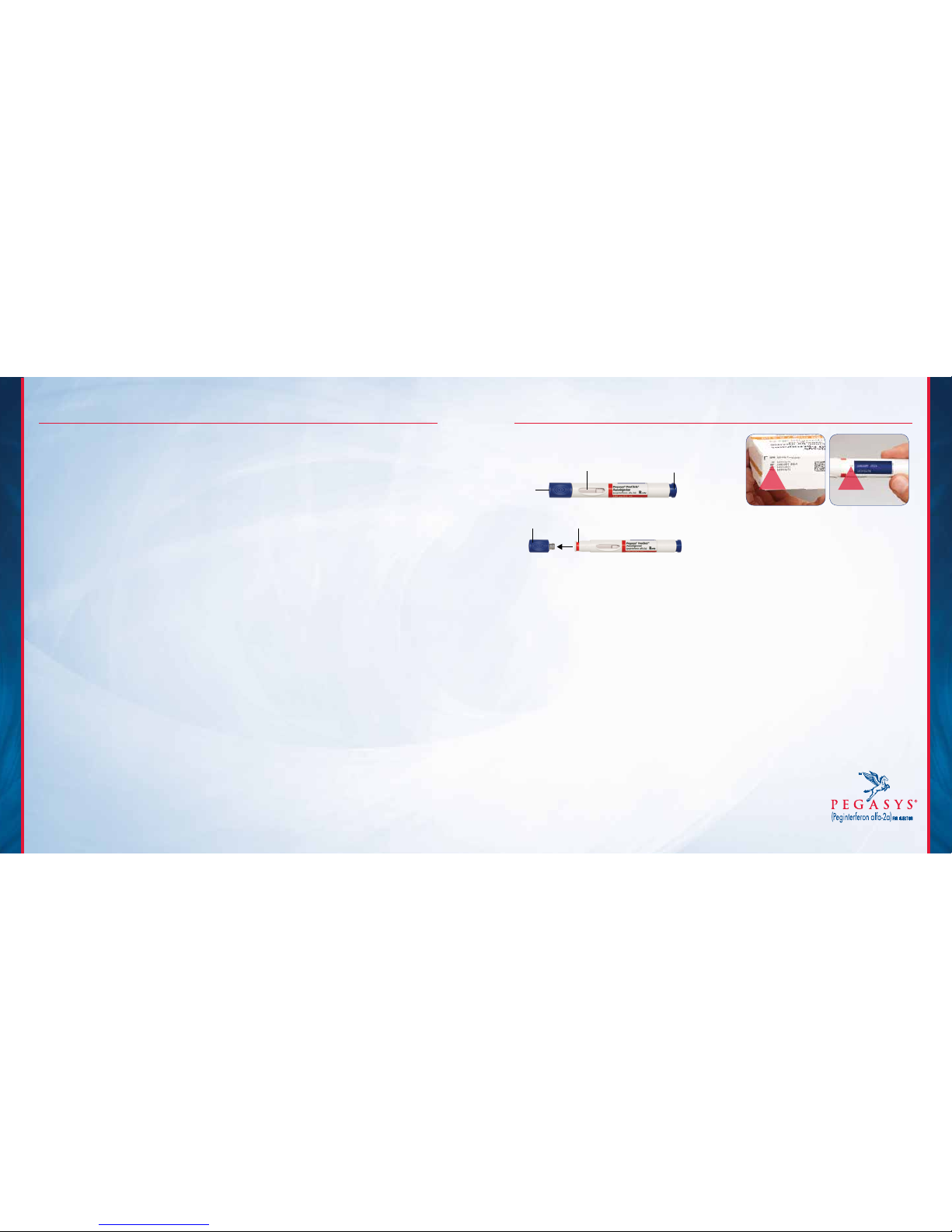
PEGASYS ProClick™ Autoinjector parts
(see Figure A)
Step 1. Prepare a dose of PEGASYS with your
PEGASYS ProClick™ Autoinjector
• Find a well-lit, clean, at surface, such as a table
• Look at your autoinjector:
— Take the carton containing your autoinjector
out of the refrigerator, and take your
autoinjector out of the carton. Keep the
blue cap on your autoinjector until Step 3.
Allow the autoinjector to come to room
temperature for about 20 minutes to warm
up. Do not warm up the autoinjector in any
other way
— Check the expiration date on the carton
and the autoinjector to make sure that it
has not passed (expired). Do not use the
autoinjector if the expiration date has
passed (see Figure B)
PHASE 1: PREPARING FOR YOUR INJECTION
— Look at the autoinjector to make sure that
it is not damaged in any way. Do not use the
autoinjector if it looks damaged
— Then, look at the medicine inside of the
autoinjector by looking through the viewing
window. The medicine in the autoinjector
should be clear and colorless to light yellow
— Do not shake the autoinjector. If there is foam
in the medicine, put the autoinjector back in
the refrigerator and use it at a later time
— Do not use the autoinjector if the
medicine in it:
– is cloudy
– contains particles
Use a different autoinjector and contact your
healthcare provider or pharmacist, or call
Genentech at 1-877-436-3683 for assistance.
• Wash your hands with soap and water
Figure A
Figure B
Viewing window Blue activation button
Blue
cap
Blue
thumb grip
Red
needle-shield
Expiration date
on carton
Expiration date
on autoinjector
Page 3
4
Please see full Prescribing Information and patient
Medication Guide for Important Safety Information.
5
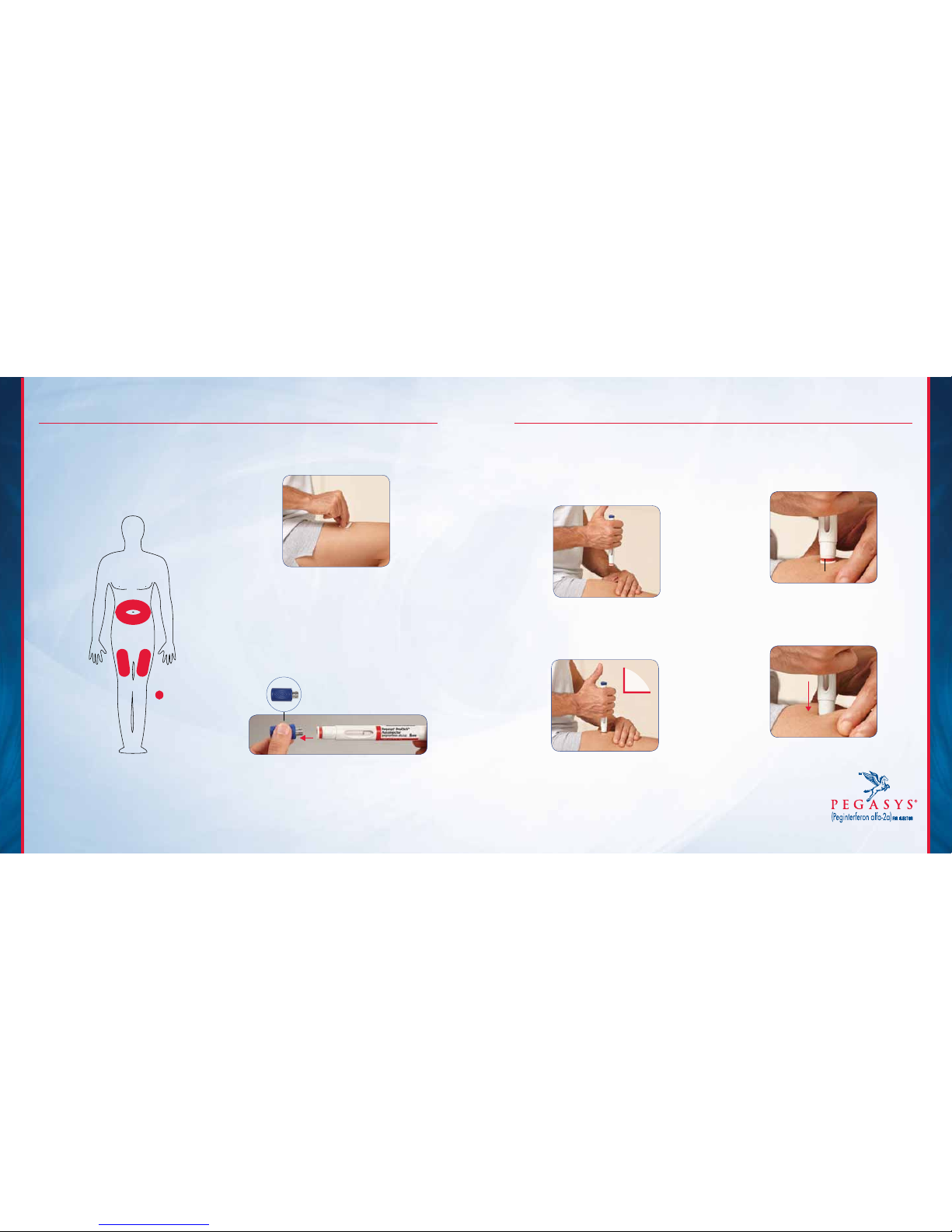
Step 2. Choose and prepare an injection site
• Choose an injection site on your stomach
or thigh (see Figure C). Avoid the 2-inch area
around your belly button (navel) and your
waistline. Use a different place each time you
give yourself an injection
PHASE 2: INJECTING PEGASYS
Figure C
Figure D
Figure E
Blue cap with thumb grip
= injection sites
Step 4. Injecting PEGASYS
• Hold the autoinjector comfortably in your
hand. Pinch and hold a fold of skin at the
injection site with your other hand, so that
the red needle-shield can rest on the skinfold
rmly and safely (see Figure F)
• Place the autoinjector straight up and down
on your skin at a right angle (90°) on the
injection site (see Figure G)
PHASE 2: INJECTING PEGASYS
• Do not press the blue activation button yet.
Press the autoinjector rmly against your skin
until the red needle-shield is completely
pushed in (see Figures H & I). The autoinjector
is now unlocked and ready for injection
• Press the autoinjector rmly against your skin
until the red needle-shield is completely
pushed in
Figure F
Figure G
90°
Figure H
Figure I
Red needle-shield
• Clean the injection site using the alcohol
pad (see Figure D). Let the skin dry for
10 seconds. Be sure not to touch the
cleaned area before injecting
Step 3. Remove blue cap from autoinjector
• Hold the autoinjector rmly with one hand,
and pull off the blue cap with the other hand
(see Figure E)
After the blue cap is removed, set it aside.
The blue cap contains a loose-tting metal
tube. Never re-attach the blue cap after it
has been removed.
Page 4
6
Please see full Prescribing Information and patient
Medication Guide for Important Safety Information.
7
Figure M
click
PHASE 2: INJECTING PEGASYS
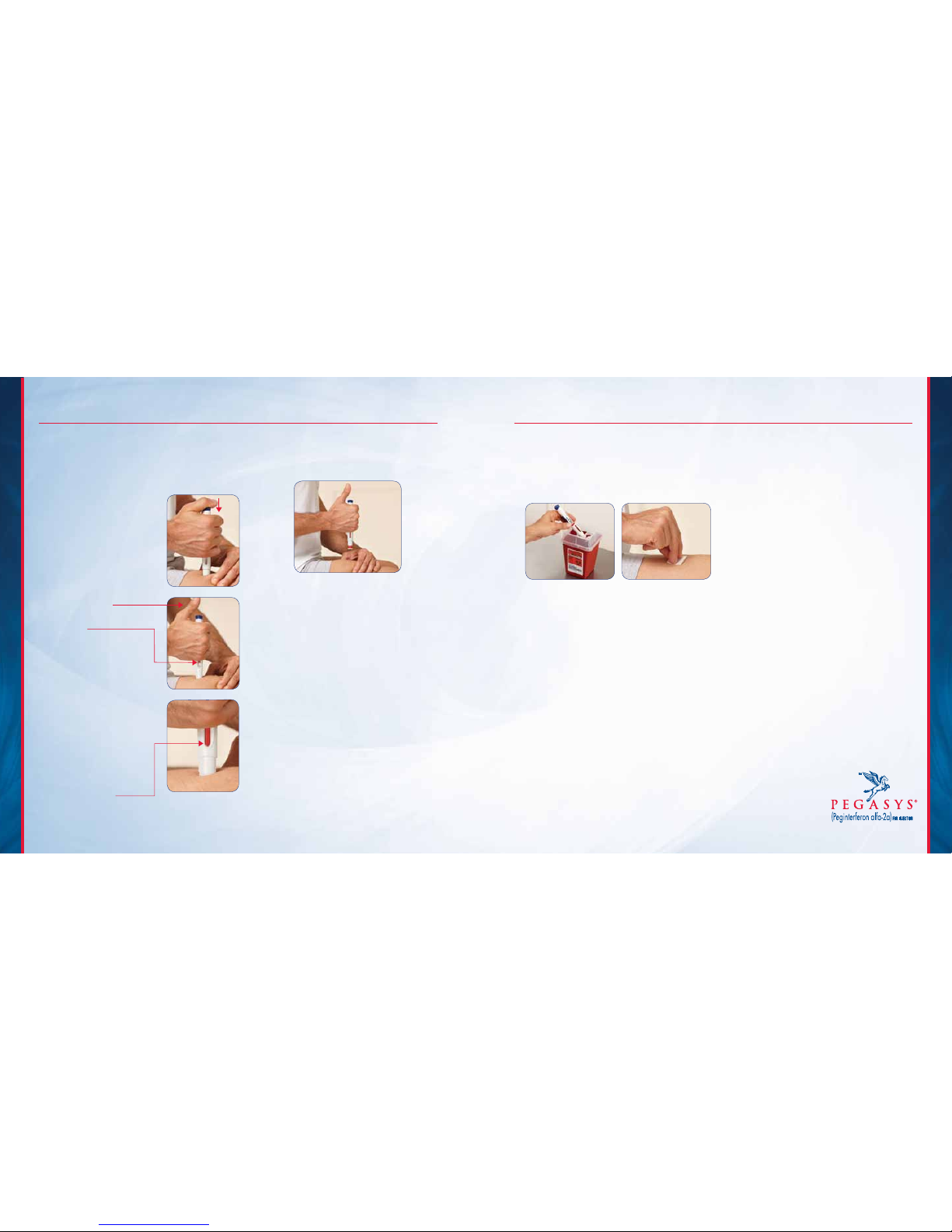
• After you slowly count to 10, lift the autoinjector
straight up (90° angle) from your skin. The red
needle-shield will automatically move out and
lock to prevent needle-stick injuries (see Figure M)
If the viewing window is not completely
lled by the red indicator
• The red needle-shield may not have locked
— Do not touch the tip of the autoinjector,
because a needle-stick injury may happen
• You may not have received your full dose
of PEGASYS
— Do not try to reuse the autoinjector
— Do not repeat the injection with another
autoinjector
— Call your healthcare provider
for instructions
If you see leakage around the injection site, you
may not have received your full dose of PEGASYS.
• Do not try to reuse the autoinjector
• Do not repeat the injection with another
autoinjector
• Call your healthcare provider for instructions
Figure L
Please see full Prescribing Information and patient
Medication Guide for Important Safety Information.
PHASE 3: CLEANING UP
• Always keep the puncture-resistant container
out of the reach of children
How should I store the PEGASYS ProClick™
Autoinjector?
• Store PEGASYS in the refrigerator between 36°F
to 46°F (2°C to 8°C). Do not leave PEGASYS out
of the refrigerator for more than 24 hours
• Do not freeze or shake PEGASYS
• Protect PEGASYS from light
Keep PEGASYS and all medicines out of the
reach of children
If you have any concerns or questions about
your PEGASYS ProClick™ Autoinjector, contact
your healthcare provider or pharmacist, or call
Genentech at 1-877-436-3683 for assistance.
INDICATIONS
What is PEGASYS?
PEGASYS® (peginterferon alfa-2a) is a
prescription medication that is:
• used alone or with COPEGUS
®
(ribavirin, USP)
to treat adults and children 5 years and older
who have chronic (lasting a long time) hepatitis C
infection and certain types of liver problems,
and have not taken alpha interferon
• used if you have chronic hepatitis C, you should
not take PEGASYS by itself unless you are not
able to take COPEGUS
• used to treat adults with chronic hepatitis B
virus who show signs that the virus is damaging
the liver
It is not known if PEGASYS is safe and will work
in children under 5 years of age.
• While holding the autoinjector rmly in place, press
the blue activation button with your thumb and
release the blue button right away (see Figures J
& K). Make sure to take your thumb off the blue
activation button, and do not press it again
— You should hear a “click”
sound, telling you that
the injection has started
— The red indicator
should move down in
the viewing window
during the injection
(see Figure K)
Release blue activation
button right away
Indicator is
turning red
• Continue to hold the
autoinjector pressed
rmly against your skin.
• Slowly count to 10
to be sure that your
injection is complete
(see Figure L)
— You may hear a second
“click” as the blue
activation button pops
back up
— The viewing window
should now be
completely red
Figure OFigure N
Figure J
Figure K
Step 5. After the injection
• Throw away your used autoinjector and blue
cap right away, as described below in the section
“How should I dispose of the used PEGASYS
ProClick™ Autoinjector?” (see Figure N)
• Wipe the injection site with the alcohol pad
(see Figure O)
• Wash your hands with soap and water
How should I dispose of the used PEGASYS
ProClick™ Autoinjector?
• Do not try to re-cap your autoinjector
• Throw away used autoinjectors in a punctureresistant container or “sharps” container. Ask your
healthcare provider or pharmacist for information
about where you can get a sharps container (or
other types of puncture-resistant containers you can
use to safely dispose of your used autoinjectors)
if you do not have one
• Check with your healthcare provider for
instructions about the right way to throw away
used autoinjectors. There may be local or state
laws about how to throw away used autoinjectors
• Do not throw away used autoinjectors or the
puncture-resistant container in household trash,
and do not recycle them
• Dispose of the full container as instructed by your
healthcare provider or pharmacist
Page 5

IMPORTANT SAFETY INFORMATION
PEGASYS, like other alpha interferons, may cause or
worsen fatal or life-threatening problems (like mental,
immune system, heart, liver, lung, intestinal and
infections). Your doctor should monitor you during
regular visits. If you show signs or symptoms of these
conditions, your doctor may stop your medication. In
many patients, but not all, these conditions get better
after they stop taking PEGASYS (see the Medication
Guide for more information and Warnings).
Ribavirin, including COPEGUS
®
, can cause birth defects
and/or death to an unborn baby. Female patients and
the female partners of male patients should avoid
getting pregnant. Ribavirin is known to cause anemia
(low red blood cells), which can make heart disease
worse (see the COPEGUS Medication Guide for more
information and Warnings).
What is the most important information I should
know about PEGASYS?
• COPEGUS in combination with PEGASYS may
cause birth defects or death of your unborn baby.
• PEGASYS therapy may cause you to develop mood
or behavioral problems.
• Some people who take PEGASYS alone or in
combination with COPEGUS may get heart problems.
• Stroke or symptoms of a stroke.
• Some people taking PEGASYS develop new or
worsening autoimmune problems.
• Some people who take PEGASYS may get an infection.
PEGASYS alone or in combination with COPEGUS can
cause serious side effects. Some of these side effects may
cause death. Tell your healthcare provider right away if
you have any of these symptoms while taking PEGASYS.
Do not take PEGASYS if you:
• have certain other liver problems
• have certain types of hepatitis caused by your immune
system attacking your liver (autoimmune hepatitis)
• have had a serious allergic reaction to another alpha
interferon medicine or to any of the ingredients in PEGASYS.
Do not take PEGASYS in combination with
COPEGUS if you:
• are pregnant, or planning to get pregnant during
treatment or during the 6 months after treatment
• are a male patient with a female sexual partner who
is pregnant or plans to become pregnant at any time
while you are being treated with COPEGUS or during
the 6 months after your treatment has ended
• have certain blood disorders such as thalassemia
major or sickle-cell anemia
• take didanosine (Videx
®
or Videx® EC)
Do not give PEGASYS to a baby under 1 year of age.
PEGASYS contains benzyl alcohol.
Before taking PEGASYS, tell your healthcare provider
about all your medical conditions or problems, and if
you are pregnant or breastfeeding, or plan to become
pregnant or breast feed during treatment with PEGASYS.
Tell your healthcare provider about all the
prescription and nonprescription medicines,
vitamins and herbal supplements you take.
PEGASYS can cause serious side effects including:
blood problems, thyroid problems, blood sugar
problems, serious eye problems, serious liver
problems, worsening of liver problems including
liver failure and death, lung problems, inammation
of your pancreas, inammation of your intestines,
serious allergic reactions and skin reactions, effect
on growth in children, and nerve problems.
The most common, but less serious, side effects of
PEGASYS include: u-like symptoms, tiredness
and weakness, stomach problems, loss of appetite,
skin reactions, hair thinning, trouble sleeping.
Tell your healthcare provider if you have any side
effect that bothers you or that does not go away.
Please see accompanying PEGASYS full
Prescribing Information and Medication Guide,
including Boxed WARNINGS, for additional
Important Safety Information.
PEGASYS® and COPEGUS® are registered trademarks of Hoffmann-La Roche Inc. All other brands for listed products are trademarks or registered
trademarks (as indicated) of their respective owners and are not trademarks of Genentech, Inc. or Hoffmann-La Roche Inc.
© 2011 Genentech USA, Inc. All rights reserved. PEG0000684901 Printed in USA. (11/11)
 Loading...