

Page 1

PCE Instruments contact information
Germany France Spain
PCE Deutschland GmbH PCE Instruments France EURL PCE Ibérica S.L.
Im Langel 4 23, rue de Strasbourg Calle Mayor, 53
D-59872 Meschede 67250 Soultz-Sous-Forets 02500 Tobarra (Albacete)
Deutschland France España
Tel.: +49 (0) 2903 976 99 0 Téléphone: +33 (0) 972 3537 17 Tel.: +34 967 543 548
Fax: +49 (0) 2903 976 99 29 Numéro de fax: +33 (0) 972 3537 18 Fax: +34 967 543 542
[email protected] [email protected] [email protected]
www.pce-instruments.com/deutsch www.pce-instruments.com/french www.pce-instruments.com/espanol
United Kingdom Italy Turkey
PCE Instruments UK Ltd PCE Italia s.r.l. PCE Teknik Cihazları Ltd.Şti.
Unit 11 Southpoint Business Park Via Pesciatina 878 / B-Interno 6 Halkalı Merkez Mah.
Ensign Way, Southampton 55010 Loc. Gragnano Pehlivan Sok. No.6/C
Hampshire Capannori (Lucca) 34303 Küçükçekmece - İstanbul
United Kingdom, SO31 4RF Italia Türkiye
Tel: +44 (0) 2380 98703 0 Telefono: +39 0583 975 114 Tel: 0212 471 11 47
Fax: +44 (0) 2380 98703 9 Fax: +39 0583 974 824 Faks: 0212 705 53 93
[email protected] [email protected] [email protected]
www.pce-instruments.com/english www.pce-instruments.com/italiano www.pce-instruments.com/turkish
The Netherlands Hong Kong United States of America
PCE Brookhuis B.V. PCE Instruments HK Ltd. PCE Americas Inc.
Institutenweg 15 Unit J, 21/F., COS Centre 1201 Jupiter Park Drive, Suite 8
7521 PH Enschede 56 Tsun Yip Street Jupiter / Palm Beach
Nederland Kwun Tong 33458 FL
Telefoon: +31 (0)53 737 01 92 Kowloon, Hong Kong USA
[email protected] Tel: +852-301-84912 Tel: +1 (561) 320-9162
www.pce-instruments.com/dutch [email protected] Fax: +1 (561) 320-9176
www.pce-instruments.cn [email protected]
www.pce-instruments.com/us
Page 2
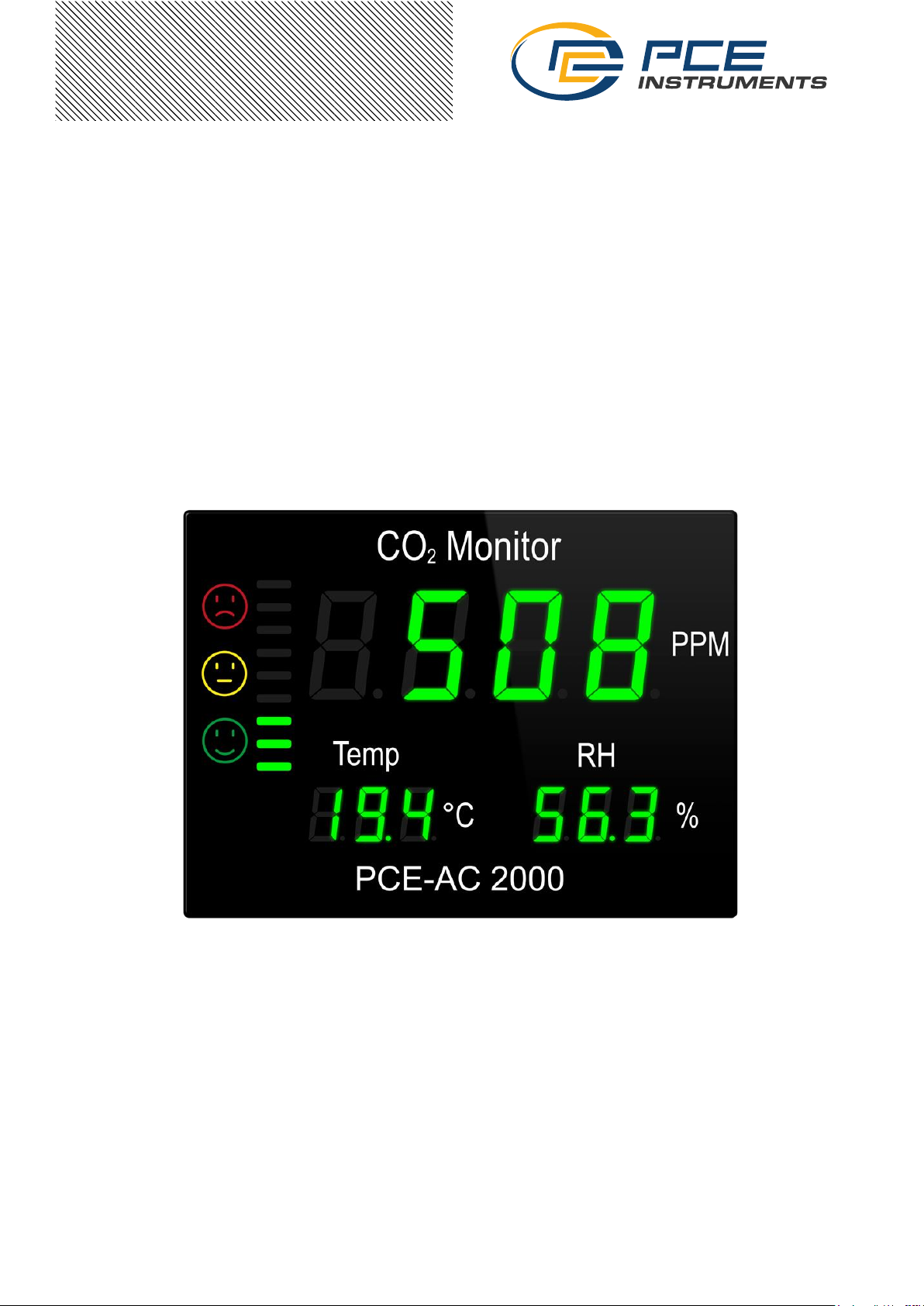
Carbon Dioxide Meter
User Manual
PCE-AC 2000
Page 3

Content
Instruction before use .............................................................................................................2
Product overview .......................................................................................................................2
Technical parameters................................................................................................................3
Panel and description for keys................................................................................................4
Considerations..........................................................................................................................5
Description of appendix information.....................................................................................5
Onsite photographing of the scene.........................................................................................8
Page 4

I. Instruction before use
Thank you very much for your purchasing of the wall-mounted multiple-function
carbon dioxide, temperature and humidity detector manufactured by our company. In
order that you can operate the device correctly, quickly and conveniently, you must
read safety information and considerations mentioned in other clauses in this
instruction book first. This will help you to use the product better.
II. Product overview:
The product is a type of multiple-function detector used to detect concentration of
carbon dioxide, temperature and humidity and is widely applied in detection of
environmental quality such as Industrial production, hotels and department stores,
offices and meeting rooms, libraries, warehouses, stations and airports, biological
pharmacy, family living rooms, laboratories of schools, reading rooms, hospitals,
agricultural production greenhouses and other sites.
Characteristic of products:
• Unique design of shell materials, as bright as new after long-term use; beautiful
overall appearance, humane key design, simple operation.
• High precision, high resolution and quick response;
• Adoption of matching power adapter converting AC 220V to DC 9V to provide
power enables continuous work for a long time.
• Multiple groups super large three-color LED digital tubes for display. Clear and
intuitive. The air quality level is distinct.
• The alarm value for upper and lower limit of carbon dioxide concentration can be set
at will. With the function of two-level sound-light alarm, the concentration for alarm
may be preset. It can respond in time and give out alarm prompt.
• Original carbon dioxide sensor imported from Europe is adopted as the sensor. The
sensor features linear output with quick response speed.
• The concentration of carbon dioxide, temperature and humidity can be displayed at
the same time to detect air quality in time.
Page 5

III.Technical parameters:
Measurement range
Measurement precision
Resolution
Repeat ability ≤±0.5 %
Response time 10 seconds
Working condition 0 ℃~50 ℃, 0 %~90 % non-condensing
Storage condition: -30 ℃~70 ℃, 0%~90 % non-condensing
Work power AC 220 V converted to DC 9 V 2 A power adapter
Maximum power
consumption
External size/weight 388 * 288 * 43 mm 2420 g
CO₂ concentration 0-9999PPM
Temperature -10℃~100℃
Humidity 0-99.9 %RH
CO₂ concentration ±70 PPM ±3 % reading
Temperature ±0.6℃(MAX ±1.5 ℃)
Humidity ±3 %
CO₂ concentration 1PPM
Temperature 0.1 ℃
Humidity 0. RH
9 V * 350 mA
Page 6
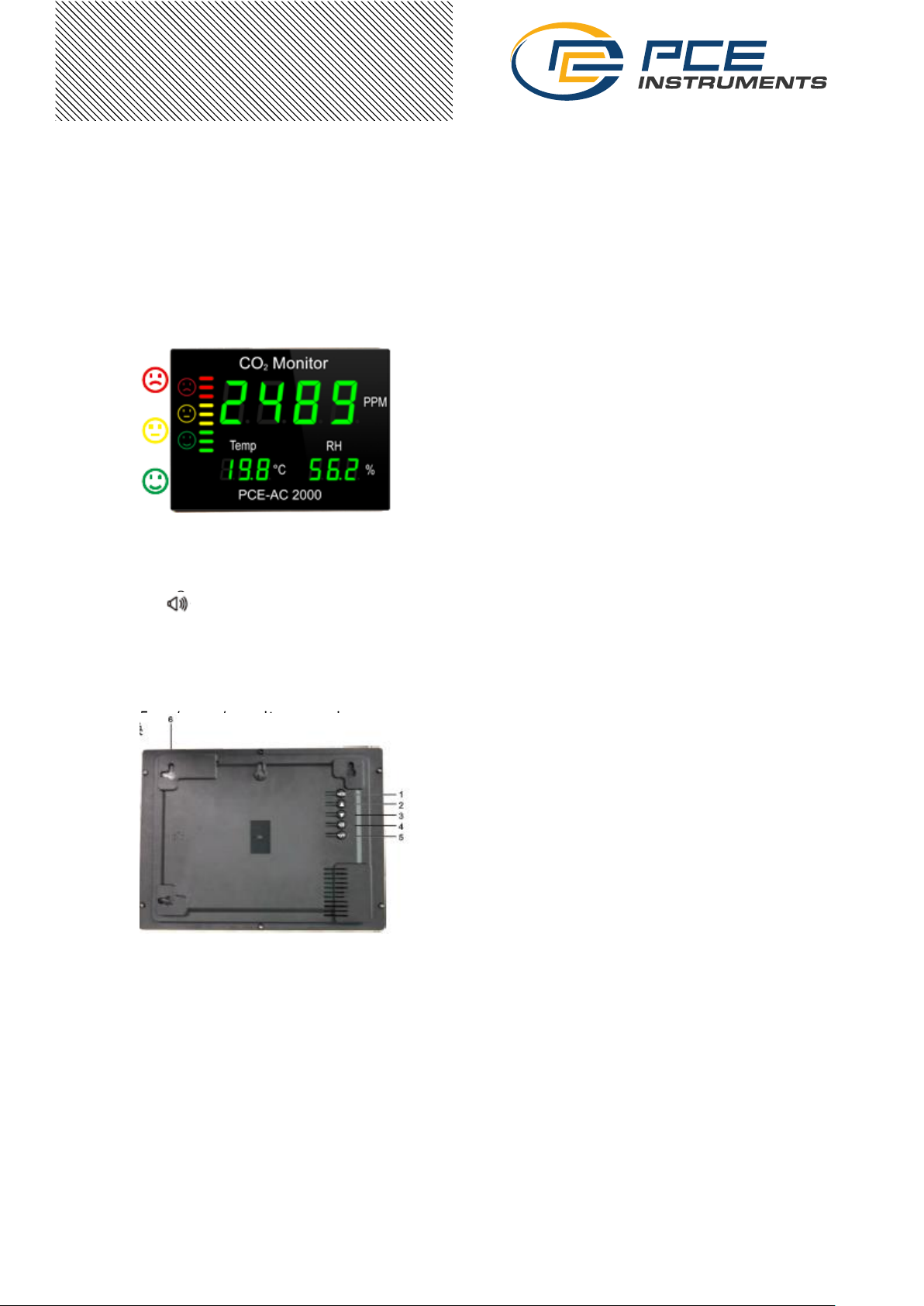
IV. Panel and description for keys:
Poor: 1200 … 9999 PPM
Good: 600 … 1100 PPM
Excellent: 0 … 500 PPM
Key function
1. MODE:set carbon dioxide concentration alarm value
2.▲: Increase the alarm value
3.▼: Decrease the alarm value
4. On or off
5.℃ /°F:℃ /°F unit conversion
6. DC power interface
Page 7

Instruction for use:
Open packing case of the product to take out DC 9 V power adaptor with standard
configuration. Insert DC contact to power interface of the device. After the power is
connected, the device will enter detection state after countdown of 7 s.
Upper limit alarm setting:
Press “mode” key to enter the mode (the initial value at delivery is 1200 PPM). Then
press “▲” and “▼” keys to adjust upper limit alarm value. After that, press “MODE”
key to exit to complete the setting of upper limit alarm value.
Ⅴ. Considerations:
● The electronic sensors and microprocessors used on the product belong to precision
electronic elements. The product must be kept away from water, fire, inflammable oil
and gas or sites with strong electromagnetic interference to prevent influence
on/damage to the device.
● At the time of installation, ensure that the air can flow naturally to prevent blocking
or blowing of strong air or hot air to the vent hole used for sampling the air.
● The device should avoid strong impact and vibration.
● Strong decontaminant or other detergents should not be used for cleaning the device.
It is suitable to wipe the casing with clear water and wet cloth. Avoid corrosive liquid
or gas hurting the device.
● In order for normal work for a long time, the power adaptor with standard
configuration of original factory must be used to ensure that fluctuation of the power
supply is within the scope of technical index of the device.
Ⅵ. Description of appendix information
1. Physical and chemical property of CO2: Carbon dioxide: molecular formula CO2,
molecular weight 44.01, condensation point -56.6 ℃, boiling point -78.5 ℃,
sublimation temperature -78.48 ℃, specific gravity 1.527 g/cm³. It is colorless,
odorless and gas with slight sour at standard conditions.
2. Source of CO₂: carbon dioxide is one of the main pollutants in indoor air. The
source of indoor carbon dioxide includes indoor and outdoor sources. Outdoor sources
include combustion of coal and timber, etc. Indoor sources mainly include two aspects.
One aspect is the gas from exhalation of mankind. Another aspect is from combustion
of fuels (indoor heating coal stove and gas stove, etc).
3. The relation between CO₂ and human body: CO₂ is the changeable component in air.
The concentration of CO₂ in normal air is about 300 … 500 ppm. CO₂ is needed for
normal physiology of human body and belongs to stimulant of respiratory center. The
concentration of CO₂ in human exhalation is about 4000 ppm. Therefore, it is not
poisonous substance generally. In places with crowded people, fuel combustion and
indoor locations with poor ventilation, CO₂ concentration is usually higher than that
of outdoor places. It will not produce toxic action for human body unless the
Page 8

concentration exceeds certain scope.
Table 1: Toxicity of CO₂
CO₂ concentration Poisoning condition
mg/m³ ppm
10000 5550 No poisoning symptom after 6 hours.
20000 30000 11000 16700 May be living within several hours
60000 80000 35500 44500 Still living within 0.5-1 hour
90000 120000 50000 67000 Die within 0.5-1 hour or acute death
Latest carbon dioxide concentration and human physiological reaction
350~450 ppm: the same as common outdoor environment
350~1200 ppm: fresh air, smooth breadth
1200—2500 ppm: feel that the air is turbid and begin to feel sleepy.
2500~5000 ppm: feel headache, drowsiness, sluggishness, aprosexia, tachycardia
and mild nausea
Larger than 5000 ppm: may result in serious anoxia, cause permanent cerebral injury,
coma or even death.
Page 9

Table 2: existing domestic CO₂ indoor air quality standard
Issuing department: Name of standard Standard code Standard value
(ppm)
Hygienic Standard for Carbon Dioxide
of Indoor Air
Hygienic Standard for Hotels GB 9663-1996 700
Hygienic Standard for Public Place of
Entertainment
Hygienic Standard for Public
Bathrooms
Hygienic Standard for Barber Shop and
Beauty Shop
Hygienic Standard for Swimming Place GB 9667-1996 ≤1500
Hygienic Standard for Gymnasium GB 9668-1996 ≤1500
Library, museum and Gallery GB 9669-1996 Library/museum
Hygienic Standard for Exhibition Hall Exhibition
Hygienic Standard for Shopping Centre
and Book Store
Hygienic Standard for Hospital Waiting
Room
Hygienic Standard for Waiting Room of
Public Transit Means
Hygienic Standard for Public Means of
Transportation
Hygienic Standard for Restaurant
(dining room)
GB/T170941997 ≤1000
1000
1000
GB 9664-1996 ≤1500
GB 9665-1996 Changing
room≤1500
Bathroom≤1000
GB 9666-1996 ≤1000
/Gallery≤1000
Hall≤1500
BG 9670-1996 ≤1500
GB 9671-1996 ≤1000
GB 9672-1996 ≤1500
GB 9673-1996 ≤1500
GB 16153-1996 ≤1500
Page 10

4. The relation between CO₂ and plants: CO₂ is raw material for photosynthesis of
plants and photosynthesis affects growth speed of plants directly. From the aspect of
professional research, CO₂ also affects respiratory rate of plants and utilization
efficiency of water at the same time and changes metabolism of plants to further
affect nutrition of plants. In short, proper CO₂ concentration can improve quantity and
quality of plants to a great extent.
Onsite photographing of the scene as shown in figure:
 Loading...