

Page 1
Order No. PHAAM1101059C3
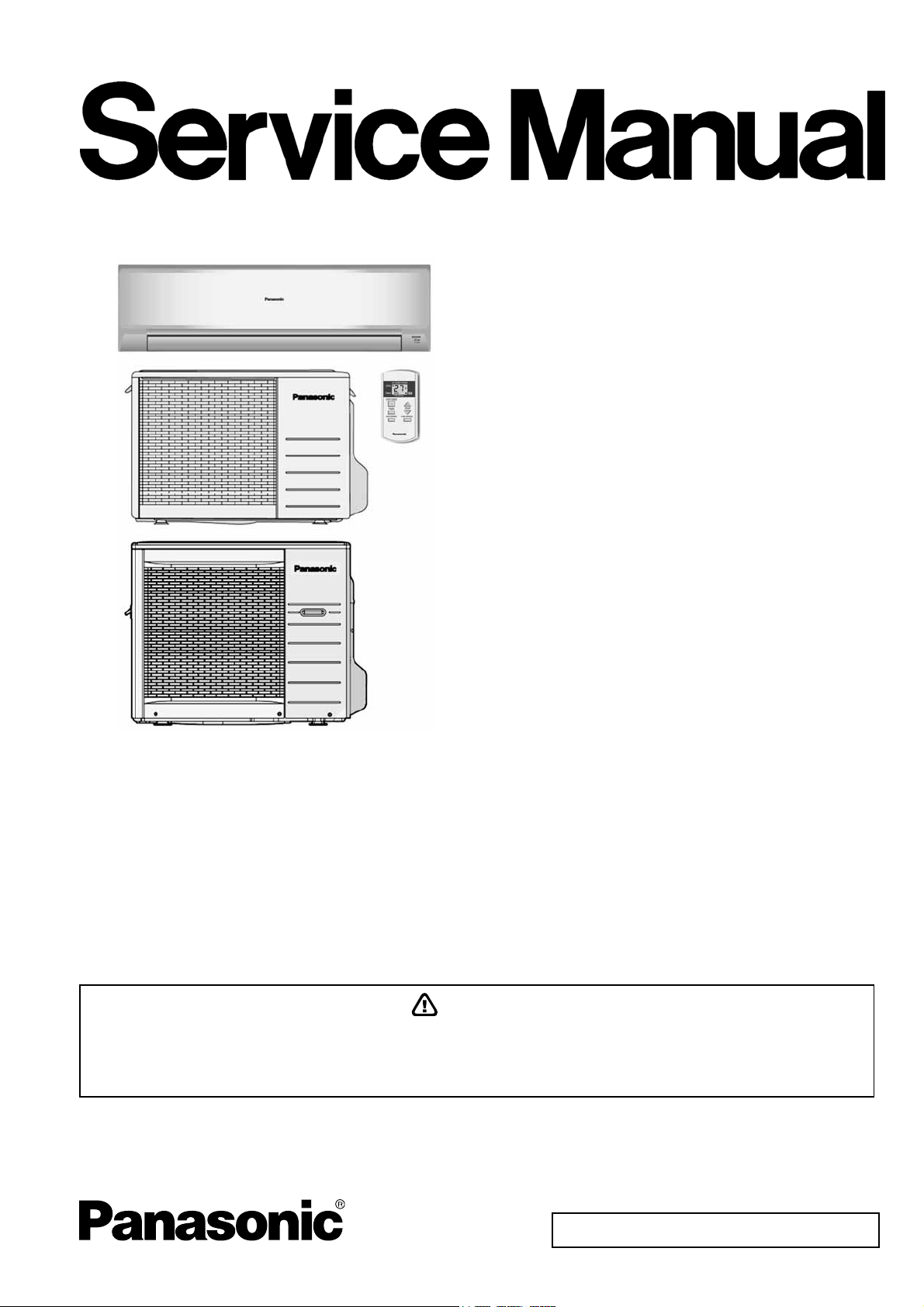
Air Conditioner
Indoor Unit Outdoor Unit
CS-YC18MKV
CS-YC24MKV
CU-YC18MKV
CU-YC24MKV
This service information is designed for experienced repair technicians only and is not designed for use by the general public.
It does not contain warnings or cautions to advise non-technical individuals of potential dangers in attempting to service a product.
Products powered by electricity should be serviced or repaired only by experienced professional technicians. Any attempt to
service or repair the product or products dealt with in this service information by anyone else could result in serious injury or death.
WARNING
© Panasonic HA Air-Conditioning (M) Sdn. Bhd. 2010.
Unauthorized copying and distribution is a violation of law.
Page 2

TABLE OF CONTENTS
PAGE PAGE
1. Safety Precautions .............................................3
2. Specifications .....................................................5
3. Location of Controls and Components............7
3.1 Indoor Unit .....................................................7
3.2 Outdoor Unit...................................................7
3.3 Remote Control..............................................7
4. Dimensions .........................................................8
4.1 Indoor Unit & Remote Control........................8
4.2 Outdoor Unit...................................................9
5. Refrigeration Cycle Diagram ...........................10
6. Block Diagram ..................................................11
7. Wiring Connection Diagram ............................12
7.1 CS-YC18MKV CU-YC18MKV......................12
7.2 CS-YC24MKV CU-YC24MKV......................13
8. Electronic Circuit Diagram ..............................14
9. Printed Circuit Board .......................................15
15.1 Small Air Filter, Indoor Electronic
Controllers and Control Board Removal
Procedures.................................................. 36
15.2 To Remove Cross Flow Fan and Indoor Fan
Motor........................................................... 39
16. Technical Data ................................................. 41
16.1 Thermostat Characteristics ......................... 41
16.2 Operation Characteristics ........................... 42
17. Exploded View and Replacement Parts
List .................................................................... 46
17.1 Indoor Unit .................................................. 46
17.2 Outdoor Unit................................................ 48
9.1 Indoor Unit ...................................................15
10. Installation Instruction .....................................17
10.1 Select the Best Location ..............................17
10.2 Indoor Unit ...................................................18
10.3 Outdoor Unit.................................................23
11. Operation and Control .....................................27
11.1 Cooling Operation........................................27
11.2 Indoor Fan Speed Control ...........................28
11.3 Outdoor Fan Speed Control.........................29
11.4 Vertical Airflow Direction Control .................29
11.5 Horizontal Airflow Direction Control .............30
11.6 Timer Control ...............................................30
11.7 Random Auto Restart Control......................30
11.8 Remote Control Signal Receiving Sound ....30
12. Protection Control ............................................31
12.1 Restart Control (Time Delay Safety
Control) ........................................................31
12.2 7 Minutes Time Save Control ......................31
12.3 60 Seconds Forced Operation.....................31
12.4 Starting current Control................................31
12.5 Freeze Preventive Control ...........................31
12.6 Compressor Reverse Rotation Protection
Control .........................................................32
12.7 Dew Prevention Control...............................32
12.8 Odor Cut Control..........................................32
13. Servicing Mode .................................................33
13.1 Auto OFF/ON Button....................................33
13.2 Remote Control Number Switch ..................33
14. Troubleshooting Guide ....................................34
14.1 Refrigeration Cycle System .........................34
15. Disassembly and Assembly Instructions ......36
2
Page 3

1. Safety Precautions
Read the following “SAFETY PRECAUTIONS” carefully before perform any servicing.
Electrical work must be installed or serviced by a licensed electrician. Be sure to use the correct rating of the
power plug and main circuit for the model installed.
The caution items stated here must be followed because these important contents are related to safety. The
meaning of each indication used is as below. Incorrect installation or servicing due to ignoring of the instruction
will cause harm or damage, and the seriousness is classified by the following indications.
WARNING
CAUTION
The items to be followed are classified by the symbols:
Carry out test running to confirm that no abnormality occurs after the servicing. Then, explain to user the
operation, care and maintenance as stated in instructions. Please remind the customer to keep the operating
instructions for future reference.
1. Do not modify the machine, part, material during repairing service.
This indication shows the possibility of causing death or serious injury.
This indication shows the possibility of causing injury or damage to properties.
This symbol denotes item that is PROHIBITED from doing.
WARNING
2. If wiring unit is supplied as repairing part, do not repair or connect the wire even only partial wire break. Exchange the whole wiring unit.
3. Do not wrench the fasten terminal. Pull it out or insert it straightly.
4. Engage authorized dealer or specialist for installation and servicing. If installation or servicing done by the user is defective, it will cause
water leakage, electrical shock or fire.
5. Install according to this installation instructions strictly. If installation is defective, it will cause water leakage, electric shock or fire.
6. Use the attached accessories parts and specified parts for installation and servicing. Otherwise, it will cause the set to fall, water leakage,
fire or electrical shock.
7. Install at a strong and firm location which is able to withstand the set’s weight. If the strength is not enough or installation is not properly
done, the set will drop and cause injury.
8. For electrical work, follow the local national wiring standard, regulation and the installation instruction. An independent circuit and single
outlet must be used. If electrical circuit capacity is not enough or defect found in electrical work, it will cause electrical shock or fire.
9. This equipment is strongly recommended to be installed with Earth Leakage Circuit Breaker (ELCB) or Residual Current Device (RCD).
Otherwise, it may cause electrical shock and fire in case equipment breakdown or insulation breakdown.
10. Do not use joint cable for indoor / outdoor connection cable. Use specified indoor / outdoor connection cable, refer to Installation
Instructions CONNECT THE CABLE TO THE INDOOR UNIT and connect tightly for indoor / outdoor connection. Clamp the cable so that
no external force will be acted on the terminal. If connection or fixing is not perfect, it will cause heat up or fire at the connection.
11. Wire routing must be properly arranged so that control board cover is fixed properly. If control board cover is not fixed perfectly, it will
cause heat-up or fire at the connection point of terminal, fire or electrical shock.
12. When install or relocate air conditioner, do not let any substance other than the specified refrigerant, eg. air etc. mix into refrigerant cycle
(piping). (Mixing of air etc. will cause abnormal high pressure in refrigeration cycle and result in explosion, injury etc.).
13. Do not install outdoor unit near handrail of veranda. When installing air-conditioner unit at veranda of high rise building, child may climb up
to outdoor unit and cross over the handrail and causing accident.
14. This equipment must be properly earthed. Earth line must not be connected to gas pipe, water pipe, earth of lightning rod and
telephone. Otherwise, it may cause electrical shock in case equipment breakdown or insulation breakdown.
15. Keep away from small children, the thin film may cling to nose and mouth and prevent breathing.
16. Do not use unspecified cord, modified cord, joint cord or extension cord for power supply cord. Do not share the single outlet with
other electrical appliances. Poor contact, poor insulation or over current will cause electrical shock or fire.
17. Tighten the flare nut with torque wrench according to specified method. If the flare nut is over-tightened, after a long period, the flare
may break and cause refrigerant gas leakage.
18. During pump down operation, stop the compressor before remove the refrigeration piping. (Removal of compressor while compressor
is operating and valves are opened will cause suck-in of air, abnormal high pressure in refrigeration cycle and result in explosion,
injury etc.).
3
Page 4

19. During installation, install the refrigerant piping properly before run the compressor. (Operation of compressor without fixing refrigeration
piping and valves at opened condition will cause suck-in of air, abnormal high pressure in refrigeration cycle and result in explosion, injury
etc.).
20. After completion of installation or service, confirm there is no leakage of refrigerant gas. It may generate toxic gas when the refrigerant
contacts with fire.
21. Ventilate if there is refrigerant gas leakage during operation. It may cause toxic gas when the refrigerant contacts with fire.
22. Do not insert your fingers or other objects into the unit, high speed rotating fan may cause injury.
23. Must not use other parts except original parts described in catalog and manual.
1. Do not install the unit at place where leakage of flammable gas may occur. In case gas leaks and accumulates at surrounding of the
unit, it may cause fire.
2. Carry out drainage piping as mentioned in installation instructions. If drainage is not perfect, water may enter the room and damage the
furniture.
3. Tighten the flare nut with torque wrench according to specified method. If the flare nut is over-tightened, after a long period, the flare
may break and cause refrigerant gas leakage.
4. Do not touch outdoor unit air inlet and aluminium fin. It may cause injury.
5. Select an installation location which is easy for maintenance.
WARNING
CAUTION
6. Pb free solder has a higher melting point than standard solder; typically the melting point is 50°F – 70°F (30°C – 40°C) higher. Please
use a high temperature solder iron. In case of the soldering iron with temperature control, please set it to 700 ± 20°F (370 ± 10°C).
Pb free solder will tend to splash when heated too high (about 1100°F / 600°C).
7. Power supply connection to the air conditioner. Connect the power supply cord of the air conditioner to the mains using one of the
following methods.
Power supply point shall be the place where there is ease for access for the power disconnection in case of emergency. In some
countries, permanent connection of this room air conditioner to the power supply is prohibited.
i. Power supply connection to the receptacle using a power plug.
Use an approved 15/16A (3/4~1.5 HP) or 16A (2.0 HP) or 20A (2.5 HP) power plug with earth pin for the connection to the socket.
ii. Power supply connection to a circuit breaker for the permanent connection.
Use an approved 16A (1.5~2.0 HP) or 20A (2.5 HP) circuit breaker for the permanent connection. It must be a double pole switch
with a minimum 3.0 mm contact gap.
8. Do not release refrigerant during piping work for installation, servicing, reinstallation and during repairing a refrigerant parts.
Take care of the liquid refrigerant, it may cause frostbite.
9. Installation or servicing work: It may need two people to carry out the installation or servicing work.
10. Do not install this appliance in a laundry room or other location where water may drip from the ceiling, etc.
11. Do not sit or step on the unit, you may fall down accidentally.
12. Do not touch the sharp aluminum fins or edges of metal parts.
If you are required to handle sharp parts during installation or servicing, please wear hand glove.
Sharp parts may cause injury.
4
Page 5

2. Specifications
Model
Performance Test Condition NEW JIS NEW JIS
Power Supply
Capacity
Running Current A 8.4 12.0
Input Power W 1.80k 2.58k
EER
Cooling
Power Factor % 97 98
Indoor Noise
Outdoor Noise
Max Current (A) / Max Input Power (W) 9.6 / 2.16k 14.1 / 3.08k
Starting Current (A) 38.0 60.0
Type
Compressor
Type Cross-flow Fan Cross-flow Fan
Material ASG30K1 ASG30K1
Motor Type Transistor (8-poles) Transistor (8-poles)
Input Power W 94.8 94.8
Output Power W 40 40
Indoor Fan
Speed
Type Propeller Fan Propeller Fan
Material PP PP
Motor Type Induction (6-poles) Induction (6-poles)
Input Power W 86.8 162.8
Output Power W 30 79
Outdoor Fan
Speed
Moisture Removal L/h (Pt/h) 2.7 (5.7) 3.8 (8.0)
Indoor Airflow
Outdoor Airflow
Refrigeration Cycle
Motor Type Induction (2-poles) Induction (2-poles)
Output Power W 1.2k 1.8k
Lo rpm 1060 1150
Me rpm 1150 1240
Hi rpm 1240 1390
SHi rpm — —
Lo rpm — 490
Hi rpm 800 820
Lo m3/min. (ft3/min.) 13.8 (489) 15.5 (546)
Me m3/min. (ft3/min.) 15.0 (530) 16.7 (589)
Hi m3/min. (ft3/min.) 16.2 (572) 18.7 (660)
SHi m
Lo m3/min. (ft3/min.) — 30.5 (1076)
Hi m
Control Device Capillary Tube Capillary Tube
Refrigerant Oil cm3
Refrigerant Type g (oz) R22, 1.00k (35.3) R22, 1.41k (49.8)
Indoor CS-YC18MKV CS-YC24MKV
Outdoor CU-YC18MKV CU-YC24MKV
Phase, Hz Single, 60 Single, 60
V 220 220
kW 4.98 6.74
BTU/h 17000 23000
kJ/h 17930 24260
W/W 2.77 2.61
BTU/hW 9.44 8.91
dB-A High: 43; Low: 39 High: 47; Low: 42
Power Level dB — —
dB-A High: 54 Low: – High: 60 Low: –
Power Level dB — —
Rotary (1 cylinder) rolling
piston type
3
/min. (ft3/min.) — —
3
/min. (ft3/min.) 30.4 (1073) 51.0 (1800)
ATMOS NM56M or
SUNISO 4GDID
(650 cm
3
)
Rotary (1 cylinder) rolling
piston type
ATMOS NM56M or
SUNISO 4GDID
(1130 cm3)
5
Page 6
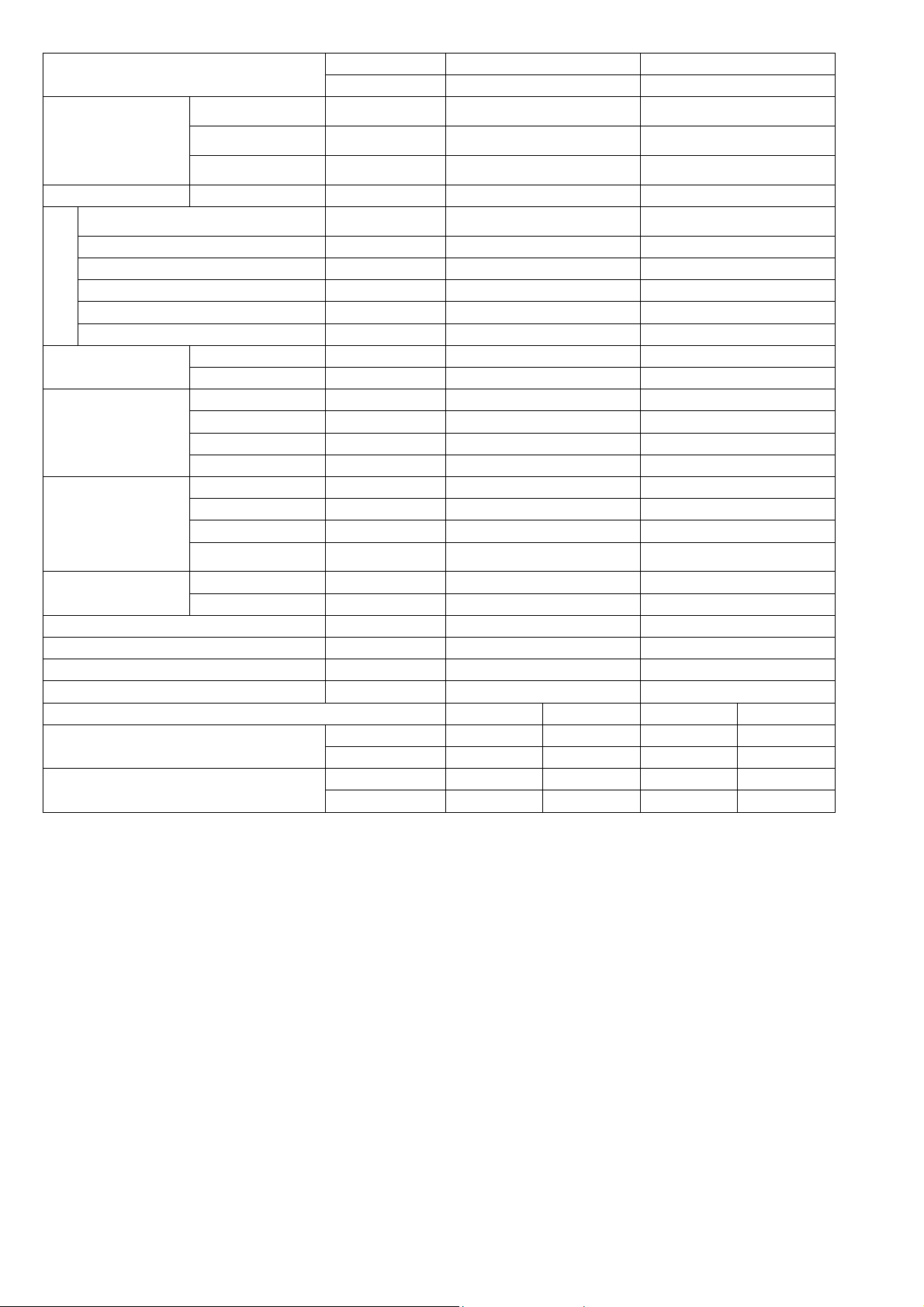
Model
Height (I/D / O/D) mm (inch)
Dimension
Weight Net (I/D / O/D) kg (lb) 12 (26) / 35 (77) 12 (26) / 56 (123)
Pipe Diameter (Liquid / Gas) mm (inch)
Standard length m (ft) 5.0 (16.4) 5.0 (16.4)
Length range (min~max) m (ft) 3 ~ 25 (9.8 ~ 82.0) 3 ~ 25 (9.8 ~ 82.0)
I/D & O/D Height different m (ft) 20 (65.6) 20 (65.6)
Piping
Additional Gas Amount g/m (oz/ft) 20 (0.2) 30 (0.3)
Length for Additional Gas m (ft) 7.5 (24.6) 7.5 (24.6)
Drain Hose
Indoor Heat Exchanger
Outdoor Heat Exchanger
Air Filter
Power Supply Indoor Power Supply Indoor Power Supply
Power Supply Cord A 16 20
Thermostat — Mechanical
Protection Device Overload Protector —
Dry Bulb Wet Bulb Dry Bulb Wet Bulb
Indoor Operation Range
Outdoor Operation Range
Width (I/D / O/D) mm (inch)
Depth (I/D / O/D) mm (inch)
Inner Diameter mm 15 15
Length mm 650 650
Fin Material Aluminium (Pre Coat) Aluminium (Pre Coat)
Fin Type Slit Fin Slit Fin
Row× Stage× FPI
Size (W × H × L) mm 810 × 315 × 25.4 810 × 315 × 25.4
Fin material Aluminium (Blue Coat) Aluminium (Blue Coat)
Fin Type Slit Fin Slit Fin
Row × Stage × FPI 2 × 24 × 17 2 × 34 × 17
Size (W × H × L) mm
Material Polypropelene Polypropelene
Type One-touch One-touch
Indoor CS-YC18MKV CS-YC24MKV
Outdoor CU-YC18MKV CU-YC24MKV
290 (11-7/16) /
540 (21-1/4)
1070 (42-5/32) /
780 (30-23/32)
220 (8-11/16) /
289 (11-3/8)
6.35 (1/4") /
12.70 (1/2")
2 × 15 × 21 2 × 15 × 21
25.4 × 504 × 693.4
713.4
Maximum 32 23 32 23
Minimum 16 11 16 11
Maximum 43 26 43 26
Minimum 16 11 16 11
290 (11-7/16) /
750 (29-17/32)
1070 (42-5/32) /
875 (34-15/32)
220 (8-11/16) /
345 (13-19/32)
6.35 (1/4") /
15.88 (5/8")
25.4 × 714 × 806.4
826.4
Note:
Cooling capacities are based on indoor temperature of 27°C Dry Bulb (80.6°F Dry Bulb), 19.0°C Wet Bulb
(66.2°F Wet Bulb) and outdoor air temperature of 35°C Dry Bulb (95°F Dry Bulb), 24°C Wet Bulb (75.2°F Wet
Bulb).
Specification are subjected to change without prior notice for further improvement.
6
Page 7

3. Location of Controls and Components
3.1 Indoor Unit
3.2 Outdoor Unit
3.3 Remote Control
7
Page 8
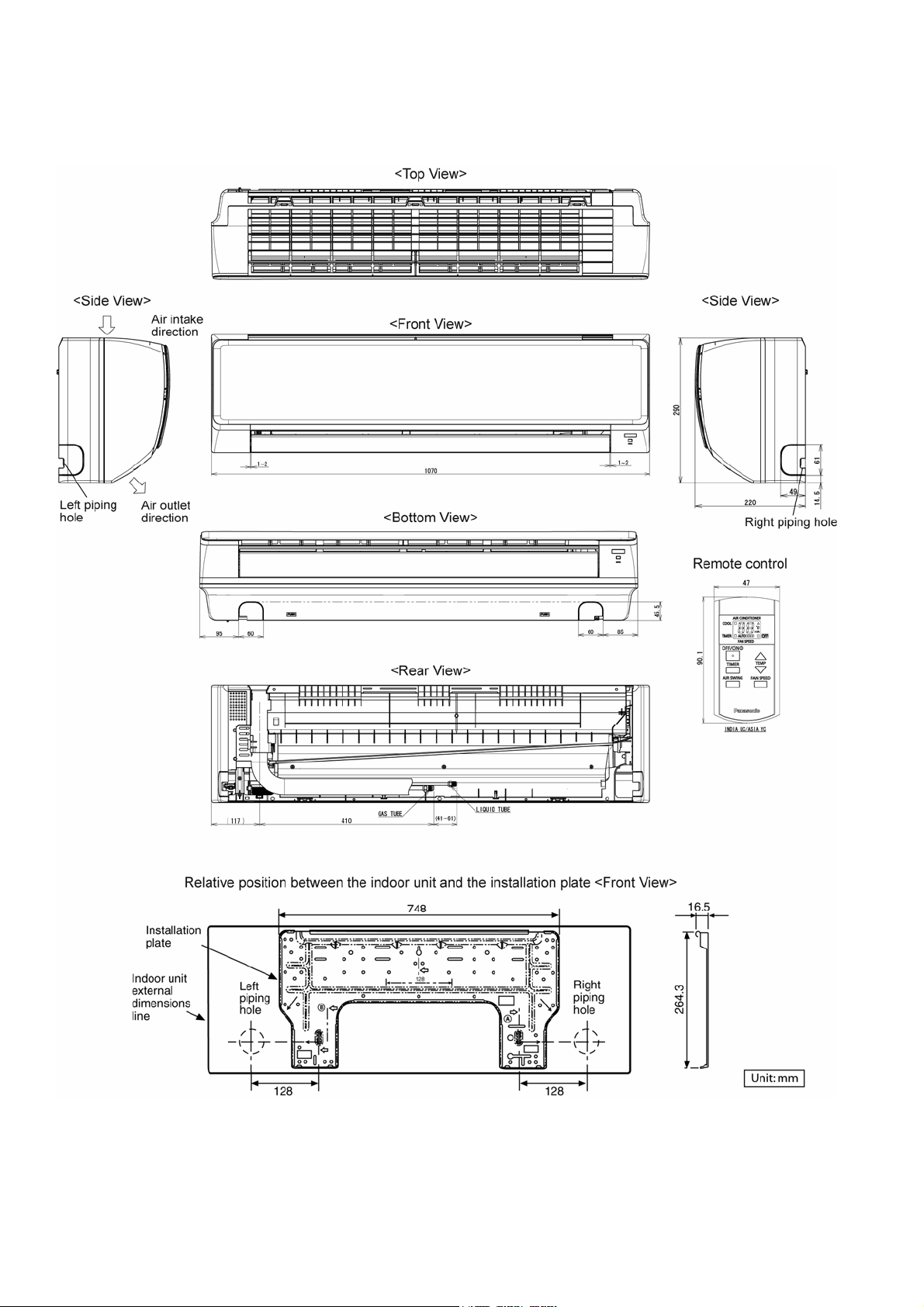
4. Dimensions
4.1 Indoor Unit & Remote Control
8
Page 9

4.2 Outdoor Unit
4.2.1 CU-YC18MKV
4.2.2 CU-YC24MKV
9
Page 10
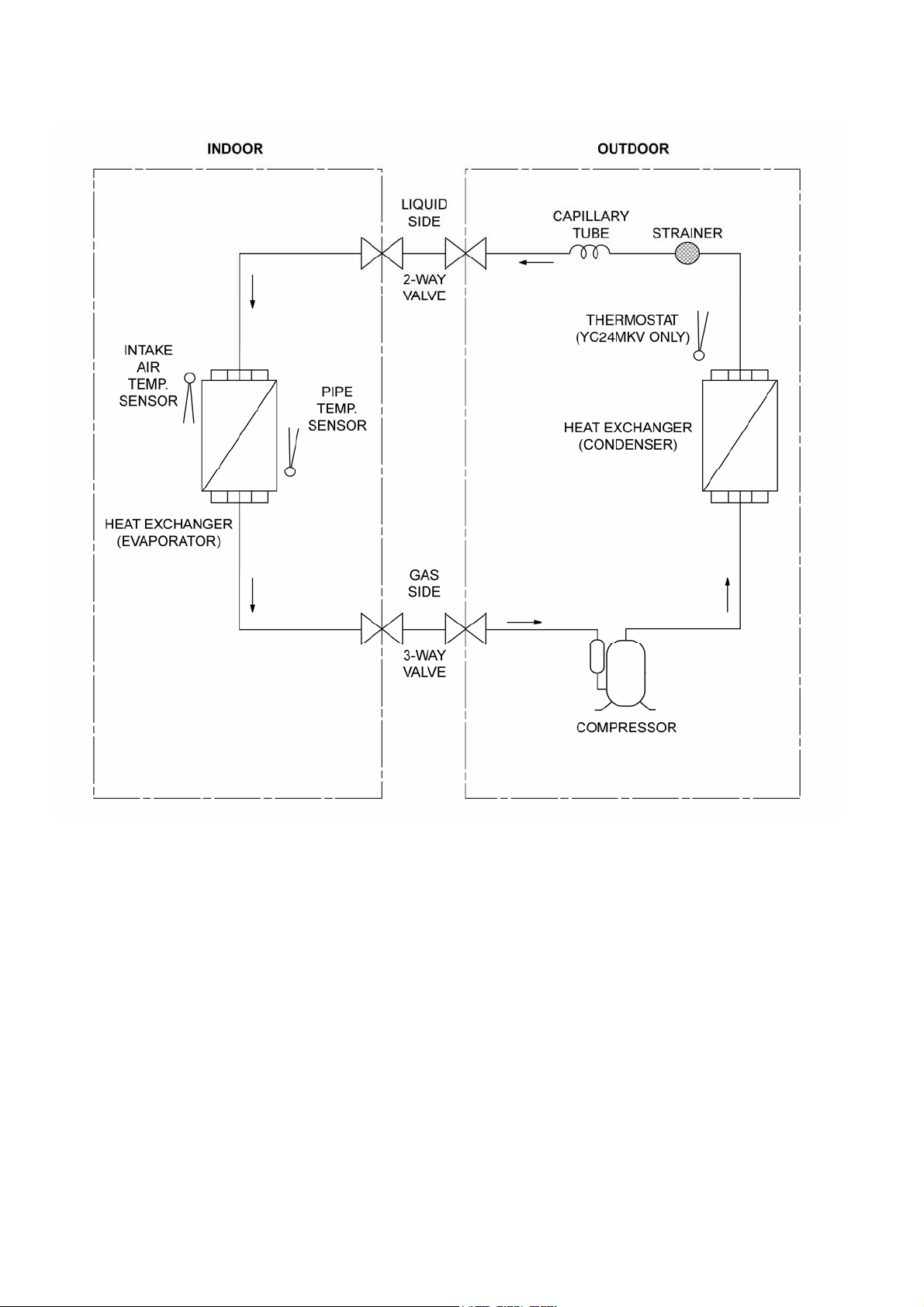
5. Refrigeration Cycle Diagram
10
Page 11
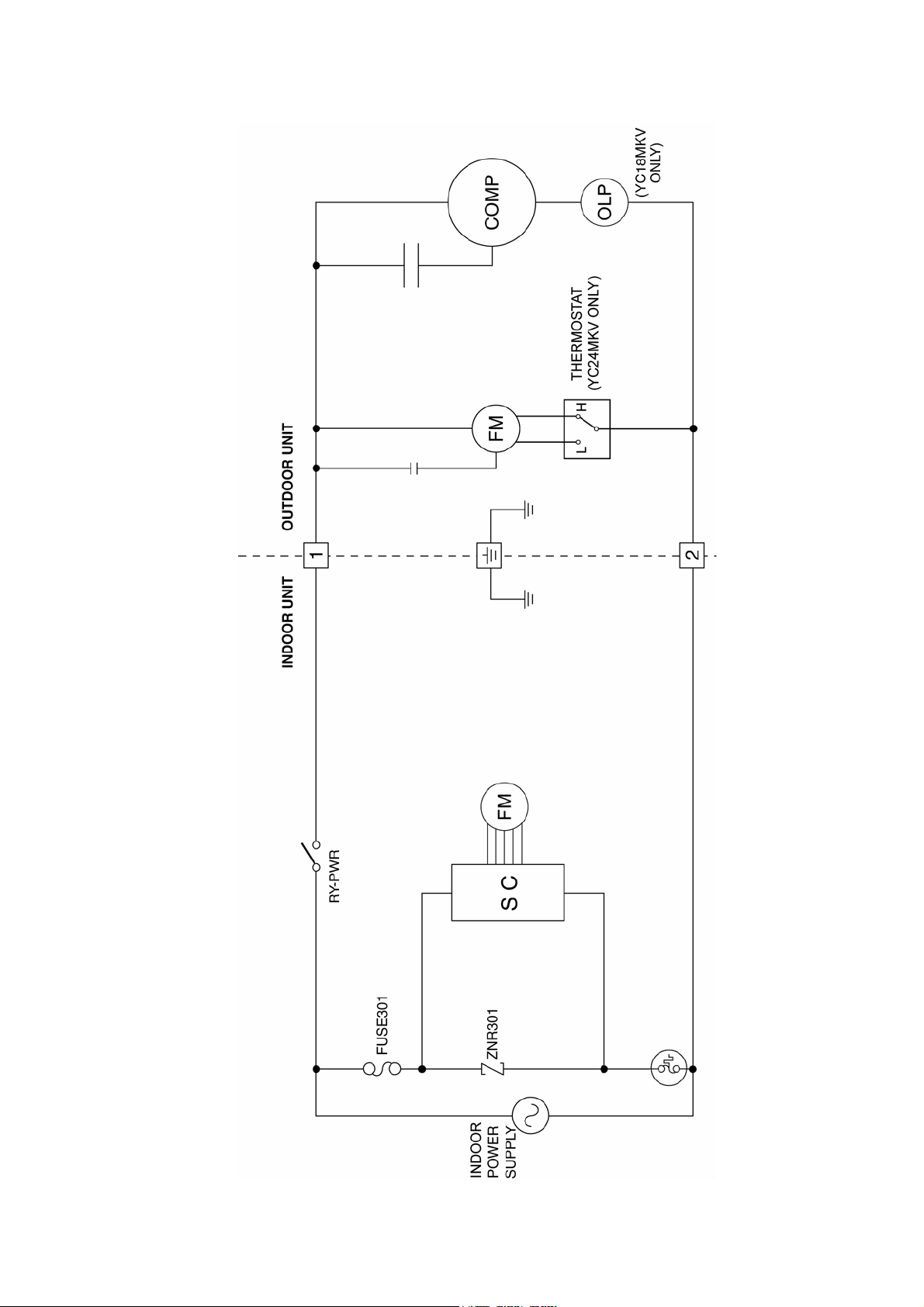
6. Block Diagram
11
Page 12
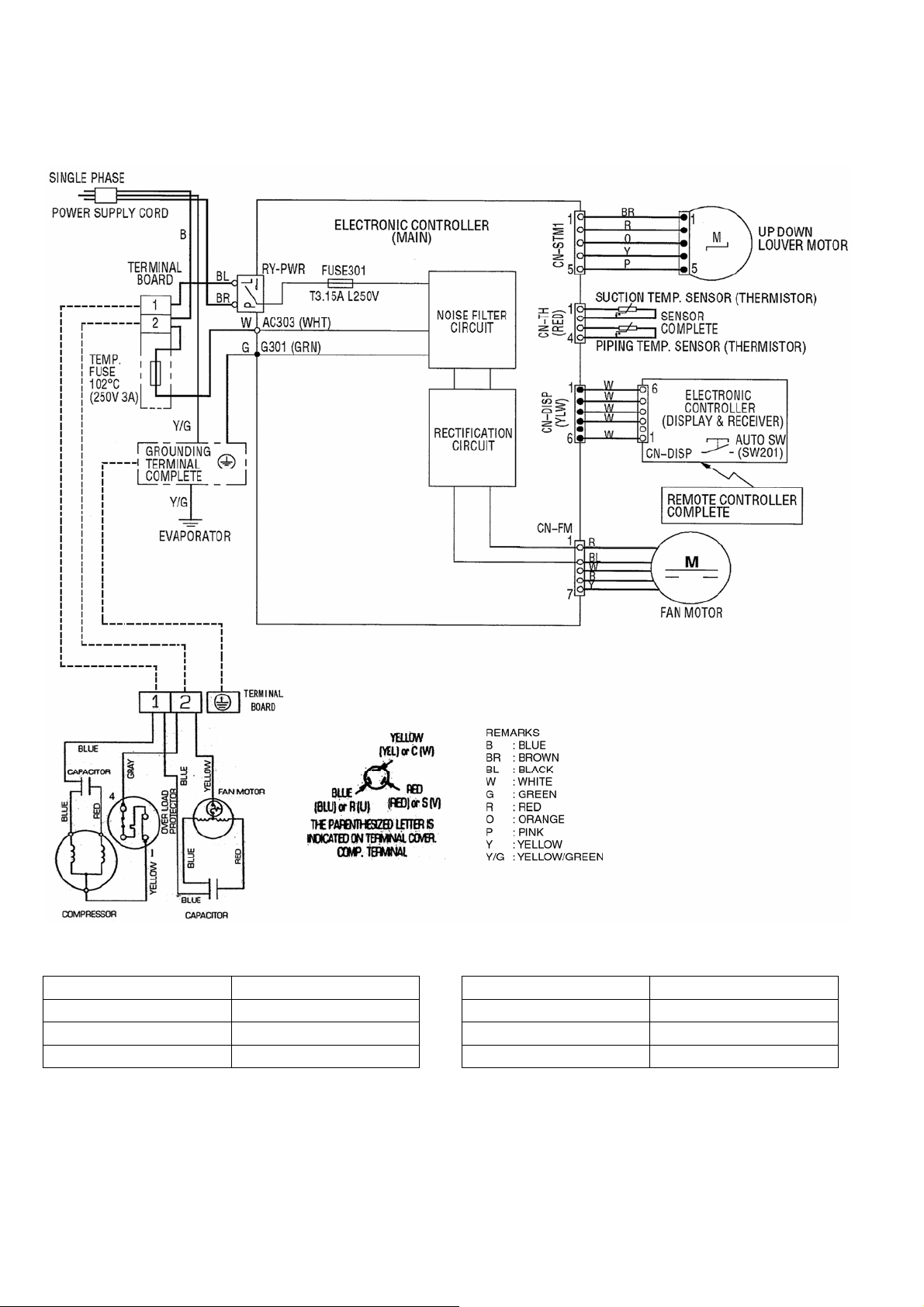
7. Wiring Connection Diagram
7.1 CS-YC18MKV CU-YC18MKV
Resistance of Outdoor Fan Motor Windings
MODEL CU-YC18MKV
CONNECTION CWA951329J
YELLOW- BLUE 258.3 Ω
YELLOW-RED 245.9 Ω
Note: Resistance at 20°C of ambient temperature.
Resistance of Compressor Windings
MODEL CU-YC18MKV
CONNECTION 2KS252F5AB04
C - R 1.959 Ω
C - S 3.083 Ω
Note: Resistance at 20°C of ambient temperature.
12
Page 13
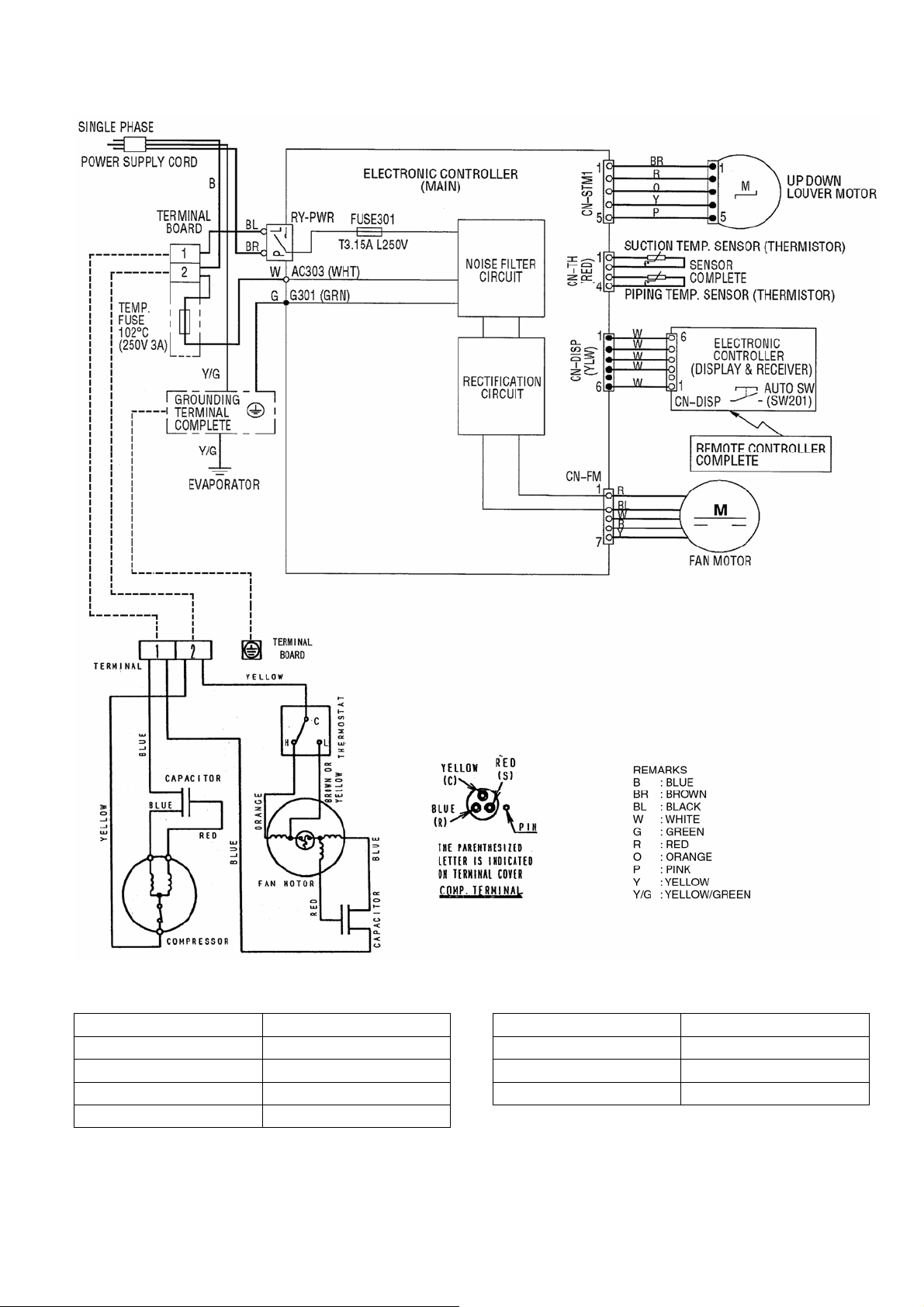
7.2 CS-YC24MKV CU-YC24MKV
Resistance of Outdoor Fan Motor Windings
MODEL CU-YC24MKV
CONNECTION CWA951399J
YELLOW-BLUE 59.47 Ω
YELLOW-ORANGE 80.58 Ω
YELLOW-RED 60.95 Ω
Note: Resistance at 20°C of ambient temperature.
Resistance of Compressor Windings
MODEL CU-YC24MKV
CONNECTION 2JS386F3AA04
C – R 1.048 Ω
C - S 1.785 Ω
Note: Resistance at 20°C of ambient temperature.
13
Page 14
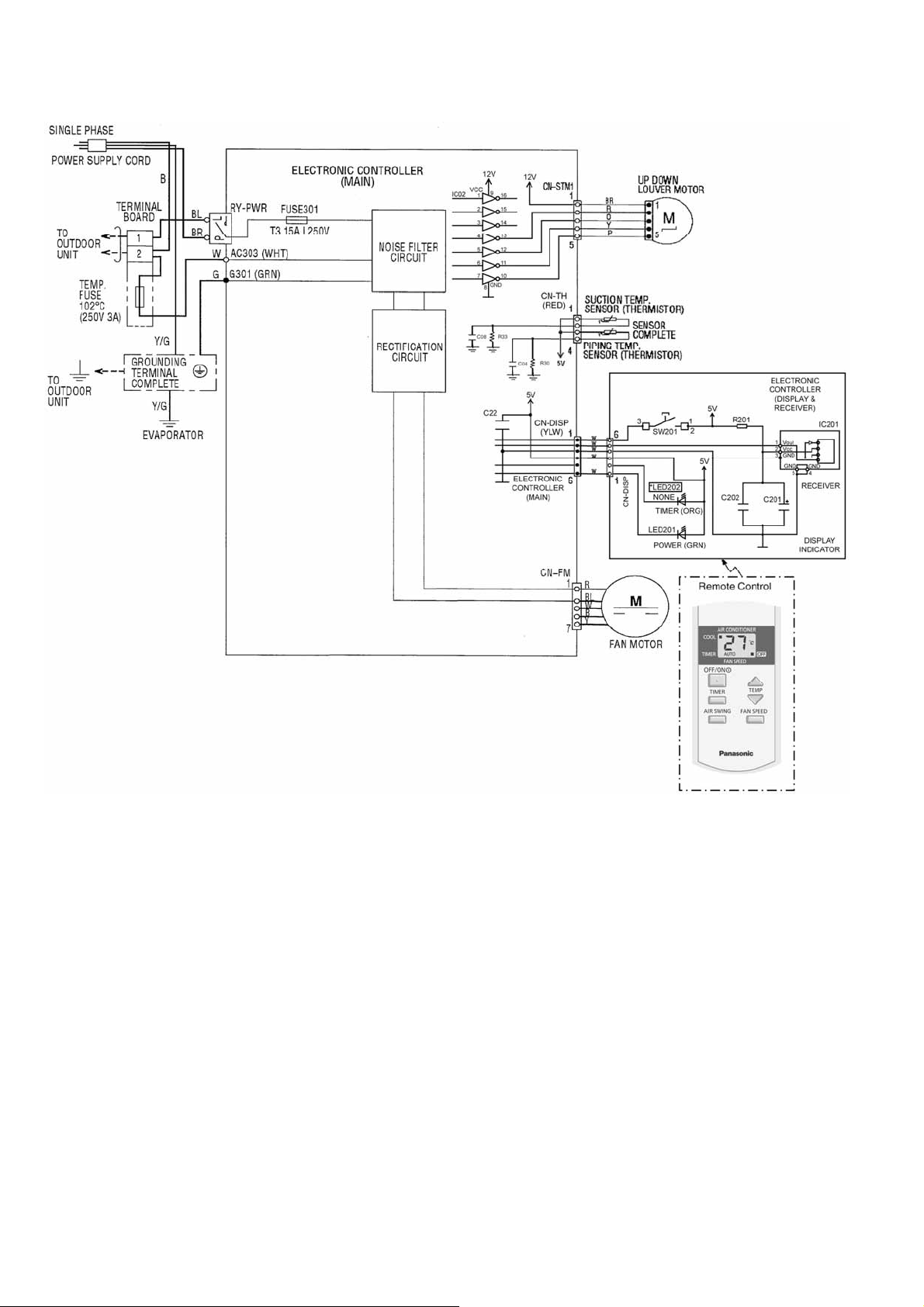
8. Electronic Circuit Diagram
14
Page 15
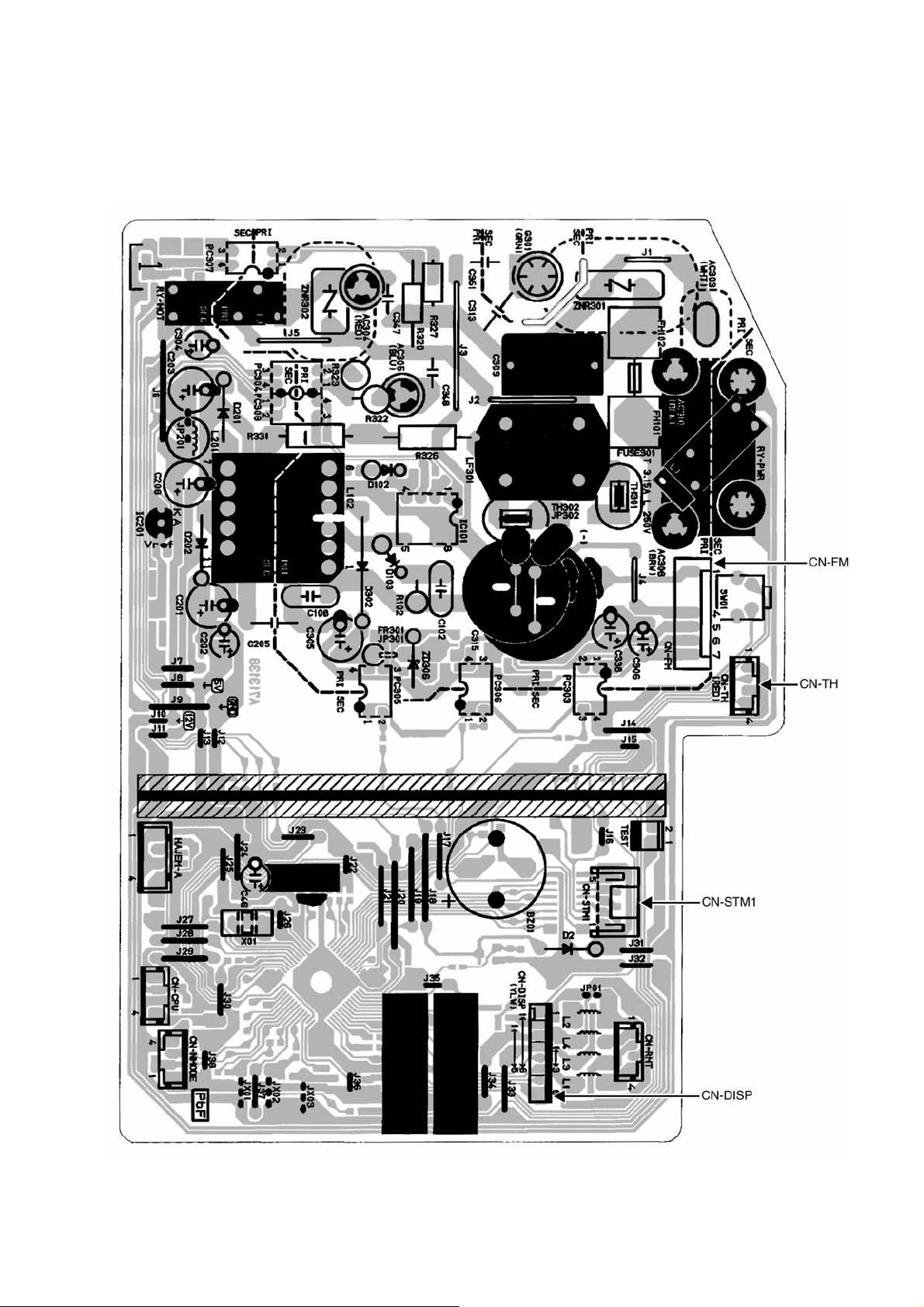
9. Printed Circuit Board
9.1 Indoor Unit
9.1.1 Main Printed Circuit Board
15
Page 16
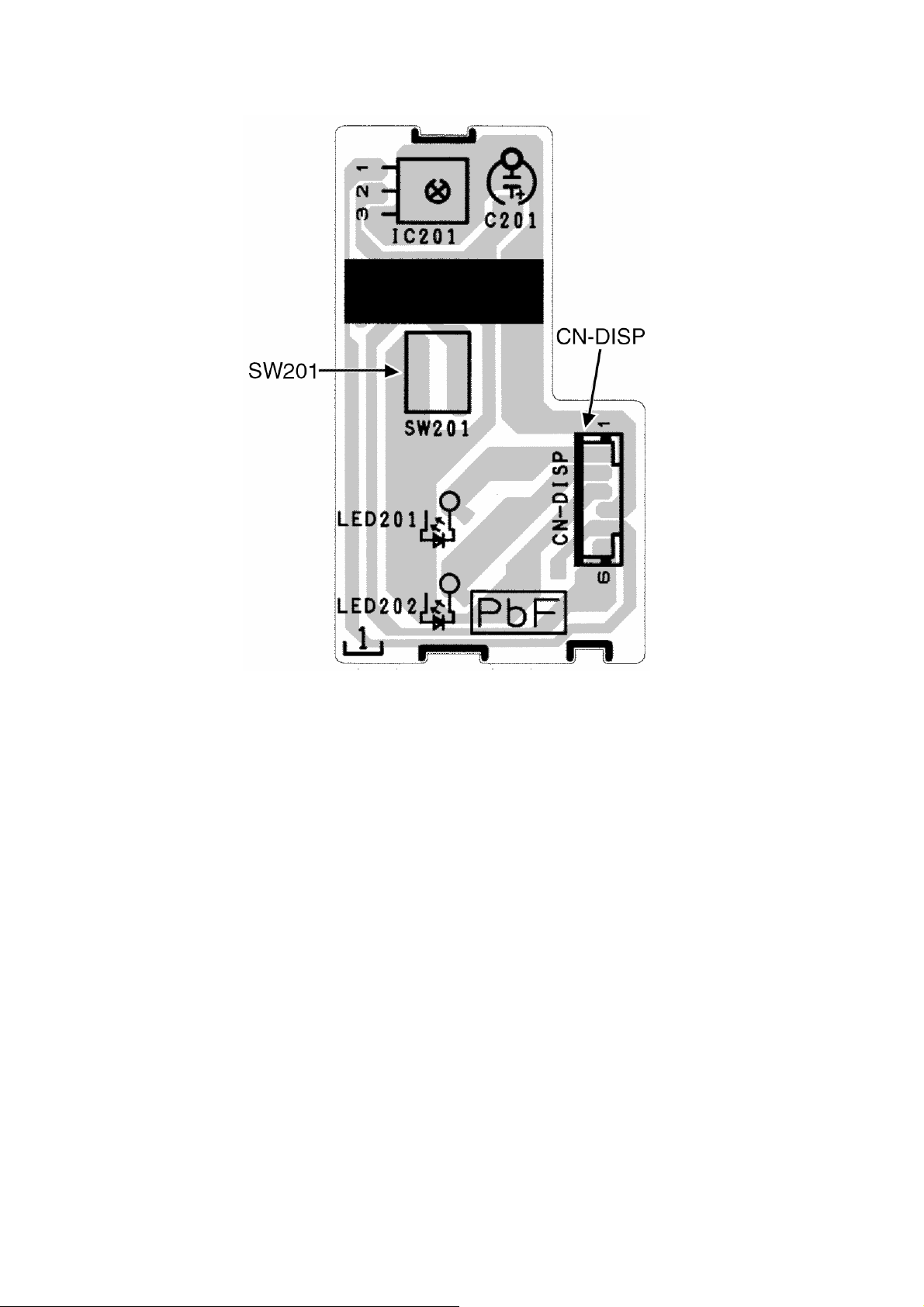
9.1.2 Indicator Printed Circuit Board
16
Page 17

10. Installation Instruction
10.1 Select the Best Location
10.1.1 Indoor Unit
Do not install the unit in excessive oil fume area
such as kitchen, workshop and etc.
There should not be any heat source or steam near
the unit.
There should not be any obstacles blocking the air
circulation.
A place where air circulation in the room is good.
A place where drainage can be easily done.
A place where noise prevention is taken into
consideration.
Do not install the unit near the door way.
Ensure the spaces indicated by arrows from the
wall, ceiling, fence or other obstacles.
Recommended installation height for indoor unit
shall be at least 2.5 m.
10.1.2 Outdoor Unit
If an awning is built over the unit to prevent direct
sunlight or rain, be careful that heat radiation from
the condenser is not obstructed.
There should not be any animal or plant which
could be affected by hot air discharged.
Keep the spaces indicated by arrows from wall,
ceiling, fence or other obstacles.
Do not place any obstacles which may cause a
short circuit of the discharged air.
If piping length is over the [piping length for
additional gas], additional refrigerant should be
added as shown in the table.
Model
YC18***
YC18***-6
YC18***-8
YC24***
YC24***-6
YC24***-8
Example: For YC18***
If the unit is installed at 10 m distance, the quantity of
additional refrigerant should be 50 g .... (10-7.5) m x 20
g/m = 50 g.
Horse
Power
(HP)
2.0HP
2.5HP
Piping size
Gas Liquid
12.7
mm
6.35
(1/2”)
mm
15.88
(1/4”)
mm
(5/8”)
Std.
Length
(m)
5
Max.
Piping
Length
(m)
Additional
Refri-
gerant
(g/m)
Piping
Length
for add.
gas (m)
Min.
Max
Piping
Eleva-
Length
tion (m)
(m)
20 3 25 20 7.5
20 3 25 30 7.5
10.1.3 Indoor/Outdoor Unit Installation
Diagram
17
Page 18

10.2 Indoor Unit
10.2.1 How to Fix Installation Plate
The mounting wall shall be strong and solid enough to
prevent it from the vibration.
Model
YC18***,
YC24***
1 2 3 4 5 6
585 mm 82 mm 165 mm 158 mm 168 mm 219 mm
The center of installation plate should be at more than
1 at right and left of the wall.
The distance from installation plate edge to ceiling
should more than 2.
From installation plate left edge to unit’s left side is 3.
From installation plate right edge to unit’s right is 4.
B : For left side piping, piping connection for liquid
should be about 5 from this line.
: For left side piping, piping connection for gas
should be about 6 from this line.
1. Mount the installation plate on the wall with 5 screws
or more (at least 5 screws).
(If mounting the unit on the concrete wall, consider
using anchor bolts.)
Always mount the installation plate horizontally by
aligning the marking-off line with the thread and
using a level gauge.
2. Drill the piping plate hole with ø70 mm hole-core drill.
Putting measuring tape at position as shown in the
diagram above.
The hole center is obtained by measuring the
distance namely 128 mm for left and right hole
respectively. Another method is intersection point of
arrow mark extension. The meeting point of the
extension arrow mark is the hole center position.
Drill the piping hole at either the right or the left and
the hole should be slightly slanting to the outdoor
side. (refer to step 3)
Dimension
10.2.2 To Drill a Hole in the Wall and Install
a Sleeve of Piping
1 Insert the piping sleeve to the hole.
2 Fix the bushing to the sleeve.
3 Cut the sleeve until it extrudes about 15 mm
from the wall.
When the wall is hollow, please be sure to use the
sleeve for tube assembly to prevent dangers caused
by mice biting the connecting cable.
4 Finish by sealing the sleeve with putty or
caulking compound at the final stage.
CAUTION
10.2.3 Indoor Unit Installation
18
Page 19

1. For the Right Rear Piping
3. For the Embedded Piping
2. For the Right and Right Bottom Piping
19
Page 20

(This can be used for left rear piping and bottom piping
also.)
20
Page 21

10.2.4 Connect the Cable to the Indoor Unit
1 Install the indoor unit on the installing holder that mounted on the wall.
2 Remove front grille by loosening the screw.
3 Remove metal cover without damaging alluminium foil.
4 Connection cable between indoor unit and outdoor unit shall be approved
polychloroprene sheathed 3 x 2.5 mm
designation 245 IEC 57 or heavier cord. Do not use joint connection cable.
Replace the wire if the existing wire (from concealed wiring, or otherwise) is
too short.
2
(2.0 ~ 2.5HP) flexible cord, type
5 Secure the connection cable onto the control board with the holder.
6 Fix back metal cover to original position without damaging alluminium foil.
Ensure metal cover is fitted at both end.
21
Page 22

This equipment must be properly earthed.
WARNING
Note:
Ensure the colour of wires of outdoor unit and the terminal Nos. are the same to the indoor’s respectively.
Earth wire shall be Yellow/Green (Y/G) in colour and longer than other AC wires for safety reason.
10.2.5 Wire Stripping and Connecting Requirement
22
Page 23

10.3 Outdoor Unit
10.3.1 Install the Outdoor Unit
After selecting the best location, start installation to Indoor/Outdoor Unit Installation Diagram.
1 Fix the unit on concrete or rigid frame firmly and horizontally by bolt nut (ø10mm).
2 When installing at roof, please consider strong wind and earthquake. Please fasten the installation stand
firmly with bolt or nails.
Model A B C D
YC18***
YC18***-8
YC18***-6
YC24***
YC24***-6
YC24***-8
10.3.2 Connect the Piping
Connecting the Piping to Indoor
Please make flare after inserting flare nut (locate at joint
portion of tube assembly) onto the copper pipe. (In case
of using long piping)
Connect the piping
Align the center of piping and sufficiently tighten the
flare nut with fingers.
Further tighten the flare nut with torque wrench in
specified torque as stated in the table.
Connecting the Piping to Outdoor
Decide piping length and then cut by using pipe cutter.
Remove burrs from cut edge.
Make flare after inserting the flare nut (locate at valve)
onto the copper pipe.
Align center of piping to valve and then tighten with
torque wrench to the specified torque as stated in the
table.
570 mm 105 mm 18.5 mm 320 mm
612.5 mm 131 mm 19 mm 383 mm
Do not over tighten, over tightening may cause gas leakage.
Piping size Torque
6.35 mm (1/4”) [18 N•m (1.8 kgf.m)]
9.52 mm (3/8”) [42 N•m (4.3 kgf.m)]
12.7 mm (1/2”) [55 N•m (5.6 kgf.m)]
15.88 mm (5/8”) [65 N•m (6.6 kgf.m)]
19.05 mm (3/4”) [100 N•m (10.2 kgf.m)]
CAUTION
23
Page 24

10.3.3 Evacuation of the Equipment
FOR ENVIRONMENTAL PROTECTION, MANUFACTURER STRONGLY RECOMMENDS TO USE EVACUATION METHOD.
1 Connect a charging hose with a push pin to the Low side of a charging set and the service port of the 3-way
valve.
o Be sure to connect the end of the charging hose with the push pin to the service port.
2 Connect the center hose of the charging set to a vacuum pump.
3 Turn on the power switch of the vacuum pump and make sure that the needle in the gauge moves from
0cmHg (0MPa) to -76cmHg (-0.1MPa). Then evacuate the air approximately ten minutes.
4 Close the Low side valve of the charging set and turn off the vacuum pump. Make sure that the needle in the
gauge does not move after approximately five minutes.
Note: BE SURE TO TAKE THIS PROCEDURE IN ORDER TO AVOID REFRIGERANT GAS LEAKAGE.
5 Disconnect the charging hose from the vacuum pump and from the service port of the 3-way valve.
6 Tighten the service port caps of the 3-way valve at a torque of 18N•m with a torque wrench.
7 Remove the valve caps of both of the 2-way valve and 3-way valve. Position both of the valves to “OPEN”
using a hexagonal wrench (4mm).
8 Mount valve caps onto the 2-way valve and the 3-way valve.
o Be sure to check for gas leakage.
If gauge needle does not move from 0cmHg (0MPa) to -76cmHg (-0.1MPa), in step 3 above take the following measure:
- If the leak stops when the piping connections are tightened further, continue working from step 3.
- If the leak does not stop when the connections are retightened, repair location of leak.
- Do not release refrigerant during piping work for installation and reinstallation.
- Take care of the liquid refrigerant, it may cause frostbite.
CAUTION
24
Page 25

10.3.4 Air Purging of the Piping and Indoor
The remaining air in the Refrigeration cycle which contains moisture may cause malfunction on the compressor.
1 Remove the caps from the 2-way and 3-way valves.
2 Remove the service-port cap from the 3-way valves.
3 To open the valve, turn the valve stem of 2-way valve counter-clockwise approx. 90° and hold it there for
ten seconds, then close it.
4 Check gas-leakage of the connecting portion of the pipings.
o For the left pipings, refer to item 4(A).
10.3.5 Connect the Cable to the Outdoor Unit
1 Remove the control board cover from the unit
by loosening the screw.
2 Connection cable between indoor unit and
outdoor unit shall be approved polychloroprene
sheathed 3 x 2.5 mm
type designation 245 IEC 57 or heavier cord. Do
not use joint connection cable. Replace the wire if
the existing wire (from concealed wiring, or
otherwise) is too short.
3 Secure the cable onto the control board with the
holder.
4 Attach the control board cover back to the
original position with screw.
5 For wire stripping and connection requirement,
refer to instruction 5 of indoor unit.
2
(2.0 ~ 2.5HP) flexible cord,
This equipment must be properly earthed.
WARNING
o Earth wire shall be Yellow/Green (Y/G) in
colour and longer than other AC wires for
safety reason.
25
Page 26

10.3.6 Piping Insulation
1 Please carry out insulation at pipe connection portion as mentioned in Indoor/Outdoor Unit Installation
Diagram. Please wrap the insulated piping end to prevent water from going inside the piping.
2 If drain hose or connecting piping is in the room (where dew may form), please increase the insulation by
using POLY-E FOAM with thickness 6 mm or above.
Cutting and Flaring the Piping
1 Please cut using pipe cutter and then remove the burrs.
2 Remove the burrs by using reamer. If burrs is not removed, gas leakage may be caused.
Turn the piping end down to avoid the metal powder entering the pipe.
3 Please make flare after inserting the flare nut onto the copper pipes.
26
Page 27

11. Operation and Control
11.1 Cooling Operation
Cooling operation can be set using remote control.
This operation is applied to cool down the room temperature reaches the setting temperature set on the remote
control.
The remote control setting temperature, which takes the reading of intake air temperature sensor, can be
adjusted from 16°C to 30°C.
During cooling operation, the compressor will stop running and restart as shown in figure below.
11.1.1 Cooling Operation Time Diagram
27
Page 28

11.2 Indoor Fan Speed Control
Indoor Fan Speed can be set using remote control.
11.2.1 Fan Speed Rotation Chart
Speed Fan Speed (rpm)
CS-YC18MKV CS-YC24MKV
Hi 1240 1390
Me 1150 1240
H Lo 1130 1210
C Lo 1060 1150
Lo- 850 970
S Lo 670 750
11.2.2 Automatic Fan Speed Control
When set to Auto Fan Speed, the fan speed is adjusted between maximum and minimum setting as shown in the
table.
- Fan speed rotates in the range of Hi and Me.
- Deodorizing Control will be activated.
Auto Fan Speed during cooling operation:
1 Indoor fan will rotate alternately between off and on as shown in below diagram.
2 At the beginning of each compressor start operation, indoor fan will increase fan speed gradually for
deodorizing purpose.
3 For the first time the compressor operate, indoor fan will be switched to Hi fan speed from Lo- after
70 seconds from the start of compressor. This cause the room temperature to achieve the setting
temperature quickly.
4 During compressor stop, indoor fan will operate at Lo for the beginning 3 minutes to prevent higher volume of
refrigerant in liquid form returning to the compressor.
5 After the compressor at turn off condition for 3 minutes, indoor fan will start to operate at Lo- to circulate the
air in the room. This is to obtain the actual reading of the intake air temperature.
6 For the resume of compressor operation, indoor fan will operate at Me fan speed to provide comfort and
lesser noise environment, after 70 seconds from the restart of compressor.
28
Page 29

11.2.3 Manual Fan Speed Control
Manual fan speed adjustment can be carried out by using the Fan Speed selection button at the remote control.
There are 3 types of fan speed settings: Lo, Me, Hi.
11.2.4 Indoor Fan Motor RPM Abnormal Control
Immediate after the fan motor is started, rpm abnormal control is performed once every second.
During fan motor on, if fan motor feedback ≥2550 or <50 rpm continuously for 10 seconds, the fan motor error
counter increased; fan motor is then stopped and restarted. If the fan motor error increased to 7, the air
conditioner will stop.
11.3 Outdoor Fan Speed Control
Outdoor fan speed can be changes to Hi or Lo according to outdoor temperature. (YC24MKV)
There is only one speed for outdoor fan motor. (YC18MKV)
When the air conditioner is turned on, the compressor and the outdoor fan will operate simultaneously.
Likewise, both compressor and outdoor fan will stop at the same time if the unit is turned off.
11.4 Vertical Airflow Direction Control
11.4.1 Auto Control
When the vertical airflow direction is set to Auto using the remote control, the louver swings up and down as
shown in the diagram.
When stop operation using the remote control, the discharge vent is reset, and stop at the closing position.
During Cooling operation, indoor fan motor may stop to rotate at certain periods. At that condition, the louver will
stop swinging.
11.4.2 Manual Control
When the vertical airflow direction is set to Manual using the remote control, the automatic airflow is released and
the airflow direction louver move up and down in the range shown in the diagram.
The louver can be adjusted by pressing the button to the desired louver position.
When stop operation using the remote control, the discharge vent is reset, and stop at the closing position.
29
Page 30

11.5 Horizontal Airflow Direction Control
The horizontal airflow direction louvers can be adjusted manually by hand.
11.6 Timer Control
11.6.1 To Set the Timer
To turn ON the unit at a preset time, set the timer while the unit is OFF (the operation will start 15 minutes early
before the preset time).
To turn OFF the unit at a delayed time, set the timer while the unit is ON.
Once the timer is set, the TIMER indication on the remote control display will be shown.
To check the remaining time before the timer takes effect, press
To cancel the timer, press
The timer will also be canceled when you press
This setting is for one time operation, you will need to set again each time you want to use the timer.
once, then press again and hold for approximately 3 seconds.
or when power failure occurs.
.
11.7 Random Auto Restart Control
If there is a power failure during operation, the air conditioner will automatically restart after 3 to 4 minutes when
the power is resumed.
It will start with previous operation mode and airflow direction.
If there are more than one air conditioner unit in operation and power failure occur, restart time for each unit to
operate will be decided randomly using 4 parameters:- intake air temperature, setting temperature, fan speed
and air swing louver position.
This Random Auto Restart Control is not available when Timer is set.
This control can be omitted by open the circuit of JX02 on the indoor unit printed circuit board.
11.8 Remote Control Signal Receiving Sound
Short beep sound will be heard when turn ON the air conditioner or enabling other operations.
Long beep sound will be heard when turn OFF the air conditioner or disabling other operations.
30
Page 31

12. Protection Control
12.1 Restart Control (Time Delay Safety Control)
When the thermo-off temperature (temperature which compressor stops to operate) is reached during:
- Cooling operation - the compressor stops for 3 minutes (minimum) before resume operation.
If the operation is stopped by the remote control, the compressor will not turn on within 3 minutes from the
moment operation stop, although the unit is turn on again within the period.
This phenomenon is to balance the pressure inside the refrigerant cycle.
12.2 7 Minutes Time Save Control
The compressor will start automatically if it has stopped for 7 minutes and the intake air temperature falls
between the compressor ON temperature (A) and compressor OFF temperature (B) during the period.
This phenomenon is to reduce the built up humidity inside a room.
12.3 60 Seconds Forced Operation
Once the air conditioner is turned on, the compressor will not stop within 60 seconds in a normal operation
although the intake air temperature has reached the thermo-off temperature. However, force stop by pressing the
OFF/ON operation button at the remote control is permitted.
The reason for the compressor to force operate at minimum 60 seconds is to allow the refrigerant oil run in a full
cycle and return back to the outdoor unit.
12.4 Starting current Control
When the compressor, outdoor fan motor and indoor fan motor are simultaneously started, the indoor fan motor
will start to operate at 1.6 second later.
The reason of the difference is to reduce the starting current flow.
12.5 Freeze Preventive Control
If the temperature of the indoor heat exchanger falls below 2°C continuously for 4 minutes or more, the
compressor turns off. The fan speed setting remains the same.
This phenomenon is to protect the indoor heat exchanger from freezing and to prevent higher volume of
refrigerant in liquid form returning to the compressor.
Compressor will restart again when the indoor heat exchanger temperature rises to 10°C (Recovery).
Restart control (Time Delay Safety Control) will be applied in this Control if the recovery time is too short.
31
Page 32

12.6 Compressor Reverse Rotation Protection Control
If the compressor is operating continuously for 5 minutes or longer and the temperature difference between
intake air and indoor heat exchanger is 2.5°C or less for continuous 2 minutes, compressor will stop and restart
automatically.
Time Delay Safety Control is activated before the compressor restart.
This is to prevent compressor from rotate reversely when there is an instantaneous power failure.
If this condition happens continuously for 5 times within 50 minutes, unit will turns off.
The 5 times counter can be reset when either one of the following condition happen:
- Unit is OFF by remote control or AUTO OFF/ON button.
- Indoor intake temperature - indoor piping temperature >5°C for 1 minute or more.
The unit could be ON by pressing OFF/ON button at remote control.
12.7 Dew Prevention Control
To prevent dew formation at indoor unit discharge area.
This control will be activated if:
- Cooling mode.
- Remote Control setting temperature is less than 25°C.
- Fan speed is at CLo.
- Room temperature is constant (±1°C) for 30 minutes.
- Compressor is continuously running.
Fan speed will be adjusted accordingly in this control.
- Fan speed will be increased slowly.
Dew prevention stop condition
- Remote control setting temperature is more than 25°C.
- Fan speed is not set to CLo.
12.8 Odor Cut Control
To reduce the odor released from the unit.
- Start Condition
- AUTO FAN Speed is selected during COOL operation.
- During freeze prevention control and timer preliminary operation, this control is not applicable.
- Control content
- Depends on compressor conditions:
1. Compressor OFF → Compressor ON.
The indoor unit fan stops temporarily and then starts to blow at minimum airflow for 30 seconds.
2. Compressor ON → Compressor OFF.
The indoor unit fan stops for 90 seconds and then blows at minimum airflow for 20 seconds.
32
Page 33

13. Servicing Mode
13.1 Auto OFF/ON Button
1 OPERATION MODE
The operation will be activated immediately once the AUTO OFF/ON button is pressed. This operation can
be used to operate air conditioner with limited function if remote control is misplaced or malfunctioned.
2 TEST RUN OPERATION (FOR PUMP DOWN/SERVICING PURPOSE)
The Test Run operation will be activated if the Auto OFF/ON button is pressed continuously for more than 5
seconds. A “beep” sound will occur at the fifth second, in order to identify the starting of this operation.
3 VARIOUS SETTING MODE
The Various Setting Mode will be activated if (within 20 seconds of Test Run Operation) the Auto OFF/ON
button is pressed for more than 5 seconds. 2 “beep” sounds will be heard to identify the starting of this
operation.
Under Various Setting mode, user could perform the following operation:
i) Remote control receiving sound OFF/ON
Press “Auto OFF/ON button” to toggle remote control receiving sound.
- Short “beep”: Turn ON remote control receiving sound.
- Long “beep”: Turn OFF remote control receiving sound.
After Auto OFF/ON Button is pressed, the 20 seconds counter for Remote Control Receiving Sound
OFF/ON Mode is restarted.
13.2 Remote Control Number Switch
o There are 2 types of remote control transmission code could be selected and stored in EEPROM of
indoor unit. The indoor unit will only operate when received signal with same transmission code from
remote control. This could prevent signal interference when there are 2 indoor units installed nearby
together.
o To change remote control transmission code, short or open jumpers at the remote control printed circuit
board.
o During unit is OFF (remote control OFF indicator is shown), after select the transmission code
combination of remote control, press OFF/ON button for 20 seconds at remote control to transmit and
store the desired transmission code to the EEPROM.
33
Page 34

14. Troubleshooting Guide
14.1 Refrigeration Cycle System
In order to diagnose malfunctions, ensure the air
conditioner is free from electrical problems before
inspecting the refrigeration cycle. Such problems include
insufficient insulation, problem with the power source,
malfunction of a compressor and a fan. The normal outlet
air temperature and pressure of the refrigeration cycle
depends on various conditions, the standard values for
them are shown in the table to the right.
34
Page 35

14.1.1 Relationship between the Condition of the Air Conditioner and Pressure and Electric
Current
Cooling Mode
Condition of the air
conditioner
Low Pressure High Pressure Electric current during operation
Insufficient refrigerant
(gas leakage)
Clogged capillary tube or
Strainer
Short circuit in the indoor unit
Heat radiation deficiency of the
outdoor unit
Inefficient compression
Carry out the measurements of pressure, electric current, and temperature fifteen minutes after an operation is
started.
14.1.2 Diagnosis Methods of a Malfunction of a Compressor
Nature of fault Symptom
Insufficient compressing of a compressor
Locked compressor
• Electric current during operation becomes approximately 20% lower than the normal value.
• The discharge tube of the compressor becomes abnormally hot (normally 70 to 90°C).
• The difference between high pressure and low pressure becomes almost zero.
• Electric current reaches a high level abnormally, and the value exceeds the limit of an
ammeter. In some cases, a breaker turns off.
• The compressor has a humming sound.
35
Page 36

15. Disassembly and Assembly Instructions
High Voltage is generated in the electrical parts area by the capacitor. Ensure that the capacitor has discharged sufficiently before proceeding
with repair work. Failure to heed this caution may result in electric shocks.
15.1 Small Air Filter, Indoor Electronic Controllers and Control Board
Removal Procedures
WARNING
36
Page 37

37
Page 38

38
Page 39

15.2 To Remove Cross Flow Fan and Indoor Fan Motor
39
Page 40

40
Page 41

16. Technical Data
16.1 Thermostat Characteristics
Cooling
41
Page 42

16.2 Operation Characteristics
16.2.1 CS-YC18MKV CU-YC18MKV
42
Page 43

43
Page 44

16.2.2 CS-YC24MKV CU-YC24MKV
44
Page 45

45
Page 46

17. Exploded View and Replacement Parts List
17.1 Indoor Unit
17.1.1 CS-YC18MKV CS-YC24MKV
Note:
The above exploded view is for the purpose of parts disassembly and replacement.
The non-numbered parts are not kept as standard service parts.
46
Page 47

REF. NO. PART NAME & DESCRIPTION QTY. CS-YC18MKV CS-YC24MKV REMARK
1 CHASSIS COMPLETE 1 CWD50C1623 ←
2 FAN MOTOR 1 ARW7628AC ARW7627AC O
3 CROSS FLOW FAN COMPLETE 1 CWH02C1077 ←
4 SCREW - CROSS FLOW FAN 1 CWH551146 ←
5 BEARING ASS’Y 1 CWH64K007 ← O
6 EVAPORATOR 1 CWB30C2772 CWB30C2774
7 FLARE NUT (LIQUID) 1 CWT251026 ←
8 FLARE NUT (GAS) 1 CWT251062 CWT251036
9 HOLDER SENSOR 1 CWH32143 ←
10 BACK COVER CHASSIS 1 CWD933031 ←
11 CONTROL BOARD CASING 1 CWH102434 ←
12 TERMINAL BOARD COMPLETE 1 CWA28C2514 CWA28C2516 O
13 POWER SUPPLY CORD-COMPLETE 1 CWA20C2829 CWA20C2836 O
14 ELECTRONIC CONTROLLER - MAIN 1 CWA73C5469 CWA73C5462 O
15
16 INDICATOR HOLDER 1 CWD933338 ← O
17 SENSOR COMPLETE 1 CWA50C2401 ←
18 DISCHARGE GRILLE COMPLETE 1 CWE20C3162 ←
19 VERTICAL VANE 13 CWE241355 ←
20 CONNECTING BAR 1 CWE261230 ←
21 CONNECTING BAR 1 CWE261231 ←
22 CONNECTING BAR 1 CWE261232 ←
23 CONNECTING BAR 1 CWE261233 ←
24 CONNECTING BAR 1 CWE261234 ← O
25 A.S.MOTOR,DC SINGLE 12V 300OHM 1 CWA981241 ←
26 HORIZONTAL VANE 1 CWE24C1377 ←
27 CAP - DRAIN TRAY 1 CWH521096 ←
28 CONTROL BOARD TOP COVER 1 CWH131447 ←
29 CONTROL BOARD FRONT COVER 1 CWH13C1233 ← O
30 REMOTE CONTROL CO.(WIRELESS) 1 CWA75C3733 ← O
31 FRONT GRILLE COMPLETE 1 CWE11C5056 CWE11C5056
32 INTAKE GRILLE COMPLETE 1 CWE22C1693 ← O
33 AIR FILTER 2 CWD001318 ←
34 SCREW - FRONT GRILLE 3 XTT4+16CFJ ←
35 CAP - FRONT GRILLE 3 CWH521194 ←
36 DRAIN HOSE 1 CWH851173 ←
37 BAG COMPLETE - INSTALLATION SCREW 1 CWH82C1824 ←
38 INSTALLATION PLATE 1 CWH361098 ←
39 FULCRUM 2 CWH621103 ←
40 OPERATING INSTRUCTION 1 CWF567877 ←
41 INSTALLATION INSTRUCTION 1 CWF614814 ←
42 INSTALLATION INSTRUCTION 1 CWF614815 ← O
43 FAN MOTOR BRACKET 1 CWD541160 ←
44 AIR FILTER (SMALL) 2 CWD001319 ←
ELECTRONIC CONTROLLER-INDICATOR &
RECEIVER
1 CWA746284 ←
Note:
All parts are supplied from PHAAM, Malaysia (Vendor Code: 00029488).
“O” marked parts are recommended to be kept in stock.
47
Page 48

17.2 Outdoor Unit
17.2.1 CU-YC18MKV
Note:
The above exploded view is for the purpose of parts disassembly and replacement.
The non-numbered parts are not kept as standard service parts.
48
Page 49

REF. NO. PART NAME & DESCRIPTION QTY. CU-YC18MKV REMARK
1 CHASSIS ASS’Y 1 CWD50K2088
2 SOUND PROOF MATERIAL 1 CWG302256
3 FAN MOTOR BRACKET 1 CWD541030
4 SCREW - FAN MOTOR BRACKET 2 CWH551217
5 FAN MOTOR 1 CWA951329J O
6 SCREW - FAN MOTOR MOUNT 4 CWH55406J
7 PROPELLER FAN ASS’Y 1 CWH03K1006
8 NUT - PROPELLER FAN 1 CWH56053J
9 COMPRESSOR 1 2KS252F5AB04 O
10 ANTI - VIBRATION BUSHING 3 CWH50055
11 NUT - COMPRESSOR MOUNT 3 CWH561049
12 CONDENSER 1 CWB32C2794
13 CAPILLARY TUBE ASS’Y 1 CWB15K1103 O
14 HOLDER COUPLING 1 CWH351046
15 2-WAY VALVE (LIQUID) 1 CWB021242 O
16 3-WAY VALVE (GAS) 1 CWB011233 O
17 OVERLOAD PROTECTOR WITH WIRE 1 CWA67C7977
18 TERMINAL COVER 1 CWH171011
19 NUT - TERMINAL COVER 1 CWH7080300J
20 SOUND PROOF BOARD 1 CWH151023
21 TERMINAL BOARD ASS’Y 1 CWA28K1064J O
22 CAPACITOR - COM. 1 CWA312078
23 HOLDER CAPACITOR 1 CWH30060 O
24 CAPACITOR - F.M 1 DS441205NPQA
25 CABINET SIDE PLATE 1 CWE041248A
26 CABINET SIDE PLATE COMPLETE 1 CWE04C1120
27 CABINET FRONT PLATE ASS’Y 1 CWE06K1034
28 CABINET TOP PLATE 1 CWE031014A
29 CONTROL BOARD COVER COMP 1 CWH13C1064
30 WIRE NET 1 CWD041111A
31 HANDLE 1 CWE161010
Note:
All parts are supplied from PHAAM, Malaysia (Vendor Code: 00029488).
“O” marked parts are recommended to be kept in stock.
49
Page 50

17.2.2 CU-YC24MKV
Note:
The above exploded view is for the purpose of parts disassembly and replacement.
The non-numbered parts are not kept as standard service parts.
50
Page 51

REF. NO. PART NAME & DESCRIPTION QTY. CU-YC24MKV REMARK
1 CHASSIS ASS’Y 1 CWD50K2100
2 SOUND PROOF MATERIAL 1 CWG302278
3 FAN MOTOR BRACKET 1 CWD541065
4 SCREW - FAN MOTOR BRACKET 4 CWH551217
5 FAN MOTOR 1 CWA951399J O
6 SCREW - FAN MOTOR MOUNT 3 CWH55252J
7 PROPELLER FAN ASS’Y 1 CWH03K1017
8 NUT - PROPELLER FAN 1 CWH561038J
9 COMPRESSOR 1 2JS386F3AA04 O
10 PACKING 3 CWB81043
11 ANTI - VIBRATION BUSHING 3 CWH50055
12 NUT - COMPRESSOR MOUNT 3 CWH561049
13 CONDENSER 1 CWB32C2692
14 CAPILLARY TUBE ASS’Y 1 CWB15K1282
15 STRAINER 1 CWB11025
16 HOLDER COUPLING 1 CWH351036
17 2-WAY VALVE (LIQUID) 1 CWB021175 O
18 3-WAY VALVE (GAS) 1 CWB011484 O
19 TERMINAL COVER 1 CWH171012
20 NUT - TERMINAL COVER 1 CWH7080300J
21 SOUND PROOF BOARD 1 CWH151051
22 TERMINAL BOARD ASS’Y 1 CWA28K1064J O
23 CAPACITOR - COM. 1 CWA312088 O
24 HOLDER CAPACITOR 1 CWH301055
25 CAPACITOR - F.M 1 DS441355NPQA O
26 CABINET SIDE PLATE 1 CWE041255A
27 CABINET SIDE PLATE COMPLETE 1 CWE04C1123
28 CABINET FRONT PLATE ASS’Y 1 CWE06K1043
29 CABINET TOP PLATE 1 CWE03K1009A
30 CONTROL BOARD COVER COMP 1 CWH131168
31 WIRE NET 1 CWD041041A
32 HANDLE 1 CWE161010
33 CONTROL BOARD COVER(RIGHT-TOP) 1 CWH131169A
34 HANDLE 2 CWE16000E
35 THERMOSTAT 1 CWA151061
Note:
All parts are supplied from PHAAM, Malaysia (Vendor Code: 00029488).
“O” marked parts are recommended to be kept in stock.
51
[PHAAM] Printed in Malaysia
YY1210-0
 Loading...