

Page 1

LIMITED WARRANTY REGISTRATION CARD
Please present your Warranty Card and a copy of your original
sales receipt to validate warranty coverage. DO NOT lose your
receipt. Please review the terms & conditions of ChoiceMMed
America Co.’s Warranty.
To obtain full warranty coverage, this card must be completed,
signed and returned to ChoiceMMed America Co. within 30 days
from date of purchase. Failure to register this card within 30 days
may render the warranty null & void.
RETURN ADDRESS: ChoiceMMed America Co. 2558 Pearl
Buck Rd, Suite 8A, Bristol, PA 19007
Service Phone: (215) 874-0458
Customer Service Representatives are available
Monday through Friday - 8:30am to 4:30pm EST
STATEMENT OF CHOICEMMED AMERICA CO. / LIMITED
WARRANTY
ChoiceMMed America Co. warrants to the original purchaser
that this equipment will be free from defects in materials and
workmanship for a period of two years from the date of purchase.
This warranty shall be limited to the repair adjustment and/or
replacement at the manufacturer's option of defective parts free of
charge except the cost of transportation to ChoiceMMed America
Co. Manufacturer's responsibility is limited to actual cost of item.
When returning equipment for warranty service, all shipping and
insurance charges must be prepaid and the proof of purchase
must be enclosed. A payment of $10.00 must be included to
cover the return shipping and handling. Returns will only be
shipped to locations within the USA. ChoiceMMed America
Co. will not be responsible for expenses or inconveniences, or
consequential damages occasioned by equipment or by breach
of any expressed or implied warranty with respect thereto.
For troubleshooting assistance please contact Consumer
Support. Our representatives are trained to provide you
assistance over the phone and may be able to resolve your
problem without returning. For the best possible assistance
please have your unit available when calling us.
Limitations
This warranty covers all defects encountered in normal use of the
equipment and does not apply in the following cases.
1) If the equipment has been serviced by other than a certied center.
2) Damage to the equipment due to mishandling, abuse, accident or
not following operating instructions.
3) INSTRUMENTS: Warranty does not extend to display face,
batteries, carrying case or lanyard.
ChoiceMMed America Co.
2558 Pearl Buck Rd, Suite 8A, Bristol, PA 19007
MODEL NO. SERIES NO. (SN)
DESCRIPTION
PURCHASE DATE
CUSTOMER NAME (MR. MRS. MS. )
PHONE NUMBER
MAILING ADDRESS
CITY/STATE ZIP
1. General Description
Thank you for purchasing OxyWatch C15D pulse oximeter. This
oximeter can be used to measure your blood oxygen saturation (in %
SpO
2
) and your pulse rate. It should be used for spot monitoring only
and not for continuous monitoring.
The OxyWatch C15D Finger-Unit spot check oximeter is only for sports
and aviation use. It is ideal for use during sports activities, mountain
climbing and piloting airplanes. It is not intended to diagnosis any
medical condition or to be used in medical applications.
2. Package Contents
1. OxyWatch C15D Pulse Oximeter
2. Lanyard
3. User Manual
4. Carrying Pouch
5. 2 AAA Batteries
1. Read the manual carefully before use.
2. Pulse oximeters are sensitive to motion artifacts. Keep hands still
while taking a reading.
3. Pulse oximeters require sufcient blood ow to obtain proper readings.
Poor blood circulation can result in inaccurate readings. If your hands
are cold or you have poor circulation, warm your hands by rubbing
them together or use another method before attempting to obtain a
reading. A tourniquet, blood pressure cuff or other blood ow
hindrances may also result in inaccurate readings.
4. Fingernail polish or acrylic nails obstruct the light transmission and
may also result in inaccurate readings.
5. Your nger must be clean for a proper reading.
6. The pulse oximeter must be clean for a proper reading.
7. If a reading is difcult to obtain, switch to another nger or to the other hand.
8. There are a number of other conditions which may lead to an
inaccurate reading including but not limited to recent medical tests that
included an injection of dyes, use of arterial catheters, a weak pulse,
low levels of hemoglobin in the blood, low perfusion (the quality of
your pulse), elevated levels of dysfunctional hemoglobin, the strength
and type of light that you are in while using the pulse oximeter and the
existence of cell phones, radios, and xed transmitters within certain
ranges of the pulse oximeter during use.
9. The pulse oximeter will not alert you if your readings are out of
normal range.
10. Explosion hazard: Do not use the pulse oximeter in an explosive
atmosphere.
11. The pulse oximeter has no SpO
2
alarms; it is not for continuous
monitoring, as indicated by the symbol.
3. Precautions for Use
NOTE: Install the batteries in right polarity. Incorrect placement may
cause damage to the bracket.
NOTE: Remove the batteries if the pulse oximeter will not be used for
long periods of time.
3. The battery indicator symbol on the front panel display will light when
the battery voltage is too low for normal operation of the pulse oximeter.
Replace the batteries when indicator symbol lights.
5. Using the Oximeter
3. Press the switch button one time on front panel to turn the pulse oximeter on.
1. Open the clamp as shown in the picture.
2. Place one of your ngers into the rubber
opening of the pulse oximeter (your nger
should touch the bottom portion) before
releasing the clamp.
1. Install two AAA batteries
into the battery compartment.
Match the plus (+) and minus
(-) signs in the compartment.
If the polarities are not
matched, damage may be
caused to the oximeter.
2. Slide the battery door cover
horizontally along the arrow
as shown in the picture.
4. Battery Installation
2. Signicant levels of dysfunctional hemoglobin (such as carbonxy-
hemoglobin or methemoglobin).
3. Intravascular dyes such as indocyanine green or methylene blue.
4. SpO
2
measurements may be adversely affected in the presence of
high ambient light such as direct sunlight. In bright light conditions,
cover the sensor area if necessary.
5. Excessive user movement.
6. High-frequency electrosurgical interference and debrillators.
7. Venous pulsations.
8. The user has hypotension, severe vasoconstriction, severe anemia or
hypothermia.
9. Fingernail polish or false ngernails may cause inaccurate SpO
2
readings.
1. Autoclaving, ethylene oxide sterilizing or immersing the sensors in liquid.
In addition to items described in the Precautions for Use, inaccurate
measurements may be caused by FACTORS INCLUDING BUT NOT
LIMITED TO:
Slide Cover
7. Brief Description of Front Panel
The height of the Pulse Bar graph indicates the intensity of the pulse and
signal strength. The bar should be greater than 30% for a proper reading.
6. Maintenance
1. Clean the pulse oximeter and sensor with a soft cloth dampened with
isopropyl alcohol. Do not pour or spray any liquids onto the pulse
oximeter. Do not allow any liquid to enter any openings in the device.
Allow the pulse oximeter to dry thoroughly before reusing.
(The rubber inside of the pulse oximeter is composed of medical
grade rubber. It is non-toxic and is not harmful to the skin.)
2. The pulse oximeter requires no routine calibration or maintenance
other than replacement of the batteries.
4. Keep your hands still for the reading. Do not shake your nger during
the test. It is recommended that you do not move your body while
taking a reading.
5. Read the data from the display screen.
7. When you press the power switch for more than one second, the
brightness of the pulse oximeter will be changed by degrees. There
are 10 levels of brightness. The default level is level four.
8. When no signal or low signal is detected, the pulse oximeter will
power off automatically in 8 seconds.
6. There are four display modes. After turning on the pulse oximeter,
each time you press the power switch, the pulse oximeter will switch
to another display mode.
8. Technical Specications
1. Display: LCD display
PR display mode: bargraph
Low power indication:
2. Battery Standard: Two AAA 1.5V Alkaline Batteries
3. Power Consumption: Less than 40mA
4. Resolution: ±1% for SpO2 and ±1 BPM for Pulse Rate
5. Measurement Range: Measuring range for SpO2: 70-100%
Measuring range for PR: 30-250 BPM
6. Measurement Accuracy:
SpO2: 70-100%, ±2 digits; <70%, no denition
PR: 30~99 BPM, ±2 BPM; 100~250 BPM, ±2%
7. Environment Requirement:
Operation Temperature: 5°C~40°C (41°F~104°F)
Storage Temperature: -20°C~55°C (-4°F~131°F)
Ambient Humidity: ≤80%, no condensation in operation
≤93%, no condensation in storage
8. Automatic Power Off: The oximeter will power off automatically after
8 seconds when the nger is removed.
9. It is recommended that the product be kept in a dry place. A damp
ambient might affect its lifetime and even might damage the product.
10. Declaration
EMC of this product complies with IEC60601-1-2 standard
The materials which users can come into contact with are non-toxic
and comply with ISO10993-1, ISO10993-5 and ISO10993-10.
Note:
The illustration used in this manual may differ slightly from the
appearance of the actual product.
Warnings:
9. Possible Problems and Solutions
10.
Symbol Denitions
Symbol Denition
Pulse Rate (bpm)
Low Power Indication
Serial Number
Oxygen Saturation
SN
SpO
2
%
PR
bpm
1. Keep the pulse oximeter away from young children. Small parts such as
the battery door and the batteries, etc., may be hazardous if swallowed.
2. The lanyard may cause strangulation in conditions that may cause it to
twist around the neck.
Warnings:
Revised Date: May 7, 2013
Guidance and manufacturer’s declaration – electromagnetic
emissions – for all EQUIPMENT and SYSTEMS
Emission test Compliance Electromagnetic environment – guidance
Guidance and manufacturer’s declaration – electromagnetic emission
RF emissions
CISPR 11
Group 1
Class B
RF emission
CISPR 11
The pulse oximeter uses RF energy only
for its internal function. Therefore, its RF
emissions are very low and are not likely to
cause any interference in nearby electronic
equipment.
The pulse oximeter is suitable for use in
all establishments, including domestic
establishments and those directly
connected to the public low-voltage power
supply network that supplies buildings
used for domestic purposes.
The pulse oximeter is intended for use in the electromagnetic environment
specied below. The customer or the user of the pulse oximeter should
assure that it is used in such an environment.
Distributed by:
ChoiceMMed America Co.
US Customer Service Site
ChoiceMMed America Co.
2558 Pearl Buck Rd: Suite 8A
Bristol, PA 19007
Phone: (215) 874-0458
www.choicemmedamerica.com
ChoiceMMed America Co.
© 2013 ALL RIGHTS RESERVED
OxyWatch C15D
1. Follow local ordinances and recycling instructions regarding disposal or
recycling of the device and device components, including batteries.
Note:
2. The illustration used in this manual may differ slightly from the
appearance of the actual product.
Problems Possible reason Solution
SpO
2
or
PR can not
be shown
normally
1. Finger is not inserted correctly
2. Patient’s Oxyhemoglobin value
is too low to be measured
1.Retry by inserting the nger
2. Try some more times. If you
can make sure no problem
exist in the product, please go
to a hospital timely for exact
diagnosis.
SpO2 or PR
is shown
unstably
1. Finger might not be inserted
deep enough.
2. Finger is trembling or patient’s
body is in movement status.
1. Retry by inserting the nger
2. Try not to move
The oximeter
can not be
powered on
1. Power of batteries might be
inadequate or not be there at all.
2. Batteries might be installed
incorrectly.
3. The oximeter might be
damaged.
1. Please replace batteries
2. Please reinstall the batteries
3. Please contact with local
customer service centre
Indication
lamps are
suddenly off
1. The product is automatically
powered off when no signal is
detected longer than 8 seconds
2. Power quantity of the batteries
is started being inadequate
1. Normal
2. Replace the batteries
Page 2
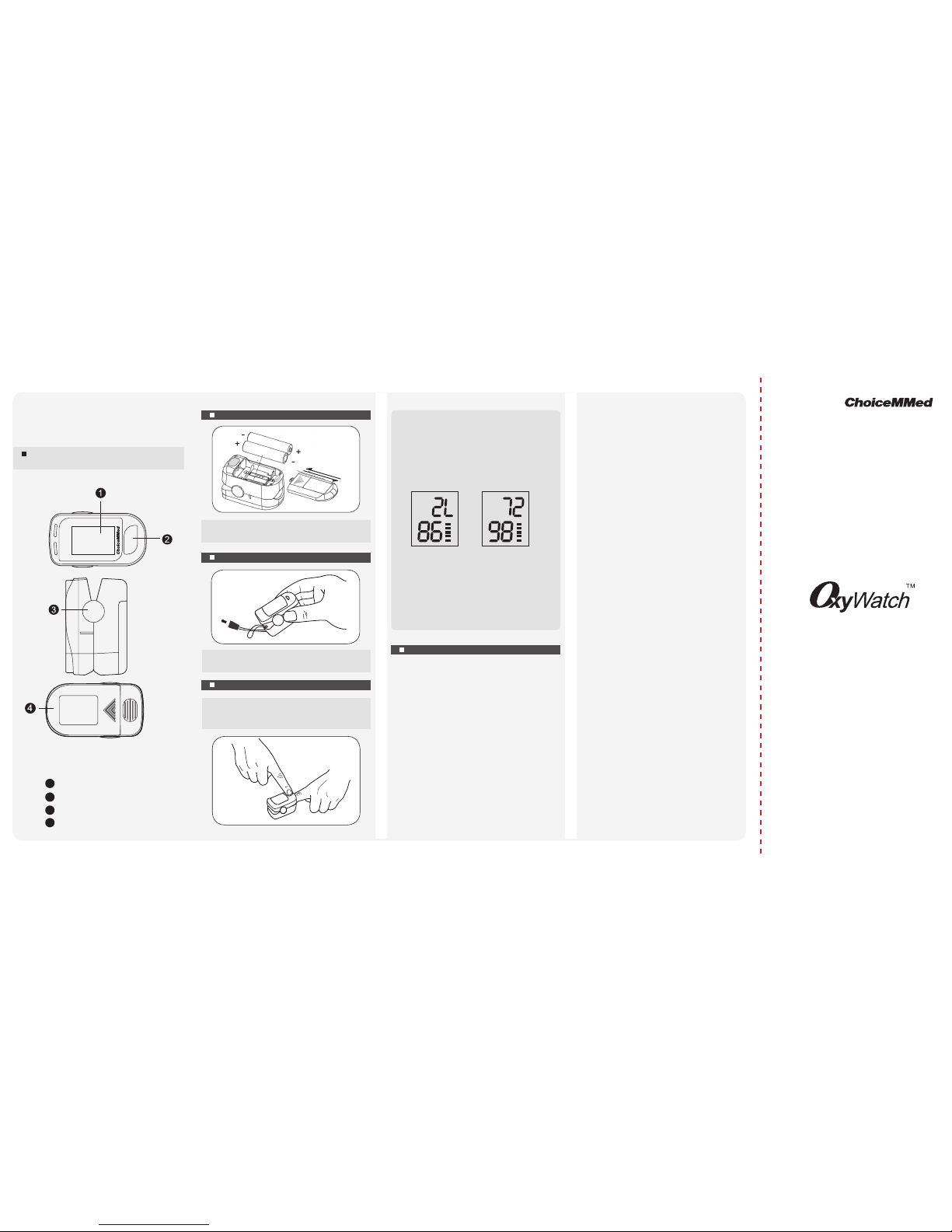
1
Displaying Screen
2
Power Key
3
Shaft Cover
4
Battery Box Cover
Quick Operation Guide
Before using the oximeter, please remove
protective sticker covering the display.
Lanyard Installation
Please put in the batteries according to the polarity
marked inside the battery compartment.
Battery Installation
What is a Pulse Oximeter?
A pulse oximeter is a non-invasive device that
indirectly monitors blood oxygen saturation (SpO
2
)
and pulse rate (heart rate). It displays both blood
oxygen saturation (SpO2) and pulse rate (heart
rate). Pulse oximeters provide an easy way of
assessing your blood oxygen level and pulse rate.
What is SpO2?
SpO
2
is also known as oxygen saturation. Oxygen
saturation is a measure of how much oxygen the
blood is carrying as a percentage of the maximum
it could carry.
What is the normal range of SpO2?
The normal range for SpO
2
is typically considered
from 95%~99%. The SpO2 measurement may be
lower for people who live at high altitudes. Ask
your health professional this question as it pertains
to you.
What is the normal range for pulse rate?
The normal resting range for pulse rate is typically
considered from 60~100 beats per minute. Ask
your health professional this question as it pertains
to you.
What kind of conditions may cause an
inaccurate reading?
Cold hands, poor circulation, very weak pulse,
movement, ngernail polish and acrylic nails may
cause inaccurate results.
The SpO
2
is not changing – it’s stuck?
SpO
2
does not change like pulse rate. It is slow to
change.
The pulse rate is changing rapidly.
Your heart rate changes with emotions, excitement
and exercise.
I do not see the battery light indicator.
The battery light indicator only appears when the
battery is low.
Place one of your ngers into the pulse oximeter to
the end and press the switch button one time on front
panel to turn it on.
Operation Instruction
Tie the lanyard through the hole in the rear of the
pulse oximeter.
Slide Cover
Warnings and Notes
ChoiceMMed_OxyWatch_C15D_Ver1.0
Warnings:
1. Keep the pulse oximeter away from young
children. Small parts such as the battery door and
the batteries, etc., may be hazardous if swallowed.
2. The lanyard may cause strangulation in conditions
that may cause it to twist around the neck.
Notes:
1. Read the manual carefully before use.
2. The illustration used in this manual may differ
slightly from the appearance of the actual product.
3. Follow local ordinances and recycling instructions
regarding disposal or recycling of the device and
device components, including batteries.
ChoiceMMed America Co.
Bristol, PA
Keep your hands still for the reading.
The pluse oximeter will power off automatically in
8 seconds if there’s no nger inside.
There are two display modes. After turning on the
pulse oximeter, each time you press the power
switch, the pulse oximeter will switch to another
display mode.
 Loading...