

Page 1

Gas Barbecues
Assemb ly and Op erating Inst ructions f or Outback®
Trooper Plus, Hunter Plus Gas Barbecues
Photographs are not to scale.
Specifications subject to change
without prior notice.
WARNING
• For outdoor use only. Not f or comm e r ci al use .
• Read instr uc t ions befor e us i ng t he appli ance . Fail ur e to follow instructi ons
could res ul t in death, seri ous bodi ly injur y, and/ or pr oper ty loss.
• Warning: accessibl e par t s m ay be ver y hot. Keep young chi l dr en away.
• Do not move t he applianc e dur ing use.
• Turn off t he ga s supply at the gas bottle after use.
• Any modificat i on of the appliance, misuse, or failure t o follow the instructions
may be dangerous and will invalidate your warranty. This does not affect your
statutory rights.
• Retain these inst r uctions for future r eference.
• Leak test annual l y, and whenever the gas bot t l e is rem oved or repl aced.
• For Flare-up contr ol please refer to the ‘OPERATION’ section of this m anual.
FOR YOUR SAFET Y
If you smell gas:
1. Shut off gas to the appliance.
2. Exti ngui sh a ny open flam e.
3. Open bar bec ue l id or hood.
4. If odour cont inues, discontinue use and
contact your local deal er.
FOR YOUR SAFET Y
1. Do not stor e or use petr ol or other fla m m able
vapours or liqui ds in the vici ni ty of this or
any other appliance.
2. A gas bottle not connected for use shall not
be stored in the vicinity of thi s or any ot her
appliance.
0359
EN (Europe)
Page 2

2
A. Part s List
Quantities vary accor di ng to model purc hased. Specificat io ns s ubject t o change without prior notice.
For more details on hardware, please see ‘ Hardwar e Ref er ence Diagram’.
CODE PART QTY
Outback®
Trooper Plus
Outback®
Hunter Plus
HOOD
A1 Hood Handle 1
A2 L/H Hood Handle Bracket 1
A3 R/H Hood Handle Bracket 1
A4
Hood (Pre-Assembled to Body)
1
A5 Hood Panel 1
A6 Heat Indicator and Nuts 1
BODY
B1
Body (see Part A1: Hood)
1
B2 Burner
2
3
B3 Control Panel 1
B4 Knob
2 3
B5 Flame Tamer 1
B6 Large Cooking Grill 1
B7 Small Cooking Grill 1
B8 Small Cooking Griddle
1
B9 Drip Tray 1
B10 Hose (if supplied)
B11 Warming Rack 1
TROLLEY
C1 Side Shelf 2
C2 Front Left Leg 1
C3 Rear Left Leg 1
C4 Front Right Leg 1
C5 Rear Right Leg 1
C6 Screen 1
C7 Leg Endcap 2
C8 Wheel 2
C9 Hubcap 2
C10 Axle 1
C11 Trolley Base 1
HARDWARE
D1 Trolley Bolt 24
D2 Body Support Bolt 8
D3 Spacer 8
D4 Washer 2
D5 Locknut 2
Pre-A sse mble d C omp onent
Quantity varies according t o model or specification purch ased
Appearance, size, an d construction may differ acc or ding to model purchased
Page 3

3
B. Parts Diagrams
Quantities vary accor di ng to model purc hased. Specificat io ns s ubject t o change without prior notice.
For more details on hardware, please see hardwar e pac k page.
A1
A4
A3
B3
B4
B2
B1
B7 B6 B8
B11
B10
C1
C6
C11
C2 C3 C4 C5
C7
B9
C10
C8
C9
D4 D5
A6
A5
A2
B5
B1
Page 4
4
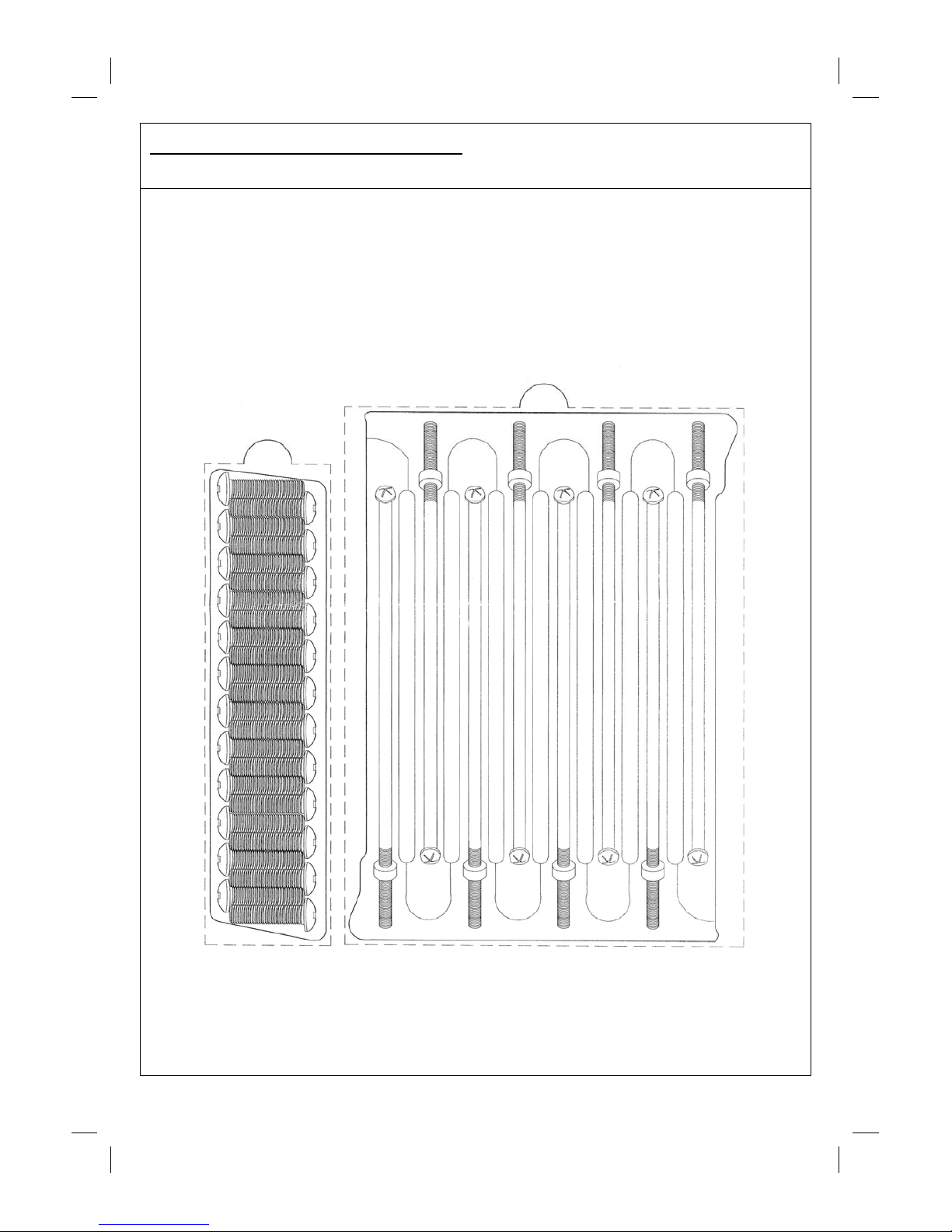
C. Hardware Reference Diagr am
Specifications s ubject to change without prior notice.
Part D1(24pcs)
Part D2(8pcs), D3(8pcs)
Page 5
5
D. Assembly
TOO LS NEEDED FOR ASSEMBLY:
Medium size flat blade or Phillips/crosspoint screwdriver, adjustable spanner or metric spanner set.
Whilst every care is taken in the manufacture of this product, care must be taken during assembly in case sharp
edges are present.
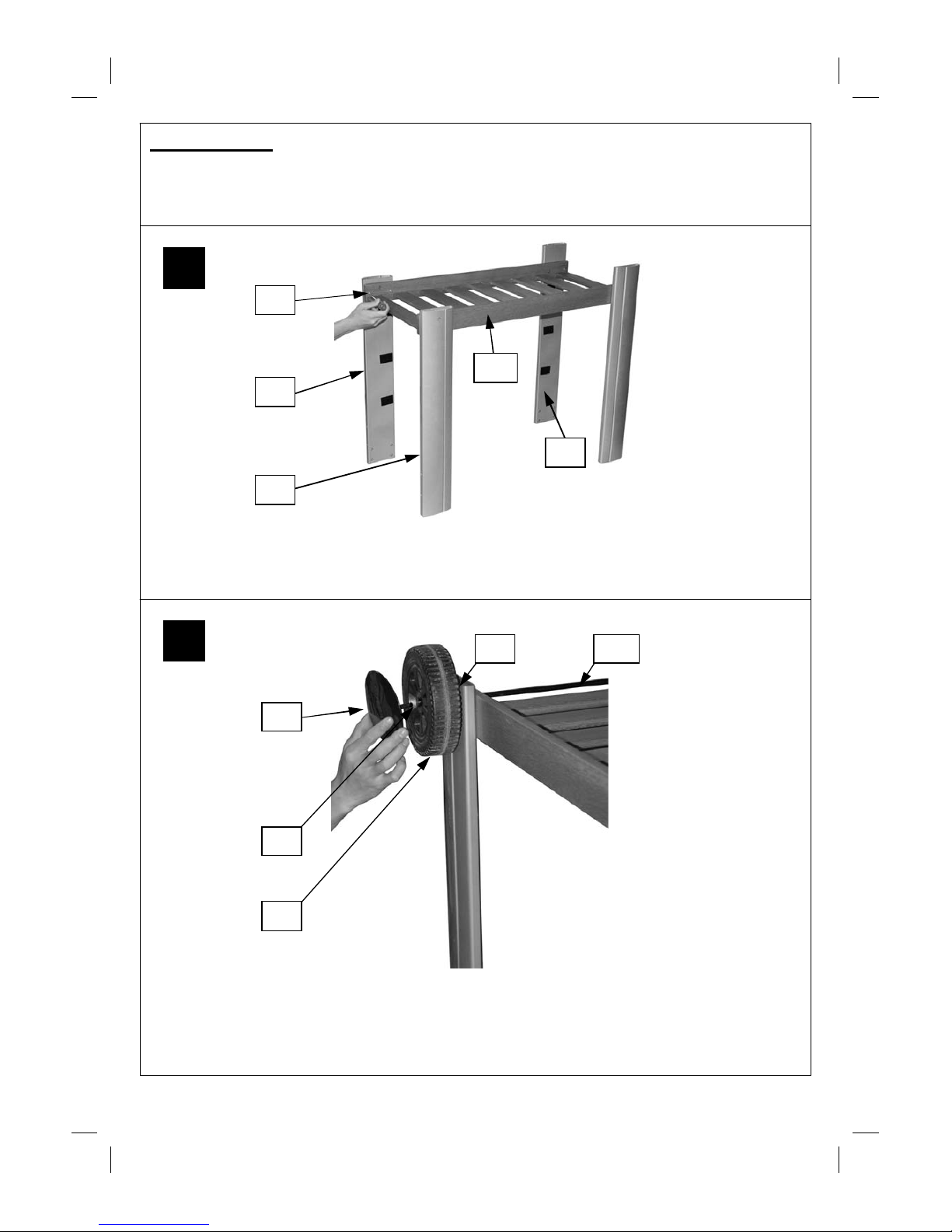
Attach the legs (C2,C3,C4,C5) to the trolley base (C11) using the trolley bolts (D1).
Take care to fix the legs with Ve lcro attached as show n in the illustration.
(Photo depicts trolley
from the reverse side)
C3
C2
D1
C11
C4
C9
D4 C10
D5
C8
Slide the axle (C10) through the corresponding holes in the short legs. Place a
washer (D4) on each end of the axle. Sl ide the wheels (C8) over each end of the
axle. Secure the wheels into place with the locknuts (D5). Snap the hubcaps ( C9)
into the wheels.
1
2
Page 6

6
Attach the side s helves (C1) to t he front/ rear left legs (C2,C3) and fro nt/rear right
legs (C4,C5) using the trolley bolts (D1) .
C1
D1
B1
B7 B6 B8
B5
Remove all cast iron cooking components, Flame Tamer, drip tray, and any internal
packaging from the barbec ue body.
Note: Loosen off the bolts and move the brackets down to their lowest position.
Retighte n the bolts.
B9
3
4
Page 7
7
B1
B1
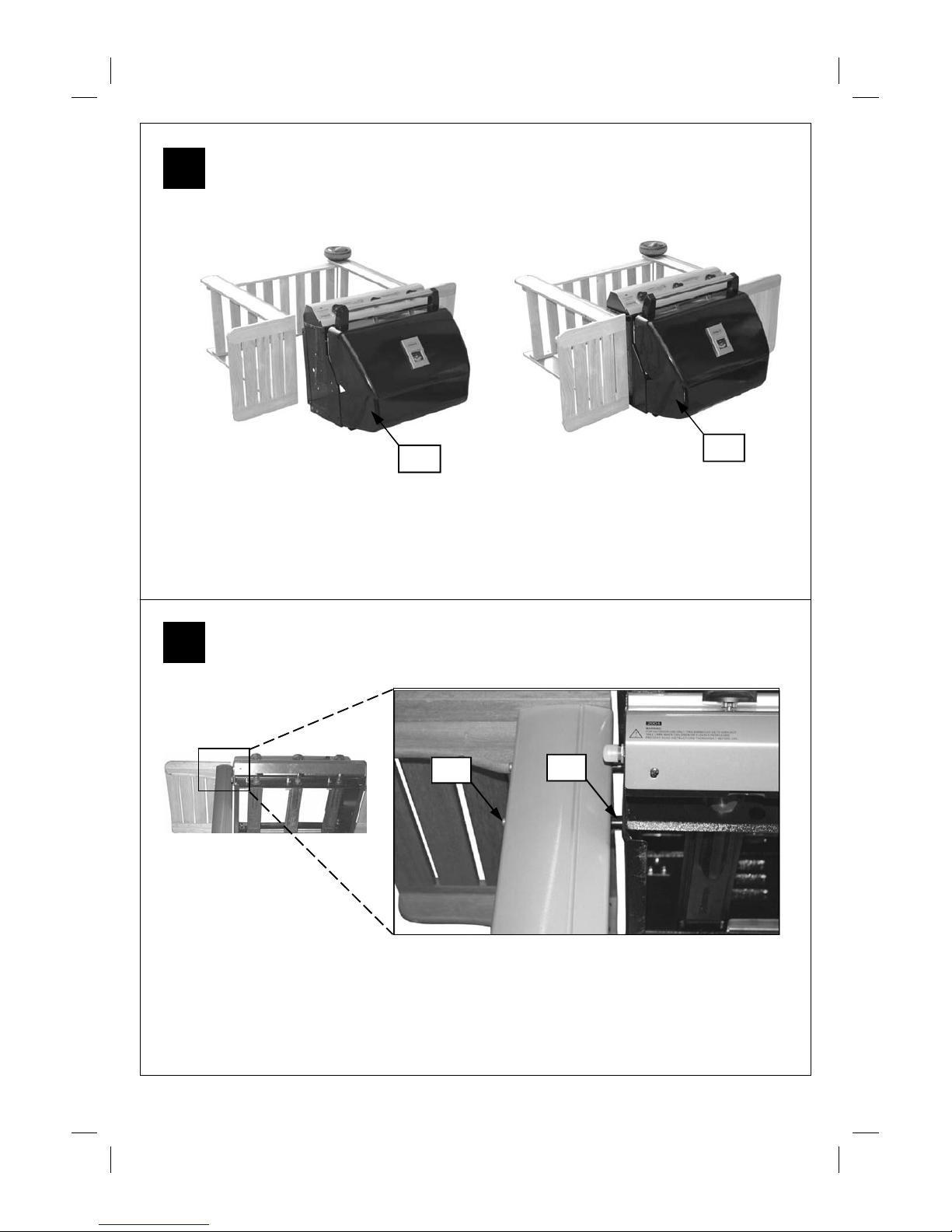
Lay the assembled trolley o n its side. Lay the body (B1) on its back and slide into position
between the trolley legs. Warning: Care must be taken to ensure hoo d does not fall ope n
unexpectedly. W he n positioning the body of the barbec ue, ensure the control pa nel is o n
the same side as the legs with Velcro fastenings.
D3
D2
With the barbec ue laid on the ground, insert a body support bolt ( D2) through the short leg,
through a spacer (D3), and secure the bolt into the sidewall of the body. Repeat the
process for all the legs until the body is completely fixed t o t he trolley.
5
6
Page 8

8
Replace the drip tray ( B9) by sliding it underneath the barbecue body.
Lay the flame tamer (B5) i nto t he body ensuring it lie le vel within the body. Lay t he grills
(B6, B7) and griddle (B8) into place.
2 bur ner mod el conf igurat ion: Left — L arge Cook ing Grill, Right — Small Cooking Gr ill,
3 bur ner mod el conf igurat ion: Left — L arge Cook ing Grill, M id d le — Small Co ok ing Gr ill,
Right — Small Griddle Plate.
NOTE: No lava rock is required when using the flame tamer
B5
B9
B6 B7 B8
7
8
Page 9

9
(Rear view of the barbecue trolley.)
Attach the screen (C6) to the front left/right
legs as shown.
C6
Leak Test Diagram
ASSEM BLY IS NOW COMPLETE.
PROCEED TO THE NEX T PAGE FOR INSTRUCTIO NS ON OPERATION AND MAINTENANCE.
ALL JOINTS AND CONNECTIONS
MUST NOW BE LEAK TESTED
BEFORE USING THE BBQ. FOR
DETAILS OF LEAK TESTING,
PLEASE REFER TO INSTRUCTIONS
ON PAGE 11.
Connect the gas hose to the BBQ. Ensure
the mating faces of the connection are clean
and not damaged. Do not use any sealing
tape, paste or liquid on the joint. The nut
must be tightened with a spanner. Do not
use force which may damage the assembly.
Attach the warming rack (B11) to the
hood as shown.
9
10
Page 10

10
E. Important Information
Please read these instructions carefully
before assembly and use.
nRetain these instructions for future
reference.
nFor outdoors use only – do not use
indoors. Do not use below ground level.
nFor use with LPG bottled gas only. A
suitable regulator must be used for
Butane, propane or mixes.
nRemove plastic wr ap f r om any part before
lighting.
nDo not use within 1m of any flammable
structure or surface.
nLP gas bottles should not be placed
directly underneat h the barbecue.
nLP gas bottles must not be stored or used
in the hor izo ntal position. A leak would be
very serious and liquid could enter the
gas line.
nOpen the barbecue hood before lighting.
nDo not move the barbecue while alight.
nThis barbecue must not be left
unattended when lit.
nThe hood handle can become very hot.
Grip only the centre of the handle. Use of
a cooking glove is advised.
nUse caution when opening the hood, as
hot steam inside is released upon
opening.
nParts of this barbecue become very hot –
care must be taken when c hildre n, elderly
people, and animals are present.
nAlways turn off the gas bottle when the
barbecue is not in use.
nNever cover a barbecue until completely
cooled.
nLeak test annually, and whenever the gas
bottle is removed or replaced.
nDo not store flammable materials near
this barbecue.
nDo not use aerosols near this barbecue.
nFail ure t o follow t he manual’s i nstruct ions
could result in serious injury or damage.
nModification of the barbecue may be
dange rous, is not p e rmitt ed and will nul lify
any warranty.
nIf you have any queries regarding these
instructions, contact your local dealer.
F. Gas and Regulator
This barbecue can use either propane or
butane LPG bottled gas. Propane bottles, will
supply gas all year round, even on cold
winter days. A spanner may be required to
change gas bottles. Butane bottles, will
supply sufficient gas in summer, but
performance of the barbecue may be
affected once the gas temperature starts to
fall below +10°C. The bot tle should never be
stood on the trolley base and placed directly
under the barbecue. Gas bottles should
never be stored or used laid on their side.
Never stor e gas bottles indoors.
YOU MUST HAVE THE PROPER
REGULATOR AND BOTTLE IN ORDER
FOR THE BARBECUE TO OPERATE
SAFELY AND EFFICIENTLY. USE OF AN
INCORRECT OR FAULTY REGULATOR IS
DANGE RO US AND WIL L INVALID ATE A NY
WARRANTY. Please consult your local gas
dealer for the most suitable gas bottles and
regulators.
G. Installation
G1. Selecting a Location
This barbecue is for outdoor use only and
should be placed in a well-ventilated area.
Take care to ensure that it is not placed
UNDER any combustib le surface. The sides
of the barbecue should NEVER be closer
than 1 metre from any combustible surface.
Keep this barbecue away from any
flammable materials.
G2. Pr ecaut ions
Do not obstruct any ventilation openings in
the barbecue body. Position the gas supply
bottle on level ground next to the barbecue
and safely away from any source of heat.
Should you need to change the gas bottle,
confirm that the barbecue is switched off,
and that there are no sources of ignition
(cigarettes, open flame, sparks, etc.) near
before proceeding. Inspect the gas hose to
ensure it is free of any twisting or tension.
The ho se sho ul d hang fr ee ly wi th no be nd s,
folds, or kinks that could obstruct free f low of
gas. Apart from the connection po int, no part
Page 11

11
of the hose should touch any hot barbecue
parts. Always inspect the hose for cuts,
cracks, or excessive wear before use. If the
hose is damaged, it must be replaced with
hose suitable for use with LPG and meet the
national standards for the country of use.
The length of t he hose shall not exceed 1.5m.
N.B.-The date on the orange hose (if
provided) is the date of manuf acture, not the
expiry date.
G3. Connecting a Gas Hose to the
Barbecue
Connect the gas hose to the gas rail inlet o n
the left hand side of the barbecue. Do not
overtighten. Do not use any sealing tape or
liquid on the connection.
G4. Fixing a Regulator t o t he Gas Bott le
Confirm all barbecue control knobs are in t he
off posit ion. Connect the regulator to the gas
bottle according to your regulator and bottle
dealer’s instr uctio ns.
G5. Leak T esting (To be performed in a
well-ventilat ed ar ea. )
Confirm all control knobs are in the off
position. Detach the barbecue control panel
located across t he front of t he barbecue body
by pulling off the control knobs and r emoving
the control panel retaining screws. O pen t he
gas control valve on the bottle or regulator.
Check for leaks by br ushing a solution of ½
water and ½ soap over all gas system joi nts,
including all valve connections, hose
connections and regulator connections.
NEVER USE AN OPEN FLAME to test for
leaks at anytime. I f bubbles form over any of
the joints, there is a leak. Turn off the gas
supply and retig hten all joints. Repeat t est. If
bubbles form again, do not use the
barbecue. Please contact your local dealer
for assistance. Leak test annually, and
whenever the gas bottle is removed or
replaced.
H. Operation
H1. nWarnings
nBefore proceeding, make certain that you
understand the IMPORTANT
INFORMATION sec t io n of t his manual.
nThis barbec ue is not designed to be used
with more than 50% of the cooking area
as a solid plate. Full coverage of plates
will c ause excess ive b uild- up of heat a nd
damage the barbecue. This is not
covered by warranty.
H2. Preparat ion Befor e Cooking
To prevent foods from sticking to the
porcelain, please use a long handled brush
to apply a light coat of cooking or veget able
oil before each barbecuing session. Line the
drip tray with aluminium foil, then place a
uniform layer of clean, dry sand 1cm deep
into the t ray . This will ab sor b exces s coo k ing
fat, thus making cleanup easy.
H3. Lighting the Barbecue Using the
Integra-Spark Integr at ed Ig nit i on Syst em
• Open the roasting hood of your barbecue
before lighting.
• Open the gas control valve on the gas
bottle or regulator.
• Pus h the control knob of the bur ner yo u
wish to light and turn it anti-clockwise
until you feel resistance to the turning.
Pause 4 seconds, then continue turning
the control knob until a click is heard and
the burner is lit. Repeat pr evious step 4-5
times until the bur ner is lit. Ignite any of
the remaining burners in any order, as
needed. Confirm each burner is alight
before igniting another burner. If any
bur ner fails to ignite after following a bove
procedure, turn all the knobs to the off
position. Close the gas valve on the gas
bottle. Wait five minutes. Reattempt all of
the abo ve ste ps. If the bar bec ue still f ails
to light, please refer to the manual
ignit ion ins tructions below.
• After ignition, burners should be burned
at the high position for 3-5 minutes in
order to preheat the barbecue. This
process should be done before every
cooking session. The hood should be
open during preheating.
• After completion of preheating, turn all
burners to the low position for best
cooking results.
H4. Manual Ignition I nst r uct ions
• Open the barbec ue hood
• Insert lit match through the leftmost
Page 12

12
match-lighting hole o n the underside of
the control panel and place near
leftmost bur ner port hole.
• Pus h and turn the leftmost control knob
anti-clockwise to the high posit io n.
• When the left burner is lit, turn the
remaining b urners on from left to right.
• Confirm that each burner is alight
before t urning on the next burner.
• If leftmost burner fails to ig nite, contact
your local dealer for ass ist ance.
• After ignition, turn the burners to the
high position for 3-5 minutes i n order to
pre heat the barbec ue. This should be
done before each cooking session.
When pre heating is complete, cooking
can begin, taking extra care if burners
are left in the high position.
• After completion of preheating, turn all
burners to the low position for best
cooking results.
H5. Grill Coo king
The burners heat up the flame tamer
underneath t he grill, which in turn heats the
food on the grill. The natural food juices
produced during cooking fall onto the hot
flame tamer below and vaporise. The
subsequent rising smoke bastes the food,
as it travels upw ards, imparting that unique
barbecued flavour. More even cooking of
food will b e achieved by using the BBQ with
the hood down. This should only be done
with the burners on low.
H6. Griddle Plate Cookin g
The burners heat the griddle plate directly,
which then cooks the food on contact.
Plates allow for the cooking of smaller
items, such as seafood, which could fall
thro ugh the spa ces of a grill. They are als o
suitable for cooki ng items that req uire hightemperature/short-duration cooking, such
as vegetables and smaller cuts of fish.
Similarly, it c an be used i n exactly the same
way as a griddle in the kitche n, for searing
steaks, cooking eggs, etc. Alternatively, it
can be used for heating pans or keeping
food war m.
H7. Roasting Hood Cooking
Barbecues equipped with a roasting hood
give the optio n of cooking with hood close d
to form an ‘ove n’ for roasting food, suc h as
joints of meat, whole chickens, etc.
When roasting, turn the burner directly
under the food to the OFF positio n. Turn all
other burners to a LOW to MEDIUM
positio n and close the hood. Avoid lifting the
hood unnecessarily as heat is lost every
time the hood is opened. Use the
temperature ga uge to check the heat of the
barbecue. DO NOT ALLOW YOUR
BARBEC UE TO OVER HEAT.
H8. Rotisserie Operating Instructions
(Opt ional accessory)
1. Carefully remove the cast iron cooking
surfaces and the warming rack from the
barbecue.
2. Slide one of the spit forks onto the spit
rod and tighten its thumb screw to
secure it into place. Insert the pointed
end of the spit rod i nt o the meat being
cooked and slide the meat tow ards the
centre of the rod. M ake sure t he f ork is
fully into the meat. Slide the other fork
onto the rod, into the meat, and tight en
the thumb screw once in place. For
optimal rotisseri e cooking, food m ust be
placed securely onto the middle of the
spit rod and balanced so that the
rotisserie can rotate freely without
interference from any barbecue
surfaces. Any loose sections of meat
should be secured so t hey do not hang
down and interfere with the rotation of
the spit rod. Do not overload the
rotisser ie. A chicke n or joint of meat of
approximately 2kg should be the
ma ximu m.
3. Insert the pointed end of the spit rod
into the motor. Lay t he other end of the
spit rod onto the opposite bracket .
4. Light the grill as specified in your
barbecue’s instructio ns.
5. Turn on the rotisserie motor to begin
rotisserie cooking. The hood has been
designed so that it may be closed
during rotisser ie cooki ng.
6. Always cook foods on the lowest flame
setting to avoid burni ng or overcooking.
Page 13

13
H9. Flare -Up Control
*** Ve ry Important Notice ***
Flare-ups occur when meat is barbecued, and
its f at and juices fall upo n the hot flame tamer.
Smoke of course helps give food its barbecued
flavour, but it i s best to avoid excessive flare-up
to prevent food being burned. To control flareups, it is ABSOLUTELY ESSENTIAL to trim
away excess fat from meat and poultry before
grilling, use cooking sauces and marinades
sparingly and try to avoid very cheap cuts of
meat or meat products as these tend to have a
high fat and water content. Also, the burners
should always be placed on the low setting
during cooking. When flare-ups do occur, they
can usually be extinguished by applying baking
soda or salt directly onto the flame tamer.
Always protect your hands when handling
anything near the cooking surface of the
barbecue, and take care to protect yourself
from t he flames.
If a fat fire should occur in the drip tray, turn all
knobs to the off position, turn off the gas at the
bottle, and wait for the fire to go out. NEVER
pul l out th e drip tray or douse with water.
H10. End of Cooking Sessi on
After each cooking session, turn the
barbecue burners to the “high” position and
burn for 5 mi nut es. This proced ur e will bur n
off cooking residue, thus making cleaning
easier. Make sure the hood or lid is open
during this process.
H11. Tur ning Off Your Barbecue
When you have finished using your
barbecue, turn all the control valves fully
clockwise to the “Off” position, then switch off
the gas at the bottle.
I. Care and Maintenance
Regularly clea n your barbecue between uses
and especially after extended periods of
storage. Ensure the barbecue and its
components are sufficiently cool before
cleaning. Do not leave the barbecue expos ed
to outside weather conditions or stored in
damp, moist areas.
nNever douse the barbecue with water
when its surfaces are hot.
nNever handle hot parts with unprotected
hands.
In order to extend t he life and maintain the
condition of your barbecue, we strongly
recommend that the unit be covered when
left outside for any length of time, especially
during the winter months. Heavy-duty
Outback® barbecue covers and other
accessories are available from your local
Outback® stockist.
I1. Porcelain Coated Cast Iron Cooking
Surfaces
Clean with hot, soapy water. To remove a ny
food residue, use a mild c ream cleaner o n a
non-abrasive pad. Rinse well and dry
thoroughly. We do not recommend cleaning
grills and grid dles in a dis hwa s her .
I2. Bu r n e r Main tenan c e
Provided that they are operating correctly, in
normal usage, burning off the residue after
cooking will keep the burners clean. The
burners should be removed and cleaned
annually, or whenever heavy build-up is
found, to ensure that there are no signs of
blockage (debris, insects) in either the bur ner
portholes or the primary air inlet of the
burners. Use a pipe cleaner to clear
obstructions. When refitting the burners, be
careful to check that the neck of the burner
fits over the valve outlet.
I3. Flame Tamer
Remove any food residue from the flame
tamer surface with a plastic or wooden
scraper or brass wire brush. Do not use a
steel scraper or wire brush. Clean with hot
soapy wat er and rinse well.
I4. Drip T r a y
After every use clean the drip tray and
grease cup of any fat or food particles.
Failure to keep these clean can res ult in a fat
fire. This can se verely damage t he barbecue
and is not covered by the warranty.
I5. Ba r b ec ue Bo dy
Regularly remo ve e xcess grease or fat from
the barbecue body with a soft plastic or
wooden scraper. It is not necessary to
remove all the grease from the body. If you
Page 14
14
need to clean f ully, use hot soapy water and
a cloth, or nylon-bristled br ush only. Remove
cooking surfaces and burners before full
cleaning. Do not immerse the gas cont rols or
manifold in water. Check burner operation
after carefully refitt ing into body.
I6. Barbecue Hood
Use a non-abrasive cloth or pad and clean
with hot, soapy water. Do not use scouring
pads or powders as they can permanently
damage the finish.
I7. Trolle y
Your trolley is manufactured using a
hardwood suited to outdoor use, provided it
is treated with Teak oil or similar after
assembly and on a regular basis thereafter.
Hardwood w ill nat urally w eather a nd change
its appearance. It is quite natural for small
cracks to appear on the surface of the wood.
I8. Fixings
All screws and bolts, etc. s hould be checked
and tightened on a regular basis.
I9. Storage
Store your barbec ue in a cool dry place. To
save space during long-term storage, the
side shelf screws can be removed, the side
shelves repositioned vertically (pointing
towar ds the floor), and the scr ews replaced.
Cover the burners with aluminium foil in
order t o pr event i nsect s or other debris from
collecting in burner holes. When using the
barbecue after extended periods of storage,
return side shelves to the normal position
and follow the cleaning procedures. The
barbecue should never be oper ated with the
shelves positioned vertical ly. If the barbecue
is to be stored indoors, the gas bottle must
be disconnected and left outside. The gas
bottle should always be stored outside, in a
dry, well-ventilated area, away from any
sources of heat or ignition. Do not let children
tamper with the bottle.
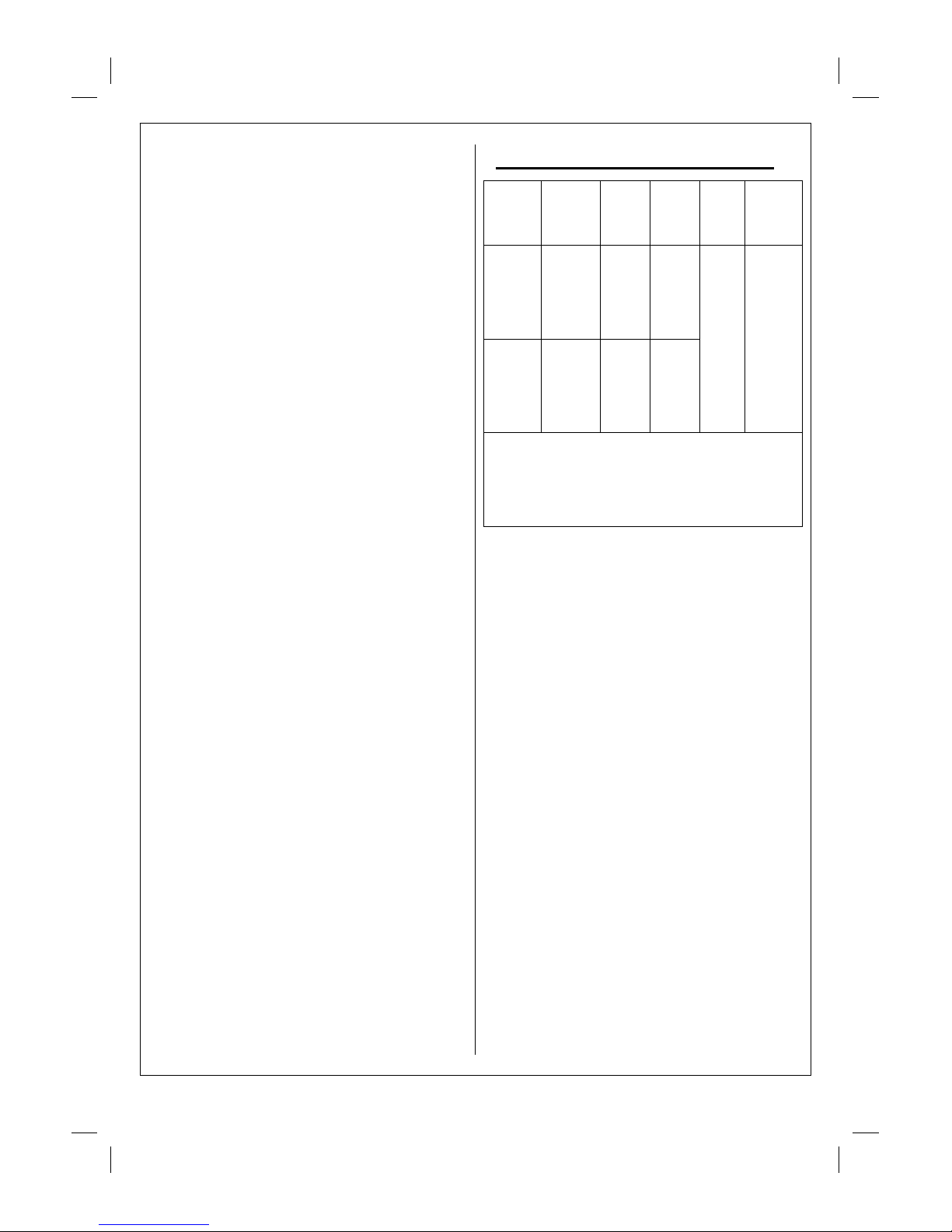
J. Techn ical Specifications
Specifications ar e subject to change without prior not ice.
CE
Approval
Heat
Input
Burners
Injector
Size
Gas /
Pressure
Outback®
Trooper
Plus
0359
359AS128
7.87kW 2
1.02
Butane/
28mbar
Propane/
37mbar
Butane/
Propane
30mbar
Butane/
Propane
50mbar
Butane/
Propane
36mbar
Outback®
Hunter
Plus
0359
359AS128
11.8kW 3
Countries of Use:
I
3+ (28-30/37)
BE, CY, CZ, EE, FR, GR, IE, IT, LV, LT, LU, PT, SK, ES,
CH, GB, RO
I
3B/P(30)
BG, CY, CZ, DK, EE, FI, GR, LV, LT, LU, MT, NL, NO, SK, SI,
SE, TR, IS
I
3B/P(50)
AT, DE, HU, SK, CH
I
3B/P(36)
PL
Page 15

15
K. Troubleshooting
Problem Possible Cause Solution
Bu rn ers wil l no t li gh t usin g
the ignition system
L P ga s bo tt le is em pt y Replace with full bottle
Faulty regulator Hav e re gu la to r ch ec ke d or rep la ce d
Obstructions in burners Clean burners
Obstructions in gas jets or gas hose Cle an jet s an d ga s ho se
Electrode wire is loose or disconnected
on el ec tr od e or ign it io n un it
Reconnect wire
Electrode or wire is damaged Cha ng e el ec tr od e an d wi re
Faulty integral ignitor Change ignitor
Burner will not light with a
match
L P ga s bo tt le is em pt y Replace with full bottle
Faulty regulator Hav e re gu la to r ch ec ke d or rep la ce d
Obstructions in burners Clean burners
Obstructions in gas jets or gas hose Cle an jet s an d ga s ho se
Lo w fl a me or fl as hb ac k
(fire in burner tube— a
hissing or roaring noise
may b e h ear d)
LP gas bottle too small Use larger bottle
Obstructions in burners Clean burners
Obstructions in gas jets or gas hose Cle an jet s an d ga s ho se
Windy conditions Use BBQ in a more sheltered position
Gas val ve k no b di ff ic ul t to
turn
Integral ignition system jammed Replace integral gas valve
Gas valve jammed Replace gas valve
For reference and correspondence,
record your serial number here.
(See sticker on side of barbecue body.)
Serial No.__________________
This number may be required when
ordering spare parts or accessories. A
part reference number may also be
required where applicable.
Published November 2007
 Loading...