

Page 1
0000161244000001
0543
Avoiding heat, humidity
and chemicals
Your hearing instrument must never be exposed to extreme
heat e.g. left inside a parked car in the sun. They must never
be exposed to a lot of moisture e.g. steam baths, showers or
heavy rain. Nor must they be dried in microwave ovens or
other ovens.
Wipe the batteries carefully if moisture is present as it may
affect their performance. Using an anti-humidity kit can help
to avoid these problems and may even extend the life of your
hearing instrument. Consult your Hearing Care Professional
for further advice.
The chemicals in cosmetics, hairspray, perfume, aftershave
lotion, suntan lotion and insect repellant can damage your
hearing instrument. You should always remove your hearing
instrument before applying such products and allow time for
the product to dry before refitting your hearing instrument. If
you use lotion, be sure to wipe your hands dry before putting
on your hearing instrument.
Waste from electronic
equipment must be
handled according to
local regulations.
International Warranty
Your hearing instruments are covered by a limited warranty
issued by the manufacturer for a period of 12 months from
the date of delivery. This limited warranty covers manufacturing and material defects in the hearing instrument itself, but
not accessories such as batteries, tubing, ear wax filters etc.
Problems arising from improper handling or care, excessive
use, accidents, repairs made by an unauthorized party,
exposure to corrosive conditions, physical changes in your
ear, damage due to foreign objects entering the device, or
incorrect adjustments are NOT covered by the limited
warranty and may void it.
The above warranty does not affect any legal rights that you
might have under applicable national legis lation governing
sale of consumer goods. Your Hearing Care Professional may
have issued a warranty that goes beyond the clauses of this
limited warranty. Please consult him/her for further
information.
If you need service
Take your hearing instrument to your Hearing Care Profes sional,
who may well be able to sort out minor problems and
adjustments on the spot.
Oticon declares that this hearing instrument is in compliance
with the essential requirements and other relevant provisions
of Directive 1999/5/EC.
Declaration of Conformity is available at the manufacturer:
Manufactured by:
Oticon A/S
Kongebakken 9
DK-2765 Smørum
Denmark
www.oticon.com
Usage of hearing instruments
• Hearing instruments should be used only as directed and
adjusted by your Hearing Care Professional. Misuse can
result in sudden and permanent hearing loss.
• Never allow others to wear your hearing instrument as
incorrect usage could cause permanent damage to their
hearing.
Choking hazards
• Hearing instruments, their parts, and batteries are not toys and
should be kept out of reach of children and anyone who might
swallow these items or otherwise cause injury to themselves.
• Never replace the battery or adjust the controls of the
hearing instrument in front of infants, small children or
people with learning diculties.
• Discard batteries carefully in a place where infants, small
children or people with learning diculties cannot reach
them.
• Batteries have occasionally been mistaken for pills. Therefore
check your medicine carefully before swallowing any pills.
• Never put your hearing instrument or batteries in your mouth
for any reason, as they are slippery and could be swallowed
by accident.
• Most hearing instruments can be supplied with a tamperresistant battery compartment upon request. This is
strongly recommended for infants, small children, and
people with learning diculties.
If a battery or hearing instrument is swallowed, see a doctor
immediately.
Battery use
• Always use batteries recommended by your Hearing Care
Professional. Batteries of low quality may leak and cause
bodily harm.
• Never attempt to recharge your batteries. They may
explode and cause serious injury.
• Never dispose of batteries by burning them. There is a risk
that they will explode and cause serious injury.
Dysfunction in hearing instruments
• Hearing instruments may stop functioning, for instance if
the batteries have expired or if the speaker is blocked by
moisture or ear wax. You should be aware of this possibility,
in particular when you are in trac or otherwise dependent
on warning sounds.
Active implants
• If you wear an active implant, then keep the hearing
instrument more than 15 cm away from the implant e.g.
do not carry them in a breast pocket.
• If you have an active brain implant, please contact the
manufacturer of your implantable device for information
about the risk of disturbance.
Explosives
• The power source in your hearing instrument has
insucient energy to cause re in normal conditions of use.
The hearing instrument has not been tested for compliance
with international standards concerning explosive
atmospheres. It is recommended not to use your hearing
instrument in areas where there is a danger of explosions.
X-ray, CT, MR, PET scanning and
electrotherapy
• Remove your hearing instrument for example during X-ray,
CT / MR / PET scanning electrotherapy or surgery as your
hearing instrument may be damaged when exposed to
strong elds.
Power instrument
• Special care should be exercised in selecting, tting
and using a hearing instrument where maximum sound
pressure capability exceeds 132 dB SPL (IEC 711), as there
may be risk of impairing the remaining hearing of the
hearing instrument user.
Possible side eects
• Hearing instruments, moulds or domes may cause an
accelerated accumulation of ear wax.
• The otherwise non-allergenic materials used in hearing
instruments may in rare cases cause a skin irritation or any
other unusual condition.
Please seek consultation with a physician if these conditions occur.
Interference
• Your hearing instrument has been thoroughly tested for
inter-ference, according to the most stringent international
standards. However, interference with your hearing instrument and other devices may occur, for example for some
mobile telephones, citizens band devices and shop alarm
systems. If this occur increase the distance between the
hearing instrument and the device.
IMPORTANT NOTICE
Please familiarise yourself with the following general
warnings and both this User Guide and the Instruction for
use before using your hearing instrument. It contains
instructions and important informa tion about the use and
handling of your hearing instru ment and batteries.
CAUTION
Sumo DM is a powerful hearing instrument. Never allow
others to wear your hearing instruments, as incorrect or
wrongful usage could cause permanent damage to their
hearing.
161244UK / 05.15
BTE
INSTRUCTIONS FOR USE
SUMO DM
Warnings Warnings
Indications for Use
The hearing instrument is intended to amplify and transmit
sound to the ear and thereby compensate for profound
impaired hearing.
Page 2
Cleaning the mould
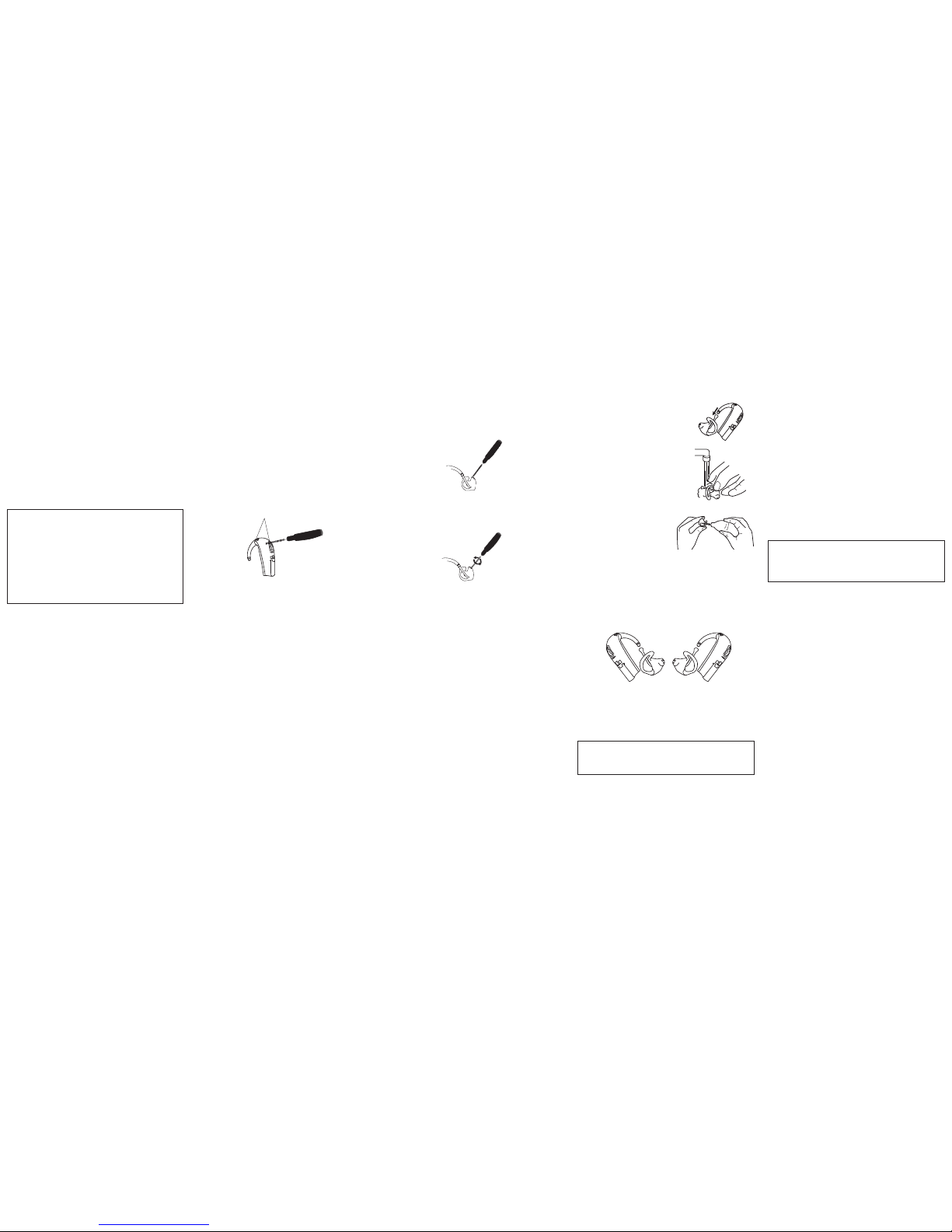
The mould should be cleaned regularly:
• Clean away any traces of wax from around the sound outlet
with a brush. Hardened sediments can be removed by a
wire loop.
• Clean the ventilation opening by pressing the brush
through the hole while twisting it slightly.
Use the cloth to clean the surface of the instrument.
A MultiTool can be purchased from your Hearing Care
Professional. A MultiTool contains a brush and a wireloop for
cleaning wax from the mould.
Washing the mould
The mould should be washed regularly:
• Disconnect the mould and the tubing
from the sound hook of the hearing
instrument.
• Wash the mould in lukewarm
water using a mild soap. Do not
use strong detergents.
• Rinse with water.
• Dry the mould.
• Any water drops inside the
mould or tubing should
be blown out. A special
device for this purpose (an
mould blower) is available
from your Hearing Care
Professional.
• Make sure the mould and tubing are completely dry before
they are reconnected to the hearing instrument. Be careful
that left ears mould and tubing are connected to the
hearing instrument with left ear marking and vice versa for
the right ear instrument.
Replacing the tubing
The tubing in the mould should be replaced when it becomes
yellow or stiff. Consult your Hearing Care Professional in
relation to this.
IMPORTANT NOTICE
The hearing instrument itself must never be washed or
immersed in water or other liquids!
Caring for your hearing instrument
Your ear canal produces ear wax (cerumen) which may clog
up the sound outlet or the ventilation opening of your mould.
To prevent wax accumulation causing a change in performance, the guidelines in this section should be followed.
When handling a hearing instrument, keep it over a soft
surface to avoid damage if you drop it.
Before retiring at night:
• Make sure that there is no ear wax in any of the mould
openings since it may reduce the hearing instrument’s
eciency.
• Open the battery door to allow air to circulate.
IMPORTANT NOTICE
• Only use parts designed for your hearing instrument.
• Proper preventive care and maintenance will go a long
way toward ensuring reliability and safe performance.
Clean your tube on a regulary basis.
• Do not share your hearing instrument or any of the
parts with other people.
• Ensure your hands are clean when handling the
hearing instrument and its parts.
• The hearing instrument itself must never be washed or
immersed in water or other liquids.
Cleaning the instrument
A special purpose brush can be used for cleaning. These
should be used to ensure the best care and performance of
your hearing instrument. Use a cloth to wipe clean the surface
of the instrument.
Cleaning the microphone openings
Make sure that the microphone openings are not clogged
by dust or dirt. Carefully brush away visible signs of debris
from the openings. Brush only on the surface and make sure
the hairs of the brush are not pressed into the openings. Be
careful not to push debris into the microphone openings, as
this can affect the performance of the instrument.
Accessories
FM
Your hearing instrument supports the option of attaching a
FM system. This consists of a dedicated FM receiver and a FM
transmitter. The FM system allows you to receive speech or
audio signals clear from background noise directly to your
hearing instrument.
DAI
Your hearing instrument supports the option of attaching a
DAI adaptor. The Dai adaptor is a connector that allows you to
input audio signals directly to your hearing instrument.
The DAI adaptor is mounted on the hearing instrument and is
connected by a cord to an external sound source, like a radio,
music player or hand microphone.
IMPORTANT NOTICE
When the DAI is connected to an audio source plugged
into a wall outlet, the audio source must comply with
IEC-60065, IEC-60601 or equivalent safety standards.
For detailed information on accessories ask your Hearing Care
Professional.
Microphone openings
 Loading...