

Page 1
Page 2
People First
People Fi rst is ou r promise
to empower people
to communicate freely,
interact naturally and
participate actively
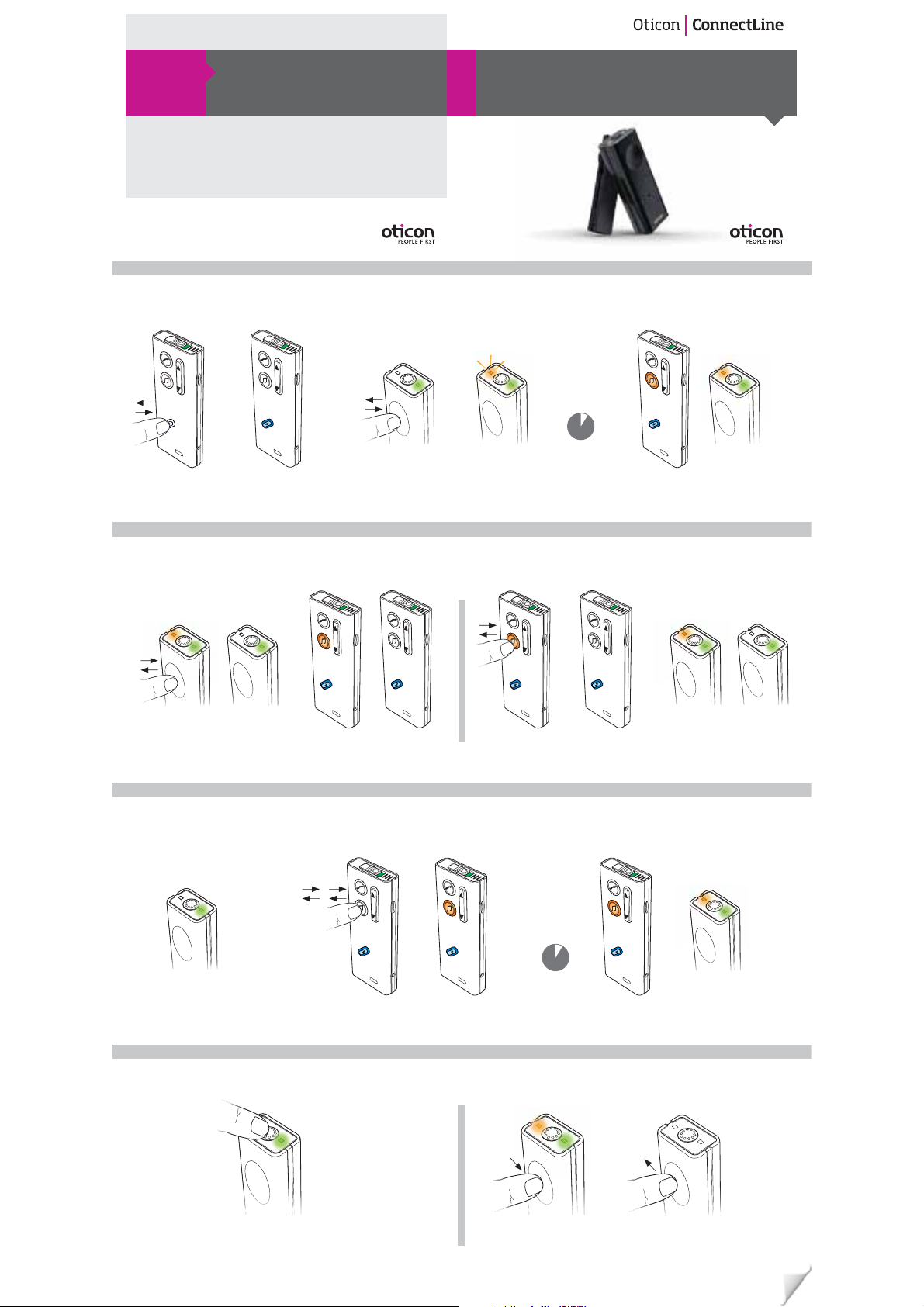
INSTRUCTIONS FOR USE MICROPHONE
Start / turn on / resume sound from Microphone
1. Make sure Streamer is on 2. Start / turn on Microphone 3. Sound from Microphone to Streamer
5 secs
Short press on connect
button
Blue light slowly
pulsating on Streamer
Short press on
on/off
Orange light
slowly pulsating
Orange light Streamer on
and orange light Microphone on
Pause sound
a. Pause sound from Microphone b. Pause sound from Streamer
Short press on
on/off button
Orange light
on Microphone
turns off
Orange light on Streamer
turns off
Short press on
Streamer audio
button
Orange light
Streamer off
Resume sound from Streamer
1. Microphone has to be on 3. Sound from Microphone to Streamer2. start sound from Streamer
Two short
presses
12
2 secs
Orange light Microphone
turns off
(green light on)
two short presses
on audio button
Check sound
Tap the top of the microphone to check that the sound is heard in
the hearing instruments
Orange light
Streamer slowly
After 2 seconds, orange light Microphone
turns on
pulsating
Turn off Microphone
Press and hold two seconds, until green light turns off
Turn page
Page 2

Page 1
Peopl e First
People F irst is ou r promis e
to empow er people
to commu nicate f reely,
intera ct natur ally and
part icipate ac tively
INSTRUCTIONS FOR USE MICROPHONE
105838UK / 1 2.10
What’s in the box? Product overview
Microphone
Power supply (charger)
Information
Important additional information
IMPORTANT NOTICE
Please familiarise yourself with the entire contents of this
The ConnectLine wireless microphone contains a radio trans-
booklet before using your Connectline Microphone. It con-
mitter using a frequency hopping technology working in the
tains instructions and important information about the use
ISM-band at 2.4 GHz.
and handling of your Connectline Microphone.
The peak conducted output power of the transmitter is less
than 6 dBm and the antenna is a small PCB antenna with a
Warnings
directional gain of less than 2 dBi (dB over an isotropical or
Not a toy
omni-directional antenna).
The Connectline Microphone is not a toy and therefore should
be kept out of the reach of children and anyone else who might
The emission power from the Connectline Microphone is below
swallow parts or otherwise cause injury to themselves. Special
international emission limits for Human Exposure. For comattention should be paid to the smaller components in order to
parison, the radiation of the Connectline Microphone is less
prevent children from swallowing them and choking. If a part is
than unintended electromagnetic radiation from for example
swallowed, see a doctor immediately.
hair dryers, electric shavers etc. The Connectline Microphone
complies with international standards concerning Electromag-
Use on aircrafts
netic Compatibility.
The Connectline Microphone should not be used onboard aircrafts unless specically permitted by the ight personnel.
USA and Canada
Due to the limited size available on the device, many of the
Active Implants
relevant approval markings are found in this document.
Oticon shows caution and advise to follow the guideline as
recommended by manufacturers of implantable debrillators
This instrument is certied under:
and pacemakers regarding use of mobile phones. If you wear
an active implant, then keep the microphone more than 15 cm
FCC ID: U28MIC110
away from the implant.
IC: 1350B-MIC110
Do not expose to great heat
The device complies with Part 15 of the FCC rules and
Never exposure the Connectline Microphone to great heat by
RSS-210 of Industry Canada.
putting it in the oven, micro wave oven or burning it. There is a
risk that it will explode and cause serious injury.
Operation is subject to the following two conditions:
This device may not cause harmful interference. This device
Cleaning
must accept any interference received, including interference
Oticon recommends cleaning on a regular basis, using a
that may cause undesired operation.
damp cloth witout solvents.
Note: This equipment has been tested and found to comply
Do not immerse Connectline Microphone in water or other
with the limits for a Class B digital device, pursuant to Part 15
liquids.
of the FCC Rules. These limits are designed to provide reason-
able protection against harmful interference in a residential
Only charge from UL/IEC approved equipment
installation. This equipment generates, uses and can radiate
The safety of recharging batteries with the USB connector
radio frequency energy and, if not installed and used in ac-
only is determined by the external equipment. When the
cordance with the instructions, may cause harmful interfer-
USB connector is connected to mainsoperated equipment, this
ence to radio communications. However, there is no guarantee
equipment should be UL approved or comply IEC 60950, IEC-
that interference will not occur in a particular installation.
60065, IEC-60601 or equivalent safety standards.
If this equipment does cause harmful interference to radio or
Use of the Lanyard
television reception, which can be determined by turning the
If by accident the lanyard should get caught on something
equipment o and on, the user is encouraged to try to correct
while wearing it, the lanyard is constructed to release.
the interference by one or more of the following measures:
Therefore, never try to shorten or modify the lanyard in an
unauthorized way. The lanyard should not be used for children
• Reorient or relocate the receiving antenna.
who weights less than 11 kg.
• Increase the separation between the equipment and
receiver.
Explosives
The power source in your microphone has insucient energy
• Connect the equipment into an outlet on a circuit dierent
to cause re in normal conditions of use. The microphone has
from that to which the receiver is connected.
not been tested for compliance with international standards
• Consult the dealer or an experienced radio/TV technician
concerning explosive atmostpheres. It is recommended not to
for help.
use your hearing instruments in areas where there is a danger
of explosions.
Products complying with R&TTE:
When using the ConnectLine michrophone in Norway it must
be ensured that no radio transmission is performed within a
20 km radius from the center of Ny-Aalesund.
X-ray, CT, MR, PET scanning and electrotherapy
Do not wear the microphone during X-ray, CT / MR / PET
scanning, electrotherapy or surgery.
LanyardCarry pouch
Status indicator
(orange)
Microphone input
(Voice)
Power indicator
This manualImportant
(green)
On off button
Microphone input
(noise detector),
do not cover
How the Microphone works
Microphone
Streamer.
Should always
be worn with
the neck-loop
Up to 15 m
Speaker
Hearing Instrument user
The Microphone will transmit the speech from the Speaker directly
to the Hearing instrument user.
Note: A Microphone will only work with one Streamer at a time
Charging / power indicator
Clip
wearing
Wearing with
Lanyard
Wrong
wearing
The microphone should point towards the speakers mouth with in a
distance of 10 to 20 cm.
Constant
red light
Blinking
green light
Constant
green light
Battery Charge connector
(mini USB)
To charge the microphone, connect the power supply cord to
the mini USB connector placed at the bottom of the microphone.
Pairing / intial setup (only needed once)
1. Streamer in pairing mode
Press
Hold until blue
light flashes
2. Microphone in pairing mode
Press and hold for 6 seconds until orange
Light flashes rapidly
Battery Low
Maximum 20 min.
speaking time left
Orange light is flashing
rapidly in pairing mode
Charging Fully charged
After approx. 1.5 hour.
Will last for 5 hours use
3. Microphone paired
1 min6 secs6 secs
Wait up to 1 minute until Streamer light
is orange and microphone light is orange
Turn page
Page 3

Please familiarize yourself with the entire contents of this
booklet before using your Connectline Microphone. It con-
112395U S / 01.11
tains instructions and important information about the use
and handling of your Connectline Microphone.
IMPORTANT NOTICE
Warnings
Not a toy
The Connectline Microphone is not a toy and therefore should
be kept out of the reach of children and anyone else who might
swallow parts or otherwise cause injury to themselves. Special
attention should be paid to the smaller components in order to
prevent children from swallowing them and choking. If a part is
swallowed, see a doctor immediately.
Use on aircrafts
The Connectline Microphone should not be used onboard aircrafts unless specically permitted by the ight personnel.
Active Implants
Oticon shows caution and advises following the guideline as
recommended by manufacturers of implantable debrillators
and pacemakers regarding use of mobile phones. If you wear
an active implant, then keep the microphone more than 15 cm
away from the implant.
Important additional information
The ConnectLine wireless microphone contains a radio transmitter using a frequency hopping technology working in the
ISM-band at 2.4 GHz.
The peak conducted output power of the transmitter is less
than 6 dBm and the antenna is a small PCB antenna with a
directional gain of less than 2 dBi (dB over an isotropical or
omni-directional antenna).
The emission power from the Connectline Microphone is below
international emission limits for Human Exposure. For comparison, the radiation of the Connectline Microphone is less
than unintended electromagnetic radiation from, for example,
hair dryers, electric shavers, etc. The Connectline Microphone
complies with international standards concerning Electromagnetic Compatibility.
USA and Canada
Due to the limited size available on the device, many of the
relevant approval markings are found in this document.
This instrument is certied under:
FCC ID: U28MIC110
IC: 1350B-MIC110
Do not expose to extreme heat
Never exposure the Connectline Microphone to extreme heat
by putting it in the oven, micro wave oven or burning it. There
is a risk that it will explode and cause serious injury.
Cleaning
Oticon recommends cleaning on a regular basis, using a
damp cloth without solvents.
Do not immerse Connectline Microphone in water or other
liquids.
Only charge from UL/IEC approved equipment
The safety of recharging batteries with the USB connector
only is determined by the external equipment. When the
USB connector is connected to mains operated equipment,
this equipment should be UL approved or comply with IEC
60950, IEC-60065, IEC-60601 or equivalent safety standards.
Use of the Lanyard
If by accident the lanyard should get caught on something
while wearing it, the lanyard is constructed to release.
Therefore, never try to shorten or modify the lanyard in an
unauthorized way. The lanyard should not be used for children
who weights less than 11 kg.
Explosives
The power source in your microphone has insucient energy
to cause re in normal conditions of use. The microphone has
not been tested for compliance with international standards
concerning explosive atmostpheres. It is recommended not
to use your microphone in areas where there is a danger of
explosions.
Products complying with R&TTE:
When using the ConnectLine microphone in Norway it must be
ensured that no radio transmission is performed within a
20 km radius from the center of Ny-Aalesund.
The device complies with Part 15 of the FCC rules and
RSS-210 of Industry Canada.
Operation is subject to the following two conditions:
This device may not cause harmful interference. This device
must accept any interference received, including interference
that may cause undesired operation.
Caution:
Any changes or modications made to the equipment which
are not expressly approved by Oticon may void the user’s authority to operate the equipment.
Note: This equipment has been tested and found to comply
with the limits for a Class B digital device, pursuant to Part 15
of the FCC Rules. These limits are designed to provide reasonable protection against harmful interference in a residential
installation. This equipment generates, uses and can radiate
radio frequency energy and, if not installed and used in accordance with the instructions, may cause harmful interference to radio communications. However, there is no guarantee
that interference will not occur in a particular installation.
If this equipment does cause harmful interference to radio or
television reception, which can be determined by turning the
equipment o and on, the user is encouraged to try to correct
the interference by one or more of the following measures:
• Reorient or relocate the receiving antenna.
• Increase the separation between the equipment and
receiver.
• Connect the equipment into an outlet on a circuit dierent
from that to which the receiver is connected.
• Consult the dealer or an experienced radio/TV technician
for help.
X-ray, CT, MR, PET scanning and electrotherapy
Do not wear the microphone during X-ray, CT / MR / PET
scanning, electrotherapy or surgery.
Page 4

International Warranty
The manufacturer, Oticon, issues a one-year limited warranty
to the original consumer of this product.
This warranty comes into eect upon the date of original
purchase of this equipment, and will remain in eect for one
calendar year from that date.
Please notice that extended warranties may apply in your
country. Please contact your local Hearing Care Professional
for more information.
What is covered by this warranty?
Any electronic component which, because of workmanship,
manufacturing or design defects, fails to function properly under normal use during the life of this warranty will be replaced
or repaired at no charge for parts or labor when returned to the
point of purchase. Transportation is paid by the customer. If it
is determined that repair is not feasible, the entire unit may be
replaced with an equivalent unit upon mutual agreement of
the Hearing Care Professional and customer.
What is not covered by this warranty?
This one-year limited warranty does not cover:
• Malfunctions resulting from abuse, neglect or accident.
• Peripheral accessories as itemized within the product
brochure, when such items are later than 90 days from the
original purchase.
• Batteries.
• Instruments connected, installed, used or adjusted in a
manner contrary to the instructions provided.
• Consequential damages and damages resulting from delay
or loss of this instrument. The exclusive remedy under this
warranty is strictly limited to repair or replacement as herein
provided.
• Products damaged in transit, unless investigated by the
shipper and returned to the warrantor with the investigation
report.
If your ConnectLine Microphone requires service under the
terms of this warranty, carefully package the instrument to
prevent damage in transit and return it to the point of purchase. Include a detailed description of the problem, your full
name, billing and shipping address and telephone number.
The above warranty does not aect any legal rights that you
might have under applicable national legislation governing
sale of consumer goods. Your point of purchase may have issued a warranty that goes beyond the clauses of this limited
warranty. Please consult your point of purchase for further
information.
Oticon hereby declares that this Connectline Microphone is in
compliance with the essential requirements and other relevant
provisions of Directive 1999/5/EC. Declaration of conformity is
available at:
Oticon A/S
Kongebakken 9
DK-2765 Smørum
Denmark
www.oticon.com
Waste from electronic
equipment must be
handled according to
local regulations.
N1175
The manufacturer reserves the right to make changes in the
design or construction of any of its instruments at any time
without incurring any obligation to make any changes whatsoever on units previously purchased. This warranty is in lieu
of all other expressed warranties by the manufacturer. No
representative or person is authorized to represent or assume
for the manufacturer any liability in connection with the sale
or use of this product other than as set forth above.
Warranty Certicate
Name of Owner:
Dispenser:
Dispenser Address:
Dispenser Phone:
Purchase Date:
Warranty Period: Month:
Model: Serial no.:
Page 5

Veuillez vous familiariser avec ce livret avant d’utiliser le
microphone Connectline. Il renferme des instructions et des
informations importantes sur l’utilisation et la manipulation
112405C A-FR / 01.11
du microphone Connectline.
REMARQUE IMPORTANTE
Mises en garde
Il ne s’agit pas d’un jouet
Le microphone Connectline n’est pas un jouet et, par conséquent, doit être tenu hors de portée des enfants et de
quiconque pouvant avaler des pièces ou se blesser. Il faut faire
particulièrement attention aux petits composants an que les
enfants ne les avalent pas et ne subissent pas de choc. Si une
pièce est avalée, consulter immédiatement un médecin.
Utilisation en avion
Le microphone Connectline ne doit pas être utilisé à bord des
avions, sauf si le personnel navigant le permet spéciquement.
Implants actifs
Oticon recommande de suivre les directives indiquées par les
fabricants de débrillateurs internes et débrillateurs cardiaques en ce qui concerne l’utilisation des téléphones portables. Si vous portez un implant actif, conservez le microphone à
plus de 15 cm de l’implant.
Ne pas exposer aux chaleurs extrêmes
N’exposez jamais le microphone Connectline à une chaleur
importante en le plaçant dans un four, four à micro-ondes ou
en le brûlant. Il existe un risque d’explosion et cela pourrait
entraîner de graves blessures.
Nettoyage
Oticon recommande de nettoyer régulièrement le microphone
à l’aide d’un chiffon humide sans solvant.
N’immergez pas le microphone Connectline dans de l’eau ou
d’autres liquides.
Charge uniquement issue d’appareils approuvés UL/CEI
La sécurité de recharge des piles avec le connecteur USB uniquement est déterminée par l’équipement externe. Lorsque
le connecteur USB est connecté à un équipement fonctionnant sur secteur, cet équipement doit être approuvé UL ou se
conformer à CEI-60950, CEI -60065, CEI -60601 ou d’autres
normes de sécurité équivalentes.
Utilisation du cordon
Le cordon est conçu pour céder s’il se prend par accident, dans
quelque chose alors que l’utilisateur le porte.
Par conséquent, n’essayez jamais de raccourcir ou modifier
le cordon de façon non autorisée. Le cordon ne doit pas être
utilisé chez les enfants pesant moins de 11 kg.
Explosifs
La source d’alimentation de votre microphone n’a pas suffisamment d’énergie pour entraîner un incendie en conditions
normales d’utilisation. Le microphone n’a pas été testé pour la
conformité aux normes internationales sur les atmosphères
explosives. Il est recommandé de ne pas utiliser vos aides auditives dans les zones où il existe un risque d’explosion.
Produits se conformant à la directive R&TTE :
Lors de l’utilisation du microphone ConnectLine en Norvège, il
faut s’assurer qu’aucune transmission radio n’est réalisée dans
un périmètre de 20 km à partir du centre de Ny-Aalesund.
Rayons X, TDM, IRM, TEP et électrothérapie
Ne portez pas le microphone pendant des examens avec des
rayons X, TDM/IRM/TEP, électrothérapie ou chirurgie.
Informations supplémentaires
importantes
Le microphone sans fil ConnectLine comporte un émetteur
radio utilisant une technologie à saut de fréquence fonctionnant sur la bande ISM à 2,4 GHz.
La puissance de sortie de l’émetteur est inférieure à 6 dBm et
l’antenne est une petite antenne PCB avec un gain directionnel
inférieur à 2 dBi (dB sur une antenne isotrope ou omnidirectionnelle).
La puissance d’émission issue du microphone Connectline est
inférieure aux limites internationales d’émission pour l’exposition humaine. Pour comparaison, les rayonnements du
microphone Connectline sont inférieurs aux rayonnements
électromagnétiques imprévus issus par exemple des sèchecheveux, rasoirs électriques, etc. Le microphone Connectline
est conforme aux normes internationales de compatibilité
électromagnétique.
USA et Canada
En raison de la taille limitée disponible sur l’appareil, tous les
marquages d’approbation utiles gurent dans ce document.
L’appareil est certié en vertu de :
FCC ID: U28MIC110
IC: 1350B-MIC110
Ce dispositif est conforme à la Partie 15 des règles de la FCC et
RSS-210 de Industrie Canada.
L’utilisation est soumise aux deux conditions suivantes :
Ce dispositif ne peut provoquer d’interférence dangereuse.
Ce dispositif doit accepter toute interférence reçue, y compris
les interférences pouvant provoquer un fonctionnement nonsouhaité.
Tout changement apporté à l’équipement qui ne serait pas
approuvé par Oticon peut annuler l’autorisation d’utilisation de
l’appareil par l’utilisateur.
Remarque : Ce dispositif a été testé et est conforme aux
limites d’un appareil de Classe B, conformément à la Partie 15
des règles de la FCC. Ces limites sont conçues pour fournir une
protection raisonnable contre toute interférence dangereuse
issue d’une installation résidentielle. Ce dispositif génère,
utilise et peut irradier de l’énergie à fréquence radioélectrique
et, s’il n’est pas installé et utilisé conformément aux instructions, peut provoquer des interférences dangereuses avec les
communications radio. Cependant, il est impossible de garantir
qu’aucune interférence ne surviendra dans une installation
particulière.
Si ce dispositif provoque des interférences dangereuses à la
réception des télévisions ou radios, ce qui peut se déterminer
en éteignant et allumant le dispositif, l’utilisateur est vivement
encouragé à essayer de corriger les interférences en adoptant
au moins l’une des mesures suivantes :
• Réorienter ou déplacer l’antenne de réception.
• Augmenter la distance entre le dispositif et le récepteur.
• Connecter le dispositif à une prise sur un circuit diérent de
celui auquel le récepteur est connecté.
• Consulter le distributeur ou un technicien radio/TV
expérimenté.
Page 6

Garantie internationale
Le fabricant, Oticon, émet une garantie limitée d’un an au
client original de ce produit.
Cette garantie prend effet dès la date d’achat original de cet
appareil, et restera en vigueur pendant une année civile à
partir de cette date.
Veuillez remarquer que les extensions de garantie peuvent
s’appliquer dans votre pays. Demandez à votre audioprothésiste de plus amples informations.
Ce qui est couvert par cette garantie ?
Tout composant électronique qui, par un défaut de main
d’œuvre, fabrication ou conception, ne fonctionne pas correctement lors de l’utilisation normale pendant l’effet de cette
garantie sera remplacé ou réparé gratuitement pour les pièces
ou main d’œuvre lorsqu’il est renvoyé au point d’achat. Les frais
de transport sont à la charge de l’acheteur.
En cas de réparation impossible, l’unité toute entière peut
être remplacée par une unité équivalente après accord mutuel
entre l’audioprothésiste et le client.
Ce qui n’est pas couvert par cette garantie ?
Cette garantie limitée d’un an ne couvre pas :
• Les dysfonctionnements dus à un abus, une négligence ou un
accident.
• Les accessoires périphériques tels que détaillés dans la brochure du produit, lorsque ces articles sont renvoyés dans les
90 jours après achat.
• Les piles.
• Les appareils connectés, installés, utilisés ou réglés de façon
contraire aux instructions fournies.
• Dommages consécutifs et dommages dus à au retard ou à la
perte de cet appareil. Le recours exclusif en vertu de cette
garantie se limite strictement à la réparation ou au remplacement décrits ici.
• Les produits endommagés pendant le transport, sauf si le
transporteur fait une investigation et que le produit est renvoyé au garant avec le rapport d’investigation.
Si votre microphone ConnectLine requiert des réparations
pendant la période de garantie, emballez l’appareil avec précaution afin d’éviter tout dommage pendant le transport et
renvoyez-le au point d’achat. Incluez une description détaillée
du problème, votre nom complet, l’adresse de facturation et
d’expédition et un numéro de téléphone.
La garantie ci-dessus n’affecte pas les droits légaux que vous
pouvez avoir en vertu de la loi nationale en vigueur gouvernant
la vente de biens de consommation. Votre point d’achat peut
avoir émis une garantie allant au-delà des clauses de cette
garantie limitée. Veuillez contacter votre point d’achat pour
toutes informations supplémentaires.
Oticon déclare par la présente que ce microphone Connectline
est conforme aux exigences essentielles et aux autres disposi-
tions applicables de la Directive 1999/5/CE. La déclaration de
conformité est disponible chez :
Oticon A/S
Kongebakken 9
DK-2765 Smørum
Denmark
www.oticon.com
Les déchets issus d’équipements électroniques
doivent être manipulés
conformément aux
réglementations locales.
N1175
Le fabricant se réserve le droit d’effectuer des changements
de conception ou de construction de ses appareils à tout
moment sans être obligés d’apporter des modifications sur
les unités précédemment achetées. Cette garantie remplace
toutes les autres garanties exprimées par le fabricant. Aucun
représentant, ni aucune personne n’est autorisé(e) à représenter ou assumer au nom du fabricant toute obligation en ce
qui concerne la vente ou l’utilisation de ce produit autre que ce
qui a été établi ci-dessus.
Certicat de garantie
Nom du propriétaire :
Audioprothésiste :
Adresse de l’audioprothésiste :
N° de téléphone de l’audioprothésiste :
Date d’achat :
Période de garantie : Mois:
Modèle: N° série .:
 Loading...