

Page 1
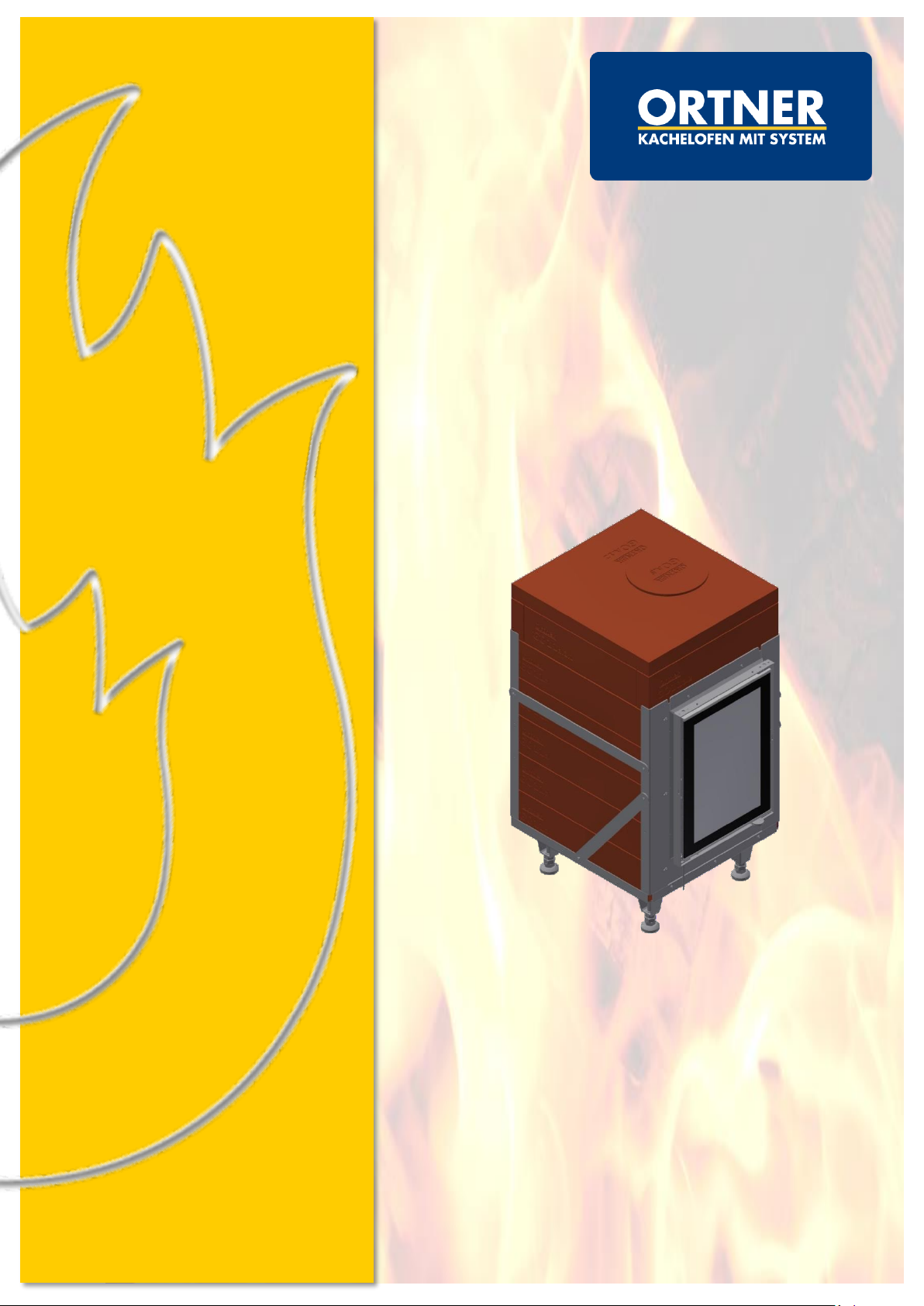
Operating Manual
ORTNER ST11 42/59
Manual and automatic operation
Before the commissioning of the firing installation, the operating manual must be
read; disregard of the instructions will lead to the voiding of the manufacturer’s
warranty.
The respective national or local regulations and general provisions and codes of
practice must be complied with!
Do NOT use this firing installation as a waste incinerator.
Version: 10_2016
Page 2

1
ORTNER GmbH | Hürmer Straße 36 in A-3382 Loosdorf | Tel +43 2754 2707 | Fax +43 2754 2708
office@ortner-cc.at | www.ortner-cc.at
Page 3

2
ORTNER GmbH | Hürmer Straße 36 in A-3382 Loosdorf | Tel +43 2754 2707 | Fax +43 2754 2708
[email protected] | www.ortner-cc.at
Contents
Standards and limit values ........................................................................................................................................................ 3
General safety information ...................................................................................................................................................... 4
Technical specifications ............................................................................................................................................................ 4
Control elements and their function in manual operation ..................................................................................................... 5
Control elements and their function in automatic operation ................................................................................................ 5
Fuel ............................................................................................................................................................................................ 6
It is prohibited to burn the following substances:.............................................................................................................. 6
Special instructions ................................................................................................................................................................... 7
Commissioning .......................................................................................................................................................................... 7
Caution .................................................................................................................................................................................. 7
Note ...................................................................................................................................................................................... 7
Cleaning and maintenance ....................................................................................................................................................... 8
Caution .................................................................................................................................................................................. 8
Troubleshooting ........................................................................................................................................................................ 9
The draught of the stove is insufficient, the fire almost goes out (Caution! Risk of deflagration): ............................ 9
Flue gas leakage from the stove: .................................................................................................................................... 9
The stove does not become sufficiently warm: ............................................................................................................. 9
Condensate escapes from the stove pipe and the chimney becomes wet and sooty: ............................................... 9
The wood does not ignite correctly: .............................................................................................................................. 9
The observation window becomes very dirty: ............................................................................................................... 9
A large amount of ash is generated: .............................................................................................................................. 9
Following combustion, a large amount of black charcoal remains in the firebox: ...................................................... 9
Page 4
3
ORTNER GmbH | Hürmer Straße 36 in A-3382 Loosdorf | Tel +43 2754 2707 | Fax +43 2754 2708
[email protected] | www.ortner-cc.at
Standards and limit values
All national and European standards as well as local regulations that are required for the
operation of the firing installation must be observed.
A significant contribution to the environmentally friendly operation of the stove can only be
ensured under adherence of all requirements specified in the operating manual.
The ST11 42/59 has been verified in accordance with EN13229 and additionally complies with
the following national emissions requirements:
CO
(mg/MY)
NOx
(mg/MY)
OGC
(mg/MY)
Dust
(mg/MY)
(%)
Austria, 15a
Environmental label
UZ 37
1100
700
150
120
50
50
35
30
80
80
Germany, BIMSchV 2nd
stage 2015
830 - -
27
70-80
Switzerland,
Swiss Clean Air Act
(LRV) 2011
1000 - -
50
-
Table of the measured emission values in accordance with EN 13229:
CO
(mg/MY)
NOx
(mg/MY)
OGC
(mg/MY)
Dust
(mg/MY)
(%)
576
100
21
13
>80
Page 5

4
ORTNER GmbH | Hürmer Straße 36 in A-3382 Loosdorf | Tel +43 2754 2707 | Fax +43 2754 2708
[email protected] | www.ortner-cc.at
General safety information
Before the commissioning of the firing installation, read this operating manual and observe the warnings and cautions.
As soon as the commissioning of the stove has been performed, the operating manual including all usage regulations
are considered as accepted without exception, this also applies in the event that the operating manual has not been
read.
Heat energy is released with the burning of wood that leads to a significant heating of the dual-pane glass door, the
operating lever, the chimney flue, the door handle and in part the surface. Coming into contact with these
components without the use of corresponding protection or aids (heat-protection glove) must be prevented. A large
amount of heat radiation is released via the glass fire door. For this reason, no combustible objects of any kind may be
placed at a distance of 80 cm forwards and 20 cm to the side of the combustion chamber door. Instruct your children
of this particular hazard and keep them out of reach of the stove during heating operation. It is prohibited to place
objects that are not heat-resistant on the firing installation or to bring them into its vicinity. Do not place laundry on
the stove for drying purposes. Racks for the drying of clothing must be positioned at a sufficient distance from the
heating unit. The handling of highly combustible or explosive substances is prohibited during the operation of the
stove. Remove the ash in the combustion chamber in a timely manner in order to prevent the blocking of the inlet air
openings. Before each lighting, ensure both an unimpeded, sufficient inlet air supply (simultaneous operation of the
fume hood, mechanical ventilation systems, possibly open an outside window, …) as well as the secure removal of the
exhaust gases.
When the inlet air line is longer than 1 m, then the required minimum cross section must be determined using a
suitable calculation programme.
Operating errors can lead to deflagration and as a result to the damaging of the stove or cause severe injuries. Only
spare parts approved by the manufacturer may be installed. No modifications may be performed on the firing
installation.
This firing installation is suitable for multiple connections of the chimney.
Technical specifications
Type designation:
ST11 42/59
Rated heat output in relation to the combustion duration
45 kW
Heat output in regard to the storage duration of 12 h (with Ortner KMS)
2.9 kW
Max. fuel amount
11 kg
Min. fuel amount
5.5 kg
Burning duration with max. fuel amount
approx. 70 min
Burning duration with min. fuel amount
approx. 40 min
Heating interval when using Ortner KMS
12 h
Mean required discharge pressure with rated heat output
14 Pa
Stack gas mass flow:
43 g/s
Total mass (without KMS):
approx. 455 kg
Page 6
5
ORTNER GmbH | Hürmer Straße 36 in A-3382 Loosdorf | Tel +43 2754 2707 | Fax +43 2754 2708
[email protected] | www.ortner-cc.at
Control elements and their function in manual operation
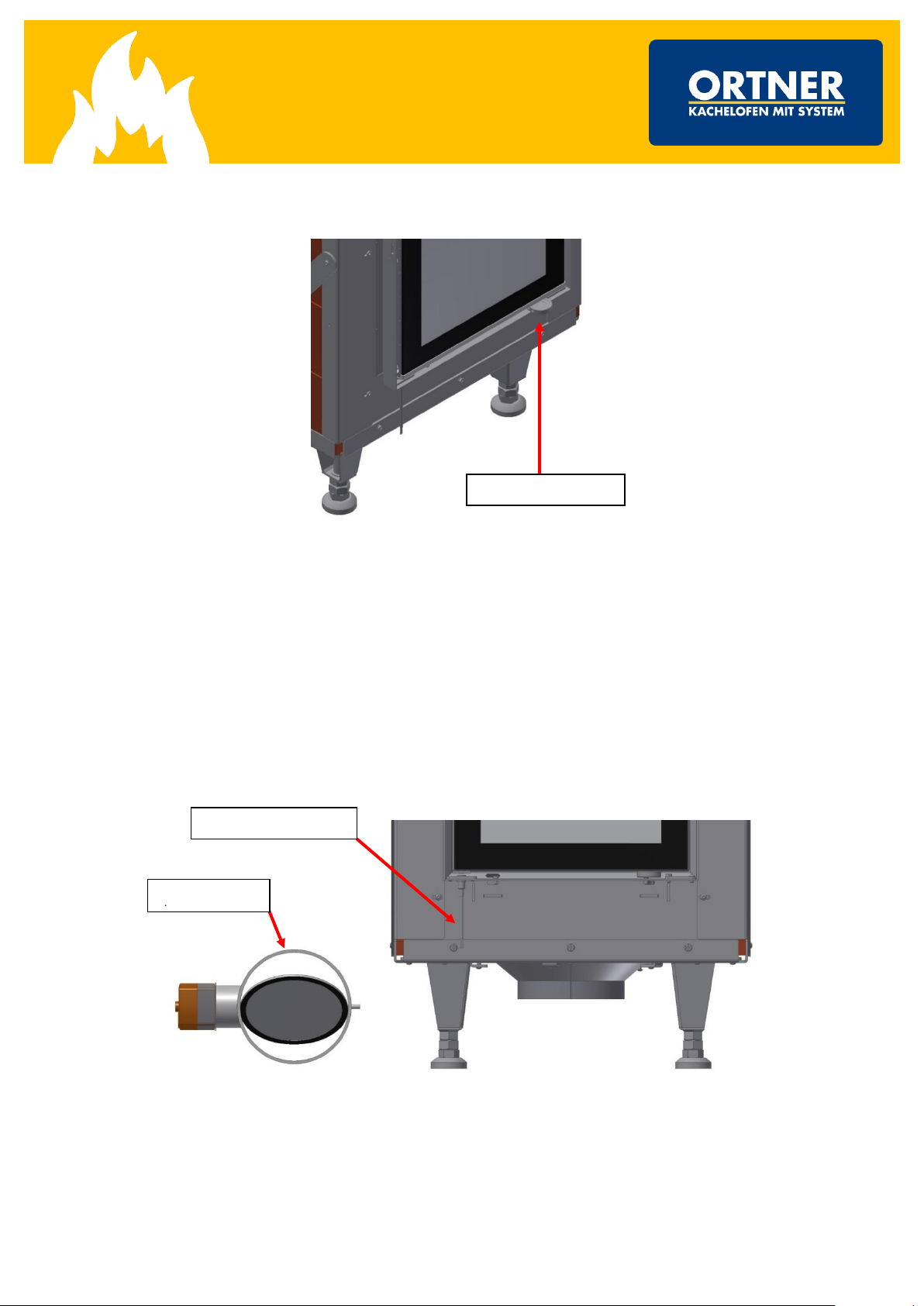
The control lever is labelled with its function.
Caution! The air supply may only be closed completely after the complete combustion of the wood (danger of
deflagration).
The dual-pane glass door is opened or closed with the use of the door closure lever.
When closing the door, pay attention to the engagement of the lock. Only a correctly locked combustion chamber
door ensures a secure combustion. The combustion chamber can now be loaded with wood and the wood can be
ignited. In order to prevent the release of heating gas, the firebox door must always be closed except during lighting,
when refilling with fuel, and during ash removal. In order to refill fuel, the door may only be opened after the wood
has been burnt (shortly before the embers phase).
Control elements and their function in automatic operation
The dual-pane glass door is opened or closed with the use of the door closure lever. Pressing the door handle upwards
will release the door and it can then be opened. When the door handle is pressed down, the door is locked and with
this, the ST11 is operational.
When pressing the door lever down, pay attention to the engagement of the lock. Only a correctly locked combustion
chamber door ensures a secure combustion.
Manual control lever
Door contact switch
Inlet air
Page 7
6
ORTNER GmbH | Hürmer Straße 36 in A-3382 Loosdorf | Tel +43 2754 2707 | Fax +43 2754 2708
[email protected] | www.ortner-cc.at
During the opening of the dual-pane glass, the door contact switch responds and sends a signal to the combustion
control. The control detects that the door has been opened and activates the air damper motor, the inlet air damper is
opened.
The combustion chamber can now be loaded with wood and can be ignited. When closing the dual-pane glass door,
the door contact switch again sends a signal to the control and the combustion is started. The combustion control runs
through a programme from the start of the combustion up to the cooling down of the stove, the so-called resting
position. The dual-pane glass door and the air damper are closed in the resting position.
In order to prevent the release of heating gas, the firebox door must always be closed except during lighting, when
refilling with fuel, and during ash removal. In order to refill fuel, the door may only be opened after the wood has been
burnt (shortly before the embers phase).
Fuel
Hardwood: Beech, oak, ash, maple, birch, cherry
Softwood: Willow, poplar, linden and almost all coniferous wood types
We generally recommend the use of hardwood. The most important precondition for a correct and long function of
your masonry heater is the use of dry, clean and untreated wood logs with a residual moisture content in the interior
of the log of no more than 20%. In addition to a greatly reduced heating value, wet wood generates an excess of
shining soot deposits (pitch-like deposit) on the inside of the pane, on the ceramic components as well as the chimney
(risk of a chimney fire).
Wood will only achieve an optimal heating value when it has been stored dry and ventilated under a roof for at least
two years. The logs should have an equal length and have a weight of 1-2 kg. In regard to the length, pay attention
that the wood fits correctly in the combustion chamber of your stove.
Softwood has a high calorific value and as a result of its reduced density by definition burns faster and hotter. For this
reason, when using softwood, the stack height should be halved and the second half should be inserted during the
embers phase.
Cuttings and kindling, of any type, even with optimal quality are only suitable for lighting or mixing in (overall
proportion < 10%).
In the event that you use briquettes, then please pay attention to the quality. These should be pressed without the use
of additives. Due to the high density and the low moisture content of briquettes, the stacking amount must be halved
and inserted a second time. Please note that the briquettes increase in volume during combustion. The fuel surface
increases many times over and the combustion chamber temperature increases sharply. This can cause an overheating
of the metallic fixtures and frame components and clouding of the inner glass pane. The warranty is voided in the
event that damage occurs due to the reasons stated above.
It is prohibited to burn the following substances:
Moist wood
Bark and chipboard waste
Wood with a high resin content
Painted and coated wood
Waste from carpenter’s
workshops
Bark briquettes
Woodchips, wood pellets
Kitchen and household waste
Plastics, cardboard
Combustible liquids
Coal of any type
!
Page 8

7
ORTNER GmbH | Hürmer Straße 36 in A-3382 Loosdorf | Tel +43 2754 2707 | Fax +43 2754 2708
[email protected] | www.ortner-cc.at
Special instructions
Please note that the surfaces of the ST11 can heat up strongly during the heating operation. (Metal parts, ceramic
glass) The ST11 is designed for a defined maximum wood stacking amount. This maximum amount may not be
exceeded. The manufacturer’s warranty is voided in the event of prolonged overloading with an amount that is larger
than specified as well as when using fuels that are not suitable.
Any warranty obligation of the manufacturer is voided when the manufacturer’s dimensional specifications for the
inlet air and chimney cross section are not adhered to or are modified afterwards irrespective of the reason. Any
warranty obligation is voided in the event that constructional changes are performed on the unit. The floor must be
able to bear the load and must be level. In the event of combustible flooring, a stable and non-combustible base must
be used. This must protrude to the front by 30 cm and 10 cm to the side. Please observe the assembly instructions for
the ST11.
In particular, pay attention to the supply of inlet air when using fume hoods, central vacuum cleaning systems, housing
ventilation or any other ventilation systems (risk of suffocation). Please consult your chimney sweep or stove fitter in
this matter.
Combustion air inlet openings may not be closed.
Immediately alert the fire brigade in the event of a chimney fire and inform your chimney sweep.
Breakage of the glass pane can occur as a result of mechanical overloading. This will create sharp parts CAUTION!
RISK OF INJURY.
Commissioning
Remove all documents and accessory parts present in the firebox.
Press the operating lever fully into the open position.
Stack up 11 kg hardwood logs with a length of approx. 33 cm (corresponds to about 3/4 of the combustion chamber
height). Add finely chopped softwood on top and ignite this using firelighters (lighting wool, barbecue lighter). The fuel
should rapidly be brought to a full fire.
During stoking, the firebox door should not be shut completely during the first 5 minutes. You can close the firebox
door as soon as the wood begins to burn properly. The maximum wood stacking amount should not be exceeded.
During the first use, a slight odour nuisance may occur (assembly residue). Should this be the case, then the
installation space should be ventilated well in order to ensure the removal of the odours.
Caution
Under no circumstances use liquid or gaseous firelighters.
Under no conditions exceed the maximum wood stacking amount (11 kg). When using the minimum wood amount
(5.5 kg), the firelighter is positioned in the centre of the wood stack. The firing installation is operated in temporary
burning. In order to achieve the maximum output with a heating interval of 12 h, this process must be repeated after
12 h (KMS 300).
Note
Because moisture is introduced during the construction of the unit, steam formation may occur in the event of intense
heating. This can cause the formation of cracks; for this reason, the unit must be heated dry before plastering is
carried out. For this, place around 6 kg hardwood logs with a length of approx. 33 cm in the combustion chamber, light
this with a suitable firelighter in the centre of the wood stack and allow the wood to burn off. Repeat this process 2 to
3 times.
Page 9

8
ORTNER GmbH | Hürmer Straße 36 in A-3382 Loosdorf | Tel +43 2754 2707 | Fax +43 2754 2708
[email protected] | www.ortner-cc.at
Cleaning and maintenance
The unit should be cleaned regularly, however at least once a year. Depending on the intensity of use, remove the ash
in a timely manner. This is absolutely required when the height of the ash has reached the point halfway between the
bottom edge of the firebox door and the firebox floor.
Caution
Because nests of glowing embers can remain for a prolonged time in the ash, this must never be discarded
immediately after removal, but instead should ideally be temporarily stored in a fireproof container with a lid (e.g.
metal pail) for so long until a possible ignition due to nests of glowing embers can be excluded. The ST11 may only be
cleaned in cold condition. Clean the dual-pane glass door (1) with a suitable window cleaner and a soft cloth. Please
note that the cleaning of the dual-pane glass door may only be performed in cold condition.
Have the cleaning of the chimney, the connection piece between the chimney and the firing installation and the
ceramic components of the masonry heater performed regularly by a licensed specialist in accordance with the
country-specific regulations. A blockage of the chimney may occur as a result of a prolonged interruption of the
operation. Therefore, before each start-up, verify that this is not obstructed. The firebox lining serves for the
protection of the material located behind it as well as the air distribution. Due to the high thermal load, this material is
subject to wear. This means that hairline cracks can appear in the material, the surface will become rougher and a
certain degree of material removal will occur. This generally is not an impairment and therefore is not covered by the
warranty.
However, depending on the intensity of heating and use of the firebox lining, it must be replaced periodically. A
replacement kit can be purchased for this from the manufacturer. A warranty claim only becomes effective when
heavy damage / breakage of the firebox lining occurs without mechanical external influence (e.g. throwing in the logs,
…).
1
Page 10

9
ORTNER GmbH | Hürmer Straße 36 in A-3382 Loosdorf | Tel +43 2754 2707 | Fax +43 2754 2708
[email protected] | www.ortner-cc.at
Troubleshooting
The draught of the stove is insufficient, the fire almost goes out (Caution! Risk of deflagration):
Verify that the inlet openings are open, that the operating lever for the combustion air inlet is fully open and the
chimney is unobstructed.
In the event of low pressure weather conditions, reduced / no draught can occur during the lighting phase. This effect
in particular occurs when the stove is fully cooled off. Ignite a pilot fire in the chimney (consult your chimney sweep in
this matter).
If an insufficient draught poses a permanent problem, then this may be due to an incorrectly dimensioned chimney or
due to an unfavourable positioning of the chimney on the roof (downwind side of the roof). Contact your stove fitter
in order to have a smoke extraction module installed.
Flue gas leakage from the stove:
Check the draught of the stove.
A possible cause may be that the wind is pressing down on the chimney or an insufficient draught is present due to a
higher outside temperature during the transition period.
If necessary, install wind protection on the chimney.
The stove does not become sufficiently warm:
Check the wood’s moisture content.
Condensate escapes from the stove pipe and the chimney becomes wet and sooty:
Possible causes are exhaust gas temperatures or chimney temperatures that are too low. Insulate the chimney.
Check the wood’s moisture content.
The wood does not ignite correctly:
Check the wood’s moisture content (the moisture content should be lower than 20%, generally this is wood that has
been stored for 2 years).
Use more/smaller kindling.
The observation window becomes very dirty:
Position the logs as far away from the window as possible.
Have the chimney draught checked (insufficient negative pressure).
Check the door seals for their proper fit.
A large amount of ash is generated:
Only use clean, untreated wood. Wood with a high bark content and dirty wood will cause a large amount of ash (noncombustible components of the wood).
Following combustion, a large amount of black charcoal remains in the firebox:
Check the quality of the wood (moisture, dirt content) or you are using an insufficient amount of wood per firing
instance.
Page 11

10
ORTNER GmbH | Hürmer Straße 36 in A-3382 Loosdorf | Tel +43 2754 2707 | Fax +43 2754 2708
office@ortner-cc.at | www.ortner-cc.at
 Loading...