

Page 1
V-MUL-008-D(A0)
Smoke Alarm User’s Manual
Please read and save this manual
IONIZATION SMOKE ALARM
MODEL: VST-IS588
Ionization smoke alarms are generally more effective at detecting flaming fires which
consumer combustible materials rapidly and spread quickly. Sources of these fires may
include paper burning in a wastebasket or a grease fire in the kitchen.
MAIN FEATURES
¾ DC Operated Ionization Type Smoke Alarm
¾ Ionization Sensor for fast flaming
¾ Test button
¾ High and stable sensitivity
¾ Quick fix mounting bracket for easy installation
¾ Fitting and battery tamper-resist feature
¾ LED operation indicator
¾ Extra loud alarm sound over 85 dB
¾ Low-battery and battery missing warning indicator
¾ Auto-reset when smoke clears
SPECIFICATION
¾ Model Number: VST-IS588
¾ Detection Type: Ionization Chamber
¾ Power Source:
¾ Standby Current: 15uA max
¾ Alarm Current : 30mA max
¾ Alarm Sound Level: 85 decibels at 3 meters
¾ Operation Temperature: 4℃to 38℃
¾ Ambient Humidity: 10%-90%
¾ Sensitivity to Smoke: 0.61 ~ 1.92 %/FT.OBS.
¾ Compact size: 110mm diameter
IMPORTANT SAFETY INFORMATION
1 . This smoke alarm requires constant working 9-volt battery to operate properly. This smoke alarm WILL NOT
work if DC power is not connected or has failed or been interrupted for any reason AND the battery is removed,
drained or improperly connected. DO NOT use any other kind of battery except as specified. DO NOT connect
this smoke alarm to any other type of smoke alarm or auxiliary device. It is designed as a stand alone one.
2 . The Test button accurately tests all smoke alarm functions. Do not use any other test method. Test smoke alarm
9V DC Battery
Page 2

weekly to ensure proper operation. It is designed as a stand alone unit.
3 . DO NOT remove or disconnect battery to quiet unwanted alarms. This will remove your protection. Open
windows or fan the air around smoke alarm to silence it
4 . Observe and follow all local and national electrical and building codes for installation.
5 . This smoke alarm is designed to be used inside a single room only. In multi-room buildings, each individual
living unit should have its own smoke alarms. Do not install in non-residential buildings. And this smoke alarm
is not a substitute for a complete alarm system.
6 . Smoke may not reach the smoke alarm for many reasons. For example, if a fire starts in a remote part of the
home, on another level, in a chimney, wall, roof, or on the other side of a closed door, smoke may not reach the
smoke alarm in time to alert household members. A smoke alarm will not promptly detect a fire except in the
area or room in which it is installed.
7 . Smoke alarms may not alert every household member every time. The alarm sound is loud in order to alert
individuals to a potential danger. However, there may be limiting circumstances where a household member
may not hear the alarm (i.e. outdoor or indoor noise, sound sleepers, drug or alcohol usage, the hard of hearing,
etc.). If you suspect that this smoke alarm may not alert a household member, install and maintain specialty
smoke alarms. Household member must hear the alarm’s warning sound and quickly respond to it to reduce the
risk of damage, injury, or death that may result from fire. If a household member is hearing impaired, install
special smoke alarms with lights or vibrating devices to alert occupants.
8 . Smoke alarms can only sound their alarms when they detect smoke. Smoke alarms detect combustion particles
in the air. They do not sense heat, flame, or gas. This smoke alarm is designed to give audible warning of a
developing fire. However, many fires are fast-burning, explosive, or intentional. Others are caused by
carelessness or safety hazards. Smoke may not reach the smoke alarm QUICKLY ENOUGH to ensure safe
escape.
9 . Smoke alarms have limitations. This smoke alarm is not foolproof and is not warranted to protect lives or
property from fire. Smoke alarms are not a substitute for insurance. Homeowners and renters are responsible for
their lives and property. In addition, it is possible for the smoke alarm to fail at any time. For this reason, you
must test the smoke alarm weekly and replace every 10 years.
Note: For best protection, we recommend that you install a smoke alarm in every room.
RECOMMENDED LOCATIONS FOR SMOKE ALARMS
Installing Smoke Alarms in Single-Family Residences
Minimum coverage is one unit on every floor, in every sleeping area, or in every bedroom. For additional
coverage, Vs-top Electronics Co.,Ltd recommends you install units in all rooms, halls, storage areas, and finished
attics, where temperatures normally remain between 5℃ and 45℃.
More specifically, install Smoke Alarms:
On every level of your home, including finished attics.
Inside every bedroom, especially if people sleep with doors closed.
In the hall near every sleeping area. If your home has multiple sleeping areas, install a unit in each. If a hall is over
12 meters (40feet) long, install an alarm at each end.
At the top of the first-to-second floor stairway.
IMPORTANT!
Specific requirements for Smoke Alarm installation vary from state to state. Check with your local Fire Brigade
for current requirements in your area.
See “Recommended Locations For Smoke Alarm” Diagram on the following page.
Page 3

A
BEDROOM
KITCHEN
DINING ROOM
BEDROOM
HALL
BEDROOM
BEDROOM
LIVING ROOM
LIVING ROOM
KITCHEN
SINGLE-STORY RESIDENCE,APARTMENT,
MOBILE HOME
FINISHED BASEMENT
MULTI-STORY RESIDENCE
KEY:
●Minimum required smoke alarm locations
○Recommended additional smoke alarm locations
△Smoke alarms with hush features recommended for additional protection
IMPORTANT SMOKE ALARM PLACEMENT AND EXCEPTION INFORMATION
1. Install a smoke alarm as close to the center of the ceiling as possible. If this is not practical, mount no closer
than 4 inches from a wall or corner. Also, if local codes allow, install smoke alarms on walls, between 4 and 12
inches from ceiling/wall intersections.
2. Install a minimum of two smoke alarms in every home, no matter how small the home.
3. Install a smoke alarm in each room that is divided by a partial wall (either coming down from the ceiling at
least 8 inches, or coming up from the floor).
4. Install a smoke alarm in lived-in attics or attics which house electrical equipment like furnaces, air conditioners,
or heaters.
DO NOT INSTALL SMOKE ALARMS
10CM(4'')
CEILING
MINIMUM
NYWHERE
IN THIS AREA
10CM(4'')
MINIMUM
MAXIMUM
SIDEWALL
10CM(4'')
0.9M(3ft)
0.9M(3ft)
HORIZONTAL DISTANCE
FROM PEAK
BEST HERE NEVER HERE
ACCEPTABLE HERE
1. Near appliances or areas where normal combustion regularly occurs (kitchens, near furnaces, hot water
heaters). Use specialized smoke alarm with unwanted alarm control for this areas.
2. In areas with high humidity, like bathrooms or areas near dishwashers or washing machines. Install at least 10
feet away from these areas.
3. Near air returns or heating and cooling supply vents. Install at least 3 feet away from these areas. The air could
blow smoke away from the detector, interrupting its alarm.
Page 4

4. In rooms where temperatures may fall below 4℃ or rise above 38℃.
5. In extremely dusty, dirty, or insect-infested areas where loose particles interfere with smoke alarm operation.
WARNING: Incorrect orientation will result in a decrease in operational effectiveness.
HOW TO INSTALL THIS SMOKE ALARM
WARNING: Smoke alarm installation must be in
accordance with the requirements of any national and local codes that may apply.
1. From back of smoke alarm, remove the mounting plate by turning it counterclockwise.
(To later engage tamper-resist feature, twist out and set aside one of the pins molded into plate. Both pins are
exactly the same.)
2. Secure plate to ceiling or wall with mounting screws.
3. Lift open battery pocket door.
4. Connect new 9-volt battery to battery connector inside battery pocket. Be sure battery is
securely connected. Red LED may blink briefly when battery is installed.
5. Close battery pocket door, snapping it into place.
6. Position smoke alarm to mounting plate and turn clockwise to lock into place. To engage
tamper-resist feature, insert pin into notch on edge of smoke alarm after alarm is
properly positioned in base.
7. Push test button to test smoke alarm. See TESTING THE SMOKE ALARM.
OPERA TING YOUR SMOKE ALARM
Once the smoke alarm has been installed A RED indicator light (LED) should flash approximately once a minute
to indicate the battery is healthy and the unit is operating properly.
If smoke is detected, the unit will emit a load pulsating alarm and a RED indicator light (LED) will be flashing
quickly until the air is clear.
TESTING THE SMOKE ALARM
1. Test each smoke alarm to be sure it is installed correctly and operating properly.
2. The Test button accurately tests functions.
Do not use an open flame to test this smoke alarm. You may
ignite and damage the smoke alarm or your home.
3. Test smoke alarms weekly and upon returning from vacation or
when no one has been in the household for several days.
4. Stand at arm’s length from the smoke alarm when testing.
Page 5
TEST ALL SMOKE ALARMS WEEKLY BY DOING THE FOLLOWING:
1. Firmly push the TEST button, and the smoke alarm will sound a loud beep.
The alarm will stop sounding after releasing the TEST button.
2. If smoke alarm does not sound, please retest the smoke alarm.
DANGER: If the alarm sounds, and smoke alarm is not being tested, the smoke alarm is sensing smoke.
THE SOUND OF THE ALARM REQUIRES YOUR IMMEDIATE ATTENTION AND ACTION.
MAINTENANCE AND CLEANING
In addition to weekly testing, this smoke alarm requires yearly battery replacement and periodic cleaning to
remove dust, dirt, and debris.
BATTERY REPLACEMENT
Replace battery at least once a year or immediately when the low battery signal sounds once a minute. Batteries
should be replaced regularly as necessary.
WARNING: Do not use any other type of battery, except as specified in this manual.
Do not use rechargeable batteries.
CAUTION: Explosion will happen if battery is incorrectly replaced.
You’d better use good battery to make the alarm work long.
1. Turn smoke alarm counterclockwise to detach it from the mounting plate.
2. Gently pull down smoke alarm.
3. Remove battery from the compartment.
4. Insert a new 9-volt battery to connector. NOTE POLARITY OF CONNECTIONS.
Ensure the metal tab is fully depressed when the battery has been fitted.
5. Using the Push-to-Test button, test the smoke alarm to verify 9V DC battery.
See “
TESTING THE SMOKE ALARM”
6. Reattach the smoke alarm to the mounting plate by turning smoke alarm clockwise until it snaps into place.
Insert the two tamperproof tabs back into the notch on edge of smoke alarm after alarm is properly positioned
in base
7. Test the smoke alarm using “Test” button. See “
TESTING THE SMOKE ALARM”
CHOOSING A REPLACEMENT BATTERY:
The unit requires one standard 9V battery. The following batteries are acceptable as replacements:
Golden Power #6F22, Megaton #6F22; New Leader #6F22; Gold Peak #1604; Eveready #522, #1222;
Gold en Power H6F22; Golden Power GL6F22A
CLEANING
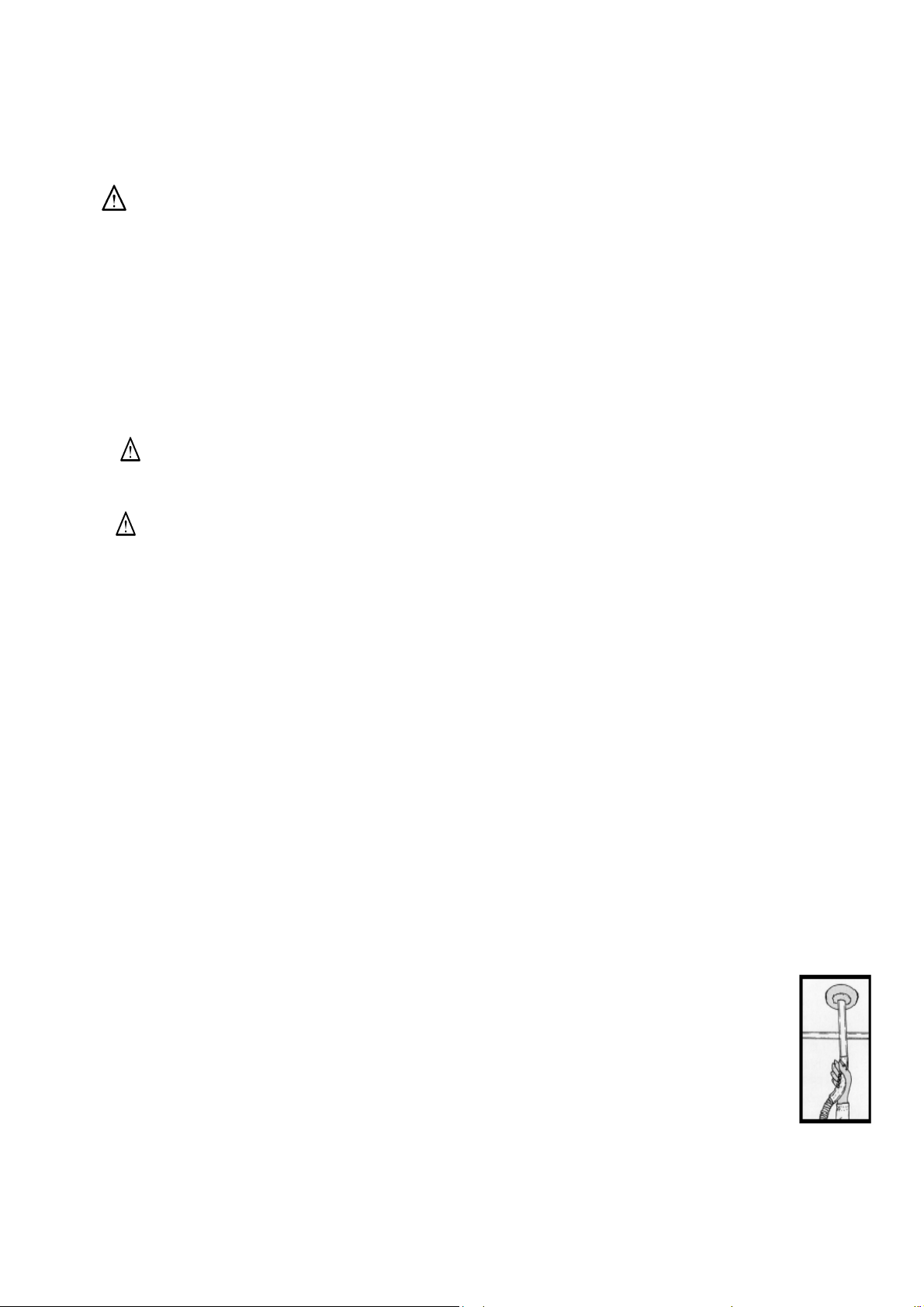
Clean the smoke alarm at least once a month to remove dust, dirt, or debris. Using the soft brush or wand
attachment to a vacuum cleaner, vacuum all sides and cover of smoke alarm. Be sure all the vents are free
of debris. If necessary, use a damp cloth to clean its cover.
IMPORTANT: Do not attempt to remove the cover to clean inside the smoke alarm. This will void your
warranty.
PRACTICE FIRE SAFETY
If the smoke alarm sounds its alarm horn, and you have not pushed the test button, it is warning of a dangerous
Page 6

situation. Your immediate response is necessary. To prepare for such occurrences, develop family escape plans,
discuss them with all household members, and practice them regularly.
1. Expose everyone to the sound of a smoke alarm and explain what the sound means.
2. Determine two exits from each room and an escape route to the outside from each exit.
3. Teach all household members to touch the door and use an alternate exit if the door is hot. Instruct them not to
open the door if the door is hot.
4. Teach household members to crawl along the floor to stay below dangerous smoke, fumes and gases.
5. Determine a safe meeting place for all members outside the building.
WHAT TO DO IN CASE OF FIRE
1. Do not panic; stay calm.
2. Leave the building as quickly as possible. Touch doors to feel if they are hot before opening them. Use an
alternate exit if necessary. Crawl along the floor, and do not stop to collect anything.
3. Meet at a pre-arranged meeting place outside the building.
4. Call the fire department from outside the building.
5. Do not go back inside a burning building. Wait for the fire departm ent to arrive .
These guidelines will assist you in the event of a fire. However, to reduce the chance that fires will start, practice
fire safety rules and prevent hazardous situations.
TROUBLESHOOTING
WARNING: DO NOT disconnect battery to quiet an unwanted alarm. This will remove your protection.
Fan the air or open a window to remove smoke or dust.
PROBLEM
Smoke alarm does not sound when tested.
NOTE: Push test button for at least five
seconds while testing!
Smoke alarm beeps about once a minute. Replace battery. See battery replacement in the maintenance and cleaning
Smoke alarm sound unwanted alarms
intermittently or when residents are
cooking, taking showers, etc.
The alarm sounds different than I’m used
to. It starts and stops.
SOLUTION
1 Remove smoke alarm from mounting plate and check that battery is
properly attached to connector.
2 Clean smoke alarm.
section.
1 Clean smoke alarm. See cleaning in the maintenance and cleaning
section
2 Move smoke alarm to a new location.
See SMOKE ALARM PLACEMENT
The alarm is operating correctly. This alarm features the internationally
recognized horn signal for evacuation. The alarm sound pattern is 3 short
beeps followed by a 2 second pause and then repeats.
WARNING: Radioactive material Am241, <29.6KBq (0.8uCi). Do not tamper with sealed source. When
this alarm is not longer required, it should be returned to supplier or Department of Health for disposal. Do not
dispose of it in any other way.
Manufacturer: Xiamen Vs-Top Electronics Co., Ltd.
2nd floor, No-107 Xiaguang Road, Xinyang Industrial District, Haicang ,Xiamen, China.
Tel: 0086-592-6017700 Fax: 0086-592-6017711
E-mail: [email protected]
Website: www.orientalert.com
 Loading...