

Page 1
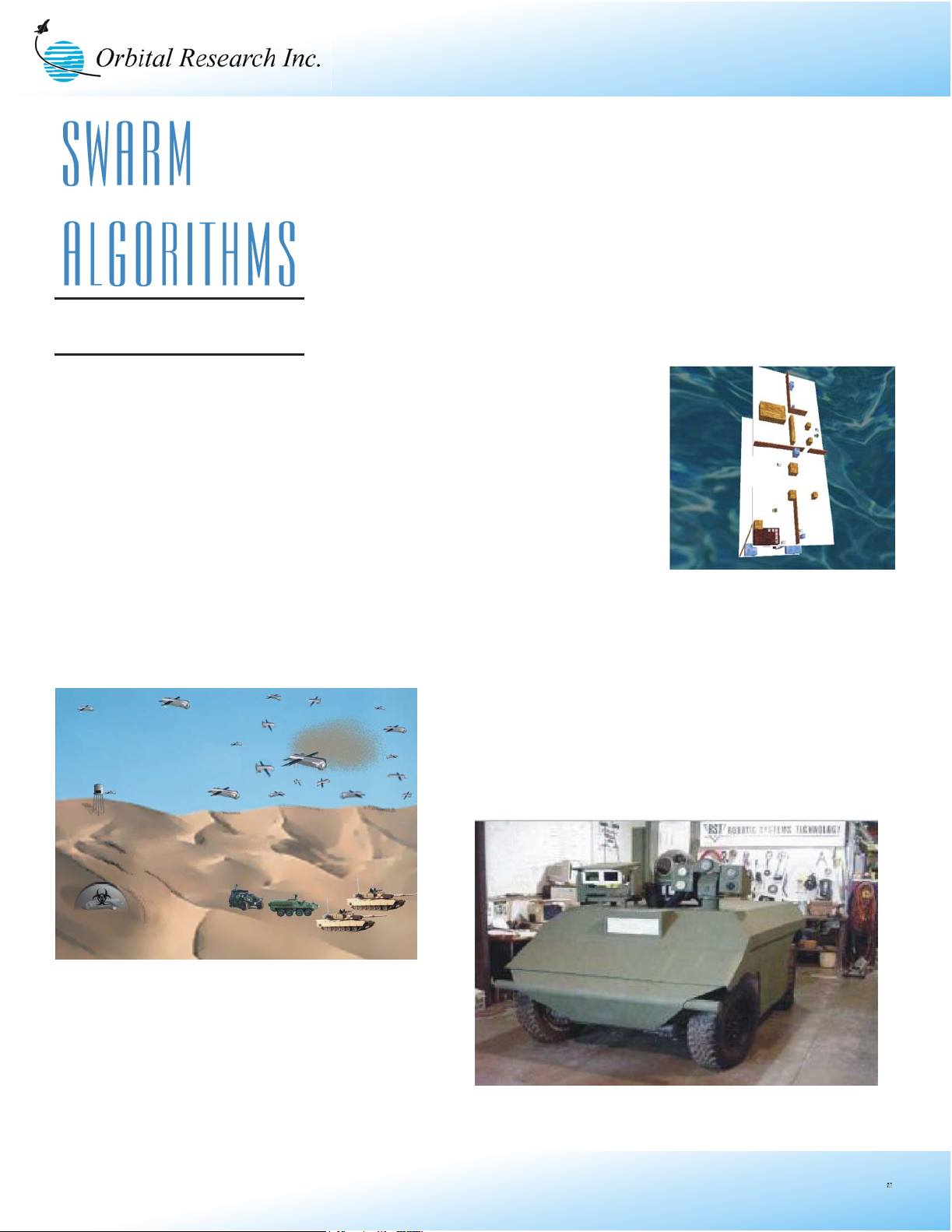
rbital Research has leveraged the work of biologists and computer
O
scientists to develop biologically-inspired swarm algorithms for the control
of swarms of autonomous agents ranging from unmanned air vehicles (UAVs) to
data packets on a communications network. Using algorithms honed by
evolution, Orbital Research combines these algorithms with its background in
advanced controls to produce efficient algorithms for multi-agent coordination
Advanced Techniques for Multi-Agent
Coordination
that are robust to changing situations and can operate under highly restrictive
communications bandwidth requirements.
Swarm Intelligence
Imagine an ant colony overrun with activity. Hundreds of
thousands of ants, each following only the simple rules encoded
in their DNA, will eventually build an elaborate structure that
rivals in complexity ma ny of today's modern marvels. This is
just one of the many examples of swarm algorithms that can be
found in nature. Using nature as a guide, Orbital Research can
leverage millions of years of evolution to produce algorithms
that can coordinate large heterogeneous swarms of
autonomous agents.
Ants, as well as many other creatures, communicate through
stigmergy, which is a form of indirect communication through
modification of the local environment. For example, ants leave
chemical pheromone trails, which when encountered by
another ant will help dictate the next action taken.
to fully realize the capabilities
of UAVs, multiple UAVs need
to be deployed simultaneously
and they must have the ability
to the presence of the
realize
other UAV s. Orbital Research
has developed several UAV
coordination algorithms that
allow a single controller to
command large groups of
UAVs to p erform such tasks as
formation flying, dynamic task
assignment, reconnaissance,
and chemical cloud tracking. In
addition many of these algorithms have been shown to be directly
applica ble to similar systems such as unmanned under water vehicles
(UUVs), unmanned ground vehicles (UGVs), and
autonomous.
Underway replenishment of a naval carrier is a time-consuming task
where the largest cost comes from the need to constantly train
new sailors. In order to reduce cost, a reduction in manpower is
needed, which in turn requires an increase in efficiency. Orbital
Research is currently developing swarm-based algorithms for the
Efficient material handling on board
aircraft c a rr i er s is enab l ed with
swarm algorithms.
submun itions
A swarm of UAV’s tra ck a c hem ical weapon c loud
Applications
Orbital Research has successfully applied its extensive
background in biologically-inspired swarm algorithm
development in many areas of research. Unmanned air vehicles
(UAVs) provide a safe and cost-effective way of performing
many of the tasks still performed today by sold iers, such as
reconnaissance and battle damage assessment (BDA). In order
Orbital Research, Inc.
4415 E uclid Ave., S uite 500
leveland, OH 44103-3733C
Con ta ct: Fre deric k J. Lisy, Ph.D .
Telephone ( 216) 649 -0399
E-mail lisy@orb italresearch.com
Swarm algorithms can be used to coordinate large numbers
of vehicles such as the XUV
www.orbitalres earch.com
Copyrigh t 20 03
Rev F: RMK-12-09-2003
Page 2
efficient routing of packages through a carrier. These
algorithms combine the efficiency of graph theory with the
power of swarm algorithms to produce a package that can
provide efficient paths while considering important factors
such as package type and priority, carrier status level,
current bottlenecks, and broken conveyors/elevators.
Swarm algorithms are also being used to enable the low
Autonomous Martian based up on tumbleweeds,
use swarm algorithms for cooperative control.
Rovers,
cost exploration of space. A new concept for the
exploration of Mars calls for the use of large groups of
lightweight, wind driven rovers based upon the Russian
Thistle or tumbleweed. These groups of Martian rovers
use swarm algorithms to coordinate their behaviors while
using nothing more than w ind as their motive po wer. In
add itio n, this concept and the technolog ies developed for
it have relevance to the exploration, surveillance and
reconnaissance of any dangerous or inaccessible
environment.
This algorithm development suite enables rapid formulation of control systems
for complex systems, including human-in-the-loop (HIL) systems
automate and streamline the process of swarm algorithm development.
Evolutionary programming is another biologically-inspired technique that
uses concepts borrowed fro m the theories of Dar winian and Lamarckian
evolution that allow computer programs to compete for survival.
Orbital Resear ch has developed a component-based evolutiona ry
programming package that is fully interoperable with the SWEEP-Re
simulation system and has been successfully used to evolve many
standard swarm algorithms.
Swarm Algorithm Development
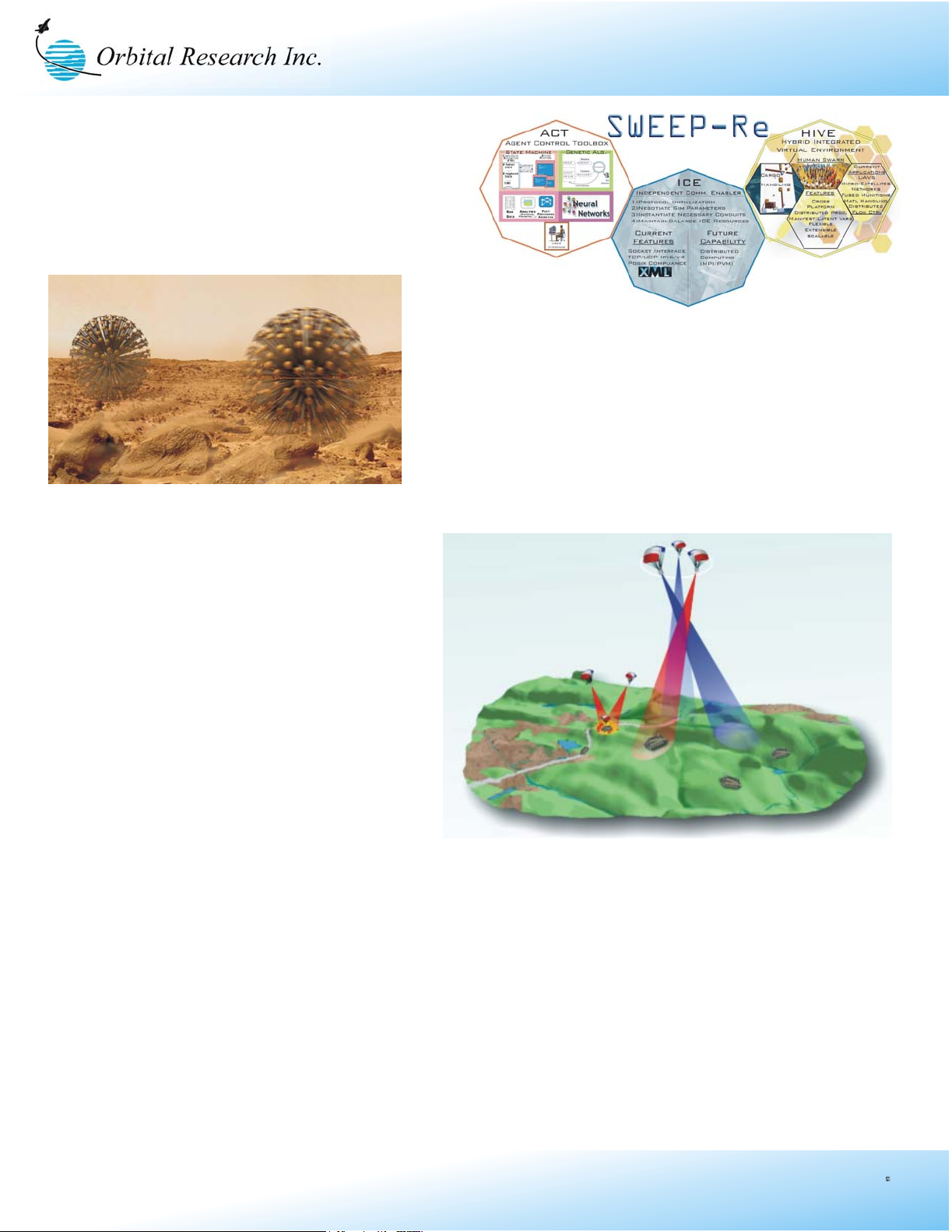
SWEEP-Re (Swarm Experimentation and Evaluation
Platform, Recursive) is Orbital Research's autonomous
agent simulation and modeling tool suite. The SWEEP-Re
model consists of four modules: ACT, ICE, HIVE, and
EPIC. The Agent Control Toolbox (ACT) is the main
controller for the agent. The Hybrid Integrated Virtual
Environment (HIVE) is a model of the environment in
which t he a gents reside . The Evaluatory Pr obes and
Interactive Control (EPIC) module enables users to gather
dat a from all parts of the simulat ion and also to change
run-time parameters on-the-fly. Finally, all of the previous
compo nents ar e tied t og ether thr ough the Independ ent
Communications Layer (ICE), which is an XML enabled
protoco l that provides methods of tr anslat ing
communiqués between two independent sources.
The current state of the art in swarm algorithm
development is relegated to a tedious trial-and-error
methodology due to the complex behaviors that arise
from the large numbers of agent interactions. Orbital
Research has leveraged evolutionary programming to
Orbital Research, Inc.
4415 E uclid Ave., Suite 50 0
leveland, OH 44103-3733C
Autonomous submunitions swarm to prosecute multiple ta rgets.
Future Directions and Ongoing Research
Orbital Research is maintaining its competitive advantage in this field by
conducting substantial research and development into new types of
swarm algorithms, new tools for their development and application.
New approaches based upon complex systems theory are being used for
rigorous examination of the properties of swarm algorithms and to
provide new methods for algorithm generation. Applications such as
information fusion, data mining, and data routing in computer networks
are being developed using swarm algorithms. The versatility and
robustness of the swarm intelligence-based algorithms developed at
Orbital Research coupled with new theoretical results being produced by
O rbi t al Re sear ch Orb i tal Re s earch
to be a leader in the field of swarm intelligence algorithms.
Con ta ct: Freder ick J. Lis y, Ph .D.
Telephone (216) 649-0399
E-mail lisy@o rbitalresearch.c om
researchers ensures that will continue
www.orbitalresearch.c om
Copyrigh t 20 03
Rev F: RMK-12-09-2003
 Loading...