

Page 1
Linear
Adaptive
n an increasingly competitive market place, today's systems require a high degree of flexibility,
robustness and performance. The need for ever faster, cheaper, and more capable systems is
I
driving a concomitant requirement for more robust, capable and flexible control systems. One
important class of modern control design techniques in this drive for better controllers is linear
adaptive control. In an adaptive controller, the controller itself can adapt its behavior to
Control
Flexible and robust
control enabling
accommodate changes in the system or the environment. Orbital Research, Inc. has developed a
family of linear adaptive controllers for a variety of applications, including a computationally
efficient predictiv e adaptive controller
today's applications
The Need for Adaptive Control
Occam's Razor dictates that the simplest control algorithm that
will produce the desired results should be used and, hence,
suggests the use of more conventional control theory that deals
predominantly with linear, constant coefficient systems. Linear
systems theory often provides a good approximation for systems
being regulated about a fixed operating point. Unfortunately,
linear control theory is not always sufficient, particularly in the
presence of large variations in system parameters or
disturbances. In addition, it not always possible to characterize a
system sufficiently to permit the complete design of a suitable
control system. The main reasons for using a nonlinear approach
such as adaptive control are: 1.) variations in plant dynamics, 2.)
variations in the characteristics of the disturbances, and 3.)
engineering efficiency.
Many systems are inherently nonlinear and linear approximations
are valid over only small regions of the systems operating
envelope. For instance, a robot arm’s inertial properties change
nonlinearly with the arm’s joint angles. Similarly, the
performance of actuators can vary widely under different
operating conditions such as changing temperature as well as
degrade over time due to wear or other environmental effects.
The use of an adaptive control scheme can greatly ameliorate the
deleterious effects that changing system parameters have on the
mechanism for accomodating changes
in arm inertias and joint dynamics in robots.
Adaptive Control provides a
performance of the controller. While other techniques such as
robust high gain control can often accommodate a wide range of
system parameters, they do so at the cost of system
performance. Only adaptive control techniques permit
parameter variation while still allowing good control sensitivity
and responsiveness.
Disturbance accommodation is another important aspect of
control design. It is a straightforward process to compensate for
disturbances with given characteristics but the problem is far
more diffic ult if the disturbance patterns are unknown or are
nonstati onary
nonstationary disturbance is wind load. As the weather
conditions change, not only does the magnitude and direction of
the wind change but the spectrum describing the wind load also
changes, both in mode and shape. A constant gain controller
designed to reject wind disturbances for a particular weather
condition is not going to be nearly as effective in other weather
conditions. Adaption provides a mechanism for retuning the
disturbance rejection properties of the control system in
response to changing environmental disturbances.
Finally, in many situations, the use of adaptive control is the
simplest choice. In many applications, due to system complexity
or inherent nonlinearity, it is either very difficult or impossible to
deduce appropriate system parameters from first principals. It
can therefore be advantageous to trade a more capable
controller design against the potentially more effort consuming
path of modeling, design and implementation of multiple control
systems.
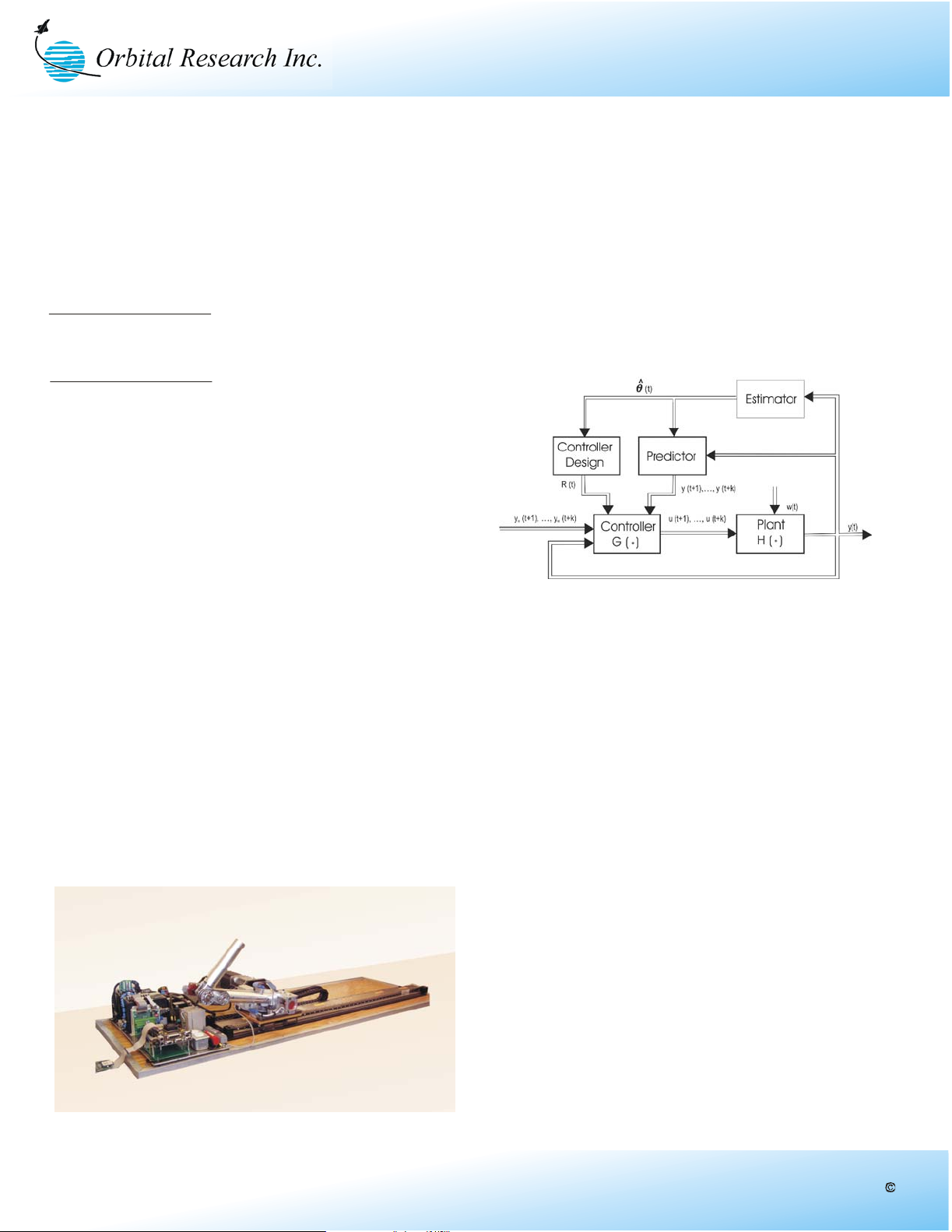
Block diagram for the ORICA adaptve controller
, or changing with time. A classical example of a
Orbital Research, Inc.
4415 E uclid Ave.
Clev eland, OH 4 4103
Con tact: Freder ick J. Lisy, Ph.D.
Telephone (216) 649-0399
E-mail [email protected]
www.orbitalresearch.com
Copyright 2003
Rev D RMK 12.2.2003
Page 2
Adaptive Control for Linearly Parameterized
Systems
In linear adaptive control algorithms, a control law is designed
based upon an assumed linear model. During operation, the
parameters of this linear model are updated and the
corresponding control design is adapted to reflect the updated
model. Several different approaches exist for the updating of
parameters, each based upon slightly different assumptions.
One approach is to treat the problem as if the parameters are
constant but unknown. This is known as the problem
and is the underlying assumption of
(STR)
, and related control algorithms. Typically, an
Self Tuning Regulators
identification algorithm such as least squares estimation is used
to identify the unknown parameters. The
Equivalence Principle
, which holds that the identified
parameters can be used as if they are equal to the true
parameters, is invoked and the identified parameters are used
to compute updated controller parameters via an automated
design process. Another approach makes the assumption that
the parameters are changing, though much more slowly than
the state variables. The rate at which the parameters evolve
in time can be controlled by the designer's choice of adaption
Model Reference Adaptive Controllers (MRAC)
rate.
and their variants use this approach.
As noted above, adaptive controllers involve control law
calculations that are based upon estimates of the controlled
plant parameters, , that are identified in real time. This
2
identification is typically performed via a recursive formulation
Least Squares Estimator (LSE)
of the , though other
estimation techniques such as (LMS)
Least M ean Squ ared
estimation can also be used. The control law calculations can
be performed directly, in which case the estimation is
configured to explicitly identify the controller parameters, or
indirectly, in
which case the
estimation
routine identifies
the plant
parameters,
which are in turn
used to compute
the controller
parameters.
Another adaptive
control approach
Generalized
is
Predi ctive Cont rol
(GPC).
GPC is based
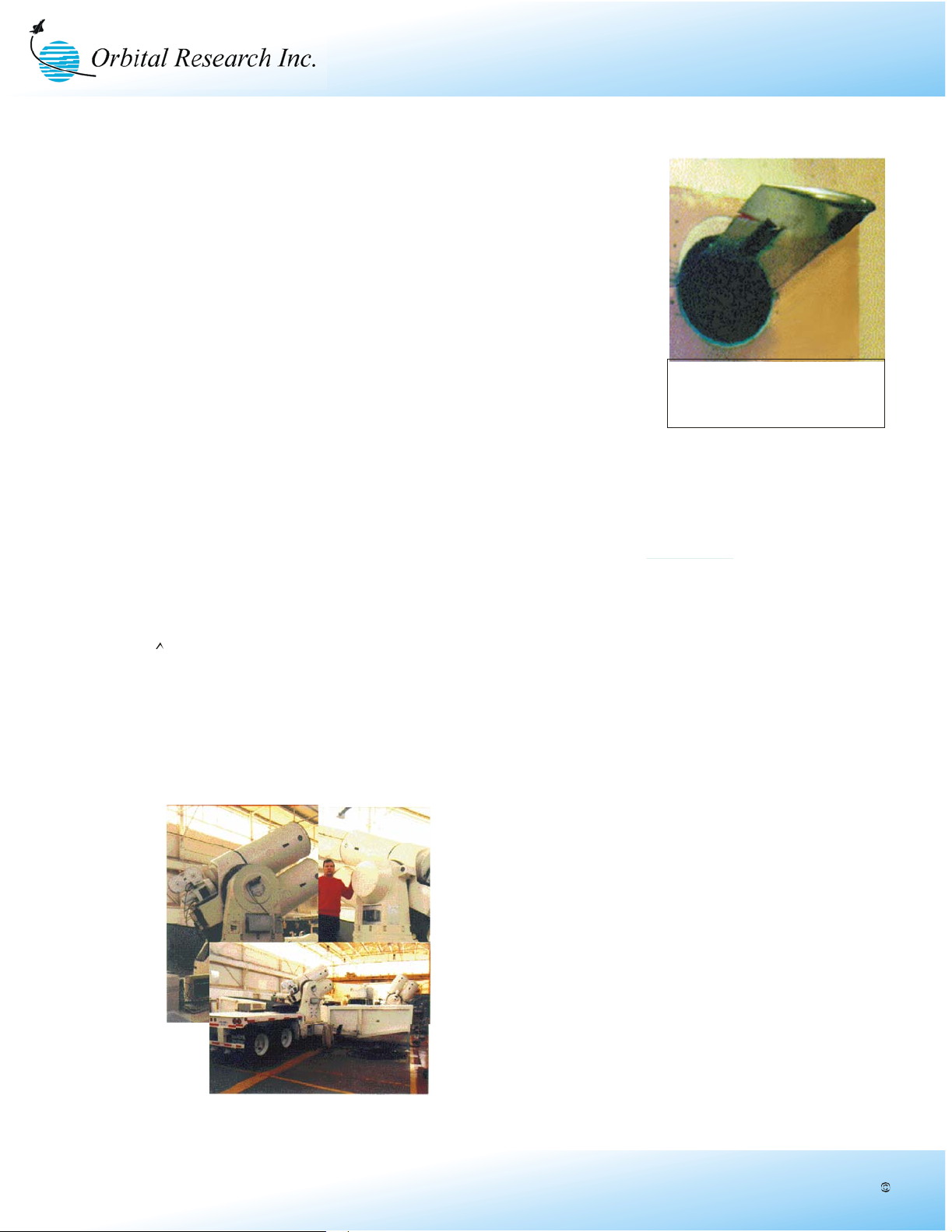
ORICA has been used to
rol the
cont smart munitions
tracking scope (SMTS) at
White Sands Missile Test Range.
tuning
Certainty
upon an assumed model
of the plant or process to
be controlled and on an
assumed scenario of
future control signals.
Predictive controllers
produce a sequence of
control signals for the
range of times from the
next time step to a future
time, known as the
prediction horizon
Only the first of these
control signals is input to
the system and a new
.
ORICA has successfully been
used forsuppression of wing
flutter in NASA Lanfley’s BACT
test bed facility
sequence of control
signals is calculated when a new measurement is obtained.
This approach has proven to be robust to both model order
and system dead time assumptions as well as for nonminimum
phase systems and systems with unstable or badly damped
open loop poles.
Åström, K.J., Wittenmark, B., , Addison Wesley, Reading,
MA, 1989
Adaptive Control
Orbital Research Intelligent Control
Algorithm (ORICA)
The major limitation on the application of the GPC algorithm
is the computational cost associated with the computation of
the block of control inputs. Because of this, the application of
this algorithm has generally limited to the control of processes
and plants whose dynamics are sufficiently slow to permit the
computation the control inputs. The computational power of
modern processor as well as the development of more
efficient algorithms for computing block control inputs has
however made the application of this algorithm feasible for
the real time control of systems with significantly faster
dynamics such as aircraft wing flutter. Orbital Research, Inc.
has developed an efficient predictive adaptive control
algorithm, the
Algorithm, (ORICA)
control aircraft wing flutter in NASA Langley Research
Center's Benchmark Active Controls Test (BACT) platform
and to control the Smart Munitions Tracking Scope (SMTS) at
the White Sands Missile Test Range.
Dong, Y., Chizeck, H.J., “A Unified Approach to the Analysis and Design of
Predictive Control,” In Proc. 1991 American Control Conference, Boston,
MA, 1991.
Dong, Y., Chizeck, H.J., Khoury, J.M., Schmidt, R.N., “Extended Horizon
Adaptive Block Predictive Controller with an Efficient Prediction System,”
U.S. Patent Number 5424942, June 13, 1995.
Orbit al Research Intellig ent Control
, that has successfully been used to
Orbital Research
673 G lpha Park Drive
A
leveland, OH 4 4143-2140
C
Contact: Frederick J. Lis y, Ph.D.
Telepho ne (44 0) 449 -5785
E-mail [email protected]
www.orb ita lresearch.com
Copyright 2003
Rev D RMK 12-05-2003
 Loading...