

Page 1
ecent research into the development of systematic design for global adaptive
R
control of nonlinear systems with parametric uncertainty at Case Western
Reserve University has resulted in the development of a nonsmooth framework for
global adaptive control of a significant class of nonlinearly parameterized systems.
Orbital Research, Inc., in conjunction with Case Western Reserve University is
currently developing a family of Nonlinear Adaptive Control algorithms for
Nonlinear control techniques for global
underactuated mechanical systems based upon this ground breaking research.
regulation of underactuated systems
Underactuated Systems Control
The pursuit of more capable and versatile systems is driving the need
for more and more capable control system design techniques. In
particular, control systems are becoming increasing important for
bridging gaps left by design tradeoffs. One example of particular
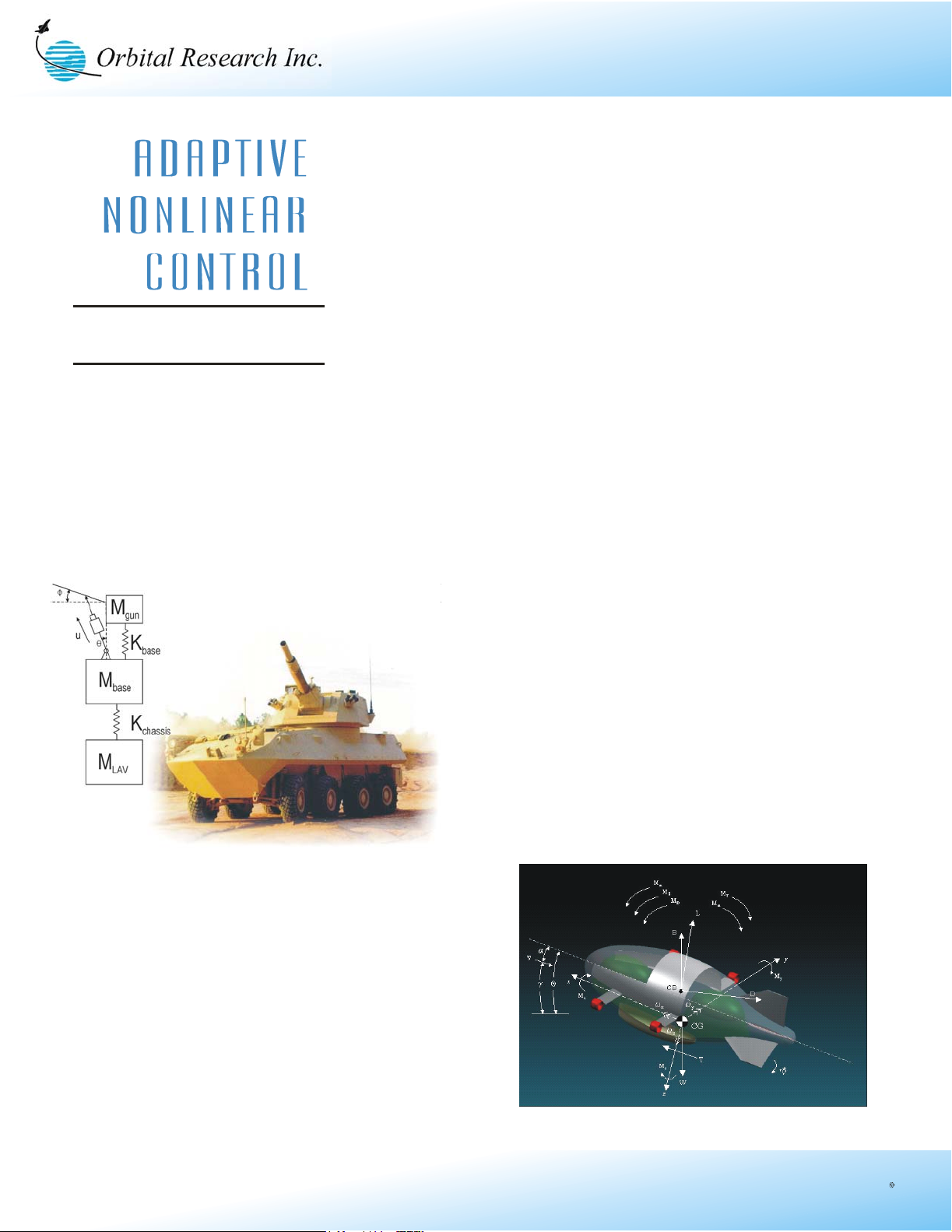
interest is the control of a vehicle mounted gun or mortar on a Light
Armored Vehicle (LAV). In this application, the transportability of the
LAV is of paramount importance and hence, any gun/mount system
must be made as light as possible. For the lightweight application
envisioned with the LAV, a lighter, and therefore, more flexible
structure is necessary to satisfy weight constraints. Unfortunately,
New nonlinear adaptive control
techniques can accomodate nonlinear
structural flexibil it y in applications such
as light weight gun-mounts for LAV’s.
example, crane booms can have significant flexibility and typically
have no actuation designed to control the boom dynamics. Another
examp le is the control of a figh ter ai rcra ft, in comb at scen arios it may
be necessary to control a damaged aircraft that has, for example, lost
an engine and has damage to one of its wings. The undamaged
control surfaces can be used to compensate for the engine loss,
asymmetric flow resulting from wing damage, as well as the loss of
contr o l su rf aces via hi gher or der couplin g e ffe cts in t he f ig hte r
aerodynamics. In both of these cases, it may be impossible to
stabilize the systems via any smooth static or dynamic feedback.
Nonlinear Adaptive Control
ORI’s approach to nonlinear adaptive control design is markedly
different from the majority of systematic design methods for global
adaptive control of nonlinear systems with parametric uncertainty.
Typical approaches concentrated on adaptive control of feedback
linearizable systems with linear parameterization using
feedback
smooth or a t least C and many inherently nonlinear systems cannot
be stabilized by any smooth static or dynamic state feedback. The
control design methodology discussed here assumes only continuous
0
(C ) feedback.
The majority of the commercially available controllers are
.
1
smooth
the lighter, more flexible structure does not supply a suitable ground
for more traditional controllers such as those used to control the
main guns of heavier fighting vehicles that possess heavier and more
rigid gun mount structures. In order to adequately control gun
attitude on the LAV, a control scheme capable of accommodating the
system compliance over a large range of operating conditions is
needed.
Orbital Research, Inc. (ORI), in conjunction with Case Western
Reserve University (CWRU), is developing a suite
adaptive controllers
applications. In particular, they are ideally suited for underactuated
systems, i.e. for systems that possess more degrees of freedom than
control inputs. This type of system occurs frequently in mechanical
systems that possess structural flexibility or in the design of fault
tolerant controllers to accommodate the loss of actuation. For
Orbital Research, Inc .
4415 E uclid Ave., S uite 500
leveland, OH 44103- 3733C
that have a tremendous number of
nonlinear
Contact: Frederick J. Lisy, Ph.D.
E-mail lisy@o rbitalresearch.com
In contrast, the control methodology discussed here focuses on the
development of but continuous adaptive control
schemes for nonlinearly parameterized systems. The approach
combine s a recently developed extension to the technique of
Telephone (216) 64 9-0399
nonsmooth
adding
a
The adaption mechanism provides a means of producing fault tolerant
controllers for unmanned air vehicles i ncluding high altitude ai rships.
www.orbitalresearch.com
Copyright 20 03
Rev C: RMK-12-0 5-03
Page 2
power integrator
with a new parameter separation technique to
produce non-Lipschitz continuous a daptive regulators that achieve
global stab ility with asy mptotic state regulation for cases where
there do not exist any smooth static or dynamic stabilizers.
Lin , W., Qian, C. , “Adap tiv e Contr ol of Non lin early Paramet erized Sy stem s: The Sm ooth
Feedback Case,” I n IEEE Trans . On A utomatic Contro l, Vol. 47, No. 8, pp . 1249-1266,
2002
Lin, W., Qian, C., “Adaptive Control of Nonlinearly Paramet erized Systems: A Nonsmooth
Feedback Framework,” In IEEE Trans. On Automatic Control, Vol. 47, No. 5, pp. 757-774,
2002
Nonsmooth Adaptive Control
The new results are based upon two new tools for the design of
nonlinear control syste ms, the technique of
integrator separation principle
and a novel that p er mi ts the
construction of a linear-like parameterized system from a
nonlinearly parameterized system.
Qian, C., Lin, W., “Non-Lipschitz continuous stabilizers for nonlinear systems with
uncontrollable unstable linearizations,” In Syst. Cont. Lett., Vol. 42, No. 3, pp. 33-48, Jan.
1993
add ing a po we r
analogous to pole -zero cancellat ion in linear control d es ign an d
hence can be destabilizing in the presence of parameterization
er ror.
Lin, W., Q ian, C., “A dding o ne p ower integrato r: a to ol for gl obal stabilization of high-order
lower-triangular systems,” In Systems and Control Letters, Vol. 39, pp. 339-351, 2000.
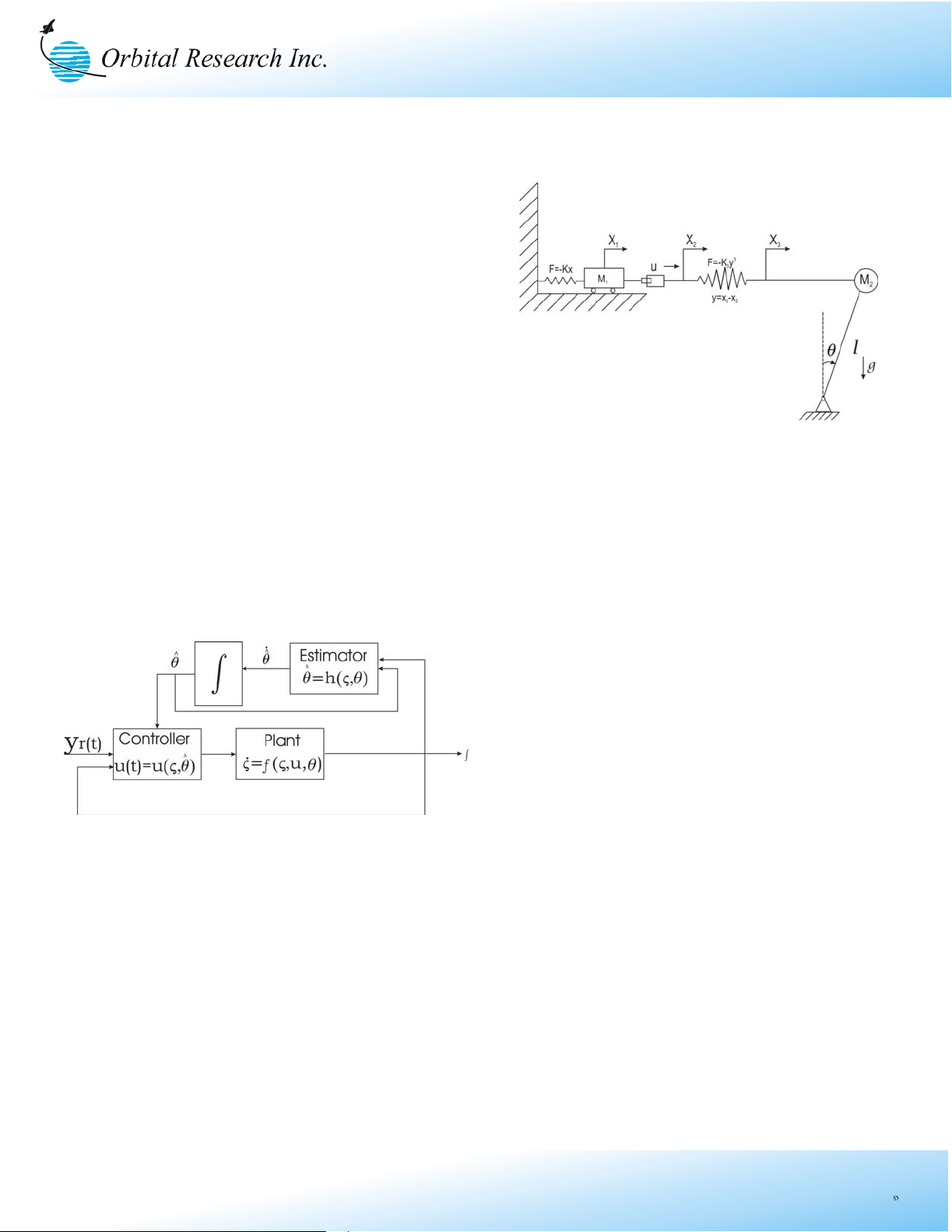
Benchmark underactuated system. The linear
approximation is unstable and uncontrollable
and hence is only controllable via nonlinear
feedback.
Adding a Power Integrator
A ne w feedback design tool ca lled is u sed
adding a power integrator
to solve the problem of global robust stabilization for a significant
class of uncertain nonlinear systems that are of a lower triangular
form but neither necessarily feedback linearizable (fully or
partially) nor affine in the control input. This type of system
cannot be dealt with via conventional approaches but under
certain conditions, a globally stabilizing smooth state feedback
control law can be explicitly constructed by using the technique of
adding a power integrator.
Block diagram of nonlinear adaptive controller
The technique of adding a power integrator is a generalization of
the technique of , also known as
backstepping
adding a linear int egrator
. The technique of adding a po wer integrator,
however, is not a trivial extension of the integrator backstepping
technique because the two tools rely upon very different design
philosophies. To wit, traditional techniques focus on
feedback linearizing
“ ” the system at every step of the recursive
backstepping
design procedure, usua lly by canceling the nonlinearities using
feedback. On the other hand, adding a power integrator focuses
on ways to exploit the dominant nonlinearities of the dynamic
system in the feedback design. Specifically, this technique relies
upon rather than feedback cancellation. In
feedback domination
other words, rather than relying upon nonlinear feedback to
cancel nonlinearities, linear and nonlinear control terms are
designed so that the effect of the system nonlinearities is
negligible. This is crucial as the cancellation of nonlinear t erms is
A Separation Principle for Nonlinearly Parameterized Systems
The vast majority of results presented in the literature thus far for
adaptive control focus on the design of adaptive con trollers f or
nonlinear systems with linear parameterization. That is to say, for
systems in which the unknown parameters appear linearly. Recent
work at CWRU introduces a novel separation principal that allows
a large class of nonline ar syste ms to be charac terized by a
like parameterization
continuous nonlinearly parameterized function can be
dominated by tw o smooth bounding f unctions , and ( )
, such that | (x . Define and the
nonlinearly parameterized linear-like
parameterized function
. From this it follows that one can estimate the new parameter
b
, instead of , and design adaptive controllers directly for
()
22
linear-lik e parameterized
the system. It should be noted here also
. Specifically, the work shows that every
(x )
a(x) b
a( )b b
x() ()
2222
))|
function is decomposed as a
with respect to a new unknown parameter
linear-
2
2
that the conventional backstepping design cannot be applied to
the linear-like parameterized system because it is based upon
feedback linearization or cancellation. On the other hand, the
technique of adding a power integrator is ideally suit ed for the
design of adaptive controllers for linear-like parameterized
systems as it is based upon feedback domination. Due to the
nature of a domination design, one needs only knowing of the
bounding functions (i.e. , not the precise knowledge of
the nonlinearity itself (i.e. ).
Lin, W., Qian, C ., “Adaptive regulation of cascad e sys tems with no nlinear
parameterization,” In Int. J. of Robust and Nonlinear Control, Vol. 12, pp. 1093-1108,
2001
a, b
(x) ( ))
(x
2
2
Adaption
Rather than identify a full set of system parameters via a filtering
approach and up dati ng th e control laws accordin gly as i s
commonly don e, th e app roach descr ibed he re must only identif y
b
()
22
the value of th e bounding function, , and does so via the
construction of a and attendant dynamics. By
Lyapunov function
reducing the identification problem to the identification of the
value of a single bounding function, a minimal parameterization is
which achieve d significantly reduc es comput atio nal overhea d. By
relying upon a Lya punov ba sed adaption scheme, th e ide ntification
can be gua rante ed to converge global ly and hence the adaptive
control le r is
Globally Asymptotically Regulating (GAR).
Orbital Re search, Inc.
4415 Euclid Ave., S uite 500
leveland, OH 44103-3733C
Contact: Frederick J. Lisy, Ph.D.
Telephone (216) 64 9-0399
E-mail lisy @o rb italres earc h.com
www.orbitalresearch.com
Copyr ight 2003
Rev C: RMK-12-5-2003
 Loading...