

Page 1
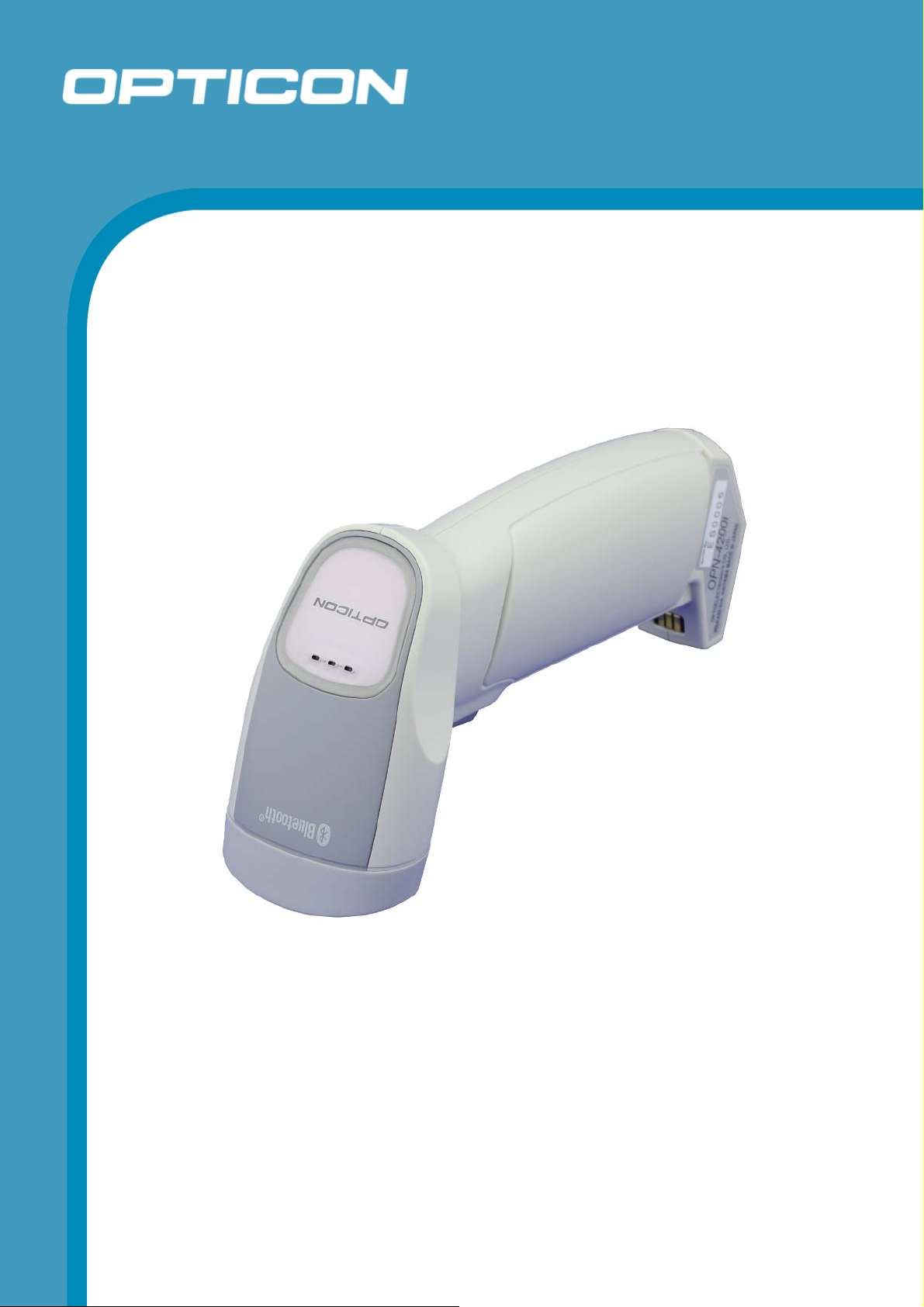
Handheld Bluetooth 1D CCD Scanner
OPC-3301n
This manual provides specifications for the OPC3301n handheld Bluetooth 1D CCD scanner.
Specifications Manual
Page 2

All information subject to change without notice.
Document History
OPC-3301n
Specifications Manual
Model Number:
Edition:
Date:
OPC-3301n
1st
2014-10-20
Specification Number:
Original Spec Number:
(SS14024)
(SS14016)
Copyright 2014 Opticon. All rights reserved.
This manual may not, in whole or in part, be copied, photocopied, reproduced, translated or converted to any
electronic or machine readable form without prior written consent of Opticon.
Limited Warranty and Disclaimers
PLEASE READ THIS MANUAL CAREFULLY BEFORE INSTALLING OR USING THE
PRODUCT.
Serial Number
A serial number appears on all Opticon products. This official registration number is directly related to the device
purchased. Do not remove the serial number from your Opticon device. Removing the serial number voids the
warranty.
Warranty
Unless otherwise agreed in a written contract, all Opticon products are warranted against defects in materials and
workmanship for two years after purchase. Opticon will repair or, at its option, replace products that are defective
in materials or workmanship with proper use during the warranty period. Opticon is not liable for damages caused
by modifications made by a customer. In such cases, standard repair charges will apply. If a product is returned
under warranty and no defect is found, standard repair charges will apply. Opticon assumes no liability for any
direct, indirect, consequential or incidental damages arising out of use or inability to use both the hardware and
software, even if Opticon has been informed about the possibility of such damages.
Packaging
The packing materials are recyclable. We recommend that you save all packing material to use should you need
to transport your scanner or send it for service. Damage caused by improper packaging during shipment is not
covered by the warranty.
Trademarks
Trademarks used are the property of their respective owners.
Opticon Inc. and Opticon Sensors Europe B.V. are wholly owned subsidiaries of OPTOELECTRONICS Co., Ltd.,
12-17, Tsukagoshi 4-chome, Warabi-shi, Saitama, Japan 335-0002. TEL +81-(0) 48-446-1183; FAX +81-(0) 48446-1184
SUPPORT
USA Europe
Web: www.opticon.com
Page 3

Specifications Manual
Revision History
Specification No. : (SS14024)
Product name : OPC-3301n
Edition Date Page Section Description of Changes
First 2014/10/20 - - Initial release
OPC-3301n
Page 4

OPC-3301n
Specifications Manual
Contents
1. Abstract.............................................................................................................................................1
2. Overview............................................................................................................................................ 1
3. Basic Specifications......................................................................................................................... 2
4. Detailed View .................................................................................................................................... 4
5. Electrical Specifications..................................................................................................................5
5.1. Current Consumption................................................................................................................ 5
5.2. Operating Time and Charging Time ......................................................................................... 5
6. Interface Specifications...................................................................................................................5
6.1. Bluetooth ................................................................................................................................... 5
7. Optical Specifications...................................................................................................................... 6
7.1. Basic Optical Specifications...................................................................................................... 6
7.2. Aiming Pattern .......................................................................................................................... 6
8. Technical Specifications..................................................................................................................7
8.1. Bar Code Test Sample.............................................................................................................. 7
8.2. Scan Area and Depth of Field................................................................................................... 8
8.3. Printed Contrast Signal (PCS) .................................................................................................. 9
8.4. Minimum Resolution ................................................................................................................. 9
8.5. Wide Bar Code.......................................................................................................................... 9
8.6. Pitch, Skew and Tilt ................................................................................................................ 10
8.7. Curvature ................................................................................................................................ 10
8.8. Scanning from LCD Screen .................................................................................................... 11
8.9. Auto Trigger ............................................................................................................................ 11
8.9.1. Stand Detection............................................................................................................. 11
8.9.2. Auto Trigger Operation.................................................................................................. 12
9. Environmental Specifications....................................................................................................... 13
9.1. Temperature............................................................................................................................ 13
9.2. Humidity .................................................................................................................................. 13
9.3. Ambient Light Immunity .......................................................................................................... 13
9.4. Dust and Drip Proof ................................................................................................................ 13
9.5. Vibration Strength (without packing).......................................................................................13
9.6. Vibration Strength (in individual packing) ............................................................................... 14
9.7. Drop Impact Strength (without packaging) ............................................................................. 14
9.8. Drop Impact Strength (in individual packaging)...................................................................... 14
9.9. Electrostatic Discharge (ESD) Immunity................................................................................. 14
10. Regulatory Compliance ............................................................................................................... 15
10.1. LED Safety............................................................................................................................ 15
10.2. Product Safety ...................................................................................................................... 15
Page 5

OPC-3301n
Specifications Manual
10.3. EMC ...................................................................................................................................... 15
10.4. Others ................................................................................................................................... 16
11. RoHS..............................................................................................................................................16
12. Reliability....................................................................................................................................... 16
13. Precautions................................................................................................................................... 16
13.1. Handling................................................................................................................................ 16
13.2. Radio Law ............................................................................................................................. 17
13.3. Bluetooth............................................................................................................................... 17
13.4. Frequency Baud.................................................................................................................... 17
14. Product Labels..............................................................................................................................18
15. Packaging Specifications............................................................................................................ 19
15.1. Individual Packaging ............................................................................................................. 19
15.2. Collective Packaging............................................................................................................. 20
16. Physical Features.........................................................................................................................21
16.1. Dimensions ........................................................................................................................... 21
16.2. Weight ................................................................................................................................... 21
16.3. Mechanical Drawing.............................................................................................................. 21
17. Supported Symbologies.............................................................................................................. 22
17.1. Default Setting ...................................................................................................................... 22
17.2. Supported Symbologies........................................................................................................ 22
17.2.1. 1D Bar Codes .............................................................................................................. 22
17.2.2. GS1 Databar, Composite Code................................................................................... 23
Page 6

OPC-3301n
Specifications Manual
1. Abstract
This manual provides specifications for the OPC-3301n handheld Bluetooth 1D CCD scanner.
2. Overview
The OPC-3301n is a handheld 1D scanner with a built-in CCD imager that enables high speed scanning
of standard linear (1D) symbologies. The scanned data is output via Bluetooth.
・ All bar code data scanned is transmitted to a host device through the Bluetooth interface.
・ The scanner can work with many Bluetooth-enabled host devices, such as PCs, tablet PCs and
smart phones.
・ Bluetooth SPP (Serial Port Profile) and HID (Human Interface Device Profile) are implemented.
・ The scanner can read bar codes from LCD screens.
・ A single red LED aiming line toward a target bar code can help the users find the appropriate
scanning position.
・ Special antimicrobial treatment is applied to the chassis, and alcohol can be used to wipe the
scanner clean (except for the scanning window and the logo panel).
・ The power source is 3.7 V 1100 mAh (typ.) lithium-ion battery.
・ A dedicated charging cradle CHG-3201 is supplied for recharging and easy storage of the
scanner.
1
Page 7
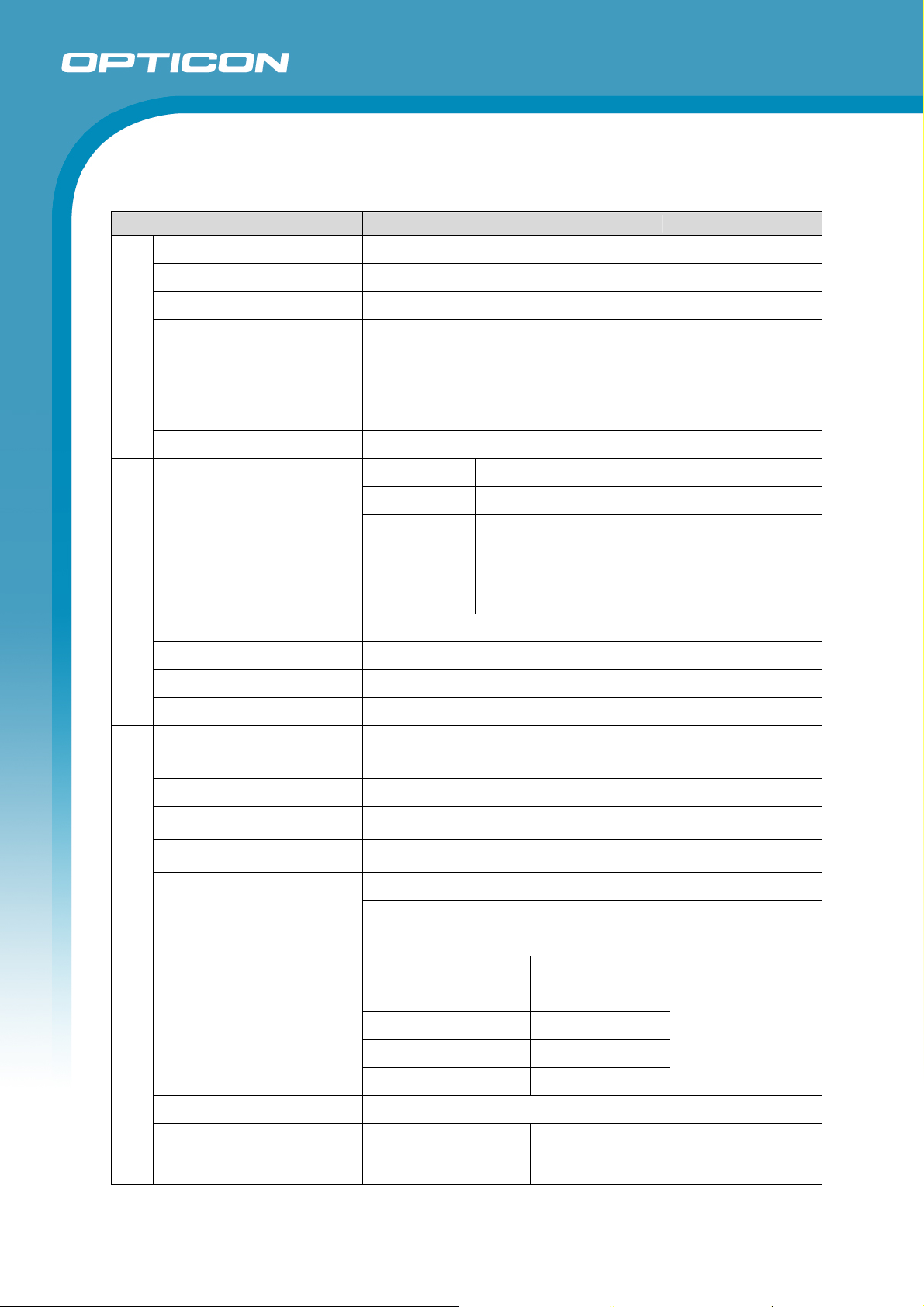
3. Basic Specifications
Item Specification Note
CPU 32 bit CISC / 96 MHz
Section
Control
FROM 512 Kbyte + 32 Kbyte
OPC-3301n
Specifications Manual
SRAM 96 Kbyte
FROM (storage) 1 Mbyte
Section
Input
Key type 1 key: trigger
Indicator
LED 2 colors (red, green) and 1 color (blue)
Buzzer Loudness (3-level) / tone adjustable
Frequency 2402 ~ 2480 MHz
Interface
Bluetooth
Specification Bluetooth Ver 2.1 compliant
Communication
distance
10 m
Output level Class 2
Profile SPP / HID
Scan method CCD linear image sensor
Section
Optical
Light source 1 red LED
Effective pixels 1500 pixels
View angle Horizontal: approx. 50°
JAN, EAN, UPC-A, UPC-E, NW-7 (Codabar),
Symbologies
Industrial 2 of 5, Interleaved 2 of 5, Code 11,
Code 39,Code 93,Code 128 etc.
Minimum resolution Code 39 : 0.1 mm
Curvature
Wide bar code
Supported 1D Symbologies
R ≥ 15 mm (8-digit JAN)
R ≥ 20 mm (13-digit JAN)
110 mm wide 0.2 mm resolution Code 39
(DOF 150 mm) is readable:
Pitch : ±50°
For data area only
It may be shorter
depending on usage
environments
Max output 4 dBm
Refer to Chapter 17. for
details
PCS 0.9
PCS 0.9
Scan angle
Skew : ±65° (excluding dead zone)
Tilt : ±25°
Resolution (0.127) 55 ~ 75
Resolution (0.15) 45 ~ 100
Depth of field
(mm)
Code 39
Resolution (0.25) 35 ~ 175
Resolution (0.5) 40 ~ 300
Resolution (1.0) 60 ~ 500
Minimum PCS 0.3 or more
Brightness of white
On LCD screen
space
Contrast ratio 100:1 or more
2
MRD 32% or more
30 cd/m
2
or more
Page 8

Power Section
Main battery Lithium-ion 1100 mAh (typ.)
Up-time 48 hours or more
OPC-3301n
Specifications Manual
Item Specification Note
Charge the battery
before initial use
*1
Operating (charging) voltage 5.0 ~ 6.5V
Current
consumption
Charging Less than 1 A
Operating 0 ~ 50°C
Temperature
Environmental Specifications
Storage -20 ~ 60°C
Operating 20 ~ 85%
Humidity
Storage 20 ~ 85%
Ambient light
immunity
Fluorescent 10,000 lx or less
Sunlight 100,000 lx or less
10 Hz ~ 100 Hz, acceleration of 19.6 m/s2, 60
Vibration
minutes per cycle, repeat once in each X, Y
and Z-direction
Drop
Drop the scanner 30 times (6 faces x 5) from
the height of 150 cm onto a concrete floor
Dust and drip proof IP42 equivalent
LED safety IEC 62471-1:2006 Exempt_Group
Regulatory Compliance
Product safety
IEN60950-1:2005
IEC60950-1:2006
EN 55022:2010
EN 301 489-1 V1.9.2
EMC
EN 301 489-17 V2.1.1
EN 300 328 V1.8.1
FCC Part 15 Subpart C, Subpart B ClassB
VCCI Class B
Bluetooth logo certification
Other
Immunity
Test
No distraction Air discharge (direct): ±15 kV
ESD
No malfunction
Features
Physical
Dimensions 113 × 56 × 132 (WDH mm)
CE Marking
Certification for Construction Design of
Specified Radio Equipment
Contact discharge (direct / indirect): ±6 kV
Air discharge (direct): ±8 kV
Charging with charger
No condensing
No frost
Peak Wavelength
624 nm
For residential,
commercial and lightindustrial environments
Conditions:
IEC61000-4-2
compliant
Weight Approx. 125 g
Excluding accessories
*1: When a bar code is read twice every 10 seconds at room temperature in a const Bluetooth connection (SPP
master mode).
3
Page 9
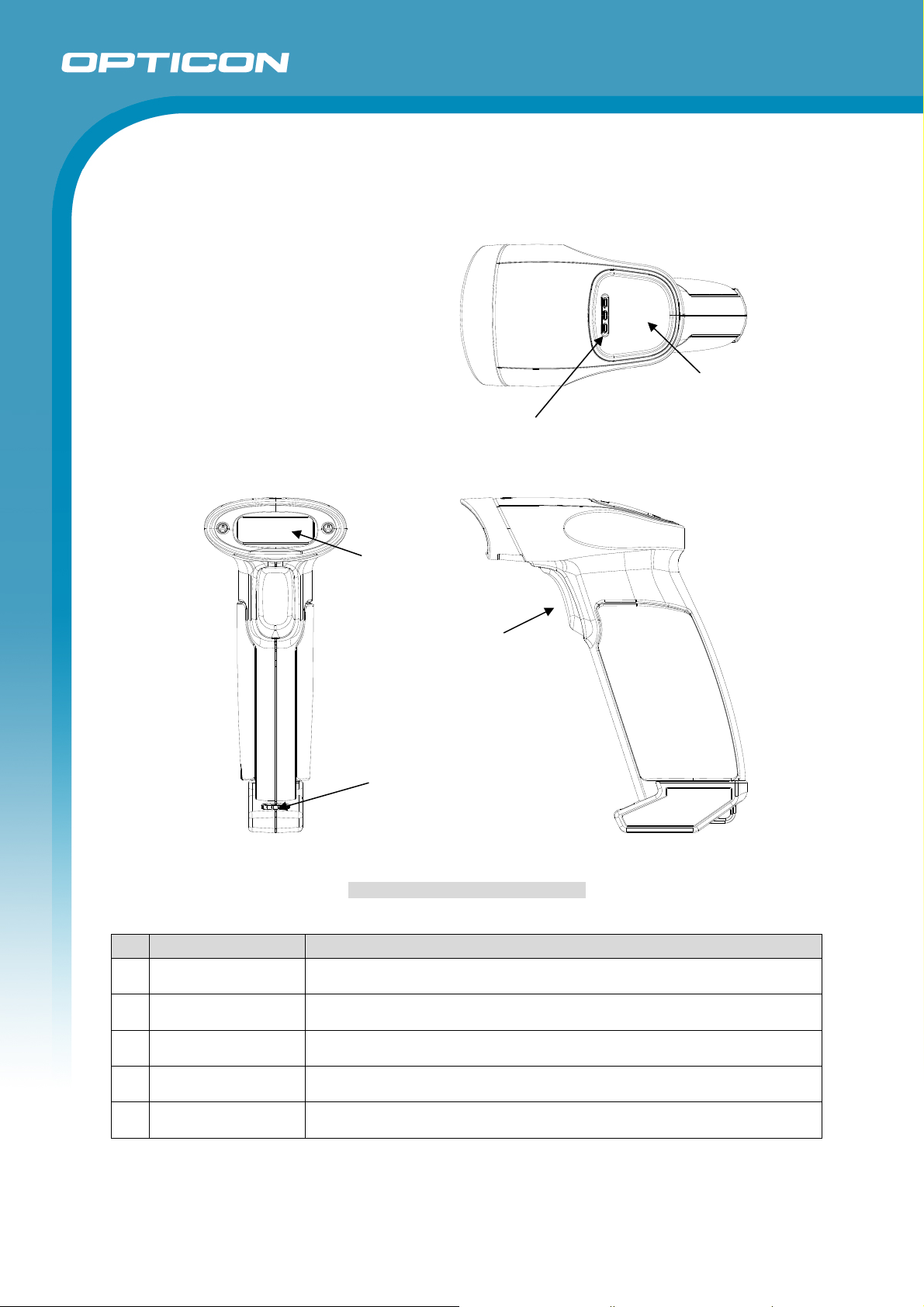
4. Detailed View
OPC-3301n
Specifications Manual
3
2
1
5
Figure 1: Detailed View of OPC-3301n
No Name Description
1 Trigger Key A key to read bar codes
2 Scan Window LED illumination is emitted from this window to read bar codes.
3 Status LED
4 Buzzer Holes A sound from a built-in buzzer comes out through these holes.
5 Charging terminals Charging pins connected to the dedicated charging cradle CHG-3201
The operating statuses, such as bar code reading, Bluetooth connection
and warning, are indicated by different colors.
4
Page 10
Specifications Manual
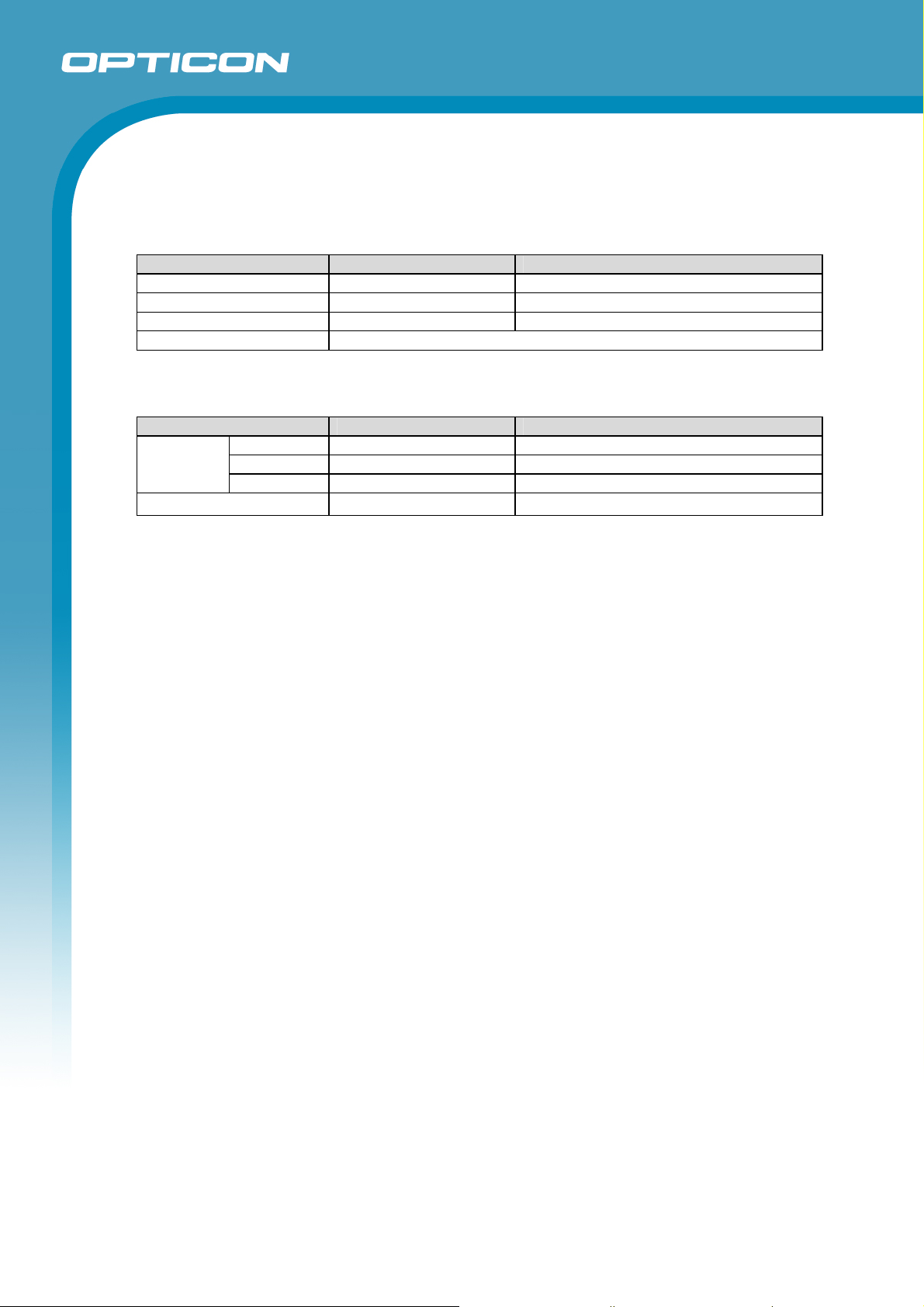
5. Electrical Specifications
5.1. Current Consumption
Item Specification Note
Standby 15 mA or less With wireless connection
Sleep 1 mA or less
Operating 200 mA or less Reading, communications, LED activated
Measurement condition Power voltage 3.7 V at 25 °C
5.2. Operating Time and Charging Time
Item Specification Note
Battery
duration
Charging time Approx. 3 hours
* The above specifications may not be met when the battery pack has been deteriorated.
Sleep 200 hours or more
Standby Approx. 72 hours With wireless connection
Reading Approx. 48 hours 1 scan / 5 secs with wireless connection
With AC adaptor power supply
6. Interface Specifications
OPC-3301n
6.1. Bluetooth
Frequency : 2402 ~ 2480 MHz
Specification : Bluetooth Ver 2.1 compliant
Communication distance : 10 m
Output level : Class 2 (max 4 dBm)
Implemented profile : SPP / HID
Communication configuration : 1 to 1
Operating mode in communication : Master / Slave mode
Security mode : Authentication supported
Encryption : Encryption supported
5
Page 11
A
7. Optical Specifications
7.1. Basic Optical Specifications
Item Characteristics
Scan method CCD linear image sensor -
Effective pixels Horizontal 1500 dots
Image capture speed (*1) Scan rate 300 scans/sec
Focal distance Distance from the front edge of scanner 105 mm
View angle Horizontal Approx. 50°
Red LED -
Light source
*1 The fastest seed of image capture
*2 Reference value based on the datasheet (25°C, luminous efficiency 60lm/W, IF = 100 mA ).
Peak wavelength 624 nm
Maximum radiation output (*2) 12 lm
OPC-3301n
Specifications Manual
7.2. Aiming Pattern
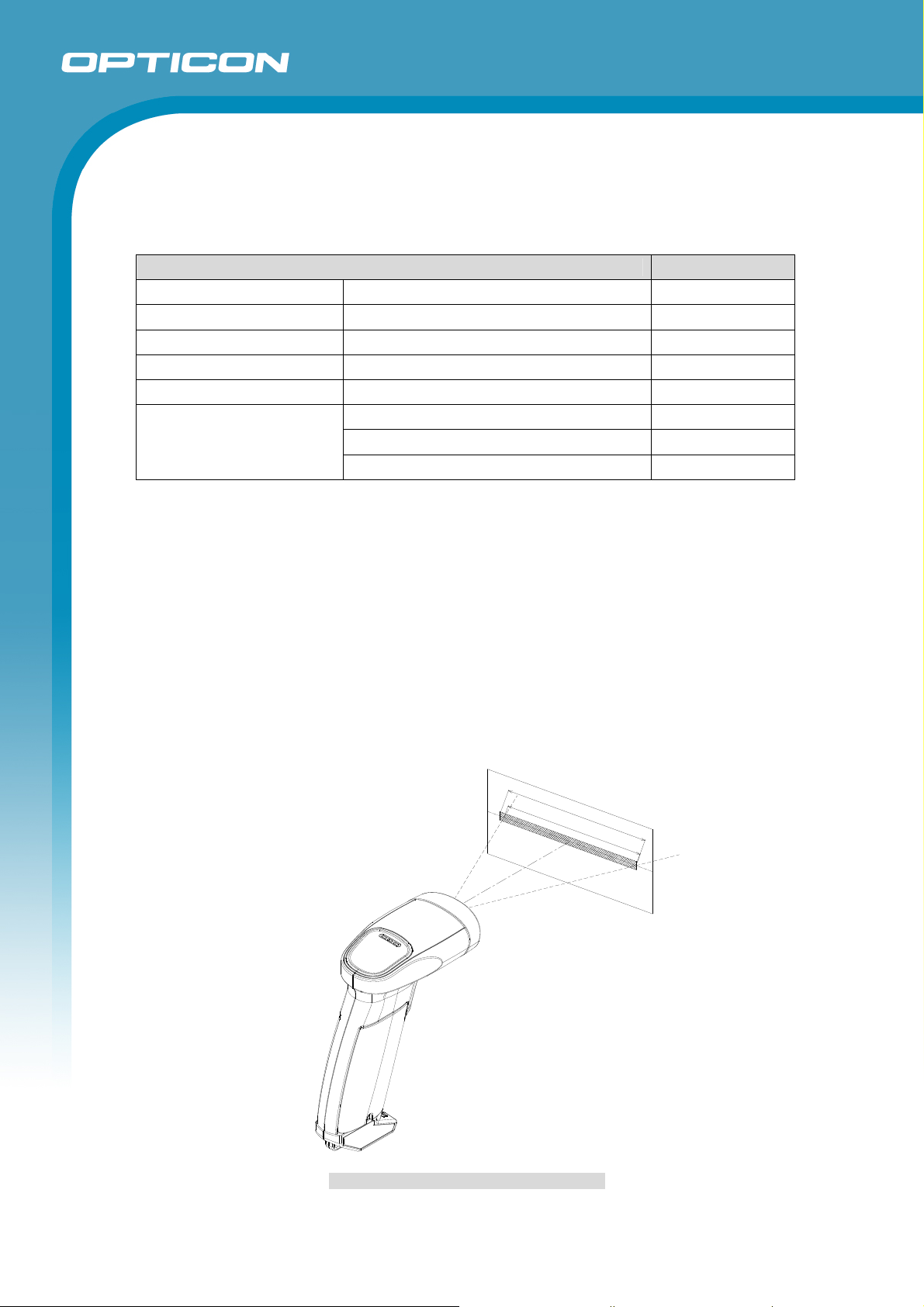
The aiming is used for the following purpose:
1. Light source for bar code reading
2. Light source to indicate the appropriate reading range
The aiming specifications are as follows:
・ An optical axis of imaging field of view and the center of horizontal aiming width coincide at a
distance of L=60±10 mm from the front edge of the scanner.
・ The horizontal aiming width to the horizontal width of imaging filed of view at a distance of L=60
mm is 100%±10%.
iming Width
Horizontal FOV
L
Figure 2: Aiming Pattern and Imaging Range
6
Page 12
OPC-3301n
Specifications Manual
8. Technical Specifications
The conditions for technical specifications are as follows unless otherwise specified in each section.
<Conditions>
Temperature and humidity : Room temperature, room humidity
Ambient light : 200 ~ 300 lx
Angles : Pitch: α = 0°, Skew: β = 15°, Tilt: γ = 0°
Curvature : R = ∞
Power supply voltage : 3.7 V
Reading test : 1 read in 0.5 sec or less.
Accept the performance with 10 consecutive successes
Bar code test sample : OPTOELECTRONICS test samples.
Refer to Section 8.1. for details.
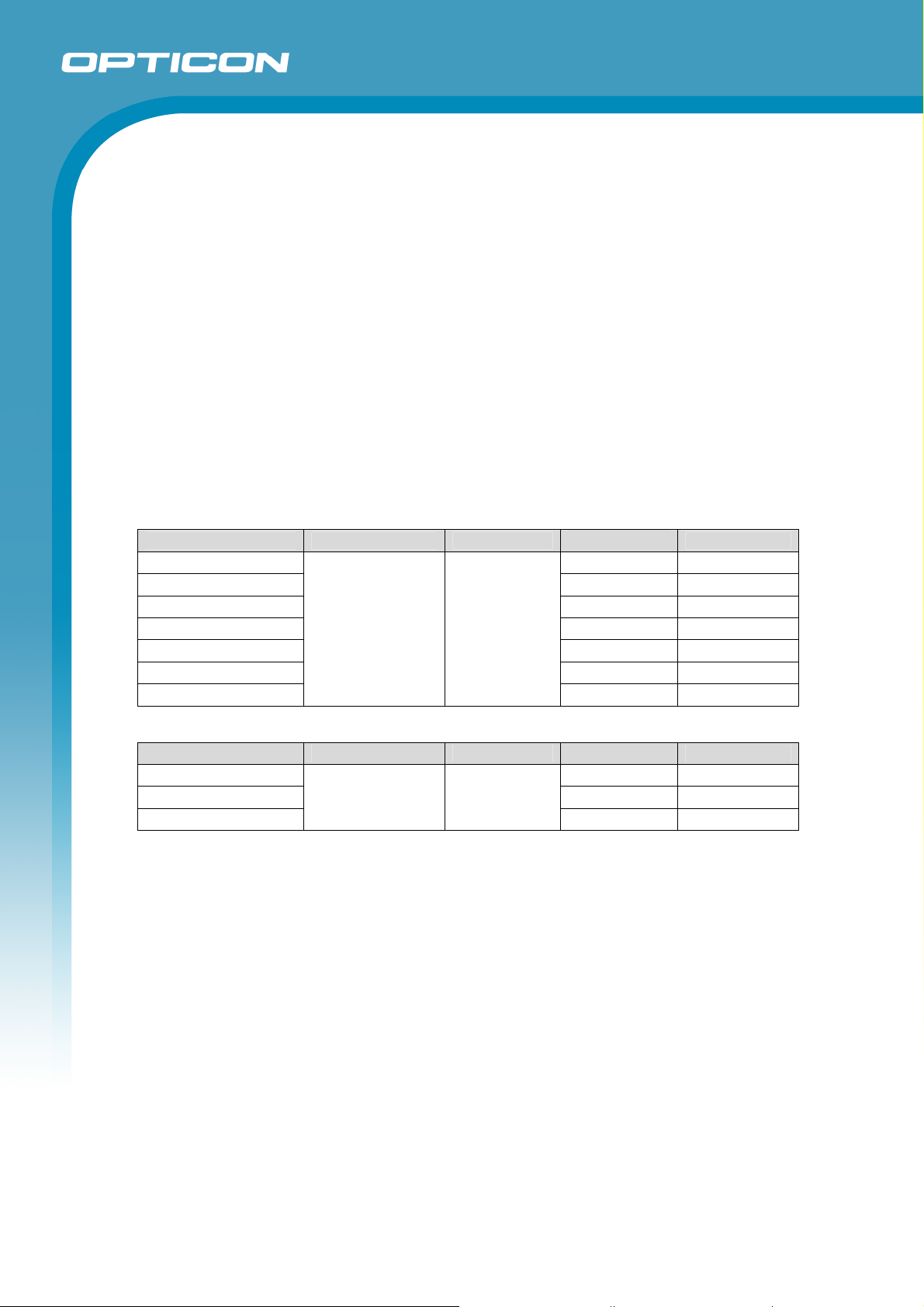
8.1. Bar Code Test Sample
<Code 39>
Quiet Zone
No. of Digits
5 mm 4
Quiet Zone
No. of Digits
10 mm 13
Resolution Symbology PCS
1.0 mm 25 mm 1
0.5 mm 18 mm 3
0.25 mm 10 mm 8
0.2 mm 10 mm 34
Code 39 0.9
0.15 mm 7 mm 10
0.127 mm 5 mm 4
0.1 mm
<JAN>
Resolution Symbology PCS
0.26 mm 10 mm 13
0.26 mm 10 mm 8
JAN 0.9
0.33 mm
7
Page 13
OPC-3301n
Specifications Manual
8.2. Scan Area and Depth of Field
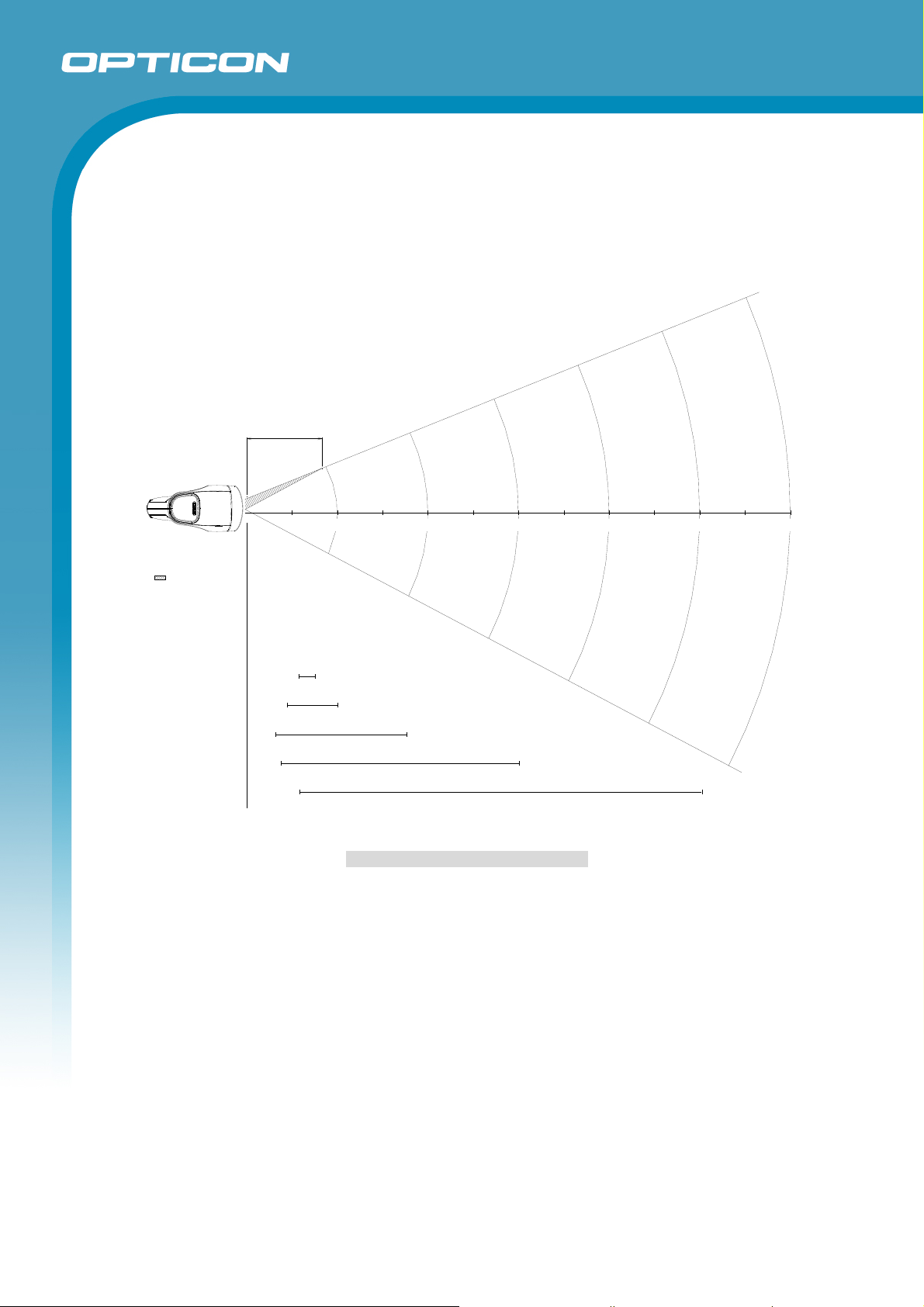
The scan area is within the arc centered on the scan origin as shown in each resolution, which is
measured from the front edge of the scanner.
60
Scanning may
not be possible
within this range
50
100 200 300
Resolution 0.127
55 75
Resolution 0.15
45 100
35 175
Resolution 0.25
40 300
60 500
150 250
Resolution 0.5
Resolution 1.0
350 450
400 500 600
Figure 3: Scan Area and Depth of Field
550
(Unit: mm)
8
Page 14
Specifications Manual
8.3. Printed Contrast Signal (PCS)
0.3 or higher
<Conditions>
MRD : 32% and higher
(70% or higher reflectivity of space and quiet zone)
Distance : 72 mm from the front edge of the scanner
Bar code : JAN (resolution 0.26 mm, PCS 0.3) specified in Section 8.1.
MRD = Minimum reflectance of white space - Maximum reflectance of black bar
PCS =
Reflectance of white spece - Reflectance of black bar
Reflectance of white space
* Be sure to keep the optical window clean without dirt or scratches, or it may have a bad effect on
the reading characteristics.
OPC-3301n
8.4. Minimum Resolution
0.1 mm or more
<Conditions>
Bar code : Code 39 (resolution 0.1 mm) specified in Section 8.1.
Distance : 72 mm from the front edge of the scanner
Angle : α = 0°, β = + 15°, γ = 0°
Curvature : R = ∞
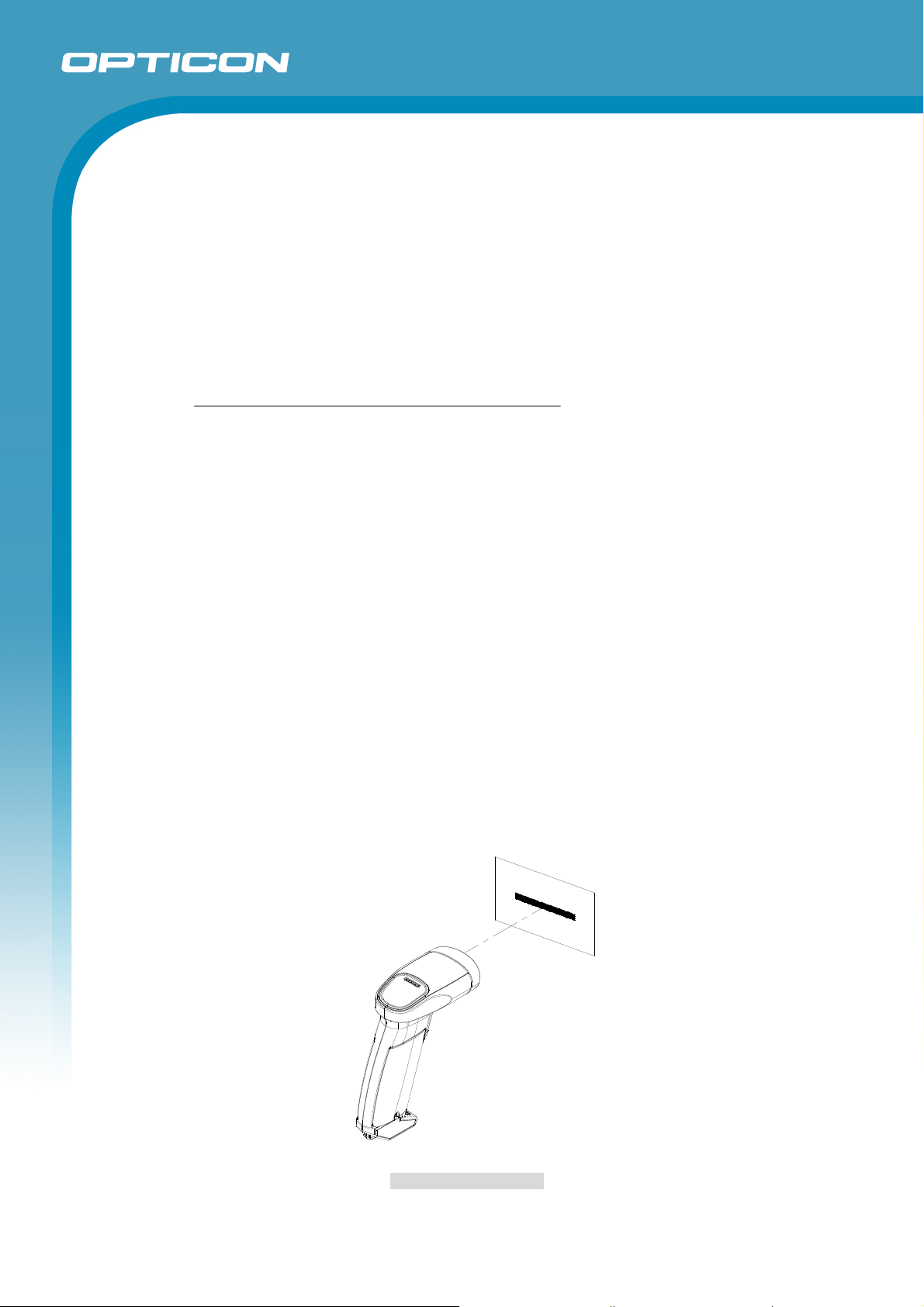
8.5. Wide Bar Code
Code 39 with width of 110 mm and resolution of 0.2 mm can be read
<Conditions>
Bar code : Code 39 (resolution 0.20 mm, PCS 0.9) specified in Section 8.1.
Distance : 127 mm from the front edge of the scanner
Angle : α = 0°, β = +15°, γ = 0°
Curvature : R = ∞
Figure 4: Wide Bar Code
9
Page 15
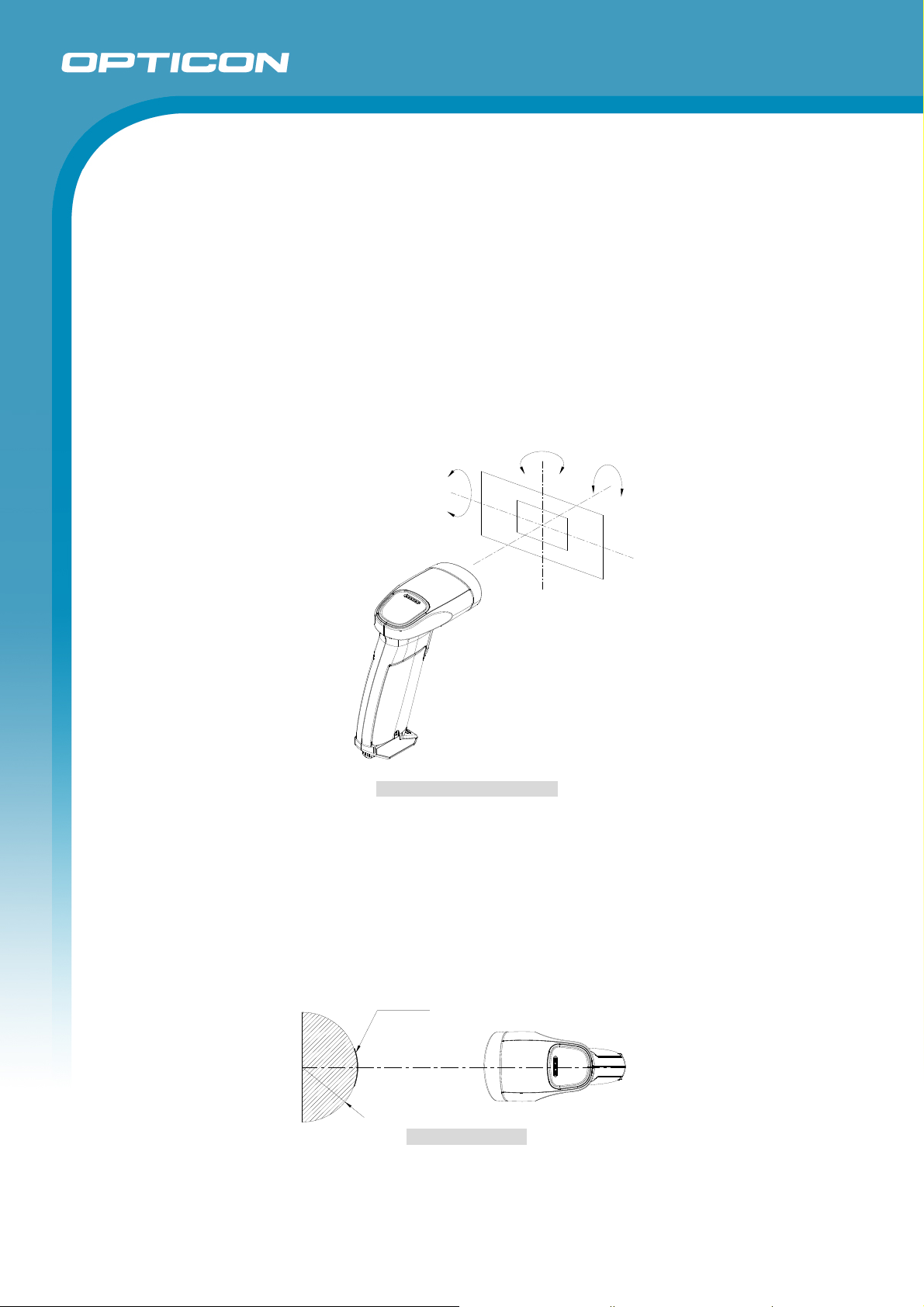
8.6. Pitch, Skew and Tilt
Pitch : α = ±50°
Skew : β = ±65°
Dead zone : β = ±8°
Tilt : γ = ±25°
<Conditions>
Bar code : JAN (resolution 0.33 mm) specified in Chapter 8.1
Distance : 72 mm from the front edge of the scanner
Curvature : R = ∞
Angle : Pitch β = +15°, γ = 0°
Skew, Dead zone α = 0°, γ = 0°
Tilt α = 0°, β = +15°
α
OPC-3301n
Specifications Manual
-
β
+
+
Figure 5: Pitch, Skew and Tilt
8.7. Curvature
0.26 mm 8-digit JAN : R ≥ 15 mm
0.26 mm 13-digit JAN : R ≥ 20 mm
<Conditions>
Bar code : JAN (resolution 0.26 mm) specified in Section 8.1.
Distance : 127 mm from the front edge of the scanner
Angle : α = 0°, β = +15°, γ = 0°
γ
+
Bar code
R
Figure 6: Curvature
* The reading characteristics may deteriorate due to the specular reflection of LED illumination when the
reflectivity is high.
10
Page 16
OPC-3301n
A
r
Specifications Manual
8.8. Scanning from LCD Screen
Bar codes displayed on LCD screens (brightness of white part 30 cd/m2 or more, contrast ratio
100:1) can be read.
<Conditions>
Bar code : JAN (resolution 0.26 mm) specified in Section 8.1.
Ambient light : 100 lx or less
Distance : 127 mm from the front edge of the scanner
Angle : α = 0°, β = 0°, γ = 0°
LCD screen type : Transmissive (backlight) TFT
Contrast ratio =
* The bar code resolution is the value when displayed on the LCD screen.
* The width of bar code element is an integral multiple of pixel width of LCD screen.
* The reading characteristics may deteriorate due to the specular reflection of LED illumination when
the reflectivity is high.
Brightness of white parts
Brightness of black parts
8.9. Auto Trigger
When the scanner is placed in a dedicated stand (sold separately) which contains a magnet, it can
detect this magnet and enters auto trigger mode. The scanner starts scanning automatically when it
detects a change in brightness that occurs when a bar code label is presented in front of it.
8.9.1. Stand Detection
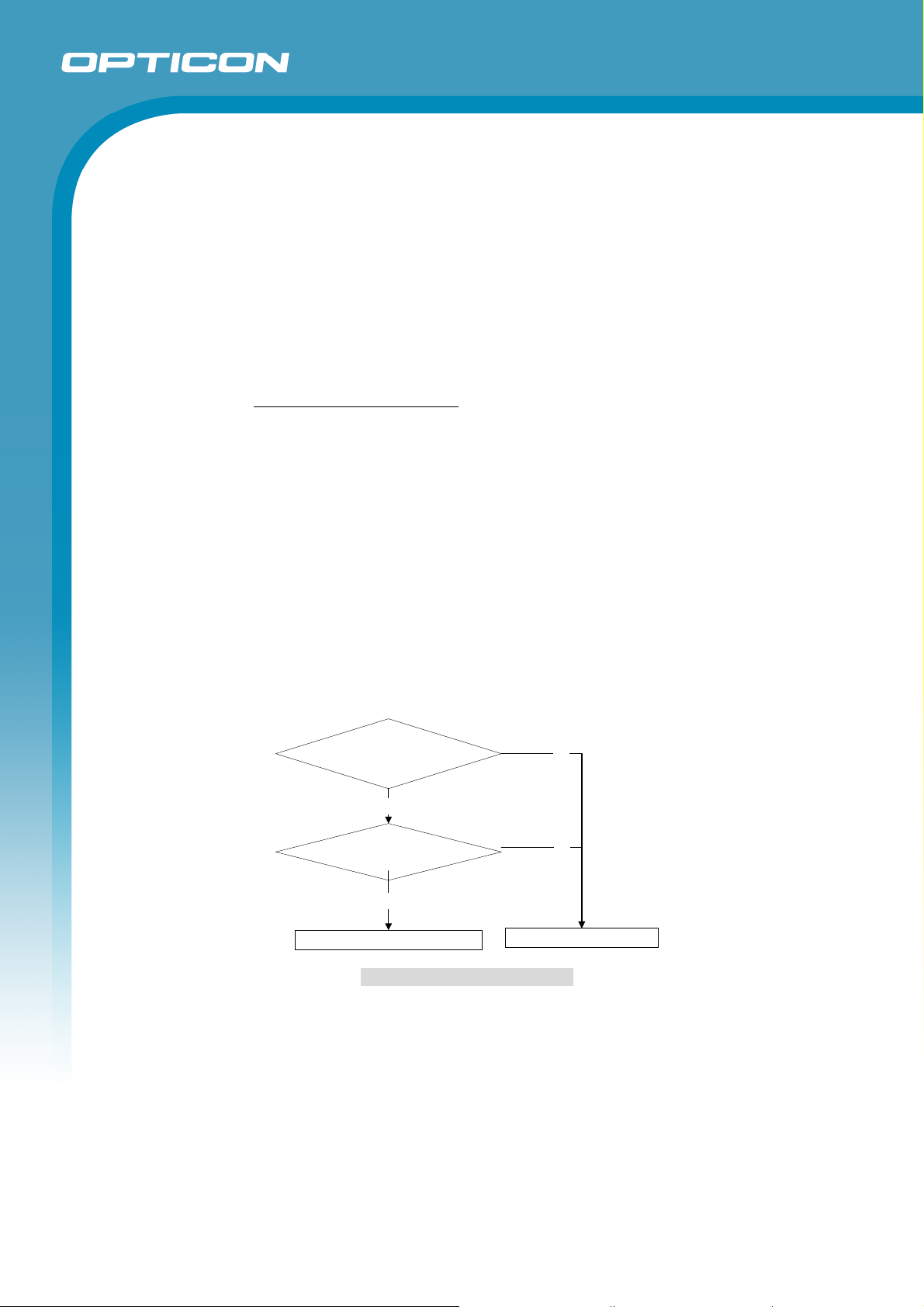
“Stand detection - Auto trigger flow”
Is Stand Detection
mode “*4” enabled?
Yes
Is the scanner
in the stand?
Yes
uto Trigge
No
No
Manual Trigger
Figure 7: Stand Detection Flow
* The dedicated stand is an optional accessory that can be purchased separately.
* The stand detection mode is disabled by default. It must be enabled to be used.
11
Page 17
OPC-3301n
Specifications Manual
8.9.2. Auto Trigger Operation
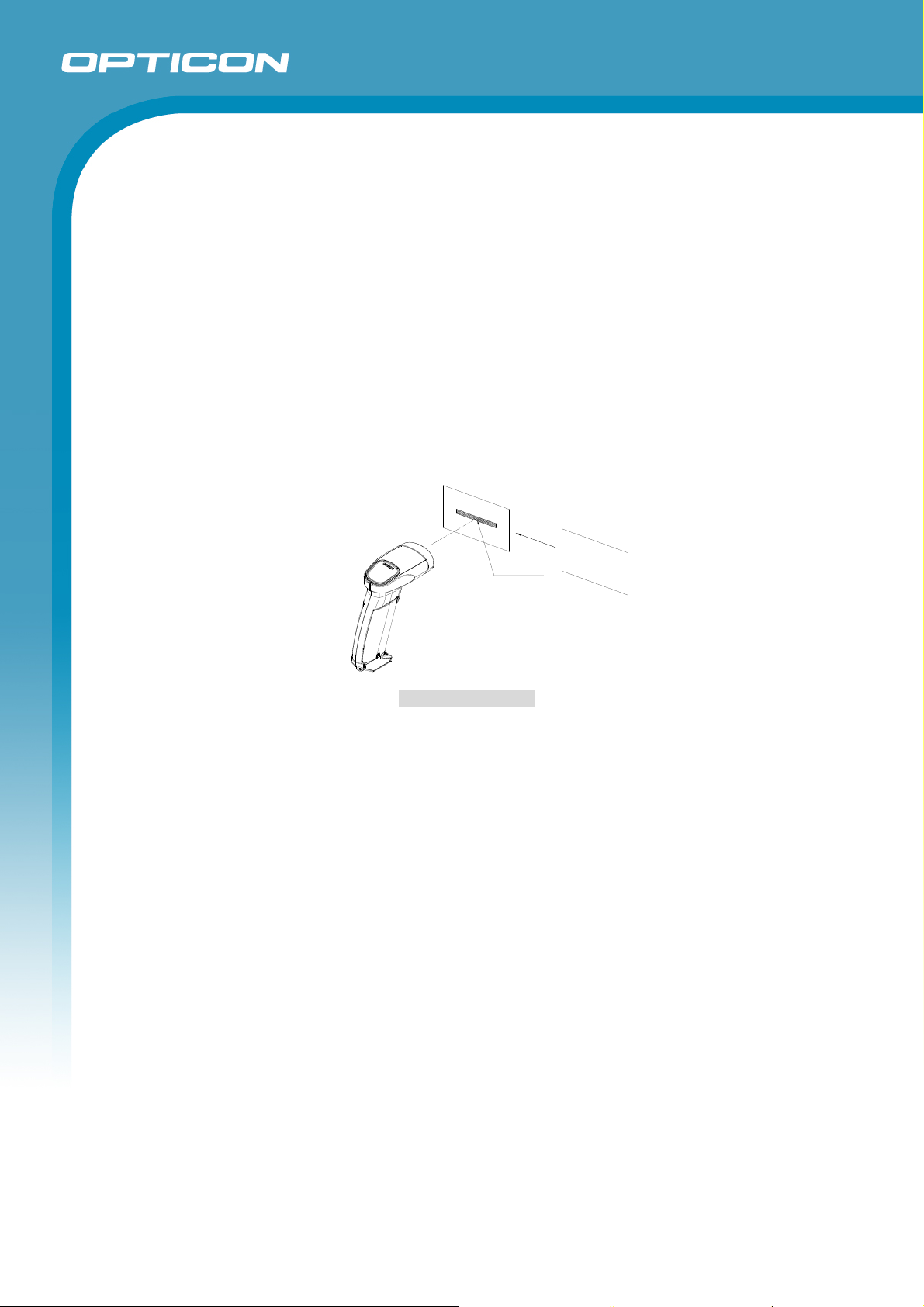
The scanner has an optional auto trigger mode in which it starts to read a bar code
automatically when it detects one.
When auto trigger mode is enabled, the scanner tries to detect bars at regular intervals and
when it detects 18 or more bars, it enters read mode in which it tries to decode a bar code.
When the scanner continues to detect bars after the reading has been done, it will assume
those bars are from the same bar code as the previous one and will not attempt to read it.
When the detecting conditions are not met, the scanner will perform the intermittent scanning
again until the next bar code is detected.
<Conditions>
Angle of paper : Skew angle, excluding pitch angle and dead zone,
specified in Section 8.6
Temperature / Humidity : Room temperature / room humidity
Ambient light : 500 ~ 1000 lx
Paper
Detection range
Figure 8: Auto Trigger
12
Page 18

OPC-3301n
Specifications Manual
9. Environmental Specifications
9.1. Temperature
Scanning performance is guaranteed when the range of ambient temperature around the scanner is
the following values:
Operating temperature : 0 ~ 50 °C
Storage temperature : -20 ~ 60°C
9.2. Humidity
Scanning performance is guaranteed when the range of ambient humidity around the scanner is the
following values:
Operating humidity : 20 ~ 85% RH (no condensation, no frost)
Storage humidity : 20 ~ 85% RH (no condensation, no frost)
9.3. Ambient Light Immunity
Scanning performance is guaranteed when the range of illumination on a bar code surface is
between zero and the following values:
Incandescent light : 10,000 lx
Fluorescent light : 10,000 lx
Sunlight : 100,000 lx
<Conditions>
Bar code : JAN (resolution 0.26 mm) specified in Section 8.1.
Distance : 72 mm from the front edge of the camera module
Angle
Curvature : R = ∞
Power supply voltage : 3.7 V
* Be sure that the direct light or specular reflection from the light source does not enter the light
receiving section of the scanner.
: α = 0°, β =+15°, γ = 0°
9.4. Dust and Drip Proof
IEC IP42 equivalent
Protection against solid objects: Level 4 equivalent
Protected against solid objects greater than 1.0 mm
Protection against liquids: Level 2 (JIS IPX2) equivalent
Protected against dripping water from the vertical when tilted up to 15°
* () is JIS drip-proof type.
9.5. Vibration Strength (without packing)
There shall be no sign of malfunction after the following vibration test.
Vibration test: Increase the frequency of the vibration from 10Hz to 100Hz at an accelerated
velocity of 19.6m/s
this in each X, Y and Z direction.
2
(2.0 G) for 30 minutes (60 minutes per cycle) in the non-operating state. Repeat
13
Page 19
OPC-3301n
Specifications Manual
9.6. Vibration Strength (in individual packing)
There shall be no sign of malfunction after the following vibration test.
Vibration test:
velocity of 19.6 m/s
Increase the frequency of the vibration from 10Hz to 100Hz at an accelerated
2
(2.0 G) for 30 minutes (60 minutes per cycle) in individually packaged state.
Repeat this in each X, Y and Z direction.
9.7. Drop Impact Strength (without packaging)
There shall be no sign of malfunction after the following drop test.
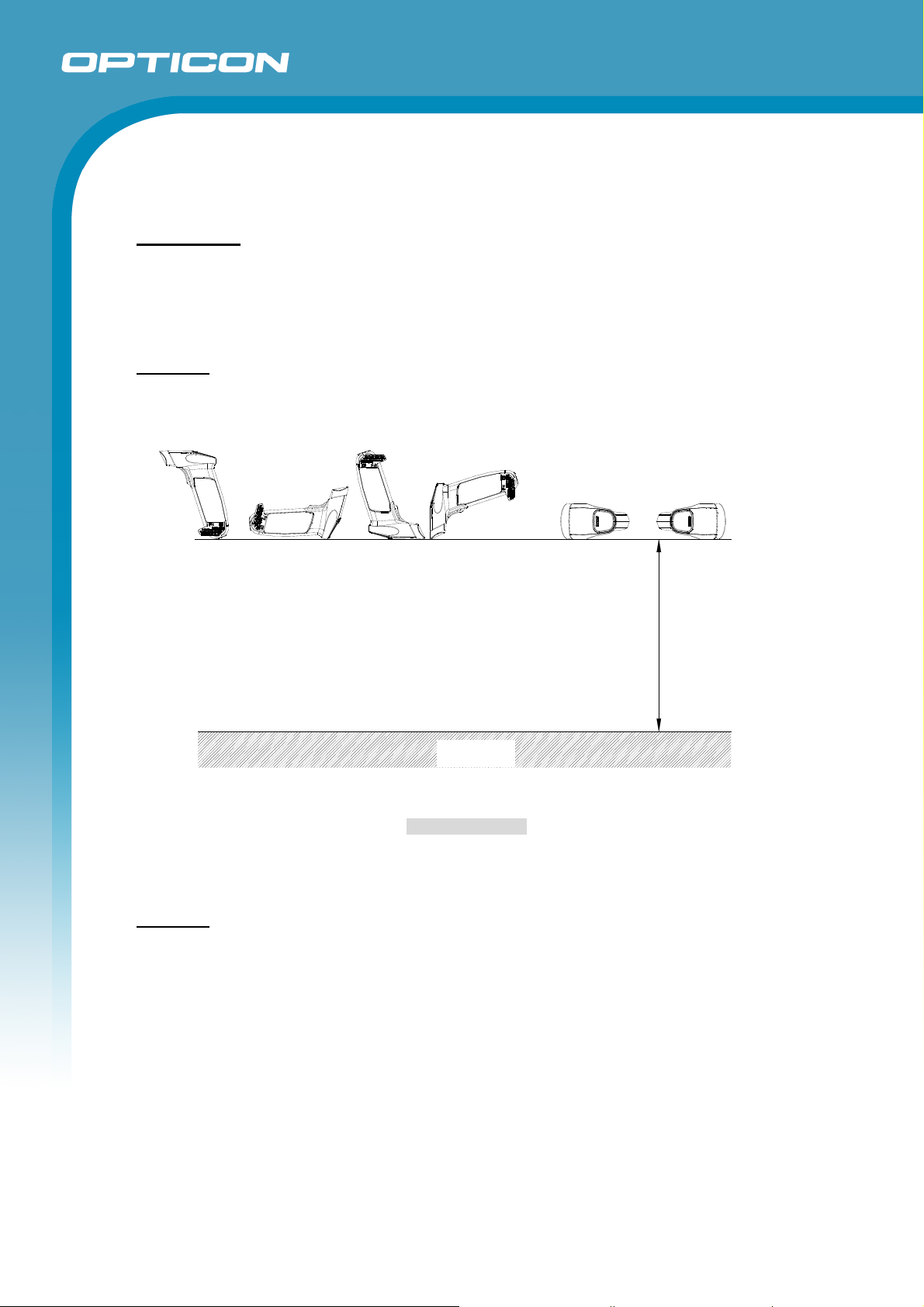
Drop test: Drop the scanner 30 times in total (5 times at each 6 face) from a height of 150 cm onto
a concrete floor as shown below.
150cm
Concret
Figure 9: Drop Test
9.8. Drop Impact Strength (in individual packaging)
There shall be no sign of malfunction after the following drop test.
Drop test:
Drop an individually packaged scanner 10 times in total, at any of 1 corner, 3 edges, and
6 faces, from a height of 150 cm onto a concrete floor.
9.9. Electrostatic Discharge (ESD) Immunity
Contact discharge : ±6 kV max (direct or indirect discharge, no malfunction)
Aerial discharge : ±8 kV max (no malfunction)
±15 kV max (no distraction)
Measurement environment : Testing method compliant with IEC-61000-4-2.
Discharge resistance : 330 Ω
Charging capacitor : 150 pF
150 cm
14
Page 20

10. Regulatory Compliance
10.1. LED Safety
IIEC 62471-1:2006
10.2. Product Safety
EN60950-1:2005
IEC60950-1:2006
10.3. EMC
R&TTE Directive
・EN 55022:2010
・EN 301 489-1 V1.9.2
・EN 301 489-17 V2.1.1
・EN 300 328 V1.7.1
FCC Part 15 Subpart B Class B
Federal Communications Commission Notices
This product complies with Part 15 of the FCC Rules. Operation is subject to the following two
conditions:
(1) this device may not cause harmful interference, and
(2) this device must accept any interference received, including interference that may cause
undesired operation.
Harmful Interference Notice
This product has been tested and complies with the specifications for a Class B digital device,
pursuant to Part 15 of the FCC Rules. These limits are designed to provide reasonable protection
against harmful interference in a residential installation. This equipment generates, uses, and can
radiate radio frequency energy and, if not installed and used according to the instructions, may
cause harmful interference to radio communications. However, there is no guarantee that
interference will not occur in a particular installation. If this equipment does cause harmful
interference to radio or television reception, which is found by turning the equipment off and on,
the user is encouraged to try to correct the interference by one or more of the following measures:
• Reorient or relocate the receiving antenna
• Increase the separation between the equipment or devices
• Connect the equipment to an outlet other than the receiver's
• Consult a dealer or an experienced radio/TV technician for assistance
Changes or modifications to this equipment that have not been approved by Ruckus Wireless
may void the user's authority to operate this equipment.
RF Exposure Information
This product complies with FCC radiation exposure limits set forth for an uncontrolled
environment.
VCCI Class B
This is a Class B product, to be used in a domestic environment, based on the Technical
Requirement of the Voluntary Control Council for Interference from Information Technology
Equipment (VCCI). If this is used near a radio or television receiver in a domestic environment, it
may cause radio interference.
Exempt_Group
OPC-3301n
Specifications Manual
15
Page 21
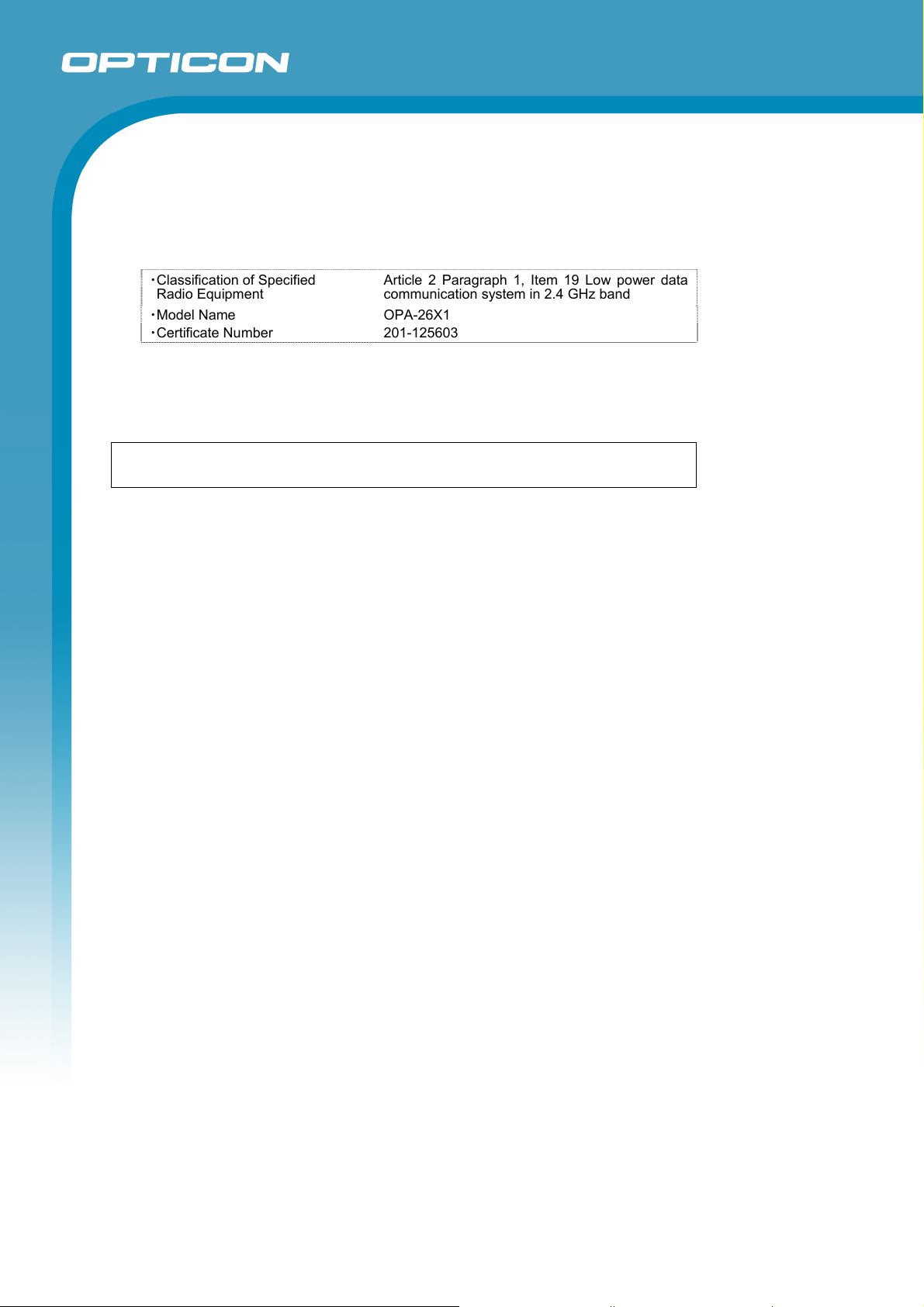
10.4. Others
・Bluetooth logo certification
・Certification for Construction Design of Specified Radio Equipment
・Classification of Specified
Radio Equipment
・Model Name OPA-26X1
・Certificate Number 201-125603
Article 2 Paragraph 1, Item 19 Low power data
communication system in 2.4 GHz band
11. RoHS
The OPC-3301n is compliant with RoHS.
RoHS: The restriction of the use of certain hazardous substances in electrical and
electronic equipment, 2011/65/EU
OPC-3301n
Specifications Manual
12. Reliability
MTBF (Mean Time Between Failures) 10,000 hours
13. Precautions
13.1. Handling
Handle this product carefully. Do not deliberately subject it to any of the following.
(1) Shock:
・Do not drop this product from a height greater than specified in this manual.
・Do not place this product under or between any heavy items.
・Do not swing the cable around.
(2) Temperature Conditions:
・Do not use this product at temperatures outside the specified range.
・Do not pour boiling water on this product.
・Do not throw this product into a fire.
(3) Foreign Materials:
・Do not immerse this product in water or other liquid.
・Do not expose this product to chemicals.
(4) Others
・Do not disassemble this product.
・Do not use this product near a radio or a TV. It may cause reception problems.
・This product may be affected by a momentary voltage drop caused by lightning.
16
Page 22

Specifications Manual
13.2. Radio Law
This product qualifies as specified radio equipment for radio stations of 2.4 GHz band data
communication system and has obtained the Certification for Construction
Design of Specified Radio Equipment. Therefore, radio station license is not required in Japan.
The following activities are prohibited under the Radio Law:
・Remodeling and disassembly
・Peeling off the certificate label
Do not use
device and end up with causing physical or material damage.
・Safety apparatus and medical device for human body protection
・Environment where is concerned to cause serious damage
this equipment under the following environment, as radio interference may affect other
13.3. Bluetooth
・This product supports Bluetooth wireless communication with other Bluetooth devices that have
the same profile
・This product complies with Bluetooth standards; however, its communication performance with
untested devices is not guaranteed.
・Bluetooth devices use the 2.4 GHz frequency band that is shared among other devices. It may
affect the communication speed and distance between this product and the host device.
・The communication speed and distance vary depending on the interference and radio wave
condition between this product and the host device.
OPC-3301n
13.4. Frequency Baud
This product uses the 2.4 GHz frequency band. Read carefully the followings before using this
product.
In the frequency band of this product, scientific, medical and industrial devices including microwaves
are used. Also other radio stations including local private radio station for mobile object identification
requiring license for such as manufacturing lines at factories, specific power-saving radio station
requiring no license and amateur radio station are managed.
1. Make sure that “other radio stations” are not managed in the frequency band 2.4 GHz before
using this product.
2. In case that radio interference occurs between this product and “other radio stations,” change the
service space immediately, or stop transmitting radio wave to avoid the interference.
3. If you have any questions or troubles, please contact our sales office.
17
Page 23
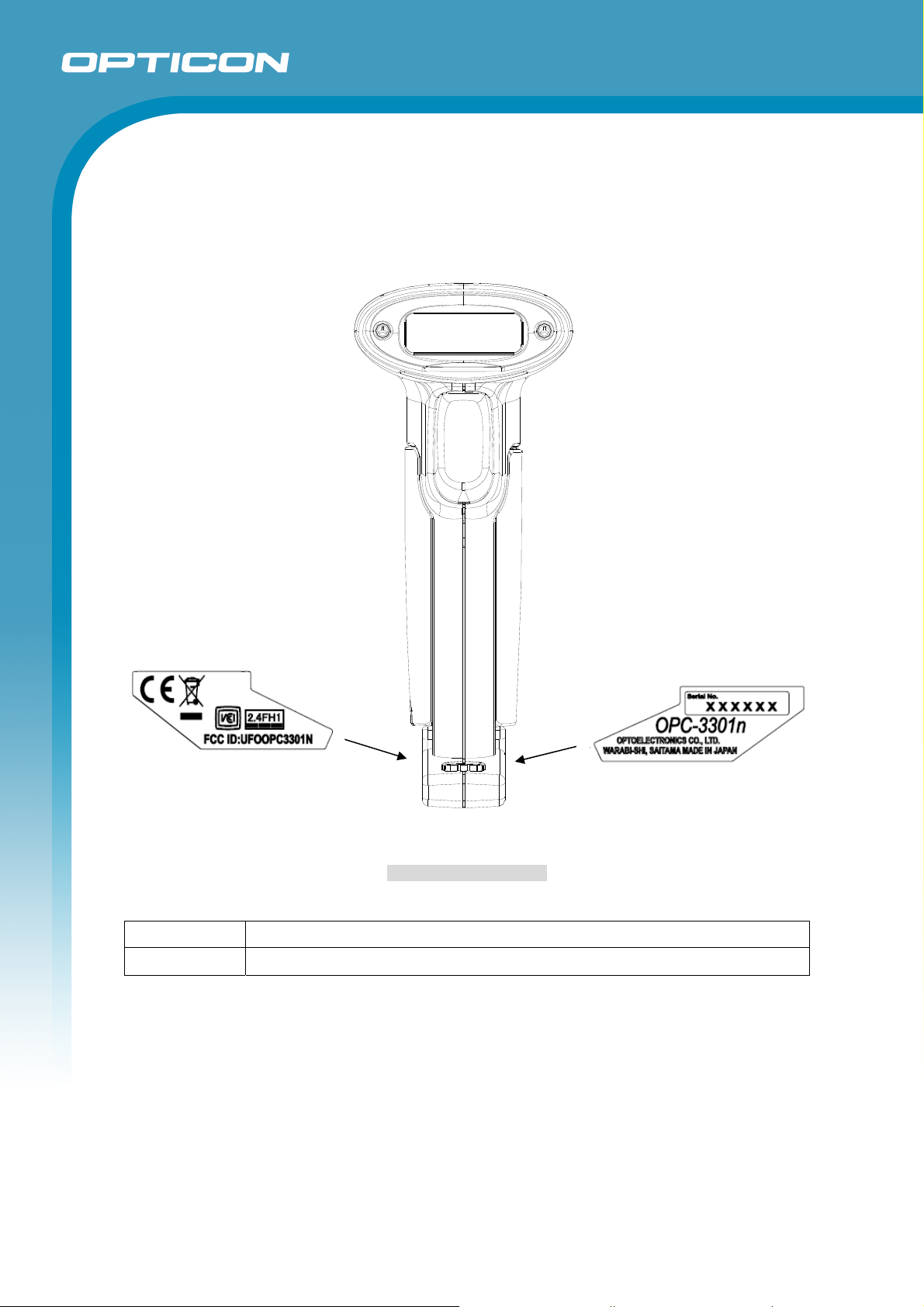
14. Product Labels
The product labels are affixed to the scanner as shown below.
OPC-3301n
Specifications Manual
Logo label
Figure 10: Product Labels
Product label
Product label Shows the product name, serial number, and month and year of manufacture.
Logo label Shows the standards-compliant languages and logos.
18
Page 24
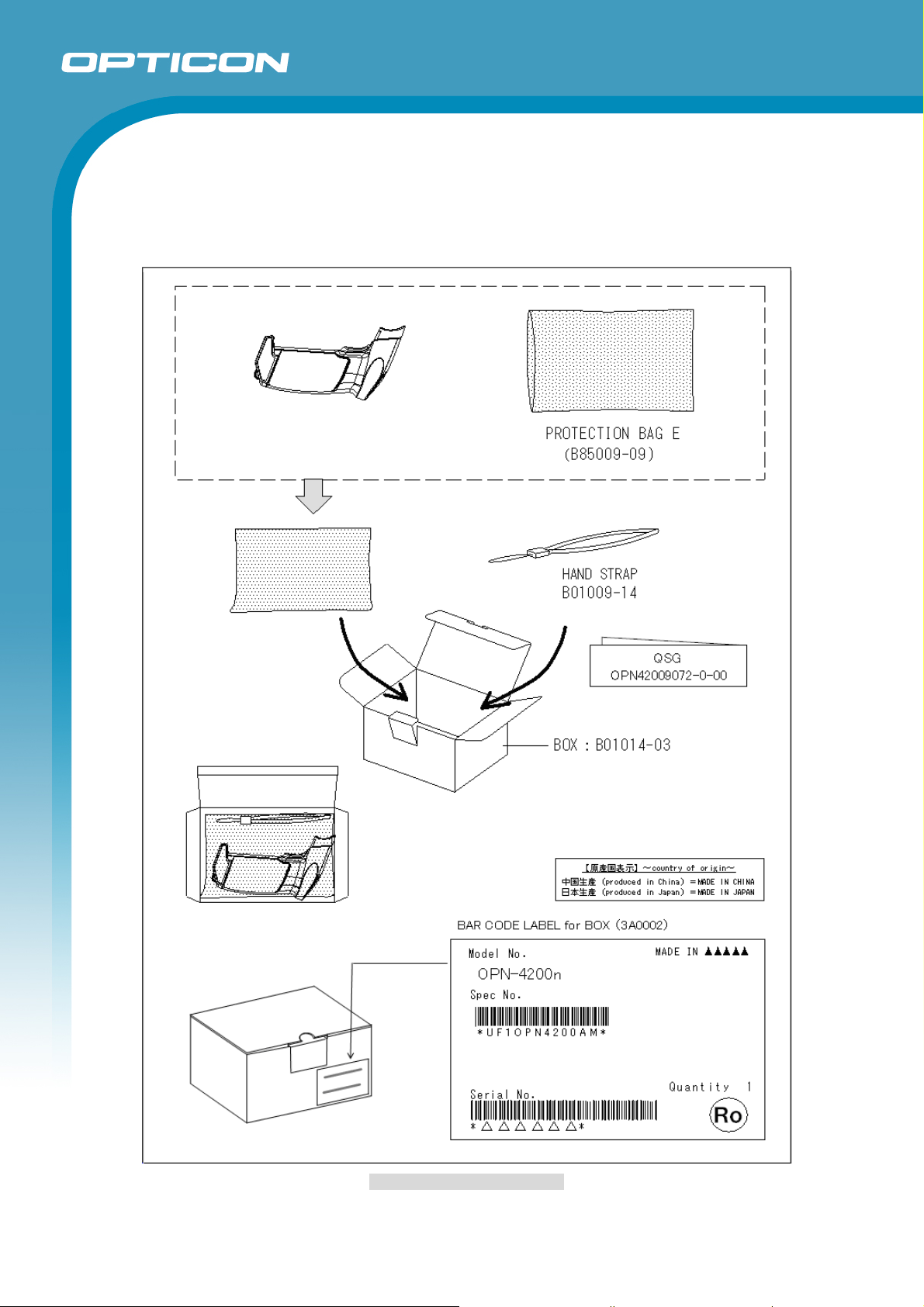
15. Packaging Specifications
15.1. Individual Packaging
Assembled package size: 165 × 110 × 82 (WDH mm)
OPC-3301n
Specifications Manual
Figure 11: Individual Packaging
19
Page 25
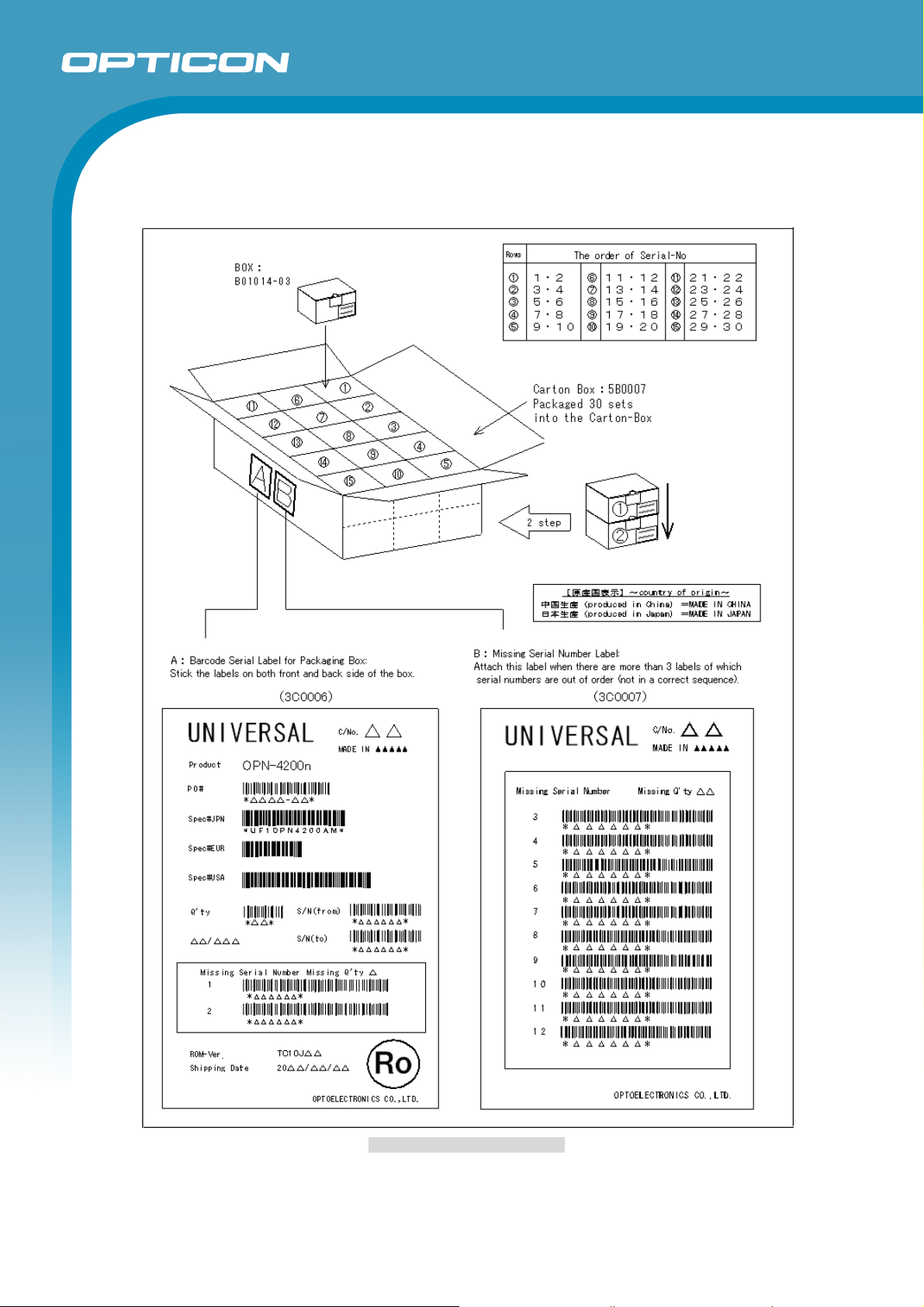
15.2. Collective Packaging
Assembled package size : 585 × 520 × 200 (WDH mm)
OPC-3301n
Specifications Manual
* ‘Ro mark’ on the boxes for the product indicates that the product is RoHS compliant declared by
Optoelectronics Co., Ltd.
Figure 12: Collective Packaging
20
Page 26
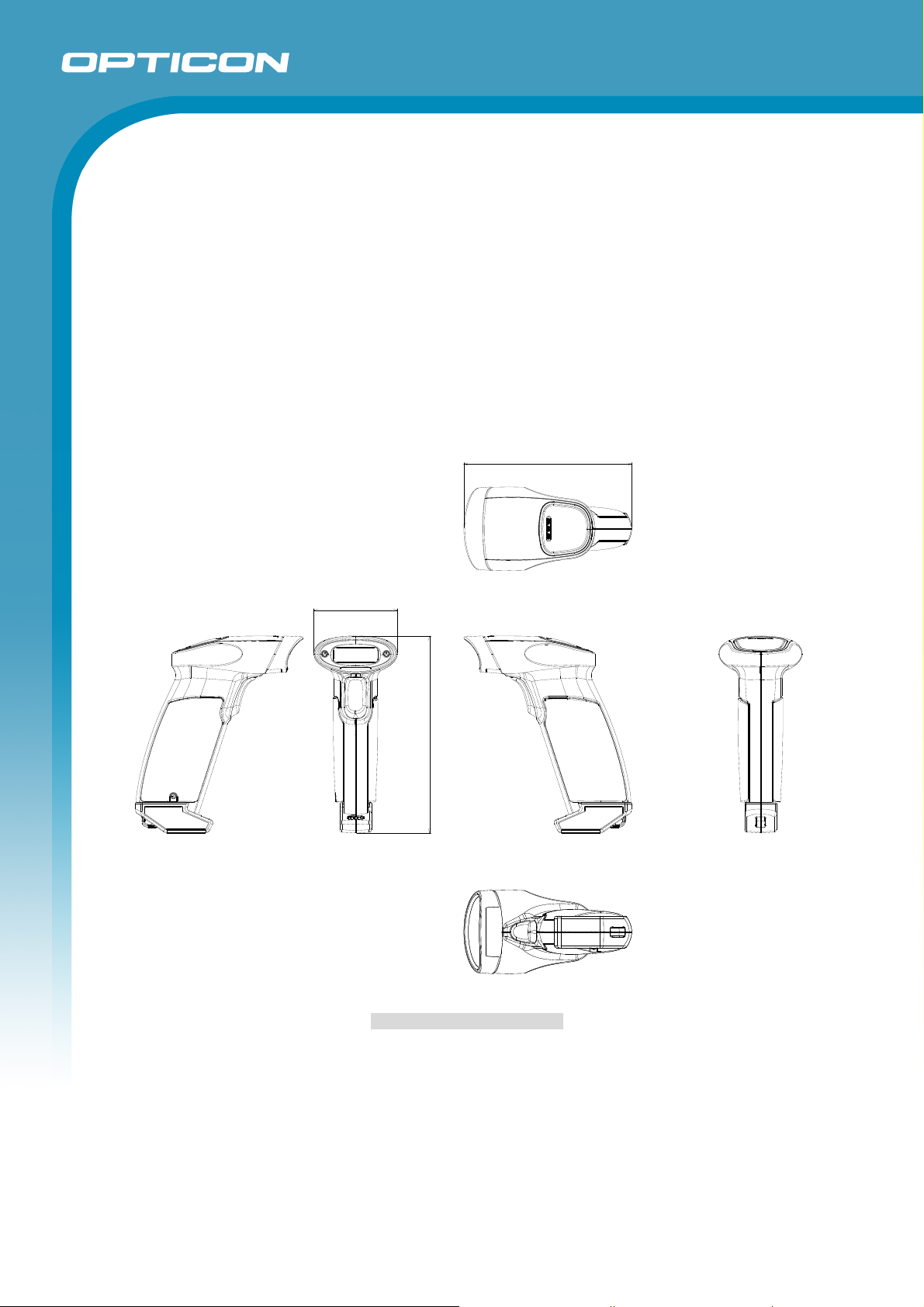
16. Physical Features
16.1. Dimensions
56 × 113 × 132 (WDH mm / excluding protruding portion)
16.2. Weight
Approx.125 g (excluding accessories)
16.3. Mechanical Drawing
OPC-3301n
Specifications Manual
(113)
(56)
(132)
Figure 13: Mechanical Drawing
21
Page 27
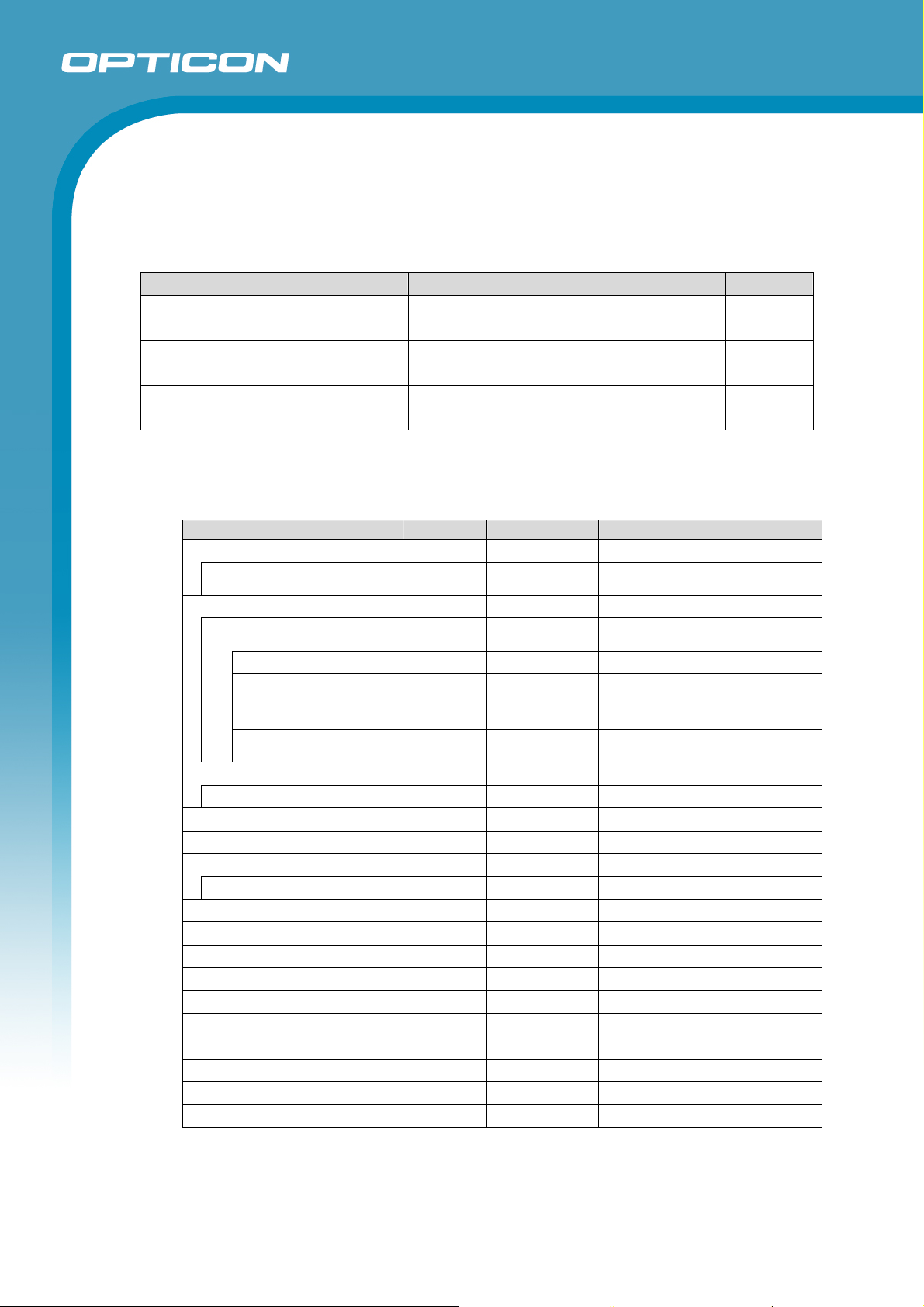
17. Supported Symbologies
17.1. Default Setting
The scanner is set to default settings by reading the following menu labels.
Function Menu label Menu code
OPC-3301n
Specifications Manual
SET
Default
END
17.2. Supported Symbologies
17.2.1. 1D Bar Codes
Code type Default Minimum length Note
UPC ○ -
UPC Add-on 2
UPC Add-on 5
EAN (JAN) ○ -
EAN Add-on 2
EAN Add-on 5
EAN-13 ○
EAN-8 ○
Code 39 ○ 1 Not transmit ST/SP
Tri-Optic ○ - Not transmit ST/SP
Codabar (NW7) ○ 5 Not transmit ST/SP
Industrial 2 of 5 ○ 5
Interleaved 2 of 5 ○ 6
S-Code ○ 5
Code 128 ○ 1 GS1 conversion (setting required)
Code 93 ○ 1
IATA ○ 5
MSI/Plessey ○ 3
UK/Plessey ○ 2
TELEPEN ○ 1
Code 11 1
Matrix 2 of 5 5
Chinese Post Matrix 2 of 5 -
Korean Postal Authority -
EAN-13 Add-on 2
EAN-13 Add-on 5
EAN-8 Add-on 2
EAN-8 Add-on 5
_ZZ_
_SO_
_ZZ_
ZZ
SO
ZZ
22
Page 28
OPC-3301n
Specifications Manual
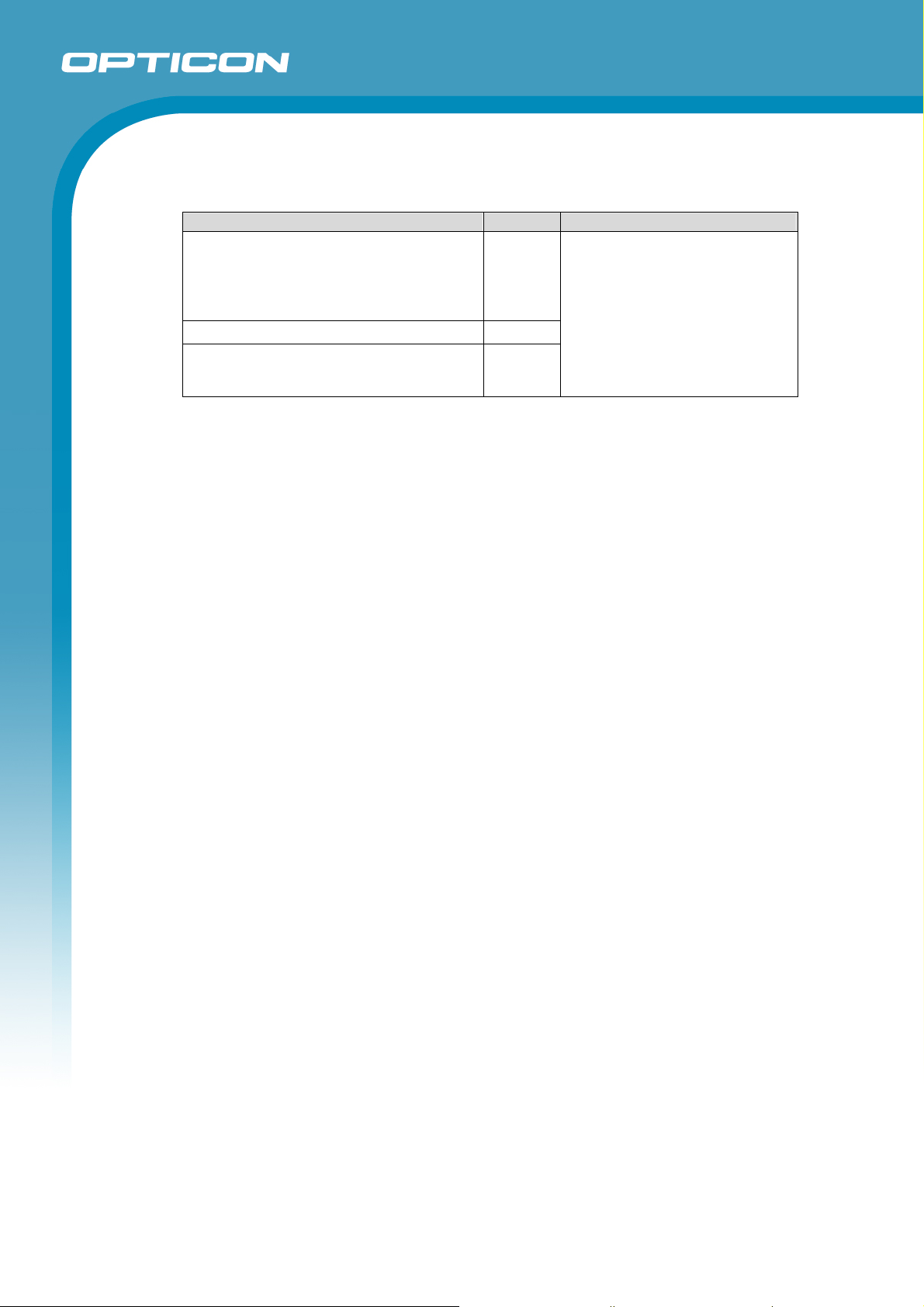
17.2.2. GS1 Databar, Composite Code
Code type Default Note
GS1 DataBar
・GS1 DataBar Omnidirectional
・GS1 DataBar Truncated
・GS1 DataBar Stacked
・GS1 DataBar Stacked Omnidirectional
GS1 DataBar Limited ○
GS1 DataBar Expanded
・GS1 DataBar Expanded
・GS1 DataBar Expanded Stacked
* The supported symbologies vary depending on specifications for the application to be loaded.
○
GS1 conversion (setting required)
○
23
 Loading...