

Page 1
The One Systems 112.HSB is a 12-inch (305 mm) subwoofer / bass module designed to augment
the low-end response of all variants of One Systems full-range speakers including the 104, 106, 108,
208, 112 and 212 models.!
There are two basic system configurations for using the 112.HSB: 1). As a “classic” subwoofer or
2). In an “overlap” mode that can double the system’s acoustic output from 50 Hz to the upper overlap
frequency range of 80 Hz and 120 Hz. !
All of the small and medium-format speakers - the 104, 106, 108 and 208 models - should be used
with the 112.HSB in the “classic” subwoofer mode only. !
The “overlap” mode is most suited for using the subwoofer with the 112 and 212 models to maximize
low-frequency output and to improve the system’s very low-frequency polar control. !
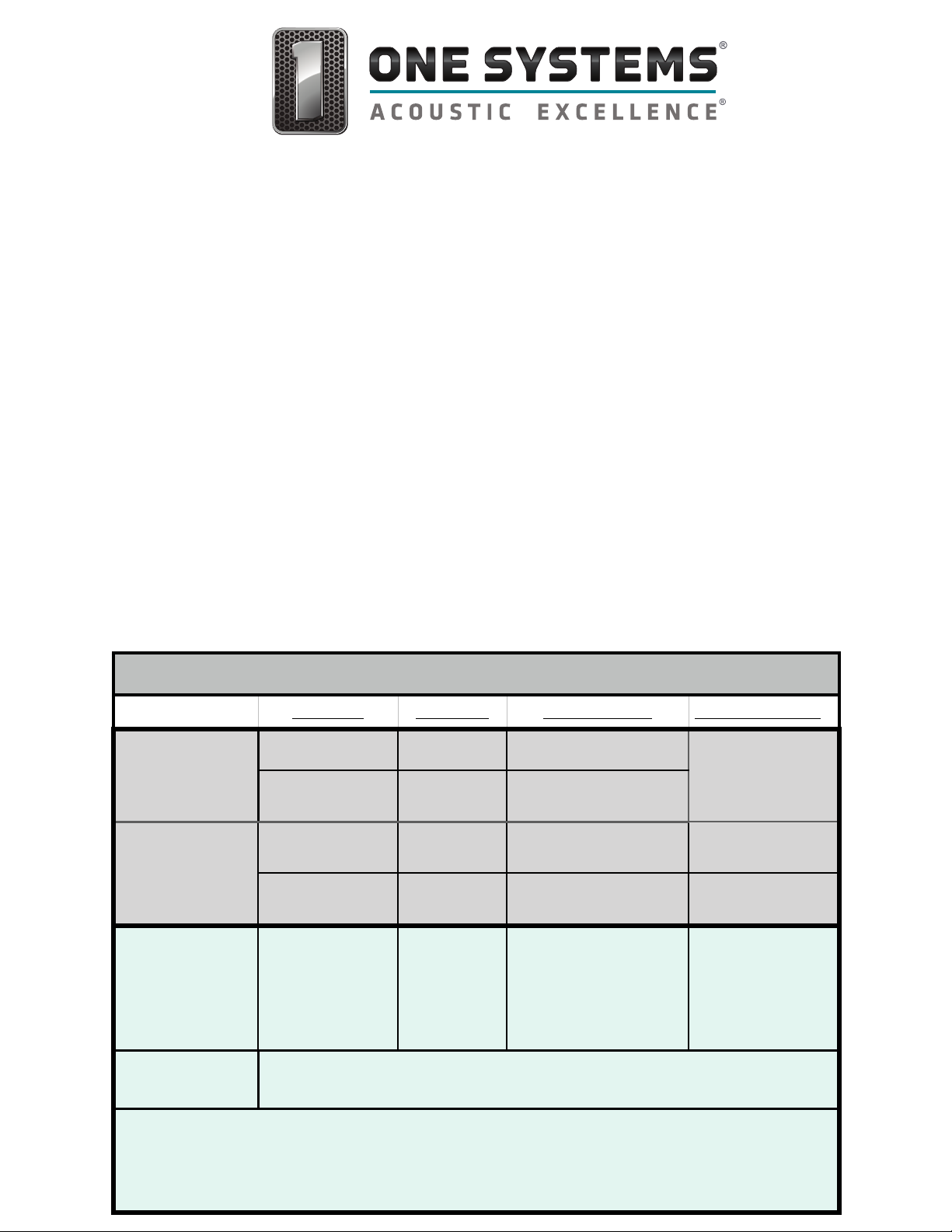
Recommended processor settings are shown for the “classic” subwoofer mode and for the “overlap”
mode. Both configurations require use of a DSP-based loudspeaker system processor and two
amplifier channels (bi-amplification). An analog crossover may be used for the “classic” subwoofer
mode, but only a DSP-based processor may be used for the “overlap” mode.!
“CLASSIC” SUBWOOFER MODE
Parameter
Frequency
Filter Alignment
Sub Channel Gain
112.HSB
Output
High-Pass Filter
45 Hz
4th order Butterworth
Set to
personal taste
Low-Pass Filter
80 Hz -
120 Hz
4th order Linkwitz-Riley
Parametric
Filter Settings
for sub
PEQ 1
60 Hz
PEQ Gain = + 4 dB
PEQ Bandwidth =
0.3 octave
PEQ 2
80 Hz
PEQ Gain = +2.5 dB
PEQ Bandwidth =
0.3 octave
Output for
Full-Range
Speaker
High-Pass Filter
80 Hz -
120 Hz
(same as
low-pass
filter setting
for sub)
4th order Linkwitz-Riley
n.a.
Parametric
FIlter Settings
Use the recommended settings for the specific One Systems model
being used
Any parametric EQ used on the output for the full-range speaker should use the
specific parameters recommended for the model being used. Any EQ
recommendations with center frequencies below the high-pass filter frequency
should be set to 0 dB (not used).
OPTIMIZING SYSTEM PERFORMANCE
WITH THE 112.HSB
Page 2
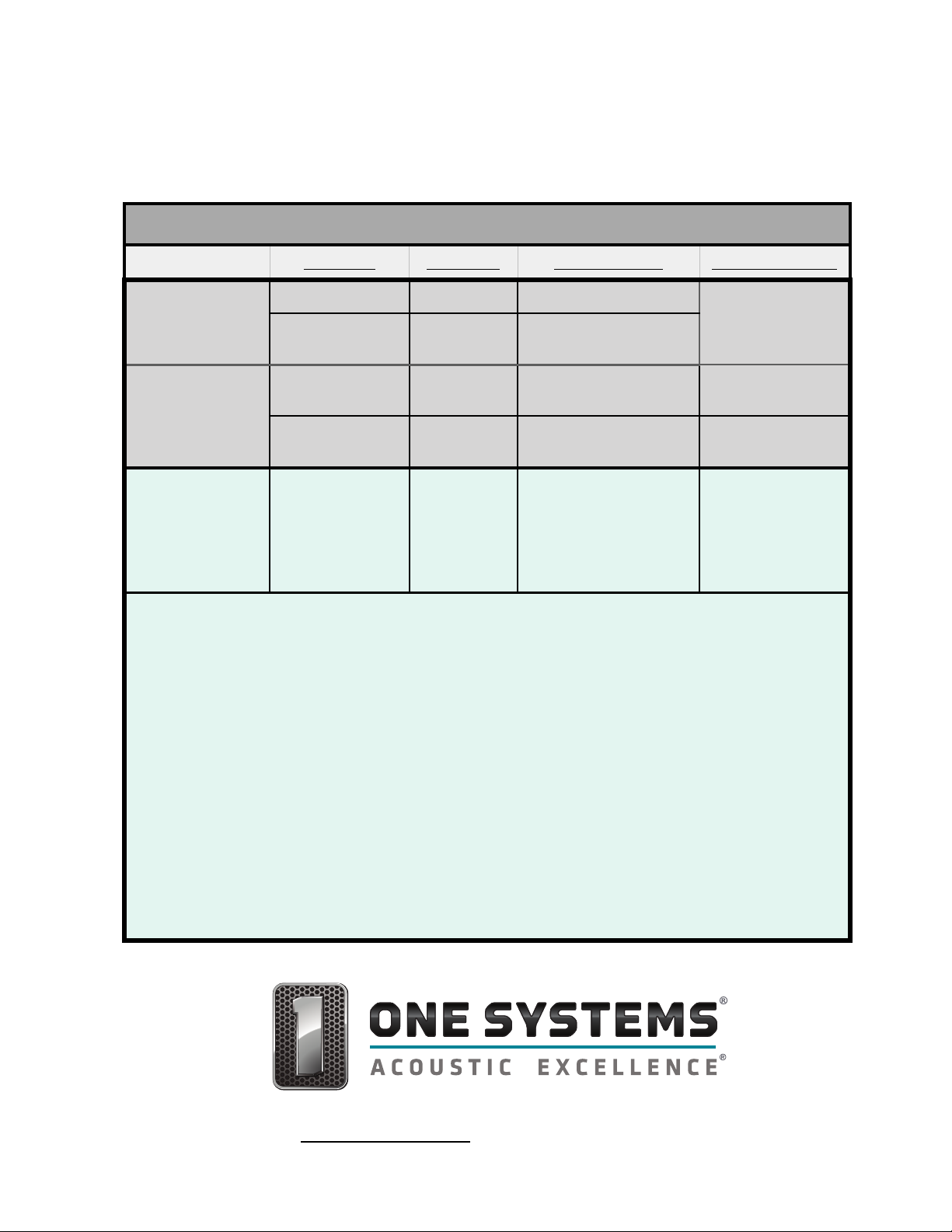
As noted, the “OVERLAP” Mode is best suited for using with 112 and 212 models
with the 112.HSB subwoofer.
“OVERLAP” MODE
Parameter
Frequency
Filter Alignment
Sub Channel Gain
112.HSB
Output
High-Pass Filter
45 Hz
4th order Butterworth
Set to
personal taste
Low-Pass Filter
80 Hz -
120 Hz
4th order Linkwitz-Riley
Parametric
Filter Settings
for sub
PEQ 1
60 Hz
PEQ Gain = + 4 dB
PEQ Bandwidth =
0.3 octave
PEQ 2
80 Hz
PEQ Gain = +2.5 dB
PEQ Bandwidth =
0.3 octave
Output for
Full-Range
Speaker
High-Pass Filter
45 Hz
4th order Butterworth
n.a.
In the "Overlap" mode, the acoustic summing of the low-frequency section (112.HSB
output) will require delay applied to the full-range output. The specific amount of
delay required will be based on the group delay associated with the low-pass filter of
the 112.HSB's output, but also based on the physical location of the 112.HSB
relative to the full-range speaker.
The recommended initial delay on the full-range output should be approximately
5 mSec to 6 mSec. !
This value can be varied to achieve the best low-frequency summing. In general, the
lower the frequency of the low-pass filter in the 112.HSB's output, the larger the
required time delay on the full-range channel (Approximately 6 mSec for an 80 Hz
low-pass frequency to 5mSec for a 120 Hz low-pass frequency). The delay should be
applied to the full-range output! The delay value may require additional tuning based
on the physical location of the two enclosures.
OPTIMIZING SYSTEM PERFORMANCE
WITH THE 112.HSB
One Systems, Inc."" www.onesystems.com tel:+1-615-823-1655 fax: +1-615-261-1429
One Systems, Inc © 2020, All Rights Reserved
Page 3
!
One Systems, Inc © 2020, All Rights Reserved
One Systems, Inc."" www.onesystems.com tel:+1-615-823-1655 fax: +1-615-261-1429
MODEL
104.HTH
106.HTH
108.HTC
High-Pass Filter:
Butterworth 24 dB
Butterworth 24 dB
Butterworth 24 dB
High-Pass Frequency:
70 Hz
70 Hz
70 Hz
Filter 1 Type:
PEQ
PEQ
PEQ
Filter 1 Frequency:
4,000 Hz
800 Hz
100 Hz
Filter 1 Bandwidth:
0.33 octave / Q = 4.3
0.33 octave / Q = 4.3
0.33 octave / Q = 4.3
Filter 1 Level (dB):
- 2.0 dB
- 2.0 dB
+ 3.0 dB
Filter 2 Type:
PEQ
PEQ
PEQ
Filter 2 Frequency:
2,500 Hz
1,000 Hz
125 Hz
Filter 2 Bandwidth:
0.33 octave / Q = 4.3
0.33 octave / Q = 4.3
0.33 octave / Q = 4.3
Filter 2 Level (dB):
- 2.0 dB
- 2.0 dB
+ 3.0 dB
Filter 3 Type:
Low Shelf
PEQ
PEQ
Filter 3 Frequency:
150 Hz
1,250 Hz
160 Hz
Filter 3 Bandwidth:
12 dB / octave
0.33 octave / Q=4.3
0.33 octave / Q = 4.3
Filter 3 Level (dB):
+ 3.0 dB
-2.0 dB
+ 3.0 dB
Filter 4 Type:
Low Shelf
PEQ
Filter 4 Frequency:
125 Hz
4,000 Hz
Filter 4 Bandwidth:
12 dB / octave
0.33 octave / Q = 4.3
Filter 4 Level (dB):
+3.0 dB
- 3.0 dB
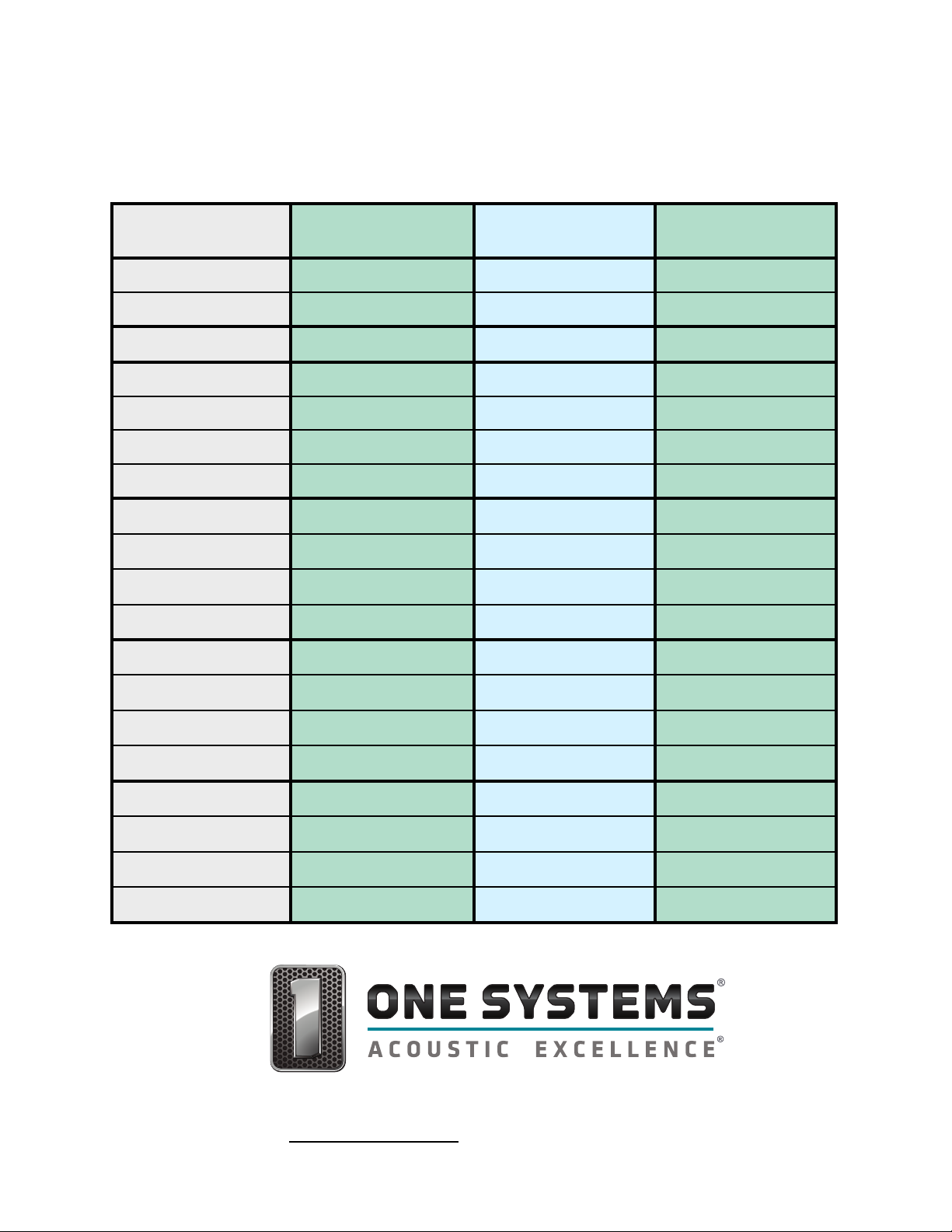
DSP PARAMETERS FOR ONE SYSTEMS FULL-RANGE MODELS
Please note - the settings are identical for the HTH / HTC models
and the previous IM Series versions of those models.
Page 4
One Systems, Inc."" www.onesystems.com tel:+1-615-823-1655 fax: +1-615-261-1429
MODEL
108.HTH with
ETS 60/40 Horn
108.HTH with
ETS 105/60 Horn
208.HTC
High-Pass Filter:
Butterworth 24 dB
Butterworth 24 dB
Butterworth 24 dB
High-Pass
Frequency:
65 Hz
65 Hz
65 Hz
Filter 1 Type:
PEQ
PEQ
PEQ
Filter 1 Frequency:
100 Hz
1,250 Hz
100 Hz
Filter 1 Bandwidth:
0.33 octave / Q = 4.3
0.33 octave / Q = 4.3
0.5 octave / Q = 2.87
Filter 1 Level (dB):
- 2.0 dB
- 2.5 dB
- 2.5 dB
Filter 2 Type:
PEQ
PEQ
Filter 2 Frequency:
100 Hz
100 Hz
Filter 2 Bandwidth:
0.5 octave / Q = 2.87
0.5 octave / Q = 2.87
Filter 2 Level (dB):
+ 2.0 dB
+ 2.0 dB
Page 5
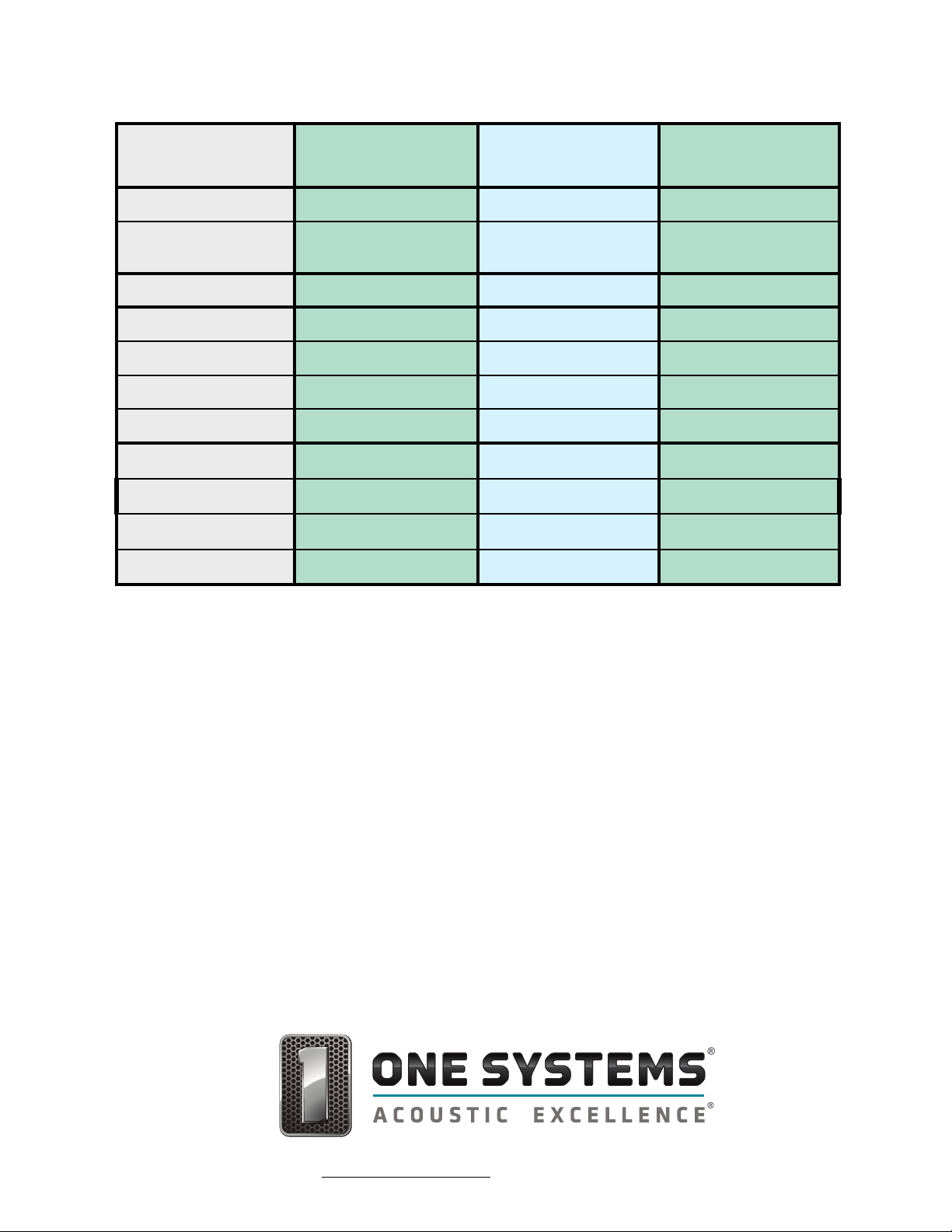
For best results, use the “Overlap” mode when combining the 112 and
212 models with the 112.HSB subwoofer
MODEL
112.HTH with
ET 60/40 Horn
112.HTH with
ET 105/60 Horn
212.HC
High-Pass Filter:
Butterworth 24 dB
Butterworth 24 dB
Butterworth 24 dB
High-Pass Frequency:
50 Hz
50 Hz
55 Hz
Filter 1 Type:
PEQ
PEQ
PEQ
Filter 1 Frequency:
1,000 Hz
1,000 Hz
1,000 Hz
Filter 1 Bandwidth:
0.5 octave / Q = 2.87
0.4 octave / Q = 3.59
0.33 octave / Q = 4.3
Filter 1 Level:
- 2.0 dB
- 2.0 dB
- 2.5 dB
Filter 2 Type:
PEQ
PEQ
PEQ
Filter 2 Frequency:
65 Hz
65 Hz
70 Hz
Filter 2 Bandwidth:
0.33 octave / Q = 4.3
0.33 octave / Q = 4.3
0.33 octave / Q = 4.3
Filter 2 Level:
+ 3.0 dB
+ 3.0 dB
+ 2.0 dB
Filter 1 Type:
PEQ
Filter 1 Frequency:
3,000 Hz
Filter 1 Bandwidth:
0.33 octave / Q = 4.3
Filter 1 Level:
- 2.5 dB
One Systems, Inc © 2020, All Rights Reserved
One Systems, Inc."" www.onesystems.com tel:+1-615-823-1655 fax: +1-615-261-1429
 Loading...