

Page 1
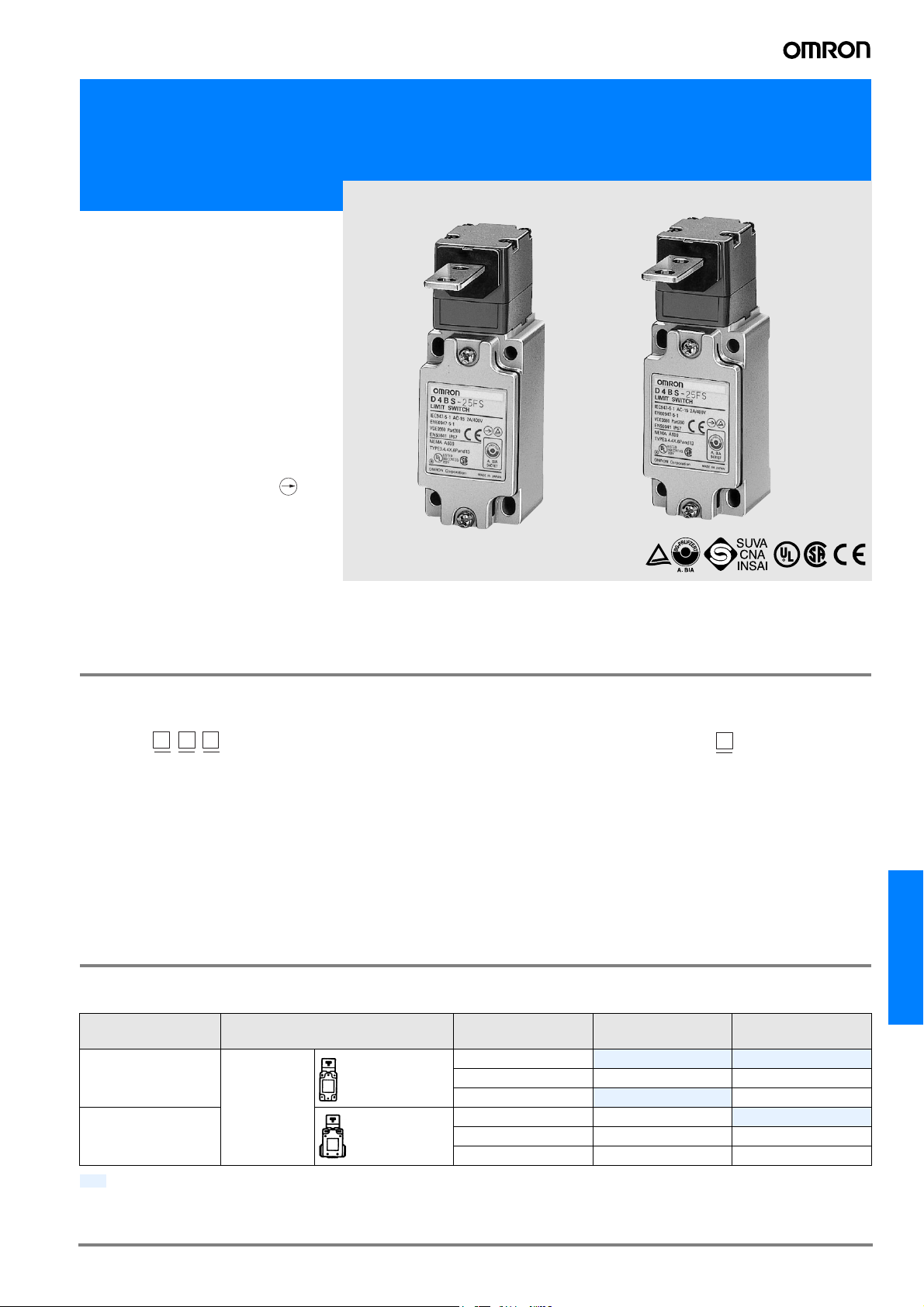
Safety-door Switch
D4BS
Safety-door Switch’s Special
Operation Key Directly Pulls
Apart the Contacts from Each
Other and Contributes to the
Safety of the Production Site
• Conforms to EN (TÜV) standards corresponding to the CE marking.
• Approved by UL, CSA, BIA, and SUVA
standards.
• The switch contact is opened by a direct opening mechanism (NC contacts
only) when the protective cover is
opened. The EN-approved direct opening mechanism is indicated by on
the Switch.
• Degree of protection of the switch box:
IP67 (EN60947-5-1).
• Series includes models with gold-plated contacts for handling the micro-load
range.
• Metric conduit types available.
Model Number Structure
Model Number Legend
Switch
D4BS - S
123
1. Conduit
1: PG13.5 (1 conduit)
2: G1/2 (1 conduit)
3: 1/2-14NPT (1 conduit)
4: M20
5: PG13.5 (3-conduit)
6: G1/2 (3-conduit)
7: 1/2-14NPT (3-conduit)
8: M20 (3-conduit)
Ordering Information
List of Models
Switches
Type Mounting direction Conduit size
1-conduit
Front-side
mounting
3-conduit
Prefered stock item
5: 1NC/1NO (slow-action)
6: 1NC/NO (slow-action), gold-plated contacts
A: 2NC (slow-action)
B: 2NC (slow-action), gold-plated contacts
3. Head Mounting Direction
F: Four mounting directions pos-
sible (front-side mounting at
shipping)
Pg13.5
G1/2 D4BS-25FS D4BS-2AFS
M20
Pg13.5 D4BS-55FS
G1/2 D4BS-65FS D4BS-6AFS
M20 D4BS-85FS D4BS-8AFS
Operation Key
D4BS - K
1
1. Operation Key Type2. Built-in Switch
1: Horizontal mounting
2: Vertical mounting
3: Adjustable mounting (Horizontal)
1NC/1NO
(Slow-action)
D4BS-15FS D4BS-1AFS
D4BS-45FS D4BS-4AFS
2NC (Slow-action)
D4BS-5AFS
D4BS
G-143D4BS
Page 2

Operation Keys (Order Separately)
Type Model
Horizontal mounting
D4BS-K1
Vertical mounting
Adjustable mounting
(Horizontal)
D4BS-K2
D4BS-K3
Specifications
Approved Standards Standards and EC Directives
Agency Standard File No.
TÜV Rheinland EN60947-5-1
UL UL508 E76675
CSA CSA C22.2 No. 14 LR45746
BIA GS-ET-15 9303323
SUVA SUVA E6187.d
R9351022
(Direct opening: approved)
Conforms to the following EC Directives:
Machinery Directive
Low Voltage Directive
EN50041
EN1088
Approved Standard Ratings
TÜV (EN60947-5-1)
Utilization category AC-15
Rated operating current (Ie) 2 A
Rated operating voltage (Ue) 400 V
Note: Use a 10-A fuse type a gI or gG that conforms to IEC269 as a short-circuit protection device.
UL/CSA (UL508, CSA C22.2 No. 14)
A600
Rated voltage Carry current
120 VAC
240 VAC
480 VAC
600 VAC
10 A
Make Break Make Break
60 A 6 A
30 A 3 A
15 A 1.5 A
12 A 1.2 A
Current Volt-amperes
7,200 VA 720 VA
G-144 Safety Sensors / Components
Page 3
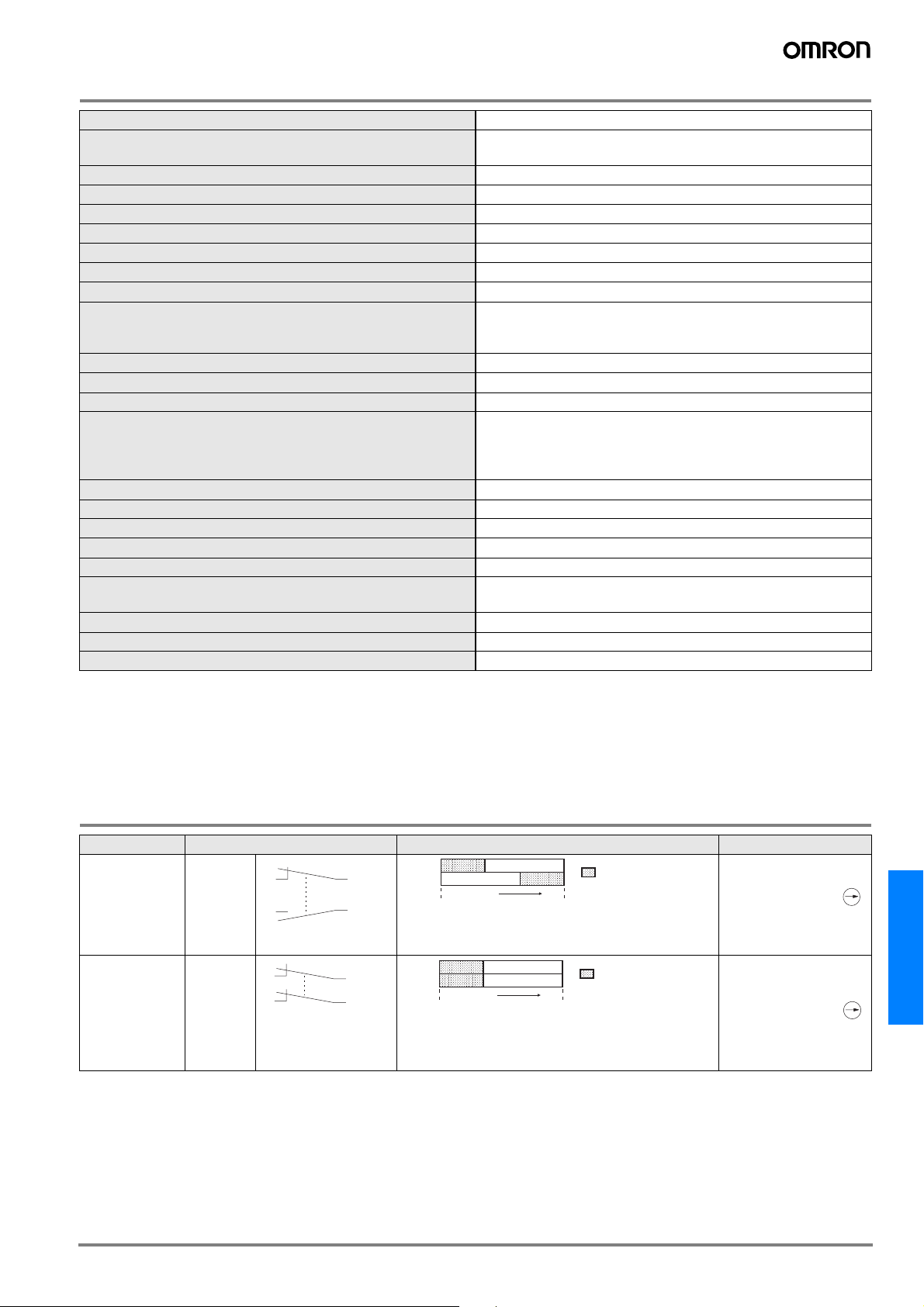
Characteristics
Degree of protection (see note 2) IP67 (EN60947-5-1)
Durability (see note 3)
Operating speed 0.1 m/s to 0.5 m/s
Operating frequency 30 operations/min max.
Rated frequency 50/60 Hz
Contact gap 2 x 2 mm min.
Direct opening force (see note 4) 19.61 N min. (EN60947-5-1)
Direct opening travel (see note 4) 20 mm min. (EN60947-5-1)
Full stroke 23 mm min.
Insulation resistance
Contact resistance 25 mΩ max. (initial value)
Rated insulation voltage (Ui) 600 V (EN60947-5-1)
Conventional enclosed thermal current (I
) 20 A (EN60947-5-1)
the
Dielectric strength (Uimp)
Switching overvoltage 1,500 V max. (EN60947-5-1)
Conditional short-circuit current 100 A (EN60947-5-1)
Pollution degree (operating environment) 3 (EN60947-5-1)
Insulation class Class I (with ground terminal)
Vibration resistance Malfunction: 10 to 500 Hz, 0.65-mm single amplitude
Shock resistance
Ambient temperature Operating:-40°C to 80°C (with no icing)
Ambient humidity Operating:95% max.
Weight Approx. 285 g (in the case of D4BS-15FS)
Mechanical:1,000,000 operations min.
Electrical:500,000 operations min. (10 A at 250 VAC, resistive load)
100 MΩ min. (at 500 VDC) between terminals of same or different
polarity, between each terminal and ground, and between each terminal and non-current-carrying metal part
Impulse dielectric strength (U
) 4 kV (EN60947-5-1) between ter-
imp
minals of same or different polarity, between current-carrying metal
parts and ground, and between each terminal and non-current-carrying metal part
2
Destruction:1,000 m/s
Malfunction:300 m/s
min. (IEC68-2-27)
2
min. (IEC68-2-27)
Note: 1. The above values are initial values.
2. Although the switch box is protected from dust, oil, or water penetration, do not use the D4BS in places where dust, oil, water, or chemicals
may penetrate through the key hole on the head, otherwise Switch damage or malfunctioning may occur.
3. The durability is for an ambient temperature of 5° C to 35° C and an ambient humidity of 40% to 70%. Contact your OMRON sales rep-
resentative for more detailed information on other operating environments.
4. These figures are minimum requirements for safe operation.
Contact Form (Diagrams Show State with Key Inserted)
Model Contact form Diagram Remarks
D4BS-#5#S 1NC/1NO
D4BS-#A#S 2NC
Zb
11
23
Zb
11
21
12
24
12
22
11 - 12
23 - 24
Operation Key
insertion completion position
11 - 12
21 - 22
Operation Key
insertion completion position
ON
Stroke
Extraction
completion
position
ON
Stroke
Extraction
completion
position
Note: The terminal numbers are in accordance with EN50013, and the contact symbols are in accordance with IEC947-5-1.
Only NC contact 11-12
has an approved direct
opening mechanism.
Terminals 11-12 and
23-24 can be used as
unlike poles.
NC contacts 11-12 and
21-22 have an
approved direct
opening mechanism.
Terminals 11-12 and
21-22 can be used as
unlike poles.
D4BS
G-145D4BS
Page 4

Nomenclature
Operation Key
D4BS's exclusive-use Operation Key is provided
to assure accurate switching operation.
Set Zone Mark
A triangular Set Zone Mark makes it
easy to adjust the operating position
when inserting the Operation Key.
Head
The switch head is coated with easy-to-see red
paint. The mounting direction of the switch head can
be varied to any of the four directions.
Seal Ring (NBR)
Oil Seal (NBR)
The operation plunger employs an oil seal, with
which the switch box meets the requirements of
IP67 (the sealing capability of the Operation Key's
insertion mouth is IP00).
Built-in Switch
A shearing force contact separating mechanism (NC
contact) is employed, which positively pulls apart the
contacts from each other by using shearing force if
any abnormality such as contact welding should occur
in the contact area.
There is a difference in level between the NC and NO
terminal, which assures easy wiring.
Seal Packing (NBR)
Conduit Opening
Available in four different types of conduit
threads: Pg 13.5, G1/2, or 1/2-14NPT, M20.
Ground Terminal Screw
A ground terminal is provided to
improve safety. (Built into the
Unit.)
G-146 Safety Sensors / Components
Page 5

Dimensions
Note: 1. All units are in millimeters unless otherwise indicated.
2. Unless otherwise specified, a tolerance of ±0.4 mm applies to all dimensions.
3. The conduit thread varies with the model as follows:.
Conduit thread Model
Pg 13.5 D4BS-1##S, D4BS-5##S
G1/2 D4BS-2##S, D4BS-6##S
M20 D4BS-4##S, D4BS-8##S
Switches
1-conduit
D4BS-1##S
D4BS-2##S
D4BS-4##S
3-conduit
D4BS-5##S
D4BS-6##S
D4BS-8##S
Red
Red
(110)
(111.5)
66.4
60±0.2
50.9
31.4
17
7
35
Two, 5.3 dia.
mounting holes
Two, M4 cover
clamping screws
7.3
5.3
8
30±0.1
+1
40
0
31.4
17
7
5.3
Six, 5.3 dia.
30±0.2
mounting holes
Four, M3.5 x 10 cover
clamping screws
Two caps
Cover
Cover
41
Four, M3.5 head
16
clamping screws
D4BS-1##S: Pg13.5
15
D4BS-2##S: G1/2
31.5
D4BS-4##S: 1/2-14NPT
43
41
16
34.5
77
Four, M3.5 head
clamping screws
34.5
75.4
71.4
Operating
characteristics
Key insertion force
Key extraction force
Pretravel (PT)
Direct opening force
Direct opening stroke
Operating
characteristics
Key insertion force
Key extraction force
Pretravel (PT)
Direct opening force
Direct opening stroke
D4BS-1##S
D4BS-2##S
D4BS-4##S
19.61 N max.
19.61 N max.
10±5 mm
19.61 N min.
20 mm min.
D4BS-5##S
D4BS-6##S
D4BS-8##S
19.61 N max.
19.61 N max.
10±5 mm
19.61 N min.
20 mm min.
Operation Keys
D4BS-K1
D4BS-K3
Black
Red
26 15
11.4
5
Black
5.3 dia.
mounting hole
4 dia.
30±0.15
40.7
40
19.5±0.15
17.2
35.7
38.3
Black
(37.8)
51
28.5
78.7
20±0.15
12
Two, 2.65R
5.3 5.3
36
26
11.4
5
30
D4BS-5##S: 3-Pg13.5
D4BS-6##S: 3-G1/2
57
D4BS-8##S: 3-1/2-14NPT
63
D4BS-K2
7.3 15
7.5
2.5
20
40
15
4 dia. M4 Allen-head bolt
2012
(80.7)
36
2.5
17.5
34.6
+0.15
Two, 5
dia. holes (6 mm deep)
-0
15
26
11.4
5
4 dia.
53.7
36
5.3 ¥ 7.3 mounting long hole
13
52.4
40±0.15
12 7.5
5.3
2.5
20
D4BS
G-147D4BS
Page 6

With Operation Key Inserted
Horizontal Mounting
D4BS-1##S +D4BS-K1
D4BS-2##S +D4BS-K1
D4BS-4##S +D4BS-K1
Red
53.5 min.
58 max.
Operation Key insertion
radius in horizontal
direction: R ≥ 1200 53.5 min.
58 max.
Operation Key insertion
radius in horizontal
direction: R ≥ 1000
Vertical Mounting
D4BS-1##S +D4BS-K2
D4BS-2##S +D4BS-K2
D4BS-4##S +D4BS-K2
Red
54.5 min.
59 max.
Adjustable Mounting (Horizontal)
D4BS-1##S +D4BS-K3
D4BS-2##S +D4BS-K3
D4BS-4##S +D4BS-K3
Red
81.5 min.
86 max.
Operation Key insertion
radius in horizontal
direction: R ≥ 1200
Operation Key insertion
radius in horizontal
direction: R ≥ 150 81.5 min.
54.5 min.
59 max.
86 max.
Operation Key insertion
radius in horizontal
direction: R ≥ 1000
Operation Key insertion
radius in horizontal
direction: R ≥ 1000
Note: Unless otherwise specified, a tolerance of ±0.4 mm applies to all dimensions.
Note: "R" is the Operation Key insertion radius.
G-148 Safety Sensors / Components
Page 7

Precautions
Do not dismount the Operation Key from the door intentionally and
insert it to the Switch with the door open. Machine may start operating and injury or death may be caused.
Mount the Operation Key at a location where it will not come in contact with users when the door is opened or closed.
When operating the D4BS as a part of a safety category circuit to
prevent injury, operate the NC contacts that have a direct opening
mechanism in direct opening mode. For safety purposes, tighten the
switch body and Operation Key with one-way screws or equivalents
or install a switch protection cover and warning label for safety purposes to prevent easy removal of the D4BS.
Connect the fuse to the D4BS in series to prevent it from short-circuit
damage. The value of the breaking current of the fuse must be calculated by multiplying rated current by 150% to 200%. When using the
D4BS with EN ratings, use 10-A fuse Type gI or gG that complies
with IEC60269.
Correct Use
Operating Environment
Make sure in advance that the environment is suitable, with no oil,
water, or chemicals, as these may cause the seal to deteriorate,
resulting in faulty contact, faulty isolation, current leakage, or burning.
Do not use the D4BS in the following locations:
• Locations subject to severe temperature changes
• Locations subject to high temperatures or condensation
• Locations subject to severe vibration
• Locations where the product may come into direct contact with pro-
cessing waste or dust
Securing the Door
If the Operation Key on the closed door is pulled outside the set zone
by a force caused by vibration, the door’s weight, or the door cushion
rubber, the switch contact may be opened (causing the machinery to
stop) or the D4BS may be damaged. Secure the door with hooks so
that it will remain within the set zone.
Extra space
Set zone
Mounting
Do not use the Switch as a stopper. Be sure to install a stopper as
shown in the following illustration when mounting the Switch. The
range of space “a” must be determined according to the available set
zone of the Operation Key.
Stopper
a
Operation Key
Be sure to use a special Operation Key only. Do not operate the
D4BS with anything other than the special Operation Key, otherwise
the D4BS may break or the safety of the system may not be maintained.
Do not impose excessive force on the Operation Key inserted into
the D4BS or drop the D4BS with the Operation Key inserted, otherwise the Operation Key may deform or break.
Excessive force
Drop
Secure the Operation Key with a one-way screw, or an equivalent, so
that the Operation Key cannot be easily removed.
Switch
Refer to Dimensions for the mounting dimension of the Operation
Key and mount the Operation Key correctly. The Operation Key will
soon become damaged or worn out if it is not mounted correctly.
Make sure that the Operation Key can be inserted properly with a tolerance of ±0.5 mm in the upward, downward, left, or right direction,
otherwise the D4BS may soon become damaged.
±0.5 min.
D4BS
±0.5 min.
G-149D4BS
Page 8

Other
Make sure that the D4BS is located outside the safety door and that
no metal dust, oil, or chemical will be sprayed onto the D4BS. Otherwise, the D4BS may soon fail to operate due to the penetration of
metal dust, oil, or chemical.
Tightening Torque
Be sure to tighten each screw of the D4BS properly, otherwise the
D4BS may malfunction.
Mounting Dimensions (M5)
Standard Model Three-conduit Model
30
40
42
60
59.3±0.1
Protruding portions
27±0.1
No. Type Torque
1
2
M3.5 terminal screw (including
ground terminal screw)
Cover mounting screw
(see note 1)
0.59 to 0.78 N·m
1.18 to 1.37 N·m
3 Head mounting screw 0.78 to 0.98 N·m
4
M5 body mounting screw
(see note 2)
4.90 to 5.88 N·m
5 Operation Key mounting screw 2.35 to 2.75 N·m
6 Connector 1.77 to 2.16 N·m
7 Cap screw 1.27 to 1.67 N·m
Note: 1. Apply a torque of 0.78 o 0.88 N·m if the D4BS is a three-con-
duit model.
2. Apply a torque of 4.90 to 5.88 N·m in the case of an Allen-
head bolt. If it is a pan head screw, apply a torque of 2.35 to
2.75 N·m.
30
Mounting hole
Mounting side
Insertion hole for protrusions
-0.05
5
-0.15
-0.05
5
dia. holes, max. height 5
-0.15
dia. holes, max. height 5
The D4BS can be mounted more securely by adding two protruding
portions, each of which is 5 mm maximum in height and
–0.05
/
5
mm in diameter as shown below.
–0.15
Operating Key Mounting Dimensions
Horizontal Mounting
Two, M5
±0.1
20
Vertical Mounting
Adjustable Mounting (Horizontal)
Changes in Head Mounting Direction
By removing the screws on the four corners of the head, the head
can be reset in any of four directions. The head direction can be
changed with or without the Operation Key inserted in the head.
Make sure that no foreign materials penetrate through the head and
that the head is tightened securely within the proper torque range.
Two, M5
±0.1
40
Two, M5
±0.1
30
G-150 Safety Sensors / Components
Page 9

Wiring
Do not connect the lead wires directly to the terminals. Connect the
lead wires through insulation tubes and M3.5 crimp terminals.
Tighten each terminal screw within the proper torque range.
The proper lead wire is AWG20 to AWG14 (0.5 to 2.5 mm
dz dia.: 3.7
D dia.: 4.5
B: 7.0
L: 20.2
F: 7.7
I: 9.0 (mm)
D dia.
2
) in size.
Connector
Tighten the connector to a suitable torque. Excessive tightening
torque may damage the casing.
When using a 1/2-14NPT conduit, apply sealing tape between connector and conduit opening so that the enclosure will confirm to IP67.
If using a Pg13.5 conduit, use an ABS-08 Pg13.5 connector or an
ABS-12 Pg13.5 connector (manufactured by Nippon Flex).
Use a connector (SC Series, sold separately) suitable for the outer
diameter of the cable.
When wiring a 3-conduit model, securely tighten the cap screw provided for unused conduit openings.
dz dia.
Make sure that all crimp terminals are correctly connected and
located within the casing or cover as shown below.
Casing
Incorrect
Incorrect
Terminal screw
Crimp terminal
Cover
Crimp terminal
Crimp terminal
Crimp
terminal
Casing
Correct
Terminal screw
Correct
Terminal screw
Cover
Crimp terminal
Maintenance and Repairs
The user must not maintain or repair equipment incorporating any
D4BS model. Contact the manufacturer of the equipment for any
maintenance or repairs required.
D4BS
G-151D4BS
Page 10

ALL DIMENSIONS SHOWN ARE IN MILLIMETERS.
To convert millimeters into inches, multiply by 0.03937. To convert grams into ounces, multiply by 0.03527.
Cat. No. C094-E2-04A-X
In the interest of product improvement, specifications are subject to change without notice.
G-152 Safety Sensors / Components
 Loading...