

Page 1

O2 SENSORS – Zirconium Dioxide (ZrO2)
Oxygen Sensor Operating Principle Guide
This document describes the physics and concepts behind SST Sensing’s range of dynamic and highly
accurate oxygen sensors.
When reading this document, keep in mind the following key differentiators between SST’s range of
sensors and other zirconium dioxide oxygen sensors:
SST’s sensors measure partial pressure of oxygen in a gas or mixture of gases, NOT oxygen
concentration %.
SST’s sensors do NOT require a reference gas.
Page 2

Contents
1 INTRODUCTION ...................................................................................................................... 1-1
2 BACKGROUND PHYSICS ........................................................................................................... 2-1
2.1 Partial pressure ............................................................................................................... 2-1
2.2 Zirconium Dioxide (ZrO2) ................................................................................................. 2-4
2.3 Nernst Voltage ................................................................................................................ 2-4
3 SENSOR FUNCTION ................................................................................................................. 3-1
3.1 Sensor Cell Construction ................................................................................................. 3-1
3.2 Pumping Plate ................................................................................................................. 3-2
3.3 Sensing Plate ................................................................................................................... 3-2
4 MEASUREMENT ...................................................................................................................... 4-1
4.1 Recommended Values for Use in Normal Atmospheric Pressures .................................... 4-3
4.2 Initial Sensor Drift and Active Burn-In .............................................................................. 4-4
4.3 Calibration Processes – Converting td to ppO2 and O2% ................................................... 4-5
APPENDIX A – WATER VAPOUR PRESSURE LOOKUP TABLE ............................................................. A-1
APPENDIX B – SPECIAL NOTES AND APPLICATION HINTS ................................................................. B-1
APPENDIX C – DESIGNING INTERFACE ELECTRONICS ....................................................................... C-1
Page 3

Page | 1-1
1 INTRODUCTION
The zirconium dioxide oxygen sensor does NOT measure oxygen concentration %, but rather it
measures partial pressure of oxygen in a gas or mixture of gases.
The sensor employs a well proven, small zirconium dioxide based element at its heart and due to its
innovative design does NOT require a reference gas. This removes limitations in the environments in
which the sensor can be operated with high temperatures, humidity and oxygen pressures all
possible. SST Sensing’s range of oxygen sensors are therefore ideal for use in the following
applications:
Laboratory measurements
Combustion control of systems using natural gas, oil, biomass, etc.
Automotive emissions testing
Oxygen generation in medical and aerospace markets
Aerospace fuel tank inerting applications
Agricultural applications including composting and cultivation
Bakery ovens and heat treatment furnaces
Key to understanding the fundamentals of the sensor operation is the physics that govern it.
For information on the correct use and implementation which is key to getting the most from the
sensor in a wide range of applications, refer to AN-0050, Zirconia O2 Sensor Operation and
Compatibility Guide.
Page 4
P a g e | 2-1
2 BACKGROUND PHYSICS
2.1 Partial pressure
2.1.1 Definition
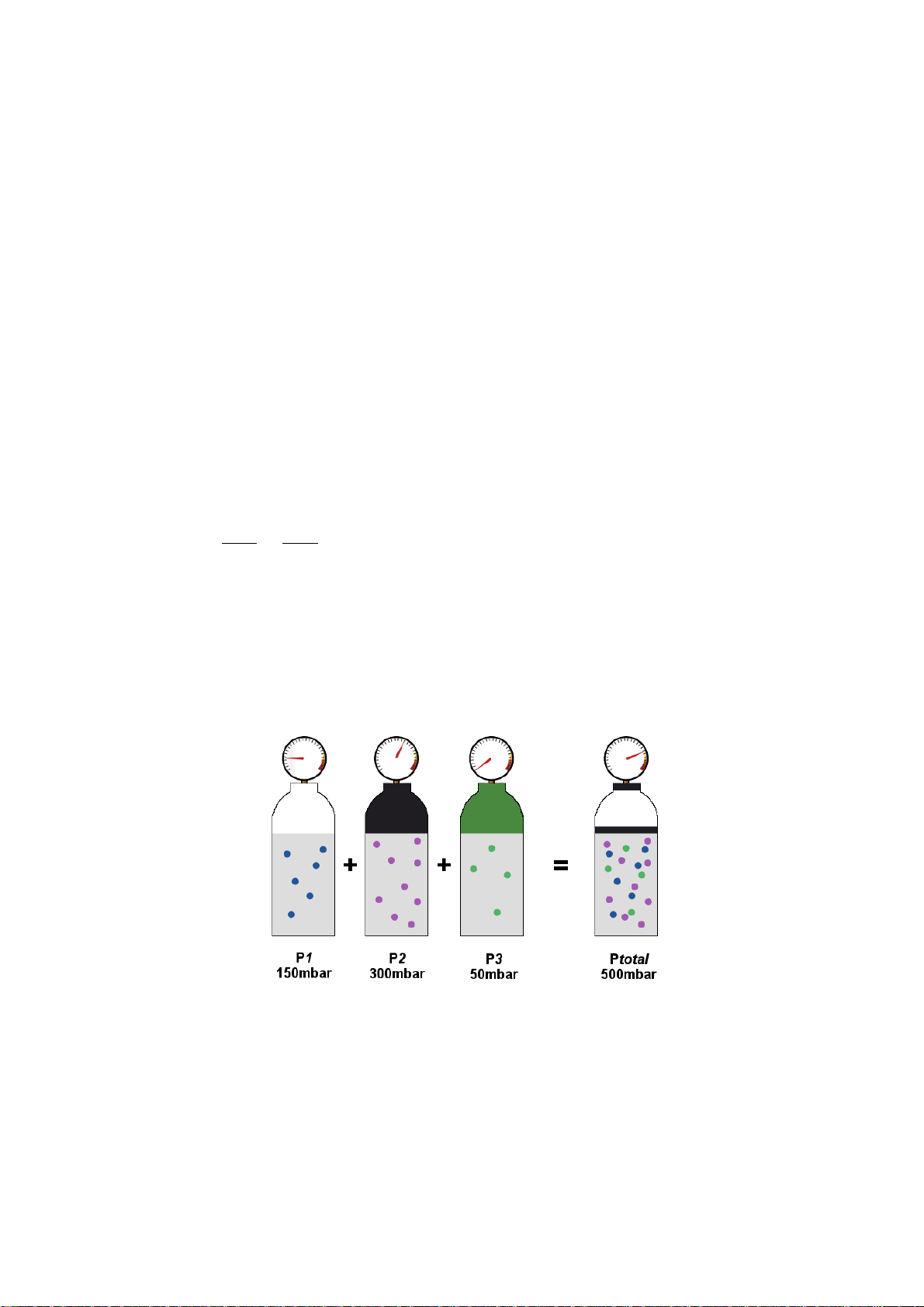
The partial pressure is defined as the pressure of a single gas component in a mixture of gases. It
corresponds to the total pressure which the single gas component would exert if it alone occupied
the whole volume.
2.1.2 Dalton’s law
The total pressure (P
total
) of a mixture of ideal gases is equal to the sum of the partial pressures (Pi) of
the individual gases in that mixture.
(1)
From Equation 1 it can be derived that the ratio of the number of particles (ni) of an individual gas
component to the total number of particles (n
total
) of the gas mixture equals the ratio of the partial
pressure (Pi) of the individual gas component to the total pressure (P
total
) of the gas mixture.
(2)
ni Number of particles in gas i
n
total
Total number of particles
pi Partial pressure of gas i
P
total
Total pressure
Figure 2-1 Ptotal = P1 + P2 + P3 (Constant Volume & Temperature)
Page 5
Page | 2-2
Example 1:
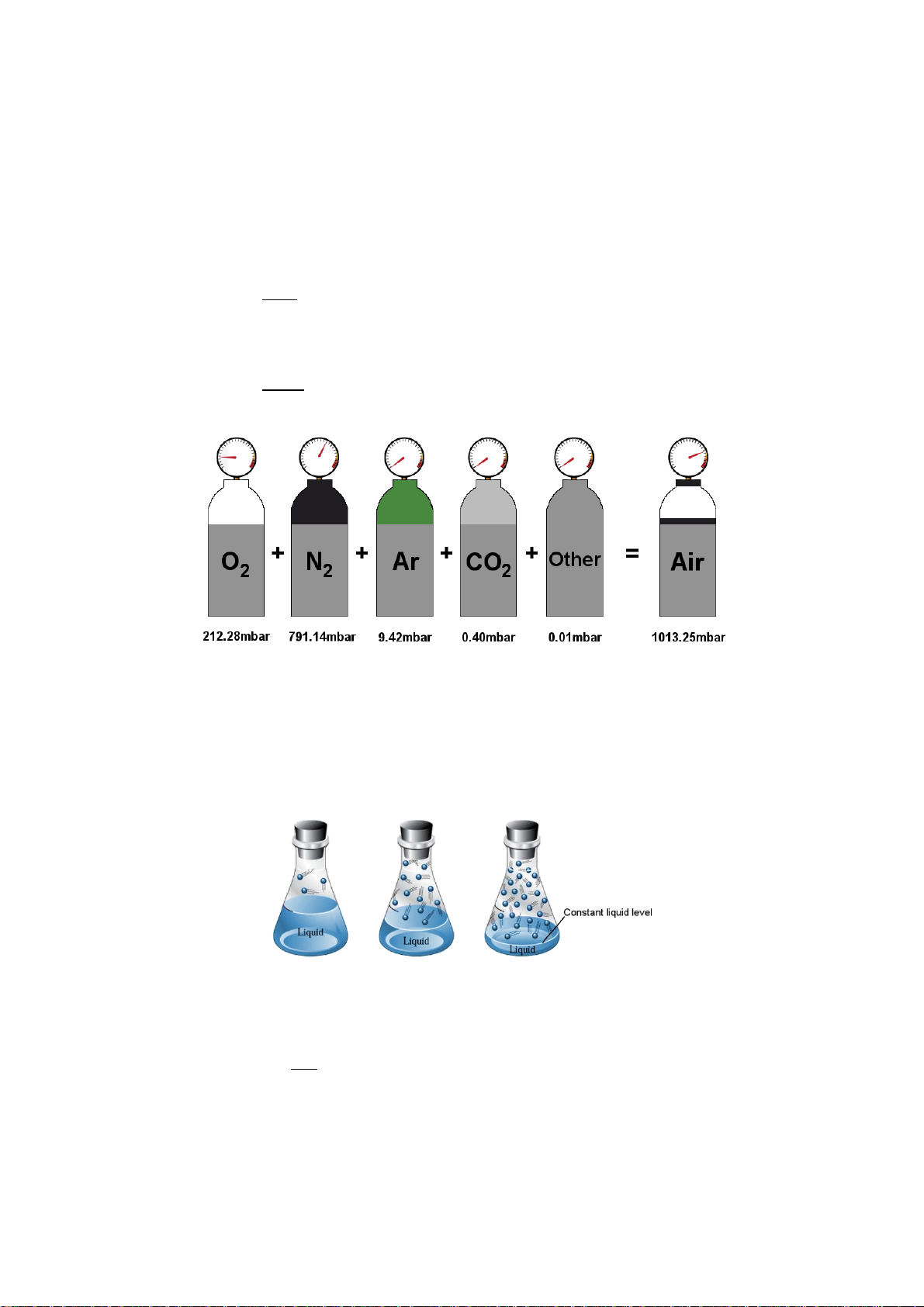
The atmospheric pressure at sea level (under standard atmospheric conditions) is 1013.25mbar.
Here, the main components of dry air are nitrogen (78.08% Vol.), oxygen (20.95% Vol.), argon
(0.93% Vol.) and carbon dioxide (0.040% Vol.). The volumetric content (%) can be equated to the
number of particles (n) since the above gases can be approximated as ideal gases.
Equation 2 can be solved for the partial pressure of an individual gas (i) to get:
(3)
The oxygen partial pressure then equates to:
Figure 2-2 Partial Pressure at 0% Humidity
Of course, this value is only relevant when the atmosphere is dry (0% humidity). If moisture is
present a proportion of the total pressure is taken up by water vapour pressure. Therefore, the
partial oxygen pressure (ppO2) can be calculated more accurately when relative humidity and
ambient temperature are measured along with the total barometric pressure.
Figure 2-3 Liquid Vapour Pressure
Firstly, water vapour pressure is calculated:
(4)
WVP Water Vapour Pressure (mbar)
H
Rel
Relative Humidity (%)
WVP
max
Maximum Water Vapour Pressure (mbar)
Page 6

Page | 2-3
For a known ambient temperature, maximum water vapour pressure (WVP
max
) can be determined
from the lookup table in APPENDIX A. The maximum water vapour pressure is also referred to as the
dew point. Warmer air can hold more water vapour and so has a higher WVP
max
.
Partial oxygen pressure then equates to:
(5)
ppO2 Partial Pressure O2 (mbar)
BP Barometric Pressure (mbar)
WVP Water Vapour Pressure (mbar)
Example 2 below describes the effect of humidity reducing the partial oxygen pressure and therefore
the volumetric content of oxygen.
Example 2:
On a typical day, the following information is recorded from a calibrated weather station:
Temperature: 22°C
Humidity: 32%
Barometric Pressure: 986mbar
Using the lookup table in APPENDIX A, WVP
MAX
= 26.43mbar.
Partial oxygen pressure then equates to:
As we now know the oxygen partial pressure and the total barometric pressure we can work out the
volumetric content of oxygen.
Page 7
Page | 2-4
2.2 Zirconium Dioxide (ZrO
2
)
At high temperatures (> 650°C), stabilised zirconium dioxide (ZrO
2
) exhibits two mechanisms:
1. ZrO
2
partly dissociates producing mobile oxygen ions and therefore becomes a solid
electrolyte for oxygen. A ZrO2 disc coated with porous electrodes connected to a constant
DC current source allows ambient oxygen ions to be transported through the material. This
liberates an amount of oxygen at the anode proportional to the charge transported
(electrochemical pumping) which according to Faraday’s First Law of Electrolysis is:
(6)
N Number of Moles of Oxygen Transported
i Constant Current
t Time (seconds)
z Ionic Valence of Oxygen
F Faraday Constant = 96487 C/mola
2. ZrO
2
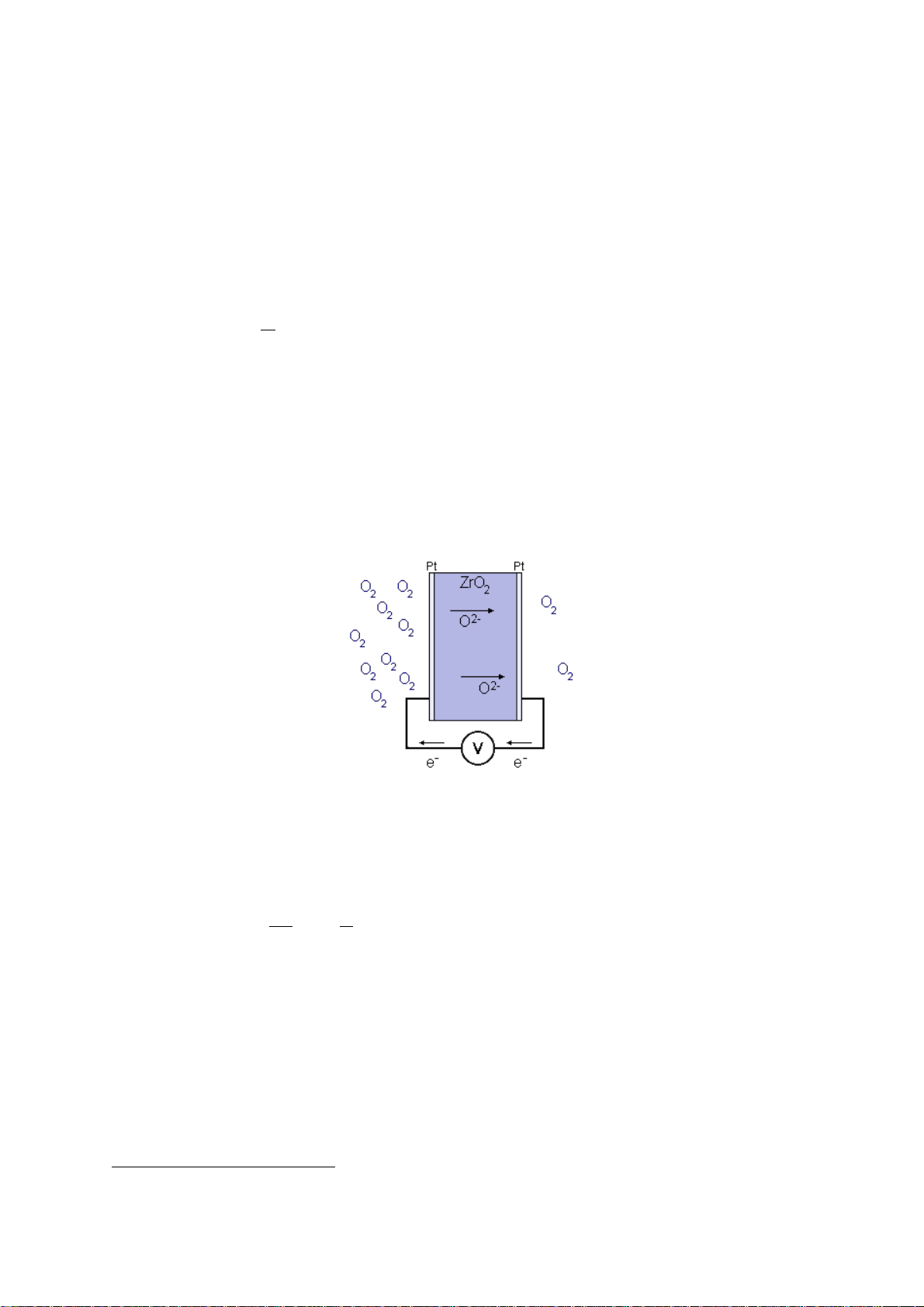
behaves like an electrolyte. If two different oxygen pressures exist on either side of a
piece of ZrO2, a voltage (Nernst voltage) is generated across it.
2.3 Nernst Voltage
Two different ion concentrations on either side of an electrolyte generate an electrical potential
known as the Nernst Voltage. This voltage is proportional to the natural logarithm of the ratio of the
two different ion concentrations. Electrolysis is:
(7)
kB Boltzmann constant (kB = 1.38x10
-23
J/K)
T Temperature in K
e0 Elementary charge (e0 = 1.602x10
-19
C)
ci Ion concentration in mol/kg
Either of these properties are used in many variants of oxygen sensors, however SST’s oxygen
sensors employ both principals simultaneously. This removes the need for a sealed reference gas
making the sensor more versatile for use in a range different oxygen pressures.
a
Where C is units of charge in coulombs, and mol is mole, a unit of substance.
Page 8
P a g e | 3-1
3 SENSOR FUNCTION
3.1 Sensor Cell Construction
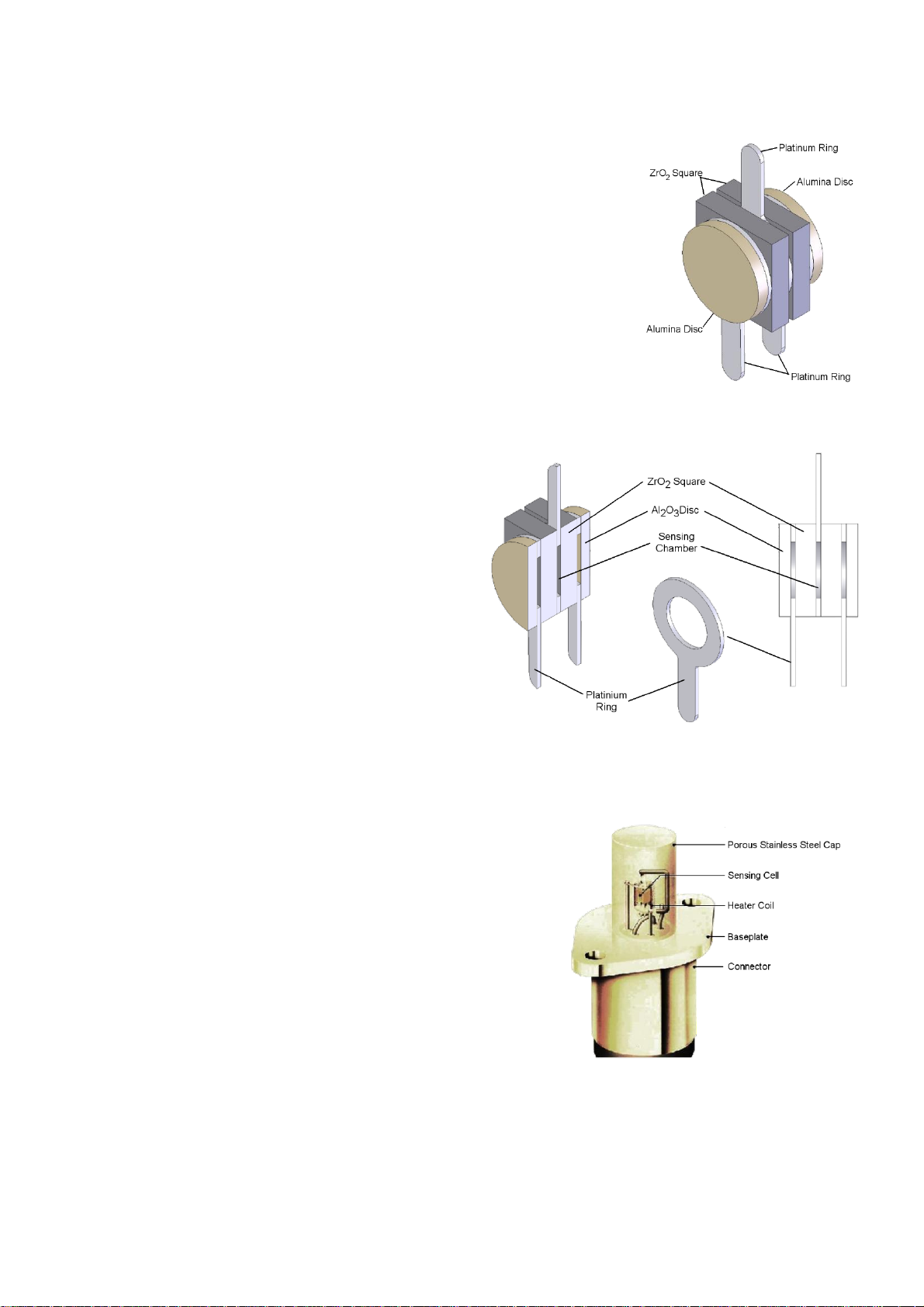
At the core of the oxygen sensor is the sensing cell (Figure 3-1). The cell
consists of two zirconium dioxide (ZrO2) squares coated with a thin porous
layer of platinum which serve as electrodes. The platinum electrodes
provide the necessary catalytic effect for the oxygen to dissociate,
allowing the oxygen ions to be transported in and out of the ZrO2.
The two ZrO2 squares are separated by a platinum
ring which forms a hermetically sealed sensing
chamber. At the outer surfaces, there are two
further platinum rings which along with centre
platinum ring provide the electrical connections to
the cell.
Two outer alumina (Al2O3) discs filter and prevent
any ambient particulate matter from entering the
sensor and also remove any unburnt gases. This
prevents contamination of the cell which may lead
to unstable measurement readings. Figure 3-2
shows a cross-section of the sensing cell with all
the major components highlighted.
The cell assembly is surrounded by a heater coil which
produces the necessary 700°C required for operation. The
cell and heater are then housed within a porous stainless
steel cap to filter larger particles and dust and also to
protect the sensor from mechanical damage. Figure 3-3
shows the complete sensor assembly. Refer to AN-0050,
Zirconia O2 Sensor Operation and Compatibility Guide for
more information about other gases and chemicals with
have an influence on the sensor operation and lifespan.
Figure 3-1 The Sensing Cell
Figure 3-2 Cross-Section of the Sensing Cell
Figure 3-3 Complete Sensor Assembly
Page 9
Page | 3-2
3.2 Pumping Plate
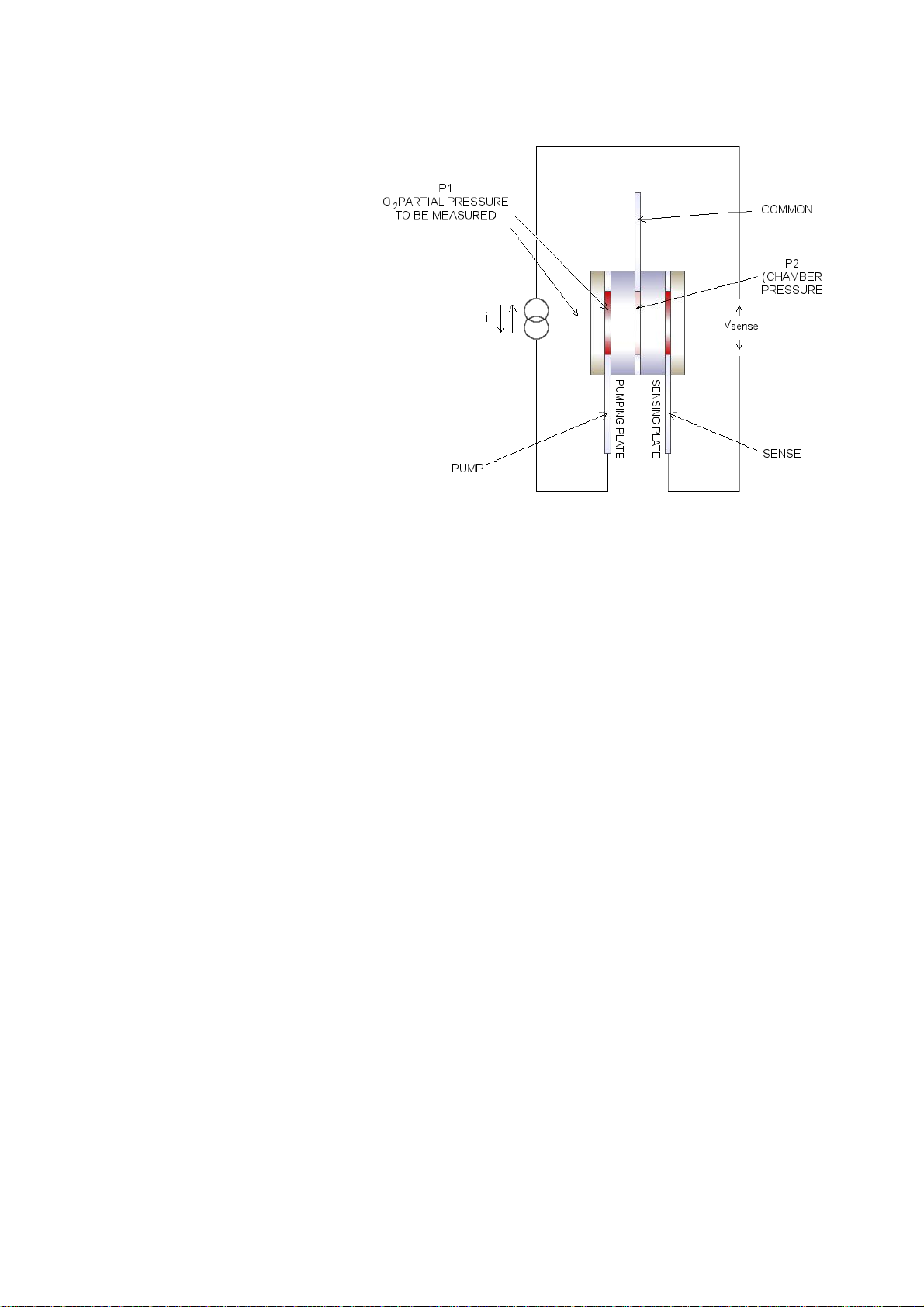
The first ZrO2 square works as an
electrochemical oxygen pump,
evacuating or re-pressurising the
hermetically sealed chamber.
Depending on the direction of the
DC constant current source, the
oxygen ions move through the
plate from one electrode to the
other, this in turn changes the
oxygen concentration and
therefore the oxygen pressure (P2)
inside the chamber. The pumping is
controlled so that the pressure
inside the chamber is always less
than the ambient oxygen pressure
outside the chamber. Figure 3-4 shows the
electrical connections to the cell.
3.3 Sensing Plate
A difference in oxygen pressure across the second ZrO2 square generates a Nernst voltage which is
logarithmically proportional to the ratio of the oxygen ion concentrations (See 2.3 Nernst Voltage on
page 2-4). As the oxygen pressure inside the chamber (P2) is always kept less than the oxygen
pressure outside of the chamber (P1), the voltage at sense with respect to common is always
positive.
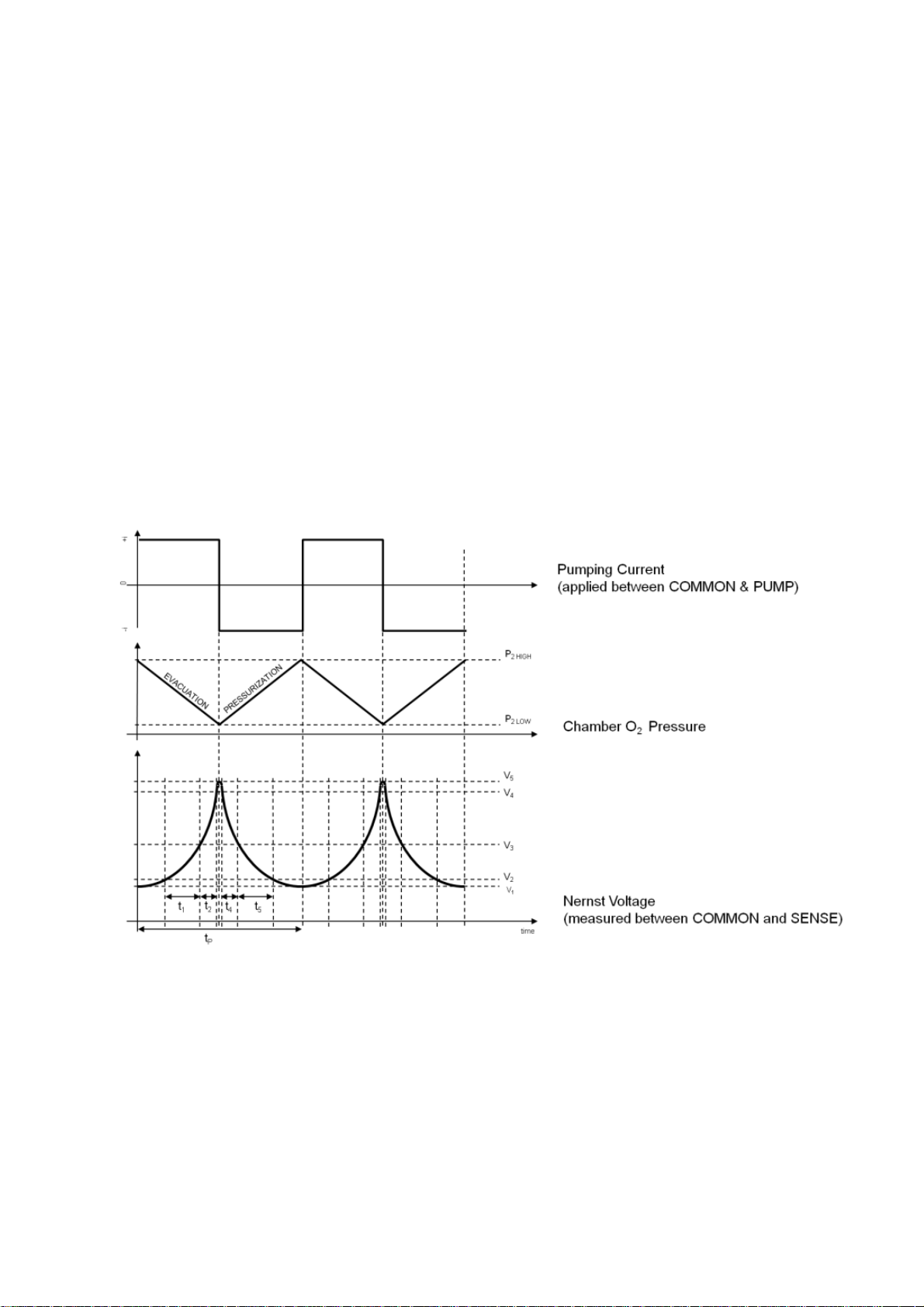
This voltage is measured and compared with two reference voltages (V1 & V5, Figure 4-1 on page 4-1)
and every time either of these two references are reached the direction of the constant current
source is reversed. When the ppO2 is high, it takes longer to reach the pump reversal voltages than it
does in a low ppO2 atmosphere. This is because a greater number of oxygen ions are required to be
pumped in order to create the same ratiometric pressure difference across the sensing disc.
Example 3:
P1, the O2 pressure we want to measure, is 10mbar and the set reference voltage is achieved when
P2 is 5mbar. If P1 is then changed to 1bar, P2 would have to be 0.5bar in order to achieve the same
reference voltage. This would involve evacuating far more oxygen ions and as the current source
used to pump the ions is constant, would therefore take a lot longer.
Section 4 MEASUREMENT on page 4-1 explains the interpretation of the generated Nernst voltage
and how this corresponds to oxygen pressure.
Figure 3-4 Electrical Connections to the Cell
Page 10
P a g e | 4-1
4 MEASUREMENT
SST Sensing’s range of sensors have five connections:
Two Heater Connections: The heater requires a specific voltage to ensure the correct operating
temperature at the cell.
Three Cell Connections: A reversible DC constant current source is applied between PUMP and
COMMON in order to create the electrochemical pumping action. The resulting Nernst voltage is
measured between SENSE and COMMON.
As previously explained, when the amplitude of the sense signal hits predetermined reference levels
(V1 and V5) the direction of the constant current source is reversed. The duration of a complete
pump cycle, that is, the time taken to once evacuate and refill the chamber, depends on the partial
pressure of oxygen in the gas to be measured (see Figure 4-1); this time is equivalent to the cycle
duration of the Nernst voltage (tp). The higher the ambient oxygen pressure is, the longer it takes for
the oxygen pump at constant pump current to reach the same levels. Thus, the pumping cycle and
therefore the cycle time of the Nernst voltage are linearly proportional to the oxygen partial
pressure.
Figure 4-1 Pump Current and Generated Nernst Voltage
Practical Considerations
In theory, any two values can be chosen for V1 and V5; in practice, they are chosen to:
1. Eliminate the effect of an electric double layer in the ZrO
2
square formed by space charges.
2. Create the best response time for the application.
3. Reduce temperature dependence.
Page 11
Page | 4-2
Compensating for the Electric Double Layer
Not all of the charge supplied by the constant current source contributes to a pressure change in the
chamber, some is absorbed by an electric double layer formed at the platinum/ZrO2 interface as the
current source is reversed. This effect is particularly noticeable at the pressure extremities and near
the pump reversal voltages. As pressure increases the amount of charge required to change the
chamber pressure also increases. To reduce this effect, the working chamber pressure should only
vary 1 – 10% from the ambient pressure.
To overcome the influence of the double layer near the pump reversal points, Nernst voltages are
chosen well away from V1 and V5. (V2, V3 and V4 in Figure 4-1 illustrate this).
Response Time
Due to the pump cycle time increasing as the oxygen pressure increases, at higher oxygen pressures
V1 and V5 should be made close to each other in order to ensure a fast response.
Compensating for Temperature Dependence
It can be seen that the Nernst voltage (Equation 7) is temperature dependant. However, the
temperature dependence is such that under certain operating conditions, the combined
temperature dependence of Nernst Law and the Gas Laws that govern oxygen can be vastly reduced.
Again, much of this temperature dependence occurs around the pump reversal points so by
choosing to measure Nernst voltages at V2, V3 and V4 we can make the temperature co-efficient (TC)
virtually equal zero.
When operating in this TC = 0 mode the time taken to reach V2, V3 and V4 are measured. These are
highlighted as t1, t2, t4 and t5 in Figure 4-1. The revised cycle time (td) is then calculated as follows:
(8)
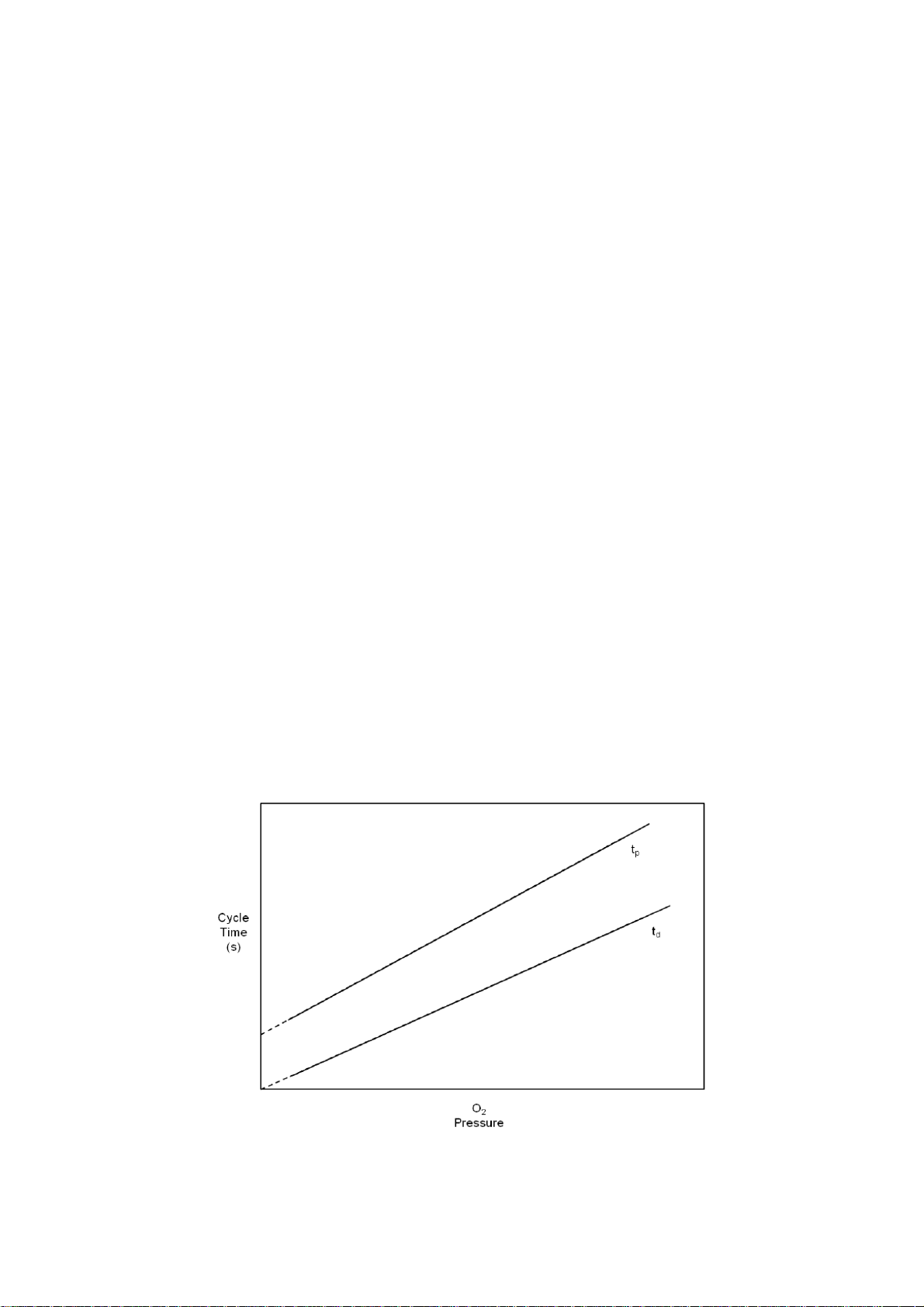
Not only does td give a linear output proportional to the ambient oxygen pressure but unlike tp, it
also passes through the origin. The graph in Figure 4-2 shows the output when calculating td vs. tp.
Figure 4-2 td versus tp
Page 12

Page | 4-3
One of the major benefits of having a linear response that passes through the origin is that sensor
calibration (gain) can occur at one point anywhere on the slope. By measuring tp, two-point
calibration is required not only to set the gain but also to remove the zero offset.
It should also be noted that the response of both tp and td are represented by a dotted line as they
approach zero O2 pressure (ppO2). This is because the sensor by definition requires at least some
ambient ppO2 in order to operate. If the ppO2 is zero, the sensor, due to the applied constant current
source, will try to pump the O2 within the ZrO2. This will, in time, damage the ZrO2 and degrade
sensor performance. It is therefore imperative that the sensor is not used for prolonged periods in
very low oxygen environments (less than 1 mbar ppO2), especially in reducing atmospheres (an
atmosphere in which there is little free oxygen and oxygen is consumed).
NOTE: Calculating tp is only recommended for very basic applications where high accuracy is not
necessarily required; for this reason, SST recommend calculating td as per the following sections.
Sensitivity/Slope
Sensitivity or Slope is defined as the Cycle Time (td) in milliseconds divided by the ppO2 in mbar of
the known calibration atmosphere.
When calculating td (only one calibration point), sensitivity is defined as:
(9)
Sensitivity/Slope for a nominal sensor, when calculating td, is typically 1.05ms/mbar. Though due to
many factors that may influence the sensitivity (chamber volume, ZrO2 thickness, etc.), there is a
production tolerance of ±15%. This makes calibration a necessity to ensure good sensor to sensor
repeatability.
4.1 Recommended Values for Use in Normal Atmospheric Pressures
When using the sensor to measure ppO2 of approx. 1 – 1000mbar (0.1 – 100% of typical barometric
pressure), the following values are recommended:
td (TC = 0 mode)
Constant Current Source: i = 40μA
Pump Reversal Voltages: V1 = 40mV and V5 = 90mV
Sense Voltages: V2 = 45mV, V3 = 64mV and V4 = 85mV
When using the sensor in higher O2 pressures alternate values can be recommended on request.
NOTE: Due to the many benefits of operating the sensor in TC = 0 mode (calculating td), this is the
recommended mode of operation.
Typical Measurement Procedure
1. Oxygen sensor heats up until the correct operating temperature is reached, minimum 60s
from cold.
2. In order to begin the electrochemical pumping the cell is first evacuated by applying the
constant current source between PUMP and COMMON.
3. The Nernst Voltage across SENSE and COMMON increases until V
5
is reached.
Page 13

Page | 4-4
4. The pump current connections are reversed and the constant current now flows between
COMMON and PUMP. The cell begins to re-pressurise.
5. The Nernst Voltage across SENSE and COMMON decreases until V
1
is reached.
6. When V
1
is reached one pumping cycle is complete and the process is repeated.
7. This cycling is repeated indefinitely and each time a complete waveform is captured, t
d
is
calculated.
4.2 Initial Sensor Drift and Active Burn-In
During the first 200hrs the sensor output can drift by up to ±3%. This is due to a number of factors
including:
1. Impurities in the zirconium dioxide migrating to the grain boundaries and to the surface of
the platinum electrode bond.
2. Sintering of the porous platinum electrodes.
3. Heater coil ageing.
4. The internal stainless steel surface of the cap becoming less reflective due to thermal
oxidation.
Regular calibration removes the effect of initial sensor drift as the sensor output is constantly rereferenced against the known calibration gas.
However, if regular calibration is not possible and the output is required to have stabilised prior to
use in the application then it may be necessary to actively burn-in the sensor.
Active burn-in involves operating the sensor normally in a clean atmosphere typically for 200hrs. For
most applications, this is a simple timed process and the sensor output is not monitored.
For demanding applications that require characterised sensor stability, active burn-in involves
operating the sensor normally in a controlled atmosphere where the exact ppO2 is known. If this is
fresh air, then all weather data must be recorded and the ppO2 calculated as previously described in
Example 2 on page 2-3.
With the ppO2 known, the sensor output (td) can be normalised as described in Equation 9. By
calculating slope any variance in the sensor output can be considered to be drift and not due to
environmental fluctuations.
The level of stability required will be dependent on the application specifications however in general
the output can be considered stable when the slope value has varied by less than ±0.2% of reading in
the last 48hrs.
When SST perform active burn-in, measurements are taken at 12hr intervals and the environmental
temperature is kept constant to negate any temperature dependence the sensor output may exhibit.
Page 14

Page | 4-5
4.3 Calibration Processes – Converting t
d
to ppO2 and O2%
The following procedures are relevant to td measurements made in TC = 0 mode as this is the
recommended mode of operation.
In order to convert td to a ppO2 measurement, sensitivity must first be calculated in a known ppO2
atmosphere. The volumetric content can easily be calculated from Dalton’s law if the total pressure
of the gas mixture is known; refer to Equation 2 on page 2-1.
If a relative content (percent by volume) is to be determined without measuring the total pressure,
Sensitivity must be calculated in the actual measurement environment with a known oxygen
concentration. Future measurements will then be referenced to the total pressure at the time of this
calculation. Typically, this would involve calibration in normal air to 20.7% (not 20.95%) to take into
account average humidity levels. In order to maintain accuracy, calibration should occur regularly to
remove variance caused by fluctuations in barometric/application pressure. As barometric pressure
changes relatively slowly, daily calibrations are recommended. Regular calibration also removes any
sensor drift which is typical in the first few hundred hours of operation as explained in 4.2 Initial
Sensor Drift and Active Burn-In on page 4-4.
If regular calibration in fresh air is not possible it may be necessary to use a pressure sensor in
conjunction with the sensor to automatically compensate the output for fluctuations in the
barometric or application pressure. This is a relatively simple process as variations in the barometric
pressure change the sensor output by the same proportion. So, if the barometric pressure changes
by 1% the sensor output will also change by 1%.
Ideally the initial system calibration should be performed after the sensor has burned in for 200hrs.
This will ensure any sensor drift, which may affect future accuracy, has occurred beforehand.
4.3.1 ppO
2
Measurement Only
1. Place sensor in calibration gas with a known ppO
2
. If this is fresh air, then the weather data
should be used to accurately calculate ppO2 as described in Example 2 on page 2-3.
2. Oxygen sensor heats up until the correct operating temperature is reached, ~60s from cold.
3. Pumping cycles commence.
4. Leave sensor at the operating temperature for 5 – 10 mins to fully stabilise.
5. Calculate output t
d
. Usually over at least ten cycles to average out any noise; the greater the
averaging the better.
6. Calculate Sensitivity using Equation 9 on page 4-3.
7. Rearranging Equation 9 allows ppO
2
to be calculated for all future td measurements (see
Equation 10 below):
(10)
Page 15

Page | 4-6
4.3.2 O
2
% Measurement Only – No Pressure Compensation
1. Place sensor in calibration gas, typically normal air (20.7% O
2
), though can be any gas of
known concentration.
2. Oxygen sensor heats up until the correct operating temperature is reached, ~60s from cold.
3. Pumping cycles commence.
4. Leave sensor at the operating temperature for 5 – 10 mins to fully stabilise.
5. Calculate output t
d
. Usually over at least ten cycles to average out any noise; the greater the
averaging the better.
6. Calculate Sensitivity% using Equation 11 below:
(11)
7. Rearranging Equation 11 allows O
2
% to be calculated for all future td measurements (see
Equation 12 below).
NOTE: Any fluctuations in the barometric or application pressure will result in measurement
errors proportional to the difference between the pressure at the time of measurement and
the pressure when Sensitivity% was calculated.
(12)
4.3.3 ppO2 and O
2
% Measurement – With Pressure Compensation
1. Place sensor in calibration gas, typically normal air (20.7% O
2
), though can be any gas of
known concentration.
2. Calculate ppO
2
from the known oxygen concentration and the total pressure of the
environment using Equation 13 below:
(13)
3. Oxygen sensor heats up until the correct operating temperature is reached, ~60s from cold.
4. Pumping cycles commence.
5. Leave sensor at the operating temperature for 5 – 10 mins to fully stabilise.
6. Calculate output t
d
. Usually over at least ten cycles to average out any noise; the greater the
averaging the better.
7. Calculate Sensitivity using Equation 9 on page 4-3.
8. Calculate all future t
d
measurements using Equation 10 on page 4-5.
9. Rearranging Equation 13 allows O
2
% to be calculated from new ppO2 measurements and the
total pressure (see Equation 14 below).
(14)
Page 16

P a g e | A-1
APPENDIX A – WATER VAPOUR PRESSURE LOOKUP TABLE
Lookup table for maximum water vapour pressure.
Temperature (°C)
Max water vapour
pressure (mbar)
Temperature (°C)
Max water vapour
pressure (mbar)
0
6.10
31
44.92
1
6.57
32
47.54
2
7.06
33
50.30
3
7.58
34
53.19
4
8.13
35
56.23
5
8.72
36
59.42
6
9.35
37
62.76
7
10.01
38
66.27
8
10.72
39
69.93
9
11.47
40
73.77
10
12.27
42.5
84.19
11
13.12
45
95.85
12
14.02
47.5
108.86
13
14.97
50
123.38
14
15.98
52.5
139.50
15
17.04
55
157.42
16
18.17
57.5
177.25
17
19.37
60
199.17
18
20.63
62.5
223.36
19
21.96
65
250.01
20
23.37
67.5
279.31
21
24.86
70
311.48
22
26.43
75
385.21
23
28.11
80
473.30
24
29.82
85
577.69
25
31.66
90
700.73
26
33.60
95
844.98
27
35.64
100
1013.17
28
37.78
110
1433.61
29
40.04
120
1988.84
30
42.42
130
2709.58
Page 17

P a g e | B-1
APPENDIX B – SPECIAL NOTES AND APPLICATION HINTS
To ensure the best performance from your equipment it is important that the attached oxygen
sensor is installed and maintained correctly.
Document AN-0050, Zirconia O2 – Sensor Operation and Compatibility Guide provides some essential
sensor operating tips and a complete list of gases and materials that MUST be avoided to ensure a
long sensor life.
Page 18

P a g e | C-1
APPENDIX C – DESIGNING INTERFACE ELECTRONICS
If you are not using one of SST Sensing’s interface boards for sensor control and conditioning, refer
to AN-0113, Zirconia O2 Sensor Software and Hardware Design Guide.
Page 19

AN-0043 Rev 5 © 2017 SST SENSING LTD.
REFERENCE DOCUMENTS
Other documents in the Zirconium Dioxide product range are listed below; this list is not exhaustive,
always refer to the SST website for the latest information.
Part Number
Title
AN-0050
O2 Sensors – ZrO2 Sensor Operation and Compatibility Guide
AN-0076
O2 Sensors – ZrO2 Sensor and Interface Selection Guide
AN-0113
O2 Sensors – ZrO2 Sensor Software and Hardware Design Guide
DS-0044
Zirconia O2 Sensors Flange Mounted Series – Datasheet
DS-0051
Zirconia O2 Sensors Miniature Series – Datasheet
DS-0052
Zirconia O2 Sensors Probe Series - Short Housing – Datasheet
DS-0053
Zirconia O2 Sensors Probe Series - Screw Fit Housing – Datasheet
DS-0055
Zirconia O2 Sensors Oxygen Measurement System – Datasheet
DS-0058
OXY-LC Oxygen Sensor Interface Board – Datasheet
DS-0072
OXY-COMM Oxygen Sensor – Datasheet
DS-0073
Zirconia O2 Sensors OXY-Flex Oxygen Analyser – Datasheet
DS-0074
O2I-Flex Oxygen Sensor Interface Board – Datasheet
DS-0122
Zirconia O2 Sensors Probe Series - BM Screw Fit Housing – Datasheet
DS-0131
Zirconia O2 Sensors Probe Series - Long Housing – Datasheet
CAUTION
Do not exceed maximum ratings and ensure
sensor(s) are operated in accordance with their
requirements.
Carefully follow all wiring instructions. Incorrect
wiring can cause permanent damage to the device.
Zirconium dioxide sensors are damaged by the
presence of silicone. Vapours (organic silicone
compounds) from RTV rubbers and sealants are
known to poison oxygen sensors and MUST be
avoided. Do NOT use chemical cleaning agents.
Failure to comply with these instructions may
result in product damage.
INFORMATION
As customer applications are outside of SST Sensing
Ltd.’s control, the information provided is given
without legal responsibility. Customers should test
under their own conditions to ensure that the
equipment is suitable for their intended application.
For technical assistance or advice, please email:
General Note: SST Sensing Ltd. reserves the right to make changes to product specifications without notice or liability.
All information is subject to SST Sensing Ltd.'s own data and considered accurate at time of going to print.
SST SENSING LIMITED, 5 HAGMILL CRESCENT, SHAWHEAD INDUSTRIAL ESTATE, COATBRIDGE, UK, ML5 4NS
 Loading...