

Page 1
®
User’s Guide
Shop online at
omega.com
®
e-mail: [email protected]
For latest product manuals:
omegamanual.info
HHWT-14
Handheld Photometer for Lead,
Mercury, and Cadmium testing
Page 2

OMEGAnet®Online Service Internet e-mail
U.S.A.:
ISO 9001 Certified
Canada:
For immediate technical or application assistance:
U.S.A. and Canada:
Mexico/
Latin America:
Benelux
Czech Republic:
France:
Germany/Austria:
United Kingdom:
ISO 9001 Certified
: Managed by the United Kingdom Office
®
omega.com [email protected]
Servicing North America:
Omega Engineering, Inc., One Omega Drive, P.O. Box 4047
Stamford, CT 06907-0047 USA
Toll Free: 1-800-826-6342 TEL: (203) 359-1660
FAX: (203) 359-7700 e-mail: [email protected]
976 Bergar
Laval (Quebec), H7L 5A1 Canada
Toll-Free: 1-800-826-6342 TEL: (514) 856-6928
FAX: (514) 856-6886 e-mail: [email protected]
Sales Service: 1-800-826-6342/1-800-TC-OMEGA
Customer Service: 1-800-622-2378/1-800-622-BEST
Engineering Service: 1-800-872-9436/1-800-USA-WHEN
®
®
®
Servicing Europe:
Frystatska 184
733 01 Karviná, Czech Republic
Toll-Free: 0800-1-66342 TEL: +420-59-6311899
FAX: +420-59-6311114 e-mail: [email protected]
Managed by the United Kingdom Office
Toll-Free: 0800 466 342 TEL: +33 (0) 161 37 29 00
FAX: +33 (0) 130 57 54 27 e-mail: [email protected]
Daimlerstrasse 26
D-75392 Deckenpfronn, Germany
Toll-Free: 0800 6397678 TEL: +49 (0) 7056 9398-0
FAX: +49 (0) 7056 9398-29 e-mail: [email protected]
OMEGA Engineering Ltd.
One Omega Drive, River Bend Technology Centre, Northbank
Irlam, Manchester M44 5BD United Kingdom
Toll-Free: 0800-488-488 TEL: +44 (0) 161 777-6611
FAX: +44 (0) 161 777-6622 e-mail: [email protected]
It is the policy of OMEGA Engineering, Inc. to comply with all worldwide safety and EMC/EMI
regulations that apply. OMEGA is constantly pursuing certification of its products to the European New
Approach Directives. OMEGA will add the CE mark to every appropriate device upon certification.
The information contained in this document is believed to be correct, but OMEGA accepts no liability for any
errors it contains, and reserves the right to alter specifications without notice.
WARNING: These products are not designed for use in, and should not be used for, human applications.
Page 3
HHWT-14
Advanced Photometer System
Ideal for Screening for Lead, Mercury,
and Cadmium in Potable Water
(For Lead Soil Testing, see page 17)
For Your Safety:
Please read the entire manual
before using the test kit.
Parameter Page MENU
Lead in Water 5 PB2
Mercury in Water 6 HG3
Cadmium in Water 7 CD4
Kit Specifications 4
Spiked Recovery Method 8
Tips for Best Accuracy 9
Instrument Operation 10
Meter Error Messages 11
Battery Installation 11
Lead Recovery Samples 12
Summary of Chemistry 13
Lead Test Interferences 14
MSDS Sheets 15-16
Lead in Soil Method 17
HHWT-14 Accuracy 18
Page 4
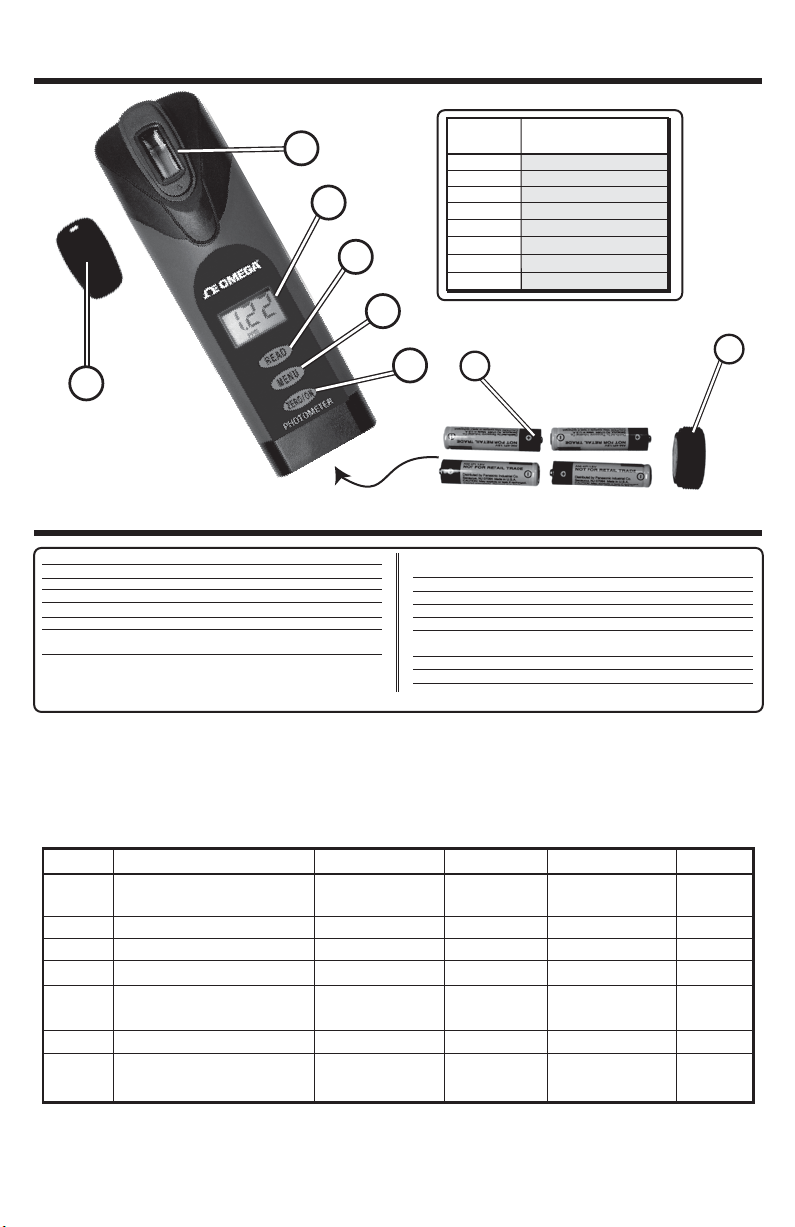
HHWT-14 Photometer
B
C
A
HHWT-14 Meter Specifications
Measurement Method: Photometric
Light Source: Light Emitting Diode (LED)
Wavelength: 476 nm
ABS Range: .001 - 2.00
Photometric Precision: .001
Automatic Range Selection: See Specifications below
Display: 3-digit customized liquid crystal display
with annunciators
CELL Pathlength: 20mm
ITEM PICTURED
LETTER
A
B
C
D
E
D
F
G
H
COMPONENT
NAME
Mixing Cap
Cell (Built-in Plastic, 4mL)
LCD Display
READ Button
MENU Button
ZERO/ON Button
Battery Cover with loop for lanyard
AAA Batteries (x4) (INCLUDED)
E
F
H
G
+
–
Cell Chamber: Custom-molded, proprietary, PET plastic
fused into chamber, non-removable
Sample Required: 4mL (0.13 oz)
Operating Temperature Range:
Power Supply: (4) AAA alkaline batteries (Included)
Battery Life: 2000 tests with alkaline batteries
Electromagnetic Compliance:
(EMC) Immunity to Interference - EN 61326
Waterproof Rating: Exceeds IP67
Weight: Instrument: 140 g (5 oz)
Dimensions: Instrument: 5 (W) x 3.5 (D) x 16.5 (H) cm;
(2 x 1.4 x 6.375 in)
0 - 50°C (32° - 122°F)
Emitted Interference - EN 61326
HHWT-14 has been designed to offer the user a more “Green” and cost-effective alternative to testing.
We offer a “Green” Alternative
Instead of using a 10mL water sample, HHWT-14 uses a 4mL water sample, which uses up to 60% less
chemical per test. The accuracy of the meter is maintained by designing the photo cell with a 20mm pathlength.
HHWT-14 Specifications
Menu Tests for Range Resolution +/- Accuracy Limit*
PA1 Diluted Homogenized .000 to 1.99 .001 .003 or 6% —
Paint Lead
PB2 Lead in Water (auto-zero) 1 - 500 µg/L 1 µg/L 3 µg/L or 6% 3 µg/L
HG3 Mercury in Water
CD4 Cadmium in Water
AB5 Future or Custom Tests .000 - 1.99 .001 .002 or 2% —
(Absorbance) abs abs abs
PB6 Lead in Water 1 - 500 µg/L 1 µg/L 3 µg/L or 6% 3 µg/L
PB2
Modified Test for Lead in Soil
200 - 300,000 200 + - 40% 200
*Limit is defined as the minimum reliable detection for that test. Any value below the limit should be
considered inconclusive for that metal’s presence.
(auto-zero)
(auto-zero)
10 - 600 µg/L 1 µg/L 6 µg/L or 6% 10 µg/L
0.01 - 0.80 mg/L .01 mg/L .06 mg/L or 6% .02 mg/L
18 - 3000 mg/kg 1 mg/kg + - 25% 18 mg/kg
mg/kg
4
Page 5
PB2
1
2
3
4
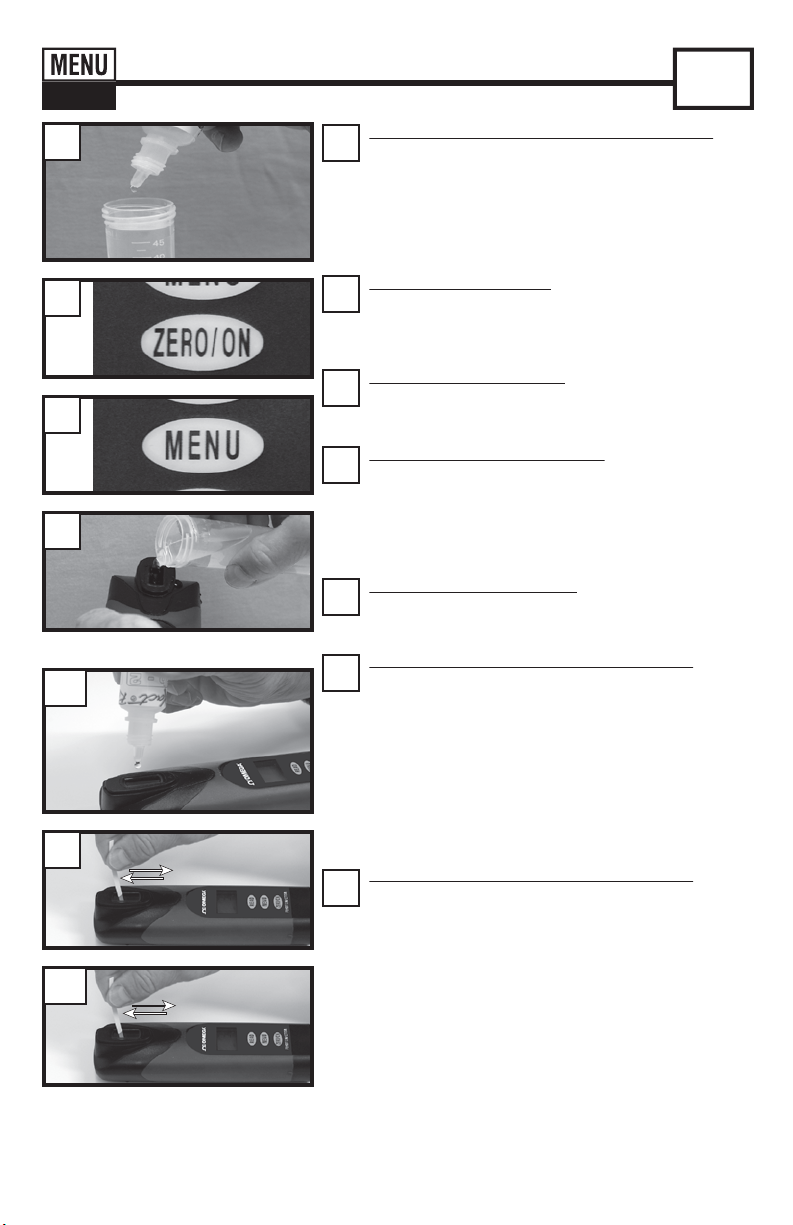
Lead in Water Test Procedure
Uses Reagent Set HHWT-486901.
PREPARE SAMPLE FOR TESTING
1
Collect water sample in 50mL conical tube to the 50mL
line. Add three (3) drops of PB-ACID Reagent
HHWT-486999B. Mix and allow to sit for at least five (5)
minutes. After this time, TEST SAMPLE is ready for
testing. NOTE: If sample is tap water or is acidic,
add 2 drops of PB-ACID.
TURN METER ON
2
Press the ZERO/ON button to power the meter on;
the display will show all annunciators, then the current
MENU selection, followed by the last reading.
SELECT TEST: PB2
3
Press and re-press the MENU button until the
display shows the parameter PB2.
ADD SAMPLE TO CELL
4
Using the TEST SAMPLE from above, fill and empty
the CELL four (4) times. Finally, fill cell to capacity
(4mL) with the TEST SAMPLE. Tilt meter forward to
allow excess sample to flow out in order to make room
for Pb-2 Reagent addition below.
ADD REAGENT Pb-2
5
Add five (5) drops of
Reagent Pb-2 HHWT-488375B
PB
.
DIP STRIP AND PRESS “READ”
6
5
Dip the Pb-3 HHWT-486997 strip into the CELL and
immediately press READ. This starts the 20 SECOND
countdown timer. During this time move the strip in a
gentle back and forth motion.
strip after “1” on the display disappears*.
will flash (- - -) and begin immediately counting up from
1 to 60. After the 60 seconds, the meter
automatically zeros. The cursor will move across the
display followed by 0 µg (µg/L).
Remove and discard the
The display
6
DIP STRIP AND PRESS “READ”
7
Dip the Pb-4 HHWT-486995 strip into the CELL and
immediately press READ. This starts the 20 SECOND
countdown timer. During this time move the strip in a
gentle back and forth motion.
7
*NOTE: When testing outdoors (sunlight), for best accuracy, use the Mixing Cap/Cell Cover when Zeroing and Reading the sample.
NOTE: For best results, the final pH of the sample should be between 9.5 and 10.
strip after “1” on the display disappears*.
will flash (- - -) and begin immediately counting up from
1 to 60. After the 60 seconds, the cursor will move
across the display, informing you that it is about to
measure the sample as µg (µg/L). Record result
displayed (this result is automatically stored in PB2).
After testing, discard sample and rinse cell at least
three times with clean water.
5
Remove and discard the
The display
Page 6
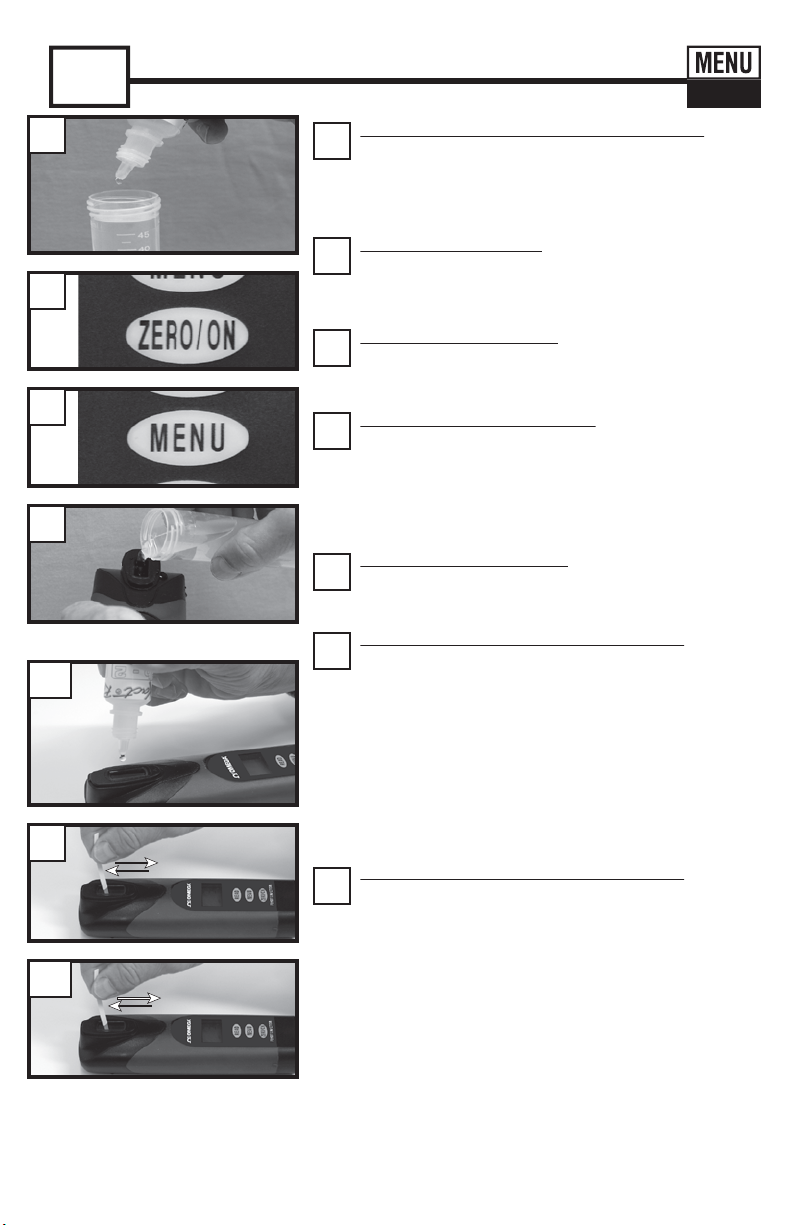
Mercury in Water Test Procedure
HG
1
2
3
4
5
6
7
*NOTE: When testing outdoors (sunlight), for best accuracy, use the Mixing Cap/Cell Cover when Zeroing and Reading the sample.
Uses Reagent Set HHWT-486901.
PREPARE SAMPLE FOR TESTING
1
Collect water sample in 50mL conical tube to the 50mL
line. Add three (3) drops of PB-ACID Reagent
HHWT-486999B. Mix and allow to sit for at least five (5)
minutes. After this time, TEST SAMPLE is ready for testing.
TURN METER ON
2
Press the ZERO/ON button to power the meter on;
the display will show all annunciators, then the current
MENU selection, followed by the last reading.
SELECT TEST: HG3
3
Press and re-press the MENU button until the
display shows the parameter HG3.
ADD SAMPLE TO CELL
4
Using the TEST SAMPLE from above, fill and empty
the CELL four (4) times. Finally, fill cell to capacity
(4mL) with the TEST SAMPLE. Tilt meter forward to
allow excess sample to flow out in order to make room
for Pb-2 Reagent addition below.
ADD REAGENT Pb-2
5
Add five (5) drops of
DIP STRIP AND PRESS “READ”
6
Dip the Pb-3 HHWT-486997 strip into the CELL and
immediately press READ. This starts the 20 SECOND
countdown timer. During this time move the strip in a
gentle back and forth motion.
strip after “1” on the display disappears*.
will flash (- - -) and begin immediately counting up from
1 to 60. After the 60 seconds, the meter automatically
zeros. The cursor will move across the display followed
by 0 µg (µg/L).
DIP STRIP AND PRESS “READ”
7
Dip the Pb-4 HHWT-486995 strip into the CELL and
immediately press READ. This starts the 20 SECOND
countdown timer. During this time move the strip in a
gentle back and forth motion.
strip after “1” on the display disappears*.
will flash (- - -) and begin immediately counting up from
1 to 60. After the 60 seconds, the cursor will move
across the display, informing you that it is about to
measure the sample as µg (µg/L). Record result
displayed (this result is automatically stored in HG3).
After testing, discard sample and rinse cell at least
three times with clean water.
Reagent Pb-2 HHWT-488375B
Remove and discard the
The display
Remove and discard the
The display
HG3
.
6
Page 7
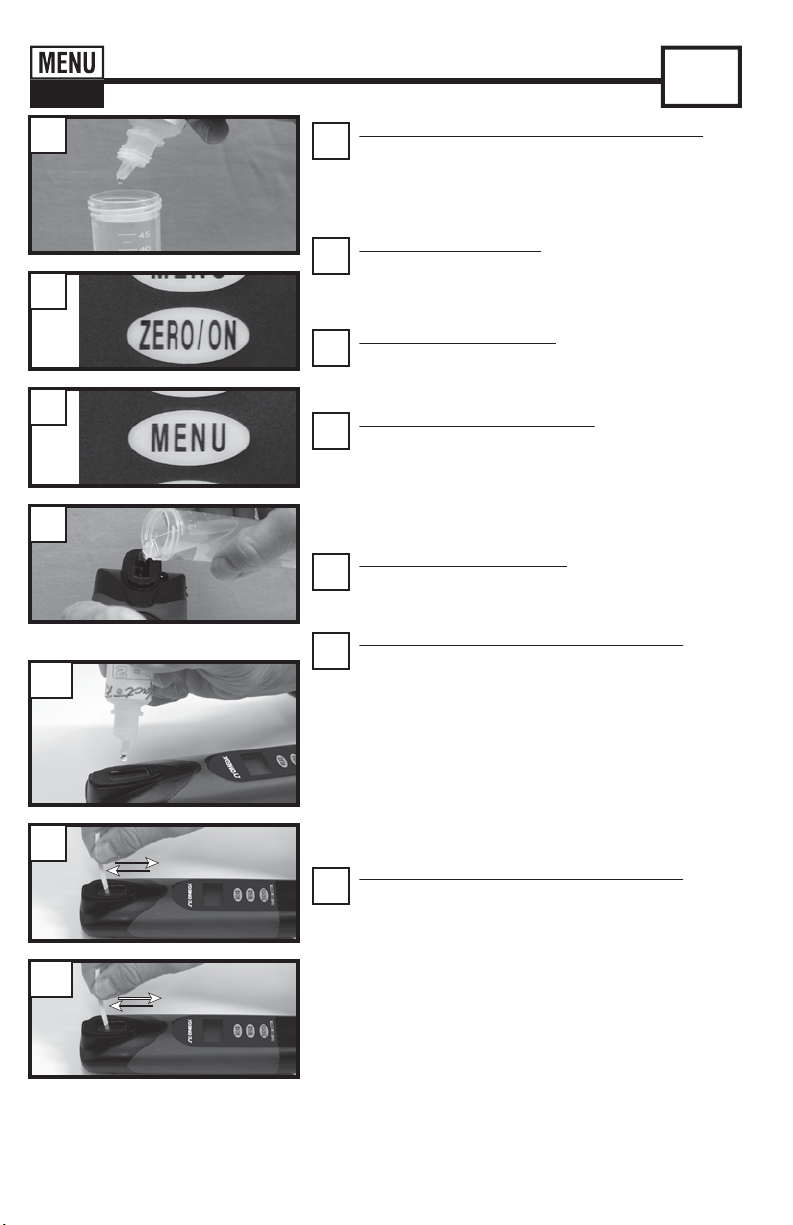
CD4
1
2
3
4
5
6
7
Cadmium in Water Test Procedure
Uses Reagent Set HHWT-486904.
PREPARE SAMPLE FOR TESTING
1
Collect water sample in 50mL conical tube to the 50mL
line. Add five (5) drops of HCl-1 Reagent
HHWT-486994. Mix and allow to sit for five (5) minutes.
After 5 minute wait, TEST SAMPLE is ready for testing.
TURN METER ON
2
Press the ZERO/ON button to power the meter on;
the display will show all annunciators, then the current
MENU selection, followed by the last reading.
SELECT TEST: CD4
3
Press and re-press the MENU button until the
display shows the parameter CD4.
ADD SAMPLE TO CELL
4
Rinse the CELL at least 3 times with the TEST
SAMPLE above. Finally, fill cell to capacity (4mL) with
the TEST SAMPLE. Tilt meter forward to allow excess
sample to flow out in order to make room for Pb-2
Reagent addition below.
ADD REAGENT Pb-2
5
Add five (5) drops of
DIP STRIP AND PRESS “READ”
6
Dip the Pb-3 HHWT-486996 strip into the CELL and
immediately press READ. This starts the 20 SECOND
countdown timer. During this time move the strip in a
gentle back and forth motion.
strip after “1” on the display disappears*.
will flash (- - -) and begin immediately counting up from
1 to 240. After the 240 seconds, the meter
automatically zeros. The cursor will move across the
display followed by 0.00 mg (mg/L).
DIP STRIP AND PRESS “READ”
7
Dip the Pb-4 HHWT-486995 strip into the CELL and
immediately press READ. This starts the 20 SECOND
countdown timer. During this time move the strip in a
gentle back and forth motion.
strip after “1” on the display disappears*.
will flash (- - -) and begin immediately counting up from
1 to 240. After the 240 seconds, the cursor will move
across the display, informing you that it is about to
measure the sample as mg (mg/L). Record result
displayed (this result is automatically stored in CD4).
After testing discard sample and rinse cell immediately.
Reagent Pb-2 HHWT-488375B
Remove and discard the
Remove and discard the
CD
.
The display
The display
*NOTE: When testing outdoors (sunlight), for best accuracy, use the Mixing Cap/Cell Cover when Zeroing and Reading the sample.
7
Page 8

Spiked Recovery Test Method for Interferences:
The Spiked Recovery Test Method (also referred to as Standard Additions Method) is used to verify that
HHWT-14 gives accurate results for your water sample. If you find an unexplained difference in results
when compared to another test method it is reasonable that you should resolve the issue. A good way to
resolve the issue is by a technique commonly used by analytical chemists every day. This technique is often
referred to as Spiked Recovery Test Method for Interferences. The following information explains how to
perform the test method. You will need a Lead standard solution. The idea behind this method is as follows:
1. Add a known amount or concentration of Lead standard solution to the questionable sample. This is
now the “spiked sample.” It is recommended to add a Standard Solution amount that is at least equivalent
to three times the minimum detectable limit of the test (10 µg/L or ppb).
2. Test the spiked and un-spiked (original) samples using the same reagents, instrument and technique
or test method. The spiked sample should show an increase equal to the amount of standard added. The
value obtained is called the Recovery. Ideally the % recovery is 100%. Results are acceptable if the %
recovery is +/- 10%. The formula for calculating percent Recovery is below.
3. If the percent recovery is not in the acceptable range there may be interferences. You can consider
diluting the sample with lead free water past the point of interference, within the detection limit of the
test kit. You can also consider calculating the actual lead in the sample (see below) as long as the %
Recovery is above a reasonable level such as 40%.
The percent recovery formula is as follows:
% Recovery = 100(cs-cu)
K
Where:
cs = concentration found through testing of the spiked sample
cu = concentration found through testing of the un-spiked sampl e
(NOTE: result should be adjusted for the dilution of the spike volume if volume change
is more then 5%)
k = concentration of the spike added to the sample
Example 1: An un-spiked questionable sample measures 10 ppb Lead. A separate 10mL portion of the
questionable sample was spiked by adding 20 µL of a 10 ppm Lead standard solution. This is the equivalent of adding 20 ppb Lead to the water sample. The spiked solution was measured by the same method
as the original sample. The Spiked result was 28 ppb (Cs)
cs = 28 ppb
cu = 10 ppb
k = 20 ppb
% Recovery = 100(28-10) = 90% (Recovery result acceptable)
20
Example 2: In another water sample using a similar spiked method as in Example 1 the results were
cs = 30 ppb
cu = 18 ppb
k = 20 ppb
% Recovery = 100(30-18) = 60% (Recovery result unacceptable)
20
Calculating the Lead:
water sample gives lead results that are 60% of the actual concentration. To calculate the concentration
of lead in this sample divide the expected recovery (100%) by the observed recovery (60%) to get the
interference correction factor (100% / 60% = 1.67). Multiply the interference correction factor by the
un-spiked sample result (cu) for the actual concentration of lead in the sample (1.67 x 18 ppb = 30 ppb).
In this example the percent recovery value is low and suggests that, with this test, the
8
Page 9

HHWT-14 Tips For Best Accuracy
1.
Become familiar with the meter and the different tests by reading the instructions carefully.
2.
Observe the dip time (as required for the test) for accurate results.
3.
Be sure the CELL is filled to capacity (4mL). Then, tilt meter forward to discard about
0.2mL of the cell volume. This allows for the Pb-2 addition to be performed without
overfilling the CELL.
4.
Rinse the CELL with clean water immediately after completing the test. (Some test
reagents will stain or coat the CELL)
5.
It is recommended that the sample be allowed to sit for 5 minutes or longer in Step 1 to
facilitate Acid reaction. Additional time would be recommended if the detection of solid Lead
or Cadmium, containing particles, are of interest.
6.
Store the meter and all test materials out of direct sunlight and away from chemical storage areas.
7.
Minimize exposure of meter and test reagents to heat. Storage below 80°F (27°C) is
recomended. DO NOT REFRIGERATE TEST REAGENTS.
8.
Dry the outside of the meter when testing is complete or before storage of the meter.
9.
Each strip is valid for ONLY one test. Discard strip after single use in regular trash that is
inaccessible to children and pets.
10.
Each bottle of strips contains the quantity of strips notated on the bottle. Due to the
manufacturing process, you may find one or two strips that are noticeably smaller or larger
in width than the normal strips in the bottle. These should be discarded. Using these strips
may give unreliable results.
11.
If conversion table(s) are supplied, they have a unique revision number. It is recommended
that you visit www.sensafe.com to check for any updated revisions and details.
12.
Tests are calibrated at 75°F +/- 2°F (24°C +/- 1°C). It is recommended that the water sample
be warmed before testing if sample temperature is below 60°F / 16°C.
13.
Our lab testing with the HHWT-14 meter has shown that zeroing and measuring of the
sample does not require any cell cover for accurate results, even in full sunlight.
14.
Remove batteries when meter is not used for more than a month.
15.
CELL cleaning procedure: Fill cell with clean water and add two drops of Acid-1 or HCl-1.
Leave meter undisturbed for 5 minutes. Afterwards, rinse the cell and the meter is ready
for use again. Cleaning the cell regularly will not be necessary if you rinse the CELL
immediately after the test.
Lead in Water Recomendation for “First Draw Sample”
The EPA 2007 Lead and Copper Rule Revision has a heavy lead testing focus on schools.
The sampling is tiered:
1. “First draw sample” - sample a line unused for at least 8 to 18 hours. Draw the first
250mL to test. This measures the lead contribution from fixtures.
2. “Flushed sample” - before any water is used in the morning allow the line to run for 30
seconds, and then collect a 250mL sample. This measures the lead contribution from
internal piping
The June 1991 Lead and Copper Rule Fact Sheet recommended 1 liter of water from a
tap unused for 6 hours. This is not mentioned in the 2007 revisions to the rule.
The amount of flushing determines what part of the system is being evaluated for lead. If
the volume of water in the system can be determined (e.g. gallons of water/linear ft. of
pipe) the amount of flushing can help isolate the source of the lead contamination. It
appears that this approach is used by some cities as they do mandated lead testing of their
water systems.
9
Page 10
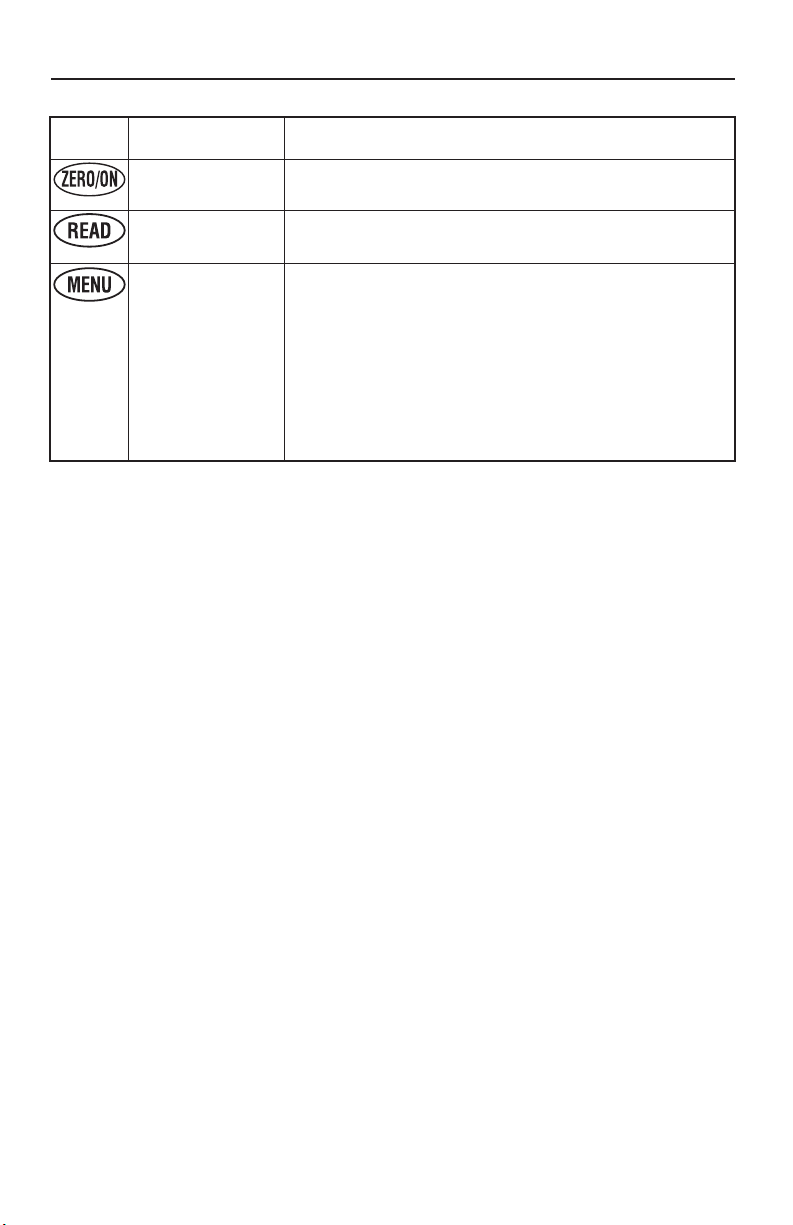
Instrument Operation Summary
Key Functions
Key Description Function
ZERO/ON While meter is off, when pressed, this turns meter on.
When meter is on, when pressed, this zeros meter.
READ When pressed, this initiates countdown timing and
count up timing as appropriate for the MENU test.
MENU When pressed and re-pressed, this advances the
display to the next MENU test. When pressed and held
down for two seconds (continue holding down), the
instrument automatically retrieves the last 20
measurements in the MENU displayed. Beginning with
the most recent measurement stored (20) through the
oldest measurement stored (1). This recall is available
for each MENU test.
10
Page 11
HHWT-14 Meter Messages
The following are some common messages that may be displayed, including error messages. If an
error message other than those listed below is displayed, please contact technical support in the USA
at (800) 872-9436.
LCD Message
HI
LO
LO
ER
Description
In READ mode: test sample concentration is above
the measurement range (test specific).
In READ mode: test sample concentration is below
the measurement range (test specific).
In ZERO mode: sample absorbance (due to a
cloudy or colored sample or a dirty cell) is too high
to zero, the meter will read “LO”.
Excessive stray light detected. Normally this
does not occur, even when testing in sunlight.
Low battery indication.
Corrective Action
Dilute and retest.
Sample value is below measurement range.
Dilute sample, filter sample, or clean cell.
Testing cannot proceed until a valid ZERO is
acheived.
Place the LIGHT BLOCKING CAP over the CELL
for zeroing and for reading result. Moving
to a shaded area can also fix this problem.
Replace the batteries.
About The Built-In Cell
The built-in CELL is transparent plastic and, when filled to the top, contains 4mL. The sturdy CELL
design will last for over 20,000 readings. Scratches on the CELL will not interfere or compromise
the accuracy of the readings because of its fixed position. For best accuracy, rinse cell with clean
water immediately after a test is completed. Do not use solvents, such as acetone, to clean the
cell. When the CELL becomes stained or cloudy from repeated testing, or when the meter does
not blank when you press the ZERO/ON button, the cell needs to be cleaned.
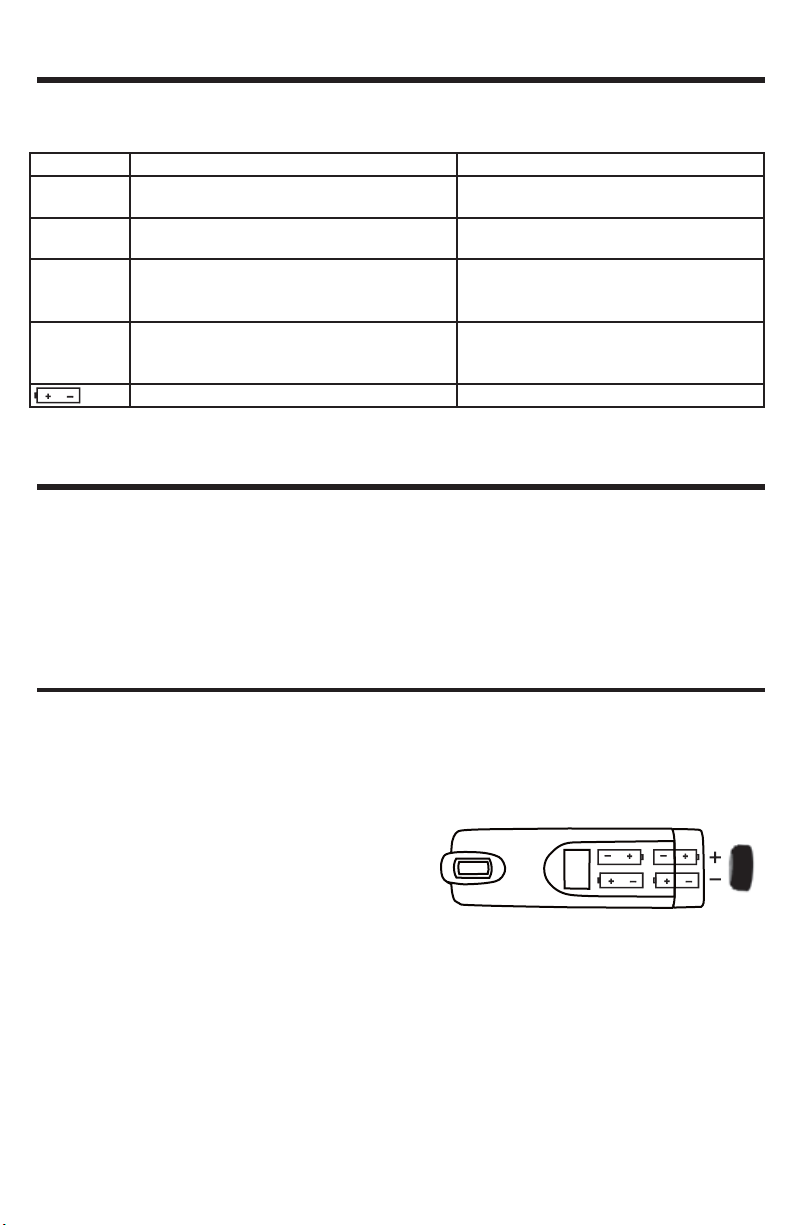
To Install/Replace “AAA” Batteries:
1. Unscrew the O-ring sealed battery cover counter-clockwise. Use proper sized pliers if
necessary. Do not disturb the sealing O-ring. Batteries are not included.
2. Remove the used batteries and install 4 new AAA batteries following the diagram for
correct polarity (see diagram). We recommend high quality AAA alkaline batteries be used.
4. Replace the battery cover. Be sure to tighten the cover securely. This is necessary for meter
to be waterproof.
5. Dispose of the used batteries in accordance with
your local regulations.
6. Press ZERO/ON button to confirm the meter
turns on. The meter is now ready for operation.
7. Meter will not work if battery orientation is incorrect.
11
TOP VIEW
Page 12

Lead Recovery in Various Water Samples:
Our laboratory has performed numerous Spiked Recovery tests using water samples from
around the world. The water samples were obtained in the locations as identified below. The
water was collected in clean plastic bottles and shipped to our lab. The samples were not preserved by acid and not refrigerated.
Each sample was spiked in duplicate at two different spiked concentrations (20µg/L and 50µg/L)
giving a total of four spiked tests. Except for two water samples the % recovery of spiked water
samples had an acceptable average for the four spiked water tests (within +/- 10%). The Highland,
NC well water averaged a 74% Recovery and the Seattle, WA municipal water averaged 83.5%
Recovery.
Water sample lead (Pb
as 0, except for Rock Hill, SC water (exposed to lead).
Water Spiked Spiked
Water Sample 20ppb % 50ppb %
Water Origin Type µg/L ppb (ug/L) Recovery ppb (ug/L) Recovery
Vienna, Austria M 0 21 105 52 104
repeated 0 19 95 51 102
Munich, Germany M 0 21 105 54 108
repeated 0 19 95 46 92
Kusnacht, Switzerland M 0 20 100 51 102
repeated 0 19 95 54 108
Paris, France M 0 19 95 50 100
repeated 0 20 100 45 90
Washington, DC M 0 23 119 52 104
repeated 0 20 100 49 98
Philadelphia, PA M 0 17 85 45 90
repeated 0 23 119 43 86
Phoenix, AZ M 0 20 100 47 94
repeated 0 21 105 47 94
Edgewater, MD W 0 22 110 50 100
repeated 0 16 80 46 92
Highland, NC W 0 15 75 36 72
repeated 0 15 75 37 74
Rockwell, NC W 0 22 110 51 102
repeated 0 23 119 50 100
Las Vegas, NV M 0 19 95 52 104
repeated 0 17 85 49 98
Chicago, IL M 0 21 105 51 102
repeated 0 16 80 52 104
Rock Hill, SC W 0 18 90 47 94
repeated 0 17 85 46 92
Melbourne, Australia M 0 20 100 47 94
repeated 0 19 95 45 90
Rock Hill, SC
(exposed to lead) M 5 25 100 56 102
repeated 5 26 104 52 95
Weaverville, NC M 0 16 80 52 104
repeated 0 20 100 46 92
Anaheim, CA M 0 19 95 53 106
repeated 0 21 105 47 94
Seattle, WA M 0 16 80 45 90
repeated 0 16 80 42 84
Kilowna, BC, Canada M 0 19 95 51 102
repeated 0 21 105 53 106
*M = Municipal, W = Well
+2
) concentrations found for all samples were below 3ppb, and reported
12
Page 13

Summary of HHWT-14 Chemistry for Lead (Pb+2) Detection:
+2
Lead in the water sample is first solubilized to Pb
reagent. Pb-2 Buffer is then added to make the solution alkali. The Strip Pb-3 is
dipped for 20 seconds with gentle motion, which adds the porphyrin indicator, and
mixes the solution. After a one minute wait, which allows for the porphyrin and Pb+2
to form a colorimetric complex, the HHWT-14 Colorimeter automatically zeros. The
Strip Pb-4 is dipped into the cell sample for twenty seconds with gentle motion. This
motion releases EDTA into the sample which then breaks up the colorimetric
porphyrin-Pb2+ complex. After a one minute wait, the result is displayed in µg (µg/L)
as Lead. The Mercury test uses a similar chemistry. Cadmium uses Hydrochloric
Acid for solubilization of the Cadmium ion, and this test requires more indicator
reagent.
A procedure using the porphyrin 5,10,15,20-terakis(1-methylpyridinium-4-yl)porphine as indicator is described in Mirochim Acta volume 157, page 87-91 published
in 2007 K. Kawamura, et al. For convenience the indicator is referred to as TMPYP.
Our modified test procedure is patented. In combination with the Strip reagent
delivery device, and by not removing the cell from the meter between the zeroing and
reading steps; HHWT-14 delivers optimum accuracy and sensitivity. Please refer to
the Lead Test Interference chart (Table 1) for details as to the highest concentration
of ions the test can tolerate. From our lab and contract lab studies with HHWT-14
we find that over 90% of the typical potable, municipally treated water samples
experience no interference. Before you start using the HHWT-14 with potable water
samples in your area use the “Standard Additions” method to determine if there are
any interferences in your water that may require consideration.
Interfering ions listed, except for Mercury and Cadmium, inhibit the TMPYP-Pb+2
complex formation above the concentrations given. Mercury and Cadmium give
similar color reaction with TMPYP. Mercury is rarely found in tap water above 0.005
mg/L. A procedure modification is not yet available to remove Mercury interference.
Typical Cadmium levels in tap water will not interfere in the Lead and Mercury
procedures using Nitric Acid. Hardness ions such as Calcium and Magnesium are
tolerated as noted in Table 1. When the water sample has Total Hardness minerals
above 400 mg/L, the Pb-4 addition of EDTA may be inadaquate; and the TMPYP-Pb+2
complex may not be completely destroyed and the lead reading will be low. If you
suspect this, do a Spiked Recovery Test (page 8).
by the addition of the Nitric Acid
It is recommended that for best results this test be done on unpreserved, freshly
drawn water samples. Water samples that have been preserved with strong Nitric
Acid for lead testing will require alkali neutralization of excess acid to a pH of about
2.5; and the Acid-1 addition can be skipped. After the Pb-2 addition step the pH
should be verified if pH issue is a concern; and ideally should be between 9.5 and
10.0 pH.
13
Page 14
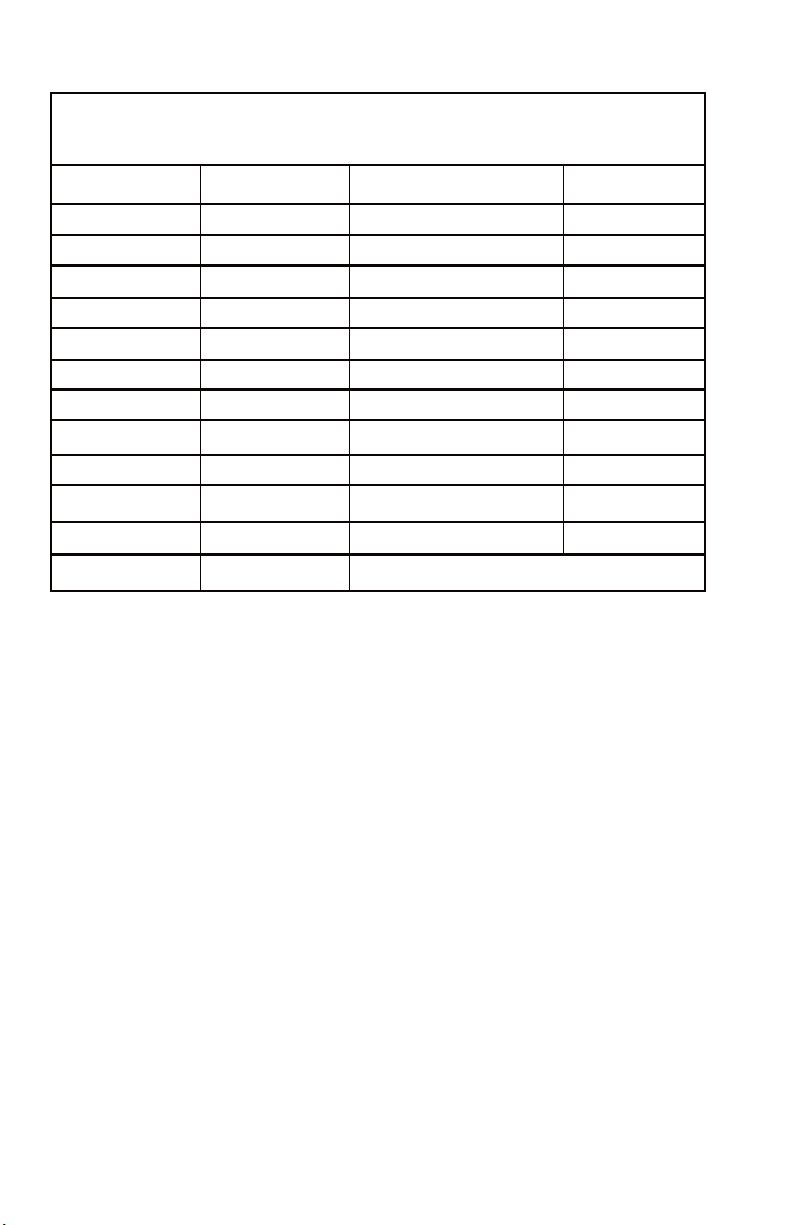
Table 1:
Lead Test (PB2 & PB6 MENU) Interferences
(Similar interferences can be expected for Mercury and Cadmium Tests.)
Ion
Aluminum, Al
Barium, Ba
2+
Bromide, Br
Cadmium, Cd
Calcium, Ca
Chloride, Cl
-
Chromium, Cr
Cobalt, Co
Copper, Cu
Fluoride, F
Iron, Fe
2+
2+
-
2+
3+
Interference
Level
3+
2 mg/L Magnesium, Mg
3 mg/L Manganese, Mn
-
2+
20 mg/L
2+
0.07 mg/L Nickel, Ni
Mercury, Hg
500 mg/L Nitrogen, Ammonium, NH
150 mg/L Nitrogen, Nitrate, NO
3+
0.1 mg/L
1 mg/L
Nitrogen, Nitrite, NO
Phosphate, PO
5 mg/L Sulfate, SO
40 mg/L
0.2 mg/L
Tin, Sn
Zinc, Zn
Ion
2+
2+
2+
2+
-
3
-
2
3-
4
2-
4
2+
2+
0.1 mg/L
+
4
Interference
Level
200 mg/L
0.5 mg/L
0.01 mg/L
1 mg/L
40 mg/L
20 mg/L
300mg/L
100 mg/L
200 mg/L
0.2 mg/L
2 mg/LIron, Fe
Rev. 07/03/07
About your Water Sample:
If the water sample you are testing has a pH of 6.5 to 8.5, then the HHWT-14 Reagent
System will give valid results. If your water sample is below pH 6.5 or above pH 8.5, or
has a Total Alkalinity above 200 PPM; then the pH of the water needs to be adjusted to
between pH 7 and 8 before testing begins. Use 1.0N HCl or 1.0N NaOH to adjust the
pH of your water sample. Iron above 0.1 ppm can be present in well water samples. It
is recommended that the absence of iron be confirmed by the Iron Check Test (HHWT-
480025). If your results are different from what you expect, then after the test is
completed, check the pH of the reacted sample. The chemistry, to work properly, should
have a final pH of 9.5 to 10.0. If your pH is below 9.5, then add six drops of PB-2 in
step 5. If pH is above 10.0, then add four drops of PB-2 in step 5.
Specifications:
The test detects from 0 to 500 µg/L or ppb levels of Lead as Pb2+. The most accurate test
range will be 3 to 200 µg/L. For this range, the Test resolution is 1 ppb, minimum detection
is 3 µg/L, and accuracy is +/-3 µg/L or +/-6% (whichever is higher), when used with an
HHWT-14 Photometer. If lead level is above 500 µg/L (ppb), dilute sample with lead-free
water before retesting.
The MCL (Maximum Contaminant Levels allowed) for drinking water as set by the USEPA for
Pb2+ is 15 µg/L (WHO is 10 µg/L); Mercury (Hg+2) is 2 µg/L; and Cadmium (Cd+2) is 5µg/L.
14
Page 15

MSDS 1
Material Safety Data Sheet
Section 1 Chemical Identification
Catalog # / Description: Part Number HHWT-486999B
Name: Reagent PB-Acid (17mL)
Section 2 Composition / Information on Ingredients
CAS #:7697-37-2 Nitric Acid 18%
CAS#: 7732-18-5 Demineralized Water 82%
Caution: CORROSIVE ingredient
Section 3 Hazards Identification
Clear colorless liquid causes BURNS:
Eye contact: Causes eye burn
Skin Contact : Causes burn
Ingestion: Can cause acid burn including nausea, abdominal pain. Wear
safety glasses with top and side shields and latex gloves when handling.
Irritating to nose and throat. Avoid inhalation. Remove and wash
contaminated clothing before reuse.
Section 4 First-Aid Measures
• If swallowed, give 1-2 glasses of water. Call a physician or the
Poison Control Center as a precaution.
least 2 minutes. Remove contaminated clothing and shoes.
at least 15 minutes. Call physician.
seek medical advice.
Section 5 Fire Fighting Measures
Not Flammable, but reacts with many metals forming hydrogen gas,
appropriate for surrounding fire conditions.
Section 6 Exposure Controls / Personal Protection
Have an eyewash station nearby. Do not expose to eyes, skin, or clothing. Keep away from children and pets. Wash hands thoroughly after
handling. Maintain general hygienic practices when using this product.
Section 7 Physical and Chemical Properties
Appearance and Odor:
• Clear, colorless liquid with no odor
Physical Properties:
• Melting Point: Not Applicable
• Vapor Pressure: Not Applicable
• Vapor Density: Not Available
• pH: < 0.6
• Stable when stored at room temperature.
Hazardous Polymerization:
• Will not occur.
Section 8 Toxicological Information
• Ingredient toxicological data:
• Nitric acid oral Human LDLo=430mg/kg
• Each bottle contains about 17mL liquid
Wash hands after use and avoid skin, eye contact.
• This product may be shipped as part of a chemical test kit composed
of various compatible components because of it’s small volume.
Section 9 Other Information
The above information is believed to be correct but does not purport
to be all-inclusive and shall be used ONLY as a guide. Keep away from
children and pets.
about 1.2
MSDS 2
Material Safety Data Sheet
Section 1 Chemical Identification
Catalog # / Description: Part Number HHWT-488375B
Name: Reagent Pb-2 (15mL)
Section 2 Composition / Information on Ingredients
CAS#: 115-69-5 2-Amino-2-Methyl-1,3-Propanediol (AMP) 7%
CAS# 77-86-1 Tris(hydroxymethyl)-aminomethane (TRIS) 15%
CAS# 7732-18-5 Demineralized water 78%
Section 3 Hazards Identification
• Physical Appearance: Clear, colorless liquid
• Immediate Concerns: DANGER. Alkali pH of around 10.8. Causes
skin and eye burns. Wear safety glasses with top and side shields
and latex gloves when handling. Irritating to nose and throat. Avoid
inhalation. Remove and wash contaminated clothing before reuse.
Section 4 First-Aid Measures
for 15 minutes. Call Physician.
with soap and plenty of water. If skin irritation develops, seek medical
attention.
INGESTION: If swallowed: Give 1-2 glasses of water. Do not induce
vomiting. Never give anything by mouth to an unconscious person. Call
a physician immediately.
Section 5 Fire Fighting Measures
conditions
Section 6 Exposure Controls / Personal Protection
Do not expose to eyes, skin, or clothing. Keep away from children and
pets. Wash hands thoroughly after handling. Maintain general hygienic
practices when using this product.
Section 7 Physical and Chemical Properties
Appearance and Odor:
• Clear liquid.
• Odorless
Physical Properties:
• Melting Point: Not Applicable
• Vapor Pressure: Not Volatile
• Vapor Density: Not determined
Stability:
• Stable when stored under proper conditions.
Hazardous Polymerization:
• Will not occur.
Incompatibilities:
• Incompatible with strong acids.
Section 8 Toxicological Information
Acute Effects of ingredients:
• TRIS Oral LD50: 5,900 mg/kg (rat)
• AMP Oral LD50: 17,000 mg/kg (rats)
Section 9 Other Information
The above information is believed to be correct but does not purport
to be all-inclusive and shall be used ONLY as a guide. Keep away from
children and pets.
about 1.4
15
Page 16

MSDS 3
Material Safety Data Sheet
Section 1 Chemical Identification
Catalog # / Description: Part Number HHWT-486997
Name: Strip Pb-3 (50)
Section 2 Composition / Information on Ingredients
CAS #: 36951-72-1
Chemical: meso-Tetra(N-methyl-4-pyridyl)prophine
tetratosylate salt
Trade name: TMPYP
• Purple powder, Brown appearance on strip pad
Section 3 Hazards Identification
Precautionary Statements:
May be harmful by inhalation, ingestion and skin absorption. Causes eye
and skin irritation.
Section 4 First-Aid Measures
physician.
seek medical advice.
• In case of contact, immediately wash skin with soap and water
thoroughly.
Section 5 Fire Fighting Measures
Fire/Explosion Hazard:
• Fire may produce irritating or poisonous gases in small quantity
Extinguishing Media:
• Foam and water, Carbon Dioxide or dry chemical.
Section 6 Exposure Controls / Personal Protection
Do not get in eyes, on skin, on clothing. Keep away from children and
pets. Wash hands thoroughly after handling. Maintain general hygienic
practices when using this product.
Section 7 Physical and Chemical Properties
Appearance and Odor:
• Solid bluish-gray powder
Physical Properties:
• Melting Point: >400°C
• Vapor Pressure: Not Applicable
• Vapor Density: Not Applicable
Stability
• Stable when stored dried and at room temperature.
Hazardous Polymerization:
• Will not occur.
Section 8 Toxicological Information
• Skin and eye irritation.
• LD50: None reported
Section 9 Other Information
The above information is believed to be correct but does not purport
to be all-inclusive and shall be used ONLY as a guide. Dispose of empty
bottle and used test strip as normal trash. Keep away from children
and pets. Store in a dry, cool place. Keep container tightly closed.
1.98
:
MSDS 4
Material Safety Data Sheet
Section 1 Chemical Identification
Catalog # / Description: Part Number HHWT-486995
Name: Strip Pb-4 (50)
Section 2 Composition / Information on Ingredients
CAS#: 64-02-8
Chemical: EDTA Tetrasodium salt
impregnated on strip pad
pH adjusted to 10.5
Section 3 Hazards Identification
Precautionary Statements:
• May be irritating to eyes and nasal passages.
• Low toxicity orally due to small amount in test pad
• LD50: None reported.
Section 4 First-Aid Measures
• If swallowed, give large quantities of water and call a physician or the
Poison Control Center as a precaution.
at least 15 minutes. Call physician.
Section 5 Fire Fighting Measures
Not Applicable since the amount of Reagent in pad and kit is negligible.
Section 6 Exposure Controls / Personal Protection
Do not expose to eyes, skin, or clothing. Keep away from children and
pets. Wash hands thoroughly after handling. Maintain general hygienic
practices when using this product.
Section 7 Physical and Chemical Properties
Appearance and Odor:
• White powder. Soluble in water.
Physical Properties:
• Melting Point: >300°C
• Vapor Pressure: Not Applicable
• Vapor Density: Not Applicable
Stability
• Stable when stored under proper conditions.
Hazardous Polymerization:
• Will not occur.
Incompatibilities:
• None reported.
Section 8 Toxicological Information:
• LD50: None reported
Section 9 Other Information
The above information is believed to be correct but does not purport to
be all-inclusive and shall be used ONLY as a guide. Keep away from children and pets. Store in a dry, cool place. Keep container tightly closed.
Not Applicable
:
16
Page 17
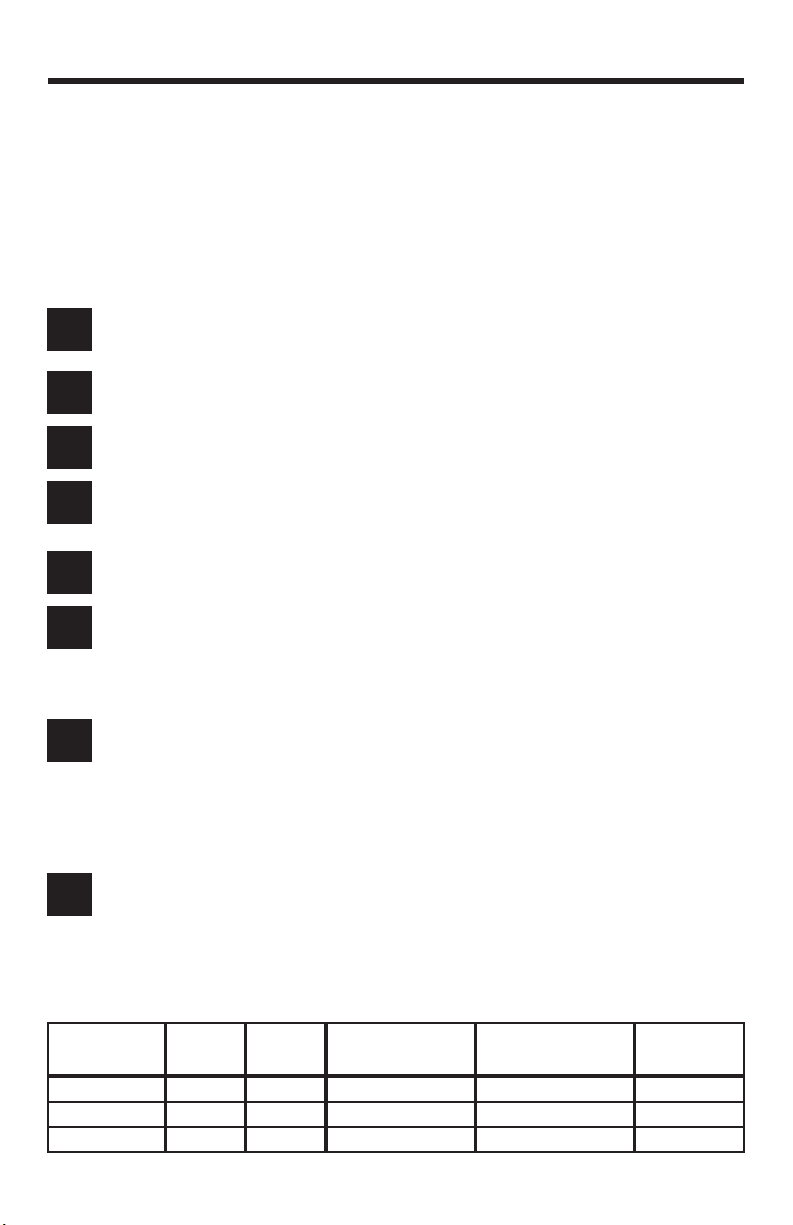
HHWT-14 Method for Lead in Soil:
Uses Reagent Set HHWT-486902.
Extraction Method
Add one level scoop (0.1mL volume scoop, which holds approximately 0.14
grams) of soil sample to a clean 50mL, graduated, plastic conical tube. Add
Twenty (20) drops of Pb-1P HHWT-487925-P15 to the conical tube. Swirl the
mixture for a few seconds or until all soil is suspended and mixed well. After five
minutes, bring the volume of the sample to 50mL using deionized, distilled, or
lead free tap water. Cap and mix this solution. This solution is now identified as
the Soil Extraction Solution (SES). Wait one (1) minute, or more, for suspended
solids to settle, then perform the test as follows:
Add 1.0mL (1000 µl) of SES sample to a clean 50mL conical tube. Do not add Pb-1P
1
HHWT-487925-P15 to the conical tube. Adjust the volume of the cell to 50mL using lead free
tap water. Mix sample. Test Sample is ready for testing.
Press the ZERO/ON button to power the meter on; the display will show all annunciators,
2
then the current MENU selection, followed by the last reading.
Press and re-press the MENU button until the display shows the parameter PB2.
(Pb-1P, 0.1mL scoop, and 50mL Plastic Conical tube are not supplied, but required to perform this test)
3
Rinse the CELL at least 3 times with the Test Sample above. Finally, fill cell to capacity (4mL)
4
with the Test Sample. Tilt meter forward to allow excess sample to flow out in order to make
room for Pb-2 Reagent addition below.
Add five (5) drops of Reagent Pb-2 HHWT-488375B.
5
Dip the Pb-3 HHWT-486997 strip into the CELL and immediately press READ. This starts the
6
20 SECOND countdown timer. During this time move the strip in a gentle back and forth
motion. Remove and discard the strip after “1” on the display disappears. The display will
flash (- - -) and begin immediately counting up from 1 to 60. After the 60 seconds, the
meter automatically zeros. The cursor will move across the display followed by 0 µg (µg/L).
Dip the Pb-4 HHWT-486995 strip into the CELL and immediately press READ. This starts the
7
20 SECOND countdown timer. During this time move the strip in a gentle back and forth
motion. Remove and discard the strip after “1” on the display disappears. The display will
flash (- - -) and begin immediately counting up from 1 to 60. After the 60 seconds, the
cursor will move across the display, informing you that it is about to measure the sample as
µg (µg/L). Record result displayed (this result is automatically stored in PB2). After testing
is complete discard sample and rinse cell immediately.
To convert the value in step 7 from µg/L to mg/kg use 17.86 as the multiplication factor:
8
(For example: 65 µg/L
NOTE: If no Lead is found when 1.0mL SES sample is used in Step 1, then try 2mL of the
SES for lower detection. If the result reads “HI”, then the SES sample should be retested
using a 0.01mL sample in Step 1. Pb-1P and Pb-2 drops required for these
SES volume variations are listed in the chart below.
× 17.86 = 1161 mg/kg)
SES
Volume
0.01mL
1mL
2mL
Pb-1P
Drops
0
0
0
Pb-2
Drops
5
5
5
Multiplication
Factor
1786
17.86
8.93
17
Range
(mg/Kg)
up to 300,000
18 to 3000
18 to 1500
Accuracy
(%)
± 40
± 25
± 25
Page 18

HHWT-14 Accuracy
Hach® Lead Standard Solution, 10 mg/L as Pb+2 (Cat. 23748-20) was verified by Atomic Absorption
and used with the HHWT-14 Meter, PB2 MENU to confirm precision and accuracy.
®
Hach
AAS, Lead
Std, ppb
The Hach Company and all other Hach products trademarks,
service marks, trade names, logos, domain names, URLs and
icons (“Marks”) appearing on this manual, registered or not, are
the property of Hach Company Inc., Loveland, CO.
Meter 1
PB2 MENU
0
5
10
10.7
14
20
60
107
214
321
428 438
ppb
110
209
322
0
4
6
6
10
18
63
Meter 2
PB2 MENU
ppb
0
4
10
10
10
20
67
110
221
331
451
Average
PB2 MENU
ppb
0
4
8
8
10
19
65
110
215
326.5
444.5
450
Detection of Lead in Water
400
350
300
250
200
150
HHWT-14 PB2 MENU, ppb
100
50
0
0 50 100 150 200 250 300 350 400 450
y = 1.0335x - 1.7741
2
= 0.9996
R
®
Hach
Lead Standard, ppb (AAS measured)
18
Page 19

WARRANTY/DISCLAIMER
OMEGA ENGINEERING, INC. warrants this unit to be free of defects in materials and workmanship for a
period of 13 months from date of purchase. OMEGA’s WARRANTY adds an additional one (1) month
grace period to the normal one (1) year product warranty to cover handling and shipping time. This
ensures that OMEGA’s customers receive maximum coverage on each product.
If the unit malfunctions, it must be returned to the factory for evaluation. OMEGA’s Customer Service
Department will issue an Authorized Return (AR) number immediately upon phone or written request.
Upon examination by OMEGA, if the unit is found to be defective, it will be repaired or replaced at no
charge. OMEGA’s WARRAN
including but not limited to mishandling, improper interfacing, operation outside of design limits,
improper repair, or unauthorized modification. This WARRANTY is VOID if the unit shows evidence of
having been tampered with or shows evidence of having been damaged as a result of excessive corrosion;
or current, heat, moisture or vibration; improper specification; misapplication; misuse or other operating
conditions outside of OMEGA’s control. Components in which wear i
limited to contact points, fuses, and triacs.
OMEGA is pleased to offer s uggestions on the use o f its various products. H owever,
OMEGA neither assumes responsibility for any omissions or errors nor assumes liability for any
damages that result from the use of its products in accordance with information provided by
OMEGA, either verbal or written. OMEGA warrants only that the parts manufactured by the
company will be as specified and free of defects. OMEGA MAKES NO OTHER WARRANTIES OR
REPRESENTATIONS OF ANY KIND WHATSOEVER, EXPRESSED OR
TITLE, AND ALL IMPLIED WARRANTIES INCLUDING ANY WARRANTY OF MERCHANTABILITY
AND FITNESS FOR A PARTICULAR PURPOSE ARE HEREBY DISCLAIMED. LIMITATION OF
LIABILITY: The remedies of purchaser set forth herein are exclusive, and the total liability of
OMEGA with respect to this order, whether based on contract, warranty, negligence,
indemnification, strict liability or otherwise, shall not exceed the purchase price of the
component upon which liability is based. In no event shall OMEGA be liable for
conse
quential, incidental or special damages.
CONDITIONS: Equipment sold by OMEGA is
Component” under 10 CFR 21 (NRC), used in or with any nuclear installation or activity; or (2) in medical
applications or used on humans. Should any Product(s) be used in or with any nuclear installation or
activity, medical application, used on humans, or misused in any way, OMEGA assumes no responsibility
as set forth in our basic WARRANTY/DISCLAIMER language, and, additionally, purchase
OMEGA and hold OMEGA harmless from any liability or damage whatsoever arising out of the use of the
Product(s) in such a manner.
TY does not apply to defects resulting from any action of the purchaser,
s not warranted, include
IMPLIED, EXCEPT THAT OF
not intended to be used, nor shall it be used: (1) as a “Basic
but are not
r will indemnify
RETURN REQUESTS/INQUIRIES
Direct all warranty and repair requests/inquiries to the OMEGA Customer Service Department. BEFORE
RETURNING ANY PRODUCT(S) TO OMEGA, PURCHASER MUST OBTAIN AN AUTHORIZED RETURN
(AR) NUMBER FROM O M EGA’ S CUSTOMER S ERVICE D EPART MEN T ( IN ORDER TO AVOID
PROCESSING DELAYS). The assigned AR number should then be marked on the outside of the return
package and on any correspondence.
The purchaser is responsible for shipping charges, freight, insurance and proper packaging to prevent
breakage in transit.
FOR WARRANTY
following information available BEFORE
contacting OMEGA:
1. Purchase Order number under which the product
was PURCHASED,
2. Model and serial number of the product under
warranty, and
3. Repair instructions and/or specific problems
relative to the product.
OMEGA’s policy is to make running changes, not model changes, whenever an improvement is possible. This affords
our customers the latest in technology and engineering.
OMEGA is a registered trademark of OMEGA ENGINEERING, INC.
© Copyright 2012 OMEGA ENGINEERING, INC. All rights reserved. This document may not be copied, photocopied,
reproduced, translated, or reduced to any electronic medium or machine-readable form, in whole or in part, without the
prior written consent of OMEGA ENGINEERING, INC.
RETURNS, please have the
FOR NON-WARRANTY REPAIRS,
for current repair charges. Have the following
information available BEFORE contacting OMEGA:
1. Purchase Order number to cover the COST
of the repair,
2. Model and serial number of the product, and
3. Repair instructions and/or specific problems
relative to the product.
consult OMEGA
19
Page 20

Where Do I Find Everything I Need for
Process Measurement and Control?
OMEGA…Of Course!
Shop online at omega.com
TEMPERATURE
Thermocouple, RTD & Thermistor Probes, Connectors, Panels & Assemblies
Wire: Thermocouple, RTD & Thermistor
Calibrators & Ice Point References
Recorders, Controllers & Process Monitors
Infrared Pyrometers
PRESSURE, STRAIN AND FORCE
Transducers & Strain Gages
Load Cells & Pressure Gages
Displacement Transducers
Instrumentation & Accessories
FLOW/LEVEL
Rotameters, Gas Mass Flowmeters & Flow Computers
Air Velocity Indicators
Turbine/Paddlewheel Systems
Totalizers & Batch Controllers
pH/CONDUCTIVITY
pH Electrodes, Testers & Accessories
Benchtop/Laboratory Meters
Controllers, Calibrators, Simulators & Pumps
Industrial pH & Conductivity Equipment
SM
DATA ACQUISITION
Data Acquisition & Engineering Software
Communications-Based Acquisition Systems
Plug-in Cards for Apple, IBM & Compatibles
Data Logging Systems
Recorders, Printers & Plotters
HEATERS
Heating Cable
Cartridge & Strip Heaters
Immersion & Band Heaters
Flexible Heaters
Laboratory Heaters
ENVIRONMENTAL
MONITORING AND CONTROL
Metering & Control Instrumentation
Refractometers
Pumps & Tubing
Air, Soil & Water Monitors
Industrial Water & Wastewater Treatment
pH, Conductivity & Dissolved Oxygen Instruments
20
M-5101/1212
 Loading...