

Page 1
Cartridge Heaters
Hi-Density Cartridge Heaters
*
Features
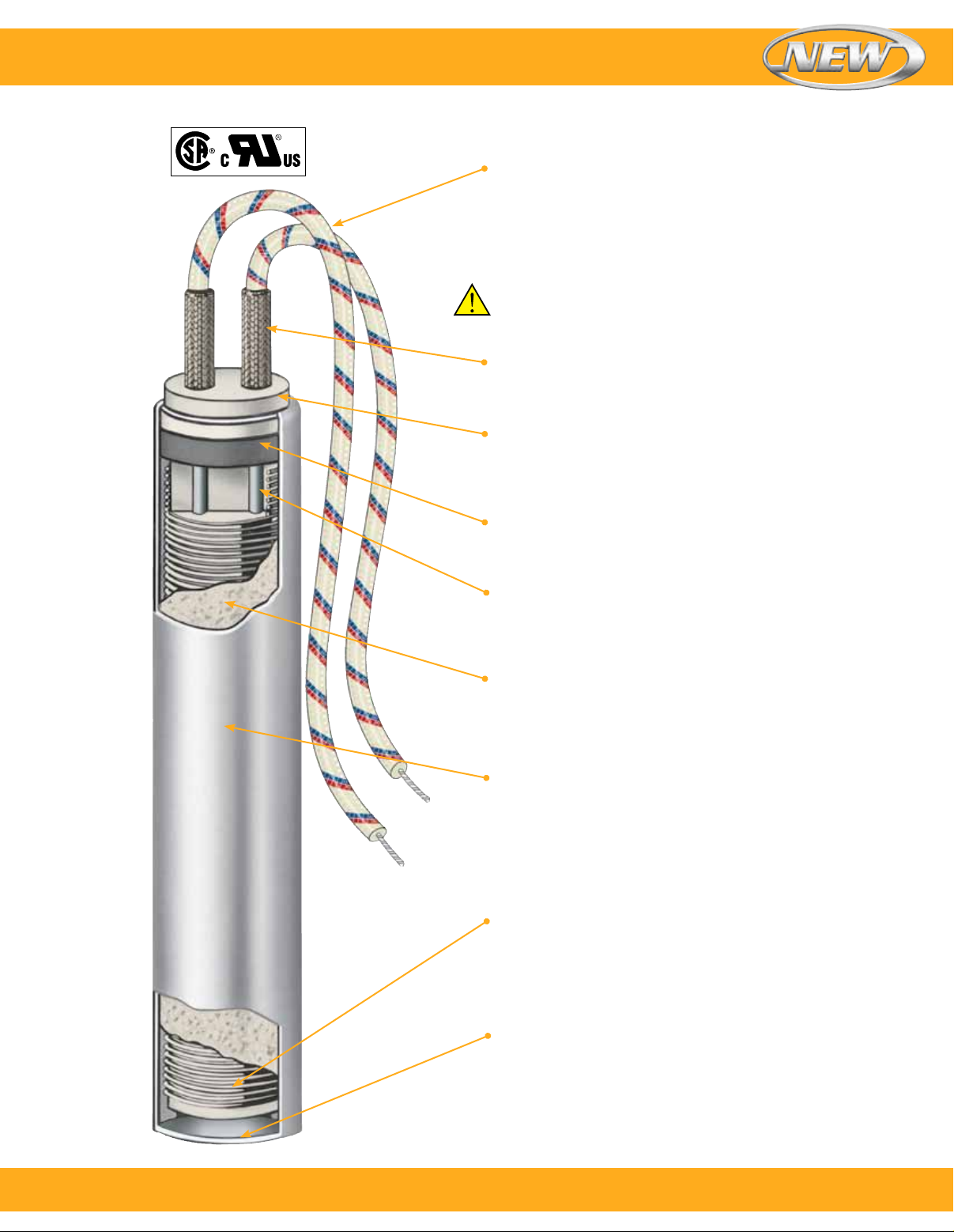
The standard termination for Hi-Density Cartridge Heaters
is Type N, 254 mm (10") long nickel conductor lead wires
externally connected to 32 mm (11⁄4") solid conductor
terminal pins. The lead wires have fiberglass insulation and
are UL approved for temperatures up to 250°C (482°F). Mica
insulated UL approved wires for temperatures up to 450°C
(842°F) are optional.
Note: To meet the requirements of your application we offer
over 40 standard termination styles to select from that will
solve many of the most common application problems.
High temperature fiberglass sleeve provides maximum
electrical insulation to the crimp connector used to splice the
nickel conductors to the flexible leads.
Ceramic end cap prevents nickel conductors from shorting
out against sheath when sharp bending of the leads is
required. The ceramic cap may be eliminated in some cases
to optimize the heater watt density.
Ceramic end cap and swaged-in lava plug protect the
internal cartridge from outer contamination. Other types of
seals can also be provided.
Solid conductor terminal pins are used to ensure a good
electrical connection between the nickel conductor lead
wires and the resistance wire. They are sized for the
maximum current rating of the heater.
Specially selected grain size high purity Magnesium Oxide
(MgO) is used to fill all remaining space inside the sheath.
Heater is then swaged, which compacts the magnesium
oxide grains into a solid mass, thereby increasing thermal
conductivity and dielectric strength.
Standard sheath material is 321 Stainless Steel. It provides
high temperature strength up to 650°C (1200°F), good
thermal conductivity, and resistance to corrosion and
scaling. Alloy 321 is a Nickel-Chromium Stainless Steel
modified with the addition of Titanium. For higher operating
temperatures up to 760°C (1400°F) or corrosive immersion
heating applications, Incoloy® 800 is available. Consult
OMEGA for other sheath materials.
Grade “A” Nickel-Chrome resistance wire precisely wound
on a high purity magnesium oxide core places the resistance
wire as close to the inside of the sheath as possible while
maintaining dielectric strength. This provides excellent heat
transfer and long heater life with the highest possible watt
densities.
Welded end disc made from the same material as the
sheath provides a positive seal against moisture and other
contaminants.
Hi-Density Cartridge Heaters are UL recognized and CSA certified in many
*
design variations under UL File Number E65652 and CSA File Number 043099.
If you require UL and/or CSA Agency Approval, please specify when ordering.
To order, call 1-800-826-6342 or shop online at omega.com
SM
1
Page 2
Cartridge Heaters
OMEGA Offers the Most Comprehensive and Diverse Selection
in Hi-Density Cartridge Heaters
Typical Applications
l Plastic Extruders
l Hot Runner Molds
l Hot Stamping
l Medical Equipment
l Packaging Equipment
l Molds
l Aerospace
l Sealing Bags
l Semi-Conductor
l Plastic Molding
l Shoe Machinery
l Food Processing
l Heating Gases and Liquids
l Glue Guns
l Laminating Presses
l Platens
l Scientific Equipment
l Food Service Equipment
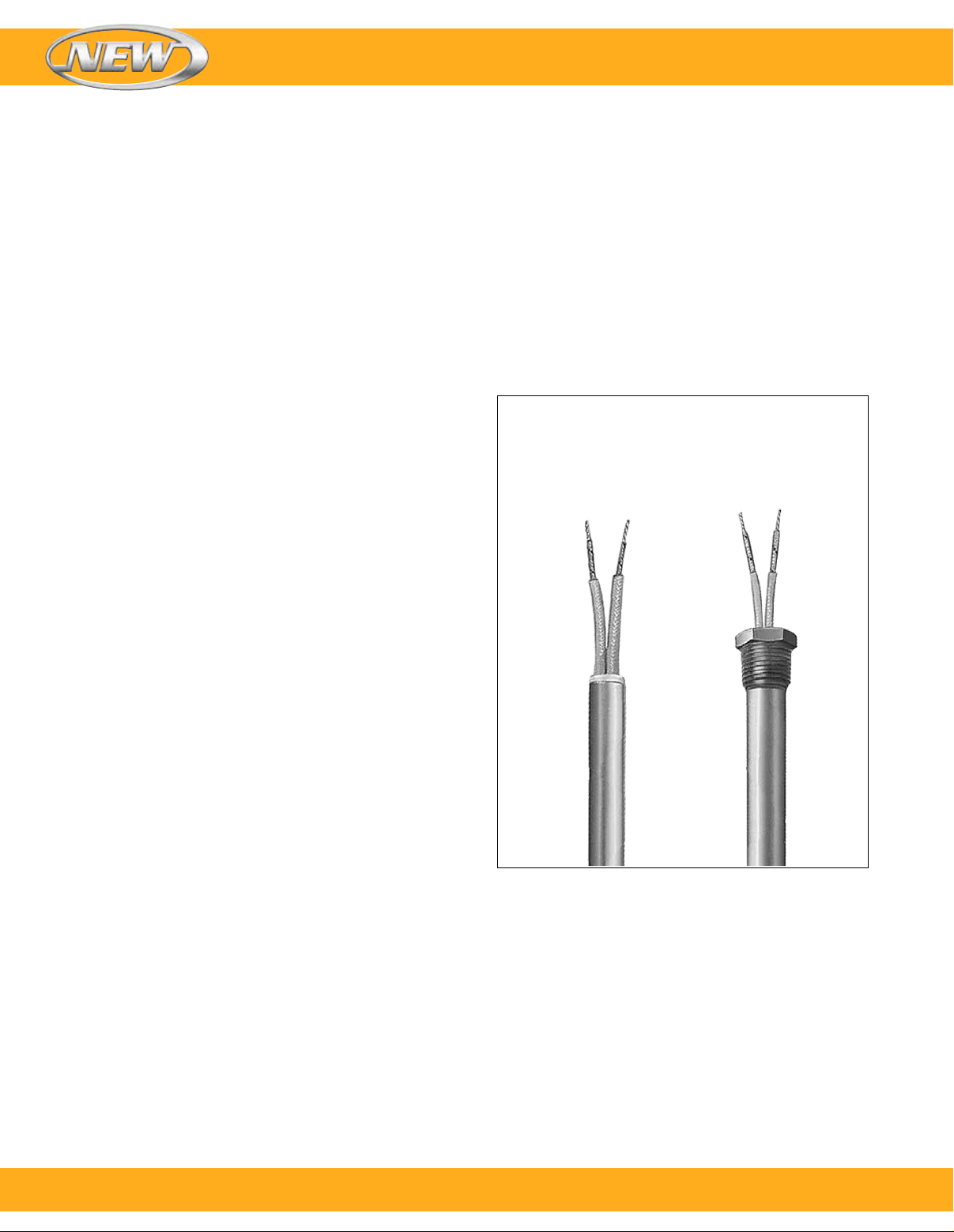
Hi-Density Cartridge Heaters Have Evolved and
Today Offer a Multitude of Diverse Product Options:
1. (HDC) A hi-density cartridge heater in US sizes.
2. (HDL) A hi-density cartridge heater designed with NPT
Fittings for Immersion heating.
Hi-Density Cartridge Heaters Provide Maximum
Processing Temperature Capability
l Higher watt densities permit smaller heaters to be used
without sacrificing life expectancy. This results in up-front as
well as long-term cost savings.
l Swaged construction provides maximum support for the
resistance wire and excellent heat transfer characteristics,
improving the overall life expectancy of the cartridge heater.
l Termination styles and special features allow customization
to any application.
l Applications up to 760°C (1400°F)
Hi-Density Cartridge Heaters are
Classified in Two Distinct Categories
Multi-Purpose Use
The multi-purpose use cartridge heaters represent OMEGA’s
commitment to value-added customer service as we maintain
in stock over 65,000 semi-finished hi-density cartridge heater
substrates, offering a combination of over 1000 sizes in
industry standard diameters and lengths ranging from 25.4 mm
(1") to 914.4 mm (36") in a complete spectrum of wattages and
operating voltages. Multi-purpose use cartridge heaters are the
solution for a multitude of original equipment manufacturers
(OEMs) or maintenance (MRO) applications.
Available through the terminator program. Complete details are
found on page 8.
➁
➀
Highly Engineered Specific Purpose Use
OMEGA has been at the forefront of addressing the
challenges of Original Equipment Manufacturers (OEMs)
in a broad segment of diversified industries. As a company
we are uniquely qualified and committed to providing valueadded expertise in engineering and manufacturing capabilities
assisting customers in developing highly engineered
specific use cartridge heaters for dependable and reliable
performance. Let us provide the optimal solution to your
thermal loop system and cartridge heater design challenges.
Consult us with Your Requirements
We Welcome Your Inquiries
2
To order, call 1-800-826-6342 or shop online at omega.com
SM
Page 3
Cartridge Heaters
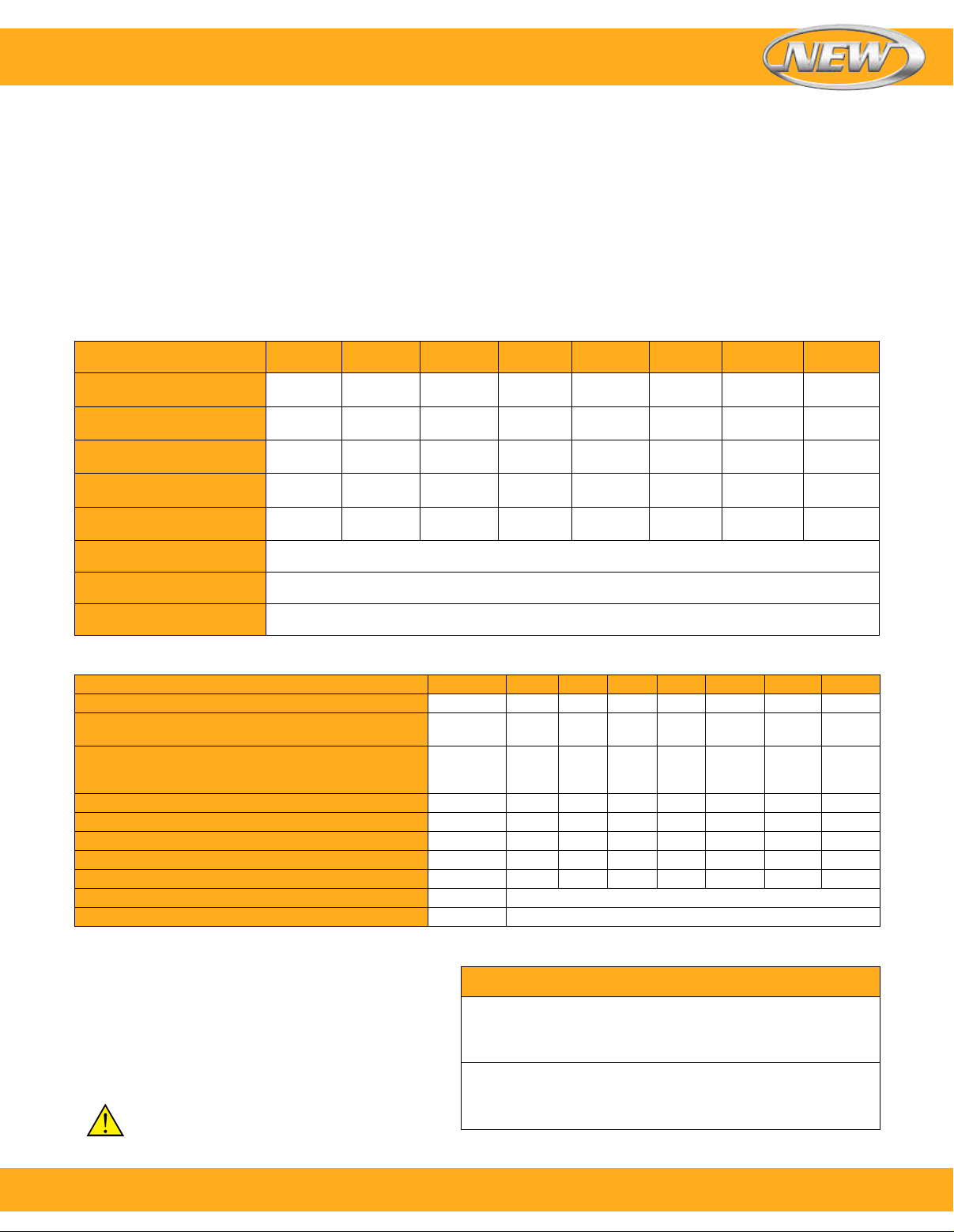
Hi-Density Cartridge Heater Specifications
Standard Specifications
Performance Ratings
Maximum Temperature: 760°C (1400°F)
Maximum Watt Density: 15.5 to 46.5 watt/cm
(100 to 300 Watt/in2) depending on heater size and
operating temperature
Note: The maximum operating temperature and the life expectancy of a
cartridge heater is dependent on two main factors:
1. The maximum recommended sheath temperature [648°C (1200°F) for a
standard heater]
2. The maximum ambient temperature for the termination selected.
Consult OMEGA if you require a recommendation for your application.
2
Length Tolerance for Lead Wires,
Wire Braid Leads, and Armor Cable Leads:
1
Up to 914 mm (36"): -12.7, 25.4 mm (-
⁄2, 1")
914 to 1829 mm (36 to 72"):
25.4, 50.8 mm (-1, 2")
Above 72": 101.6 mm (±4")
Dimensional Specifications
1
Nominal Diameter
Actual Diameter
Diameter Tolerance
Minimum Length
Maximum Length
Length Tolerance Heaters
up to 127 mm (5") long
⁄8"
mm (inch)
3.10
(0.122)
0.051
(±0.002)
31.8
(1.25)
305
(12)
2.4
(±3/32)
Length Tolerance Heaters
over 127 mm (5") long
Camber Tolerance Heaters
to 305 mm (12") long
Camber Tolerance Heaters
over 305 mm (12") long
A certain amount of camber is unavoidable. With a slight force, hi-density cartridge heaters will flex enough to fit into a straight reamed hole.
1
⁄4"
mm (inch)
6.25
(0.246)
0.051
(±0.002)
25.40
(1)
914
(36)
2.4
(±3/32)
5
⁄16"
mm (inch)
7.82
(0.308)
0.051
(±0.002)
25.40
(1)
914
(36)
2.4
(±3/32)
3
⁄8"
mm (inch)
9.42
(0.371)
0.051
(±0.002)
25.40
(1)
1219
(48)
2.4
(±3/32)
1
⁄2"
mm (inch)
12.60
(0.496)
0.051
(±0.002)
25.40
(1)
1219
(48)
2.4
(±3/32)
±2% of sheath length
0.254 mm (0.010") per foot of length
0.508 mm (0.020") per foot of length
5
⁄8"
mm (inch)
15.77
(0.621)
0.051
(±0.002)
25.40
(1)
1829
(72)
2.4
(±3/32)
mm (inch)
(0.746)
(±0.003)
Electrical Specifications
Nominal Diameter
Maximum Voltage
Maximum Amperage
1
⁄8"
240 240 240 240 240 480* 480* 480*
3.0 4.4 4.5 6.7 10.5 23 23 23
(see next line for exceptions)
†Maximum Amperage for Types C1C, C1D, C2C,
C2D, CS, F, M3, R1B, S1, S2, SA, W and
— 3.0 3.0 5.5 7.6 9.7 9.7 9.7
W3 Terminations
Minimum Wattage at 120V on a 1" long Heater
Minimum Wattage at 120V on a 2" long Heater
Maximum Wattage at 120V
Maximum Wattage at 240V
Maximum Wattage at 480V
Wattage Tolerance
Resistance Tolerance
† Current carrying capacities are for ambient temperatures up to 250°C (482°F) with mica insulated lead wires.
*480V when applicable. Consult OMEGA.
Temperature Coefficient of Resistance
The electrical resistance (ohms) of the heater resistance
— 50 45 45 50 50 — —
5 20 20 20 20 20 20 20
360 525 540 800 1260 2760 2760 2760
720 1050 1080 1600 2520 5520 5520 5520
— — — — — 11,000 11,000 11,000
+10, -15% Plus 5%, minus 10%
+15, -10% Plus 10%, minus 5%
Available Electrical Features
Diameter
wire increases with temperature rise.
OMEGA standard hi-density cartridge heaters are
manufactured with ohms (cold ohms) 3.3% lower than
the actual calculated ohms (hot ohms) to compensate for
this increase.
Note: Specifications detailed on this page are standard.
consult OMEGA if your application requires tighter
tolerances or has other special requirements
Consult factory for maximum wattages and voltages
*Heaters may require a larger diameter transition area at lead end.
1
1
⁄8" No No No No
1
⁄4" No No No No
5
⁄16" No No No No
3
⁄8" Yes* No No Yes*
1
⁄2" Yes* Yes Yes Yes*
5
⁄8" Yes Yes Yes Yes
3
⁄4" Yes Yes Yes Yes
5
⁄4"
⁄16"
Dual
Volts 3-Phase
3
⁄8"
1
⁄2"
Dual
Circuits
5
⁄8"
Multiple Heat Zones
(maximum 3 zones)
1" Yes Yes Yes Yes
3
⁄4"
18.95
0.076
31.75
1
⁄4)
(1
1829
(72)
3.2
(±1/8)
1"
mm (inch)
23.30
(0.996)
0.076
(±0.003)
44.45
(13⁄4)
1829
(72)
3.2
(±1/8)
3
⁄4" 1"
To order, call 1-800-826-6342 or shop online at omega.com
SM
3
Page 4
Cartridge Heaters
Recommendations for Improving the Life of Hi-Density Cartridge Heaters
Hi-density cartridge heaters have been widely used in many
demanding and diverse applications since 1972. The commonly
used basic applications are platen, plastic mold and die heating,
liquid immersion and air heating.
Note: Selection of the wrong termination for a particular application is
the primary reason for all heater failures. However, failure to consider
other important criteria can also have a negative effect on the life
of the heater. To get the best performance and assure long life, it is
important to carefully evaluate the following factors.
Operating Temperature
Operating temperature of a heater is a major factor in
determining the life expectancy of a heating element. The
heater life depends on the actual temperature of the resistance
wire within the heater and not on the process operating
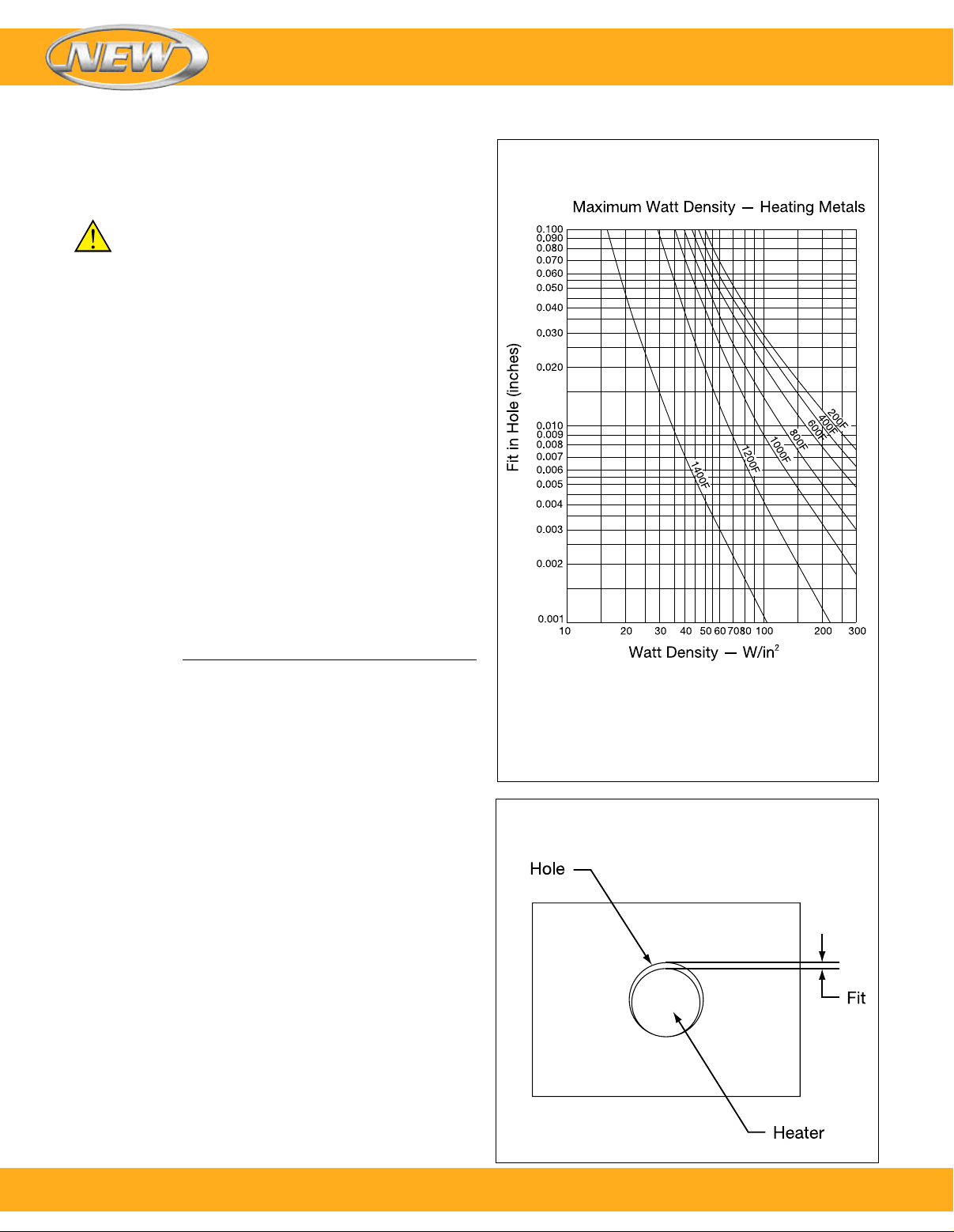
temperature. The graph in Figure 1 demonstrates the proper
relationship between operating temperature and watt density;
the higher the operating temperature, the lower the maximum
recommended watt density.
Heater Watt Density
Cartridge heater watt density is defined as the wattage
dissipated per square inch of the heated sheath surface. For a
particular application a heater’s watt density governs internal
resistance wire temperature, which determines the outer sheath
temperature. These factors are critical to the proper heating of
the application and to the life expectancy of the heater. Special
construction features that promote excellent heat transfer
permit Hi-Density Cartridge Heaters to operate at higher watt
densities while maintaining the lowest possible resistance wire
temperatures of any style cartridge heater.
Heater watt density (watts/in2) is calculated using the following
formula:
Watt Density =
Heated length × Heater diameter × 3.1416
Heater wattage
Heated length is the overall length of the heater minus any
unheated (cold) sections. Standard Type N, Hi-Density
cartridge heaters have 10 mm (3⁄8") at the lead end and 6 mm
(1⁄4") at the disc end unheated. This would mean a 152 mm (6")
long heater would have 265 mm (53⁄8") effective heated length.
Unheated sections vary with type of heater termination.
The graph in Figure 1 shows the maximum recommended
watt density for hi-density cartridge heaters when used in
a steel platen. Watt density limitations for various materials
are given in the engineering section of this catalog. For liquid
immersion heaters the maximum watt density depends on
the type of liquid being heated. The more viscous, or thicker
the liquid, the lower the maximum watt density. Higher watt
density can cause the liquid to carbonize and accumulate on
the heater sheath, which will cause premature heater failure. It
is advisable to use heaters that have watt densities below the
maximum recommended watt density to get the longest heater
life. If the actual heater watt density is close to the maximum
recommended watt density, you can correct the problem by:
1. Increasing the number, diameter and length of heaters.
2. Lowering the total wattage; however, this may increase
the heat-up time.
3. Obtaining tighter fit (see Figure 2 — Determining Fit).
A hi-density cartridge heater designed at the maximum
recommended watt density allows the smallest heater to be
used to obtain the required wattage with good service life.
All things being equal, using a lower watt density heater will
typically provide optimized service life.
Figure 1
Recommended Watt Density for Heating Metal Parts
The graph shows the recommended maximum watt density
for OMEGA Hi-Density cartridge heaters at different operating
temperatures and fit, when the heater is installed in an oxidized
mild steel block. The thermocouple is located 13 mm (1⁄2") from
the heater. When heating other materials, the data needs to be
extrapolated based on the thermal conductivity of the material.
Consult OMEGA with your requirements.
Figure 2
Determining Fit
4
To order, call 1-800-826-6342 or shop online at omega.com
SM
Page 5

Cartridge Heaters
Recommendations for Improving the Life of Hi-Density Cartridge Heaters (Continued)
Determining Fit
When heating a platen, mold, die or hot runner probe with
hi-density cartridge heaters inserted into drilled holes, fit is
an important factor in determining the life expectancy of the
heater. Fit is the difference between the minimum diameter of
the cartridge heater and the maximum diameter of the hole.
Unheated sections on a hi-density cartridge may be smaller
in diameter due to swaging. To determine fit, use the smallest
diameter on the heated length only.
Example: A 10 mm (3⁄8") nominal OD Hi-Density cartridge
heater has an actual diameter of 9 mm (0.371") ±0.002,
which translates to a minimum diameter of 9 mm (0.369").
If used in a 10 mm (0.376") ±0.002 hole, the fit would be
0.23 mm (0.009") 10 – 9 mm = 23 mm
(0.378" – 0.369" = 0.009").
When medium watt density heaters (less than 60 watts per
square inch) are used in low temperature applications [less
than 315°C (600°F)] general purpose drills are commonly
used to drill holes. The typical hole size may be 0.1 to 0.2 mm
(0.003 to 0.008") over the drill size. For higher watt density
and/or higher temperature applications, we recommend that
the holes are drilled and reamed for the tightest possible fit.
In applications where precise temperature control and heat
transfer properties are required, hi-density cartridge heaters
can be centerless ground to ±0.01 mm (±0.0005").
Although a tighter fit is desirable to efficiently transfer heat
and to get long heater life, a looser fit will aid in installing and
removing heaters, especially long heaters. We recommend
that you apply BNS anti-seize cartridge heater coating as
it will improve heat transfer and will make the removal of
heaters easier.
The graph in Figure 1 (page 4) shows the effect of fit in
determining the maximum recommended watt density on a
steel platen. As it is indicated in the graph, the tighter the fit,
the higher the maximum recommended watt density.
Temperature Control and Location
of Temperature Sensing Device
In order to better control the heater temperature and hence
the resistance wire temperature, use of an appropriate
temperature control and the proximity of the heater to the
sensor is very important. The graph in Figure 1 (page 4)
shows the effect of operating temperature in determining the
maximum recommended watt density on a steel platen where
the sensor is located 13 mm (1⁄2") from the heater. Higher watt
density heaters can generate heat faster than the surrounding
area’s ability to dissipate heat. This creates a thermal lag
between the heater and the sensor. The closer the sensor to
the heater, the better you can control the heater temperature.
By keeping the sensor further from the heater, temperature
gradients of several hundred degrees can be observed in
many applications, especially during initial start-up and heavy
thermal cycling. Although the set operating temperature may
be low, the heater may be running at a very high temperature.
This is a common cause of heater failure. This can be
minimized using time proportional and PID functions of the
temperature controllers.
Power Control
Power control methods affect the life expectancy of heating
elements. In general, although economical, on-off controls
increase thermal fatigue and oxidation rate on heating
elements by causing wide temperature swings of the internal
heating element. Silicon controlled rectifiers (scrs), mercury
relays and solid state power controls can increase the life
expectancy of heating elements by reducing the temperature
swings of the internal heating element.
Common Causes of
Cartridge Heater Failures
Contamination
Contamination is a major cause of heater failure. Moisture,
hydraulic oils, and melted plastic are the most common
contaminants that are seen on failed heaters. Since the
magnesium oxide insulation in a hi-density heater is
hygroscopic in nature, moisture is easily absorbed into the
heater and typically results in premature heater failure.
Moisture absorption during machine washdown or cleanup
also is a frequent problem. These contaminants, which are
electrically conductive, will short out the heater. Most probably,
the failures will be at the lead end of the heater and in some
cases can split or blow a hole on the heater sheath. The disc
end of a Hi-Density cartridge heater is welded shut with a
stainless steel disc.
Generally, contaminants enter the heater through the lead
end of the heater. The high temperature lead wires used on
Hi-Density heaters have fiberglass or mica insulation. Oil and
moisture can wick through the insulation on the lead wire
into the heater. OMEGA offers a wide variety of terminations
to avoid this problem, including epoxy seals, PTFE seals,
convoluted cables, welded end discs, PTFE insulated lead
wires and SJO cable . However, there are temperature
limitations on many of these terminations.
Excessive Flexing of Leads
Hi-Density heaters use flexible grade A nickel stranded
lead wires with fiberglass or mica insulation. On certain
terminations the lead wires are connected externally to solid
nickel conductor pins. In applications where there is excessive
movement or vibration, the solid pins could break due to
fatigue. A simple solution is to give enough slack on the leads
to minimize the stress on the solid pins or provide an internal
lead wire connection within the heater. OMEGA also offers
strain relief brackets and springs to prevent this problem.
Where heater leads can wear out by abrasion due to excessive
flexing of the leads, OMEGA offers several abrasion resistant
terminations.
Lack of Heat Sink
Hi-Density heaters are designed with minimum unheated (cold)
sections. If the heated sections project from the platen or
mold, these sections will get extremely hot due to lack of heat
transfer. This will lead to premature heater failure. OMEGA can
manufacture heaters with cold sections anywhere
along the length of the heater to prevent overheating of the
heater sheath.
When a hi-density heater is used as a liquid immersion heater,
make sure the heater’s sheath length is completely immersed
in the liquid. The heater lead end should not be immersed
in liquid, since most of the lead end seals are only moisture
resistant, not moisture proof.
Note: If you should encounter premature cartridge heater failure,
consult OMEGA. Our team of professionals will have the solution
to your problem.
To order, call 1-800-826-6342 or shop online at omega.com
SM
5
Page 6
Cartridge Heaters
Recommendations for Improving the Life of Hi-Density Cartridge Heaters (Continued)
High Operating Temperature
OMEGA hi-density heaters are designed to operate at
sheath temperatures up to 760°C (1400°F). When process
temperatures approach the maximum heater sheath
temperature, make sure the sheath temperature doesn’t
exceed its limitations. Location of the thermocouple and the
type of temperature and power controls are factors that affect
sheath temperature and potential overshoot conditions.
Although the heater is designed to run at temperatures up to
760°C (1400°F), heater lead wires and terminations are rated
for much lower temperatures. Care should be taken to make
sure that the heater lead end temperatures do not exceed
their limitations. Heaters can be made longer with unheated
sections at the lead end to bring the lead end out of the high
temperature area. OMEGA can also provide you with a high
temperature wiring harness, which can withstand temperatures
up to 760°C (1400°F).
Wattage Rating
Heaters with very high wattage ratings can create temperature
overshoots, uneven temperature distribution and high heater
sheath temperatures, causing premature heater failure.
For liquid immersion heaters, maximum watt density depends
on the type of liquid being heated. The heavier or thicker the
liquid, the lower the maximum watt density. Higher watt density
can cause the liquid to carbonize and accumulate on the
heater sheath, which will cause premature heater failure.
Scale and Sludge Buildup
In liquid immersion applications, periodic cleaning of the
heater sheath is necessary to remove any scale buildup on the
sheath. Scale can accumulate on the sheath and cause the
heater to overheat and fail. When used to heat liquid in a tank,
be sure to clean any sludge from the bottom of the tank. A
heater sheath covered with sludge will overheat and fail.
Note: As explained in the above paragraphs, the single major
cause for cartridge heater failure is the selection of the wrong type
of heater lead end termination for the specific application. To assist
you in selecting the right termination type, see section of detailed
descriptions of over 40 terminations designed to solve many of
the common application problems. If you need further assistance,
consult OMEGA.
Important Installation Considerations
1. For closest fit and best heat transfer, use reamed holes.
2. When possible, drill holes through the object being heated.
This will make heater removal easier.
3. When using an anti-seize coating like BNS spray or paste,
do not apply over lead wires or any other current carrying
conductors.
4. When using insulated tape or sleeving, check to make sure
it is rated for the temperature of the application. Lower
temperature rated materials can contain an adhesive
or binder that can carbonize and become electrically
conductive.
5. When using heaters near their maximum recommended
watt density, it is recommended that the temperature
sensing probes be at maximum 13 mm (1⁄2") from the
heater sheath.
6. Lead wires should not be located in the hole containing
the cartridge heater during operation. This may cause the
lead wires to be exposed to temperatures above their rated
temperature.
7. When used in a vacuum application, make sure the
lead end of the heater is outside the vacuum. If the lead
has to be in the vacuum, consult OMEGA for specific
recommendations.
8. Many applications will subject a heater’s electrical
terminations to one or more of the following potentially
damaging conditions:
•Moisture •Flexing
•Oilandother •Abrasion
contaminants •Hightemperature
Note: To protect the heater from damage in these harsh
environments, OMEGA has a wide selection of terminations and
options available.
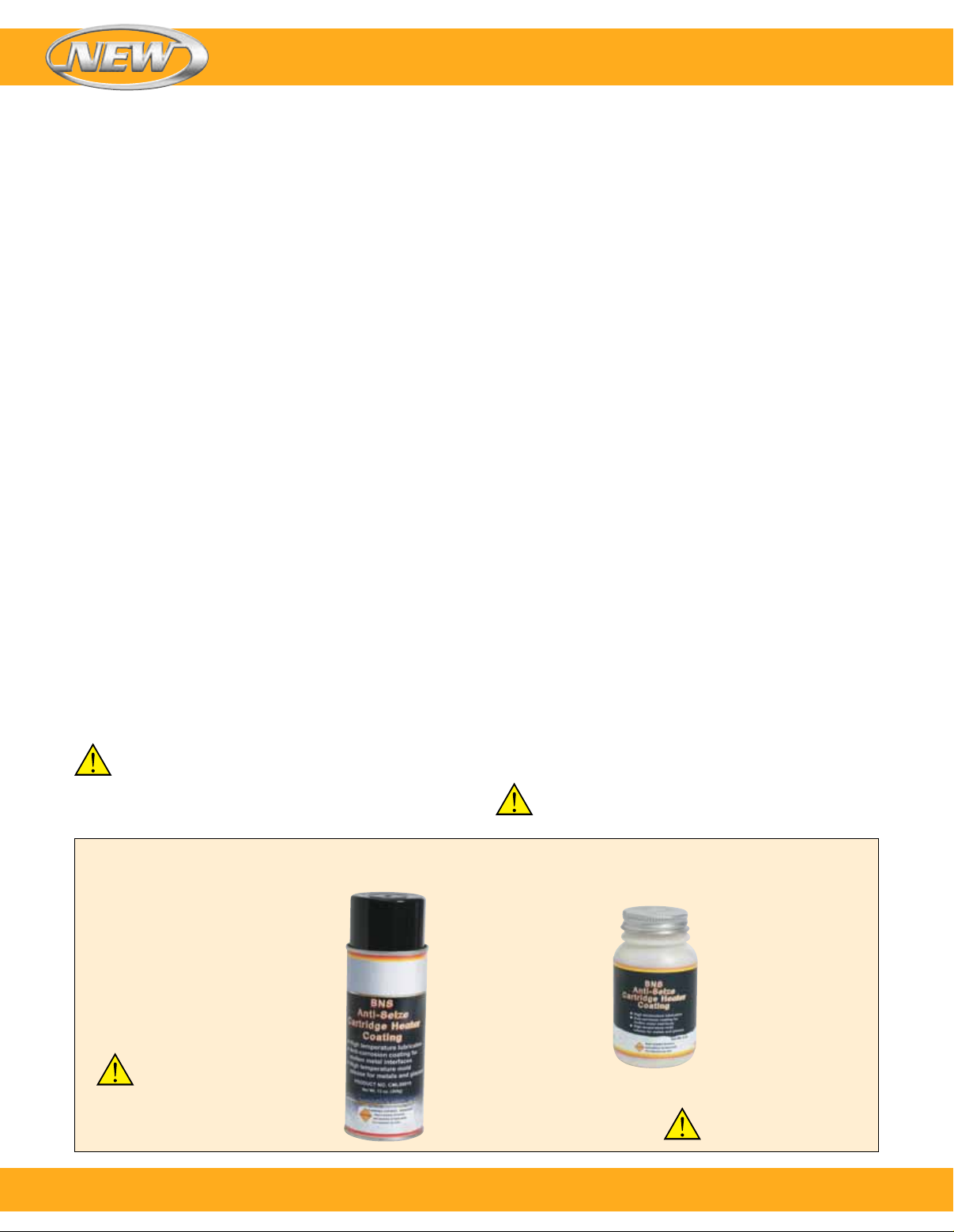
BNS Anti-Seize Cartridge Heater Coating
This high temperature, electrically
insulating and thermally conductive
coating will minimize oxidation and
improve heat transfer from heater to
the object being heated.
Brush a thin layer of paste or spray
lightly over the cartridge heater prior
to inserting the heater into a hole.
CAUTION! Do not apply over
lead wires or other bare current
carrying conductors, since the
water in the paste and spray can
cause an electrical short circuit.
6
To order, call 1-800-826-6342 or shop online at omega.com
13 oz.
Aerosol spray can
Part Number:
CML00010
l Temperature Range
1562°F (850°C)
l High Heat Transfer
4 oz. Paste with
brush applicator top
Part Number: CML00020
l Temperature Range
1562°F (850°C)
l High Heat Transfer
Note: Formulated to assist in the
removal of cartridge heaters.
SM
Page 7
Cartridge Heaters
Custom Terminated Multi-Purpose Use Cartridge Heaters from the Terminator Program
OMEGA stocks over 1000 different semi-finished hi-density
cartridge heaters in diameters 6, 8, 10, 13, 16, and 19 mm
(1⁄4, 5⁄16, 3⁄8, 1⁄2, 5⁄8 and 3⁄4").
These cartridge heaters are semi-finished (substrates),
offering you the option to finish them by choosing from
19 program-qualified lead end terminations and options.
Cartridge heaters will be ready for shipment within 1 to 3
days, depending on the termination/option selected.
Ordering Information — Follow These Simple Steps
1. Select an available 6 mm (
1
⁄4") through 19 mm (3⁄4")
hi-density cartridge heater. The model numbers in the
tables are for heaters with termination type N
[254 mm (10") long externally connected lead wires].
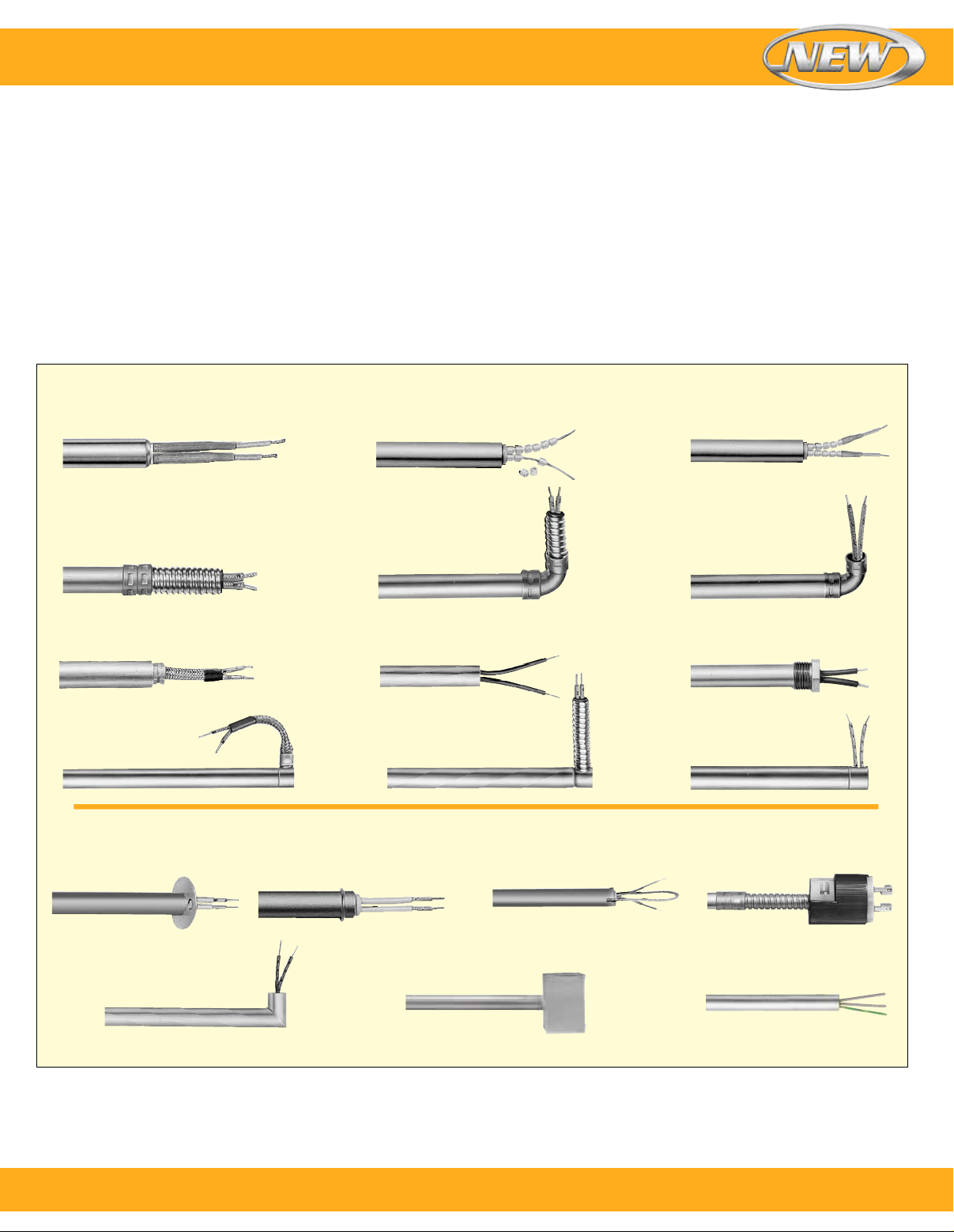
Terminations
Type N
Standard Leads
Type C1A & C1B only
Straight Armor Cable
Ceramic Bead Insulation
Type C2A & C2B
Right-Angle Armor
Cable with Copper Elbow
2. Refer to the program-qualified lead terminations reference
photos to select the cartridge heater termination type best
suited for your application.
NOTE: Type “N” [254 mm (10") long externally connected plain lead wires]
is the most common termination applied in the Terminator program.
If a termination other than Type N is selected a new permanent part
number will be assigned when your order is placed.
3. Specify your lead requirements in the event that the
standard supplied lengths for Plain Leads 254 mm (10"),
braid or armor cable [254 mm (10") over 305 mm (12")
leads] are not suited for your application.
4. Specify the quantity.
Type B
Type BL
Ceramic Bead and Leads
Type R1A
Right-Angle Leads with
Copper Elbow
Straight Wire Braided Leads
Type W1A & W1B
Mounting Flange Round
Type W
Right-Angle Wire
Braided Leads
Type MFR
Type R3
Angled Sheath Extension
(Cement Potting Only)
Type M2A & M2E
Potted Lead End Seal
(Cement Only)
Type C3A, C3B, C3C & C3D
Right-Angle Armor Cable
Options
Type LR
Locating Ring
Type E1
General Purpose Box
Complete specifications and details on these terminations can be found at omega.com.
Type PS
Pull Strap
Type CMB & CMP
Single Threaded Fitting
Type R2A & R2B
Right-Angle Leads
Type P
Quick Disconnect Plug
Type GL
Ground Lead Sheath
Custom Engineered/Manufactured Hi-Density Cartridge Heaters
Because cartridge heaters can be very application specific, consult OMEGA with your special
requirements. For sizes, electrical ratings and any other design features required but not listed in the
catalog, OMEGA will custom engineer and manufacture to your specifications.
Consult OMEGA with Your Requirements. We Welcome Your Inquiries.
To order, call 1-800-826-6342 or shop online at omega.com
SM
7
Page 8
Cartridge Heaters
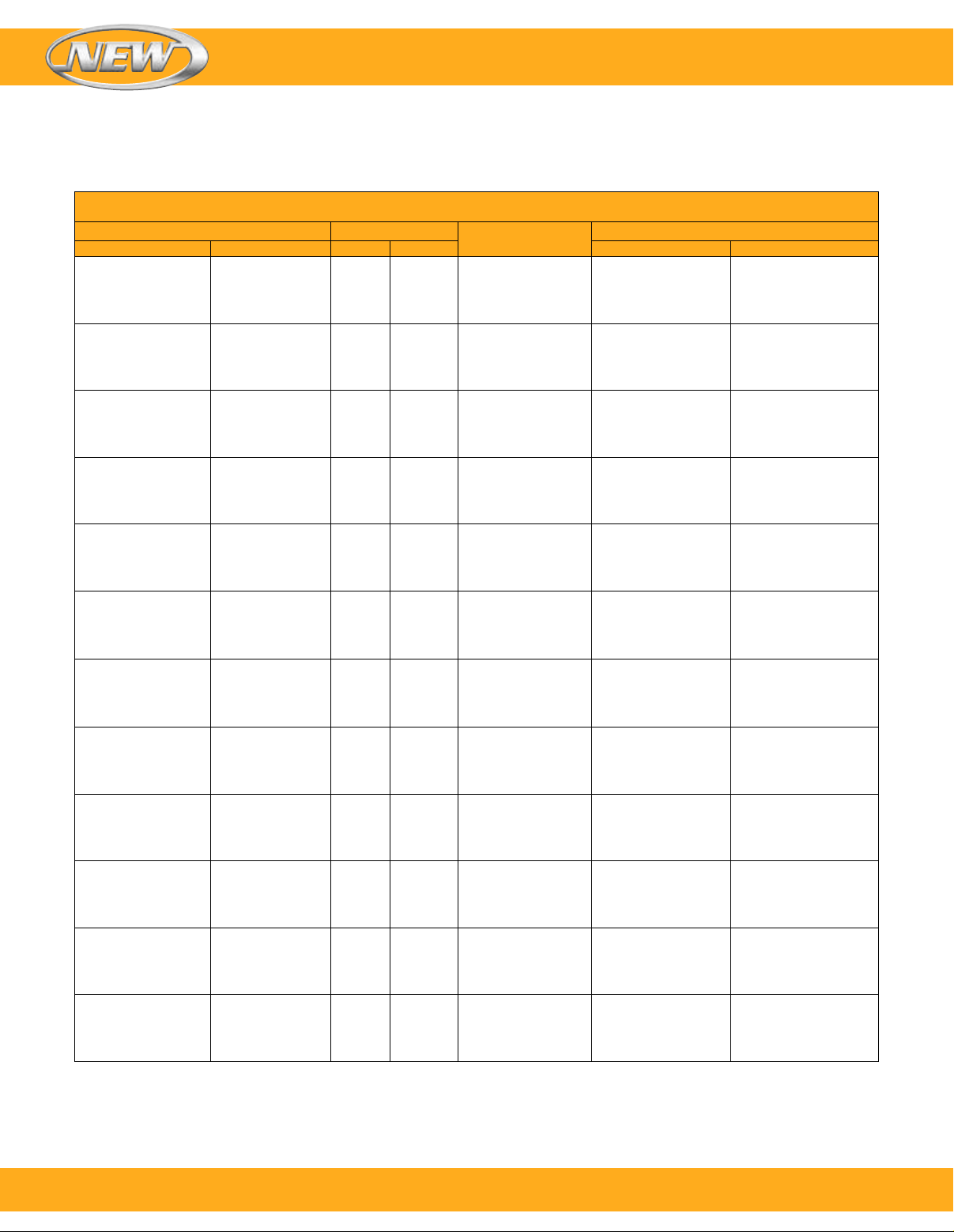
Hi-Density Cartridge Heaters
3
⁄4" Diameter, Actual 18.95 mm (0.746")
Model numbers listed are for cartridge heaters terminated with 254 mm (10") long leads (Type N termination).
Other terminator program terminations and options can also be applied to heaters (see ordering information).
To Order Visit omega.com/hdc00906_series for Pricing and Details
Model Number Sheath Length
120V 240V mm inch Watts/cm
HDC00906 —
— HDC00907
HDC00908 —
— HDC00909
HDC00910 —
HDC00911 HDC00912
HDC00913 HDC00914
— HDC00915
HDC00916 HDC00917
— HDC00918
HDC00919 —
— HDC00920
HDC00921 —
— HDC00922
— HDC00923
HDC00924 —
HDC00926 HDC00927
— HDC00928
HDC00929 HDC00930
HDC00931 —
HDC00932 HDC00933
— HDC00934
— HDC00935
HDC00936 HDC00937
— HDC00938
— HDC00939
HDC00940 HDC00941
— HDC00942
— HDC00943
HDC00944 HDC00945
— HDC00946
HDC00947 HDC00948
— HDC00949
— HDC00950
— HDC00951
HDC00952 HDC00953
HDC00954 HDC00955
HDC00956 HDC00957
— HDC00958
— HDC00959
— HDC00961
HDC00962 HDC00963
— HDC00964
— HDC00965
— HDC00966
HDC00967 HDC00968
— HDC00969
— HDC00970
50.8 2 200 9 57
50.8 2 800 35 226
57.2 2
1
⁄4 200 8 49
57.2 21⁄4 800 30 194
76.2 3 250 7 42
76.2 3 500 13 85
76.2 3 600 16 102
76.2 3 1000 26 170
88.9 3
88.9 31⁄2 350 8 50
88.9 3
88.9 31⁄2 1000 22 141
95.3 3
95.3 3
1
⁄2 250 6 35
1
⁄2 500 11 71
3
⁄4 250 5 33
3
⁄4 500 10 65
95.3 33⁄4 1000 20 131
101.6 4 250 5 30
101.6 4 500 9 61
101.6 4 750 14 91
101.6 4 1000 19 121
114.3 4
114.3 41⁄2 875 14 93
114.3 4
1
⁄2 350 6 37
1
⁄2 1400 23 149
120.7 43⁄4 750 12 75
127.0 5 300 4 28
127.0 5 500 7 47
127.0 5 750 11 71
127.0 5 1000 15 94
127.0 5 1200 18 113
146.1 5
3
⁄4 1000 13 81
152.4 6 500 6 39
152.4 6 750 9 58
152.4 6 1000 12 77
152.4 6 1200 14 93
152.4 6 1500 18 116
152.4 6 2000 24 154
177.8 7 500 5 33
177.8 7 1000 10 65
177.8 7 1500 15 98
177.8 7 2000 20 131
193.7 7
5
⁄8 450 4 27
203.2 8 350 3 20
203.2 8 500 4 28
203.2 8 700 6 40
203.2 8 1000 9 57
203.2 8 1350 12 76
203.2 8 2000 18 113
228.6 9 350 3 17
228.6 9 500 4 25
Watts
Watt Density
2
Watts/in
2
Ordering Information
Order by Model Number for cartridge heaters with Type N
termination. Call OMEGA for part numbers for heaters with
other terminator program terminations and options.
8
To order, call 1-800-826-6342 or shop online at omega.com
Custom Engineered/Manufactured
Cartridge Heaters can be application specific; therefore for
sizes, electrical ratings, terminations and any other design
features not listed in this section will custom manufacture to
your specifications. Consult us with your requirements.
SM
Page 9
Cartridge Heaters
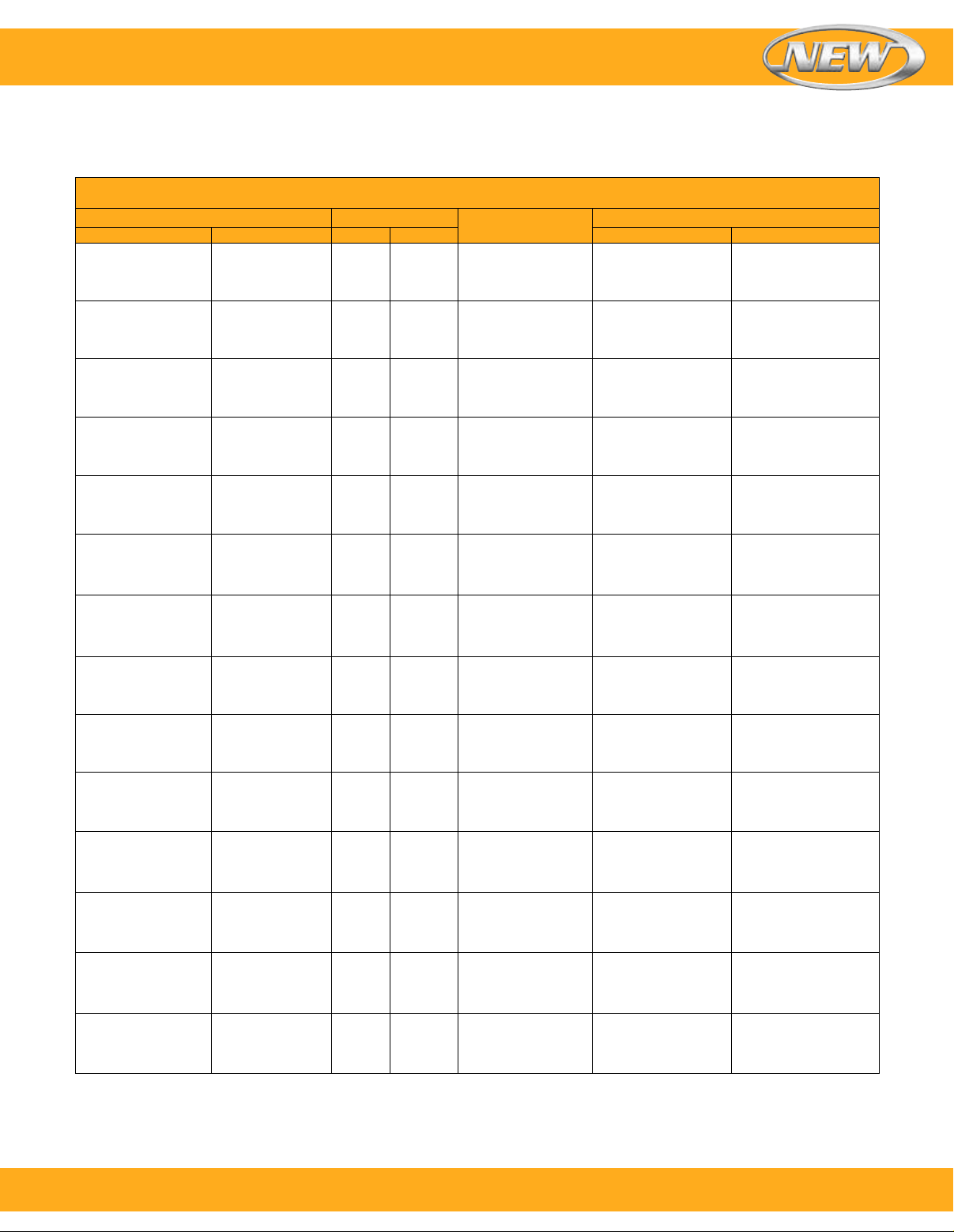
Hi-Density Cartridge Heaters
3
⁄4" Diameter, Actual 18.95 mm (0.746")
Model numbers listed are for cartridge heaters terminated with 254 mm (10") long leads (Type N termination).
Other terminator program terminations and options can also be applied to heaters (see ordering information).
To Order Visit omega.com/hdc00906_series_series for Pricing and Details
Model Number Sheath Length
120V 240V mm inch Watts/cm
— HDC22945
— HDC00971
— HDC00973
— HDC00974
— HDC00975
— HDC00976
— HDC00977
— HDC22946
HDC00978 HDC00979
— HDC00980
— HDC00981
— HDC00983
— HDC00984
— HDC00985
— HDC00986
— HDC00987
HDC00988 HDC00989
— HDC00990
— HDC00991
— HDC00992
— HDC00993
— HDC00994
HDC00995 —
— HDC00996
— HDC00997
— HDC00998
— HDC00999
— HDC01000
— HDC01001
— HDC01002
— HDC01003
HDC01004 —
— HDC01005
— HDC01006
— HDC01007
— HDC01008
— HDC01009
— HDC01010
— HDC01011
HDC01012 —
— HDC01013
— HDC01014
— HDC01015
— HDC01016
— HDC01017
— HDC01018
— HDC01019
— HDC01020
— HDC01021
— HDC01022
— HDC01023
— HDC01024
— HDC01025
— HDC01026
— HDC01027
— HDC01028
228.6 9 1000 8 53
228.6 9 1200 9 60
228.6 9 1800 14 90
247.7 93⁄4 2000 14 92
254.0 10 600 4 27
254.0 10 1000 7 45
254.0 10 1200 8 54
254.0 10 1500 11 70
254.0 10 2000 14 89
266.7 10
279.4 11 1000 6 40
298.5 11
1
⁄2 550 4 23
3
⁄4 2000 12 75
304.8 12 800 5 30
304.8 12 1000 6 37
304.8 12 1200 7 44
304.8 12 1500 9 55
304.8 12 2000 11 74
304.8 12 2500 14 92
304.8 12 4000 23 148
330.2 13 1000 5 34
355.6 14 800 4 25
355.6 14 1000 5 31
355.6 14 1125 6 35
355.6 14 1250 6 39
355.6 14 1400 7 44
355.6 14 2500 12 79
355.6 14 4500 22 141
374.7 14
3
⁄4 1500 7 45
381.0 15 1000 5 29
381.0 15 1500 7 44
406.4 16 1000 4 27
406.4 16 1175 5 32
406.4 16 1500 6 41
406.4 16 1800 8 49
406.4 16 3000 13 82
406.4 16 4700 20 129
431.8 17 1000 4 26
450.9 17
3
⁄4 850 3 21
457.2 18 1000 4 24
457.2 18 1250 5 30
457.2 18 1450 6 35
457.2 18 2000 8 49
457.2 18 3250 12 79
457.2 18 5000 19 121
482.6 19 1000 4 23
508.0 20 1000 4 22
508.0 20 1150 4 25
508.0 20 2050 7 45
508.0 20 2250 8 49
508.0 20 5250 18 114
609.6 24 1000 3 18
609.6 24 1375 4 25
609.6 24 2000 6
609.6 24 2750 8 50
609.6 24 5500 15 99
914.4 36 2500 5 30
Ordering Information
Order by Model Number for cartridge heaters with Type N
termination. Call OMEGA for part numbers for heaters with
other terminator program terminations and options.
Watts
Custom Engineered/Manufactured
Cartridge Heaters can be application specific; therefore for
sizes, electrical ratings, terminations and any other design
features not listed in this section will custom manufacture to
your specifications. Consult us with your requirements.
Watt Density
2
Watts/in
36
2
To order, call 1-800-826-6342 or shop online at omega.com
SM
9
 Loading...