

Page 1
1
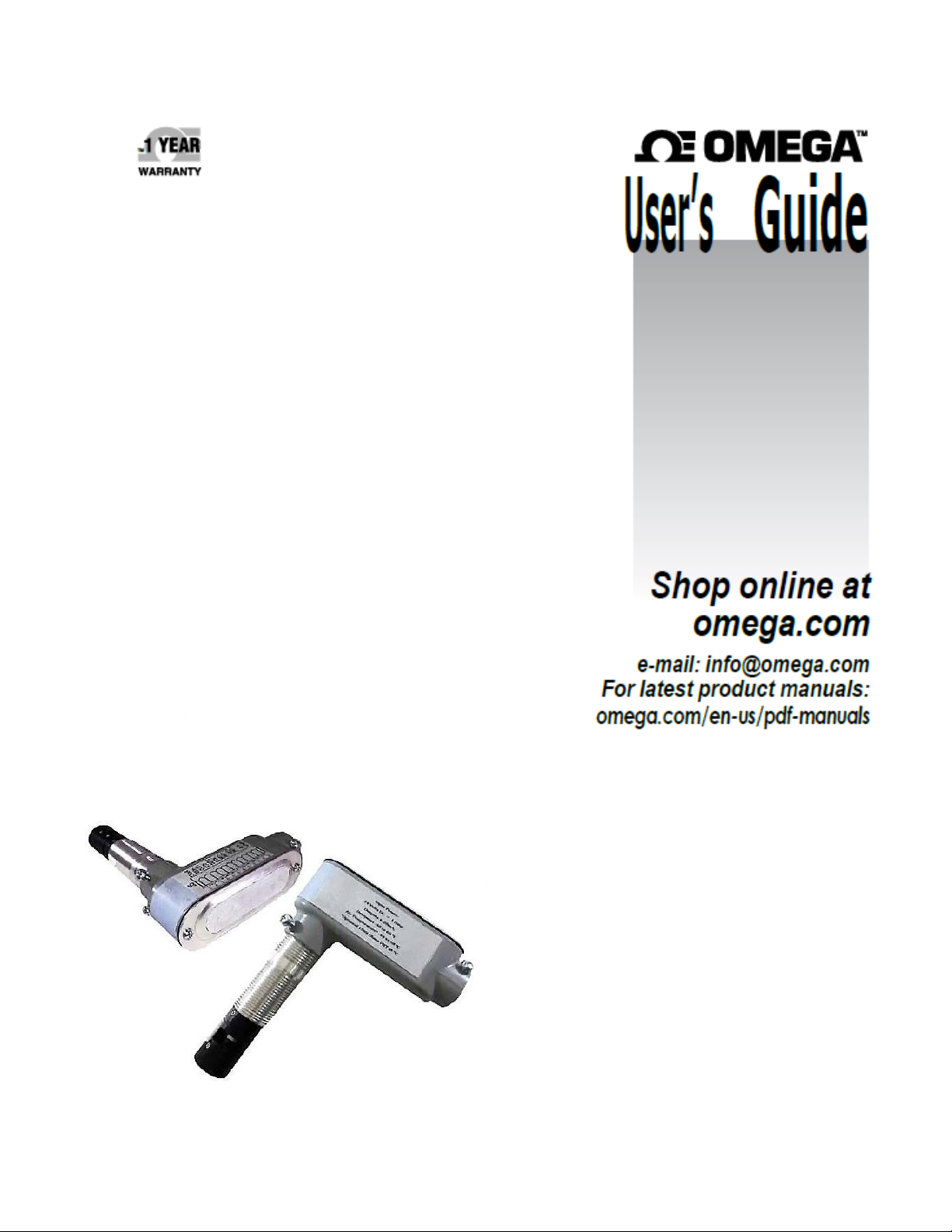
CMDP Series
Chilled Mirror Hygrometer
Page 2

2
CMDP Overview
The CMDP series is a family of low-cost dew point chilled mirror transmier that can be congured as a
duct, wall, pipe, or an OEM unit. The unit oers stable, accurate and repeatable measurements that are
traceable to NIST. Available air temperature opon for wall and OEM conguraons. Seable service
cycles for balancing and cleaning the mirror. The CMDP is a primary measurement using a fundamental
principle to measure the dew point very accurately. Simple maintenance to cleaning the mirror requires
using a weed coon swab to restore the transmier to normal operaon. Because of its construcon,
the customer can enjoy a long life of excellent performance.
Features
• Precision accuracy
• Two 4-20mA outputs (congurable)
• Durable and fast responding
• Automac balance funcon for the mirror, opcal circuitry
• RS232 communicaon
• Simple maintenance-mirror cleaning
Specicaons
Operang Limitaons:
Temperature: -40°C to +70°C. High temperatures will damage the electronics
Accuracy: ± 0.5C of reading for both dew point and temperature
Repeatability: ± 0.05C
Calibraon: NIST Traceable
Measurement Range:
Dew Point -20°C (@ 25°C) to 60°C (non-condensing)
Dew Point -40°C (@ 0°C)
Temperature probe (oponal): -40°C to 120°C
Output:
(2) 4 to 20mA output at 24Vdc (congurable)
Default sengs: -20C to 60C (unless specied on purchase order)
Supply Voltage: 24Vdc +/-3V @1.0A
Weight: 2lbs
Weed material: Nickel, ultem and anodized aluminum
Pressure rang: 5 ATM. Thread size 1.25”-12 UNF
*WARNING: Pressure more than allowable rang may cause the housing to burst and cause serious personal injury.
Air Velocity: 50 to 900m/min
Air Temperature probe dimensions (oponal): Length 5”, O.D. 0.1875 (3/16”)
Air temperature connecon (oponal): 4 Wire (ying leads)
Ordering Conguraon
CMDP-D Duct mounted chilled mirror hygrometer (dew point only)
CMDP-W Wall mounted chilled mirror hygrometer (dew point only)
CMDPT-W Wall mount chilled mirror hygrometer (dew point/air temperature)
CMDP-P Pipe mounted chilled mirror hygrometer (dew point only)
Page 3
3
CMDP Instruconal Guide
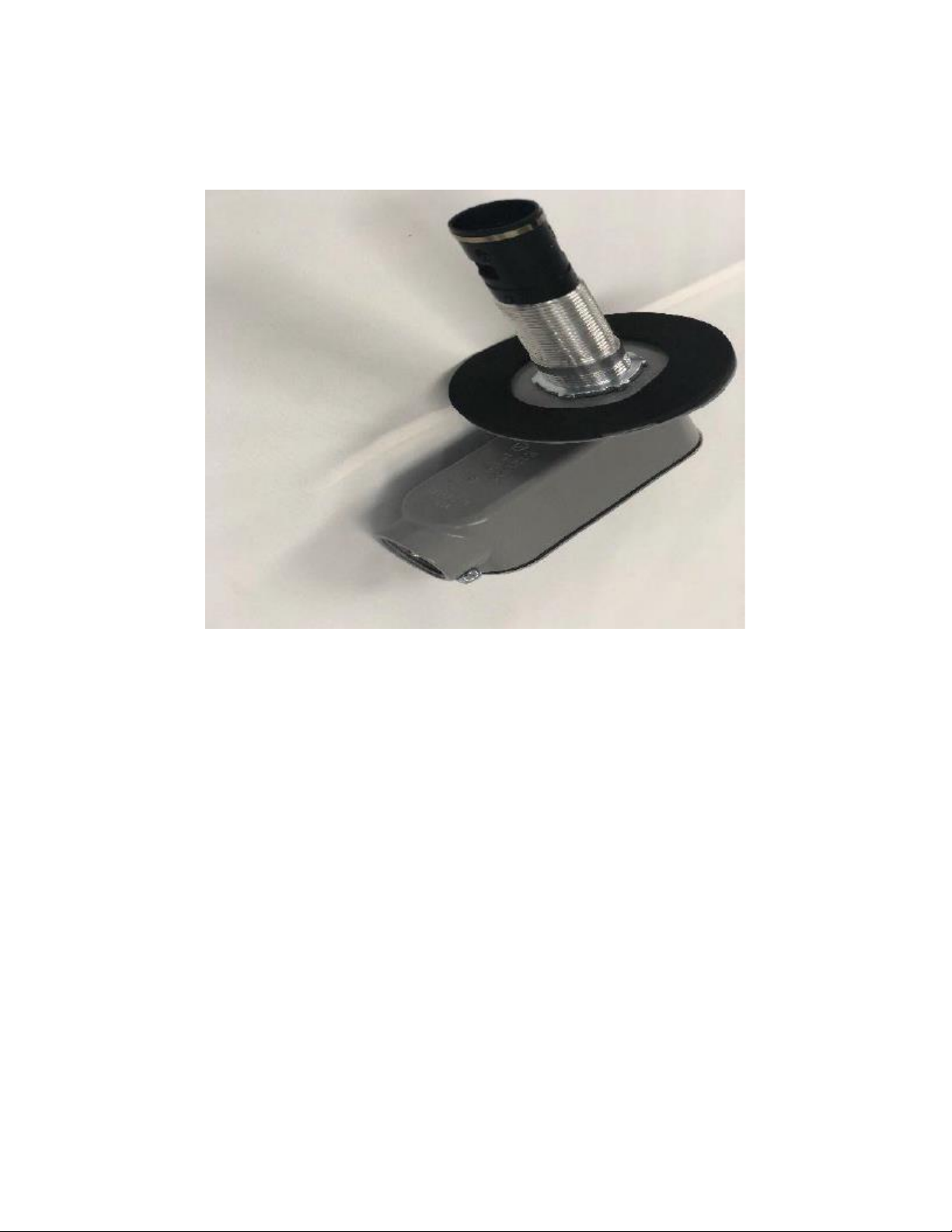
The CMDP is a single stage chilled mirror hygrometer congured for duct mount, wall mount and OEM
applicaon. For Pipe Mount applicaons please consult factory. The CMDP requires 24VDC @1 A for
power. It has two 4-20mA outputs factory scaled for -40°C to 60°C. The unit also has a RS232
communicaon connecon that can be accessed using either the Hyper terminal or Tera Term program
which is available on most computers.
Notes: Even though the unit is scaled from -40°C to 60°C, the unit can only measure to -20°C dew point at
ambient temperature condions (25°C). If the dew point is lower than -20°C, the user will have to cool
the body of the sensor to a lower temperature. The unit has depression capability of 45°C (meaning if at
ambient (25°C), subtract 45° from 25°C and that will be your lowest dew point (-20°C). So, lowering the
temperature of the sensor will get you to lower measurable dew points.
Page 4
4
CMDP Wiring Instrucons
Terminal Block
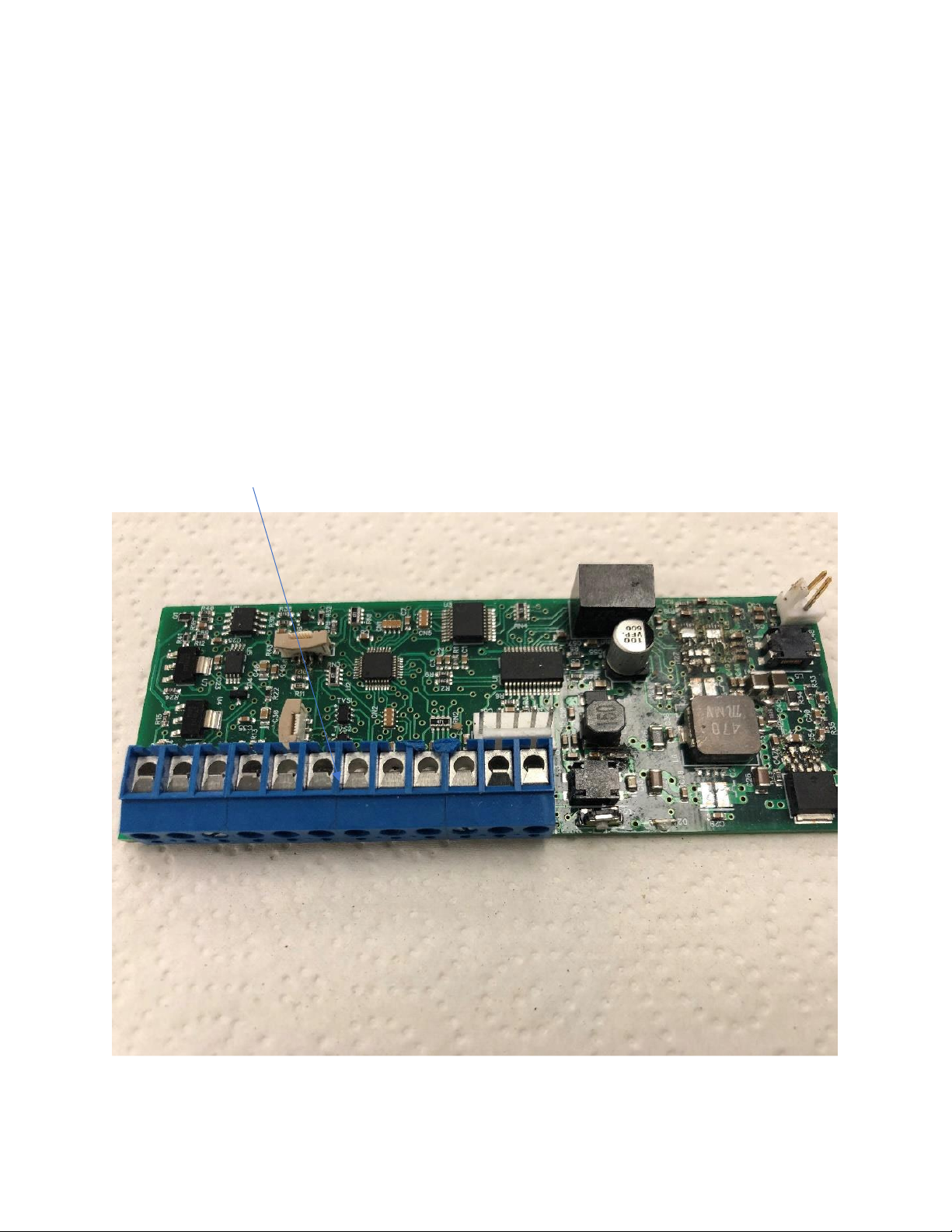
All wiring is done to the 12-pin terminal block located on the PCB
Pin 1 Tx (RS232)
Pin 2 Rx (RS232)
Pin 3 (+) 4-20mA output
Pin 4 Ground
Pin 5 (+) 4-20mA output
Pin 6 (-) common for 4-20mA outputs
Pin 7 (-) Air temperature probe
Pin 8 (-) Air temperature probe
Pin 9 (+) Air temperature probe
Pin 10 (+) Air temperature probe
Pin 11 Return
Pin 12 24Vdc (@1A)
PCB blue connector:
Page 5

5
CMDP Protocol Setup
No special soware is needed. User can use either the Tera Term program or the HyperTerminal program
on their PC. Connect the RS232 connecon from the Dew Tran and using a USB converter connect to your
PC.
Protocol conguraon: Baud rate 19.2K, 8 Bits, 1 stop Bit, No parity To access the menu, hit the “esc”
The Cap lock key must be on when selecng commands.
Calibrang Current Outputs:
There are 2 methods for calibrang the 4-20 mA outputs. Method 1 uses a digital ammeter, capable of 1
uA. Resoluon. The second method uses high precision (.005%) Resistor(s), In range of 10 – 750 ohms.
The factory Calibraon is done using 100.00 ohm resistors. For output 1, connect Ammeter across BLACK
Wire and RETURN.
From normal operaon, enter following keystrokes:
<ESC> <C>hange <O>utputs <C>alibrate <C>urrent at the “Sense Resistor Value (Y/N) OHMS?” Prompt,
enter <N> Enter<1> for Current output 1.
The prompt “4 mA. = ?, enter the value displayed on Ammeter, as mA’s Connue for the next 2 prompts
(12 mA. and 20 mA.)
The prompt “4 mA. = 1XXXX” is displayed, check Ammeter for 4.00 mA. reading.
Press <CR> to sequence (8, 12, 16 ,20 mA.) Values, with corresponding Ammeter Readings. If calibrated
values good, at “Save Calibraon (Y/N)?, enter<Y>.
Operaons
There are two ways to determine if the sensor is operang/properly funconing.
Reminder: When the unit is rst powered on, the unit will take 3-5 minutes to control. Typically, the unit
goes through what we call an ARC condion. Which is a balancing cycle, the unit inial heats up, then
goes into an acquiring mode (hunng for the dew point) and then the control mode.
1) If you are using the RS232, output you can view the data via your computer to see if the unit is in
control. The data will be streamlined on your PCs and you will see the word “control” at the end of each
line.
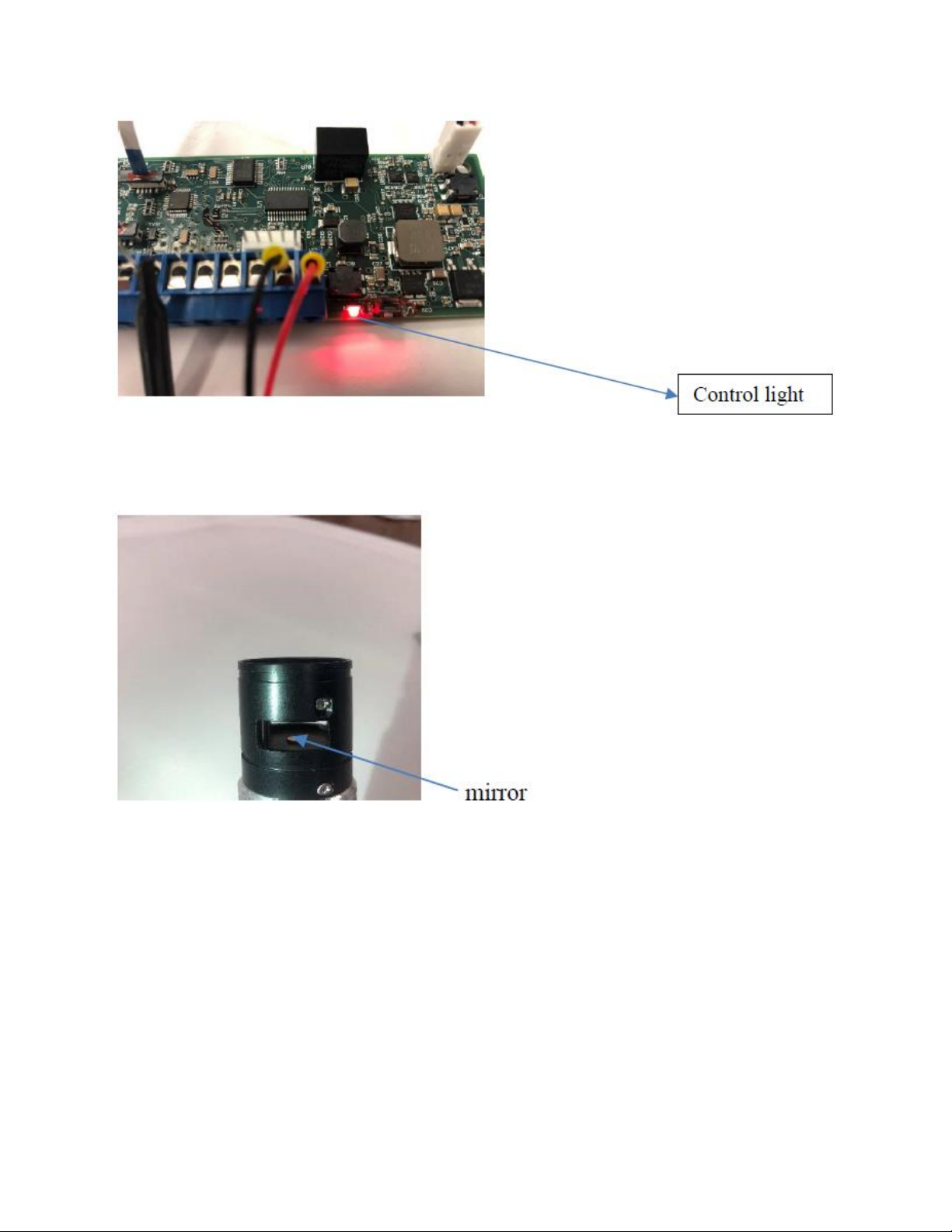
2) Another method is by viewing the red light on the PCB. If the red light is in a steady state (always on),
the unit is in control.
3) If the red light is blinking, the unit is most likely in one of these three states.
a. The unit was just powered on and is going through its ARC cycle for 3-5 minutes.
b. The mirror is dirty (has contaminants on it) and it needs to be cleaned. Refer to the clean
mirror procedure.
c. If the above 2 steps do not remove the blinking red light condion, the unit could be out of
range to measure that dew point/frost point. (Ex: if your ambient condion is 25C and your dew
points is below -20C, the unit can not measure that dew point (red light will blink). A way to
correct that is to lower the body temperature of the sensor to a point where the dew point is
measurable with this unit.
Page 6
6
Clean Mirror
1) Power down
2) Gain access to the mirror
3) Clean mirror with a weed (using isopropyl alcohol) coon swab.
4) Dry the mirror surface with a dry coon swab.
5) Reinstall sensor shield if applicable.
6) Power the CMDP on
7) Also, the mirror can be cleaned during the ARC (when red light is blinking) by following the above steps
2- 5
Page 7
7
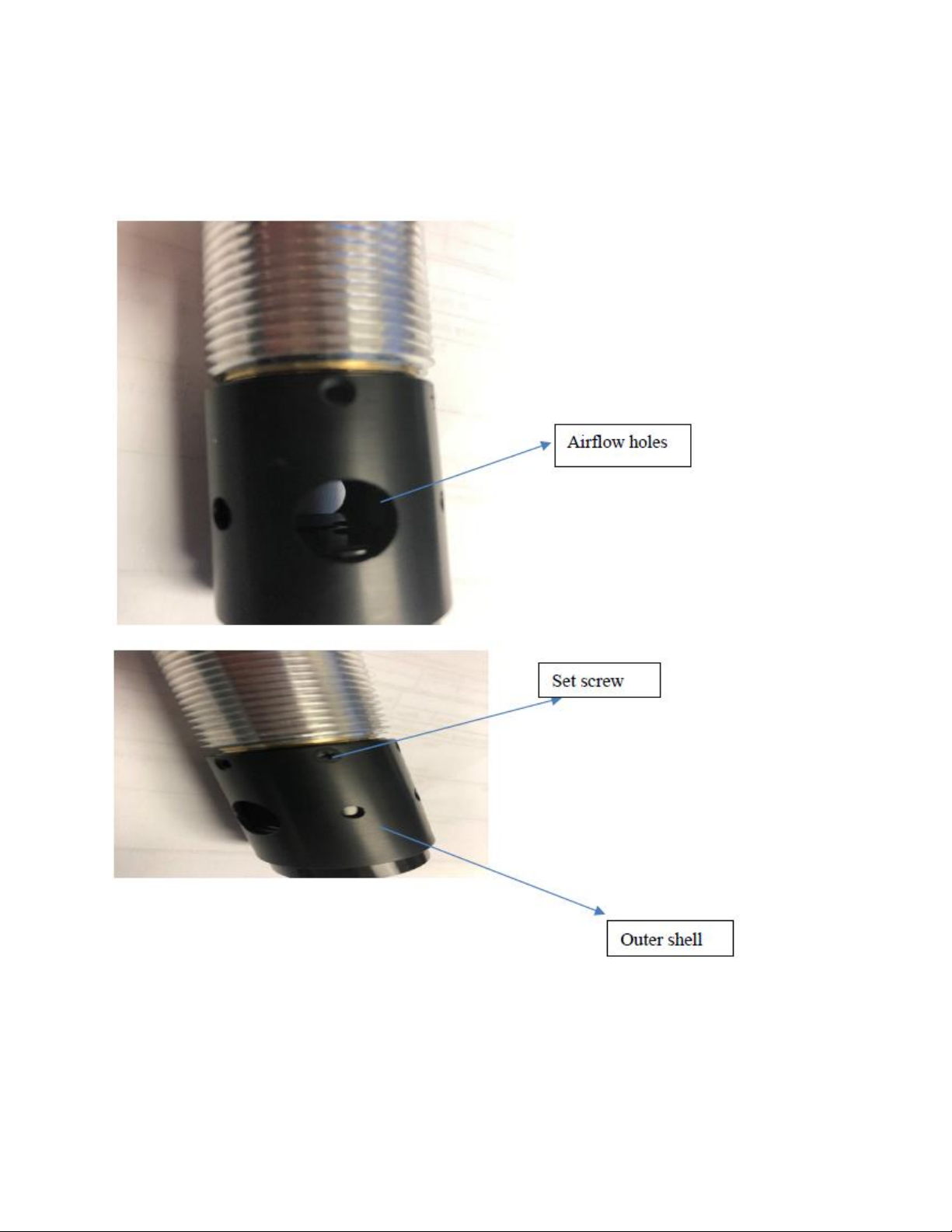
Airow Adjustments
There are 6 air holes in the middle of the outer shell: 2 large holes, 2 medium, and 2 small. The holes
allow the airow to the mirror (where the measurement is made).
To adjust the airow to the mirror, the Phillip set screw must be removed. Once removed, twist the outer
shell to the correct hole for airow and then re-install the set screw to hold the outer shell in place.
Example: if the larger airow hole has been selected and your signal is constantly oscillang aer the red
light is in a steady state. You might want to select a smaller hole to slow down the airow to the mirror. If
that doesn’t work, try to clean the mirror.
Page 8
8
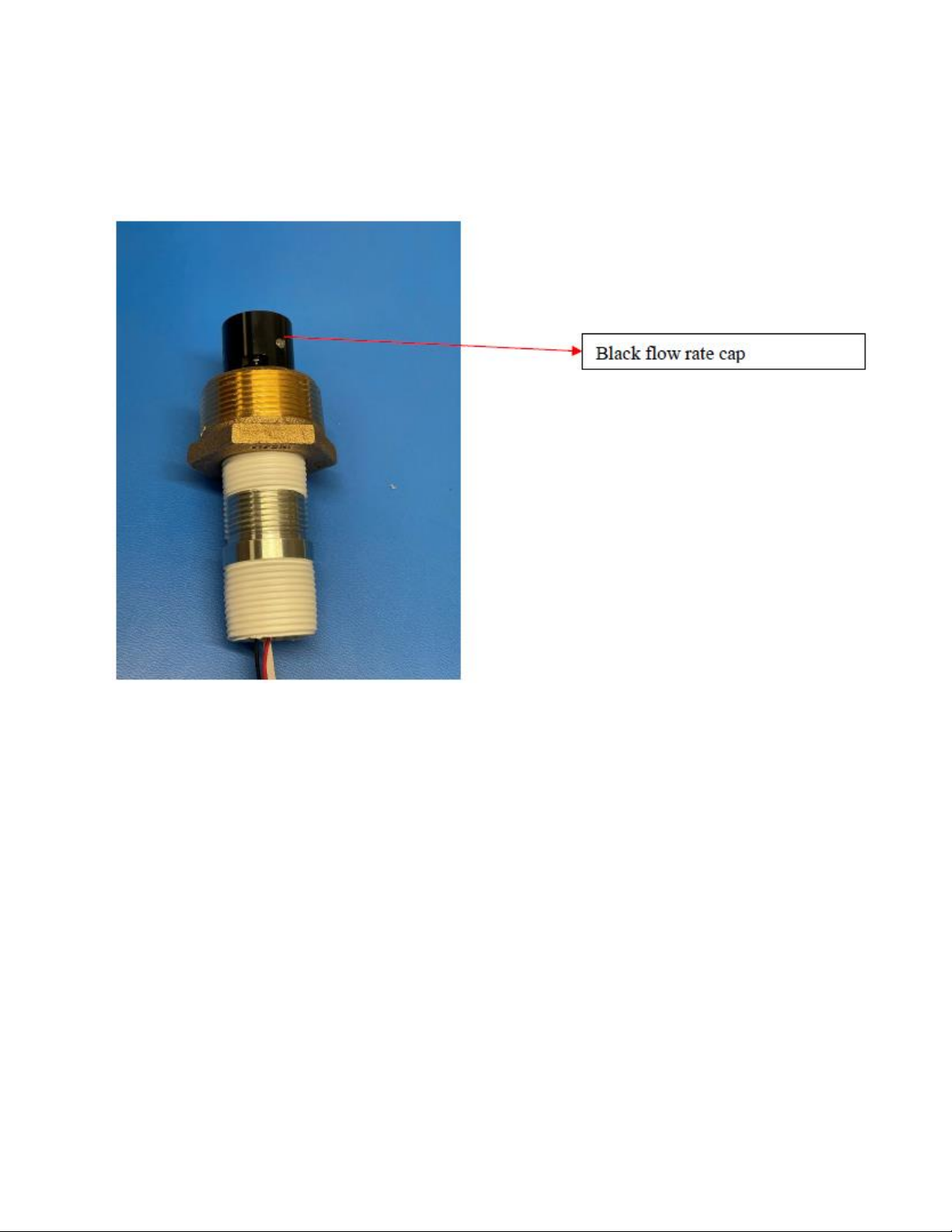
Pipe Mount Conguraons
Roscid supplies a Hex Bushing: Red Brass, 1 1/2 in x 1 in Fing Pipe Size, Male NPT x Female NPT, Class
125.
The sensor head (black ow rate cap) should be installed at least 1” into the process gas.
If the reading is oscillang, you might need to adjust the black ow rate cap, slowing the ow rate down.
Page 9
9
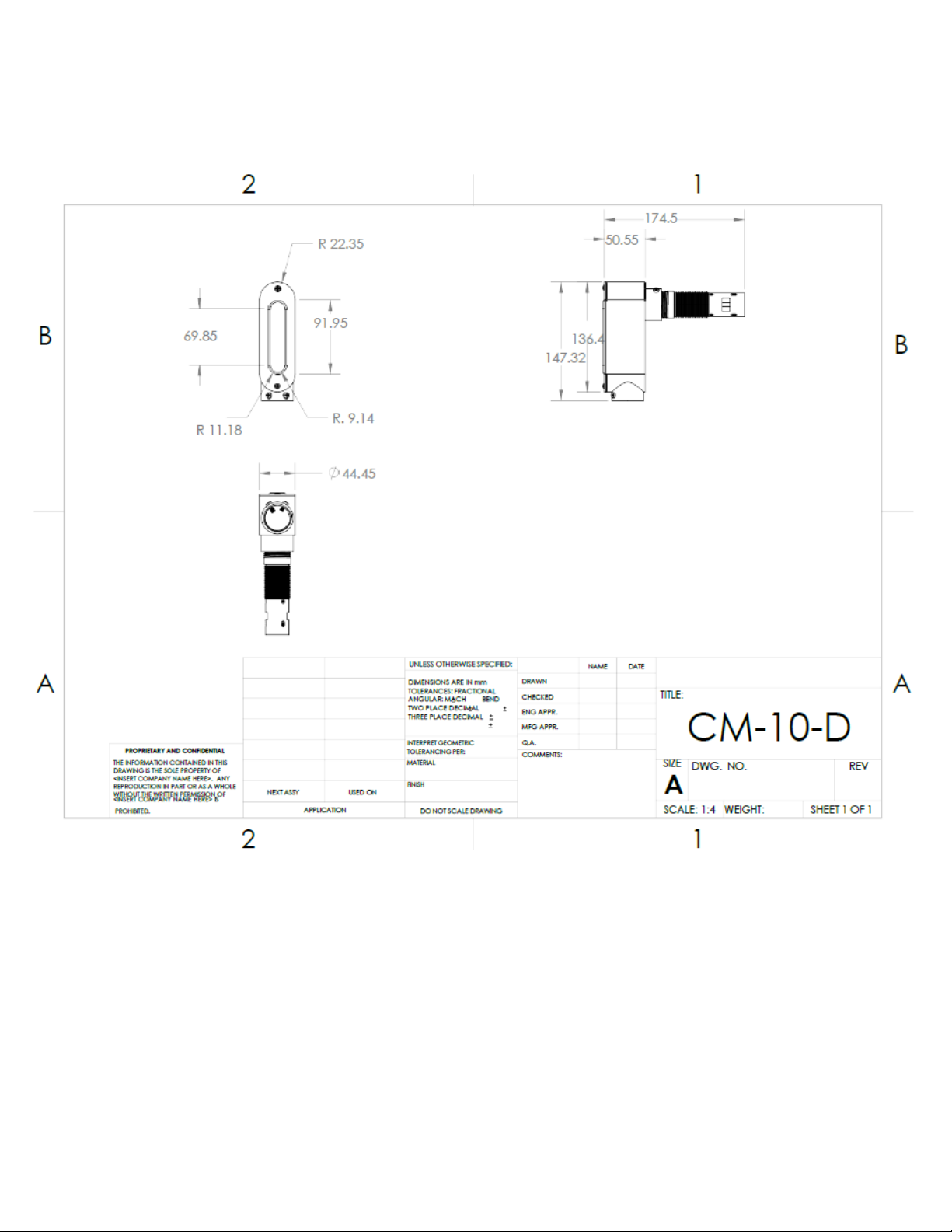
Fundamental First Principal Measurement for Dew Point
Page 10

10
Chilled mirror hygrometers (CMH) use a primary fundamental principal measurement which is a change
in resistance. This principle works when a sample of process gas ows across a special polished coated
mirror. The mirror temperature is lowered by thermal electric coolers (located beneath the mirror
block/mirror) unl the water vapor of gas condenses out on to the mirror in the form of either dew or
frost. There is an opcal circuit which constantly monitors the mirror surface and looks for equilibrium
between the opcal LED detectors (a reference and the dew detector). The temperature of the mirror
surface is measure by a highly accurate Planum Resistance Thermometer (PRT) which is embedded and
sealed in the mirror block which is thermally connected to the mirror. The PRT resistance measurement is
what makes this a fundamental dew point measurement.
In more detail, a fundamental measurement is such that the parameter being measured, is the same as
the Standard Internaonal denion of that parameter. In the case of the Chilled Mirror Hygrometer, that
measurement is the temperature of the mirror surface covered by a water layer that is in equilibrium
between the liquid and gaseous phases of water. If that temperature measurement is accomplished by a
planum resistance thermometer, the measurement is equivalent to the denion of dew point. Tables
constructed by NIST, notably by Wexler and Greenspan, establish the equivalence of dew point and the
vapor pressure of water. Using this equivalence and a second, fundamental, temperature measurement,
realizes the denion of Relave humidity: Vapor pressure of water/saturaon vapor pressure
(temperature) of the gas being measured, X100(%) i.e. %RH =100*PH2Ov/PSAT. Addion of a 3rd
measurement, the pressure of the gas being sampled, allows measurement of almost every other
humidity parameter.
Some further unit examples: absolute Humidity (gH2Ov/m3), mixing rao (gH2Ov /kgDRY), Parts per
million (PH2Ov/(PTot- PH20)), enthalpy(h), to name a few.
Chilled mirrors hygrometers are used where accuracy, typically +-0.2°C or beer, repeatability, stability
and no dri are paramount. CMH are the preferred reference standard in most calibraon labs. Also,
CMH work well due to their ruggedness, their inertness, their simple maintenance and ability to
accurately measure sample gasses remotely from process, i.e. ovens, dryers, furnaces, etc. Dew points
above ambient can be measured by heang the chilled mirror and associated components. Chilled
mirrors can be, and are, constructed as an inseron probe, provided the temperature of the process is <
~95 °C.
In closing, the upside of the chilled mirror hygrometer is that it uses a fundamental principal, it can be
designed to be inert to many corrosive gases, it is a repeatable in its measurement, there is no
measurable hysteresis, it is very accurate and has a very long operang life. The downside is that it is
expensive and is typically slower in response me when compared to other secondary principal humidity
measurements.
Page 11

11
omega.com [email protected]
Servicing North America:
U.S.A. Headquarters: Omega Engineering, Inc.
800 Conneccut Ave. Suite 5N01, Norwalk, CT 06854
Toll-Free: 1-800-826-6342 (USA & Canada only)
Customer Service: 1-800-622-2378 (USA & Canada only)
Engineering Service: 1-800-872-9436 (USA & Canada only)
Tel: (203) 359-1660 Fax: (203) 359-7700
e-mail: [email protected]
The informaon contained in this document is believed to be correct, but OMEGA accepts no liability for any errors it contains and reserves the
right to alter specicaons without noce.
Page 12
12
Page 13

13
Manual #M5789/1022
 Loading...