

Page 1
3/4˝ NUT
[95.25]
1/8 FEMALE NPT
A
D
ØB
SERIES APV | PROXIMITY® BY DWYER
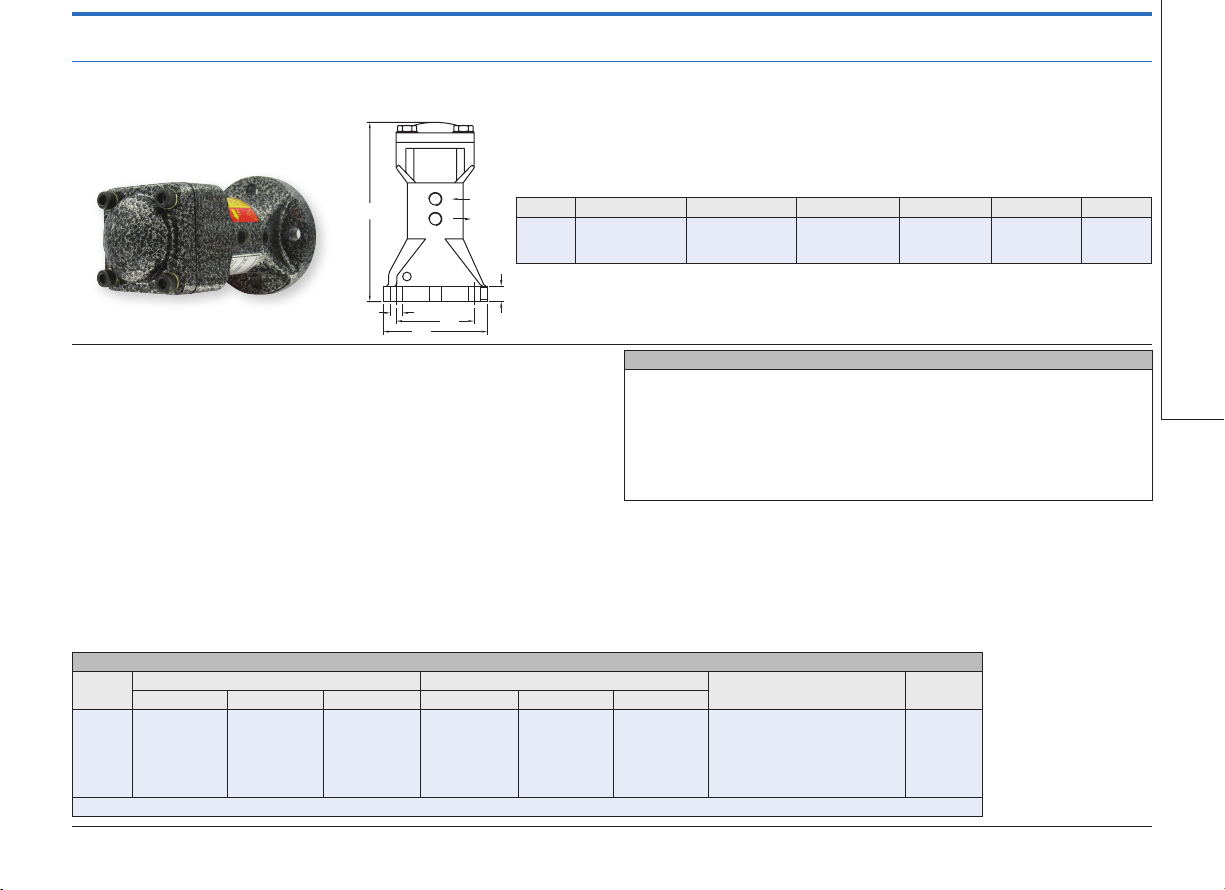
PISTON VIBRATOR
Air Cushioned or Piston Vibrators
ØH
ØC
IN
Model A B C D H IN/OUT
OUT
APV-X1
APV-X2
APV-X3
5-7/16 [138.11]
6-35/64 [166.69]
8-13/64 [208.36]
3-5/32 [80.17]
3-15/16 [100.01]
5-33/64 [140.10]
2-3/8 [60.33]
2-61/64 [75.01]
4-9/64 [105.17]
31/64 [12.30]
41/64 [16.27]
41/64 [16.27]
23/64 [9.13]
7/16 [11.11]
19/32 [15.08]
1/8 BSPT
1/4 BSPT
1/4 BSPT
Bin Vibrators/
Aerators
The Series APV Piston Vibrator uses compressed air to push the piston from one
side and cause vibration power. APV-C models are air cushioned to provide low noise,
making it suitable for quiet area applications. APV-I models allow direct impact on the
tank to help get rid of dust or material accumulated inside of pipes and tanks.
FEATURES/BENEFITS
• High strength aluminum alloy housing
• Frequency and amplitude of vibration can be adjusted as needed
• Low frequency and direct impact models available
APPLICATIONS
• Bin vents
• Bag houses
• Dust collectors
MODEL CHART
Frequency (V.P.M.) Pressure Input Force lbf (N) Pressure Input
Model
APV-C1
1765
APV-C2
1333
APV-C3
1000
APV-I1
1973
APV-I2
1744
APV-I3
1277
V.P.M. = vibrations per minute
2308
1677
1200
2885
2459
1875
2857
1875
1340
3571
3000
1973
44 (195)
62 (275)
91 (404)
1818 (8086)
3245 (14443)
3470 (15434)
85 (380)
119 (531)
175 (780)
3044 (13542)
4934 (21948)
7799 (34692)
SPECIFICATIONS
Temperature Limit: 212°F (100°C).
Noise Level Range: APV-C: 60-75 dBA; APV-I: 80-115 dBA.
Supply Pressure: 29 to 87 psi (2 to 6 bar).
Air Consumption: See model chart.
Air Connection: 1/8˝ BSPT female with 1/4˝ OD push to connect adapter on
APV-C1 and APV-I1; 1/4˝ BSPT female with 1/4˝ OD push to connect adapter on
APV-C2, APV-C3, APV-I2 and APV-I3. Also includes mufer for exhaust port.
Housing Material: Aluminum.
HOW THEY OPERATE
There are air-breathing tubes located in both ends of the cylinder. Compressed air
pushes the piston from one side to the other. Vibration power arises when the piston
moves back and forth in the body. In APV-C air cushion at both ends produced by the
to-and-fro motion will keep the piston from striking the body. Therefore, the piston will
not produce much noise. In APV-I, air cushion at the top end is produced by the to-andfro compression. This will keep the piston from striking onto the body top. The piston
will strike directly on the bottom side of the body to produce a strong impact.
126 (560)
161 (715)
231 (1030)
3996 (17776)
6048 (26904)
8276 (36816)
Air Consumption cfm (l/min)
Pressure Input
8.12 (230)
8.79 (249)
9.50 (269)
8.8 (250)
9.5 (270)
10.6 (300)
Weight
lb (kg)29 psi (2 bar) 58 psi (4 bar) 87 psi (6 bar) 29 psi (2 bar) 58 psi (4 bar) 87 psi (6 bar)
1.98 (0.9)
4.19 (1.9)
9.92 (4.5)
2.2 (1.0)
4.6 (2.1)
10.6 (4.8)
DWYER INSTRUMENTS, INC. | dwyer-inst.com
339
 Loading...