

Page 1

Page 2
2002 Oldsmobile Alero
Owner’s Manual
Litho in U.S.A.
Part Number 22673544 A First Edition All Rights Reserved
E
Copyright General Motors Corporation 06/25/01
i
Page 3
GENERAL MOTORS, GM, the GM Emblem,
OLDSMOBILE, the OLDSMOBILE Rocket Emblem
and the name ALERO are registered trademarks of
General Motors Corporation.
This manual includes the latest information at the time
it was printed. We reserve the right to make changes
after that time without further notice. For vehicles first
sold in Canada, substitute the name “General Motors
of Canada Limited” for Oldsmobile Division whenever
it appears in this manual.
Please keep this manual in your vehicle, so it will
be there if you ever need it when you’re on the road.
If you sell the vehicle, please leave this manual in it
so the new owner can use it.
We support voluntary
technician certification.
For Canadian Owners Who Prefer a French Language Manual:
Aux propriétaires canadiens: Vous pouvez vous
procurer un exemplaire de ce guide en français chez
votre concessionaire ou au:
Helm, Incorporated
P.O. Box 07130
Detroit, MI 48207
ii
Page 4
How to Use this Manual
Many people read their owner’s manual from beginning
to end when they first receive their new vehicle. If you
do this, it will help you learn about the features and
controls for your vehicle. In this manual, you’ll find
that pictures and words work together to explain
things quickly.
Safety Warnings and Symbols
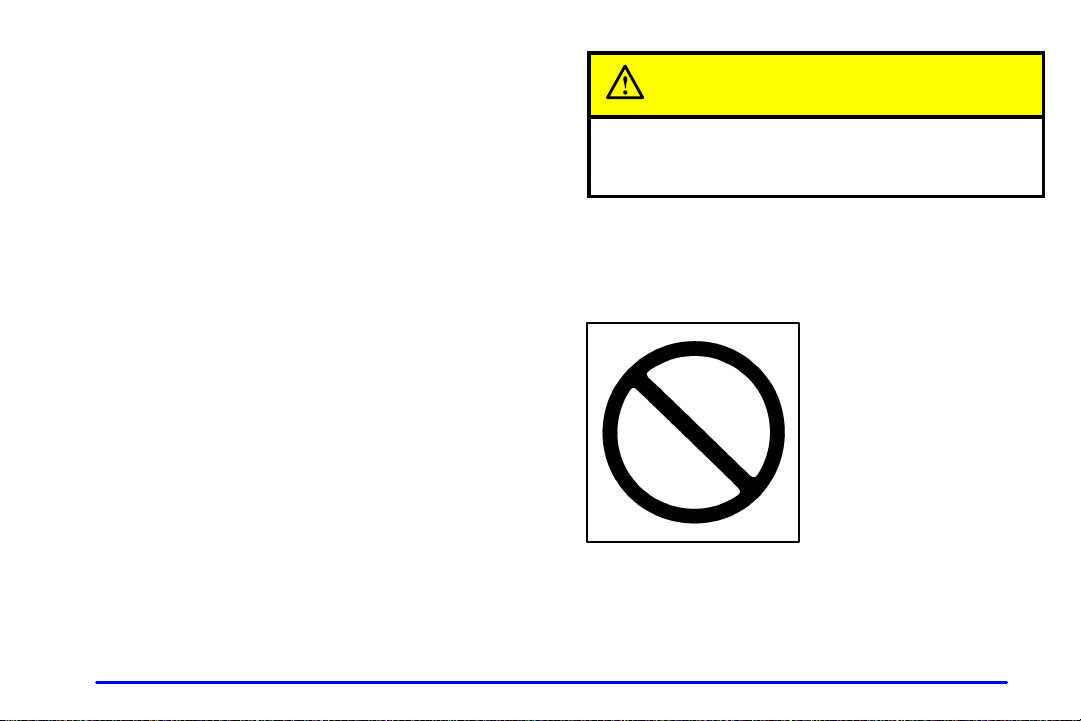
You will find a number of safety cautions in this book.
We use a box and the word CAUTION to tell you
about things that could hurt you if you were to ignore
the warning.
CAUTION:
These mean there is something that could hurt
you or other people.
In the caution area, we tell you what the hazard is.
Then we tell you what to do to help avoid or reduce
the hazard. Please read these cautions. If you don’t,
you or others could be hurt.
You will also find a circle
with a slash through it in
this book. This safety
symbol means “Don’t,”
“Don’t do this” or “Don’t
let this happen.”
iii
Page 5
Vehicle Damage Warnings
Also in this book you will find these notices:
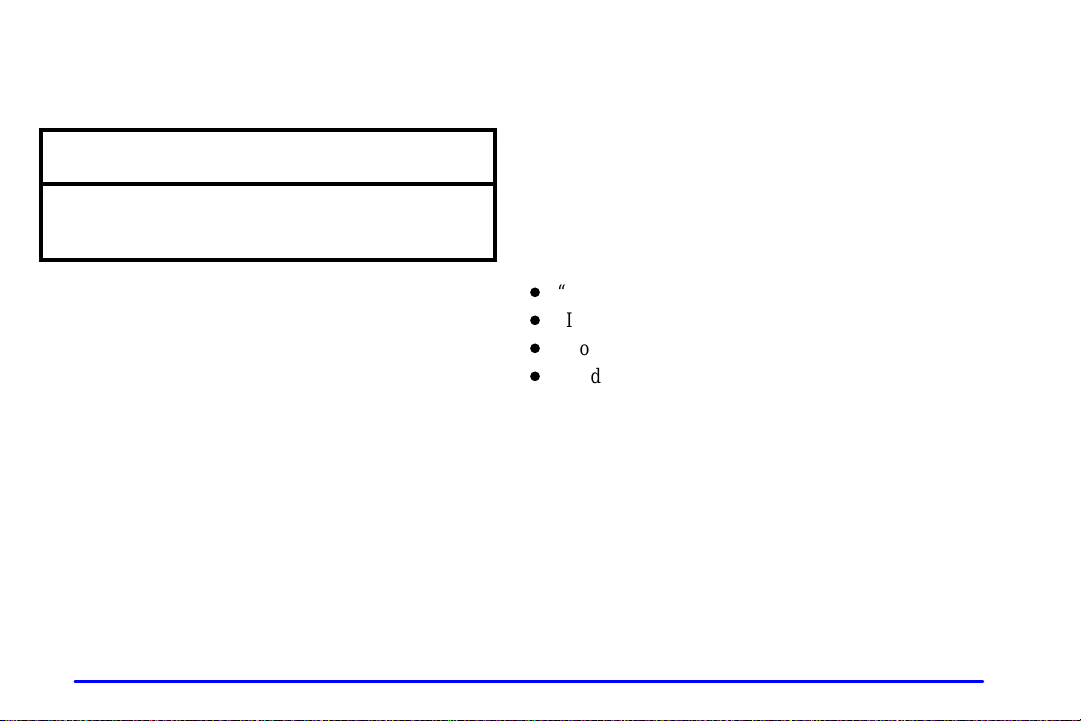
NOTICE:
These mean there is something that could damage
your vehicle.
In the notice area, we tell you about something that can
damage your vehicle. Many times, this damage would
not be covered by your warranty, and it could be costly.
But the notice will tell you what to do to help avoid
the damage.
When you read other manuals, you might see
CAUTION and NOTICE warnings in different colors
or in different words.
You’ll also see warning labels on your vehicle.
They use the same words, CAUTION or NOTICE.
Vehicle Symbols
Your vehicle may be equipped with components and
labels that use symbols instead of text. Symbols,
used on your vehicle, are shown along with the text
describing the operation or information relating to a
specific component, control, message, gage or indicator.
If you need help figuring out a specific name of a
component, gage or indicator reference the following
topics in the Index:
D
“Engine Compartment Overview”
D
“Instrument Panel”
D
“Comfort Controls”
D
“Audio Systems”
Also see “Warning Lights and Gages” in the Index.
iv
Page 6
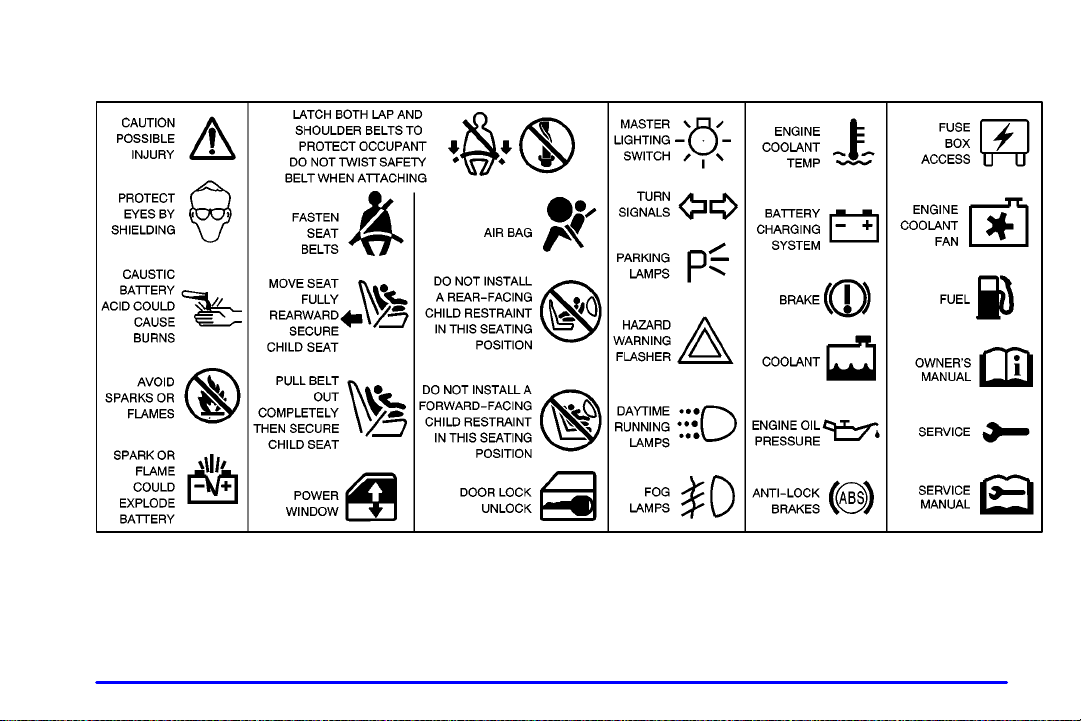
These are some examples of vehicle symbols you may find on your vehicle:
v
Page 7
Section 1 Seats and Restraint Systems
Here you’ll find information about the seats in your vehicle and how to use your safety belts properly. You can also
learn about some things you should not do with air bags and safety belts.
1
-2 Seats and Seat Controls
1
-8 Safety Belts: They’re for Everyone
-12 Here Are Questions Many People Ask About
1
Safety Belts
-13 How to Wear Safety Belts Properly
1
1
-14 Driver Position
1
-21 Safety Belt Use During Pregnancy
-22 Right Front Passenger Position
1
1
-22 Supplemental Restraint System (SRS)
-28 Rear Seat Passengers
1
-- and the Answers
-31 Rear Safety Belt Comfort Guides for
1
Children and Small Adults
1-34 Center Passenger Position
1
-35 Children
-39 Restraint Systems for Children
1
1
-53 Older Children
1
-56 Safety Belt Extender
-56 Checking Your Restraint Systems
1
1
-56 Replacing Restraint System Parts
After a Crash
1-
1-1
Page 8
Seats and Seat Controls
This section tells you about the seats -- how to
adjust them
and head restraints.
-- and also about reclining seatbacks
Manual Seats
CAUTION:
You can lose control of the vehicle if you try to
adjust a manual driver’s seat while the vehicle is
moving. The sudden movement could startle and
confuse you, or make you push a pedal when you
don’t want to. Adjust the driver’s seat only when
the vehicle is not moving.
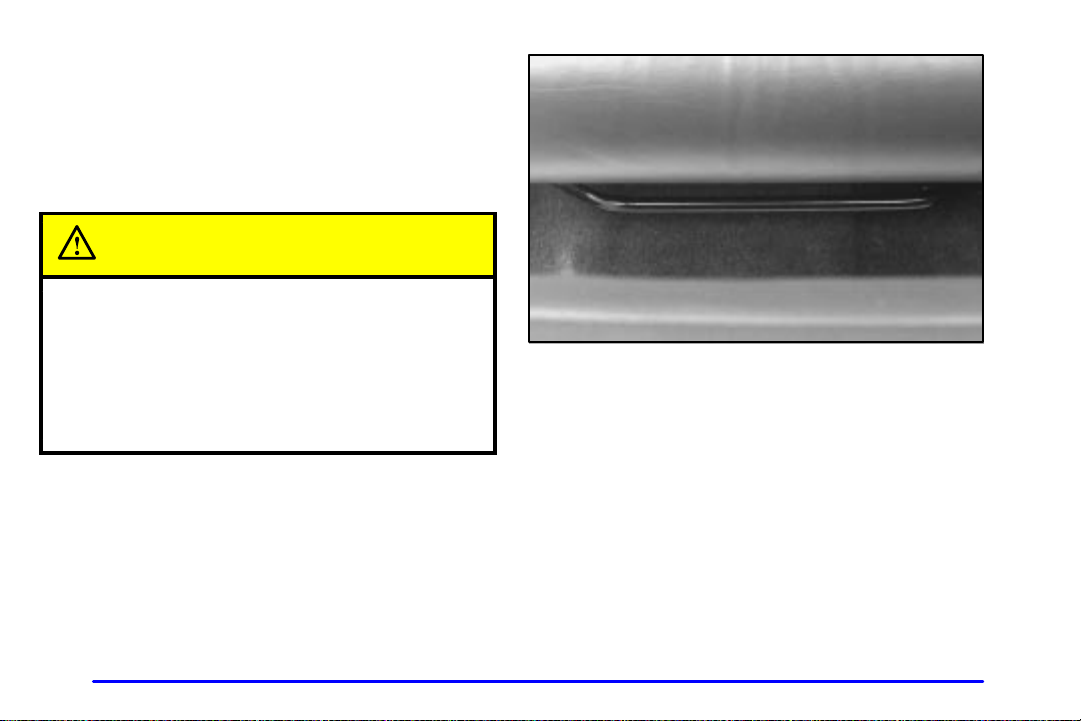
Lift the bar located under the front of the seat to unlock
it. Slide the seat to where you want it and release the bar.
Try to move the seat with your body to be sure the seat
is locked in place.
1-2
Page 9
Power Lift Seat (If Equipped)
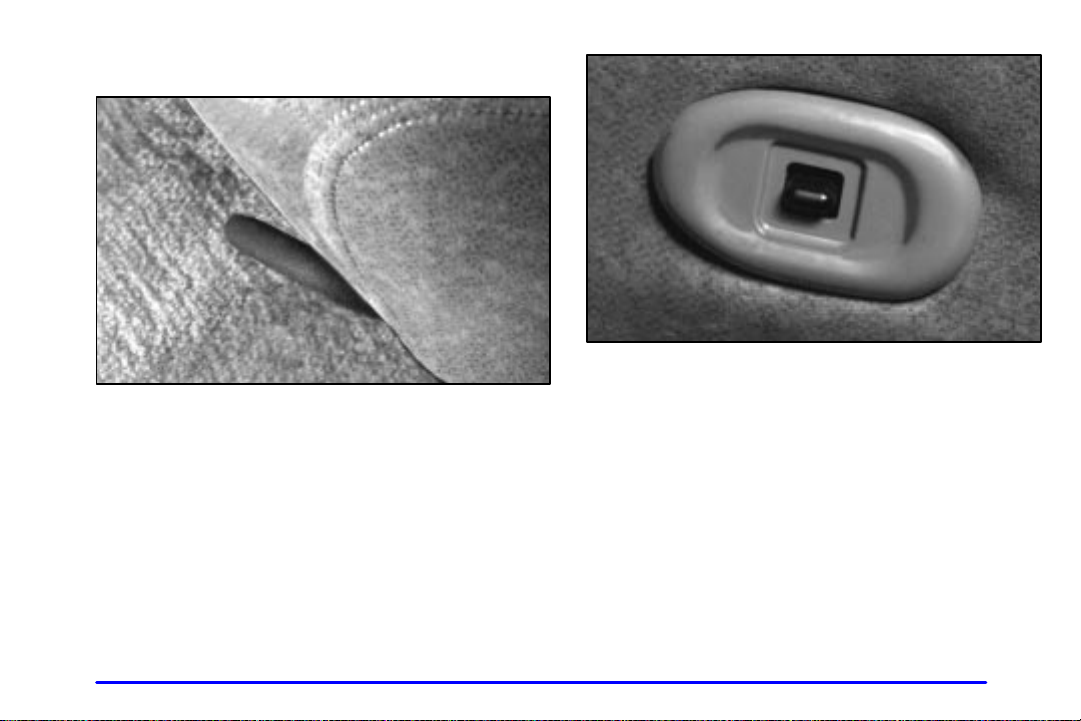
If your vehicle has this feature, to move the power lift
seat forward or rearward, pull up on the lever located
under the front of the driver’s seat to unlock it. Slide the
seat to where you want it and release the lever. Try to
move the seat with your body to make sure the seat is
locked into place.
T o raise or lower the power lift seat, hold the switch
located on the outboard side of the driver’s seat
up or down.
1-3
Page 10
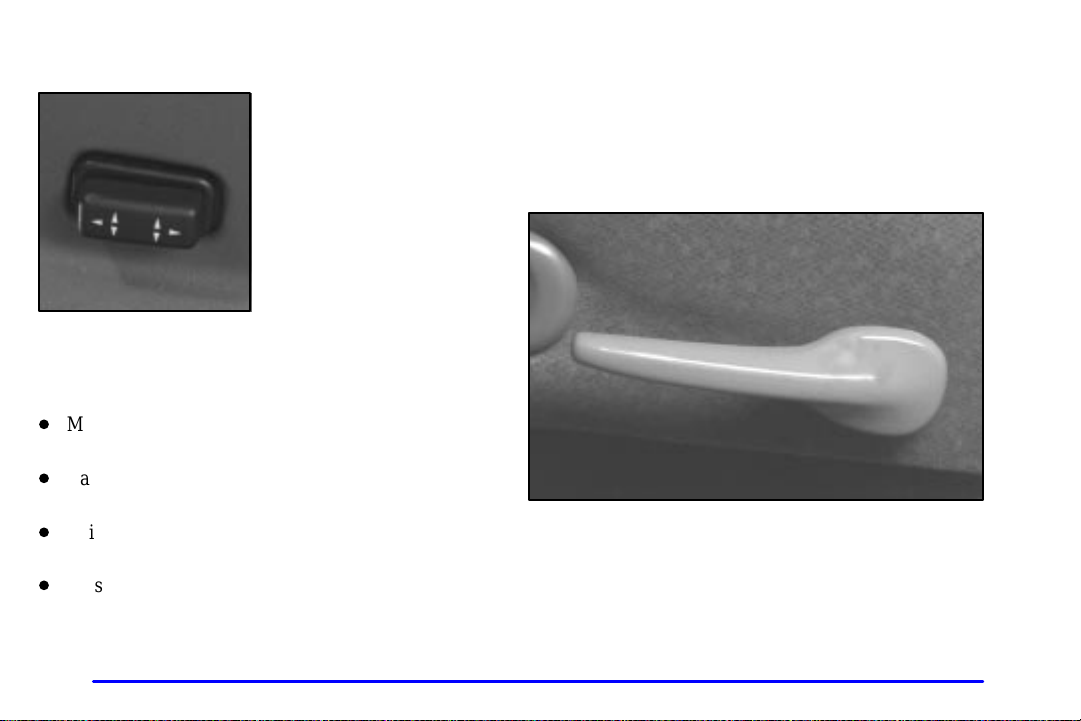
Six-Way Power Seat Controls (If Equipped)
If your vehicle has this
feature, the power seat
control is located on
the outboard side of
the driver’s seat.
This control allows you to move the seat up, down,
forward, or backward. It will also move the front or rear
of the seat cushion up or down.
D
Move the seat forward or rearward by pushing the
control toward the front or rear of the vehicle.
D
Raise or lower the entire seat cushion by holding
the control up or down.
D
Raise or lower the front of the seat cushion by
holding the front of the control up or down.
D
Raise or lower the rear of the seat cushion by
holding the rear of the control up or down.
Manual Lumbar Support (If Equipped)
If your vehicle has this feature, turn the knob located on
the inboard side of the driver’s seat cushion clockwise
or counterclockwise to adjust support of the lower back.
Reclining Front Seatbacks
T o adjust the seatback, lift the lever located on the
outboard side of the seat and move the seatback to
where you want it. Release the lever to lock the
seatback. Pull up on the lever without pushing on the
seatback, and the seatback will go to an upright position.
1-4
Page 11
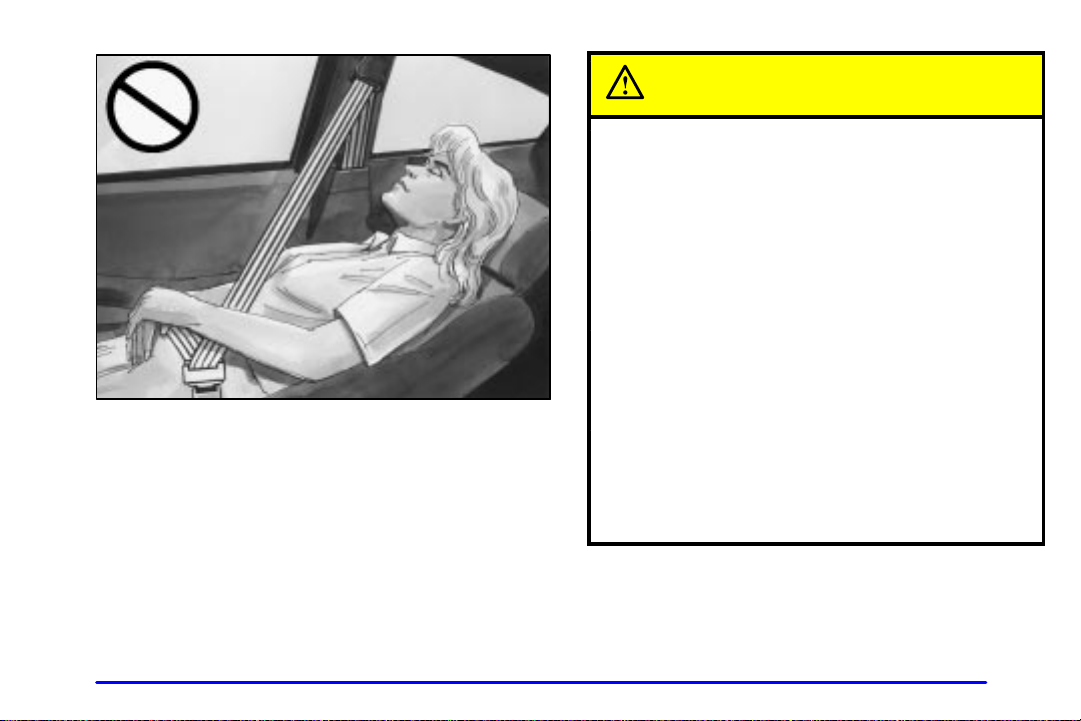
But don’t have a seatback reclined if your vehicle
is moving.
CAUTION:
Sitting in a reclined position when your vehicle is
in motion can be dangerous. Even if you buckle
up, your safety belts can’t do their job when
you’re reclined like this.
The shoulder belt can’t do its job because it
won’t be against your body. Instead, it will be
in front of you. In a crash you could go into it,
receiving neck or other injuries.
The lap belt can’t do its job either. In a crash the
belt could go up over your abdomen. The belt
forces would be there, not at your pelvic bones.
This could cause serious internal injuries.
For proper protection when the vehicle is in
motion, have the seatback upright. Then sit
well back in the seat and wear your safety
belt properly.
1-5
Page 12
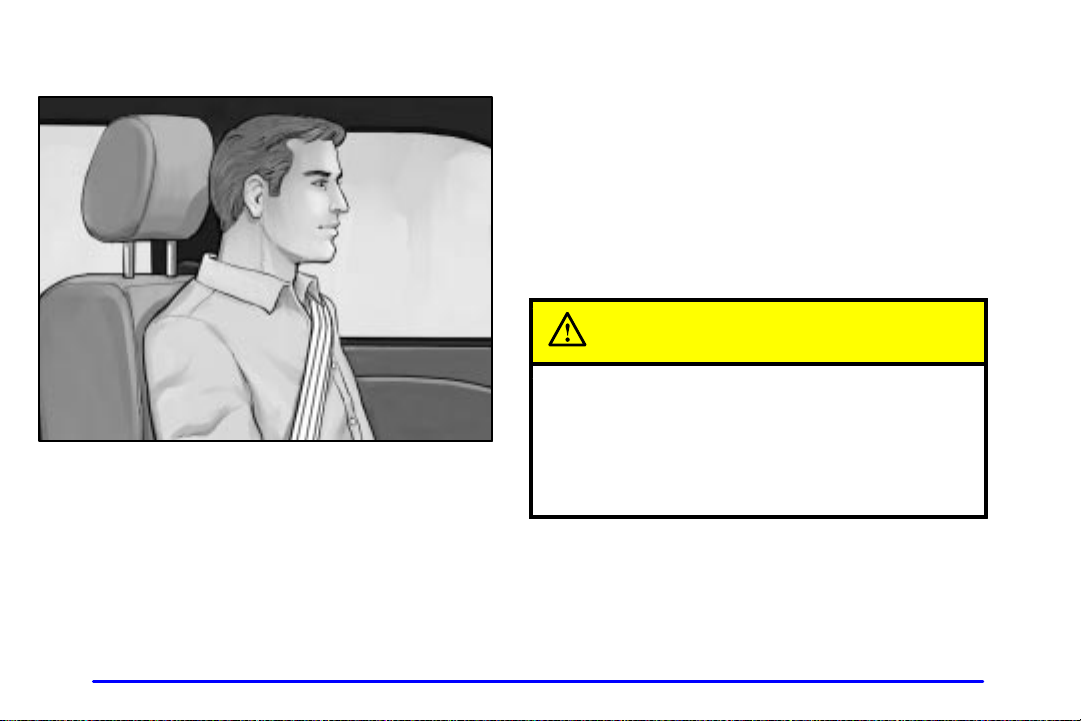
Head Restraints
Slide the head restraint up or down so that the top of the
restraint is closest to the top of your head. This position
reduces the chance of a neck injury in a crash.
Seatback Latches (Two-Door Models)
The front seatbacks fold forward to let people get into
the back seat. The seatback latch is designed for
one
-handed operation.
T o fold a front seatback forward, lift the seatback
latch fully without pushing forward on the seatback to
unlock it. Then the seatback will fold forward.
Push the seatback to its original position, and the
seatback will lock.
CAUTION:
If the seatback isn’t locked, it could move
forward in a sudden stop or crash. That could
cause injury to the person sitting there. Always
press rearward on the seatback to be sure it
is locked.
1-6
Page 13
Easy Entry Seat (Two-Door Models)
The right front seat of your vehicle makes it easy for
people to get in and out of the rear seat.
1. Fold the right front seatback forward by lifting the
seatback latch fully.
2. The seat will slide forward to allow someone to get
into the rear seat area.
3. Push the seatback upright to lock it and slide the seat
fully rearward to lock it.
4. Adjust the seat to the desired position.
5. The front passenger should try to move the seat to
make sure the seat is locked into place.
CAUTION:
If an easy entry right front seat isn’t locked,
it can move. In a sudden stop or crash, the person
sitting there could be injured. After you’ve used
it, be sure to push rearward on an easy entry seat
to be sure it is locked.
Rear Seats
Folding the Rear Seatback (Option)
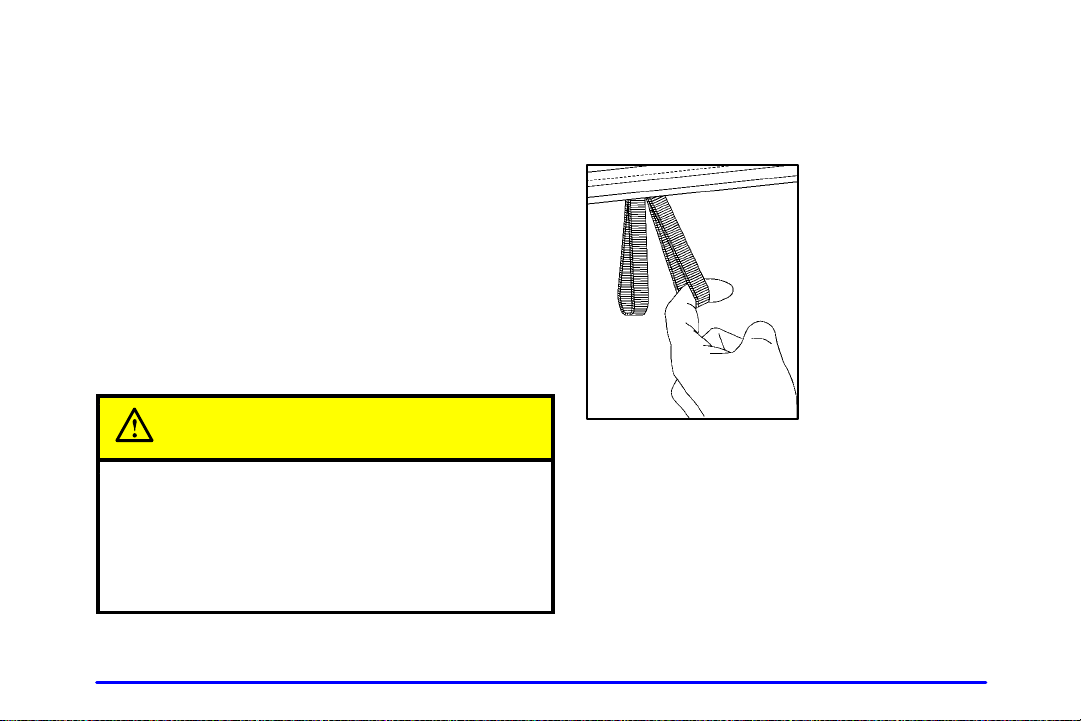
T o fold down the rear seatback, do the following:
1. Pull the release straps
located in the trunk.
The right strap operates
the passenger’s side rear
split seat. The left strap
operates the driver’s
side rear split seat.
2. Fold the seatback down from the inside of
the vehicle.
T o raise the seatback, push the seatback up to return it
to its original position.
Push and pull on the seatback to make sure it is latched
securely in the fully upright position.
1-7
Page 14
Safety Belts: They’re for Everyone
This part of the manual tells you how to use safety belts
properly. It also tells you some things you should not do
with safety belts.
And it explains the Supplemental Restraint System (SRS),
or air bag system.
CAUTION:
Don’t let anyone ride where he or she can’t wear
a safety belt properly. If you are in a crash and
you’re not wearing a safety belt, your injuries
can be much worse. You can hit things inside the
vehicle or be ejected from it. You can be seriously
injured or killed. In the same crash, you might
not be if you are buckled up. Always fasten your
safety belt, and check that your passengers’ belts
are fastened properly too.
CAUTION:
It is extremely dangerous to ride in a cargo
area, inside or outside of a vehicle. In a collision,
people riding in these areas are more likely to be
seriously injured or killed. Do not allow people
to ride in any area of your vehicle that is not
equipped with seats and safety belts. Be sure
everyone in your vehicle is in a seat and using
a safety belt properly.
Your vehicle has a light
that comes on as a reminder
to buckle up. See “Safety
Belt Reminder Light” in
the Index.
1-8
Page 15
In most states and Canadian provinces, the law says to
wear safety belts. Here’s why: They work.
You never know if you’ll be in a crash. If you do have a
crash, you don’t know if it will be a bad one.
A few crashes are mild, and some crashes can be so
serious that even buckled up a person wouldn’t survive.
But most crashes are in between. In many of them,
people who buckle up can survive and sometimes walk
away . Without belts they could have been badly hurt
or killed.
After more than 30 years of safety belts in vehicles,
the facts are clear. In most crashes buckling up does
matter ... a lot!
Why Safety Belts Work
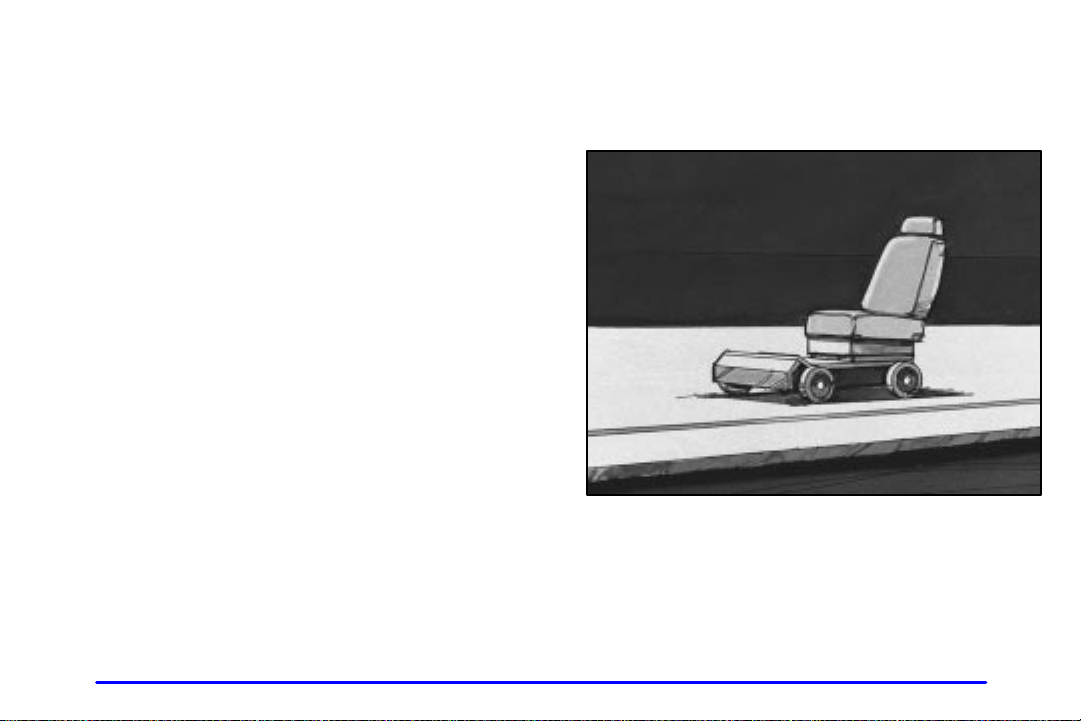
When you ride in or on anything, you go as fast as
it goes.
T ake the simplest vehicle. Suppose it’s just a seat
on wheels.
1-9
Page 16
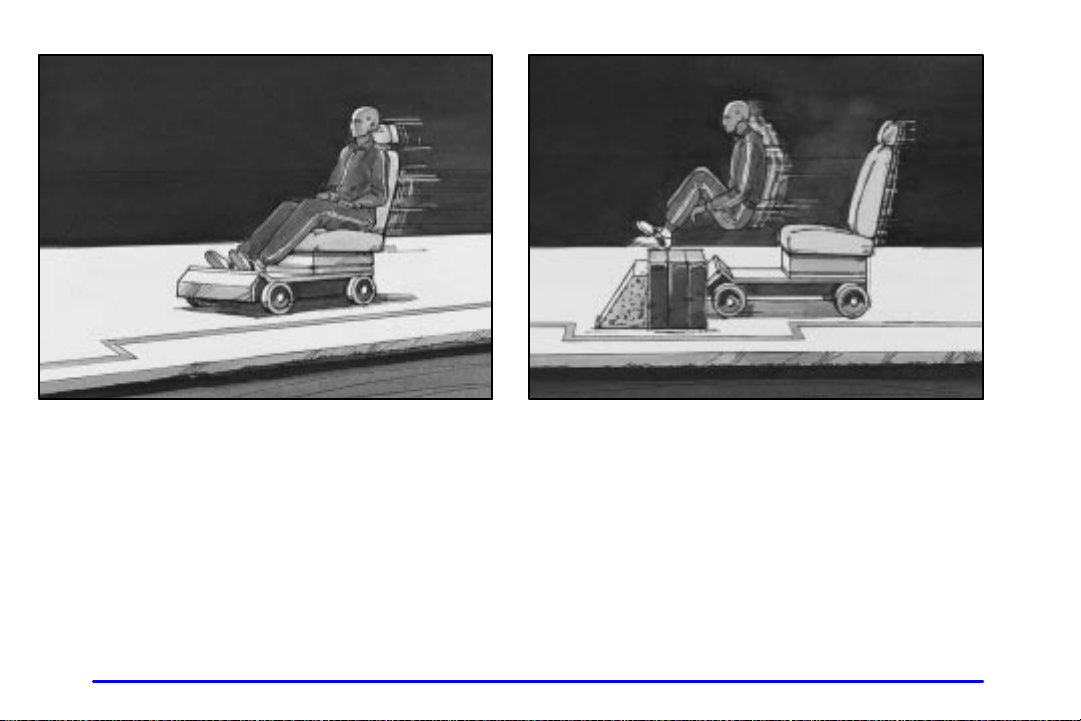
Put someone on it. Get it up to speed. Then stop the vehicle. The rider
doesn’t stop.
1-10
Page 17
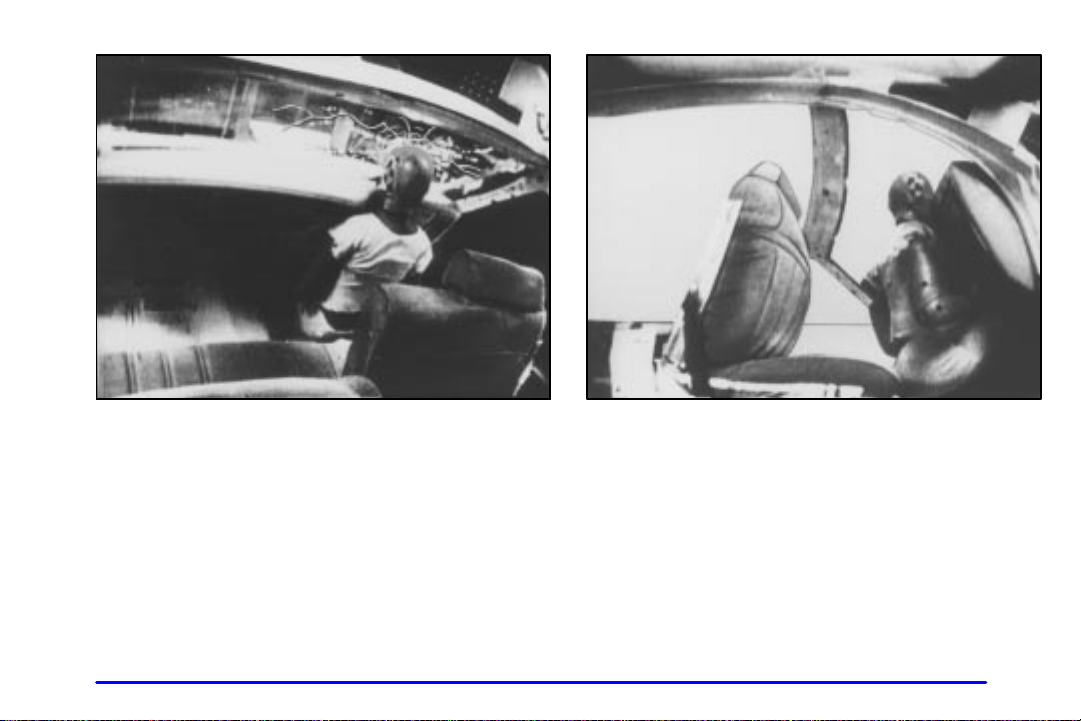
The person keeps going until stopped by something.
In a real vehicle, it could be the windshield ...
or the instrument panel ...
1-11
Page 18
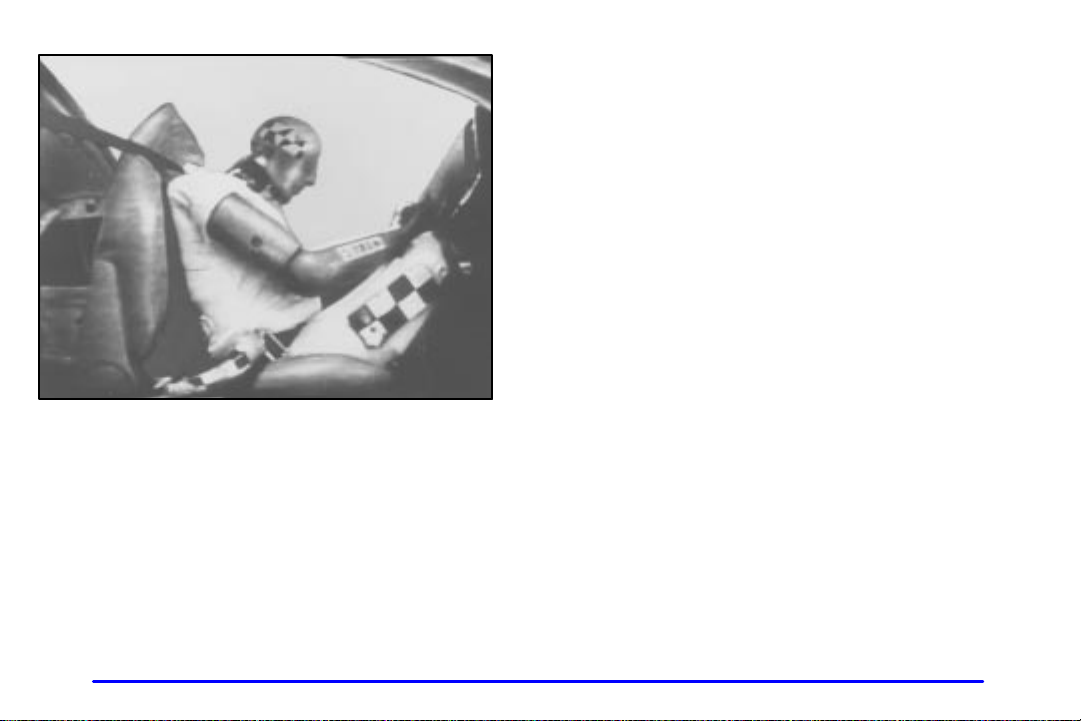
or the safety belts!
With safety belts, you slow down as the vehicle does.
You get more time to stop. You stop over more distance,
and your strongest bones take the forces. That’s why
safety belts make such good sense.
Here Are Questions Many People Ask
About Safety Belts
Won’t I be trapped in the vehicle after an
Q:
accident if I’m wearing a safety belt?
-- and the Answers
A: You could be -- whether you’re wearing a safety
belt or not. But you can unbuckle a safety belt,
even if you’re upside down. And your chance of
being conscious during and after an accident, so
you can unbuckle and get out, is much greater if
you are belted.
Q: If my vehicle has air bags, why should I have
to wear safety belts?
A: Air bags are in many vehicles today and will be in
most of them in the future. But they are
supplemental systems only; so they work with
safety belts
system ever offered for sale has required the use of
safety belts. Even if you’re in a vehicle that has air
bags, you still have to buckle up to get the most
protection. That’s true not only in frontal collisions,
but especially in side and other collisions.
-- not instead of them. Every air bag
1-12
Page 19

Q: If I’m a good driver, and I never drive far from
home, why should I wear safety belts?
A: You may be an excellent driver , but if you’re in
an accident
and your passengers can be hurt. Being a good
driver doesn’t protect you from things beyond
your control, such as bad drivers.
Most accidents occur within 25 miles (40 km)
of home. And the greatest number of serious
injuries and deaths occur at speeds of less than
40 mph (65 km/h).
Safety belts are for everyone.
-- even one that isn’t your fault -- you
How to Wear Safety Belts Properly
Adults
This part is only for people of adult size.
Be aware that there are special things to know about
safety belts and children. And there are different
rules for smaller children and babies. If a child will be
riding in your vehicle, see the part of this manual called
“Children.” Follow those rules for everyone’s protection.
First, you’ll want to know which restraint systems your
vehicle has.
We’ll start with the driver position.
1-13
Page 20
Driver Position
This part describes the driver’s restraint system.
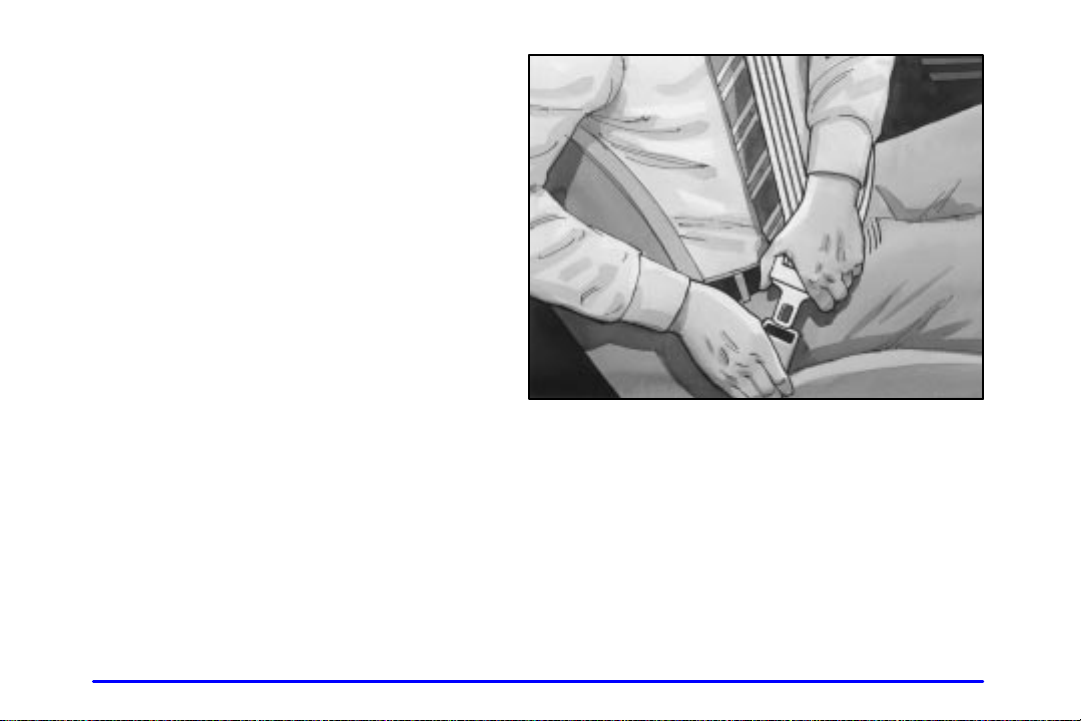
Lap-Shoulder Belt
The driver has a lap-shoulder belt. Here’s how to wear
it properly.
1. Close and lock the door.
2. Adjust the seat so you can sit up straight.
T o see how, see “Seats” in the Index.
3. Pick up the latch plate and pull the belt across you.
Don’t let it get twisted.
The shoulder belt may lock if you pull the belt across
you very quickly. If this happens, let the belt go back
slightly to unlock it. Then pull the belt across you
more slowly.
1-14
Page 21
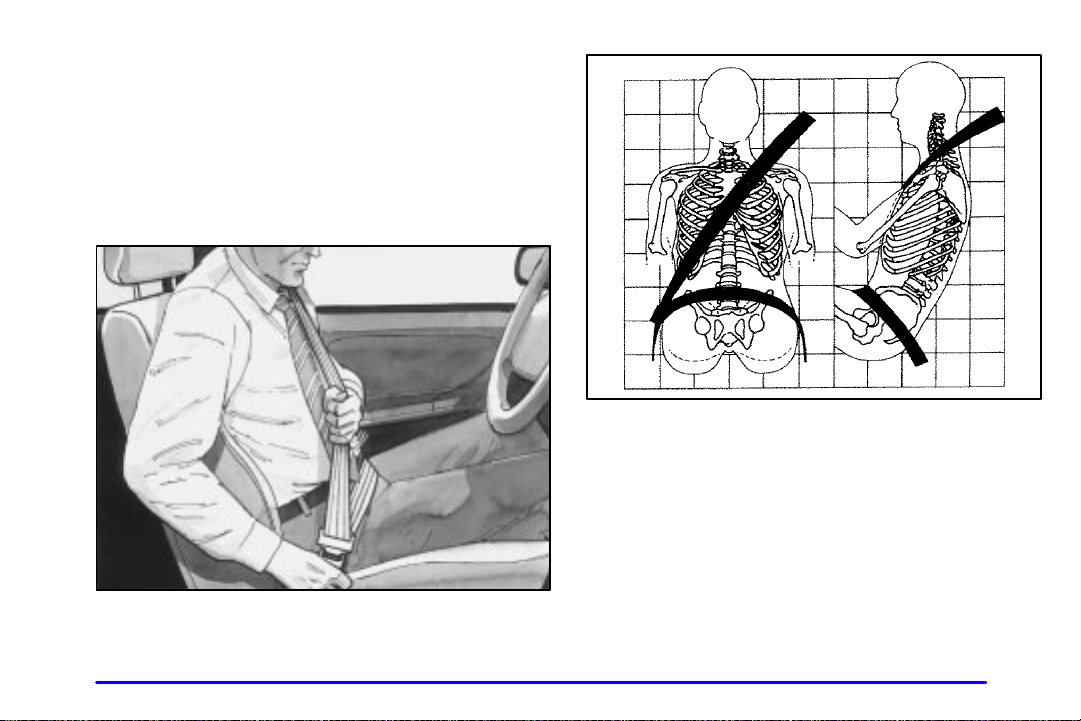
4. Push the latch plate into the buckle until it clicks.
Pull up on the latch plate to make sure it is secure.
If the belt isn’t long enough, see “Safety Belt
Extender” at the end of this section.
Make sure the release button on the buckle is
positioned so you would be able to unbuckle the
safety belt quickly if you ever had to.
5. T o make the lap part tight, pull down on the buckle
end of the belt as you pull up on the shoulder belt.
The lap part of the belt should be worn low and snug on
the hips, just touching the thighs. In a crash, this applies
force to the strong pelvic bones. And you’d be less likely
to slide under the lap belt. If you slid under it, the belt
would apply force at your abdomen. This could cause
serious or even fatal injuries. The shoulder belt should
go over the shoulder and across the chest. These parts
of the body are best able to take belt restraining forces.
The safety belt locks if there’s a sudden stop or crash,
or if you pull the belt very quickly out of the retractor.
1-15
Page 22
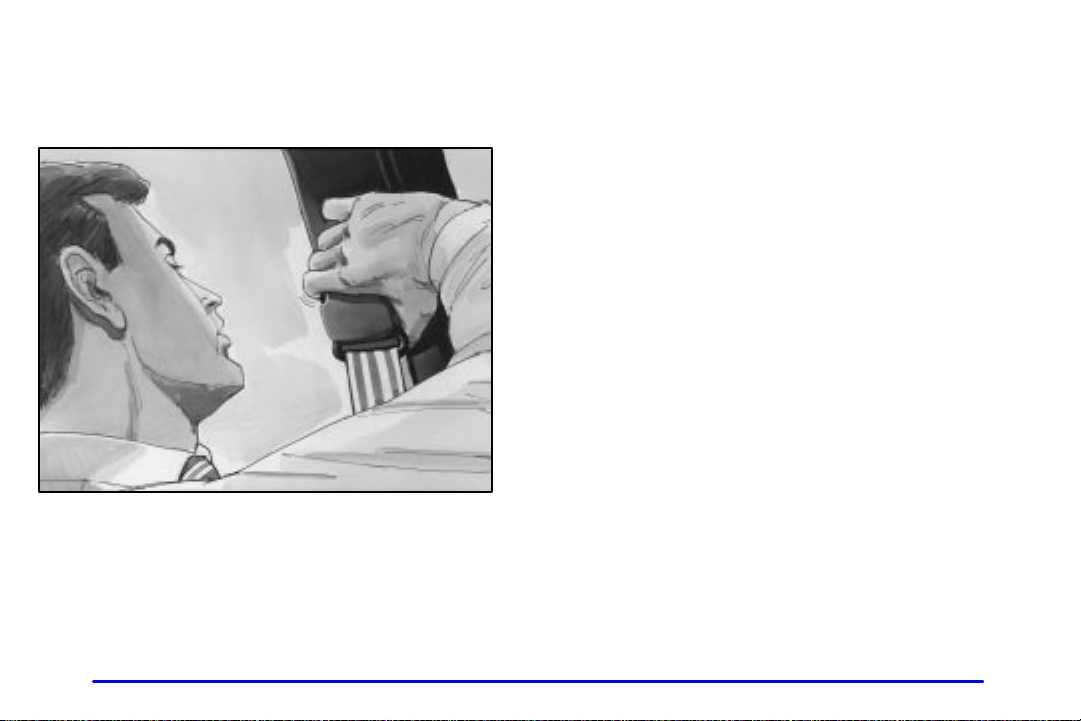
Shoulder Belt Height Adjuster (Four-Door Models)
Before you begin to drive, move the shoulder belt
adjuster to the height that is right for you.
T o move it down, squeeze the release button and move
the height adjuster to the desired position. You can move
the adjuster up just by pushing on the shoulder belt
guide. After you move the adjuster to where you want it,
try to move it down without squeezing the release button
to make sure it has locked into position.
Adjust the height so that the shoulder portion of the
belt is centered on your shoulder. The belt should be
away from your face and neck, but not falling off
your shoulder.
1-16
Page 23
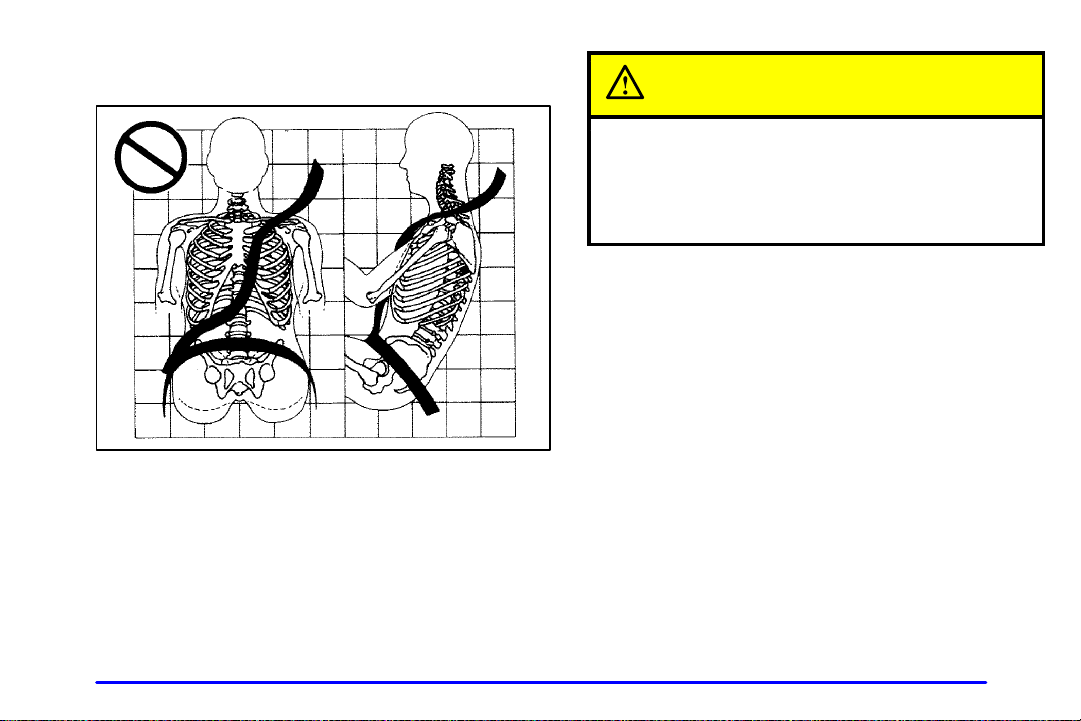
Q: What’s wrong with this?
A: The shoulder belt is too loose. It won’t give nearly
as much protection this way.
CAUTION:
You can be seriously hurt if your shoulder belt is
too loose. In a crash, you would move forward
too much, which could increase injury. The
shoulder belt should fit against your body.
1-17
Page 24
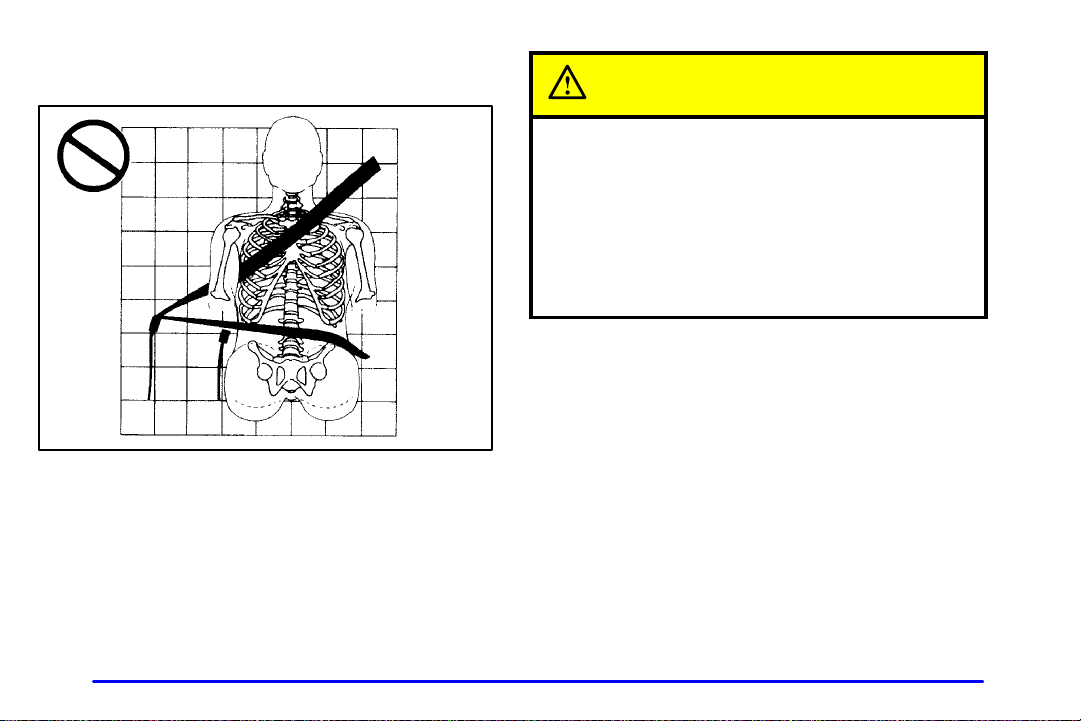
Q: What’s wrong with this?
A: The belt is buckled in the wrong place.
CAUTION:
You can be seriously injured if your belt is
buckled in the wrong place like this. In a crash,
the belt would go up over your abdomen. The
belt forces would be there, not at the pelvic
bones. This could cause serious internal
injuries. Always buckle your belt into the
buckle nearest you.
1-18
Page 25
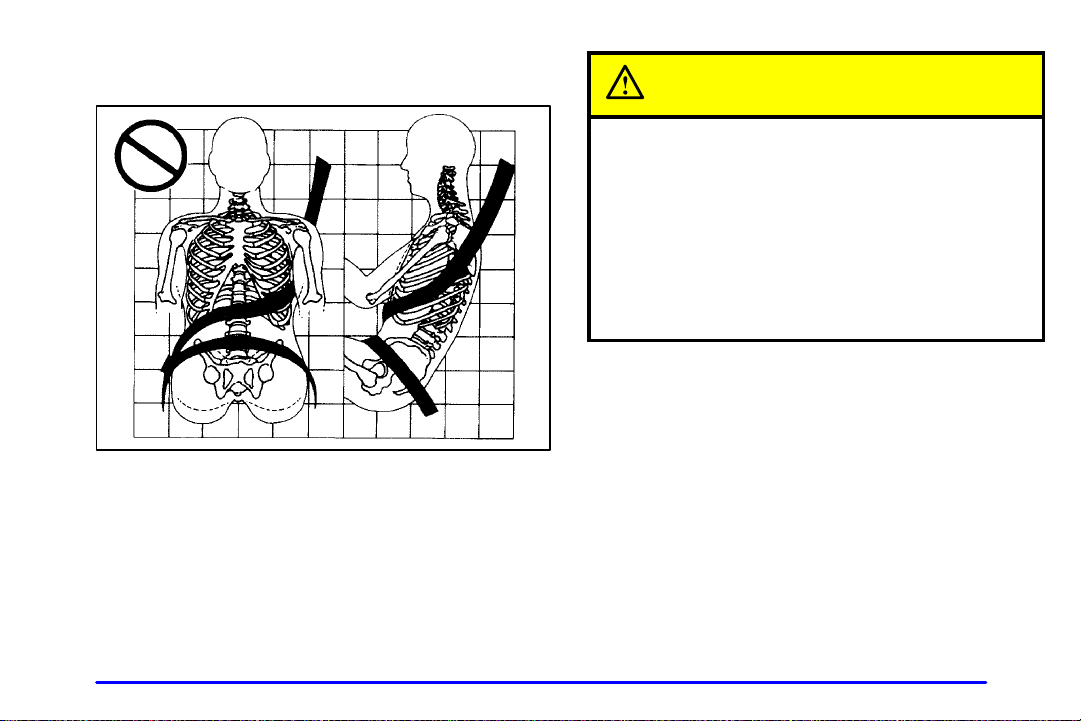
Q: What’s wrong with this?
A: The shoulder belt is worn under the arm. It should
be worn over the shoulder at all times.
CAUTION:
You can be seriously injured if you wear the
shoulder belt under your arm. In a crash, your
body would move too far forward, which would
increase the chance of head and neck injury.
Also, the belt would apply too much force to the
ribs, which aren’t as strong as shoulder bones.
You could also severely injure internal organs
like your liver or spleen.
1-19
Page 26
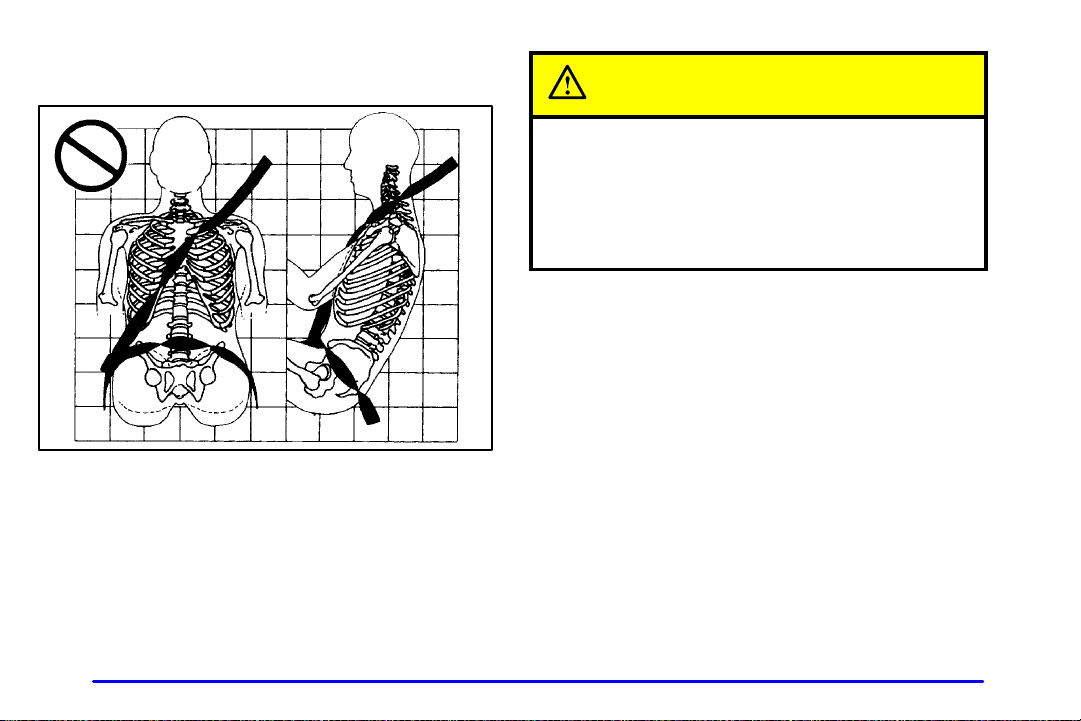
Q: What’s wrong with this?
A: The belt is twisted across the body.
CAUTION:
You can be seriously injured by a twisted belt.
In a crash, you wouldn’t have the full width
of the belt to spread impact forces. If a belt is
twisted, make it straight so it can work properly,
or ask your dealer to fix it.
1-20
Page 27
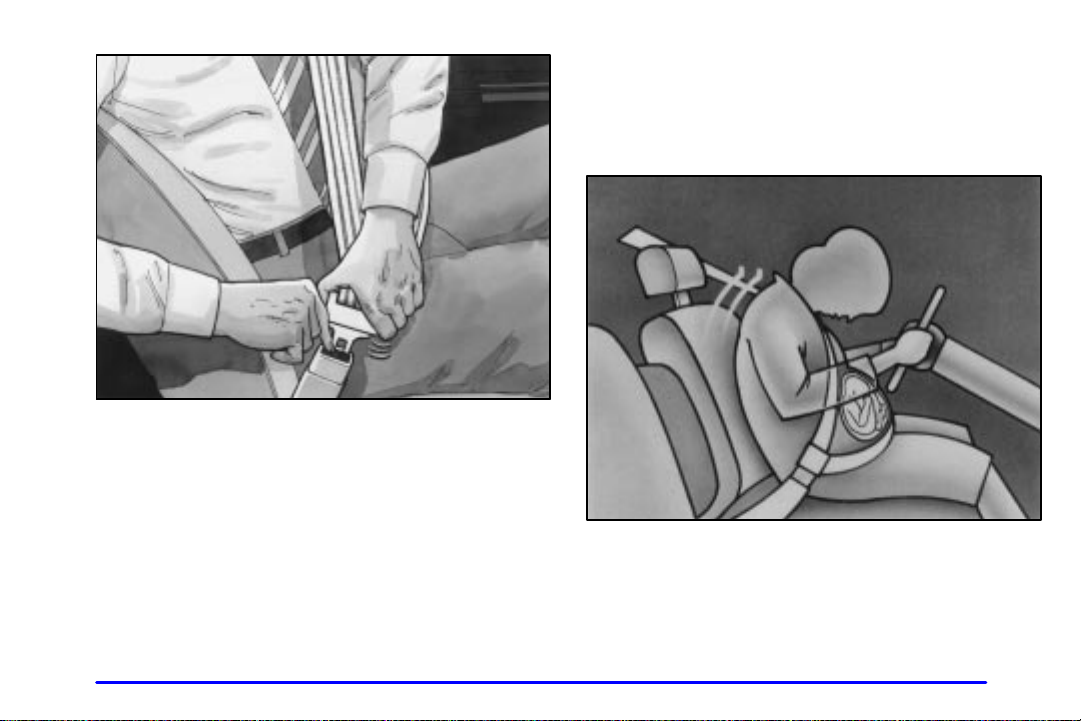
T o unlatch the belt, just push the button on the buckle.
The belt should go back out of the way.
Before you close the door, be sure the belt is out of the
way . If you slam the door on it, you can damage both the
belt and your vehicle.
Safety Belt Use During Pregnancy
Safety belts work for everyone, including pregnant
women. Like all occupants, they are more likely to
be seriously injured if they don’t wear safety belts.
A pregnant woman should wear a lap-shoulder belt,
and the lap portion should be worn as low as possible,
below the rounding, throughout the pregnancy.
1-21
Page 28
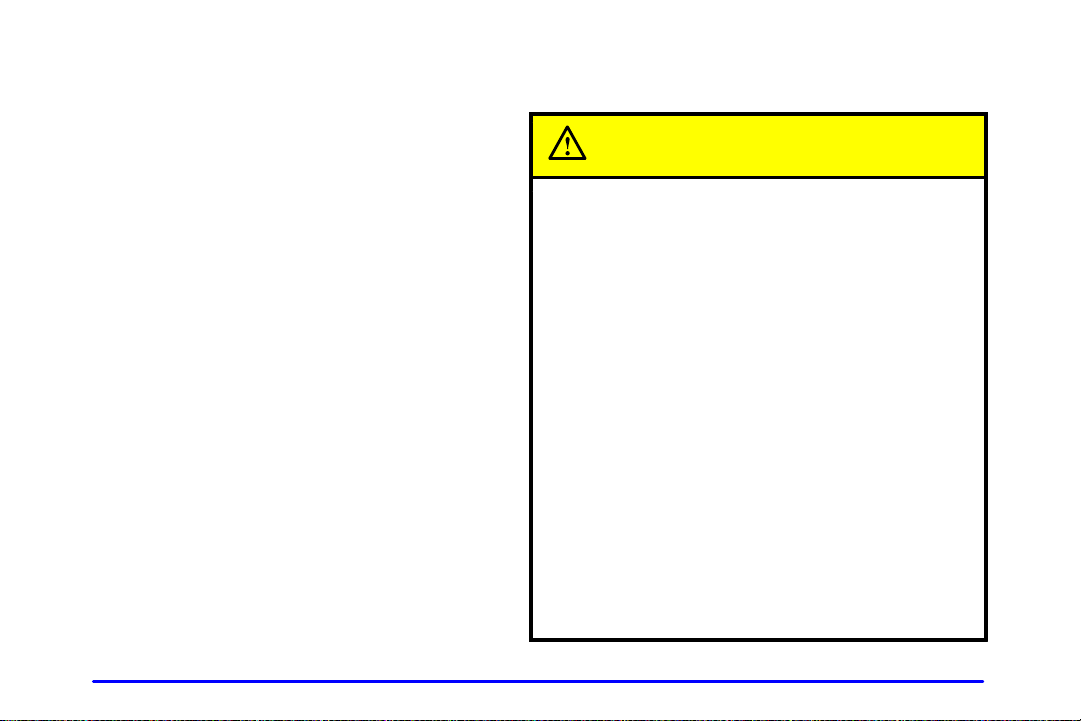
The best way to protect the fetus is to protect the
mother. When a safety belt is worn properly, it’s more
likely that the fetus won’t be hurt in a crash. For
pregnant women, as for anyone, the key to making
safety belts effective is wearing them properly.
Here are the most important things to know about the air
bag system:
CAUTION:
Right Front Passenger Position
T o learn how to wear the right front passenger’s
safety belt properly, see “Driver Position” earlier
in this section.
The right front passenger’s safety belt works the same
way as the driver’s safety belt
If you ever pull the shoulder portion of the belt out
all the way, you will engage the child restraint locking
feature. If this happens, just let the belt go back all the
way and start again.
-- except for one thing.
Supplemental Restraint System (SRS)
This part explains the Supplemental Restraint System
(SRS) or air bag system.
Your vehicle has air bags
and another air bag for the right front passenger.
Frontal air bags are designed to help reduce the risk of
injury from the force of an inflating air bag. But these
air bags must inflate very quickly to do their job and
comply with federal regulations.
1-22
-- one air bag for the driver
You can be severely injured or killed in a crash
if you aren’t wearing your safety belt
if you have air bags. Wearing your safety belt
during a crash helps reduce your chance of
hitting things inside the vehicle or being ejected
from it. Air bags are designed to work with
safety belts, but don’t replace them. Air bags
are designed to work only in moderate to severe
crashes where the front of your vehicle hits
something. They aren’t designed to inflate
at all in rollover, rear or low
crashes, or in many side crashes. And, for some
unrestrained occupants, air bags may provide
less protection in frontal crashes than more
forceful air bags have provided in the past.
Everyone in your vehicle should wear a safety
belt properly
bag for that person.
-- whether or not there’s an air
-speed frontal
-- even
Page 29
CAUTION:
Air bags inflate with great force, faster than
the blink of an eye. If you’re too close to an
inflating air bag, as you would be if you were
leaning forward, it could seriously injure you.
Safety belts help keep you in position before and
during a crash. Always wear your safety belt,
even with air bags. The driver should sit as far
back as possible while still maintaining control
of the vehicle.
CAUTION:
Anyone who is up against, or very close to, any
air bag when it inflates can be seriously injured
or killed. Air bags plus lap
the best protection for adults, but not for young
-shoulder belts offer
CAUTION: (Continued)
CAUTION: (Continued)
children and infants. Neither the vehicle’s safety
belt system nor its air bag system is designed
for them. Young children and infants need the
protection that a child restraint system can
provide. Always secure children properly in
your vehicle. To read how, see the part of this
manual called “Children.”
There is an air bag
readiness light on the
instrument panel, which
shows the air bag symbol.
The system checks the air bag electrical system for
malfunctions. The light tells you if there is an electrical
problem. See “Air Bag Readiness Light” in the Index
for more information.
1-23
Page 30
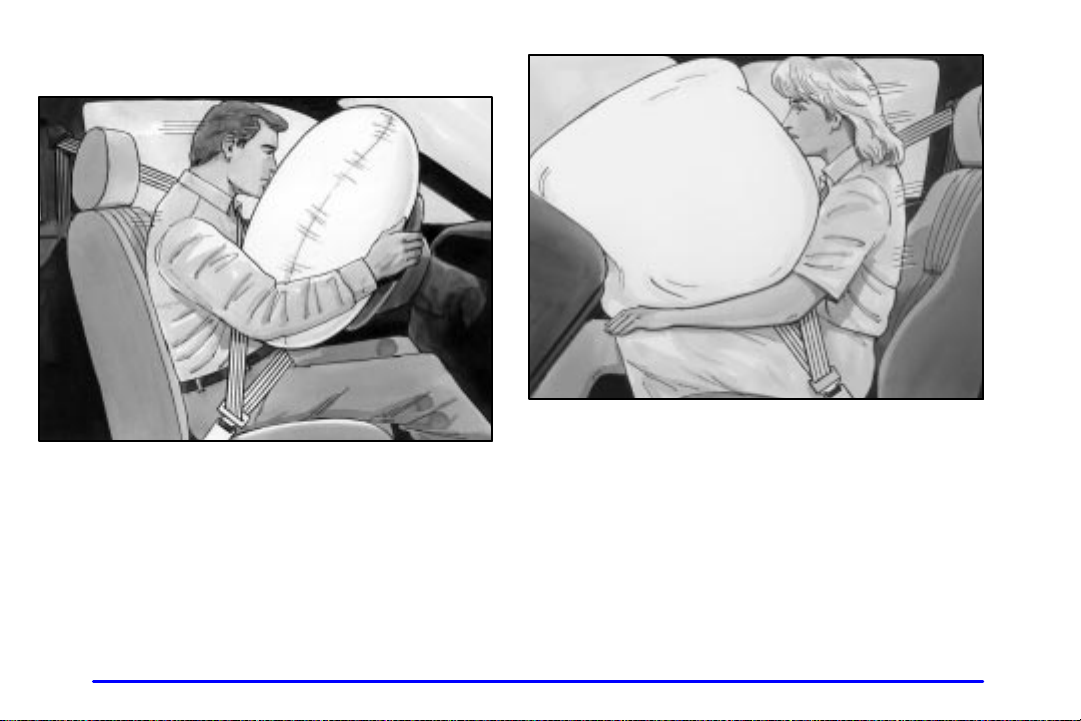
How the Air Bag System Works
Where are the air bags?
The driver’s air bag is in the middle of the
steering wheel.
The right front passenger’s air bag is in the instrument
panel on the passenger’s side.
1-24
Page 31

CAUTION:
If something is between an occupant and an
air bag, the bag might not inflate properly or
it might force the object into that person
causing severe injury or even death. The path
of an inflating air bag must be kept clear. Don’t
put anything between an occupant and an air
bag, and don’t attach or put anything on the
steering wheel hub or on or near any other
air bag covering.
When should an air bag inflate?
An air bag is designed to inflate in a moderate to severe
frontal or near
only if the impact speed is above the system’s designed
“threshold level.” If your vehicle goes straight into a
wall that doesn’t move or deform, the threshold level is
about 9 to 14 mph (14 to 23 km/h). The threshold level
can vary, however, with specific vehicle design, so that
it can be somewhat above or below this range. If your
vehicle strikes something that will move or deform, such
as a parked car, the threshold level will be higher. The
air bag is not designed to inflate in rollovers, rear
impacts, or in many side impacts because inflation
would not help the occupant.
In any particular crash, no one can say whether an air
bag should have inflated simply because of the damage
to a vehicle or because of what the repair costs were.
Inflation is determined by the angle of the impact and
how quickly the vehicle slows down in frontal or
near
-frontal impacts.
-frontal crash. The air bag will inflate
1-25
Page 32

What makes an air bag inflate?
In an impact of sufficient severity, the air bag sensing
system detects that the vehicle is in a crash. The sensing
system triggers a release of gas from the inflator, which
inflates the air bag. The inflator, air bag and related
hardware are all part of the air bag modules inside the
steering wheel and in the instrument panel in front of the
right front passenger.
How does an air bag restrain?
In moderate to severe frontal or near
even belted occupants can contact the steering wheel or the
instrument panel. Air bags supplement the protection
provided by safety belts. Air bags distribute the force of
the impact more evenly over the occupant’s upper body,
stopping the occupant more gradually. But air bags would
not help you in many types of collisions, including
rollovers, rear impacts and many side impacts, primarily
because an occupant’s motion is not toward those air bags.
Air bags should never be regarded as anything more than a
supplement to safety belts, and then only in moderate to
severe frontal or near
-frontal collisions.
-frontal collisions,
What will you see after an air bag inflates?
After an air bag inflates, it quickly deflates, so quickly that
some people may not even realize the air bag inflated.
Some components of the air bag module
wheel hub for the driver’s air bag, or the instrument panel
for the right front passenger’s bag -- will be hot for a short
time. The parts of the bag that come into contact with you
may be warm, but not too hot to touch. There will be
some smoke and dust coming from vents in the deflated
air bags. Air bag inflation doesn’t prevent the driver from
seeing or from being able to steer the vehicle, nor does it
stop people from leaving the vehicle.
-- the steering
CAUTION:
When an air bag inflates, there is dust in the air.
This dust could cause breathing problems
for people with a history of asthma or other
breathing trouble. To avoid this, everyone in the
vehicle should get out as soon as it is safe to do so.
If you have breathing problems but can’t get out
of the vehicle after an air bag inflates, then get
fresh air by opening a window or door.
1-26
Page 33

In many crashes severe enough to inflate an air
bag, windshields are broken by vehicle deformation.
Additional windshield breakage may also occur from the
right front passenger air bag.
D
Air bags are designed to inflate only once. After they
inflate, you’ll need some new parts for your air bag
system. If you don’t get them, the air bag system
won’t be there to help protect you in another crash.
A new system will include air bag modules and
possibly other parts. The service manual for your
vehicle covers the need to replace other parts.
D
Your vehicle is equipped with a crash sensing and
diagnostic module, which records information about
the air bag system. The module records information
about the readiness of the system, when the system
commands air bag inflation and driver’s safety belt
usage at deployment.
D
Let only qualified technicians work on your air
bag system. Improper service can mean that your
air bag system won’t work properly. See your dealer
for service.
NOTICE:
If you damage the covering for the driver’s or the
right front passenger’s air bag, the bag may not
work properly. You may have to replace the air
bag module in the steering wheel or both the air
bag module and the instrument panel for the
right front passenger’s air bag. Do not open or
break the air bag coverings.
1-27
Page 34

Servicing Your Air Bag-Equipped Vehicle
Air bags affect how your vehicle should be serviced.
There are parts of the air bag system in several places
around your vehicle. You don’t want the system
to inflate while someone is working on your vehicle.
Your dealer and the service manual have information
about servicing your vehicle and the air bag system.
T o purchase a service manual, see “Service and Owner
Publications” in the Index.
CAUTION:
For up to 10 minutes after the ignition key is
turned off and the battery is disconnected, an air
bag can still inflate during improper service. You
can be injured if you are close to an air bag when
it inflates. Avoid wires wrapped with yellow tape
or yellow connectors. They are probably part
of the air bag system. Be sure to follow proper
service procedures, and make sure the person
performing work for you is qualified to do so.
The air bag system does not need regular maintenance.
Rear Seat Passengers
It’s very important for rear seat passengers to buckle up!
Accident statistics show that unbelted people in the rear
seat are hurt more often in crashes than those who are
wearing safety belts.
Rear passengers who aren’t safety belted can be thrown
out of the vehicle in a crash. And they can strike others
in the vehicle who are wearing safety belts.
Rear Seat Outside Passenger Positions
Lap-Shoulder Belt
The positions next to the windows have lap
belts. Here’s how to wear one properly.
-shoulder
1-28
Page 35

1. Pick up the latch plate and pull the belt across you.
Don’t let it get twisted.
The shoulder belt may lock if you pull the belt across
you very quickly. If this happens, let the belt go back
slightly to unlock it. Then pull the belt across you
more slowly.
2. Push the latch plate into the buckle until it clicks.
If the belt stops before it reaches the buckle, tilt the
latch plate and keep pulling until you can buckle it.
Pull up on the latch plate to make sure it is secure.
If the belt is not long enough, see “Safety Belt
Extender” at the end of this section. Make sure the
release button on the buckle is positioned so you
would be able to unbuckle the safety belt quickly if
you ever had to.
1-29
Page 36

3. T o make the lap part tight, pull down on the buckle
end of the belt as you pull up on the shoulder part.
1-30
The lap part of the belt should be worn low and snug on
the hips, just touching the thighs. In a crash, this applies
force to the strong pelvic bones. And you’d be less likely
to slide under the lap belt. If you slid under it, the belt
would apply force at your abdomen. This could cause
serious or even fatal injuries. The shoulder belt should
go over the shoulder and across the chest. These parts
of the body are best able to take belt restraining forces.
The safety belt locks if there’s a sudden stop or a crash,
or if you pull the belt very quickly out of the retractor.
Page 37

CAUTION:
You can be seriously hurt if your shoulder belt is
too loose. In a crash, you would move forward
too much, which could increase injury. The
shoulder belt should fit against your body.
T o unlatch the belt, just push the button on the buckle.
Rear Safety Belt Comfort Guides for Children and Small Adults
Rear shoulder belt comfort guides will provide
added safety belt comfort for older children who
have outgrown booster seats and for small adults.
When installed on a shoulder belt, the comfort guide
better positions the belt away from the neck and head.
There is one guide for each outside passenger position
in the rear seat. T o provide added safety belt comfort
for children who have outgrown child restraints and for
smaller adults, the comfort guides may be installed on
the shoulder belts. Here’s how to install a comfort guide
and use the safety belt:
1-31
Page 38

1. Pull the elastic cord out from between the edge
of the seatback and the interior body to remove
the guide from its storage clip.
1-32
2. Slide the guide under and past the belt. The elastic
cord must be under the belt. Then, place the guide
over the belt, and insert the two edges of the belt
into the slots of the guide.
Page 39

3. Be sure that the belt is not twisted and it lies flat.
The elastic cord must be under the belt and the
guide on top.
4. Buckle, position and release the safety belt as
described in “Rear Seat Outside Passenger Positions”
earlier in this section. Make sure that the shoulder
belt crosses the shoulder.
To remove and store the comfort guides, squeeze the
belt edges together so that you can take them out of the
guides. Pull the guide upward to expose its storage clip,
and then slide the guide onto the clip. Turn the guide and
clip inward and in between the seatback and the interior
body, leaving only the loop of the elastic cord exposed.
1-33
Page 40

Center Passenger Position
Lap Belt
When you sit in the center seating position, you have a
lap safety belt, which has no retractor. To make the belt
longer, tilt the latch plate and pull it along the belt.
1-34
Page 41

T o make the belt shorter, pull its free end as shown until
the belt is snug.
Buckle, position and release it the same way as the lap
part of a lap
see “Safety Belt Extender” at the end of this section.
Make sure the release button on the buckle is positioned
so you would be able to unbuckle the safety belt quickly
if you ever had to.
-shoulder belt. If the belt isn’t long enough,
Children
Everyone in a vehicle needs protection! This includes
infants and all other children. Neither the distance
traveled nor the age and size of the traveler changes
the need, for everyone, to use safety restraints. In fact,
the law in every state in the United States and in every
Canadian province says children up to some age must
be restrained while in a vehicle.
Infants and Young Children
Every time infants and young children ride in vehicles,
they should have the protection provided by the
appropriate restraint. Young children should not use
the vehicle’s safety belts, unless there is no other choice.
1-35
Page 42

CAUTION:
People should never hold a baby in their arms
while riding in a vehicle. A baby doesn’t weigh
much
-- until a crash. During a crash a baby will
become so heavy it is not possible to hold it.
CAUTION: (Continued)
CAUTION: (Continued)
For example, in a crash at only 25 mph (40 km/h),
a 12
-lb. (5.5 kg) baby will suddenly become a
240
-lb. (110 kg) force on a person’s arms. A baby
should be secured in an appropriate restraint.
1-36
Page 43

CAUTION:
Children who are up against, or very close to, any
air bag when it inflates can be seriously injured
or killed. Air bags plus lap
outstanding protection for adults and older
children, but not for young children and infants.
Neither the vehicle’s safety belt system nor its air
bag system is designed for them. Young children
and infants need the protection that a child
restraint system can provide.
-shoulder belts offer
Q: What are the different types of add-on
child restraints?
A: Add-on child restraints, which are purchased
by the vehicle’s owner, are available in four basic
types. Selection of a particular restraint should
take into consideration not only the child’s weight,
height and age but also whether or not the restraint
will be compatible with the motor vehicle in which
it will be used.
For most basic types of child restraints, there are
many different models available. When purchasing
a child restraint, be sure it is designed to be used
in a motor vehicle. If it is, the restraint will have a
label saying that it meets federal motor vehicle
safety standards.
The restraint manufacturer’s instructions that
come with the restraint state the weight and
height limitations for a particular child restraint.
In addition, there are many kinds of restraints
available for children with special needs.
1-37
Page 44

CAUTION:
CAUTION:
Newborn infants need complete support,
including support for the head and neck. This is
necessary because a newborn infant’s neck is
weak and its head weighs so much compared with
the rest of its body. In a crash, an infant in a
rear
-facing seat settles into the restraint, so the
crash forces can be distributed across the
strongest part of an infant’s body, the back and
shoulders. Infants always should be secured in
appropriate infant restraints.
1-38
The body structure of a young child is quite
unlike that of an adult or older child, for whom
the safety belts are designed. A young child’s hip
bones are still so small that the vehicle’s regular
safety belt may not remain low on the hip bones,
as it should. Instead, it may settle up around the
child’s abdomen. In a crash, the belt would apply
force on a body area that’s unprotected by any
bony structure. This alone could cause serious or
fatal injuries. Young children always should be
secured in appropriate child restraints.
Page 45

Restraint Systems for Children
An infant car bed (A), a special bed made for use in a
motor vehicle, is an infant restraint system designed to
restrain or position a child on a continuous flat surface.
Make sure that the infant’s head rests toward the center
of the vehicle.
A rear-facing infant seat (B) provides restraint with
the seating surface against the back of the infant. The
harness system holds the infant in place and, in a crash,
acts to keep the infant positioned in the restraint.
1-39
Page 46

A forward-facing child seat (C-E) provides restraint for
the child’s body with the harness and also sometimes
with surfaces such as T
-shaped or shelf-like shields.
1-40
A booster seat (F-G) is a child restraint designed to
improve the fit of the vehicle’s safety belt system.
Some booster seats have a shoulder belt positioner,
and some high
harness. A booster seat can also help a child to see out
the window.
-back booster seats have a five-point
Page 47

Q: How do child restraints work?
A: A child restraint system is any device designed for
use in a motor vehicle to restrain, seat, or position
children. A built
permanent part of the motor vehicle. An add
child restraint system is a portable one, which is
purchased by the vehicle’s owner.
For many years, add
used the adult belt system in the vehicle. T o help
reduce the chance of injury, the child also has to
be secured within the restraint. The vehicle’s belt
system secures the add
vehicle, and the add
system holds the child in place within the restraint.
One system, the three
that come down over each of the infant’s shoulders
and buckle together at the crotch. The five
harness system has two shoulder straps, two hip
straps and a crotch strap. A shield may take the
place of hip straps. A T
straps that are attached to a flat pad which rests low
against the child’s body. A shelf
shield has straps that are attached to a wide,
shelf
-like shield that swings up or to the side.
-in child restraint system is a
-on
-on child restraints have
-on child restraint in the
-on child restraint’s harness
-point harness, has straps
-point
-shaped shield has shoulder
- or armrest-type
When choosing a child restraint, be sure the child
restraint is designed to be used in a vehicle. If it is,
it will have a label saying that it meets federal motor
vehicle safety standards.
Then follow the instructions for the restraint. You may
find these instructions on the restraint itself or in a
booklet, or both. These restraints use the belt system in
your vehicle, but the child also has to be secured within
the restraint to help reduce the chance of personal injury.
When securing an add-on child restraint, refer to the
instructions that come with the restraint which may be
on the restraint itself or in a booklet, or both, and to this
manual. The child restraint instructions are important,
so if they are not available, obtain a replacement copy
from the manufacturer.
1-41
Page 48

Where to Put the Restraint
Accident statistics show that children are safer if they
are restrained in the rear rather than the front seat.
General Motors, therefore, recommends that child
restraints be secured in the rear seat including an infant
riding in a rear
forward
booster seat. Never put a rear
the front passenger seat. Here’s why:
-facing infant seat, a child riding in a
-facing child seat and an older child riding in a
-facing child restraint in
CAUTION:
A child in a rear-facing child restraint can be
seriously injured or killed if the right front
passenger’s air bag inflates. This is because the
back of the rear
very close to the inflating air bag. Always secure
a rear
-facing child restraint in a rear seat.
You may secure a forward-facing child restraint
in the right front seat, but before you do, always
move the front passenger seat as far back as it
will go. It’s better to secure the child restraint in
a rear seat.
-facing child restraint would be
Wherever you install it, be sure to secure the child
restraint properly.
Keep in mind that an unsecured child restraint can
move around in a collision or sudden stop and injure
people in the vehicle. Be sure to properly secure any
child restraint in your vehicle
child is in it.
-- even when no
Top Strap
Some child restraints have a top strap, or “top tether.”
It can help restrain the child restraint during a collision.
For it to work, a top strap must be properly anchored to
the vehicle. Some top strap
are designed for use with or without the top strap being
anchored. Others require the top strap always to be
anchored. Be sure to read and follow the instructions
for your child restraint. If yours requires that the top
strap be anchored, don’t use the restraint unless it is
anchored properly.
-equipped child restraints
1-42
Page 49

If the child restraint does not have a top strap, one
can be obtained, in kit form, for many child restraints.
Ask the child restraint manufacturer whether or not a
kit is available.
In Canada, the law requires that forward-facing
child restraints have a top strap, and that the strap be
anchored. In the United States, some child restraints also
have a top strap. If your child restraint has a top strap,
it should be anchored.
Anchor the top strap to one of the following anchor
points. Be sure to use an anchor point located on the
same side of the vehicle as the seating position where
the child restraint will be placed.
Once you have the top strap anchored, you’ll be ready
to secure the child restraint itself. Tighten the top
strap when and as the child restraint manufacturer’s
instructions say.
1-43
Page 50

Your vehicle has top strap anchors already installed for
the rear seating positions. You’ll find them behind the
rear seat on the filler panel.
Lower Anchorages and Top Tethers for Children (LATCH System)
Your vehicle has the LATCH system. You’ll find
anchors (A) in the rear outside seat positions.
T o assist you in locating the lower anchors for this child
restraint system, each seating position with the LATCH
system will have a label sewn to the seatback at each
anchor position.
The labels are located
near the base of the
two rear outside
seating positions.
1-44
Page 51

In order to use the system, you need either a
forward
points (B) at its base and a top tether anchor (C), or a
rear-facing child restraint that has attaching points (B),
as shown here.
-facing child restraint that has attaching
With this system, use the LATCH system instead of the
vehicle’s safety belts to secure a child restraint.
1-45
Page 52

CAUTION:
If a LATCH-type child restraint isn’t attached
to its anchorage points, the restraint won’t be
able to protect a child sitting there. In a crash,
the child could be seriously injured or killed.
Make sure that a LATCH
is properly installed using the anchorage points,
or use the vehicle’s safety belts to secure the
restraint. See “Securing a Child Restraint in a
Rear Outside Seat Position” in the Index for
information on how to secure a child restraint
in your vehicle using the vehicle’s safety belts.
-type child restraint
Securing a Child Restraint Designed for the LATCH System
1. Find the anchors for the seating position you want
to use, where the bottom of the seatback meets the
back of the seat cushion.
2. Put the child restraint on the seat.
3. Attach the anchor points on the child restraint to
the anchors in the vehicle. The child restraint
instructions will show you how.
4. If the child restraint is forward
strap to the top strap anchor. See “Top Strap” in the
Index. Tighten the top strap according to the child
restraint instructions.
5. Push and pull the child restraint in different
directions to be sure it is secure.
T o remove the child restraint, simply unhook the top
strap from the top tether anchor and then disconnect
the anchor points.
-facing, attach the top
1-46
Page 53

Securing a Child Restraint in a Rear Outside Seat Position
If your child restraint is equipped with the LATCH
system, see “Lower Anchorages and T op Tethers for
Children (LATCH)” in the Index.
You’ll be using the lap
part about the top strap if the child restraint has one.
Be sure to follow the instructions that came with the
child restraint. Secure the child in the child restraint
when and as the instructions say.
1. Put the restraint on the seat.
2. Pick up the latch plate, and run the lap and shoulder
portions of the vehicle’s safety belt through or
around the restraint. The child restraint instructions
will show you how.
-shoulder belt. See the earlier
Tilt the latch plate to adjust the belt if needed.
If the shoulder belt goes in front of the child’s face
or neck, put it behind the child restraint.
1-47
Page 54

3. Buckle the belt. Make sure the release button is
positioned so you would be able to unbuckle the
safety belt quickly if you ever had to.
1-48
4. T o tighten the belt, pull up on the shoulder belt while
you push down on the child restraint. If you’re using
a forward
helpful to use your knee to push down on the child
restraint as you tighten the belt.
5. Push and pull the child restraint in different
directions to be sure it is secure.
T o remove the child restraint, just unbuckle the vehicle’s
safety belt and let it go back all the way. The safety belt
will move freely again and be ready to work for an adult
or larger child passenger.
-facing child restraint, you may find it
Page 55

Securing a Child Restraint in the Center Rear Seat Position
You’ll be using the lap belt. Be sure to follow the
instructions that came with the child restraint. Secure
the child in the child restraint when and as the
instructions say.
See the earlier part about the top strap if the child
restraint has one.
1. Make the belt as long as possible by tilting the latch
plate and pulling it along the belt.
2. Put the restraint on the seat.
3. Run the vehicle’s safety belt through or around the
restraint. The child restraint instructions will show
you how.
1-49
Page 56

4. Buckle the belt. Make sure the release button is
positioned so you would be able to unbuckle the
safety belt quickly if you ever had to.
5. T o tighten the belt, pull its free end while you
push down on the child restraint. If you’re using
a forward
helpful to use your knee to push down on the child
restraint as you tighten the belt.
6. Push and pull the child restraint in different
directions to be sure it is secure.
-facing child restraint, you may find it
T o remove the child restraint, just unbuckle the vehicle’s
safety belt. It will be ready to work for an adult or larger
child passenger.
Securing a Child Restraint in the Right Front Seat Position
Your vehicle has a right front passenger air bag. Never
put a rear
-facing child restraint in this seat. Here’s why:
CAUTION:
A child in a rear-facing child restraint can be
seriously injured or killed if the right front
passenger’s air bag inflates. This is because the
back of the rear
very close to the inflating air bag. Always secure
a rear
-facing child restraint in the rear seat.
-facing child restraint would be
1-50
Page 57

Although a rear seat is a safer place, you can secure
a forward
You’ll be using the lap
part about the top strap if the child restraint has one.
Be sure to follow the instructions that came with the
child restraint. Secure the child in the child restraint
when and as the instructions say.
1. Because your vehicle has a right front passenger
2. Put the restraint on the seat.
3. Pick up the latch plate, and run the lap and shoulder
-facing child restraint in the right front seat.
-shoulder belt. See the earlier
air bag, always move the seat as far back as it will
go before securing a forward
See “Seats” in the Index.
portions of the vehicle’s safety belt through or
around the restraint. The child restraint instructions
will show you how.
If the shoulder belt goes in front of the child’s face or
neck, put it behind the child restraint.
-facing child restraint.
4. Buckle the belt. Make sure the release button is
positioned so you would be able to unbuckle the
safety belt quickly if you ever had to.
1-51
Page 58

5. Pull the rest of the shoulder belt all the way out of
the retractor to set the lock.
1-52
6. To tighten the belt, feed the shoulder belt back into
the retractor while you push down on the child
restraint. You may find it helpful to use your knee to
push down on the child restraint as you tighten the belt.
7. Push and pull the child restraint in different
directions to be sure it is secure.
T o remove the child restraint, just unbuckle the vehicle’s
safety belt and let it go back all the way. The safety belt
will move freely again and be ready to work for an adult
or larger child passenger.
Page 59

Older Children
Older children who have outgrown booster seats should
wear the vehicle’s safety belts.
If you have the choice, a child should sit next to a
window so the child can wear a lap
get the additional restraint a shoulder belt can provide.
-shoulder belt and
Q: What is the proper way to wear safety belts?
A: If possible, an older child should wear a
lap
-shoulder belt and get the additional restraint a
shoulder belt can provide. The shoulder belt should
not cross the face or neck. The lap belt should fit
snugly below the hips, just touching the top of the
thighs. It should never be worn over the abdomen,
which could cause severe or even fatal internal
injuries in a crash.
Accident statistics show that children are safer if they
are restrained in the rear seat.
In a crash, children who are not buckled up can strike
other people who are buckled up, or can be thrown
out of the vehicle. Older children need to use safety
belts properly.
1-53
Page 60

CAUTION:
Never do this.
Here two children are wearing the same belt.
The belt can’t properly spread the impact forces.
In a crash, the two children can be crushed
together and seriously injured. A belt must be
used by only one person at a time.
Q: What if a child is wearing a lap-shoulder belt,
but the child is so small that the shoulder belt is
very close to the child’s face or neck?
A: Move the child toward the center of the vehicle, but
be sure that the shoulder belt still is on the child’s
shoulder, so that in a crash the child’s upper body
would have the restraint that belts provide. If the
child is sitting in a rear seat outside position, see
“Rear Safety Belt Comfort Guides” in the Index.
If the child is so small that the shoulder belt is still
very close to the child’s face or neck, you might
want to place the child in the center seat position,
the one that has only a lap belt.
1-54
Page 61

CAUTION:
Never do this.
Here a child is sitting in a seat that has a
lap
-shoulder belt, but the shoulder part is behind
the child. If the child wears the belt in this way,
in a crash the child might slide under the belt.
The belt’s force would then be applied right on
the child’s abdomen. That could cause serious or
fatal injuries.
Wherever the child sits, the lap portion of the belt
should be worn low and snug on the hips, just touching
the child’s thighs. This applies belt force to the child’s
pelvic bones in a crash.
1-55
Page 62

Safety Belt Extender
If the vehicle’s safety belt will fasten around you,
you should use it.
But if a safety belt isn’t long enough to fasten, your
dealer will order you an extender. It’s free. When you go
in to order it, take the heaviest coat you will wear, so the
extender will be long enough for you. The extender will
be just for you, and just for the seat in your vehicle that
you choose. Don’t let someone else use it, and use it
only for the seat it is made to fit. T o wear it, just attach it
to the regular safety belt.
Checking Your Restraint Systems
Now and then, make sure the safety belt reminder light
and all your belts, buckles, latch plates, retractors and
anchorages are working properly. Look for any other
loose or damaged safety belt system parts. If you see
anything that might keep a safety belt system from
doing its job, have it repaired.
T orn or frayed safety belts may not protect you in
a crash. They can rip apart under impact forces.
If a belt is torn or frayed, get a new one right away.
Also look for any opened or broken air bag covers, and
have them repaired or replaced. (The air bag system
does not need regular maintenance.)
Replacing Restraint System Parts After a Crash
If you’ve had a crash, do you need new belts or
LATCH system parts?
After a very minor collision, nothing may be necessary.
But if the belts were stretched, as they would be if worn
during a more severe crash, then you need new parts.
If the LATCH system was being used during a more
severe crash, you may need new LATCH system parts.
If belts are cut or damaged, replace them. Collision
damage also may mean you will need to have LATCH
system, safety belt or seat parts repaired or replaced.
New parts and repairs may be necessary even if the belt
or LATCH system wasn’t being used at the time of
the collision.
If your seat adjuster won’t work after a crash, the special
part of the safety belt that goes through the seat to the
adjuster may need to be replaced.
If an air bag inflates, you’ll need to replace air bag
system parts. See the part on the air bag system
earlier in this section.
1-56
Page 63

Section 2 Features and Controls
Here you can learn about the many standard and optional features on your vehicle, and information on starting,
shifting and braking. Also explained are the instrument panel and the warning systems that tell you if everything is
working properly
-- and what to do if you have a problem.
-2 Windows
2
2
-4 Keys
-6 Door Locks
2
2
-11 Remote Keyless Entry System (If Equipped)
-15 Trunk
2
2
-18 Theft
2
-19 Passlock
2-19 New Vehicle “Break-In”
2
-20 Ignition Positions
-21 Starting Your Engine
2
2
-24 Engine Coolant Heater (Option)
2
-26 Automatic Transaxle Operation
-30 Manual Transaxle Operation
2
2
-32 Parking Brake
-33 Shifting Into PARK (P)
2
(Automatic Transaxle Only)
2-35 Shifting Out of PARK (P)
(Automatic Transaxle Only)
R
2-
2
-35 Parking Your Vehicle/Key Removal
2-36 Parking Over Things That Burn
-36 Engine Exhaust
2
2
-37 Running Your Engine While You’re Parked
2-38 Tilt Wheel
2
-38 Turn Signal/Multifunction Lever
-45 Exterior Lamps
2
2
-48 Interior Lamps
2
-50 Mirrors
-52 Storage Compartments
2
-53 Ashtray and Cigarette Lighter (If Equipped)
2
2
-53 Sun Visors
-54 Accessory Power Outlet
2
2
-55 Sunroof (Option)
2
-56 The Instrument Panel -- Your
-60 Warning Lights, Gages and Indicators
2
(Manual Transaxle Models Only)
(Automatic Transaxle)
Information System
2-1
Page 64

Windows
CAUTION:
Leaving children in a vehicle with the windows
closed is dangerous. A child can be overcome by
the extreme heat and can suffer permanent
injuries or even death from heat stroke. Never
leave a child alone in a vehicle, especially with the
windows closed in warm or hot weather.
2-2
Page 65

Manual Windows
On a vehicle with manual windows, use the window
crank to open and close each window.
Power Windows (If Equipped)
The power window switches are located on the armrest
on the driver’s door. In addition, each passenger door
has a window switch.
Auto
-Down Switch
The driver’s window switch has an auto
This switch is labeled AUTO. Press the rear of the
switch slightly down, and the driver’s window will open
a small amount. If the rear of the switch is pressed all
the way down, the window will go all the way down.
T o stop the window while it is lowering, press the front
of the switch. T o raise the window, press and hold the
front of the switch.
-Out Switch (Four-Door Models)
Lock
On four
controls also include a lock
lock
passengers will be able to use their window switches.
Move the lock-out switch to the right to stop the
passengers from using their window switches.
The driver can still operate all of the windows with
the lock on.
-door models, the driver’s power window
-out switch. When the
-out switch is moved to the left, the driver and
-down feature.
2-3
Page 66

Keys
CAUTION:
Leaving children in a vehicle with the ignition
key is dangerous for many reasons. A child or
others could be badly injured or even killed.
They could operate the power windows or other
controls or even make the vehicle move. Don’t
leave the keys in a vehicle with children.
2-4
Page 67

One key is used for the
ignition and all locks.
When a new vehicle is delivered, the key has a
-coded key tag. This tag may be removed by your
bar
dealer before it is delivered.
Each tag has a key code on it that tells your dealer
or a qualified locksmith how to make extra keys.
Keep the tag in a safe place. If you lose your keys,
you’ll be able to have one made easily using this tag.
If you need a new key, go to your dealer for the correct
key code. See “Roadside Assistance” in the Index for
more information.
NOTICE:
Your vehicle has a number of new features that
can help prevent theft, therefore you can have a
lot of trouble getting into your vehicle if you ever
lock your keys inside. You may even have to
damage your vehicle to get in. So be sure you
have extra keys.
2-5
Page 68

Door Locks
CAUTION:
Unlocked doors can be dangerous.
D
Passengers -- especially children -- can
easily open the doors and fall out of a
moving vehicle. When a door is locked, the
handle won’t open it. You increase the
chance of being thrown out of the vehicle in
a crash if the doors aren’t locked. So, wear
safety belts properly and lock the doors
whenever you drive.
D
Young children who get into unlocked
vehicles may be unable to get out. A child
can be overcome by extreme heat and can
suffer permanent injuries or even death
from heat stroke. Always lock your vehicle
whenever you leave it.
D
Outsiders can easily enter through an
unlocked door when you slow down or stop
your vehicle. Locking your doors can help
prevent this from happening.
There are several ways to lock and unlock your vehicle.
T o unlock the door from the outside, use your key or
remote keyless entry transmitter, if your vehicle is
equipped with this feature.
T o lock the door from the inside, move the manual
lock forward.
T o unlock the door, move the manual lock rearward.
2-6
Page 69

Power Door Locks
With the power door locks, you can lock or unlock all of
the doors on your vehicle using the driver’s or front
passenger’s door lock switch.
Press the bottom of the switch to lock all of the doors.
Press the top of the switch to unlock all of the doors.
Programmable Automatic Door Locks
Your vehicle has a feature that allows you to program
your power door locks to automatically lock and unlock
under certain conditions. You can program your vehicle
to have all of the doors lock when you move your shift
lever out of PARK (P) to REVERSE (R) if your vehicle
has an automatic transaxle or when the vehicle speed is
greater than 5 mph (8 km/h) if your vehicle has a
manual transaxle. If someone needs to get out while the
vehicle is running, have that person use the door lock.
When the door is closed again, it will lock automatically
when the vehicle reaches about 5 mph (8 km/h). You can
also program all doors to automatically unlock when the
shift lever is moved to PARK (P) on vehicles with an
automatic transaxle or to REVERSE (R) on vehicles
with a manual transaxle when the key is turned to OFF.
2-7
Page 70

Customizing the Automatic Door Locks
One of four operating modes may be selected and
programmed by the driver on vehicles with an
automatic transaxle:
D
Mode 1: All doors automatically lock when the
transaxle is shifted out of PARK (P). The doors will
remain locked unless manually unlocked or the lock
button is pressed. All doors will unlock when the
transaxle is shifted into PARK (P) and the key is
turned to OFF.
D
Mode 2: This mode is only available on vehicles
equipped with a remote keyless entry transmitter. All
doors automatically lock when the transaxle is
shifted out of PARK (P). Automatic driver’s door
only unlock when the transaxle is shifted into
PARK(P) and the key is turned to OFF.
D
Mode 3: All doors automatically lock when the
transaxle is shifted out of PARK (P). No automatic
door unlock.
D
Mode 4: No automatic door lock or unlock.
One of the four operating modes may be selected
and programmed by the driver on vehicles with a
manual transaxle:
D
Mode 1: All doors automatically lock when the
vehicle speed is greater than 5 mph (8 km/h). The
doors will remain locked unless manually unlocked
or the lock button is pressed. All doors will unlock
when the transaxle is shifted into REVERSE (R) and
the key is turned to OFF.
D
Mode 2: This mode is only available with the remote
keyless entry transmitter. All doors automatically
lock when the vehicle speed is greater than 5 mph
(8 km/h). Automatic driver’s door only unlock when
the transaxle is shifted into REVERSE (R) and the
key is turned to OFF.
D
Mode 3: All doors automatically lock when the
vehicle speed is greater than 5 mph (8 km/h). No
automatic door unlock.
D
Mode 4: No automatic door lock or unlock.
2-8
Page 71

Before your vehicle was shipped from the factory it was
programmed in Mode 1. T o determine the current mode
or to change to a different mode, do the following:
1. Put an automatic transaxle in PARK (P) or a manual
transaxle in REVERSE (R) with the parking brake
engaged and turn the ignition to ON.
2. Press and hold the lower part of the power door lock
switch for 10 seconds. Release the switch when you
hear the chime.
3. Count the number of chimes you hear. The number
of chimes tells you which mode your vehicle is in.
You can change the mode by pressing and holding
the lower part of the power door lock switch (two
chimes for Mode 2, three chimes for Mode 3 and
four chimes for Mode 4).
4. Repeat Step 2 until you hear the number of chimes
that matches the mode you want.
The mode you selected is now set.
Delayed Locking
This feature will allow the driver to delay the actual
locking of the vehicle. This feature will not operate if
the key is left in the ignition. See “Anti
Protection” later in this section.
When the lower part of the driver’s power door lock
switch is pressed, with the key removed from the
ignition and the driver’s door open, three chimes will
be heard. The doors will not lock. Seven seconds after
the driver’s door has been closed, all of the doors
will lock and the parking lamps will flash. The horn
will also chirp if the horn chirp feature is enabled.
See “Programmable Horn Chirp” in the Index for
more information.
If the driver opens another door before the seven
seconds are up, the doors will not lock until seven
seconds have elapsed after the last door is closed.
If the lower part of the power door lock switch is
pressed twice when leaving the vehicle, or the lock
symbol button on the remote keyless entry transmitter is
pressed, the doors will lock immediately.
If the power door lock switch is pressed to unlock, the
doors will not lock automatically.
-Lockout
2-9
Page 72

Rear Door Security Locks (Four-Door Models)
If your vehicle is a four-door model, it is equipped with
rear door security locks that help prevent passengers
from opening the rear doors from the inside.
The switch is located on the
inside of the rear door.
T o use the security locks, do the following:
1. Move the switch up.
2. Close the door.
3. Do the same thing to the other rear door.
The rear doors on your vehicle cannot be opened
from the inside when this feature is in use. If you
want to open a rear door when the security lock is on,
do the following:
1. Unlock the door from the inside.
2. Then open the door from the outside.
If you don’t cancel the security lock feature, adults or
older children who ride in the rear won’t be able to open
the rear door from the inside. You should let adults and
older children know how these security locks work, and
how to cancel the locks.
T o cancel a rear door lock, do the following:
1. Unlock the door from the inside and open it from
the outside.
2. Move the switch down.
3. Do the same to the other rear door.
The rear doors will now work normally.
2-10
Page 73

Anti-Lockout Protection
Anti-lockout protection is intended to provide enhanced
security and convenience. This feature prevents a driver
who has left the keys in the ignition from locking the
doors, using the power door locks while any door
is open.
T o override this feature, when the key is in the ignition
and any door is open, press and hold down the power
door lock switch for three seconds.
This feature cannot guarantee that you will never be
locked out of your vehicle. If you don’t leave the keys in
the ignition, or if you use the manual door lock or the
remote keyless entry transmitter, you could still lock
your keys inside your vehicle. Always remember to take
your keys with you.
Leaving Your Vehicle
If you are leaving your vehicle, open your door and
set the locks from the inside, then get out and close
the door.
Remote Keyless Entry System (If Equipped)
If your vehicle has this feature, you can lock and unlock
your doors or unlock your trunk from about 3 feet (1 m)
up to 30 feet (9 m) away using the remote keyless entry
transmitter supplied with your vehicle.
Your remote keyless entry operates on a radio frequency
subject to Federal Communications Commission (FCC)
Rules and with Industry Canada.
This device complies with Part 15 of the FCC Rules.
Operation is subject to the following two conditions:
(1) this device may not cause harmful interference, and
(2) this device must accept any interference received,
including interference that may cause undesired operation.
This device complies with RSS
Operation is subject to the following two conditions:
(1) this device may not cause interference, and (2) this
device must accept any interference received, including
interference that may cause undesired operation of
the device.
-210 of Industry Canada.
2-11
Page 74

Changes or modifications to this system by other than an
authorized service facility could void authorization to
use this equipment.
At times you may notice a decrease in range. This is
normal for any remote keyless entry system. If the
transmitter does not work or if you have to stand closer
to your vehicle for the transmitter to work, try this:
D
Check the distance. You may be too far from your
vehicle. You may need to stand closer during rainy
or snowy weather.
D
Check the location. Other vehicles or objects may
be blocking the signal. T ake a few steps to the left
or right, hold the transmitter higher, and try again.
D
Check to determine if battery replacement is
necessary. See the instructions that follow.
D
If you’re still having trouble, see your dealer or a
qualified technician for service.
Operation
The following functions
are available with the
keyless entry system:
(Lock): All doors will automatically lock when this
button on the transmitter is pressed. The interior lamps
will turn off after all of the doors are closed. If all of the
doors are closed, the parking lamps will flash twice and
the horn will chirp to indicate locking has occurred.
(Unlock): The driver’s door will unlock
automatically when this button on the transmitter is
pressed. If the button is pressed again within five
seconds, all remaining doors will unlock. The interior
lamps will stay on for 10 seconds or until the ignition is
turned on. The parking lamps will flash twice to indicate
unlocking has occurred.
2-12
Page 75

(Remote T runk Release): The trunk will unlock
when the vehicle symbol on the transmitter is pressed, as
long as the trunk lockout is not engaged. You can open
the trunk with the transmitter when the vehicle speed is
less than 2 mph (3 km/h), when the parking brake is
engaged, or when the ignition is off. The interior lamps
will come on for 10 seconds or until the ignition switch
is turned to ON.
(Horn): The horn will sound and the headlamps
and the parking lamps will flash for up to two minutes
when the horn symbol on the transmitter is pressed.
The interior lamps will come on and remain on while
the horn is sounding and the lamps are flashing. The
horn and lamps can be turned off by pressing the horn
symbol button again or by turning the ignition to ON.
Programmable Horn Chirp
When you use the remote keyless entry transmitter to
lock the doors or use the delayed locking feature the
parking lamps will flash and the horn will chirp.
The programmable horn chirp can be disabled by
pressing and holding either of the door lock switches in
the unlock position for 10 seconds with the ignition ON
and all of the doors closed. When you hear the horn
chirp, programming is complete.
T o reactivate the horn chirp feature, repeat the
above procedure.
Matching Transmitter(s) to Your Vehicle
Each remote keyless entry transmitter is coded to
prevent another transmitter from unlocking your vehicle.
If a transmitter is lost or stolen, a replacement can be
purchased through your dealer. Remember to bring any
remaining transmitters with you when you go to your
dealer. When the dealer matches the replacement
transmitter to your vehicle, any remaining transmitters
must also be matched. Once your dealer has coded the
new transmitter, the lost transmitter will not unlock your
vehicle. Each vehicle can have a maximum of four
transmitters matched to it.
2-13
Page 76

Battery Replacement
Under normal use, the battery in your remote keyless
entry transmitter should last about four years.
You can tell the battery is weak if the transmitter won’t
work at the normal range in any location. If you have to
get close to your vehicle before the transmitter works,
it’s probably time to change the battery.
NOTICE:
When replacing the battery, use care not to touch
any of the circuitry. Static from your body
transferred to these surfaces may damage the
transmitter.
T o replace the battery in the remote keyless
entry transmitter:
1. Use a flat object like a coin to separate the bottom
half from the top half of the transmitter.
2. Remove the battery and replace it with the new
one. Make sure the positive side of the battery faces
up. Use one three
type battery.
3. Put the two halves back together. Make sure the
cover is on tightly, so water won’t get in.
-volt, CR2032, or equivalent,
2-14
Page 77

Trunk
T o unlock the trunk from the outside, insert the key and
turn the trunk lock cylinder or use the remote keyless
entry transmitter (if equipped).
When closing the trunk, close from the center to ensure
it fully latches.
CAUTION:
It can be dangerous to drive with the trunk lid
open because carbon monoxide (CO) gas can
come into your vehicle. You can’t see or smell
CO. It can cause unconsciousness and even death.
CAUTION: (Continued)
CAUTION: (Continued)
If you must drive with the trunk lid open or if
electrical wiring or other cable connections must
pass through the seal between the body and the
trunk lid:
D
Make sure all other windows are shut.
D
Turn the fan on your heating or cooling
system to its highest speed with the setting
on vent with the outside air button pressed.
That will force outside air into your vehicle.
See “Comfort Controls” in the Index.
D
If you have air outlets on or under the
instrument panel, open them all the way.
See “Engine Exhaust” in the Index.
2-15
Page 78

Remote Trunk Release
Press the remote trunk release button, located on the
driver’s door, to release the trunk lid.
Make sure the remote trunk release lockout feature
is not activated. Also, the remote trunk release will
only work when either the ignition is off, the parking
brake is engaged or the vehicle speed is less than
2 mph (3 km/h).
Remote Trunk Release Lockout
The switch is located on the inside of the trunk lid,
mounted to the trunk lid latch.
T o turn the lockout on, slide the switch all the way to the
left (ON). T o turn the lockout off, slide the switch all the
way to the right (OFF).
When the lockout is on, the remote trunk release
switch on the driver’s door will not release the trunk lid.
However, the trunk lid can still be opened with the key,
but not with the remote keyless entry transmitter
(if equipped).
2-16
Page 79

Trunk Release Handle
NOTICE:
The trunk release handle was not designed to be
used to tie down the trunk lid or as an anchor
point when securing items in the trunk. Improper
use of the trunk release handle could damage it.
There is a glow-in-the-dark trunk release handle located
inside the trunk on the trunk latch. This handle will glow
following exposure to light. Pull the release handle up to
open the trunk from the inside.
Trap-Resistant Trunk Kit
T o help prevent a child from becoming trapped in your
trunk, you can order a trap
dealer. This kit includes:
D
a modified trunk latch,
D
a lighted release handle, and
D
seatback tethers (for vehicles with folding
rear seatbacks).
See your dealer for additional information.
-resistant trunk kit from your
2-17
Page 80

Theft
Vehicle theft is big business, especially in some cities.
Although your vehicle has a number of theft
features, we know that nothing we put on it can
make it impossible to steal. However, there are ways
you can help.
Key in the Ignition
If you leave your vehicle with the keys inside, it’s an
easy target for joy riders or professional thieves
don’t do it.
When you park your vehicle and open the driver’s door,
you’ll hear a chime reminding you to remove your key
from the ignition and take it with you. Always do this.
Your ignition and transaxle will be locked. And
remember to lock the doors.
Parking at Night
Park in a lighted spot, close all windows and lock your
vehicle. Remember to keep your valuables out of sight.
Put them in a storage area, or take them with you.
-deterrent
-- so
Parking Lots
Even if you park in a lot where someone will be
watching your vehicle, it’s still best to lock it up and
take your keys. But what if you have to leave your key?
D
If possible, park in a busy, well
D
Put your valuables in a storage area, like your trunk
or glove box.
D
Be sure to close and lock the storage area.
D
Close all windows.
D
Move the trunk release lockout switch to ON.
D
Lock the glove box.
D
Lock all the doors except the driver’s.
D
If your vehicle has a remote lock control system,
take the transmitter with you.
-lit area.
2-18
Page 81

Passlock
Your vehicle is equipped with the Passlock
theft
-deterrent system.
Passlock is a passive theft-deterrent system. Passlock
enables fuel if the ignition lock cylinder has not been
tampered with.
During normal operation, the SECURITY light will go
off approximately five seconds after the ignition key is
turned to ON and the engine is started.
After attempting to start the engine, if the SECURITY
light flashes or stays on, wait 10 minutes with the key in
ON until the light goes off. Then turn the ignition to
OFF before attempting to start the engine again.
R
New Vehicle “Break-In”
NOTICE:
Your vehicle doesn’t need an elaborate
“break
-in.” But it will perform better in the
long run if you follow these guidelines:
D
Don’t drive at any one speed -- fast or
slow
-- for the first 500 miles (805 km).
Don’t make full
D
Avoid making hard stops for the first
200 miles (322 km) or so. During this time
your new brake linings aren’t yet broken
in. Hard stops with new linings can mean
premature wear and earlier replacement.
Follow this breaking
time you get new brake linings.
D
Don’t tow a trailer during break
See “Towing a Trailer” in the Index for
more information.
-throttle starts.
-in guideline every
-in.
2-19
Page 82

Ignition Positions
With the key in the ignition switch, you can turn it to
four different positions.
A (OFF): This is the only position from which you can
remove the key. With an automatic transaxle, the shift
lever must be in PARK (P) with the ignition in OFF to
remove the key. With a manual transaxle, the shift lever
must be in REVERSE (R) with the ignition in OFF to
remove the key.
A warning chime will sound if you open the driver’s
door when the ignition is off and the key is in the
ignition.
NOTICE:
If your key seems stuck in OFF and you can’t
turn it, be sure you are using the correct key; if
so, is it all the way in? Turn the key only with
your hand. Using a tool to force it could break
the key or the ignition switch. If none of this
works, then your vehicle needs service.
B (ACCESSORY): This position unlocks the transaxle.
It also lets you use things like the radio and windshield
wipers when the engine is not running. To use
ACCESSORY, turn the key clockwise to the first
position. Use this position if your vehicle must be pushed
or towed, but never try to push
-start your vehicle.
2-20
Page 83

C (ON): This position is where the key returns to after
you start your engine and release the key. The ignition
switch stays in ON when the engine is running. But even
when the engine is not running, you can use ON to
operate your electrical accessories and to display some
instrument panel warning lights.
D (START): This position starts the engine. When the
engine starts, release the key. The ignition switch will
return to ON for normal driving.
Retained Accessory Power (RAP)
Your vehicle is equipped with a Retained Accessory
Power (RAP) feature which will allow the radio to
continue to work up to 10 minutes after the ignition is
turned to OFF.
Your radio will work when the ignition key is in ON or
ACCESSORY. Once the key is turned from ON to OFF,
the radio will continue to work up to 10 minutes or until
the driver’s door is opened.
Starting Your Engine
Automatic Transaxle
Move your shift lever to PARK (P) or NEUTRAL (N).
Your engine won’t start in any other position
a safety feature. T o restart when you’re already moving,
use NEUTRAL (N) only.
-- that’s
NOTICE:
Don’t try to shift to PARK (P) if your vehicle
is moving. If you do, you could damage the
transaxle. Shift to PARK (P) only when your
vehicle is stopped.
Manual Transaxle
The gear selector should be in neutral and the parking
brake engaged. Hold the clutch pedal to the floor and
start the engine. Your vehicle won’t start if the clutch
pedal is not all the way down
-- that’s a safety feature.
2-21
Page 84

Starting Your 2.2L L4 ECOTECt Engine
1. With your foot off the accelerator pedal, turn your
ignition key to STAR T. When the engine starts, let
go of the key. The idle speed will go down as your
engine gets warm.
NOTICE:
3. If your engine still won’t start (or starts but then
stops), it could be flooded with too much gasoline.
Try pushing your accelerator pedal all the way to
the floor and holding it there as you hold the key in
STAR T for about three seconds. If the vehicle starts
briefly but then stops again, do the same thing, but
this time keep the pedal down for five or six seconds.
This clears the extra gasoline from the engine.
Holding your key in START for longer than
15 seconds at a time will cause your battery to
be drained much sooner. And the excessive heat
can damage your starter motor. Wait about
15 seconds between each try to help avoid
draining your battery or damaging your starter.
2. If it doesn’t start, wait about 15 seconds and try
again to start the engine by turning the ignition key
to START. Wait about 15 seconds between each try.
When your engine has run about 10 seconds to warm
up, your vehicle is ready to be driven. Don’t “race”
your engine when it’s cold.
If the weather is below freezing (32_F or 0_C),
let the engine run for a few minutes to warm up.
2-22
NOTICE:
Your engine is designed to work with the
electronics in your vehicle. If you add electrical
parts or accessories, you could change the way
the engine operates. Before adding electrical
equipment, check with your dealer. If you don’t,
your engine might not perform properly.
Page 85

Starting Your 3400 V6 Engine
1. With your foot off the accelerator pedal, turn your
ignition key to STAR T. When the engine starts, let
go of the key. The idle speed will go down as your
engine warms up.
NOTICE:
Holding your key in START for longer than
15 seconds at a time will cause your battery to
be drained much sooner. And the excessive heat
can damage your starter motor. Wait about
15 seconds between each try to help avoid
draining your battery or damaging your starter.
2. If the engine doesn’t start in 10 seconds, push the
accelerator pedal about one
while you turn the key to START. Do this until the
engine starts. As soon as it does, let go of the key.
-quarter of the way down
3. If your engine still won’t start (or starts but then
stops), it could be flooded with too much gasoline.
Try pushing your accelerator pedal all the way to the
floor and holding it there as you hold the key in
STAR T for a maximum of 15 seconds. This clears
the extra gasoline from the engine. If the engine still
won’t start or starts briefly but then stops again,
repeat Step 1 or 2, depending on temperature.
When the engine starts, release the key and the
accelerator pedal.
NOTICE:
Your engine is designed to work with the
electronics in your vehicle. If you add electrical
parts or accessories, you could change the way
the engine operates. Before adding electrical
equipment, check with your dealer. If you don’t,
your engine might not perform properly.
2-23
Page 86

Engine Coolant Heater (Option)
2.2L L4 ECOTECt Engine
3400 V6 Engine
In very cold weather, 0_F (
the engine coolant heater can help. You’ll get easier
starting and better fuel economy during engine
warm
-up. Usually , the coolant heater should be
plugged in a minimum of four hours prior to starting
your vehicle. At temperatures above 32_F (0_C),
use of the coolant heater is not required.
-18
_
C) or colder,
2-24
Page 87

To Use the Engine Coolant Heater
1. Turn off the engine.
2. Open the hood and unwrap the electrical cord. On
the 2.2L L4 ECOTEC engine, the engine coolant
heater cord is located in front of the coolant surge
tank on the passenger’s side of the engine
compartment. On the 3400 V6 engine, the engine
coolant heater cord is located near the engine air
cleaner/filter. See “Engine Compartment Overview”
in the Index for more information on location.
3. Plug it into a normal, grounded 110
-volt AC outlet.
CAUTION:
Plugging the cord into an ungrounded outlet
could cause an electrical shock. Also, the wrong
kind of extension cord could overheat and cause
a fire. You could be seriously injured. Plug the
cord into a properly grounded three
110
-volt AC outlet. If the cord won’t reach, use a
heavy
-duty three-prong extension cord rated for
at least 15 amps.
-prong
4. Before starting the engine, be sure to unplug and
store the cord as it was before to keep it away
from moving engine parts. If you don’t, it could
be damaged.
How long should you keep the coolant heater plugged
in? The answer depends on the outside temperature, the
kind of oil you have, and some other things. Instead of
trying to list everything here, we ask that you contact
your dealer in the area where you’ll be parking your
vehicle. The dealer can give you the best advice for that
particular area.
2-25
Page 88

Automatic Transaxle Operation
Your automatic transaxle
has a shift lever located
on the console between
the seats.
PARK (P): This position locks your front wheels.
It’s the best position to use when you start your engine
because your vehicle can’t move easily.
CAUTION:
It is dangerous to get out of your vehicle if the
shift lever is not fully in PARK (P) with the
parking brake firmly set. Your vehicle can roll.
CAUTION: (Continued)
CAUTION: (Continued)
Don’t leave your vehicle when the engine is
running unless you have to. If you have left the
engine running, the vehicle can move suddenly.
You or others could be injured. To be sure your
vehicle won’t move, even when you’re on fairly
level ground, always set your parking brake and
move the shift lever to PARK (P).
See “Shifting Into PARK (P)” in the Index.
If you’re pulling a trailer, see “Towing a Trailer”
in the Index.
Ensure the shift lever is fully in PARK (P) before
starting the engine. Your vehicle has an automatic
transaxle shift lock control system. You have to apply
your regular brake before you can shift from PARK (P)
when the ignition key is in ON. If you cannot shift out
of PARK (P), ease pressure on the shift lever and push
the shift lever all the way into PARK (P) as you
maintain brake application. Then move the shift lever
into the gear you wish. (Press the shift lever button
before moving the shift lever.) See “Shifting Out of
PARK (P)” later in this section.
2-26
Page 89

REVERSE (R): Use this gear to back up.
NOTICE:
Shifting to REVERSE (R) while your vehicle is
moving forward could damage your transaxle.
Shift to REVERSE (R) only after your vehicle
is stopped.
T o rock your vehicle back and forth to get out of snow,
ice or sand without damaging your transaxle, see “Stuck
In Sand, Mud, Ice or Snow” in the Index.
NEUTRAL (N): In this position, your engine doesn’t
connect with the wheels. T o restart when you’re
already moving, use NEUTRAL (N) only. Also, use
NEUTRAL (N) when your vehicle is being towed.
CAUTION:
Shifting out of PARK (P) or NEUTRAL (N)
while your engine is “racing” (running at high
speed) is dangerous. Unless your foot is firmly
on the brake pedal, your vehicle could move
very rapidly. You could lose control and hit
people or objects. Don’t shift out of PARK (P)
or NEUTRAL (N) while your engine is racing.
NOTICE:
Damage to your transaxle caused by shifting out
of P ARK (P) or NEUTRAL (N) with the engine
racing isn’t covered by your warranty.
2-27
Page 90

AUTOMATIC OVERDRIVE (D): This position is
for normal driving. If you need more power for passing,
and you’re:
D
Going less than 35 mph (55 km/h), push your
accelerator pedal about halfway down.
D
Going about 35 mph (55 km/h) or more,
push the accelerator all the way down.
You’ll shift down to the next gear and have more power.
NOTICE:
If your vehicle seems to start up rather slowly,
or if it seems not to shift gears as you go faster,
something may be wrong with a transaxle
system sensor. If you drive very far that way,
your vehicle can be damaged. So, if this happens,
have your vehicle serviced right away. Until then,
you can use SECOND (2) when you are driving
less than 35 mph (55 km/h) and AUTOMATIC
OVERDRIVE (D) for higher speeds.
THIRD (3): This position is also used for normal
driving, however, it offers more power and lower fuel
economy than AUTOMATIC OVERDRIVE (D).
Here are some times you might choose THIRD (3)
instead of AUTOMATIC OVERDRIVE (D):
D
When driving on hilly, winding roads.
D
When towing a trailer, so there is less shifting
between gears.
D
When going down a steep hill.
2-28
Page 91

SECOND (2): This position gives you more power but
lower fuel economy. You can use SECOND (2) on hills.
It can help control your speed as you go down steep
mountain roads, but then you would also want to use
your brakes off and on.
FIRST (1): This position gives you even more power
(but lower fuel economy) than SECOND (2). You can
use it on very steep hills, or in deep snow or mud. If the
shift lever is put in FIRST (1), the transaxle won’t shift
into first gear until the vehicle is going slowly enough.
NOTICE:
Don’t drive in SECOND (2) for more than 25 miles
(40 km), or at speeds over 55 mph (90 km/h), or
you can damage your transaxle. Use AUTOMATIC
OVERDRIVE (D) or THIRD (3) as much as
possible. Don’t shift into SECOND (2) unless you
are going slower than 65 mph (105 km/h) or you
can damage your engine.
NOTICE:
If your front wheels can’t rotate, don’t try to
drive. This might happen if you were stuck in
very deep sand or mud or were up against a
solid object. You can damage your transaxle.
Also, if you stop when going uphill, don’t hold
your vehicle there with only the accelerator
pedal. This could overheat and damage the
transaxle. Use your brakes or shift into PARK (P)
to hold your vehicle in position on a hill.
2-29
Page 92

Manual Transaxle Operation
This is your shift pattern.
The clutch must be fully
pressed in when shifting a
manual transaxle to ensure
the transaxle is fully in gear.
Here’s how to operate your transaxle:
FIRST (1): Press the clutch pedal and shift into
FIRST (1). Then, slowly let up on the clutch pedal
as you press the accelerator pedal.
You can shift into FIRST (1) when you are going less
that 20 mph (32 km/h). If you have come to a complete
stop and it is hard to shift into FIRST (1), put the shift
lever into NEUTRAL and let up on the clutch. Press the
clutch pedal back down. Then shift into FIRST (1).
SECOND (2): Press the clutch pedal as you let up
on the accelerator pedal and shift into SECOND (2).
Then, slowly let up on the clutch pedal as you press
the accelerator pedal.
THIRD (3), FOURTH (4) and FIFTH (5): Shift into
THIRD (3), FOURTH (4) and FIFTH (5) the same way
you do for SECOND (2). Slowly let up on the clutch
pedal as you press the accelerator pedal.
To stop, let up on the accelerator pedal and press the brake
pedal. Just before the vehicle stops, press the clutch pedal
and the brake pedal, and shift to NEUTRAL.
NEUTRAL: Use this position when you start or idle
your engine.
2-30
Page 93

REVERSE (R): To back up, press down the clutch
pedal and lift up on the ring on the shift lever to shift
into REVERSE (R). Let up on the clutch pedal slowly
while pressing the accelerator pedal.
Shift Speeds
CAUTION:
NOTICE:
Shift into REVERSE (R) only after your
vehicle is stopped. Shifting into REVERSE (R)
while your vehicle is moving could damage
your transaxle.
Also, use REVERSE (R), along with the parking brake,
for parking your vehicle.
Once the shift lever is in REVERSE (R), the ignition
can be turned to OFF and the key removed.
If you skip a gear when you downshift, you could
lose control of your vehicle. You could injure
yourself or others. Don’t shift down more than
one gear at a time when you downshift.
Up-Shift Light (Manual Transaxle) (If Equipped)
If you have a manual
transaxle, you may have a
SHIFT light. This light will
show you when to shift to
the next higher gear for the
best fuel economy.
When this light comes, you can shift to the next higher
gear if the weather, road and traffic conditions permit.
For the best fuel economy, accelerate slowly and shift
when the light comes on.
2-31
Page 94

Parking Brake
Automatic Transaxle shown,
Manual T ransaxle similar
T o set the parking brake, pull up on the parking brake
handle. If the ignition is on, the brake system warning
light will come on.
T o release the parking brake, hold the regular brake
pedal down. Pull the parking brake handle up until you
can press the release button. Hold the release button in
as you move the brake handle all the way down.
NOTICE:
Driving with the parking brake on can cause
your rear brakes to overheat. You may have to
replace them, and you could also damage other
parts of your vehicle.
If you are towing a trailer and are parking on a hill, see
“T owing a Trailer” in the Index. That section shows
what to do first to keep the trailer from moving.
2-32
Page 95

Shifting Into PARK (P) (Automatic Transaxle Only)
CAUTION:
It can be dangerous to get out of your vehicle if
the shift lever is not fully in PARK (P) with the
parking brake firmly set. Your vehicle can roll.
If you have left the engine running, the vehicle
can move suddenly. You or others could be
injured. To be sure your vehicle won’t move,
even when you’re on fairly level ground, use
the steps that follow. If you’re pulling a trailer,
see “Towing a Trailer” in the Index.
1. Hold the brake pedal down with your right foot and
set the parking brake.
2. Move the shift lever into PARK (P) like this:
Automatic T ransaxle shown,
Manual T ransaxle similar
D
Hold in the button on the shift lever.
D
Push the shift lever all the way toward the front
of the vehicle.
3. Turn the ignition key to OFF.
4. Remove the key and take it with you. If you can
leave your vehicle with the ignition key in your
hand, your vehicle is in PARK (P).
2-33
Page 96

Leaving Your Vehicle With the Engine Running (Automatic Transaxle Only)
CAUTION:
It can be dangerous to leave your vehicle with
the engine running. Your vehicle could move
suddenly if the shift lever is not fully in PARK (P)
with the parking brake firmly set. And, if you
leave the vehicle with the engine running, it could
overheat and even catch fire. You or others could
be injured. Don’t leave your vehicle with the
engine running unless you have to.
If you have to leave your vehicle with the engine running,
be sure your vehicle is in PARK (P) and your parking
brake is firmly set before you leave it. After you’ve moved
the shift lever into PARK (P), hold the regular brake pedal
down. Then, see if you can move the shift lever away
from PARK (P) without first pushing the button.
If you can, it means that the shift lever wasn’t fully
locked into PARK (P).
Torque Lock (Automatic Transaxle)
If you are parking on a hill and you don’t shift your
transaxle into PARK (P) properly, the weight of the
vehicle may put too much force on the parking pawl in
the transaxle. You may find it difficult to pull the shift
lever out of PARK (P). This is called “torque lock.”
T o prevent torque lock, set the parking brake and then
shift into PARK (P) properly before you leave the
driver’s seat. To find out how , see “Shifting Into
PARK (P)” in the Index.
When you are ready to drive, move the shift lever out
of PARK (P) before you release the parking brake.
If torque lock does occur, you may need to have
another vehicle push yours a little uphill to take some
of the pressure from the parking pawl in the transaxle,
so you can pull the shift lever out of PARK (P).
2-34
Page 97

Shifting Out of PARK (P) (Automatic Transaxle Only)
Your vehicle has an automatic transaxle shift lock control
system. You have to apply your regular brake before you
can shift from PARK (P) when the ignition is in ON.
See “Automatic Transaxle Operation” in the Index.
If you cannot shift out of PARK (P), ease pressure
on the shift lever and push the shift lever all the way
into PARK (P) as you maintain brake application.
Then move the shift lever into the gear you wish.
(Press the shift lever button before moving the
shift lever.)
If you ever hold the brake pedal down but still can’t
shift out of PARK (P), try this:
1. Turn the ignition key to ACC.
2. Apply and hold the regular brake until the end
of Step 5.
3. Shift to NEUTRAL (N).
4. Start the vehicle.
5. Shift to the drive gear you want.
6. Have the vehicle fixed as soon as you can.
Parking Your Vehicle/Key Removal (Manual Transaxle Models Only)
Before leaving your vehicle, fully press the clutch pedal
in, move the shift lever into REVERSE (R) and firmly
apply the parking brake. Once the shift lever has been
placed in REVERSE (R) with the clutch pedal pressed
in, you can turn the ignition key to OFF, remove the
key and release the clutch. See “Manual Transaxle
Operation” in the Index.
2-35
Page 98

Parking Over Things That Burn
CAUTION:
Things that can burn could touch hot exhaust
parts under your vehicle and ignite. Don’t park
over papers, leaves, dry grass or other things that
can burn.
Engine Exhaust
CAUTION:
Engine exhaust can kill. It contains the gas
carbon monoxide (CO), which you can’t see or
smell. It can cause unconsciousness and death.
You might have exhaust coming in if:
D
Your exhaust system sounds strange
or different.
D
Your vehicle gets rusty underneath.
D
Your vehicle was damaged in a collision.
D
Your vehicle was damaged when driving
over high points on the road or over
road debris.
D
Repairs weren’t done correctly.
D
Your vehicle or exhaust system had been
modified improperly.
If you ever suspect exhaust is coming into
your vehicle:
D
Drive it only with all the windows down
to blow out any CO; and
D
Have your vehicle fixed immediately.
2-36
Page 99

Running Your Engine While You’re
Parked (Automatic Transaxle)
It’s better not to park with the engine running. But if you
ever have to, here are some things to know.
CAUTION:
Idling the engine with the climate control
system off could allow dangerous exhaust into
your vehicle. See the earlier Caution under
“Engine Exhaust.”
Also, idling in a closed-in place can let deadly
carbon monoxide (CO) into your vehicle even
if the fan is at the highest setting. One place
this can happen is a garage. Exhaust
CO
-- can come in easily. NEVER park in a
garage with the engine running.
Another closed-in place can be a blizzard.
See “Blizzard” in the Index.
-- with
CAUTION:
It can be dangerous to get out of your vehicle if
the shift lever is not fully in PARK (P) with the
parking brake firmly set. Your vehicle can roll.
Don’t leave your vehicle when the engine is
running unless you have to. If you’ve left the
engine running, the vehicle can move suddenly.
You or others could be injured. To be sure your
vehicle won’t move, even when you’re on fairly
level ground, always set your parking brake and
move the shift lever to PARK (P).
Follow the proper steps to be sure your vehicle won’t
move. See “Shifting Into PARK (P)” in the Index.
If you are parking on a hill and if you’re pulling a
trailer, also see “Towing a Trailer” in the Index.
Horn
You can sound the horn by pressing the horn symbol
on your steering wheel.
2-37
Page 100

Tilt Wheel
A tilt wheel allows you to adjust the steering wheel
before you drive. You can raise it to the highest level to
give your legs more room when you exit and enter your
vehicle.
The lever that allows you to tilt the steering wheel is
located on the left side of the steering column.
T o tilt the wheel, hold the wheel and pull the lever
toward you. Then move the wheel to a comfortable
position and release the lever to lock the wheel in place.
Turn Signal/Multifunction Lever
The lever on the left side of the steering column
includes the following:
D
Turn and Lane
D
Headlamp High/Low
D
Flash
-to-pass
For information on the exterior lamps, See “Exterior
Lamps” later in this section.
-Change Signals
-Beam Changer
2-38
 Loading...