

Page 1
6700-0078-000 Rev1 06/2009
Continuous Vacuum
Regulators
Service Manual
E
D
M
100
80
120
-mmHg
60
W
O
40
L
20
F
140
H
I
G
H
160
180
200
U
C
L
A
V
L
600
400
500
50
60
70
High Flow
High Vacuum
80
90
100
700
300
40
200
30
20
100
10
a
P
k
-
g
H
m
m
-
Page 2

6700-0078-000 Rev1 06/2009
User Responsibility
This Product will perform in conformity with the description thereof contained in this manual and accompanying
labels and/or inserts, when assembled, operated, maintained and repaired in accordance with the instructions
provided. This Product must be checked periodically. A
malfunctioning Product should not be used. Parts that
are broken, missing, plainly worn, destroyed or contaminated, should be replaced immediately. Should such
repair or replacement become necessary, Ohio Medical
recommends that a telephonic or written request for service advice be made to the nearest Ohio Medical Service
Office. This Product or any of its parts should not be
repaired other than in accordance with written instructions provided by Ohio Medical, or altered without the
prior written approval of Ohio Medical’s Safety
Department. The user of this Product shall have the sole
responsibility for any malfunction which results from
improper use, faulty maintenance, improper repair, damage, or alterations by anyone other than Ohio Medical
Corporation.
Important: Federal law in the U.S.A. and Canada
restricts this device to sale by or on the order of a
licensed medical practitioner. This device is to be used
only by persons who have been adequately instructed in
its use.
Important: This document is not to be reproduced in any
manner, nor are the contents herein to be disclosed to
anyone without the express authorization of Ohio
Medical Corporation.
The procedures described in this service manual should
be performed by competent individuals who have a general knowledge of and experience with devices of this
nature. No repairs should ever be undertaken or attempted by anyone not having such qualifications.
Genuine replacement parts manufactured or sold by
Ohio Medical must be used for all repairs.
Read completely through each step in every procedure
before starting the procedure; any exceptions may result
in a failure to properly and safely complete the attempted procedure.
CCW Counterclockwise (Anti-clockwise)
MAX Full Line Vacuum
in Hg Inches of mercury
kPa Kilo pascals (kPa x 7.50 = mm Hg)
LPM Liters per minute
mm Hg Millimeters of mercury (mm Hg x .133 = kPa)
°C Degrees Celsius
°F Degrees Fahrenheit
N-m Newton-Meter (N-m x .737 = ft-lb)
ft-lb Foot-Pound Force (ft-lb x 1.356 = N-m)
oz Ounces
DISS Diameter Index Safety System
OES Oxequip Suction
NCG National Compressed Gases (Chemetron)
NPT National Pipe Thread (USA)
NPTF National Pipe Thread Female (USA)
MPTS Multi-Purpose Therapy Stand
gal Gallon
PTFE Teflon®
User Responsibility
User Responsibility
Page 3

6700-0078-000 Rev1 06/2009
Table of Contents
1/Precautions
1.1 Definitions . . . . . . . . . . . . . . . . . . . . . . . . . . .1-1
1.2 Warnings . . . . . . . . . . . . . . . . . . . . . . . . . . . .1-1
1.3 Cautions . . . . . . . . . . . . . . . . . . . . . . . . . . . . .1-2
2/Scope
2.1 North American Vacuum Regulators. . . . . . . .2-1
2.2 International Vacuum Regulators . . . . . . . . . .2-2
3/Description and Specifications
3.1 Description . . . . . . . . . . . . . . . . . . . . . . . . . . .3-1
3.2 Specifications . . . . . . . . . . . . . . . . . . . . . . . . .3-2
4/Operation
4.1 Equipment Set-up . . . . . . . . . . . . . . . . . . . . .4-1
4.2 Attaching the Safety Trap . . . . . . . . . . . . . . .4-2
4.3 Mode Selection . . . . . . . . . . . . . . . . . . . . . . .4-3
4.4 Setting the Suction Level . . . . . . . . . . . . . . . .4-4
4.5 Pre-Use Checkout Procedure . . . . . . . . . . . .4-4
4.6 Patient Set-up . . . . . . . . . . . . . . . . . . . . . . . .4-7
5/Cleaning and Sterilization
5.1 Cleaning . . . . . . . . . . . . . . . . . . . . . . . . . . . . .5-1
5.1.1 Routine Exterior Cleaning . . . . . . . . . . .5-1
5.1.2 Internal Component Cleaning . . . . . . . .5-1
5.2 Sterilization . . . . . . . . . . . . . . . . . . . . . . . . . . .5-1
6/Troubleshooting
7/Service - Disassembly and Assembly
7.1 Service Tools and Equipment . . . . . . . . . . . .7-1
7.2 Continuous Vacuum Regulators (All Models)7-1
7.2.1 Disassembly . . . . . . . . . . . . . . . . . . . . .7-1
7.2.2 Assembly . . . . . . . . . . . . . . . . . . . . . . . .7-3
7.3 Suction Level Limit Setting - Low
Models ONLY . . . . . . . . . . . . . . . . . . . . . . . . .7-3
7.3.1 Low Vacuum Limiting Screws . . . . . . . .7-3
7.3.2 Vacuum Relief Valve Adjustment . . . . .7-4
7.4 Regulator Module . . . . . . . . . . . . . . . . . . . . . .7-4
7.4.1 Disassembly . . . . . . . . . . . . . . . . . . . . .7-4
7.4.2 Assembly . . . . . . . . . . . . . . . . . . . . . . . .7-5
8/Service Checkout Procedure
8.1 Set-up . . . . . . . . . . . . . . . . . . . . . . . . . . . . . .8-1
8.2 Flow Test . . . . . . . . . . . . . . . . . . . . . . . . . . . .8-1
8.3 Gauge Test . . . . . . . . . . . . . . . . . . . . . . . . . . .8-2
8.3.1 High Vacuum Gauges ONLY . . . . . . . .8-2
8.3.2 Standard and Low Vacuum
Gauges ONLY . . . . . . . . . . . . . . . . . . .8-2
8.4 Regulation Test . . . . . . . . . . . . . . . . . . . . . . .8-2
8.5 Low Vacuum Regulators ONLY . . . . . . . . . . .8-2
8.6 Bleed Test . . . . . . . . . . . . . . . . . . . . . . . . . . .8-2
8.7 Leak Test - Supply Side . . . . . . . . . . . . . . . . .8-3
8.8 Leak Test - Patient Side . . . . . . . . . . . . . . . . . . .8-4
9/Maintenance
9.1 General Maintenance of Suction Equipment .9-1
9.2 Recommended Maintenance Schedule . . . . .9-1
9.2.1 Maintenance Schedule . . . . . . . . . . . . . . . . . .9-1
9.3 Repair Policy . . . . . . . . . . . . . . . . . . . . . . . . .9-2
9.4 Technical Assistance . . . . . . . . . . . . . . . . . . .9-2
9.5 Return Instructions . . . . . . . . . . . . . . . . . . . . .9-2
10/Ordering Information
10.1 Illustrated Parts . . . . . . . . . . . . . . . . . . . . . .10-1
10.2 Service Kits . . . . . . . . . . . . . . . . . . . . . . . . .10-2
10.3 Fittings and Adapters . . . . . . . . . . . . . . . . . .10-2
10.4 International . . . . . . . . . . . . . . . . . . . . . . . . .10-3
10.4.1 Regulator Options . . . . . . . . . . . . . . .10-3
10.4.2 Other Options . . . . . . . . . . . . . . . . . .10-4
Appendix
Installation procedure for Adapters/Probes and Fittings.
A-1
Page 4
6700-0078-000 Rev1 06/2009
1/Precautions
1.1 Definitions
Note: A Note provides additional information to clarify a point in the text.
Important: An Important statement is similar to a note but of greater emphasis.
CAUTION: A CAUTION statement is used when the possibility of damage to the equipment exists.
WARNING: AWARNING statement is used when the possibility of injury to the patient or the operator
exists.
= Attention. Alerts you to a warning or caution in the text.
MAX = maximum
High Flow
High Vacuum = high flow, high vacuum
High Flow
Low Vacuum = high flow, low vacuum
I (On) = on
O (Off) = off
= European Union Representative
1.2 Warnings
The Pre-Use Checkout Procedure must be performed
before using this equipment on each patient. If the regulator fails any part of the Pre-Use Checkout Procedure, it
must be removed from service and repaired by qualified
service personnel.
Connect the Vacuum Regulator to the vacuum source
only. Connection to pressure sources even momentarily
could injure the patient or operator and damage the
equipment.
Always connect the regulator to the vacuum source and
check its operation before attaching the patient connection.
The fitting port of the regulator must be occluded when
setting the prescribed suction level. This prevents the
patient from receiving higher than required suction levels.
Do not use this device in the presence of flammable
anesthetics. Static charges may not dissipate and a possible explosion hazard exists in the presents of these
agents.
After patient use, regulators may be contaminated.
Handle in accordance with your hospital’s infection control policy.
Clean and sterilize all suction equipment before shipment or service to ensure transportation personnel
and/or service personnel are not exposed to any hazardous contamination.
Clean and sterilize all suction equipment if contaminated
before disassembly, to ensure service personnel are not
exposed to hazardous contamination.
Following sterilization with ethylene oxide, parts should
be quarantined in a well ventilated area to allow dissipation of residual ethylene oxide gas absorbed by the
material. Aerate parts for 8 hours at 130oF (54oC).
If the Vacuum Regulator is repaired or disassembled in
any manner, the Service Checkout Procedure must be
performed before using the equipment on the patient.
The Low Vacuum Limit Setting Procedure must be followed when repairing Low Vacuum Regulators. Failure
to do this may result in suction exceeding the prescribed
level.
1-1
Page 5

6700-0078-000 Rev1 06/2009
Precautions/1
1.3 Cautions
Do not lubricate any internal components of the regulator
module.
Do not use any Loctite® products to seal the fitting and
adapter port threads (or products which contain
Methacrylate Ester as an active ingredient).
Only competent individuals trained in the repair of this
equipment should attempt to service it.
To help prevent aspirate from entering the regulator, as a
result of misuse, an Overflow Safety Trap and suction filter should be attached prior to its use. Aspirate in the regulator will impair the operation. The use of the Overflow
Safety Trap and suction filter will help prevent this and
extend the life of the suction equipment.
Use of lubricants other than recommended may degrade
plastic or rubber components.
Prior to placing the unit back into service after repair or
dissassembly , perform the Service Check-out Procedure.
Not for Field or Transport use**
®Loctite is a registered trademark of the Loctite Corp.
** The categories of Field and Transport Use are specifically defined in ISO
10079-3. "Field" means use at accidents or emergencies outside a hospital.
"Transport" means use in ambulances, cards and airplanes. These situations
may expose the equipment to uneven support, water, dirt mechanical shock and
temperature extremes. Ohio Medical suction equipment has not been tested to
comply with the specific requirements of these categories.
1-2
Page 6
6700-0078-000 Rev1 06/2009
2/Scope
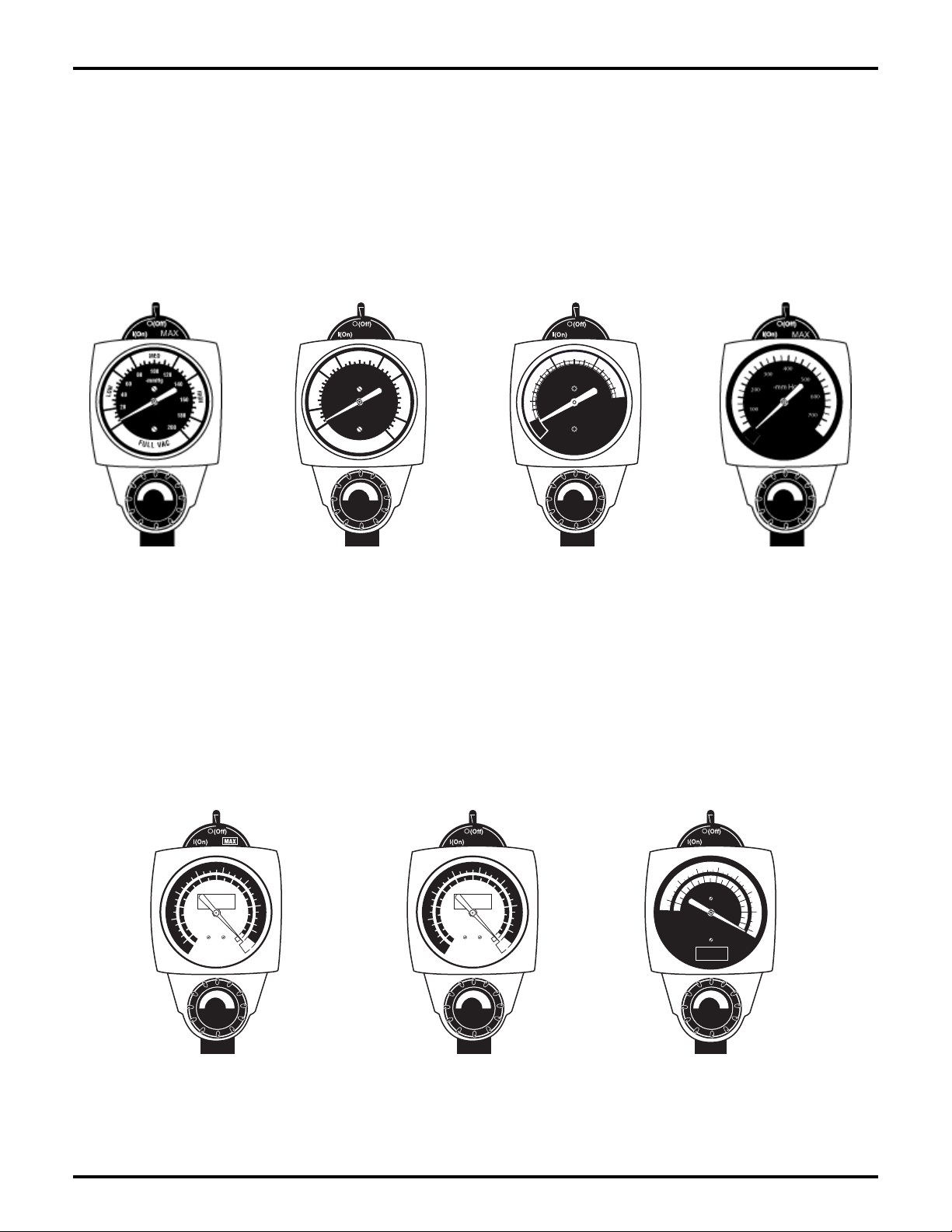
This service manual contains service, maintenance and parts information on all models of the Continuous Vacuum
Regulator.
North American
International
2.1 North American Vacuum Regulators.
Note: Part numbers given are for Vacuum Regulators without fittings or adapters.
2.2 International Vacuum Regulators
Important: International Vacuum regulators comply with the requirements of EN ISO 10079-3 and are CE marked.
Note: Part numbers given are for Vacuum Regulators without fittings or adapters.
Standard Three Mode
Continuous
0-200 mmHg-FULL VAC
Low Continuous
0-135 mmHg
High Three Mode
Continuous
0-760 mmHg
Standard Two Mode
Continuous
0-200 mmHg-FULL VAC
Two Mode High Continuous
CCW
0-760 mmHg/0-100 kPa
Two Mode Low Continuous
CCW
0-135 mmHg/0-18 kPa
Three Mode High Continuous
CCW
0-760 mmHg/0-100 kPa
2-1
D
E
E
D
M
100
80
120
-mmHg
60
W
O
40
L
20
140
H
I
G
H
160
180
200
F
U
C
L
A
V
L
M
100
H
mm Hg
I
G
120
H
140
160
80
Low Vacuum
60
W
O
40
L
20
400
60
70
High Vacuum
100
50
High Flow
300
40
200
30
20
100
10
a
P
k
-
g
H
m
m
-
500
600
80
90
700
400
60
70
High Vacuum
100
50
High Flow
300
40
200
30
20
100
10
a
P
k
-
g
H
m
m
-
500
600
80
90
700
100
80
120
16
140
18
20
Low Vacuum
14
High Flow
60
12
10
8
40
6
4
2
20
a
P
k
-
g
H
m
m
-
Page 7
6700-0078-000 Rev1 06/2009
Description and Specification/3
3.1 Description
WARNING
Do not use this device in the presence of flammable anesthetics. Static
charges may not dissipate and a possible explosion hazard exists in the
presence of these agents.
The Continuous V acuum Regulator is a lightweight, compact unit used throughout the hospital primarily for pharyngeal/tracheal suctioning (airway management).
Various models provide regulated or full-line vacuum for
hospital suction procedures.
There are several models of the Continuous Vacuum
Regulators. All models contain a vacuum gauge which
indicates suction supplied by the regulator. Each has a
positive pressure safety relief valve to prevent pressurization by either failed injector vacuum (venturi) units or
inadvertent cross connection to pressurized gasses. In
addition, the Low Continuous models include a vacuum
relief valve to limit maximum suction.
Some models operate in a regulated or non-regulated
(MAX) mode. Others operate only in the regulated (limited) mode.
In the non-regulated (MAX) mode, the vacuum source is
connected directly to the fitting port. The regulator module is bypassed and full-line vacuum is provided.
In the regulated (limited) mode, the vacuum source is
connected through the regulator module which functions
as an automatic valve. Turning the suction control knob
adjusts the position of the regulator module and allows
selection of a predetermined level of suction when set
according to instructions.
During use, as the flow requirement increases, the valve
automatically opens to maintain suction at the preset
level. Conversely , when the flow requirement decreases,
the valve automatically closes to maintain suction at the
preset level. The same mechanism compensates for
changes in supply vacuum and automatically maintains
the pre-set suction level when set according to instructions.
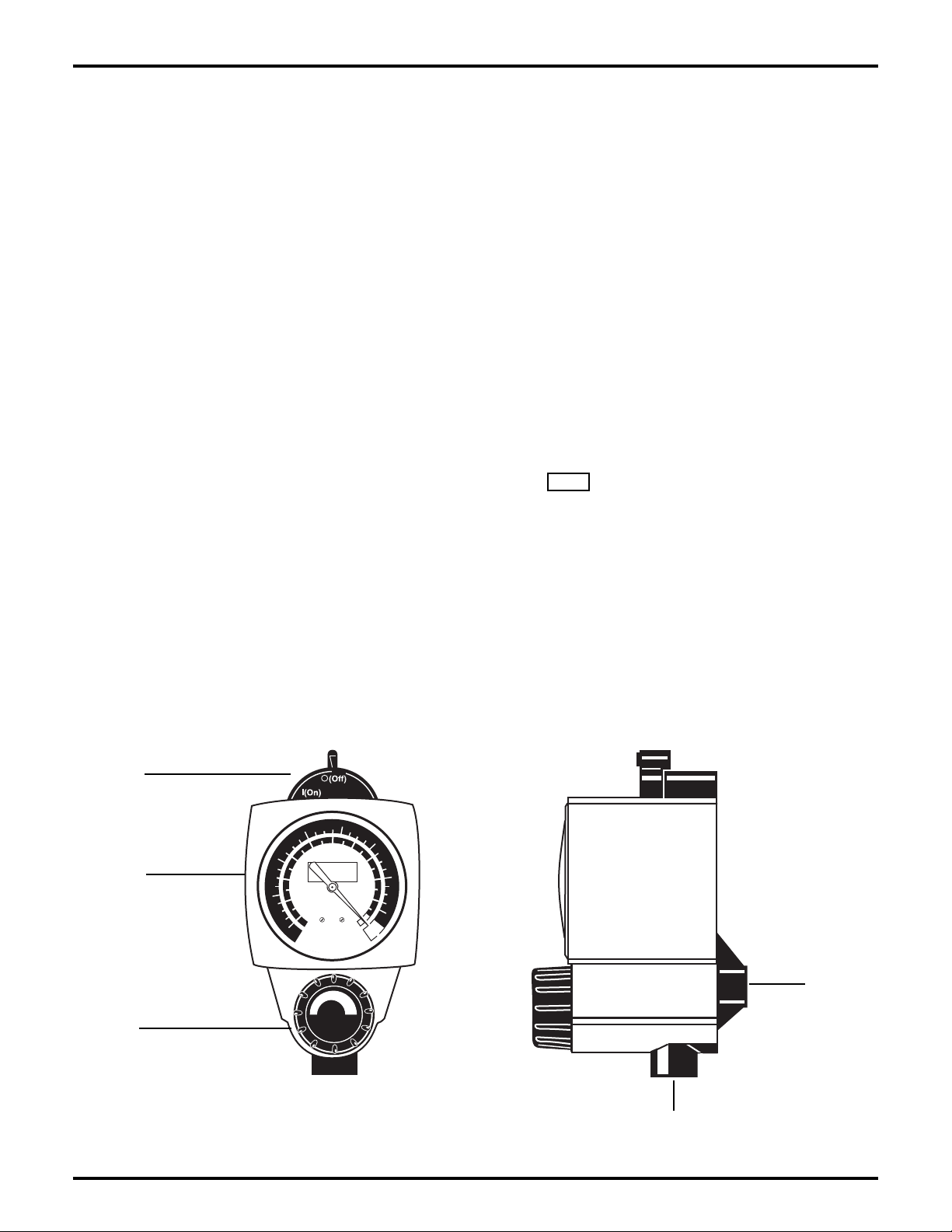
1. Suction Control Knob - Allows easy adjustment of
suction to the patient.
2. Mode Selector Switch - Allows quick and easy mode
changes.
a. | (On) - Suction can be adjusted with the suction
control knob.
b. O (Off) - No suction is supplied to the patient.
c. MAX - Maximum full-line vacuum is supplied to
the patient.
3. Vacuum Gauge - The suction level to the patient is
displayed during use.
Mode
Selector
Switch
Front and Side View
Fitting Port
Adapter
Port
Suction
Control
Knob
Vacuum
Gauge
3-1
400
50
60
High Flow
High Vacuum
300
40
200
30
20
100
10
a
P
k
-
g
H
m
m
-
500
70
600
80
90
100
700
Page 8

6700-0078-000 Rev1 06/2009
3/Description and Specifications
3.2 Specifications
Gauge: Accuracy: ±5% of full scale deflection
Flow Rate: 0 to 80 LPM without fittings at full increase setting depending on supply vacuum and open
air flow
Positive Pressure Safety Located in the vacuum supply line to prevent pressurization of the patient connection by
Relief Valve: failed injector vacuum (venturi) units, or inadvertent cross connection to pressurized
gases
Ranges: Gauge Range Regulated Suction
Standard Models 0 to 200 mm Hg/0 to 26 kPa 0 to 760 mm Hg/0 to 100 kPa
High Models 0 to 760 mm Hg/0 to 100 kPa 0 to 760 mm Hg/0 to 100 kPa
Low Models 0 to 160 mm Hg/0 to 21 kPa 0 to 135 mm Hg/0 to 18 kPa*
* When measured with an independent measuring device.
Vacuum Relief Valve 140 mm Hg ± 5 mm Hg/18.7 kPa ± 0.7 kPa
(Low Vacuum models ONLY):
Weight: 11 oz/312 grams
(Less fittings)
Weight
Low Vacuum models: 12 oz/340 grams
(Less fittings)
Dimensions: Height: 5.7 inches/145 mm
(Less fittings) Width: 3.0 inches/76 mm
Depth: 3.8 inches/96 mm
Latex tubing, 0.25 in (6.4 mm) I.D. X 0 to full vacuum
12 in (30 cm) supplied: Flow dependent on source and setup
Disposable tubing (Available 0 to full vacuum
separate in some markets; Flow dependent on source and setup
6 mm I.D. X 450 mm, 750 mm
and 2M) to connect regulator
and collection bottle
Disposable Suction Filter: 0 to full vacuum
0 to 100 Lpm @ 650 mmHg (-87 kPa)
Environmental Specifications
Operating Temperature Range: 40oF (4oC) to 120oF (49oC)
Storage Temperature Range: 0oF (-18oC) to 150oF (71oC)
Operating and Storage Relative Humidity: 5 to 95%
3-2
Page 9
6700-0078-000 Rev1 06/2009
Operation/4
4.1 Equipment Set-up
Insert the probe into the vacuum wall outlet. If the regulator is mounted elsewhere, connect a vacuum supply
hose between the regulator’s probe adapter and the wall
outlet.
WARNING
Connect the vacuum regulator to the
vacuum source only and check its
operation before attaching the patient
connection. Connection to pressure
sources, even momentarily, could
injure the patient or operator and
damage the equipment.
Note: For proper installation of Adapters/Probes and
Fittings see Appendix.
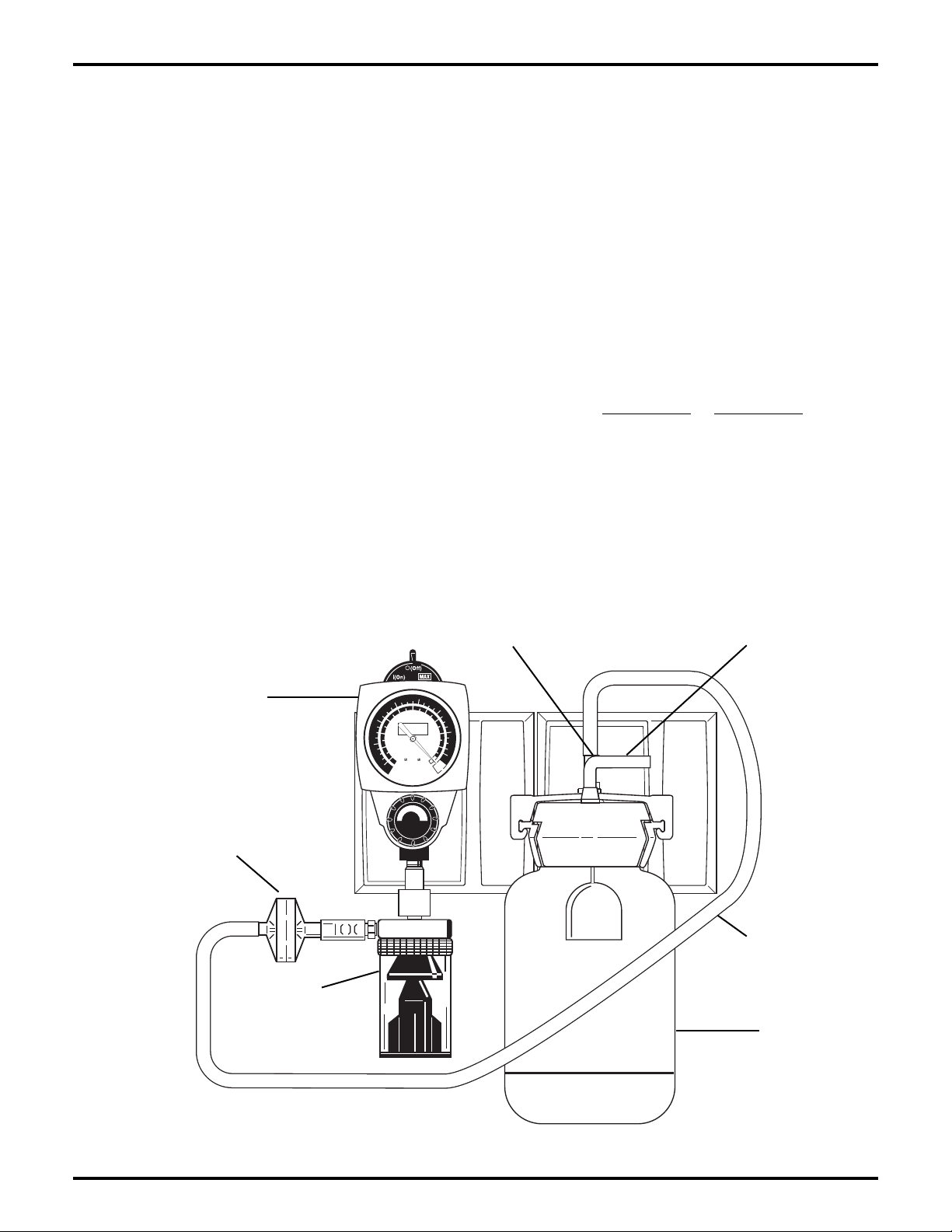
Connect the collection bottle's vacuum port to the regu-
lator's fitting port or Overflow Safety Trap with the appropriate suction filter and vacuum tubing.
Use hospital-supplied suction tubing between the end
piece and the collection container, and between the
patient port and the patient (minimum inside diameter is
6 mm [0.25 in.]).
ISO 10079-3 (BS 7259: Part 2, section 5.1.2) states that
“the usable volume of the collection container shall not
be less than 500 ml.”
An Ohio Medical High Flow Suction Filter should be
used between the collection container and regulator to
prevent contamination of the regulator. Hospital-supplied suction tubing must be used between the catheter
and the collection bottle. Recommended minimum
inside diameter is 0.25 in (6 mm).
Suction Filters - Hydrophilic
Pkg of 20 6730-0350-800
Pkg of 200 6730-0351-800
Suction Filters - Hydrophobic
Tubing x 1/8 NPT x
tubing nipple
tubing nipple
Pkg of 3 6730-0570-800 6730-0580-800
Pkg of 10 6730-0571-800 6730-0581-800
Pkg of 100 6730-0572-900 6730-0582-800
Vacuum
Regulator
Overflow
Safety Trap
Equipment Set-Up
Collection
Bottle
Connective Tubing
Patient Port
Vacuum Port
Disposable
Suction Filter
4-1
400
80
90
70
100
50
60
High Flow
High Vacuum
300
40
200
30
20
100
10
a
P
k
-
g
H
m
m
-
500
600
700
Underwater Seal Line 2 cm H2O
Made in USA
Page 10
6700-0078-000 Rev1 06/2009
4/Operation
4.2 Attaching the Safety Trap
CAUTION
To help prevent aspirate from entering
the regulator, wall outlet and pipeline
system as a result of misuse, an
Overflow Safety Trap should be
attached prior to its use. Aspirate in the
regulator, wall outlet and pipeline system
may impair their operation. The use of
the Overflow Safety Trap and suction filter will help prevent this and extend the
life of suction equipment.
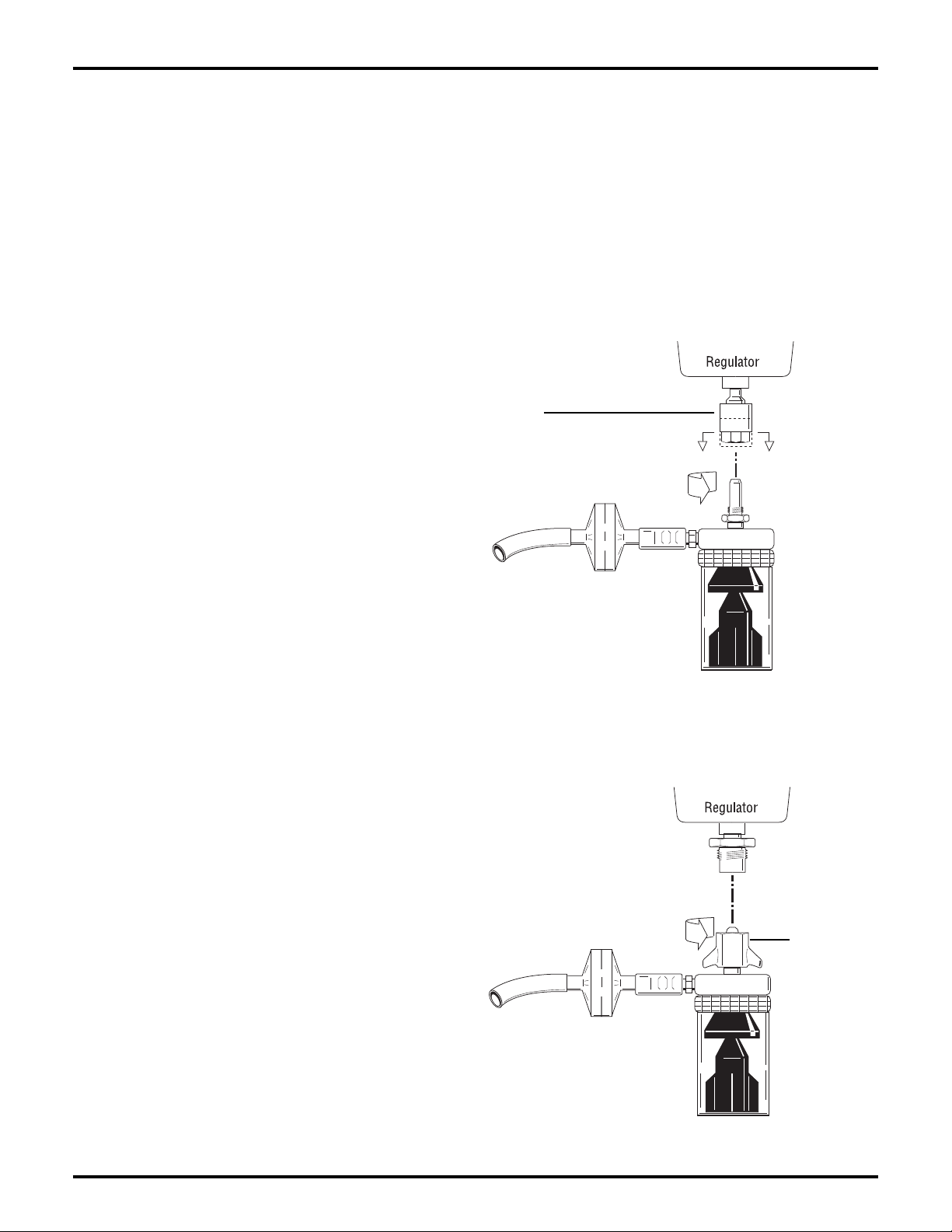
Standard fitting
1. Raise the sleeve and insert the trap into the regulator fitting.
2. Turn the trap clockwise about one and a half turns to
engage the threads. The trap does not need to be
screwed tight; an O-ring in the regulator fitting provides a vacuum seal. The trap should rotate freely to
allow the desired tubing positioning.
3. Lower sleeve to lock trap in position.
DISS fitting
1. Insert trap into the regulator fitting. Situate the tubing
in the desired position.
2. Turn the DISS wing nut clockwise to engage threads
and tighten (there is no O-ring, so the vacuum seal
depends on a tight connection).
Sleeve
Wing nut
4-2
Page 11
6700-0078-000 Rev1 06/2009
Operation/4
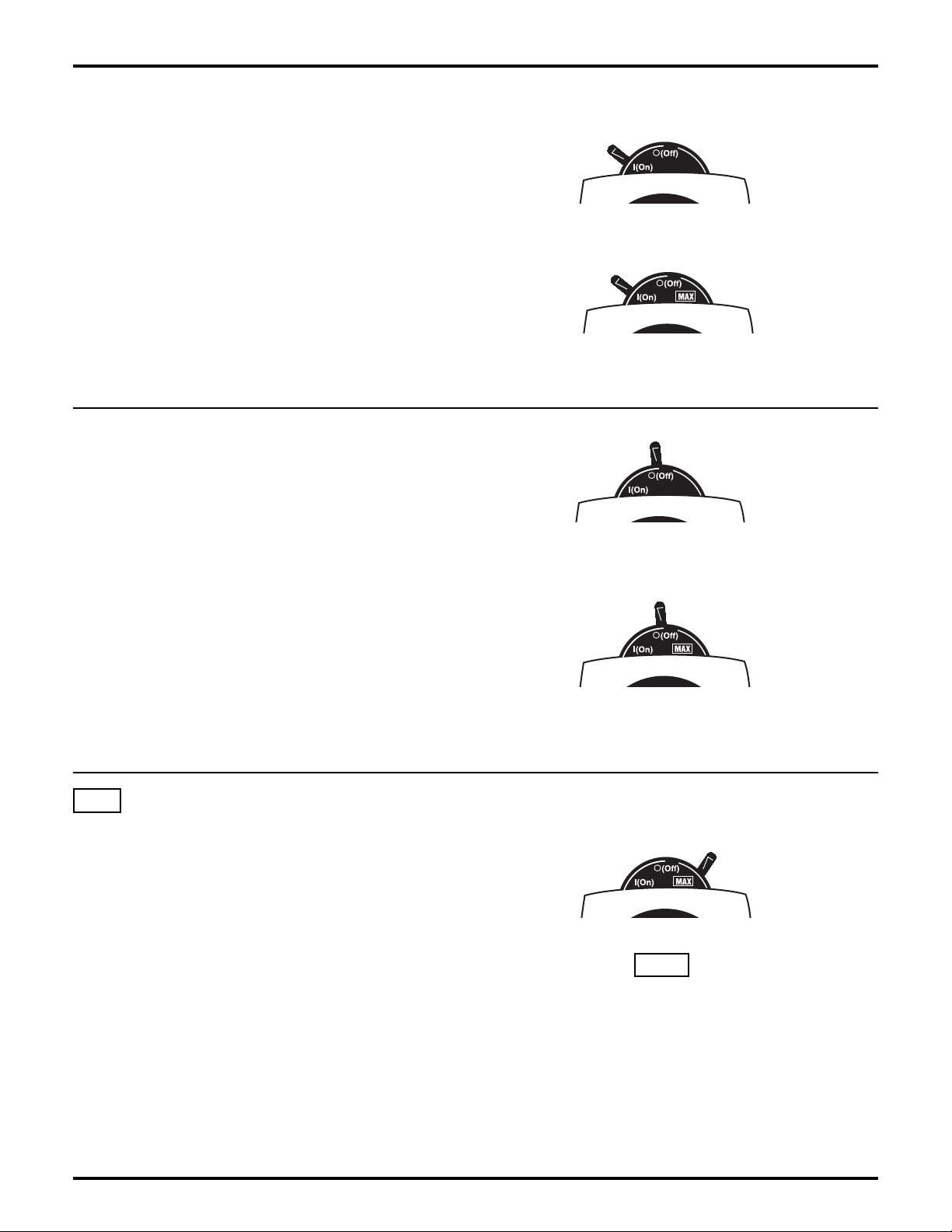
4.3 Mode Selection
| (On) - Suction can be adjusted with the suction control
knob.
O (Off) - No suction is supplied to the patient.
MAX - Maximum, full-line vacuum is supplied to the
patient.
Note: available on three mode vacuum regulators only.
2 - Mode Switch
3 - Mode Switch
I/(On)
2 - Mode Switch
3 - Mode Switch
O/(Off)
3 - Mode Switch
MAX
4-3
Page 12

6700-0078-000 Rev1 06/2009
4/Operation
4.4 Setting the Suction Level
1. Turn the mode selector switch to I (On).
2. Occlude or clamp tubing
3. Rotate the suction control knob until the vacuum
gauge indicates the required setting.
WARNING
The regulator fitting port or patient
connector must be occluded when
setting the prescribed suction level
so that the patient does not receive
higher than required suction.
4.5 Pre-Use Checkout Procedure
WARNINGS The Pre-Use Checkout Procedure
must be performed before using the
equipment on each patient. If the regulator fails any part of the Pre-Use
Checkout Procedure, it must be
removed from service and repaired
by qualified service personnel.
Connect the vacuum regulator to the
vacuum source only and check it's
operation before attaching the patient
connection. Connection to pressure
sources, even momentarily, could
injure the patient or operator and
damage the equipment.
All tests must be performed with supply vacuum of 380
mm Hg (51 kPa) minimum.
1. Turn the mode selector switch to O (Off).
Rotate the suction control knob one full turn clock-
wise (increase).
Clamp tubing to occlude the fitting port. The gauge
needle should not move.
Clamp
Clamp
4-4
400
300
500
50
60
40
200
30
70
High Flow
High Vacuum
600
700
20
80
90
100
10
100
a
P
k
-
g
H
m
m
-
400
300
500
50
60
40
200
30
70
High Flow
High Vacuum
600
700
20
80
90
100
10
100
a
P
k
-
g
H
m
m
-
Page 13

6700-0078-000 Rev1 06/2009
Operation/4
2. Turn the mode selector switch to I (On).
Rotate the suction control knob fully anti-clockwise
(decrease).
Clamp tubing. The gauge needle should not move.
3. Clamp tubing.
Regulator Setting
Standard & Low: increase the suction to 100 mm Hg
(13 kPa)
High: increase the suction to 300 mm Hg
(40 kPa)
Slowly open and close the clamped tubing to create various flow rates through the regulator. Check that the suction level is maintained when the tubing is clamped.
For Standard 2 Mode Continuous, go to step 5.
Clamp
Clamp
Release
Clamp
4-5
400
300
500
50
60
40
200
30
70
High Flow
High Vacuum
600
700
20
80
90
100
10
100
a
P
k
-
g
H
m
m
-
400
300
500
50
60
40
200
30
70
High Flow
High Vacuum
600
700
20
80
90
100
10
100
a
P
k
-
g
H
m
m
-
Page 14

6700-0078-000 Rev1 06/2009
4/Operation
4a. High and Standard 3 Mode Continuous
Turn the mode selector to MAX. Clamp tubing and
check that the gauge needle indicates the maximum
available suction.
Turn the mode selector to I (On).
4b. Low Continuous
Clamp tubing and rotate knob fully clockwise
(increase) to verify the suction level does not exceed
150 mm Hg (20 kPa).
Clamp
Clamp
4-6
400
300
500
50
60
40
200
30
70
High Flow
High Vacuum
600
700
20
80
90
100
10
100
a
P
k
-
g
H
m
m
-
100
80
120
60
12
14
10
16
140
8
18
40
6
20
4
2
20
a
P
k
-
m
High Flow
m
-
Low Vacuum
Page 15

6700-0078-000 Rev1 06/2009
Operation/4
5. Reduce the suction level to zero and set the mode
selector switch to O (Off).
4.6 Patient Setup
1. Make sure the Pre-Use Checkout Procedure has
been performed.
2. Turn the mode selector switch to I (On) and clamp
tubing.
3. Set the prescribed suction level.
WARNING
The regulator must be occluded when
setting the prescribed suction level
so that the patient does not receive
higher than required suction.
Clamp
4-7
400
300
500
50
60
40
200
30
70
High Flow
High Vacuum
600
700
20
80
90
100
10
100
a
P
k
-
g
H
m
m
-
400
300
500
50
60
40
200
30
70
High Flow
High Vacuum
600
700
20
80
90
100
10
100
a
P
k
-
g
H
m
m
-
Underwater Seal Line 2 cm H2O
Made in USA
Page 16

6700-0078-000 Rev1 06/2009
4/Operation
4. Turn the mode selector switch to O (Off).
5. Attach tubing to the vacuum port of the collection
container.
6. Turn the mode selector switch to I (On).
Important: The Low models do not
deliver suction in excess of 150
mm Hg (20 kPa).
Patient
Connective
Tubing
4-8
400
300
500
50
60
40
200
30
70
High Flow
High Vacuum
600
20
80
90
700
100
10
100
a
P
k
-
g
H
m
m
-
Underwater Seal Line 2 cm H2O
Made in USA
400
300
500
50
60
40
200
30
70
High Flow
High Vacuum
600
700
20
80
90
100
10
100
a
P
k
-
g
H
m
m
-
Underwater Seal Line 2 cm H2O
Made in USA
Page 17

6700-0078-000 Rev1 06/2009
Cleaning and Sterilization/5
5.1 Cleaning
WARNING After patient use, regulators may be
contaminated. Handle in accordance
with your hospital’s infection control
policy.
5.1.1 Routine Exterior Cleaning
Routine cleaning of the regulator is recommended as a
standard procedure after each use.
Wipe all exterior surfaces with a solution of water and
mild detergent.
5.1.2 Internal Component Cleaning
CAUTION Cleaning the gauge may result in damage.
The regulator requires cleaning if it becomes flooded with
patient fluid as a result of misuse.
1. Refer to the Service - Disassembly and Assembly
instructions.
2. All internal components, with the exception of the
gauge, may be cleaned with a solution of warm water
and mild detergent, preferably an enzymatic cleaner.
3. Dry all components with a lint free cloth before
assembly.
5.2 Sterilization
Should misuse occur, resulting in accidental flooding of
the regulator, the regulator may be sterilized using
Ethylene Oxide (ETO). After sterilization, follow the service checkout procedures in Section 8.
WARNING
Following sterilization with ethylene
oxide, parts should be quarantined in
a well ventilated area to allow dissipation of residual ethylene oxide gas
absorbed by the material. Aerate
parts for 8 hours at 130oF (54oC).
CAUTION
Do not steam autoclave or liquid sterilize
the Continuous Vacuum Regulator.
Severe impairment to the operation of
the regulator will result. The only acceptable method of sterilization is with gas
(ethylene oxide).
CAUTION
Sterilization with ethylene oxide mixtures may cause crazing (minute superficial cracking) of some plastic parts.
Crazing will be more pronounced when
mixtures containing Freon® are used.
Note: The Vacuum Regulator should only be sterilized if
it is contaminated or maintenance is to be performed.
1. The regulator should be sterilized with the mode
selector switch in the | (On) position.
2. The only acceptable method of sterilization is with
ethylene oxide. Ethylene oxide mixtures can be used
at temperatures of 125 to 135 °F (52 - 57 °C). If this
temperature cannot be obtained, room temperature
sterilization with 100% ethylene oxide can also be
used. Sterilization is not recommended as a standard procedure after each use.
3. After each sterilization, check the condition of the
internal filter. If the filter appears to have shrunk,
replace it before placing the regulator back in service.
4. Adequately aerate the regulator prior to disassembly,
shipment or use. Aerate parts prior to reassembly.
®Freon is a registered trademark of the DuPont Company.
5-1
Page 18

6700-0078-000 Rev1 06/2009
6/Troubleshooting
Problem
A. No gauge indication and no suc-
tion in any setting
B. No gauge indication but suction
is being delivered
C. Gauge indication but no suction
is being delivered
D. Suction level cannot be adjusted
E. Insufficient flow through regula-
tor
Possible Causes
1. No supply vacuum
2. Kinked tube
3. Poor connection
4. Blocked adapter port
5. Blocked backplate
6. Blocked adapter
7. Blocked wall outlet
1. Blocked gauge pressure sensing
orifice
2. Gauge mechanism locked by
debris
3. Gauge mechanism damaged
1. Blocked fitting port
2. Overflow Safety Trap shut-off
3. Blocked external filter
4. Blocked fitting
1. Mode selector switch in MAX
position
2. Regulator module small o-ring
failure
3. Regulator module diaphragm
rupture
4. Regulator module stem screw
loose
1. Partial blockage in wall supply
2. Partial blockage in regulator
Remedy
1. Correct supply problems
2. Straighten tube
3. Check all connections and seals
4. Unblock port
5. Clean with soap and water and
pipe cleaner
6. Replace adapter
7. Unblock outlet
1. Clean or replace gauge
2. Clean or replace gauge
3. Replace gauge
1. Clean port
2. Reset flow and/or empty trap
3. Replace filter
4. Clean fitting
1. Switch to I(On)
2. Replace rubber components with
regulator module replacement kit
3. Replace rubber components with
regulator module replacement kit
4. Tighten stem screw
1a. Confirm wall supply open air flow
meets minimum hospital requirements
1b. Unblock if necessary
2a. Perform the Flow Test in the
Service Checkout Procedure
Section of this manual
2b. Clear blockage if necessary
6-1
Page 19

6700-0078-000 Rev1 06/2009
Troubleshooting/6
Problem
F. Inaccurate gauge reading
Note: All gauge needles should
come to rest within the zero
range bracket or return to the
stop pin when no suction is
being supplied.
G. With the fitting port occluded,
unable to decrease the suction
level and gauge needle does not
return to zero when switched to
O (Off)
H. No suction in any setting and
whistling noise from inside the
regulator
Possible Causes
1. Damaged gauge
1. Blocked filter and/or orifice
2. Damaged gauge
1. Positive pressure safety relief
valve failure
2. Vacuum relief valve failure (low
models ONLY)
Remedy
1. Replace gauge
1. Clear orifice and replace filter
2. Replace gauge
1. Replace positive pressure safety relief valve
2. Replace o-ring and ensure that
the steel ball is present and
clean
6-2
Page 20

6700-0078-000 Rev1 06/2009
7/Service - Disassembly and Assembly
7.1 Service Tools and Equipment
CAUTION
Use of lubricants other than recommended may degrade plastic or rubber
components.
The following items should be on hand during any service procedure.
• Supply vacuum: 500 mm Hg/ ± 10 mmHg (67 kPa ±
1.3 kPa) & 50 LPM open air flow minimum
• Supply Vacuum Regulator with Gauge, 760 mm Hg
(101.3 kPa) Full Scale.
• Low Vacuum Calibration Gauge, 225 mm Hg (30
kPa) Full Scale* (Ohio Medical P/N 6700-0353-800)
• High Vacuum Calibration Gauge, 760 mm Hg (101.3
kPa) Full Scale*(Ohio Medical P/N 6700-0352-800)
• 50 LPM Flowmeter (Ohio Medical P/N 6700-0355-
800)
• Hexagonal Allen Wrench 3/32 inch
• Phillips Head Screwdriver, No. 2
• Flat Head Screwdriver, 1/4 inch
• Pliers
• Dow® 111 Grease (Ohio Medical P/N 6700-0074-
200)
• Loctite® 242 Removable Thread Locker (Ohio
Medical P/N 0220-5016-300)
• Tubing Clamp
• Bubble Leak Tester
• Tweezers (Filter Remover)
• Wooden Tooth Pick (O-ring Remover)
• Pipe Cleaner
(*) Accuracy: ±1% of full scale deflection
®Dow is a registered trademark of the Dow Chemical Corporation
7.2 Continuous Vacuum Regulators (All
Models)
7.2.1 Disassembly
WARNINGS If the Vacuum Regulator is repaired
or disassembled in any manner, the
Service Checkout Procedure must be
performed before using the equipment on a patient.
Clean and sterilize all suction equipment if contaminated before disassembly, to ensure service personnel
are not exposed to hazardous contamination.
When servicing a Low Vacuum
Regulator, perform the Vacuum Relief
Valve Adjustment and Low Vacuum
Limit Setting Procedure.
CAUTION
The gauge assembly must be handled
with utmost care to retain its precision. If
the lens is removed, do not rest the
gauge on its face.
7-1
Page 21

6700-0078-000 Rev1 06/2009
Service - Disassembly and Assembly/7
1. Cover Screw (4)
2. Cover Assembly
3. Low Vacuum Limiting Screws
(2) (Not Shown) (On old versions of the
Low Models Only)
1. Mode Selector Switch
2. Switch Plate
3. Screw
4. O-ring, Vacuum Relief Valve
(Low Models Only)
5. Vacuum Relief Valve & O-ring
(Low Models Only)
6. Gauge Assembly (includes gauge, o-rings, and lens)
7. Lens
8. O-ring (2), Gauge
9. Regulator Module
10. Positive Pressure Safety Relief Valve
11. Filter (Internal)
12. Base
13. O-ring, Stem
14. O-ring, Regulator Module
1. Remove the four cover screws from the back of the regulator.
2. Carefully pull the cover assembly off the back body.
3. To remove the gauge assembly, grasp the assembly and
pull straight out. The snap-fit lens can also be removed
(if applicable) for replacement.
4. To remove the regulator module from the cover assembly , rotate the suction control knob counterclockwise until
the regulator module is free.
5. Using tweezers, remove the filter. Replace with a new filter.
6. Grasp the positive pressure safety relief valve, and pull it
from the back body.
7. Remove the mounting screw from the switch plate
assembly and remove the switch plate and mode switch.
8. Low models ONLY: Grasp the vacuum relief valve and
pull it from the back body.
Pull down plastic tab with
right index finger while
holding gauge
Snap Fit Lens Removal
7-2
1
2
1
12
11
1
14
13
9
3
4
8
5
6
7
3
2
Page 22

6700-0078-000 Rev1 06/2009
7/Service - Disassembly and Assembly
7.2.2 Assembly
CAUTION To prevent stripping the plastic threads,
place the screw in the hole and turn
counterclockwise until it drops into the
original thread. Tighten screw.
1. Place the positive pressure safety relief valve in position and push onto the back body.
2. Low models ONLY: Lubricate the vacuum relief valve
O-ring and install it in the valve housing.
3. Lubricate the switch gasket surface with a thin coating of Dow 111 Grease. Place the mode switch on
the base with the arrow at 12 o’clock. Place the
switch plate onto the switch so that the OFF/O is
under the arrow. Install and tighten the mounting
screw. Test the mode switch at all positions.
4. Place the internal filter into the proper cavity and
push until it hits the bottom of the base.
5. Place the regulator module into the cover with the
screw thread facing the knob. Align the protruding
ears at 3 and 9 o’clock and rotate the suction control
knob clockwise until the threads engage.
6. Install the snap-fit lens by placing one of the retaining tabs over the edge of the gauge face, and then
pressing lightly until the other tab snaps onto the
gauge face. Rotate the lens to confirm proper installation.
7. Install the gauge assembly by lubricating the gauge
o-rings with a thin coating of Dow 111 Grease and
pushing the gauge into the base mount. Ensure that
the gauge is properly aligned.
8. Place the cover assembly onto the base and push
together until the base and back of the cover are
flush.
9. Install the 4 cover screws.
7.3Suction Level Limit Setting-Low Models
ONLY
WARNING
This Low Vacuum Limit Setting
Procedure must be followed when
repairing Low Vacuum Regulators.
Failure to do this may result in suction exceeding the prescribed level.
The design of the low continuous vacuum regulator has
been changed to eliminate the low vacuum limiting set
screws located inside the cover behind the suction control knob. The vacuum relief valve has also been
changed to limit the vacuum to the same level as the set
screws did. This new vacuum relief valve has four vent
holes; the old valve had two. If a new cover is used, a
new vacuum relief valve must be used.
Versions with limiting screws have two means of limiting
the suction level:
1. Low vacuum limiting screws in the cover; these can
be set at 140 mmHg/19 kPa (± 10 mmHg/1.0 kPa).
2. Vacuum relief valve; this can be set at 165 mmHg ±
15 mmHg (22 kPa ± 2 kPa).
These vacuum limit settings may be reduced to
accommodate user requirements. If the vacuum limit
settings are reduced, the vacuum relief valve must
be set 25 mmHg ± 15 mmHg (3 kPa ± 2 kPa) higher
than the vacuum limiting screws.
Versions without the limiting screws use only the relief
valve to limit the suction level. The relief valve can be set
at 140 mmHg ± 5 mmHg (18.7 kPa ± 0.7 kPa).
7-3
Page 23

6700-0078-000 Rev1 06/2009
Service - Disassembly and Assembly/7
7.3.1 Low Vacuum Limiting Screws
CAUTION
When adjusting the vacuum limiting
screws, be sure to adjust them to an equal height.
CAUTION
Remove the “Increase” label careful-
ly. Press firmly in place when replacing.
1. Remove the “Increase” label and place it aside. Be
careful not to damage the face or glued back of the
label.
2. Adjust the two vacuum limiting screws located
behind the suction control knob until they are the
same height in the case. Use a 3/32” hexagonal allen
wrench.
3. Connect the vacuum supply to the adapter port and
occlude the fitting port.
4. Be certain that the screws remain at an equal height
by adjusting both low vacuum limiting screws the
same amount and in the same direction. Adjust the
screws to supply a maximum vacuum of 150 mm Hg
(20 kPa) and not less than 130 mm Hg (17 kPa).
7.3.2 Vacuum Relief Valve Adjustment
1. Remove the cover.
2. Connect the supply vacuum to the adapter port.
3. Turn the mode selector switch to I/ON.
4. Occlude the fitting port.
5. Slowly pull the regulator module away from the base.
Note the suction level at which the relief valve opens.
The relief valve should open at 165 mmHg ± 15
mmHg (22 kPa ± 2 kPa) on units with limiting
setscrews and140 mmHg ± 5 mmHg (18.7 kPa ± 0.7
kPa) for units without limiting setscrews.
6. If adjustment is required, grip the vacuum relief valve
firmly with pliers and rotate the screw about 1/8 turn
with a screwdriver. Repeat the previous step and
check the suction level at which the valve opens.
Note: Clockwise rotation will increase the suction
level at which the relief valve opens.
Counterclockwise rotation will decrease it.
WARNING
Excess Loctite® may seal the steel
ball to the seat. This will disable the
vacuum relief valve and may allow
suction to exceed the preset limit.
CAUTION
When Loctite is used on the vacuum
relief safety valve, ensure that it only
contacts the metal parts. Loctite causes
many plastic parts to deteriorate.
7. Lock the adjusting screw with a drop of removable
thread locker such as Loctite 242. Repeat step 5 to verify the vacuum relief valve setting.
® Loctite is a registered trademark of the Loctite Corporation.
Cover and Knob
Assembly
Allen
Wrench
Set Screws
Increase Label
Setting the Vacuum Limiting Screws
Vacuum Relief Valve
Valve
Body
Steel
Ball
O-Ring
Screw
w/Magnet
Loctite
242
7-4
Page 24

6700-0078-000 Rev1 06/2009
7.4 Regulator Module
WARNING
If repairing or replacing a regulator
module on a Low Vacuum Regulator,
you must perform the Suction Level
Limit Setting-Low Models ONLY
Procedure. Failure to do this may
result in suction exceeding the prescribed level.
CAUTION
Do not lubricate any internal components of the regulator module.
The cap screws can strip the regulator
module housing threads if they are
screwed in too tight.
7.4.1 Disassembly
1. Remove the cap screws (2) and remove the cap.
2. Remove the o-rings (2).
3. Observe the position of the diaphragm convolution to
aid in assembly.
4. Withdraw the diaphragm/stem assembly from the
housing.
5. Remove the spring.
6. Grasp the stem with your fingers and unscrew the
stem screw.
7. Remove the retainer, diaphragm and piston from the
stem.
7/Service - Disassembly and Assembly
1. O-ring, Stem
2. O-ring
3. Housing
4. Stem
5. Spring
6. Piston
7. Diaphragm
8. Retainer
9. Stem Screw
10. Cap
11. Cap Screw
1
11
11
10
9
8
7
6
5
4
3
2
Regulator Module Parts and Descriptions
7-5
Page 25

6700-0078-000 Rev1 06/2009
Service - Disassembly and Assembly/7
7.4.2 Assembly
1. Return the diaphragm to its original position (convoluted), with the molded number facing the retainer.
2. Assemble the diaphragm onto the retainer by lining
up their center holes as shown in the diagram.
3. Insert the piston into the diaphragm and ensure that
the retainer mates with the recess in the piston.
4. Insert the stem through the piston.
5. Holding the retainer/diaphragm/piston/stem as an
assembly with your fingers, insert the stem screw
and tighten.
6. Place the spring in the housing.
7. Insert the retainer/diaphragm/piston/stem assembly
through the spring and into the cavity in the housing.
Fit the diaphragm bead into the groove in the housing.
8. Install the cap and the two cap screws.
9. Apply a small amount of Dow® 111 Grease to the orings only.
10. Install o-rings onto the stem and housing.
Diaphragm Assembly
Stem
Retainer
Set Screw
Diaphragm
Piston
7-6
Page 26

6700-0078-000 Rev1 06/2009
8/Service Checkout Procedure
WARNING
If the Vacuum Regulator is rep aired or
disassembled in any manner, the
Service Checkout Procedure must be
performed before using the equipment on a patient.
Important: This entire Service Checkout Procedure
must be performed in numerical order.
8.1 Set-up
1. Verify that there is 500 mmHg ± 10 mmHg (67 kPa ±
1.3 kPa) vacuum on the supply gauge.
2. The supply open flow must be 50 LPM minimum.
3. Connect the supply vacuum to the adapter port.
8.2 Flow Test
1. Connect the regulator's fitting port to the flowmeter
with tubing.
2. Rotate the suction control knob fully clockwise
(increase).
3. Turn the mode selector switch to I (On) and verify
that the flow rate exceeds 30 LPM.
4. Turn the mode selector switch to MAX (if available)
and verify that the flow rate exceeds 30 LPM.
5. Turn the mode selector switch to O (Off).
6. Disconnect the flowmeter.
Mode
Selector
Switch
Supply Vacuum gauge
0-760 mmHg (0-101.3 kPa)
Supply Vacuum Reg. set to
500 mmHg +
10 mmHg
(64 kPa +
1.3 kPa)
Supply Vacuum
500 mmHg (67 kPa)
Minimum and
Open Flow of
50 LPM Minimum
Occluded
Low Vacuum
Calibration Gauge
225 mmHg/30 kPa
High Vacuum
Calibration Gauge
760 mmHg/101.3 kPa
Flowmeter
50 LPM
Service Checkout Tests
8-1
60
W
O
40
L
20
E
D
M
100
80
120
mmHg
140
H
I
G
H
160
180
200
F
U
C
L
A
L
V
Page 27

6700-0078-000 Rev1 06/2009
Service Check Out Procedure/8
8.3 Gauge Test
Note: All Ohio Medical gauges are supplied with an accuracy of ±5% of full scale deflection throughout their
range. The table below is provided for reference.
Gauge Range Tolerance
Standard 0-200 mmHg (0-26 kPa) ±10 mmHg (1.3 kPa)
Vacuum
Low 0-160 mmHg (0-20 kPa) ±8 mmHg (1.1 kPa)
Vacuum
High 0-760 mmHg (0-100 kPa) ±38 mmHg (5 kPa)
Vacuum
Note: All gauge needles should come to rest within the
zero range bracket or return to the stop pin when no suction is being supplied. Gauges which do not comply may
be out of calibration.
When checking gauge accuracy , be sure that the calibration gauge has an accuracy of 1% of full scale deflection
or better.
8.3.1 High Vacuum Gauges ONLY
1. Connect the regulator's fitting port to the high calibration gauge with tubing.
2. Turn the mode selector switch to I (On).
3. Assure that the gauge is in agreement with the high
vacuum calibration gauge within the ±38 mmHg (5
kPa) tolerance. Recommended test points are 100,
300, and 500mm Hg.
8.3.2 Standard and Low Vacuum Gauges ONLY
1. Connect the regulator's fitting port to the low calibration gauge with tubing.
2. Turn the mode selector switch to I (On).
3. Assure that the gauge is in agreement with the low
vacuum calibration gauge within the ±10 mmHg (1.3
kPa) or the ±8 mmHg (1.1 kPa) tolerance for standard and low gauges respectively. Recommended
test points are 40, 80, and 140 mmHg.
4. For the Standard Gauge ONLY: Rotate the suction
control knob fully clockwise (increase) and verify its
reading is in the FULL VAC range.
8.4 Regulation Test
1. Disconnect the calibration gauge and occlude the fitting port.
2. If using a High Vacuum Regulator, set its gauge to
300 mmHg (40 kPa). If using a Low or Standard
Vacuum Regulator, set its gauge to 100 mmHg/14
kPa.
3. Open and close the fitting port several times.
4. With the fitting port occluded, the gauge should
return to the setting listed in step 2 within a tolerance
of:
±38 mmHg (5 kPa) for high vacuum gauge
or
±10 mmHg (1.3 kPa) for the standard
vacuum gauges
or
±8mmHg (1.1 kPa) for the low vacuum gauge.
8.5 Low Vacuum Regulators ONLY
1. Occlude the fitting port.
2. Rotate the suction control knob fully clockwise
(increase).
3. Verify that the suction delivered does not exceed 150
mm Hg (20 kPa) or the maximum suction requested
by the clinician.
Note: For setting the Suction level limit, refer to
Suction Level Limit Setting-Low Models ONLY.
8.6 Bleed Test
1. Occlude the fitting port and set the vacuum level to
100 mm Hg (14 kPa).
2. Turn the selector switch to O (Off) and observe the
gauge needle. It must return to the zero range bracket or stop pin within 10 seconds.
8-2
Page 28

6700-0078-000 Rev1 06/2009
8/Service Checkout Procedure
8.7 Leak Test - Supply Side
1. Connect the supply vacuum tubing to port “A” of the Bubble Leak Tester.
2. Connect port “B” of the Bubble Leak Tester to the regulator adapter port.
3. Turn the mode selector switch to O (Off). Allow the fitting port to be open to air.
4. Wait 20 seconds. No More than 6 bubbles should appear in the next ten seconds.
Important: Prior to venting port "A" of the Bubble Leak Tester to atmosphere (i.e. turning the supply regulator off),
ensure the tubing from port "B" has been disconnected from the adapter port of the vacuum regulator.
8.8 Leak Test - Patient Side
1. Connect the supply vacuum tubing to the regulator adapter port.
2. Connect the regulator fitting port to port “A” of the Bubble Leak Tester with tubing. Allow port “B” of the Bubble
Leak Tester to be open to air.
3. Rotate the suction control knob a minimum of one full turn clockwise (increase). No bubbles should appear in the
next ten seconds.
4. Rotate the suction control knob fully
counterclockwise (decrease).
5. Turn the mode selector switch to I (On).
No bubbles should appear in the next ten
seconds.
Supply Vacuum Gauge
0-760 mmHg (0-101.3 kPa)
Bubble Leak
Tester
1/4” I.D.
Clear Tubing
Sealed
Port B
Port A
1.0 in.
Fitting port
Adapter Port
Vacuum
Regulator
Supply
Vacuum
Supply Regulator
500 mmHg (67 kPa)
Water
Bubble Leak Test - Supply Side
Mode
Selector
Switch
1.0 in.
Bubble Leak
Tester
Water
1/4” I.D.
Clear
Tubing
Port B
Port A
Sealed
Suction
Control
Knob
Vacuum
Regulator
Bubble Leak Test -Patient Side
8-3
E
D
M
100
80
120
mmHg
60
140
W
O
40
L
20
H
I
G
H
160
180
200
F
U
C
L
A
L
V
Page 29

6700-0078-000 Rev1 06/2009
Maintenance/9
WARNING
The Pre-Use Checkout Procedure
must be performed before using this
equipment on each patient. If the regulator fails any part of the Pre-Use
Checkout Procedure, it must be
removed from service and repaired
by qualified service personnel.
WARNING
Clean and sterilize all suction equipment if contaminated before disassembly, to ensure service personnel
are not exposed to hazardous contamination.
Continuous Vacuum Regulators should be kept in
use or used on a rotating basis.
Unused equipment may tend to deteriorate.
Maintenance of the vacuum piping system is as important as maintenance of the suction equipment. The use
of Collection Bottles with reliable shut-off valves,
Overflow Safety Trap assemblies and disposable suction
filters will protect the regulator and piping system. The
flow rate at the wall outlet should be checked on a yearly basis and suitable cleaning of the outlets should be
performed. The flow rate measurement should meet
local standards.
Routine maintenance and inspection are important to the
performance of suction equipment. The following is a
recommended list for care of suction equipment after
each patient use.
1. Perform a thorough cleaning by washing all bottles,
tubing, metal connectors, etc, and removing all
residue.
2. Wipe all exterior surfaces with a solution of water
and mild detergent.
3. Perform a careful visual inspection.
4. Check that the High Flow Disposable Suction Filter is
clean and in good condition.
5. Check that all tubing is in good condition and connected securely to the correct ports.
6. Check the floats in the Overflow Safety Trap and
Collection Bottle for correct operation.
7. Perform the Pre-Use Checkout Procedure.
9.2 Recommended Maintenance Schedule
In addition to the Pre-Use Checkout Procedure, the following periodic maintenance should be performed.
9
.2.1 Maintenance Schedule
Item Minimum Frequency Comments
Service Checkout Every 12 months If the regulator does not pass the
Procedure Service Checkout Procedure,
refer to the Troubleshooting section of
this manual. Repair as necessary.
Elastometric As Required Cleaning and replacement interval
Components,O-rings, will depend greatly on hours of usage and
switch gasket, environmental conditions. Replace and
reg. module diaphragm, repair as necessary.
positive pressure safety valve) and Internal Filter
9-1
Page 30

6700-0078-000 Rev1 06/2009
9/Maintenance
9.3 Repair Policy
WARNING
Clean and sterilize all suction equipment before shipment or service to
ensure transportation personnel
and/or service personnel are not
exposed to any hazardous contamination.
CAUTIONS Do not steam autoclave or liquid sterilize
the Continuous Vacuum Regulator.
Severe impairment to the operation of
the regulator will result. The only acceptable method of sterilization is with gas
(ethylene oxide).
Only competent individuals trained in the
repair of this equipment should attempt
to service it.
Do not use malfunctioning equipment. Make all necessary repairs. Have the equipment repaired by qualified
service personnel or by Ohio Medical. Parts listed in the
service manual for this product may be repaired or
replaced by a competent, trained person who has experience in repairing devices of this nature. After repair, perform the Service Checkout Procedure to ensure that it is
functioning properly, and complies with the published
specifications.
9.4 Technical Assistance
If technical assistance is required, contact Ohio Medical
technical support or field operations listed on the back
cover.
9.5 Return Instructions
1. Call 866-549-6446 for a returned goods authorization.
2. Clean and sterilize the Vacuum Regulator.
3. Package the Vacuum Regulator securely for protection; preferably in the original container.
4. Include a letter describing in detail any difficulties
experienced with the Vacuum Regulator. Include the
person, title, and telephone number to contact for
functional questions.
5. Ohio Medical now offers a ten year warranty on vacuum regulators sold on or after July 1, 2005. If the
vacuum regulator was purchased on or after July 1,
2005 and is less than ten years old or if the vacuum
regulator is covered under the previous warranty and
is less than five years old, include the warranty information that came with the device and a copy of the
invoice.
6. Include a purchase order to cover repair of a regulator not under warranty.
7. Ship the Vacuum Regulator prepaid. Write your
return address and billing address information on the
package or letter that comes with the package.
For all Repairs Contact your nearest Ohio Medical office
or authorized Ohio Medical Distributor.
9-2
Page 31

6700-0078-000 Rev1 06/2009
Ordering Information/10
Description Part Number
1. Cover Screw (4) . . . . . . . . . . . . . . .6700-0152-400
2. Cover Assembly
Low* . . . . . . . . . . . . . . . . . . . . . . . .6700-0629-850
Std/High . . . . . . . . . . . . . . . . . . . . .6700-0628-850
3. Low Vacuum Limiting Screw (2)
(Not Shown) (Low Models Only) . .6700-0058-400
* If current unit does not have limit screws inside the
cover behind the control knob and the relief valve has 4
vent holes, the Std/High part can be purchased.
Description . . . . . . . . . . . . . . . . . . . . . . . .Part Number
1. Switch . . . . . . . . . . . . . . . . . . . . . . .6700-0078-500
2. Switch Plate
3 Mode . . . . . . . . . . . . . . . . . . . . . .6700-0193-500
2 Mode/Low . . . . . . . . . . . . . . . . . .6700-0194-500
3. Screw . . . . . . . . . . . . . . . . . . . . . . .6700-0152-400
4. O-ring, Vacuum Relief Valve
(Low Models Only) . . . . . . . . . . . . .6700-0135-500
5. Vacuum Relief Valve
& O-ring (Low Models Only) . . . . . .6700-0660-850
6. Gauge Assembly (Includes gauge, o-rings and lens)
North American Standard,
0-200 mmHg . . . . . . . . . . . . . . . . . .6700-0050-206
North American Low, 0-160 mmHg 6700-0050-207
North American High, 0-760 mmHg6700-0050-208
International Low . . . . . . . . . . . . . .6700-0050-209
International High . . . . . . . . . . . . . .6700-0050-210
International Standard . . . . . . . . . . .6700-0050-211
7. Lens . . . . . . . . . . . . . . . . . . . . . . . .6700-0087-500
8. O-ring (2), Gauge . . . . . . . . . . . . . .6700-0130-500
10.1 Illustrated Parts
9. Regulator Module
Standard/High Models . . . . . . . . . .6700-1225-800
Low * . . . . . . . . . . . . . . . . . . . . . . . .6700-0428-800
10. Positive Pressure Safety Relief
Valve . . . . . . . . . . . . . . . . . . . . . . . .6700-0115-800
11. Filter (Internal) . . . . . . . . . . . . . . . .0206-5159-300
12. Base
North American Standard & High
(2 & 3 Mode) . . . . . . . . . . . . . . . . . .6700-0018-203
North American Low . . . . . . . . . . . .6700-0029-203
International Low . . . . . . . . . . . . . .6700-0029-200
International Standard & High . . . .6700-0018-200
13. O-ring, Stem . . . . . . . . . . . . . . . . . .0210-0527-300
14. O-ring, Regulator Module . . . . . . . .6700-0136-500
* If current unit does not have limit screws inside the
cover behind the control knob and the relief valve has 4
vent holes, the Std/High part can be purchased.
1
10
14
13
12
11
1
2
3
4
8
5
9
6
7
3
2
10-1
Page 32

6700-0078-000 Rev1 06/2009
10.2 Service Kits
Standard and High Models . . . . . . . . . .6700-0043-200
Includes the following parts:
O-ring (2), Gauge
Filter (Internal)
Positive Pressure Safety Relief Valve
Regulator Module Replacement Kit
Low Models . . . . . . . . . . . . . . . . . . . . . .6700-0044-200
Includes the following parts:
O-ring (2), Gauge
Filter (Internal)
Positive Pressure Safety Relief Valve
Regulator Module Replacement Kit
O-ring, Vacuum Relief Valve
Increase Label (Universal)
Regulator Module
Replacement Kit . . . . . . . . . . . . . . . . . .6700-0030-700
Includes the following parts:
O-ring, Stem These parts are available
O-ring only in kit form. If other
Diaphragm parts are needed for reStem Screw placement, the entire
Cap Screw (3) Module must be ordered
(6700-1225-800).
O-rings and Filters Kit . . . . . . . . . . . . . .0221-5871-870
Includes the internal filter and 6 O-rings
Continuous Regulator Module (6) . . . . .6700-0028-700
Low Cont. Regulator Module (6)* . . . . .6700-0190-700
Regulator Module Replacement
Parts Kit (6) . . . . . . . . . . . . . . . . . . . . . .6700-0031-700
The following kits for U.S. regulators only
Standard Vacuum Gauge (4) . . . . . . . .0205-8689-871
High Vacuum Gauge (4) . . . . . . . . . . . .6700-0097-201
Low Vacuum Gauge (4) . . . . . . . . . . . .6700-0098-201
Standard & High Backplate (4) . . . . . . .6700-0194-700
Low Backplate (4) . . . . . . . . . . . . . . . . .6700-0198-700
* If current unit does not have limit screws inside the cover behind the control
knob and the relief valve has 4 vent holes, the continuous regulator modules
can be purchased.
10/Ordering Information
10.3 Fittings and Adapters
Description . . . . . . . . . . . . . . . . . . . . . . . .Part Number
1. Diamond Adapter . . . . . . . . . . . . . .0221-2685-802
2. NCG Adapter (Round) . . . . . . . . . .0221-0204-802
NCG Adapter (Rectangle) . . . . . . . .0221-0205-800
3. Schrader Adapter . . . . . . . . . . . . . .0221-0690-731
4. DISS Union Nut & Gland . . . . . . . .6700-0094-700
5. DISS Hand-I-Twist Nut & Gland . . .0204-6717-800
6. OES Adapter . . . . . . . . . . . . . . . . . .0221-0152-300
7. Puritan Adapter . . . . . . . . . . . . . . . .0221-0106-300
8. Medstar Adapter . . . . . . . . . . . . . . .0221-0163-300
9. 90° Tubing Nipple . . . . . . . . . . . . . .6700-0095-700
10. 45° Locking Gland . . . . . . . . . . . . .6700-0143-700
11. 45° Threaded Locking Gland . . . . .6700-0141-700
12. Tubing Nipple . . . . . . . . . . . . . . . . .0204-9020-535
13. Locking Gland . . . . . . . . . . . . . . . . .6700-0144-700
14. Threaded Locking Gland . . . . . . . .6700-0142-700
15. DISS Male . . . . . . . . . . . . . . . . . . .0204-7989-535
1
2
3
4
5
6
7
8
9
10 11 12 13 14 15
10-2
Page 33

6700-0078-000 Rev1 06/2009
Ordering Information/10
10.4 International
10.4.1 Regulator Options
Instructions: Select the vacuum regulator and fittings to form an 11-digit part number. (For yellow cover, replace
5700 with 4700)
Example: 5700-1229-901 = Three Mode High Continuous Regulator w/Tubing Nipple
5700-12XX-900
w/o Inlet Fittings
5700-12XX-901
w/Tubing Nipple
5700-12XX-902
w/Tubing Nipple,
12" Tubing,
1/2 gal. Bottle,
Cap & Float
Assembly and Wall
Slide (Straight)
5700-12XX-904
w/Locking Gland
5700-12XX-905
w/Locking Gland and
Overflow Safety Trap
5700-12XX-906
w/Locking Gland,
Overflow Safety Trap,
12" Tubing, 1/2 gal. Bottle,
Cap & Float Assembly and
Wall Slide (Straight)
5700-12XX-911
w/Locking Gland,
Overflow Safety Trap,
12"Tubing, 1/2 gal.
Bottle, Cap & Float
Assembly and Wall
"V" Slide
(International)
5700-12XX-912
w/Tubing Nipple,
12" Tubing, 1/2 gal. Bottle,
Cap & Float Assembly and
Wall "V" Slide
(International)
0221-2685-802
Diamond
0204-6717-800
Hand-I-Twist
0221-0205-800
NCG (Rectangle)
0221-0204-802
NCG (Round)
0221-0106-300
Puritan
0221-0163-300
MedStar
0204-9020-535
Tubing Nipple
0221-0152-300
OES
0221-0690-731
Schrader
6700-0094-700
DISS Nut & Gland
6700-0095-700
90° Tubing Nipple
Regulators Inlet Fittings Probes
5700-12XX-9XX 5700-12XX-9XX
4700-12XX-9XX 4700-12XX-9XX
5700-1229-9XX
Three Mode
High Continuous
(Anti-clockwise)
5700-1233-9XX
Two Mode
Low Continuous
(Anti-clockwise)
5700-1230-9XX
Two Mode
High Continuous
(Anti-clockwise0
10-3
400
300
500
50
60
40
200
30
70
High Flow
High Vacuum
600
700
20
80
90
100
10
100
a
P
k
-
g
H
m
m
-
400
300
500
50
60
40
200
30
70
High Flow
High Vacuum
600
700
20
80
90
100
10
100
a
P
k
-
g
H
m
m
-
100
80
120
60
12
14
10
16
140
8
18
40
6
20
4
2
20
a
P
k
-
g
H
m
High Flow
m
-
Low Vacuum
Page 34

6700-0078-000 Rev1 06/2009
10/Ordering Information
10.4.2 Other Options (International)
Instructions: Select the desired configuration and write down the first four and the last three digits of the part num-
ber. Select the vacuum regulator desired (below) and insert the middle four digits in the "XXXX" section of the
selected 11-digit part number.
Example: 5711-1229-913 = Three Mode High Continuous Regulator with MPTS (Slide) Bracket and
Overflow Safety Trap
5700-1229-9XX
Three Mode
High Continuous
(Anti-clockwise)
5700-1233-9XX
Two Mode
Low Continuous
(Anti-clockwise)
5700-1230-9XX
Two Mode
High Continuous
(Anti-clockwise0
Regulator 12XX Options for Additional Accessories
Regulator with 30
o
Fitting, Overflow Safety
Trap
5711-XXXX-930
Regulator & MPTS
(Slide) Bracket,
Overflow Safety Trap
5711-XXXX-913
Regulator and
Dovetail Bracket,
Overflow Safety
Trap
5711-XXXX-935
10-4
400
300
500
50
60
40
200
30
70
High Flow
High Vacuum
600
700
20
80
90
100
10
100
a
P
k
-
g
H
m
m
-
400
300
500
50
60
40
200
30
70
High Flow
High Vacuum
600
700
20
80
90
100
10
100
a
P
k
-
g
H
m
m
-
120
16
140
18
20
Low Vacuum
100
14
High Flow
80
60
12
10
8
40
6
4
2
20
a
P
k
-
g
H
m
m
-
Page 35

6700-0078-000 Rev1 06/2009
Appendix
Installation procedure for Adapters/Probes
and Fittings.
All adapters/probes and fittings should be sealed and
installed properly to prevent leaks and to support the
equipment when mounted. Both vacuum regulator ports
are 1/8-27 NPTF tapered pipe threads. It is important to
note that adapters/probes and fittings seal on the thread
and may have threads exposed after they have been
tightened properly.
Prior to installing the adapter/probe or fitting, seal the
thread with Teflon® (PTFE) tape or one of the following
lubricants:
Dow® 111 (Ohio Medical P/N 6700-0074-200)
Ball Vac Kote (37951M) (Ohio Medical P/N 0220-0091-
300)
CAUTION
Do not use any Loctite products to seal
the threads (or products which contain
Methacrylate Ester as an active ingredient).
The torque range for installing adapters/probes and fittings is 4.0 ft-lb (5.4 N-m) minimum to 10.0 ft-lb (13.6 Nm) maximum.
Adapters/probes and fittings which are not keyed for
specific orientation, should be torqued to approximately
6.0 ft-lb (8.1 N-m).
Adapters/probes and fittings that are keyed to specific
orientation, must be torqued initially to 4.0 ft-lbs.
Additional torque is applied only until orientation is correct.
®Teflon is a registered trademark of the DuPoint Company.
A-1
Page 36

6700-0078-000 Rev1 06/2009
Ohio Medical Corporation
Authorized Representative
(OxygenCare Ltd.)
Corrig Road
Sandyford Industrial Est.
Dublin 8
Ireland
Phone +35 31 295 3421
North America
United States
Customer Service and Distribution Center
Technical Support
Sales and Service
Equipment Service Center
Ohio Medical Corporation
1111 Lakeside Drive
Gurnee, Il, 60031-4099 USA
Toll free: 866-549-6446
Phone: +1 847-855-0800
Fax: +1 847-855-6218
www.ohiomedical.com
 Loading...