

Page 1
Nu-Calgon Application Bulletin 3-104
T O T A L
S Y S T E M
P R O T E C T I O N
Monitor Acid Levels of Refrigeration
Systems
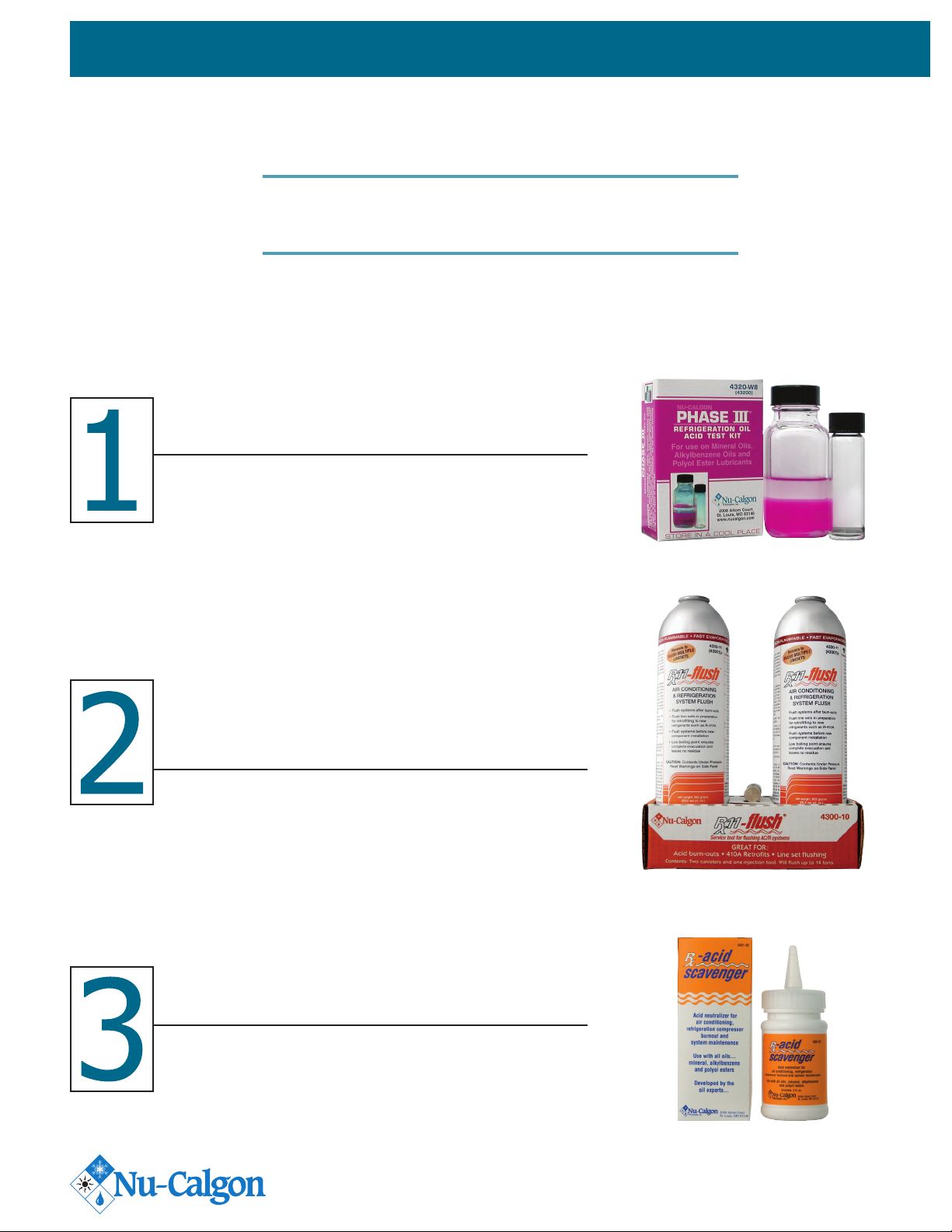
Phase III® Refrigeration Oil
Acid Test Kit
FLUSH and CLEAN Refrigeration
Systems after burnouts or for
R-410A line-set conversions
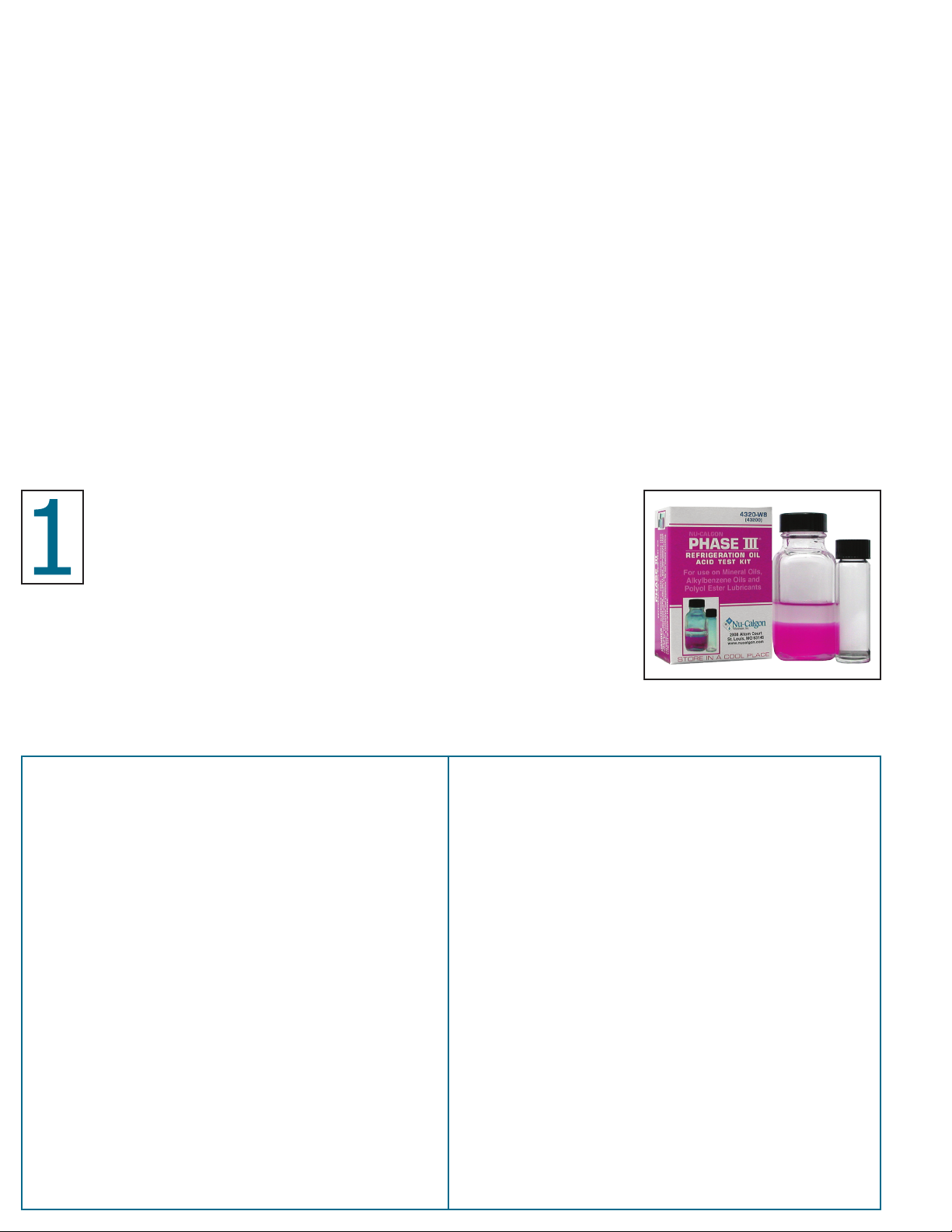
Rx11-Flush
Protect Refrigeration Systems from
acid contamination and burnouts
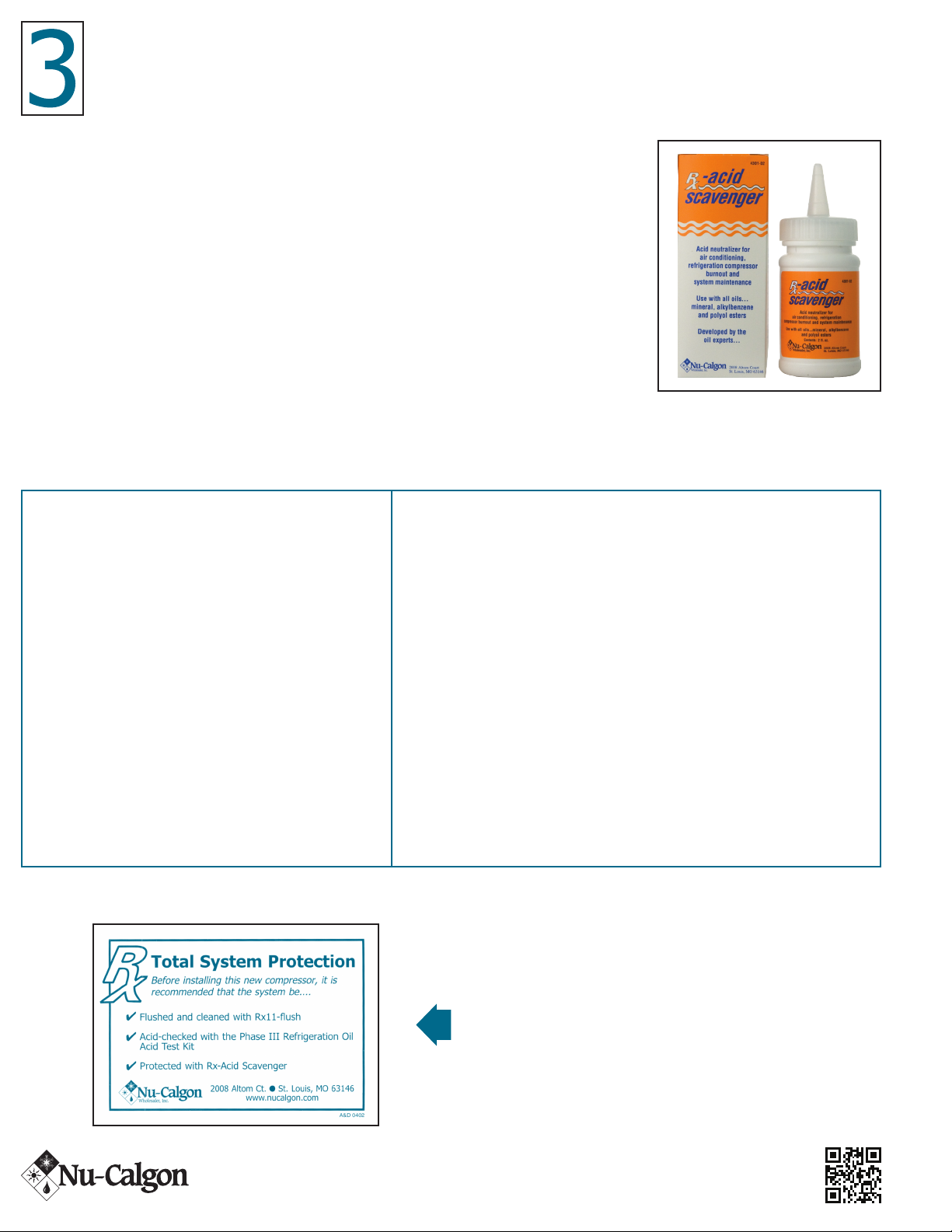
Rx-Acid Scavenger
®
®
2008 Altom Ct. • St. Louis, MO 63146 • 800-554-5499 • ww w.nucalgon.com
Page 2
AIR CONDITIONING, REFRIGERATION COMPRESSOR
The compressor is considered to be the heart of a refrigeration system. And, despite the great care taken during its
manufacture and installation, compressors do fail occasionally, even under ideal operating conditions. Examination of many
compressors and the oil taken from their systems indicates that the oil or refrigerant are often affected by an abnormal
condition somewhere in the system, causing the formation of contaminant’s. As more contaminant’s are formed, a burnout
is inevitable if these contaminant’s are not removed.
Compressor burnouts can be divided into at least three broad categories: contamination failures, electrical failures and
seizure failures. Electric failures are those which can be traced to electrical malfunctions such as short circuits which cause
hot spots in the system. The excessively high temperatures associated with these hot spots can be enough to cause the oil
to begin breaking down.
Seizure failures can be caused by copper plating, metal particles or sludge. Sludge formations require the motor and
compressor to operate under a heavier load. This generates more heat leading to further oil breakdown, more sludge
formation and, eventually complete failure or burnout.
Contamination failures usually result from incomplete de-aeration and/or drying of the system. In fact, the presence
of moisture and non-condensables (such as air) have been found to be the prime sources behind failures caused by
contamination. For example, chlorine and fluorine (from the refrigerant) and moisture can combine to form acid (hydrochloric
or hydrofluoric) which leads to further degradation and burnouts.
Whether it is clean up after a burnout, or regular maintenance, component change out or retrofitting (i.e. R-22 to R410A),
Nu-Calgon’s Total System Protection™ offers the tools and procedures to adequately maintain the refrigeration system.
Detection of Acid
Of all the factors contributing to oil breakdown and eventual compressor
burnouts, moisture seems to be a contributing factor in all three categories
discussed above. Since moisture will, under most conditions, form highly
corrosive acids which are readily absorbed in the oil, the acid content of the
oil can be a good indication of the health of the compressor system. This
is especially true because the oil necessarily migrates with the refrigerant
throughout the entire system.
In addressing this situation, the technician’s refrigeration oil acid test kit
has become indispensable and Nu-Calgon’s Phase III® Refrigeration Oil
Acid Test Kit is the most reliable test kit available.
ADVANTAGES
• Simple – Phase separation makes it easy to see color
changes in acid indicator.
• Universal – Works with mineral oil, alkylbenzenes and
POE’s.
• Convenient – Only two bottles to work with.
• Precise – PHASE III is highly accurate service tool
that can save expensive compressor repair and
replacement costs.
• Unique packaging – Both vials are made with a highly
specialized boro-silicate glass that protects the
integrity of the reagents.
• Effective In The Presence of Dyes - Many systems
will contain dyes, such as fluorescent colored dyes,
for leak detection purposes. These dyes render most
acid test kits useless; not PHASE III. Because of its
phase separation, PHASE III makes it easy to test
such systems.
PART NUMBER 4320-W8
APPLICATION
The concentration of acid in refrigeration oil is expressed
as an acid number in mg (milligrams) of acid. Generally,
it is an industry standard that total acid number (or TAN)
at or below 0.05 mg is considered safe for mineral oil or
alkylbenzene systems. For POE’s, the generally accepted
maximum is 0.16 mg, although some industry experts
consider numbers as high as 0.21 mg as marginally safe.
In the PHASE III test, an acid number of 0.05 mg per
gram of oil has been set as the maximum acceptable acid
concentration in mineral oil and alkylbenzene oil. In polyol
esters, the number is 0.16 mg. Mineral and alkylbenzene
oils with an acid number less than 0.05 mg or POE’s with
an acid number less than 0.16 mg are acceptable and will
cause no change in the color of the test kits acid indicator.
However, if the respective oils have an acid number
greater than these limits, it will cause the acid indicator to
change from purple to pink or clear indicating that the oil
is contaminated.
Page 3
System flushing after burnouts, retrofits or component change outs
As discussed earlier, refrigeration and air conditioning systems suffer failures that result in contamination. The most
common such failure is a compressor burnout, although contaminant’s can also form as the result of electrical
failures, moisture ingress, etc. During such an event, the refrigeration system becomes contaminated with large
quantities of disintegrating particulate, sludge, acids, carbon residues, and moisture. All of these contaminant’s
must be removed before the system is returned to duty.
At the same time, flushing can become necessary when changing out components, or when retrofitting (i.e. R-22 to R-410A).
In these instances, various levels of flushing may be necessary, from flushing the entire system to flushing line sets.
For all of these flushing requirements, Nu-Calgon has developed Rx11-Flush®. Used exactly like the old R-11 flushing process,
Rx11 is strong enough to rinse away particulate, sludge, carbon residues, acids, oils and water. It enhances system service
and avoids the need for time-consuming repeat visits. It should become an integral part of standard procedures for any major
system repair, oil change-out or retrofit.
PACKAGING
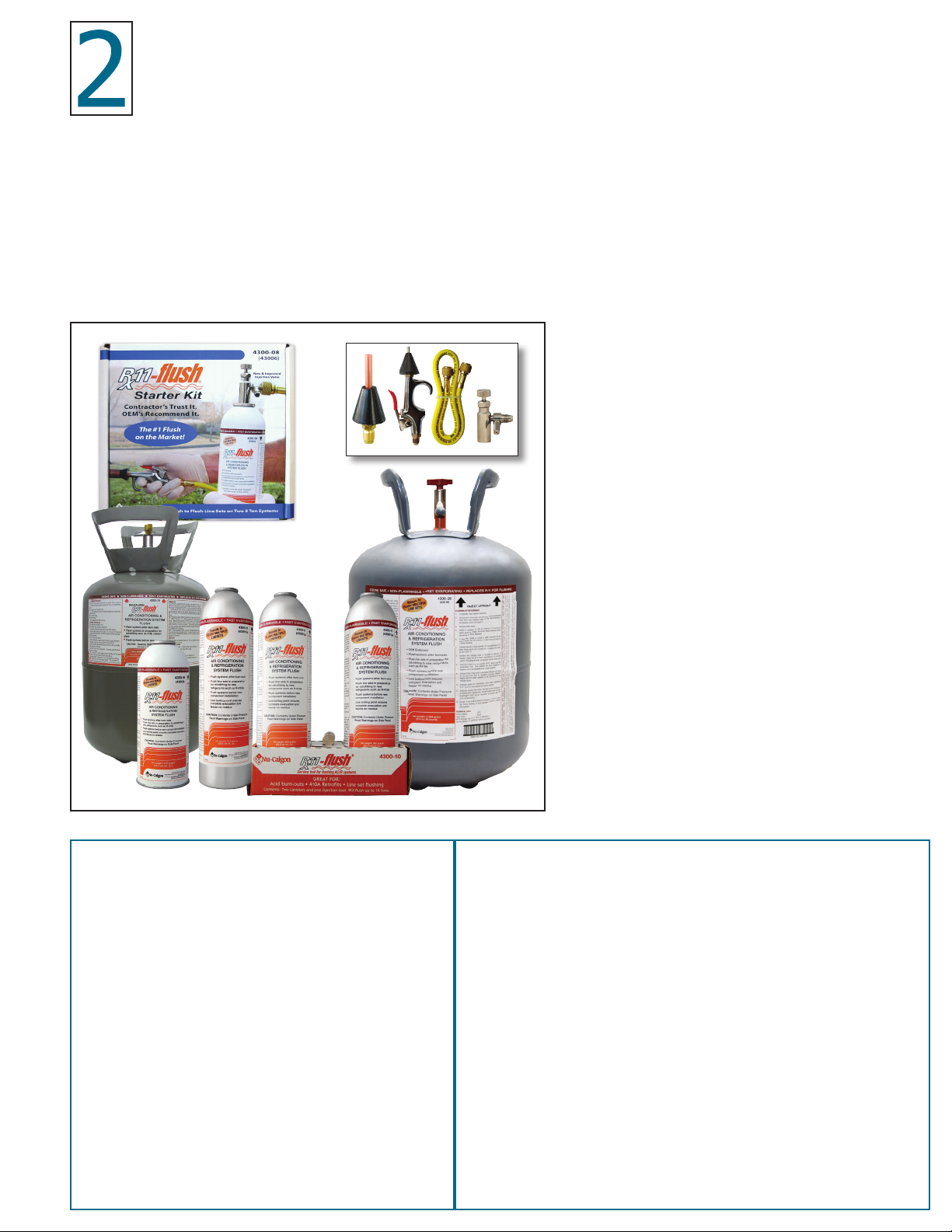
1 lb. Canister: 4300-09
(flushes 3-4 tons)
2 lb. Canister: 4300-11
(flushes 5-7 tons)
“2+1” Display Pack: 4300-10
(flushes 14 tons)
ADVANTAGES
• Safe, nontoxic and nonflammable
• Used the same way as R-11
• Low Boiling point enhances complete
evaporation
• Cleaning is fast, efficient and verifiable
• Can be used for new system cleaning or
retrofits
• Modern packaging minimized solvent
exposure to hands, eyes and lungs
• The solvent is approved as part of the U.S.
EPA’s Significant New Alternatives Program
(SNAP)
13 lb. Cylinder: 4300-15
(flushes up to 50 tons)
26 lb. Cylinder: 4300-26
(flushes over 50 tons)
Starter Kit: 4300-08
Flushing Tool: 4300-50
Rx11-flush Gun: 4300-51
Rx11-flush Hose (24˝)
: 4300-52
Injection Valve: 4300-89
APPLICATION
Based on new and patented HFC solvents developed by
Dupont, Rx11-flush is ozone-safe, non-toxic, nonflammable
and compatible with most materials in a refrigeration system.
The cleaner itself has excellent solvency characteristics and it
is packaged in a convenient pressurized container, sufficient
to purge a moderately contaminated five to seven ton air
conditioning or refrigeration system.
Rx11-Flush is a totally new chemical formulation based on new
HFC technologies. It is a powerful cleaner, stronger than R-11
ever was, and it is the best prescription to effectively scrub the
inside of the refrigeration system. It dries quickly, has a low
boiling point, has no aroma, will not attack components, offers
great worker safety ratings and is affordably priced. Rx11Flush is the industry’s best answer for major system overhauls.
Page 4
Neutralization of possible acid contamination is good insurance
against future problems
Acid in refrigeration systems can be the result of either simple moisture ingress or one
of the after effects of a burnout. When moisture enters the system, it can form highly
corrosive acids that are ultimately absorbed by the oil. In addition, burnouts can result
in the same organic acids, hydrochloric and hydrofluoric, if the refrigerant breaks down.
These acids can attack metal, and they can even go after the welded connections
embedded in glass. Hydrofluoric acid is the most aggressive on glass. The acids can
also react with the oil and system metals, causing metal salts or oxides; they can also
degrade motor insulation.
Rx-Acid Scavenger™ was developed to specifically “scavenge” and neutralize such
acids. Based upon newer carbidimide chemistry, it allows for use with all oils: mineral,
alkylbenzenes and POE. Less is required per gallon of system oil as compared to current
market competitors.
PART NUMBER 4301-02
ADVANTAGES
• Easy-to-use snip spout
• Use Rx-Acid Scavenger after burnouts or
for system maintenance
• Use with all oil: mineral, alkylbenzene or
POE
• Use one 2 fl. oz. bottle per gallon of system
oil, the lowest treatment requirement of all
industry neutralizers
• Eliminate acid build-up
• Protect against future acid contamination
• Prevent compressor burnout
• Protect reclaim equipment
APPLICATION
Formulated as a hydrolytic stabilizer or “acid scavenger” for
lubricants. It is considered a more stable and compatible acid
reactant. As formulated, Rx-Acid Scavenger can bind and
neutralize both organic and inorganic acids although organic
acids are the most typical for refrigeration systems.
The two most prominent benefits are: its ability to be used with all
three industry lubricants and its “low treat” feature that requires
only 2 fl. oz. of product per gallon of oil. Because it can be
used with all oils, only one neutralizer product is needed for all
applications, one product on the shelf, one product in the truck
and in the tool box. Because of its “low treat” feature, less matter
must be added to a system in neutralizing acid. There is up to
50% less than used by all industry competitors. This becomes
significant on rack systems and other large system applications.
Use the Total System Protection sticker for notification
on equipment and applications where these products
should be used.
2008 Altom Ct. • St. Louis, MO 63146 • 800-554-5499 • ww w.nucalgon.com
Calgon is a licensed trade name • (911) 3-104
 Loading...