

Nova Florida ALTAIR RTN 24, ALTAIR RTN 32, ALTAIR RTN E 32, ALTAIR RTN 18, ALTAIR RTN E 36 Installation, Use And Maintenance Manual
...Page 1

ALTAIR RTN
IST 04 C 126 - 01
BRAND NAME
INSTALLATION, USE AND
MAINTENANCE
GB
Page 2

1
Dear Customer,
Thank you for choosing and buying one of our boilers. Please read these instructions carefully in order to
install, operate, and maintain this equipment properly.
Page 3

This INSTRUCTION BOOKLET is an
integral and essential part of this
product and must be handed to the
user by the installer for safekeeping
and consultation when necessary.
This instruction booklet is to be handed over with the equipment should
it be sold or transferred.
The boiler must only be used for
the purposes that are expressly
foreseen. Any other use is to be
considered improper and therefore dangerous.
The installation must be carried out
in compliance with current standards
and following the manufacturer’s
instructions contained in this booklet.
Incorrect installation may result in
harm to people, animals, and/or property, and the manufacturer accepts
no responsibility for such damage.
The unit must be installed in a
room that is sufficiently well ventilated, in compliance with current
standards and laws
.
The producer does not accept
any contractual or extra-contractual
responsibility for any damage caused due to errors in installation or
operation, or resulting from failure to
follow the instructions below.
Before installing this equipment
make sure that the technical data for
the unit meet the requirements for its
proper use in the plant.
Also check that the equipment is
complete and that it has not been
damaged in transit or during handling. Do not install any equipment
that is clearly damaged and/or
defective.
Do not obstruct the air intake and/or
heat dissipation grilles.
For all equipment with optional
extras or kits (including electrical
ones), only original accessories
must be used.
When installing the equipment do
not throw the packing away. All the
materials can be recycled and must
be taken to specific separated collection areas.
Keep the packing out of reach of children, as, by its very nature, it may
constitute a source of danger.
Should the equipment break down
and/or function defectively, switch it
off and do not attempt to repair it
yourself. Call in only qualified personnel.
Any repairs to this product must be
made using only original spare parts.
Failure to comply with the above may
compromise the safety of the equipment and expose people, animals,
and property to danger.
The owner is obliged to have routine maintenance carried out on
the equipment once a year, as
indicated in the programme given
in the relevant section of this booklet, in order to ensure that it
works efficiently and correctly
.
Where the equipment is not to be
used for an extensive period of time,
disconnect it from the electrical
power supply and shut the fuel stopcock.
Where there is a danger of freezing,
add antifreeze. Draining the system
is not recommended as this may
damage the overall system. For this
purpose use non-freeze products
specifically made for multi-metal
heating equipment.
IMPORTANT
For equipment powered by gas fuel,
if you smell gas in the area, proceed
as follows:
- Do not activate any electric switches or start any electric equipment.
- Do not light any flames and do
not smoke.
- Shut the central gas stopcock.
- Open all doors and windows.
- Contact a Service Centre, qualified installer, or the gas supply
company.
Using naked flames to check for
gas leaks is completely forbidden.
2
GENERAL NOTES FOR THE USER AND THE INSTALLER
WARNING
This ALTAIR unit is built for installation in the destina-
tion Country specified on the technical data plate.
Installation in any country other than that indicated
may pose a danger to people, animals, or property.
Page 4

Warnings page 1
General notes for the installer, maintenance technician and user page 2
1 Instructions for the user page 4
1.1 Control panel page 4
1.2 Operating the boiler page 5
1.2.1 Switching on page 5
1.2.2 Switching off page 5
1.2.3 Burner cut-out page 5
1.2.4 Cut-Out do to overheating page 5
1.2.5 Cut-Out due to incorrect draught on the flue page 6
1.2.6 Cut-Out due to insufficient gas pressure (RTN 70/RTN 100) page 6
1.3 Maintenance page 6
1.4 Notes for the User page 6
2 Technical characteristics and dimensions page 7
2.1 Technical characteristics page 7
2.2 Dimensions page 8
2.3 Technical data page 9
3 Instructions for the Installer page 11
3.1 Installation standards page 11
3.2 Installation page 11
3.2.1 Packaging page 11
3.2.2 Choosing where to install the boiler page 11
3.2.3 Installing the boiler page 11
3.2.4 Ventilation of boiler rooms page 11
3.2.5 Smoke chimney system page 11
3.2.6 On-site measurement of combustion efficiency page 12
3.2.7 Connecting to the gas mains page 12
3.2.8 Connecting to the electrical mains page 12
3.2.9 Plumbing connections page 12
3.2.10 Installation of original kits page 12
3.3 Filling the system page 12
3.4 Starting the boiler page 13
3.4.1 Preliminary checks page 13
3.4.2 Starting up and switching off page 13
3.5 Wiring diagrams page 13
3.5.1 General layout page 14
3.5.2 Topographycal diagrams page 16
3.6 Gas Conversions page 18
3.6.1 Conversion from natural gas to LPG page 18
3.6.2 Conversion from LPG to natural gas page 18
4 Maintenance page 18
3
CONTENTS
Page 5

Main lit switch (green) (1)
When the switch is in the 0 position
the boiler is switched off and the
switch is not lit.
When the switch is in the I position
the boiler is switched on and the
switch is lit.
Reset button (2)
When the reset button is pressed the
boiler is restarted.
Temperature adjustment for the
heating water (3)
This knob is used to set the temperature for the water in the heating
system. It can be set between a minimum of 45°C and a maximum of
85°C.
Heating function LED (yellow) (4)
This LED indicates that the system is
calling for heating.
Overheating cut-out LED (red) (5)
This light indicates that the cut-out
connected to the safety thermostat
has tripped due to malfunctioning. It
must be reset manually.
Cut-out LED (red) (6)
(On all models) This light indicates
that the smoke safety device has tripped due to a lack of draught on the
flue (albeit only temporary) or low gas
supply pressure (for models RTN 70
to RTN 100). It must be reset
manually.
Burner cut-out LED (red, only “E”
models) (7)
This light indicates that the burner
safety device has tripped due to a
malfunction.
Burner operation LED (yellow) (8)
This light indicates that the burner is
operating.
Thermometer or pressure gauge (9)
The thermometer’s function is to indicate the temperature of the water in
the boiler, while the thermometer /
pressure gauge is used to indicate
the pressure as well.
Safety thermostat manual reset (10)
The safety thermostat is used to protect the boiler in case of a fault. The
thermostat reset button can be
accessed by removing the protective
cover.
1. INSTRUCTIONS FOR THE USER
1.1 CONTROL PANEL
4
1. General switch with line light (green)
2. Reset button
3. Temperature adjustment for the
heating water
4. Heating pump operation light (yellow)
5. Overheating cut-out LED (red)
6. LED to indicate cut-out due to no
draught on the flue or low gas
pressure (low gas pressure for models
RTN 70 to 100)
7. Burner cut-out LED (only “E” models)
8. Burner operation LED (yellow)
9. Water thermometer (models RTN
18 to RTN 48) or thermometer/pres-
sure gauge (for models RTN 60 to
RTN 100 and all PV models)
10.Safety thermostat manual reset
fig. 1
Page 6

1.2 Operating the boiler (Fig. 1)
1.2.1 Switching on
For “E” models
• Open the fuel stopcock.
• Switch the boiler’s main switch 1 to
the ON position (the switch lights up).
• Turn the heating water temperature adjustment knob
3 to set the tem-
perature required for the heating
system.
• Set the ambient temperature using
the ambient thermostat (if there is
one).
• When the heating system calls for
heat the heating request light
4
comes on.
• When the burner is operating, the
burner operation light
8 comes on.
For models with a thermoelectric
valve:
• Open the fuel stopcock.
• Make sure that the main switch is
in the OFF position (the switch is not
lit up).
• Remove the front panel on the boiler.
This allows access to the gas valve
and the piezoelectric device and the
pilot burner can be switched on.
• Turn the cover over the pilot burner
so that it can be seen through the
relevant hole.
• Pushing the gas valve knob gently,
rotate it anti-clockwise from the •
(off) position to the (pilot) position.
• Hold the knob down and push the
piezo until the pilot burner is burning.
• Hold the knob down for about 20
seconds.
• After releasing the knob turn it anticlockwise to the (main burner)
position.
• Put the cover plate for the pilot
burner back in its original position.
• Replace the front panel on the boiler.
• Switch the boiler’s main switch 1 to
the ON position (the switch lights up).
• Turn the heating water temperature adjustment knob
3 to set the tem-
perature required for the heating
system.
• Set the ambient temperature using
the ambient thermostat (if there is
one).
• When the heating system calls for
heat the heating request light
4
comes on.
• When the burner is operating, the
burner operation light
8 comes on.
Please Note: When igniting the bur-
ner after the boiler has been out of
use for a long period of time, especially in the case of LPG boilers,
there may be airlocks in the pipes.
The boiler’s burner may cut-out a
few times. Restart the burner using
the reset button (see the following
paragraphs).
1.2.2 Switching off
For “E” models
Set the main switch on the OFF
position (the switch is not lit up).
If necessary, shut the fuel stopcock.
For models with a thermoelectric
valve:
On these models, when the main
switch is on the OFF position (switch
not lit up) the main burner is extinguished but the pilot burner stays
alight.
If you wish to extinguish the pilot
burner as well, after setting the main
switch to the OFF position, remove
the boiler’s front panel and turn the
gas valve knob to the • (off) position
by turning it clockwise.
1.2.3 Burner cut-out
When any functioning faults arise
the boiler’s burner cuts out automatically. On “E” models the cut-out
light
7 comes on. Should this hap-
pen, proceed as follows:
• First check the fuel supply, make
sure that the gas stopcock is open
and that the gas mains have gas in
them by lighting a cooking ring in the
kitchen, for example.
• Having checked the fuel supply,
reset the burner by pushing the
reset button
2 on the control panel.
Models with a thermoelectric valve
do not have any cut-out indication
light.
The boiler must be re-ignited as per
instructions given in paragraph
1.2.1
and this can only be done 60
seconds after it has gone out (automatic safety device).
If the equipment does not restart
and cuts out again, after trying three
times contact an authorised Service
Centre or qualified personnel to
carry out maintenance.
If the burner cuts out frequently this
is a sign that there is an ongoing
operating fault.
Contact qualified personnel or an
authorised Service Centre for maintenance.
1.2.4 Cut-out do to overheating
Should the red cut-out light 5 indicating overheating come on, this
means that the safety thermostat
cut-out has tripped and must be
reset manually. This is due to an
operating fault and an authorised
Service Centre or qualified personnel must be contacted for maintenance.
5
Page 7

1.2.5 Cut-out due to incorrect
draught in the flue
Should conditions arise that lead to a
faulty draught in the flue, the boiler
cuts out and red light
6 comes on.
To restart the boiler proceed as follows:
• Switch the boiler’s main switch
1 to
the 0 position (the boiler is switched
off and the switch is not lit up).
• Remove the front panel on the boiler.
• Push the button on the thermostat
that checks proper evacuation of
smoke (fig. 2)
• Replace the front panel on the boiler.
• Switch the boiler’s main switch
1 to
the I position (the boiler is switched
on and the switch is lit up).
WARNING
If after resetting the boiler does not
start working properly again and
cuts out again, contact qualified
personnel or an authorised
Service Centre for maintenance.
1.2.6 Cut-out due to insufficient
gas pressure (on models RTN 70 to
RTN 100)
Should the gas supply pressure be
insufficient, the boiler does not start
up and red light
6 lights up.
If the unit remains in this state for any
length of time, contact the gas supply
company.
1.3 Maintenance
The user is obliged to have routine
maintenance done on the boiler and
the burner once a year.
Correct maintenance of the boiler
allows it to work under the best conditions, protects the environment, and
makes the equipment fully safe for
people, animals, or property.
The boiler must be maintained only
by qualified personnel.
The user may only clean the casing
on the boiler, and this must be
done using products for cleaning
furniture.
Do not use water!
1.4 Notes for the user
The user is not authorised to remove the casing of the boiler and to
work on parts inside.
NOBODY, INCLUDING QUALIFIED
PERSONNEL, IS AUTHORISED TO
MODIFY THE BOILER.
Qualified personnel may install specific original kits on the boiler.
The producer accepts no
responsibility for damage to people, animals, or property that may
arise due to tampering or incorrect
work done on the boiler
.
The heating system can be effectively
protected against freezing by using
specific anti-freeze products that are
suitable for multi-metal systems.
Do not use anti-freeze products for
car engines, and check the effectiveness of the product over the
time.
This boiler is fitted with a thermometer to allow you to check the water
temperature.
6
fig. 2
Page 8

2.1 Technical characteristics
The ALTAIR RTN is a boiler with a
high performance heat exchanger
that works with gas burners at atmospheric pressure. The following
models are available:
ALTAIR RTN E 18 and RTN 18 with
a heat output of 18 kW.
ALTAIR RTN E 24 and RTN 24 with
a heat output of 24 kW.
ALTAIR RTN E 32 and RTN 32 with
a heat output of 31,5 kW.
ALTAIR RTN E 36 and RTN 36 with
a heat output of 36 kW.
ALTAIR RTN E 48 and RTN 48 with
a heat output of 48 kW.
ALTAIR RTN E 60 with a heat output
of 60 kW.
ALTAIR RTN E 70 with a heat output
of 70 kW.
ALTAIR RTN E 80 with a heat output
of 80 kW.
ALTAIR RTN E 90 with a heat output
of 90 kW.
ALTAIR RTN E 100 heat output of
100 kW.
RTN 18 to RTN 36 and RTN E 18 to
RTN E 36 models of
ALTAIR boilers
can be supplied in a
PV version,
which means that they have a circulation pump and an 8 lit. expansion
tank.
ALTAIR RTN E boilers are equipped
with an electronic card for checking
the flame and have an electronic
ignition (which is indicated by the
addition of the letter E in the model
name).
The models from RTN 18 to RTN 48
are fitted with a thermoelectric valve
and a piezoelectric ignition unit.
ALTAIR boilers meet the essential
requirements laid down in EEC
Directives for this product and Gas
Directive 90/396/EEC dated 29th
June 1990,
Performance Directive 92/42/EEC
dated 21st May 1992.
EMC Directive 89/336/EEC dated
3rd May 1989, as amended by
Directive 92/31/EEC dated 28th April
1992,
European Community Low Voltage
Directive 73/23/EEC dated 19th
February 1973, as amended by
Directive 93/68/EEC dated 22nd July
1993,
and they are fitted with all the safety
devices called for in the current standards for this type of product.
The main technical characteristics of
the
ALTAIR boiler are listed below.
• High-performance cast-iron heat
exchanger.
• Insulation in glass wool with thick
aluminized paper (50 mm).
• Casing in electrically galvanised
steel plating, epoxy-polyester powder coated.
• Lit main switch.
• LED indications for: power on, hea-
ting pump operation, burner operation, overheating cut-out, cut-out due
to lack of draught in the flue or low
gas pressure (low gas pressure only
RTN 70 to RTN 100 models) and
burner cut-out (only “E” models).
• Heating temperature selector
(45/85°C).
• Safety limit thermostat (110°C).
• Smoke safety thermostat.
• Minimum gas supply pressure
switch (models RTN 70 to RTN 100).
• Thermometer or thermometer/
pressure gauge (for models RTN 60
to RTN 100 and all PV models).
• System drain cock.
• Electrical system with printed elec-
tric circuit.
• Provision for the electrical connection of a heating pump.
• Can take a safety pressure switch
to guard against insufficient water.
• Provision for the connection of a
card for managing a remote water
cylinder (optional kit).
• Provision for the connection of a
climatic unit (optional kit).
• Provision for the connection of a
card for managing three heating
areas (optional kit).
• 8-lit. expansion tank (for PV
models).
• Single-speed circulation unit (for
PV models).
2. TECHNICAL CHARACTERISTICS AND DIMENSIONS
7
Page 9
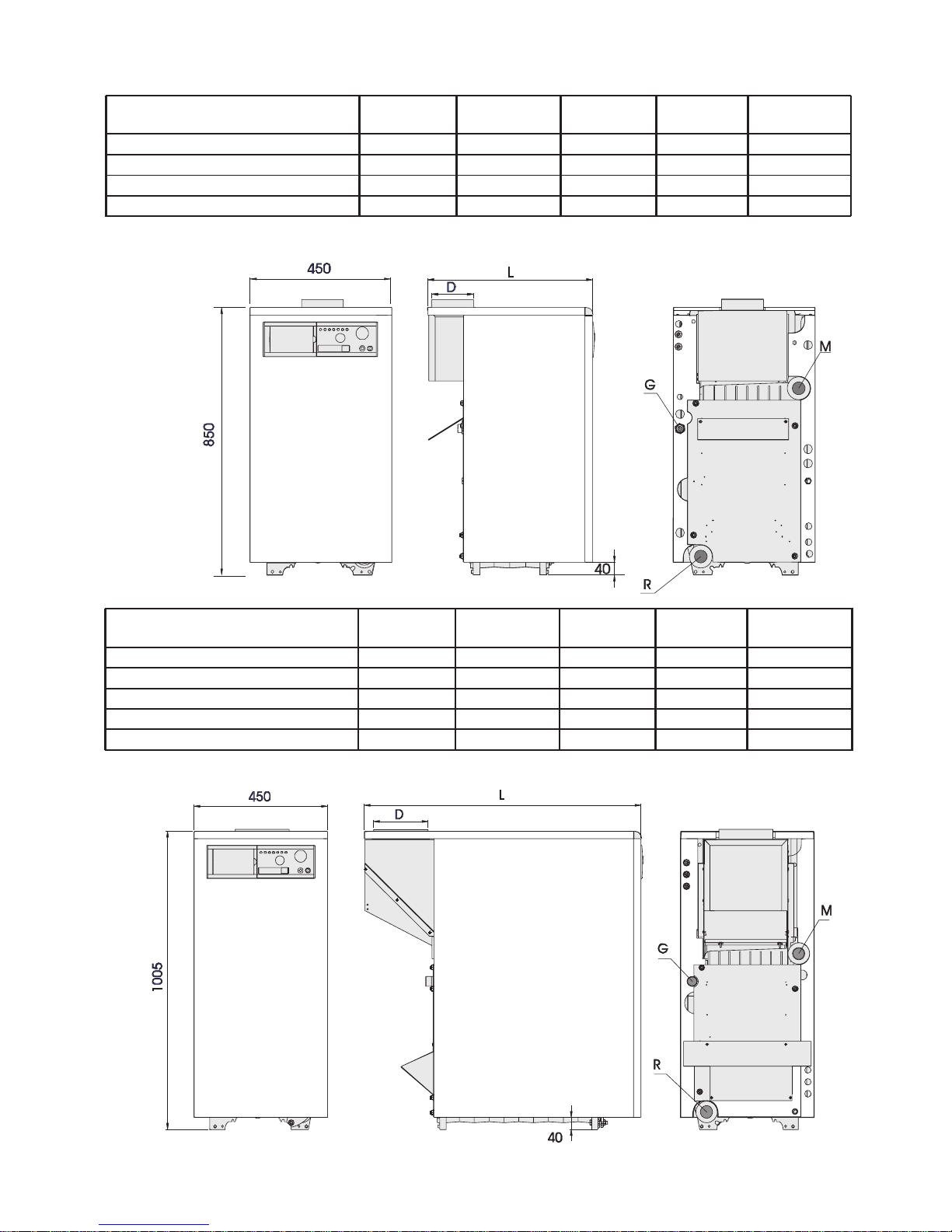
L Delivery Return Gas Smoke Flue
(mm) M R G D (mm)
935 G1” 1/2 G1” 1/2 G1” 180
1052 G1” 1/2 G1” 1/2 G1” 180
1153 G1” 1/2 G1” 1/2 G1” 200
1280 G1” 1/2 G1” 1/2 G1” 220
1430 G1” 1/2 G1” 1/2 G1” 250
MODEL
RTN E 60
RTN E 70
RTN E 80
RTN E 90
RTN E 100
2.2 Dimensions
NOTE: in the PV models, equipped with circulation pump and expansion tank, R and M connection are G 3/4”
8
L Delivery Return Gas Smoke Flue
(mm) M R G D (mm)
525 G1” 1/4 G1” 1/4 G 3/4” 110
525 G1” 1/4 G1” 1/4 G 3/4” 130
625 G1” 1/4 G1” 1/4 G 3/4” 130
725 G1” 1/4 G1” 1/4 G 3/4” 150
MODEL
RTN 18/RTN E 18
RTN 24/RTN E 24
RTN 32/RTN 36 - RTN E 32/RTN E 36
RTN 48/RTN E 48
fig. 3
fig. 4
Page 10

MODELS
RTN E 18 RTN E 24 RTN E 32 RTN E 36 RTN E 48
RTN 18 RTN 24 RTN 32 RTN 36 RTN 48
18
20
89,6
89,2
2,3
0,2
8,2
3
105
10
400
110
4
45 - 85
230/50
10
4
5,8
110/120
42
3
2,2
2X0,27
9,5
2,11
6,3
110/120
40
3
1,25
0,5
26
1,6
24
26,6
90,9
91,1
2,2
0,2
6,9
3
105
10
520
130
4
45 - 85
230/50
10
4
5,5
110/120
56
3
2,5
2X0,27
11,0
2,81
6,9
110/120
53
3
1,50
0,5
26
2,1
31,5
34,4
90,9
89,0
2
0,2
7,1
4
138
13,4
680
130
4
45 - 85
230/50
10
4
6,4
120/130
63
3
3
2X0,27
9,5
3,64
8,2
120/130
60
3
1,7
0,5
25,5
2,7
36
39,2
90,83
90,75
2
0,2
7,2
4
138
13,4
770
130
4
45 - 85
230/50
10
4
6,5
120/130
70
3
3,0
2X0,27
12,0
4,15
8,7
120/130
64
3
1,8
0,5
26,8
3,1
48
52,8
91,84
90,4
1,8
0,2
6,4
5
173
16,8
1030
150
4
45 - 85
230/50
10
4
7,0
120/130
88
3
3,1
2X0,27
12,5
5,58
8,7
120/130
80
3
2,05
0,5
26
4,2
51BP2712
II2H3+
B11BS
kW
kW
%
%
%
%
%
Kg
l
l/h
mm
bar
°C
V-Hz
W
A
%
°C
Kg/h
mm
mm
mbar
Stm3/h
%
°C
Kg/h
mm
mm
mbar
kg/h
EC Efficiency class
EC PIN
Category
Type
Heat output
Heat input
Performance at nominal load
Performance at reduced load (30%)
Maintenance losses ∆T=50
Flue losses with burner extinguished
Flue losses with burner working
N° of elements of the heat exchanger
Net weight
Water content
Minimum water flow
Smoke flue diameter
Maximum operating pressure
Working temperature
Electrical power supply
Electrical power
Fuse on power supply
Natural gas G20
CO2value
Smoke temperature
Smoke mass flow
Number of main burner nozzles
Diameter of main burner nozzles
Diameter of main pilot nozzle
Gas pressure at burner
Gas Flow (15°C / 1013 mbar).
Gas G30
CO2value
Smoke temperature
Smoke mass flow
Number of main burner nozzles
Diameter of main burner nozzles
Diameter of main pilot nozzle
Gas pressure at burner
Gas Flow (15°C / 1013 mbar).
2.3 Technical Data
9
★★
★★
★★ ★★
★★
Page 11

60
66
91,7
90,6
1,80
0,2
6,5
6
215
20,2
1200
180
4
45 - 85
230/50
20
4
6,5
110/120
114
3
3,9
2X0,27
11,55
6,97
6,5
110/120
134
3
2,4
0,5
26
5,2
70
76,3
91,7
90,40
1,7
0,2
6,6
7
250
23,5
1500
180
4
45 - 85
230/50
20
4
6,3
110/120
136
3
4,1
2X0,27
13,4
8,13
6,5
110/120
154
3
2,6
0,5
26
6,1
80
87,3
91,7
90,3
1,6
0,2
6,7
8
285
26,8
1700
200
4
45 - 85
230/50
20
4
6,8
120/130
144
3
4,5
2X0,27
12,0
9,23
7,3
120/130
158
3
2,75
0,5
25,5
6,9
90
98,2
91,6
90,3
1,5
0,2
7
9
320
30,1
1900
220
4
45 - 85
230/50
20
4
5,5
110/120
200
3
4,9
2X0,27
11,0
10,44
5,7
110/120
225
3
2,9
0,5
26,8
7,8
100
109,7
91,6
90,2
1,20
0,2
7,2
10
355
33,4
2100
250
4
45 - 85
230/50
20
4
5,5
110/120
223
3
5,2
2X0,27
11,60
11,60
5,7
110/120
252
3
3,05
0,5
26
8,7
MODELS
RTN E 60 RTN E 70 RTN E 80 RTN E 90 RTN E 100
51BP2708
II2H3+
B11BS
kW
kW
%
%
%
%
%
Kg
l
l/h
mm
bar
°C
V-Hz
W
A
%
°C
Kg/h
mm
mm
mbar
Stm3/h
%
°C
Kg/h
mm
mm
mbar
kg/h
EC Efficiency class
EC PIN
Category
Type
Heat output
Heat input
Performance at nominal load
Performance at reduced load (30%)
Maintenance losses ∆T=50
Flue losses with burner extinguished
Flue losses with burner working
N° of elements of the heat exchanger
Net weight
Water content
Minimum water flow
Smoke flue diameter
Maximum operating pressure
Working temperature
Electrical power supply
Electrical power
Fuse on power supply
Natural gas G20
CO2value
Smoke temperature
Smoke mass flow
Number of main burner nozzles
Diameter of main burner nozzles
Diameter of main pilot nozzle
Gas pressure at burner
Gas Flow (15°C / 1013 mbar).
Gas G30
CO2value
Smoke temperature
Smoke mass flow
Number of main burner nozzles
Diameter of main burner nozzles
Diameter of main pilot nozzle
Gas pressure at burner
Gas Flow (15°C / 1013 mbar).
10
★★
★★
★★ ★★
★★
Page 12

3.1 Installation standards
This ALTAIR boiler must be installed
in compliance with current laws and
standards, which are taken as being
an integral part of this booklet.
3.2 Installation
3.2.1 Packaging
ALTAIR
boilers are supplied packed
in a strong cardboard box on a wooden pallet. On removing the cardboard box, make sure that the boiler
is complete.
The packing materials can be recycled. Dispose of them via specific
waste collection sites.
Keep the packing out of the reach
of children, as, by its very nature, it
may constitute a source of danger.
The producer accepts no
responsibility for damage to people, animals, or property due to
failure to observe the instruction
above.
The pack contains a packet in which
you will find the installation, operation, and maintenance manual.
3.2.2 Choosing where to install
the boiler
The following must be taken into
account when choosing where to
install the boiler:
• It is advisable to leave at least 50
cm on each side of the boiler to facilitate future maintenance.
• Do not install in damp or dusty
rooms.
• The boiler room must not be accessible to outsiders, children, or animals.
3.2.3 Installing the boiler
Before connecting the boiler to the
piping for the hot water and heating
systems, clean the piping carefully to
eliminate any metal residue left
during working and welding, and any
oil or grease that may be left and that
could damage the boiler or alter its
operation if it reaches the boiler.
NB: Do not use solvents, as these
could damage the components.
The producer accepts no respon-
sibility for damage to people, animals, or property due to failure to
observe the instructions above.
To install the boiler proceed as follows:
• Remove the galvanised plate on
the lower back part of the boiler.
• Unscrew the four screws which
block the brackets fixing the boiler to
the timber pallet (Fig. 5)
• Remove the boiler from the pallet
without damaging it.
• Put spacers between the floor and
the boiler’s feet if necessary, to make
the installation stable.
• Connect the boiler to the system’s
delivery and return pipes.
• Remember that the plumbing
system must include all the safety and
control elements required in terms of
current standards (safety valve, water
pressure switch, heat discharge valve,
pressure gauge, etc.).
• Couple the boiler to the flue.
• Connect to the electrical system of
the boiler: the ambient thermostat,
the heating pump, and the heating
water pressure switch.
• Connect to the electrical mains.
3.2.4 Ventilation of boiler rooms
ALTAIR boilers have open combu-
stion chambers and are designed for
being connected to a smoke flue.
The combustion-supporting air is
drawn
directly from the room in
which the boiler is installed.
It is obligatory that the boiler be
installed in an adequate room in
terms of the current standard,
which
is taken as an integral part of this
booklet.
3.2.5 Smoke chimney system
The ALTAIR boilers have a smoke
flue coupling that is suitable for connecting to a smoke chimney with a
diameter as specified in the technical data tables.
Current standards must be complied
with when discharging smoke into
the atmosphere, and
these standards are taken as being an integral part of this booklet.
The smoke ducts from the boiler are
to be connected to a smoke flue formed as indicated in current standards,
which are taken as being an
integral part of this booklet.
The following obligatory requirements for smoke flues and smoke
ducts must be kept in mind:
• They are to be of a diameter not
less than that on the boiler outlet.
• They are to be made of impermeable material that can withstand the
smoke temperature and related acid
condensate.
• They are to have low thermal conductivity, sufficient mechanical
strength, be properly sealed, and of a
calculated height and cross-section.
• The vertical inclination (smoke flue
pipe) and section are to be constant,
without any bottlenecks.
• Where horizontal flues sections
have to be used, these must be at an
incline of at least 5%.
• The end of the flue pipe is to be
such that it can ensure efficient, constant evacuation of smoke under any
weather conditions.
• The end section of the flue pipe is
to be at least 0,5 m above any adjacent structure within a 5 m radius.
3. INSTRUCTIONS FOR THE INSTALLER
11
fig. 5
Page 13

3.2.6 On-site measurement of
combustion efficiency
To determine combustion efficiency
the following measurements must be
taken:
• The temperature of the combustion-supporting air.
• The temperature of the smoke and
the percentage of CO
2 in samples
drawn from the hole provided for this
purpose in the smoke duct.
Take the specific measurements
with the boiler running at normal
load.
3.2.7 Connecting to the gas mains
The gas supply pipe must have a
cross-section that is equal to or
greater than that on the burner.
Installation standards must be complied with and are taken as being an
integral part of this booklet.
Remember that before putting an
internal gas distribution system
into service, before it is connected to the meter, it must be checked for leaks.
If any part of the system is inaccessible the tightness test must
be carried out before the pipes are
covered up.
The tightness test must not be
carried out using combustible
gas. Use air or nitrogen for this
purpose.
Once there is gas in the pipes,
checking for leaks using a naked
flame is forbidden.
Use the products made for this
purpose that are available on the
market.
3.2.8 Connecting to the electrical
mains
ALTAIR boilers have a terminal
board for connection to a three-pole
power supply cable, and a suitable
cable clamp to prevent it from being
torn out.
This boiler must be connected to a
230V-50Hz electrical power supply.
When forming the connection
respect the phase/neutral polarity.
During installation relevant standards must be complied with and
are taken as being an integral part
of this booklet.
A two-pole switch must be fitted
upstream of the boiler to allow all
maintenance work to be carried out
in complete safety.
The power supply to the boiler must
be fitted with a differential magneticthermal trip-switch of a suitable tripping power.
The electrical power supply must be
safely earthed.
This basic safety requirement must
be checked. In case of doubt, call in
professionally qualified personnel to
check the electrical system carefully.
The producer accepts no
responsibility whatsoever for any
damage caused due to failure to
earth the system. Gas, water or
heating system pipes are not suitable for earthing the system.
3.2.9 Plumbing connections
Before installation, the boiler should be
cleaned in order to remove, as far as
possible, the impurities that may come
from the components as far as possible, as these could damage the circulation pump or the heat exchanger.
The heating delivery and return
pipes must be connected to the
respective couplings on the boiler.
When sizing the piping for the heating system, bear in mind the load
losses caused by radiators, thermostatic valves, radiator gate valves,
and the configuration of the system
itself.
3.2.10 Installation of original kits
The producer provides original
kits for installing clock programmers,
cards for managing a remote water
storage cylinder, and for installing a
heat-regulating unit.
These original kits are to be installed
in compliance with the instructions
supplied with them.
3.3 Filling the system
Once all the connections in the
system have been completed, the
heating circuit can be filled.
This operation must be carried out
carefully, and in the following steps:
• Open the bleeding valves on the
radiators and make sure that the
vent valve installed in the boiler room
is working.
• Gradually open the relevant stopcock to fill the system and make sure
that all automatic air vents installed
in the system are working properly.
• Close the vent valve as soon as
water comes out of it.
• Use the pressure gauge installed
in the boiler room to check when the
pressure reaches 0.8 / 1 bar.
• Shut the filling stopcock and bleed
any air out again using the bleeding
valves on the radiators.
• Having started the boiler and
brought the system up to its working
temperature, stop the pump and
repeat the air bleeding operations.
• Allow the system to cool and
return the water pressure to 0.8/1
bar.
WARNING
It is essential to treat the water of
domestic heating systems using
specific products that are compatible
with multimetal systems. This must
be made to optimise performance
and safety, to preserve these conditions over time, to ensure longlasting regular operation of auxiliary
equipment as well, and to minimise
energy consumption, thereby integrating current laws and standard.
Note: The boiler is equipped with
a drain cock at the front of the unit
that can be used to empty the
system.
12
Page 14

13
3.4 Starting the Boiler
3.4.1 Preliminary Checks
Before starting the boiler it is advisable to check that:
• The smoke flue has been installed in compliance with
instructions.
When the boiler is running no products
generated by combustion are to leak from any of the
gaskets.
• The boiler power supply is 230 V – 50 Hz.
• The system is properly filled with water (pressure on
the water gauge 0.8 / 1 bar).
• All stopcocks in the system’s piping are open.
• The fuel supply stopcock is open.
• There are no gas leaks.
• The external main switch is on.
• The boiler’s safety valve is not blocked.
• There are no water leaks.
To speed up and facilitate igniting the boiler for the first
time, bleed the air out of the gas piping using the gas
pressure valve socket.
Close the pressure socket carefully after bleeding the
system.
3.4.2 Starting Up and Switching Off
For starting up and switching off the boiler, follow the
“User’s Instructions”.
3.5 Wiring Diagrams
BC
: Flame control
EA: Ignition electrode
ER: Flame detection electrode
F1: Protection fuse F4A 250V
IG: Main switch [marked “on/off” on the printed circuit]
L1: Smoke thermostat / gas pressure gauge indication
L3: Heating circulation unit indication
L4: Burner ON indication
L5: Safety thermostat indication
L6: Burner cut-out indication (only E models). .
Lon: Power ON indication
Mn: Minimum thermostat (optional) [marked “Tm” on
the printed circuit]
MT: Motor timer (optional) [marked TIMER on the prin-
ted circuit]
PA: Water pressure switch (optional) [marked with the
pressure switch symbol on the printed circuit]
PC: Heating circulation unit
Pgas: Gas pressure switch
PZ: Ignition piezoelectric unit
P1: Burner reset button
R: Heating thermostat [marked “Tr ” on the printed cir-
cuit]
TA: Ambient thermostat
TS: Safety thermostat
TF: Smoke thermostat
TM: Contact timer (optional) [marked TIMER on the
printed circuit]
VG,VG1,VG2: Gas Valve
a = Blue
br = Brown
g = Grey
p = Pink
v = Violet
bl = Dark Blue
bk = Black
gn = Green
r = Red
y = Yellow
w = White
ygn = Yellow/Green
o = Orange
Page 15
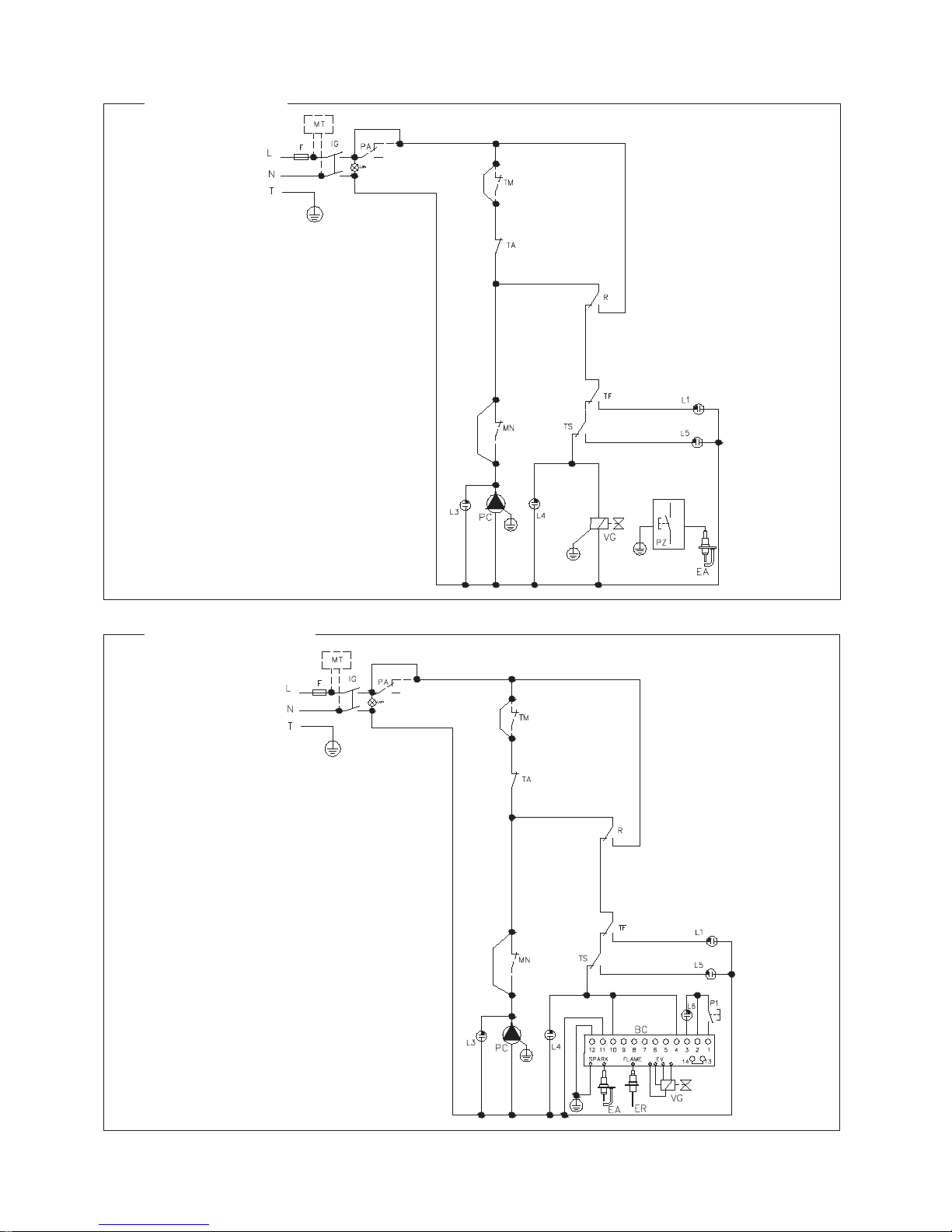
3.5.1 General layout
14
fig. 6
fig. 7
ALTAIR 18 - 48 RTN E
ALTAIR 18 - 48 RTN
Page 16
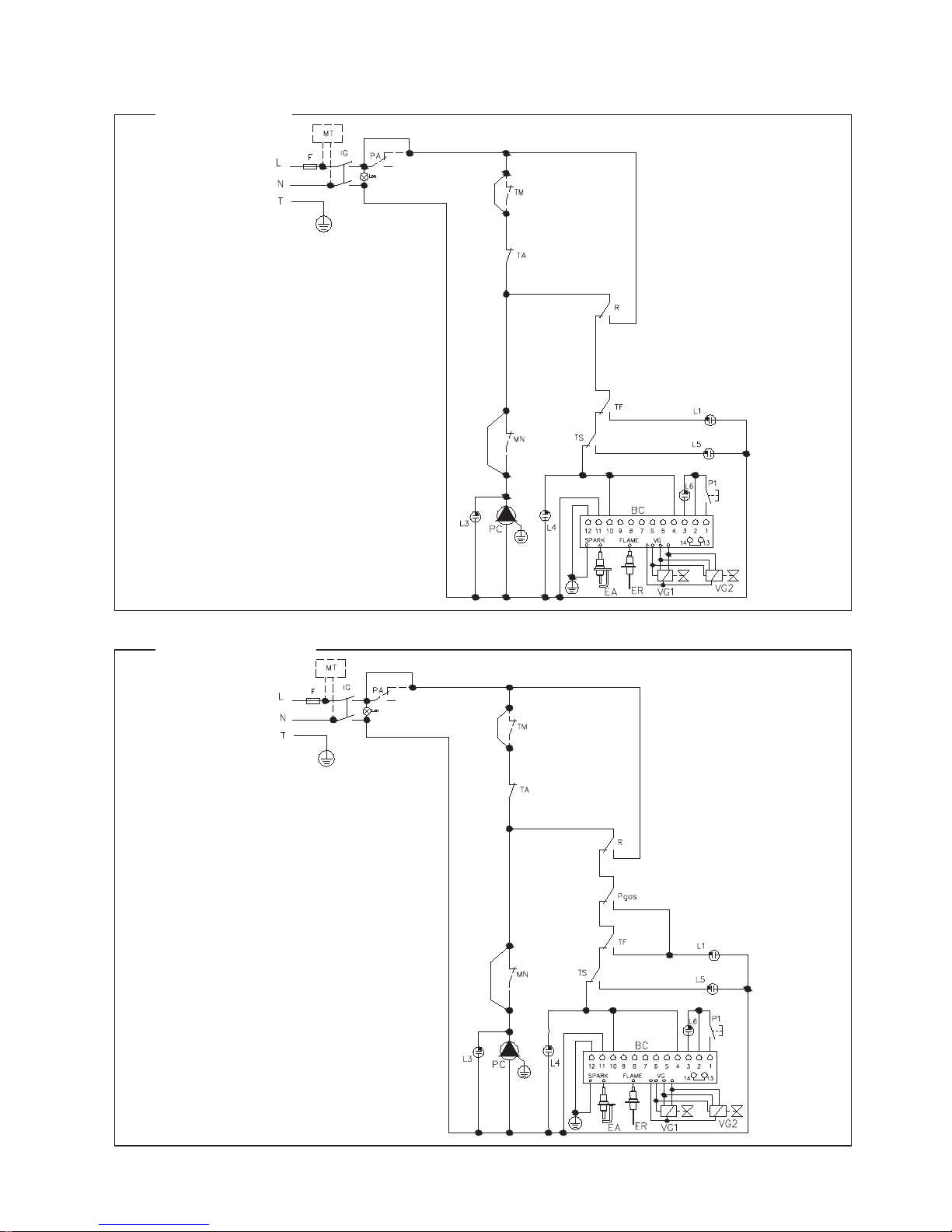
fig. 8
fig. 9
15
ALTAIR 60 RTN E
ALTAIR 70 - 100 RTN E
Page 17
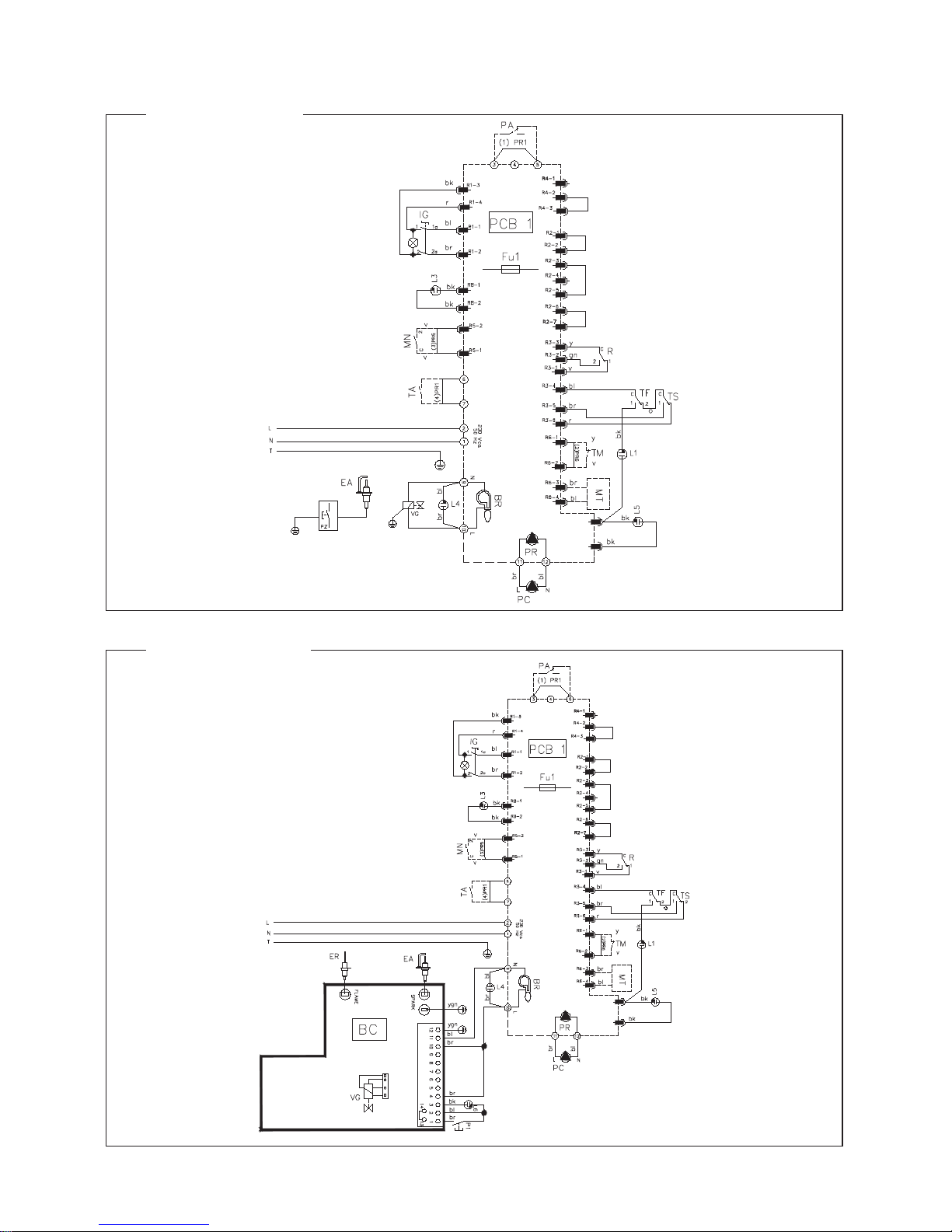
fig. 6a
fig. 7a
16
ALTAIR 18 - 48 RTN E
ALTAIR 18 - 48 RTN
3.5.2 Topographical Diagrams
Page 18
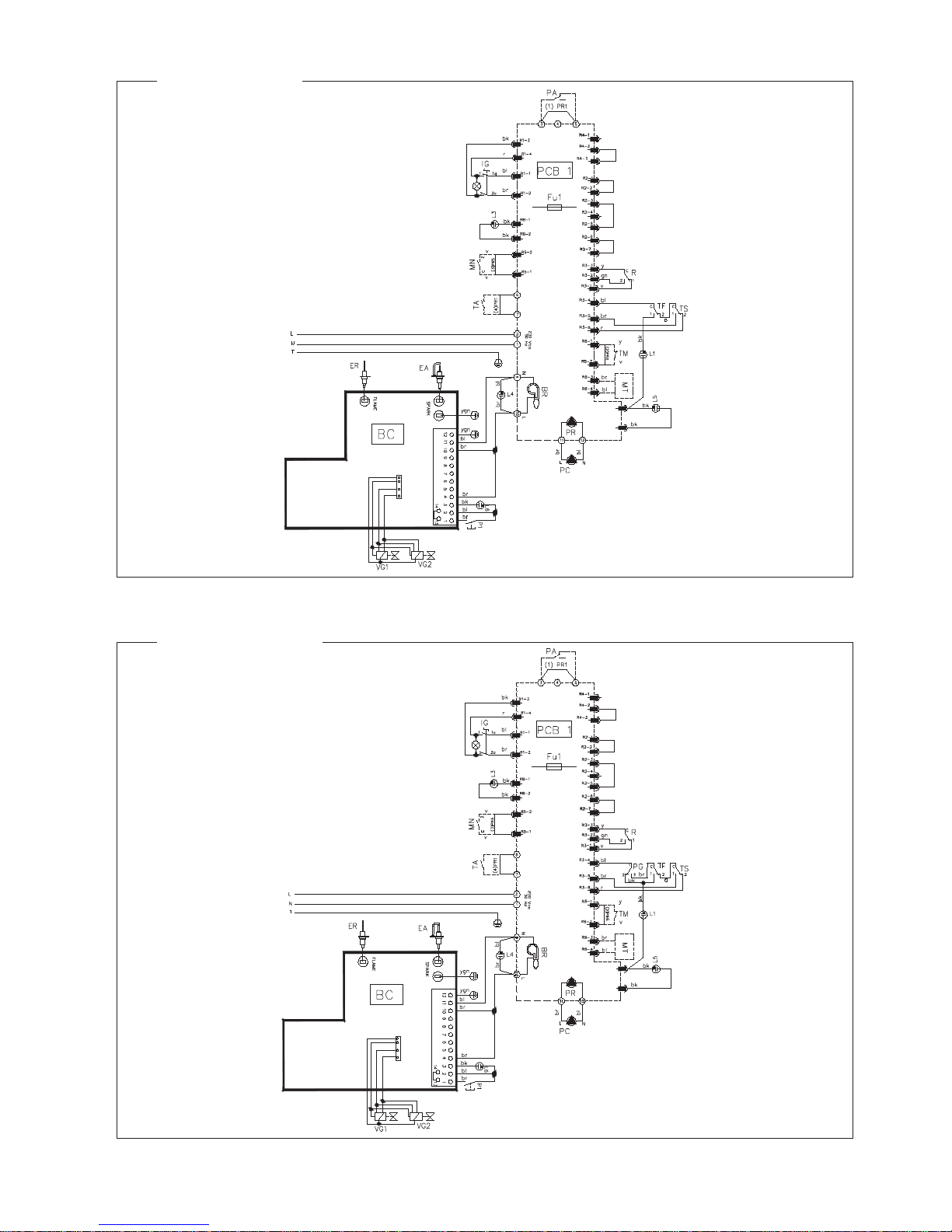
fig. 8a
fig. 9a
ALTAIR 70 - 100 RTN E
ALTAIR 60 RTN E
17
Page 19

3.6 Gas conversions
Changing a boiler over from natural gas to LPG and vice versa is
only to be carried out by qualified
personnel.
To check the setting values for the
nozzles and gas supply pressure,
use a pressure gauge connected to
the pressure sockets on the valves.
3.6.1 Conversion from natural gas
to LPG
Proceed as follows:
• Remove the natural gas nozzle
from the pilot burner after having
unscrewed the nut that holds the
olive and vent the gas supply pipe to
the pilot burner.
• Position the LPG nozzle checking
that it is as indicated in the technical
data table, and after repositioning
the gas supply pipe tighten the nut
that secures the olive.
• Remove the natural gas nozzle on
the main burner and fit the LPG
nozzle, checking that this is as indicated in the technical data table.
• Unscrew the pressure regulating
cap on the gas valve and tighten the
pressure regulating screw all the
way.
• Screw the pressure regulating cap
back on and seal it (using paint or a
self-adhesive label, for example).
NOTE: for models RTN E 60 to
RTN E 100 the regulating operations must be carried out on both
gas valves.
• Check the gas circuit for leaks,
especially the points that were disconnected.
• Affix the self-adhesive label provided that indicates the type of gas
and pressure for which the equipment is set.
3.6.2 Conversion from LPG to
natural gas
Proceed as follows:
• Remove the LPG nozzle from the
pilot burner after having unscrewed
the nut that holds the olive and vent
the gas supply pipe to the pilot burner.
• Position the natural gas nozzle
checking that it is as indicated in the
technical data table, and after repositioning the gas supply pipe tighten
the nut that secures the olive.
• Remove the LPG nozzle on the
main burner and fit the natural gas
nozzle, checking that this is as indicated in the technical data table.
• Unscrew the pressure regulating
cap on the gas valve and unscrew
the pressure regulating screws so
that the pressure at the outlet is as
specified in the technical data table.
• Screw the pressure regulating cap
back on and seal it (using paint or a
self-adhesive label, for example).
NOTE: for models RTN E 60 to
RTN E 100 the regulating operations must be carried out on both
gas valves, taking care to balance
them correctly.
• Check the gas circuit for leaks,
especially the points that were disconnected.
• Affix the self-adhesive label provided that indicates the type of gas
and pressure for which the equipment is set.
4. MAINTENANCE
In order to ensure that the equipment
is efficient and that it functions correctly, maintenance must be carried
out annually, based on the programme laid out below:
It is obligatory for all maintenance
(and repair) operations to be carried out by qualified personnel.
Before starting any maintenance
work that involves replacing components and/or cleaning the inside
of the boiler, disconnect the equipment from the electrical power
supply.
Maintenance programme
Routine maintenance must include
the following checks:
- Check of the general integrity of the
boiler.
- Checking the gas supply to the boiler for leaks.
- Checking ignition of the boiler.
- Checking the boiler’s combustion
parameters by analysing the smoke
(this check is done every two years if
the boiler is installed on its own.
Where the boiler is installed in a
cascading system, this check is run
annually).
- Checking the integrity, good state
of preservation, and tightness test on
the smoke flue.
- Checking the integrity of safety
devices on the boiler in general.
- Checking for water leaks and
rusting on the boiler’s couplings.
- Checking the efficiency of the
system’s safety valve.
The following cleaning is to be
done (with the boiler cold):
- General internal cleaning of the
boiler.
- Cleaning of the burner and resetting of the same if necessary, as per
instructions provided by the manufacturer.
- Cleaning of the ventilation grille for
the boiler room.
- Cleaning of the smoke side of the
heat exchanger. This can be done
using swabs and vacuum cleaners to
remove soot deposits on the sides
and fins used for exchanging heat.
Alternatively specific chemical products can be used in compliance with
the instructions for use of the same.
Do not use inflammable products
such as petrol, solvents or any
other such material to clean the
heat exchanger.
When working on the boiler for the
first time, check:
- The declaration of conformity for
the plant.
- The plant handbook.
Also check:
- The suitability of the boiler room.
- The ventilation openings in the
room.
- The smoke evacuation flues, and
the diameters and lengths of these.
- That the boiler has been correctly
installed as per instructions contained
in this booklet.
If the equipment is not able to work
correctly, or where it poses any
danger to people, animals or property, inform the person responsible for the plant and draw up a statement in this regard.
18
Page 20

Fondital S.p.A.
25078 VESTONE (Brescia) Italy
Via Mocenigo, 123
Tel. (+39) 0365 596.211
Fax (+39) 0365 820.200
e mail: [email protected]
www.novaflorida.it
BRAND NAME
Cod.0LIBISEN10
Uff. Pubblicità Fondital IST 04 C 126 - 01 Dicembre 2004 (12/2004)
The producer reserves the right to make minor modifications to the products
as required, without affecting the basic features.
 Loading...