

Page 1
Nortel Networks
BayStack 380 Switches
Highlights
•High-density desktop switching
and server farm aggregation
(BayStack 380-24T)
•High-density wiring closet Layer 2
aggregation (BayStack 380-24F)
•Resilient connectivity for minimal
network downtime
•Traffic prioritization
•Secure access and data traffic protection
• Easier configuration and management
• BoSS v3.0 software simplifies software
upgrades
•Lower training and installation costs
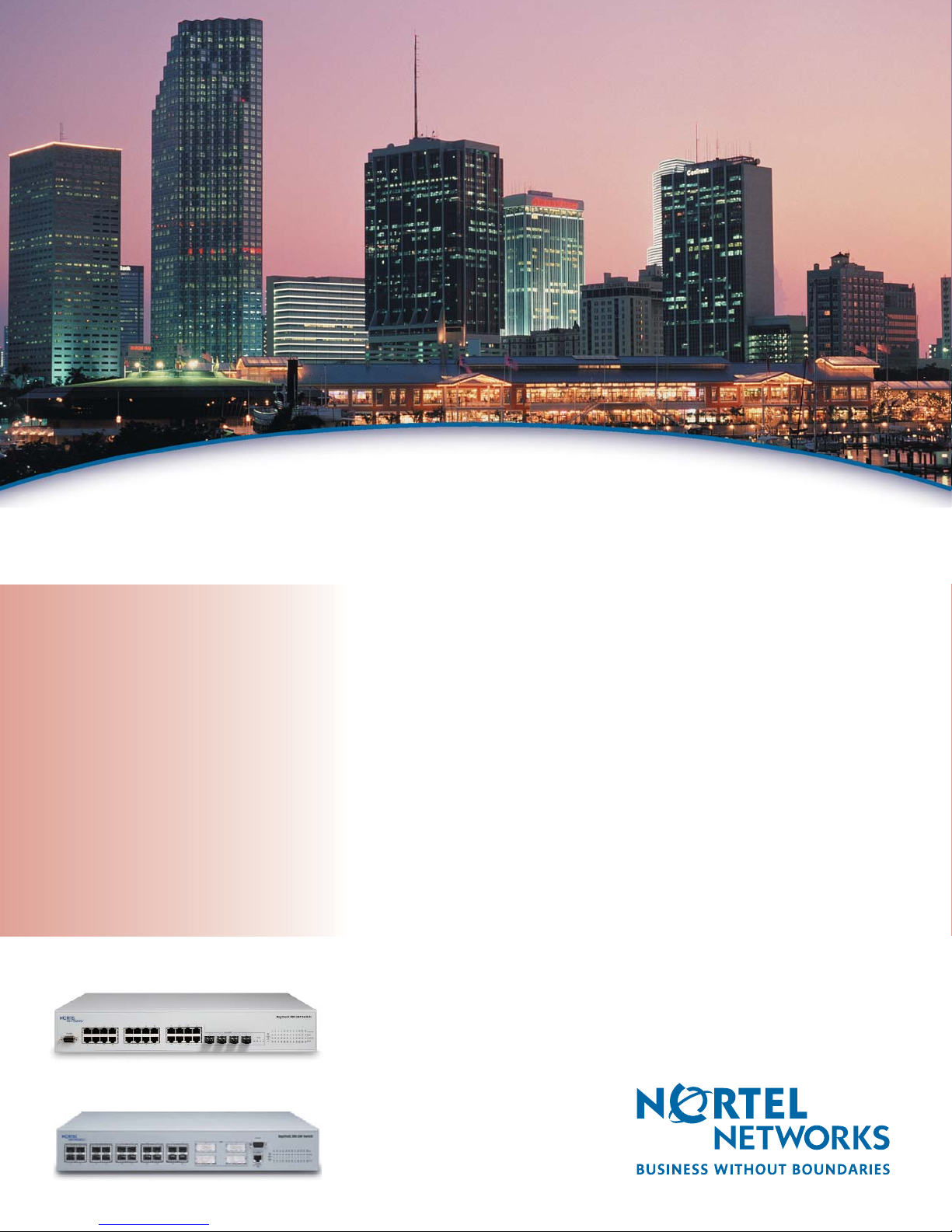
Figure 1: The BayStack 380-24T Switch
The BayStack 380-24F Switch
Nortel Networks BayStack* 380 Switches
are designed to provide high-density, highbandwidth connectivity to desktops, other
switches, servers, and other network devices.
BayStack 380 Switches offer a resilient
solution that minimizes capital and operational expenses. Their robust security
features offer protection against unauthorized access to data traffic. The switches are
Web-manageable and support Redundant
Power Supply (RPS) and Uninterruptible
Power Supply (UPS) options. BayStack
380 Switches are available in two models—
BayStack 380-24T and BayStack 380-24F
(Figure 1).
BayStack 380-24T—
High-density desktop switching
and server aggregation
The BayStack 380-24T Switch has 24
10/100/1000 Mbps auto-sensing ports and
four SFP (Small Form Factor Pluggable)
GBIC (Gigabit Interface Converter) ports. It
provides high-density Gigabit connectivity
to power-user desktops for high-speed applications such as graphics, multimedia and
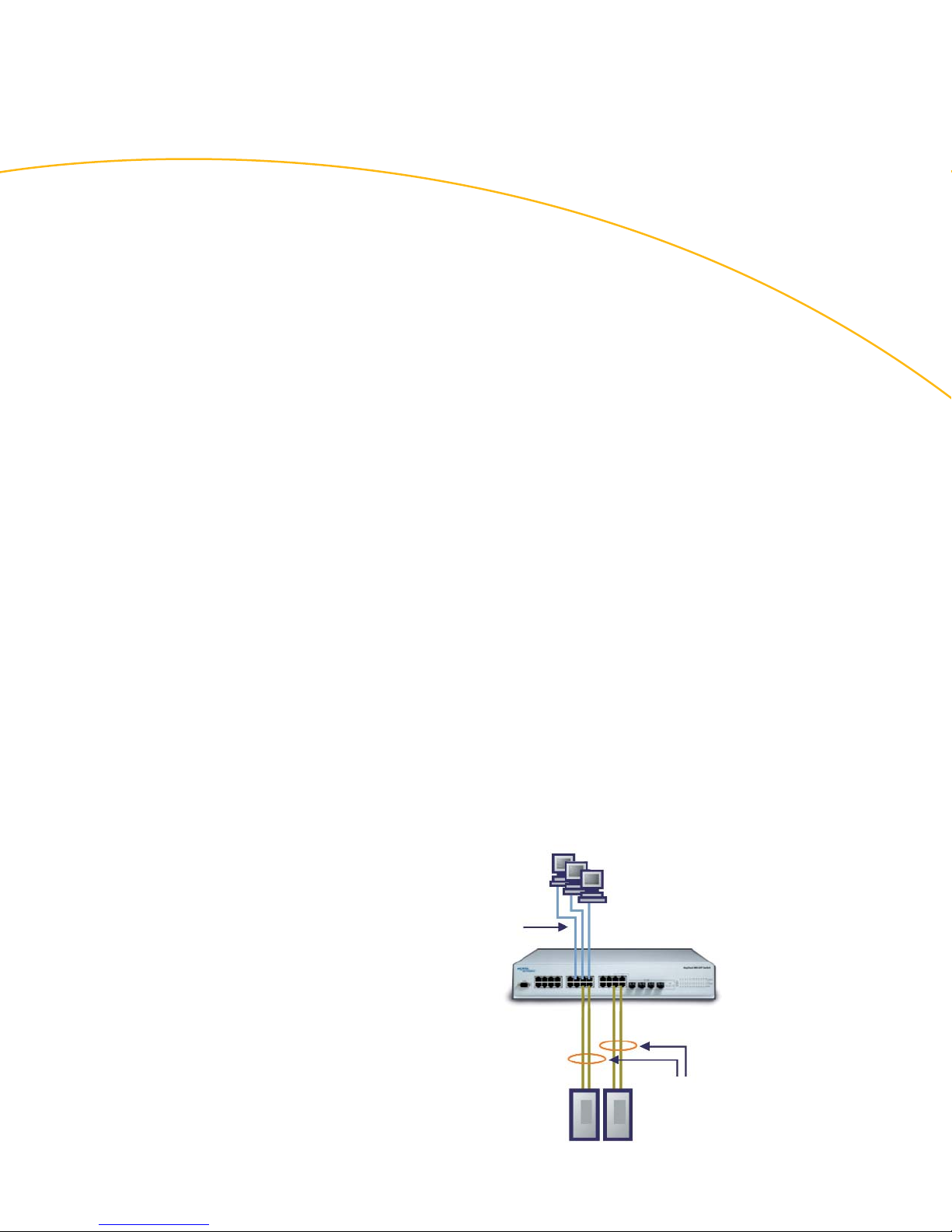
CAD/CAM, as well as server farm aggregation (Figure 2). Ports 21 through 24 may be
configured as either 10/100/1000 BASE-TX
ports or SFP GBIC ports in any combination.
The BayStack 380-24T is ideal for mid-size
and large businesses that have a need for
high bandwidth to the desktop.
BayStack 380-24F —
High-density wiring closet
switch aggregation
The BayStack 380-24F Switch with 20 SFP
(Small Form Factor Pluggable) ports and
four full-sized GBIC (Gigabit Interface
Converter) ports is an ideal switch for
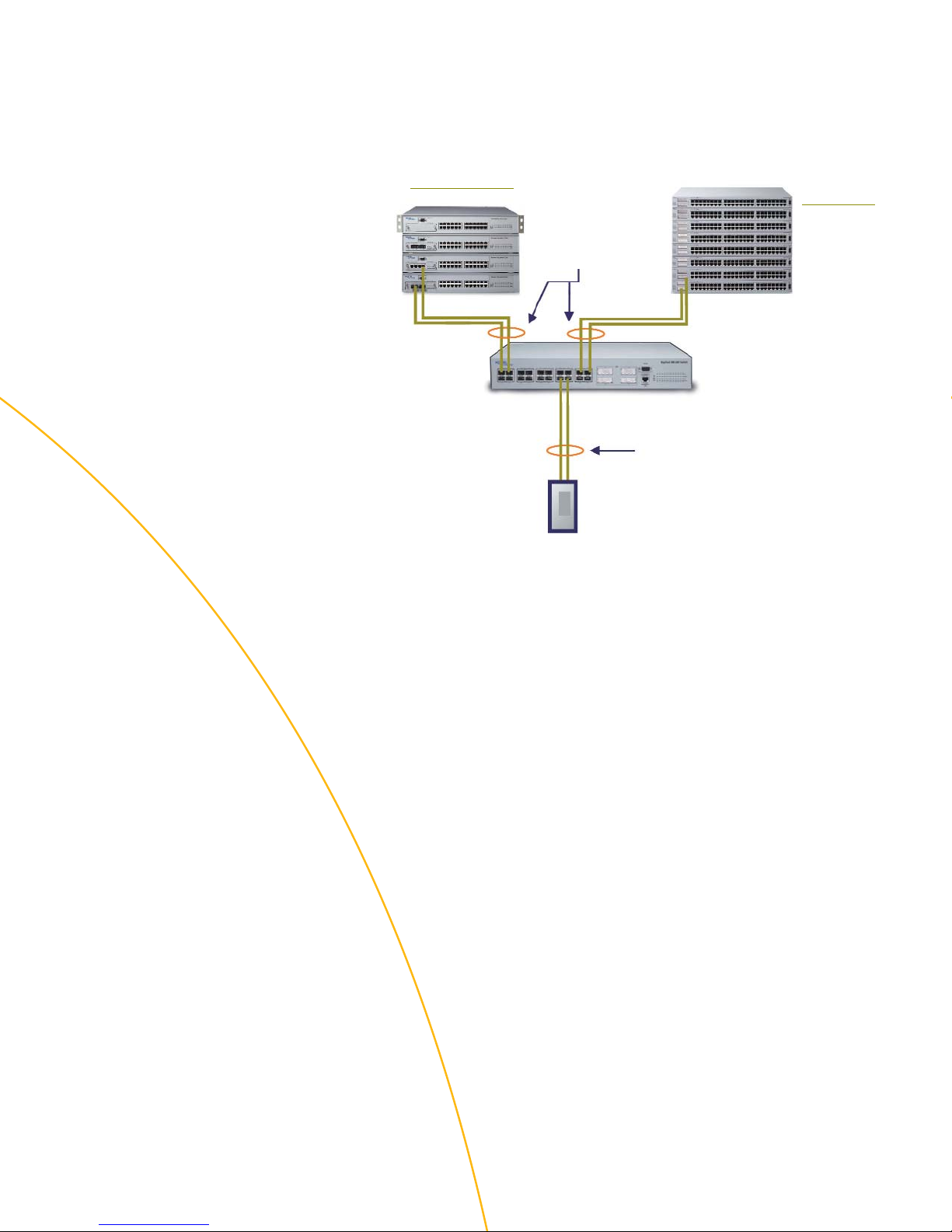
high-density wiring-closet Layer 2 aggregation. BayStack 470-48T stacks or
BayStack Business Policy Switch/BayStack
450 stacks can be collapsed into the
BayStack 380-24F using the uplink ports
on the wiring closet switches
(Figure 3).
The GBIC ports offer an unmatched flexibility of fiber connection types including
SX, LX, ZX, and XD as well as CWDM.
In addition, copper GBIC is also supported.
The BayStack 380-24F’s high-density
design results in lower per port price than
its competitors. The BayStack 380-24F is
ideal for small and mid-size businesses
that need simple and cost-effective Layer 2
aggregation.
Product Brief
Page 2
2
The SNMPv3 feature provides user
authentication and data encryption for
higher security. It also offers secure configuration and monitoring.
Class of Service
BoSS v3.0 allows the BayStack 380 to
prioritize traffic based upon the Class of
Service/Diffserv Code Point (CoS/DSCP)
of IP packets. The switch prioritizes LAN
traffic based on Layer 2 802.1p value. It
also provides the capability to map the
DSCP values in the IPv4 frame to any of
four priority queues. If the frame is not an
IPv4 frame, DSCP mapping is not applicable and the 802.1p mapping or port-based
priority is used. The BayStack 380 allows
the user to map all 64 possible DSCP
values to any of the four priority queues.
The IPv4 frames will be forwarded according
to the CoS queue priorities. Frames can be
prioritized in strict round-robin or
weighted round-robin fashion. Class of
Service implementation enables prioritization of multimedia or latency sensitive
traffic, making possible integration of voice,
video, and data within the same network.
Redundancy
With connectivity to the BayStack 10
Power Supply Unit (PSU) paired with a
–48V DC-to-DC converter module, the
BayStack 380 Switches deliver redundant
power supply support crucial in missioncritical environments. Uninterruptible
Power Supply (UPS) capability for
BayStack 380 Switches is supported
with the BayStack 10 PSU.
Security
The BayStack 380 Switches support
BaySecure*, which allows authentication
of all access, not only to the switches for
management and configurations but also
access to the infrastructure through these
switches. This software feature limits access
to only network authorized and trusted
personnel, including full tracking of
network connections. With BaySecure,
network access is granted or denied via
proper MAC-address identification.
In addition, with the Distributed Access
List Security feature, network access is
granted or denied on a per-port basis.
The BayStack 380 Switches also provide
Remote Authentication Dial-In User
Service (RADIUS) for switch security
management.
Figure 2: High-density gigabit connectivity and server farm aggregation
for mid-size and large businesses
10/100/1000 Mbps
connections
BayStack 380-24T
Power users
desktop
connectivity
Server farm
aggregation
Multi-Link
Gigabit
Trunks
Multi-Link Trunking
for resiliency
Multi-Link Trunking (MLT) enables
grouping of links between the switch and
another switch or server to provide greater
bandwidth of up to 8 Gbps full duplex
with active redundant links for one trunk.
This feature also provides load-balancing
and automatic fail-over protection. Up to
six trunks are supported.
Passport 8600’s Split Multi-Link Trunking
(SMLT) eliminates single points of failure
in the network and allows the BayStack
380 to have multiple active connections to
the network core. The BayStack 380’s
ability to have multiple connections to
a Passport 8600 network core allows
customers to double their network bandwidth with no extra investment. The
Passport 8600 provides a self-healing
network which delivers the reliability and
availability required by today’s missioncritical applications.
BoSS (BayStack operating
system Switching Software)
BoSS v3.0 for Gigabit standalone switches
is a single software image exclusively for
the BayStack 380-24F and the BayStack
380-24T. With BoSS v3.0 for Gigabit
standalone switches, software upgrades are
simplified as the users need to download
only one set of software. This common
image provides the same software to all
user interfaces such as menu, Telnet, CLI,
WEB, and JDM.
BoSS v3.0 adds many new features including IGMP snooping, increased number of
VLANs, Class of Service/Diffserv Code
Point, CLI, ASCII configuration download, ASCII configuration generator, Single
Fiber Fault Detection, and a single software
image. In addition, BoSS v3.0 adds 10/100
management port and copper GBIC support
for the BayStack 380-24F switch.
Page 3
3
MAC addresses
The BayStack 380 Switches support up to
32,768 MAC addresses for deployment of
large-scale enterprise networks with many
attached devices and workgroups, allowing
for scalability and cost effectiveness.
IGMP snooping
BoSS v3.0 provides IP Multicast support by
examining (‘snooping’) all Internet Group
Multicast Protocol (IGMP) traffic in hardware at line rate, and pruning unwanted data
streams from affecting network or endstation performance. IGMP snooping
enables the switch to selectively forward
Multicast traffic only onto ports where
particular streams are expected.
Spanning Tree Protocol
BayStack 380 Switches include built-in
support for Spanning Tree Protocol (IEEE
802.D) which detects and eliminates logical
loops in the network.
VLAN support
Up to 512 port-based VLANs can be
established for each switch to extend the
broadcast domain and segment network
traffic for greater efficiency. BayStack 380
supports up to 4095 VLAN IDs, but only
a maximum of 512 can be active at any
given time. BayStack 380 also supports
Independent VLAN Learning (IVL)
VLANs.
Jumbo frame support
Jumbo frame support of up to 9,216 bytes
is provided on each port for applications
requiring large frames such as graphics and
video applications.
Port mirroring
This feature, also known as conversation
steering, allows you to designate a single
switch port as a traffic monitor for a specified port for ingress or egress.
Nortel Networks Command
Line Interface (CLI)
The CLI is used to automate general
management and configuration of
BayStack 380 Switches. The CLI is used
through a Telnet session or through the
serial port on the console.
ASCII Configuration Generator
The ASCII Configuration Generator
(ACG) allows the configuration settings of
the switch to be saved to an external ASCII
configuration file made up of a series of
CLI commands. This editable ASCII
configuration file can then be uploaded to
another switch from an external file server
to accelerate deployment.
802.3x High Speed Flow
Control
This feature allows you to control traffic
and avoid congestion on the gigabit fullduplex link. If a receive port buffer
becomes full, the switch issues a flow
control signal to the device at the other end
of the link to suspend transmission.
Auto MDI/MDIX
(BayStack 380-24T only)
The BayStack 380-24T Switch saves
money and time if it needs to be connected
to a hub or another switch. Normally, you
need a crossover cable for this purpose, but
with the BayStack 380-24T Switch you
can use an inexpensive straight through
cable or a crossover cable. The BayStack
380-24T is able to automatically detect the
energy on the cable and configure itself on
every port.
Figure 3: Wiring closet Layer 2 aggregation for a small- or mid-sized business
Distributed
Multi-Link Trunks
(Gigabit Fiber)
Wiring closet switch
aggregation
BayStack
470-48T
Switch stack
Floor 2
Server
Gigabit
Fiber Links
BayStack 450/
BayStack Business
Policy Switch stack
Floor 1
BayStack 380-24F
Page 4

Network management
On-box management
Network management begins with the
device. The BayStack 380 Switches support
four groups of Remote Monitoring
(RMON) on all ports and are SNMP
(Simple Network Management Protocol)
compliant. The SNMP agent software
resides in the switch and uses the information it collects to provide management
for all ports providing comprehensive
network monitoring capabilities.
Web-based management
Web-based network management makes
managing the BayStack 380 Switches easy
with a Web browser. This feature provides
summary, configuration, fault, statistics,
application, administration and support
pages for the switch. The Web interface
also allows for static configuration of
numerous parameters of the device.
Fault management
and resolution
With Optivity Network Management
System†, the network manager has quick
access to the information required to
manage and isolate all BayStack 380
networks’ events. Tools such as Physical
Topology View inform the network
manager of how a particular event is affecting the physical connectivity within the
network. End Node Locate tool provides
the ability to locate a failing end node and,
with one mouse click, you have access to
the RMON statistics for the failing
Ethernet port supporting that end node.
These solutions provide visual and statistical tools necessary to quickly resolve any
network event or to manage performance
in real-time.
4
ASCII configuration file
download
This feature downloads an ASCII configuration file from a Trivial File Transfer
Protocol (TFTP) server, parses the commands
in the file, and configures the switch based
on the commands in the file. The configuration file can be edited on any host
computer using a regular text editor. This
provides quick configuration of the switch,
using an easy-to-modify text configuration
file. The Nortel Networks Command Line
Interface (CLI) can be used to make changes
to the ASCII configuration file. This
feature provides administrators with the
flexibility of creating command configuration files that can be used on several
switches with minor modifications.
10/100 Mbps management port
(BayStack 380-24F only)
The 10/100 management port feature for
the BayStack 380-24F switch allows the
switch to be managed using the RJ 45 port
without the need for a fiber connection to
the switch.
Single Fiber Fault Detection
Single Fiber Fault Detection (SFFD) allows
remote fault detection on Gigabit Ethernet
fiber ports. When a partial fiber break occurs,
data is lost on one side of a link. SFFD
detects this error condition and causes the
port that is losing data to go down. This
stops the loss of data. This feature is
enabled on a port-by-port basis for the
BayStack 380-24T and BayStack 380-24F.
Common software platform
All BayStack switches, including the
BayStack 380, have a common “look and
feel” which reduces training costs. This
allows the switches to be managed in a
similar fashion via a broad set of management tools. These tools include Web-based
management, Java™-based Device Manager
(JDM), menus, Optivity* Network
Management System (NMS), and
Optivity Switch Manager (OSM).
LED Indicators
Front panel LEDs provide indication for
Power, Status, and RPSU Status. In addition, for each port, two multifunction
LEDs are provided that indicate the
Speed/Link Status and Activity and
provide a comprehensive and convenient
visual management system.
Configuration management
The process of configuration begins with a
single device but finishes across multiple
devices. Java-based Device Manager is
the configuration tool for those functions
that require communicating with a single
device. However, Device Manager uses a
common user interface and workflow that
supports many Nortel Networks Ethernet
Switches. This commonality allows the
network manager to become familiar
with one tool instead of many.
Optivity Switch Manager performs the
configuration function across multiple
devices. Configuration functions such as
VLAN assignments, MLT, and Multicast
are deployed across multiple Nortel
Networks Ethernet switches.
With more than 100 years in telecommunications, Nortel Networks is uniquely
positioned to help your business reduce
costs by combining voice and data into
an integrated system. Why take a chance
on a vendor that only understands part of
the equation? Let us show you how the
BayStack 380 Switches, along with other
Nortel Networks products, can help you
increase your profitability, streamline your
business operations, increase productivity,
and gain the competitive edge.
†
Future software release.
Page 5

5
Technical specifications
Table 1: BayStack 380 Switches technical specifications
Physical specifications
Weight 4.8Kg (10.6 lb) for -24T and 5Kg (11 lb) for -24F
Height 7.04 cm (2.77 in.)
Width 43.82 cm (17.25 in.)
Depth 32.34 cm (12.75 in.)
Performance specifications
Switch Fabric Dual 24 Gbps
Frame Forward Rate (64-byte packets) Up to 35.7 million packets per second (pps) maximum
Port Forwarding/Filtering Performance For 10 Mbps: 14,880 pps maximum
(64-byte packets)
For 100 Mbps: 148,810 pps maximum
For 1000 Mbps: 1,488,100 pps maximum
Address Database Size 32,768 entries at line rate
Addressing 48-bit MAC address
Frame Length 64 to 9,216 bytes (IEEE 802.1Q Tagged)
802.1p Priority classification Four (4) hardware-based queues
SDRAM size 16 Mbyte
Flash memory size 32 Mbyte
Data rate
10Mbps Manchester encoded, 100 Mbps 4B/5B encoded or 1000 Mbps 8B/10B encoded
Interface options
BayStack 380-24T only
10BASE-T/100BASE-TX/1000BASE-TX 24 RJ-45 (8-pin modular) connectors for Auto MDI/MDI-X interface with auto-polarity
Full-size GBICs for BayStack 380-24F
1000BASE-SX Uses shortwave length 850 nm duplex SC fiber optic connectors to connect devices over
multimode (550 m or 1,805 ft) fiber optic cable.
1000BASE-LX Uses longwave length 1,300 nm duplex LC fiber optic connectors to connect devices over
single mode (5 km or 3.1 mi) or multimode (550 m or 1,805 ft) fiber optic cable.
1000BASE-XD Uses single mode fiber to connect devices over distances up to 50 km (or 31 mi), depending
on the quality of the cable.
1000BASE-ZX Uses single mode fiber to connect devices over distances up to 70 km (or 43 mi), depending
on the quality of the cable. The ports on this GBIC operate only in full-duplex mode.
SFP GBICs for BayStack 380-24T and -24F
1000BASE-SX Uses short wavelength 850 nm MTRJ type fiber optic connectors to connect devices over
multimode (275m, 62.5um core or 550m, 50.0um core) fiber optic cable.
1000BASE-SX Uses short wavelength 850 nm duplex LC type fiber optic connectors to connect devices over
multimode (275m, 62.5um core or 550m, 50.0um core) fiber optic cable.
1000BASE-LX Uses long wavelength 1300nm duplex LC type fiber optic connector to connect devices over
single mode (10km, 9um core) fiber optic cable.
1000BASE-CWDM Uses long wavelength 1470, 1490, 1510, 1530, 1550, 1570, 1590, 1610nm LC type fiber
optic connector to connect devices over single mode (40km, 9um core or 70km, 9um core)
fiber optic cable.
—continued
Page 6
5
Table 1: BayStack 380 Switches technical specifications continued
Network protocol and standards compatibility
IEEE 802.3 10BASE-T (ISO/IEC 8802 3, Clause 14)
IEEE 802.3u 100BASE-TX (ISO/IEC 8802-3, Clause 25)
IEEE 802.1p (Prioritizing)
IEEE 802.1Q (VLAN Tagging)
IEEE 802.1D Spanning Tree Protocol
IEEE 802.3z 1000BASE-X specifications
IEEE 802.3x Flow Control (with 802.1D compliant device)
IETF DiffServ
RFC support
RFC 1213 (MIB-II); RFC 1493 (Bridge MIB); RFC 2863 (Interfaces Group MIB);
RFC 2665 (Ethernet MIB); RFC 2737 (Entity MIBv2); RFC 2819 (RMON MIB);
RFC 1757 (RMON); RFC 1271 (RMON); RFC 1157 (SNMP); RFC 2570 (SNMPv3);
RFC 2571 (SNMP Frameworks); RFC 2573 (SNMPv3 Applications);
RFC 2574 (SNMPv3 USM); RFC 2575 (SNMPv3 VACM); RFC 2576 (SNMPv3);
RFC 2572 (SNMP Message Processing)
Electrical specifications
Input voltage 100-240VAC @ 47 to 63 Hz
-48 Volts DC with redundant power support
Input Power consumption 150 W max
Input current (AC Version) 1.5 A @100 VAC, 0.6 A @ 240VAC -48 Volts DC @ 3.0 Amps
Environmental specifications
Operating temperature 0° to 40° C (32° to 104° F)
Storage temperature –25° to +70° C (-13° to 158° F)
Operating humidity 85% maximum relative humidity, non-condensing
Storage humidity 95% maximum relative humidity, non-condensing
Operating altitude Up to 3,024 m (10,000 ft.) above sea level
Storage altitude Up to 12,096 m (40,000 ft.) above sea level
Safety agency approvals
USA, UL60950
Canada, CAN/CSA-22.2 No.60950
Europe, EN60950 / IEC 60950, CB report with all national deviation.
Australia/New Zealand, AS/NZS 60950
Mexico NOM-019
Electromagnetic emissions summary
Meets the following standards USA, FCC CFR47 Part 15, subpart B, Class A
Canada, ICES-003, Class A
Europe, EN55022, CISPR 22, Class A
Australia/New Zealand, AS/NZS 3548, Class A
Japan, VCCI-V-3/02.04, Class A
Taiwan, CNS 13438, Class A
Electromagnetic immunity
Europe, EN55024, CISPR 24
Page 7

7
Ordering information
Table 2: BayStack 380 Switches ordering information
Order No. Description
AL4412?01** BayStack 380-24T 10/100/1000 Autosensing Switch (24 10/100/1000BASE-TX plus four built-in SFP GBIC uplink slots)
AL4512?01** BayStack 380-24F Standalone 1Gbps Ethernet Switch, with 20 SFP ports and 4 Standard GBIC ports (requires SFP and/or
standard GBIC transceivers)
AL1904006 -48 V DC-to-DC converter for BayStack 380 for use with BayStack 10 Power Supply System
AA1419001^ 1-port 1000BASE-SX Gigabit Interface Connector (GBIC) (BayStack 380-24F only)
AA1419002^ 1-port 1000BASE-LX Gigabit Interface Connector (GBIC) (BayStack 380-24F only)
AA1419003^ 1-port 1000BASE-XD Gigabit Interface Connector (GBIC) – 40km (BayStack 380-24F only)
AA1419004^ 1-port 1000BASE-ZX Gigabit Interface Connector (GBIC) – 70km (BayStack 380-24F only)
AA1419042^ 1-port 1000BASE-T Gigabit Interface Converter (GBIC), 8-pin modular connector (RJ-45) (BayStack 380-24F only)
AA1419013~ 1-port 1000BASE-SX SFP GBIC (LC connector)
AA1419014~ 1-port 1000BASE-SX SFP GBIC (MT-RJ connector)
AA1419015~ 1-port 1000BASE-LX SFP GBIC (LC connector)
AA1419025~ 1-port 1000BASE-CWDM Small Form Factor GBIC – 1470nm Wavelength (40km), LC connector
AA1419026~ 1-port 1000BASE-CWDM Small Form Factor GBIC – 1490nm Wavelength (40km), LC connector
AA1419027~ 1-port 1000BASE-CWDM Small Form Factor GBIC – 1510nm Wavelength (40km), LC connector
AA1419028~ 1-port 1000BASE-CWDM Small Form Factor GBIC – 1530nm Wavelength (40km), LC connector
AA1419029~ 1-port 1000BASE-CWDM Small Form Factor GBIC – 1550nm Wavelength (40km), LC connector
AA1419030~ 1-port 1000BASE-CWDM Small Form Factor GBIC – 1570nm Wavelength (40km), LC connector
AA1419031~ 1-port 1000BASE-CWDM Small Form Factor GBIC – 1590nm Wavelength (40km), LC connector
AA1419032~ 1-port 1000BASE-CWDM Small Form Factor GBIC – 1610nm Wavelength (40km), LC connector
AA1419033~ 1-port 1000BASE-CWDM Small Form Factor GBIC – 1470nm Wavelength (70km), LC connector
AA1419034~ 1-port 1000BASE-CWDM Small Form Factor GBIC – 1490nm Wavelength (70km), LC connector
AA1419035~ 1-port 1000BASE-CWDM Small Form Factor GBIC – 1510nm Wavelength (70km), LC connector
AA1419036~ 1-port 1000BASE-CWDM Small Form Factor GBIC – 1530nm Wavelength (70km), LC connector
AA1419037~ 1-port 1000BASE-CWDM Small Form Factor GBIC – 1550nm Wavelength (70km), LC connector
AA1419038~ 1-port 1000BASE-CWDM Small Form Factor GBIC – 1570nm Wavelength (70km), LC connector
AA1419039~ 1-port 1000BASE-CWDM Small Form Factor GBIC – 1590nm Wavelength (70km), LC connector
AA1419040~ 1-port 1000BASE-CWDM Small Form Factor GBIC – 1610nm Wavelength (70km), LC connector
** The seventh character (?) of the switch order number must be replaced with the proper code to indicate desired product nationalization: “A”– No power
cord included; “B”– Includes European “Schuko” power cord common in Austria, Belgium, Finland, France, Germany, The Netherlands, Norway,
and Sweden; “C”– Includes power cord commonly used in the United Kingdom and Ireland; “D”– Includes power cord commonly used in Japan;
“E”– Includes North American power cord; “F”– Includes Australian power cord, also commonly used in New Zealand and the People’s Republic
of China.
^Up to 4 of full-sized GBICs can be installed in the BayStack 380-24F GBIC slots
~Up to 4 of SFP GBICs can be installed in the BayStack 380-24T GBIC slots and 20 of these can be installed in the BayStack 380-24F.
Page 8

In the United States:
Nortel Networks
35 Davis Drive
Research Triangle Park, NC 27709
USA
In Canada:
Nortel Networks
8200 Dixie Road,
Suite 100
Brampton, Ontario L6T 5P6
Canada
In Caribbean and Latin America:
Nortel Networks
1500 Concorde Terrace
Sunrise, FL 33323
USA
In Europe:
Nortel Networks
Maidenhead Office Park
Westacott Way
Maidenhead Berkshire SL6 3QH
UK
In Asia:
Nortel Networks Asia
6/F Cityplaza 4,
Taikooshing,
12 Taikoo Wan Road,
Hong Kong
Nortel Networks is an industry leader and innovator focused on transforming how the world
communicates and exchanges information. The company is supplying its service provider and enterprise customers with communications technology and infrastructure to enable value-added IP data,
voice and multimedia services spanning Wireless Networks, Wireline Networks, Enterprise Networks,
and Optical Networks. As a global company, Nortel Networks does business in more than 150 countries.
More information about Nortel Networks can be found on the Web at:
www.nortelnetworks.com
For more information, contact your Nortel Networks representative, or
call 1-800-4 NORTEL or 1-800-466-7835 from anywhere in North America.
*Nortel Networks, the Nortel Networks logo, the globemark design, BayStack, BaySecure, Optivity, and Passport are trademarks
of Nortel Networks. All other trademarks are the property of their owners.
Copyright © 2004 Nortel Networks. All rights reserved. Information in this document is subject to change without notice.
Nortel Networks assumes no responsibility for any errors that may appear in this document.
NN100101-011404
 Loading...