

Page 1
Owner ’s Manual
For model N400 - a 4.5 cu. ft., 2-way or 3-way, refrigerator .
For model N500 - a 5.5 cu. ft., 2-way or 3-way, refrigerator .
For model N510 - a 5.5 cu. ft., 2-way or 3-way, refrigerator .
WARNING: Improper installation, adjustment, alteration, service or mainte-
nance can cause injury or property damage. Refer to this manual.
For assistance or additional information, contact a qualified installer, service agency, or the gas supplier.
FOR YOUR SAFETY
Do not store or use gasoline or other flammable vapors and liquid in
the vicinity of this or any other appliance.
FOR YOUR SAFETY
If you smell gas:
1. Open windows.
2. Don’t touch electrical switches.
3. Extinguish any open flame.
4. Immediately call your gas supplier.
NORCOLD, Inc.
P .O. Box 4248
Sidney, OH 45365-4248
English
French
Norcold Customer Support Dept.
Telephone: 800-543-1219
Fax: 937-497-3183
Web Site: www.norcold.com
Part No. 622266B (11-01)
Page 2
Table of Contents
NORCOLD - Gas Absorption 3 Year Limited
Warranty Policy
Gas Absorption 3 Year Limited Warranty Policy ......................... 2
Gas Absorption Warranty Information ........................................ 3
Gas Absorption Warranty Questions .......................................... 3
Safety Awareness ....................................................................... 4
Safety Instuctions ....................................................................... 4
About Your Refrigerator .............................................................. 4
Storage volume ................................................................... 4
Leveling ............................................................................... 4
Food compartment .............................................................. 4
Flip-up shelf ........................................................................ 4
Door bins ............................................................................. 5
Freezer compartment .......................................................... 5
Operation during travel ........................................................ 5
Door latch for travel and storage......................................... 5
Operating the Refrigerator Controls (N400 models) ................. 5
Control Panel ...................................................................... 5
Ignition - propane gas operation ........................................ 5
Do a test of the gas safety valve.......................................... 5
Start up - AC operation......................................................... 6
Start up - DC operation (model N400.3)............................. 6
Shut down ........................................................................... 6
Operating the Refrigerator Controls (N500 models) ................. 6
Control Panel ...................................................................... 5
Ignition - propane gas operation ........................................ 6
Do a test of the gas safety valve.......................................... 6
Start up - AC operation......................................................... 7
Start up - DC operation (model N500.3)............................. 7
Shut down ........................................................................... 7
Operating the Refrigerator Controls (N510 models) ................. 7
Control Panel ...................................................................... 7
Automatic mode operation .................................................. 7
Manual mode operation ...................................................... 7
Ignition of propane gas in either auto or gas mode ........... 8
Shut down ........................................................................... 8
Backup operating system ................................................... 8
DC Operation Precautions (models N400.3, N500.3, and
N510.3)................................................................................ 8
DC Operation Guidelines (models N400.3, N500.3, and
N510.3)................................................................................ 8
Refrigerator Care Checklist ....................................................... 9
Defrosting and Cleaning ............................................................ 9
Defrosting............................................................................ 9
Cleaning.............................................................................. 9
Door Sealing .............................................................................. 9
Refrigerator Maintenance Checklist .......................................... 9
Refrigerator Maintenance ......................................................... 10
Gas flame appearance ..................................................... 1 0
Remove and clean the burner orifice ............................... 10
Fuse Replacement (model N510 models only) ...................... 1 0
Remove the Refrigerator ........................................................... 11
Reinstall the Refrigerator .......................................................... 11
Replacement Parts ...................................................................11
Wiring Pictorial (N400 models only) ........................................ 1 2
Wiring Diagram (N400 models only) ....................................... 12
Wiring Pictorial (N500 models only) ........................................ 1 2
Wiring Diagram (N500 models only) ....................................... 12
Wiring Pictorial (N510 models only) ........................................ 1 2
Wiring Diagram (N510 models only) ....................................... 12
Fault Codes (N510 models only) ............................................. 13
Norcold • P.O. Box 4248 • Sidney, OH • USA • 45365-4248
Provided it is properly installed, properly maintained and placed
under normal service and use, Norcold, Inc. warrants its
refrigeration equipment to be free from defects in material and
workmanship for three years with respect to the equipment’s
component parts, and for two years with respect to the labor to
repair or replace such parts, commencing from the original date
of purchase.
Limitations of warranty
1. This Warranty applies only to Norcold gas absorption
refrigerator operating equipment. This Warranty does not
extend to glassware, electric light bulbs, and replaceable
fuses.
2. This warranty does not apply to parts and assemblies that
have been subjected to misuse, improper installation,
improper or abnormal service, transit damage, recharging of
the cooling system, accident, fire, improper repair, tampering
or abuse.
3. Irrespective of the nature of the warranty protection offered or
claimed, the period of warranty shall in no case extend
beyond three years for component parts and two years for the
labor to repair or replace such parts, commencing from the
original date of purchase of the new equipment.
4. In order to obtain the remedy of repair and replacement, the
refrigerator must be brought to any Norcold Service Center for
warranty service. The end consumer is responsible for all
expenses resulting from any remote service call if the
refrigerator cannot be brought into the Norcold service center.
5. It is the responsibility of the end consumer to have maintenance performed upon the warranted equipment one time
during the second year or before the beginning of the third
year after original purchase. Such maintenance is required to
maintain this warranty in effect and failure to perform such
maintenance will void the remainder of the warranty. Required maintenance during the second year or before the
third year after purchase is cleaning and checking of the
following: Burner, Flue, Spiral Baffle, Roof Cap Screen, and
Control Board Sequence.
Limitation of remedy
1. The responsibility of Norcold under this or any warranty is
limited to the repair or replacement (at Norcold’s option) of
the defective part or assembly.
2. In no event and under no circumstances shall Norcold be
responsible under this limited warranty for any other charge
whatsoever, including but not limited to charges or claims for
labor, lost business, lost time, lost profits, loss of use, or any
kind of incidental or consequential damages, however
denominated or described. The remedy under this warranty
is limited to replacement or repair.
Owner’s Manual 2
Page 3
3. Some states do not allow the exclusion or limitation of
incidental or consequential damages, so the above exclusion
may not apply to you.
Disclaimer of other warranties
This warranty is expressly in lieu of all other warranties either
expressed or implied. All other warranties, expressed or
implied, including any warranty of merchantability or fitness for a
particular purpose, are hereby disclaimed and excluded.
Legal rights
This warranty gives you specific legal rights, and you may have
other legal rights, which vary from state to state.
Gas Absorption Warranty Information
Your refrigerator is made to provide the ultimate in cooling
satisfaction and will serve you reliably in the years to come.
Norcold refrigerators are the only RV refrigerators made in the
United States and offer a standard limited three-year warranty.
Norcold also offers an additional warranty coverage plan which
extends the standard limited three-year warranty. To activate
your three-year limited warranty and to receive an invitation to
participate in the extended warranty plan, complete and mail the
warranty registration supplied.
Help us to help you.
Write the model number and serial number below for future
reference. These numbers are on the serial plate in the
refrigerator. The serial plate is located in the fresh food
compartment on the top right hand side. Use these numbers
when receiving service or in any correspondence concerning
your refrigerator.
Model number ___________ Serial number ___________
If a problem occurs with your refrigerator, contact any of the
service centers throughout the United States and Canada. To
find an authorized Norcold Service Center near you, please
telephone the Norcold Customer Support Dept. at 800-5431219 (option-1) or visit our web site at www.norcold.com.
Norcold is committed to providing products that are in harmony
with the environment. Your Norcold refrigerator meets all
environmental safety standards.
Gas Absorption Warranty Questions
This warranty is the only warranty for your Norcold refrigerator.
There are no other express warranties. The only uses for this
product are described in this manual. Part or model specifications are subject to change without notice.
What does this warranty cover?
This warranty covers labor and U.P.S. ground transportation
costs incurred in removing and reinstalling the refrigerator
when necessary to replace a defective part and any parts
replaced under warranty (including cooling units).
What is not covered by this warranty?
- Travel expenses for bringing the refrigerator to an authorized Norcold Service Center for warranty coverage.
- Additional costs caused by the inability to bring the
refrigerator to an authorized Norcold Service Center.
- Defects which are caused by transit damage, misuse,
neglect, or accident.
- Manufacturing defects found at the time of purchase, parts
replaced under warranty, and associated labor, which the
original consumer-purchaser do not communicate to
Norcold within 30 days.
- Labor, performed without need for parts replacements,
which the original consumer-purchaser does not communicate to Norcold within 30 days.
- Defects in glassware, electric light bulbs, or replacement
fuses.
- Defects caused by improper installation, maintenance, or
adjustment.
- Normal maintenance of this refrigerator as described in this
manual.
- Defects caused by the improper use of parts or parts not
manufactured or supplied by Norcold for repairs or replacements to the refrigerator.
Norcold will not be liable for any incidental or consequential
loss or damage, due directly or indirectly to the use of this
product. Some states do not allow the exclusion or limitation
of incidental or consequential damages, so the above may
not apply to you.
How long does this warranty last?
This warranty is effective for a period of two years from date of
purchase or for a period of three years from date of puchase if
the required maintenance is done.
What will Norcold do?
Norcold will provide free service and replacement of defective
parts, at no charge, at all authorized Norcold Service Centers.
Norcold has the option of replacing the defective parts or the
entire refrigerator. If the refrigerator is replaced, Norcold is
not responsible for replacing dealer installed options.
How do you get service?
Bring the refrigerator to any authorized Norcold Service Center
and:
- Show proof that the defective item is within warranty
coverage.
- Show proof that required maintenance has been performed
if applicable. Required maintenance during the second
year or before the third year after purchase is cleaning and
checking of the Burner, Flue, Spiral Baffle, Roof Cap
Screen, and Control Board Sequence.
If you are unable to bring the refrigerator to an authorized
Norcold Service Center:
- Send a written notice of the defect to Norcold.
- Norcold will promptly advise you how to obtain warranty
service.
What rights do you have?
This warranty gives you specific legal rights. You may also
have other rights which vary from state to state.
Owner’s Manual 3
Page 4
Safety Awareness
Read this manual carefully and understand the contents before
you use the refrigerator.
Be aware of possible safety hazards when you see the safety
alert symbol on the refrigerator and in this manual. A signal
word follows the safety alert symbol and identifies the danger of
the hazard. Carefully read the descriptions of these signal
words to fully know their meanings. They are for your safety.
WARNING: This signal word means a hazard, which if
ignored, can cause dangerous personal injury, death, or
much property damage.
CAUTION: This signal word means a hazard, which if
ignored, can cause small personal injury or much
property damage.
Safety Instructions
- The refrigerator cooling system is under pressure. Do
not try to repair or to recharge a defective cooling
system. The cooling system contains sodium chromate. The breathing of certain chromium compounds
can cause cancer. The cooling system contents can
cause severe skin and eye burns, and can ignite and
burn with an intense flame. Do not bend, drop, weld,
move, drill, puncture, or hit the cooling system.
CAUTION:
- The rear of the refrigerator has sharp edges and
corners. To prevent cuts or abrasions when working
on the refrigerator, be careful and wear cut resistant
gloves.
- Make sure all fasteners and connections are tight.
About Y our Refrigerator
Storage Volume:
WARNING:
- Disconnect both the AC and DC power sources before
doing any maintenance work on the refrigerator. All
service work on this refrigerator must be done by a
qualified service technician.
- The storage of flammable materials behind or around
the refrigerator creates a fire hazard. Do not use the
area behind the refrigerator to store flammable
materials (gasoline, cleaning supplies, etc.)
- A circuit overload can result in an electrical fire if the
wires and/or fuses are not the correct size. Use only
the wire and fuse sizes as written in the “Installation
Manual”.
- Incorrect installation, adjustment, change to, or
maintenance of this refrigerator can cause personal
injury, property damage, or both. Have service and
maintenance work done by your dealer or by an
Norcold authorized service center.
- Do not remove the round ground prong from the
refrigerator AC power cord. Do not use a two prong
adapter or extension cord on the AC power cord.
- Do not spray liquids near electrical outlets, connections, or the refrigerator components. Many liquids are
electrically conductive and can cause a shock hazard,
electrical shorts, and in some cases fire.
- Do not bypass or change the refrigerator’s electrical
components or features.
- When you discard an appliance, remove all doors to
prevent accidental entrapment and suffocation.
This refrigerator is made to store fresh and frozen foods and for
making ice.
Total capacity 4.50 cubic feet 5.50 cubic feet
Freezer capacity .81 cubic feet .81 cubic feet
Food compartment capacity 3.69 cubic feet 4.69 cubic feet
N400 N500 and N510
Leveling:
CAUTION:
off level side-to-side and 6° off level front-to-back (as
looking at the front of the refrigerator). Operating it at
more than these limits can cause damage to the cooling
system and create a risk of personal injury or property
damage. Make sure the vehicle is level before you
operate the refrigerator.
The refrigerator is made to operate within 3°
Food compartment:
Ignite or start up the refrigerator and let it cool for eight hours
before loading with food. If the refrigerator does not start to cool
down after about two hours, contact your dealer or an authorized
Norcold Service Center.
For the best cooling performance:
- Let air move freely inside the entire food compartment.
- Do not cover the shelves with plastic, paper, etc.
To decrease the amount of ice that collects on the cooling fins:
- Cover all liquids and moist foods.
- Let all hot foods cool before putting them in the refrigerator.
- Do not open the door any longer than necessary.
Owner’s Manual 4
Flip-up shelf:
The flip-up shelf supplies a space to store tall bottles. To use
the flip-up shelf, lift the center of the shelf and fold it up against
the inside wall of the refrigerator.
Page 5
Door Bins:
You may put the door bins [1] of the fresh food compartment in a
location that best meets your need (See Art01114). To remove
the bins, lift them over the locator and pull them forward. To
install the bins, push them onto the locator.
NOTE: Do not wash the door bins in a dishwasher. The door
bins are not dishwasher safe.
When the outside air temperature is below 50° F, the refrigerator may have a tendency to freeze food at the colder temperature
settings. To reduce the tendency to freeze food:
- Turn the thermostat to a warmer temperature setting.
- Keep the refrigerator full.
- Put foods that are more likely to freeze on the upper shelf.
Freezer compartment:
The freezer compartment is made to keep pre-frozen food
frozen and not to quick freeze food. Keep pre-frozen foods in the
freezer compartment.
NOTE: Do not put other items on the ice tray while the water is
freezing. The water freezes more rapidly if the thermostat is at the coldest temperature setting.
Operation during travel:
While the refrigerator should be level when the vehicle is
stopped, performance during travel is not usually effected.
Door latch for travel and storage:
During travel, the door latch prevents the door from opening.
There are no chains, slides, or any devices that you must
engage.
During storage, the door latch prevents the door from completely closing. Use it to prevent odors when the refrigerator is
shut down for a long period of time.
To use the door latch for storage (See Art00979):
- Open the door just so the door latch [1] is between the ribs
[2] of the latch plate [3].
Operating the Refrigerator Controls (N400 models)
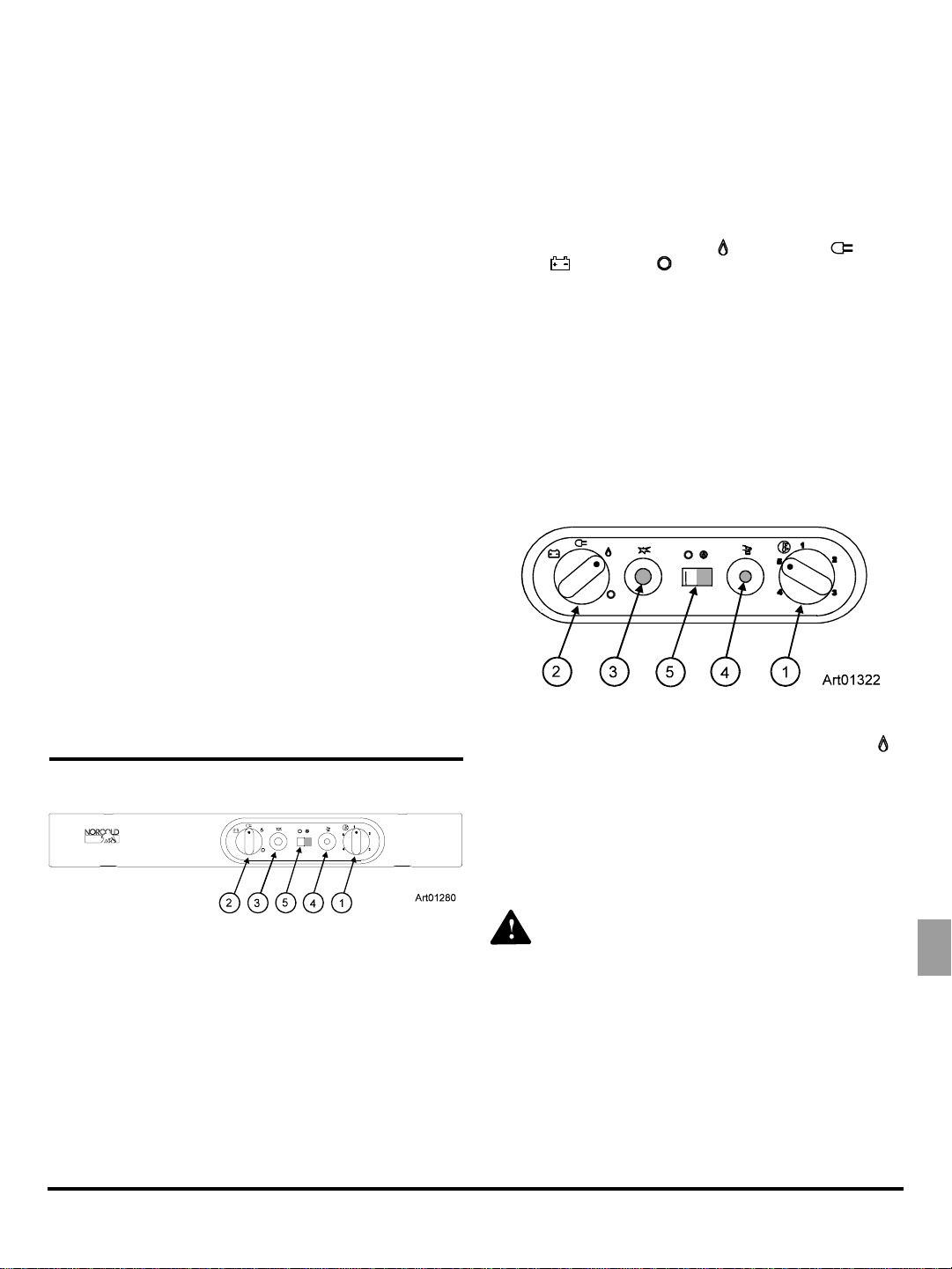
Control panel:
The selector switch [2] changes the energy source of the
refrigerator between propane gas (
electric (
The gas safety valve [3] is built into the control panel. As long
as a flame is present, the valve is open and allows propane
gas to flow into the burner. Any loss of flame (empty propane
gas tank, blow out, etc.) closes the safety valve and stops the
flow of propane gas.
The piezo igniter [4] makes a spark which ignites the flame in
the burner.
The flame meter [5] shows if a flame is present in the burner.
), and OFF ( ).
), AC electric ( ), DC
Ignition - propane gas operation:
1. Open the valve at the propane gas storage tank.
2. Turn the thermostat [1] to the 5 position.
3. Turn the selector switch [2] to the propane gas position (
4. Push and hold in the safety valve [4] and push in the igniter
[3] several times in rapid succession, for about five seconds:
).
Thermostat...........................................................................1
Selector switch ..................................................................... 2
Piezo lighter .........................................................................3
Gas safety valve ................................................................... 4
Flame meter ........................................................................ 5
The thermostat [1] (See Art01280) changes the amount of
propane gas that goes to the burner. This acts as the temperature control of the refrigerator. Number 5 is the coldest temperature setting.
NOTE: This is not an automatic gas control. It does not change
the flame from high fire to low fire as do some RV
refrigerators. If the cooling load changes, you must
manually change the gas control to maintain the same
temperature inside the refrigerator.
WARNING: Do not hold in the safety valve for more than
30 seconds. If there is no flame in this time, wait at least
five minutes before you try ignition again. If you continue
to hold in the safety valve, gas will collect in the burner
area. This could cause a fire or explosion and result in
dangerous personal injury or death.
- When a flame is present and the flame meter [5] moves into
the green area, release the safety valve.
- If the flame meter does not move into the green area, do
this step again.
5. Turn the thermostat to the temperature setting that you wish.
Do a test of the gas safety valve:
With an established flame in GAS mode:
1. Close the manual gas shutoff valve [2] of the refrigerator
(See Art00975].
Owner’s Manual 5
Page 6

2. After the flame is extinguished, you should hear a sharp
“click” sound within three minutes.
NOTE: The gas safety valve should close with a sharp “click“
sound.
3. Open the manual gas shutoff valve of the refrigerator.
4. Without pushing in the gas control, push the igniter several
times rapidly in succession. The burner flame should not
ignite. This means that the gas safety valve is working
correctly.
Start up - AC operation:
- Make sure that 120 volts AC is available.
The selector switch [2] changes the energy source of the
refrigerator between propane gas (
electric (
The gas safety valve [3] is built into the control panel. As long as
a flame is present, the valve is open and allows propane gas to
flow into the burner. Any loss of flame (empty propane gas tank,
blow out, etc.) closes the safety valve and stops the flow of
propane gas.
The flame indicator [4] shows if a flame is present in the burner.
), and OFF ( ).
), AC electric ( ), DC
Ignition - propane gas operation:
1. Open the valve at the propane gas storage tank.
- Turn the selector switch to the AC position (
- Turn the thermostat to the temperature setting that you
wish.
).
Start up - DC operation (3-way model N400.3):
- Make sure that 12 volts DC is available.
- Turn the selector switch to the DC position (
).
Shut down:
- Turn the selector switch to the OFF position ( ).
Operating the Refrigerator Controls (N500 models)
Control panel:
Thermostat...........................................................................1
Selector switch ..................................................................... 2
Gas safety valve ................................................................... 3
Flame indicator .................................................................... 4
The thermostat [1] (See Art01281) changes the amount of
propane gas that goes to the burner. This acts as the temperature control of the refrigerator. Number 5 is the coldest temperature setting.
NOTE: This is not an automatic gas control. It does not change
When the outside air temperature is below 50° F, the refrigerator may have a tendency to freeze food at the colder temperature
settings. To reduce the tendency to freeze food:
Owner’s Manual 6
the flame from high fire to low fire as do some RV
refrigerators. If the cooling load changes, you must
manually change the gas control to maintain the same
temperature inside the refrigerator.
- Turn the thermostat to a warmer temperature setting.
- Keep the refrigerator full.
- Put foods that are more likely to freeze on the upper shelf.
2. Turn the thermostat [1] to the 5 position.
3. Turn the selector switch [2] to the propane gas position (
4. Push and hold in the safety valve [3] for about five seconds:
- The refrigerator automatically ignites the gas at the burner.
WARNING: Do not hold in the safety valve for more than
30 seconds. If there is no flame in this time, wait at least
five minutes before you try ignition again. If you continue
to hold in the safety valve, gas will collect in the burner
area. This could cause a fire or explosion and result in
dangerous personal injury or death.
- When a flame is present and the flame indicator [4]
illuminates, release the safety valve.
- If the flame indicator does not illuminate, do this step again.
5. Turn the thermostat to the temperature setting that you wish.
Do a test of the gas safety valve:
With an established flame in GAS mode:
1. Close the manual gas shutoff valve [2] of the refrigerator
(See Art00975].
2. After the flame is extinguished, you should hear a sharp
“click” sound within three minutes.
NOTE: The gas safety valve should close with a sharp “click“
sound.
3. Open the manual gas shutoff valve of the refrigerator.
4. Without pushing in the gas control, push the igniter several
times rapidly in succession. The burner flame should not
ignite. This means that the gas safety valve is working
correctly.
).
Page 7

Start up - AC operation:
- Make sure that 120 volts AC is available.
- Push and hold the MODE button and a light bar flashes in
the center display beside each of the four operating modes
of the refrigerator, one at a time.
- Turn the selector switch to the AC position (
- Turn the thermostat to the temperature setting that you
wish.
).
Start up - DC operation (3-way model N500.3):
- Make sure that 12 volts DC is available.
- Turn the selector switch to the DC position (
).
Shut down:
- Turn the selector switch to the OFF position ( ).
Operating the Refrigerator Controls(model
N510 )
Control panel:
- There is one automatic mode of operation and two
(three on model N510.3) manual modes of operation.
- When the light bar flashes beside the mode of operation that you wish, release the MODE button.
Automatic mode operation:
When you select AUTO mode, the refrigerator controls automatically select the most efficient energy source that is available for operation. If a more efficient energy source becomes
available, the refrigerator controls change from the current
energy source to the more efficient energy source. The refrigerator will not select DC operation.
The controls select the energy source in this sequence:
- When 120 volts AC is available to the refigerator:
- The light bar beside AUTO [5] and the light bar beside
AC [6] show in the center display.
- After ten seconds, the light bar beside AC goes off and
only the light bar beside AUTO remains.
- This means that the refrigerator is operating on AC
electric.
- If 120 volts AC is not available to the refrigerator:
- The light bar beside AUTO and the light bar beside LP
GAS [7] show in the center display.
The refrigerator control panel (see Art10562) is above the
refrigerator door. To maintain the operating control functions of
the refrigerator, a 12 volt DC power supply is necessary. The
refrigerator and any other DC components in the vehicle receive
DC power from the 12 volt system of the vehicle; either an
auxillary battery, a converter, or the vehicle engine battery .
The ON / OFF button [1] starts and shuts down the refrigerator:
- If the refrigerator is shut down, press the ON / OFF button to
start the refrigerator in auto mode.
- If the refrigerator is operating, press and hold the ON / OFF
button for two seconds to shut down the refrigerator.
The TEMP SET button [2] controls the temperature adjustment
of the freezer and the fresh food compartment. The temperature
adjustment that you select does not change if the mode of
operation of the refrigerator changes.
- Push the TEMP SET button and the temperature setting “19” appears in the center display [3].
- Push and hold the TEMP SET button and the temperature
setting changes.
- The number “9” is the coldest temperature setting.
The MODE button [4] controls the operation mode of the
refrigerator.
- After ten seconds, the light bar beside LP goes off and
only the light bar beside AUTO remains.
- This means that the refrigerator is operating on
propane gas.
If an energy source is available to the refrigerator, but is not
operating correctly:
- A fault code appears in the center display.
- The refrigerator controls try to change to a less efficient
energy source.
- If a less efficient energy source is not available:
- The refrigerator stops operation.
- Refer to the “Fault Codes” section of this manual.
Manual mode operation:
When you select one of the manual modes of operation, The
light bar beside the AUTO goes out in the center display and
only the light bar beside either AC, LP, or DC remains.
- AC means that the refrigerator is operating on AC electric.
- DC means that the refrigerator is operating on DC electric.
- LP means that the refrigerator is operating on propane gas.
If the energy source is interrupted:
Owner’s Manual 7
Page 8

- The refrigerator stops operation.
- Refer to the “Fault Codes” section of this manual.
- If the temperature is too cold, push and hold the
TEMP SET button to lower the temperature setting
by one number.
Ignition of propane gas in either auto or manual
mode:
NOTE: On initial start up of the refrigerator, ignition of the
propane gas may not occur within 30 seconds.
If ignition of the propane gas does not occur within 30 seconds:
- The gas safety valve of the refrigerator closes.
- The refrigerator stops operation.
- Refer to the “Fault Codes“ section of this manual.
- The fault code remains until you push the ON / OFF button
two times (to stop and start the refrigerator).
- If ignition does not occur after two or three times:
- Check the gas supply line.
- Consult your local dealer or an authorized Norcold
Service Center.
- Change to manual mode and operate on AC electric.
Shut down:
- To shut down the refrigerator, push and hold the ON/OFF
button for two seconds.
Backup operating system:
This refrigerator has a backup operating system. The backup
operating system allows the refigerator to continue to cool if the
temperature sensor of the refrigerator should fail.
If this failure occurs:
- Have the refrigerator serviced by your dealer or an Norcold
authorized Service Center as soon as possible.
DC Operation Precautions (models N400.3,
N500.3, and N510.3)
This refrigerator is made to operate on DC power while your
vehicle is “in transit” and AC power or propane gas sources are
not available. Operate the refrigerator on DC power only when
the vehicle engine is running.
For the refrigerator to operate correctly on DC power, the battery
must be maintained in a fully charged condition.
For the battery to be fully charged at all times during refrigerator
operation on DC, the vehicle engine
alternator must be in good operating condition.
Keep in mind the following electrical precautions for DC
operation of the refrigerator:
- Good battery condition is necessary for correct DC operation.
- The capacity of the battery charging system must be more
than what is necessary for the refrigerator and other DC
appliances.
- While the vehicle engine is running, make sure the voltage
of the DC power supply leads at the refrigerator is more
than 11.5 VDC.
must be running and the
DC Operation Guidelines (models N400.3,
N500.3, and N510.3)
- The refrigerator automatically changes to the backup
operating system.
- When you push the TEMP SET button, the temperature
setting flashes in the center display for ten seconds.
- After the temperature setting flashes, the mode of
operation appears in the center dispaly.
- The backup operating system can overfreeze or thaw the
contents of the freezer and the fresh food compartment.
- Make sure the temperatures of the freezer and the
fresh food compartment are satisfactory.
NOTE: If you open the door(s) too often, the tempera-
tures inside the freezer and fresh food compartment do not become stable. Allow the refrigerator to operate for about one hour after each
adjustment change before you examine the
contents. The number “9” is the coldest
temperature setting.
- If the temperature is too warm, push and hold the
TEMP SET button to raise the temperature setting
by one number.
Owner’s Manual 8
DC operation is intended only to maintain the temperature of
the refrigerator and its contents when they are already cool.
The DC operation is not intended for the initial start up and
cooling of the refrigerator. Always use either the AC operation or
propane gas operation to initially start up and cool the refrigerator. The refrigerator must be cooled and the temperature must
be steady before you operate the refrigerator on DC.
Keep in mind the following guidelines for DC operation of the
refrigerator:
- Use DC operation of the refrigerator while the vehicle is in
transit.
- Do not use DC operation until the refrigerator and its
contents are completely cooled.
- Only use DC operation if the vehicle battery and alternator
are in good operating condition.
Page 9

Refrigerator Care Checklist
Your refrigerator will give you years of trouble free service if you
do these simple checks every three to six months:
- Keep the food compartment and the freezer clean. See
“Defrosting and Cleaning”.
- Defrost the refrigerator as necessary. See “Defrosting and
Cleaning”.
- Make sure the door seals correctly. See “Door Sealing“.
- Be aware of any cooling changes that are not because of
weather, loading, or gas control changes. If changes occur,
contact your dealer or an authorized Norcold Service Center.
- Make sure the gas supply is propane gas only and not
butane or a butane mixture.
Defrosting and Cleaning
Defrosting:
It is normal for frost to collect on the cooling fins inside the
refrigerator. Excess frost decreases the cooling performance of
the refrigerator. Defrost the refrigerator when frost starts to
close the spaces between the fins:
- Shut down the refrigerator.
Door Sealing
If the door does not seal correctly, excess frost will collect inside
the refrigerator. Make sure the door seals correctly:
- Close the door on a piece of paper that is about the size
and thickness of a dollar bill (See Art00980).
- Gently pull the paper.
- You should feel a slight drag between the gasket and
the cabinet.
- Do this on all four sides of the door.
- If you do not feel a slight drag on the
paper, the door is not sealing correctly:
- Make sure the screws of the hinges are tight.
- Make sure the door gasket does not touch the door
latch:
- If the door gasket touches the door latch,
loosen the screws of the door latch.
- Raise the door latch just so it does not touch
and tighten the screws of the door latch.
- Make sure the door latch holds the door closed
- Remove all food from the refrigerator.
NOTE: Defrosting the refrigerator makes excess water inside
the refrigerator.
- Put dry towels (etc.) inside the refrigerator to absorb the
water.
- Put trays of hot water in the freezer until the frost is melted.
- Empty the drip tray.
- Remove the wet towels (etc.) and dry the interior.
- Put the drip tray and all food in the refrigerator.
- Ignite or start up the refrigerator.
Cleaning:
A good time to clean the refrigerator is just after you defrost it.
Clean the inside of the refrigerator as often as necessary to
avoid food odors:
- Remove all food from the refrigerator.
NOTE: Do not use abrasive cleaners, chemicals, or
scouring pads because they can damage the
interior of the refrigerator.
- Wash the interior with a solution of liquid dish detergent
and warm water.
Refrigerator Maintenance Checklist
Read and understand the following maintenance sections of
this manual.
NOTE: Norcold is not responsible for installation, adjust-
ment, alteration, service, or maintenance performed
by anyone other than a qualified RV dealer or an
authorized Norcold Service center.
Have a qualified RV dealer or an authorized Norcold Service
Center do these annual safety and maintenance checks:
- Examine the gas supply lines for leaks.
- Replace or repair if needed.
- Make sure the propane gas pressure is correct.
- Adjust if needed.
- Make sure the combustion seal is complete and intact.
- Replace or repair it if needed.
- Make sure the burner and the burner orifice are clean (See
Art00956).
- Clean if needed.
Owner’s Manual 9
Page 10

- Make sure the electrode spark gap [3] is 1/8 - 3/16 inch
(See Art00955).
- Adjust if needed.
- Make sure the AC and DC voltages are correct.
- Adjust if needed.
- Make sure the thermocouple tip is clean and secure.
- Make sure the area at the rear of the refrigerator is free of
any combustible materials, gasoline, and other flammable
vapors and liquids.
Refrigerator Maintenance
Gas flame appearance:
While in propane gas operation, examine the appearance of the
gas flame:
- Turn the thermostat to the 5 position.
- Open the lower intake vent.
CAUTION: The burner box cover can be hot. Wear
gloves to avoid burns.
- Open the burner box door [3] and look at the gas flame [1]
(See Art00955 and Art00975).
- The flame should be a darker blue inside and a lighter
blue outside and should be a constant and steady
shape.
- Shut down the refrigerator..
- Open the lower intake vent.
- Remove the burner box cover by removing one screw.
WARNING: To avoid possible propane gas leaks,
always use two wrenches to loosen and tighten the gas
supply line at the refrigerator’s manual shut off valve.
- Remove the flare nut from the orifice assembly [1] (See
Art00956).
- Remove the orifice assembly from the burner [2].
WARNING: Do not try to remove the orifice [3] from
the orifice adapter [4] when cleaning. Removal will
damage the orifice and seal of the orifice and can
cause a propane gas leak. Leaking propane gas can
ignite or explode which can result in dangerous
personal injury or death. Do not clean the orifice with a
pin or other objects.
- Clean the orifice assembly with air pressure and alcohol
only.
- Using a wrench, assemble the orifice assembly to the
burner.
- Assemble the flare nut to the orifice assembly.
- Tighten the flare nut by hand.
- Hold the orifice assembly securely and, using a
wrench, tighten the flare nut 1/4 revolution only.
- Examine all of the connections for gas leaks.
- If the flame is yellow or has an erratic and unstable
shape, contact your dealer or an authorized Norcold
Service Center.
- Make sure the flame does not touch the inside of the
flue tube [2].
- If the flame touches the inside of the flue tube, contact
your dealer or an authorized Norcold Service Center.
- Close the burner box door.
Remove and clean the burner orifice:
NOTE: Your dealer or an authorized Norcold Service Center
must do this procedure.
To remove and clean the burner orifice:
- Close the valve at the propane gas tank(s).
- Close the manual shut off valve of the refrigerator.
Fuse Replacement
(N510 models only)
The electrical circuits of this refrigerator have fuses to protect
them from an overload. If the fault codes show that a fuse is
unservicable, replace it as follows.
WARNING: Do not operate the refrigerator without the
power board cover on the refrigerator. To prevent a circuit
overload and a possible electrical fire, use only these
fuses:
DC control circuit - 5 amp (purple) blade type automotive
fuse
DC heater circuit - 30 amp (green) blade type automotive
fuse
AC circuit - 5 amp glass cartridge fuse
1. Push the ON/OFF button to shut down the refrigerator.
2. Remove the black AC power cord from the receptacle.
3. Remove the AC power cord from the power board that is at
the rear of the refrigerator.
Owner’s Manual 10
Page 11

4. Remove the DC power supply wires from the power board.
5. Remove the ignition sense wire from the power board.
6. Remove the gas valve wires from the power board.
7. Remove the mounting screws and the power board cover.
8. Replace the unservicable fuse(s) with the new fuse(s) of the
correct type and size.
9. Reverse this procedure and assemble the power board
cover and all wiring.
10. If the fuse(s) continues to become unservicable, consult
your dealer or a Norcold authorized Service Center.
Remove the Refrigerator
NOTE: Your dealer or an authorized Norcold Service Center
must do this procedure.
CAUTION: The rear of the refrigerator has sharp edges
and corners. To prevent cuts or abrasions when working
on the refrigerator, be careful and wear cut resistant
gloves.
Reinstall the Refrigerator
NOTE: Your dealer or an authorized Norcold Service Center
must do this procedure.
WARNING: Make sure the combustion seal is not
broken, is completely around the refrigerator mounting
flanges, and is between the mounting flanges and the
wall of the enclosure. If the combustion seal is not
complete, exhaust fumes can be present in the living
area of the vehicle. The breathing of exhaust fumes can
cause dizziness, nausea, and in extreme cases, death.
1. Push the refrigerator completely into the enclosure.
2. Remove the door from the refrigerator.
3. Put the screws though the mounting flanges and into the
wall.
4. Attach the door to the refrigerator
CAUTION: The rear of the refrigerator has sharp edges
and corners. To prevent cuts or abrasions when working
on the refrigerator, be careful and wear cut resistant
gloves.
5. Open the lower intake vent and put the screws through
refrigerator and into the floor.
1. Close the valve at the propane gas tank(s).
WARNING: To avoid possible propane gas leaks,
always use two wrenches to loosen and tighten the gas
supply line at the refrigerator’s manual shut off valve.
2. Open the lower intake vent and remove the gas supply line
from the manual shut off valve of the refrigerator.
3. Remove the AC power cord from the receptacle.
4. Remove the DC wiring from the refrigerator:
- Put a mark on the DC wires so you can put them back in
the correct location.
- Remove the DC fuse or remove the DC wiring from the
battery or the converter of the vehicle.
- Remove the DC wires from the refrigerator.
5. Remove the screws which fasten the refrigerator to the floor.
6. Remove the door from the refrigerator.
7. Remove the screws which fasten the refrigerator to the wall.
8. Remove the refrigerator from the opening.
9. Attach the door to the refrigerator.
WARNING: To avoid possible propane gas leaks,
always use two wrenches to loosen and tighten the gas
supply line at the refrigerator’s manual shut off valve.
6. Attach the gas supply line to the manual shut off valve of the
refrigerator.
7. Open the valve at the propane gas tank(s).
WARNING: Do not allow the leak checking solution to
touch the electrical components. Many liquids are
electrically conductive and can cause a shock
hazard,electrical shorts, and in some cases fire.
8. Examine the gas supply line for leaks.
9. Connect the DC wiring to the refrigerator:
- Install the DC fuse or connect the DC wiring to the battery or
the converter.
- Connect the DC wires from the refrigerator.
10. Connect the AC power cord to the receptacle.
Replacement Parts
You may purchase replacement parts through your local RV
dealer or an authorized Norcold Service Center.
Owner’s Manual 11
Page 12

Wiring Pictorial
(N400 models only)
Wiring Diagram
(N500 models only)
The parts of the wiring pictorial are (Art01326):
1 .............................................................120VAC Power cord
2 ..................................................................... Terminal block
3 ...........................................................................3 Amp fuse
4 .................................................................... Selector switch
5 ..................................................................... Thermocouple
6 ..............................................Thermostat / gas safety valve
7 ................................................... Thermocouple interrupter
8 ........................................................................ Flame meter
9 .............................................................................AC heater
10 ........................... -12 VDC Power supply (model N400.3)
11 ........................... +12 VDC Power supply (model N400.3)
12 ............................................ 25 Amp fuse (model N400.3)
13 ............................................... DC heater (model N400.3)
Wiring Diagram
(N400 models only)
The parts of the wiring diagram are (See Art01327):
1 ............................................................................... 120 V AC
3 ...........................................................................3 Amp fuse
5 ..................................................................... Thermocouple
6 ...................................................................Gas safety valve
7 ................................................... Thermocouple interrupter
8 ........................................................................ Flame meter
9 .............................................................................AC heater
10 ......................................... -12 VDC Com (model N400.3)
11 ................................................... +12 VDC (model N400.3)
12 ............................................ 25 Amp fuse (model N400.3)
13 ............................................... DC heater (model N400.3)
14 ........................................................................ Thermostat
15 .......................................................................... Spark gap
16 ....................................................................... Piezo lighter
The parts of the wiring diagram are (See Art01315):
1 ............................................................................... 120 V AC
3 ...........................................................................3 Amp fuse
5 ..................................................................... Thermocouple
8 ................................................................... Flame indicator
9 .............................................................................AC heater
10 .................................................................... -12 VDC Com
11............................................................................. +12 VDC
12 ............................................ 25 Amp fuse (model N500.3)
14 ............................................................................ Relighter
15 ............................................... DC heater (model N500.3)
16 .........................................................................1 Amp fuse
17 ........................................................................ Thermostat
18 .................................................................Gas safety valve
19 ................................................. Thermocouple interrupter
20 .......................................................................... Spark gap
Wiring Pictorial
(N510 models only)
The parts of the wiring pictorial are (Art01576):
1 ............................................................................... 120 V AC
2 ........................................................ -12 VDC Power supply
3 ....................................................... +12 VDC Power supply
4 ........................................................................ Power board
5 ...........................................................................5 Amp fuse
6 .............................................. 30 Amp fuse (model N510.3)
7 .............................................................................AC heater
8 ................................................. DC heater (model N510.3)
9 ...................................................................Gas safety valve
10 ................................................................. Spark electrode
11 ......................................................... Display board overlay
12 .................................................................... Display board
13 ......................................................... Temperature sensor
14 .................................................................... Fan (optional)
15 ........................................................ Thermostat (optional)
Wiring Pictorial
(N500 models only)
The parts of the wiring pictorial are (Art01314):
1 .............................................................120VAC Power cord
2 ..................................................................... Terminal block
3 ...........................................................................3 Amp fuse
4 .................................................................... Selector switch
5 ..................................................................... Thermocouple
6 ..............................................Thermostat / gas safety valve
7 ................................................... Thermocouple interrupter
8 ................................................................... Flame indicator
9 .............................................................................AC heater
10 ...................................................... -12 VDC Power supply
11 ...................................................... +12 VDC Power supply
12 ............................................ 25 Amp fuse (model N500.3)
13 ................................................................. Spark electrode
14 ............................................................................ Relighter
15 ............................................... DC heater (model N500.3)
16 .........................................................................1 Amp fuse
Owner’s Manual 12
Wiring Diagram
(N510 models only)
The parts of the wiring diagram are (See Art01575):
1 ............................................................................... 120 V AC
2 ........................................................ -12 VDC Power supply
3 ....................................................... +12 VDC Power supply
4 ........................................................................ Power board
7 .............................................................................AC heater
8 ................................................. DC heater (model N510.3)
9 ...................................................................Gas safety valve
12 .................................................................... Display board
13 ......................................................... Temperature sensor
14 .................................................................... Fan (optional)
15 ........................................................ Thermostat (optional)
16 ............................................................... Voltage regulator
17 .................................................................ON / OFF switch
18 ..................................................................... MODE switch
19 .............................................................. TEMP SET switch
20 ................................................................. Microprocessor
21 ....................................................................................LED
Page 13

Fault Codes (model N510)
sedoCtluaFgninaeMedoCtluaFsnoitcAevitcerroC
siegatlovCD
oN
.yalpsid
"F"
"A"
"C"
gnitteserutarepmeT
sdnocesnetrofsehsalf
.sraeppaedomdna
ehtotelbaliavanu
lortnocrotaregirfer
ehtrolenap
.FFOsirotaregifer
tondidrenrubehT
.etingi-erroetingi
siegatlovCA
ehtotelbaliavanu
.lortnocrotaregirfer
ehtotegatlovCD
lortnocrotaregirfer
.wolootsilenap
sirotaregirferehT
kcaB"ehtnognitarepo
."metsySgnitarepOpU
:kcehC
:kcehC
:kcehC
:kcehC
retneC
.NOsirotaregirferehttahT-
.lanoitareposielcihevehtfotnempiuqegnigrahcyrettabehttahT-
.)elbacilppafi(lanoitareposiretrevnocCD/CAehttahT-
.esooltonsirotaregirferehtotnoitcennocCDehttahT-
.tcatnisirotaregirferehtfoesufCDehttahT-
.retneCecivreSdlocroNdezirohtuarorelaedruoyeeS-
.tcerrocsiegatlovCDehttahT-
.degrupsienilylppussagenaporpehttahT-
.neposi)s(knatsagenaporpehtfoevlavehttahT-
.erusserptcerrocehttasisagenaporpehttahT-
.neposirotaregirferehtfoevlavffotuhslaunamehttahT-
.retneCecivreSdlocroNdezirohtuarorelaedruoyeeS-
.nideggulprotaregirferehttahT-
.tcatnisielcihevehtforekaerbtiucricroesufehttahT-
.)elbacilppafi(lanoitareposirotarenegelcihevehttahT-
.tcatnisirotaregirferehtfoesufCAehttahT-
.retneCecivreSdlocroNdezirohtuarorelaedruoyeeS-
.lanoitareposielcihevehtfotnempiuqegnigrahcyrettabehttahT-
.)elbacilppafi(lanoitareposiretrevnocCD/CAehttahT.esooltonsirotaregirferehtotnoitcennocCDehttahT.retneCecivreSdlocroNdezirohtuarorelaedruoyeeS-
ecivreSdlocroNdezirohtuarorelaedruoyeeS.elbacivresrenwotonsisihT
"H"
"r"
"S"
ehtnihtiwtluafasisihT
.slortnocrotaregirfer
ehtnihtiwtluafasisihT
.slortnocrotaregirfer
ehtnihtiwtluafasisihT
.slortnocrotaregirfer
retneC
.retneC
.retneC
ecivreSdlocroNdezirohtuarorelaedruoyeeS.elbacivresrenwotonsisihT
ecivreSdlocroNdezirohtuarorelaedruoyeeS.elbacivresrenwotonsisihT
ecivreSdlocroNdezirohtuarorelaedruoyeeS.elbacivresrenwotonsisihT
06510trA
Owner’s Manual 13
Page 14

1
1
4
5
A
2
5
4
3
2
3
rt01280
Page 15

3110
111216
Art01314
1234567
8
BLK (SMOOTH) / NOIRBLK (RIBBED) / NOIR (CANN)BLK / NOIRRED / ROUG
E
ORG / ORAN G E
2
Wiring pictorial
(N400 models only)
Schéma de câblage
(modèles N400 seulement)
BLK / NOIR
YEL/ JAUNE
13
ORG /
ORANGE
14
BLK / NOIR
YEL/ JAU NE
ORG / ORANGE
BLK / NOIR
BLK / NOI R
WHT/ BLAN C
15
5
9
YEL/ JAUNE
WHT/ BLAN C
RED / ROUGE
BLU / BLEU
4a
4b
2a
2b
BRN / BRUN
ORG / ORANGE
ORG / ORANGE
BLU / BLEU
7
3b
3a
1b
1a
RED / ROUGE
BLK / NOIR
GRN / YEL
VERT / JAUNE
Wiring pictorial
(N500 models only)
Schéma de câblage
(modèles N500 seulement)
8
6
4
Wiring pictorial
(N510 models only)
Schéma de câblage
(modèles N510 seulement)
Page 16

Wiring diagram
(N400 models only)
Schéma électrique
(modèles N400 seulement)
Wiring diagram
(N500 models only)
Schéma électrique
(modèles N500 seulement)
Wiring diagram
(N510 models only)
Schéma électrique
(modèles N510 seulement)
 Loading...