

Page 1
Noise Engineering
Type
CV Randomized sequencer
Size
6HP Eurorack
Depth
.8 Inches
Power
10-pin Eurorack
+12 mA
50 mA
-12 mA
50 mA
Mimetic Sequent
6HP CV randomizer and recorder
Overview
Mimetic sequent is a sixty-four step pitch-aware CV recorder and
randomizer with the ability to save and modify three unique patterns.
Switch between stored patterns or use the Mimetic Multium expander to
output all three patterns simultaneously in addition to four separate
randomized rhythm sources.
1
Page 2
Noise Engineering
Mimetic Sequent
6HP CV randomizer and recorder
Patch Tutorial
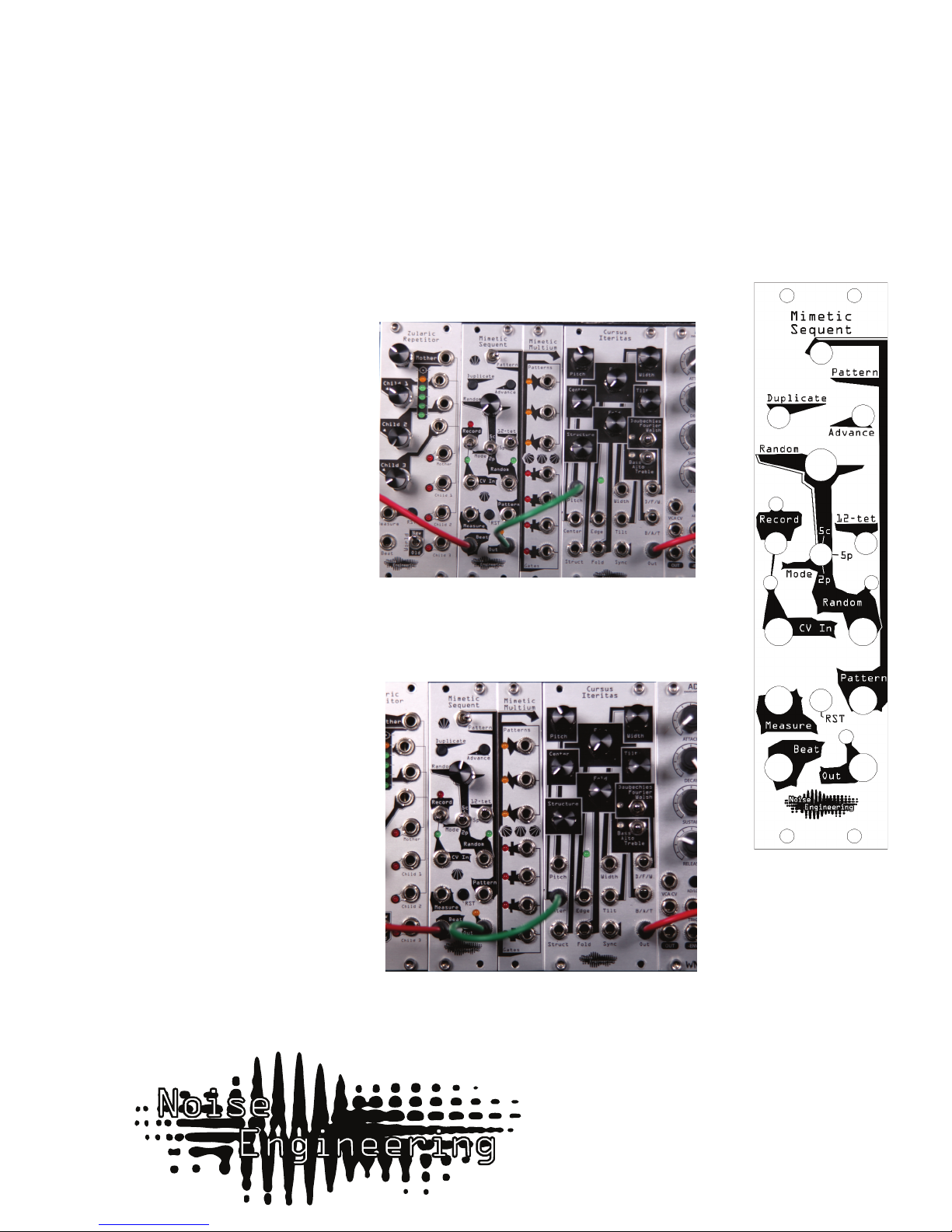
Basic Pitching
Turn record mode off, set Mode to 2P,
and, if desired, turn on the 12-tet
quantizer. Connect a clock to the Beat
input. Patch the Out to the pitch CV
control of the module of your choice
(Loquelic Iteritas or Cursus Iteritas
are good options). Turn the Random
knob clockwise and experiment.
When you nd a pattern you like,
turn the knob fully CCW to lock the
pattern in. For broader range of
pitches randomized, switch MS to 5P
mode. If you would like the pattern to
be shorter send the output of a clock
divider to the measure input.
Mimetic Sequent and Other
Parameters
Turn record mode off, set Mode to
5C. Connect a clock to the Beat input.
Patch the Out to any parameter CV
control of the module of your choice
(try Noise Engineering’s Basimilus
Iteritas Alter, Loquelic Iteritas or
Cursus Iteritas, for example). Turn the
Random knob clockwise and
experiment. When you nd a pattern
you like, turn the knob fully CCW to
lock the pattern in.
2
Page 3
Noise Engineering
Mimetic Sequent
6HP CV randomizer and recorder
Patch Tutorial
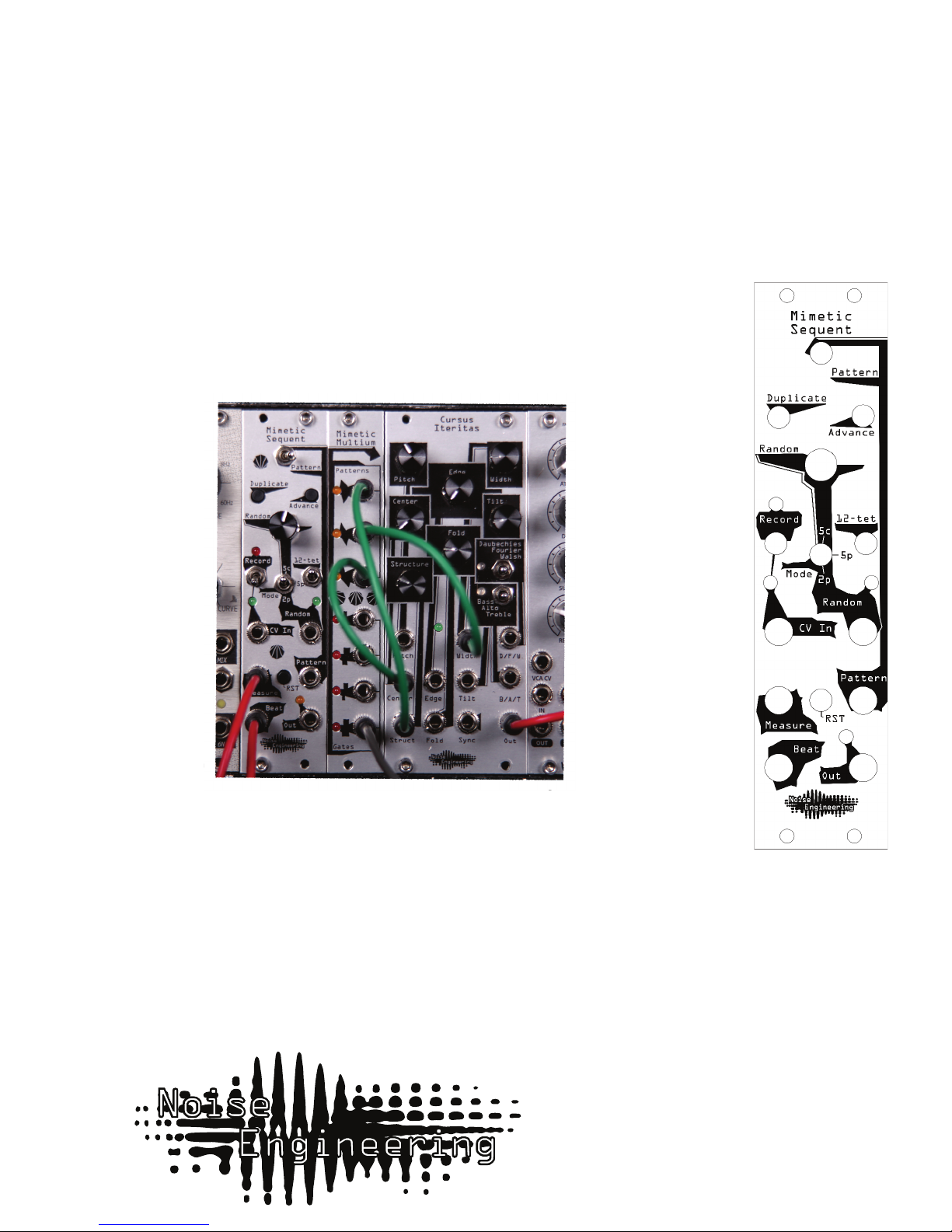
Multiple Outputs
With Mimetic Multium optional expander, each pattern out maps to one of the
three patterns stored by MS. Patch the three Pattern outs to pitch or parameter CV
controls (choosing the appropriate mode on MS). Patch up to four gate outs to
trigger or CV-control other modules.
Sample and Hold
Mimetic Sequent can operate as a unipolar sample-and-hold by keeping it in
record mode. Patch the signal you want to sample into the Record input. Send the
sampling clock to the beat input. Flip the Record switch to the top position. e
MS will sample the input when it receives a beat input.
3
Page 4
Noise Engineering
Mimetic Sequent
6HP CV randomizer and recorder
Patch Tutorial
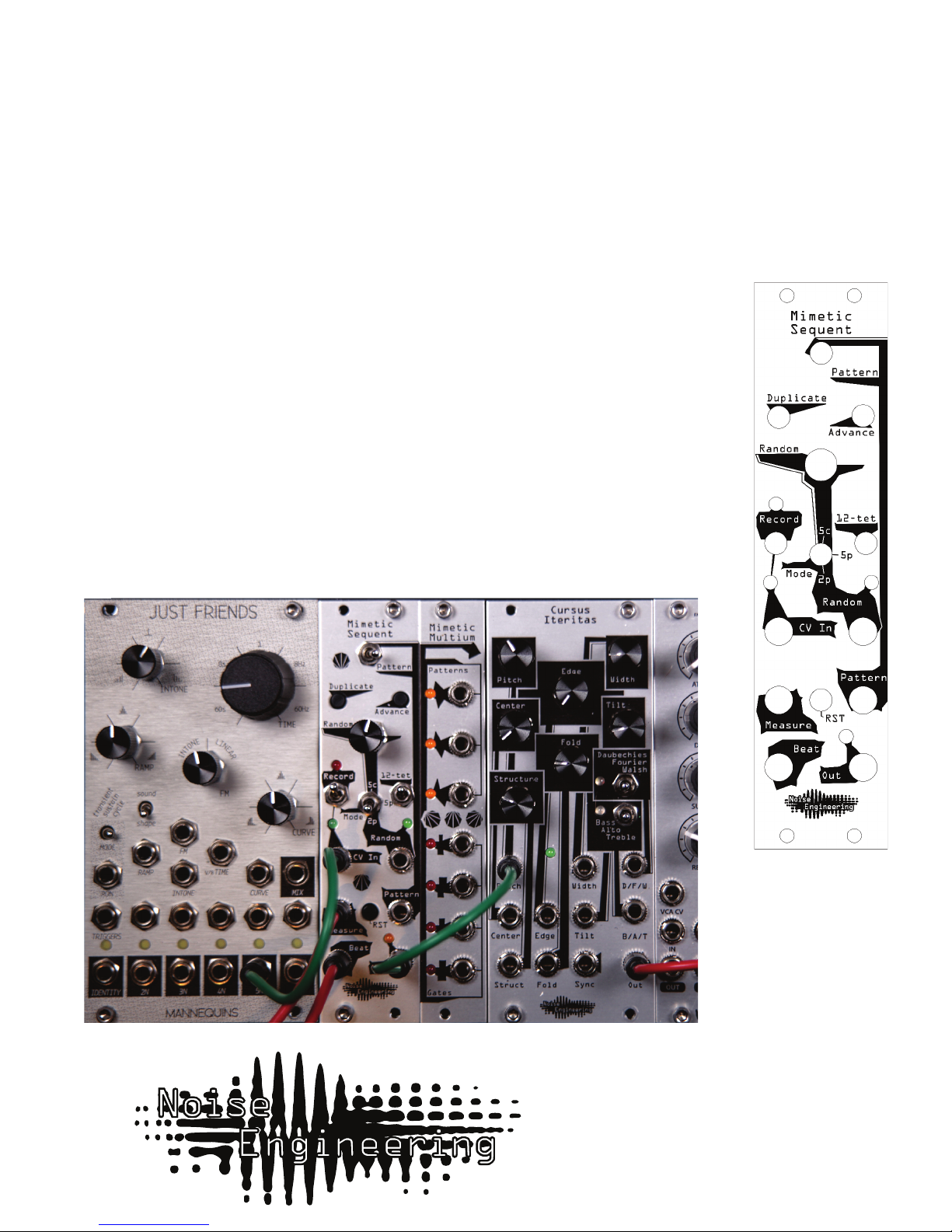
Recording
To record a sequence of CVs into the MS, plug the CV out from a CV source (for
example, the Mannequins Just Friends, WMD PDO, or other source) into the MS
record in. Connect the same clock used to advance the CV source to the MS’s beat
input. If you want to record only one measure you will also need to connect a
measure clock to the MS input.
Enable record mode and the MS will record the CVs into its ash. To enable
short-term record mode, ip the Record switch to the middle position. MS will
stop recording aer 64 steps or when it receives an end-of-measure signal. To
enable normal record mode, ip the Record switch all the way up. MS will record
until you disable it.
4
Page 5
Noise Engineering
Mimetic Sequent
6HP CV randomizer and recorder
Interface
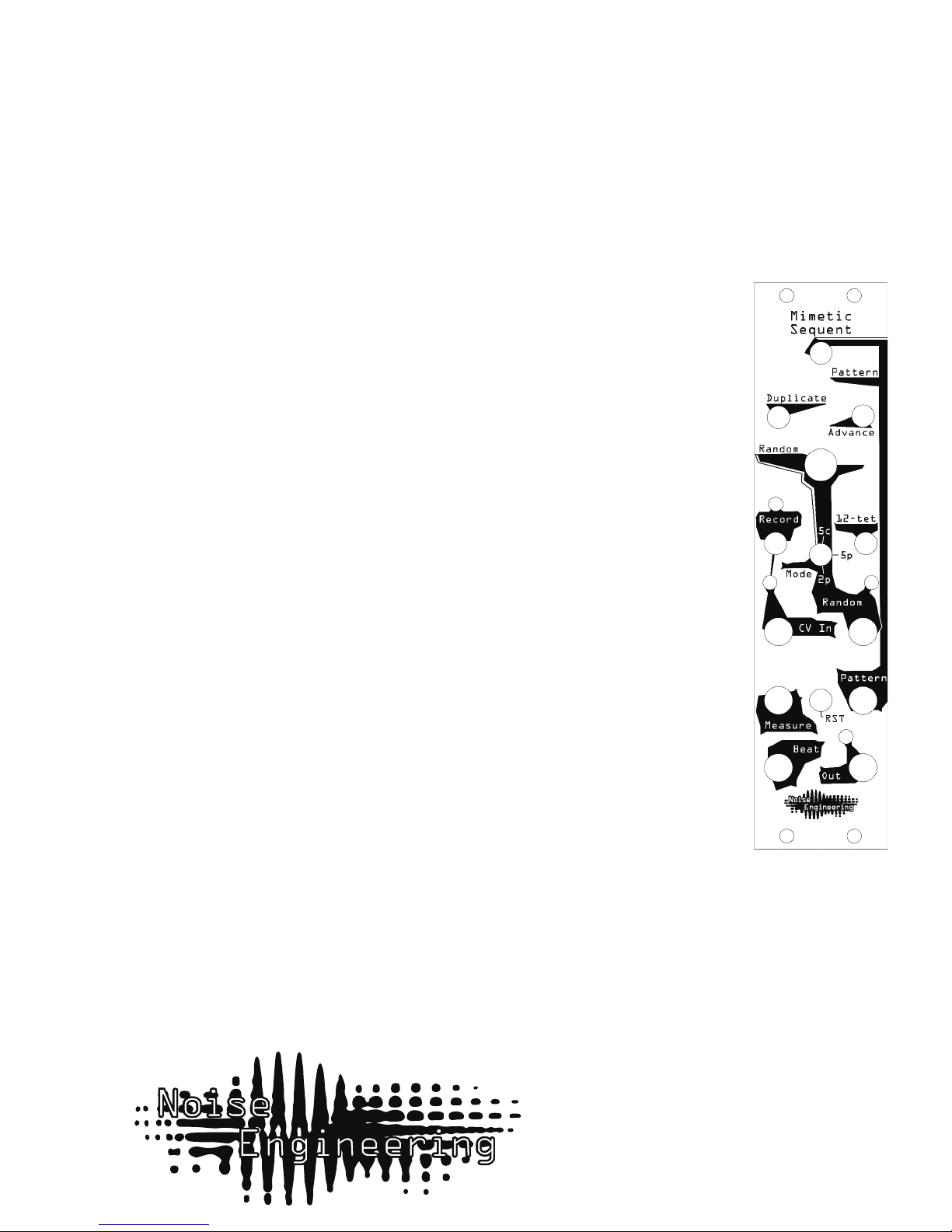
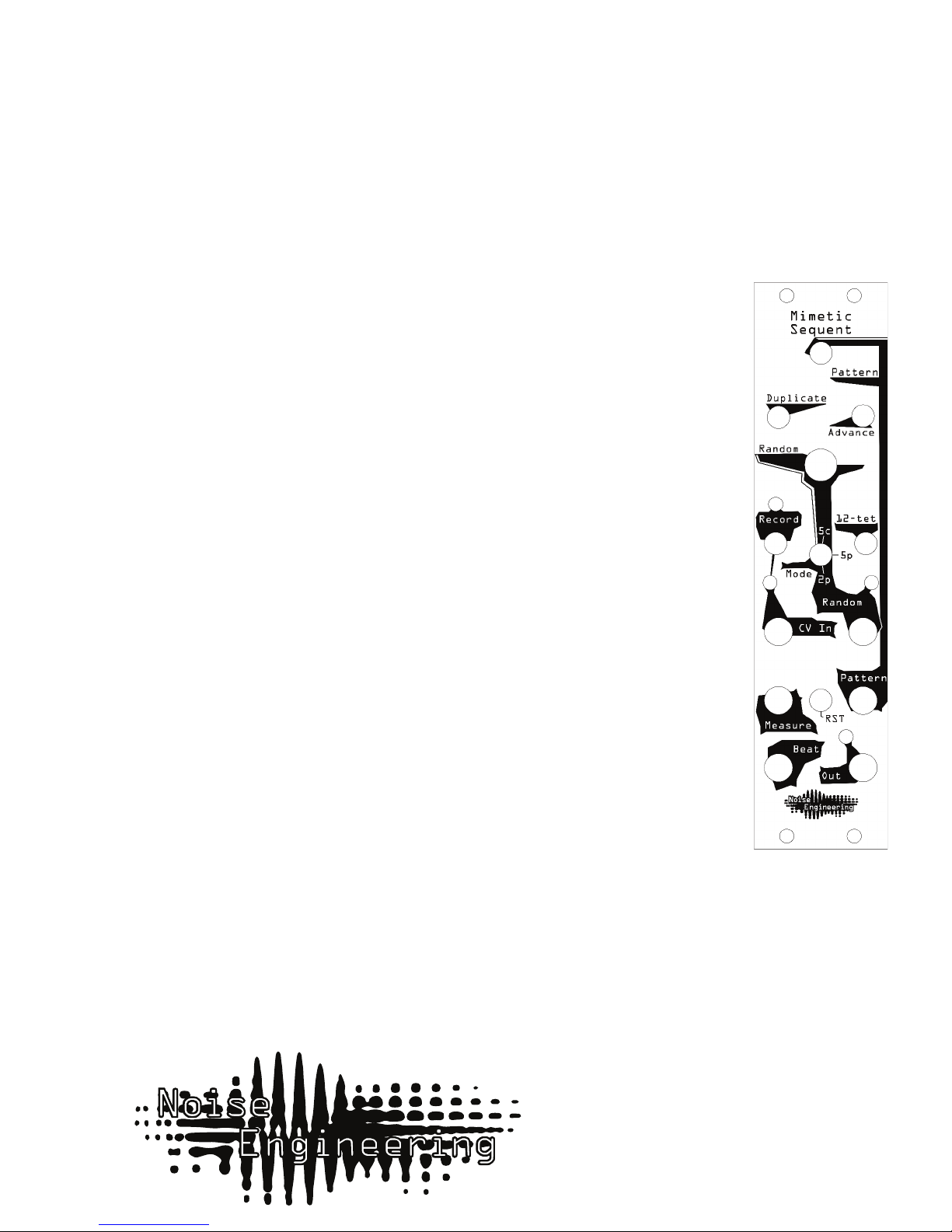
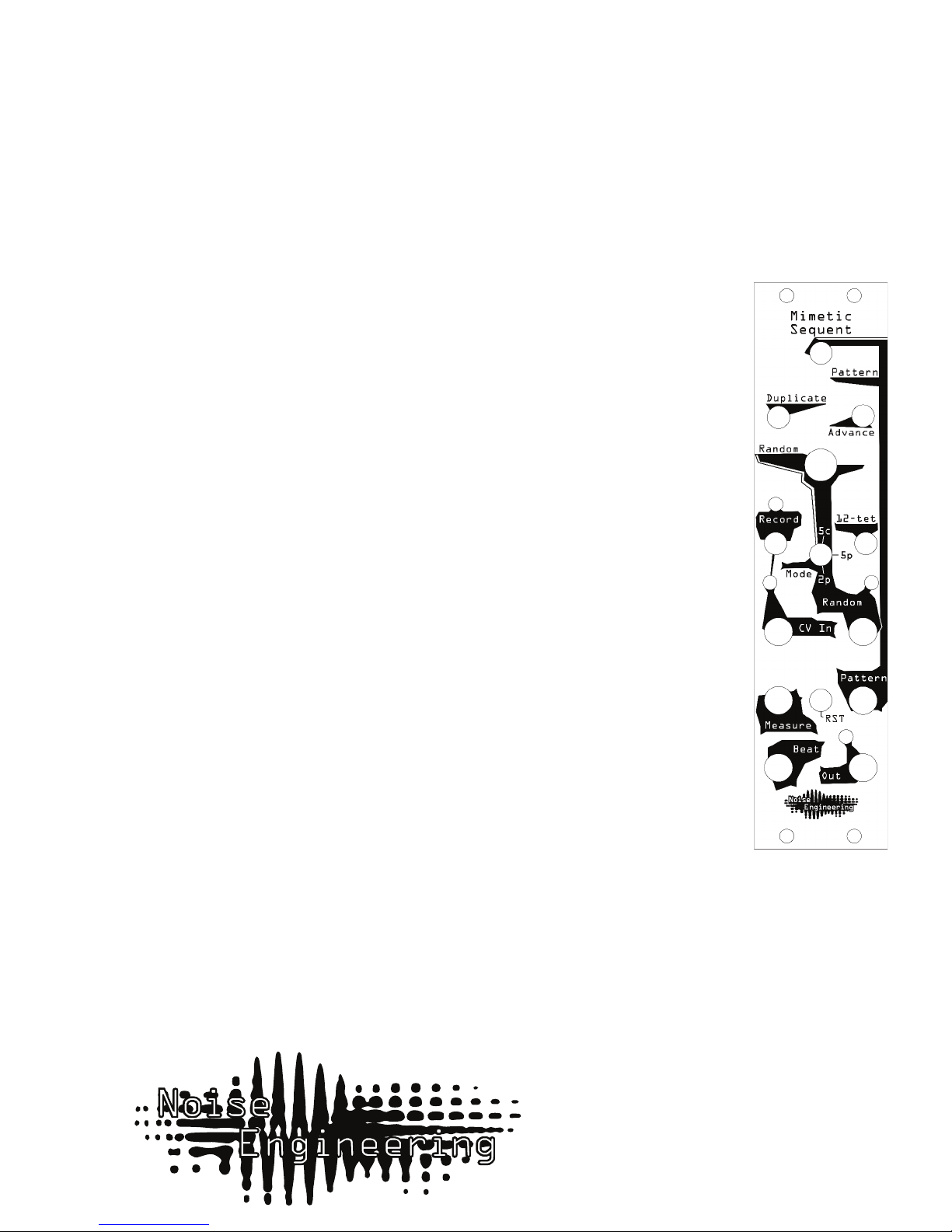
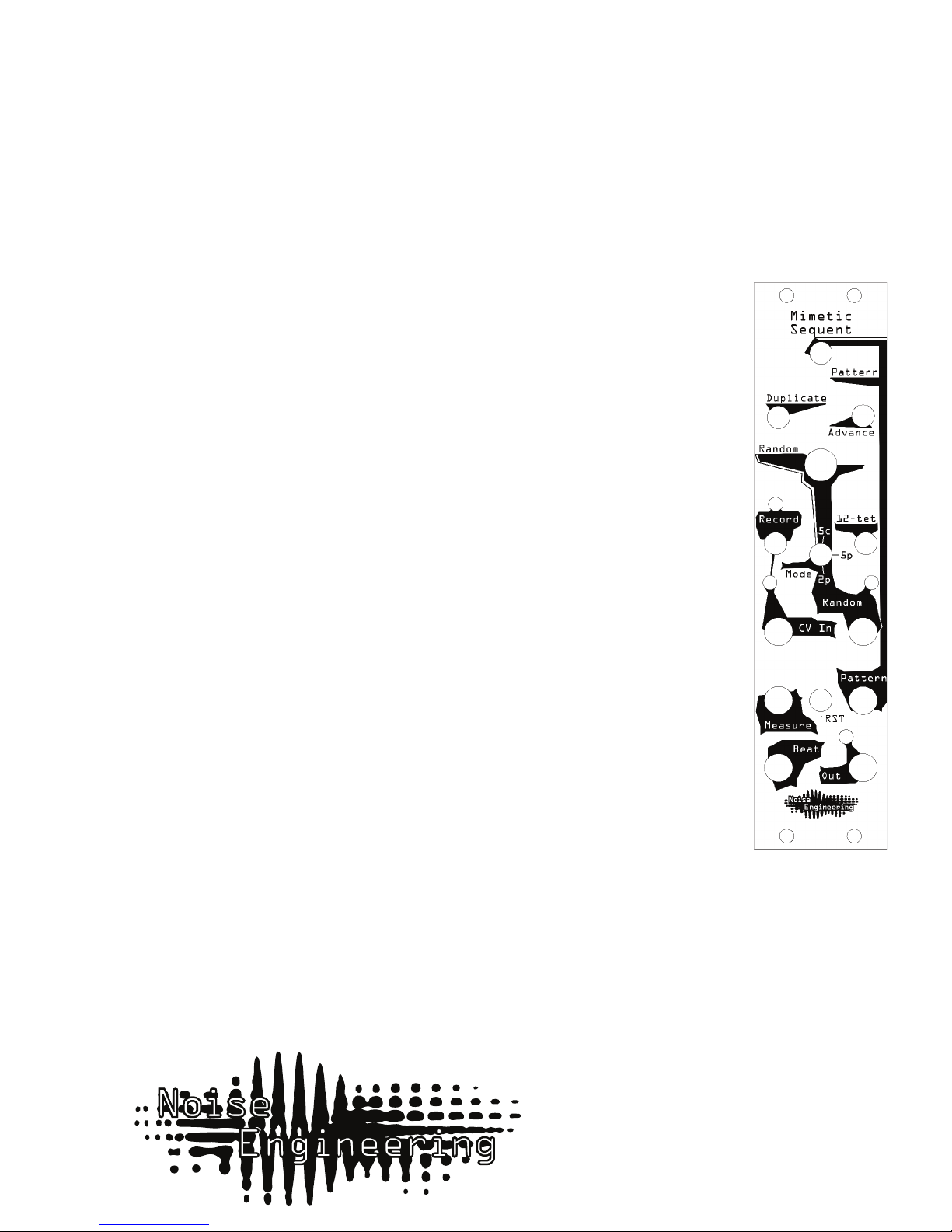
Pattern
switch that controls which of three patterns is selected for output.
Duplicate
copies the currently selected pattern to the other two patterns.
Advance
manual advance of the step in the pattern. Equivalent to a rising edge on beat.
Random
randomization knob. When fully CCW, the knob locks the current pattern.
The angle affects both the likelihood and the method used for the
randomization. This is the heart of Mimetic Sequent and is documented in
more detail in the section entitled Less Random.
Record
a three-position switch that controls record mode. When fully down, record
mode is disabled. In the middle position, short-record mode is enabled which
will record until either 64 steps have been recorded or a rising edge of measure
is received. In the fully up position, MS enters free-record mode that will
continue until turned off.
Mode
controls the method by which the stored voltages are randomized. Methods are
detailed below in the section entitled Less Random.
12-tet
in the up position, the output voltages will be quantized to the common 12-note
equal-tempered scale.
5
Page 6
Noise Engineering
Mimetic Sequent
6HP CV randomizer and recorder
Interface
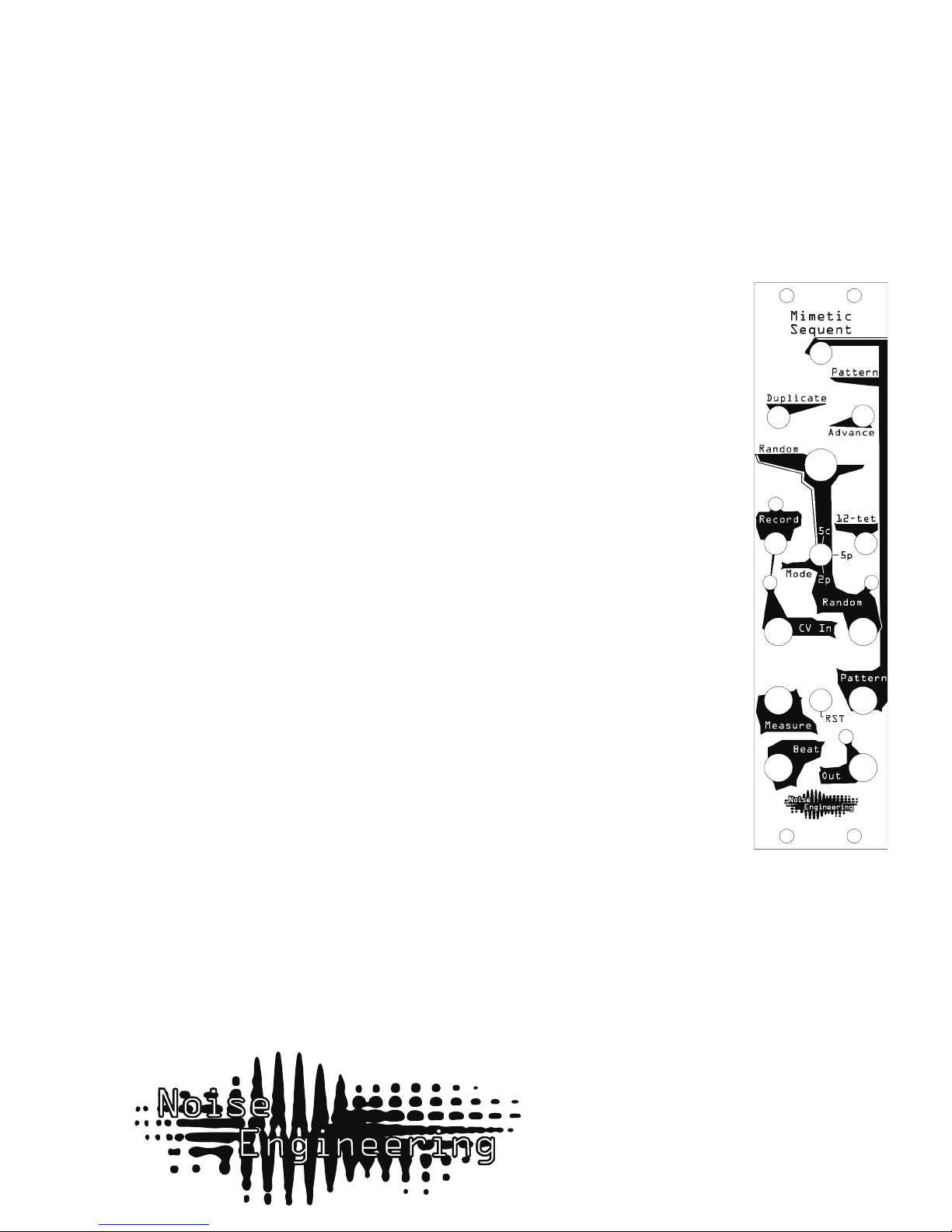
CV in
CV input for recording voltages.
Random (jack)
CV control over the randomization knob. When the jack is in use the Random
knob scales the voltage applied to the jack.
Measure
a clock input to indicate the start of a measure.
RST
reset button. While depressed, MS ignores any clock input. On release, MS
resets the current step the beginning of the pattern.
Pattern (jack)
CV control over pattern switch.
Beat
a clock input to advance the current step.
Out
CV output.
6
Page 7
Noise Engineering
Mimetic Multium
6HP CV randomizer and recorder expander
Interface
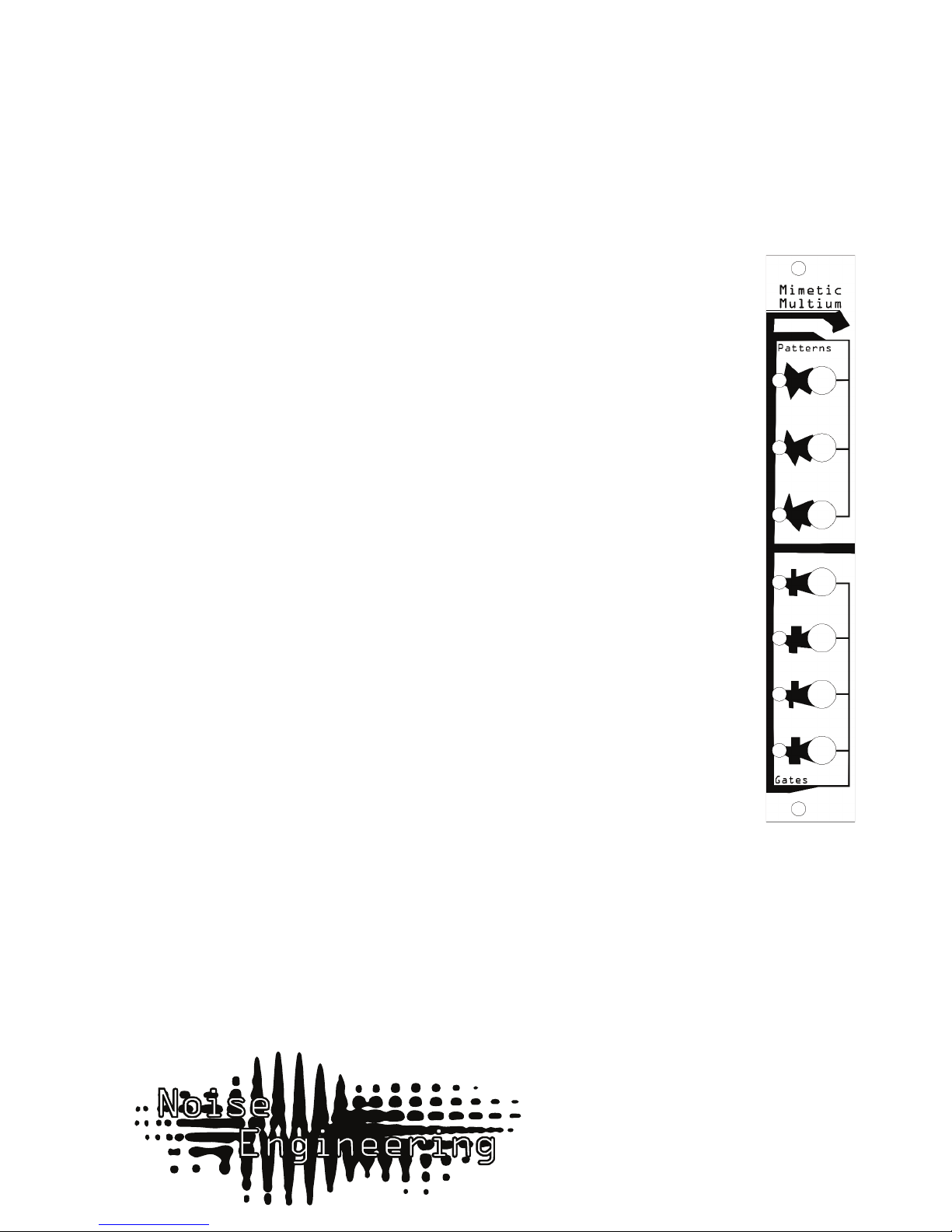
Patterns
allows for simultaneous output of all three pattern currently on MS
Gates
outputs four separate gates that are randomized using the rules and controls
of MS.
7
Page 8
Noise Engineering
Mimetic Sequent
6HP CV randomizer and recorder
Less Random
Randomization is a tricky subject—particularly when human perception
is involved. In designing MS, I wanted to build in different options for
people who might want to incorporate different ideas of “random” for
synthesis. The result is a three-mode module that gives the user the ability
to define the amount and type of randomization they want.
In all modes the randomization knob controls both the probability the
current step will be randomized as well as how extreme the
randomization will be. Turning clockwise both increases both the chance
the step will be randomized and the amount of randomization.
Randomization occurs only to the current step in the current pattern on
the beat.
The mode switch on Mimetic Sequent allows three different ways of
randomizing. The simplest mode is 5C. This mode treats the voltages as
values. When it chooses to randomize a step, it uses the random knob to
control the maximum movement from the current value so when the
knob is mostly CCW it will only make small changes to the current
pattern. This mode is not pitch cognizant and is best used for controlling
other parameters.
Mode 2P was designed specifically for pitch. Mode 2P only randomizes
across 2 octaves of pitches, but when it randomizes, it modifies the
voltage in ways that make sense for the values being pitches. For example,
in this mode, MS may offset by a fifth or copy another note from a
different part of the pattern. As the knob is turned more clockwise the
actions that it chooses between become less consonant and at the
maximum becomes entirely random. By careful playing of the random
knob musical variations can easily be produced on the fly. Mode 5P is
similar to Mode 2P but instead randomizes over 5 octaves for a much
broader range of sounds. Although these modes were designed with pitch
in mind, their utility is definitely not limited to pitch CV.
8
Page 9
Noise Engineering
Mimetic Sequent
6HP CV randomizer and recorder
Saving to Flash
Mimetic Sequent’s patterns are saved to flash. To reduce wear and tear on
flash—as it has a finite number of uses—this only occurs when
- randomization is turned off (if the random knob is fully CCW)
- recording is completed, either when short mode completes or when the
record switch is manually disabled
Because patterns are saved to flash memory, power cycling will not erase
them; take your patterns wherever you want.
Design Notes
Mimetic Sequent was a problem child from the very start. The very first
prototype was a 6HP ribbon controller/recorder that happened to have
randomization built in. The randomization ended up being more fun than
the ribbon controller and was dropped after the first build. We had a
continual stream of last-second problems that caused us to punt on
manufacturing many times.
One module that the second prototype was often compared to was the
Turing Machine and it pretty quickly became a goal to make a more
musical, more jammable, and smaller turing machine. The crux to
achieving this was the Musically Random algorithm documented in the
Less Random selection.
More so than any other module I have worked on the design was guided by
our many testers. There were 20 hardware revisions and endless
suggestions from our friends in the three years Mimetic Sequent has been
in development.
9
Page 10
Noise Engineering
Mimetic Sequent
6HP CV randomizer and recorder
Calibration
Mimetic Sequent comes pre-calibrated. If MS drifts over time, the device
can be calibrated. Calibration of Mimetic Sequent requires a Mimetic
Multium and an accurate voltage meter.
1. Connect a MM to MS via 10 pin ribbon
2. Connect MS to euro power
3. Put panel into initial position: randomize fully CCW, record down,
quantize up, mode down, pattern left.
4. Depress the RST switch from before power on until the record LED
stops blinking.
* RST held down during bootup enters calibration mode.
* calibration mode has two submodes determined by the quantize and
record switch.
- submode 1 (quantize up) is for calibrating the outputs and sets all
outputs to 3v.
- submode 2 (quantize down) is for calibrating the input and sets the
MS output to equal the input voltage.
- submode 3 (record up, either quantize) primary adjustment mode.
5. Set calibration submode 1 (quantize up).6. Connect MS output to
voltmeter.
7. Adjust output trimmer until output equals 3v.
8. If calibrating the connected MM, adjust the MM trimmers until the
MM outputs are 3v.
9. Set calibration submode to 3 (record up), connect CV out to CV record
in via cable.
10. Adjust input trimmer until both of the top gate outs on MM are
blinking at approximately the same frequency.
11. Press duplicate to save current configuration to flash.
10
Page 11
Noise Engineering
Mimetic Sequent
6HP CV randomizer and recorder
Special Thanks
Kris Kaiser
Shawn Jimmerson
DJ Surgeon
Skyler “Kittyspit” King
Tyler Thompson
Alex Anderson
schwarzmodul
Mickey Bakas
William Mathewson
All of the many people who contributed to
testing this module over the past three
years
11
 Loading...