

Page 1
ACCESSORIES
Interchangeable viewfinders
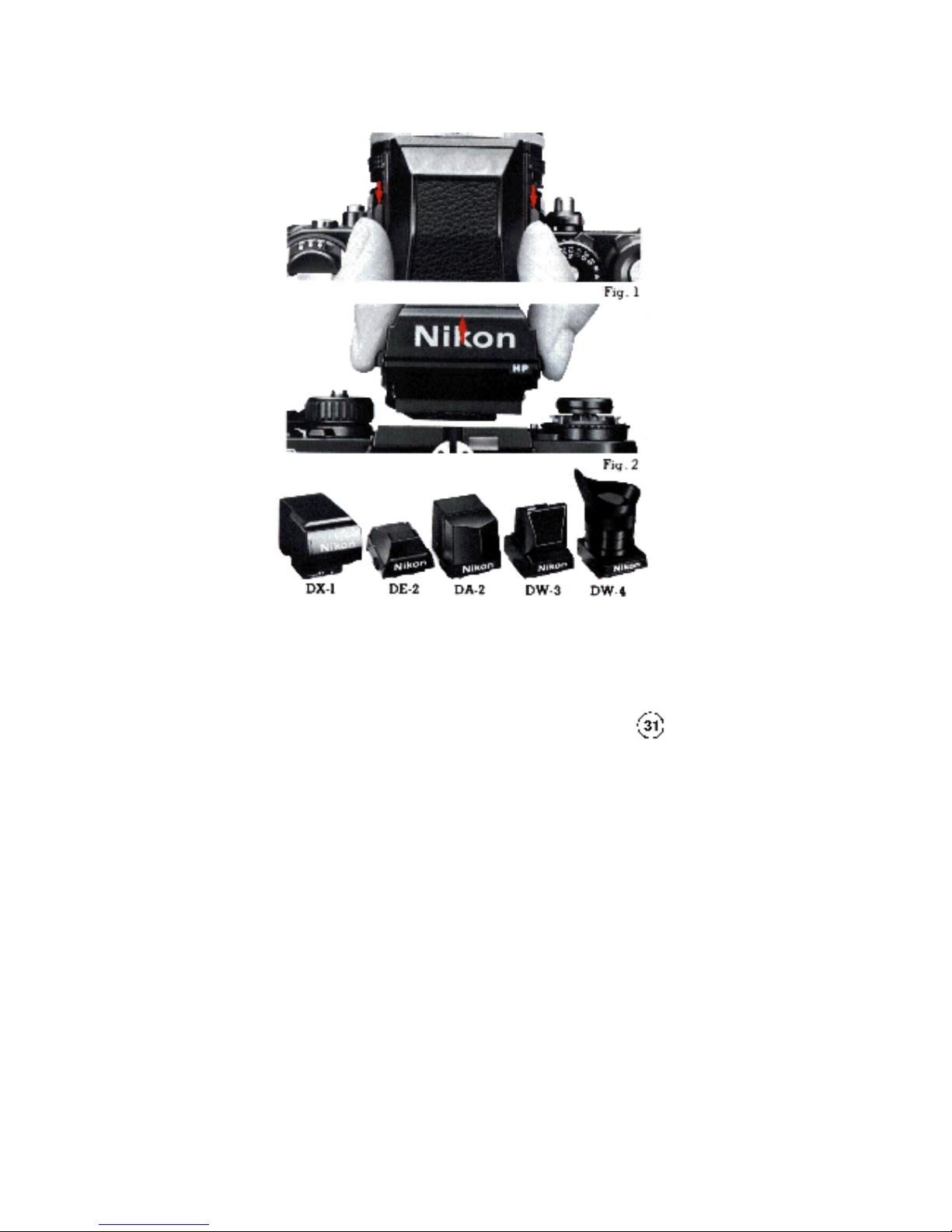
In addition to the DE-3 High-Eyepoint Finder, the F3 High-Eyepoint camera accepts various other
interchangeable viewfinders. To remove the finder, slide the finder release levers with your thumb and
finger towards the back of the camera (Fig. 1), and lift the finder out (Fig. 2). The DX-1 AF Finder provides an
electronic focus-aid indication as you manually rotate the lens to obtain correct focus.
The DE-2 Eyelevel Finder offers regular eyelevel viewing and is recommended for photographers who don't
wear glasses. The DW-3 Waist Level Finder is ideal when you want to use the camera at a low angle or upside
down over your head for shooting over crowds. The DA-2 Action Finder works well for those situations when
you can't bring your eye close to the finder, such as when you are wearing a helmet or goggles or when the
camera is enclosed in a waterproof underwater housing. The DW-4 6X Magnification Finder is for critical high
magnification close-up work or photomicrography. Regardless of which finder is attached, you still have full
automatic exposure control because the meter is built not into the finder but the body.
When using the DA-2 or DW-3, be careful that stray light does not enter from the top and cause an inflated meter
reading.
Caution: Before attaching the DX-1, the focusing screen inside the comera body must be removed (refer to
the next poge).
Page 2
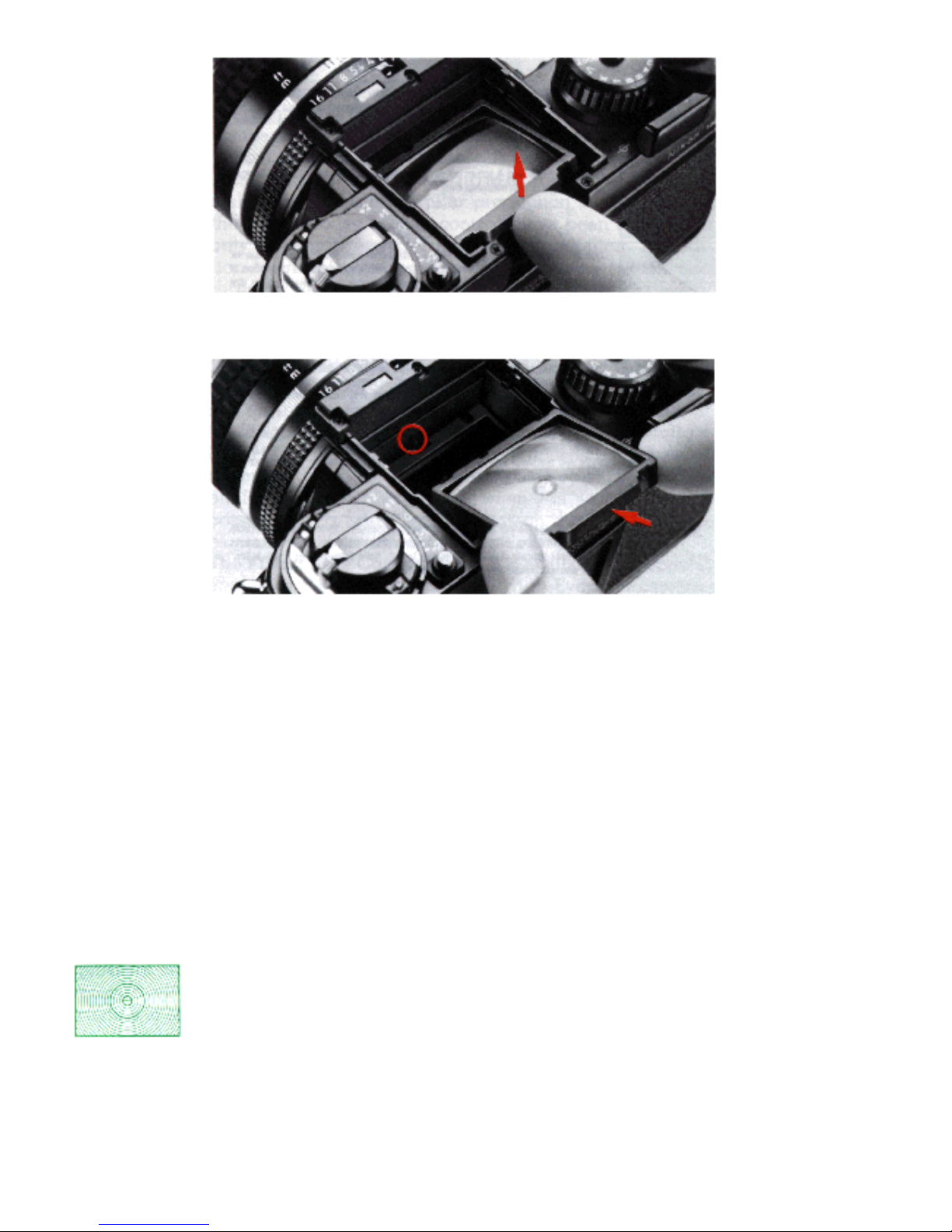
Fig. 1
Fig. 2
Interchangeable focusing screens
Nikon offers you a choice of 21 interchangeable focusing screens: A–U. The type K screen comes with the
camera as standard equipment. On the following page is a chart listing all the screens.
To take out the focusing screen, first remove the finder, then insert your fingernail under the rear edge of the
screen and lift it out (Fig. 1).
To install another screen, simply insert the front edge (the edge with the slot in the middle) under the pin and push
the rear edge of the screen down into place (Fig. 2).
Note: For more information on which screens are compatible with which lenses, consult the instruction sheet
supplied with the lens.
Focusing Screen Selector Guide
Type A: Matte/Fresnel field with 3mm¢ circular split-image rangefinder spot and 12mm¢ reference circle. Rapid
and accurate focusing. Excellent for general photography.
Page 3
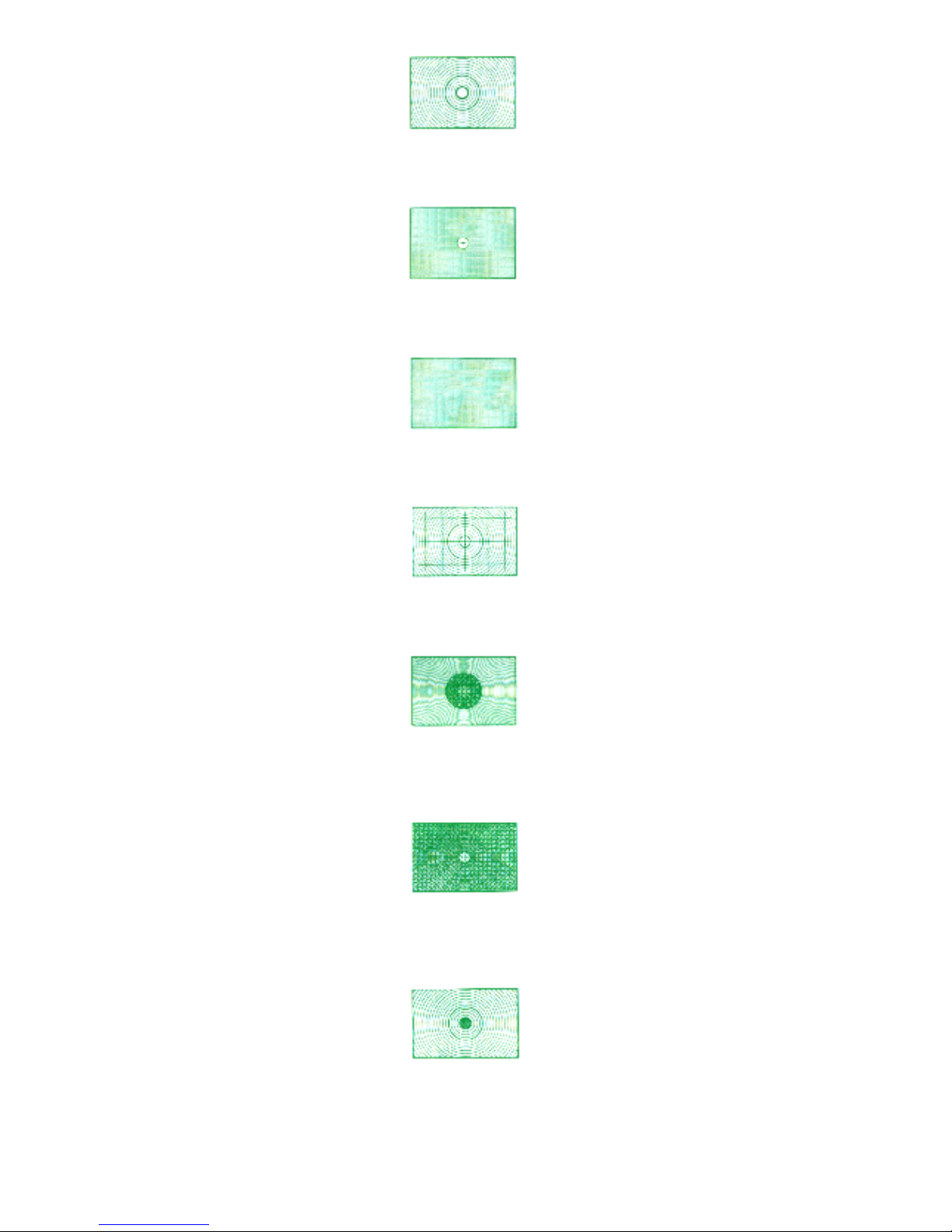
Type B: Matte/Fresnel field with 3mm¢ fine-ground matte focusing spot and 12mm¢ reference circle. Good for
general photography, especialy with long lenses.
Type C: Fine-ground matte field wth 4mm¢ clear spot and cross hair. For photomicrography, astrophotography
and other high-magnification applications, using parallax focusing on aerial images.
Type D: Overall fine-ground matte field Full specialized close up photography and for use with long lenses.
Type E: Matte/Fresnel field with 3mm¢ fine-ground matte spot, 12mm¢ reference circle, and etched horizontal
and vertical lines. Ideal for architectural photography.
Type G: Clear Fresnel field with extra-bright 12mm¢ microprism focusing spot for viewing and focusing in
poor light. Four models (Gl - G4) are available corresponding to specific focal length lenses. Depth of field
cannot be observed.
Type H: Clear Fresnel field with microprism focusing pattern over the entire screen area. Permits rapid focusing
on any part of the screen with optimum edge-to-edge brightness in poor light. Available in four models (H1 - H4)
corresponding to particular focal length lenses.
Type J: Matte/Fresnel field with central microprism focusing spot and 12mm¢ circle. Good for general
photography.
Page 4
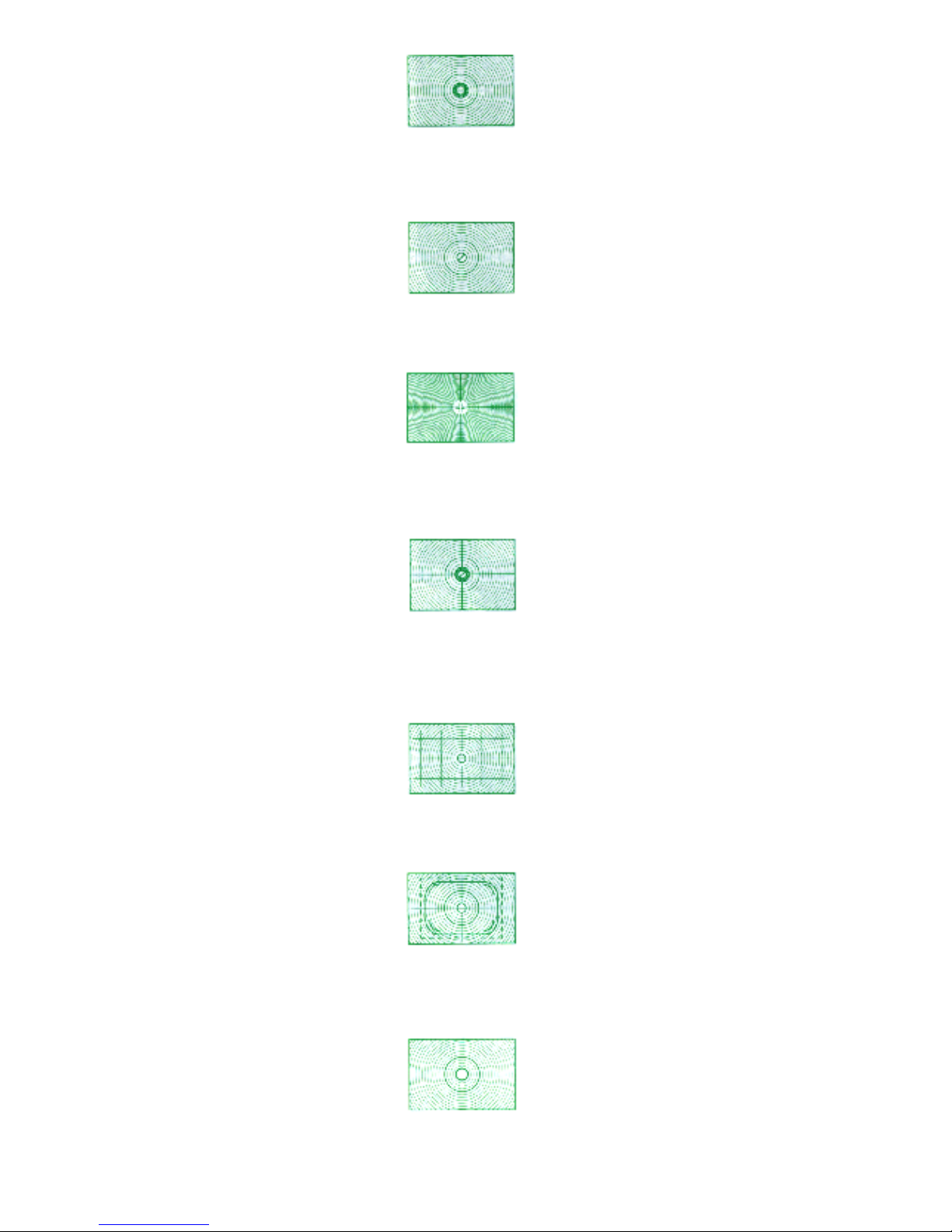
Type K: Combination of Type A and J screens. Matte/Fresnel field with 3mm¢ split-image rangefinder spot
surrounded by 1mm-wide microprism doughnut. Rapid and accurate focusing for subjects with both straight lines
and ill-defined contours. Suitable for general photography.
Type L: Same as Type A screen but with split-image rangefinder line at a 45° angle. Best for subjects with
horizontal lines.
Type M: Fine-ground Fresnel field with 5.5mm¢ clear spot and double cross hair for use in parallax focusing on
aerial image, plus millimeter scales for calculation of individual magnification of objects or for measuring objects.
Brilliant image in dim light. Suitable for close-ups photomicrography and other high magnification applications.
Type P: Same as Type K but with split/image rangefinder line at a 45° angle and etched horizontal and vertical
lines as an aid to compositon. Rapid and accurate focusing for subject with horizontal or vertical lines or
ill-defined contours. Suitable for general photography.
Type R: Same as Type A but with rangefinder prisms of sloping surfaces at a smaller angle and horizontal area
vertical lines to aid proper composition. Works best with lenses having maximum apertures from f/3.5 to f/5.6.
Type T: Matte/Fresnel field with spit image rangefinder, 12mm¢ reference circle, and horizontal and vertical
lines. Used when preparing slides for TV broadcasts. Dotted lines indicate standard TV screen format. Solid
outline shows sale action area whereas broken lines indicate "safe title" area.
Type U: Matte/Fresnel field with 3mm¢ fine-ground matte focusing spot and 12mm¢ reference circle. Utilizes
the same matte field as Type B, but with lenses longer than 100mm the image in the viewfinder is easier to see.
Page 5
With shorter focal-length lenses, this screen is nof suitable because of light fall-off in the corners.
Motor Drive MD-4
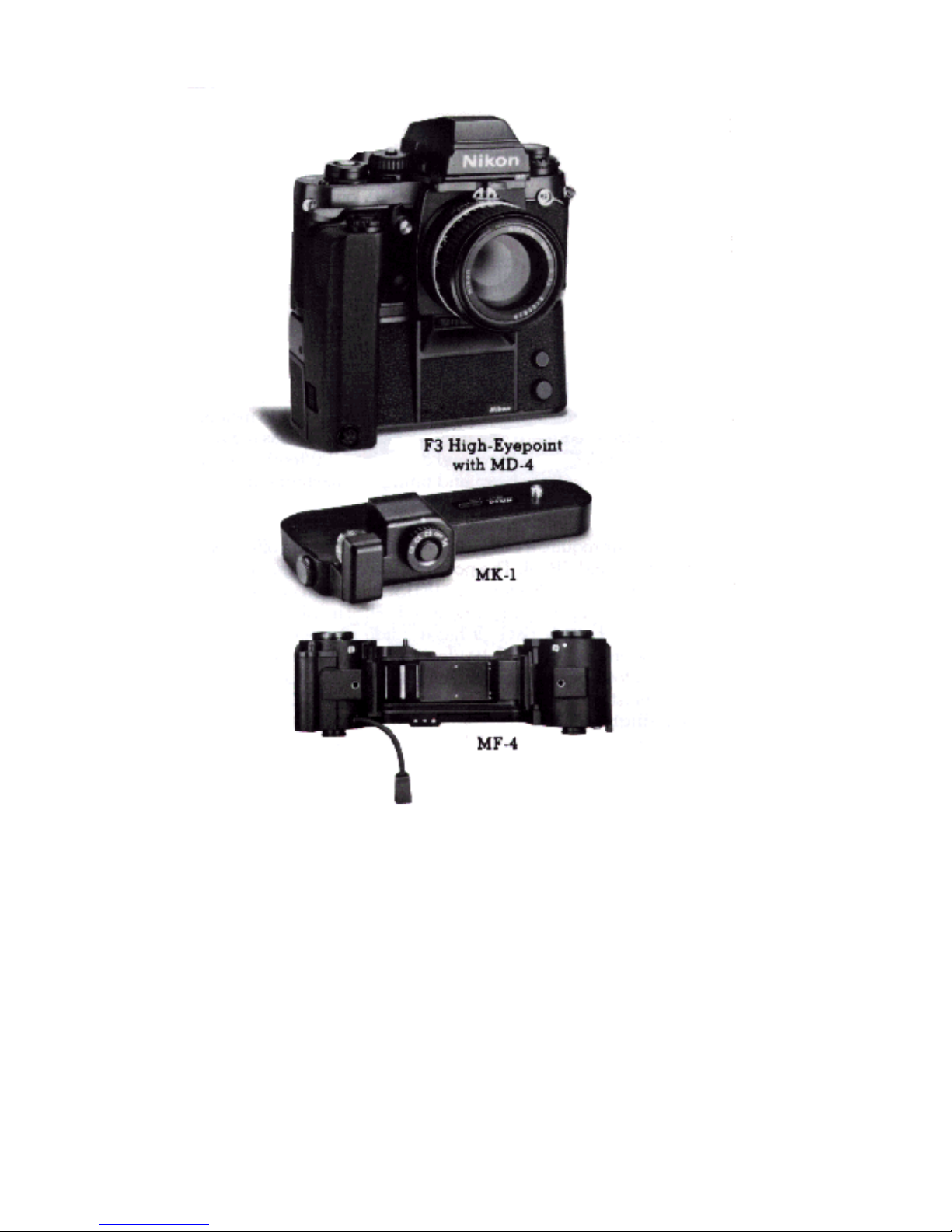
One of the most exciting accessories for the F3 High-Eyepoint camera is the Motor Drive MD-4. This amazingly
compact, light, and streamlined unit attaches to the bottom of the camera in seconds and advances the film either
singly or in sequence up to 6* frames per second– making it the fastest regular production motor drive on the
market today. Actual controls have been reduced to only those necessary for convenient operation. In addition to
the electromagnetic trigger button (which also turns on the camera's meter when depressed halfway), there are its
concentric S-C (Single/Continuous) mode selector, a battery check button and LED indicators, two interlocking
rewind slides for automatic film rewinding, and a subtractive frame counter which stops the motor at the desired
number of frames. Eight AA-type penlight batteries fit into a quick-release clip housed in the base of the motor
drive. An optional NiCd battery pack is available for use in cold weather or when you want the fastest possible
firing rate. Once you attach the MD-4 to your camera, you'll never want to take it off.
The Firing Rate Converter MK-1 is available as a special accessory for a motor-driven F3 High-Eyepoint
Page 6

camera. It screws into the tripod socket of the MD-4 and plugs into the remote terminal to provide three firing
rates–1, 2, or 3 frames per second. It has its own handy trigger button for use in vertical format shooting.
The Magazine Back MF-4 for shooting up to 250 frames without changing film is also available as an option.
• Possible with NiCd battery pack at 1/125 sec. or above with the mirror locked up.
Electronic Flash Units
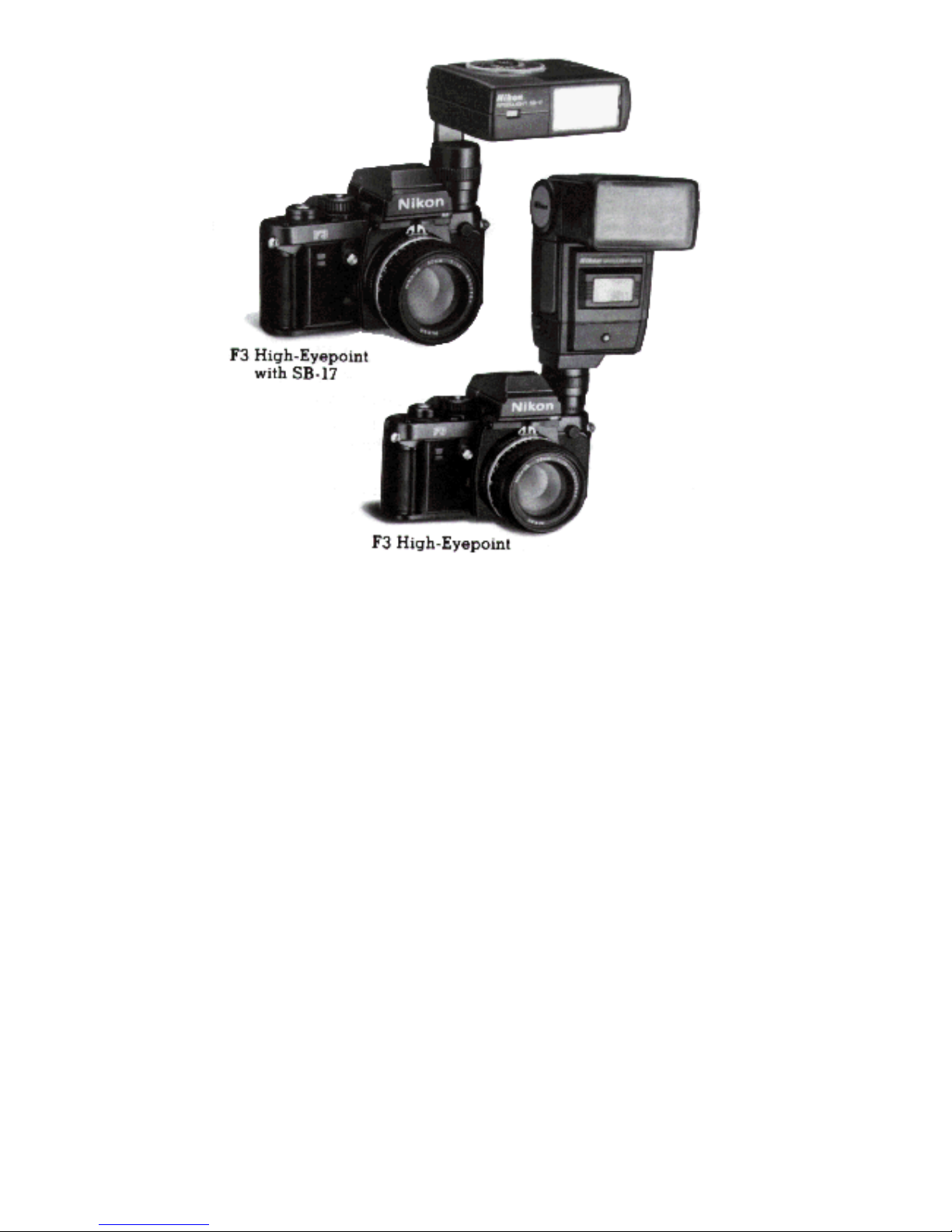
Nikon Speedlights are dedicated electronic flash units and provide the perfect complement to your F3
High-Eyepoint camera. Just set the aperture and flash output is measured through the lens for correct exposures
regardless of the lens in use.
Speedlights SB-16A and 17
The SB-16A and SB-17 mount directly on the camera for automatic TTL flash exposure control. The SB-16A
features two flash heads for more natural bounce-flash portraits: main head tilts 90° and rotates 270°; the
secondary head faces straight ahead to provide catchlight in subject's eyes. Main head zooms in and out to match
the coverage of 28, 35, 50 and 85mm lenses with a guide number of 32 (ISO 100 and meters) or 105 (ISO
100/feet). The light, compact SB-17 has a guide number of 25 (ISO 100/meters) or 82 (ISO 100/feet) and
features a rotating flash head and tilting 90° flashtube module for convenient bounce flash.
Speedlights SB-11 and 14
When your require a bracket mounting unit, Nikon offers two, the SB-11 and SB-14. The powerful SB-11 has a
guide number of 36 (ISO 100/meters) or 118 (ISO 100/feet) and features a 120° tilting flash head for bounce
flash. The SB-14 requires a separate battery pack. It has a guide number of 32 (ISO 100/meters) or 105 (ISO
100/feet), and tilts 120° and rotates 120° for total bounce control. For automatic TTL control, these units must be
used with TTL remote cord SC-12
Speedlight SB-21A
The SB-21A lets you use TTL automatic exposure for macro photography, and a convenient focus illuminator
ensures pin-point focus adjustment. The flash head offers a 65° horizontal and 85° vertical angle of coverage, and
a wide illuminahon panel lets you shoot flash-to-subject distances closer than 40mm (approx. 1.6 in.). SB-21A
can be used with an external power source (AC or DC). Guide number is 13 (at ISO 100/meters) or 43 (at ISO
100/feet) with internal batteries, and 15 (or 49) with external power source.
Page 7
OTHER ACCESSORIES
Eyepiece Correction Lenses
Screwing into the finder eyepiece, four separate lenses are provided, so that near- and farsighted photographers
can use the F3 High-Eyepoint camera without their glasses. They are available in -2, O, + 1 and + 2 diopters
representing the combined dioptry of the finder and lens.
Eyepiece Adapter DK-1
The DK-1 is required when either the DR-3 Right-Angle Viewing Attachment, the DG-2 Eyepiece Magnifier, or
an Eyepiece Correction Lens designed for the F3 (but not the F3 High-Eyepoint) camera is attached to the Nikon
F3 High-Eyepoint camera's viewfinder eyepiece. Note that slight vignetting may occur when you wear glasses
and look through the viewfinder with a correction lens for the F3 attached via the DK-1.
Camera Cases
The CF-21, CF-21A, CF-22 Semi-Soft Leather Cases and CS-15 Soft Leather Case were designed exclusively
for the F3 High-Eyepoint camera.
 Loading...