

Page 1
Nikon Digital SLR Camera D700 Specifications
Printed in China Code No. 6CE80091 (0807/A)K
• CompactFlash and Extreme are registered trademarks of SanDisk Corporation. • HDMI, the HDMI logo and HighDefinition Multimedia Interface are trademarks or registered trademarks of HDMI Licensing LLC. • Products and brand
names are trademarks or registered tr ademarks of their respective companies. • Images in viewfinders, on LCDs and
monitors shown in this brochure are simulated.
Image area L M S
FX format (36 x 24) 4,256 x 2,832 3,184 x 2,120 2,128 x 1,416
DX format (24 x 16) 2,784 x 1,848 2,080 x 1,384 1,392 x 920
Type
Type Single-lens reflex digital camer a
Lens Mount Nikon F bayonet mount with AF coup ling and AF contacts
Picture Angle Equivalent to angle produc ed by lens focal length (1.5 times when DX forma t is selected)
Effective Pixels
Effective Pixels 12.1 million
Image Sensor
Image Sensor CMOS sensor, 36.0 x 23.9 mm; Nikon FX format
Total Pixels 12.87 million
Dust-Reduction Sy stem Image sen sor self-cleaning function, Imag e Dust Off reference da ta acquisition (Capture
NX 2 required)
Storage
Image Size (pixels)
File Format 1) NEF (RAW): 12 or 14 bit, lossless compressed, compres sed, or uncompressed
2) TIFF (RGB)
3) JPEG: J PEG-Baselin e complian t with fine (appro x. 1:4), norm al (approx . 1:8), or basic
(approx. 1:16) compression (Size priorit y); [Optimal quality] compr ession available
4) NEF (RAW) + JPEG: Single photograph recor ded in both NEF (RAW) and JPEG format s
Picture Control Sys tem Four setti ng options: Standard, Neu tral, Vivid, Monochrome; ea ch option can be adjusted
Storage Media CompactFlash (Type I, complian t with UDMA)
File System Compliant wit h DCF 2.0, DPOF, Exif 2.21, Pictbridge
Viewfinder
Viewfinder SLR-t ype with fixed eye-level pe ntaprism
Diopter Adjustment -3 to +1 m
-1
Eyepoint 18 mm (-1.0 m-1)
Focusing Screen Type B BriteView Cle ar Matte VI scre en with s uperimposed AF point s and fra ming grid
lines
Frame Coverage
Approx. 95% (vertical/horizontal)
Magnification
Approx. 0.72x (50 mm f/1.4 lens at infinity; -1.0 m-1)
Reflex Mirror Quick-ret urn type
Depth-of-field Previe w W hen CPU lens is attach ed, lens aperture can b e stopped down to valu e selected by user
(A and M modes) or value selected by camer a (P and S modes)
Lens Aperture Instant-retur n type, with depth-o f-field preview button
Lens
Compatible Lenses Refer to page 22.
Shutter
Type Electronically con trolled vertical-tr avel focal-plane shut ter
Speed 1/8,000 to 30 s in steps of 1/3, 1/2 or 1 EV; Bulb; X250
Flash Sync Speed X = 1/250 s; sy nchronizes wi th shutter at 1/320 s or sl ower (flash rang e drops at speeds
between 1/250 and 1/320 s)
Release
Release Modes 1) Single-fra me [S] mode, 2) Co ntinuous Low-sp eed [CL] mode, 3 ) Continuous Hig h-speed
[CH] mode, 4) Live View [LV] mode, 5) Self-timer [ ] mode, 6) Mirror-up [Mup] mode
Continuous Shooting With Rechar geable Li-ion Batter y EN-EL3e: 1-5 frames per sec ond in [CL] mode, 5 fps in
Speed [CH] mode
With Multi -Power B attery Pack MB- D10 with b atteries other t han Recha rgeable Li- ion
Battery EN -EL3e or AC Adapt er EH-5a/EH- 5: 1-7 frames per sec ond in [CL] mode, 8 fp s in
[CH] mode
Self-timer Electronically con trolled timer with duratio n of 2, 5, 10 or 20 s
Exposure
Metering TTL full-apertur e exposure metering using 1,0 05-pixel RGB sensor
Metering System 1) 3D Color Ma trix Metering II (type G and D lenses); Color Mat rix Metering I I (other CPU
lenses); Color Matrix Mete ring (non-CPU lenses if user pro vides lens data)
2) Cent er-Weighte d: Weigh t of 7 5% given to 8 -, 12-, 15 - or 2 0-mm c ircle i n cent er of
frame, or weighting based on ave rage of entire frame
3) Spot: Me ters 4-mm circle (about 1.5% of frame) centered o n selected focus point (on
center focus point when no n-CPU lens is used)
Metering Range 1) 0 to 20 EV (Matrix or Center-Weighted Mete ring), 2) 2 to 20 EV (Spot Metering) (ISO 100
equivalent, f/1.4 lens, at 20°C/68°F )
Exposure Meter Coupling Combined CPU an d AI
Exposure Modes 1) Progra mmed Auto (P) with flexible pr ogram, 2) Shutter-Pr iority Au to (S), 3) Apertur e-
Priority Auto (A), 4) Manual (M)
Exposure Compensation ±5 EV in increment s of 1/3, 1/2 or 1 EV
Exposure Lock Exposure locked at detec ted value with AE-L/AF- L button
Exposure Bracke ting Exposure and/or flash bra cketing (2 to 9 exposures in increme nts of 1/3, 1/2, 2/3 or 1 EV)
Sensitivity ISO 200 to 6400 in ste ps of 1/3, 1/2, or 1 E V; can be set t o approx. 0.3, 0.5, 0.7, or 1 (ISO
100 equivalent) EV below ISO 200, or to approx. 0.3, 0.5, 0.7, 1 (ISO 12800 equiv alent), or
2 (ISO 25600 equivalent) EV ov er ISO 6400
Active D-Lighti ng Can be selected from [Auto], [High], [Normal], or [Low]
Focus
Autofocus TTL phase-det ection AF, 51 focus points (15 cros s-sensors) by Nikon Multi-CAM 3500FX
autofocus module; Det ection: -1 to +19 EV (ISO 100 at 20°C/68°F); AF fine tunin g possible;
AF-assist illuminator (rang e approx. 0.5-3 m/1.6-9. 8 ft.)
Lens Servo 1) Autofocus: Single-servo AF (S); Continu ous-servo AF (C); Focus Track ing automatic ally
activated acco rding to subject status, 2) Manual fo cus (M) with electronic rang efinder
Focus Point Single AF poin t can be selected from 51 or 11 focus points
AF-Area Mode 1) Single-point AF, 2) Dynamic- area AF [number of AF points: 9, 21, 51, 51 (3D-Tracking) ],
3) Auto-area AF
Focus Lock Focus can be locke d by pressin g AE-L/AF-L button or by pressing shutter-release button
halfway (Single-point AF in AF- S)
Flash
Built-in Flash Manual pop-u p type; guide number of 17/56 (ISO 200, m/ft., 20°C/68 °F) or 12/39 (ISO 100,
m/ft., 20°C/68°F)
Flash Control 1) TTL flash co ntrol wi th 1,005 -pixel RGB sensor; i-TTL bal anced fill-fla sh and s tandard
i-TTL fill-flash available with SB-9 00, 800, 600 or 400
2) Auto aperture (AA): Availab le with SB-900, 80 0 and CPU lens
3) Non-TTL auto (A): Available with SB- 900, 800, 28, 27 or 22s
4) Distance-priori ty manual (GN): Available with SB-9 00, 800
Flash Sync Modes 1) Front-cur tain sync (normal), 2) Slow sync, 3) Rear-cu rtain sy nc, 4) Red -eye redu ction,
5) Red-eye reduction wit h slow sync
Flash Compensation -3 to +1 EV in increments of 1/3, 1/2 or 1 EV
Flash-ready Indica tor Lights when Speed light such as SB-900, S B-800, SB- 600, SB-40 0, SB-80DX, SB -28DX, or
SB-50DX is fully charged ; blinks after flash is fired at full output
Accessory Shoe Standard ISO 518 hot-shoe contac t with safety lock
Sync Terminal ISO 519 standard terminal
Nikon Creative Lighting Wi th Speedlights such as SB-9 00, SB-800 , SB-600, SB-R 200, SU-800 (comm ander only),
System supports Adv anced Wireless Lighting, Auto FP High-Speed Sync, Flash Color Infor mation
Communication, modeling flas h and FV lock; built-in flash can be used as a commander
White Balance
White Balance • Auto (TTL white balanc e with main image sensor and 1,005 -pixel RGB sensor);
• Seven manual modes can be preset with fine-tuning; color temperature setting; whi te
balance bracketing: 2 to 9 expo sures in increments of 1, 2 or 3
Live View
Modes Hand-held mode: TTL phase -detection AF wit h 51 focus areas (15 cross-type sensor s)
Tripod mode: Contrast-de tect AF on a desired point within a speci fic area
Monitor
LCD Monitor 3-in., approx. 920,0 00-dot (VGA), 170- degree wide-view ing-angle, 100% frame co verage,
low-temperatur e polysilicon TFT LCD with brigh tness adjustment
Playback
Playback Function Full -frame and thumb nail (4 or 9 imag es) pl aybac k wit h pla yback zoom, slide show,
histogram d isplay, highlight display, auto image rot ation, and image commen t (up to 36
characters)
Interface
USB Hi-Sp eed USB
Video Output NTSC or PAL; simultaneous p layback from both the vide o output and on the LCD moni tor
available
HDMI Output Supports HDMI ver sion 1.3a; Type C mini co nnector is provided; simultaneous playback
from both the HDMI outp ut terminal and on the LCD monitor not avail able
Ten-pin Terminal 1) GPS: NMEA 018 3 (Ver. 2.01 a nd 3.01) inte rface st andard sup ported with 9-pin D-sub
cable and GPS Cable MC-35 (optional)
2) Remote control: via Ten-pin terminal
Supported Languages
Supported Langu ages Chinese (Simplif ied and Traditi onal), D utch, English, Finnish, Frenc h, Germ an, It alian,
Japanese, Korean, Polish, Por tuguese, Russian, Spanish, Swedi sh
Power Source
Battery One Rechargeable Li-ion Batter y EN-EL3e
Battery Pack Multi-Pow er Batte ry Pack MB-D10 (opti onal) with one Rechar geable Li-io n Batter y EN-
EL4a/EN -EL4 (b atter y ch amber cover BL-3 re quired) or EN -EL3e, or e ight R 6/AA-siz e
alkaline (LR6), Ni-MH (HR6), lithium (FR6) b atteries, or nickel-mang anese ZR6 batteri es
AC Adapter AC Adapt er EH-5a/EH-5 (opt ional)
Tripod Socket
Tripod Socket 1/4 in. (ISO 1222)
Dimensions/Weight
Dimensions (W x H x D) Approx. 147 x 123 x 77 mm (5.8 x 4.8 x 3.0 in.)
Weight Approx. 995 g (2.19 lb.) without battery, memory card, bod y cap or LCD monitor cover
Operating Environment
Temperature 0-40°C/32-104°F
Humidity Under 85% (no conden sation)
Accessories
Supplied Accessories* Rechargeable Li -ion Bat tery EN -EL3e, Qui ck Charger MH-18a, US B Cable U C-E4, Vide o
Cable EG-D10 0, Camera Strap AN-D700, Body Cap BF-1A, Acc essory Shoe Cov er BS-1,
LCD Monitor Cover BM-9, Sof tware Suite CD- ROM
*Supplied accessories may dif fer depending on countr y or area
Main Optional Wireless Transmitter WT-4/4A , Magnifying Eyepiec e DK-17M, AC Adapter EH-5a,
Accessories Capture NX 2 Software, Came ra Control Pro 2 Soft ware, Image Authentic ation Software
Page 2
2 3
Exceptional Performance. Agile Design.
The first Nikon FX-format camera, the D3, produced a quantum
leap in digital photography that forever changed the way
professionals are able to work. Now, with the launch of the
second Nikon FX-format camera — the Nikon D700 — you
can achieve, in a smaller, lighter design, many of those same
extraordinary imaging feats that made the Nikon D3 an immediate
legend. Like the D3, the D700 transcends the expectations of
the world's leading photographers, in an agile body developed
from the award-winning DX-format D300. In soft, subtle lighting,
it captures seductively smooth tones with astonishingly rendered
detail — easily. In low-lit situations, it delivers virtually noise-
free images for impeccable results at up to ISO 6400 — easily.
And if you’re faced with constantly changing lighting conditions,
the D700 handles these complex exposure changes with ISO
sensitivity auto control — easily. When your day is long and
demanding and you need to travel light, you’ll appreciate this
camera’s portability, responsiveness and finely balanced handling.
And when you need more speed to capture a crucial moment,
the D700 delivers with the option of a multi-power battery pack
that gives you up to 8 frames per second*, continuous shooting.
Whether your subject’s fast, slow or still, you’ll capture it with
tack-sharp precision using Nikon’s exclusive 51-point AF system
— easily. Every aspect of the D700 has been carefully engineered,
to provide you with the freedom to work efficiently and with the
utmost sensitivity, as a natural extension of your personal vision.
The D700 achieves a remarkable distillation of the finest imaging
performance digital photography can offer.
*With EN-EL4/4a and AA-size batteries
Page 3
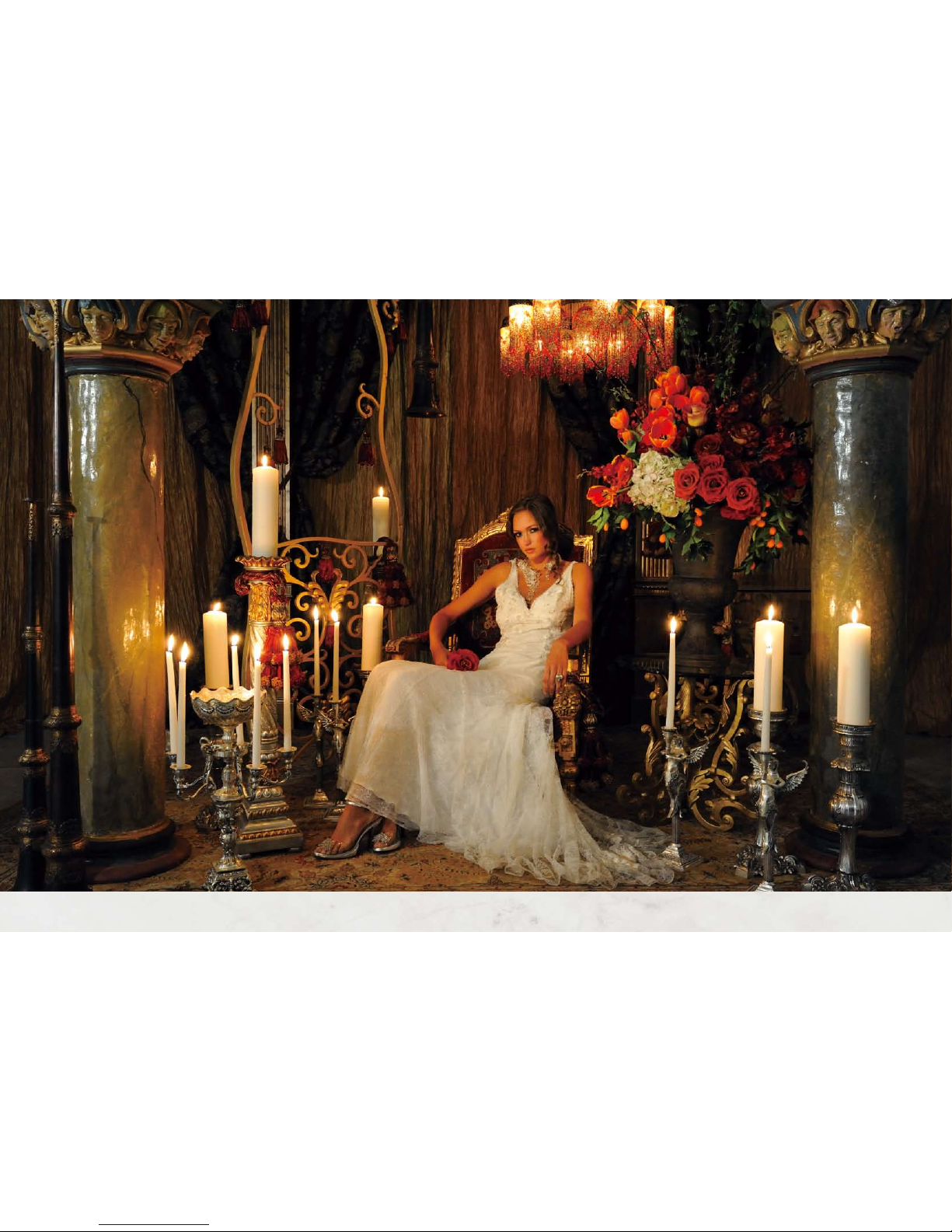
• Lens: AF-S NIKKOR 24-70mm f/2.8G ED • Exposure: [A] mode, 1/13 second, f/8 • White balance: Auto • Sensitivity: ISO 3200 • Picture Control: Standard
©Cherie Steinberg Coté
Move beyond difficult lighting conditions
Page 4
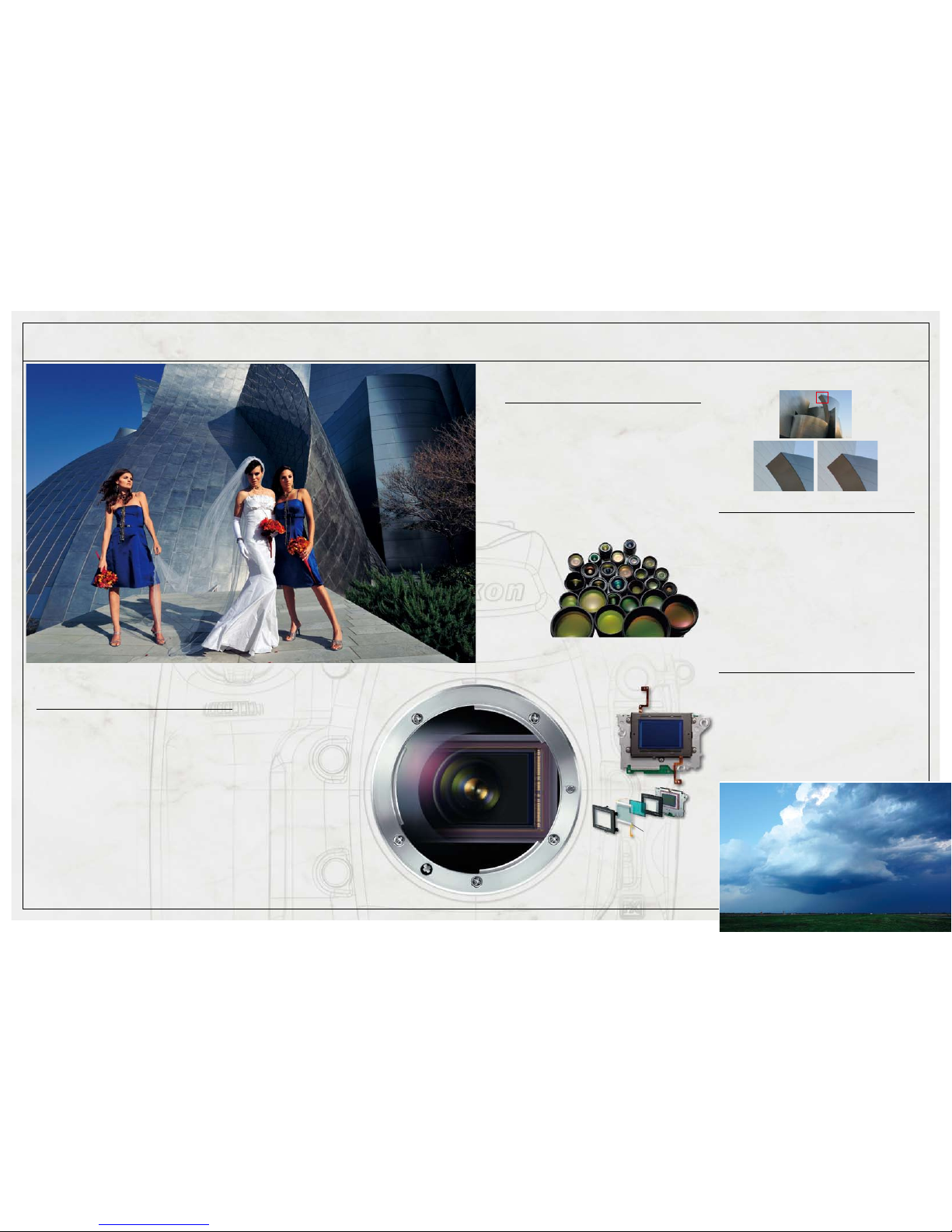
Lateral chromatic aberration reduction
Color fringes, also known as chromatic aberration, are
generated because varying wavelengths of light result in
slightly different magnifications. To overcome this unwanted
effect, the D700 incorporates Nikon’s exclusive lateral
chromatic aberration reduction function. Unlike conventional
correction methods that merely eliminate the colors of
chromatic aberration, Nikon’s method compensates for the
differences in the resolving index for each color, making it
particularly effective for reducing the image distortion at
the edges of a frame in addition to improving image quality
throughout the entire frame. Moreover, because aberration
is corrected regardless of lens type, this feature delivers
sharper images whichever NIKKOR you use.
Integrated Dust Reduction System
Nikon meticulously developed this system, analyzing the
characteristics of a myriad of image-degrading particulates so
as to fully evaluate performance and reliability in a wide range
of temperatures and humidity levels. One key component
of the system is the Image Sensor Cleaning function, which
employs piezoelectric elements to generate vibrations at four
specific frequencies to optimize dust removal. Image Sensor
Cleaning can be set for automatic activation when the camera
is turned on and off, or at any time the photographer feels it's
necessary.
Without
With
Lateral chromatic
aberration reduction
• Lens: AF-S NIKKOR 14-24mm f/2.8G ED • Exposure: [M] mode, 1/4 second, f/11
• White balance: Auto • Sensitivity: ISO 200 • Picture Control: Vivid
©Cherie Steinberg Coté
©Jim Reed
6
7
The D700 enables you to use a broad spectrum of NIKKOR
lenses while retaining the lens’ native angle of view. In crop
mode, you can broaden the D700’s versatility through the
use of DX NIKKORs. And up to nine manual focus NIKKORs
can be registered to provide even more D700 system
compatibility.
The NIKKOR lens advantage
The praise heaped upon NIKKOR interchangeable lenses has
been earned legitimately. So prepare yourself for images that
exhibit extraordinary sharpness, color, saturation and contrast
— from a comprehensive selection of outstanding zoom,
super wideangle, wideangle, normal, telephoto and super
telephoto NIKKOR lenses. The Nikon FX format enables
photographers to once again take advantage of the familiar
perspective characteristics of 35mm film photography. And
Nikon has painstakingly adapted the specific characteristics
of a wide range of NIKKORs, both old and new, to the D700’s
Nikon FX-format sensor for superb results.
Nikon FX format and renowned NIKKOR lens es: Made for each other
Your foundation for exceptional images: The
12.1-megapixel Nikon FX-format CMOS sensor
Incorporating the same Nikon-original FX-format CMOS
imaging sensor developed for the groundbreaking D3, the
new Nikon D700 delivers immaculately clean images. Indeed,
the combination of the overall precision and light-handling
efficiency of this sensor with the legendary performance of
NIKKOR interchangeable lenses is integral to the outstanding
picture quality shared by these two extraordinary cameras.
Nikon engineers understand the importance of transforming
light into electrical signals as early in the process as possible,
so they conducted a vast number of trials to construct a
sophisticated imaging sensor design featuring nanometric
precision and absolute minimum loss. This is one of the key
reasons that images produced by the D700 don't simply rival
the resolution and tonal nuances of film — it's a standard
that the D700 clearly exceeds. The large Nikon FX format
and 12.1-megapixel resolution are major factors supporting
this incomparable image quality. Each pixel
has ample space to preserve details —
even in shadows and highlights — that
lesser cameras find impossible. With
this level of quality, you can expect
image integrity that goes far
beyond the numbers.
• Lens: AF-S NIKKOR 14-24mm f/2.8G ED • Exposure: [A] mode, 1/800 second, f/11 • White balance: Auto • Sensitivity: ISO 400 • Picture Control: Standard
©Cherie Steinberg Coté
D700 Image Sensor Cleaning function
Piezoelectric element
Page 5
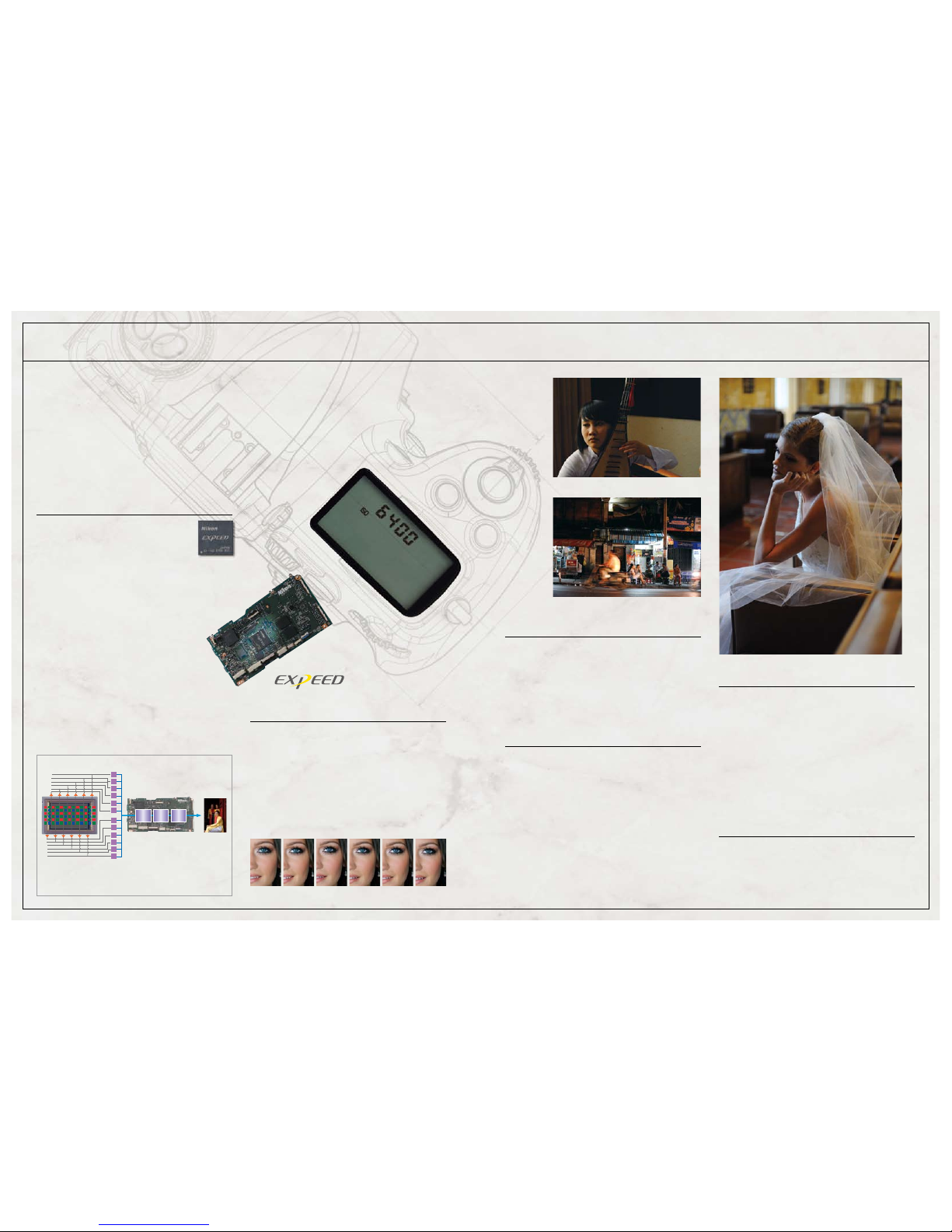
Comprehensive strategy to reduce noise
The D700 is designed to reduce noise even before the menuactivated High ISO NR settings are applied. And at higher
ISO settings of 2000 and over, with the High ISO NR turned
on, it’s activated automatically but in a manner designed to
give you rich, satisfying, natural saturation a world beyond
the synthetic appearance of conventional image processing
systems.
Superior results instantly, even in difficult lighting
conditions
Access to high ISO settings that de liver superior image
files gives you so many more exposure options for shooting
exceptional pictures in situations that were formerly beyon d
your grasp. Poorly lit scenes that used to take time for
lighting setup can now be captured immediately. When
shooting in more subtle conditions, such as o n an overcast
day, you won’t have to sacrifice aperture settings for the
sake of shutter speed. Simply boost the I SO and use a faster
shutter speed to achieve superior results. At loc ations where
tripods and monopods are prohi bited or are inconvenient to
use, you can still obtain superb handheld resul ts. And with
NIKKOR VR (V ibration Reduction) lenses, the shot you want
is a given. Scenes that you long considered di fficult or even
impossible are yours for the taking, and ca pturing them has
never been easier.
Auto ISO setting
For shooting opportunities where you need to deal with
constantly changing light, ISO sensitivity auto control can
be a major advantage, eliminating the need to sacrifice
either aperture or shutter speed. Taking pictures with ISO
sensitivity auto control enables you to limit how high you
want the camera to allow the ISO to rise while selecting
your preference for slowest permitted shutter speed. Now
you can go with your instincts in Programmed- or Aperturepriority auto, or simply lock the aperture and shutter speed
combination you want in manual mode and let the D700
judge the lighting situation for you, determining the optimum
ISO for constant exposure results.
Active D-Lighting
Automatically regulating the dynamic range when the contrast
is too great lets you preserve highlights, such as those in the
sky or a clear halo around the sun, and shadow details. The
D700 employs Nikon’s new Active D-Lighting, which works
automatically when needed, so you can leave it on, knowing it
will activate only when conditions indicate a need.
Low noise high ISO delivers faster shutter speeds, smaller apertures for sharper, cleaner images
• Exposure: [M] mode, 1/50 second, f/4 • White balance: Auto
• Sensitivity: ISO 640 • Picture Control: Standard
• Exposure: [A] mode, 1/30 second, f/2.8 • White balance: Auto
• Sensitivity: ISO 6400 • Picture Control: Standard
• Exposure: [A] mode, 1/400 second, f/2.8 • White balance: Auto • Sensitivity: ISO
3200 • Picture Control: Standard
©Cherie Steinberg Coté
©Douglas Menuez
©Douglas Menuez
8 9
ISO 200
ISO 6400
ISO 400 ISO 800 ISO 1600 ISO 3200
D700's high image q uality throughout wid e ISO settings
14-bit A/D conversion and 16-bit data transmission throughout the process offer
an incredibly high signal-to-noise ratio.
12-channel parallel
readout
14-bit A/D
conversion
Final
processing
Rich tonal gradation, wide dynamic range: 14-bit
A/D conversion followed by 16-bit image processing
Another key to the D700’s outstanding image
quality is Nikon’s powerful, state-of-the-art
EXPEED image-processing, a technology it
shares with the D3. Rich data captured with
the Nikon FX-format 12.1-megapixel CMOS sensor maintains
an extremely high signal-to-noise ratio throughout 14-bit
A/D conversion and the numerous stages of 16-bit image
processing. This ensures smooth tonal gradations, the finest
shadow details and continuous transition even in highlights
— delivering unparalleled results in an astounding variety of
lighting situations, be they well-lit, backlit or poorly lit.
Colors remain well-saturated and accurate even in
transition, contributing to image depth that is simply
not possible with lesser cameras. This technology
applies not only to Nikon’s NEF (RAW) files, but also to
JPEG files, which often require no post-processing and
are ready for immediate printing. Nikon's exclusive EXPEED
technologies process rich data at phenomenal speeds. And
unlike many digital cameras, everything is handled by a single
engine, conserving significant battery power. This, combined
with the large buffer memory, gives you greater breadth in
crucial situations, including extended shoots of fast-moving
subjects, such as sports or wildlife.
Clean files from ISO 200 through 6400
The D700’s high signal-to-noise ratio contributes to
impeccably clean image files across the broadest span of
ISO settings. The D700’s standard range extends from ISO
200 to ISO 6400, and whichever setting you select, the D700
delivers outstanding image quality. Now, you can choose high
ISO settings without hesitation and be assured of images
that exhibit remarkably low noise. And when conditions
demand it, you can also go lower to ISO 100 and higher to
ISO 12800 or even ISO 25600.
16-bit image processing
14-bit A/D conversion and 16-bit image-processing pipeline
©Cherie Steinberg Coté
Page 6
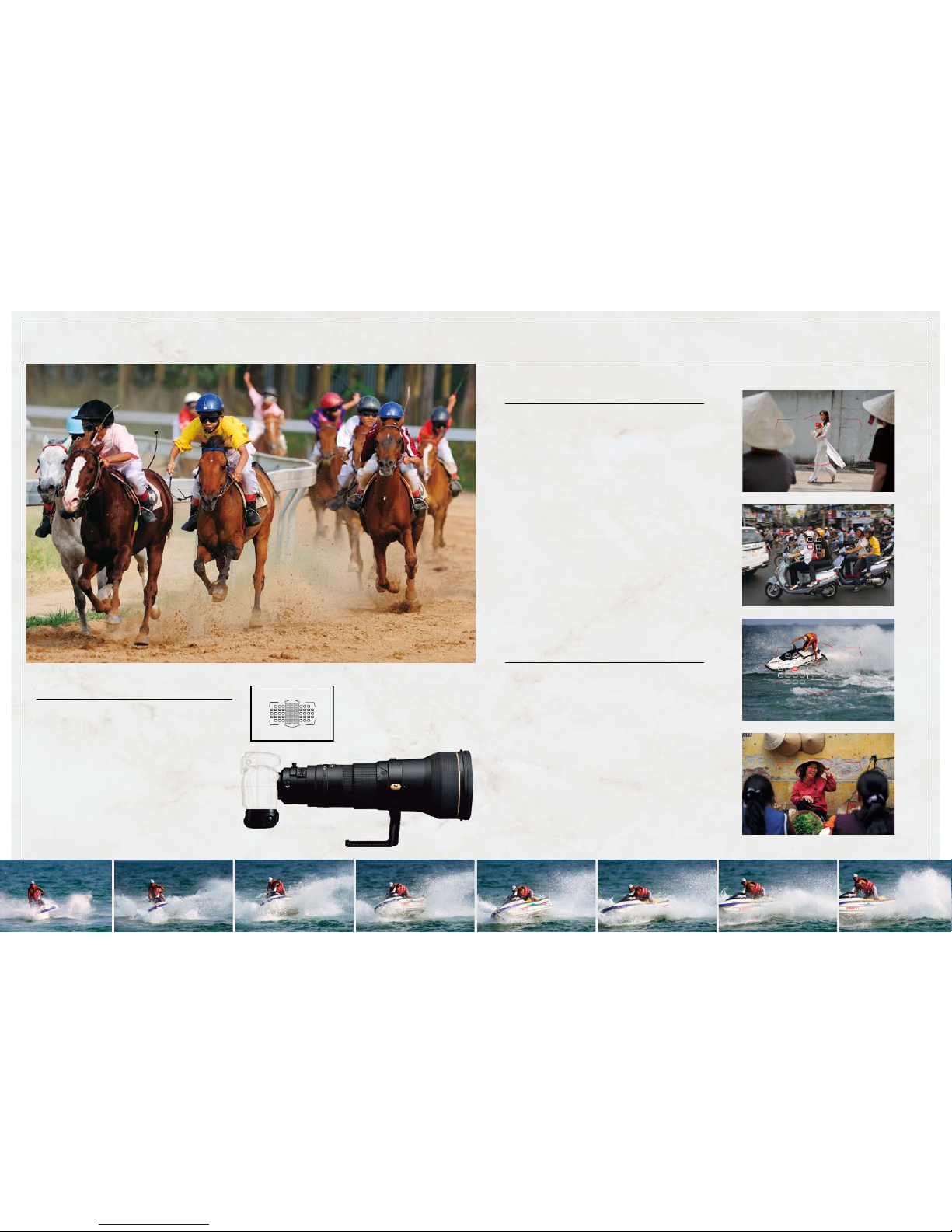
Versatile AF area modes
The D700’s three AF area modes — Single-point AF, Dynamic-area
AF, and Auto-area AF — prepare you for any shooting situation.
With good light control and a static subject, Single-point AF
ensures that the most important element in your composition,
such as the eyes in a character portrait, will be sharply focused.
With Dynamic-area AF, you can select from several focusing
options, utilizing 9, 21 or all 51 points. Just select a single AF point
as your priority, and the areas surrounding it serve as backup — a
significant advantage when shooting moving subjects. Select the
nine-point option when you want to focus on erratically moving
subjects with greater accuracy. When dealing with insufficient
contrast for fast focus detection, choosing 21 or 51 points makes
detection easier. The 51-point option allows for 3D-Tracking
which uses color information from the 1,005-pixel RGB sensor to
automatically follow moving subjects across the AF points. Yet
unlike other Dynamic-area AF systems, you don’t have to manually
reposition the AF point to continue tracking the subject, which
means you can concentrate more on composition. Auto-area AF
also uses color information and special face recognition algorithms
to automatically focus on an individual’s face, extremely helpful for
situations when there’s simply no time to select a focus point or
when using Live View in Hand-held mode at high or low angles.
Speed, response, and power at up to 8 frames per
second
With a startup time of 0.12 seconds and shutter release time
lag as short as 40 milliseconds (CIPA standard), the compact,
lightweight D700 combines speed, response and power to rival
the professional Nikon D3. If it's agility you require, use the D700
in its lightest configuration for a remarkable 5 frames per second.
For even greater speed, attach the Multi-Power Battery Pack
MB-D10 to boost shooting to a rapid-fire 8 frames per second*
— ideal for sports or other action photography. With the D700
as is, you can shoot as many as 1,000 frames, while adding
the MB-D10 enables you to go for a massive 2,900. The MultiPower Battery Pack's contours seamlessly meld with the D700,
providing a comfortable grip for vertical composition shooting
and a reassuring stability when attached to a tripod or a long,
heavy lens. The D700 also supports next-generation UDMA
technology, giving you an extra boost of recording speed, and
enabling you to shoot more consecutive shots — for never-to-berepeated shooting opportunities.
*With EN-E L4/4a and AA -size batteries
With the Multi-P ower Battery Pack MB-D10 atta ched, the D700 fires at up to an impressive 8 frames per second.
Dynamic-area AF mode using 9 points
©Douglas Menuez
Dynamic-area AF mode using 21 points
©Douglas Menuez
Auto-area AF
©Douglas Menuez
Single-point AF mode
©Douglas Menuez
©Douglas Menuez
The MB-D10 is easily attached and detached, and works
with EN-EL4/4a*, EN-EL3e, and AA-size
batteries.
*Battery holder B L-3 is required.
Freeze the action, perfect your composition
51-point AF system
The strategically positioned 51 AF points of the D700's MultiCAM 3500FX AF sensor module are identical with those of
the D3, and keep your subject in focus, even with quick and/or
erratic subject movement, across a wide extent of the frame.
The result is tack-sharp images and the opportunity to explore
a greater variety of compositions. The highly responsive AF
sensor detects your subject in EV as low as -1. The 15 points
of the three center rows employ cross-type sensors for extrapowerful detection with any NIKKOR lens of f/5.6 or faster,
far exceeding the limitations imposed by similar competing
systems, contributing further to the Nikon system’s broad range
of superior performance and versatility. After all, accurate
autofocus while tracking a crucial subject isn’t a luxury — it’s
a necessity.
Wide area coverage with
51 AF points
15 cross-type sensors perform
with any AF NIKKOR f/5.6 or
faster lens
• Lens: AF-S NIKKOR 400mm f/2.8G ED VR • Exposure: [A] mode, 1/1,250 second, f/5 • White balance: Auto • Sensitivity: ISO 320 • Picture Control: Vivid
• Dynamic-area AF mode 51-point 3D-Tracking
©Douglas Menuez
Page 7
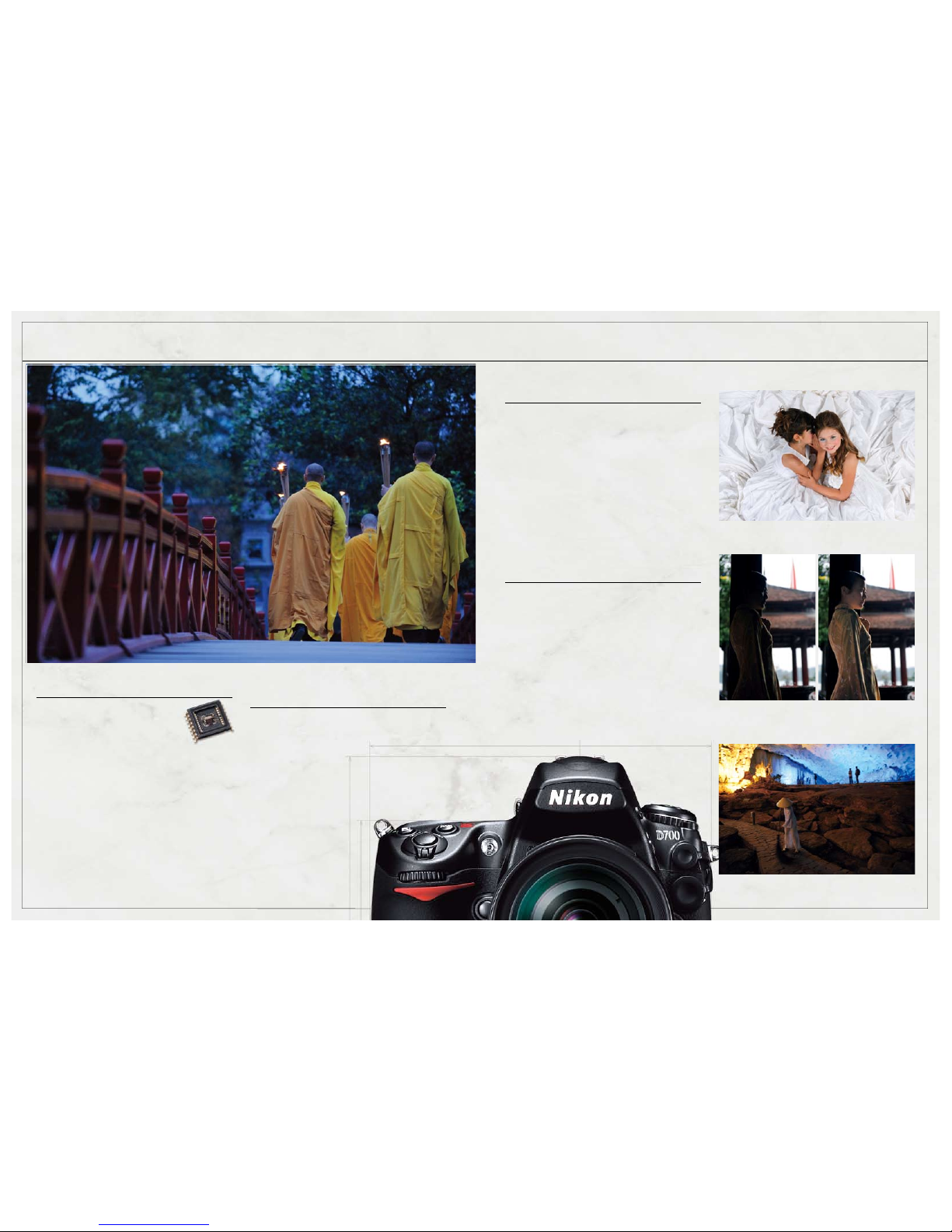
Highly sophisticated auto and flash exposure results
Nikon's 3D Color Matrix Metering II has long been praised
by discerning professionals for its superior and consistent
accuracy. Indeed, it delivers exposure results faithful to what
the photographer actually sees in various lighting situations,
such as front, side and back lighting. The system analyzes
a host of scene conditions — such as brightness, contrast,
selected AF area, color, subject-to-camera distance and even
the reflective quality of a scene — then compares these
elements with an in-camera database containing information
from over 30,000 actual shooting situations for incredible
exposure precision. Nikon’s unique Scene Recognition
System’s highlight analysis combined with the D700’s image
processing gives you images that accurately retain their tones
as well as fine details in highlights and shadows.
Accurate Auto White Balance, even with a mix of
light sources
Auto White Balance works together with Nikon's Scene
Recognition System to give you so much more. Milliseconds
before shutter release, the D700’s 1,005- pixel RGB
information assists the camera in calculating the in-depth
characteristics of the scene, cross-referencing it with 5,000
actual picture data examples among the over 20,000 images
stored in the D700’s AWB database. This lets you shoot with
confidence, even in tricky conditions such as mercury vapor
lighting, orange sodium lighting, and mixed light sources that
would easily confuse lesser cameras. With the D700, white
stays white, yellow appear s as yellow, just the way you see
it. The results are astonishing, and immensely satisfying.
Active D-Lighting Off
• Lens: AF-S NIKKOR 24-70mm f/2.8G ED • Exposure: [A] mode, 1/60 second, f/8 • White
balance: Auto • Sensitivity: ISO 200 • Picture Control: Standard
• Lens: AF-S NIKKOR 24-70mm f/2.8G ED • Exposure: [M] mode, 1/30 second, f/2.8
• White balance: Auto • Sensitivity: ISO 3200 • Picture Control: Standard
• Lens: AF-S NIKKOR 24-70mm f/2.8G ED • Exposure: [A] mode, 1/400 second, f/2.8
• White balance: Color Temperature (5000K) • Sensitivity: ISO 250
• Picture Control: Standard
©Cherie Steinberg Coté
©Douglas Menuez
©Douglas Menuez
12 13
Scene Recognition System: A new level of au to control accuracy
Scene Recognition System
Nikon’s revolutionary Scene Recognition
System redefines the scope, accuracy and
performance of Digital SLR automatic control.
One way it does this is by expanding the
potential of the renowned 1,005-pixel RGB sensor far beyond
3D Color Matrix Metering II and i-TTL flash control, applying
information from it to autofocus and auto white balance
processes as well, thereby introducing a whole new level
of accuracy and performance. The key to this revolutionary
technology is a unique optical device that enables more
precise color information readouts for an unprecedented
level of detailed scene information and analysis. This enables
the D700 to know and understand additional and essential
elements within the scene you're about to shoot. Each scene
is analyzed milliseconds prior to shutter release, further
optimizing autofocus, auto exposure, i-TTL control and white
balance — before the image is captured. Think of the Scene
Recognition System as an artificial-intelligence assistant,
working tirelessly alongside you.
Precise color information for outstanding AF
accuracy
The D700’s precise color information readouts deliver
auto focus subject identification and tracking performance
that no other camera maker can imitate. Use any of the
Dynamic-area AF modes — 9, 21, or 51 points — and the
color information of your main subject guides the D700’s AF
system to continue tracking your subject, whether it moves
toward the camera, away from the camera, or from side to
side. Color information is integral to 3D-Tracking, which uses
color to constantly follow the subject, switching focus points
as needed to allow you to concentrate on ideal composition
without worrying about keeping
the subject in focus. In Autoarea AF mode, the D700
automatically recognizes people
and skin tones, quickly focusing
on the most important element
— the human face.
• Lens: AF-S VR Zoom-Nikkor 70-200mm f/2.8G IF-ED • Exposure: [A] mode, 1/160 second, f/2.8 • White balance: Auto • Sensitivity: ISO 3200 • Picture Control: Standard
©Douglas Menuez
Active D-Lighting On
Page 8

• Lens: AF-S VR Zoom-Nikkor 24-120mm f/3.5~5.6G IF-ED • Exposure: [A] mode, 1/200 second, f/4.2 • White balance: Color Temperature (5000K) • Sensitivity: ISO 640 • Picture Control: Standard
©Douglas Menuez
Color and depth you've only dreamed about
Page 9
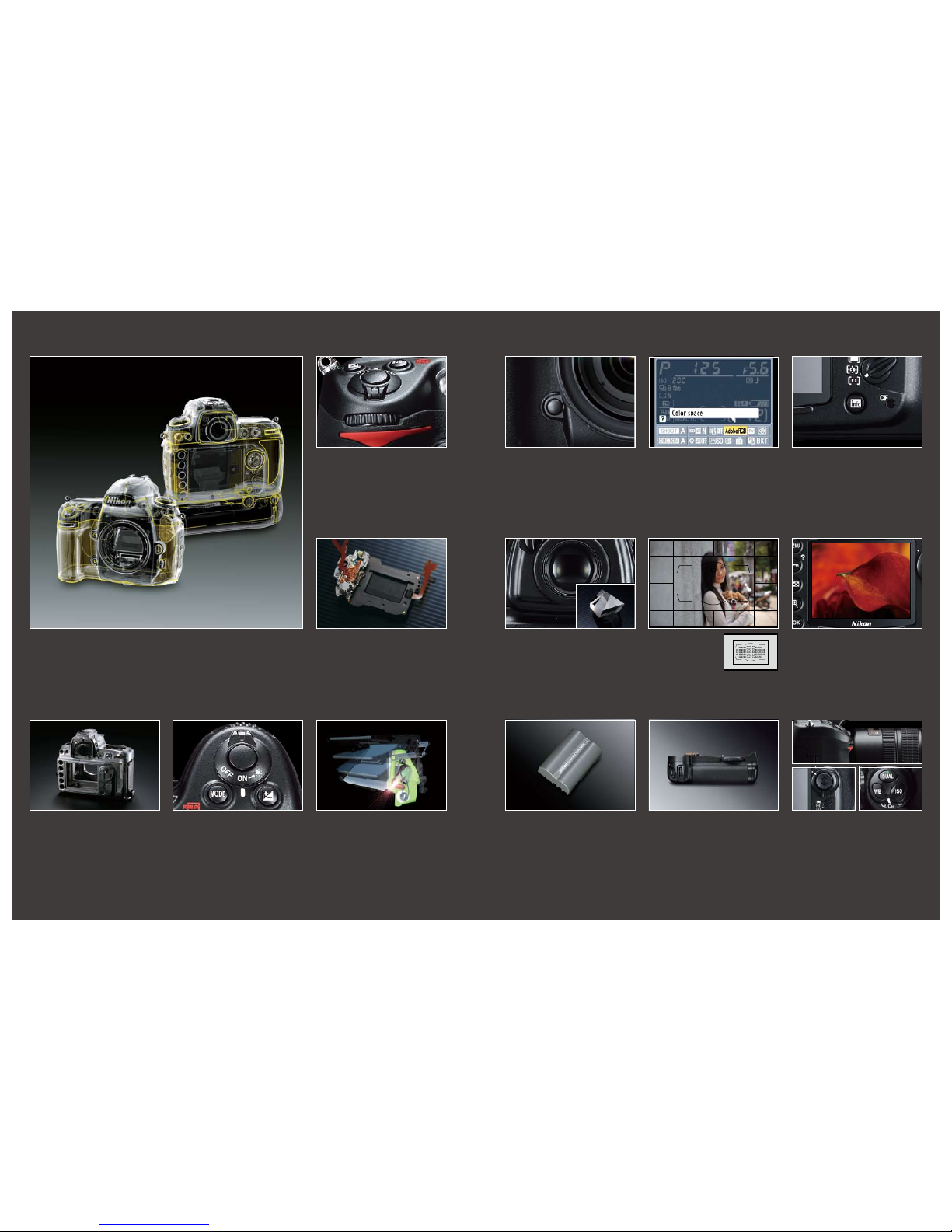
Large, bright viewfin der
Put your eye to the D700’s large circular eyepiece and rediscover why a
camera’s viewfinder experience cannot be taken for granted. One look
through a D700 confirms that superior viewfinder design is at the heart
of single-lens reflex camera handling. The Nikon FX format and large
pentagonal prism deliver a large, bright viewfinder image, making accurate
composition easier for any shooting conditions. What’s more, the D700’s
expertly designed viewfinder enables skilled photographers to confirm focus visually, in either auto
or manual focus mode.
Inspired layout, intell igently
applied ergonomi cs
The D700 gives you easy access, via buttons,
to functions often required while shooting,
eliminating the need for time-consuming
menu searches. The size and layout of all
buttons and dials have been optimized to
reduce the chance of error. They’re also
consistent with Nikon’s other professional
D-SLRs to make the use of multiple camera
platforms substantially easier.
Long-life batte ry
Using the EN-EL3e, the same battery used in
the D300, the D700 lets you shoot up to 1,000
frames per charge (CIPA standard) thanks to
intelligent power management. And by adding
the EN-EL4a in the optional Multi-Power
Battery Pack MB-D10, you can shoot up to
2,900 frames. All power options enable you to
monitor the level of battery power and shots
remaining on a charge.
3-inch, 920,000 -dot LCD
The large, high-resolution colo r LCD monitor
delivers bright, crisp image playback, with
enlargements up to 27x (large-size images in
FX format), for immediate and precise image
confirmation. Each D700 LCD is individuall y
fine-tuned to deliver consistent, outstanding
display performance.
Function button ena bles instant
shooting in NEF
The D700 features a function button you
can designate for shooting in NEF. When
shooting in JPEG and you decide to also
take the next shot in NEF, pressing the
button readies you instantly, without having
to access a menu.
Easy-to-view camera setting display
All of your settings are easily confirmed in
the large, high-definition LCD wi th clear,
easy-to-read fonts. You can choose to display
information with black lettering against a
white background or vice versa. It’s also
possible to set the camera to different
displays that match diverse ambient lighting
conditions, and so achieve the ideal view for
any situation.
Info button
Pushing the info button twice takes you
directly to useful features such as Picture
Control, Active D-L ighting and Noise
Reduction.
16 17
Precision- cast magnesium all oy
body
The D700 features rugged, durable and
lightweight magnesium alloy for the body,
exterior cover, chassis, and mirror box, to protect
the advanced technologies within and ensure
its ability to perform in the most demanding
shooting conditions. Nikon also conducts severe
anti-shock tests to assure robust reliability of
performance. Magnesium alloy is also utilized in
the Multi-Power Battery Pack MB-D10.
Engineered so nothing gets in your way
40-millis econd shutter re sponse
The D700 works as fast as you do, enabling
you to capture the precise moments you
want. That’s why the shutter release time
lag was cut to an industry-leading 4 0
milliseconds (CIPA standard). Just compose
and the camera will capture your subject’s
every move — critical when shooting fastmoving subjects.
Comprehensivel y sealed against dus t and moisture
The D700 goes the extra mile to protect against invasive moisture, dust, and even
electromagnetic interference. A meticulous, systematic series of O- rings and other specialized
seals, combined with additional Nikon protective engineering, keeps you shooting when lesse r
cameras fail.
Mirror balancer for longe r
viewing time
When the shutter is released, the mirror cycles
up and down at a very high speed. Nikon's
unique precision mirror balancer instantly
cancels mirror bounce by absorbing shock.
As a result, the viewfinder blackout time and
mirror movement noise are minimized.
0.12-second star t-up time
As with all other Nikon digital SLR cameras,
the D700’s power switch is conveniently
located in front of the shutter release button
for natural, fluid operation. Start-up time has
been minimized to 0.12 second to ensure
you’re ready for every shooting opportunity.
Durable, high-precision shutter unit
Tested on fully assembled cameras, the
D700’s shutter unit has been proven through
150,000 cycles under the most demandin g
conditions. Nikon’s exclusive self-diagnostic
shutter constantly monitors shutter operation,
confirming that it is operating at precisely
the designated shutter speed. Deviations are
corrected automatically, maintaining shutter
speed accuracy for more precise exposures.
DX-format crop
Multi-Power Batter y Pack
MB-D10 (option)
The optional Multi-Power Battery Pack
MB-D10, which uses one Rechargeable
Li-ion Battery EN-EL4a/4/3e or eight AA-size
batteries, is equipped with a shutter-release
button, AF-ON button, multi selector, and
main- and sub-command dials.
Page 10
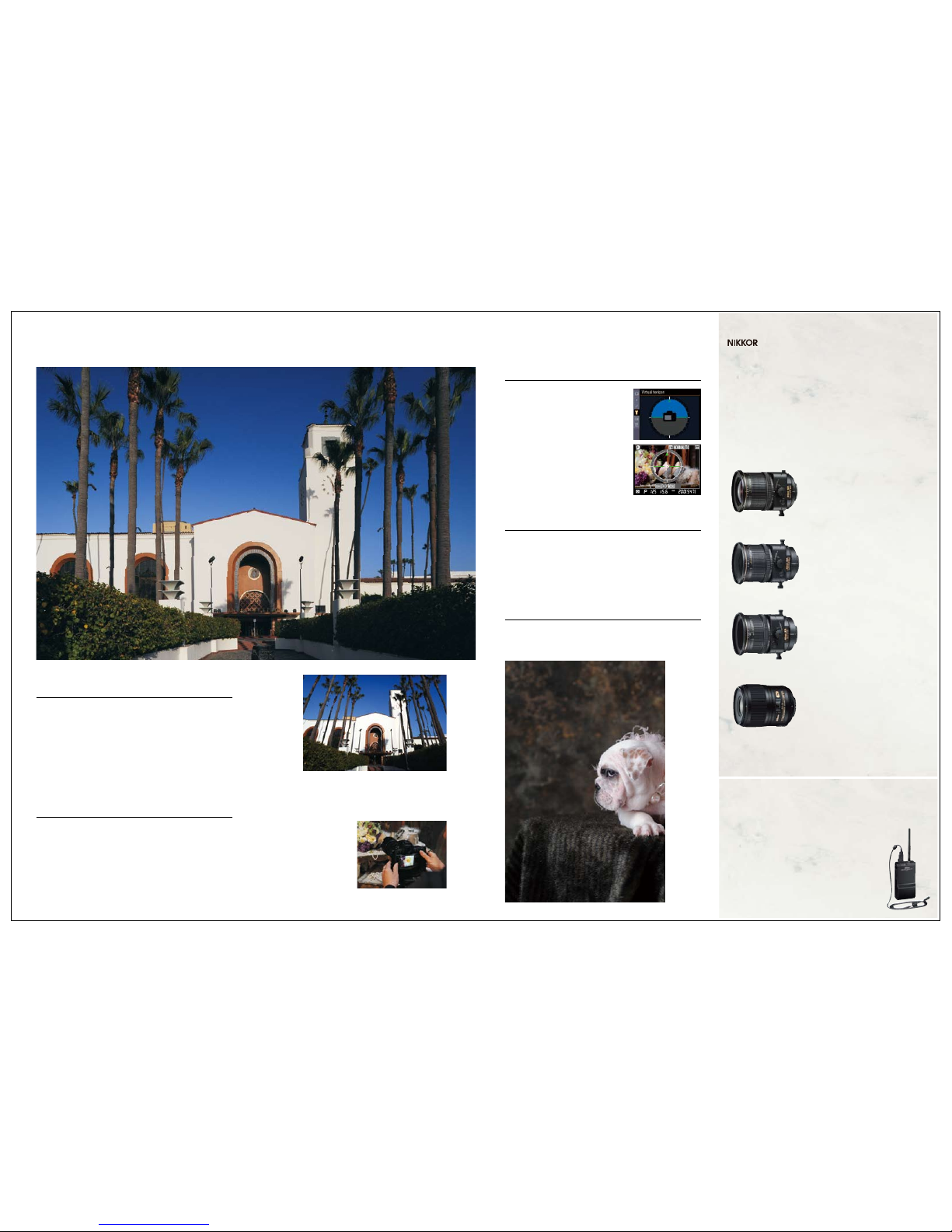
PC-E NIKKOR 24mm f/3.5D ED
Features Nano Crystal Coat, three ED
glass elements, three aspherical lens
elements and a closest shooting distance of 0.21 m.
Electronic Virtual Horizon
The innovative Virtual Horizon
provides instant, accurate
confirmation of the D700’s position
relative to horizontal level. When
using Live View, you can choose
to display the virtual horizon on the
LCD, a feature ideal for landscape
and architecture photography. You
can also level the D700 while looking
through the viewfinder using the
convenient analog scale.
Hand-held mode for low- and high-angle
compositions
In situations where you’re unable to look through the
viewfinder, Hand-held Mode can be a tremendous
assistance. First, select your focus point from the 51 points
available, or use Auto-area AF, then use the wide, 170-degree
viewing angle for composing — remarkably easy, even when
holding your D700 overhead or close to the ground.
Quick access to Live View
A simple custom setting allows you to designate the function
button for quick access to Live View. One push of the button
and you’re ready for Live View shooting.
— Comprehensive PC-E and Micro lens
versatility
Joining the D700 are four NIKKOR lenses that give photographers
exciting opportunities to develop in new and specialized directions.
All of these lenses incorporate a number of exclusive NIKKOR lens
technologies, such as Nano Crystal Coat, for achieving stunning
images, setting a new standard for effective control of ghost and
flare. The three PC-E lenses offer shift and tilt functions as well
as the revolving mechanism, and their anti-dust and anti-moisture
construction makes them a joy to work with even in severe
conditions. The micro NIKKOR employs an internal focusing system
for even faster autofocus and better balanced handling.
PC-E Micro NIKKOR 45mm
f/2.8D ED
Features Nano Crystal Coat, an ED
glass element, and a closest shooting
distance of 0.253 m.
PC-E Micro NIKKOR 85mm
f/2.8D
Features Nano Crystal Coat and a
closest shooting distance of 0.39 m.
AF-S Micro NIKKOR 60mm
f/2.8G ED
Features Nano Crystal Coat, an ED
glass element, three aspherical lens
elements for the first time in a micro
lens, a fast-and-quiet silent wave
motor, a closest shooting distance of
0.185 m, and a reproduction ratio of
up to 1:1
• Lens: AF-S Micro NIKKOR 60mm f/2.8G ED • Exposure: [M] mode, 1/200 second, f/6.3
• White balance: Auto • Sensitivity: ISO 200 • Picture Control: Standard
©Cherie Steinberg Coté
WT-4/4A Wireless Transmitter
For photographers working in large, crowded venues, the WT4/4A Wireless Transmitter offers huge advantages. Sup porting both
the IEEE 802.11a and IEEE 802.11b/g, it gives you
the range to move freely. And to streamline image
transfer, you can send just thumbnail images first;
then, the complete data of only the editor's selections
need be transmitted — a real timesaver. Up to five
photographers at a time can use the system, which
means that a single unit is able to handle most
events. The WT-4/4 A is also compatible with a variety
of system formats and security protocols.
18 19
Live View further expands shooting opportunities
Live View with high-resolution, 920,000-dot LCD
The D700’s Live View function further expands versatility
in a variety of shooting situations. In studio photography,
for example, the D700’s LCD shows bright, crisp, beautiful
images through a 3-inch, 920,00 0-dot screen in real time.
Because it’s so large and clear, you’re always aware of
what's happening in your composition. The 170-degree wide
viewing angle allows you to see what’s going on in front of
the camera from extremely high or low angles. The D700
offers two modes — Tripod and Hand-held.
Sharp contrast AF in tripod mode
Tripod Mode is ideal for conditions that dem and a precise
focus and involve detailed composition, suc h as studio still
life, architecture and landscape photograp hy. In this mode,
the high-precision, c ontrast-detect AF system, using the
FX-format CMOS sens or, offers exceptionally accurate
focusing from any point in the entire frame — much wider
than the 51-AF point area. You can easily rearrange still life
subjects while simultaneously co nfirming your composition,
or confirm your focus by enlarging the focus point im age
up to 13 times — an indispensable feature for macro
photography where subtle changes in the subject’s position
greatly influence the depth of field. You can also control focus
and shutter release from a
personal computer via Camera
Control Pro 2. When used
in combination with Nikon’s
latest PC-E NIKKOR lenses,
which incorporate tilt and shift
functions, the Live View Tripod
Mode further empowers you to
pursue your creative instincts.
Live View offers two modes —
Tripod Mode and Hand-held
Mode — accessible through the
LCD monitor.
• Lens: PC-E NIKKOR 24mm f/3.5D ED • Exposure: [M] mode, 1/8,000 second, f/8 • White balance: Auto • Sensitivity: ISO 800 • Picture Control: Standard
©Cherie Steinberg Coté
Same setting as top
photo but without
lens shifting
Exit
Page 11
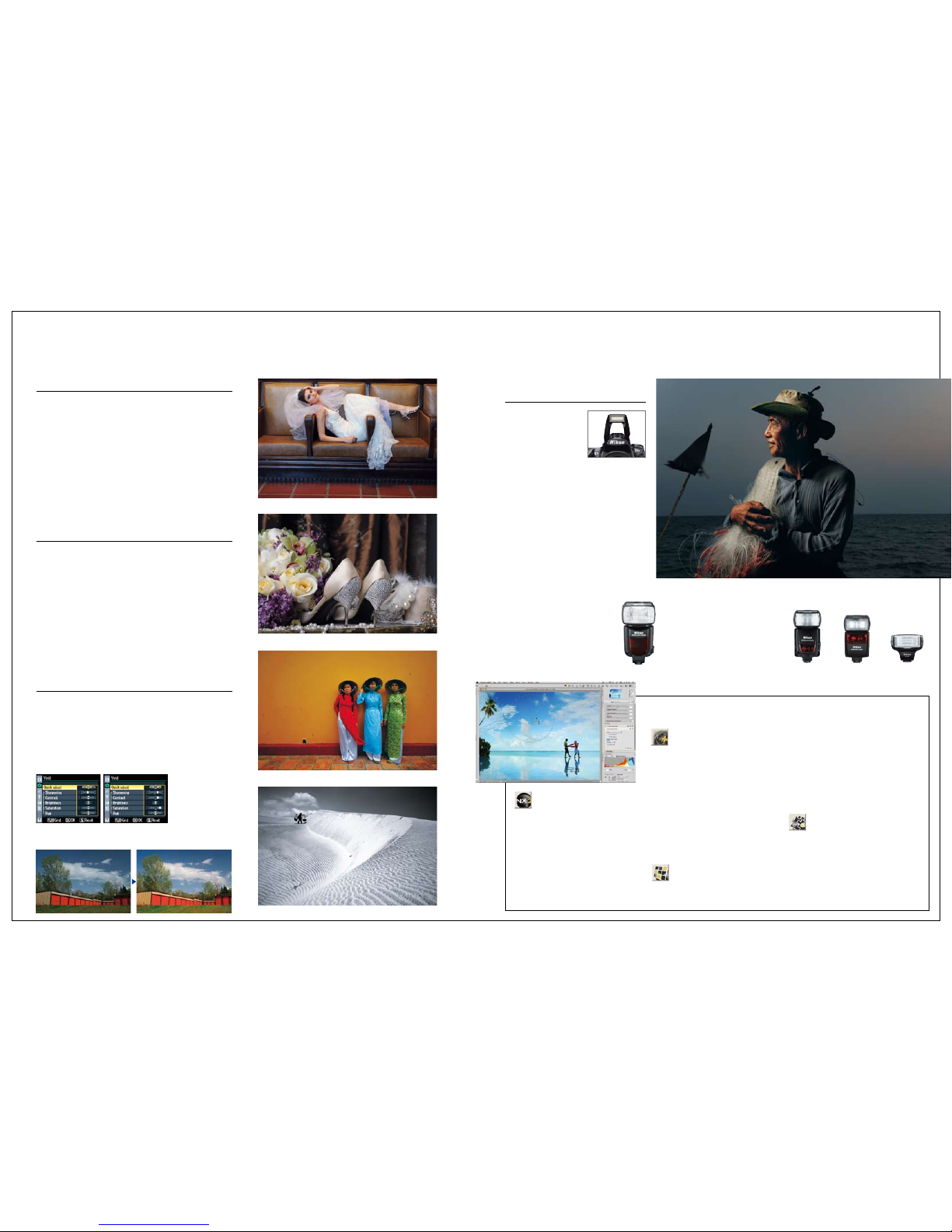
Seamless workflow in new directions
Simple to use yet sophisticated: Nikon's Creative Lighting System
Built-in flash with 24mm lens
coverage and i-TTL flash control
The D700 is fully
compatible with Nikon's
unmatched Creative
Lighting System, which
includes i-TTL flash
control and Advanced Wireless Lighting.
The camera’s Scene Recognition System's
highlight analysis further refines the world's
most sophisticated digital SLR lighting
system. Utilizing the 1,005-pixel RGB sensor
for a more refined flash metering evaluation,
this system reduces overexposure to
a degree never before achieved, even
with small subjects, which can easily be
overexposed. Metering accuracy for scenes
containing highly reflective objects has also
been substantially advanced. The built-in
flash has 24mm lens coverage, and works
as a wireless commander for up to
two groups of remote Speedlights
in Advanced Wireless Lighting.
Capture NX 2 (option)
Nikon’s proprietary image processing software
lets you get the most out of your NEF, JPEG or
TIFF images. Capture NX 2 and its innovative U Point
technology empower you to:
• Alter and enhance color and details quickly and
thoroughly
• Create and customize your own color schemes using
Picture Control, then save the results for later use or
export to D-SLRs that support Picture Control
• Take advantage of important functions such as batch
processing, edit list, vignette control, color aberration
control and distortion control
Camera Control Pro 2 (option)
Remote shooting has never been more
productive. Camera Control Pro 2 provides:
• Full control of Live View, Picture Control, White Balance
and the 51-point AF system
• Remote control and image transfer via wireless LAN
when using the WT-4/4A Wireless Transmitter
• Immediate thumbnail confirmation
• Deletion of unwanted images before data transfer
• Image display using ViewNX
Image Authentication Software (option)
Protect your data's integrity with Nikon's Image
Authentication Software:
• Indicates whether an image has been altered
• Recognizes any change in XMP and IPTC information
ViewNX
Professional NEF shooters have a powerful ally
in Nikon's ViewNX software. ViewNX treats
RAW and JPEG files of the same image as a single file,
which makes browsing faster and more efficient.
With the ViewNX advantage, you can:
• Switch from JPEG to RAW details in one click
• Use labels to categorize, prioritize and filter your images
• Edit XMP and IPTC information
• View thumbnails and previews quickly
• Easily switch between Nikon Transfer and Capture NX 2
• Customize images via ViewNX's Picture Control utility
• Easily print, create slideshows and send images via
email
Nikon Transfer
Organize your workflow efficiently. Nikon
Transfer enables you to:
• Transfer images from Nikon D-SLR or memory cards
• Add labels, ratings and IPTC at transfer time for
efficient sorting later on
• Continue selecting images while transfer is in progress
SB-600 SB-400
Speedlight SB-900
• Fully compatible with Nikon's Creative Lighting System
• Guide number: 34 (ISO100, m), 48 (ISO200, m) at
35mm in normal lighting
• Wide auto zoom coverage of 17-200mm
• Automatic detection of imaging sensor format for
superior light distribution
• High-speed recycling
• Lens: AF-S NIKKOR 24-70mm f/2.8G ED • Exposure: [M] mode, 1/80 second, f/11 • White balance: Auto • Sensitivity: ISO 200
• Picture Control: Standard
©Douglas Menuez
SB-800
20 21
Capture images with your own customized look and feel
Innovative, versatile Picture Control
Define tones and colors easily
The D700 provides rich tones and colors in the default
setting, but also gives you the freedom to custom tailor
image characteristics to your own specific tastes or client
requirements. Picture Control is an intuitive, easy-to-use
system for defining the image tone. In certain respects, it
is reminiscent of the way in which film photographers once
selected certain types of film stock for specific shooting
situations. Tones defined by the Picture Control System will
remain consistent with future Nikon digital SLR cameras that
are compatible with Picture Control System. You'll also have
access to optional Picture Controls to be introduced in the
future via the Nikon Website.
Four types of Picture Controls
Select [Standard] for bright, balanced images suitable for
any application. [Neutral] is designed to reproduce accurate
color and gradation, making it your choice when you plan to
make post-production image enhancements. [Vivid] delivers
distinct, colorful, fresh-looking images with just the right
emphasis on your subject’s contrast and contours, making
it ideal for emphasizing primary colors, while [Monochrome]
provides classic styles like black-and-white and sepia. You
can even edit or change the Picture Controls using Nikon's
ViewNX browsing software, or with the optional Capture NX
2 with U Point technology — something no other camera
manufacturer offers.
Direct, intuitive image control
[Standard], [Neutral], and [Vivid] enable you to adjust
parameters such as sharpening, contrast, brightness,
saturation and hue. With [Monochrome], you can fine-tune
sharpening, contrast, brightness, filter effects and toning.
Changes can be saved as Custom Picture Controls under
your chosen name for future use with particular shooting
scenarios.
Quick adjust: Enjoy instant access to five parameters — sharpening,
contrast, brightness, saturation and hue in [Standard] and [Vivid]
Picture Controls. It’s all as easy as moving the sliders.
Standard
Neutral
Vivid
Monochrome
©Cherie Steinberg Coté
©Cherie Steinberg Coté
©Douglas Menuez
©Douglas Menuez
Page 12
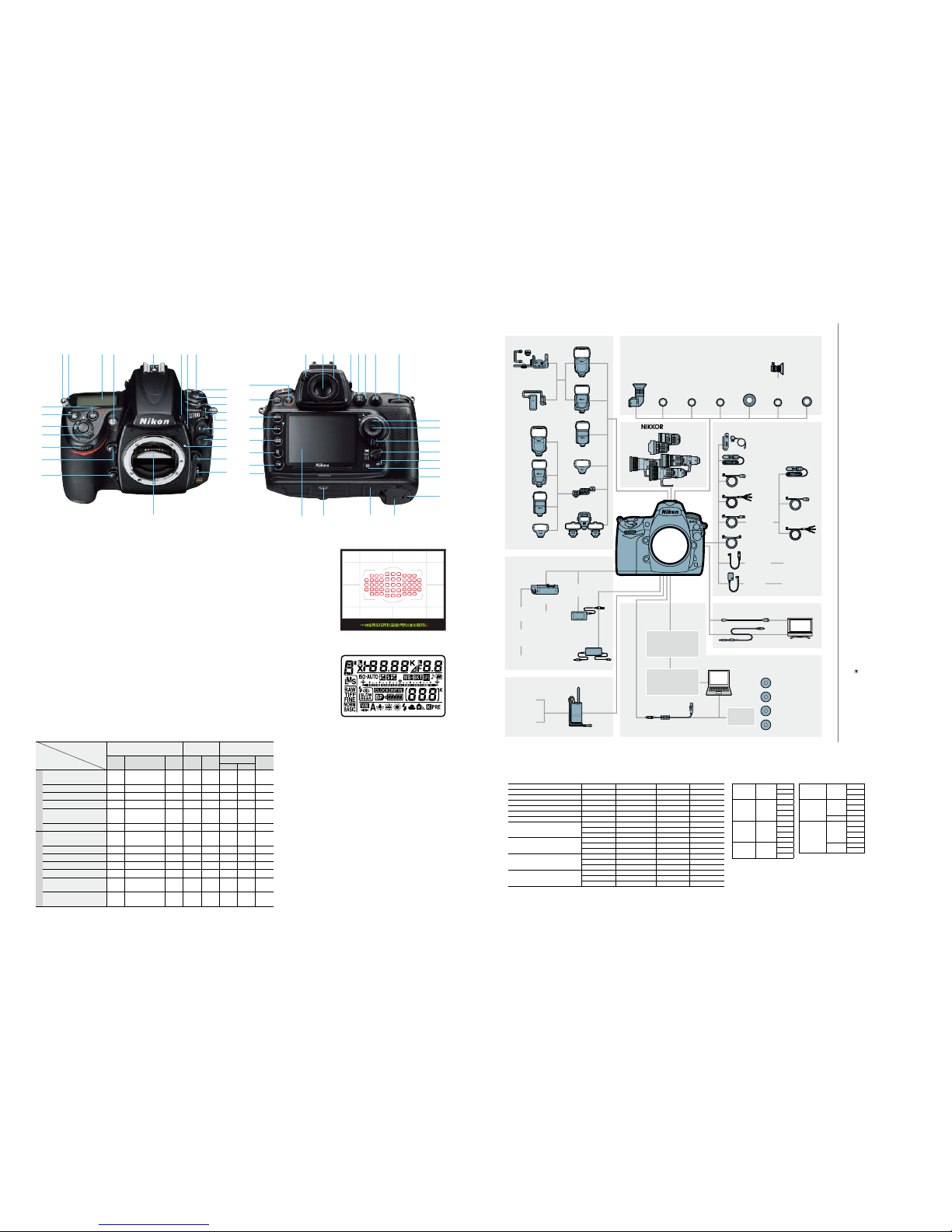
Lenses
SPEEDLIGHTS
REMOTE CONTROL ACCESSORIES
VIEWFINDER ACCESSORIES
TV ACCESSORIES
COMPUTER RELATED
ACCESSORIES
WIRELESS TRANSMITTER
AC ADAPTERS, BATTERIES AND
CHARGERS
Power Bracket Unit
SK-6/6A
High-Performance
Battery Pack SD-8A
Speedlight SB-900
Speedlight SB-600
Speedlight SB-400
Speedlight
SB-800
Speedlight
SB-600
Close-up Speedlight
Commander Kit R1C1
TTL Remote Cord
SC-28, 29
Modulite Remote
Control Set ML-3
Remote Cord
MC-36
Remote Cord
MC-30
Remote Cord
MC-22
Extension Cord
MC-21
Connecting Cord
MC-23
Adapter Cord
MC-25
Ten-Pin Remote
Accessories
GPS Cable
MC-35
GPS Unit**
Remote Cord
MC-36
Remote Cord
MC-30
Remote Cord
MC-22
Video Cable EG-D100*
TV Monitor**
Eyepiece
DK-17*
Eyepiece
Correction
Lens DK-17C
(-3, -2, 0,
+1, +2 m-1)
Rubber
Eyecup
DK-19
Eyepiece
Adapter
DK-18
Eyepiece Magnifier
DG-2
Magnifying
Eyepiece
DK-17M
Right-Angle
Viewing
Attachment
DR-5
Antifog
Finder
Eyepiece
DK-17A
PC Card Adapter**
CF Card Reader**
CompactFlashTM Card**
Personal Computer**
Printer**
Capture NX 2
Camera Control Pro 2
Image Authentication
Software
Software Suite*
Quick Charger
MH-21/MH-22
AC Adapter EH-5a/EH-5
Rechargeable
Li-ion Battery
EN-EL3e*
Wireless Transmitter WT-4/4A
USB Cable UC-E4*
Eight R6/AA-size
batteries**
HDMI Cable**
Rechargeable
Li-ion Battery
EN-EL3e
AC Adapter
EH-6
*Supplied accessories **Non-Nikon products
C: Custo m Setting B ank
R: Reset Cu stom Set tings
a: Autof ocus
a1: AF-C Pr iority Selec tion
a2: AF-S Pri ority Selec tion
a3: Dynami c AF Area
a4: Focus Trac king with Lock- On
a5: AF Acti vation
a6: Focus Po int Illumination
a7: Focus Po int Wrap-Arou nd
a8: AF Point Sel ection
a9: Built-in AF- assist Illuminat or
a10: AF-ON for MB -D10
b: Meteri ng/Ex posure
b1: ISO Sensit ivity Step Val ue
b2: EV Step s for Exposur e Control
b3: Exp Co mp/Fine Tune
b4: Easy Ex posure Comp ensation
b5: Center-Wei ghted Area
b6: Fine Tune Opt imal Exposur e
c: Timers /AE Lock
c1: Shut ter-Release B utton AE-L
c2: Aut o Meter-off Del ay
c3: Self-Tim er Delay
c4: Moni tor Off Delay
d: Shootin g/Displ ay
d1: Beep
d2: Viewfi nder Grid Display
d3: Screen T ips
d4: CL Mode Sh ooting Speed
d5: Max. Co ntinuous Releas e
d6: File Numbe r Sequence
d7: Shootin g Info Display
d8: LCD Illumina tion
d9: Expo sure Delay Mode
d10: MB-D10 Batt ery Type
d11: Battery Orde r
e: Bracket ing/Fla sh
e1: Flash Sy nc Speed
e2: Flash Shu tter Speed
e3: Flash Con trol for Built-in Fl ash
e4: Modeling F lash
e5: Auto Br acketing Set
e6: Auto Br acketing (Mode M )
e7: Bracke ting Order
f: Contr ols
f1: [
] Switch
f2: Multi Select or Center But ton
f3: Multi Select or
f4: Photo Info /Playback
f5: Assign FUNC B utton
f6: Assign Prev iew Button
f7: Assign AE-L /AF-L Butto n
f8: Shutter Sp eed/Apert ure Lock
f9: Customize C ommand Dials
f10: Release But ton to Use Dial
f11: No Memory Card?
f12: Reverse Indi cators
Custom Settings menus
System Chart
Memory Card Capacity
The following table shows the approximate number of pictures that can be stored on a
2 GB SanDisk Extreme IV (SDCFX4) card at different image quality and image size settings with FX-format image area.
Image quality Image size File size 1No. of images 1Buffer capacity
2
NEF (RAW), Lossless compressed, 12-bit — 13.3 MB 100 23
NEF (RAW), Lossless compressed, 14-bit — 16.3 MB 77 20
NEF (RAW), Compressed, 12-bit — 11.0 MB 138 26
NEF (RAW), Compressed, 14-bit — 13.8 MB 114 23
NEF (RAW), Uncompressed, 12-bit — 18.8 MB 100 19
NEF (RAW), Uncompressed, 14-bit — 24.7 MB 77 17
TIFF (RGB) L 35.9 MB 53 17
M 20.7 MB 95 20
S 10.0 MB 211 28
JPEG fine
3
L 5.7 MB 279 100
M 3.2 MB 496 100
S 1.4 MB 1000 100
JPEG normal
3
L 2.9 MB 548 100
M 1.6 MB 976 100
S 0.7 MB 2000 100
JPEG basic
3
L 1.4 MB 1000 100
M 0.8 MB 1800 100
S 0.4 MB 3900 100
1 All figures are approximate. File size varies with scene recorded.
2 Maximum number of exposures that can be stored in memory buffer. Drops if [Optimal quality] is selected for [JPEG compression], ISO sensitivity is
set to H 0.3 or higher, [High ISO NR] is on when ISO sensitivity auto control is on or ISO sensitivity is set to 2000 or higher, or long exposure noise
reduction, Active D-Lighting or image authentication is on.
3 Figures assume [JPEG compression] is set to [Size priority]. Selecting [Optimal quality] increases the file size of JPEG images; number of images and
buffer capacity drop accordingly.
FX-format (36 x 24) Image Area
Speedlight
SB-400
Rechargeable Li-ion
Battery
EN-EL4/EN-EL4a
Quick Charger
MH-18a*
Extreme IV SDCFX4 8 GB
4 GB
2 GB
Extreme III SDCFX3 8 GB
4 GB
2 GB
1 GB
Ultra II SDCFH 8 GB
4 GB
2 GB
1 GB
Standard SDCFB 4 GB
2 GB
1 GB
Profession al
UDMA
300x 8 GB
4 GB
2 GB
Platinum II 80x 2 GB
1 GB
512 MB
60x 4 GB
Profession al 133x WA 8 GB
4 GB
2 GB
1 GB
80x Lt 2 GB
512 MB
SanDisk Lexar Media
The following Type I CompactFlash memory cards
have been tested and approved for use in the D700.
Approved Memory Cards
Other cards have not been tested. For more details on the above cards, please contact the
manufacturer.
Multi-Power Battery
Pack MB-D10
Battery Chamber
Cover BL-3
Speedlight SB-800
Speedlight
SB-900
23
1
Exposure mode/Format button
2
Exposure compensation/Two-button
reset button
3
Shutter-release button
4
Power switch
5
Sub-command dial
6
Depth-of-field preview button
7
Function button
8
Mirror
9
Focus-mode selector
!
Lens release button
"
Lens mounting index
#
Ten-pin remote terminal cover
$
Flash sync terminal cover
%
Eyelet for camera strap
&
Release mode dial lock release
(
Release mode dial
)
Image quality/Image size/Two-button
reset button
~
White balance button
+
ISO sensitivity button
,
Flash mode/Flash compensation button
-
Flash pop-up button
.
Accessory shoe (for optional flash unit)
/
AF-assist illuminator/Self-timer lamp/
Red-eye reduction lamp
:
Control panel
;
Focal plane mark
<
Eyelet for camera strap
=
Delete/Format button
>
Playback button
?
Menu button
@
Protect/Help button
[
Thumbnail/Playback zoom out button
\
Playback zoom in button
]
OK button
^
HDMI mini-pin connector/Video
connector/USB connector/DC-IN
connector (under the connector cover)
_
Monitor
{
Tripod socket
|
Connector cover for MB-D10
}
Battery-chamber cover
*
Battery-chamber cover latch
a
Memory card slot cover
b
Info button
c
Memory card access lamp
d
AF-area mode selector
e
Focus selector lock
f
Multi-selector center button
g
Multi selector
h
Main command dial
i
AF-ON button
j
Metering selector
k
AE/AF lock button
l
Diopter adjustment control
m
Viewfinder eyepiece
n
Viewfinder
o
Eyepiece shutter lever
<
1
Control Panel
Viewfinder Display
Nomenclature
2
3
4
5
6
7
8
9
!
"
#
$
%
&
(
)
~
+,-./:;
=
>
?
@
[
\
]
^
_ { | }
*
a
b
c
d
f
e
g
hiklmno j
q
1
IX-Nikkor lenses cannot be used. 2 Vibration Reduction (VR) supported with VR lenses.
3
Spot metering meters selected focus point. 4 The camera’s exposure metering and flash
control systems do not work properly when shifting and/or til ting the lens, or when an
aperture other than the maximum ap erture is used. 5 Can not be used with shifting or tilting.
6
Manual exposure mode only. 7 Can be used with AF-S and AF-I lenses only. 8 With maximum effective aperture of f/5.6 or faster. 9 When focusing at minimum focus distance with AF
80-200mm f/2.8, AF 35-70mm f/2.8, AF 28-85mm f/3.5-4.5 <New>, or AF 28-85mm f/3.5-4.5
lens at maximum zoom, in-focus indicator may be displayed when image on matte screen in
viewfinder is not in focus. Adjust focus manually until image in viewfinder is in focus. 10 With
maximum aperture of f/5.6 or faster. 11 Some lenses cannot be used. 12 Range of rotation for
AI 80-200mm f/2.8 ED tripod mount is limited by camera body. Filters cannot be exchanged
while AI 200-400mm f/4 ED is mounted on camera. 13 If maximum aperture is specified using
[Non-CPU lens data], aperture value will be displayed in viewfinder and top control panel.
14
Can be used only if lens focal length and maximum aperture are specified using [Non-
CPU lens data]. Use spot or center-weighted metering if desired results are not achieved.
15
For improved precision, specify lens focal length and maximum aperture using [Non-CPU
lens data]. 16 Can be used in manual exposure mode at shutter speeds slower than 1/125 s.
17
Exposure determined by presetting lens aperture. In aperture-priority auto exposure mode,
preset aperture using lens aperture ring before performing AE lock or shifting lens. In manual
exposure mode, preset aperture using lens aperture ring and determine exposure before
shifting lens. 18 Exposure compensation required when used with AI 28-85mm f/3.5-4.5, AI
35-105mm f/3.5-4.5, AI 35-135mm f/3.5-4.5, or AF-S 80-200mm f/2.8D. See teleconverter
manual for details. 19 Requires PK-12 or PK-13 auto extension ring. PB-6D may be required
depending on camera orientation. 20 Use preset aperture. In aperture-priority auto exposure
mode, set aperture using focusing attachment before determining exposure and taking photograph.
Lens Compatibility Chart
Camera setting Focus Exposure Metering
mode mode system
S
M (with electronic
M P A w
Lens/accessory C rangefinder) S M 3D Color
e
Type G or D AF Nikkor2
AF-S, AF-I Nikkor
3 3 3 3 3 3— 3
3
PC-E NIKKOR series
—
35 3 35 35 35— 3
3
PC-Micro Nikkor 85mm f/2.8D4 —
35 3— 36 3— 3
3
AF-S / AF-I Teleconverter7
38 38 3 3 3 3— 3
3
Other AF Nikkor
39 39 3 3 3— 3 3
3
(except lenses for F3AF)
AI-P Nikkor —
310 3 3 3— 3 3
3
AI-, AI modified Nikkor or
Nikkor Series E lenses12
—
310 3— 313— 314 3
15
Medical-Nikkor 120mm f/4 —
3 3— 316——
—
Reflex-Nikkor ——
3— 313—— 3
15
PC-Nikkor —
35 3— 317—— 3
AI-type Teleconverter18 —
38 3— 313— 314 3
15
PB-6 Bellows Focusing
Attachment19
—
38 3— 320—— 3
Auto extension rings
(PK-series 11A, 12, or 13; PN-11)
—
38 3— 313—— 3
CPU lenses
1
Non-CPU lenses
11
22
 Loading...