

Page 1
11N Wireless USB Adapter User Guide
-- 1 --
Page 2

11N Wireless USB Adapter User Guide
Copyright Statement
Nexxt Solutions is a registered trademark. All the
products and product names mentioned herein are the
trademarks or registered trademarks of their
respective holders. Copyright of the whole product as
integration, including its accessories and software,
belongs to Nexxt Solutions Co., Ltd. Without the
permission of Nexxt Solutions Co., Ltd, any indivi dual
or party is not allowed to copy, plagiarize, imitate or
translate it into other languages.
All the phot os and p roduct s pecificat ions me ntioned in
this guide are for references only. As the upgrade of
software and hardware, there will be changes. And if
there are changes, Nexxt Solutions is not responsible
for informing in advance. If you want to know more
about our product information, please visit our website
at
www. nexxtsolutions.com.
-- 1 --
Page 3

11N Wireless USB Adapter User Guide
Table of Content
Chapter 1 Introduction·························································3
1.1 Product Features ······················································4
1.2 Product Deployment ···············································5
1.3 Indicator Description ··············································6
1.4 Package Contents ···················································· 6
Chapter 2 Installation Guide···············································7
Chapter 3 Client Utility Interface ···································· 13
3.1 Station Mode ··························································· 14
3.1.1 Station Mode Topology ································ 14
3.1.2 Status ································································14
3.1.3 Site Survey ······················································ 15
3.1.4 Profile Management ······································ 17
3.1.5 Statistics··························································· 19
3.1.6 WPS Settings ·················································· 19
3.2 AP Mode ···································································· 21
3.2.1 AP Mode Topology ·········································21
3.2.2 Basic Settings ················································· 22
3.2.3 Security Settings ···········································23
3.2.4 Access Control ················································ 24
3.2.5 About ································································· 26
Appendix One: Acronyms and Terms····························· 27
Appendix Two: Product Specification····························· 30
Appendix Three: How to connect with PSP™ ··············31
-- 2 --
Page 4

11N Wireless USB Adapter User Guide
Chapter 1 Introduction
LYNX 150 utilizes the latest wireless networking
technology, IEEE802.11n (Draft 2.0), and can be
greatly compatible backwards with 802.11b/g
standards, which multiples wireless transmission
range and reduces “dead spots” in the wireless
coverage area.
Soft AP supported by L YNX 150 can help you establish
wireless LAN networks fast. Besides, WPS (Wi-Fi
Protected Setup) encryption methods to avoid you
memorizing long passwords. Moreover , complete WMM
support makes your voice and video smoother.
Supports PSP™, NDS™ and WII™ connection with
Xlink Kai to enjoy on-line gaming.
All in all,
LYNX 150 is a cost-effective Wireless-N
USB Adapter with high-performance and further
wireless coverage.
-3-
Page 5

11N Wireless USB Adapter User Guide
1.1 Product Features
• Complies with IEEE 802.11n (Draft 2.0), IEEE
802.11g and IEEE 802.11b standards
• Requires USB2.0 port
• Provides 150Mbps receiving rate and 150Mbps
sending rate
• Supports 20MHz/40MHz frequency width
• Auto-detects and changes the network
transmission rate
• Provides two work modes: Infrastructure and
Ad-Hoc
• Supports Soft AP to establish your wireless
LAN networks
• Supports PSP™, WII™ and NDS™ connecting
with Internet and Xlink Kai to enjoy on-line
gaming
• Supports 64/128-bit WEP, WPA, WPA2
encryption methods and 802.1x security
authentication standard
• Supports WPS (Wi-Fi Protected Setup)
encryption method to avoid you memorizing
-4-
Page 6

11N Wireless USB Adapter User Guide
long passwords.
• Supports WMM to make your voice and video
smoother.
• Easy-to-install, plug and play
1.2 Product Deployment
LYNX 150 Wireless USB Adapter offers fast,
reliable and cost- effective solution for
wireless access. Deployment as follows;
• For staff who requires higher mobility in the
office, or who requires to have access to
traditional wired or wireless network in any
place of the company;
• Enterprise or individual who requires often
changes in the layout of network cables;
• Companies or places which are not suitable for
LAN cable laying out because of budget or
objective of the building, including places of
-5-
Page 7

11N Wireless USB Adapter User Guide
great interests, rented places or places for
short-term usage;
• Companies or individuals who avoid using
expensive cables, renting cables or paying
rights for access.
1.3 Indicator Description
In the front panel of LYNX 150, there is a LED
indicator blinking when data communication is going
on.
1.4 Package Contents
Unpack the packets, and please find the following
items:
¾ One
LYNX 150 11N Wireless USB Adapter
¾ One CD-ROM
-6-
Page 8
11N Wireless USB Adapter User Guide
Chapter 2 Installation Guide
This chapter is to assist you to use the included
CD-ROM which includes the Setup Wizard and the
Client Utility Interface.
The following steps on Setup Wizard are taken from
Windows XP as an example.
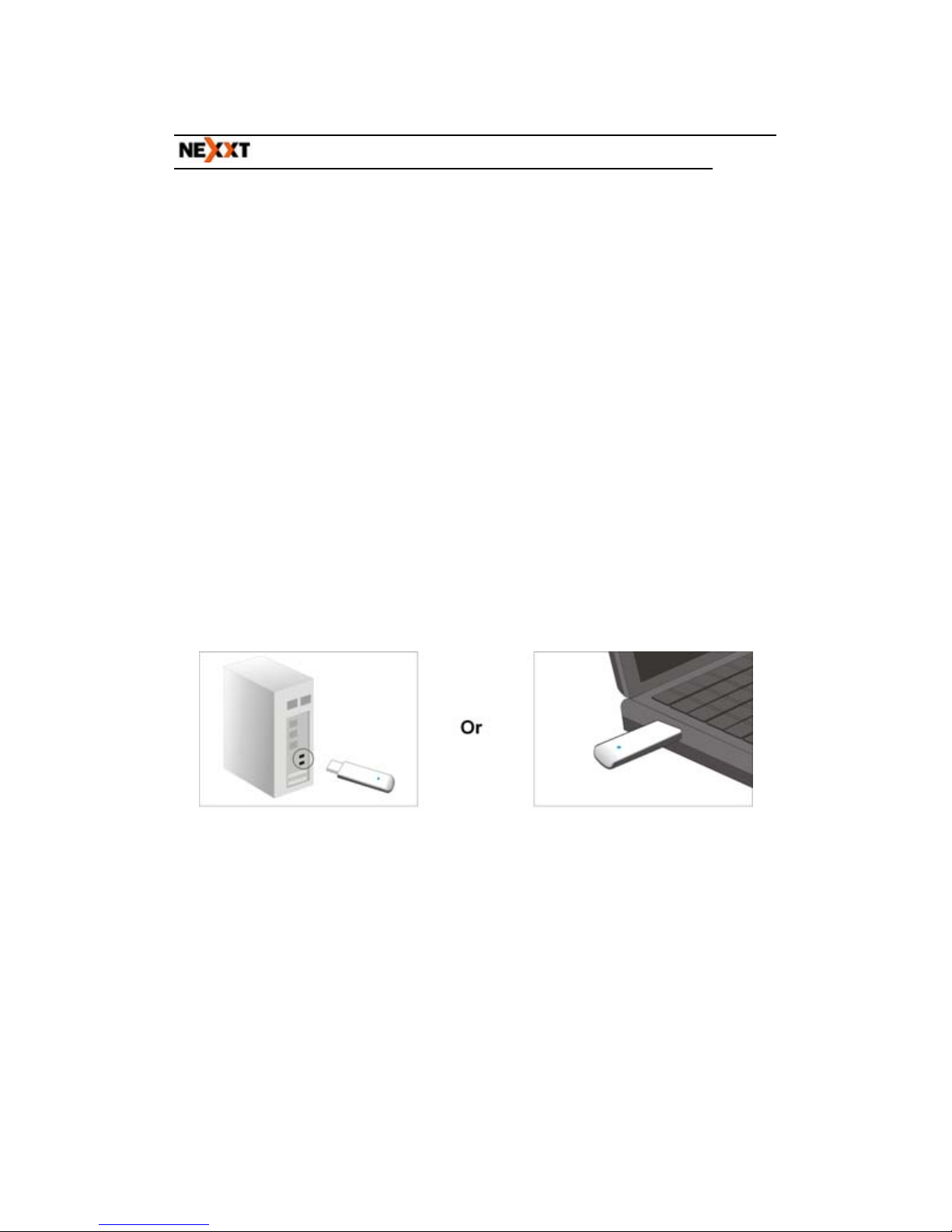
1. Please insert the Wireless USB Adapter into any
USB port of your computer.
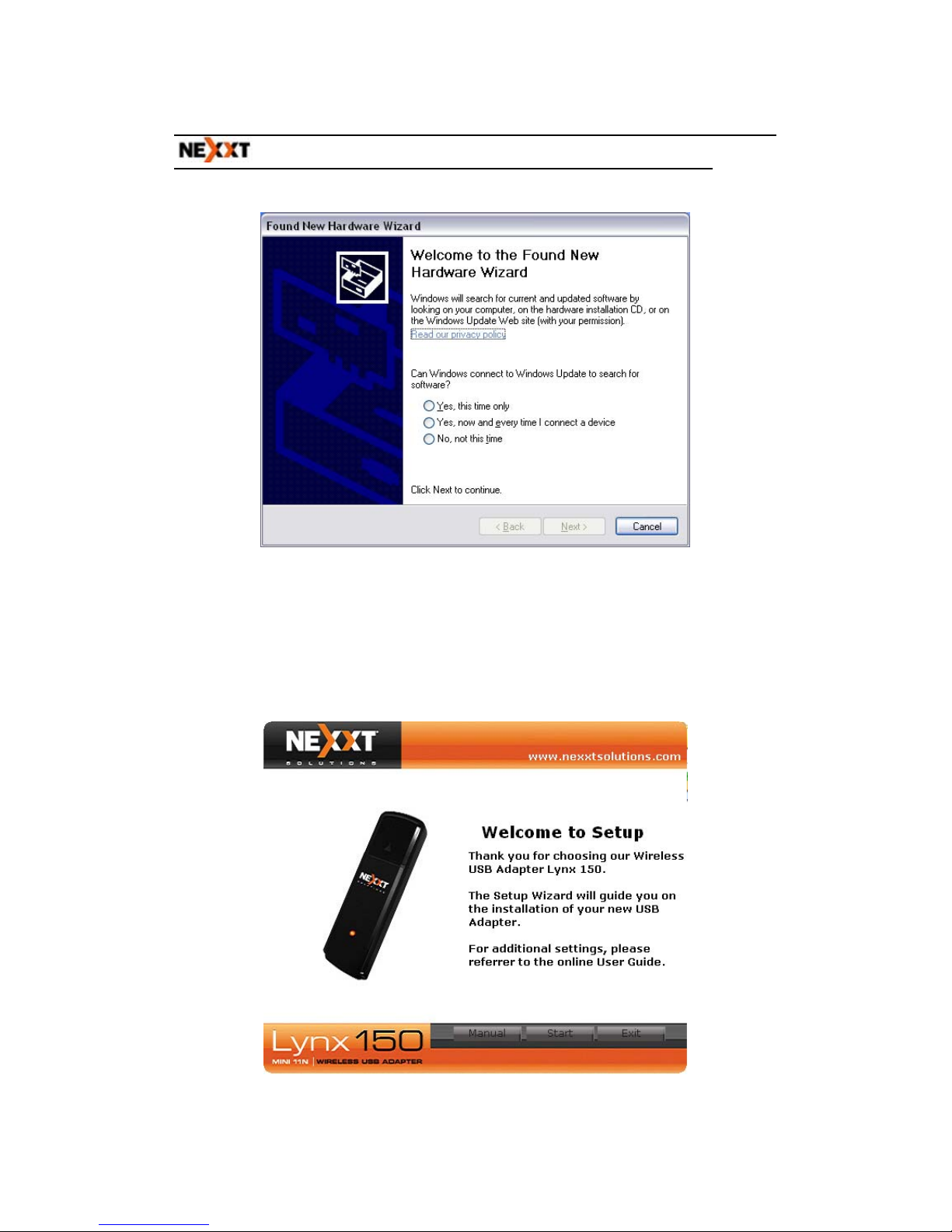
2. When “Found New Hardware” system dialogue
appears, select “Cancel” to use the included Setup
Wizard for fast installation; of course, you can also
select “Next” to install manually.
-7-
Page 9
11N Wireless USB Adapter User Guide
3. Insert the included CD-ROM into the CD-ROM
drive of your computer, and the Welcome screen
will appear . (If it does not appear, double click the
“Setup.exe” icon.)
-8-
Page 10
11N Wireless USB Adapter User Guide
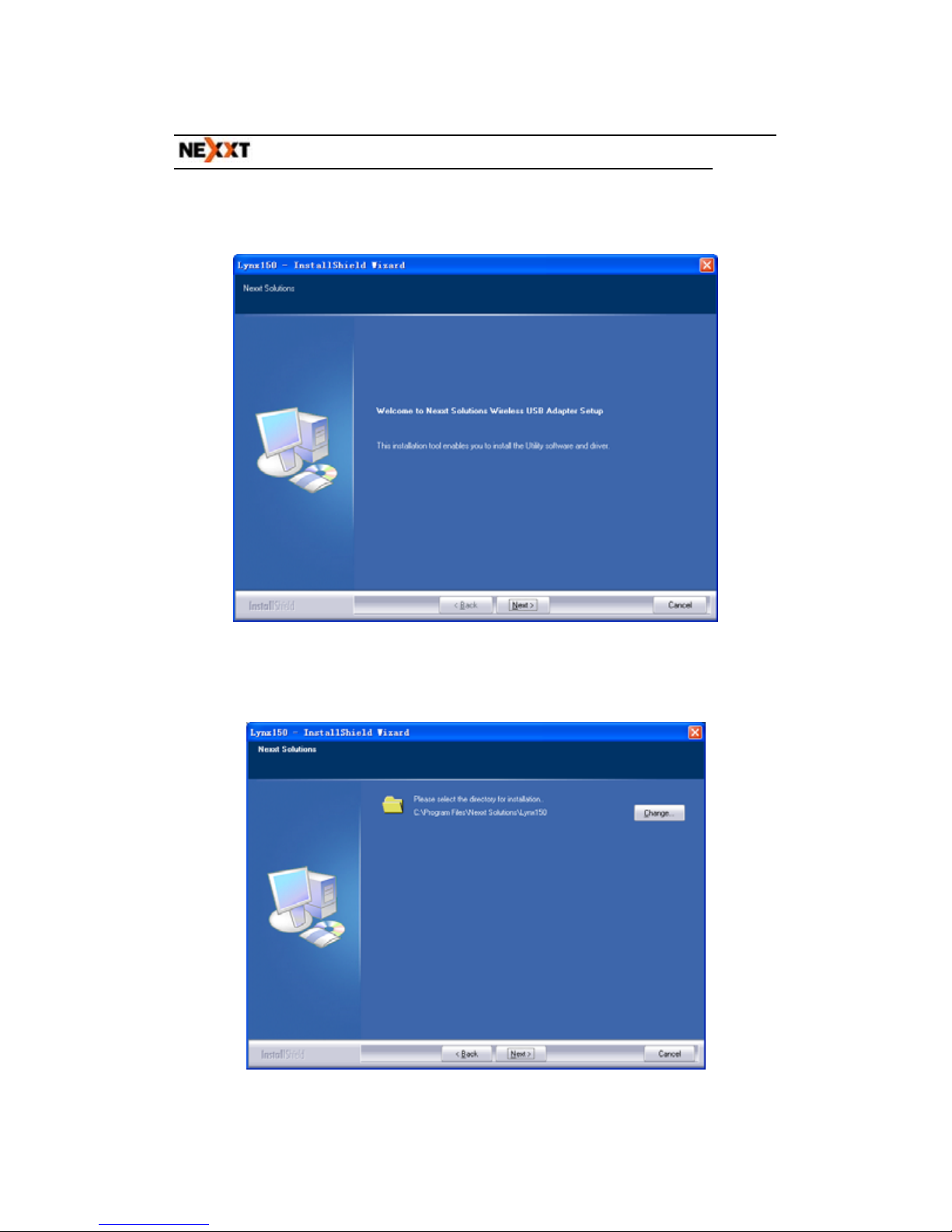
4. Click “Start”.
5. Click “Next” to start installing.
-9-
Page 11
11N Wireless USB Adapter User Guide
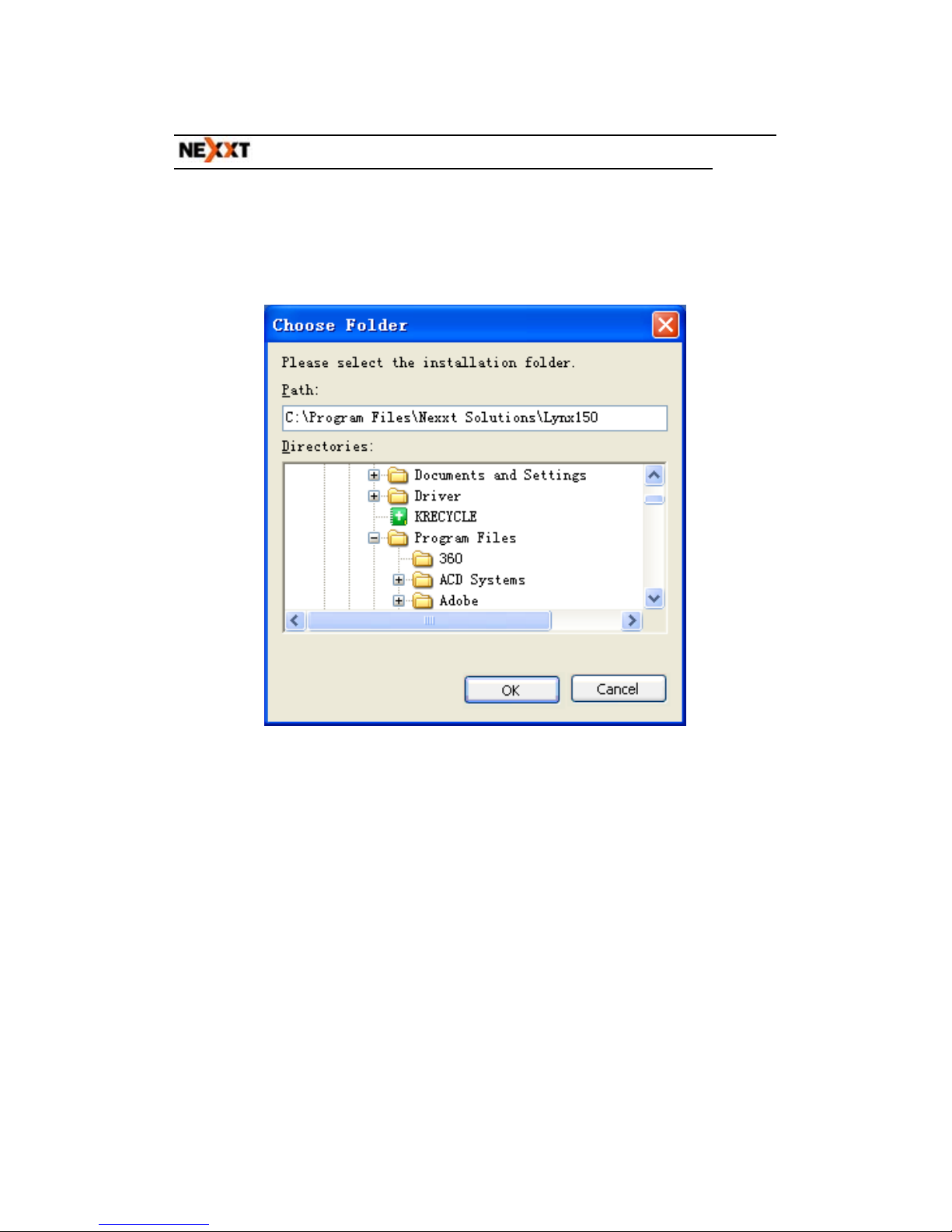
6. Click “Change…” to select the directory path, or
click “Next”.
7. Select “OK” and “Next” in the following window.
-10-
Page 12
11N Wireless USB Adapter User Guide
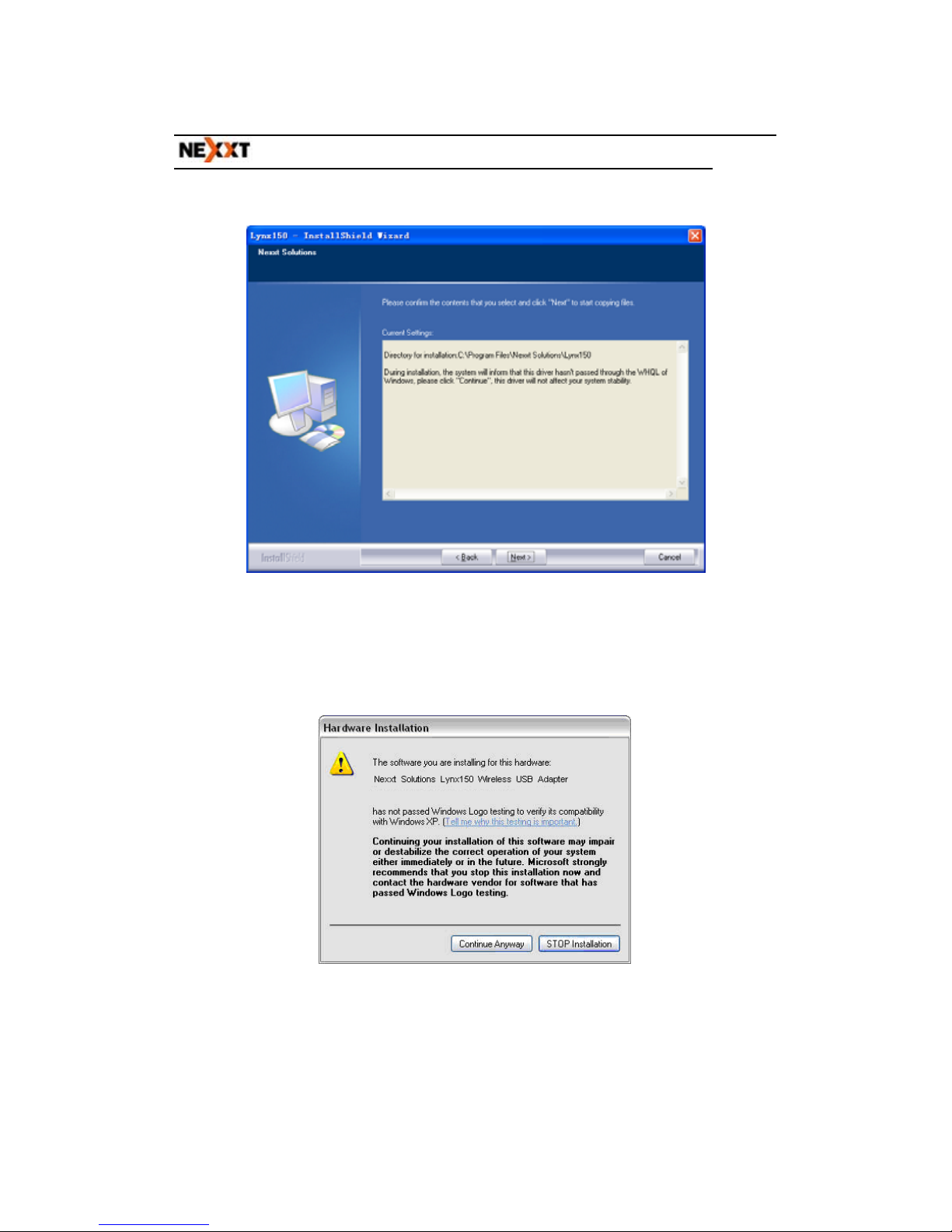
8. During the installation, the following dialogue may
appear. Click the “Continue Anyway” to continue.
There is no security threat to your computer.
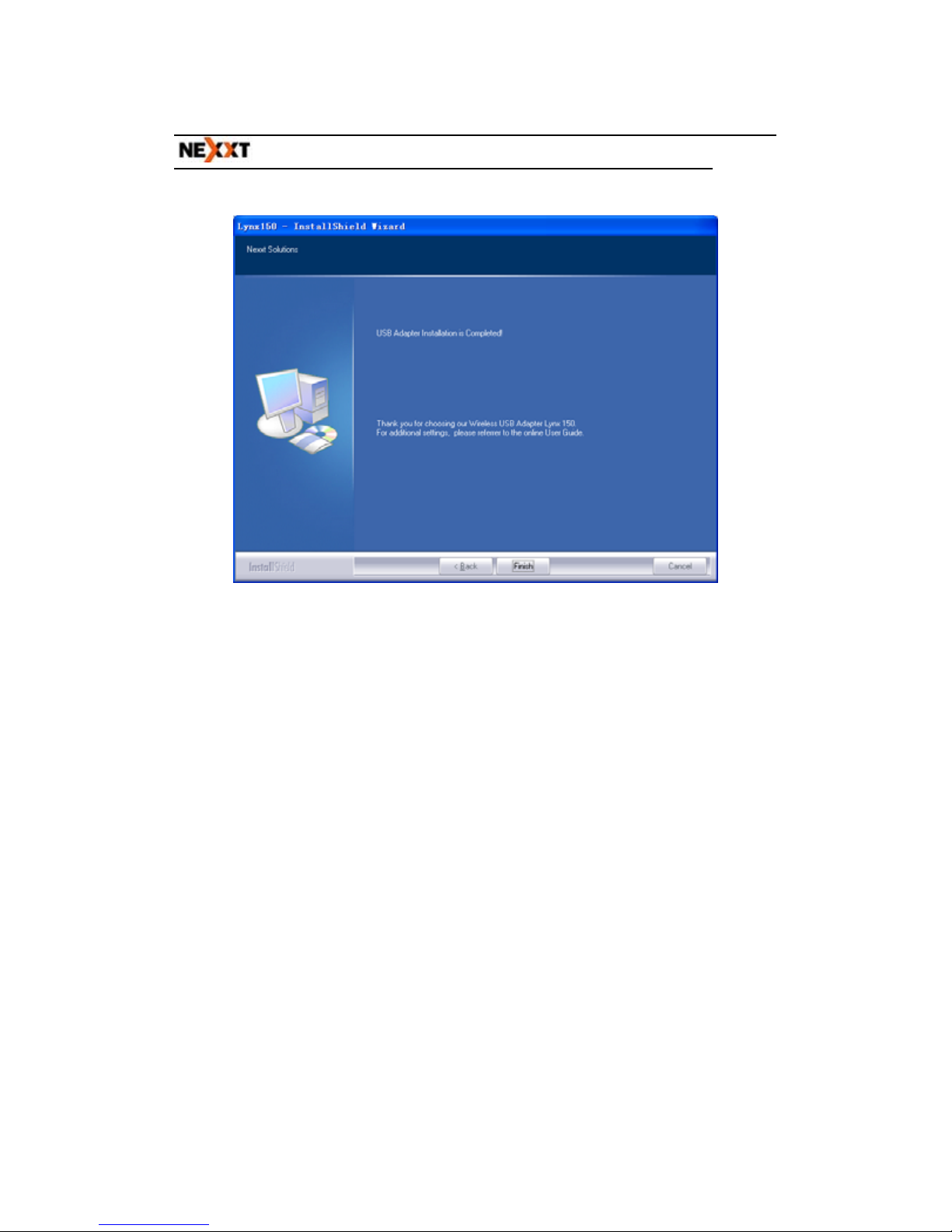
9. Click “Finish” to complete the installation.
-11-
Page 13
11N Wireless USB Adapter User Guide
-12-
Page 14

11N Wireless USB Adapter User Guide
Chapter 3 Client Utility Interface
This software is for the LYNX 150 Wireless USB
Adapter management. If it does not appear, select
“Start”—“A ll Programs” —“Nexxt
Solutions”—“
LYNX 150”, or click the shortcut on
your PC’s desktop.
Note:
In Windows XP, you can select the included
LYNX 150 Client Utility Interface or the
Windows XP internal wireless application to
configure the device.
There are two client utility applications in
LYNX
150
: Station mode and AP mode.
Note:
In this ut ility int erface, St ation Mode (Client M ode)
is the default access way.
-13-
Page 15
11N Wireless USB Adapter User Guide
3.1 Station Mode
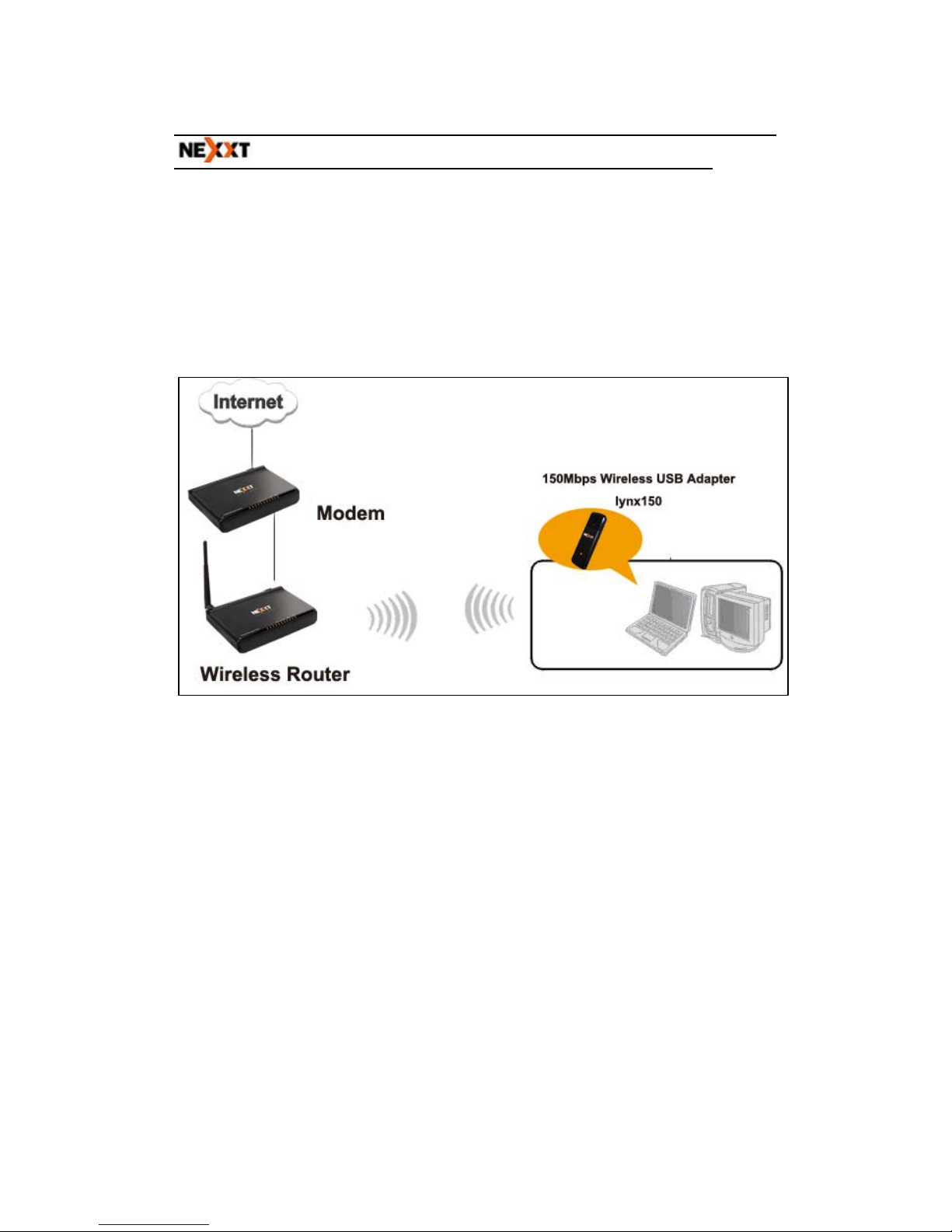
3.1.1 Station Mode Topology
In this mode, LYNX 150 serves as a client to receive
the wireless signals to access the I n ternet.
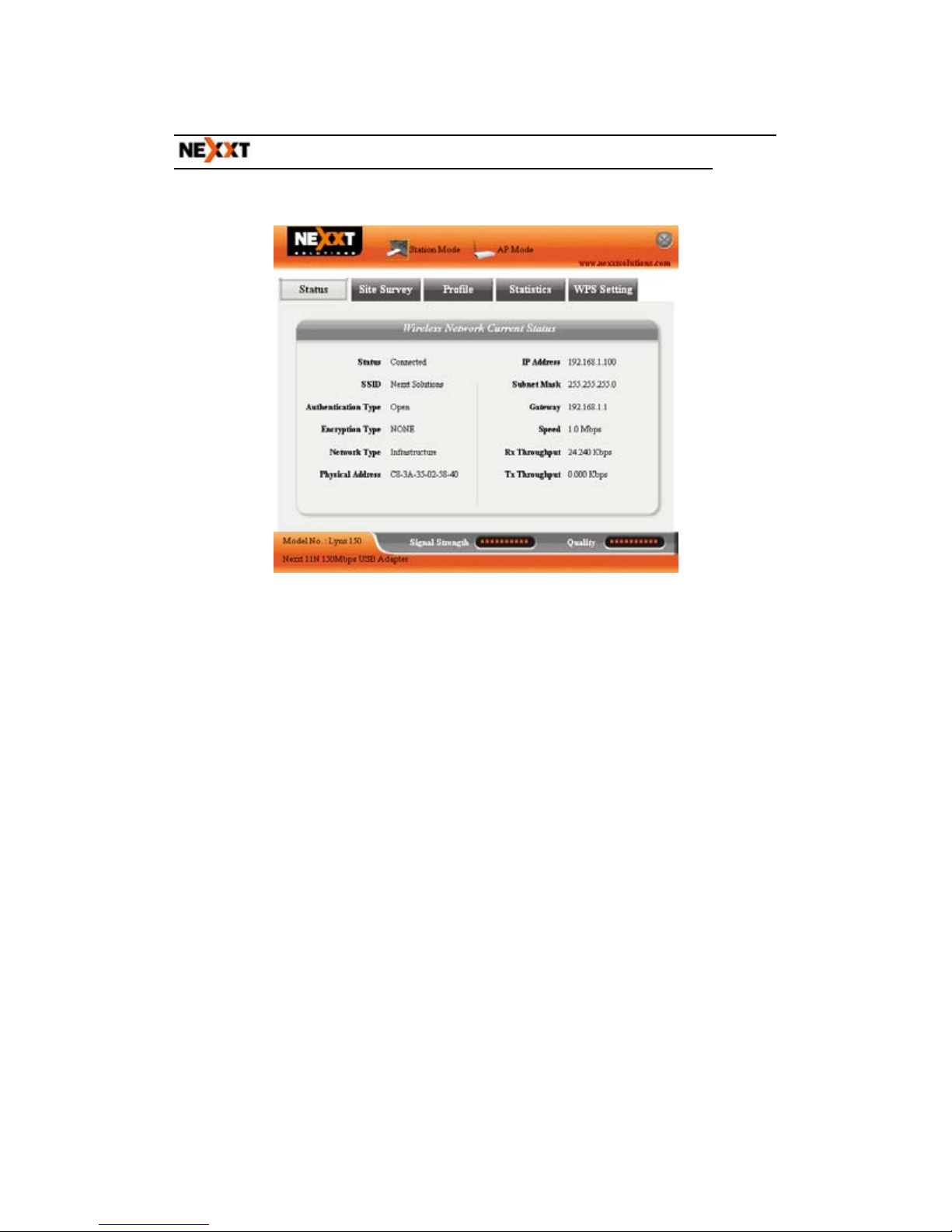
3.1.2 Status
In the Network Status window, it displays something
on wireless adapter and wireless network status,
including SSID, Authentication type, Encryption Type,
IP address, subnet mask and gateway and so on.
-14-
Page 16
11N Wireless USB Adapter User Guide
3.1.3 Site Survey
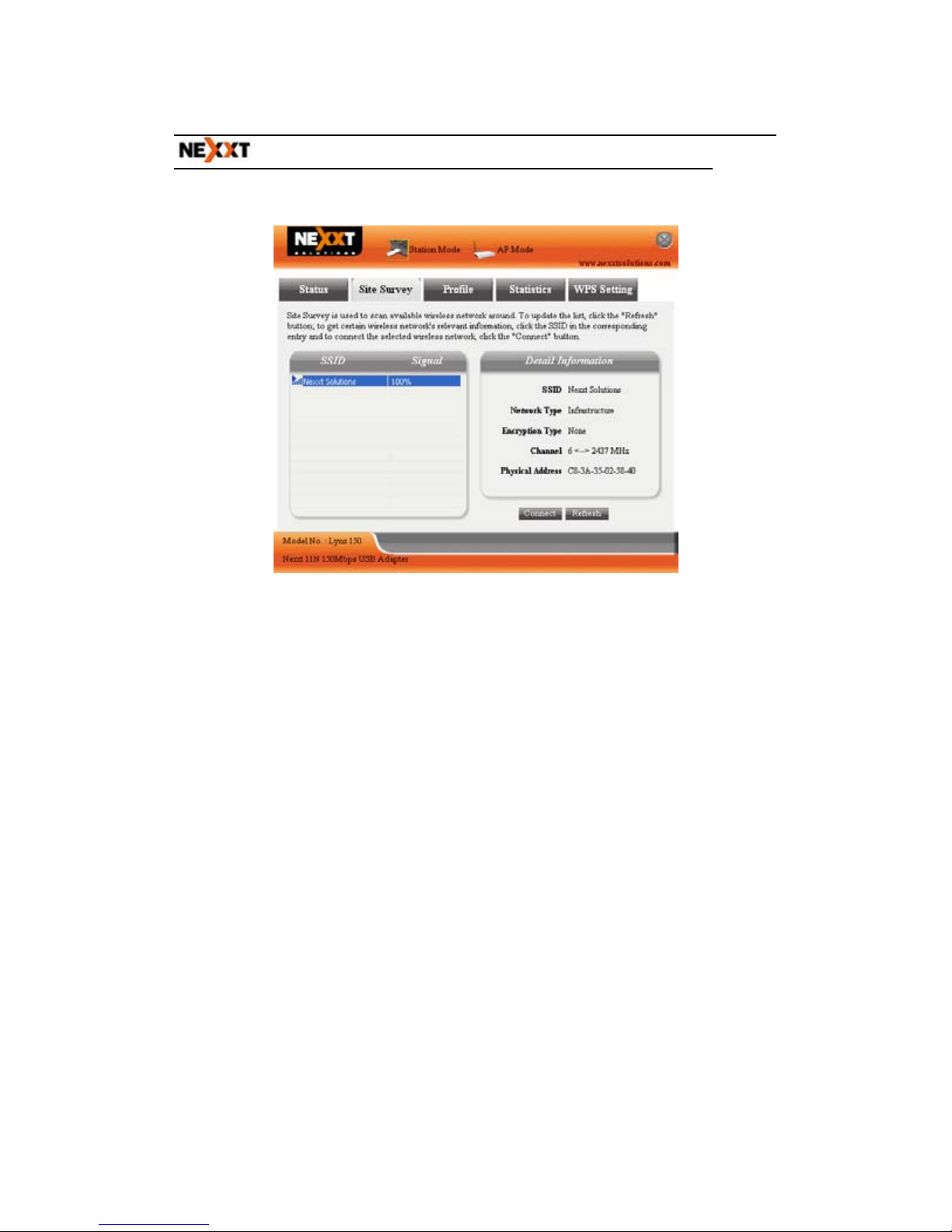
The Site Survey is used to scan the available wireless
network around, showing the wireless network’s signal
strength and other information which provides basis
for you to access which wireless network.
-15-
Page 17
11N Wireless USB Adapter User Guide
Connect: select one entry in the wireless network
list and click the button to connect the device with
the selected network.
Refresh: rescan the wireless network around.
-16-
Page 18
11N Wireless USB Adapter User Guide
3.1.4 Profile Management
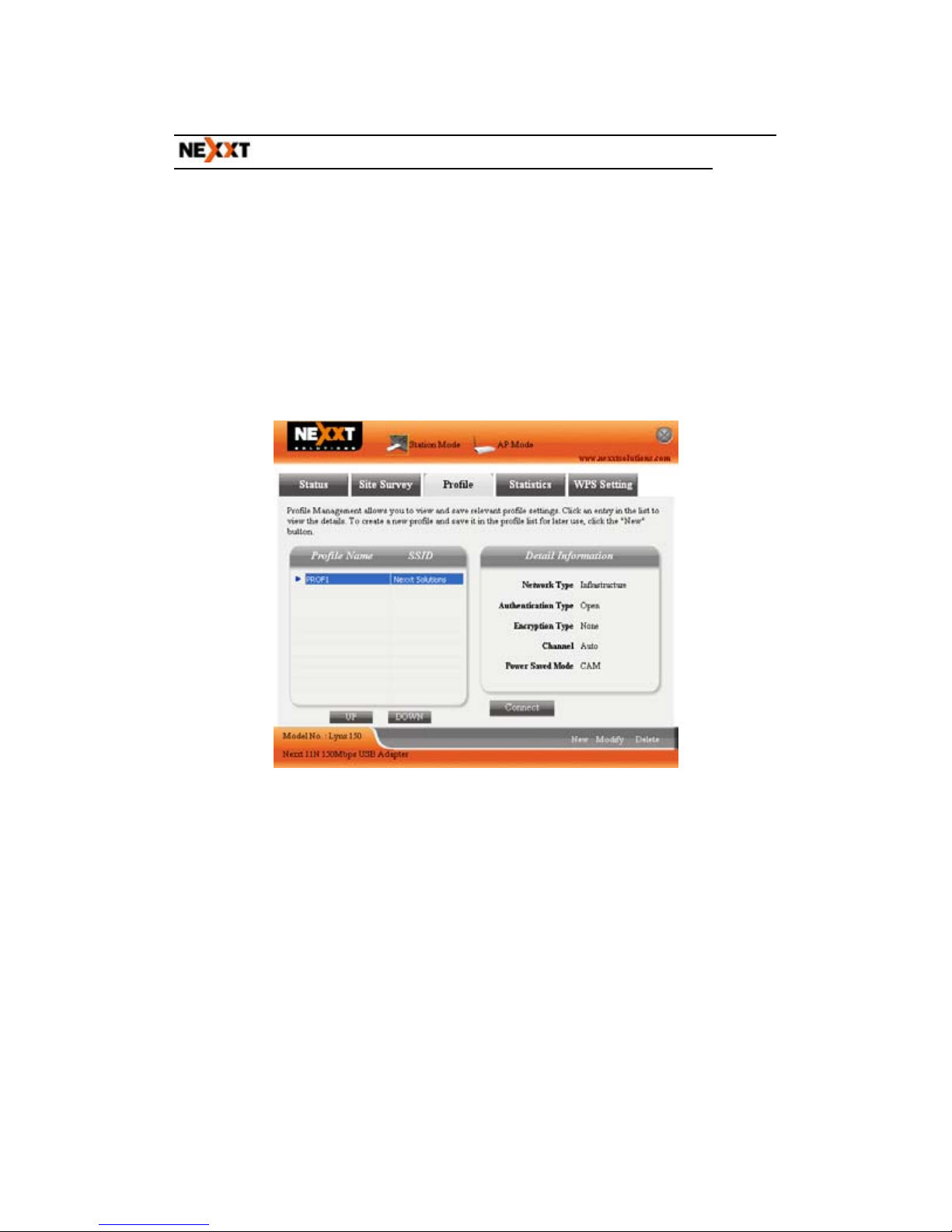
This window saves the general wireless parameters for
different profiles, which are used to connect fast to the
wireless network you need.
UP/DOWN: To change the profile’s sequence in
the list.
Connect: To activate one profile.
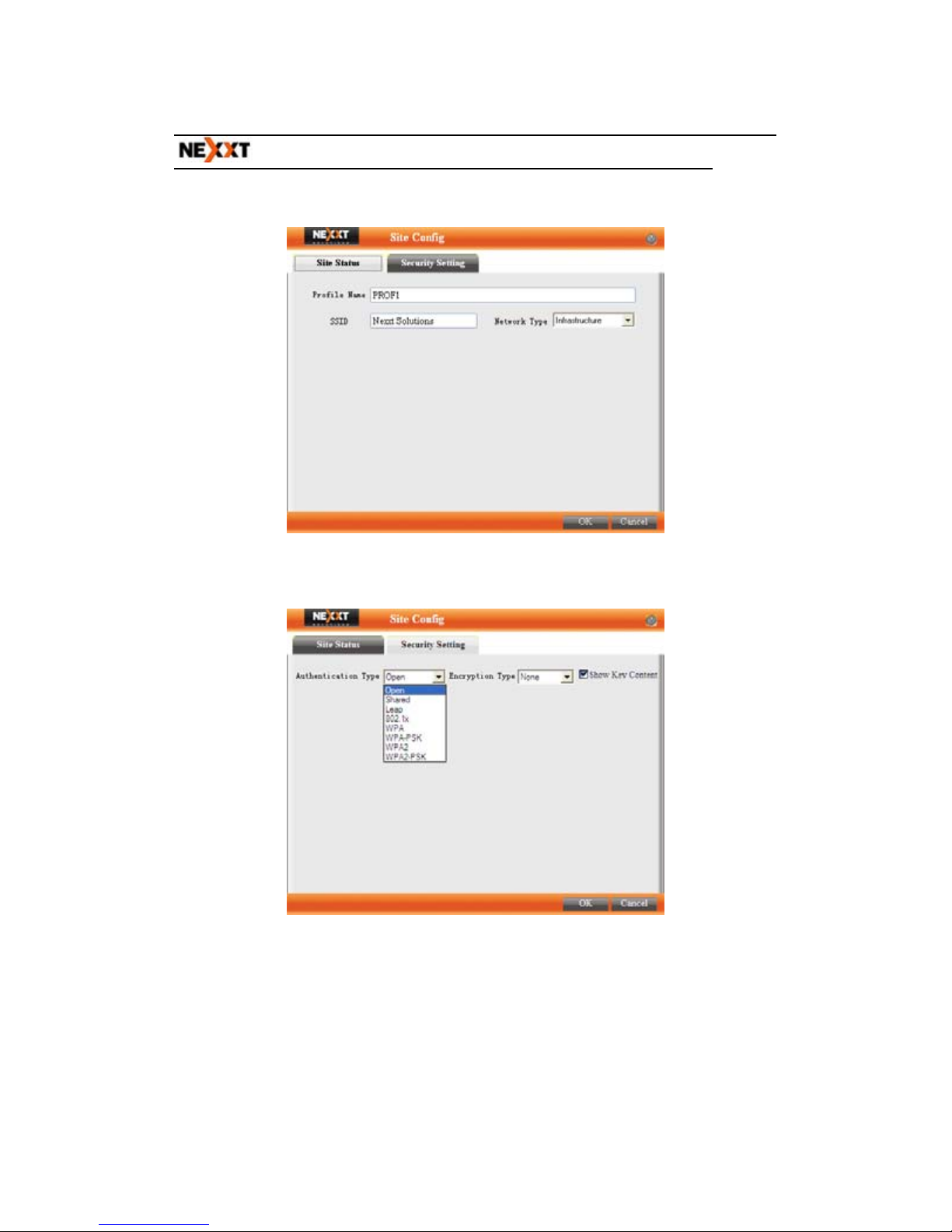
New: To create a new profile and configure the
site status and security setting.
Modify: To modify one existing profile.
Delete: To delete one existing profil e.
-17-
Page 19
11N Wireless USB Adapter User Guide
(Site Status)
(Security Setting)
-18-
Page 20
11N Wireless USB Adapter User Guide
3.1.5 Statistics
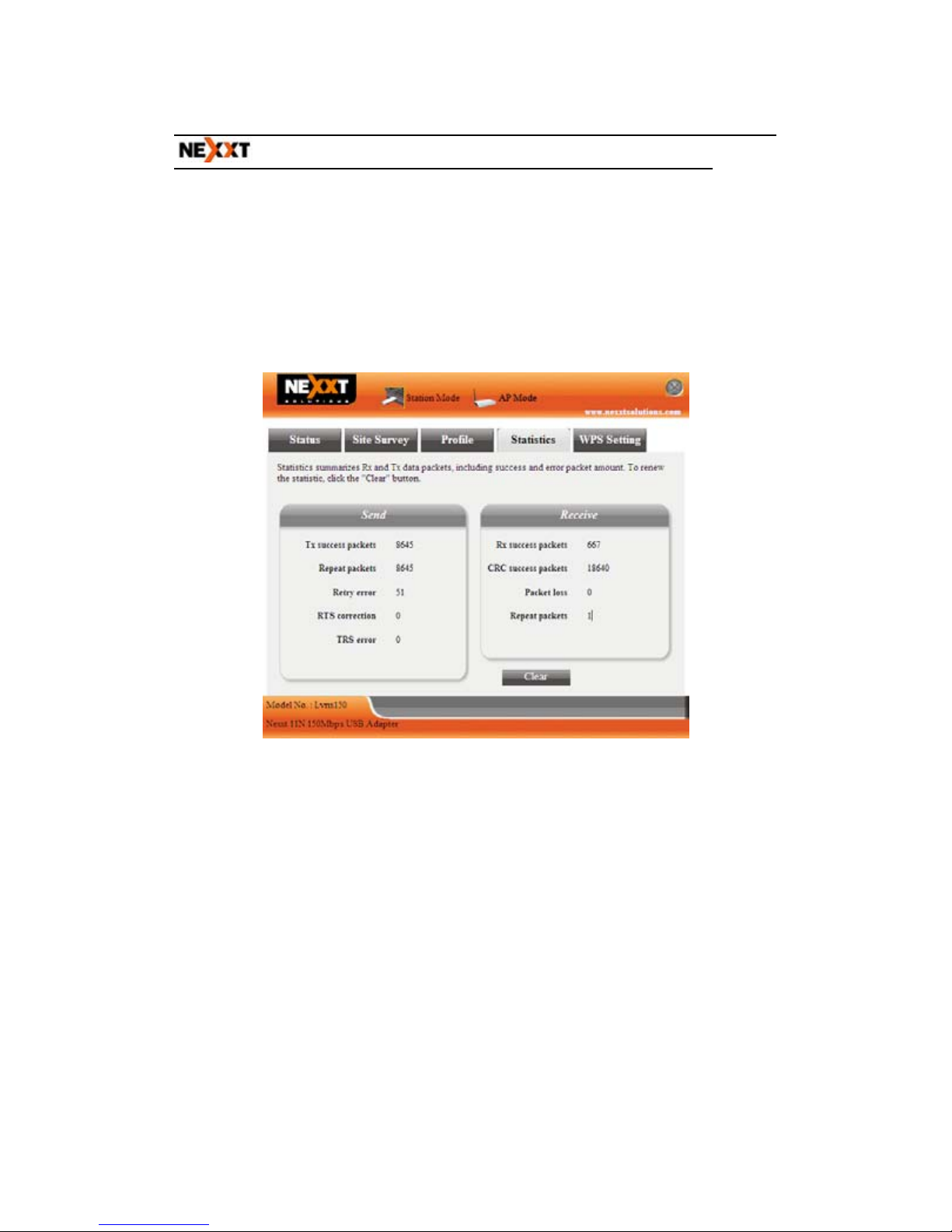
Statistics is used to summarize Rx and Tx data packets,
including the success and error packet amount.
Clear: click this button to renew the statistics.
3.1.6 WPS Settings
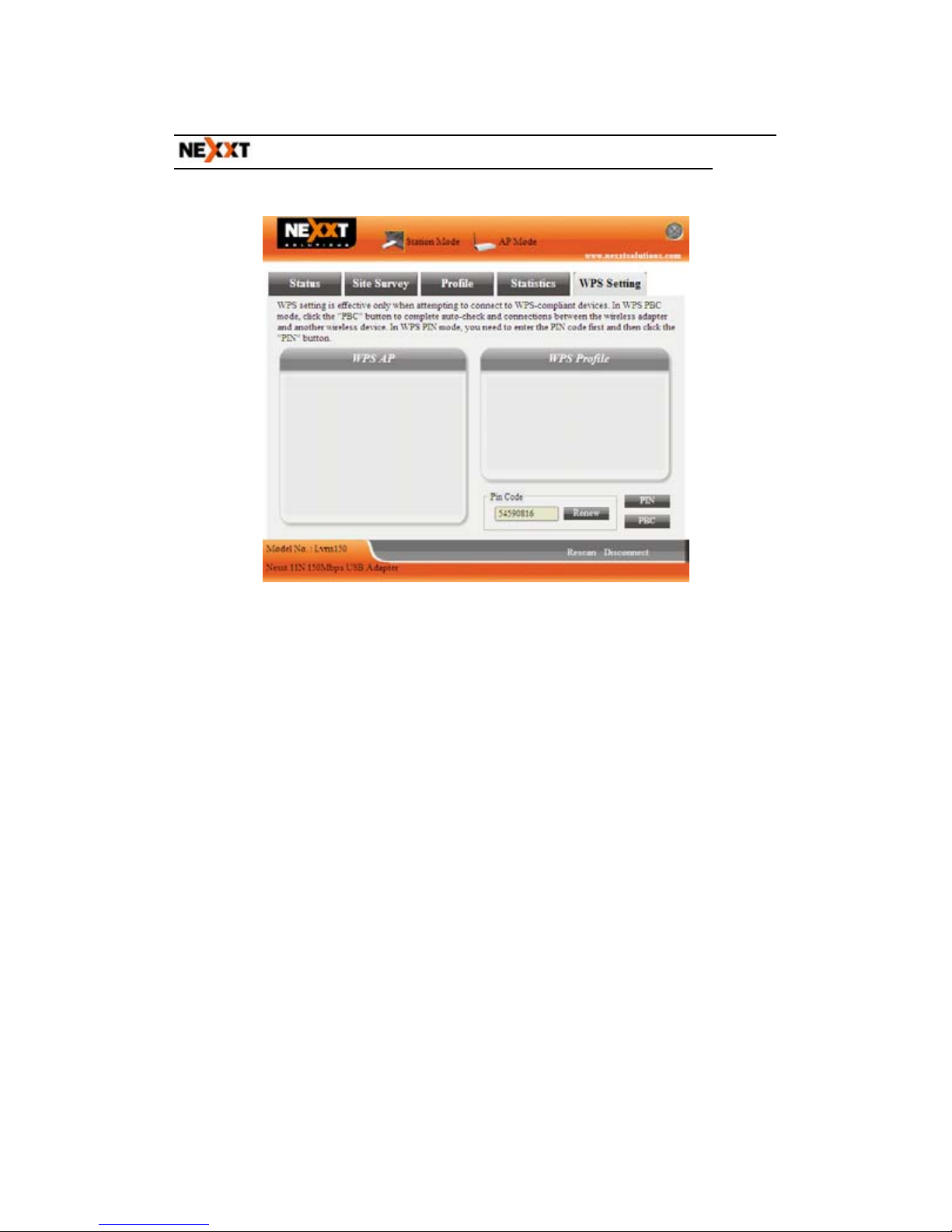
WPS setting is enabled only on WPS-compliant
devices.
-19-
Page 21
11N Wireless USB Adapter User Guide
PIN: Enter the Pin code and click the “PIN” to
automatically connect the wireless adapter with
wireless devices around.
PBC: Click the “PBC” to complete auto-check and
connections between wireless adapter and other
wireless device.
Refresh: to update the Pin code.
Rescan: to rescan the WPS-compliant wireless
network around.
Connect: click this button to connect the WPS
wireless network.
Disconnect: to disconnect the connected wireless
network.
-20-
Page 22
11N Wireless USB Adapter User Guide
3.2 AP Mode
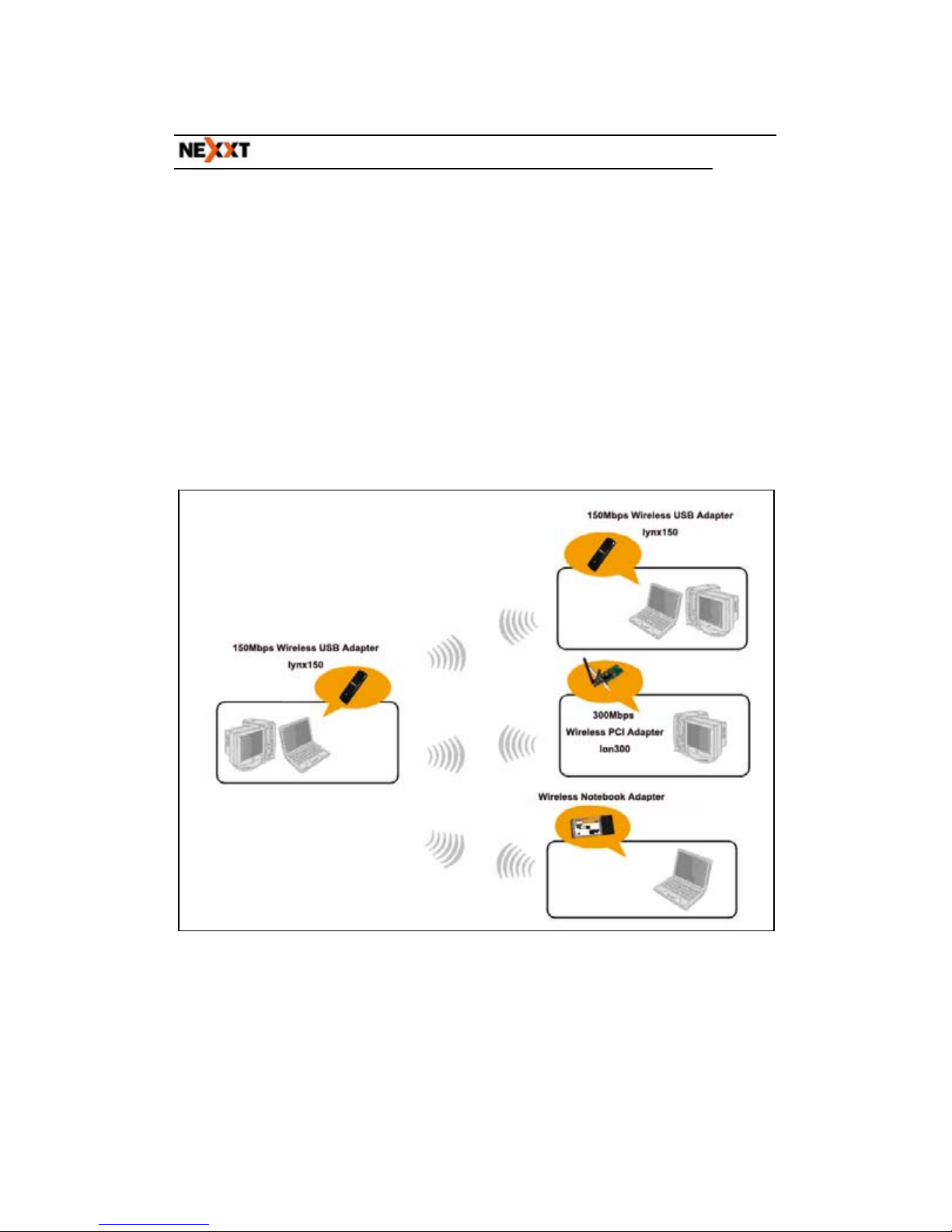
3.2.1 AP Mode Topology
The device also can serve as an access point to
transmit wireless signals and create a wireless
network, allowing other wireless clients to access the
network.
Click the AP Mode icon to enter the AP Mode interface.
-21-
Page 23
11N Wireless USB Adapter User Guide
3.2.2 Basic Settings
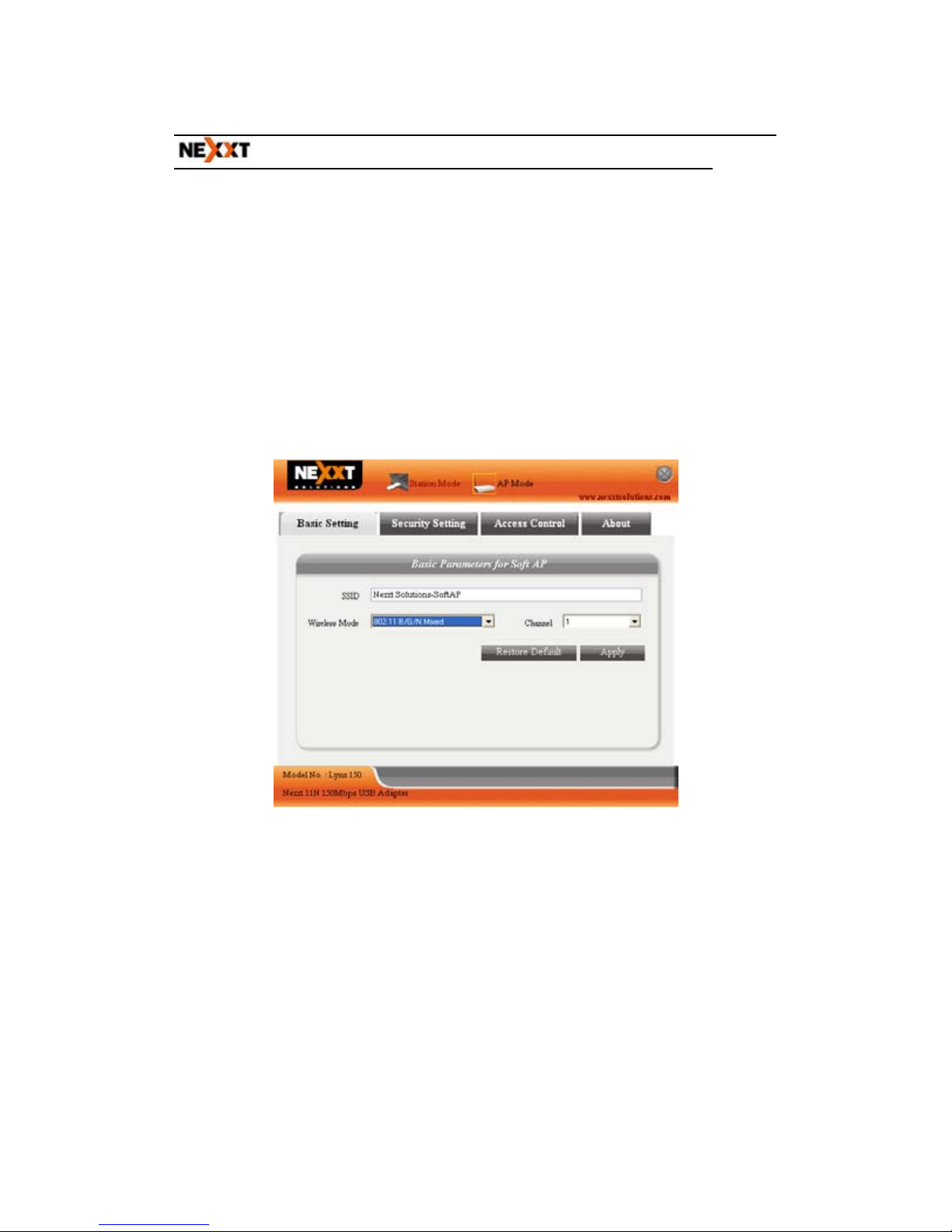
This window is used to configure the AP’s basic
parameters, including SSID, Wireless Mode and
Channel.
SSID: Wireless network’s ID name scanned by
wireless adapter.
Wireless Mode: 802.11b/802.11g/802.11b/g
mixed.
Channel: 1~11 channels provided.
Restore Default: to restore the set parameters to
-22-
Page 24
11N Wireless USB Adapter User Guide
default factory default settings.
Apply: to make the changes established take
effect.
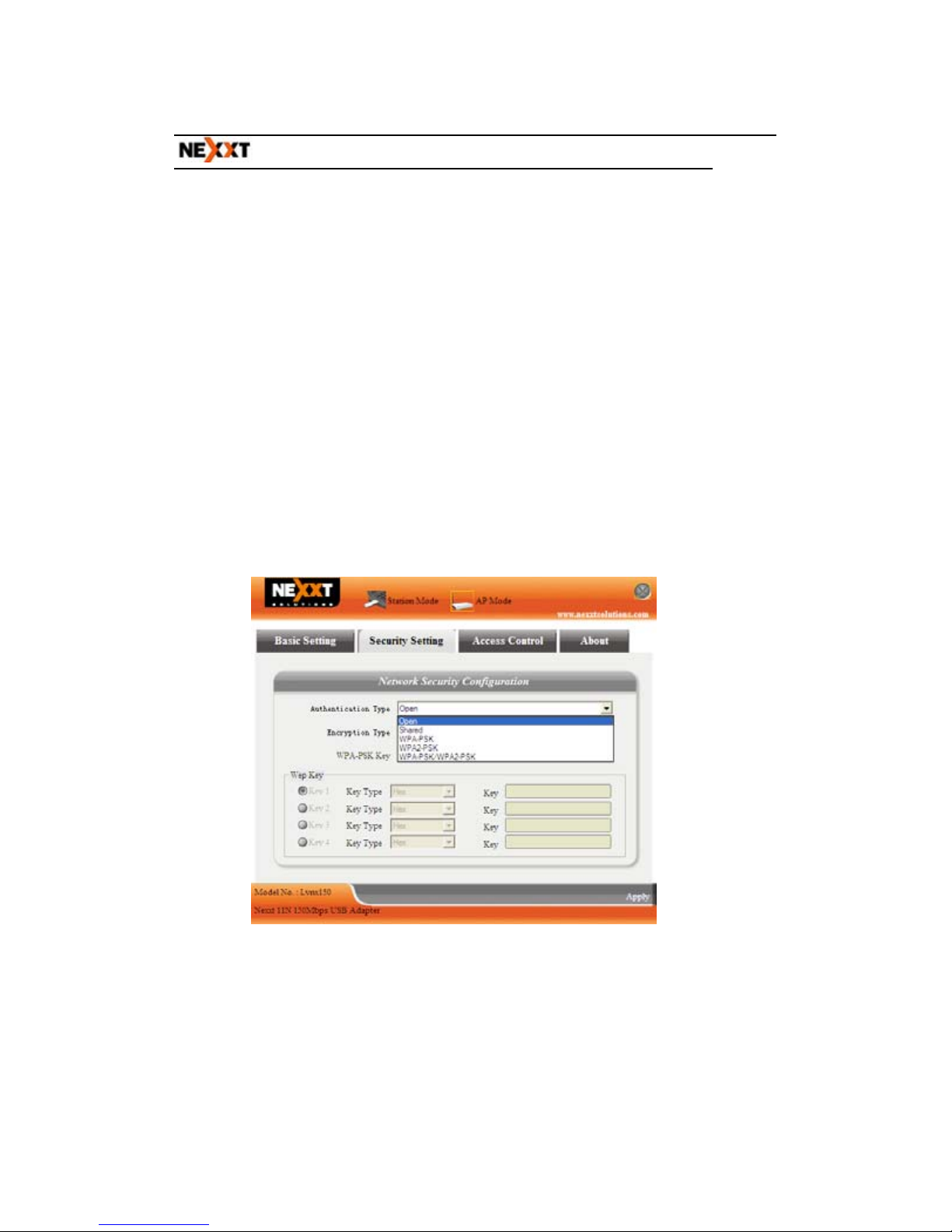
3.2.3 Security Settings
This window is used to configure the wireless
network’s security authentication, providing WEP,
WPA-PSK, WPA2-PSK, and WPA-PSK/WPA2-PSK
encryption methods.
WEP:10/26 bits Hex or 5/13 ASCII support.
WPA-PSK:8~32 bits ASCII support.
WPA2-PSK:8~32 bits ASCII support.
-23-
Page 25

11N Wireless USB Adapter User Guide
WPA-PSK/WPA2-PSK:8~32 bits ASCII support.
Note:
1. The Hex characters include 0~9 numbers and
a~f letters.
2. ASCII characters include any numbers/letters
and characters.
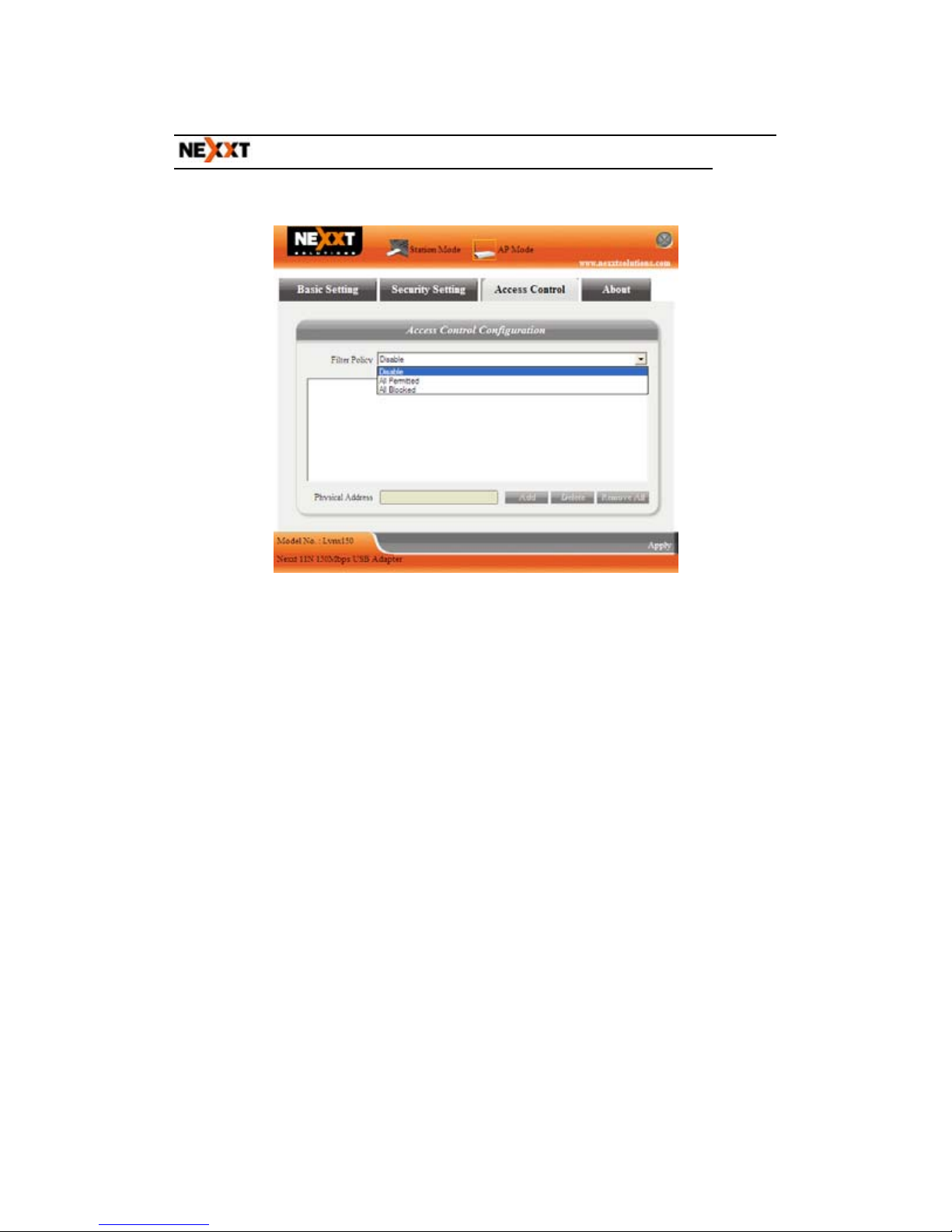
3.2.4 Access Control
Access Control is based on the MAC address to decide
that the specified client connects to the wireless
network, or disables it to access the wireless network.
-24-
Page 26
11N Wireless USB Adapter User Guide
Filter Policy:
Disabled: to disable the filter function.
All Permitted: to permit a ll clients in the list t o
access the wireless network.
All Blocked: to refuse all clients in the list to
access the wireless network.
MAC Address:to input the client’s MAC address to
implement the corresponding filter policy. For
example: b0000a8cd702.
Add: to add the entered MAC address into the list.
Delete: to delete one existing MAC address in the
list.
-25-
Page 27
11N Wireless USB Adapter User Guide
Remove All: to delete all clients’ MAC address in
the list.
Apply: to make the changes established take
effect.
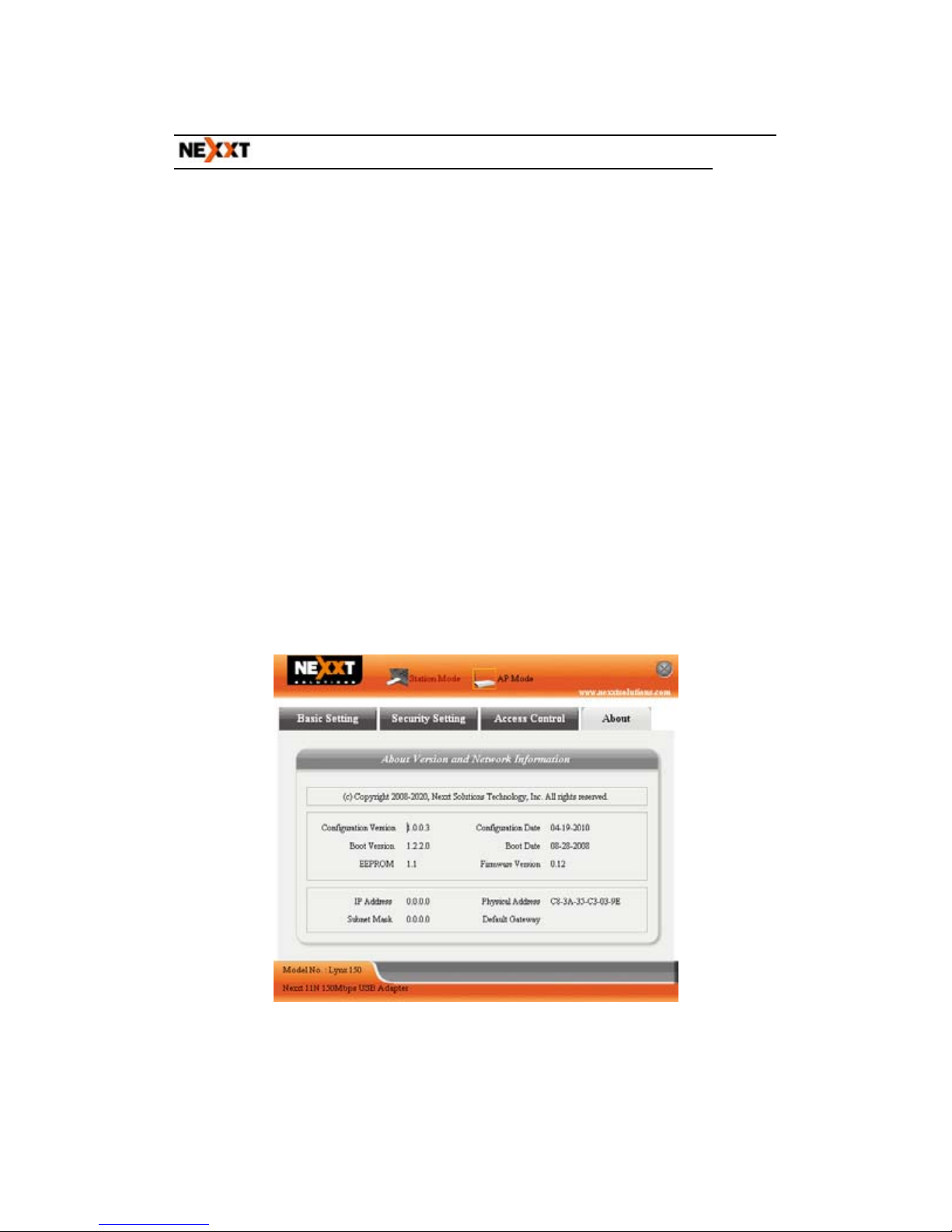
3.2.5 About
This window displays information about software
version and wireless adapter.
-26-
Page 28

11N Wireless USB Adapter User Guide
Appendix One: Acronyms and Terms
WLAN Wireless Local Area Network
802.11 A family of specifications developed by
the IEEE for WLAN technology.
802.11a An extension to 802.11 WLAN standard
that provides up to 54 Mbps
transmission in the 5 GHz UNI radio
band.
802.11b An extension to 802.11 WLAN standard
that provides up to 11 Mbps
transmission in the 2.4 GHz ISM radio
band. 802.11b uses DSSS modulation.
802.11g An extension to 802.11 WLAN standard
that provides up to 54 Mbps
transmission in the 2.4 GHz ISM radio
band. 802.11b uses OFDM modulation
and is backwards compatible with
802.11b.
Ad-Hoc A group of computers each with wireless
adapters, connected as an independent
-27-
Page 29

11N Wireless USB Adapter User Guide
WLAN.
AES Advanced Encryption Standard
BSSID Basic Service Set ID
DHCP Dynamic Host Configuration Protocol
DSSS Direct Sequence Spread Spectrum.
DSSS is one of two types of spread
spectrum radio. The other is
frequency-hopping spread spectrum
(FHSS).
QoS Quality of Service
OFDM Orthogonal Frequency Division
Multiplexing
RADIUS Remote Authentication Dial In User
Service
RTS Request to Send
SSID Service Set Identifier. A 32-character
unique identifier attached to the header
of packets sent over a WLAN that acts as
a password when a mobile device tries
to connect to the BSS.
TCP/IP Transmission Control Protocol/Internet
Protocol
-28-
Page 30

11N Wireless USB Adapter User Guide
TKIP Temporal Key Integri ty Protocol
WDS Wireless Distribution System
WEP Wired Equivalent Privacy. A security
protocol for
WLANs defined in the IEEE 802.11
standard.
WPA Wi-Fi Protected Access
WPA2 Wi-Fi Protected Access 2. The next
generation of
Wi-Fi security, based on the 802.11i
standard.
WPA2-PSK Wi-Fi Protected Access 2-Pre-shared
Keys
WPA-PSK Wi-Fi Protected Access-Pre-shared Keys
-29-
Page 31
11N Wireless USB Adapter User Guide
Appendix Two: Product Specification
Standard
IEEE802.11g, IEEE802.11b,
IEEE802.11n
Port USB2.0
Frequency Range 2.4GHz
Transmission Rate
130Mbps, 117Mbps, 104Mbps,
78Mbps, 52Mbps, 39Mbps,
26Mbps, 13Mbps, 65Mbps,
58.5Mbps, 52Mbps, 39Mbps,
26Mbps, 19.5Mbps, 13Mbps,
6.5Mbps, 54 Mbps, 48 Mbps, 36
Mbps, 24 Mbps, 18 Mbps, 12
Mbps, 9 Mbps, 6 Mbps, 11 Mbps,
5.5 Mbps, 2 Mbps, 1 Mbps
Transmission
Power
Max. 15dbm
Modulation Method
OFDM, CCK
Working Temper. 0℃~40℃
Storage Temper. -40℃~70℃
Working Humidity 10%~90%RH non-condensing
-30-
Page 32
11N Wireless USB Adapter User Guide
Appendix Three: How to connect with
PSP™
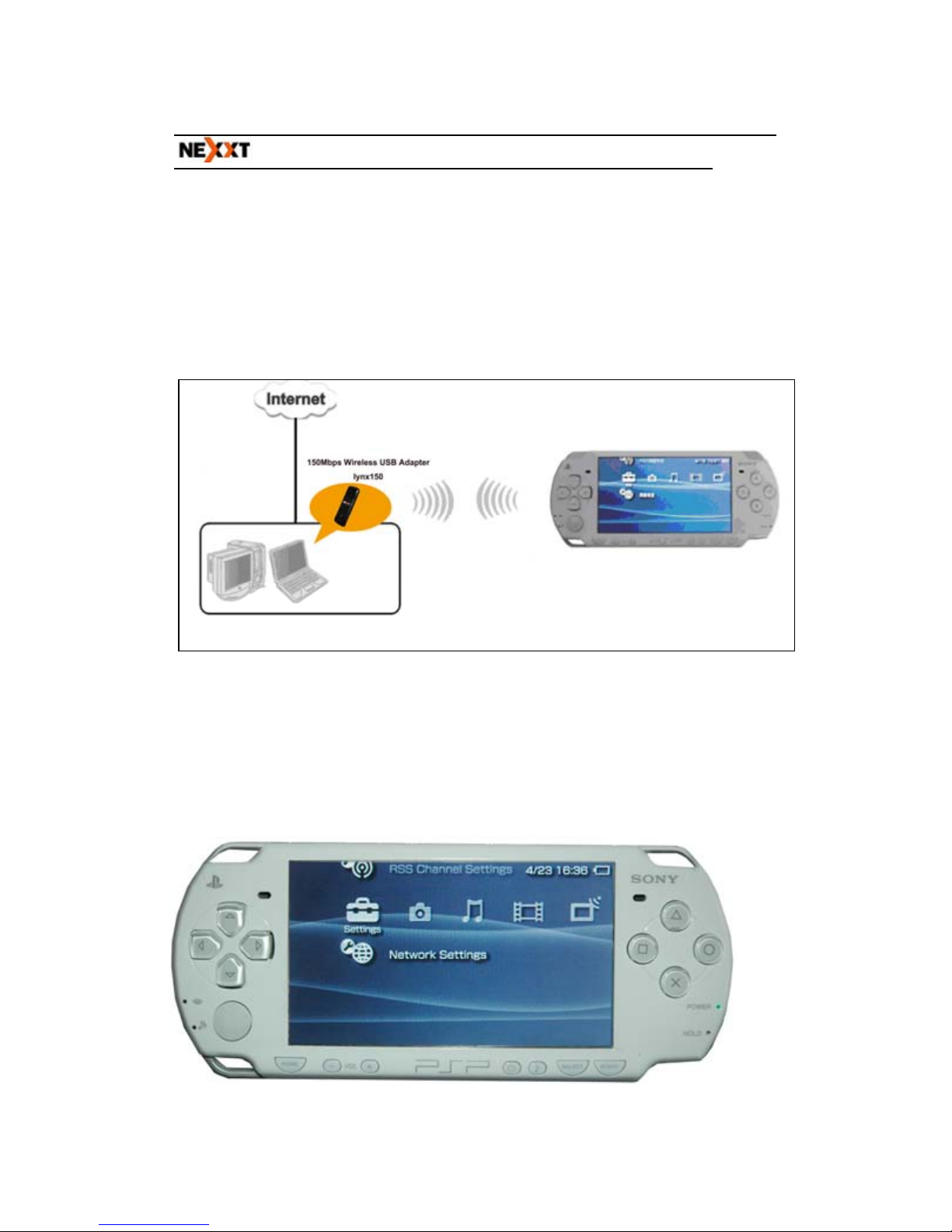
1. Topology of PSP™ connecting with LYNX 150
2. To configure PSP™ with Ad-Hoc mode
Select Network Settings
-31-
Page 33
11N Wireless USB Adapter User Guide
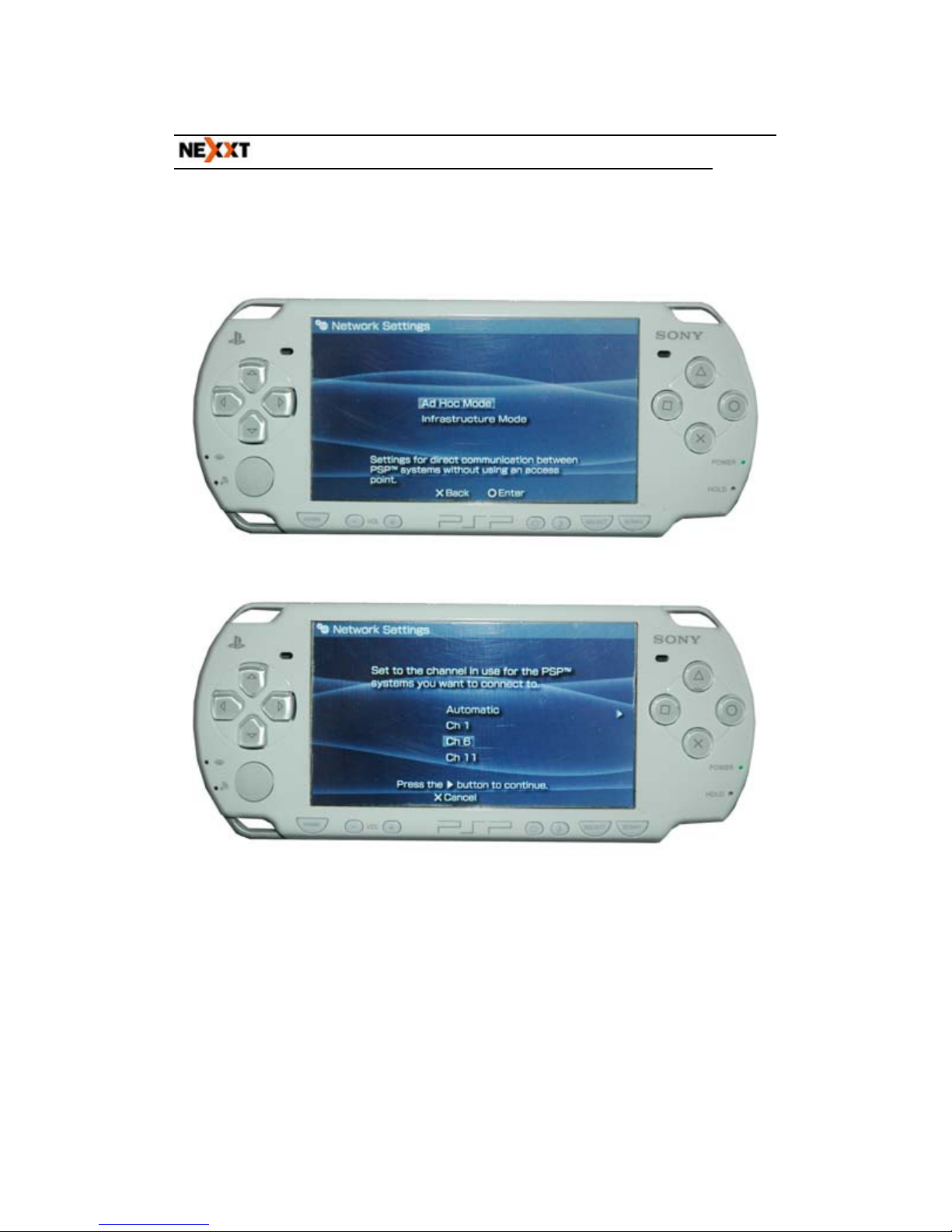
Select Ad-Hoc mode
2.3 Select Channel
-32-
Page 34
11N Wireless USB Adapter User Guide
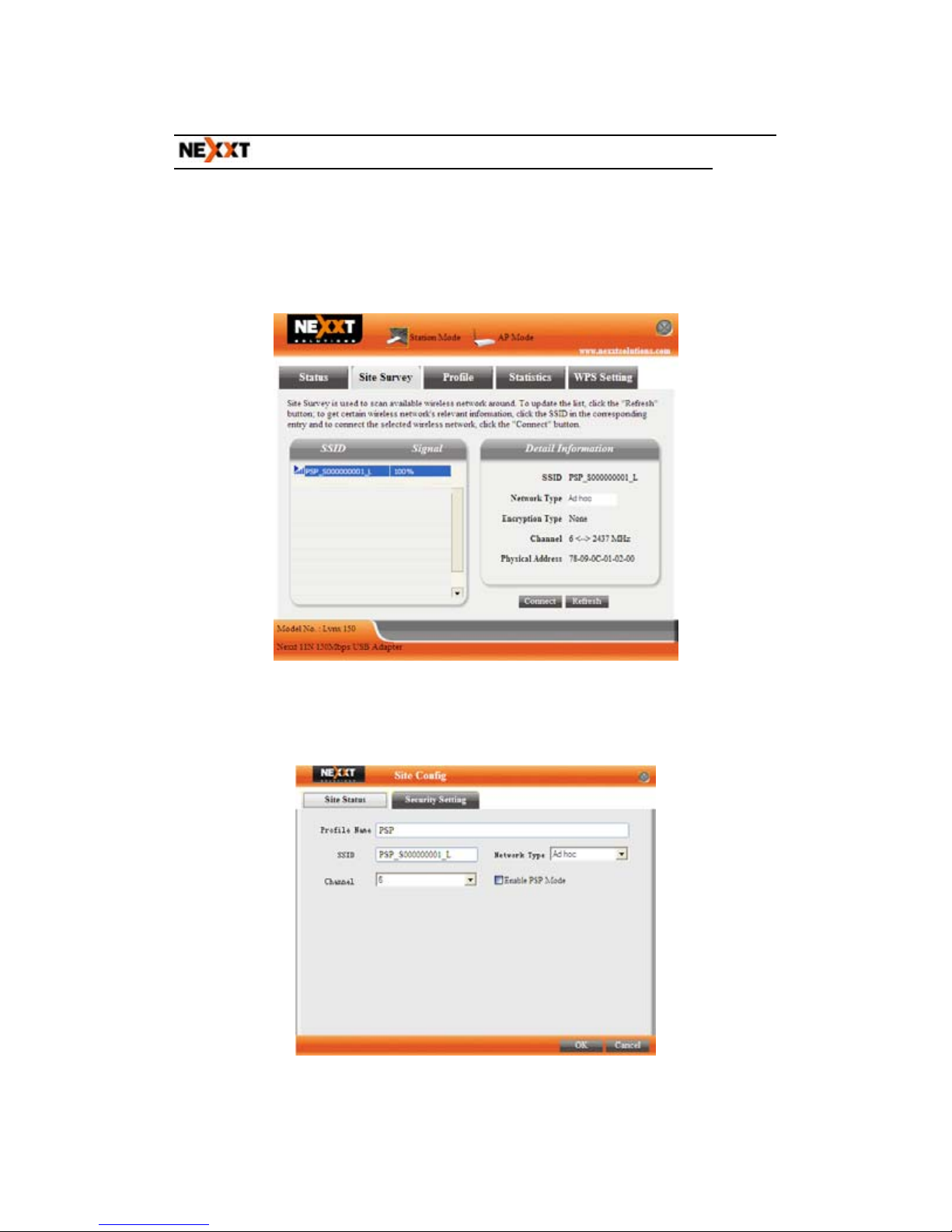
3. In LYNX 150 Utility Interface scan PSP™ and
double-click to connect the wireless
network.
4. In Site Survey check “enable PSP™
connection mode” box.
-33-
Page 35
11N Wireless USB Adapter User Guide
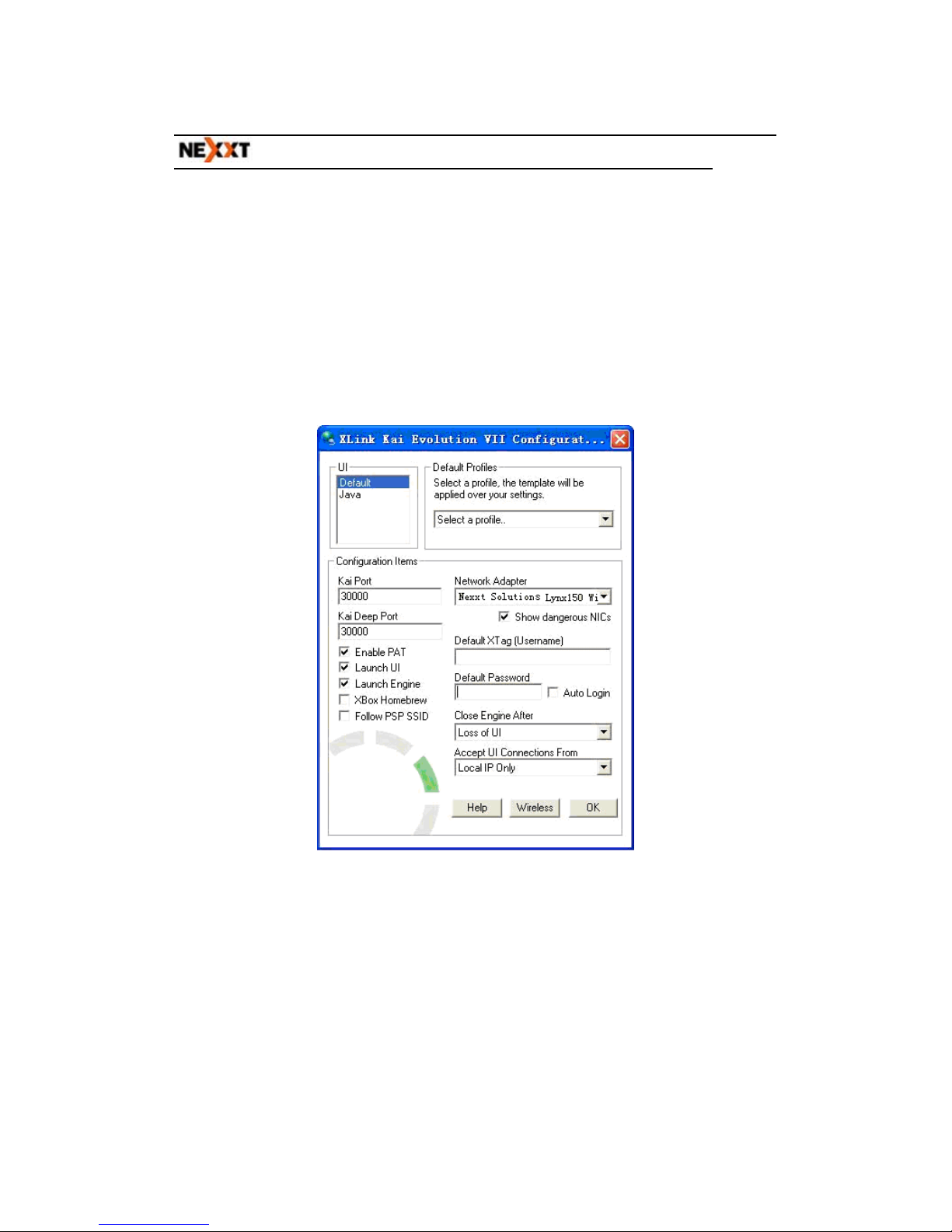
5. To configure Xlink Kai
Select “Start”→ “All programmers” → “Xlink Kai
Evolution VII” → “Start Kai Config” to configure the
user name, password and other parameters as
follows.
-34-
Page 36
11N Wireless USB Adapter User Guide
6. Login Xlink Kai
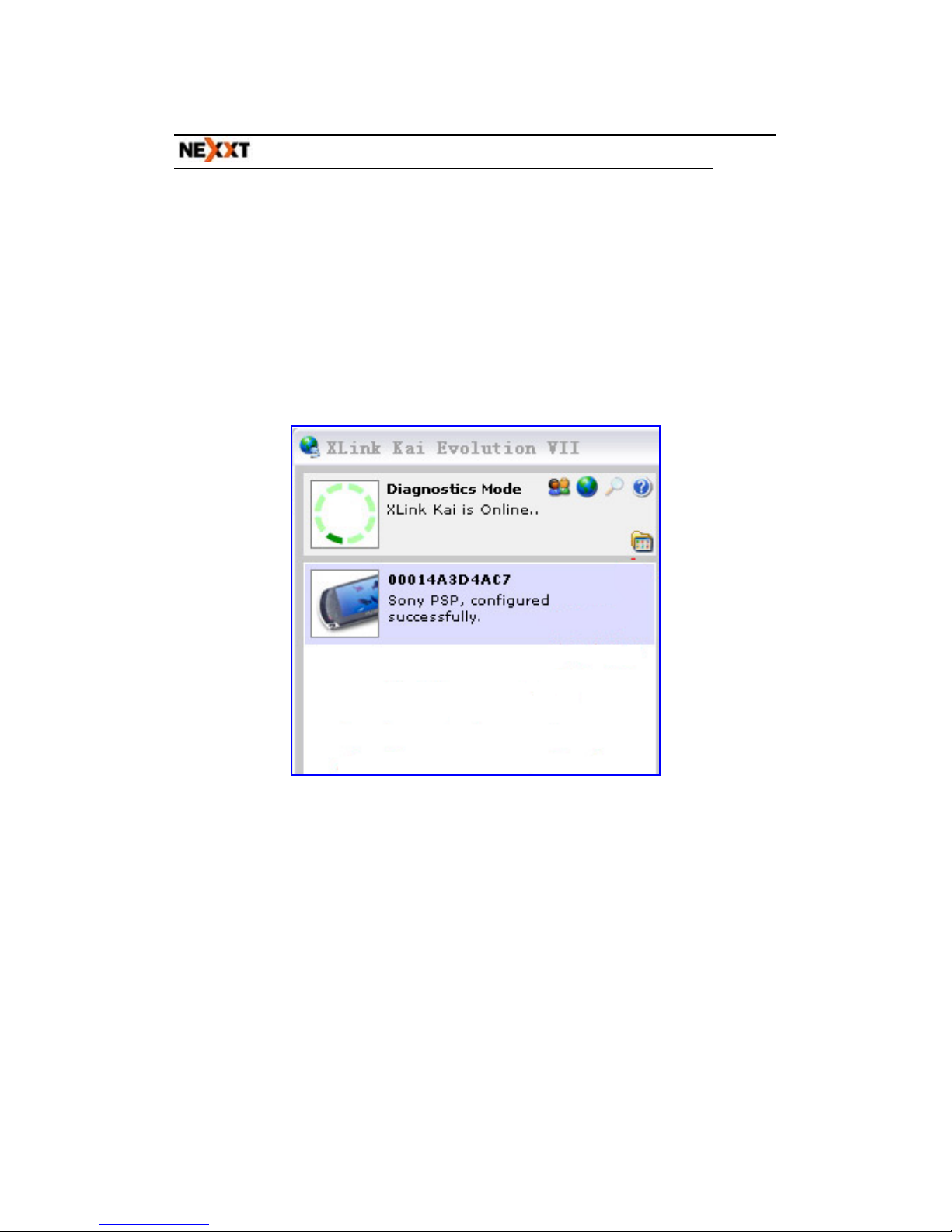
Select “Start”→ “All prog r am s” → “Xlink Kai Evolution
VII” → “Start Kai”. PSP™ will connect with Xlink Kai
automatically. The following window will indicate the
connection is established well now.
-35-
 Loading...