

Page 1
Bedienungsanleitung
Operating Instructions
NEVATON
MC 403
NEVATON - EUROPE
Lebachstrasse 30
5322 Hof bei Salzburg
Austria
Phone +43 6229 2712
Fax +43 6229 2712
Email: [email protected]
www.nevaton.eu
The Finest Handmade Microphones
Since 1947
Page 2

3
2
Table of Contents
1. The Boundary Layer Condenser
Microphone MC 403
Inhaltsverzeichnis
1. Description
2. Powering Technik
3. Technical Specifications
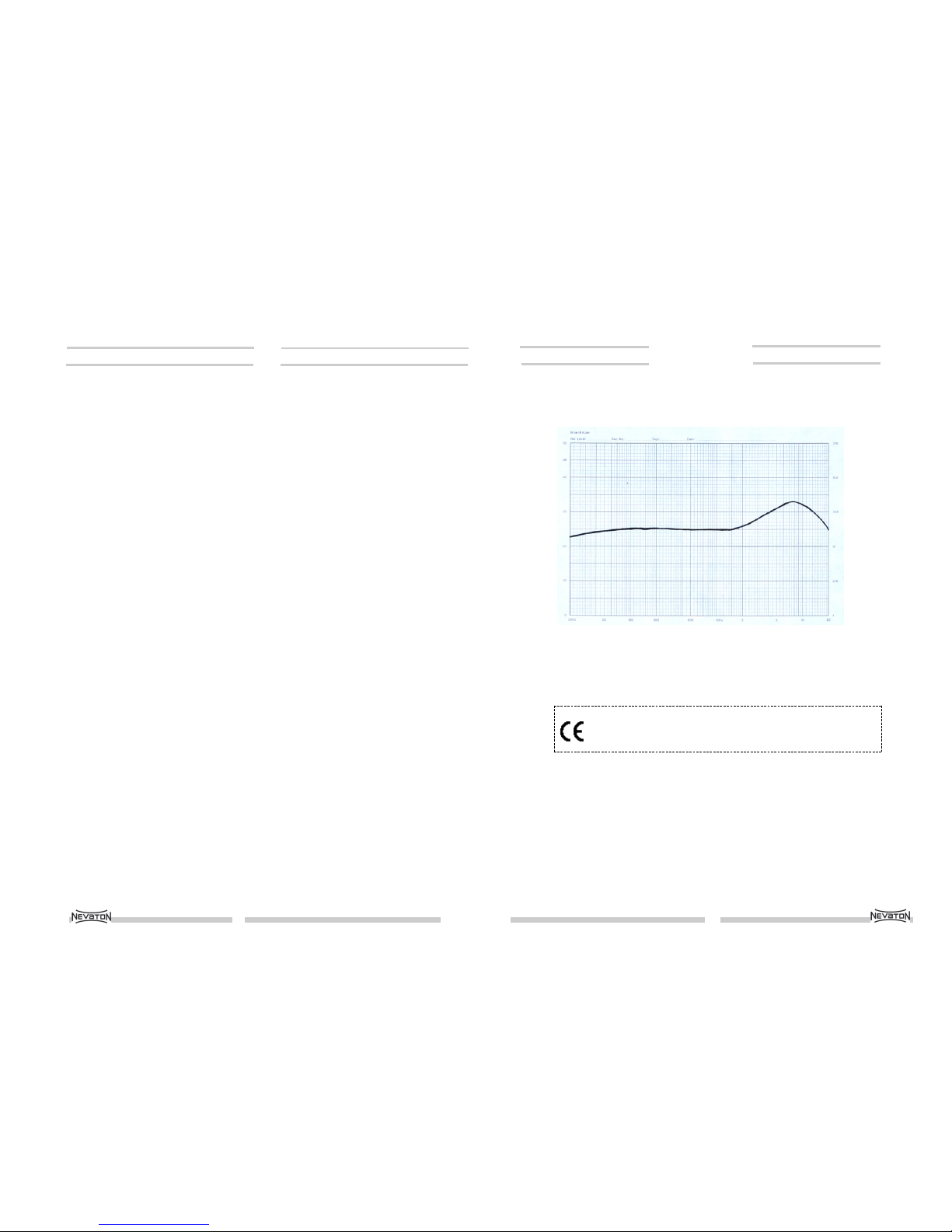
4. Frequency Range
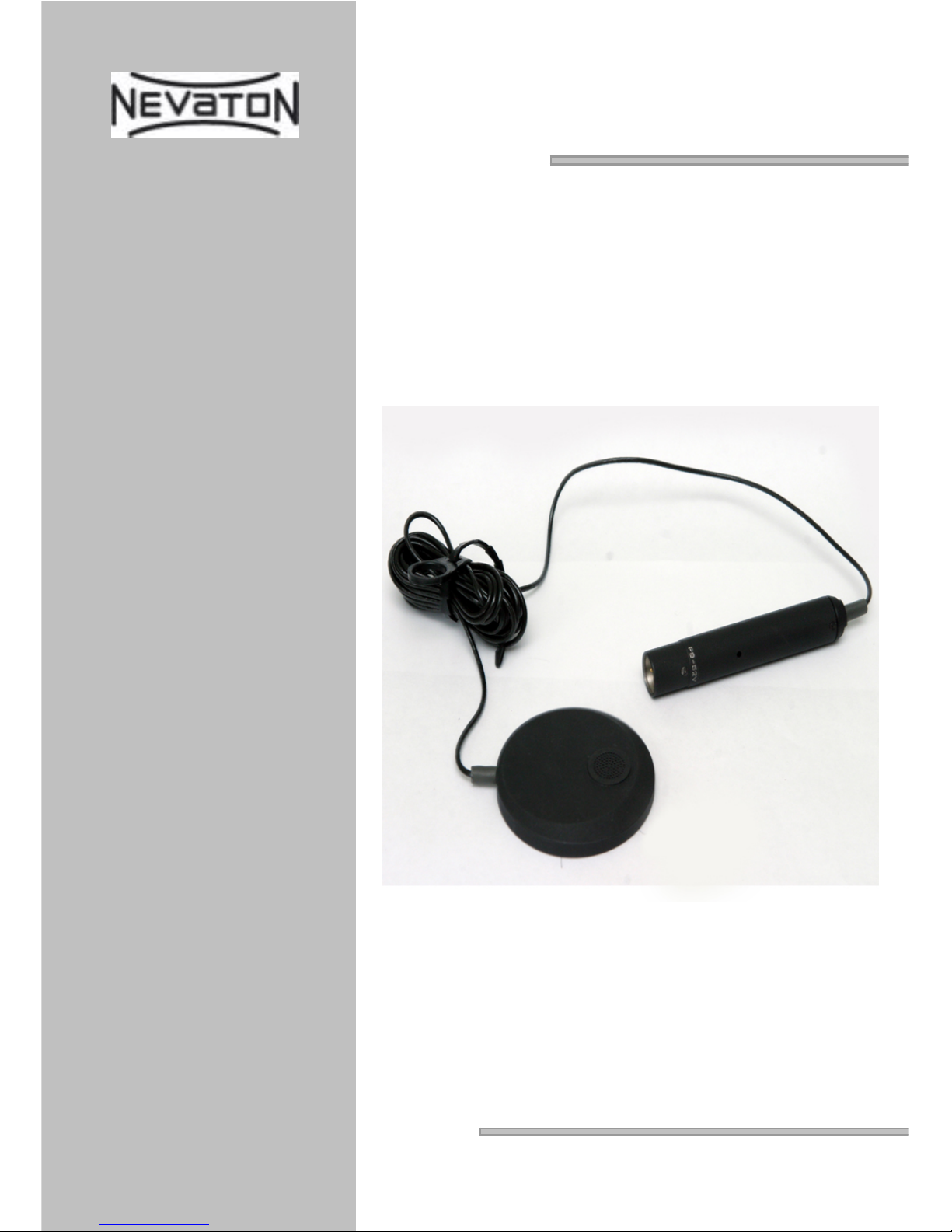
The MC 403 is a Boundary Layer Microphone
which was designed for live recordings in the
studio, on stage, or at the conference table.
The microphone transducer is a pressure
sensor with a gold-plated diaphragm, 12 mm in
diameter. It is flat and small.
The MC 403 should be mounted in the surface
area of a boundary (plate) like on the floor, on
the walls, on the table etc. This gives a number
of advantages: The sensitivity of the
microphone doubles, the S/N ratio raises and
the polar pattern becomes hemispherical.
The MC 403 is insensitive to structure borne
noise and wind and records all sound sources,
even distant ones, with full clarity and
presence.
Typical applications are live or studiorecordings where you place the microphone at
a distance of 1.5 m - 10 m away from the
sound source. It is an excellent choice for the
recording of low frequencies like base-drum
and also excellent for vocalists, classical
ensembles. It can also be physically attached
to parts of large instruments such as pianos,
double basses, harpsichords or similar
instruments.
You can also find this microphone in the
orchestra-pit, or as discreet solution for
theaters and stage. Because of its unobtrusivity it is often used for conference table discussions and on altars in churches.
It is excellent for Stereorecordings with the ABtechnique. The mic can handle a maximum
SPL of 130 dB and has very little self-noise.
It provides high output voltage and features a
smooth and clear frequency response for all
angles.
Like all other Nevaton microphones, the MC
403 uses transformerless circuitry (Class A)
All used input transistors pass a special
selection to guarantee minimal self-noise
levels.
A gold-plated standard XLR-connector is
used as an output-connector.
The MC 403 has a vibration proof structure.
It has non-slip rubber-pads for horizontal
positions, and specially threaded holes for
mounting it on walls.
The microphone`s body is made of brass with
a black non-reflective paint finish on an epoxy
base. This makes it inherently immune to
mechanical and atmospheric influences.
The mirophone is supplied with a small and
stabil aluminium case.
A windscreen for open air recordings is
recommended.
The MC 403 is designed for phantom
powering technique.
It has a balanced output and operates on
9-52V phantom power.
2. Powering Technique
1. Beschreibung
2. Stromversorgung
3. Technische Daten
4. Frequenzgänge
1. Das Grenzflächen Kondensator
Mikrofon MC 403
Das Nevaton MC 403 ist ein Grenzflächen mikrofon, welches für Live-aufnahmen im
Studio, auf der Bühne sowie für
Konferenzen entworfen wurde.
Das Mikrofon basiert auf dem Prinzip eines
Druckempfängers. Als Überträger fungiert
eine 12mm goldbeschichtete Membran. Es
ist sehr flach und schmal.
Durch die Anbringung an größeren Flächen
wie Boden, Wand, Tisch etc. verdoppelt
sich die Emfindlichkeit des Mikrofons, die
Charakteristik wird halbkugelförmig und der
Signal-Rausch-Abstand wird vergrößert.
Das MC403 ist unempfindlich gegen
Körperschall und Windgeräusche und
liefert einen präsenten, sehr durchsichtigen
Raumklang, auch für weiter entfernte
Klangquellen.
Typische Anwendungen sind Live- oder
Studioaufnahmen, wo das Mikrofon 1,5 10 m von der Klangquelle platziert wird.
Es ist hervorragende für die Wiedergabe
tiefster Frequenzen (z.B. Bass-drum)
geeignet und wird außerdem oft für die
Aufnahme von Stimme und klassischen
Ensembles verwendet. Es kann aber auch
direkt auf größeren Instrumenten wie
Klavier, Spinett, etc. angebracht werden.
Oft wird das Mikrofon auch im
Orchestergraben verwendet oder als
diskrete Lösung in Theatern, auf Bühnen,
auf Rednerpulten und Altären. Es ist
hervorragend für Stereoaufnahmen in ABTechnik geeignet.
Das Mikrophon kann sehr hohen Schalldruck(130 dB) bei sehr geringem Eigengeräuschpegel verarbeiten und glänzt
durch besonders saubere und verfärbungsfreie Klangübertragung aus allen Aufnahme
winkeln.
Wie alle Nevaton Mikrofone profitiert auch
das MC 403 von einem transformatorlosen
Schaltungsdesign (Class A). Sämtliche
verwendeten Bauteile werden handselektiert
um das geringe Eigenrauschen des Mikrofons
zu garantieren.
Als Ausgangsstecker dient eine goldbeschichtete 3-pin XLR-Steckverbindung.
Das MC 403 ist unempfindlich gegenüber
Vibrationen. Es hat Gummi-pads um es vor
dem Verrutschen zu bewahren, sowie bereits
vorgefertigte Öffnungen zur komfortablen
Anbringung an Wänden.
Das Mikrofongehäuse aus Messing ist mit
einer schwarzen nicht reflektierenden
Lackierung auf Epoxybasis versehen, welche
einen ausgezeichneten Schutz vor
mechanischen und athmosphärischen
Einflüssen gewährleistet.
Das Mikrofon wird in einer kleinen stabilen
Aluminiumbox ausgeliefert.
Für Aufnahmen außerhalb des Studios wird
ein Windschutz empfohlen.
2. Stromversorgung
Das MC 403 wurde für den Betrieb mit
Phantomspannung entworfen
Es hat einen symmetrischen Ausgang und
arbeitet mit 9 - 52V Phantom-spannung.
Page 3
5
4
3. Technical Specifications
3. Technische Daten
Acoustical operating principle Pressure- transducer
Directional pattern, hemispherical
Frequency range 20 - 20000 Hz
Sensitivity at 1 kHz 20 ±2 mV/Pa
Equivalent SPL DIN/IEC 651 18 dB-A
Recommended load impedance 1000 ohms
Nominal Impedance 50 ohms
Maximum SPL for THD 0.5% 130 dB
Dynamic range 112 dB
Supply voltage 48V ± 4 V
Current Consumption 10mA
Weight 120 g
Diameter 80 mm
Heigth 10 mm
Climatic Conditions:
temperature range - 20°C + 45°C
relative humidity 90% (at + 20°C)
Connector Type 3 - pin standard
XLR - type (male)
4. Frequency Range
Nevaton-Europe, 2007,
All rights reserved, Alle Rechte vorbehalten
Irrtümer und technische Änderungen vorbehalten
Errors excepted and subject to change
4. Frequenzgänge
 Loading...