

Page 1
IMMERSE REVERBERATOR
Page 2

Thank you for purchasing our product. We really mean it.
We hope to earn your trust by delivering a quality product
that inspires you to make great music.
Neunaber products are designed and manufactured in
Orange, California USA.
IMMERSE REVERBERATOR
USER GUIDE
Please visit www.neunaber.net for more information and support.
Page 3
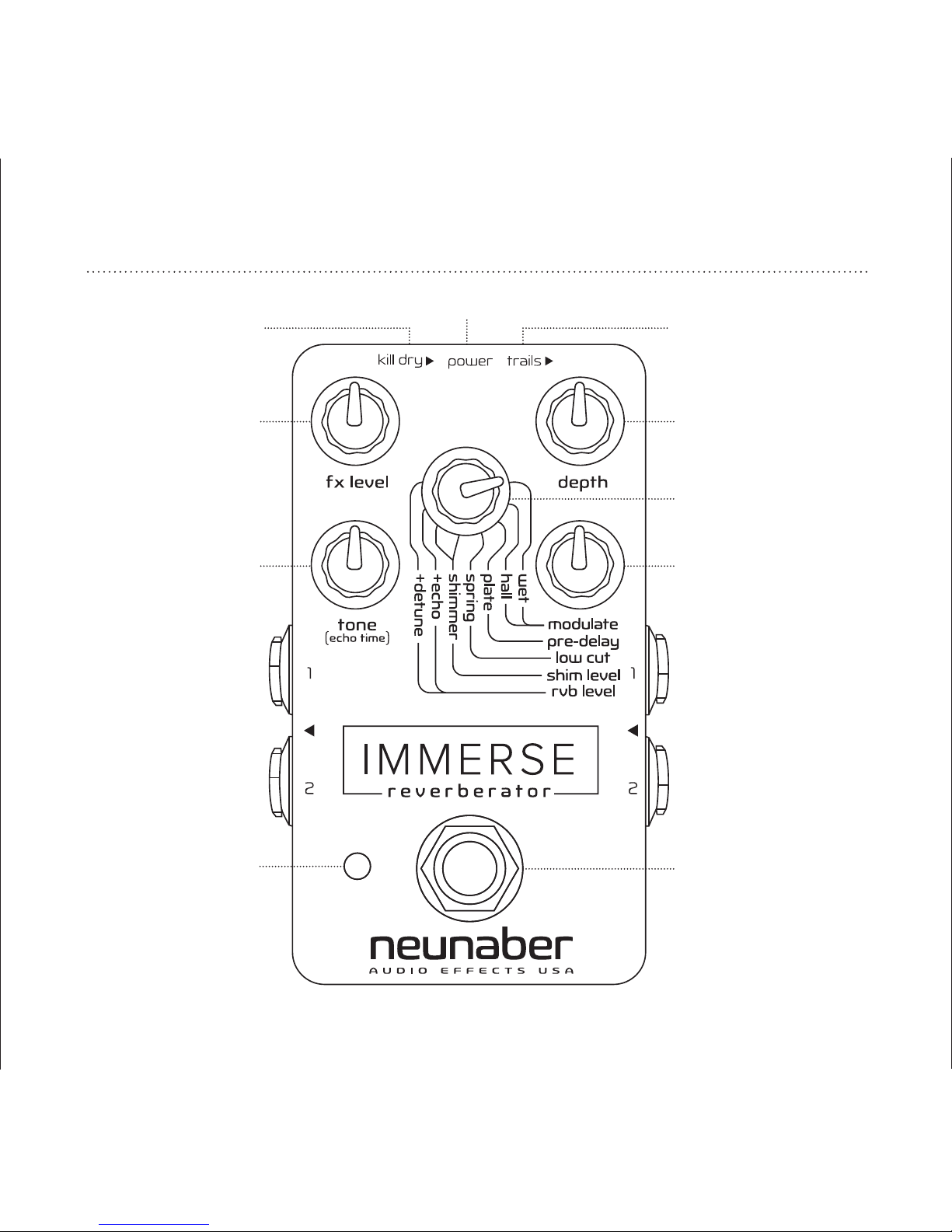
input 1 output 1
setting-specific
control
reverb selector
depth control
fx level control
tone / echo
time control
trails switch
9V DC
kill dry switch
input 2
buffered bypass
switch
output 2
enabled/bypassed
LED indicator
PEDAL MAP
Page 4
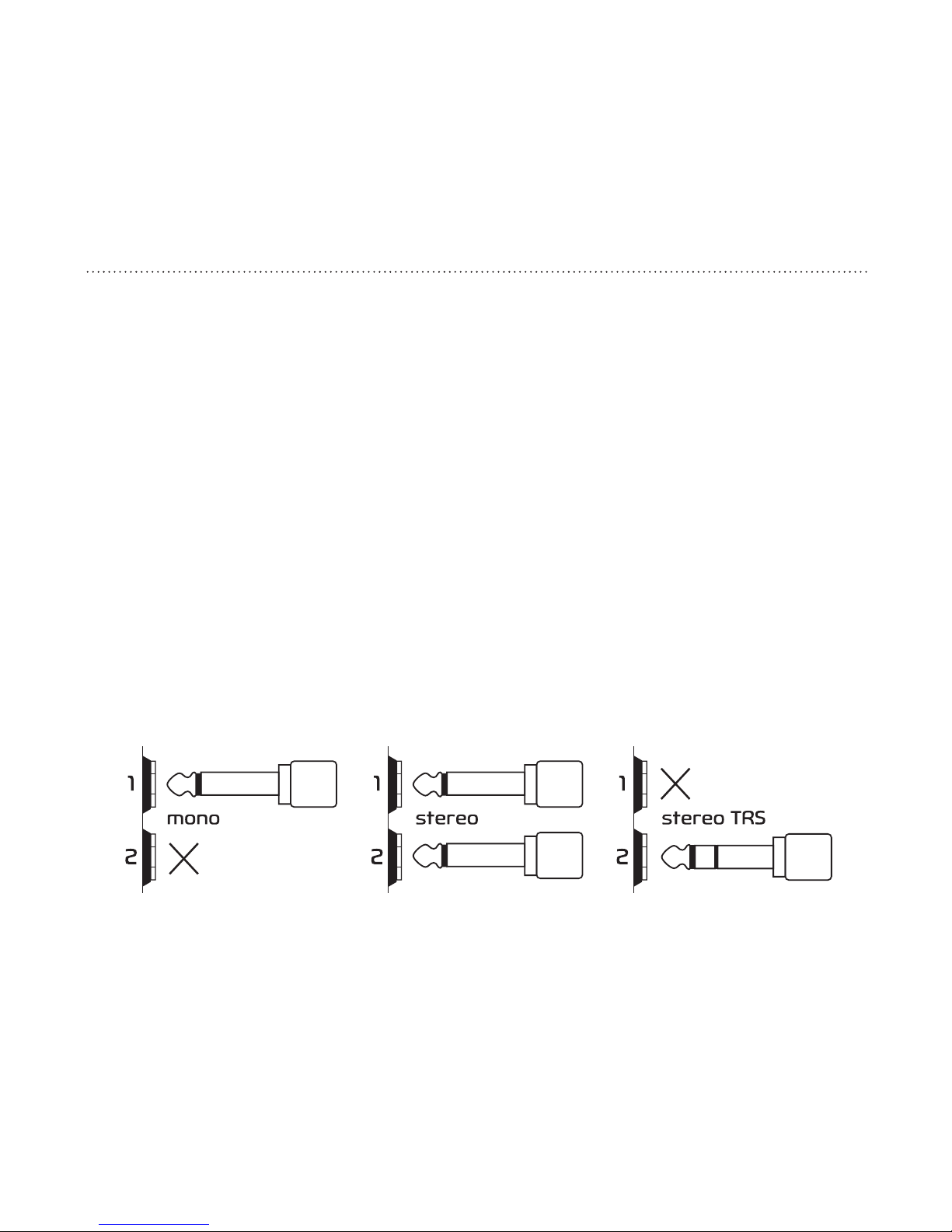
The input and output connections are independent. You may—for example—use a
mono input with stereo outputs or stereo inputs with a stereo TRS output.
CONNECTIONS
We recommend that this pedal be placed at the end of your chain, after all other
eects. If you are using the overdrive channel of your amplifier, this eect should
be placed in the eects loop for best results.
The POWER JACK accepts a standard (5.5 mm OD x 2.1 mm ID) center-negative
pedal power adapter (not included). The power adapter must be between 9 V and
12 V and capable of supplying 70 mA or more.
The INPUT JACKS (right side) accept inputs directly from your instrument,
amplifier eects loop output, or other eect pedals via standard 1/4” (6.35 mm)
phone connectors.
• Input 1 only accepts a mono input.
• Both Inputs 1 & 2 accept a stereo input.
• Input 2 only accepts a stereo TRS input.
Page 5
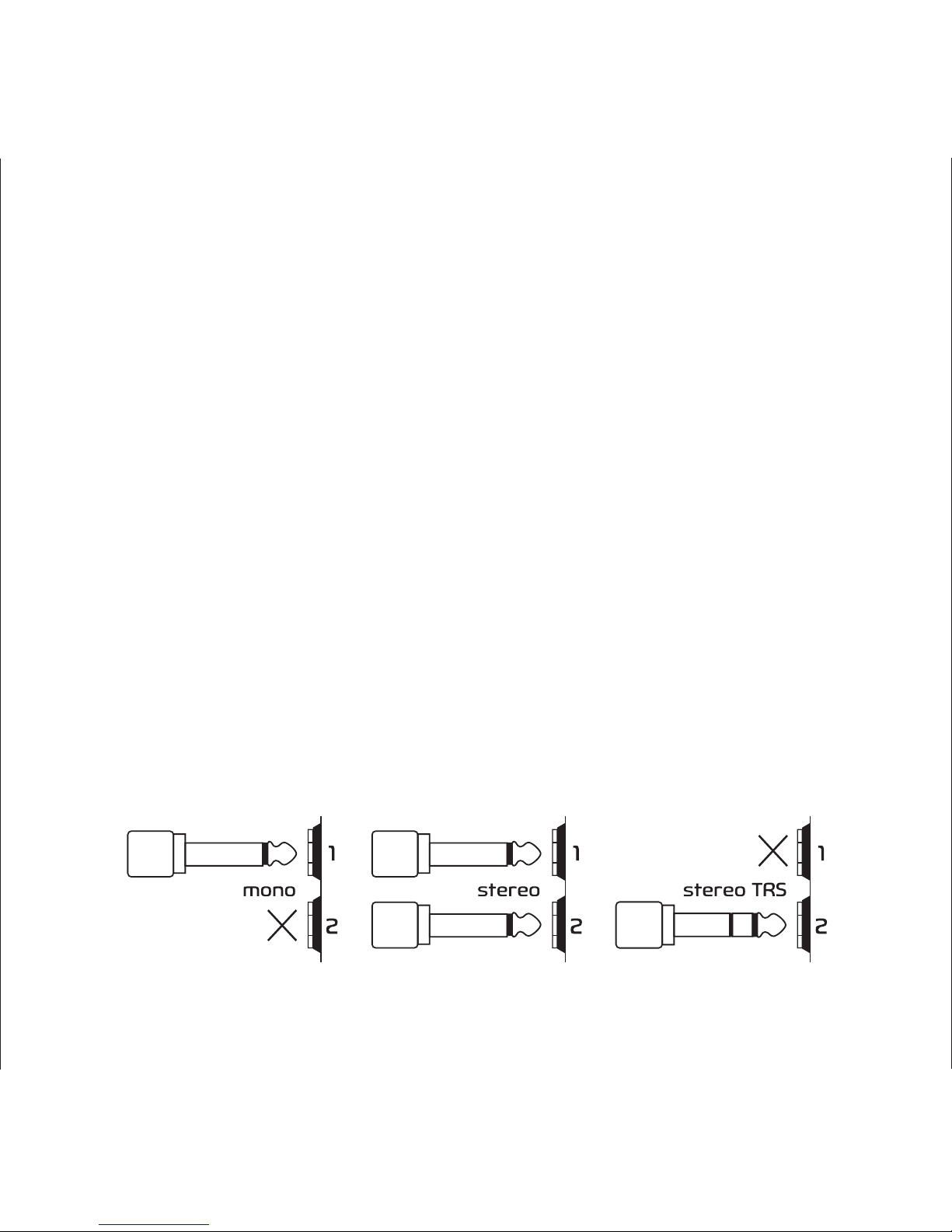
Important Note: input/output 1 and input/output 2 should not be used with two
discrete signals (such as two dierent instruments).
The FOOT SWITCH bypasses the eect. The LED lights when the eect is active.
Bypassing the eect does not lower power consumption, because it does not turn
o power to the pedal.
The Immerse Reverberator implements a high-quality buered bypass. The signal
is always buered whether on or bypassed. We chose this type of bypass because
the last output in a pedal chain should be buered, and reverb is typically placed
at the end of a pedal chain.
The OUTPUT JACKS (left side) supply output to another eect pedal, an amplifier,
or eects loop return via standard 1/4” (6.35 mm) phone connectors. The buered
output is capable of driving long cables. If plugging into the input of an amp, you
should use the low impedance (Lo-Z) input if available.
• Output 1 only supplies a summed mono output.
• Both Outputs 1 & 2 supply a stereo output. Using both outputs creates
a stereo signal from a mono input.
• Output 2 only supplies a stereo TRS output.
Page 6
The KILL DRY switch removes the dry signal, leaving only the “wet” (eect) signal.
This should be enabled for parallel eect loops, and disabled for serial (common)
eect loops.
The TRAILS switch changes the bypass mode between normal and trails. Trails
allows the eect to naturally trail o after the pedal is bypassed. With normal
bypassing, the eect is abruptly cut o; however, normal bypassing results in
lower noise while the pedal is bypassed.
EFFECTS
Reverberation (“reverb”) gives your instrument a sense of acoustic spaciousness.
There have been various methods of simulating this eect over the years, several
of which have evolved into their own distinct sounds.
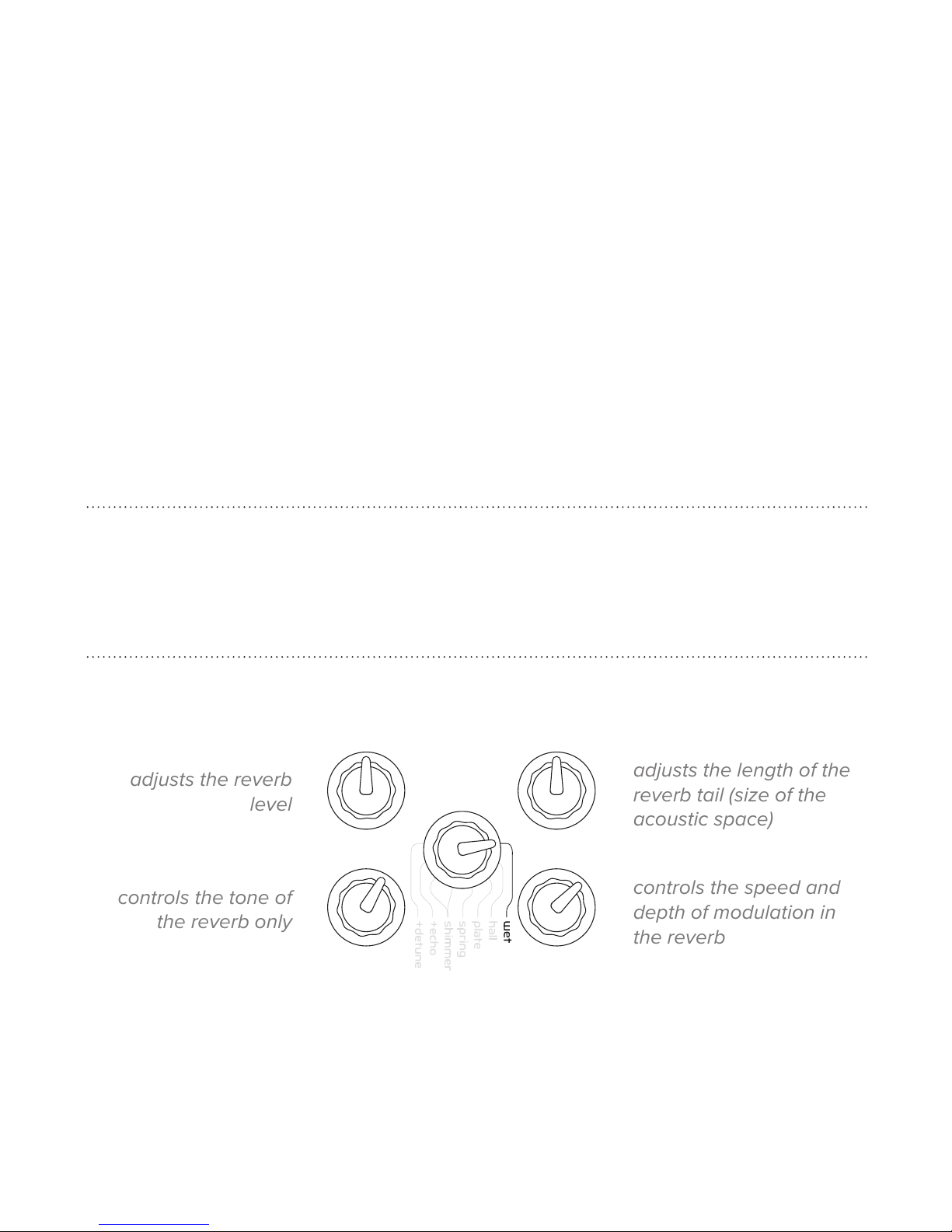
fx level
tone
depth
modulate
WET™
WET™ is an updated version of Neunaber’s renowned algorithm, with shorter
pre-delay, higher initial density and more balanced imaging. (See suggested
settings below.)
adjusts the reverb
level
adjusts the length of the
reverb tail (size of the
acoustic space)
controls the tone of
the reverb only
controls the speed and
depth of modulation in
the reverb
SUGGESTED
SETTINGS
Page 7
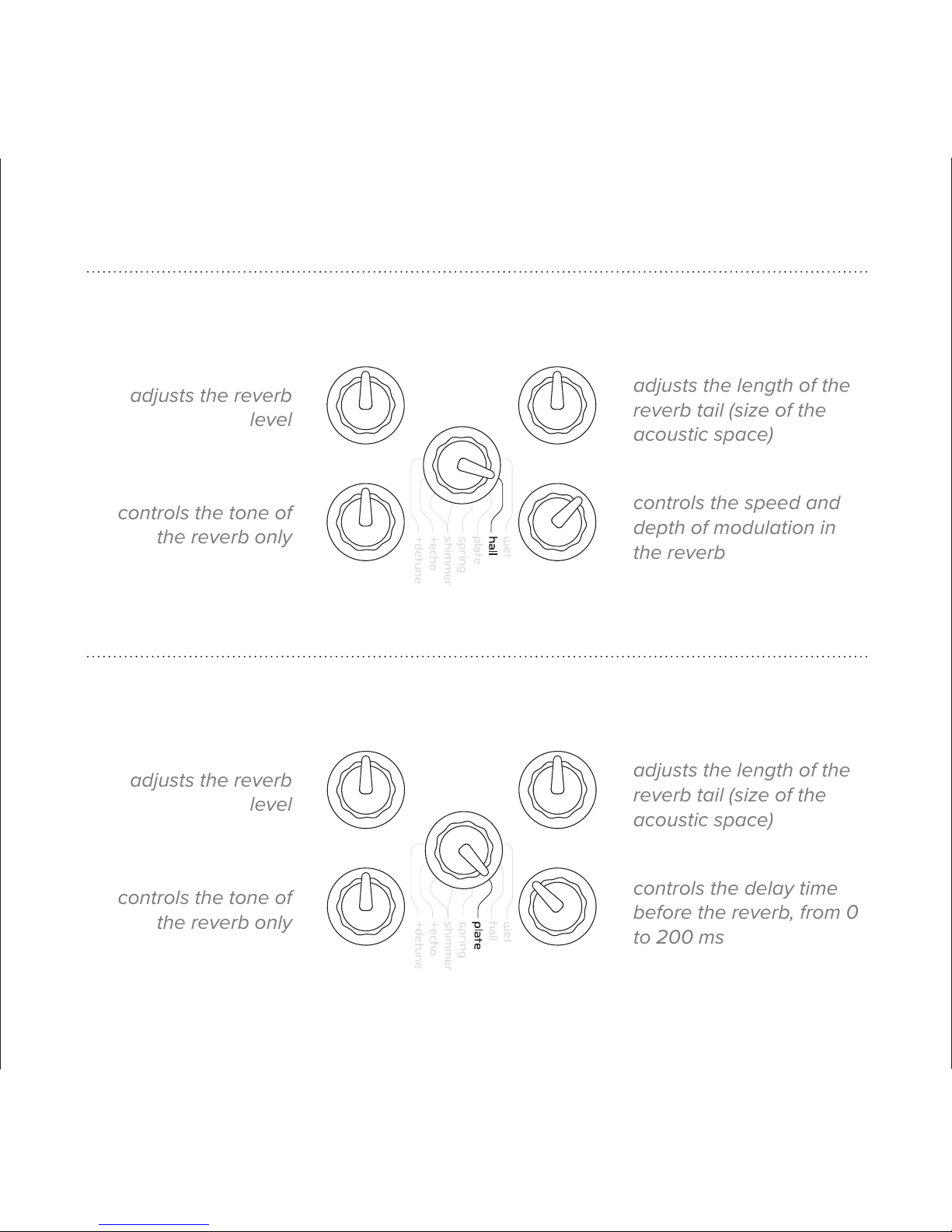
HALL
Hall reverb is known for its large, open sound—similar to what one may find in a
well-designed concert hall.
PLATE
A physical plate reverb uses transducers mounted to a large, suspended metal
plate. It is known for its bright, diused sound.
adjusts the reverb
level
adjusts the reverb
level
adjusts the length of the
reverb tail (size of the
acoustic space)
adjusts the length of the
reverb tail (size of the
acoustic space)
controls the tone of
the reverb only
controls the tone of
the reverb only
controls the speed and
depth of modulation in
the reverb
controls the delay time
before the reverb, from 0
to 200 ms
fx level
tone
depth
pre-delay
SUGGESTED
SETTINGS
fx level
tone
depth
modulate
SUGGESTED
SETTINGS
Page 8
fx level
fx level
tone
tone
depth
depth
low cut
shim level
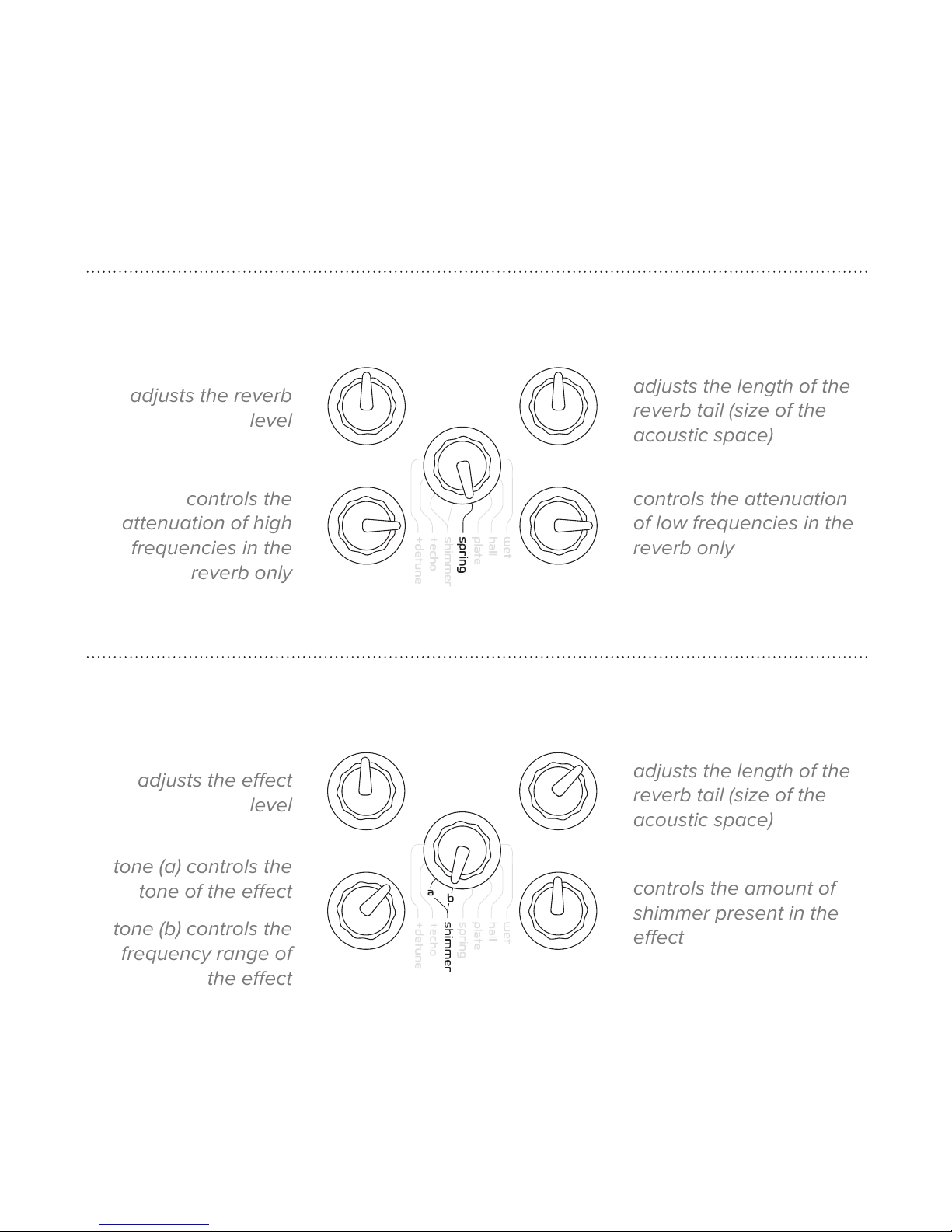
SPRING
A physical spring reverb uses metal springs suspended between transducers and
produces a distinctive initial “twerp.”
SHIMMER A & B
Shimmers are reverb eects reminiscent of a synth pad that follows what your
instrument plays.
adjusts the reverb
level
adjusts the eect
level
adjusts the length of the
reverb tail (size of the
acoustic space)
adjusts the length of the
reverb tail (size of the
acoustic space)
controls the
attenuation of high
frequencies in the
reverb only
tone (a) controls the
tone of the eect
tone (b) controls the
frequency range of
the eect
controls the attenuation
of low frequencies in the
reverb only
controls the amount of
shimmer present in the
eect
SUGGESTED
SETTINGS
SUGGESTED
SETTINGS
Page 9
fx level
fx level
echo time
tone
depth
depth
rvb level
rvb level
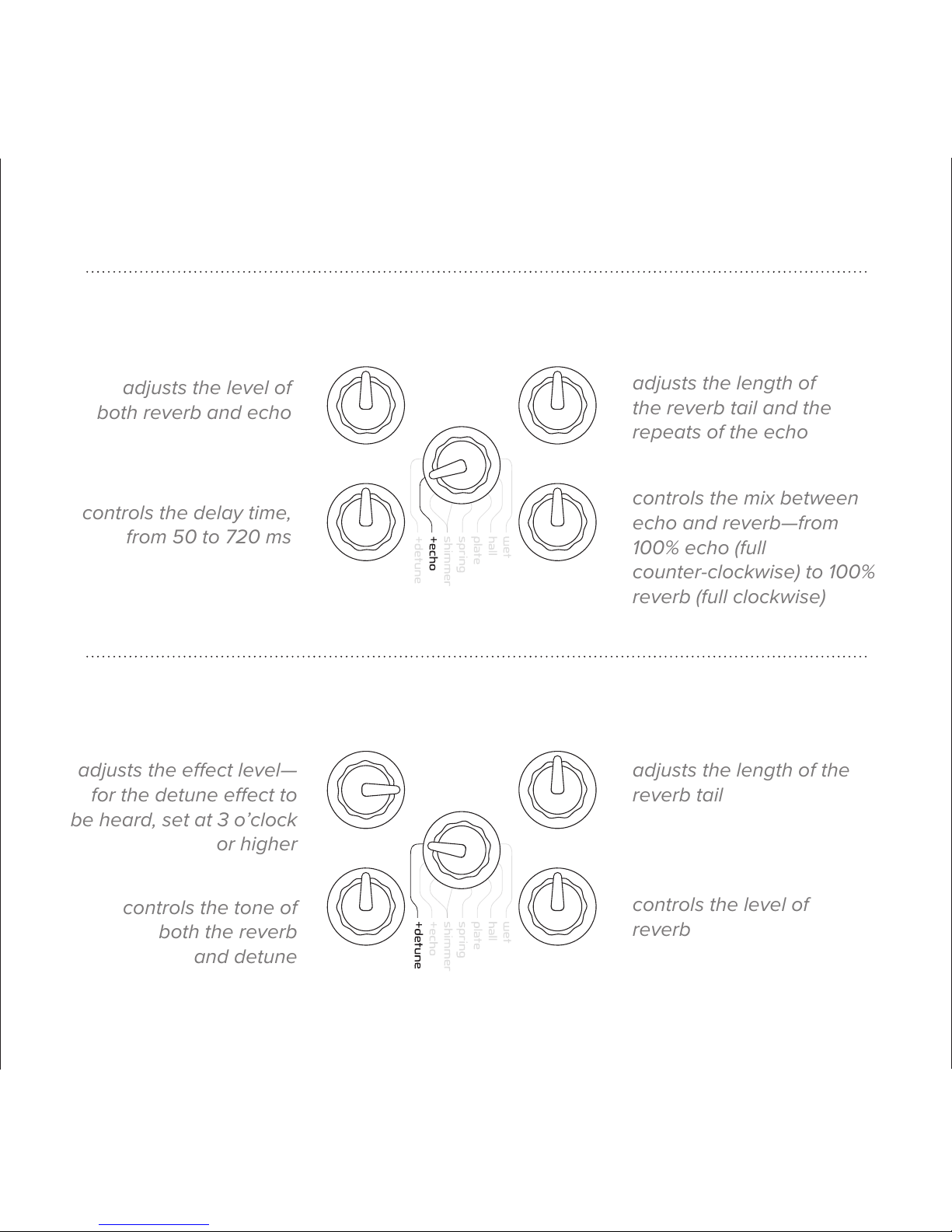
+ECHO
The +echo eect combines the Wet™ Reverb with an echo eect.
+DETUNE
The +detune eect combines the Wet™ Reverb with detune, which is a
chorusing-like eect that adds in a slightly detuned double of the dry signal.
adjusts the level of
both reverb and echo
adjusts the eect level—
for the detune eect to
be heard, set at 3 o’clock
or higher
adjusts the length of
the reverb tail and the
repeats of the echo
adjusts the length of the
reverb tail
controls the delay time,
from 50 to 720 ms
controls the tone of
both the reverb
and detune
controls the mix between
echo and reverb—from
100% echo (full
counter-clockwise) to 100%
reverb (full clockwise)
controls the level of
reverb
SUGGESTED
SETTINGS
SUGGESTED
SETTINGS
Page 10

SPECIFICATIONS
Electrical
Nominal input level -10 dBV, instrument level
Absolute max input level 6 dBV
Input impedance 1 MΩ (mono), 2 MΩ (stereo)
Output impedance 500 Ω (mono), 1 kΩ (stereo)
Gain, enabled vs. bypass 0 dB (mix @ 0)
Frequency response 20 Hz—20 kHz, +0.1 dB, -0.5 dB
(dry signal or bypassed)
Total harmonic distortion < 0.003 % typical (dry signal or bypassed,
22 Hz—22 kHz, 1.0 Vrms, 1 kHz)
Signal-to-noise ratio 112 dB mono, 110 dB stereo (A-weighted)
Power
Power adapter input 9-12 V DC, 70 mA
Plug: center-negative, 5.5 mm OD x 2.1 mm ID
Physical
Dimensions 2.9” W, 4.6” L, 2.0” H / 73 mm W, 117 mm L, 51 mm H
Weight 8.5 oz / 240 g
*Specifications subject to change without notice.
Page 11

This product contains no user-serviceable parts.
This device complies with part 15 of the FCC Rules. Operation is subject to the following two conditions:
(1) This device may not cause harmful interference, and (2) this device must accept any interference
received, including interference that may cause undesired operation.
California Proposition 65 Warning: This product may contain chemicals known to the State of California
to cause cancer, birth defects or other reproductive harm. While we believe our products are not harmful
when used as designed, we provide this warning to comply with Proposition 65.
© 2016 Neunaber Technology LLC. All rights reserved. Neunaber logo, Immerse™ and Wet™ are
trademarks of Neunaber Technology, LLC. US Patent #8204240 & China Patent #CN101689840B.
At Neunaber, we love to see what you guys do with your ‘toys’. We encourage
you to tag us in your posts, pictures & videos featuring your Neunaber gear! To
stay connected, go ahead and follow us on the channels seen below. We can’t
wait to see what you do!
@NeunaberAudio
Neunaber Audio Eects
Page 12

www.neunaber.net
 Loading...