

Page 1
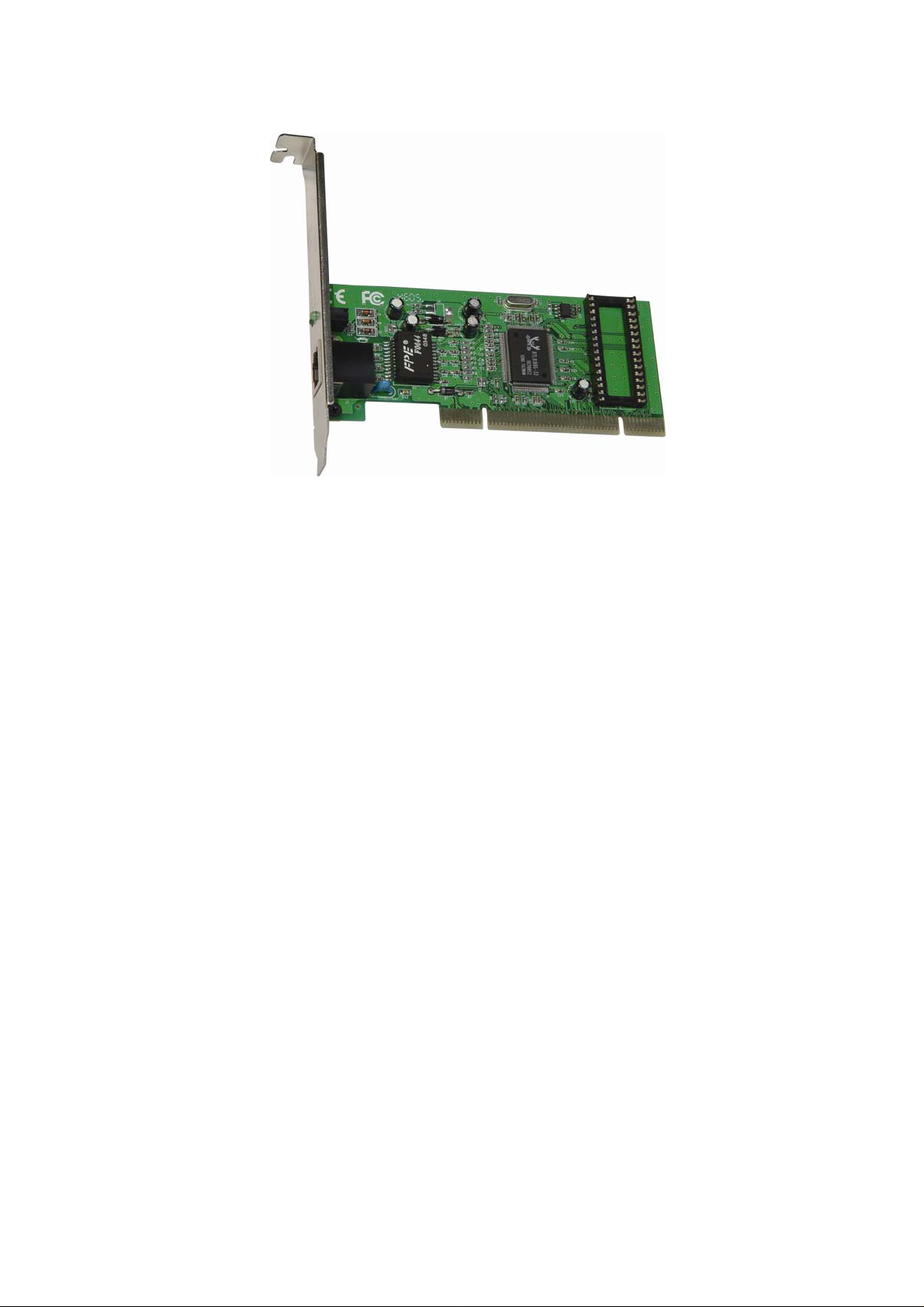
Gigabit Ethernet Adapter
USER’S MANUAL
Ver. 1.01
Page 2

FCC COMPLIANCE STATEMENT
This equipment has been tested and found to comply with the limits of a Class A computing devices, pursuant to
Part 15 of the FCC rules. These limits are designed to provide reasonable protection against harmful interference
in a residential installation. This equipment generates, used can radiate radio frequency energy and, if not
installed and used in accordance with the instructions, may cause harmful interference to radio communications.
If you suspect this product is causing interference, turn your device on and off while your radio or TV is showing
interference. If the interference disappears then when you turn the device off and reappears then you turn the
device off and reappears then you turn the device on, something in the device is causing interference.
You can try to correct the interference by one or more of the following measures:
1. Reorient/Relocate the receiving antenna.
2. Increase the separation between the equipment and receiver.
3. Connect the equipment into an outlet on a circuit difference from that to which the receivers connected.
4. Ensure that all expansion slots (on the back or side of the computer) are covered ,.Also ensure that all
metal retaining brackets are tightly attached to the computer.
1.0 Introduction
Thanks you for purchasing our Gigabit Et hernet Adapter. This guide is to provide the installation and usage of
this adapter for network installers and users. The Gigabit network adapter complies to 32 bit PCI specification
and supports half/full duplex feature which can double network speed.
This adapter supports 1000Mbps (Gigabit), 100Mbps and 10Mbps network speed, 1000BaseT operates on all
four pairs of category 5e UTP cable, 100BaseTX operates on two pairs of category 5 UTP cable and 10BaseT
operates on Category 3,4,5 UTP cable.
With the Auto-Negotiation technology, network speed is auto detected. When you connect the adapter to Gigabit
Switch or another Gigabit NIC, the speed will be doubled to 2000Mbps (1000Mbps Transmit and
1000MbpsReceive). If you connect the adapter to 100Base TX hub, the network speed is 100Mbps. Similarly, if
the hub is a switch which supports full duplex function, then the speed will be doubled to 200Mbps.
This adapter supplies many drivers including NDIS 4,5 driver for Microsoft Windows 95,98,ME,NT,2000, Linux,
and Netware Server 5.x. Whatever your requirements are ease of installation, superior performance or responsive
support backed up by unlimited technical support, this adapter is the superior choice.
2.0 Features & Specifications
(1) Feature & Benefits
1. Supports 32-bit, 33MHz PCI Bus Master for high performance and low processor utilization.
2. Complies with the IEEE 802.3 CSMA/CD, 1000Base-T, 100Base-TX and 10Base-T standard.
3. Full duplex design to double the performance to 20Mbps/200Mbps/2000Mbps.
4. One UTP/STP connector for 1000Mbps, 100Mbps or 10Mbps network speed.
5. Support Auto –negotiation function.
6. Auto-setups IRQ and I/O address.
7. NDIS 4,5 driver for Microsoft Windows 95,98,Me,NT, 2000, Linux ,and Netware ODI driver for
Server V5.x, MAC OS, Free BSD.
8. Provide two LEDs to indicate network link/activity and 1000Mbps selection.
Page 3

(2) Technical Specification
z Topology : Star
z Connector : RJ-45
z Standard : IEEE 802.3 10Base-T
IEEE 802.3u 100Base-TX
IEEE 802.3ab 1000Base-T
z Transmission Rate : 10Mbps or 20 Mbps
100Mbps or 200Mbps
1000Mbps or 2000Mbps
z Hardware Required : IBM compatible PC with available PCI
Slot (PCI2.1/2.2), 33MHz, 32bit
z IRQ Line : Assigned by system
z I/O Address : Assigned by system
z Drivers : NDIS 4/5 for Windows 95/98/Me/NT/2000
Linux, Netware 5.x, Free BSD
z LEDs : 1000Mbps
LNK/ACT
z Temperature : 0℃ to 55℃(Operating)
z Humidity : 10% to 90% (Non-condensing)
z Certification : FCC Class A,CE Mark
z Dimension : 120 x 52 mm.
z Power consumption : 5W (Max)
3.0 Installation
(1) Hardware Installation
To insert the network adapter into your PC, follow the steps bellow:
1. Turn off the computer and remove its cover.
2. Insert the adapter into a PCI slot.
3. Lock this adapter to the rear of the com puter and put back the computer cover.
4. Connect the adapter to network using twisted-pair cable.
(2) Driver Installation
Use the drivers supplied by the diskette included in this product.
4.0 Trouble- shooting
If you experience any problems with the adapter, first make sure the appropriate driver is loaded , th e p rop er
cable is connected to the adapter port and the hub/switch complies with the adapter specification, such as
10Mbps 10Base-T, 100Mbps 100Base-TX and 1000Mbps 1000Base-T, then check the LED.
The adapter provides two LEDs to indicate network status.
z 1000
When the light is ON, it indicates that the adapter works at 1000Mbps.
z LNK/ACT
The LED indicates if the UTP has been LINK ok or not. When the light is OFF, it indicates that the
UTP port has not been connected or LINK not ok. When the light is ON, it indicates that the UTP port
LINK ok. When the light is BLINKING, it indicates that is traffic flow on the network which the
adapter is connected to.
 Loading...