

Page 1
Page 2

1
Functional Description and Specifications
Intended Use
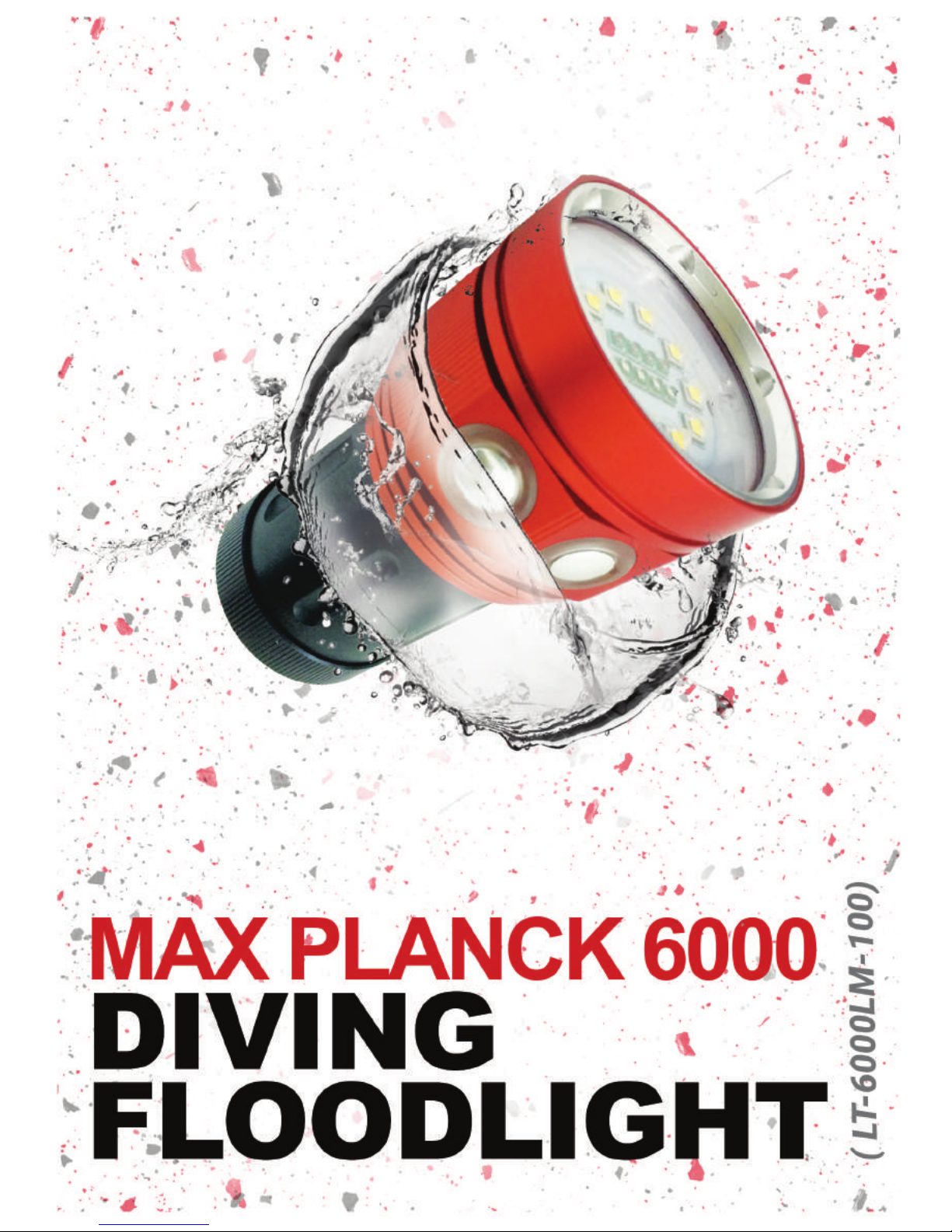
The Max Planck 6000 by Nemo is a commercial diving floodlight
intended for wide-angle illumination, professional underwater
photography, videography, and nighttime search and rescue.
The floodlight contains 18 LEDs (ten white, four red, and four blue)
which together provide various working modes, including:
♦ Wide-angle white LED floodlight mode
♦ Blue light fish attractor mode
♦ Static red light mode for professional underwater photography
and color balancing
♦ Flashing red light mode
The floodlight casing is made of durable aviation-grade aluminum
that undergoes anodizing treatment to protect it from seawater
corrosion. The floodlight is waterproof to a depth of 100 meters
(328ft).
Packing List
Your Max Planck 6000 floodlight is packaged together with the
following accessories:
♦ Four rechargeable lithium-ion (Li-ion) batteries
♦ Nitecore Intellicharger i4 battery charger
♦ Quick Release (GoPro-type) mount
♦ Aluminum Goodman handle
♦ Neoprene carrying case
Page 3

2
Technical Specifications
Battery Charger
Model Nitecore i4 Intellicharger
Charging output voltage 42V ± 1% / 148V ± 1%
Charging input voltage AC 100-240V
or
DC 12V 1A
Nemo Commercial Diving Floodlight
Model Max Planck 6000
Battery voltage 18V Li-ion
Battery cell specification Li-ion 18650 cell
Working voltage 3.0V - 4.2V
Modes
♦ Wide-angle white floodlight
(three intensities: 25%, 50%,
100%)
♦ Blue light mode
♦ Static red light mode
♦ Flashing red light mode
Maximum brightness 7000 lumens
Dimensions Head diameter: 65mm (2.6 in)
Body diameter: 50.3mm (2 in)
Length: 119mm (4.7 in)
Net weight (with batteries) 600g (21 oz)
Working temperature 60°C (140°F)
Submersible up to 100m (328 ft)
Page 4

3
Safety Warnings
Warning: Read all safety warnings and instructions, and
save them for future reference. Failure to adhere to
these warnings can result in serious injury and damage
to equipment.
Floodlight Safety
♦ The Max Planck 6000 is a powerful floodlight meant for use
underwater. Using the floodlight outside of the water for
prolonged periods will cause the floodlight to heat up
significantly. Do not keep the floodlight on for more than five
minutes at a time outside of the water.
♦ Check that all openings on the floodlight are tightly sealed
before every dive.
♦ Clean the thread on the torch body, as well as the surface and
the switches, with clean water after every dive. You can use a
mild cleanser to clean the switches if they are blocked. After
the floodlight dries, add waterproof lubricants to the thread.
♦ Charge the battery soon after every dive, or at least once every
three months.
♦ Never shine the floodlight directly into human or animal eyes.
♦ When the floodlight is on, do not cover the head of the
floodlight.
Rechargeable Battery Safety
♦ Use only Li-ion 18650 batteries like those supplied with your
power tool.
♦ When the batteries are not in use, keep them away from other
metal objects like paper clips, coins, keys, nails, and screws,
which can make a connection from one terminal to another.
♦ Store the batteries only within a temperature range of 0˚C -
45˚C (32˚F - 113˚F).
Page 5
4
♦ Do not open the batteries.
♦ Protect the batteries against heat, including continuous sun
irradiation and fire.
♦ When a battery is defective, liquid can escape and come in to
contact with adjacent components.
♦ Use only batteries with the voltage listed on the nameplate of
your floodlight. When using batteries with other voltages,
there is danger of injury as well as property damage through
exploding batteries.
♦ Protect the battery charger from rain and moisture. The
battery charger is not waterproof.
♦ Before use, always check the battery charger, cable, and plug. If
you detect defects, do not use the battery charger. Never open
the battery charger. Instead, have it opened and repaired only
by qualified personnel who will use original spare parts.
Getting Started with the Floodlight
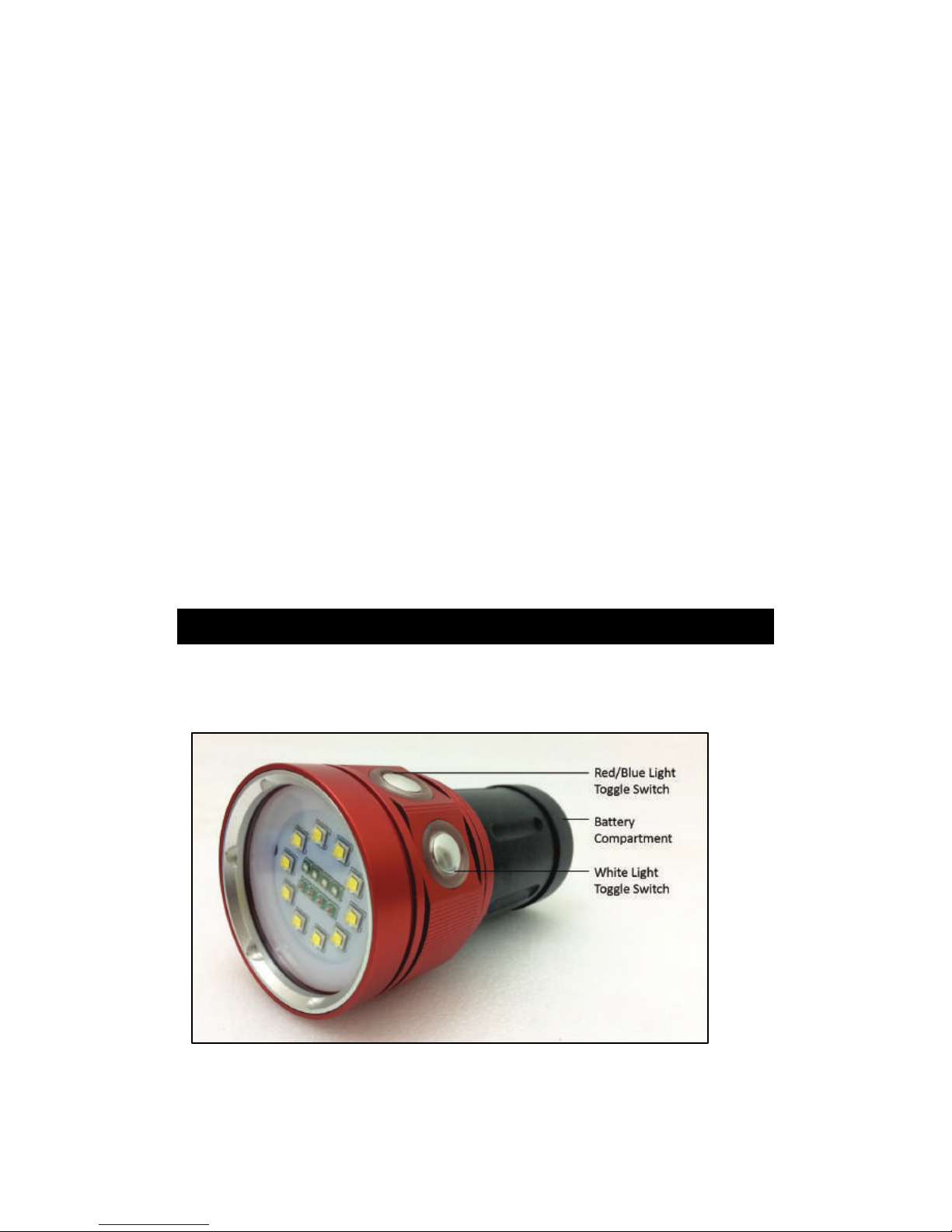
Your Max Planck 6000 includes the following main components:
Page 6
5
Charging the Batteries
The Li-ion batteries are supplied partially charged, and must be
charged to full capacity before using the floodlight for the first time.
When the batteries are fully charged, the floodlight can run at the
highest intensity for up to one hour.
Caution: Only use a battery charger designed for the Liion 18650-type batteries supplied with your floodlight.
Danger: Ensure that the power supply voltage
corresponds with the data on the nameplate of the
battery charger.
Danger: Only use the charger in a dry environment. The
charger is not waterproof. Never attempt to charge the
batteries under water.
The batteries can be charged at any time without reducing their
service life. The battery charger detects the charging condition of
the batteries, and charges them with the optimum current.
Interrupting the charging procedure does not damage the batteries.
1. Connect the mains plug of the battery charger to an electrical
outlet. A blue LED on the top-right corner of the battery
charger indicates that the charger is ready for operation.
2. Insert each of the four batteries in to the charger.
Note: If you are only charging two batteries, put them
in slots 1 and 3, or slots 2 and 4.
The batteries begin charging as soon as they are connected to
the charger, and stop charging as soon as they are full.
Flashing LEDs on a slot indicate that a battery is charging.
Steady LEDs on a slot indicate that a battery is fully
charged.
Page 7
6
Inserting the Batteries in to the Floodlight
1. Insert all four batteries in to the battery compartment, with the
positive terminals facing up.
2. Tightly screw the battery compartment on to the floodlight,
using slight force to overcome the friction caused by the Orings.
Note: Screwing the battery compartment tightly on to
the floodlight ensures that the batteries make proper
contact, as well as that the floodlight remains
waterproof.
Removing a Battery from the Floodlight
1. Rotate the battery compartment counterclockwise.
2. Pull the battery pack out and down, without exerting any force.
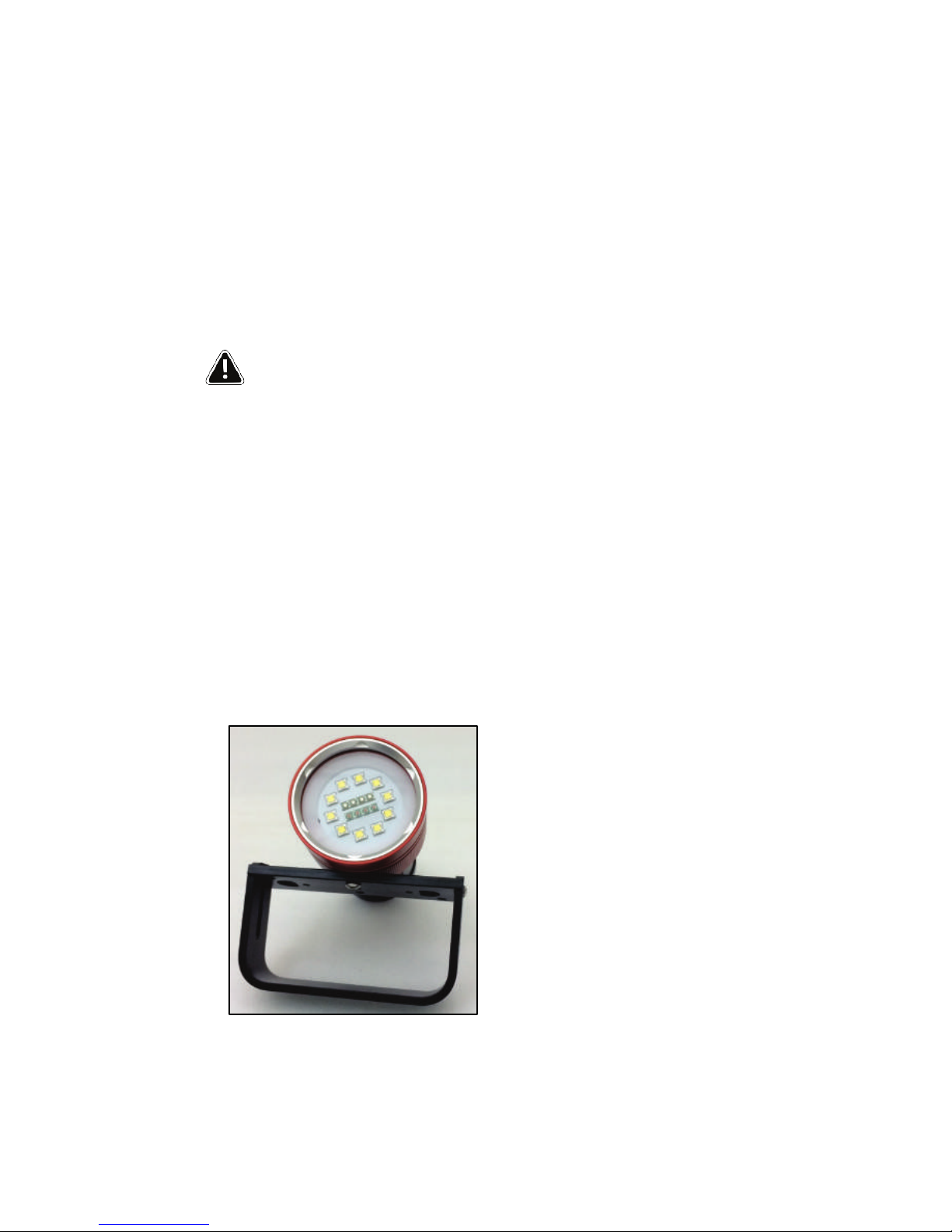
Mounting the Goodman Handle
1. Locate the hole on the floodlight body, opposite the switches.
2. Use a screw to secure the Goodman handle to the floodlight
body.
Page 8

7
Operating the Floodlight
Switching the Floodlight On or Off
♦ Press the left switch to turn on the floodlight’s ten main (white)
LED lights. The white light has three intensities, and by default
comes on at 100%. Press the switch a second time to reduce
the intensity to 50%, press it a third time to reduce the
intensity to 25%, and press it a fourth time to return to 100%.
Hold down the switch for four seconds to turn off the
floodlight.
♦ Press the right switch to toggle between the floodlight’s red
and blue modes. By default, the colored light comes on solid
red. Press the switch a second time for flashing red, a third
time for blue, and a fourth time to return to solid red. Hold
down the switch for four seconds to turn off the floodlight.
Note: Both the white and the colored lights can be
used simultaneously, but they must be switched on and
off separately.
Caution: The Max Planck 6000 is a powerful floodlight
meant for use underwater. Using the floodlight outside
of the water for prolonged periods will cause the
floodlight to heat up significantly. Do not keep the
floodlight on for more than five minutes at a time
outside of the water.
Page 9

8
Maintenance
Servicing the Floodlight
If your floodlight is damaged or faulty, have it repaired by an
authorized service technician.
Caution: Under no circumstances should the floodlight
be opened for repairs or any other purpose by anyone
other than an after-sales service technician authorized
by Nemo Power Tools. Opening the floodlight
invalidates the manufacturer warranty.
Transporting the Floodlight
The battery pack has effective protection against internal overpressure and short-circuiting, as well as devices preventing violent
rupture and dangerous reverse current flow.
The lithium-equivalent content in the batteries is below applicable
limit values. Therefore, the batteries are not subject to national or
international regulations pertaining to dangerous mediums, either
as individual components or when inserted into a floodlight.
However, the regulations governing dangerous goods may be
relevant when transporting several batteries. In this case, it might
be necessary to comply with special conditions, such as those
governing packaging.
Disposing of the Floodlight
At the end of its lifecycle, the floodlight, its accessories, and
packaging should be sorted for environmentally friendly recycling.
Do not dispose of the batteries in household waste, fire, or water.
Batteries should be collected, recycled, or disposed of in an
environmentally friendly manner.
Page 10

9
Troubleshooting
If you have any questions about operating or troubleshooting the
floodlight, visit the FAQ and troubleshooting sections at
www.NemoPowerTools.com.
Page 11

Nemo Power Tools Ltd
www.nemopowertools.com
 Loading...