

Page 1

A CONSUMER GUIDE:
HT
410
CHOOSING THE RIGHT
LARGE SCREEN DISPLAY
BY
NEC Solutions America
FOR YOUR
HOME
ARE YOU LOOKING TO TRANSFORM YOUR BASEMENT INTO A
HOME THEATER?
Have you been dreaming about converting the living room into a decorative yet usable space?
The couches, window treatments and paint are certainly important. But, selecting the right
large screen display to complete the room may be the most critical task ahead whether you are
a first-time buyer of the technology or home entertainment aficionado.
Today, there are an abundance of display choices available for the home beyond traditional TVs. A flood of new
technologies -- such as flat screens and lightweight projectors can be found in a wide range of screen sizes and
prices to fit virtually every room of the house.
Consumers are increasingly smitten by the beautiful, brilliant images and sleek, flat-screen designs offered from
plasma displays. Their sleek profile and extremely wide viewing angle addresses the functionality requirements
of rooms with minimal space, such as a living room, loft or even a bathroom. Plasma displays meet the rigorous
requirements of the most discerning home theater enthusiast, with brilliant image quality, accurate image reproduction and amazing brightness and contrast.
A PROJECTOR can offer the same vibrant, larger-than-life viewing experience as going to the movies while
being considered an attractive, practical display option for consumers. Many home entertainment projectors are
available in a compact, contemporary design that can be discreetly mounted to a wall or ceiling, but are adaptable enough to be removed from the room for other uses, like projecting the latest sci-fi thriller on the garage
or neighborhood movie night.
door f
REAL
es, c
THE
omput
HERE’S
signal compatibility, they offer capabilities that span far beyond a traditional TV, such as high
definition television, cable and satellite display. They can also be used for gaming, digital
pictur
here to stay. According to Home Theater Research Group, the plasma display market is
projected to grow 70% annually over the next three years and IDC predicts that home theater
projectors are expected to move from 9% of the overall projector market in 2004 to 20% by 2008.
BEAUTY
s and mor
er
OF LARGE SCREEN DISPLAYS:
e.
Resear
ch indic
es that lar
at
ge scr
o their br
due t
een display pr
oad
oducts ar
e
Page 2

WHAT’S ATTRIBUTING TO THIS GROWTH?
HIGH DEFINITION CONTENT. Since all broadcasting is expected to be digital by 2006, a display product with
HDTV compatibility future-proofs the investment and eliminates concerns about technology obsolescence.
Likewise, display technology has played a significant role in progressing the emergence of media and content,
such as DVD’s, which enhance the overall viewing experience.
MORE INFORMATION AND BROADER ABILITY. The increased popularity and use of large screen display
products has led to a plethora of information about them. Along with increased awareness, projectors and
plasma displays have become more accessible and can now be purchased from the web, through a professional
installer and even in a local consumer electronics retail outlet.
COCOONING. Americans are spending more time at home and using display technology to connect with family
and friends. Projectors and plasma displays enable families to view “big screen” movies together, share digital
photos with long-distance relatives or invite the neighbors over to watch a favorite sporting event.
LOWER COSTS=MORE MAINSTREAM USE. What was once thought to be suited for only a “rich and famous”
lifestyle, large screen display technology is now a much more affordable reality for today’s conventional household. Many new home builders have even begun to offer display packages as an option so families can begin to
enjoy the benefits of the technology from the day they move in.
GREATER INTEREST. Because of their wide range of uses and capabilities, these products are attracting a
more diverse demographic. Women, for example, like the decorative look and space-saving functionality of a
plasma display, which can add style to a room while remaining up and out of the way of small children.
EASIER TO USE. You don’t have to be a “techie” to use a large screen display, in fact, many are as easy to use
as a regular TV. With color-coded inputs and cabling, quick start-up menus and intuitive, automatic features and
accessories, projectors and plasma displays can now be operated by almost anyone.
A WIDE ARRAY OF NEC DISPLAYS
Page 3

WHAT TO ASK BEFORE YOU BUY:
By working through the following three primary qualifiers, you will be in a better position to decide which large
screen display is most ideal for your home:
HOW WILL I USE A LARGE SCREEN DISPLAY? Before you make a change, you must have a need. Is your
current television about to bite the dust? Have you just moved into a smaller or larger living space? Are you finally getting around to making the basement a home theater? The size of the room and the use of the display will
help narrow your choices to products that are most fitting for your situation. Knowledge is power so arm yourself
with information – industry association websites such as the
product-focused websites like Projector Central (www.projectorcentral.com) and even mainstream publications
like
PC Magazine (www.pcmagazine.com) provide statistics, trend and user articles, product reviews and more.
You’ll also want to search manufacturers’ websites to learn more about the actual displays.
WHICH ACCESSORIES DO I NEED WITH MY DISPLAY? Now that you’ve selected a large screen display,
you can begin to identify which accessory options you will need. Will the display be built into an entertainment
center or do you need it to hang flush with the wall? Accessories are a vital part of the installation because they
will ultimately maximize what you can do with your display. Most projectors and plasma monitors will require
audio/speakers, a mounting system or floor stand, source equipment such as a set top box and external tuner,
and the necessary switchers and remotes
facturers offer home theater “bundles” with various accessory options to help simplify the process, but resources
like those listed above will also provide specific information about all types of display accessories. Again, knowledge is key so take the extra time to read up on the different products and how they can enhance your viewing
experience.
to tie together all the sources and uses for the display. Some manu-
Consumer Electronics Association (www.cea.org),
bonus room
HT410
xercise room
e
42VR5
kitchen
42XR3
WHAT DO I NEED TO KNOW ABOUT INSTALLATION? While many large screen display products are
now easy enough for the “do-it-yourselfer” to set-up, most consumers will still require professional help to
design, optimize and assemble the display and accessories to maximize their desired effect. Always choose a certified professional installer for the job, as their extensive experience with the technology will assure the best possible result. Most certified professional installers will also recommend displays and accessories for the application, but it’s still wise to have a solid understanding of what you want and need prior to contracting with an
installer. For a list of professional installers in your area, go to organizations like
.cedia.net.
www
You are now well on your way toward incorporating the dazzling, stunning images and movie-like viewing experience capable with large screen displays into your home. Enjoy!
°
°
bedroom
50XR4
www.paralink.org or
°
°
°
°
°
study
HT510
family room
61XR3
home theater
HT1100
a projector or plasma display for every room in your house!
Page 4
HT
410
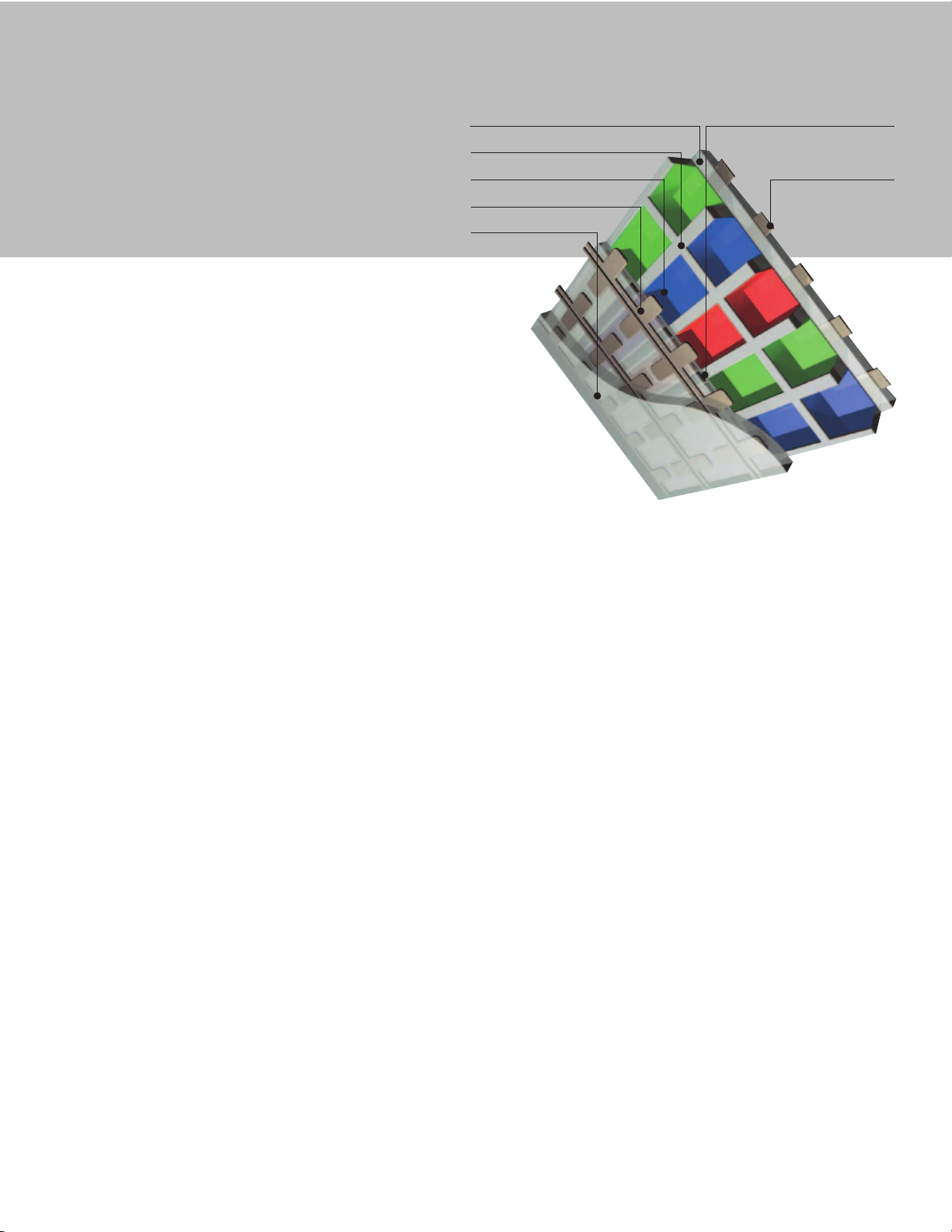
rear glass substrate black stripe
grid barrier rib
phosphor
display electrode
front glass substrate
WHAT IS A PLASMA DISPLAY AND HOW DOES
IT WORK?
Plasma display panels consist of two thin panels of mounted
glass found within the screen. The panels are made up of an
array of cells, known as pixels, which are tiny pockets composed
of compressed gas. Each pixel contains three sub pixels made up of
red, green and blue phosphors.
When an electrical current is applied to a pixel, the gas reacts to form plasma, which in turn produces UV light. The light reacts with the phosphors to
produce the colors you see on the screen. Because all the pixels emit light at
the same time, the viewers never see a flickering screen.
Pixel: The smallest discrete component of an image or picture on a screen (usually a colored dot); "the greater
the number of pixels per inch the greater the resolution." -- WordNet ® 2.0, © 2003 Princeton University
data electrode
LCD AND DLP
™
PROJECTOR TECHNOLOGIES. WHAT’S THE DIFFERENCE?
Projectors are categorized into the following two primary technologies, which reference the internal mechanisms
used to compose an image:
LCD (LIQUID CRYSTAL DISPLAY) projectors contain three separate LCD glass panels, one for red, green, and blue
omponents of the image. As light pas
c
ses through the LCD panels, individual pixels can be opened to allow light
to pass or closed to block the light. This activity modulates the light and produces the image that is projected onto
the scr
een. LCD advantages include images with deep saturated colors that are sharp and accurate, bright
images and low costs for greater affordability.
xas Instruments, the DLP chip is a reflective surface made up
DLP (DIGIT
AL
LIGHT
PROCESSING)
De
oped by T
el
v
e
of thousands of tiny mirrors. Each mirror represents a single pixel. In a DLP projector, light from the projector's
lamp is directed onto the surface of the DLP chip. A color wheel consisting of red, green, blue and sometimes
clear segments spins between the lamp and the chip to modulate the color. The mirrors move back and forth,
directing light either into the lens path or away from the lens path. DLP technology offers a very high contrast
r
atio, with less space between pixels (reduces screen door effect) for smoother images, along with fewer
components, allowing the projector to be packaged into an extremely compact design.
ormation on NEC’
e inf
or mor
F
please contact us at 800 NEC-INFO or visit www.necvisualsystems.com
The opinions expressed in this document are those of NEC Solutions America,
Inc., based on the current state of large screen display technologies as of
September 2004.
NEC 090403
s industry-leading large screen displays,
NEC is a registered trademark of NEC Corporation. All other trademarks are the property of their respective owners. All specifications
and programs are subject to change without notice. DLP
trademark of Texas Instruments.
©2004 NEC Solutions (America) Inc
Visual Systems Division
1250 Arlingt
Itasca, IL 60143-1248
on Heights Rd., Suit
e 400
™ is a
 Loading...