

Page 1

FONT
Quick guide
Page 2
Thank you for choosing the FONT Filter
for your Eurorack System.
Powering up
1.
Turn off the power of your modular synthesizer.
2.
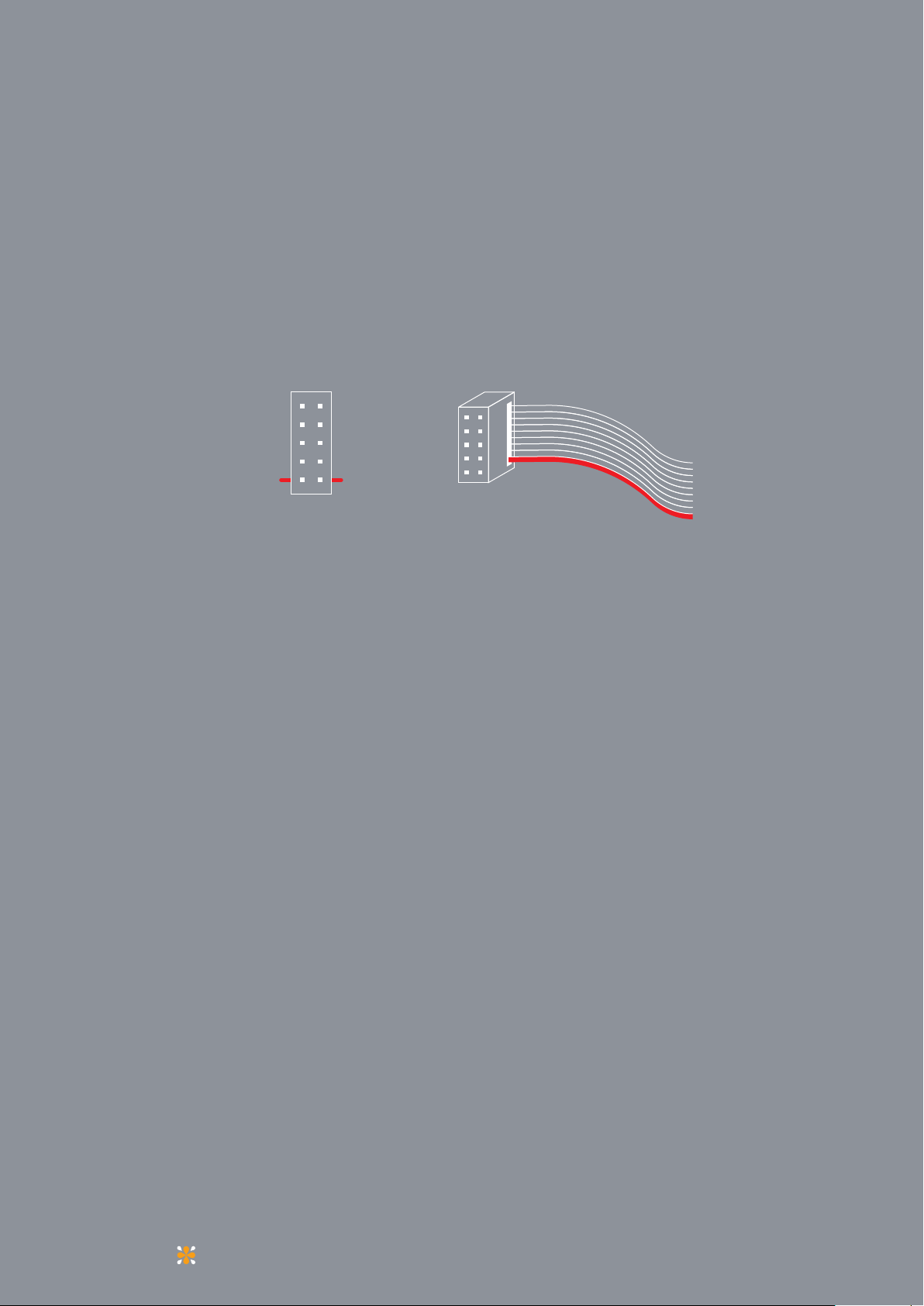
Double check the power cord polarity. If you plug the module backwards you might
damage its electronic circuits.
REDRED
If you flip over your FONT filter, you will find the “RED” mark at the PCB power
connector, which must match the colored line on the ribbon cable.
Once you have checked all the connections, you can turn on your modular system.
3.
If you notice any anomalies, turn your system off right away and check again your
4.
connections.
Description
FONT is a voltage-controlled filter.
The filtering is achieved by a high-quality V2164 IC. An OTA in the filter feedback
path brings the resonance under voltage control, and also serves as a soft-limiter to
ensure a clean self oscillation.
It features two simultaneous outputs:
• 2-pole Low Pass
• 2-pole Band Pass
This filter tracks 1 V/octave pitch input over a wide range and can be used as a
low-distortion sine VCO when self-resonating. It responds very well to frequency
modulation and the small size makes it an ideal choice for a smaller system.
FONT
NANO Modules - València 2019 ©
Page 3
Layout
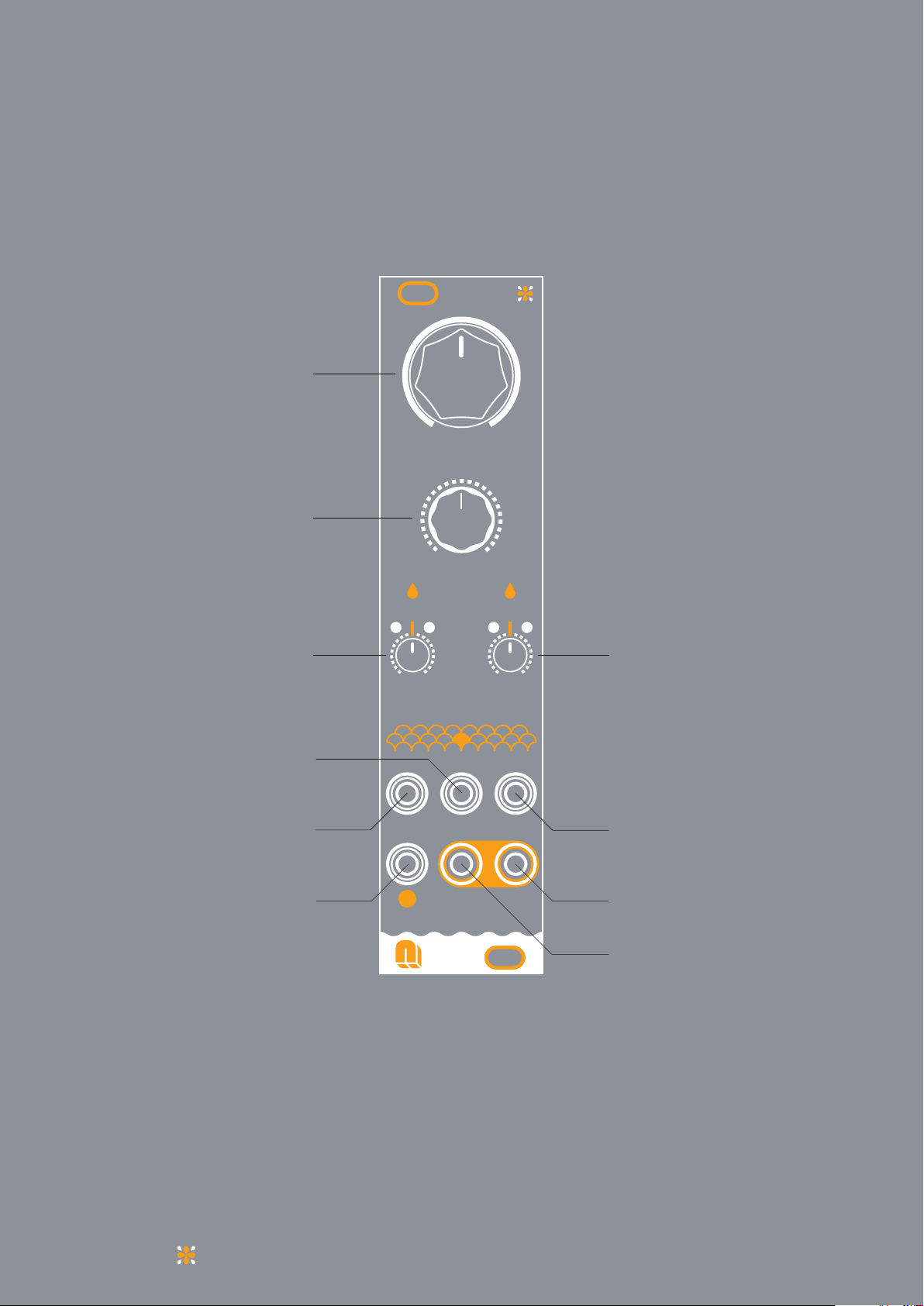
This image will clarify the function of each of the elements of the module.
FONT
Frequency
Cutoff Control
FREQ
Resonance
Q Control
CV Frequency
Attenuverter
CVF Input Control
1V/Octave Input
Un-attenuated Frequency CV,
calibrated for 1V/Oct
CV Frequency
Input
Audio
Input
RES
+-
CVF CVR
CVF
IN
LP2 BP2
+-
CV Resonance
Attenuverter
CVR Input Control
CVROCT
CV Resonance
Input
2-Pole Band Pass
Output
2-Pole Low Pass
Output
FONT
NANO Modules - València 2019 ©
Page 4
Controls
• Frequency (FREQ)
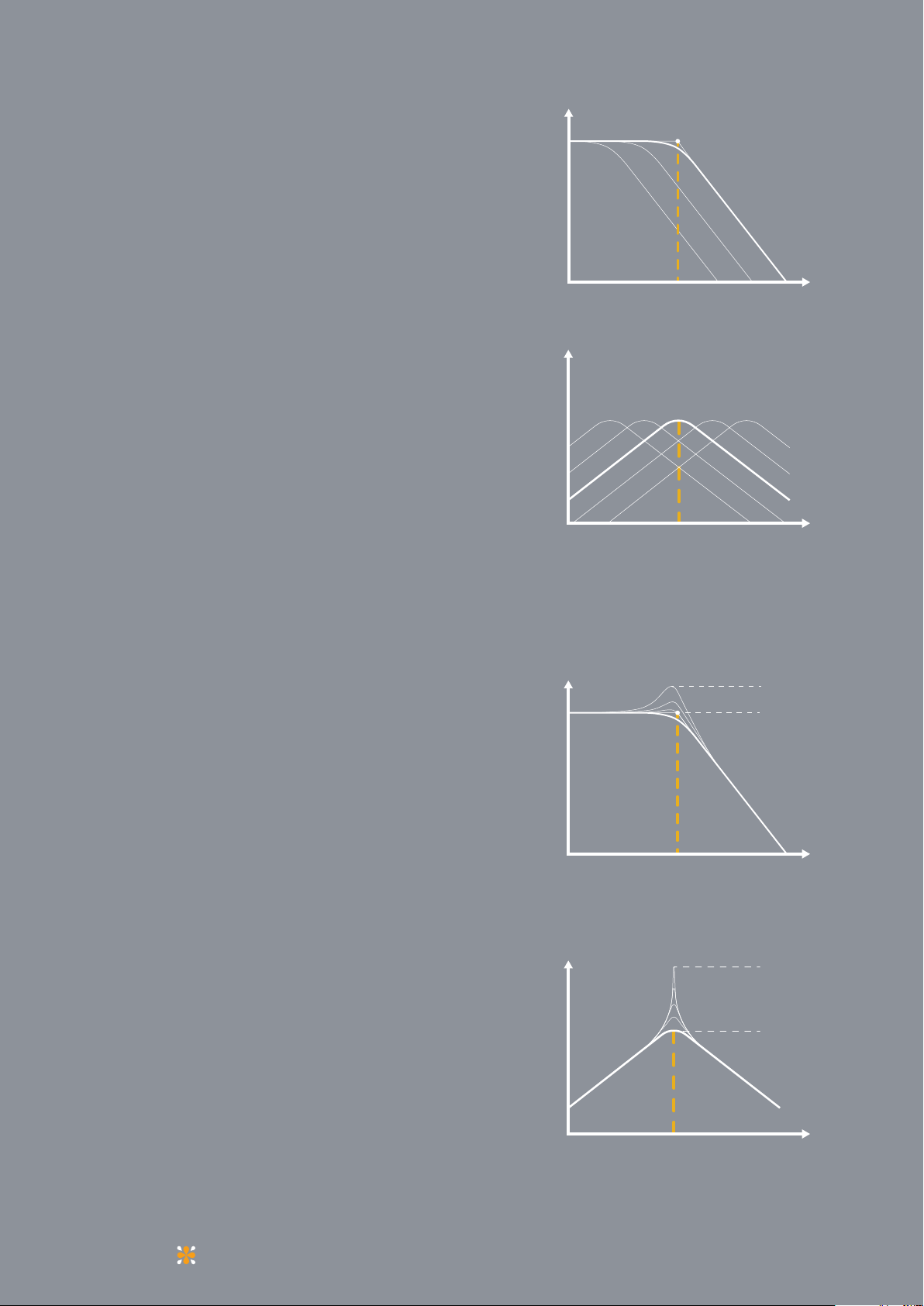
With this control you adjust the Cut-Off
Frequency fc, above which the filter
attenuates all frequencies. At maximum
level, the filter is fully open. The more you
turn down this control, the more the high
frequencies are filtered.
The sound becomes mellower and less
bright (see Fig. 1) until at minimum level the
filter is completely shut, and there will be no
output signal at all.
/CVF
Frequency attenuverter. Adjusts the
amount and polarity of frequency
modulation from the CVF input.
fc
out
frequency
Fig.1 Low Pass Filter
out
fc
frequency
Fig. 2 Band Pass Filter
• Resonance (RES)
With this control you adjust the filter’s
resonance (emphasis) - the parameter
which emphasises the frequencies around
the cut-off point fC (see Fig. 2 on p.4).
Close to its maximum setting, the filter
becomes so resonant that it goes into
self-oscillation, and starts behaving like a
sine wave. Self-oscillation occurs at about
80% of the course of this potentiometer. You
can take advantage of this effect, and use
the VCF as an additional oscillator.
/CVR
Resonance attenuverter. Adjusts the
amount and polarity of resonance
modulation from the CVR input.
out
Fig.3 Low Pass Filter
out
resonance
fc
frequency
resonance
fc
FONT
frequency
Fig. 4 Band Pass Filter
NANO Modules - València 2019 ©
Page 5
Inputs & Outputs
FREQ
RES
• Inputs
/CVF
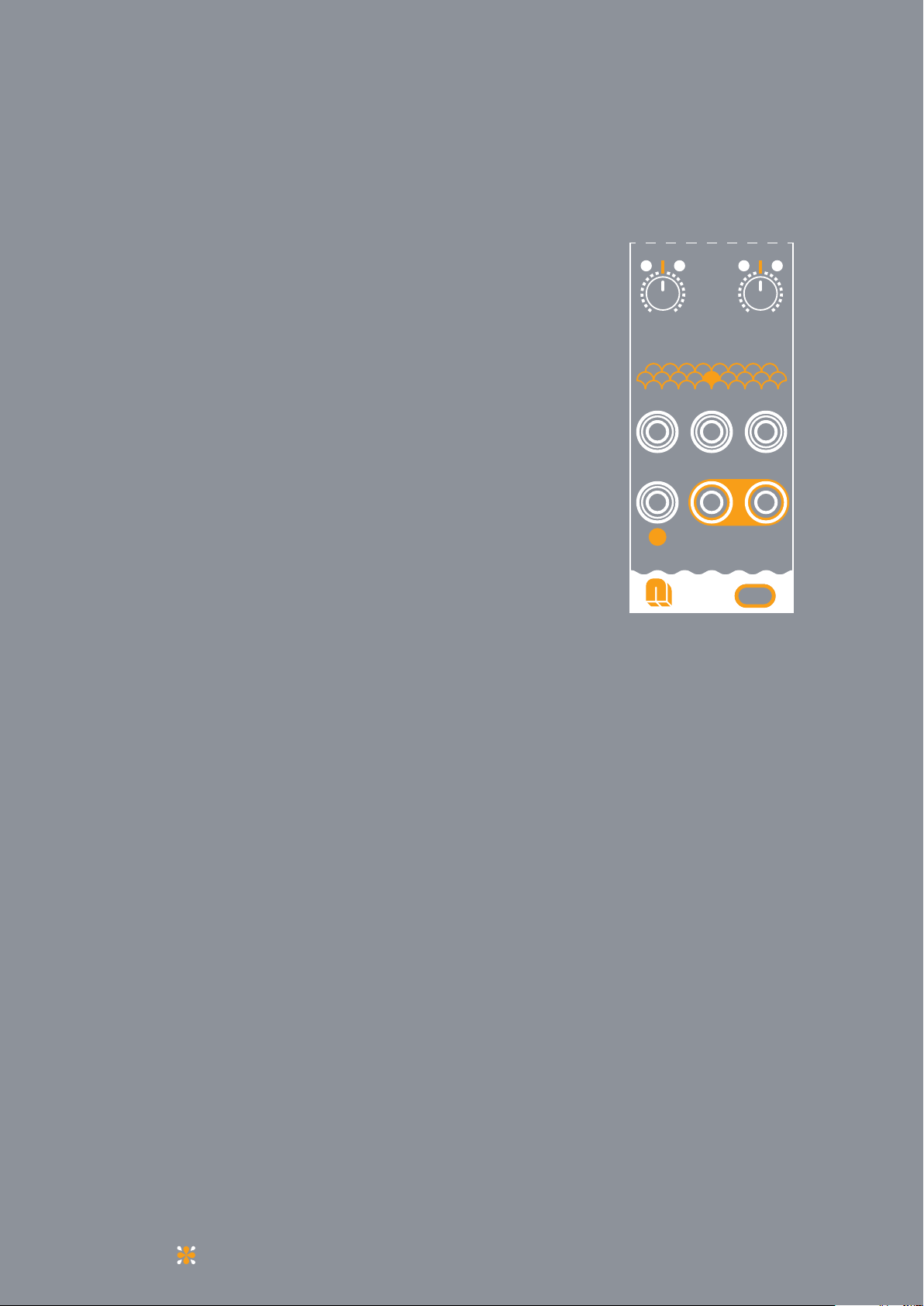
Cutoff frequency control voltage. This signal
is attenuated and polarized by the
corresponding knob.
+-
+-
• Outputs
/OCT
1 V/Oct cutoff frequency control. This input is
very helpful for getting the filter frequency to
track the keyboard note.
Notice that when resonance is set to its
maximum value, with no input signal, FONT
behaves like a sine wave oscillator.
/CVR
Resonance control voltage. A voltage of +4V
starts bringing the filter to self-oscillation.
/IN
Signal input. This input is DC-coupled.
/LP2 | 2-pole 12 dB/octave
Passes low-frequency signals and attenuates
high-frequency signals
CVF CVR
CVF
IN
LP2 BP2
CVROCT
FONT
/BP2 | 2-pole 12 dB/octave
Passes frequencies within a certain range and
attenuates frequencies outside that range.
NANO Modules - València 2019 ©
Page 6

V/Oct Calibration
FONT comes pre-calibrated.
When the RES knob is set to its maximum position, the filter starts to behave as an sine
wave oscillator. The filter is designed to track well over 5 octaves. In order to track
properly the notes from a controller, these are the steps you should follow:
Set the FREQ knob to 9 o’clock. Set the RES knob to its maximum position.
1.
Disconnect any input signal or FM modulation CV.
Connect the note CV output of a well-calibrated keyboard interface or MIDI-CV
2.
converter to the OCT input.
3.
Listen to the tone at the LP2 output.
Using a screwdriver, adjust the trimmer resistor at the back of the circuit board
4.
until the musical intervals played on the keyboard are correctly reproduced.
FONT
NANO Modules - València 2019 ©
Page 7

Compliance
This device complies to the EU guidelines and is manufactured RoHS conforming
without use of led, mercury, cadmium and chrome. Nevertheless, this device is special
waste and disposal in household waste is not recommended.
This device meets the requirements of the following standards and directives:
• EMC: 2014/30/EU
• EN 55032. Electromagnetic compatibility of multimedia equipment.
• EN 55103-2. Electromagnetic compatibility - Product family standard for audio, video,
audio-visual and entertainment lighting control apparatus for professional use.
• EN 61000-3-2. Limits for harmonic current emissions.
• EN 61000-3-3. Limitation of voltage changes, voltage fluctuations and flicker in
public low-voltage supply systems.
• EN 62311. Assessment of electronic and electrical equipment related to human
exposure restrictions for electromagnetic fields.
• RoHS2: 2011/65/EU
• WEEE: 2012/19/EU
FONT
NANO Modules - València 2019 ©
Page 8

Guarantee
This product is covered by 2 years of guarantee on purchased goods, which begins
when you receive your package.
• This guarantee covers
Any defect in the manufacturing of this product.
Replacement or repair, as decided by NANO Modules.
• This guarantee does not cover
Any damage or malfunction caused by incorrect use , such as, but not limited to:
- Power cables connected backwards.
- Excessive voltage levels.
- Unauthorized mods.
- Exposure to extreme temperature or moisture levels.
Please contact our customer service - [email protected] - for a return
authorization before sending the module. The cost of sending a module back for
servicing is paid for by the customer.
Technical Specifications
Dimensions 6HP 30x128,5mm
Current 22 mA +12V / 25 mA -12V / 0 mA +5V
Input & Output Signals between ±10V
Impedance Input 100k - Output 1k
Materials PCB and Panel - FR4 1,6mm
Depth 20mm - Skiff friendly
Modules are designed and assembled in València.
FONT
Contact
Bravo!
You have learned the basic
fundamentals of your FONT Module.
If you have any doubts, please feel free
to contact us.
nanomodul.es/contact
NANO Modules - València 2019 ©
 Loading...