

Page 1
MYSAFE AUTO RESCUE TOOL
INSTRUCTIONS
PLUG UNIT INTO YOUR VEHICLE’S
12V OUTLET TO CHARGE DEVICE
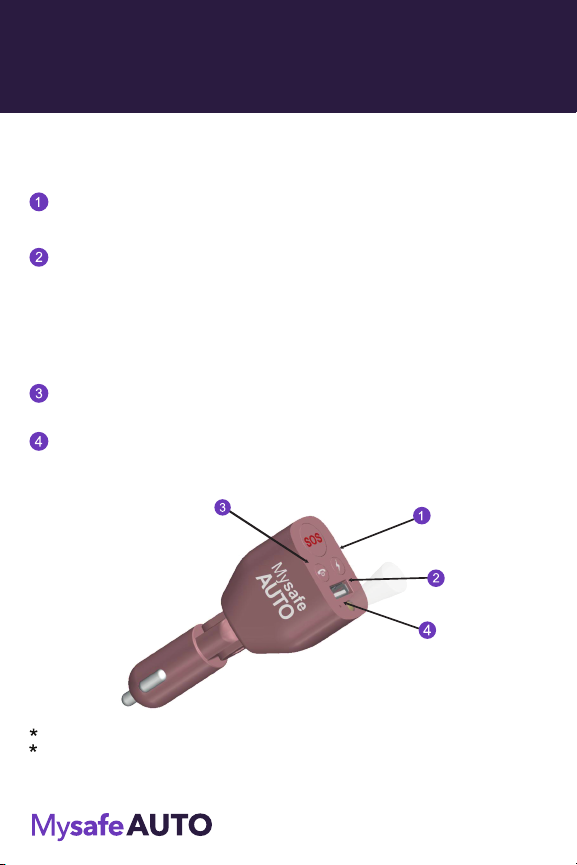
911 Call - To place a 911 call, press & hold "SOS" button for 5 seconds.
LED light will flash when a call to 911 is initiated and unit will verbally
state "Calling 911" *
Flashlight/Alarm- Operation of flashlight, strobe, and alarm:
Cancel -To cancel a call to 911 or turn off flashlight, strobe, or
alarm, press and release Cancel button.
USB Charging- The USB port on the device can be used to charge
USB-powered devices. (5V/2.1A / 1000mA)
• Flashlight: To turn on Flashlight, press and release
Flashlight button.
• Strobe Light: To turn on strobe light, press Flashlight
button twice.
• Strobe Light and Audible Alarm: To turn on audible alarm
“SOMEBODY HELP ME!” with strobe light, press and hold
the Flashlight button for 3 seconds.
NOTE
This device is designed to call 911 ONLY.
This unit does not provide location. Please let the operator know your exact location. Additionally, this
unit does not allow for call backs and will appear as an unregistered device to the 911 operator.
(844) 7- MYSAFE
Page 2

FCC Compliance
Body-worn Operation
This device was tested for typical body-worn operations. To comply with RF exposure
requirements, during calling, a minimum separation distance of 1.5cm must be maintained
between the user’s body and the handset, including the antenna. Third-party belt-clips,
holsters, and similar accessories used by this device should not contain any metallic
components. Bodyworn accessories that do not meet these requirements may not comply with
RF exposure requirements and should be avoided.
Specific Absorption Rate (SAR)
This
model wireless phone meets the government’s requirements for exposure to radio waves.
Your mobile device is a radio transmitter and receiver. It is designed and manufactured to not
exceed limits for exposure to radio frequency (RF) energy set by the Federal Communications
Commission (FCC) of the U.S. Government and by the Canadian regulatory authorities. These
limits are part of comprehensive guidelines and establish permitted levels of RF energy for the
general population. The guidelines are based on standards that were developed by
independent scientific organizations through periodic and thorough evaluation of scientific
studies. The standards include a substantial safety margin designed for the safety of all
persons, regardless of age or health.
The exposure standard for wireless mobile phones employs a unit of measurement known as
the Specific Absorption Rate, or SAR, The SAR limit set by the FCC is 1.6 W/Kg. Tests for
SAR are conducted using standard operating positions accepted by the FCC with the phone
transmitting at its highest certified power level in all tested frequency bands. Although the SAR
is determined at the highest certified power level, the actual SAR level of the phone while
operating can be well below the maximum value. This is because the phone is designed to
operate at multiple power levels so as to use only the power required to reach the network.
In general, the closer you are to a wireless base station, the lower the power output. Before a
phone model is available for sale to the public in the U.S, it must be tested and certified to the
FCC that it does not exceed the limit establish for safe exposure. The tests are performed in
positions and locations (e.g. at the ear and worn on the body) reported to the FCC.
Before a phone model is available for sale to the public in the U.S, it must be tested and
certified to the FCC that it does not exceed the limit establish for safe exposure. The tests are
performed in positions and locations (e.g. at the ear and worn on the body) reported to the
FCC.
While there may be differences between the SAR levels of various phones and at various
positions, they all meet the governmental requirements for safe exposure. Please note that
improvements to this product model could cause differences in the SAR value for later
products,
in all cases, products are designed to be within the guidelines. Additional information on
Specific Absorption Rates (SAR) can be found on the Cellular Telecommunications & Internet
Association (CTIA)
 Loading...