

Page 1
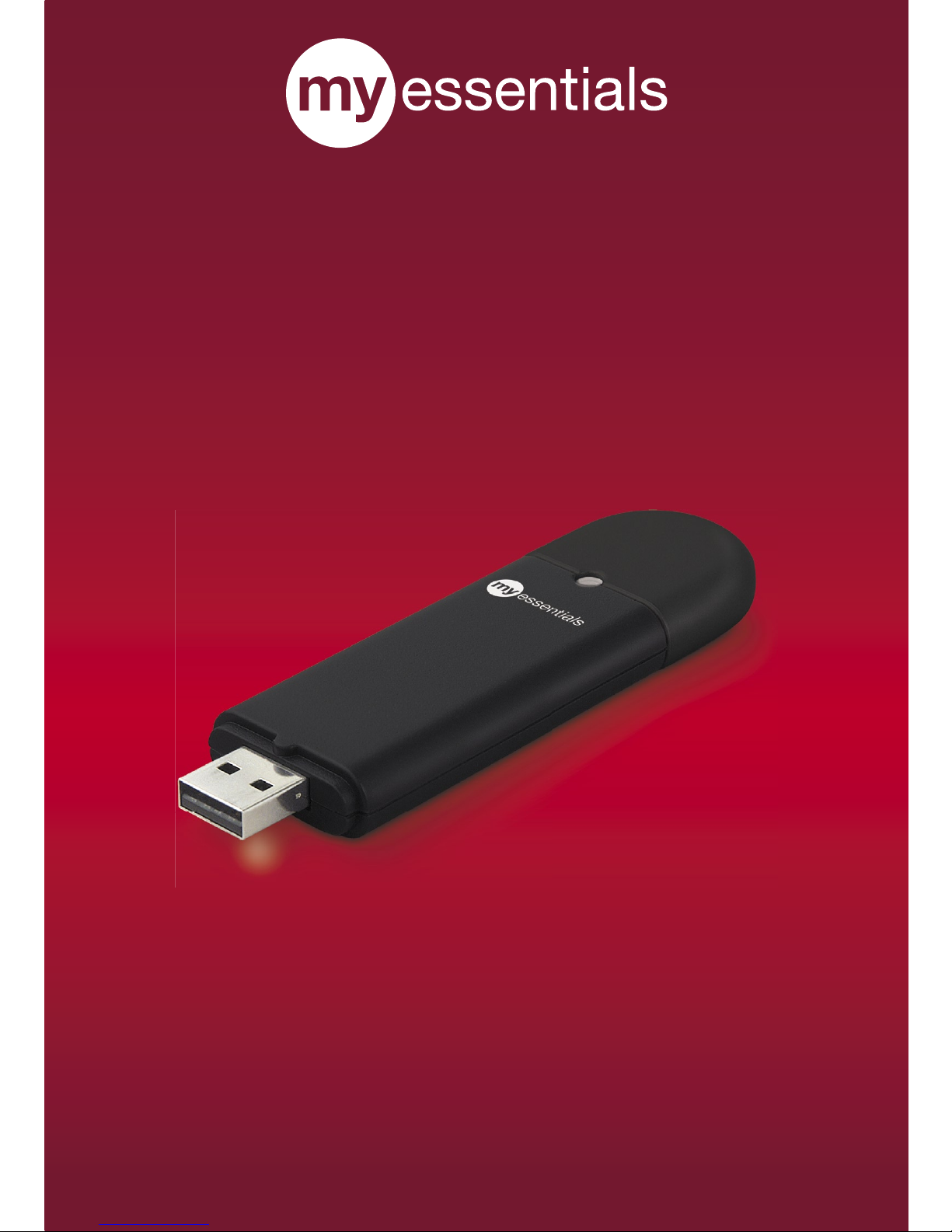
Wireless G
USB Network Adapter
User Manual
ME1001-NB
Page 2

Table of Contents
1. Introduction. . . . . . . . . . . . . . . . . . . . . . . . . . . . . . . . . . . . . 1
Benefits of a Home Network. . . . . . . . . . . . . . . . . . . . . . . . .
1
Advantages of a Wireless Network . . . . . . . . . . . . . . . . . . . .
1
Placement of your Wireless Networking
Hardware for Optimal Performance. . . . . . . . . . . . . . . . . . . .
2
2. Overview . . . . . . . . . . . . . . . . . . . . . . . . . . . . . . . . . . . . . . .
6
Product Features . . . . . . . . . . . . . . . . . . . . . . . . . . . . . . . . .
6
Applications and Advantages . . . . . . . . . . . . . . . . . . . . . . . .
7
Product Specifications . . . . . . . . . . . . . . . . . . . . . . . . . . . . .
7
System Requirements . . . . . . . . . . . . . . . . . . . . . . . . . . . . . .
8
Package Contents . . . . . . . . . . . . . . . . . . . . . . . . . . . . . . . .
8
3. Installing and Setting up the Adapter . . . . . . . . . . . . . . . .
9
Step 1: Install . . . . . . . . . . . . . . . . . . . . . . . . . . . . . . . . . . . .
9
Step 2: Connect . . . . . . . . . . . . . . . . . . . . . . . . . . . . . . . . . 10
Step 3: Configure . . . . . . . . . . . . . . . . . . . . . . . . . . . . . . . . 11
4.
Using the MyEssentials Wireless Networking Utility . . . 12
Accessing the MyEssentials Wireless Networking Utility
from the Windows System Tray . . . . . . . . . . . . . . . . . . . . . 12
Setting Wireless Network Profiles . . . . . . . . . . . . . . . . . . . . 15
Securing your Wi-Fi Network . . . . . . . . . . . . . . . . . . . . . . . 15
Configuring your MyEssentials Wireless G USB
Network Adapter to use Security . . . . . . . . . . . . . . . . . . . .
20
5. Troubleshooting . . . . . . . . . . . . . . . . . . . . . . . . . . . . . . . . 28
6. Information . . . . . . . . . . . . . . . . . . . . . . . . . . . . . . . . . . . . 34
Page 3

1
2
1
3
4
5
6
section
Introduction
Thank you for purchasing the MyEssentials Wireless G USB Network
Adapter (the Adapter). Now you can take advantage of this great new
technology and gain the freedom to network your home and office
computers wirelessly. This Adapter allows you to connect a desktop or
notebook computer to your network. The easy installation and setup will
have you networking wirelessly in minutes. Please be sure to read through
this User Manual completely, and pay special attention to the section
entitled “Placement of your Wireless Networking Hardware for Optimal
Performance” on page 2.
Benefits of a Home Network
Your MyEssentials Home Network will allow you to:
• Share one high-speed Internet connection with all the
computers in your home
• Share resources, such as files, and hard drives among all
the connected computers in your home
• Share a single printer with the entire family
• Share documents, music, video, and digital pictures
• Store, retrieve, and copy files from one computer to another
• Simultaneously play games online, check Internet email, and chat
Advantages of a Wireless Network
Here are some of the advantages of setting up a MyEssentials
wireless network:
• Mobility – you’ll no longer need a dedicated “computer
room”—now you can work on a networked laptop or desktop
computer anywhere within your wireless range
• Easy installation – MyEssentials Easy Installation Wizards make
setup simple
• Flexibility – set up and access printers, computers, and other
networking devices from anywhere in your home
• Easy expansion – the wide range of MyEssentials networking
products lets you expand your network to include devices such as
printers and gaming consoles
• No cabling required – you can spare the expense and hassle of
retrofitting Ethernet cabling throughout the home or office
• Widespread industry acceptance – choose from a wide range of
interoperable networking products
Page 4

Introduction
2
Placement of your Wireless Networking Hardware
for Optimal Performance
Your wireless connection will be stronger the closer your computer is
to your wireless router (or access point). Typical indoor operating range
for your wireless devices is between 100 and 200 feet. In the same
way, your wireless connection and performance will degrade somewhat
as the distance between your wireless router (or access point) and
connected devices increases. This may or may not be noticeable to
you. As you move farther from your wireless router (or access point),
connection speed may decrease. Factors that can weaken signals
simply by getting in the way of your network’s radio waves are metal
appliances or obstructions, and walls.
If you have concerns about your network’s performance that might be
related to range or obstruction factors, try moving the computer to a
position between five and 10 feet from the wireless router (or access
point) in order to see if distance is the problem. If difficulties persist
even at close range, please contact MyEssentials Technical Support.
Note: While some of the items listed below can affect network
performance, they will not prohibit your wireless network from
functioning; if you are concerned that your network is not operating at
its maximum effectiveness, this checklist may help.
1. Placement of your Wireless Router (or Access Point)
Place your wireless router (or access point), the central connection
point of your network, as close as possible to the center of your
wireless network devices.
To achieve the best wireless network coverage for your “wireless
clients,” (i.e., computers enabled by MyEssentials Wireless
Notebook Cards and Wireless USB Adapters):
• Ensure that your wireless router’s (or access point’s) antennas
are parallel to each other, and are positioned vertically (toward
the ceiling). If your wireless router (or access point) itself is
positioned vertically, point the antennas as much as possible
in an upward direction.
• In multistory homes, place the wireless router (or access
point) on a floor that is as close to the center of the home as
possible. This may mean placing the wireless router (or access
point) on an upper floor.
• Try not to place the wireless router (or access point) near a
cordless 2.4GHz phone.
Page 5

3
2
1
3
4
5
6
section
Introduction
2. Avoid Obstacles and Interference
Avoid placing your wireless router (or access point) near devices that
may emit radio “noise”, such as microwave ovens. Other objects that
can inhibit wireless communication can include:
• Refrigerators
• Washers and/or dryers
• Metal cabinets
• Large aquariums
• Metallic-based, UV-tinted windows
If your wireless signal seems weak in some spots, make sure that
objects such as these are not blocking the signal’s path between
your computers and wireless router (or access point).
3. Cordless Phone Placement
If the performance of your wireless network is impaired after
attending to the above issues, and you have a cordless phone:
• Try moving cordless phones away from the wireless router (or
access point) and your wireless-enabled computers.
• Unplug and remove the battery from any cordless phone that
operates on the 2.4GHz band (check manufacturer’s information).
If this fixes the problem, your phone may be interfering.
• If your phone supports channel selection, change the channel on
the phone to the farthest channel from your wireless network as
possible. For example, change the phone to channel 1 and move
your wireless router (or access point) to channel 11. (Your channel
selection will vary depending on your region.) See your phone’s
user manual for detailed instructions.
• If necessary, consider switching to a 900MHz or 5GHz
cordless phone.
4. Choose the “Quietest” Channel for your Wireless Network
In locations where homes or offices are close together, such as
apartment buildings or office complexes, there may be wireless
networks nearby that can conflict with yours. Use the Site Survey
capabilities of your Wireless Networking Utility to locate any other
wireless networks, and move your wireless router (or access point)
and computers to a channel as far away from other networks
as possible.
Experiment with more than one of the available channels, in order to
find the clearest connection and avoid interference from neighboring
cordless phones or other wireless devices.
Page 6

Introduction
4
For more MyEssentials wireless networking products, use the
detailed Site Survey and wireless channel information included in
your User Manual.
5. Secure Connections, VPNs, and AOL
Secure connections typically require a user name and password,
and are used where security is important. Secure connections
include:
• Virtual Private Network (VPN) connections, often used to connect
remotely to an office network
• The “Bring Your Own Access” program from America Online
(AOL), which lets you use AOL through broadband provided by
another cable or DSL service
• Most online banking websites
• Many commercial websites that require a user name and
password to access your account
Secure connections can be interrupted by a computer’s power
management setting, which causes it to “go to sleep.” The simplest
solution to avoid this is to simply reconnect by re-running the VPN
or AOL software, or by re-logging into the secure website.
A second alternative is to change your computer’s power
management settings so it does not go to sleep; however, this may
not be appropriate for portable computers. To change your power
management setting in Windows, see the “Power Options” item in
the Control Panel.
If you continue to have difficulty with Secure Connections, VPNs,
and AOL, please review steps 1–4 above to be sure you have
addressed these issues.
These guidelines should allow you to cover the maximum possible
area with your wireless router.
Page 7

5
2
1
3
4
5
6
section
Introduction
For more information regarding our networking products, visit our
website at www.MyEssentialssupport.com or call MyEssentials
Technical Support.
Page 8

Overview
6
Product Features
The Adapter complies with the IEEE 802.11g standard in order to
communicate with other 802.11g-compliant wireless devices at 54Mbps.
The Adapter is compatible with all 802.11g devices as well as other
802.11b products at 11Mbps. 802.11g products operate on the same
2.4GHz frequency band as 802.11b Wi-Fi® products.
• 2.4GHz ISM (Industrial, Science, and Medical) band operation
• Integrated easy-to-use Wireless Networking Utility
• USB 2.0 interface, for operation in virtually any desktop or
notebook computer
• WPA, WPA2, 64-bit WEP (Wired Equivalent Privacy), or
128-bit encryption
• Wireless access to networked resources
• Support for both Infrastructure and Ad-Hoc (peer-to-peer)
networking modes
• Data rate of up to 54Mbps (802.11g), or 11Mbps (802.11b)
• Easy installation and use
• External antenna
• LED power and network link indicators
Page 9

7
2
1
3
4
5
6
section
Overview
Applications and Advantages
• Wireless roaming with a laptop around the home or office
Offers the freedom of networking—without cables
• Connection rates of up to 54Mbps
Provides immediate wireless connectivity at home, work, and
hotspot locations without compromising the use of existing 802.11b
and 802.11g products
• Compatibility with 802.11b products
802.11g wireless LAN solutions are backward-compatible with
existing Wi-Fi (IEEE 802.11b) products and with other products
that display the 54g logo
• Difficult-to-wire environments
Enables networking in buildings with solid or finished walls, or
open areas where wiring is difficult to install
• Frequently changing environments
Adapts easily in offices or environments that frequently rearrange
or change locations
• Temporary LANs for special projects or peak time
Sets up temporary networks such as at trade shows, exhibitions,
and construction sites, which need networks on a short-term
basis; also companies who need additional workstations for a peak
activity period
• SOHO (Small Office/Home Office) networking needs
Provides the easy and quick, small network installation SOHO
users need
Product Specifications
Host Interface: USB 2.0 interface
Power Consumption: Tx/Rx peak 510/250mA @ 3.3VDC (max.)
Operating Temperature: 32–140 degrees F (0–60 degrees C)
Storage Temperature: -4–176 degrees F (-20–80 degrees C)
Humidity: Max. 90% (non-condensing)
Typical Operating Range: 100–200 ft. (30–60m) indoors
Page 10
Overview
8
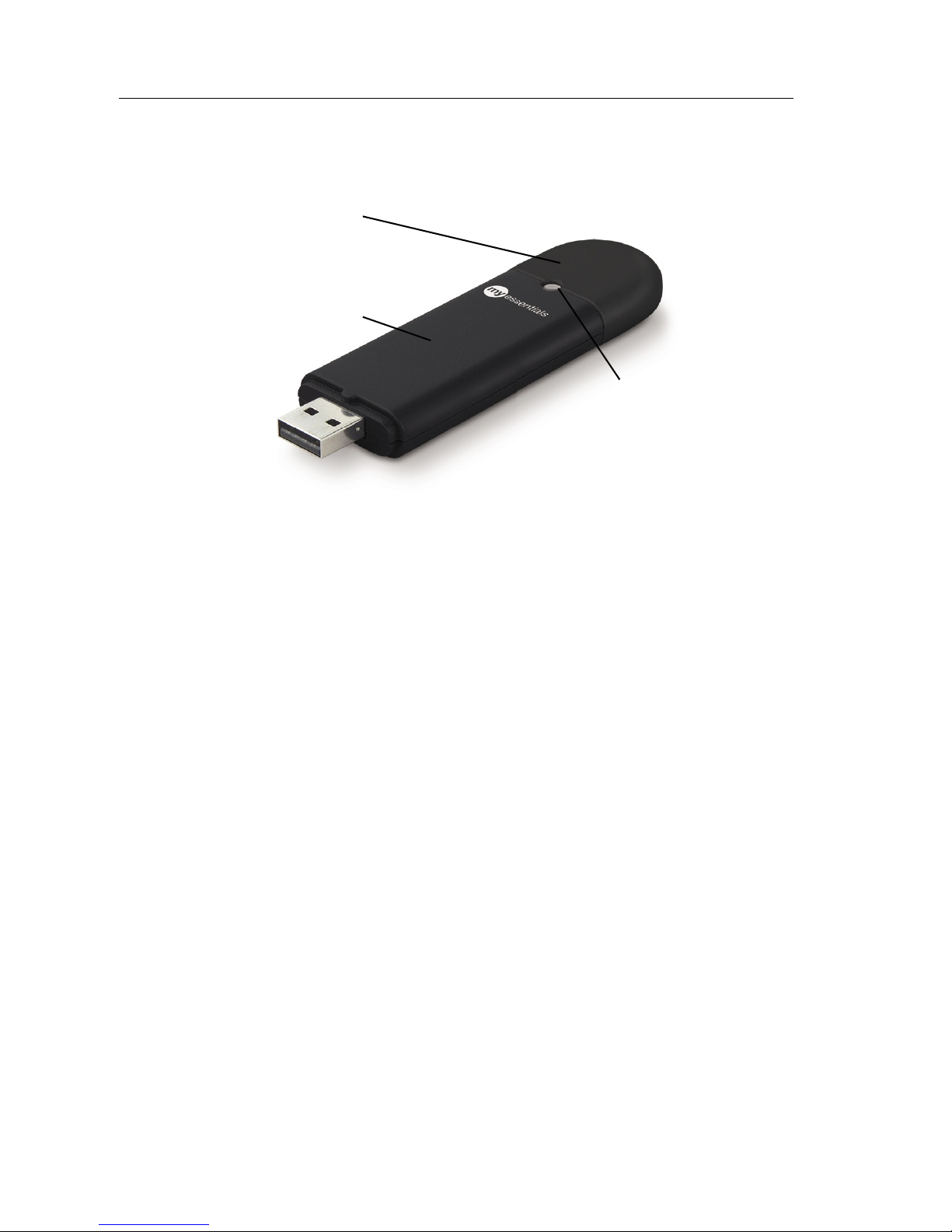
(a) Protective Cap
The cap can be stored on the opposite end of the USB connector. The
cap snaps over the USB connector for protection.
(b) Activity LED
Lights up and flashes when the Adapter is active
Blinking Green: Active
Off: Not connected to network
On: Connected to network
(c) USB Adapter
Fits securely into your computer’s USB slot or into the
Desktop Adapter Base (included).
System Requirements
- PC-compatible desktop
computer with one available
USB slot and CD-ROM drive
- Windows
®
98SE, Me, 2000,
or XP
Package Contents
- Wireless G USB Network Adapter
- Desktop Adapter Base
- Quick Installation Guide
- Installation Software CD
- User Manual
(a) Protective Cap
(b) Activity LED
(c) USB Adapter
Page 11
Step 1 Install
Important Note:
Install the software before connecting
the Adapter.
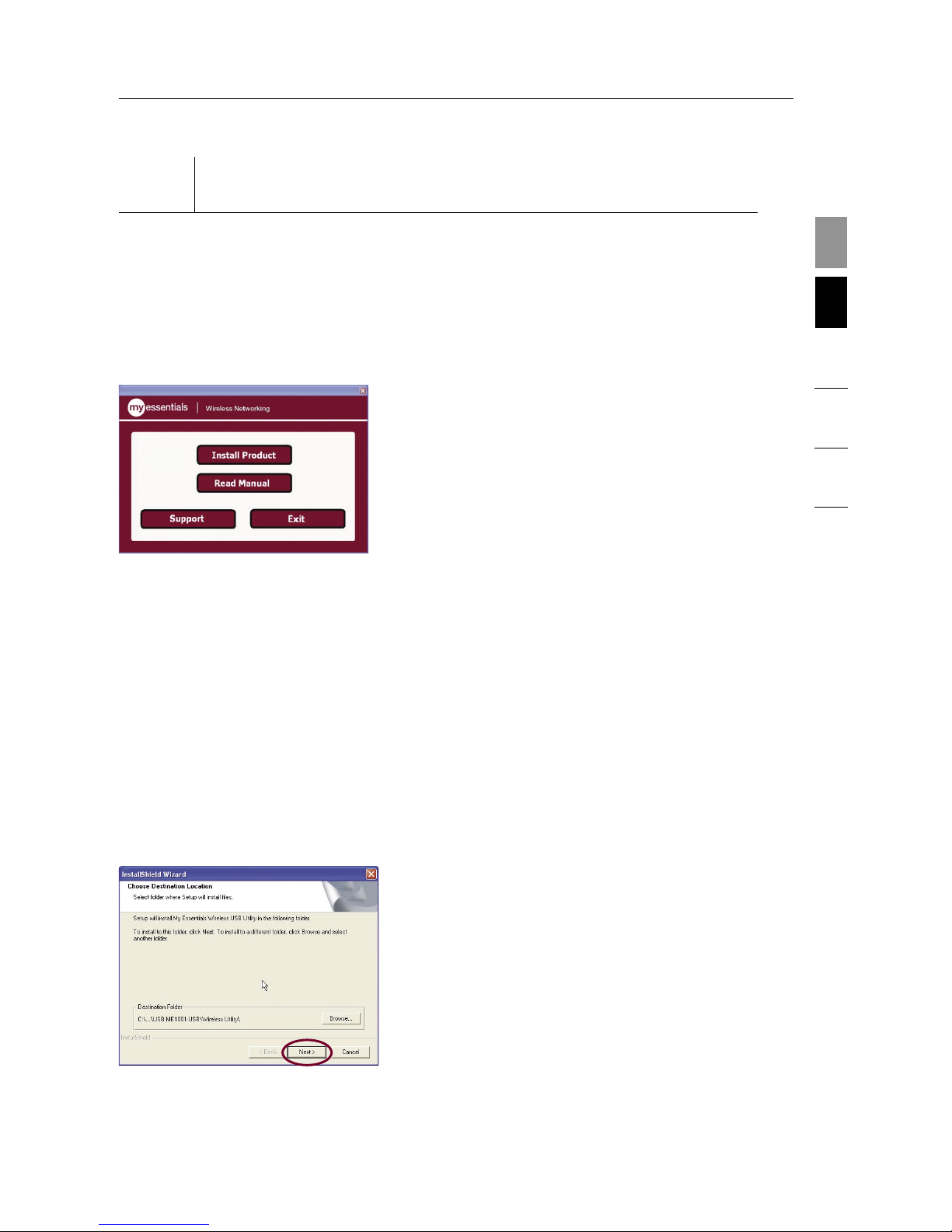
1.1 Insert the Installation Software
CD into your CD-ROM drive.
1.2 The MyEssentials Wireless
Networking Utility setup screen
will automatically appear (may
take 15–20 seconds to appear).
1.3 Click “install” from the menu.
Note: If the MyEssentials
Wireless Networking Utility
setup screen does not appear
within 20 seconds, access your
CD-ROM, double-click on the
“My Computer” icon, and then
double-click on the CD-ROM
drive into which you have placed
the installation CD. Double-click
on the folder named “Files”,
then double-click on the icon
named “setup.exe”.
1.4 Choose an installation location,
and click “Next” to accept
the default location or click
“Browse” to select a different
location before clicking “Next”.
9
2
1
3
4
5
6
section
Installing and Setting up the Adapter
Page 12
Installing and Setting up the Adapter
10
Step 2 Connect
Plug the Adapter into an Available USB Slot on your Notebook Computer
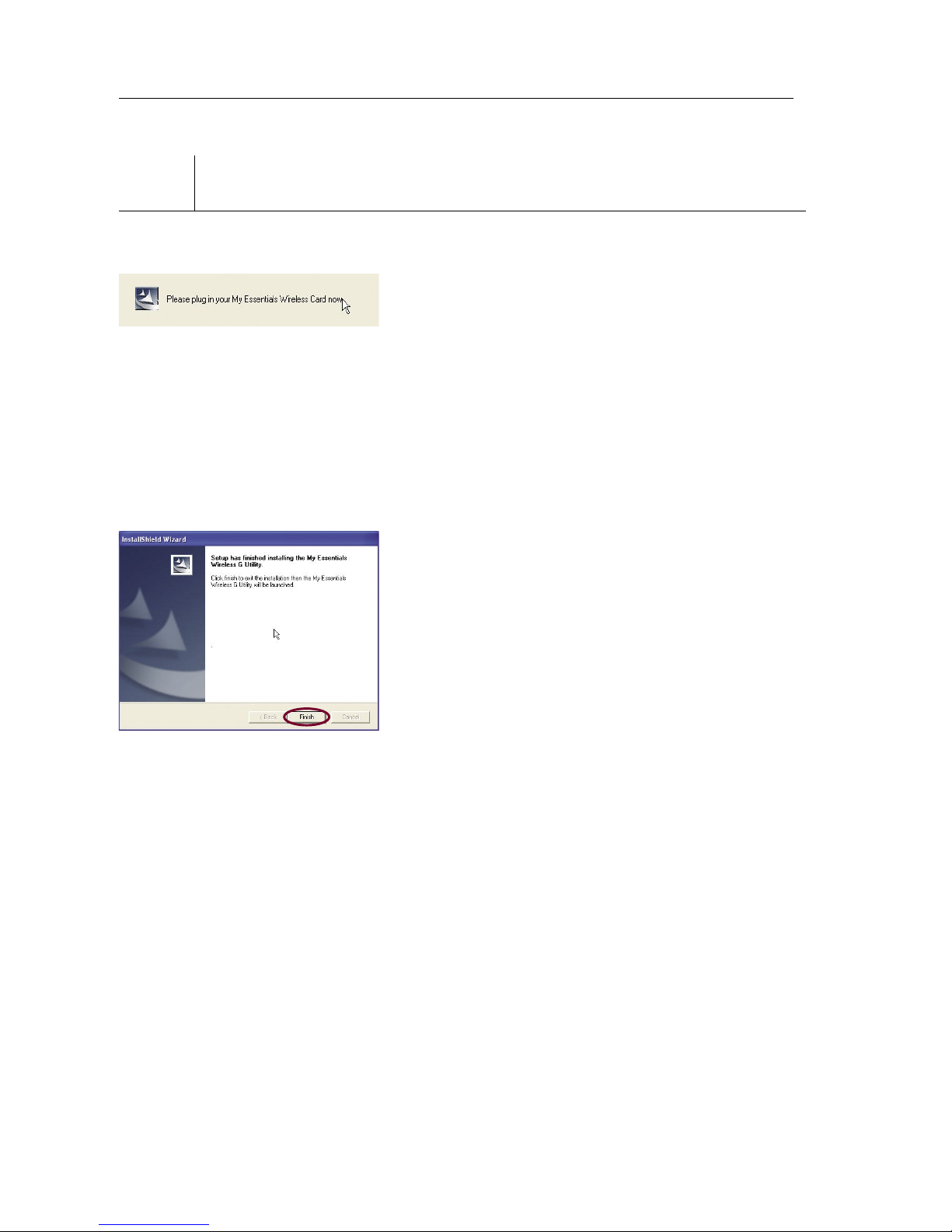
2.1 During the install process, you will be
prompted to insert your Adapter. Plug
the Adapter into an available USB
port on your computer and follow the
on-screen instructions.
Note: If your system did not prompt
you to insert your Adapter after the
installation is completed, please do
so now.
2.2 MyEssentials Wireless Networking
Utility installation is now complete.
Click “Finish” to close the Wizard.
Page 13
11
2
1
3
4
5
6
section
Installing and Setting up the Adapter
Step 3 Configure
Use the MyEssentials Wireless Networking Utility
3.1 After successfully installing
the Adapter, double-click the
MyEssentials Wireless Networking
Utility icon located on the
desktop screen.
3.2 The Wireless Networking Utility
screen will appear. Select a
network to which to connect by
selecting a network from the
“Available Networks” list. Then,
click “Connect”.
Note: In order to see your
available networks, you must be
near a working wireless router or
access point.
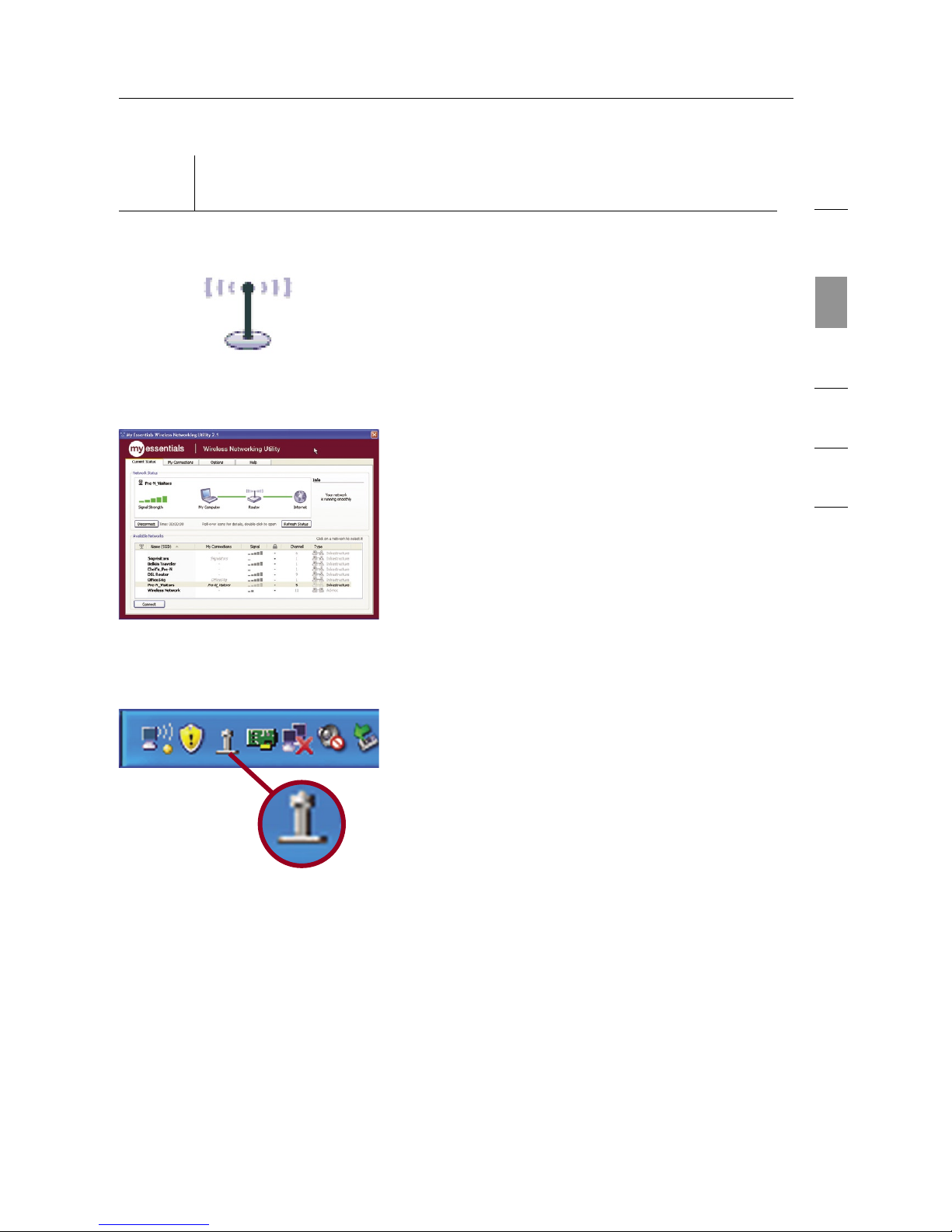
3.3 The MyEssentials Wireless
Networking Utility icon can also be
found on the system tray.
Note: Double-clicking on the
MyEssentials Wireless Networking
Utility icon on the system tray will
bring up the “Utility” screen.
Installation is now complete.
Page 14
Using the MyEssentials Wireless Networking Utility
12
After successfully installing the MyEssentials Wireless Networking Utility
(WNU), configurations for wireless connection and security are just a
few easy clicks away.
Accessing the MyEssentials Wireless Networking Utility from
the Windows System Tray
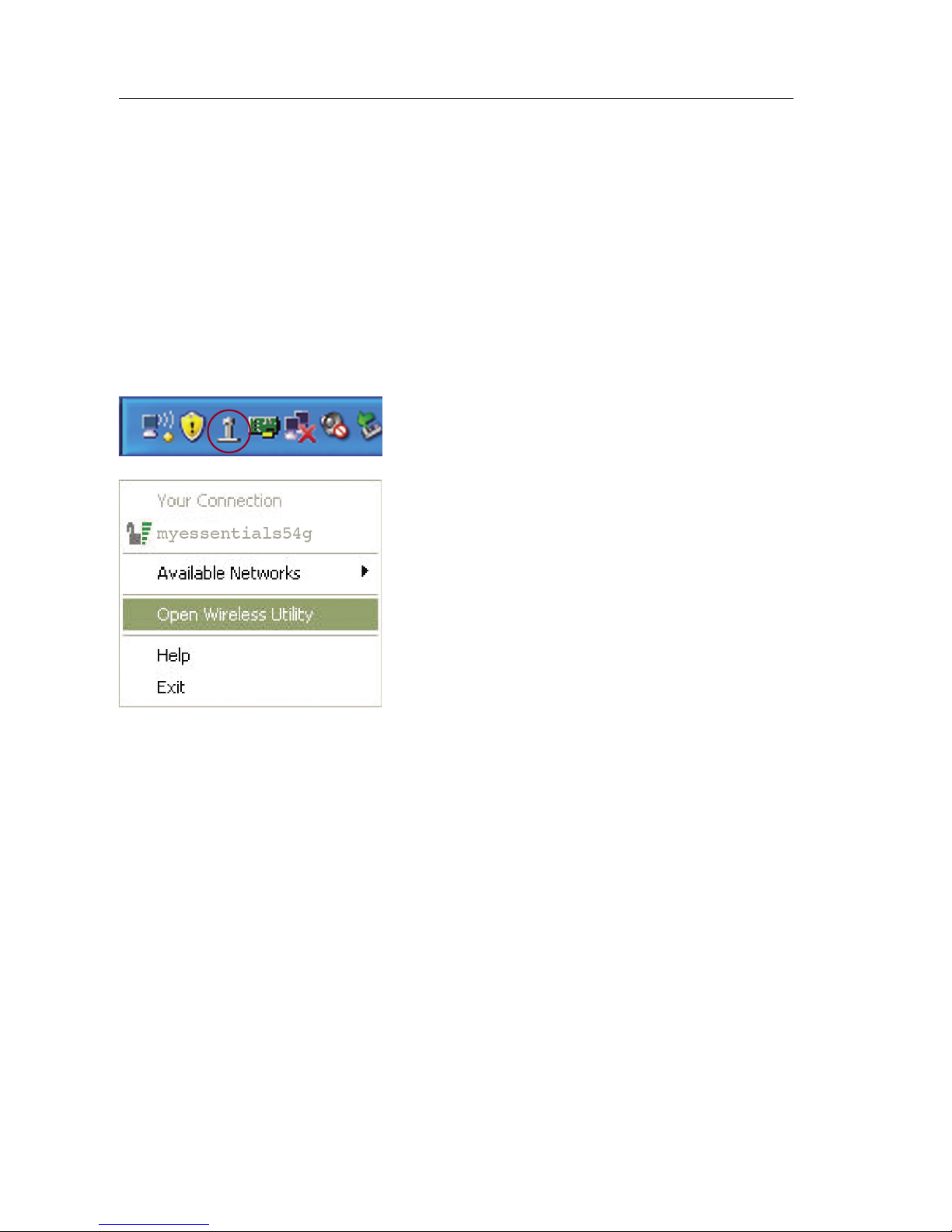
To access the WNU, simply place your mouse pointer and right-click
over the WNU icon on the Windows system tray on the lower right-hand
corner of your computer’s desktop.
If the icon is not present, click on “Start > Programs >
MyEssentials > Wireless Networking Utility”.
Page 15
13
2
1
3
4
5
6
section
Using the MyEssentials Wireless Networking Utility
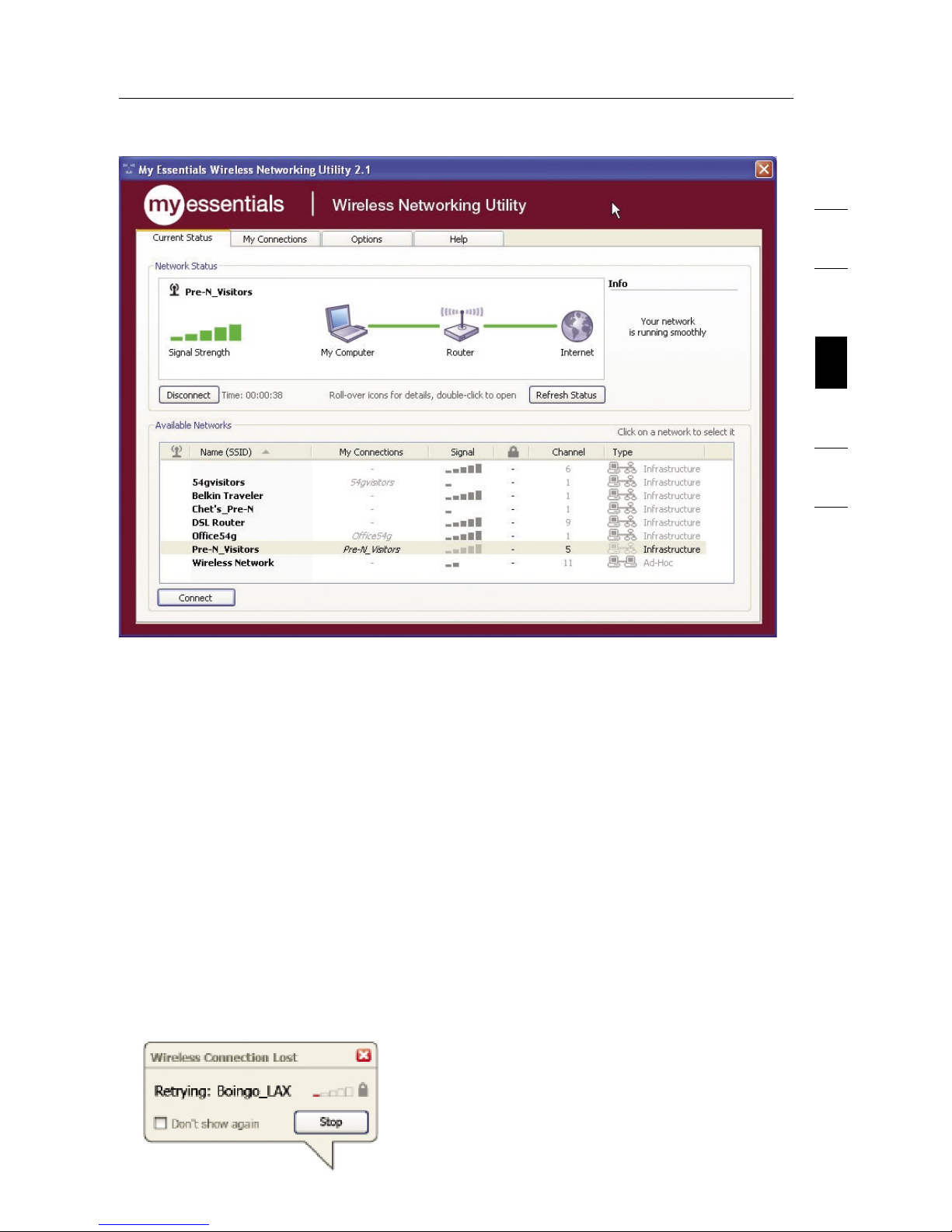
The WNU’s default screen is the “Current Status” tab. The “Current
Status” tab displays the current network status and available networks.
Network Status
This window displays the connectivity status of the current network,
between the computer and router, and between the router and the
Internet. In the event of a problem, use the “Network Status” window
to determine the source (e.g., computer, router, or Internet/modem).
Available Networks
This window displays the available networks at the current location
as well as their SSID, Signal Strength, Security Type, Channel, and
Network Type.
Lost Wireless Connection
If the current wireless connection is lost, a window will pop up and the
WNU will attempt to reconnect.
Page 16
Using the MyEssentials Wireless Networking Utility
14
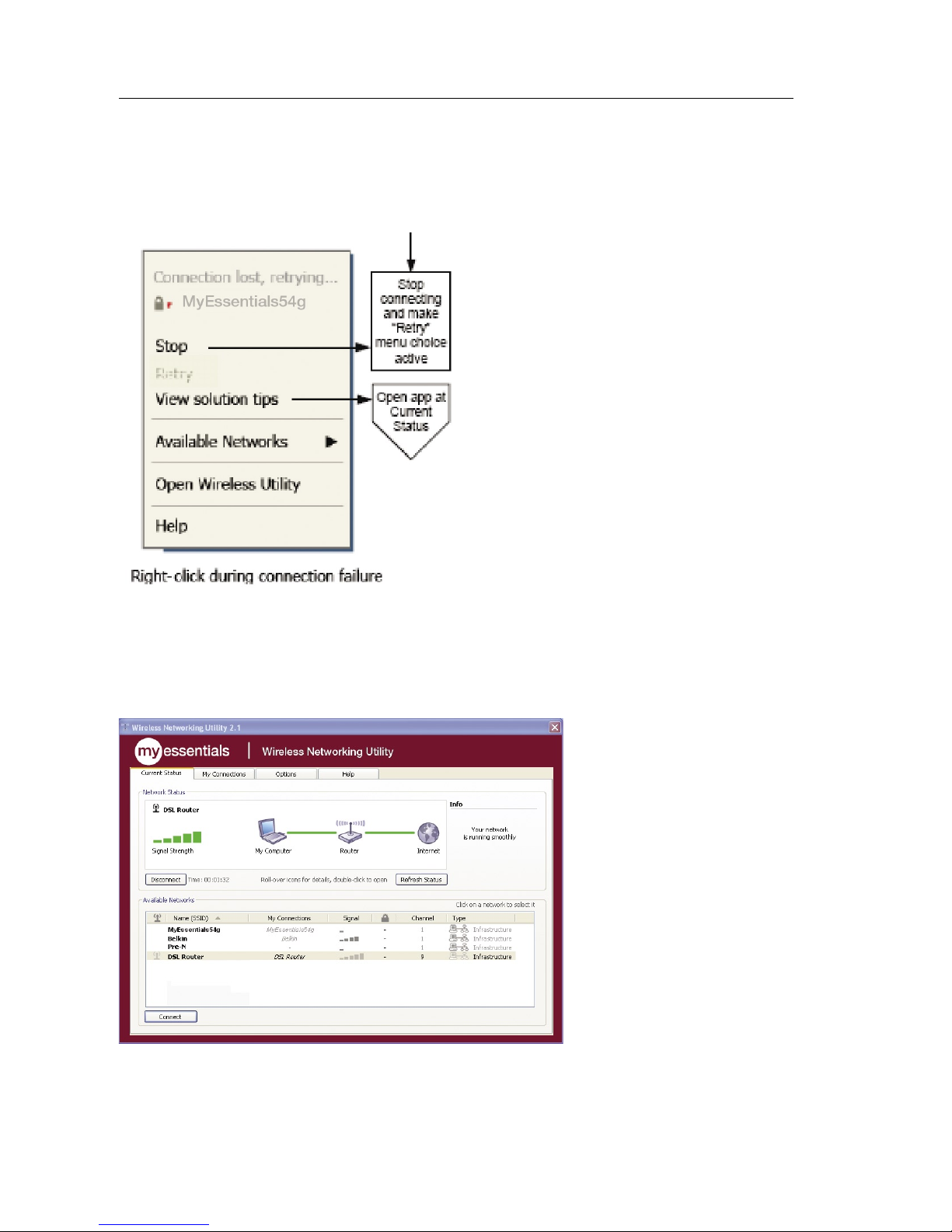
Connection Failure
Other options will appear during attempts to reconnect. To stop
connecting, click “Stop” and to reattempt connection, click “Retry”.
Network Status and Solution Tips
To further understand the current Network Status, click “Open Wireless
Utility”. The default screen will be the “Current Status” tab and the “Network
Status” section determines which connections are good and/or faulty.
The WNU also features a “Solution Tips” section that provides
troubleshooting guidelines.
Page 17
15
2
1
3
4
5
6
section
Using the MyEssentials Wireless Networking Utility
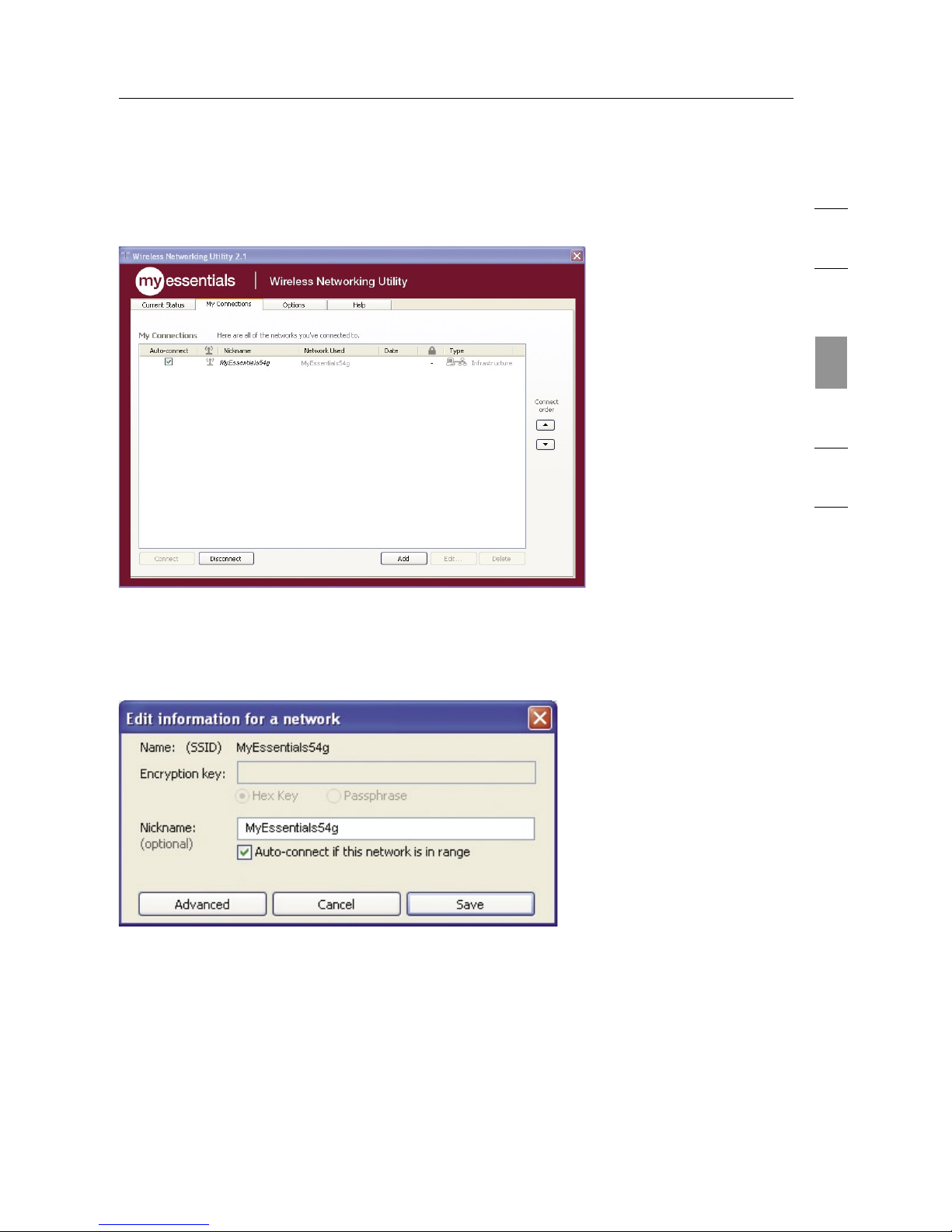
Setting Wireless Network Profiles
The “My Connections” tab on the WNU allows you to add, edit, and delete
connection profiles. It also displays signal strength, security, and network type.
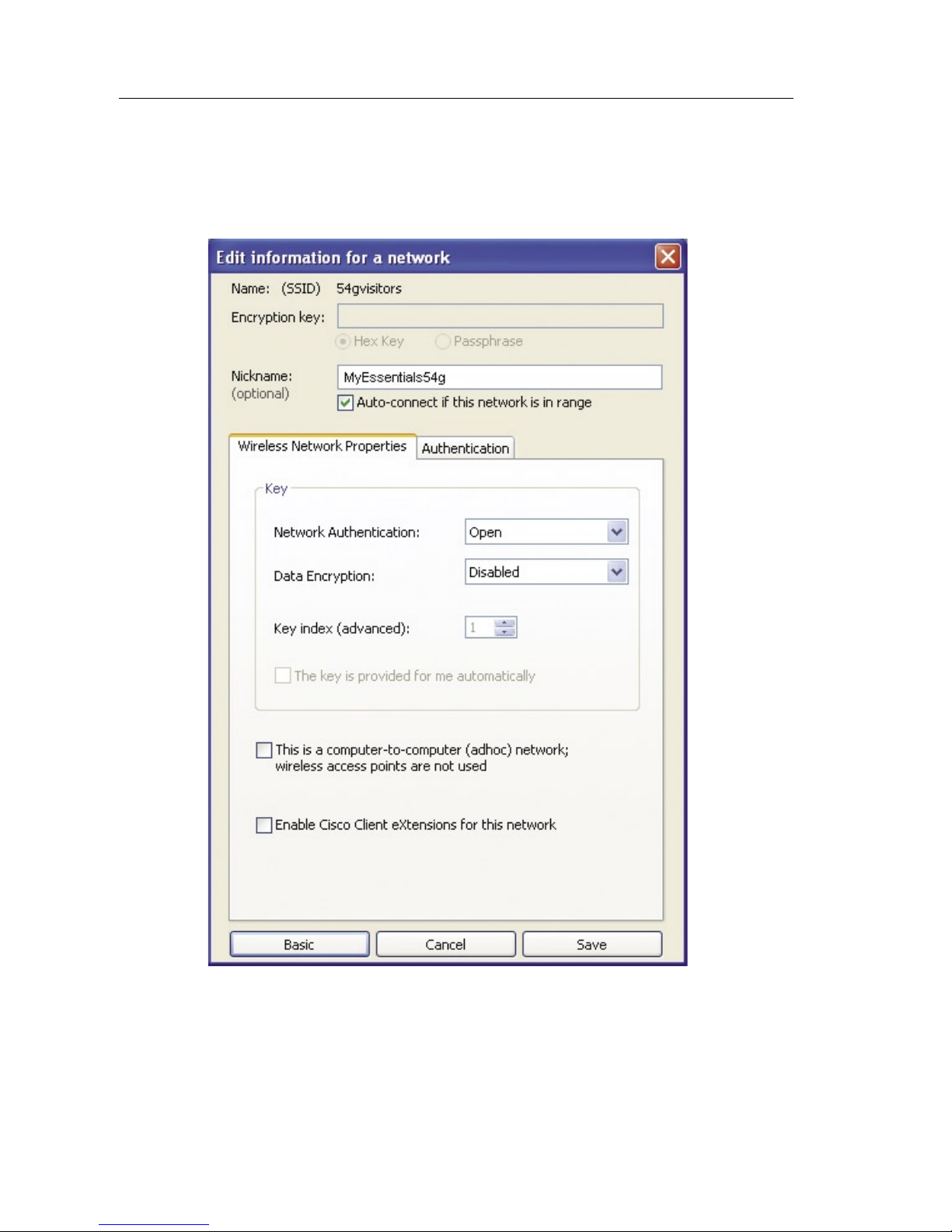
Securing your Wi-Fi® Network
If you choose to connect to a secure network, determine the type of
security (WPA or WEP*) and use the appropriate field in the dialog box.
*Note: Types of security
Page 18
Using the MyEssentials Wireless Networking Utility
16
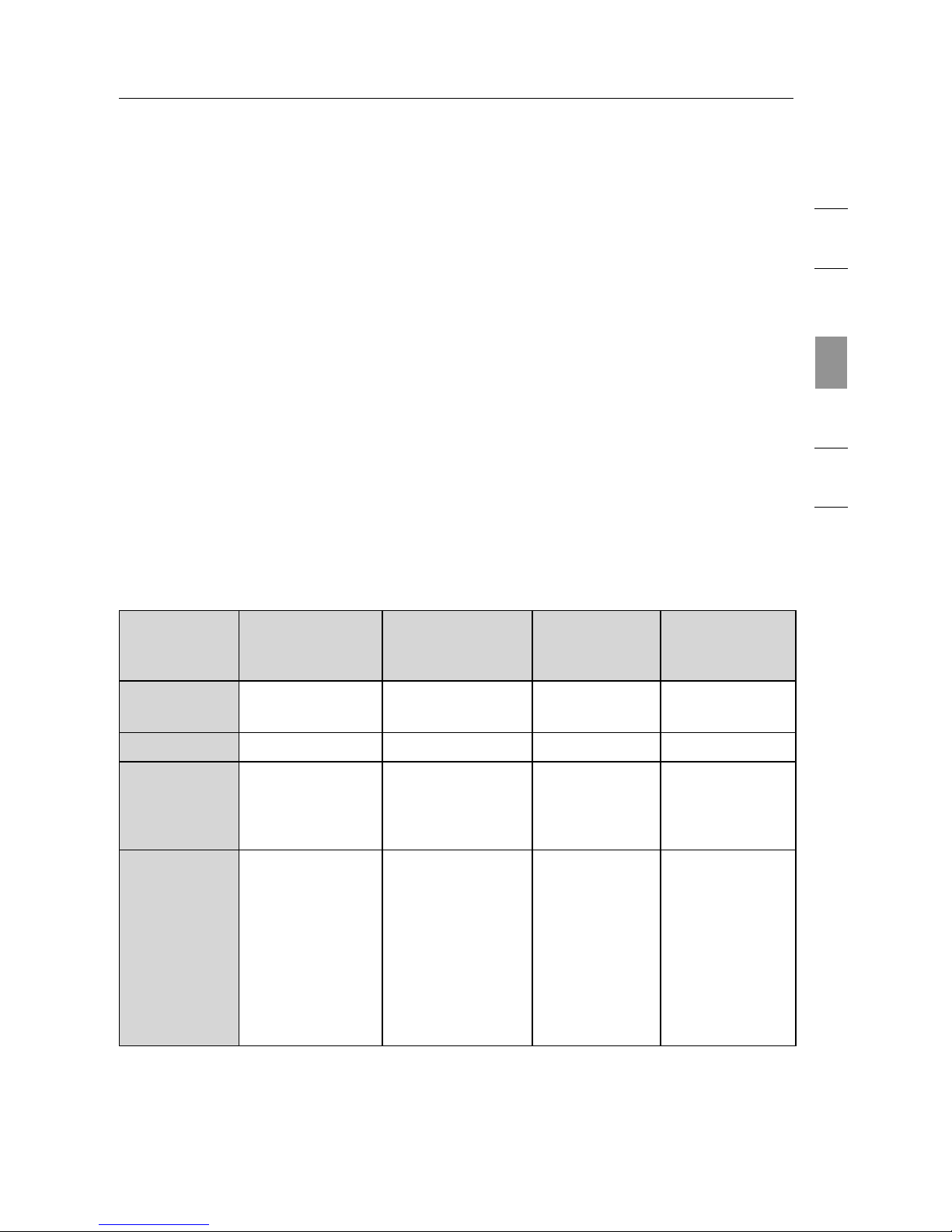
Note: When you select a network using encryption, you will first see
the simple security screen. Click the “Advanced” button to see other
security options (below).
Page 19
17
2
1
3
4
5
6
section
Using the MyEssentials Wireless Networking Utility
Wired Equivalent Privacy (WEP) is a less secure, but more
widely adopted wireless security protocol. Depending on the security
level (64- or 128-bit), the user will be asked to input a 10- or
26-character hex key. A hex key is a combination of letters, a–f, and
numbers, 0–9.
Wireless Protected Access (WPA) is the new standard in the
wireless security. However, not all wireless cards and adapters support
this technology. Please check your wireless adapter’s user manual
to check if it supports WPA. Instead of a hex key, WPA uses only
passphrases, which are much easier to remember.
The following section, intended for the home, home office, and small
office user, presents a few different ways to maximize the security of
your wireless network.
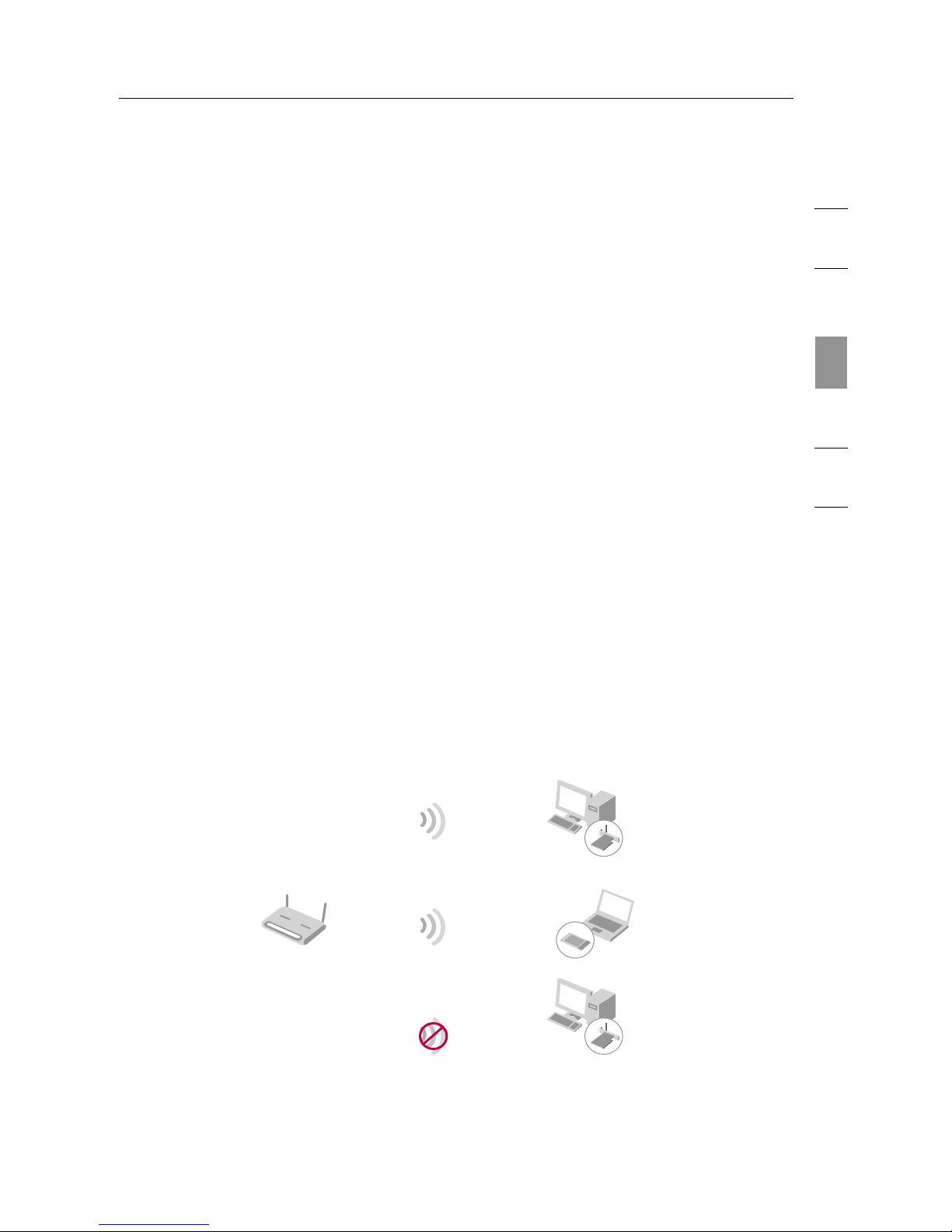
At the time of publication, four encryption methods
are available:
Encryption Methods:
Name 64-Bit Wired
Equivalent
Privacy
128-Bit Wired
Equivalent
Privacy
Wi-Fi
Protected
Access-TKIP
Wi-Fi Protected
Access 2
Acronym 64-bit WEP 128-bit WEP WPA-TKIP/
AES (or just
WPA2-AES (or
just WPA2)
Security Good Better Best Best
Features Static keys Static keys Dynamic key
encryption
and mutual
authentication
Dynamic key
encryption
and mutual
authentication
Encryption
keys based on
RC4 algorithm
(typically 40-bit
keys)
More secure than
64-bit WEP using
a key length of
104 bits plus
24 additional
bits of systemgenerated data
TKIP
(Temporal
Key Integrity
Protocol)
added so
that keys are
rotated and
encryption is
strengthened
AES (Advanced
Encryption
Standard) does
not cause any
throughput loss
Wired Equivalent Privacy (WEP)
WEP is a common protocol that adds security to all Wi-Fi-compliant
wireless products. WEP gives wireless networks the equivalent level of
privacy protection as a comparable wired network.
Page 20

Using the MyEssentials Wireless Networking Utility
18
64-Bit WEP
64-bit WEP was first introduced with 64-bit encryption, which includes
a key length of 40 bits plus 24 additional bits of system-generated
data (64 bits total). Some hardware manufacturers refer to 64-bit
as 40-bit encryption. Shortly after the technology was introduced,
researchers found that 64-bit encryption was too easy to decode.
128-Bit Encryption
As a result of 64-bit WEP’s potential security weaknesses, a more
secure method of 128-bit encryption was developed. 128-bit
encryption includes a key length of 104 bits plus 24 additional
bits of system-generated data (128 bits total). Some hardware
manufacturers refer to 128-bit as 104-bit encryption.
Most of the new wireless equipment in the market today supports
both 64-bit and 128-bit WEP encryption, but you might have older
equipment that only supports 64-bit WEP. All MyEssentials wireless
products will support both 64-bit and 128-bit WEP.
Encryption Keys
After selecting either the 64-bit or 128-bit WEP encryption mode, it is
critical that you generate an encryption key. If the encryption key is
not consistent throughout the entire wireless network, your wireless
networking devices will be unable to communicate with one another.
You can enter your key by typing in the hex key manually, or you can
type a passphrase into the “Passphrase” field and click “Generate” to
create a key. A hex (hexadecimal) key is a combination of numbers and
letters from A–F and 0–9. For 64-bit WEP, you must enter 10 hex keys.
For 128-bit WEP, you must enter 26 hex keys.
For instance:
AF
0F 4B C3 D4 = 64-bit WEP key
C3 03 0F AF 0F 4B B2 C3 D4 4B C3 D4 E7 = 128-bit WEP key
The WEP passphrase is NOT the same as a WEP key. Your Adapter
uses this passphrase to generate your WEP keys, but different hardware
manufacturers might have different methods on generating the keys.
If you have multiple vendors’ equipment in your network, the easiest
thing to do is to use the hex WEP key from your wireless router (or
access point) and enter it manually into the hex WEP key table in your
Adapter’s configuration screen.
Page 21
19
2
1
3
4
5
6
section
Using the MyEssentials Wireless Networking Utility
Wi-Fi Protected Access (WPA)
WPA is a new Wi-Fi standard that improves upon the security features
of WEP. To use WPA security, the drivers and software of your wireless
equipment must be upgraded to support it. These updates will be found on
your wireless vendor’s website. There are three types of WPA security: WPAPSK (no server), WPA (with radius server), and WPA2.
WPA-PSK (no server) uses what is known as a pre-shared key as the
network key. A network key is a password that is between eight and 63
characters long. It can be a combination of letters, numbers, or characters.
Each client uses the same network key to access the network. Typically, this
is the mode that will be used in a home environment.
WPA (with radius server) is a system where a radius server
distributes the network key to the clients automatically. This is
typically found in a business environment.
WPA2
requires Advanced Encryption Standard (AES) for encryption
of data, which offers much greater security than WPA. WPA uses both
Temporal Key Integrity Protocol (TKIP) and (AES) for encryption.
For a list of MyEssentials wireless products that support WPA,
please visit our website at www.MyEssentialssupport.com.
Most Wi-Fi products ship with security turned off. So once you have
your network working, you must activate WEP or WPA and make sure all
your wireless devices are sharing the same network key.
The following diagram shows the effect of not having the correct
network key throughout your network.
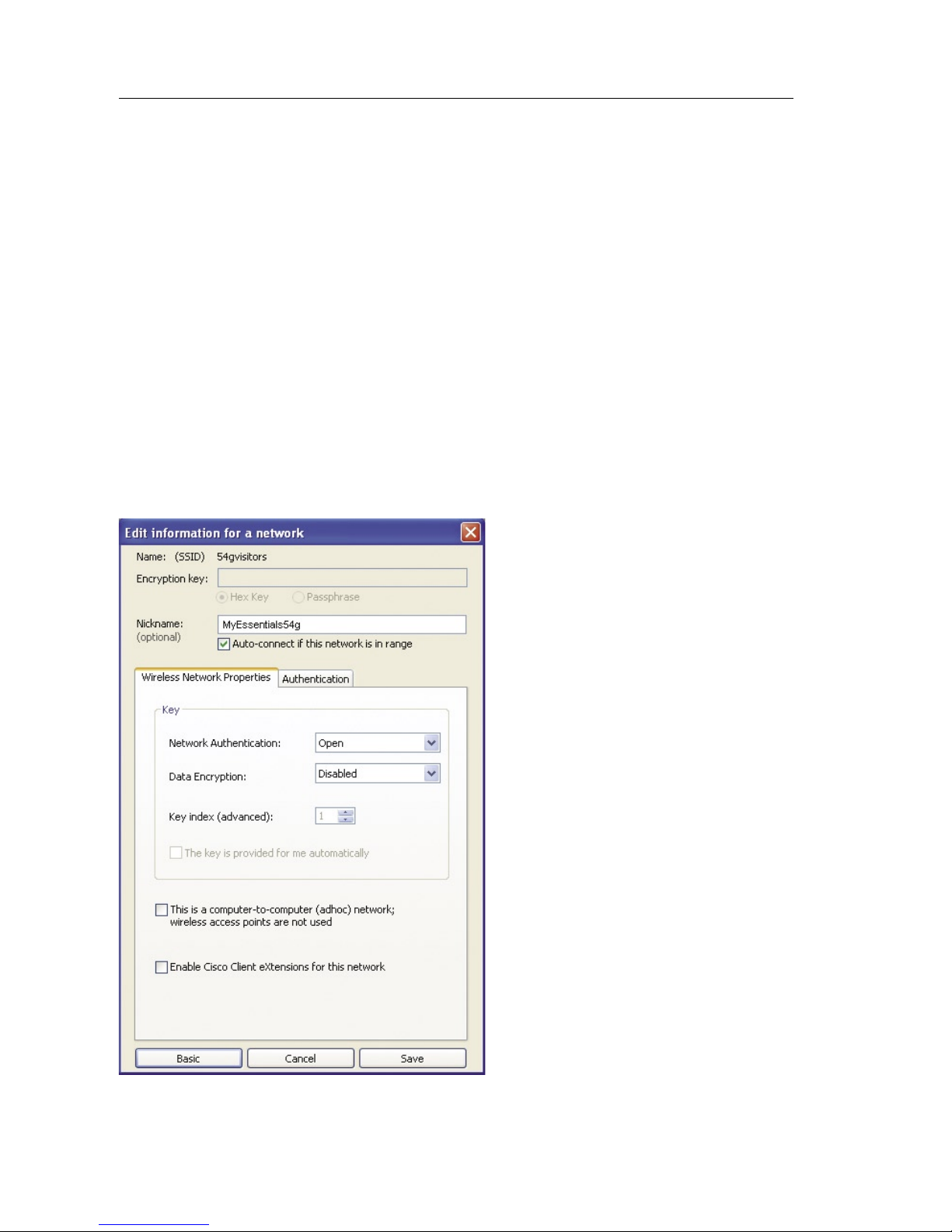
IMPORTANT: You must now set all wireless network cards/adapters to
match these settings.
Page 22
Using the MyEssentials Wireless Networking Utility
20
Configuring your MyEssentials Wireless G USB
Network Adapter to use Security
At this point, you should already have your wireless router (or access
point) set to use WPA or WEP. In order for you to gain a wireless
connection, you must set your Wireless G USB Network Adapter to use
the same security settings.
Changing the Wireless Security Settings
The MyEssentials Wireless G USB Network Adapter supports the latest
WPA security feature as well as the legacy WEP security standard. By
default, wireless security is disabled.
To enable security, you first must determine which standard is used by
the router or access point. (See your wireless router’s or access point’s
manual for directions on how to access the security settings.)
To access the security settings on your Adapter, click the “My
Connections” tab and point to the connection for which you want to
change security settings. Click “Edit” to change settings.
Page 23
21
2
1
3
4
5
6
section
Using the MyEssentials Wireless Networking Utility
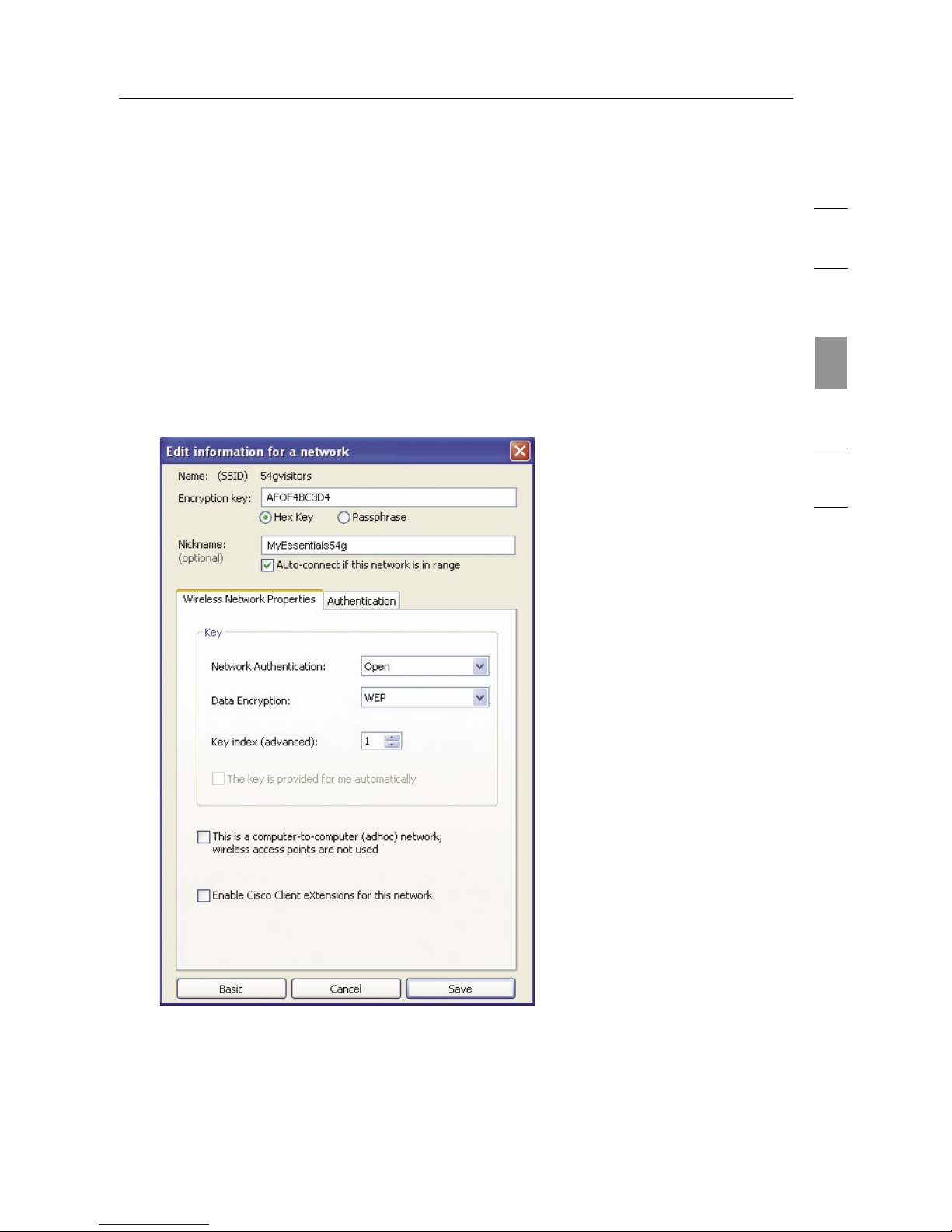
WEP Setup
64-Bit WEP Encryption
1.
Select “WEP” from the drop-down menu.
2. After selecting your WEP encryption mode, you can enter your key
by typing in the hex key manually, or you can type in a passphrase
in the “Passphrase” field and click “Generate” to create a key.
A hex (hexadecimal) key is a combination of numbers and letters from
A–F and 0–9. For 64-bit WEP, you must enter 10 hex keys.
For instance:
AF
0F 4B C3 D4 = 64-bit WEP key
Page 24

Using the MyEssentials Wireless Networking Utility
22
3. Click “Save” to finish. Encryption in the wireless router (or access
point) is now set. Each of your computers on your wireless network
must now be configured with the same security settings.
WARNING: If you are using a wireless client to turn on the security
settings in your wireless router (or access point), you will temporarily
lose your wireless connection until you activate security on your
wireless client. Please record the key prior to applying changes in the
wireless router (or access point). If you don’t remember the hex key,
your client will be locked out of the wireless router (or access point).
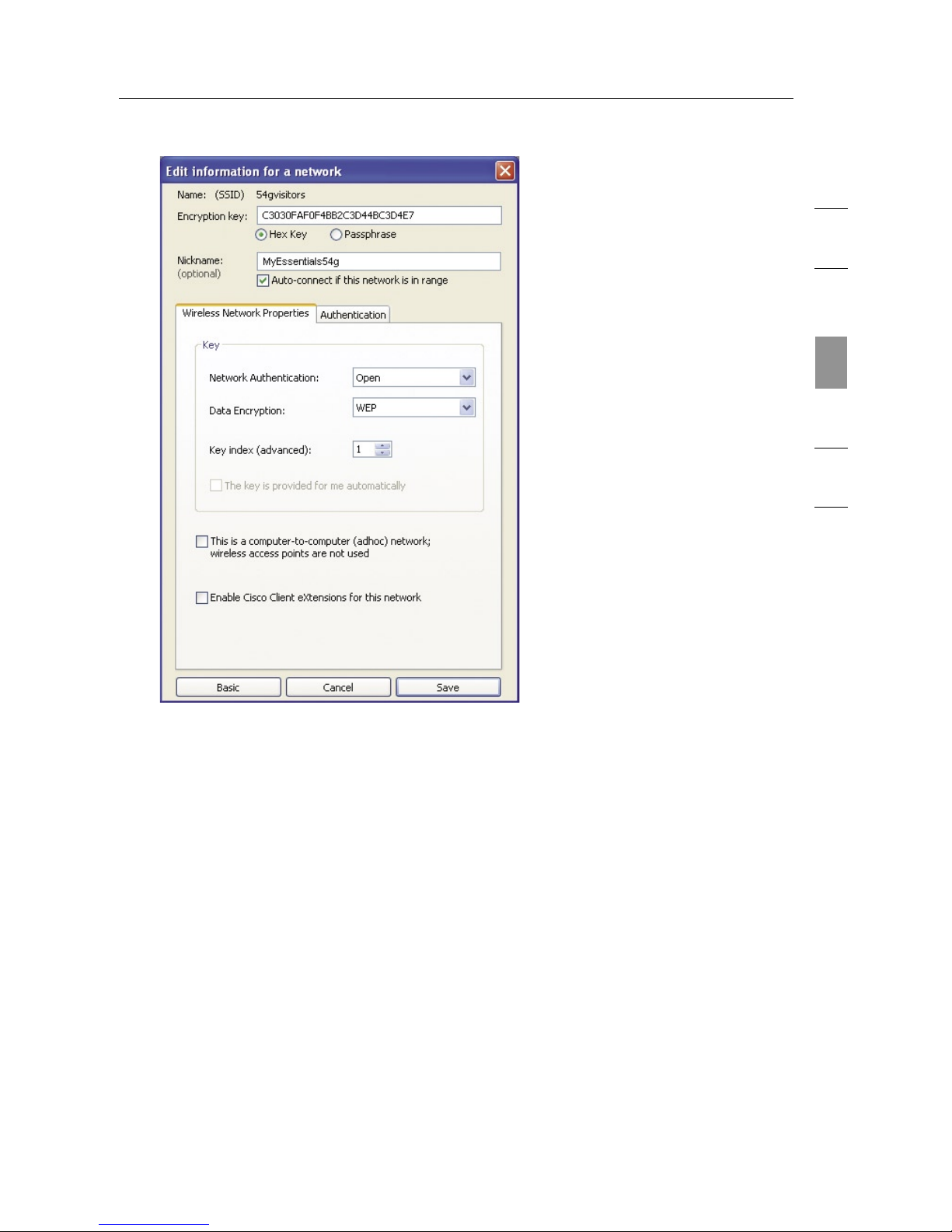
128-Bit WEP Encryption
1.
Select “WEP” from the drop-down menu.
2. After selecting your WEP encryption mode, you can enter your
key manually by typing in the hex key manually, or you can type
in a passphrase in the “Passphrase” field and click “Generate” to
create a key.
A hex (hexadecimal) key is a combination of numbers and letters from
A–F and 0–9. For 128-bit WEP, you must enter 26 hex keys.
For instance:
C3
03 0F AF 0F 4B B2 C3 D4 4B C3 D4 E7 = 128-bit WEP key
Page 25
23
2
1
3
4
5
6
section
Using the MyEssentials Wireless Networking Utility
3. Click “Save” to finish. Encryption in the wireless router (or
access point) is now set. Each of the computers on your wireless
network must now be configured with the same security settings.
WARNING: If you are using a wireless client to turn on the security
settings in your wireless router (or access point), you will temporarily
lose your wireless connection until you activate security on your
wireless client. Please record the key prior to applying changes in the
wireless router (or access point). If you don’t remember the hex key,
your client will be locked out of the wireless router (or access point).
Page 26
Using the MyEssentials Wireless Networking Utility
24
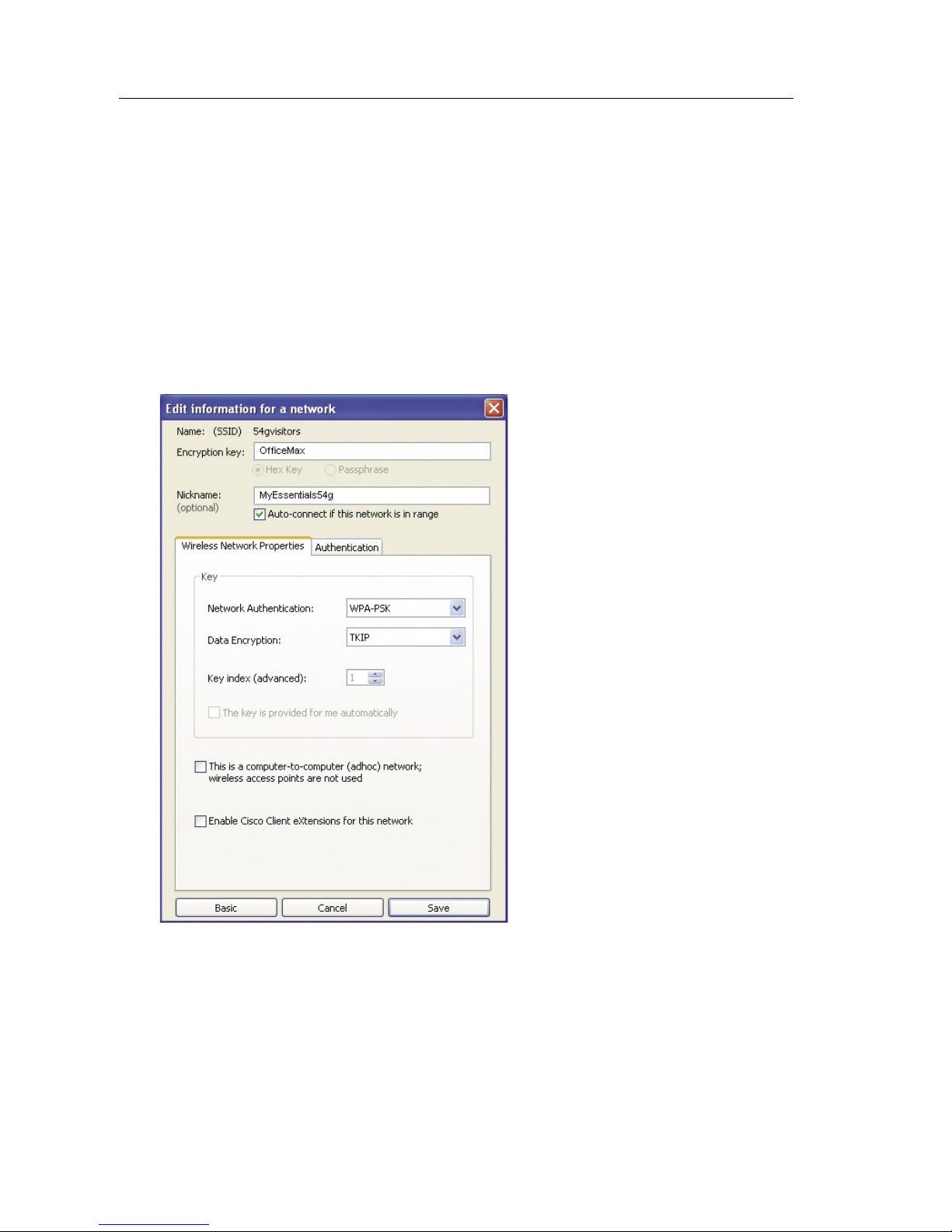
WPA-PSK (no server)
Choose this setting if your network does not use a radius server. WPA-PSK
(no server) is typically used in home and small office networking.
1. From the “Network Authentication” drop-down menu, select
“WPA-PSK (no server)”.
2. Enter your network key. This can be from eight to 63 characters
and can be letters, numbers, or symbols. This same key must be
used on all of the clients (network cards) that you want to include
in your network.
Page 27
25
2
1
3
4
5
6
section
Using the MyEssentials Wireless Networking Utility
3. Click “Save” to finish. You must now set all clients (network
cards) to match these settings.
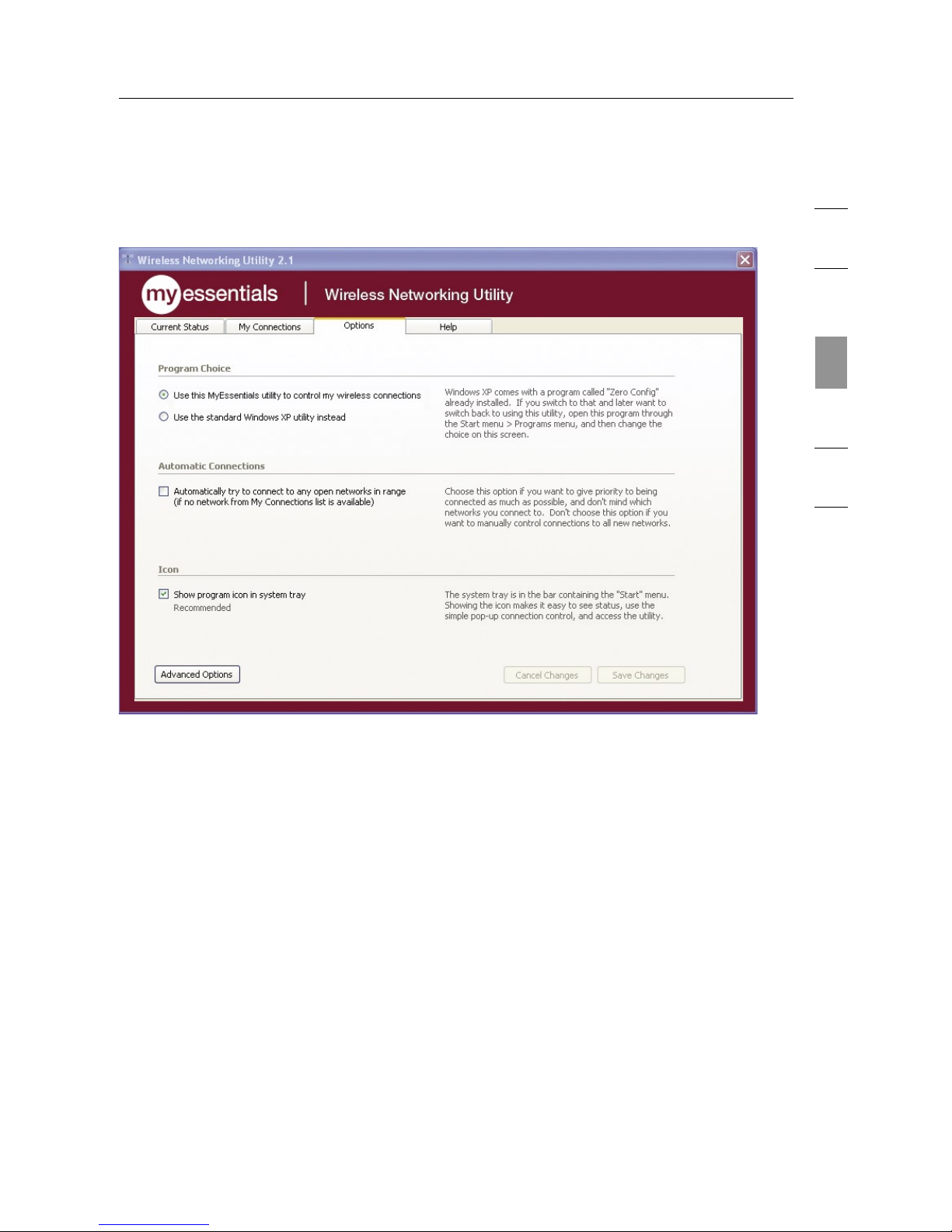
Wireless Networking Utility Options
The “Options” tab on the WNU provides the user the ability to
customize his or her WNU settings.
Page 28
Using the MyEssentials Wireless Networking Utility
26
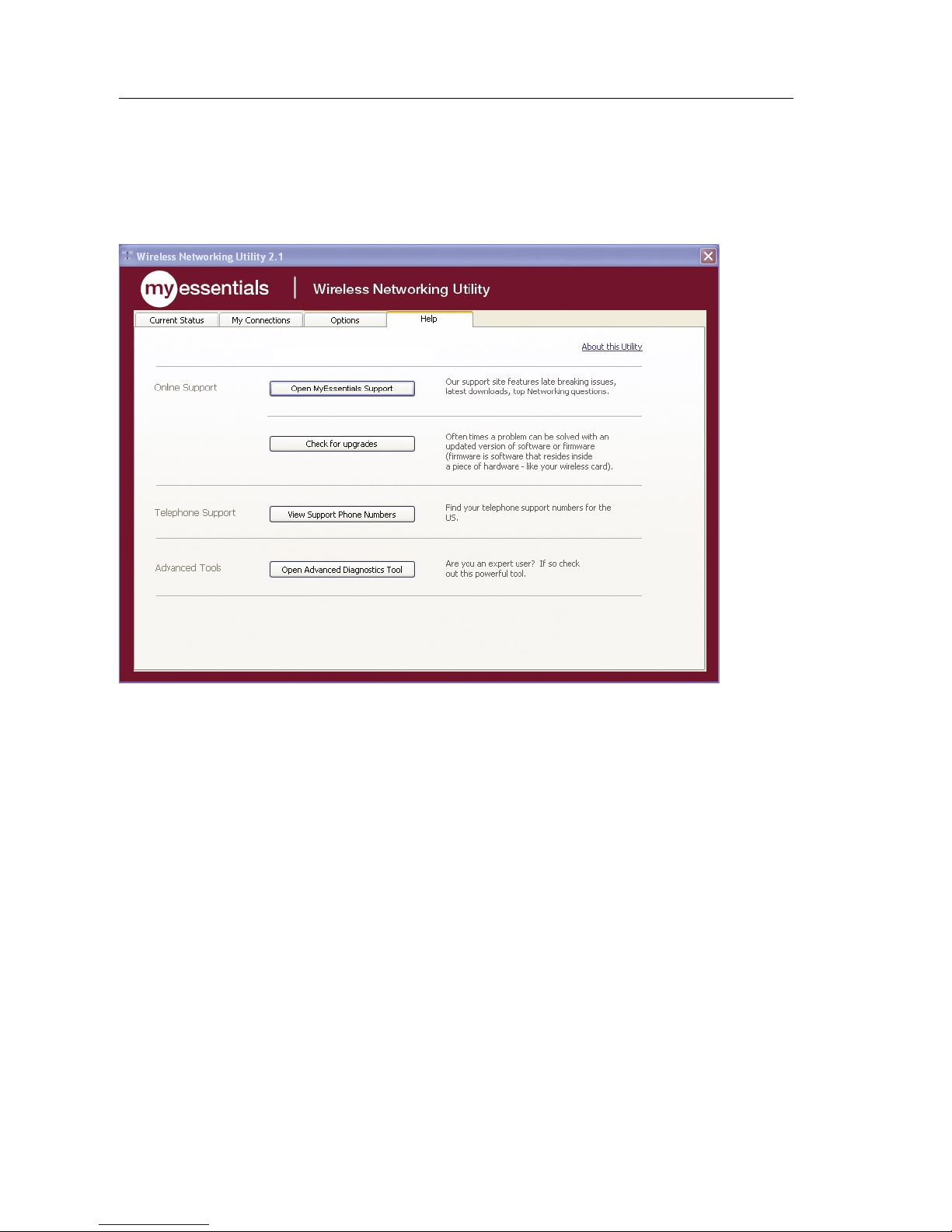
Wireless Networking Utility Help
The WNU “Help” tab provides users with access to online and
telephone support, as well as advanced diagnostic tools.
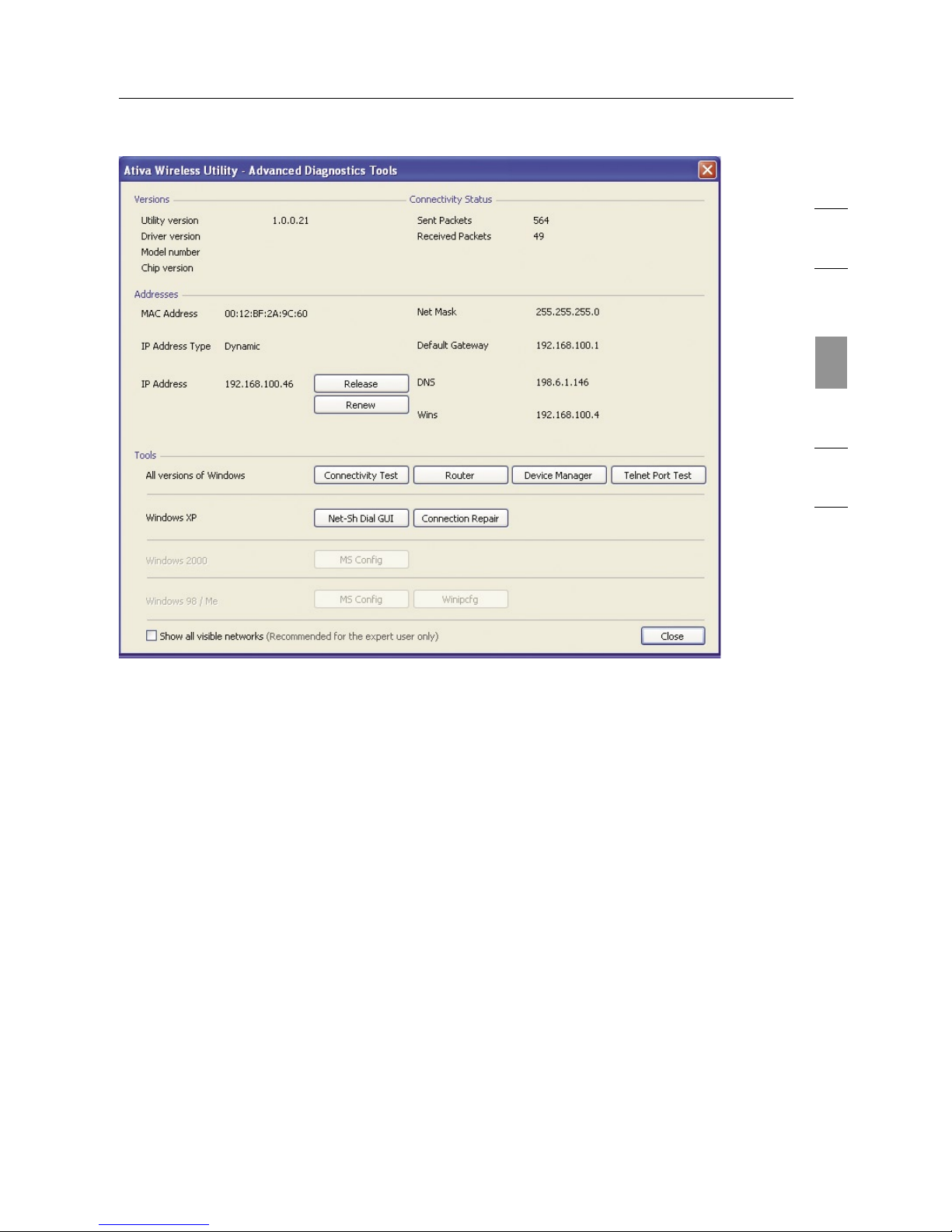
Advanced Diagnostic Tools
The “Advanced Diagnostic Tools” section is the central control panel
for all the settings of the hardware and software components of
the wireless network. It provides an array of tests and connectivity
services to ensure optimal network performance.
Page 29
27
2
1
3
4
5
6
section
Using the MyEssentials Wireless Networking Utility
Page 30
Troubleshooting
28
I can’t connect to the Internet wirelessly.
If you are unable to connect to the Internet from a wireless computer,
please check the following items:
1. Look at the lights on your wireless router. If you’re using a
MyEssentials Wireless Router, the lights should be as follows:
• The “Power” light should be on.
• The “Connected” light should be on, and not blinking.
• The “WAN” light should be either on or blinking.
If your MyEssentials Wireless Router’s lights match these descriptions,
go to number 2, below.
If this is NOT the case, please contact MyEssentials technical support.
If you are not using a MyEssentials Wireless Router, consult that router
manufacturer’s user guide.
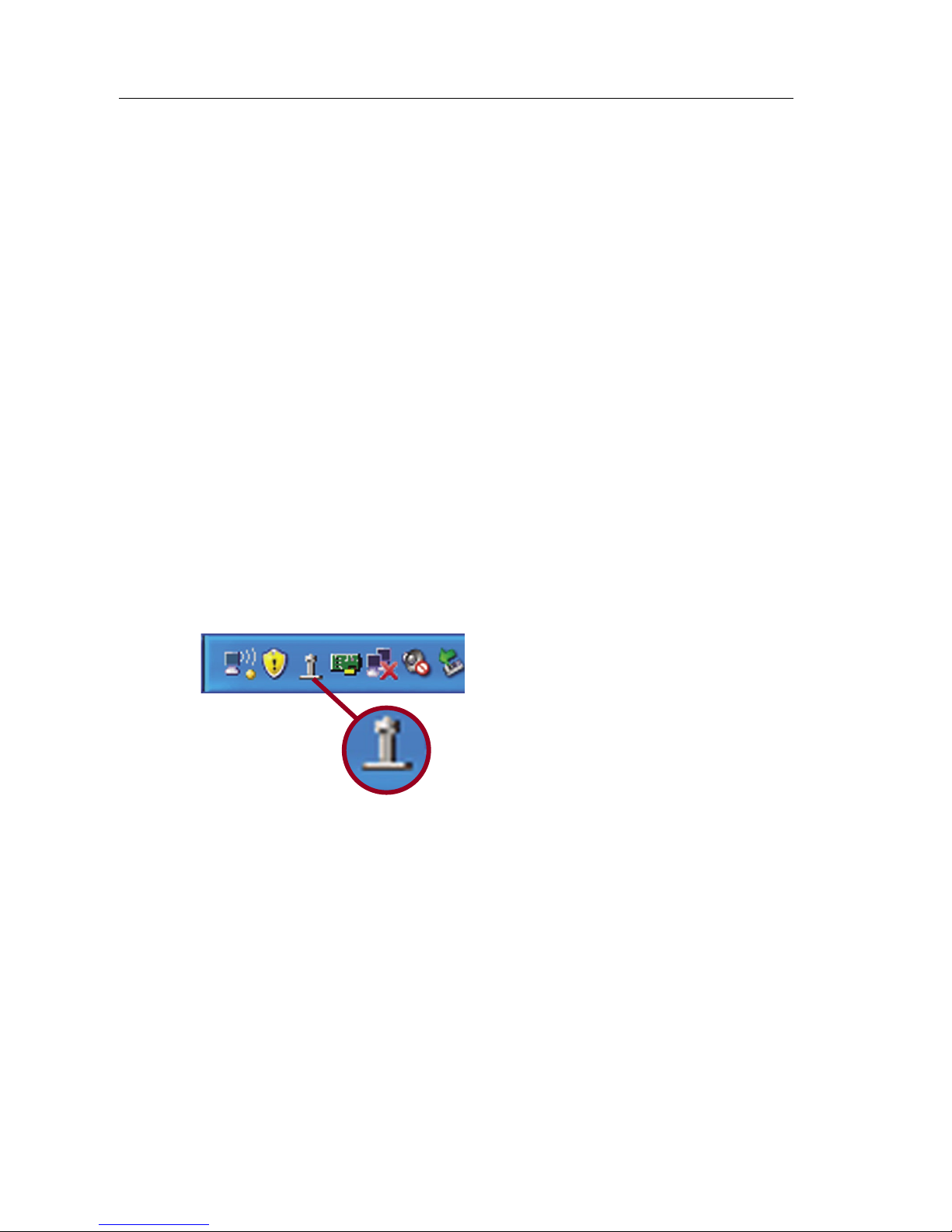
2. Open your Wireless Networking Utility software by clicking on the
icon in the system tray at the bottom right-hand corner of the screen:
the tray icon should look like this (the icon may be red or green):
3. The window that opens will show a list of “Available Networks”.
Available networks are wireless networks you can connect to.
If you are using a MyEssentials Wireless G Router, “MyEssentials54g”
is the default name.
If you are NOT using a MyEssentials Router, please consult your
router manufacturer’s user manual for the default name.
Page 31

29
2
1
3
4
5
6
section
Troubleshooting
The name of your wireless network appears in
“Available Networks”.
If the correct network name is listed in the “Available Networks”
list, please follow the steps below to connect wirelessly:
1. Click on the correct network name in the “Available Networks” list.
2. If the network has security (encryption) enabled, you must
enter the network key. For more information regarding security,
please see “Securing your Wi-Fi Network” on page 15 of
this manual.
3. Within a few seconds, the tray icon in the lower right-hand
corner of your screen should turn green, indicating a successful
connection to the network.
If you are still unable to access the Inter net after connecting
to the wireless network, please contact MyEssentials
Technical Support.
The name of your wireless network DOES NOT appear in
the list of “Available Networks”.
If the correct network name is not listed under “Available
Networks” in the Wireless Networking Utility, please attempt the
following troubleshooting steps:
1. Temporarily move computer, if possible, to five to 10 feet away
from the wireless router (or access point). Close the Wireless
Networking Utility, and reopen it. If the correct network name
now appears under “Available Networks”, you may have a
range or interference problem. Please see the suggestions
listed in the “Placement of your Wireless Networking Hardware
for Optimal Performance” section on page 2.
2. Using a computer that is connected to the wireless router (or
access point) via a network cable (as opposed to wirelessly),
ensure that “Broadcast SSID” is enabled. This setting is found
on the Router’s wireless “Channel and SSID” configuration
page. For detailed instructions on accessing this page and
changing settings, please see your wireless router’s (or access
point’s) User Manual.
If you are still unable to access the Inter net after completing
these steps, please contact MyEssentials Technical Support.
Page 32

Troubleshooting
30
Installation CD-ROM does not start Wireless
Networking Utility.
If the CD-ROM does not start the Wireless Networking Utility
automatically, it could be that the computer is running other
applications that are interfering with the CD drive.
If the Wireless Networking Utility screen does not appear within
15–20 seconds, open up your CD-ROM drive by double-clicking
on the “My Computer” icon. Next, double-click on the CD-ROM
drive that the Installation CD has been placed in to start the
installation. Then double-click on the folder named “Files”. Next,
double-click on the icon named “Setup.exe”.
Power LED does not come ON; Adapter is
not working.
If the LED indicators are not ON, the problem may be that the
Adapter is not connected or installed properly.
Verify that the Adapter is plugged firmly into the USB slot of
your computer. Check to see that the drivers for the Adapter
have been installed. Right-click on the “My Computer” icon on
your desktop. Choose “Properties” and navigate to the “Device
Manager” and see if your Adapter is listed without any errors. If
an error is indicated, contact MyEssentials Technical Support.
Link LED is blinking slowly; cannot connect to a
wireless network or the Internet.
If your Adapter appears to be functioning properly, but you
cannot connect to a network or you have a red wireless icon
at the bottom of your screen, the problem may be that there is
a mismatch between the network name (SSID) settings in your
wireless network properties.
Check the SSID settings to see if they match. The SSID is
case-sensitive and the spelling on each computer must be
exactly the same in order for the Adapter to connect to the
wireless router (or access point).
Note:
To check the SSID settings or look for an available
network, double-click the Signal Indicator icon to bring up the
“Wireless Networks” screen. Click “Add” if you do not see the
network to which you are trying to connect and type in the SSID.
For more information about setting up an SSID, please refer to
your router manufacturer’s user manual.
If issues persist even at close range, please contact MyEssentials
Technical Support.
Page 33

31
2
1
3
4
5
6
section
Troubleshooting
Link LED is solid but I cannot connect to the Internet.
If you have a signal but can’t get online or obtain an IP address,
the problem may be that there is a mismatch between the
encryption key settings in your computer and wireless router (or
access point).
Check the WEP key settings to see if they match. The key is
case-sensitive and the spelling on each computer and wireless
router (or access point) must be exactly the same in order for
the Adapter to connect to the router. For more information about
encryption, please see the “Securing your Wi-Fi Network” section
of this User Manual.
If issues persist even at close range, please contact MyEssentials
Technical Support.
Data transfer is sometimes slow.
Wireless technology is radio-based, which means connectivity and
the throughput performance between devices decreases when
the distance between devices increases. Other factors that will
cause signal degradation (metal is generally the worst culprit) are
obstructions such as walls and metal appliances. As a result, the
typical indoor range of your wireless devices will be between 100
to 200 feet. Note also that connection speed may decrease as you
move farther from the wireless router (or access point).
In order to determine if wireless issues are related to range, we
suggest temporarily moving the computer, if possible, to five to 10
feet away from the wireless router (or access point). Please see the
section titled “Placement of your Wireless Networking Hardware for
Optimal Performance” in this manual.
If issues persist even at close range, please contact MyEssentials
Technical Support.
Page 34

Troubleshooting
32
Signal strength is poor.
Wireless technology is radio-based, which means connectivity and
the throughput performance between devices decreases when
the distance between devices increases. Other factors that will
cause signal degradation (metal is generally the worst culprit) are
obstructions such as walls and metal appliances. As a result, the
typical indoor range of your wireless devices will be between 100
to 200 feet. Note also that connection speed may decrease as you
move farther from the wireless router (or access point). Please see
the section titled “Placement of your Wireless Networking Hardware
for Optimal Performance” in this manual.
If issues persist even at close range, please contact MyEssentials
Technical Support.
Why are there two wireless utilities in my system tray?
Which one should I use?
There are several features and advantages to using the
MyEssentials Wireless Networking Utility over the Windows XP
Wireless Zero Configuration utility. We offer a site survey, detailed
link information, and adapter diagnosis, to name a few.
It’s essential to know which utility is managing your adapter. We
recommend using the MyEssentials Wireless Networking Utility.
To use the MyEssentials Wireless Networking Utility, follow the
steps below:
Step 1 Right-click on the network status icon in the system tray
and select “View Available Wireless Networks”.
Step 2 Click on the “Advanced” button in the lower left-hand
corner of the “Available Wireless Networks” window.
Step 3 From the “Advanced” tab, uncheck “Use Windows to
configure my wireless network”. Once the box is unchecked, click
“OK” to close the window.
You are now using the MyEssentials Wireless Networking Utility to
configure the Adapter.
Page 35

33
2
1
3
4
5
6
section
Troubleshooting
Technical Support
You can find technical-support information at www.MyEssentialssupport.
com through the tech-support area. If you want to contact technical
support by phone, please call:
US: 1-866-761-4608
Page 36

Information
34
FCC Statement
DECLARATION OF CONFORMITY WITH FCC RULES FOR
ELECTROMAGNETIC COMPATIBILITY
We, MyEssentials, of 501 West Walnut Street, Compton, CA
90220, declare under our sole responsibility that the product,
ME1001-USB
to which this declaration relates,
complies with Part 15 of the FCC Rules. Operation is
subject to the following two conditions: (1) this device may
not cause harmful interference, and (2) this device must
accept any interference received, including interference
that may cause undesired operation.
Caution: Exposure to Radio Frequency Radiation.
The radiated output power of this device is far below the FCC radio
frequency exposure limits. Nevertheless, the device shall be used in such
a manner that the potential for human contact during normal operation is
minimized. When connecting an external antenna to the device, the antenna
shall be placed in such a manner to minimize the potential for human contact
during normal operation. In order to avoid the possibility of exceeding the
FCC radio frequency exposure limits, human proximity to the antenna shall
not be less than 20cm (8 inches) during normal operation.
Federal Communications Commission Notice
This equipment has been tested and found to comply with the limits for a
Class B digital device, pursuant to Part 15 of the FCC Rules. These limits are
designed to provide reasonable protection against harmful interference in a
residential installation.
This equipment generates, uses, and can radiate radio frequency energy.
If this equipment does cause harmful interference to radio or television
reception, which can be determined by turning the equipment off and on, the
user is encouraged to try and correct the interference by one or more of the
following measures:
• Reorient or relocate the receiving antenna.
• Increase the distance between the equipment and the receiver.
• Connect the equipment to an outlet on a circuit different from that to
which the receiver is connected.
• Consult the dealer or an experienced radio/TV technician for help.
Page 37

35
2
1
3
4
5
6
section
Information
Modifications
The FCC requires the user to be notified that any changes or
modifications to this device that are not expressly approved by
MyEssentials may void the user’s authority to operate the equipment.
MyEssentials 1-Year Limited Product Warranty
MyEssentials warrants this product against defects in materials and
workmanship for one year. If a defect is discovered, MyEssentials will,
at its option, repair or replace the product at no charge provided it is
returned during the warranty period, with transportation charges prepaid,
to the authorized MyEssentials dealer from whom you purchased the
product. Proof of purchase may be required.
This warranty does not apply if the product has been damaged by
accident, abuse, misuse, or misapplication; if the product has been
modified without the written permission of MyEssentials; or if any
MyEssentials serial number has been removed or defaced.
THE WARRANTY AND REMEDIES SET FORTH ABOVE ARE EXCLUSIVE
IN LIEU OF ALL OTHERS, WHETHER ORAL OR WRITTEN, EXPRESSED
OR IMPLIED. MYESSENTIALS SPECIFICALLY DISCLAIMS ANY AND
ALL IMPLIED WARRANTIES, INCLUDING, WITHOUT LIMITATION,
WARRANTIES OF MERCHANTABILITY AND FITNESS FOR A
PARTICULAR PURPOSE.
No MyEssentials dealer, agent, or employee is authorized to make any
modification, extension, or addition to this warranty.
MYESSENTIALS IS NOT RESPONSIBLE FOR SPECIAL, INCIDENTAL,
OR CONSEQUENTIAL DAMAGES RESULTING FROM ANY BREACH OF
WARRANTY, OR UNDER ANY OTHER LEGAL THEORY, INCLUDING BUT
NOT LIMITED TO, LOST PROFITS, DOWNTIME, GOODWILL, DAMAGE
TO OR REPROGRAMMING OR REPRODUCING ANY PROGRAM OR
DATA STORED IN, OR USED WITH, MYESSENTIALS PRODUCTS.
Some states do not allow the exclusion or limitation of incidental or
consequential damages or exclusions of implied warranties, so the above
limitations or exclusions may not apply to you. This warranty gives you
specific legal rights, and you may also have other rights that vary from
state to state.
Page 38

www.MyEssentialssupport.com
MyEssentials Tech Support
US: 1-866-761-4608
© 2006 Belkin Corporation. All rights reserved. All trade names are registered trademarks of respective
manufacturers listed. Windows is either a registered trademark or trademark of Microsoft Corporation in the
United States and/or other countries.
P75288
Wireless G
USB Network Adapter
 Loading...