

Page 1

The Mutant Snare
09.feb.2016! Mutant Snare user manual v1.03 PG1
Hexinverter Électronique, 2016
!
analog snare drum synthesis with external input, inspired by the 808
!
Thank you for your interest in/purchase of the Mutant Snare (MSN) eurorack module. We would like to thank
you for considering a place for the MSN in your modular synthesizer! We hope you find it has a unique
character that lends itself to much use in your musical endeavours. The Mutant Snare is a eurorack modular
format product, available as a module or a DIY project that electronic enthusiasts can assemble themselves.
THE SNARE: FROM CLASSIC TO MUTANT
Like the other percussion modules which make up the Mutant Drums series, the Snare was born out of the
desire to evolve away from classic drum synthesis techniques and offer something with a unique character
of its own. The world of modular synthesis has been evolving rapidly in recent years, and so has drum
synthesis. We wanted to offer a snare drum that would stand the test of time and offer the possibility of
sounds not found in any vintage drum machine.
The Mutant Snare's SHELL is comprised of two bridged-t sinewave oscillators, much like a certain legendary
vintage drum machine with the number "8" in its name. These oscillators have a particularly clean waveform
that produces a low-harmonic sine which naturally decays in amplitude, and pitch, over time. The tone of
these oscillators is quite natural sounding to our ears, which is perhaps part of the reason why some vintage
analog drum machines still see daily use by many contemporary artists. You can tune the pitch of one of
these oscillators by about two octaves - a useful feature not found on the circuit this Mutant was inspired by.
The SNAPPY makes up the noise tone of the snare drum. It uses an all-analog transistor noise generator,
just like many vintage machines. If you tire of this sound source, you can plug virtually any other audio
source into the external input. The 12dB/octave HP/BP filter which the noise feeds into is voltage
controllable with selectable resonance settings, which lends a lot of variety to the types of sounds you can
create with the Mutant Snare.
!
The Mutant Philosophy
There are already some pretty awesome clones of vintage gear out there in the modular world. The
Mutant Drums were not made to try and fill that role. Although each Mutant began as a favourable classic
drum topology, we wanted to create something modern and different, while still maintaining an analog
nature. Features like CV inputs and signal routing not found on classic analog drum machines were
incorporated to make these circuits powerful creative tools in your modular synthesizer.
Page 2

09.feb.2016! Mutant Snare user manual v1.03 PG2
Hexinverter Électronique, 2016
FEATURES
MIX and DRIVE
•!MIX lets you blend between the SHELL and SNAPPY tones that make up the overall snare drum
•!turn up the DRIVE to get overdriven snare tones with intense harmonics. The purple LED indicates when the snare
begins to overdrive
•!like the other Mutant Drums, signal levels have been normalized for modular level input and output (up to 20Vpp)
SHELL synthesizes the drum skins
•!analog bridged-t sinewave oscillators, for those organic-sounding tones we've come to love from the 808
•!TONE control blends between the two sinewaves of different frequency
•!SHELL PITCH lets you tune one of the sine waves, to change the pitch of your snare drum
SNAPPY adds some noise to the snare
•!an analog white noise generator feeds the SNAPPY circuit
•!an external input lets you patch any sound source you like into the SNAPPY generator
•!voltage control of SNAPPY decay
•!SNAPPY feeds into an analog selectable high-pass or band-pass filter
•!voltage control of filter cutoff frequency
•!when nothing is plugged into the cutoff CV input, the SNAPPY envelope OR the adjustable sinewave from the SHELL
generator normalize through the CV attenuverter for cutoff CV. A jumper on the back of the module allows you to
select which of these internal modulation signals are routed here
•!filter has three resonance settings: classic 808 (low resonance), high resonance, and self oscillation
•!bipolar attenuators (aka: 'attenuverters') on CV inputs
TECHNICAL SPECIFICATIONS
Width: 13HP | Depth: 30mm
Current draw: +50mA, -50mA @ 12V
!
Page 3
09.feb.2016! Mutant Snare user manual v1.03 PG3
Hexinverter Électronique, 2016
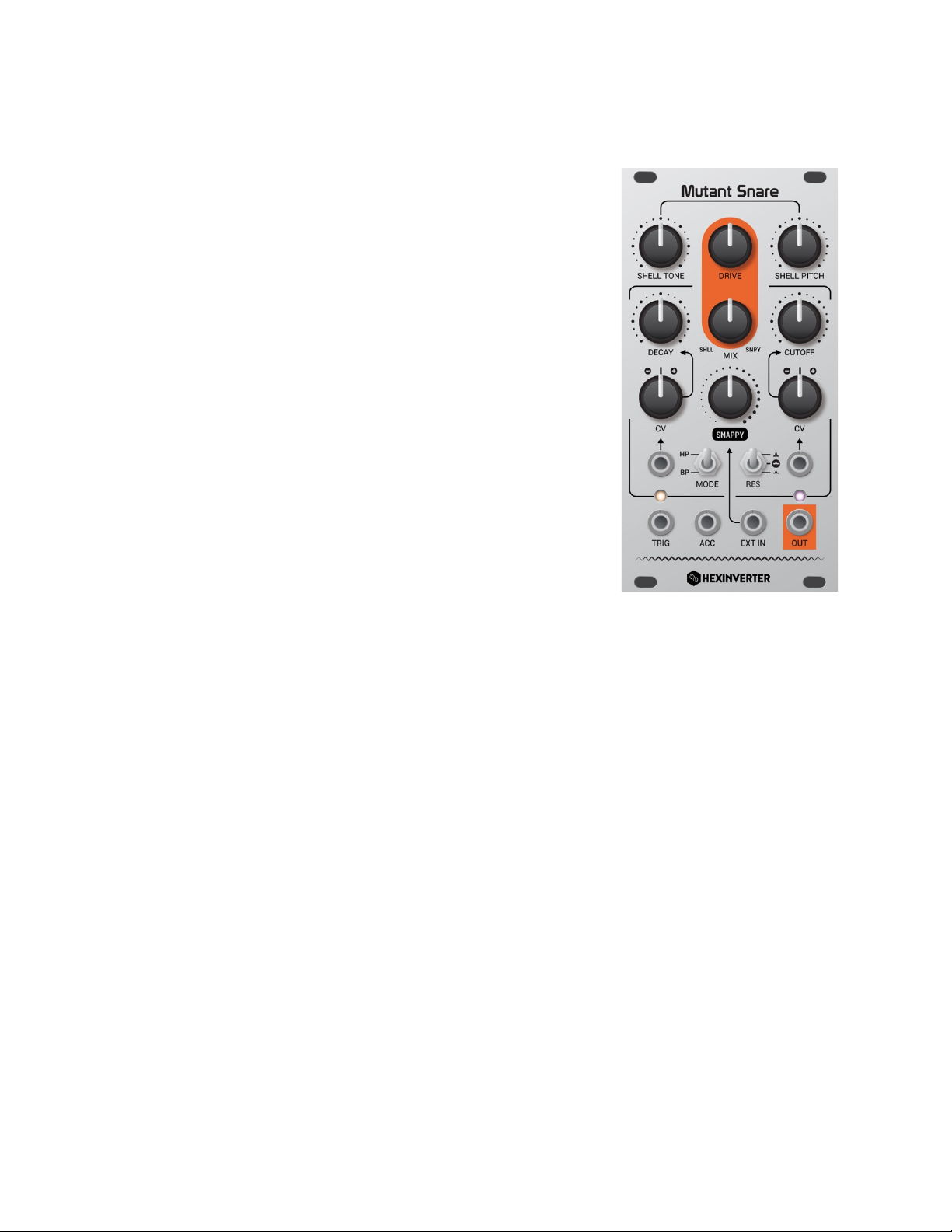
INTERFACE
Shell Interface
SHELL TONE
Blends the mix between the two sine wave oscillators that make up the SHELL
sound. Turning the knob all the way to the right results in only the secondary
fixed frequency sine wave in the mix (tuned to the same frequency the higherpitched model of the 808 had). All the way to the left results in only the primary
pitch-adjustable sine wave making it into the SHELL mix.
SHELL PITCH
Adjusts the pitch of the primary sine wave oscillator in the SHELL tone. This
control has an adjustment range of about two octaves, and spans from low
tom/bassdrum sounds up to high-pitched snare tones.
Snappy Interface
DECAY
This control, along with the respective CV input jack and attenuverter, allow you
to adjust and modulate the decay of the SNAPPY envelope. This control is
adjustable all the way from short decays about 10x faster than the drum machine
this circuit was inspired by, up to about 10 seconds. Note that the CV input
features an attenuverter - which means the zero CV position is at the knobs
centre. Turning the knob to the left of centre inverts your CV signal coming in,
while turning it to the right will apply your CV signal in a positive way.
MODE
This switch selects the mode of the 12dB/oct filter the SNAPPY sound passes through. The filter can be either highpass (HP) or band-pass (BP).
RES
This switch selects the resonance of the SNAPPY filter. At CENTRE position, it is the same mild resonance found in the
808 snare drum's filter section. Turning the resonance switch UP causes self-oscillation of the filter to occur. Turning
the switch DOWN selects medium resonance, which is higher than the CENTRE position, but not enough resonance for
self-oscillation to occur.
CUTOFF
The cutoff frequency of the filter can be adjusted/modulated with this control, its respective CV input jack and
attenuverter. When no jack is plugged into the CV input jack for CUTOFF, either the SNAPPY decay envelope or primary
sinewave oscillator of the SHELL normalize into the CUTOFF CV and attenuverter. Use the jumper on the back of the
module in order to select which of these two internal modulation sources normalise to the CUTOFF CV input jack. If you
wish to disable this internal modulation feature, simply leave the jumper disconnected from either of the selections.
EXT IN + SNAPPY (level)
The EXT IN jack allows you to replace the internal white noise generator with an external audio signal. While the Mutant
Snare circuit is tuned for modular-level signals, you can also experiment with line level signals. The SNAPPY level
control adjusts the volume of the signal feeding into the SNAPPY circuit - be it your external source or the internal
noise generator of the Mutant Snare.
Global Interface
DRIVE
Adjusts the final output volume of the combined SNAPPY and SHELL tones. Begins to overdrive at around 50%.
Overdrive/clipping is indicated by the purple LED above the OUT jack.
Page 4

09.feb.2016! Mutant Snare user manual v1.03 PG4
Hexinverter Électronique, 2016
MIX
Blends between the SHELL and SNAPPY tones that make up the overall snare sound. For example, turning all the way
to SNPY means no SHLL is present in the mix.
TRIG
This trigger input jack will accept virtually any modular signal, and should trigger around 1 volt. After a trigger occurs,
the signal's voltage must return to zero (or below) before another trigger can be activated.
ACC
The accent input jack lets you modulate the accent of the snare with CV. The default accent level is selected with a
jumper on the back of the module. A 5V accent CV level achieves maximum accent.
!
Page 5
09.feb.2016! Mutant Snare user manual v1.03 PG5
Hexinverter Électronique, 2016
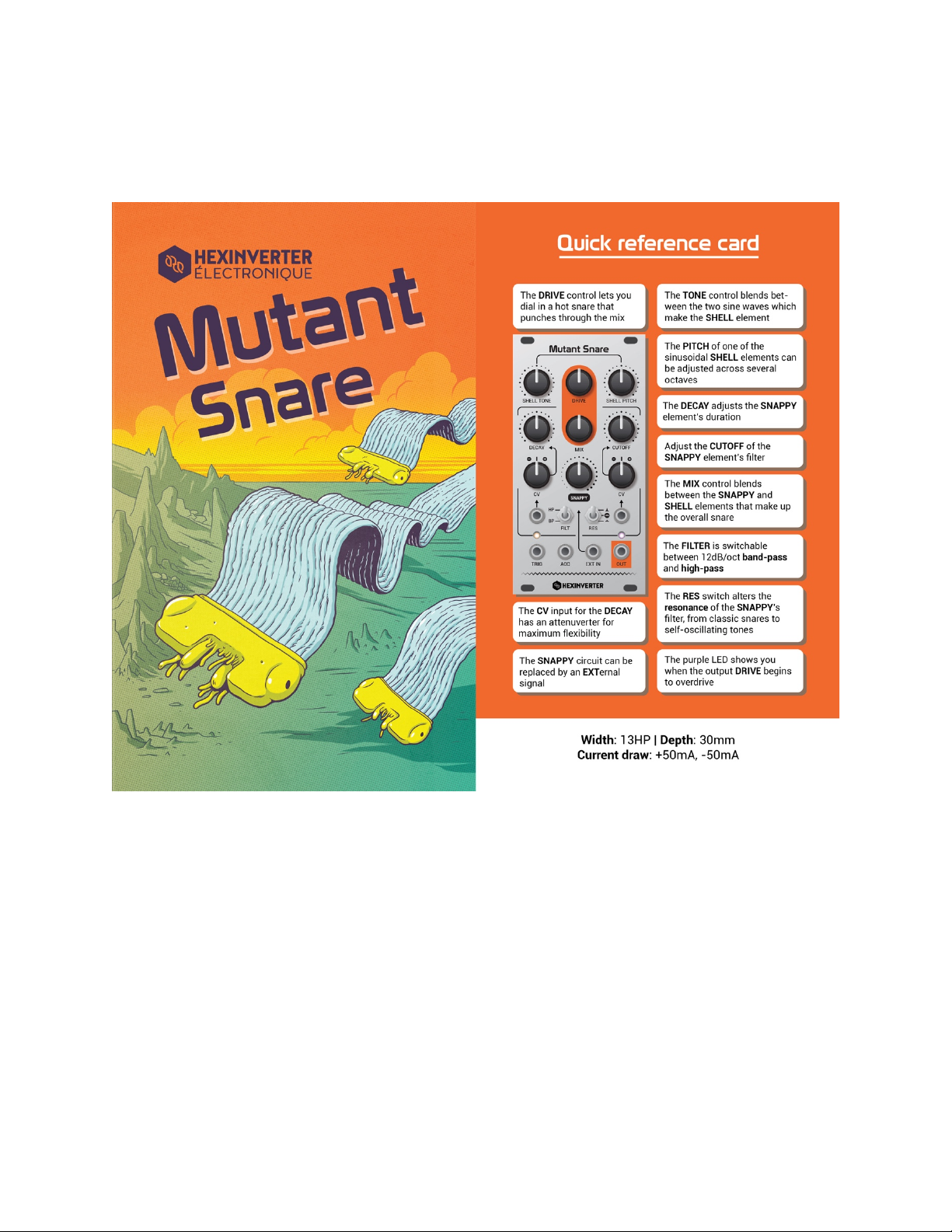
QUICK REFERENCE CARD
These are included packaged with every module, but if you lost yours or happened to build your Mutant
Snare yourself, you might find it handy to print out and keep near your modular for reference.
 Loading...