

Page 1
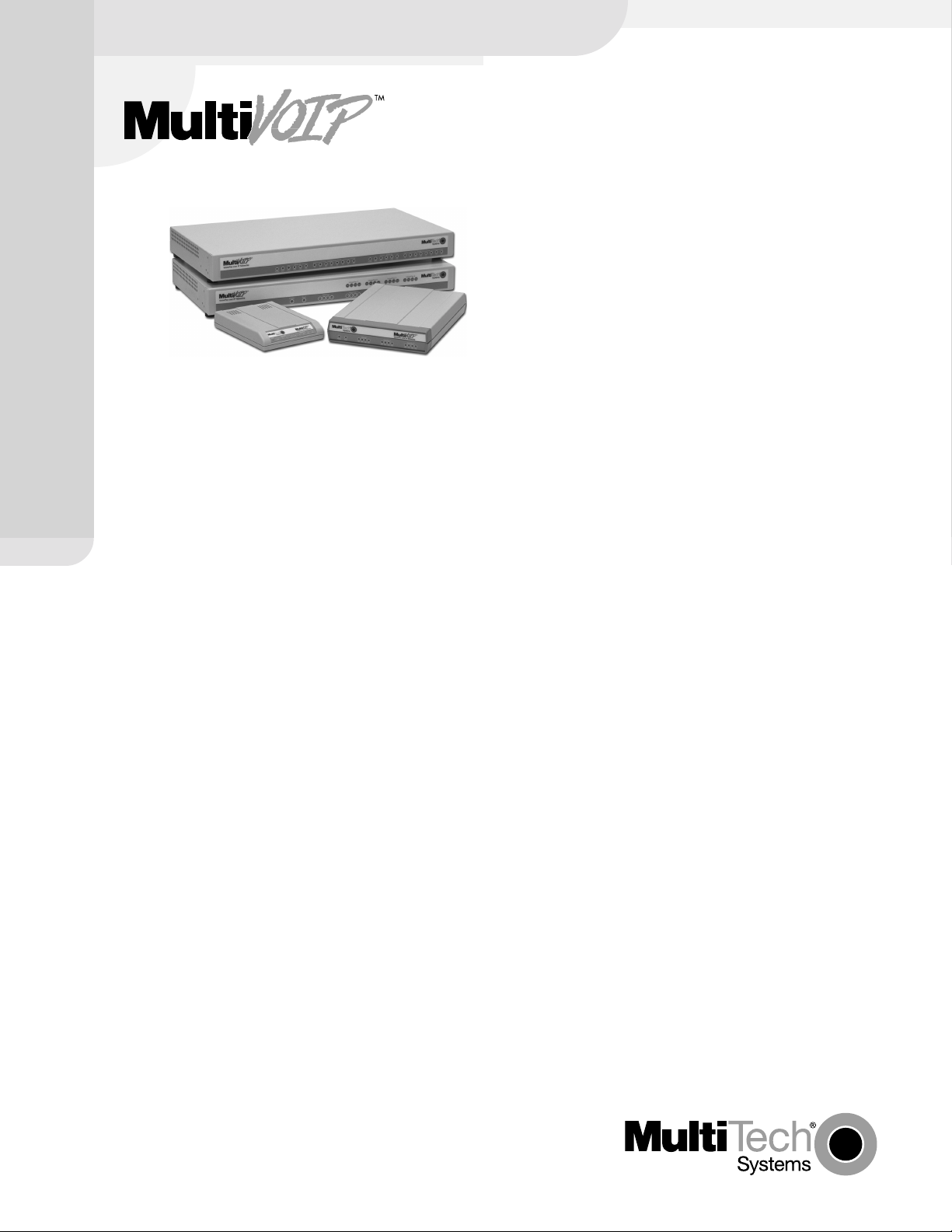
Voice/Fax over IP Gateways
The Multi-Tech MultiVOIP provides toll-free voice and fax communications
over the Internet or Intranet. By integrating voice and fax into your existing
data network, you can realize substantial savings on inter-office long distance
toll charges. The MultiVOIP family is available in analog and digital models
ranging from two to 60 ports. All MultiVOIP products connect directly to
phones, fax machines, key systems, PSTN lines, or a PBX to provide realtime, toll-quality voice connections to any office on your VOIP network.
Features
2-, 4-, 8- analog ports or 24/30 (expandable to 48/60) digital ports for
communication over an existing IP network or the Internet
Benefits
Toll bypass voice/fax communications
PSTN voice quality
Connects directly to phones, fax or PBX
Turnkey solution
Toll-free Voice/Fax
Communication over
the Internet or
Intranet
Ethernet connectivity and full IP compatibility with existing routers and
WAN infrastructure
FXS/FXO and E&M connectors on each channel for direct analog connection
to phones, key telephones, PBX extensions, PSTN lines or PBX trunks
Digital MultiVOIP connects directly to PBX or PSTN line via T1/E1 or PRI
Supports H.323 or SIP for sending voice over the Internet
PSTN fail-over automatically routes calls over the PSTN network if the IP
network is down
Supports H.450 supplementary services to provide for call transfer, call
forwarding, call hold, call waiting and name identification
Voice compression to 5.3K bps per call
T.38 real-time fax relay for interoperability among other VOIP equipment
Modem relay supports modem connections over the IP network (up to
14.4K bps)
Configuration and management using a Web browser or Windows
Models available with integrated gatekeeper for centralized phone book
management
Models with integrated gatekeeper extend the call features of a centralized
Avaya media server, running MultiVantage software, and provide local office
survivalitiy to small branch offices of large corporations
Two-year warranty
Page 2
MultiVOIP
X
M
T
R
C
V
X
S
G
R
S
G
X
M
T
R
C
V
X
S
G
R
S
G
X
M
T
R
C
V
X
S
G
R
S
G
X
M
T
R
C
V
X
S
G
R
S
G
R
C
V
X
M
T
C
O
L
L
N
K
X
M
T
R
C
V
X
S
G
R
S
G
X
M
T
R
C
V
X
S
G
R
S
G
X
M
T
R
C
V
X
S
G
R
S
G
X
M
T
R
C
V
X
S
G
R
S
G
V
o
i
c
e
/
F
a
x
5
V
o
i
c
e
/
F
a
x
6
V
o
i
c
e
/
F
a
x
7
V
o
i
c
e
/
F
a
x
8
V
o
i
c
e
/
F
a
x
1
V
o
i
c
e
/
F
a
x
2
V
o
i
c
e
/
F
a
x
3
V
o
i
c
e
/
F
a
x
4
E
t
h
e
r
n
e
t
B
o
o
t
P
o
w
e
r
™
Highlights
MultiVOIP Applications. MultiVOIP is specifically
targeted at businesses looking to reduce toll charges
between frequently called sites. MultiVOIP is a voice
over IP gateway that integrates seamlessly into your
data network and operates alongside existing PBXs, or
other phone equipment to simply extend voice
capabilities to remote locations. It is designed to help
you maximize investments you’ve already made in
your data and voice network infrastructure.
Easy Integration. With MultiVOIP, you avoid the hassle
and expense of replacing your existing routers, WAN
connections or phone system required by other VOIP
solutions. MultiVOIP simply plugs into your Ethernet
network. Neither your phone service or network is
placed at risk. Minimum requirements: Ethernet
network, WAN connection, IP addresses.
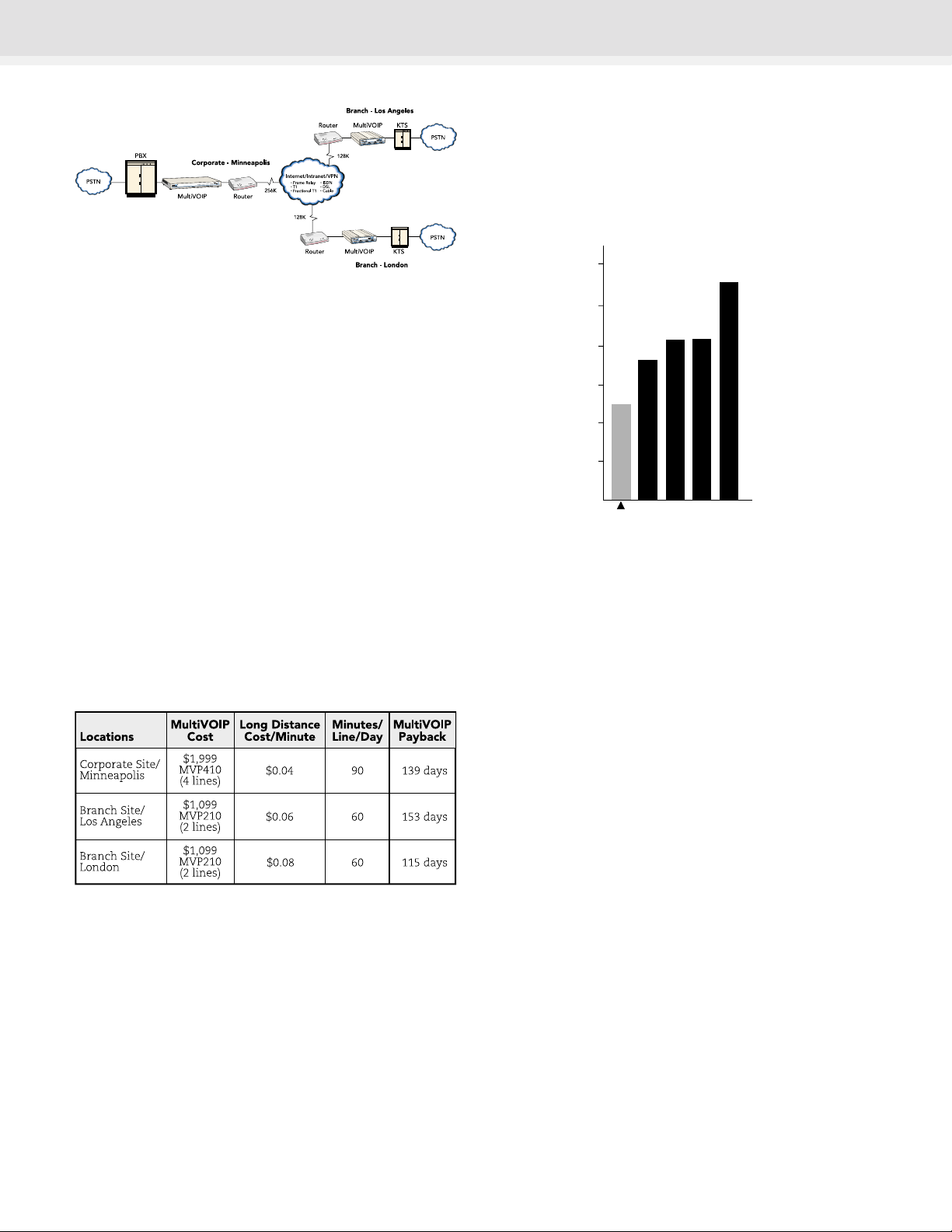
Save Thousands of Dollars Each Month. MultiVOIP
can save your company substantial amounts in long
distance charges. Even if your company uses one of the
most inexpensive calling plans, a MultiVOIP network
can quickly return your investment and begin paying
you back.
Award-winning Voice Quality. With MultiVOIP, you’ll
experience consistent toll-quality voice connections.
Using the Perceptual Speech Quality Measurement
(PSQM), Internet Telephony magazine found that
MultiVOIP delivered exceptional voice quality. In fact,
MultiVOIP outranked the competition.
PSQM SCORE S
The lower the better
Intolerable
Tolerable
Good
Exceptional
6.0
5.0
4.0
3.0
4.20Memotecs CX950
3.64Inter-Tels InterPrise400
5.64Nueras Access Plus F50ip
4.21SOSs Sovereign
2.50MultiVOIP
2.0
1.0
An independent product review conducted by
Internet Telephony magazine (March 1999)
Interoperability. MultiVOIP utilizes the H.323 and SIP
protocols to provide complete interoperability with
other Internet telephony solutions. The inbound IP call
protocol is automatically detected and the voice
channel is dynamically configured to match. The
outbound IP call protocol is configured with the phone
number allowing you the flexibility to call H.323 or SIP
devices from the same port. In addition, MultiVOIP
also supports T.38 real-time fax relay interoperability
among other VOIP equipment.
PSTN Fail-over. PSTN fail-over allows MultiVOIP to
automatically route calls over the PSTN network
when the IP network is down. MultiVOIP continually
checks if the LAN/WAN is down. If it detects a
problem, MultiVOIP switches to “survivability mode”
transparently routing all calls over PSTN lines
connected to the MultiVOIP gateway. MultiVOIP
continues to monitor the connection and automatically
switches back to the LAN/WAN once the problem is
corrected.
Advanced Speech Technologies. MultiVOIP supports
the Differentiated Services (DiffServ) Quality of
Service (QoS) protocol which sets priorities for voice
and fax traffic and allows transparent delivery. DiffServ
helps move time-sensitive voice traffic across even
low-bandwidth WAN connections, like 56K and ISDN,
with the priority and quality required by voice. Other
features such as adaptive echo cancellation, forward
error correction, bad frame interpolation, tunable
latency and dynamic jitter buffers, further enhance
voice quality.
Page 3
Complete Support for Multiple Telephony
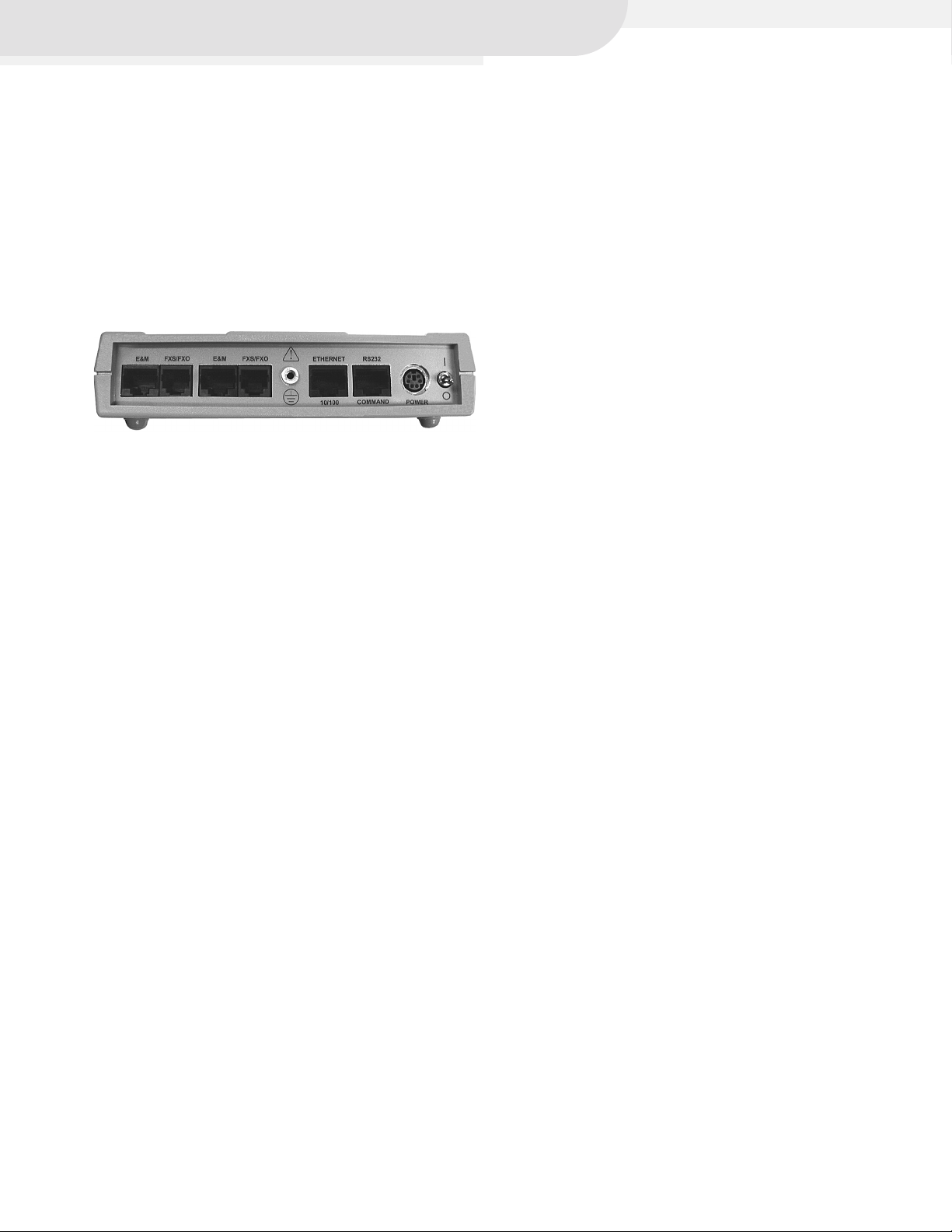
Interfaces. For maximum investment protection, the
MultiVOIP two, four and eight-port models
accommodate changing communication needs by
providing a programmable FXS/FXO and an E&M
interface for each port. This allows MultiVOIP to
connect directly to a phone, fax machine, key phone
system or PBX. It automatically detects whether the
incoming call is a voice or fax call. The single port
MultiVOIP supports either FXS or FXO interfaces,
depending on model, while the digital MultiVOIP
connects directly to a PBX or PSTN line via T1/E1 or
PRI.
Supplementary Services. MultiVOIP supports H.450
supplementary services to provide for call transfer, call
forwarding, call hold, call waiting, and name
identification. It also supports Q.SIG, an inter-PBX
signaling protocol, for networking PBX supplementary
services in a multi- or uni-vendor environment. In
addition, MultiVOIP supports SIP extensions providing
call forward and call transfer capabilities.
Integrated Gatekeeper. The MultiVOIP family now
includes models with an integrated gatekeeper to
facilitate call management in a Voice over IP network.
These cost-effective MultiVOIP gateways provide
centralized phone book management as well as deliver
the power to define and control how H.323 voice
traffic is managed over IP networks. With the
integrated gatekeeper, network managers can
configure, monitor and manage the activity of
registered end points. In addition, they can set policies
and control network resources, such as bandwidth
usage, to ensure optimal implementation.
Bandwidth Management. Bandwidth is used only when
someone is speaking. The silence suppression/Voice
Activity Detection (VAD) feature is an option that
frees unused call bandwidth for data traffic. This is
significant, since callers are usually silent for 60 percent
of the call. When using silence suppression, MultiVOIP
also offers Comfort Noise Generation (CNG) at the
receiving end so the user knows the line has not
dropped. In addition, MultiVOIP supports voice
compression standards like G.729 (8:1) and G.723 (10:1).
These standards help minimize the bandwidth required
for voice. G.723, for instance, is the maximum
compression rate and requires only 5.3K bps (plus an
added 7-8K bps for IP overhead). Even at maximum
compression, your VOIP solution will still provide tollquality voice.
No User Training. MultiVOIP provides single stage
dialing by utilizing a Uniform Dialing Plan that is
consistent with the E.164 (PSTN) standard numbering
plan. This includes automatic appending and stripping of
digits to dialed numbers to ensure that users will not
require additional training to make VOIP calls. In fact,
placing calls with MultiVOIP is like using your existing
phone system.
Avaya Small Office Media Gateway Solution. Avaya
and Multi-Tech have partnered together to provide an
affordable small office media gateway solution that
delivers the features of Avaya’s MultiVantage
TM
software to the branch offices of large corporations.
The Multi-Tech MultiVOIP gateway, with integrated
gatekeeper, cost-effectively extends the call features
and networking benefits of a centralized Avaya Media
Server to small branch offices, utilizing traditional
analog devices, over an IP infrastructure. MultiVOIP
also renders local office survivability, in the case of a
LAN or WAN failure, by providing local, reliable
PSTN trunking.
You Be the Judge. Industry experts have recognized our
VOIP gateways for their clarity. But don’t take their
word for it, or ours. You be the judge! Make a FREE
VOIP call over the Internet by dialing 1-877-TRYVOIP.
Hear for yourself how clear the connection can be.
Management. MultiVOIP is easily managed using a
Windows-based software application, web browser, or
SNMP. Multi-Tech also includes its own SNMP
management software called MultiVOIPManager
which provides central site configuration, management
and call monitoring for all MultiVOIP gateways on the
network. It utilizes a Windows interface that makes it
easy to view events like usage tracking, live use
reporting, call history, and voice quality statistics. In
addition, MultiVOIPManager eases administration by
automatically e-mailing call logs based on volume or
time.
Page 4

MultiVOIP
™
Specifications
Analog Models
Number of Ports: 2, 4 or 8
Port Interface: FXO, FXS & E&M support on each
port
FXS Interface: KTS, telephone set, or fax; ground
and loop start
FXO Interface: PBX station; CO line, loop start, 2-wire
E&M Interface: PBX E&M trunk; 2- or 4-wire
E&M Signal Types: I through V
Dialing: DTMF or pulse
Connectors: 1 RJ-48 (E&M); 1 RJ-11 (programmable
FXS or FXO) per port
Digital Models
Number of Trunks: 1 or 2 (T1/PRI-24 or 48
Channels, E1/PRI-30 or 60 Channels)
Signaling: T1-CAS/Robbed bit signaling; E1-MFC/
R2, PRI-National ISDN 2, 4ESS, 5ESS,
DMS100, Austel ISDN, ETSI, France Telcom,
HK Telcom, NTT and KDD Japan, Korean
Operator
Line Code: T1-AMI or B8Zs; E1-AMI or HDB3
Frame Format: T1-ESF or D4 (SF); E1-16 Frame plus
CRC
Connectors: 1 or 2 RJ-48
LAN Port
Format: Ethernet/Ethernet II or SNAP
Interface: 10/100BaseT
Command Port
2-Port & Digital Interface: RS-232C/D; RJ45 (RJ-
45 to DB9 cable included)
4- & 8-port Interface: RS-232C/D; DB25
Speed & Format: 115.2K bps asynchronous
Protocols
H.323 V4, SIP, H.450.2-H.450.4, H.450.6 and
H.450.8, RTP, RTCP, SMTP, Q.931, Q.Sig,
T.38 and Group 3 fax relay
Bandwidth Management
G.711, G.723, G.726, G.727, G.729 and proprietary
voice compression, silence suppression, VAD,
CNG
Voice Quality
DiffServ, G.165, G.168, adaptive echo cancellation,
forward error correction, bad frame interpolation,
tunable latency, dynamic jitter buffers
Management
Web browser, Windows, SNMP agent,
MultiVOIPManager, flash upgradeable
Power
Voltage & Frequency: 115v/240v AC, 47/60 Hz
Power Consumption: 2-Port-19W;
4- & 8-Port-46W; Digital models-27W
Dimensions
2-port model: 6.2" w x 1.4" h x 9.0" d; 2 lbs.
(15.8 cm x 3.6 cm x 22.9 cm; 0.92 kg)
4-port & 8-port model: 17.4" w x 3.8" h x 8.0" d;
7.4 lbs.
(44.2 cm x 9.5 cm x 20.3 cm; 3.4 kg)
Digital Model: 17.4" w x 1.75" h x 8.75" d; 7.5 lbs.
(44.2 cm x 4.5 cm x 22.2 cm; 3.4 kg)
Certification
EMC: FCC Part 15 Class A, EN55022, EN55024,
EN61000-3-2, EN61000-3-3
Safety: CE, UL 60950, EN60950, cUL, TS001
Telecom: FCC Part 68, CS-03, TBR21
Ordering Information
Product Description Region
Analog
MVP210* 2-Port VOIP Gateway Global
MVP210-G* 2-Port VOIP Gateway/Gatekeeper Global
MVP410* 4-Port VOIP Gateway Global
MVP410-G* 4-Port VOIP Gateway/Gatekeeper Global
MVP810* 8-Port VOIP Gateway Global
MVP810-G* 8-Port VOIP Gateway/Gatekeeper Global
Digital
MVP2410 24/48-Port T1/PRI VOIP Gateway US/Can
MVP24-48 24-Port T1/PRI Expansion Card US/Can
MVP3010* 30/60-Port E1/PRI VOIP Gateway Euro/ROW
MVP30-60 30-Port E1/PRI Expansion Card Euro/ROW
* Specify country when ordering.
Made in Mounds View, MN, U.S.A.
Trademarks: MultiVOIP, MultiVOIPManager, Multi-Tech, and the Multi-Tech logo:
Multi-Tech Systems, Inc. / All other products or technologies are the trademarks
or registered trademarks of their respective holders.
(expands a MVP2410 to 48 ports)
World Headquarters
Tel: (763) 785-3500
(800) 328-9717
www.multitech.com
12/02 86002027
Copyright © 2002 by Multi-Tech Systems, Inc. All rights reserved.
Multi-Tech Systems (France)
Tel: +(33) 1 64 61 09 81
Multi-Tech Systems (UK)
Tel: +(44) 118-959 7774
 Loading...