

Page 1
OPERATION AND PARTS MANUAL
WHISPERWATT™ SERIES
MODEL DCA20SPXU2
60HZ GENERATOR
(ISUZU BV-4LE2 DIESEL ENGINE)
Used with MLt20 series Light towers onLy
PARTS LIST NO. M1870301404
Revision #0 (01/18/13)
To find the latest revision of this
publication, visit our website at:
www.mqpower.com
THIS MANUAL MUST ACCOMPANY THE EQUIPMENT AT ALL TIMES.
PN 49840
Page 2
PROPOSITION 65 WARNING
Diesel engine exhaust and some of
PAGE 2 — DCA20SPXU2 (WITH MLT20 SERIES) • OPERATION AND PARTS MANUAL — REV. #0 (01/18/13)
Page 3

REPORTING SAFETY DEFECTS
If you believe that your vehicle has a defect that could cause a crash or could
cause injury or death, you should immediately inform the National Highway
Traffic Safety Administration (NHTSA) in addition to notifying Multiquip at
1-800-421-1244.
If NHTSA receives similar complaints, it may open an investigation, and if it
finds that a safety defect exists in a group of vehicles, it may order a recall and
remedy campaign. However, NHTSA cannot become involved in individual
problems between you, your dealer, or Multiquip.
To contact NHTSA, you may either call the Vehicle Safety Hotline toll-free at
1-888-327-4236 (TTY: 1-800-424-9153), go to http://www.nhtsa.dot.gov; or
write to:
Administrator
NHTSA
1200 New Jersey Avenue S.E.
Washington, DC 20590
You can also obtain information about motor vehicle safety from
http://www.safecar.gov.
DCA20SPXU2 (WITH MLT20 SERIES) • OPERATION AND PARTS MANUAL — REV. #0 (01/18/13) — PAGE 3
Page 4

TABLE OF CONTENTS
DCA20SPXU2 60 Hz Generator
Proposition 65 Warning ........................................... 2
Reporting Safety Defects ......................................... 3
Table Of Contents .................................................... 4
Parts Ordering Procedures ...................................... 5
Safety Information ..............................................6-11
Specifications ........................................................ 12
Dimensions ............................................................ 13
Installation ........................................................14-15
General Information ............................................... 16
Major Components ................................................ 17
Generator Control Panel ........................................ 18
Engine Control Panel ........................................ 20-21
Output Terminal Panel Familiarization .............. 22-24
Load Application/Generator Output ....................... 25
Output Terminal Panel Connections ...................... 26
Inspection/Setup ............................................... 27-30
Generator Start-Up Procedure (Manual) ......... 31-32
Generator Start-Up Procedure (Auto) ................... 33
Generator Shut-Down Procedures ........................ 34
Maintenance ..................................................... 35-38
Trailer Maintenance .......................................... 39-42
Trailer Wiring Diagram ........................................... 43
Generator Wiring Diagram ..................................... 44
Engine Wiring Diagram .......................................... 45
Troubleshooting (Generator) .................................. 46
Explanation Of Code In Remarks Column............. 48
Suggested Spare Parts ......................................... 49
Component Drawings
Generator Assembly ......................................... 50-51
Control Box Assembly. ...................................... 52-55
Engine And Radiator Assembly ........................ 56-59
Output Terminal Assembly ................................ 60-61
Battery Assembly.............................................. 62-63
Muffler Assembly .............................................. 64-65
Fuel Filter Assembly ......................................... 66-67
Enclosure Assembly ......................................... 68-71
Rubber Seals Assembly ................................... 72-73
Nameplate and Decals Assembly .................... 74-75
Terms And Conditions Of Sale — Parts ................ 76
PAGE 4 — DCA20SPXU2 (WITH MLT20 SERIES) • OPERATION AND PARTS MANUAL — REV. #0 (01/18/13)
Page 5
PARTS ORDERING PROCEDURES
Ordering parts has never been easier!
If you have an MQ Account, to obtain a Username
Effective:
Choose from three easy options:
January 1st, 2006
Best Deal!
Order via Internet (Dealers Only):
Order parts on-line using Multiquip’s SmartEquip website!
■ View Parts Diagrams
■ Order Parts
■ Print Specifi cation Information
Goto www.multiquip.com and click on
Order Parts
to log in and save!
Order via Fax (Dealers Only):
All customers are welcome to order parts via Fax.
Domestic (US) Customers dial:
1-800-6-PARTS-7 (800-672-7877)
Order via Phone:
Non-Dealer Customers:
Contact your local Multiquip Dealer for
parts or call 800-427-1244 for help in
locating a dealer near you.
and Password, E-mail us at: parts@multiquip.
com.
To ob tai n a n M Q Acc oun t, co n ta ct yo u r
District Sales Manager for more information.
Use the internet and qualify for a 5% Discount
on Standard orders for all orders which include
complete part numbers.*
Fax your order in and qualify for a 2% Discount
on Standard orders for all orders which include
complete part numbers.*
Domestic (US) Dealers Call:
1-800-427-1244
International Customers should contact
their local Multiquip Representatives for
Parts Ordering information.
Note: Discounts Are Subject To Change
Note: Discounts Are Subject To Change
When ordering parts, please supply:
❒ Dealer Account Number
❒ Dealer Name and Address
❒ Shipping Address (if different than billing address)
❒ Return Fax Number
❒ Applicable Model Number
❒ Quantity, Part Number and Description of Each Part
NOTICE
All orders are treated as Standard Orders and will
ship the same day if received prior to 3PM PST.
❒ Specify Preferred Method of Shipment:
✓ UPS/Fed Ex ✓ DHL
■ Priority One ✓ Truck
■ Ground
■ Next Day
■ Second/Third Day
www.multiquip.com
WE ACCEPT ALL MAJOR CREDIT CARDS!
DCA20SPXU2 (WITH MLT20 SERIES) • OPERATION AND PARTS MANUAL — REV. #0 (01/18/13) — PAGE 5
Page 6
SAFETY INFORMATION
Do not operate or service the equipment before reading the
Potential hazards associated with the operation of this
entire manual. Safety precautions should be followed at all
times when operating this equipment. Failure to read and
understand the safety messages and operating instructions
could result in injury to yourself and others.
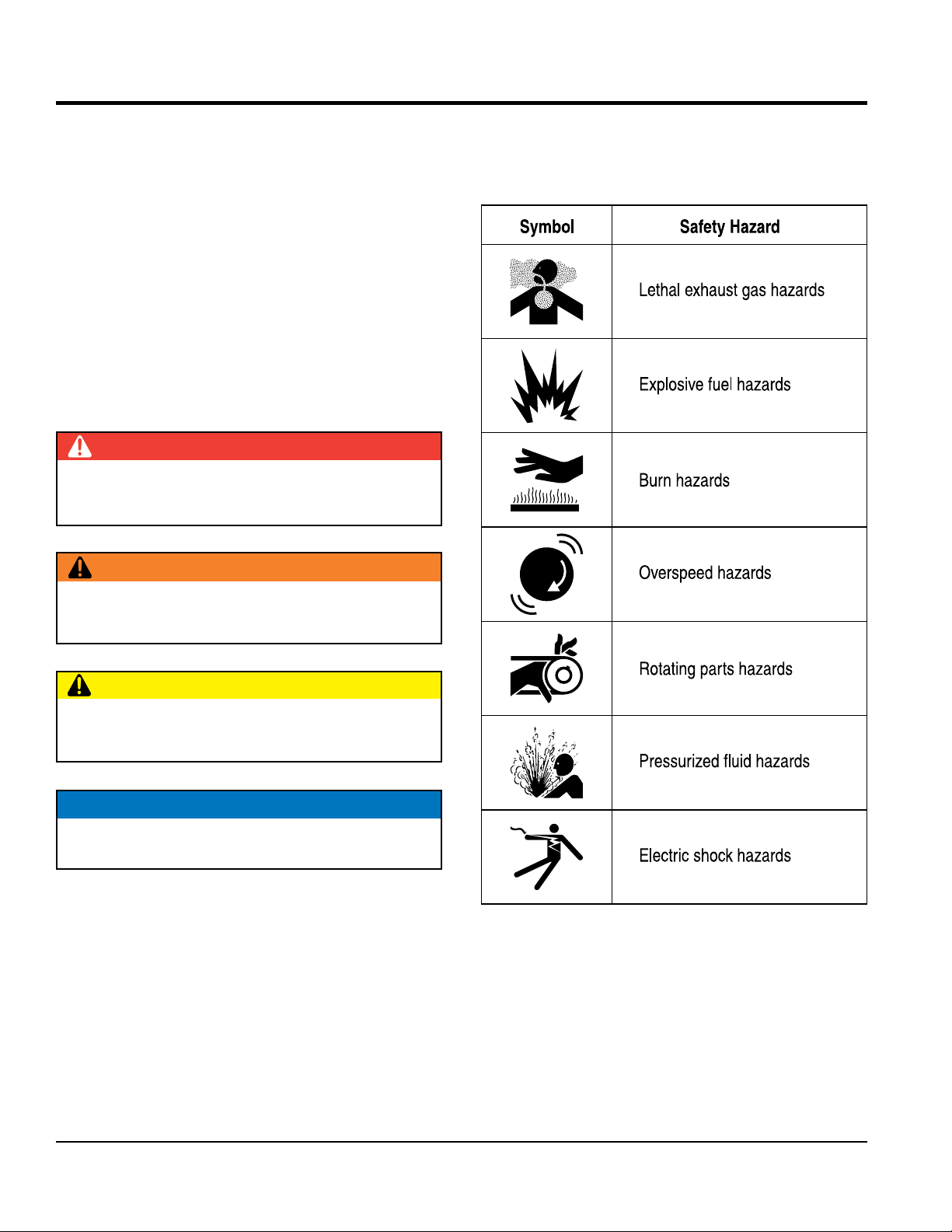
SAFETY MESSAGES
The four safety messages shown below will inform you
about potential hazards that could injure you or others. The
safety messages specifi cally address the level of exposure
to the operator and are preceded by one of four words:
DANGER, WARNING, CAUTION or NOTICE.
SAFETY SYMBOLS
DANGER
Indicates a hazardous situation which, if not avoided,
WILL result in DEATH or SERIOUS INJURY.
WARNING
equipment will be referenced with hazard symbols which
may appear throughout this manual in conjunction with
safety messages.
Indicates a hazardous situation which, if not avoided,
COULD result in DEATH or SERIOUS INJURY.
CAUTION
Indicates a hazardous situation which, if not avoided,
COULD result in MINOR or MODERATE INJURY.
NOTICE
Addresses practices not related to personal injury.
PAGE 6 — DCA20SPXU2 (WITH MLT20 SERIES) • OPERATION AND PARTS MANUAL — REV. #0 (01/18/13)
Page 7
SAFETY INFORMATION
GENERAL SAFETY
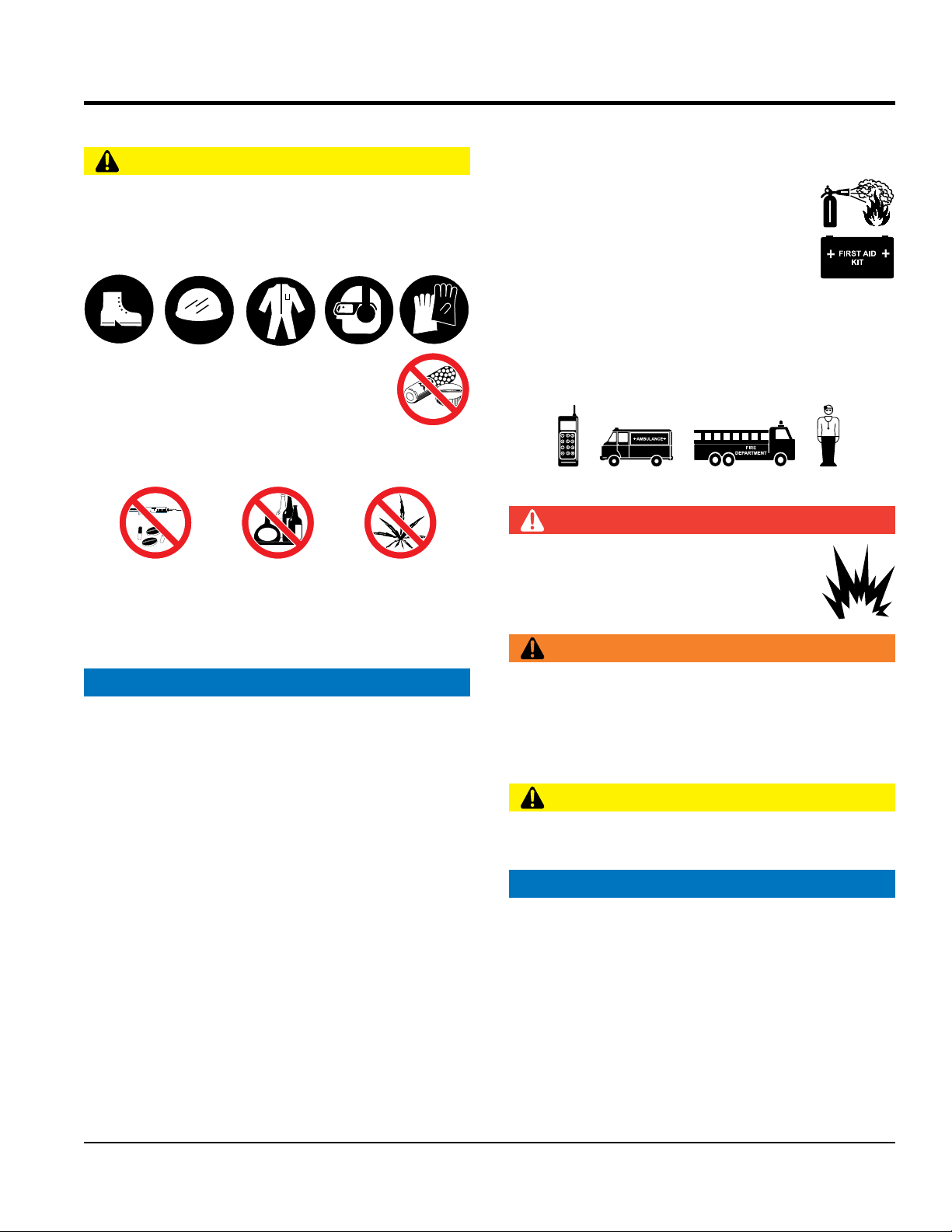
NEVER use accessories or attachments that are not
recommended by MQ Power for this equipment. Damage
Also, know the
and
This information will be invaluable in
emergency or safety devices.
Disconnection of these devices can cause severe injury,
bodily harm or even death. Disconnection of any of these
ensure generator is on level ground before use.
keep the machine in proper running condition.
store equipment properly when it is not being
used. Equipment should be stored in a clean, dry location
out of the reach of children and unauthorized personnel
CAUTION
NEVER operate this equipment without proper protective
clothing, shatterproof glasses, respiratory protection,
hearing protection, steel-toed boots and other protective
devices required by the job or city and state regulations.
NEVER operate this equipment when not
feeling well due to fatigue, illness or when
under medication.
NEVER operate this equipment under the infl uence of
drugs or alcohol.
ALWAYS check the equipment for loosened threads or
bolts before starting.
DO NOT use the equipment for any purpose other than
its intended purposes or applications.
to the equipment and/or injury to user may result.
ALWAYS know the location of the nearest
fi re extinguisher.
ALWAYS know the location of the nearest
fi rst aid kit.
ALWAYS know the location of the nearest
phone or keep a phone on the job site.
phone numbers of the nearest ambulance, doctor
fi re department.
the case of an emergency.
GENERATOR SAFETY
DANGER
NEVER operate the equipment in an explosive
atmosphere or near combustible materials. An
explosion or fi re could result causing severe
bodily harm or even death.
WARNING
NOTICE
This equipment should only be operated by trained and
qualifi ed personnel 18 years of age and older.
Whenever necessary, replace nameplate, operation and
safety decals when they become diffi cult read.
Manufacturer does not assume responsibility for any
accident due to equipment modifi cations. Unauthorized
equipment modifi cation will void all warranties.
NEVER disconnect any
These devices are intended for operator safety.
devices will void all warranties.
CAUTION
NEVER lubricate components or attempt service on a
running machine.
NOTICE
ALWAYS
ALWAYS
Fix damage to machine and replace any broken parts
immediately.
ALWAYS
DCA20SPXU2 (WITH MLT20 SERIES) • OPERATION AND PARTS MANUAL — REV. #0 (01/18/13) — PAGE 7
Page 8
ENGINE SAFETY
NOTICE
run engine without an air fi lter or with a dirty air
fi lter. Severe engine damage may occur. Service air fi lter
Wet stacking is a common problem with diesel engines
no load applied. When a diesel engine operates without
suffi cient load (less than 40% of the rated output), it will
not operate at its optimum temperature. This will allow
In order for a diesel engine to operate at peak effi ciency,
it must be able to provide fuel and air in the proper ratio
and at a high enough engine temperature for the engine
applied to relieve the condition. It can reduce the system
Codes specify that in certain locations, spark arresters
must be used on internal combustion engines that use
hydrocarbon fuels. A spark arrester is a device designed
from the engine exhaust. Spark arresters are qualifi ed
SAFETY INFORMATION
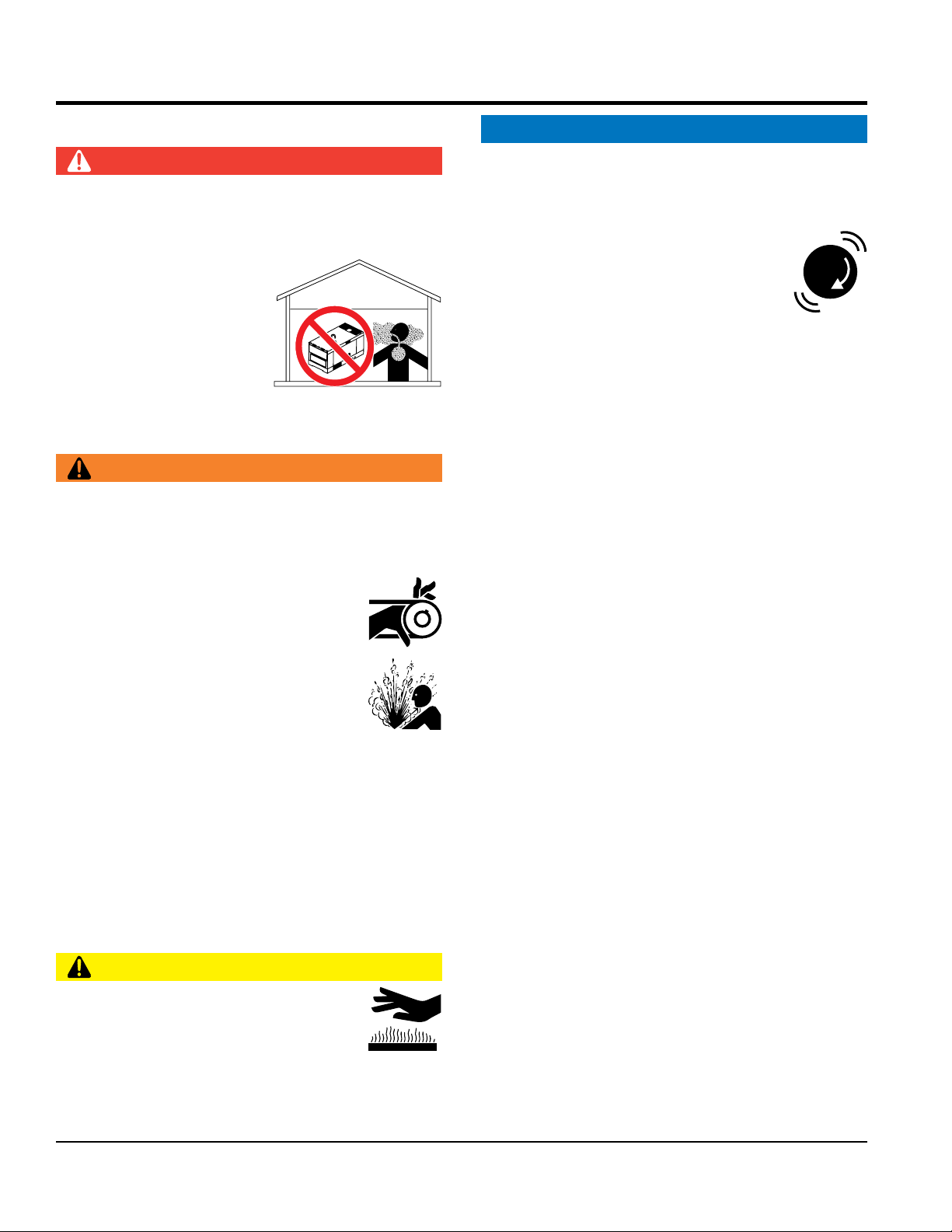
DANGER
The engine fuel exhaust gases contain poisonous carbon
monoxide. This gas is colorless and odorless, and can
cause death if inhaled.
The engine of this equipment
requires an adequate free
fl ow of cooling air. NEVER
operate this equipment in
any enclosed or narrow area
where free fl ow of the air is
restricted. If the air fl ow is
restricted it will cause injury to people and property and
serious damage to the equipment or engine.
WARNING
DO NOT place han ds or fingers inside en g ine
compartment when engine is running.
NEVER operate the engine with heat shields or
guards removed.
Keep fi ngers, hands hair and clothing away
from all moving parts to prevent injury.
DO NOT remove the radiator cap while the
engine is hot. High pressure boiling water
will gush out of the radiator and severely
scald any persons in the general area of
the generator.
DO NOT remove the coolant drain plug while the engine
is hot. Hot coolant will gush out of the coolant tank and
severely scald any persons in the general area of the
generator.
NEVER
frequently to prevent engine malfunction.
NEVER tamper with the factory settings
of the engine or engine governor. Damage
to the engine or equipment can result
if operating in speed ranges above the
maximum allowable.
which are operated for extended periods with light or
unburned fuel to accumulate in the exhaust system,
which can foul the fuel injectors, engine valves and
exhaust system, including turbochargers, and reduce
the operating performance.
to completely burn all of the fuel.
Wet stacking does not usually cause any permanent
damage and can be alleviated if additional load is
performance and increase maintenance. Applying an
increasing load over a period of time until the excess
fuel is burned off and the system capacity is reached
usually can repair the condition. This can take several
hours to burn off the accumulated unburned fuel.
State Health Safety Codes and Public Resources
DO NOT remove the engine oil drain plug while the
engine is hot. Hot oil will gush out of the oil tank and
severely scald any persons in the general area of the
generator.
CAUTION
NEVER touch the hot exhaust manifold,
muffl er or cylinder. Allow these parts to cool
before servicing equipment.
PAGE 8 — DCA20SPXU2 (WITH MLT20 SERIES) • OPERATION AND PARTS MANUAL — REV. #0 (01/18/13)
to prevent accidental discharge of sparks or fl ames
and rated by the United States Forest Service for this
purpose. In order to comply with local laws regarding
spark arresters, consult the engine distributor or the
local Health and Safety Administrator.
Page 9
FUEL SAFETY
DANGER
Make sure the hitch and coupling of the towing vehicle
NEVER
tow a trailer with defective hitches, couplings, chains, etc.
Trailer tires should be infl ated to 50 psi cold.
safety
attach trailer’s safety chains to towing
make sure the vehicle and trailer directional,
unless
posted otherwise. Recommended off-road towing is not to
Avoid sudden stops and starts. This can cause skidding,
Trailer should be adjusted to a level position at all times
rolling
underneath the trailer’s bumper
Use the trailer’s swivel jack to adjust the trailer height to
SAFETY INFORMATION
are rated equal to, or greater than the trailer “gross
vehicle weight rating.”
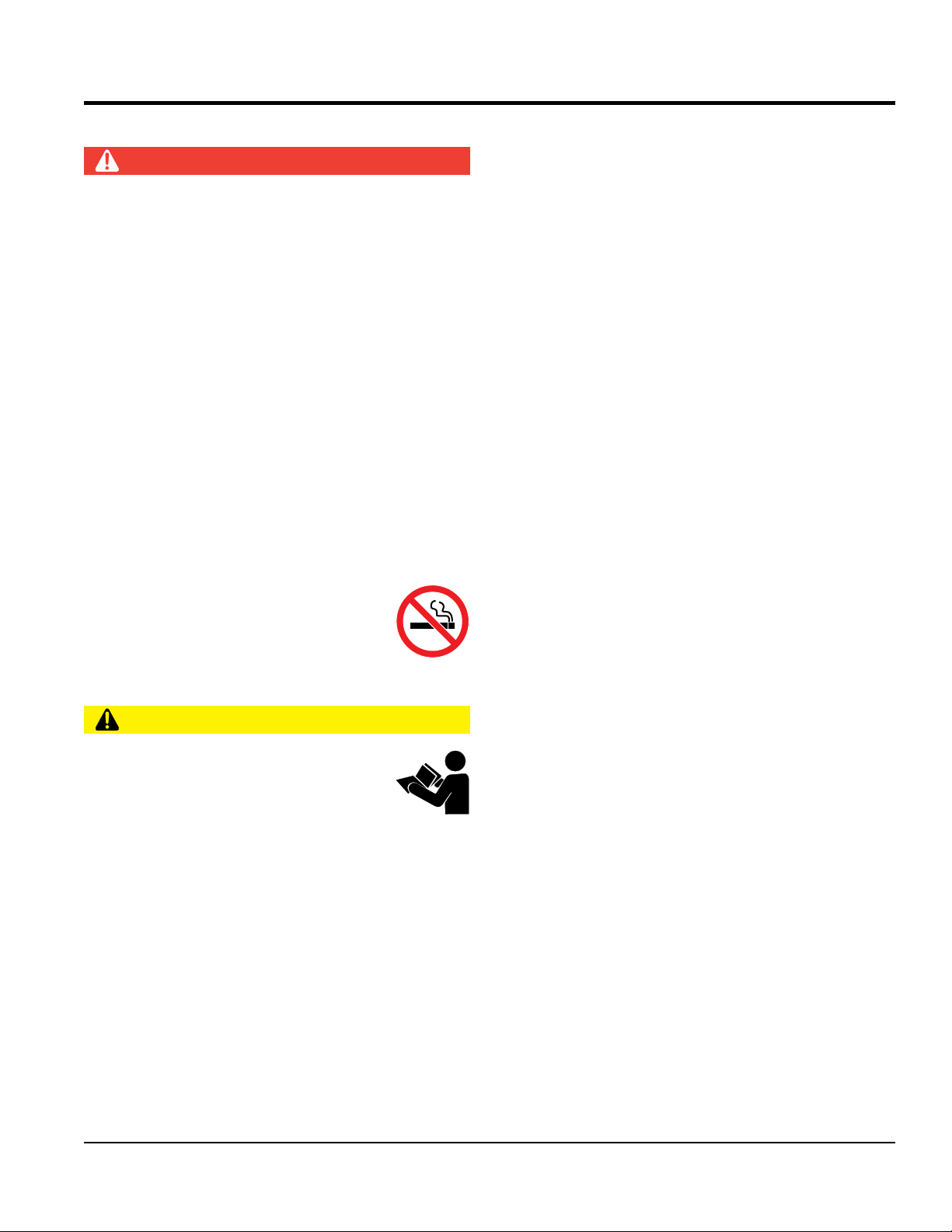
DO NOT start the engine near spilled fuel or combustible
fl uids. Diesel fuel is extremely fl ammable and its vapors
can cause an explosion if ignited.
ALWAYS refuel in a well-ventilated area, away from
sparks and open fl ames.
ALWAYS use extreme caution when working with
fl ammable liquids.
DO NOT fi ll the fuel tank while the engine is running
or hot.
DO NOT overfi ll tank, since spilled fuel could ignite if it
comes into contact with hot engine parts or sparks from
the ignition system.
Store fuel in appropriate containers, in well-ventilated
areas and away from sparks and fl ames.
NEVER use fuel as a cleaning agent.
DO NOT smoke around or ne a r the
equipment. Fire or explosion could result
from fuel vapors or if fuel is spilled on a
hot engine.
TOWING SAFETY
Check with your local county or state safety
towing regulations, in addition to meeting
Depar tment of Transpor tation (DOT)
Safety Towing Regulations, before towing
your generator.
Refer to MQ Power trailer manual for additional safety
information.
In order to reduce the possibility of an accident while
transporting the generator on public roads, ALWAYS
make sure the trailer that supports the generator and
the towing vehicle are mechanically sound and in good
operating condition.
ALWAYS shutdown engine before transporting
CAUTION
ALWAYS inspect the hitch and coupling for wear.
Check the tire air pressure on both towing vehicle and
trailer.
Also check the tire tread wear on both vehicles.
ALWAYS make sure the trailer is equipped with a
chain.
ALWAYS properly
vehicle.
ALWAYS
backup, brake and trailer lights are connected and
working properly.
DOT Requirements include the following:
• Connect and test electric brake operation.
• Secure portable power cables in cable tray with tie
wraps.
The maximum speed for highway towing is 55 MPH
exceed 15 MPH or less depending on type of terrain.
or jack-knifi ng. Smooth, gradual starts and stops will
improve towing.
Avoid sharp turns to prevent rolling.
when towing.
Raise and lock trailer wheel stand in up position when
towing.
Place chock blocks underneath wheel to prevent
while parked.
Place support blocks
to prevent tipping while parked.
a level position while parked.
DCA20SPXU2 (WITH MLT20 SERIES) • OPERATION AND PARTS MANUAL — REV. #0 (01/18/13) — PAGE 9
Page 10
ELECTRICAL SAFETY
DANGER
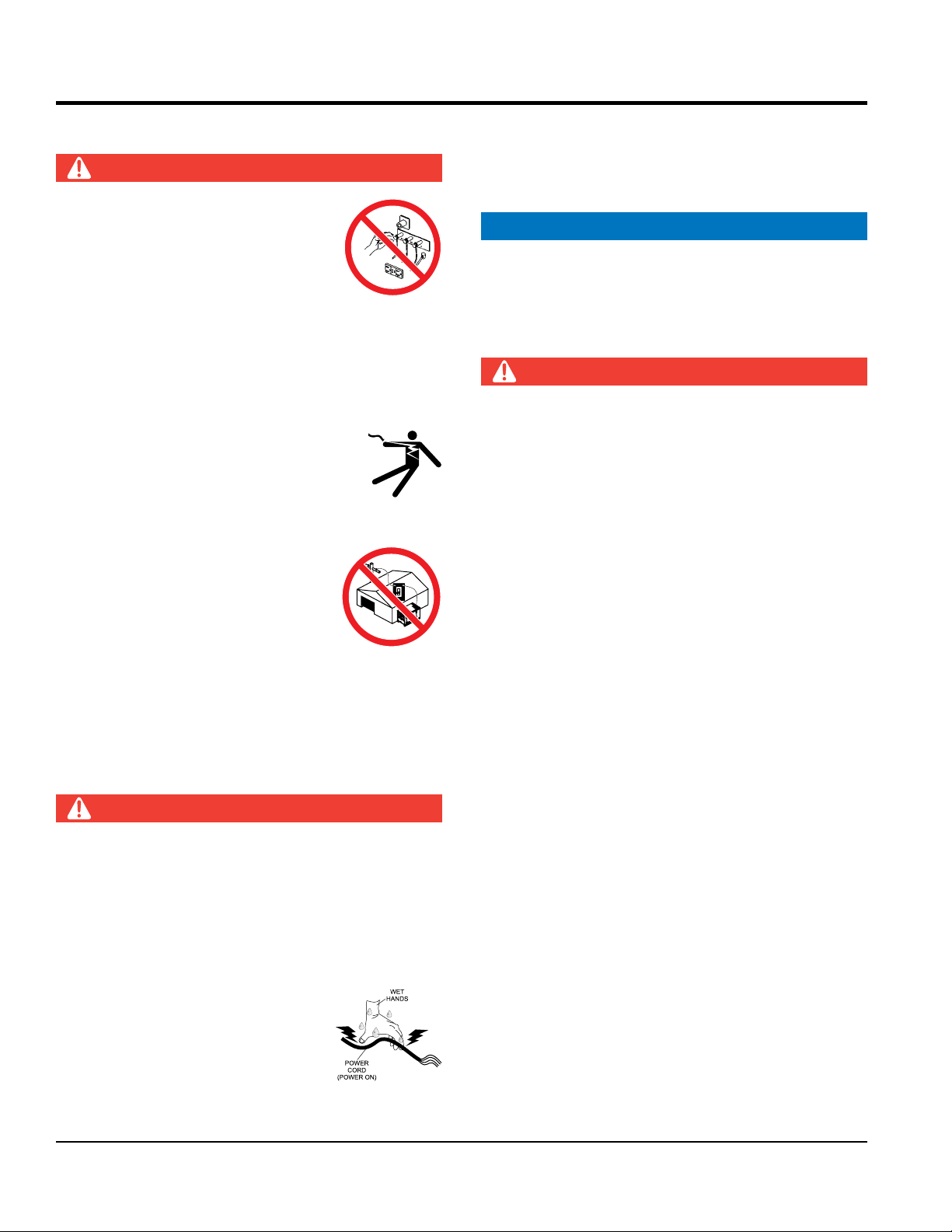
Make sure power cables are securely connected to the
make certain that proper power or extension
cord has been selected for the job. See Cable Selection
make sure that electrical circuits are properly
Severe injury or death by
can result from operating an ungrounded
DO NOT touch output terminals during
operation. Contact with output terminals
during operation can cause electrocution,
electrical shock or burn.
The electr ical voltage required to
operate the generator can cause severe
injury or even death through physical contact with live
circuits. Turn generator and all circuit breakers OFF
before performing maintenance on the generator or
making contact with output terminals.
NEVER insert any objects into the output
receptacles during operation. This is
extremely dangerous. The possibility exists
of electrical shock, electrocution or
death.
Backfeed to a utility system can cause
electrocution and/or property damage.
NEVER connect the generator to a
building’s electrical system without
a transfer switch or other approved
device. All installations should be
performed by a licensed electrician in accordance with
all applicable laws and electrical codes. Failure to do so
could result in electrical shock or burn, causing serious
injury or even death.
SAFETY INFORMATION
generator’s output receptacles. Incorrect connections
may cause electri cal sh ock and damage to the
generator.
NOTICE
ALWAYS
Chart in this manual.
Grounding Safety
DANGER
ALWAYS
grounded to a suitable earth ground (ground rod) per
the National Electrical Code (NEC) and local codes
before operating generator.
electrocution
generator.
NEVER use gas piping as an electrical ground.
Power Cord/Cable Safety
DANGER
NEVER let power cords or cables lay in water.
NEVER stand in water while AC power from the
generator is being transferred to a load.
NEVER use damaged or worn cables or cords when
connecting equipment to generator. Inspect for cuts in
the insulation.
NEVER grab or touch a live power
cord or cable with wet hands. The
possibility exists of electrical shock,
electrocution or death.
PAGE 10 — DCA20SPXU2 (WITH MLT20 SERIES) • OPERATION AND PARTS MANUAL — REV. #0 (01/18/13)
Page 11
SAFETY INFORMATION
BATTERY SAFETY
ENVIRONMENTAL SAFETY
pour waste, oil or fuel directly onto the ground,
DANGER
DO NOT drop the battery. There is a possibility that the
battery will explode.
DO NOT expose the battery to open fl ames,
sparks, cigarettes, etc. The battery contains
combustible gases and liquids. If these
gases and liquids come into contact with a
fl ame or spark, an explosion could occur.
WARNING
ALWAYS wear safety glasses when handling
the battery to avoid eye irritation. The battery
contains acids that can cause injury to the
eyes and skin.
Use well-insulated gloves when picking up the battery.
ALWAYS keep the battery charged. If the battery is not
charged, combustible gas will build up.
ALWAYS recharge the battery in a well-ventilated
environment to avoid the risk of a dangerous concentration
of combustible gasses.
NOTICE
Dispose of hazardous waste properly.
Examples of potentially hazardous waste
are used motor oil, fuel and fuel fi lters.
DO NOT use food or plastic containers to
dispose of hazardous waste.
DO NOT
down a drain or into any water source.
If the battery liquid (dilute sulfuric acid) comes into
contact with clothing or skin, rinse skin or clothing
immediately with plenty of water.
If the battery liquid (dilute sulfuric acid) comes into
contact with eyes, rinse eyes immediately with plenty
of water and contact the nearest doctor or hospital to
seek medical attention.
CAUTION
ALWAYS disconnect the NEGATIVE battery terminal
before performing service on the generator.
ALWAYS keep battery cables in good working condition.
Repair or replace all worn cables.
DCA20SPXU2 (WITH MLT20 SERIES) • OPERATION AND PARTS MANUAL — REV. #0 (01/18/13) — PAGE 11
Page 12
Model
Type
Armature Connection
Phase
Standby Output
Prime Output
SPECIFICATIONS
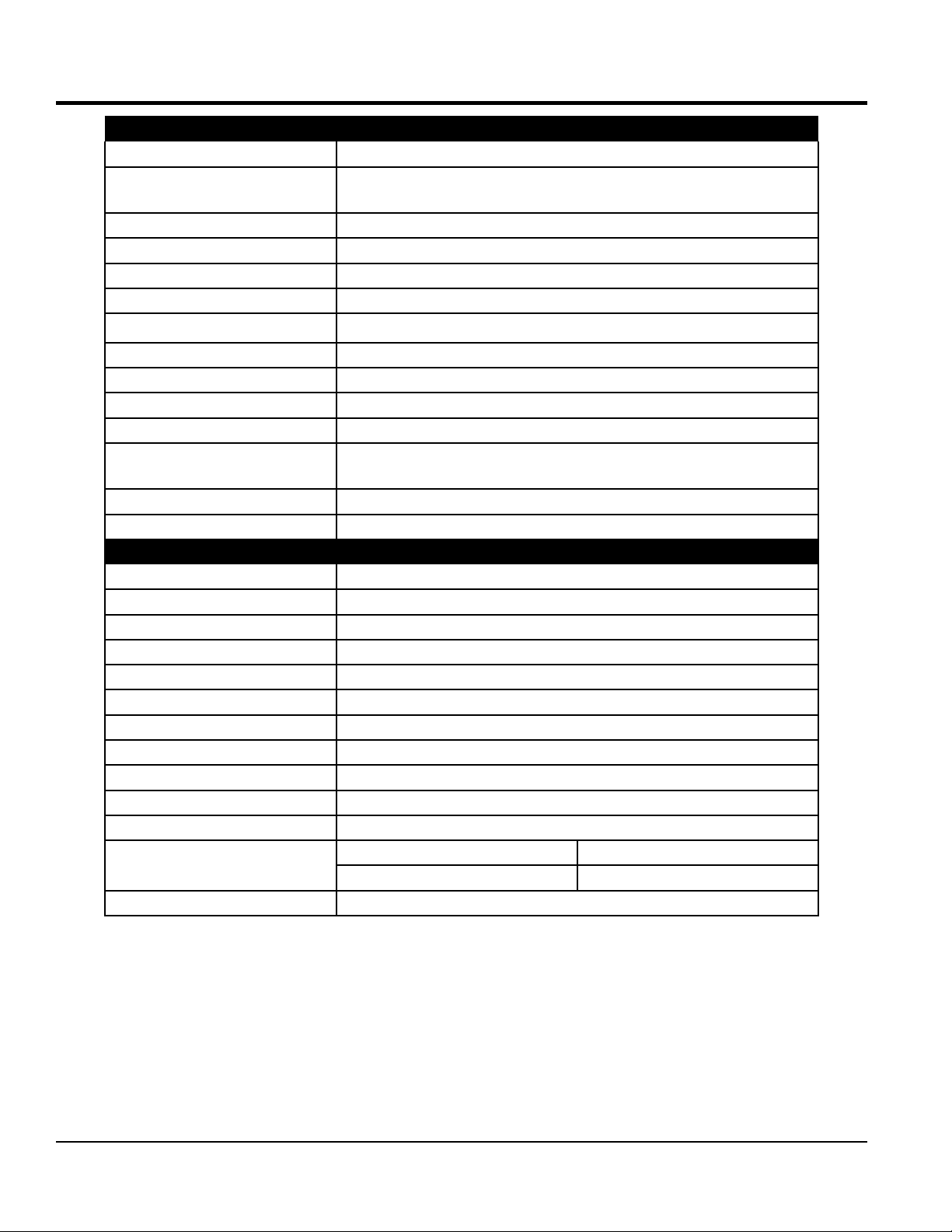
Table 1. Generator Specifications
DCA-20SPXU2
Revolving field, self ventilated,
open protected type synchronous generator
Series
Single-Phase 3-Wire
22 kW (27.5 kVA)
20 kW (25.0 kVA)
Voltage
Frequency
Speed
Power Factor
Aux. AC Power
Sound Level db (A) full Load
at 23 ft. (7 meters)
Weight (No Fuel)
Weight (Fuel)
Model
Type
No. of Cylinders
Bore x Stroke
Displacement
Rated Output
Starting
Coolant Capacity
Lube Oil Capacity
Fuel Type
Fuel Tank Capacity
Fuel Consumption
Battery
120/240V
60 Hz
1800 rpm
1.0
Single Phase, 60 Hz
63
1,412 lbs. (640 kg.)
2,012 lbs. (913 kg.)
Table 2. Engine Specifications
ISUZU BV-4LE2 Tier 4i
4 cycle, water-cooled, direct injection, turbo-charged
4 cylinders
3.34 in. x 3.77 in. (85 mm x 96 mm)
133 cu. in. (2,179 cc)
34.3 HP/1800 RPM
Electric
1.74 gal. (6.6 liters)
2.25 gal. (8.5 liters)
#2 Diesel Fuel, Low Sulfur Diesel Fuel Only
100 gal. (379 liters)
1.66 gal. (6.3 L)/hr at full load 1.21 gal. (4.6 L)/hr at 3/4 load
0.85 gal. (3.2 L)/hr at 1/2 load 0.58 gal. (2.2 L)/hr at 1/4 load
12V 53Ah x 1
PAGE 12 — DCA20SPXU2 (WITH MLT20 SERIES) • OPERATION AND PARTS MANUAL — REV. #0 (01/18/13)
Page 13
DIMENSIONS
TOP VIEW
B
A
C
D
E
20
G
SIDE VIEW
FRONT VIEW
Denyo
H
F
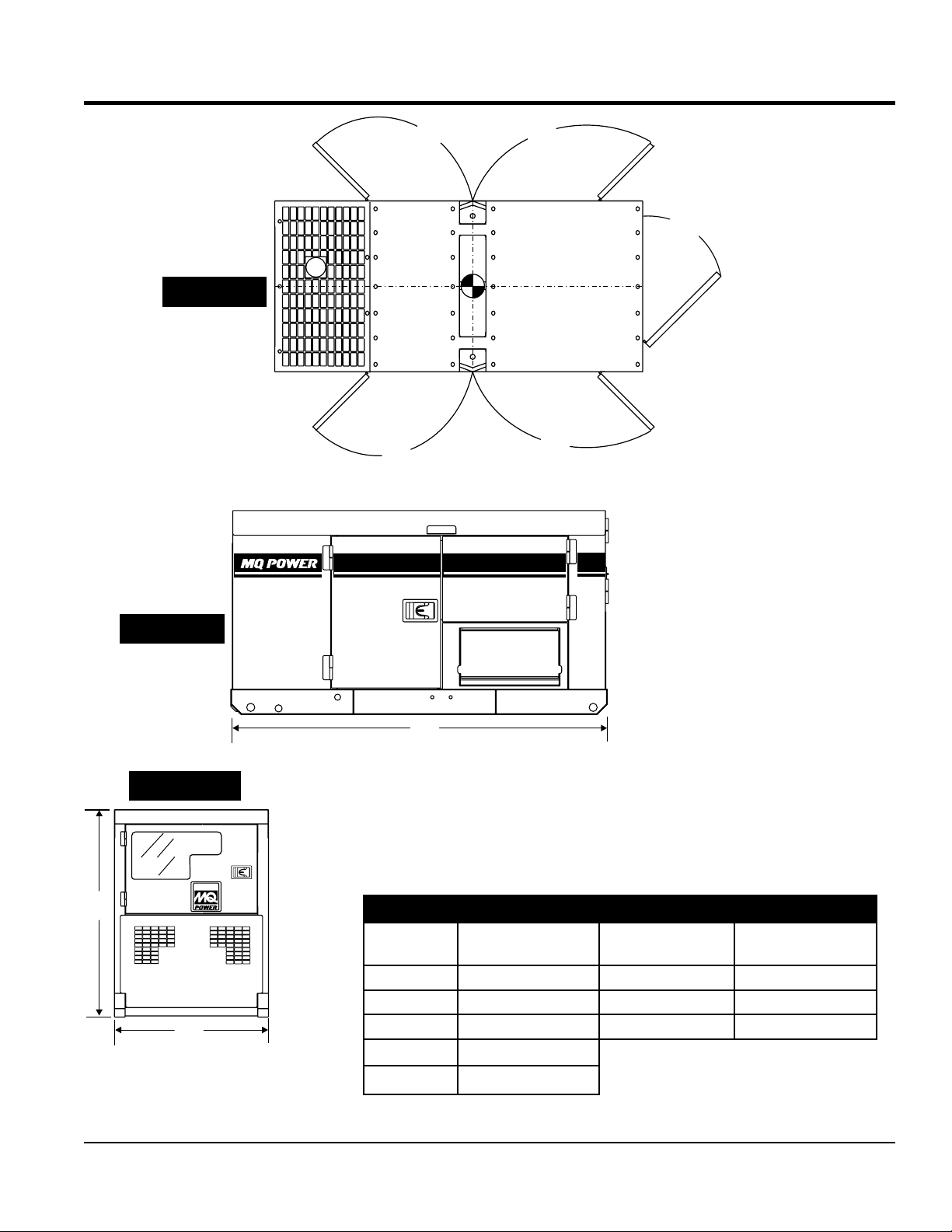
Figure 1. Dimensions
Table 3. Dimensions
Reference
Letter
A 21.06 in. (535 mm.) F 72.83 in. (1,850 mm.)
B 21.06 in. (535 mm.) G 39.37 in. (1,000 mm.)
C 24.21 in. (615 mm.) H 29.53 in. (750 mm.)
D 26.38 in. (670 mm.)
Dimension in. (mm) Reference Letter Dimension in. (mm)
E 25.00 in. (635 mm.)
DCA20SPXU2 (WITH MLT20 SERIES) • OPERATION AND PARTS MANUAL — REV. #0 (01/18/13) — PAGE 13
Page 14
GENERATOR
GROUND LUG
GROUND CABLE
INSTALLATION
GROUND ROD FOR
EARTH GROUND.
CONNECT TO BUILDING
GROUND IF
APPLICABLE
REFERENCE
NEC 250-83 (C)
8’ (MINIMUM)
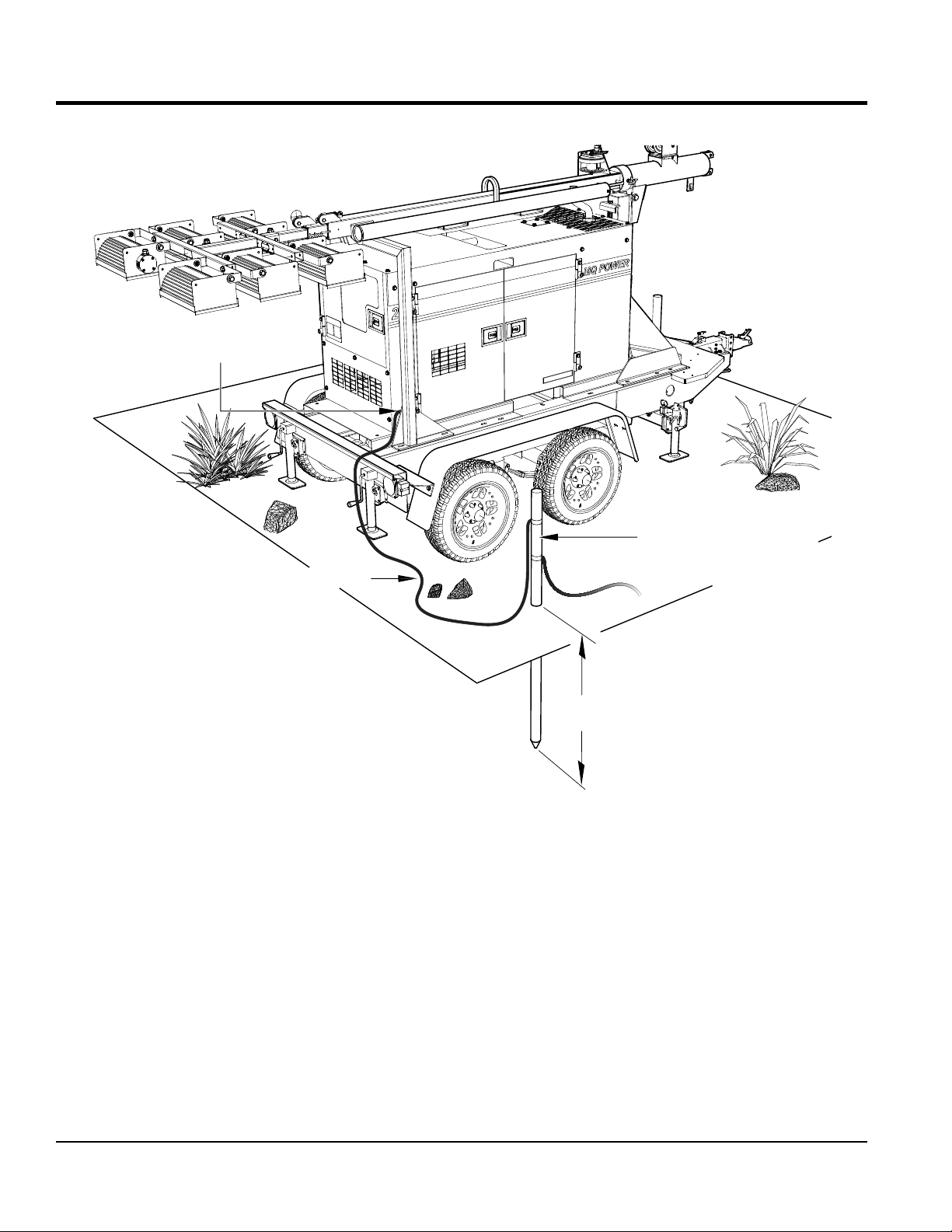
Figure 2. Typical Generator Grounding Application
PAGE 14 — DCA20SPXU2 (WITH MLT20 SERIES) • OPERATION AND PARTS MANUAL — REV. #0 (01/18/13)
Page 15
INSTALLATION
OUTDOOR INSTALLATION
Install the generator in a area that is free of debris,
bystanders, and overhead obstructions. Make sure the
generator is on secure level ground so that it cannot slide
or shift around. Also install the generator in a manner so
that the exhaust will not be discharged in the direction of
nearby homes.
The installation site must be relatively free from moisture
and dust. All electrical equipment should be protected from
excessive moisture. Failure to do will result in deterioration
of the insulation and will result in short circuits and
grounding.
Foreign materials such as dust, sand, lint and abrasive
materials have a tendency to cause excessive wear to
engine and alternator parts.
CAUTION
Pay close attention to ventilation when operating the
generator inside tunnels and caves. The engine exhaust
contains noxious elements. Engine exhaust must be
routed to a ventilated area.
GENERATOR GROUNDING
To guard against electrical shock and possible damage to
the equipment, it is important to provide a good EARTH
ground (Figure 2).
Article 250 (Grounding) of the National Electrical Code
(NEC) provides guide lines for proper grounding and
specifies that the cable ground shall be connected to the
grounding system of the building as close to the point of
cable entry as practical.
NEC articles 250-64(b) and 250-66 set the following
grounding requirements:
1. Use one of the following wire types to connect the
generator to earth ground.
a. Copper - 8 AWG (5.3 mm2) or larger.
b. Aluminum - 6 AWG (8.4 mm2) or larger.
2. When grounding the generator (Figure 2) connect the
ground cable between the lock washer and the nut on
the generator and tighten the nut fully. Connect the
other end of the ground cable to earth ground.
INDOOR INSTALLATION
Exhaust gases from diesel engines are extremely
poisonous. Whenever an engine is installed indoors the
exhaust fumes must be vented to the outside. The engine
should be installed at least two feet from any outside wall.
Using an exhaust pipe which is too long or too small can
cause excessive back pressure which will cause the engine
to heat excessively and possibly burn the valves.
MOUNTING
The generator must be mounted on a solid foundation (such
as concrete) and set firmly on the foundation to isolate
vibration of the generator when it is running. The generator
must set at least 6 inches above the floor or grade level (in
accordance to NFPA 110, Chapter 5-4.1). DO NOT remove
the metal skids on the bottom of the generator. They are
to resist damage to the bottom of the generator and to
maintain alignment.
3. NEC article 250-52(c) specifies that the earth ground rod
should be buried a minimum of 8 ft. into the ground.
NOTICE
When connecting the generator to any buildings
electrical system ALWAYS consult with a licensed
electrician.
DCA20SPXU2 (WITH MLT20 SERIES) • OPERATION AND PARTS MANUAL — REV. #0 (01/18/13) — PAGE 15
Page 16

GENERAL INFORMATION
GENERATOR
The MQ Power Model DCA20SPXU2 generator (Figure 3)
is a high quality portable (requires a trailer for transport)
power source for telecom sites, lighting facilities, power
tools, submersible pumps and other industr ial and
construction machinery.
ENGINE PANEL
Panel Light
Panel Light Switch
Fuel Filter Water Level Alarm Lamp
Auto ON/OFF Engine Controller (MPEC) Switch
Fuel Guage
Oil Pressure Gauge
Water Temperature Guage
Tachometer Guage
Charging Ammeter Guage
GENERATOR CONTROL PANEL
The “Generator Control Panel” is provided with the following:
Frequency Meter (Hz)
AC Ammeter (Amps)
AC Voltmeter (Volts)
Ammeter Change-Over Switch
Voltage Regulator
3-Pole, 90 amp Main Circuit Breaker
“Control Box” (located behind the Gen. Control Panel)
• Automatic Voltage Regulator
• Current Transformer
• Over-Current Relay
• Starter Relay
OUTPUT TERMINAL PANEL
The “Output Terminal Panel” is provided with the following:
Two 120/240V output receptacles (CS-6369), 50A
Two auxilliary circuit breakers, (for CS-6369), 50A
Two 120V output receptacles (GFCI), 20A
Two GFCI circuit breakers, 20A
Four output terminal lugs (1Ø power)
Battery Charger (Optional)
Water Heater (Optional)
OPEN DELTA EXCITATION SYSTEM
This generator is equipped with the state of the art “OpenDelta” excitation system. The open delta system consist
of an electrically independent winding wound among
stationary windings of the AC output section.
There are four connections of the open delta A, B, C and
D. During steady state loads, the power from the voltage
regulator is supplied from the parallel connections of A to
B, A to D, and C to D. These three phases of the voltage
input to the voltage regulator are then rectified and are the
excitation current for the exciter section.
When a heavy load, such as a motor starting or a short
circuit occurs, the automatic voltage regulator (AVR)
switches the configuration of the open delta to the series
connection of B to C. This has the effect of adding the
voltages of each phase to provide higher excitation to the
exciter section and thus better voltage response during the
application of heavy loads.
The connections of the AVR to the AC output windings are
for sensing only. No power is required from these windings.
The open-delta design provides virtually unlimited excitation
current, offering maximum motor starting capabilities. The
excitation does not have a “fixed ceiling” and responds
according the demands of the required load.
ENGINE
This generator is powered by a 4 cylinder, water cooled,
direct injection, Izuzu Model BV-4LE2 diesel engine.
This engine is designed to meet every performance
requirement for the generator. Reference Table 2 for engine
specifications.
In keeping with MQ Power’s policy of constantly improving
its products, the specifications quoted herein are subject
to change without prior notice.
ELECTRIC GOVERNOR SYSTEM
The electric governor system controls the RPMs of the engine.
When the engine demand increases or decreases, the
governor system regulates the frequency variation to ±.25%.
EXTENSION CABLES
When electric power is to be provided to various tools or
loads at some distance from the generator, extension cords
are normally used. Cables should be sized to allow for
distance in length and amperage so that the voltage drop
between the generator and point of use (load) is held to
a minimum. Use the cable selection chart (Table 6) as a
guide for selecting proper extension cable size.
PAGE 16 — DCA20SPXU2 (WITH MLT20 SERIES) • OPERATION AND PARTS MANUAL — REV. #0 (01/18/13)
Page 17
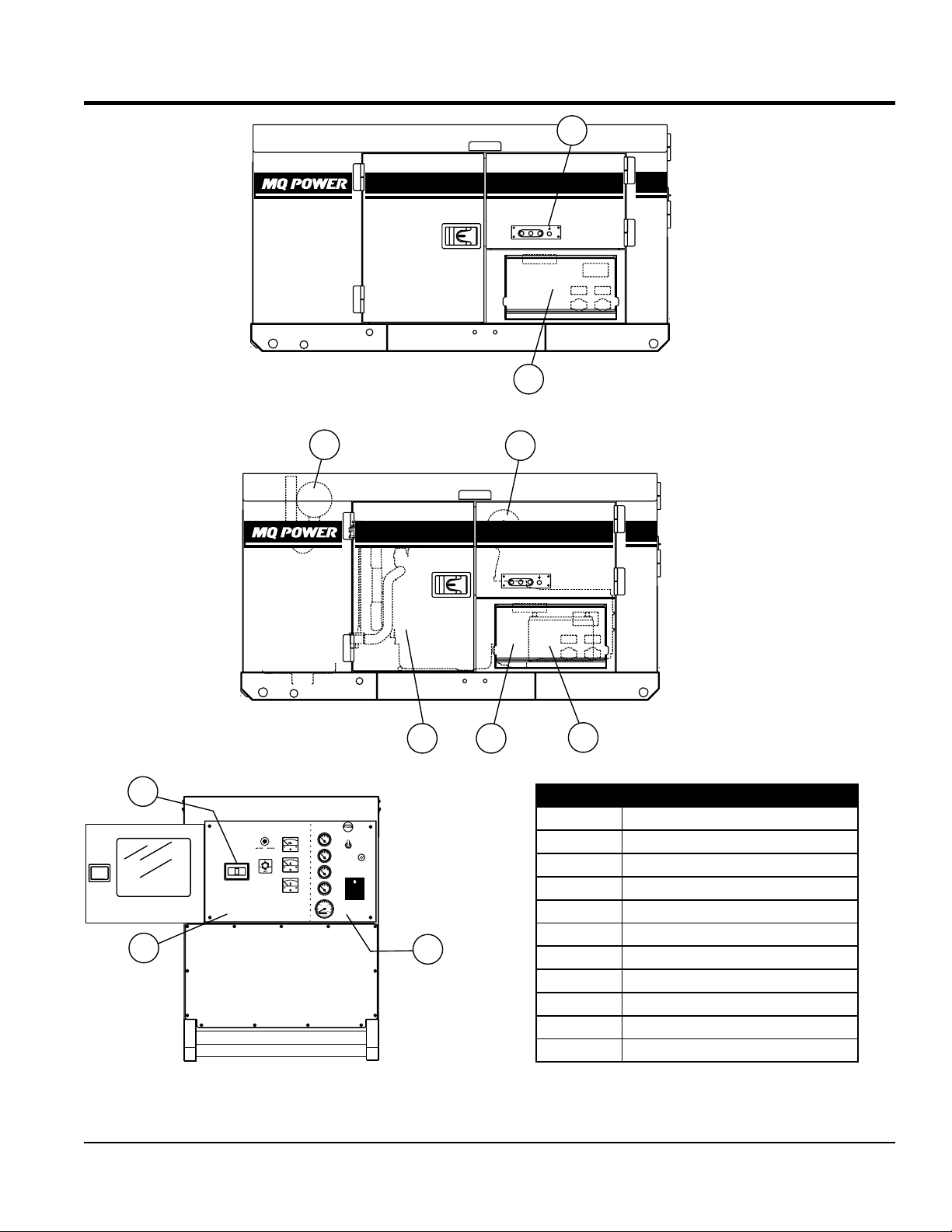
MAJOR COMPONENTS
10
9
AUTO
MANUAL
OFF/RESET
LOW OILPRESSURE
HIGH COOLANTTEMPERATURE
OVERCRANK
OVERSPEED
ENGINE RUNNING
MOOOOO-20001Q
8
2
1
20
U
O V
20
U
O V
5
3
4
7 6
Table 4. Generator Major Components
ITEM NO. DESCRIPTION
1 Output Terminal Assembly
2 Output Receptacles Assembly
3 Muffler Assembly
4 Air Filter Assembly
5 Battery Assembly
6 Generator Assembly
7 Engine Assembly
8 Circuit Breaker Assembly
9 Engine Control Panel Assembly
10 Generator Control Panel Assembly
Figure 3. Major Components
DCA20SPXU2 (WITH MLT20 SERIES) • OPERATION AND PARTS MANUAL — REV. #0 (01/18/13) — PAGE 17
Page 18

GENERATOR CONTROL PANEL
4
2
INCREASE
DECREASE
3
1
V
U
OFF
5
W
6
Figure 4. Generator Control Panel
he definitions below describe the controls and functions of
the Generator Control Panel (Figure 4).
1. Main Circuit Breaker—This three-pole, 90A main
breaker is provided to protect the the U,O, and V Output
Terminal Lugs from overload.
2. Voltage Regulator Control — Allows ±15% manual
adjustment of the generator’s output voltage.
HZ
A
V
20001000
0
3000
RPM
AUTO
MANUAL
OFF/RESET
LOW OILPRESSURE
HIGH COOLANTTEMPERATURE
OVERCRANK
OVERSPEED
ENGINE RUNNING
MOOOOO-20001Q
Located behind the generator control panel is the Generator
Control Box. This box contains some of the necessary
electronic components required to make the generator
function.
The Control Box is equipped with the following major
components:
Over-Current Relay
3. Ammeter Change-Over Switch — This switch allows
the AC ammeter to indicate the current flowing to the
load connected to any phase of the output terminals,
or to be switched off. This switch does not effect the
Automatic Voltage Regulator (AVR)
Starter Relay
Current Transformer
generator output in any fashion, it is for current reading
only.
Engine Controller
4. Frequency Meter — Indicates the output frequency
in hertz (Hz). Normally 60 Hz.
5. AC Ammeter — Indicates the amount of current the
load is drawing from the generator per leg selected by
the ammeter phase-selector switch.
6. AC Voltmeter — Indicates the output voltage present
at the U,O, and V Output Terminal Lugs.
PAGE 18 — DCA20SPXU2 (WITH MLT20 SERIES) • OPERATION AND PARTS MANUAL — REV. #0 (01/18/13)
Page 19
NOTES PANEL
DCA20SPXU2 (WITH MLT20 SERIES) • OPERATION AND PARTS MANUAL — REV. #0 (01/18/13) — PAGE 19
Page 20
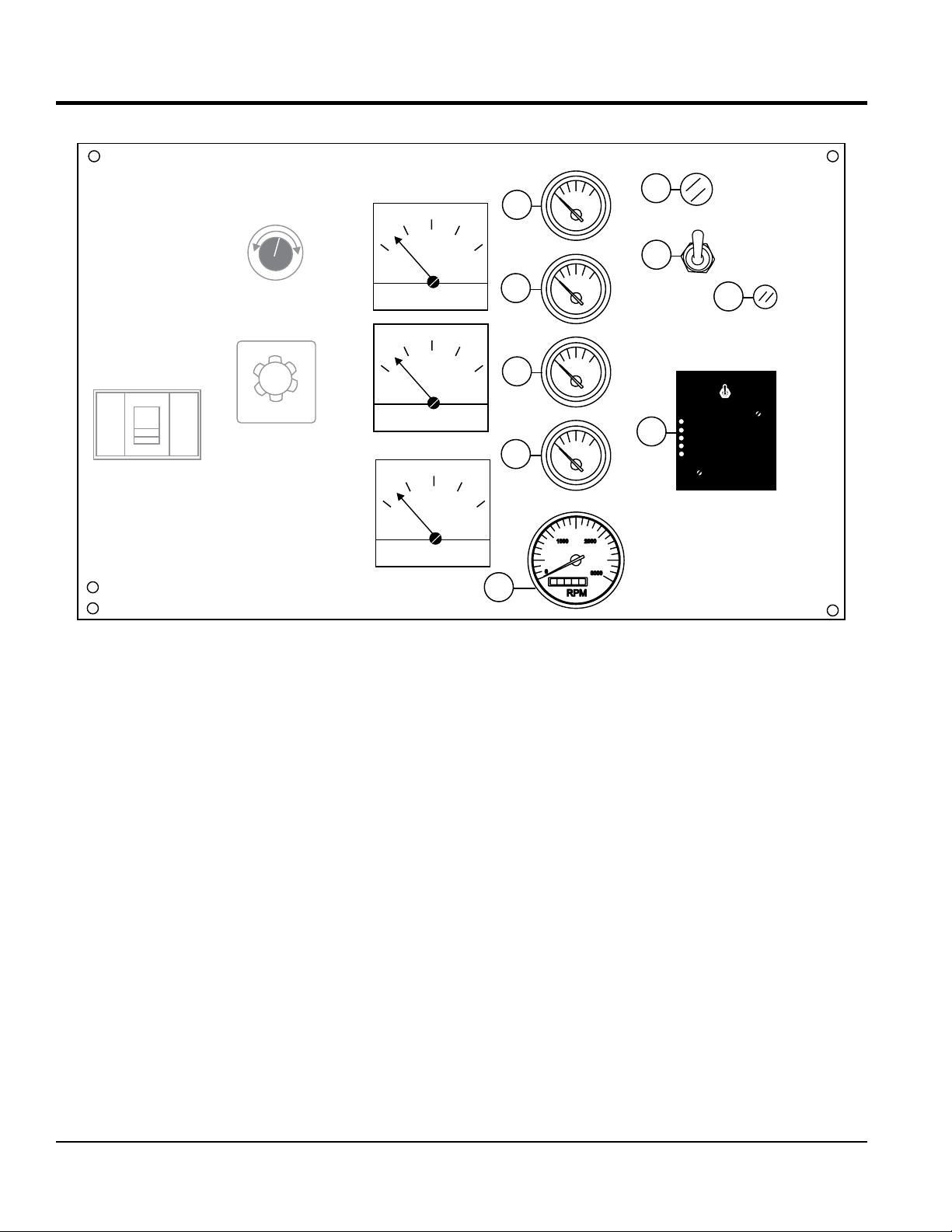
ENGINE CONTROL PANEL
6
1
INCREASE
DECREASE
HZ
2
V
U
W
OFF
A
3
4
7
9
8
AUTO
MANUAL
OFF/RESET
LOW OIL PRESSURE
HIGH COOLANT TEMPERATURE
OVERCRANK
OVERSPEED
ENGINE RUNNING
MOOOOO-20001Q
V
20001000
0
3000
5
Figure 5. Engine Control Panel
RPM
PAGE 20 — DCA20SPXU2 (WITH MLT20 SERIES) • OPERATION AND PARTS MANUAL — REV. #0 (01/18/13)
Page 21
ENGINE CONTROL PANEL
The definitions below describe the controls and functions
of the Engine Control Panel (Figure 5).
1.
Oil Pressure Gauge — During normal operation this
gauge should read between
When starting the generator the oil pressure may read a
little higher, but after the engine warms up the oil pressure
should return to the correct pressure range.
35 to 65 psi. (241~448 kPa).
2. Water Temperature Gauge — During normal operation this
gauge be should read between
3.
Charging Ammeter Gauge — Indicates the current
being supplied by the engine’s alternator which provides
current for generator’s control circuits and battery
charging system.
180°~221°F (82°~105°C)
4. Fuel Gauge — Indicates amount of diesel fuel available.
5. Tachometer — Indicates engine speed in RPM’s for 60
Hz operation. This meter should indicate 1800 RPM’s
when the rated load is applied. In addition a built in hour
meter will record the number of operational hours that
the generator has been in use.
6. Panel Light — Normally used in dark areas or at night
time. When activated, panel lights will illuminate. When
the generator is not in use be sure to turn the panel light
switch to the OFF position.
7. Panel Light Switch — When activated will turn on control
panel light.
8. Fuel Filter Water Level Alarm Lamp — This lamp will
illuminate when water in the fuel filter has reached an
abnormal level.
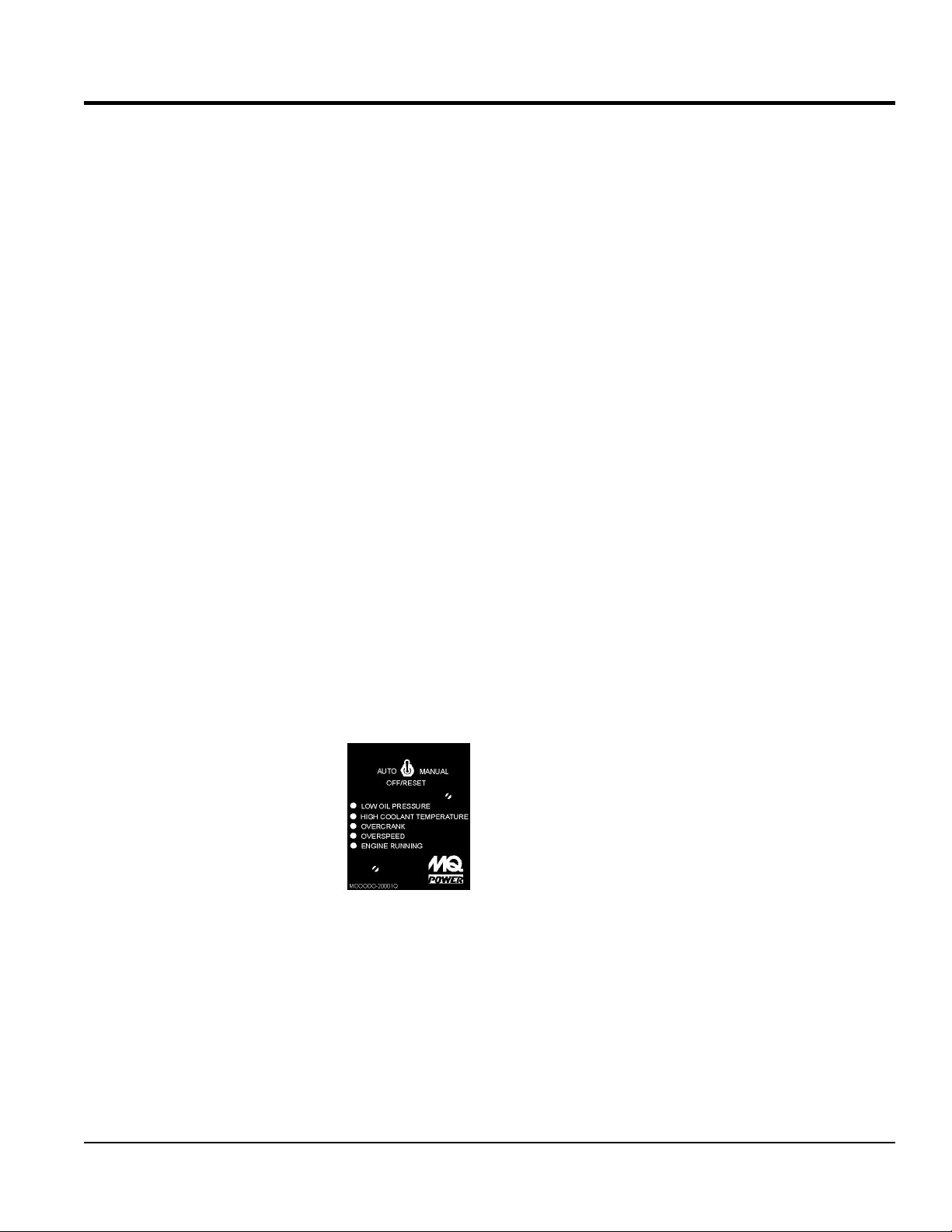
9. Au t o S TART /S TO P E ng in e
Controller (ECU) — This controller
has a vertical row of status LED's
(inset), that when lit, indicate
that an engine malfunction (fault)
has been detected. When a fault
has been detected the engine
controller will evaluate the fault
and all major faults will shutdown
the generator. During cranking
cycle, the ECU will attempt to crank the engine for 10
seconds before disengaging.
Also the engine controller will shut down the engine in
the event of low oil pressure, high coolant temperature,
low coolant level, and loss of magnetic pickup. These
conditions can be observed by monitoring the LED
status indicators on the front of the controller module.
A. MPEC Control Switch — This switch controls the
running of the unit. If this switch is set to the OFF/
RESET position, the unit will not run. When this switch
is set to the manual position, the generator will start
immediately.
If the generator is to be connected to a building’s
AC power source via an automatic transfer switch
(isolation), place the switch in the AUTO position. In this
position, should an outage occur, the automatic transfer
switch (ATS) will start the generator automatically
via the generator’s auto-start contacts connected to
the ATS’s start contacts. Please refer to your ATS
installation manual for further instructions for the
correct installation of the auto-start contacts of the
generator to the ATS.
B. Low Oil Pressure — Indicates the engine pressure
has fallen below 15 psi (103 kPa). The oil pressure is
detected using variable resistive values from the oil
pressure sending unit. This is considered a major fault.
C. High Coolant Temperature — Indicates the engine
temperature has exceeded 230°F (110°C). The engine
temperature is detected using variable resistive values
from the temperature sending unit. This is considered
a major fault.
D. Overcrank Shutdown — Indicates the unit has
attempted to start a pre- programmed number of
times, and has failed to start. The number of cycles and
duration are programmable. It is pre-set at 3 cycles with
a 10 second duration. This is considered a major fault.
E. Overspeed Shutdown — Indicates the engine is
running at an unsafe speed. This is considered a
major fault.
F. Engine Running — Indicates that engine is running
at a safe operating speed.
If the engine does not engage (start) by the third
attempt, the engine will be shutdown by the engine
controller’s Over Crank Protection mode. If the engine
engages at a speed (RPM's) that is not safe, the
controller will shutdown the engine by initializing the
Over Speed Protection mode.
DCA20SPXU2 (WITH MLT20 SERIES) • OPERATION AND PARTS MANUAL — REV. #0 (01/18/13) — PAGE 21
Page 22
OUTPUT TERMINAL PANEL FAMILIARIZATION
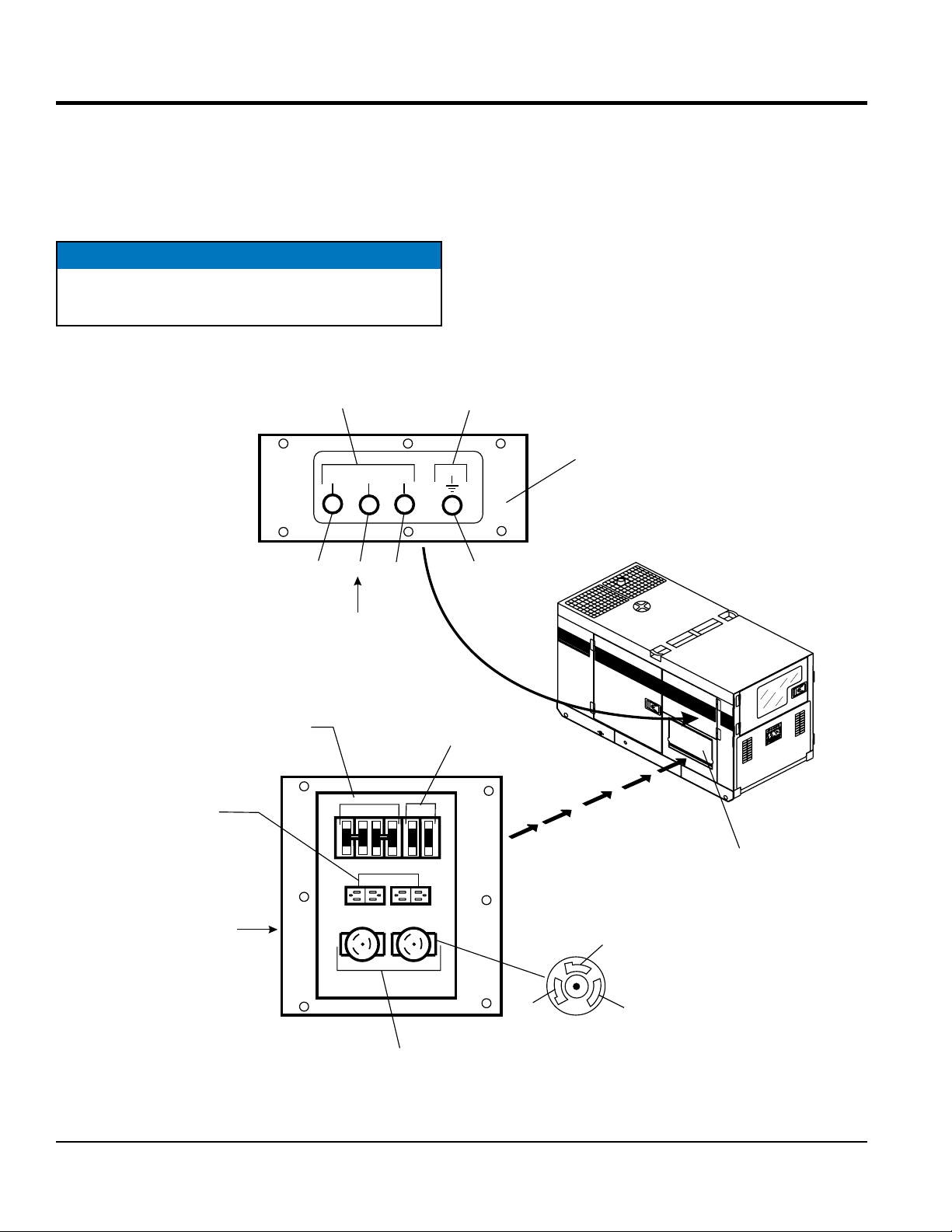
OUTPUT TERMINAL PANEL
The Output Terminal Panel (Figure 7) shown below is
located on the right-hand side (left from control panel) of
the generator. Lift up on the cover to gain access to
receptacles and terminal lugs.
NOTICE
Terminal legs “O” and “Ground” are considered bonded
grounds.
SINGLE PHASE
240 -120 VAC
OUTPUT TERMINALS
O
V
RED
BLACK
U
WHITE
OUTPUT TERMINAL FAMILIARIZATION
The “Output Terminal Panel ” (Figure 6) is provided with
the following:
Two 120/240V output receptacles @ 50 amp
Two Circuit Breakers @ 50 amps
Two 120V GFCI receptacles @ 20 amp
Two GFCI Circuit Breakers @ 20 amps
Four Output Terminal Lugs (U, O, V, and Ground)
GROUND
TERMINAL
HARD WIRE
HOOKUP PANEL
GREEN
LOCK RECEPTACLES
120 VAC, 20 AMP
GFCI RECEPTACLES
RECEPTACLE
AND
CIRCUIT BREAKER
PANEL
CIRCUIT BREAKERS
FOR CS-6369 TWIST
NEUTRAL
TERMINAL
CIRCUIT BREAKERS
FOR GFCI RECEPTACLES
AUX. POWER RECEPTACLES
120/240V, 50 AMPS
W
TWIST-LOCK
MQ POWER
CS-6369
ACCESS DOOR
LIFT TO OPEN
Y
X
Figure 6. Output Terminal Panel
PAGE 22 — DCA20SPXU2 (WITH MLT20 SERIES) • OPERATION AND PARTS MANUAL — REV. #0 (01/18/13)
Page 23
OUTPUT TERMINAL PANEL FAMILIARIZATION
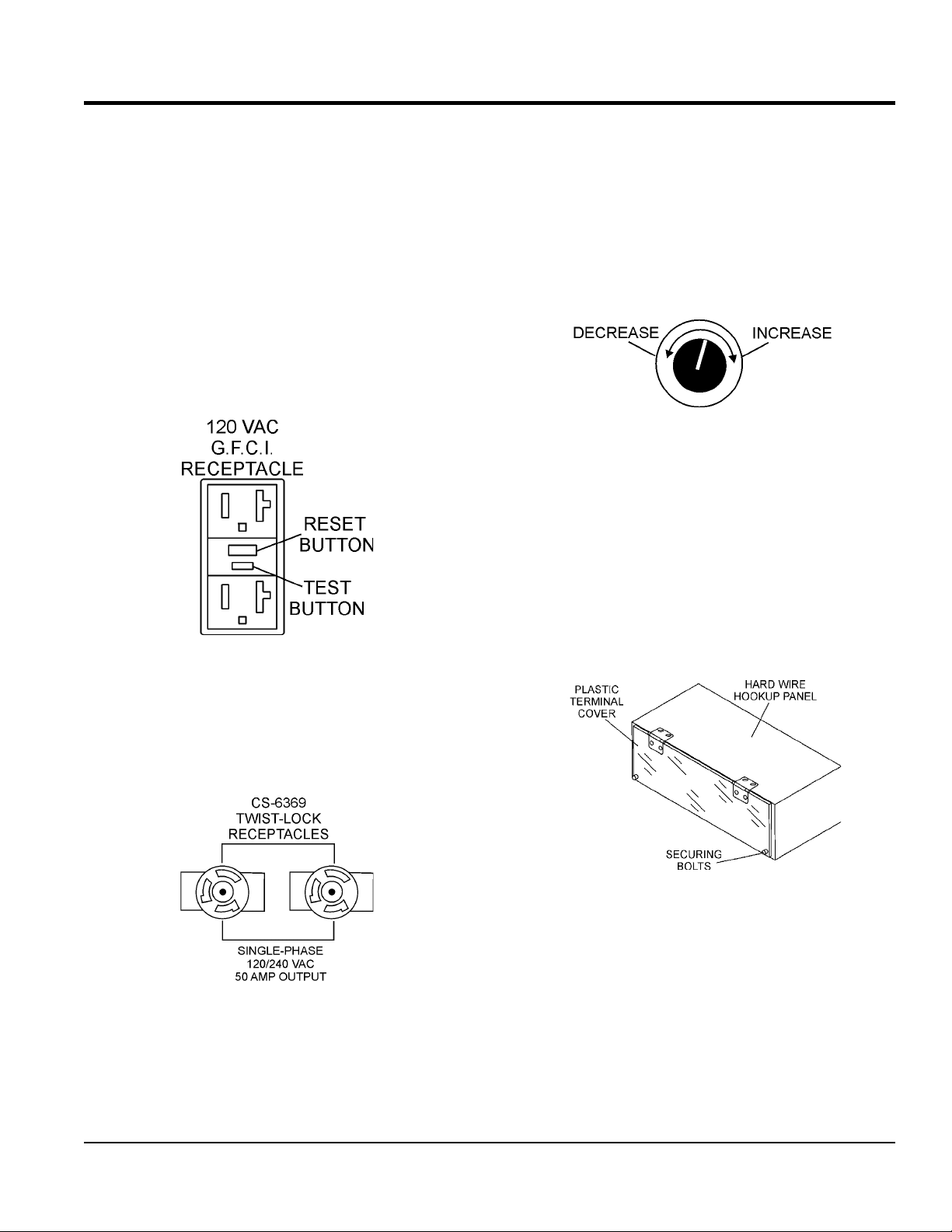
120 VAC GFCI Receptacles
There are two 120 VAC, 20 amp GFCI (Duplex Nema
5-20R) receptacles provided on the output terminal panel.
These receptacles can be accessed in any voltage
selector switch position. Each receptacle is protected by a
20 amp circuit breaker. These breakers are located directly
above the GFCI receptacles. Remember the load output
(current) of both GFCI receptacles is dependent on the load
requirements of the U, O, and V output terminal lugs.
Pressing the reset button resets the GFCI receptacle after
being tripped. Pressing the test button (See Figure 7) in
the center of the receptacle will check the GFCI function.
Both receptacles should be tested at least once a month.
Each auxiliary receptacle is protected by a 50 amp circuit
breaker. These breakers are located directly above the
GFCI receptacles. Remember the load output (current) on
all three receptacles is dependent on the load requirements
of the Output Terminal Lugs.
Turn the voltage regulator control knob (Figure 9) on the
control panel to obtain the desired voltage. Turning the knob
clockwise will increase the voltage, turning the knob
counter-clockwise will decrease the voltage.
Figure 9. Voltage Regulator Control Knob
Removing the Plastic Face Plate (Hard Wire
Hookup Panel)
The Output Terminal Lugs are protected by a plastic
face plate cover (Figure 10). Un-screw the securing bolts
and lift the plastic terminal cover to gain access to the
terminal enclosure.
Figure 7. G.F.C.I. Receptacle
Twist Lock Dual Voltage 120/240 VAC Receptacles
There are two 120/240V, 50 amp auxiliary twist-lock (CS-
6369) receptacles (Figure 8) provided on the output
terminal panel..
Figure 8. 120/240V Twist-Lock Auxiliary
Receptacles
After the load wires have been securely attached to the
terminal lugs, reinstall the plastic face plate.
Figure 10. Plastic Face Plate (Output Terminal Lugs)
DCA20SPXU2 (WITH MLT20 SERIES) • OPERATION AND PARTS MANUAL — REV. #0 (01/18/13) — PAGE 23
Page 24
OUTPUT TERMINAL PANEL FAMILIARIZATION
Connecting Loads
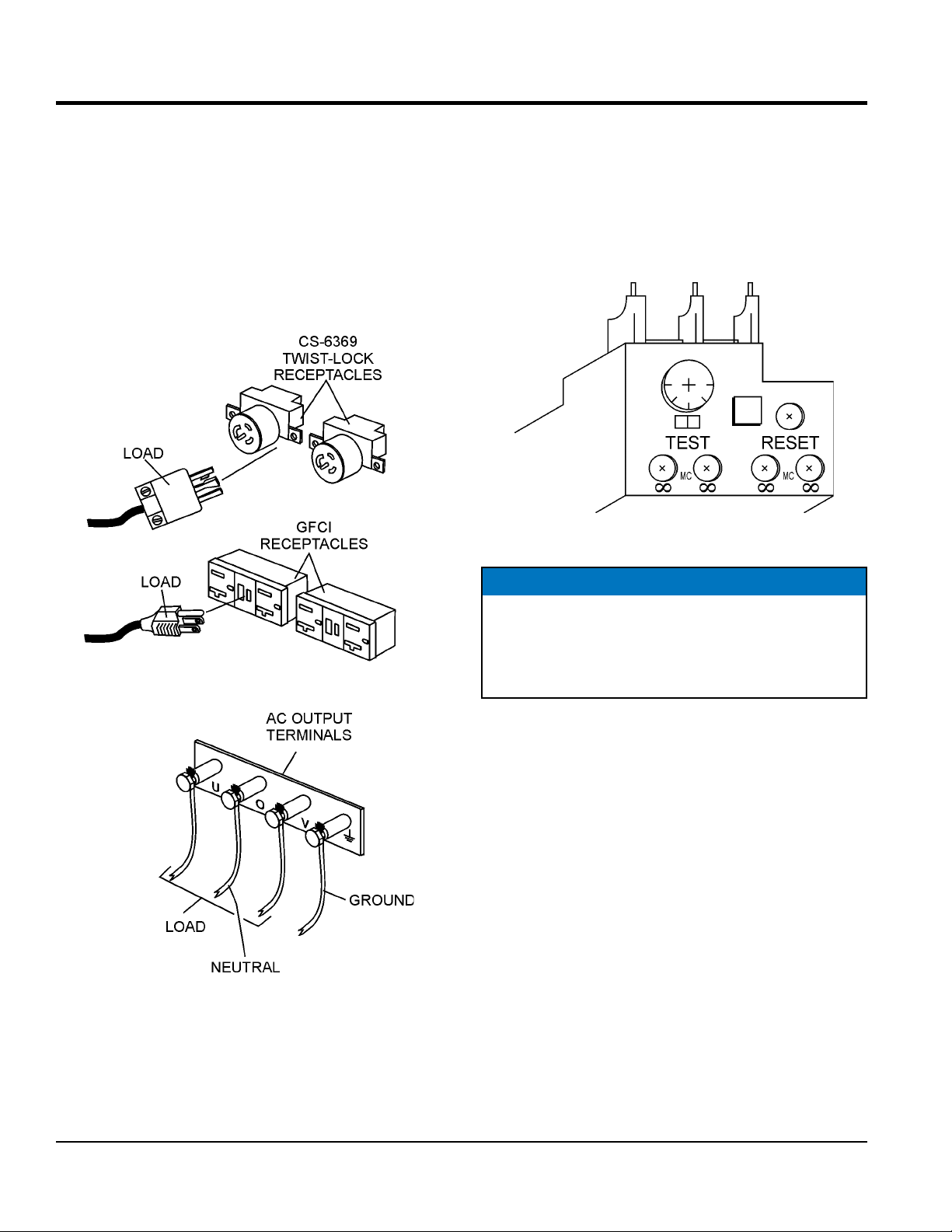
Loads can be connected to the generator by the Output
Terminal Lugs or the convenience receptacles (Figure 11).
Make sure to read the operation manual before attempting
to connect a load to the generator.
To protect the output terminals from overload, a 3-pole,
90A main circuit breaker is provided. Make sure to switch
ALL circuit breakers to the OFF position prior to starting
the engine.
Over Current Relay
An over current relay (Figure 12) is connected to the main
circuit breaker. In the event of an overload, both the circuit
breaker and the over current relay may trip. If the circuit
breaker can not be reset, the reset button on the over
current relay must be pressed. The over current relay is
located in the control box.
Figure 12. Over Current Relay
Figure 11. Connecting Loads
NOTICE
When connecting a load to the generator ALWAYS
.
make sure the load has an ON/OFF switch. DO NOT
use the circuit breakers on the generator as a method
of turning the load ON and OFF.
PAGE 24 — DCA20SPXU2 (WITH MLT20 SERIES) • OPERATION AND PARTS MANUAL — REV. #0 (01/18/13)
Page 25

LOAD APPLICATION/GENERATOR OUTPUT
SINGLE PHASE LOAD
Always be sure to check the nameplate on the generator
and equipment to insure the wattage, amperage, frequency,
and voltage requirements are satisfactorily supplied by the
generator for operating the equipment.
Generally, the wattage listed on the nameplate of the
equipment is its rated output. Equipment may require
130—150% more wattage than the rating on the nameplate,
as the wattage is influenced by the efficiency, power factor
and starting system of the equipment.
NOTICE
If wattage is not given on the equipment’s name plate,
approximate wattage may be determined by multiplying
nameplate voltage by the nameplate amperage.
WATTS = VOLTAGE x AMPERAGE
The power factor of this generator is 0.8. See Table 5 below
when connecting loads.
Table 5. Power Factor By Load
NOTICE
Motors and motor-driven equipment draw much greater
current for starting than during operation.
An inadequate size connecting cable which cannot carry the
required load can cause a voltage drop which can burn out
the appliance or tool and overheat the cable. See Table 6
When connecting a resistance load such as an
incandescent lamp or electric heater, a capacity of up
to the generating set’s rated output (kW) can be used.
When connecting a fluorescent or mercury lamp, a
capacity of up to the generating set’s rated output (kW)
multiplied by 0.6 can be used.
When connecting an electric drill or other power tools,
pay close attention to the required starting current
capacity.
When connecting ordinary power tools, a capacity of up to
the generating set’s rated output (kW) multiplied by 0.8 can
be used.
Type of Load Power Factor
Single-phase induction motors 0.4-0.75
Electric heaters, incandescent lamps 1.0
Fluorescent lamps, mercury lamps 0.4-0.9
Electronic devices, communication
equipment
1.0
Common power tools 0.8
Table 6. Cable Selection (60 Hz, Single Phase Operation)
Current
in
Amperes
2.5 300 600 1000 ft. 600 ft. 375 ft. 250 ft.
5 600 1200 500 ft. 300 ft. 200 ft. 125 ft.
7.5 900 1800 350 ft. 200 ft. 125 ft. 100 ft.
10 1200 2400 250 ft. 150 ft. 100 ft.
15 1800 3600 150 ft. 100 ft. 65 ft.
20 2400 4800 125 ft. 75 ft. 50 ft.
Load in Watts Maximum Allowable Cable Length
At 100
Volts
CAUTION: Equipment damage can result from low voltage
At 200
Volts
#10 Wire #12 Wire #14 Wire #16 Wire
DANGER
Before connecting this generator to any building’s
electrical system, a licensed electrician must install
an isolation (transfer) switch. Serious damage to
the building’s electrical system may occur without this
transfer switch.
Generator Amperage
Table 7 shows the maximum amps the generator can
provide. DO NOT exceed the maximum amps as listed.
Table 7. Generator Maximum Amps
Rated Voltage Maximum Amps
1Ø 120 Volt 83 X 2 amps (4 wire)
1Ø 240 Volt 83 amps (4 wire)
DCA20SPXU2 (WITH MLT20 SERIES) • OPERATION AND PARTS MANUAL — REV. #0 (01/18/13) — PAGE 25
Page 26

OUTPUT TERMINAL PANEL CONNECTIONS
UOV TERMINAL OUTPUT VOLTAGES
240/120V outout voltages can be obtained using the output
terminal lugs.
The voltage regulator (VR), Figure 14 allows the user to
increase or decrease the selected voltage.
1Ø-240 Output Terminal Voltage
1. Connect the load wires to the output terminal lugs as
shown in Figure 13.
1Ø-120 Output Terminal Voltage
1. Connect the load wires to the output terminal lugs as
shown in Figure 15.
Figure 15. Output Terminal Lugs
1Ø-120 Volt Connections
2. Turn the voltage regulator knob (Figure 14) clockwise
to increase voltage output, turn counterclockwise to
decrease voltage output.
Figure 13. Output Terminal Lugs
1Ø-240 Volt Connections
2. Turn the voltage regulator knob (Figure 14) clockwise
to increase voltage output, turn counterclockwise to
decrease voltage output. Use voltage regulator
adjustment knob whenever fine tuning of the output
voltage is required.
Figure 14. Voltage Regulator Knob
NOTICE
ALWAYS make sure that the connections to the UVO
terminal lugs are secure and tight. The possibility of
arcing exists, that could cause a fire.
PAGE 26 — DCA20SPXU2 (WITH MLT20 SERIES) • OPERATION AND PARTS MANUAL — REV. #0 (01/18/13)
Page 27

INSPECTION/SETUP
CIRCUIT BREAKERS
To protect the generator from an overload, a 3-pole, 90
amp, main circuit breaker is provided to protect the U,O
and V Output Terminals from overload. In addition two
single-pole, 20 amp GFCI circuit breakers are provided to
protect the GFCI receptacles from overload. Two 50 amp
load circuit breakers have also been provided to protect the
auxiliary receptacles from overload. Make sure to switch
ALL circuit breakers to the OFF position prior to starting
the engine.
LUBRICATION OIL
Fill the engine crankcase with lubricating oil through the
filler hole, but DO NOT overfill. Make sure the generator is
level and verify that the oil level is maintained between the
two notches (Figure 16) on the dipstick. See Table 8 for
proper selection of engine oil.
FUEL CHECK
DANGER
Fuel spillage on a hot engine can cause
a fire or explosion. If fuel spillage occurs,
wipe up the spilled fuel completely to
prevent fire hazards. NEVER smoke
around or near the generator.
Refilling the Fuel System
CAUTION
ONLY properly trained personnel who have read
and understand this section should refill the fuel tank
system.
This generator has an internal fuel tank located inside
the trailer frame and may also be equipped with an
environmental fuel tank (Figure 17). ALWAYS fill the fuel
tanks with clean fresh #2 diesel fuel. DO NOT fill the fuel
tanks beyond their capacities.
Figure 16. Engine Oil Dipstick
When checking the engine oil, be sure to check if the oil is
clean. If the oil is not clean, drain the oil by removing the
oil drain plug, and refill with the specified amount of oil as
outlined in the ISUZU Engine Owner’s Manual. Oil should
be warm before draining.
Other types of motor oils may be substituted if they meet
the following requirements:
API Service Classification CC/SC
API Service Classification CC/SD
API Service Classification CC/SE
API Service Classification CC/SF
Table 8. Recommended Motor Oil
Pay attention to the fuel tank capacity when replenishing
fuel. The fuel tank cap must be closed tightly after filling.
Handle fuel in a safety container. If the container does not
have a spout, use a funnel. Wipe up any spilled fuel
immediately.
FUEL TANK
FILLER NECK
Figure 17. Trailer Fuel Tank
DCA20SPXU2 (WITH MLT20 SERIES) • OPERATION AND PARTS MANUAL — REV. #0 (01/18/13) — PAGE 27
Page 28

INSPECTION/SETUP
Refueling Procedure:
WARNING
Diesel fuel and its vapors are dangerous
to your hea lth and the surro unding
environment. Avoid skin contact and/or
inhaling fumes.
1. Level Tanks — Make sure fuel cells are level with the
ground. Failure to do so will cause fuel to spill from the
tank before reaching full capacity (Figure 18).
CAUTION
ALWAYS place trailer on firm level ground before
refueling to prevent spilling and maximize the amount
of fuel that can be pumped into the tank.
2. Remove fuel cap from filler neck and fill fuel tank
(Figure 19).
3. NEVER overfill fuel tank — It is important to read the
fuel gauge when filling trailer fuel tank. DO NOT wait
for fuel to rise in filler neck (Figure 19).
Figure 19. Full Fuel Tank
CAUTION
DO NOT OVERFILL fuel system. Leave room for fuel
expansion. Fuel expands when heated (Figure 20).
Figure 18. Only Fill on Level Ground
NOTICE
ONLY use #2 diesel fuel when refueling.
Figure 20. Fuel Expansion
COOLANT (ANTIFREEZE/SUMMER COOLANT/
WATER)
ISUZU recommends antifreeze/summer coolant for use in their
engines, which can be purchased in concentrate (and mixed
with 50% demineralized water) or pre-diluted. See the ISUZU
Engine Owner’s Manual for further details.
WARNING
If adding coolant/antifreeze mix to the
radiator, DO NOT remove the radiator cap
until the unit has completely cooled. The
possibility of hot! coolant exists which can
cause severe burns.
PAGE 28 — DCA20SPXU2 (WITH MLT20 SERIES) • OPERATION AND PARTS MANUAL — REV. #0 (01/18/13)
Page 29

INSPECTION/SETUP
Day-to-day addition of coolant is done from the recovery
tank. When adding coolant to the radiator, DO NOT remove
the radiator cap until the unit has completely cooled. See
Table 9 for engine, radiator, and recovery tank coolant
capacities. Make sure the coolant level in the recovery tank
is always between the “H” and the “L” markings.
Table 9. Coolant Capacity
Engine and Radiator 1.74 gal (606 liters)
Reserve Tank 0.26 gal. (1 liter)
Operation in Freezing Weather
When operating in freezing weather, be certain the proper
amount of antifreeze (Table 10) has been added.
Table 10. Anti-Freeze Operating Temperatures
Vol %
Anti-
Freeze
50 -37 -34 108 226
Freezing Point Boiling Point
°C °F °C °F
damage and wear and adjust it in accordance with the
ISUZU Engine Owner’s Manual.
The fan belt tension is proper if the fan belt bends 10 to 15
mm (Figure 21) when depressed with the thumb as shown
below.
Figure 21. Fan Belt Tension
CAUTION
NEVER place hands near the belts or fan
while the generator set is running.
BATTERY
NOTICE
When the antifreeze is mixed with water, the antifreeze
mixing ratio must be less than 50%.
CLEANING THE RADIATOR
The engine may overheat if the radiator fins become
overloaded with dust or debris. Periodically clean the
radiator fins with compressed air. Cleaning inside the
machine is dangerous, so clean only with the engine turned
off and the negative battery terminal disconnected.
AIR CLEANER
Periodic cleaning/replacement is necessary. Inspect it in
accordance with the ISUZU Engine Owner’s Manual.
FAN BELT TENSION
A slack fan belt may contribute to overheating, or to
insufficient charging of the battery. Inspect the fan belt for
This unit is of negative ground DO NOT connect in reverse.
Always maintain battery fluid level between the specified
marks. Battery life will be shortened, if the fluid level are
not properly maintained. Add only distilled water when
replenishment is necessary.
DO NOT over fill. Check to see whether the battery
cables are loose. Poor contact may result in poor starting
or malfunctions. Always keep the ter minals fir mly
tightened. Coating the terminals with an approved battery
terminal treatment compound. Replace battery with only
recommended type battery.
The battery is sufficiently charged if the specific gravity
of the battery fluid is 1.28 (at 68° F). If the specific gravity
should fall to 1.245 or lower, it indicates that the battery is
dead and needs to be recharged or replaced.
Before charging the battery with an external electric source,
be sure to disconnect the battery cables.
DCA20SPXU2 (WITH MLT20 SERIES) • OPERATION AND PARTS MANUAL — REV. #0 (01/18/13) — PAGE 29
Page 30

INSPECTION/SETUP
Battery Cable Installation
ALWAYS be sure the battery cables (Figure 22) are
properly connected to the battery terminals as shown below.
The red cable is connected to the positive terminal of the
battery, and the black cable is connected to the negative
terminal of the battery.
CAUTION
ALWAYS disconnect the negative terminal FIRST and
reconnect negative terminal LAST.
Figure 22. Battery Connections
When connecting battery do the following:
ALTERNATOR
The polarity of the alternator is negative grounding type.
When an inver ted circuit connection takes place, the
circuit will be in short circuit instantaneously resulting the
alternator failure.
DO NOT put water directly on the alternator. Entry of water
into the alternator can cause corrosion and damage the
alternator.
WIRING
Inspect the entire generator for bad or worn electrical wiring
or connections. If any wiring or connections are exposed
(insulation missing) replace wiring immediately.
PIPING AND HOSE CONNECTION
Inspect all piping, oil hose, and fuel hose connections for
wear and tightness. Tighten all hose clamps and check
hoses for leaks.
If any hose (fuel or oil) lines are defective replace them
immediately.
1. NEVER connect the battery cables to the battery
terminals when the Control Power Switch is in either
the ON position. ALWAYS make sure that the Control
Power Switch is in the OFF position when connecting
the battery.
2. Place a small amount of battery terminal treatment
compound around both battery terminals. This will
ensure a good connection and will help prevent
corrosion around the battery terminals.
NOTICE
If the battery cable is connected incorrectly, electrical
damage to the generator will occur. Pay close attention to
the polarity of the battery when connecting the battery.
CAUTION
Inadequate battery connections may cause poor
starting of the generator, and create other malfunctions.
PAGE 30 — DCA20SPXU2 (WITH MLT20 SERIES) • OPERATION AND PARTS MANUAL — REV. #0 (01/18/13)
Page 31

GENERATOR START-UP PROCEDURE (MANUAL)
INCORRECT
BEFORE STARTING
CAUTION
The engine’s exhaust contains harmful emissions.
ALWAYS have adequate ventilation when operating.
Direct exhaust away from nearby personnel.
WARNING
NEVER manually start the engine with the main, GFCI
or auxiliary circuit breakers in the ON (closed) position.
1. Place the main, G.F.C.I., and aux. circuit breakers
(Figure 23) in the OFF position prior to star ting the
engine.
STARTING (MANUAL)
1. Place the MPEC control switch in the MANUAL
position to start the engine (Figure 25) position.
AUTO
OFF/RESET
Figure 25. MPEC Control Switch
(Manual Position)
2. Verify that the engine running status LED on the
MPEC module (Figure 26) is lit (ON) after the engine
has started
AUTO
OFF/RESET
LOW OIL PRESSURE
HIGH COOLANT TEMPERATURE
OVERCRANK
OVERSPEED
ENGINE RUNNING
MOOOOO-20001Q
MANUAL
MANUAL
Figure 23. Main, Aux. and GFCI
Circuit Breakers (OFF)
2. Connect the load to the receptacles or the output
terminal lugs as shown in Figure 11. These load
connection points can be found on the output terminal
panel and the output terminal panel’s hard wire hookup
panel.
3. Tighten terminal nuts securely to prevent load wires
from slipping out.
4. Close all engine enclosure doors (Figure 24).
CORRECT
Figure 26. Engine Running (LED ON)
3. The generator’s frequency meter (Figure 27) should
be displaying the 60 cycle output frequency in HERTZ.
Hz
Figure 27. Frequency Meter
4. The generator’s AC-voltmeter (Figure 28) will display
the generator’s output in VOLTS.
V
Figure 24. Engine Enclosure Doors
Figure 28. Voltmeter
DCA20SPXU2 (WITH MLT20 SERIES) • OPERATION AND PARTS MANUAL — REV. #0 (01/18/13) — PAGE 31
Page 32

GENERATOR START-UP PROCEDURE (MANUAL)
5. If the voltage is not within the specified tolerance use
the voltage adjustment control knob (Figure 29) to
increase or decrease the desired voltage.
DECREASE
Figure 29. Voltage Adjust Control Knob
INCREASE
6. The ammeter (Figure 30) will indicate zero amps with
no load applied. When a load is applied, the ammeter
will indicate the amount of current that the load is
drawing from the generator.
A
Figure 30. Ammeter (No Load)
Under normal operating conditions this speed is
approximately 1800 RPM’s.
20
RPM X 100
TACH
HOURS
0
25
3010
35
40
8
4
1
10
15
5
0
0 0
0
Figure 33. Engine Tachometer Gauge
10. Place the main, G.F.C.I., and aux. circuit breakers
(Figure 34) in the ON position.
.
7. The engine oil pressure gauge (Figure 31) will indicate
the oil pressure of the engine. Under normal operating
conditions the oil pressure is approximately 35 to 65
psi. (241~448 kPa).
psi
50
2
1
3
bar
DATCON
75
4
5
100
6
0
25
OIL
PRESS
Figure 31. Oil Pressure Gauge
8. The coolant temperature gauge (Figure 32) will
indicate the coolant temperature. Under normal
operating conditions the coolant temperature should
be between 180°~221°F (82°~105°C) (Green Zone).
F
150
40
60
C
DATCON
180
80
240
110
100
130
WATER
TEMP
Figure 32. Coolant Temperature Gauge
9. The tachometer gauge (Figure 33) will indicate the
speed of the engine when the generator is operating.
Figure 34. Main, Aux. and GFCI
Circuit Breakers (ON)
11. Observe the generator’s ammeter (Figure 35) and
verify it reads the anticipated amount of current with
respect to the load. The ammeter will only display a
current reading if a load is in use.
A
Figure 35. Ammeter (Load)
12. The generator will run until manually stopped or an
abnormal condition occurs.
LIGHT TOWER OPERATION
NOTICE
For light tower operation, refer to the MLT20 Series
Operation Manual (Part Number 49838).
PAGE 32 — DCA20SPXU2 (WITH MLT20 SERIES) • OPERATION AND PARTS MANUAL — REV. #0 (01/18/13)
Page 33

GENERATOR SHUT-DOWN PROCEDURES
STARTING (AUTO MODE)
DANGER
Before connecting this generator to any
building’s electrical system, a licensed
electrician must install an isolation
(transfer) switch. Serious damage to
the building’s electrical system may occur
without this transfer switch.
NOTICE
When connecting the generator to a isolation (transfer)
switch, ALWAYS have power applied to the generator’s
internal battery charger. This will ensure that the engine
will not fail due to a dead battery
NOTICE
When the MPEC control switch is placed in the AUTO
mode, the generator will automatically start in the
event of commercial power falling below a prescribed
level by means of a contact closure that is generated
automatically by a transfer switch.
1. Place the MPEC Control Switch (Figure 36) in the
AUTO position.
AUTO
OFF/RESET
Figure 36. MPEC Control Switch (AUTO)
MANUAL
2. Continue operating the generator as outlined in the
Manual Start-up procedure (start at step 2).
In this position (AUTO), should an outage occur, the
automatic transfer switch (ATS) will start the generator
automatically via the generator's auto-start contacts
connected to the ATS's start contacts.
Please refer to your ATS installation manual for further
instructions for the correct installation of the auto-start
contacts of the generator to the ATS.
WARNING
When running the generator in the AUTO mode,
remember the generator can start up at any time without
warning. NEVER attempt to perform any maintenance
when the generator is in the auto mode.
DCA20SPXU2 (WITH MLT20 SERIES) • OPERATION AND PARTS MANUAL — REV. #0 (01/18/13) — PAGE 33
Page 34

GENERATOR SHUT-DOWN PROCEDURES
NORMAL SHUTDOWN PROCEDURE
To shutdown the generator, use the following procedure:
WARNING
NEVER stop the engine suddenly except in an
emergency.
1. Place the main, G.F.C.I., and aux. circuit breakers
(Figure 37) in the OFF position.
3. Place the MPEC Control Switch (Figure 38) to the
OFF/RESET position.
AUTO
OFF/RESET
Figure 38. MPEC Control Switch (Off/Reset)
MANUAL
4. Verify that all the status LEDs on the MPEC display
are OFF (not lit).
5. Remove all loads from the generator.
6. Inspect entire generator for any damage or loosening of
components that may have occurred during operation.
EMERGENCY SHUTDOWN PROCEDURE
1. Place the main, G.F.C.I., and aux. circuit breakers
(Figure 37) in the OFF position.
Figure 37. Main, Aux. and GFCI
Circuit Breakers (OFF
2. Let the engine cool by running it at low speed for 3-5
minutes with no load applied.
PAGE 34 — DCA20SPXU2 (WITH MLT20 SERIES) • OPERATION AND PARTS MANUAL — REV. #0 (01/18/13)
Page 35

MAINTENANCE
Engine
Generator
2
10 Hrs
DAILY
250 Hrs 500 Hrs
X
X
X
Table 11. Inspection/Maintenance
Check Engine Fluid Levels X
Check Air Cleaner X
Check Battery Acid Level X
Check Fan Belt Condition X
Check for Leaks X
Check for Loosening of Parts X
Replace Engine Oil and Filter *
Clean Air Filter X
Check Fuel Filter/Water Separator Bowl X
Clean Unit, Inside and Outside X
Change Fuel Filter X
Clean Radiator and Check Coolant Protection Level*
Replace Air Filter Element *
Check all Hoses and Clamps *
Clean Inside of Fuel Tank X
Measure Insulation Resistance Over 3M ohms X
Check Rotor Rear Support Bearing X
*1 Replace engine oil and filter at 100 hours, first time only.
*2 Add “Supplemental Coolant Additives (SCA’S)” to recharge the engine coolant.
*3 Replace primary air filter element when restriction indicator shows a vacuum of 625 mm (25 in. H20).
*4 If blowby hose needs to be replaced, ensure that the slope of the blowby hose is at least a 1/2 inch per foot,
with no sags or dips that could collect moisture and/or oil.
1
3
4
1000
Hrs
X
GENERAL INSPECTION
Prior to each use, the generator should be cleaned and
inspected for deficiencies. Check for loose, missing or
damaged nuts, bolts or other fasteners. Also check for
fuel, oil, and coolant leaks. Use Table 11 as a general
maintenance guideline Engine Side (Refer to the Engine
Instruction Manual)
AIR CLEANER
Every 250 hours: Remove air cleaner element (Figure 39)
and clean the heavy duty paper element with light spray of
compressed air. Replace the air cleaner as needed.
Air Cleaner with Dust Indicator
This indicator (Figure 39) is attached to the air cleaner.
When the air cleaner element is clogged, air intake
NOTICE
The air filter should not be changed until the indicator
reads “RED”. Dispose of old air filter. It may not be
cleaned or reused.
restriction becomes greater and the dust indicator signal
shows RED meaning the element needs changing or
service. After changing the air element, press the dust
indicator button to reset the indicator.
DCA20SPXU2 (WITH MLT20 SERIES) • OPERATION AND PARTS MANUAL — REV. #0 (01/18/13) — PAGE 35
Figure 39. Air Cleaner/Indicator
Page 36

MAINTENANCE
If the engine is operating in very dusty or dry grass
conditions, a clogged air cleaner will result. This can lead to
a loss of power, excessive carbon buildup in the combustion
chamber and high fuel consumption. Change air cleaner
more frequently if these conditions exists.
FUEL ADDITION
Add diesel fuel (the grade may vary according to season
and locations).
Removing Water from the Fuel Tank
After prolonged use, water and other impurities accumulate
in the bottom of the tank. Occasionally inspect the fuel
tank for water contamination and drain the contents if
required.
During cold weather, the more empty volume inside the
tank, the easier it is for water to condense. This can be
reduced by keeping the tank full with diesel fuel.
Cleaning Inside the Fuel Tank
If necessary, drain the fuel inside the fuel tank completely.
Using a spray washer (Figure 40) wash out any deposits
or debris that have accumulated inside the fuel tank.
FUEL TANK INSPECTION
In addition to cleaning the fuel tank, the following
components should be inspected for wear:
Rubber Suspension — look for signs of wear or
deformity due to contact with oil. Replace the rubber
suspension if necessary.
Fuel Hoses — inspect nylon and rubber hoses for signs
of wear, deterioration and hardening.
Fuel Tank Lining — inspect the fuel tank lining for signs
of excessive amounts of oil or other foreign matter.
Replacing Fuel Filter
Replace the fuel filter cartridge with new one every 500
hours or so.
Loosen the drain plug at the lower top of the fuel filter.
Drain the fuel in the fuel body together with the mixed
water. DO NOT spill the fuel during disassembly.
Vent any air
AIR REMOVAL
If air enters the fuel injection system of a diesel engine,
starting becomes impossible. After running out of fuel,
or after disassembling the fuel system, bleed the system
according to the following procedure. See the ISUZU
Engine Manual for details.
To restart after running out of fuel, turn the switch to the ON
position for 15-30 seconds. Try again, if needed.
Figure 40. Fuel Tank Cleaning
PAGE 36 — DCA20SPXU2 (WITH MLT20 SERIES) • OPERATION AND PARTS MANUAL — REV. #0 (01/18/13)
Page 37

MAINTENANCE
CHECK OIL LEVEL
Check the crankcase oil level prior to each use, or when the
fuel tank is filled. Insufficient oil may cause severe damage
to the engine. Make sure the generator is level. The oil level
must be between the two notches on the dipstick as shown
in Figure 17 .
Replacing Oil Filter
Remove the old oil filter.
Apply a film of oil to the gasket on the new oil filter.
Install the new oil filter.
After the oil cartridge has been replaced, the engine oil
will drop slightly. Run the engine for a while and check for
leaks before adding more oil if needed. Clean excessive
oil from engine.
FLUSHING OUT RADIATOR AND REPLACING
COOLANT
Open both cocks located at the crankcase side and at
the lower part of the radiator and drain coolant. Open
the radiator cap while draining. Remove the overflow
tank and drain.
Check hoses for softening and kinks. Check clamps for
signs of leakage.
Tighten both cocks and replace the overflow tank.
Replace with coolant as recommended by the engine
manufacturer.
Close radiator cap tightly.
Flush the radiator by running clean tap water through
radiator until signs of rust and dirt are removed. DO
NOT clean radiator core with any objects, such as a
screwdriver.
WARNING
Allow engine to cool when flushing out
radiator. Flushing the radiator while hot
could cause serious burns from water or
steam.
RADIATOR CLEANING
The radiator (Figure 41) should be sprayed (cleaned) with
a high pressure washer when excessive amounts of dirt
and debris have accumulated on the cooling fins or tube.
When using a high pressure washer, stand at least 5 feet
(1.5 meters) away from the radiator to prevent damage to
the fins and tube.
Figure 41. Radiator Cleaning
GENERATOR STORAGE
For long term storage of the generator the following is
recommended:
Drain the fuel tank completely. Treat with a fuel stabilizer
if necessary.
Completely drain the oil from the crankcase and refill if
necessary with fresh oil.
Clean the entire generator, internal and external.
Cover the generating set and store in a clean, dry place.
Disconnect the battery.
Make sure engine coolant is at proper level.
If generator is mounted on a trailer, jack trailer up and
place on blocks so tires do not touch the ground or block
and completely remove the tires.
DCA20SPXU2 (WITH MLT20 SERIES) • OPERATION AND PARTS MANUAL — REV. #0 (01/18/13) — PAGE 37
Page 38

MAINTENANCE
JACKET WATER HEATER AND INTERNAL BATTERY
CHARGER 120 VAC IN P U T RECEP TACLES
(OPTIONAL)
This generator can be optionally equipped with two 120
VAC, 20 amp input receptacles located on the output
terminal panel.
The purpose of these receptacles is to provide power via
commercial power to the jacket water heater and internal
battery charger.
These receptacles will ONLY function when commercial
power has been supplied to them (Figure 42). To apply
commercial power to these receptacles, a power cord of
adequate size will be required (See Table 6).
When using the generator in hot climates there is no reason
to apply power to jacket water heater. However, if the
generator will be used in cold climates it is always a good
idea to apply power to the jacket water heater at all times.
To apply power to the jacket water heater simply apply
power to the jacket water heater receptacle via commercial
power using an power cord of adequate size.
If the generator will be used daily, the battery should
normally not require charging. If the generator will be idle
(not used) for long periods of time, apply power to the
battery charger receptacle via commercial power using a
power cord of adequate size.
NOTICE
To ensure adequate starting capability, always have
power applied to the generator's internal battery
charger.
Figure 42. Battery Charger and Jacket Water
Heater Power Connections
PAGE 38 — DCA20SPXU2 (WITH MLT20 SERIES) • OPERATION AND PARTS MANUAL — REV. #0 (01/18/13)
Page 39

TRAILER MAINTENANCE
TRAILER MAINTENANCE
This section is intended to provide the user with generic
trailer service and maintenance information. The service
and maintenance guidelines referenced in this section refer
to a wide range of trailers.
Remember periodic inspection of the trailer will ensure safe
towing of the generator and will prevent personal injury and
damage to the equipment.
The definitions below describe some of the major
components of a typical trailer that would be used with
generator.
1. Fuel Cell — Provides an adequate amount of fuel for
the equipment in use. Fuel cells must be empty when
transporting equipment.
2. Braking System — System employed in stopping
the trailer. Typical braking systems are electric, surge,
hydraulic, hydraulic-surge and air.
3. GVWR — Gross Vehicle Weight Rating (GVWR) is
the maximum number of pounds the trailer can carry,
including the fuel cell (empty).
4. Frame Length — Measurement is from the ball hitch
to the rear bumper (reflector).
8. Tire Size — Indicates the diameter of the tire in
inches (10,12,14, etc.), and the width in millimeters
(175,185,205, etc.). The tire diameter must match the
diameter of the tire rim.
9. Tire Ply — The tire ply (layers) number is rated in
letters; 2-ply,4-ply,6-ply, etc.
10. Wheel Hub — The wheel hub is connected to the
trailer’s axle.
11. Tire Rim — Tires mounted on a tire rim. The tire rim
must match the size of the tire.
12. Lug Nuts — Used to secure the wheel to the wheel
hub. Always use a torque wrench to tighten down
the lug nuts. See Table 15 and Figure 45 for lug nut
tightening and sequence.
13. Axle — Indicates the maximum weight the axle can
suppor t in pounds, and the diameter of the axle
expressed in inches. Please note that some trailers
have a double axle. This will be shown as 2-6000 lbs.,
meaning two axles with a total weight capacity of 6000
pounds.
14. Suspension — Protects the trailer chassis from shocks
transmitted through the wheels. Types of suspension
used are leaf, Q-flex, and air ride.
5. Frame Width — Measurement is from fender to
fender
6. Jack Stand — Trailer support device with maximum
pound requirement from the tongue of the trailer.
7. Coupler — Type of hitch used on the trailer for
towing.
15. Electrical — Electrical connectors (looms) are provided
with the trailer so the brake lights and turn signals can
be connected to the towing vehicle.
16. Application — Indicates which units can be employed
on a particular trailer.
DCA20SPXU2 (WITH MLT20 SERIES) • OPERATION AND PARTS MANUAL — REV. #0 (01/18/13) — PAGE 39
Page 40

TRAILER MAINTENANCE
BRAKES
Trailer brakes should be inspected the first 200 miles of
operation. This will allow the brake shoes and drums to seat
properly. After the first 200 mile interval, inspect the brakes
every 3,000 miles. If driving over rough terrain, inspect the
brakes more frequently.
Figure 43 displays the major hydraulic surge brake
components that will require inspection and maintenance.
Please inspect these components as required using steps
1 through 8 and Table 12 as listed below:
Brake Adjustment
1. Place the trailer on jack stands. Make sure the jack
stands are placed on secure level ground.
2. Check the wheel and drum for free rotation.
3. Remove the adjusting hole cover from the adjusting
slot at the bottom brake backing plate.
4. With a screwdriver or standard adjusting tool, rotate
the star wheel of the adjuster assembly to expand the
brake shoes.
5. Adjust the brake shoes outward until the pressure of
the lining against the wheel drum makes the wheel
difficult to turn.
6. Adjust, rotate the star wheel in the opposite direction
until the wheel rotates freely with slight lining drag.
7. Replace the adjusting hole cover and lower the trailer
to the ground.
8. Repeat steps 1 through 7 on the remaining brakes.
Hydraulic Surge Brakes
Hydraulic surge brakes (Figure 43) should not require any
special attention with the exception of routine maintenance
such as shoe and lining replacement. Brake lines should
be periodically checked for cracks, kinks, or blockage.
Figure 43. Hydraulic Brake Components
Actuator
Hydraulic surge braking requires the installation of an
actuator at the tongue of the trailer. Remember the surge
or push of the trailer toward the tow vehicle automatically
synchronizes the trailer brakes with the tow vehicle brakes.
As the trailer pushes against the tow vehicle the actuator
telescopes together and applies force to the master
cylinder, supplying hydraulic pressure to the trailer brakes.
Periodically check and test the surge “actuator” to make sure
that it is functioning correctly. Never use an undersize actuator.
Table 12. Hydraulic Brake Troubleshooting
Symptom Possible Cause Solution
No Brakes Brake line broken or kinked? Repair or replace.
Brake lining glazed? Reburnish or replace.
Weak Brakes or Brakes Pull to
One Side
Locking Brakes
Noisy Brakes
Dragging Brakes
Trailer overloaded? Correct weight.
Brake drums scored or grooved? Machine or replace.
Tire pressure correct? Inflate all tires equally.
Tires unmatched on the same axle? Match tires.
Brake components loose, bent or
broken?
Brake drums out-of-round? Replace.
System lubricated? Lubricate.
Brake components correct? Replace and correct.
Brake lining thickness incorrect or
not adjusted correctly?
Enough brake fluid or correct fluid?
Replace components.
Install new shoes and
linings.
Replace rubber parts
fill with dot 4 fluid.
PAGE 40 — DCA20SPXU2 (WITH MLT20 SERIES) • OPERATION AND PARTS MANUAL — REV. #0 (01/18/13)
Page 41

TRAILER MAINTENANCE
TIRES/WHEELS/LUG NUTS
Tires and wheels are a very impor tant and critical
components of the trailer. When specifying or replacing the
trailer wheels it is important the wheels, tires, and axle are
properly matched.
CAUTION
ALWAYS wear safet y glasses whe n
removing or installing force fitted parts.
Failure to comply may result in serious
injury.
CAUTION
DO NOT attempt to repair or modify a
wheel. DO NOT install in inner tube to
correct a leak through the rim. If the rim
is cracked, the air pressure in the inner
tube may cause pieces of the rim to explode (break off)
with great force and cause serious eye or bodily injury.
Tire Wear/Inflation
Suspension
The leaf suspension springs and associated components
(Figure 44) should be visually inspected every 6,000 miles
for signs of excessive wear, elongation of bolt holes, and
loosening of fasteners. Replace all damaged parts
(suspension) immediately. Torqued suspension components
as detailed in Table 14.
Figure 44. Major Suspension Components
Tire inflation pressure is the most important factor in tire
life. Pressure should be checked cold before operation DO
NOT bleed air from tires when they are hot!. Check inflation
pressure weekly during use to insure the maximum tire life
and tread wear.
Table 13 (Tire Wear Troubleshooting) will help pinpoint the
causes and solutions of tire wear problems.
Table 13. Tire Wear Troubleshooting
Wear Pattern Cause Solution
Center Wear Over inflation.
Edge Wear Under inflation.
Side Wear
Toe Wear Incorrect toe-in. Align wheels.
Cupping Out-of-balance.
Flat Spots
Loss of camber
or overloading.
Wheel lockup and
tire skidding.
Adjust pressure to particular
load per tire manufacturer.
Adjust pressure to particular
load per tire manufacturer.
Make sure load does not
exceed axle rating.
Align wheels.
Check bearing adjustment
and balance tires.
Avoid sudden stops when
possible and adjust brakes.
Table 14. Suspension Torque Requirements
Item Torque (Ft.-Lbs.)
3/8" U-Bolt Min-30 Max-35
7/16" U-Bolt Min-45 Max-60
1/2" U-Bolt Min-45 Max-60
Shackle Bolt
Spring Eye Bolt
Shoulder Type
Shackle Bolt
Snug fit only. Parts must rotate freely.
Locking nuts or cotter pins are
provided to retain nut-bolt assembly.
Min-30 Max-50
DCA20SPXU2 (WITH MLT20 SERIES) • OPERATION AND PARTS MANUAL — REV. #0 (01/18/13) — PAGE 41
Page 42

Lug Nut Torque Requirements
It is extremely important to apply and maintain proper wheel
mounting torque on the trailer. Be sure to use only the
fasteners matched to the cone angle of the wheel. Proper
procedure for attachment of the wheels is as follows:
1. Start all wheel lug nuts by hand.
2. Torque all lug nuts in sequence (see Figure 45). DO
NOT torque the wheel lug nuts all the way down.
Tighten each lug nut in 3 separate passes as defined
by Table 15.
3. After first road use, retorque all lug nuts in sequence.
Check all wheel lug nuts periodically.
Table 15. Tire Torque Requirements
Wheel Size
12" 20-25 35-40 50-65
13" 20-25 35-40 50-65
14" 20-25 50-60 90-120
15" 20-25 50-60 90-120
16" 20-25 50-60 90-120
First Pass
FT-LBS
Second Pass
FT-LBS
Third Pass
FT-LBS
TRAILER MAINTENANCE
Figure 45. Wheel Lug Nuts
Tightening Sequence
NOTICE
NEVER use an pneumatic air gun to tighten wheel
lug nuts.
PAGE 42 — DCA20SPXU2 (WITH MLT20 SERIES) • OPERATION AND PARTS MANUAL — REV. #0 (01/18/13)
Page 43

TRAILER WIRING DIAGRAM
Figure 46. Trailer/Towing Vehicle Wiring Diagram
DCA20SPXU2 (WITH MLT20 SERIES) • OPERATION AND PARTS MANUAL — REV. #0 (01/18/13) — PAGE 43
Page 44

GENERATOR WIRING DIAGRAM
SYMBOL
Ar
Fg
ExAr
ExFg
Re
AVR
VR
CT 1,2
AS
A
V
F
CB1
CB2,3
CB4,5
CON1, 2
CON3,4
R1
Re1
J, K
COLOR CODE
WIRE COLOR
BLACK
B
BLUE
L
BROWN
BR
GREEN
G
GRAY
GR
V
VIOLET
PINK
P
WIRE COLOR
RED
R
W
WHITE
Y
YELLOW
LB
LIGHT BLUE
LG
LIGHT GREEN
ORANGE
O
DESIGNATION
MAIN GENERATOR ARMATURE WINDING
MAIN GENERATOR FIELD WINDING
EXCITER ARMATURE WINDING
EXCITER FIELD WINDING
RECTIFIER
AUTOMATIC VOLTAGE REGULATOR
VOLTAGE REGULATOR (RHEOSTAT)
CURRENT TRANSFORMER
CHANGE-OVER SWITCH,AMMETER
AC.AMMETER
AC.VOLTMETER
FREQUENCY METER
CIRCUIT BREAKER
CIRCUIT BREAKER
CIRCUIT BREAKER
RECEPTACLE
RECEPTACLE
RESISTOR
RECTIFIER
RELAY UNIT
2
1
3
A J C
CN1
CN8
Notice:
1. With no designation use KIV1 : 1.25 mm
lead of designated color.
2
E J
CN3
DKB
1
CN10
32
1
U V
32
1
R S T
CONNECTER ARRANGEMENT
(WIRING VIEW)
2
CN4
1
CN11
1
2
3
3 1 V U
CN5
324
3
C J A
1
2
1
BKD
CN12
U
1
CN7
2 3 4
V
1
2
J E
1
3
Figure 47. Generator Wiring Diagram
PAGE 44 — DCA20SPXU2 (WITH MLT20 SERIES) • OPERATION AND PARTS MANUAL — REV. #0 (01/18/13)
Page 45

ENGINE WIRING DIAGRAM
COLOR CODE
WIRE COLOR
BLACK
B
BLUE
L
BROWN
BR
GREEN
G
GRAY
GR
V
VIOLET
PINK
P
WIRE COLOR
RED
R
W
WHITE
Y
YELLOW
LB
LIGHT BLUE
LG
LIGHT GREEN
ORANGE
O
Figure 48. Engine Wiring Diagram
DCA20SPXU2 (WITH MLT20 SERIES) • OPERATION AND PARTS MANUAL — REV. #0 (01/18/13) — PAGE 45
Page 46

TROUBLESHOOTING (GENERATOR)
Practically all breakdowns can be prevented by proper handling and maintenance inspections, but in the event of a
breakdown, use Table 16 shown below for diagnosis of the Generator. If the problem cannot be remedied, consult our
company’s business office or service plant.
Table 16. Generator Troubleshooting
Symptom Possible Problem Solution
AC Voltmeter defective? Check output voltage using a voltmeter.
Is wiring connection loose? Check wiring and repair.
No Voltage Output
Low Voltage Output
High Voltage Output
Circuit Breaker Tripped
Is AVR defective? Replace if necessary.
Defective Rotating Rectifier? Check and replace.
Defective Exciter Field? Check for approximately 17.3 ohms across J & K on CN1
Is engine speed correct? Turn engine throttle lever to “High”.
Is wiring connections loose? Check wiring and repair.
Defective AVR? Replace if necessary.
Is wiring connections loose? Check wiring and repair.
Defective AVR? Replace if necessary.
Short Circuit in load? Check load and repair.
Over current? Confirm load requirements and reduce.
Defective circuit breaker? Check and replace.
Over current Relay actuated? Confirm load requirement and replace.
PAGE 46 — DCA20SPXU2 (WITH MLT20 SERIES) • OPERATION AND PARTS MANUAL — REV. #0 (01/18/13)
Page 47

NOTES
DCA20SPXU2 (WITH MLT20 SERIES) • OPERATION AND PARTS MANUAL — REV. #0 (01/18/13) — PAGE 47
Page 48

EXPLANATION OF CODE IN REMARKS COLUMN
The following section explains the different symbols and
PART NO. Column
QTY. Column
— Item quantity can be indicated by a
A/R (As Required) is generally used for hoses or other
A blank entry generally indicates that the item is not sold
separately. Other entries will be clarifi ed in the “Remarks”
Some of the most common notes found in the “Remarks”
Column are listed below. Other additional notes needed
same unique symbol will be included when this item is
— Used to list an effective serial
— Indicates that the part
part is NOT used on a specifi c model or model number
available items. Examples include battery cables, shims,
— Indicates that an item cannot
be purchased as a separate item and is either part of an
assembly/kit that can be purchased, or is not available
remarks used in the Parts section of this manual. Use the
help numbers found on the back page of the manual if there
are any questions.
Numbers Used
number, a blank entry, or A/R.
NOTICE
The contents and part numbers listed in the parts
section are subject to change without notice. Multiquip
does not guarantee the availability of the parts listed.
SAMPLE PARTS LIST
NO. PART NO. PART NAME QTY. REMARKS
1 12345 BOLT .....................1 .....INCLUDES ITEMS W/%
2% WASHER, 1/4 IN. ..........NOT SOLD SEPARATELY
2% 12347 WASHER, 3/8 IN. ..1 .....MQ-45T ONLY
3 12348 HOSE ..................A/R ...MAKE LOCALLY
4 12349 BEARING ..............1 .....S/N 2345B AND ABOVE
NO. Column
Unique Symbols — All items with same unique
symbol
(@, #, +, %, or >) in the number column belong to the
same assembly or kit, which is indicated by a note in the
“Remarks” column.
Duplicate Item Numbers — Duplicate numbers indicate
multiple part numbers, which are in effect for the same
general item, such as different size saw blade guards in
use or a part that has been updated on newer versions
of the same machine.
NOTICE
When ordering a part that has more than one item
number listed, check the remarks column for help in
determining the proper part to order.
parts that are sold in bulk and cut to length.
Column.
REMARKS Column
to describe the item can also be shown.
Assembly/Kit — All items on the parts list with the
purchased.
Indicated by:
“INCLUDES ITEMS W/(unique symbol)”
Serial Number Break
number range where a particular part is used.
Indicated by:
“S/N XXXXX AND BELOW”
“S/N XXXX AND ABOVE”
“S/N XXXX TO S/N XXX”
Specifi c Model Number Use
is used only with the specifi c model number or model
number variant listed. It can also be used to show a
variant.
Indicated by:
Numbers Used — Part numbers can be indicated by a
number, a blank entry, or TBD.
TBD (To Be Determined) is generally used to show a
part that has not been assigned a formal part number
at the time of publication.
A blank entry generally indicates that the item is not sold
separately or is not sold by Multiquip. Other entries will
be clarifi ed in the “Remarks” Column.
PAGE 48 — DCA20SPXU2 (WITH MLT20 SERIES) • OPERATION AND PARTS MANUAL — REV. #0 (01/18/13)
“XXXXX ONLY”
“NOT USED ON XXXX”
“Make/Obtain Locally” — Indicates that the part can
be purchased at any hardware shop or made out of
and certain washers and nuts.
“Not Sold Separately”
for sale through Multiquip.
Page 49

DCA20SPXU2 WHISPERWATT GENERATOR WITH
ISUZU BV-4LE2 DIESEL ENGINE
1 to 3 units
QTY. P/N DESCRIPTION
5............2944566410 .......... CARTRIDGE , OIL FILTER
1............M1310500803 ....... HOSE, RADIATOR UPPER
1............M1310500903 ....... HOSE, RADIATOR LOWER
1............0602011079 .......... RADIATOR CAP
1............0605505070 .......... FUEL CAP
1............0602122272 .......... UNIT, OIL PRESSURE
1............0602123275 ......... UNIT, WATER TEMPERATURE
6............8980374810 .......... FILTER, FUEL CARTRIDGE
6............8944370220 .......... REPAIR KIT, FUEL PUMP
3............0602046321 .......... FILTER, AIR (ELEMENT)
1............0601870440 .......... CIRCUIT BREAKER, 1P, 120V @ 20A
1............0601870441 .......... CIRCUIT BREAKER, 2P, 250V @ 50A
1............LY2DUS12VDC .... RELAY
1............8972606490 .......... FAN BELT
1............0601820626 .......... AUTOMATIC VOLTAGE REGULATOR
1............1601840073 .......... RHEOSTAT
1............0601840121 .......... KNOB, RHEOSTAT
SUGGESTED SPARE PARTS
NOTICE
Part number on this Suggested Spare Parts list may
supersede/replace the P/N shown in the text pages of
this book.
DCA20SPXU2 (WITH MLT20 SERIES) • OPERATION AND PARTS MANUAL — REV. #0 (01/18/13) — PAGE 49
Page 50

GENERATOR ASSY.
PAGE 50 — DCA20SPXU2 (WITH MLT20 SERIES) • OPERATION AND PARTS MANUAL — REV. #0 (01/18/13)
Page 51

GENERATOR ASSY.
NO. PART NO. PART NAME QTY. REMARKS
1 B1110001402 ROTOR ASSY. ............................. 1 ...................INCLUDES ITEMS W/#
1-1# FIELD ASSY. ................................1 ...................NOT SOLD SEPARATELY
1-2# 7961025004 RECTIFIER 1
1-3# 0601822643 SURGE ABSORBER 1
1-4# 8001070003 FAN 1
1-5# 8351611004 COUPLING DISC 2
1-6# 8351612004 COUPLING HUB WASHER 1
1-7# B1112300003 BALANCING PLATE .................... 1 ...................WHEN ODERING, PURCHASE ITEM 1-10
1-8# 0010310025 HEX HEAD BOLT 4
1-9# 0042510000 WASHER, LOCK 4
1-10# 0601000209 BALANCING WEIGHT KIT 1
1-11# 0071906308 BEARING 1
2 0012308035 HEX HEAD BOLT 6
2A 0040080000 WASHER, LOCK 6
2B 0041208000 WASHER, FLAT 6
3 0070506803 BEARING 1
4 B1130001503 STATOR ASSY. 1
4-1 0845041904 GROMMET 1
5 B113700103 FIELD ASSY. EXCITER 1
6 0016008045 HEX HD CAP SCREW 3
7 0042508000 WASHER, LOCK 3
8 8351315003 END BRACKET 1
9 0017108035 HEX HEAD BOLT 6
10 8351312004 PACKING 1
11 8351331004 SUCTION COVER 1
12 0017106016 HEX HEAD BOLT 3
13 0010310030 HEX HEAD BOLT 6
13A 0040001000 WASHER, LOCK 6
13B 0041210000 WASHER, FLAT 6
14 B0155400204 FAN COVER 1
15 0010106030 HEX HEAD BOLT 1
16 0041206000 WASHER, FLAT 1
17 0600815000 NUT 1
18 M9312600004 RUBBER SUSPENSION 2
19 0207010000 HEX NUT 2
DCA20SPXU2 (WITH MLT20 SERIES) • OPERATION AND PARTS MANUAL — REV. #0 (01/18/13) — PAGE 51
Page 52

50
CONTROL BOX ASSY.
51
35A
16A
37A
17A
16B
16
17
17B
PAGE 52 — DCA20SPXU2 (WITH MLT20 SERIES) • OPERATION AND PARTS MANUAL — REV. #0 (01/18/13)
Page 53

CONTROL BOX ASSY.
NO. PART NO. PART NAME QTY. REMARKS
1 M1213001402 CONTROL BOX 1
1-1 0330000480 EDGING 1
1-2 0330000250 EDGING 1
2 0601870433 CIRCUIT BREAKER, 3P 90 AMPS 1
3 0021004075 MACHINE SCREW 4
4 0601842384 RESISTOR, 20W 50 OHM 1
5 0027104010 MACHINE SCREW 2
6 0601823240 RECTIFIER, DE45 3
7 0027104050 MACHINE SCREW 1
8 0601815759 TERMINAL BOARD, KT-20 6P 1
9 0027104020 MACHINE SCREW 2
10 0601820626 AUTO. VOLT. REGULATOR, NTA-4A-2S 1
11 0027105016 MACHINE SCREW 4
12 0601801123 CURRENT TRANSFORMER, 150/5A 2
13 0027106020 MACHINE SCREW 4
14 0601826031 RELAY, HE1 1
15 0027104010 MACHINE SCREW 2
16 0601824518 RELAY, DC 12V 2
16A 0601823143 BASE 2
16B PYCA1 CLIP ............................................................2 ................REPLACES P/N 0601824400
17 LY2DUS12VDC RELAY, DC 12V ...........................................1 ................REPLACES P/N 0601827656
17A PTF08A BASE ...........................................................1 ................REPLACES P/N 0601823109
17B PYCA1 CLIP ............................................................1 ................REPLACES P/N 0601824400
18 0027104020 MACHINE SCREW 6
19 8973259120 ENGINE CONTROLLER .............................1 ................REPLACES P/N 0602202523
20 0016906016 HEX HEAD BOLT 2
21 5825500290 RELAY .........................................................2 ................REPLACES P/N 0602201400
22 8944001061 GLOW RELAY .............................................1 ................REPLACES P/N 0602202502
23 0027105016 MACHINE SCREW 4
24 M1213500803 CONTROL BOX COVER 1
25 0016906016 HEX HEAD BOLT 5
26 0016906015 HEX HEAD BOLT 9
DCA20SPXU2 (WITH MLT20 SERIES) • OPERATION AND PARTS MANUAL — REV. #0 (01/18/13) — PAGE 53
Page 54

50
CONTROL BOX ASSY. (CONTINUED)
51
35A
16A
37A
17A
16B
16
17
17B
PAGE 54 — DCA20SPXU2 (WITH MLT20 SERIES) • OPERATION AND PARTS MANUAL — REV. #0 (01/18/13)
Page 55

CONTROL BOX ASSY. (CONTINUED)
NO. PART NO. PART NAME QTY. REMARKS
27 M1223001003 CONTROL PANEL 1
28 0601807641 FREQUENCY METER, 45~65Hz 240V 1
29 0601806844 AC AMMETER, 0~150A 1
30 0601801040 AMMETER, CHANGE-OVER SWITCH 1
31 0601800271 AC VOLTMETER, 0~300V 1
32 0601840073 RHEOSTAT (VR), 2W 1K OHM 1
33 0601840121 KNOB 1
34 0602202545 CONTROLLER, ECU-9988N 1
35 0027104040 MACHINE SCREW 2
35A 0207004000 HEX NUT 2
36 0601831340 SWITCH, MPEC 1
37 0602103092 ALARM LAMP, PL-05 1
37A 0601810245 BULB, DC 18V 1
38 0602120095 TACHOMETER 1
39 0602122093 OIL PRESSURE GAUGE 1
40 0602123090 WATER TEMP. GAUGE 1
41 0602121080 CHARGING AMMETER 1
42 0602125090 FUEL GAUGE 1
43 0601810141 PANEL LIGHT 1
44 0601831330 SWITCH, PANEL LIGHT 1
45 M1223100104 STOPPER 1
46 0027105010 MACHINE SCREW 2
47 0027105010 MACHINE SCREW 4
48 M9220100004 SET SCREW 2
49 0080200007 SNAP RING 2
50 M1246704404 WIRE HARNESS, GENERATOR 1
51 M1357201902 WIRE HARNESS, ENGINE 1
DCA20SPXU2 (WITH MLT20 SERIES) • OPERATION AND PARTS MANUAL — REV. #0 (01/18/13) — PAGE 55
Page 56

ENGINE AND RADIATOR ASSY.
4
5
6
1A
9-2
9-3
39
40
11
12
22A
53
54
17A
PAGE 56 — DCA20SPXU2 (WITH MLT20 SERIES) • OPERATION AND PARTS MANUAL — REV. #0 (01/18/13)
Page 57

ENGINE AND RADIATOR ASSY.
NO. PART NO. PART NAME QTY. REMARKS
1 M1923200104 ENGINE, ISUZU 4LE2 1
1A 8972606490 FAN BELT 1
1-1 2944566410 OIL FILTER CARTRIDGE 1
2 M1303200304 ENGINE FOOT 1
3 M1305200204 ENGINE FOOT 1
4 0010310025 HEX HEAD BOLT 8
5 0040010000 WASHER, LOCK 8
6 0041210000 WASHER, FLAT 8
7 0605000066 RUBBER SUSPENSION 2
8 0207010000 HEX NUT 2
9 M1923200094 RADIATOR 1
9-1 0602011079 RADIATOR CAP 1
9-2 M9200100904 PLUG 1
9-3 0150000016 O-RING 1
10 M9312200104 RUBBER MOUNT 2
11 0016908040 HEX HEAD BOLT 2
12 0207008000 HEX NUT 2
13 M1310500803 RADIATOR HOSE, UPPER 1
14 M1310500903 RADIATOR HOSE, LOWER 1
15 0605515069 HOSE BAND 4
16 M1310200003 FAN SHROUD 1
17 M1310200103 FAN SHROUD 1
17A M1493105004 ACCOUSTIC SHEET 1
18 0016908020 HEX HEAD BOLT 8
19 M1310300703 FAN GUARD 1
20 M1310300804 FAN GUARD 1
21 0016908020 HEX HEAD BOLT 8
22 0602046531 AIR CLEANER 1
22A 0602046321 AIR CLEANER ELEMENT 1
23 0602040690 AIR CLEANER INDICATOR 1
24 0602040552 AIR CLEANER BRACKET 1
25 0016908030 HEX HEAD BOLT 2
26 M1373100303 AIR CLEANER HOSE 1
27 M1373100503 AIR CLEANER HOSE 1
28 0605515139 HOSE BAND 3
29 0602022560 ADAPTER 1
30 M1320300304 PACKING 1
DCA20SPXU2 (WITH MLT20 SERIES) • OPERATION AND PARTS MANUAL — REV. #0 (01/18/13) — PAGE 57
Page 58

ENGINE AND RADIATOR ASSY. (CONTINUED)
4
5
6
1A
9-2
9-3
39
40
11
12
22A
53
54
17A
PAGE 58 — DCA20SPXU2 (WITH MLT20 SERIES) • OPERATION AND PARTS MANUAL — REV. #0 (01/18/13)
Page 59

ENGINE AND RADIATOR ASSY. (CONTINUED)
NO. PART NO. PART NAME QTY. REMARKS
31 0602022561 90 DEGREE ELBOW 1
32 0603306590 CONNECTOR 1
33 0603300285 LOCKNUT 1
34 0605511395 VALVE 1
35 0603306395 HOSE JOINT 1
36 0602021070 CAP 1
37 0269200280 DRAIN HOSE 1
38 M9602000003 DRAIN JOINT 1
39 M9200200004 PLUG 1
40 0150000018 O-RING 1
41 0016906020 HEX HEAD BOLT 2
42 0199900600 DRAIN HOSE 1
43 0199900500 DRAIN HOSE 1
44 0605515106 HOSE BAND 4
45 M9300100003 RESERVE TANK 1
46 M9300100003 RESERVE TANK CAP 1
47 0199100215 HOSE 1
48 M1317100004 RESERVE TANK BRACKET 1
49 0199100350 HOSE 1
50 0193600850 HOSE 1
51 0605515106 HOSE BAND 2
52 0602120481 TACHOMETER PICK UP 1
53 0602122272 OIL PRESSURE UNIT 1
54 M9200100004 ADAPTER 1
55 0602123275 WATER TEMPERATURE UNIT 1
56 M1353800004 CLAMPER ROD 1
57 0016908020 HEX HEAD BOLT 2
58 M1357300104 CLAMPER ROD 1
59 0016910020 HEX HEAD BOLT 2
DCA20SPXU2 (WITH MLT20 SERIES) • OPERATION AND PARTS MANUAL — REV. #0 (01/18/13) — PAGE 59
Page 60

OUTPUT TERMINAL ASSY.
ADD THE FOLLOWING DIGITS AFTER THE PART
NUMBER WHEN ORDERING ANY PAINTED PANEL TO
INDICATE COLOR OF UNIT:
1-ORANGE 5-BLACK
2-WHITE 6-CATERPILLAR YELLOW
3-SPECTRUM GREY 7-CATO GOLD
4-SUNBELT GREEN 8-RED
THE SERIAL NUMBER MAY BE REQUIRED.
PAGE 60 — DCA20SPXU2 (WITH MLT20 SERIES) • OPERATION AND PARTS MANUAL — REV. #0 (01/18/13)
Page 61

OUTPUT TERMINAL ASSY.
NO. PART NO. PART NAME QTY. REMARKS
1 M1230700203 TERMINAL PANEL 1
2 M9220000204 OUTPUT TERMINAL BOLT 4
3 M9220000104 TIE BOLT 4
4 0039308000 HEX BRASS NUT 8
5 0040008000 WASHER, LOCK 12
6 0041408000 WASHER, FLAT 16
7 0016906025 HEX HEAD BOLT 4
8 M1236101503 TERMINAL COVER 1
9 M1236100404 OUTPUT WINDOW 1
10 0605010040 HINGE 2
11 0027103010 MACHINE SCREW 4
11A 0030003000 HEX HEAD NUT 4
11B 0041203000 WASHER, FLAT 4
12 0027103010 MACHINE SCREW 4
12A 0030003000 HEX HEAD NUT 4
13 M9220100804 SET SCREW 2
13A 0040006000 WASHER, LOCK 2
13B 0041206000 WASHER, FLAT 2
13C 0080200005 RETAINING RING 2
14 0016906016 HEX HEAD BOLT 4
15 M1236400004 CABLE OUTLET COVER 1
16 M1236300004 CABLE OUTLET COVER SUPPORTER 1
17 0016906020 HEX HEAD BOLT 6
18 0601815194 TERMINAL 1
19 0027104016 MACHINE SCREW 2
20 0601870441 CIRCUIT BREAKER, 2P 50A 2
21 0601870440 CIRCUIT BREAKER, 1P 20A 2
22 M1260700404 BREAKER FITTING COVER 1
22-1 0222100080 RUBBER CUSHION 2
23 0016906020 HEX HEAD BOLT 2
24 0601814013 RECEPTACLE, 125V 20A (GF-20LA) 2
25 0601812538 RECEPTACLE, 250V 50A (CS6369) 2
26 0027104016 MACHINE SCREW 8
26A 0207004000 HEX NUT 8
27 M1236400104 COVER 1
28 0016906016 HEX HEAD BOLT 4
29 M1236100503 TERMINAL COVER 1
30 0010112045 HEX HEAD BOLT 2
31 0041212000 WASHER, FLAT 2
32 M9310200004 RUBBER STAY 2
33 0030012000 HEX NUT 2
DCA20SPXU2 (WITH MLT20 SERIES) • OPERATION AND PARTS MANUAL — REV. #0 (01/18/13) — PAGE 61
Page 62

BATTERY ASSY.
PAGE 62 — DCA20SPXU2 (WITH MLT20 SERIES) • OPERATION AND PARTS MANUAL — REV. #0 (01/18/13)
Page 63

BATTERY ASSY.
NO. PART NO. PART NAME QTY. REMARKS
1 0602220185 BATTERY 1
2 B9310500014 BATTERY SHEET 1
3 M9103000304 BATTERY BAND 1
4 0602220920 BATTERY BOLT SET 2
5 0040006000 WASHER, LOCK 2
6 M1348400204 BATTERY CABLE 1
7 M2346400104 BATTERY CABLE 1
8 0016910020 HEX HEAD BOLT 1
8A 0040510000 TOOTHED WASHER 3
DCA20SPXU2 (WITH MLT20 SERIES) • OPERATION AND PARTS MANUAL — REV. #0 (01/18/13) — PAGE 63
Page 64

MUFFLER ASSY.
PAGE 64 — DCA20SPXU2 (WITH MLT20 SERIES) • OPERATION AND PARTS MANUAL — REV. #0 (01/18/13)
Page 65

MUFFLER ASSY.
NO. PART NO. PART NAME QTY. REMARKS
1 M1330100803 MUFFLER 1
2 0016908020 HEX HEAD BOLT 4
3 M1333002803 EXHAUST PIPE 1
4 0602320100 GASKET 1
5 M1333200014 GASKET 1
6 0207008000 HEX NUT 4
7 0016908035 HEX HEAD BOLT 4
8 M1330400804 COVER 2
9 0016906016 HEX HEAD BOLT 4
10 49685 TUBE, EXHAUST EXTENSION 1
11 12597 CLAMP, 2" MUFFLER SADDLE 1
DCA20SPXU2 (WITH MLT20 SERIES) • OPERATION AND PARTS MANUAL — REV. #0 (01/18/13) — PAGE 65
Page 66

14A
FUEL FILTER ASSY.
17A
PAGE 66 — DCA20SPXU2 (WITH MLT20 SERIES) • OPERATION AND PARTS MANUAL — REV. #0 (01/18/13)
Page 67

FUEL FILTER ASSY.
NO. PART NO. PART NAME QTY. REMARKS
14 8943672922 FUEL FILTER ..............................................1 ................REPLACES P/N 0602042202
14A 8943692993 FUEL FILTER CARTRIDGE ........................1 ................REPLACES P/N 0602042700
15 M1366700104 FUEL FILTER BRACKET 1
16 0016908020 HEX HEAD BOLT 6
17 8970398340 FUEL PUMP ................................................1 ................REPLACES P/N 0602023177
17A 8944370220 FUEL FILTER (FUEL PUMP) ......................1 ................REPLACES P/N 0602042425
18 0016906025 HEX HEAD BOLT 2
19 0191200900 SUCTION HOSE 1
20 0191200300 SUCTION HOSE 1
21 0191200650 SUCTION HOSE 1
22 0191201100 RETURN HOSE 1
23 0605515108 HOSE BAND 2
24 0605515198 HOSE BAND 2
DCA20SPXU2 (WITH MLT20 SERIES) • OPERATION AND PARTS MANUAL — REV. #0 (01/18/13) — PAGE 67
Page 68

ENCLOSURE ASSY.
PAGE 68 — DCA20SPXU2 (WITH MLT20 SERIES) • OPERATION AND PARTS MANUAL — REV. #0 (01/18/13)
Page 69

ENCLOSURE ASSY.
NO. PART NO. PART NAME QTY. REMARKS
1 M1413003302 BASE 1
2 M1413400004 UNDER COVER 1
3 0016908020 HEX HEAD BOLT 2
4 M1423002302 FRONT FRAME 1
4A M1493104903 ACOUSTIC SHEET 1
5 0016908020 HEX HEAD BOLT 4
6 49727 PANEL,UPPER BALLAST COVER 1
6A 60131 WEATHERSTRIP .......................................12 ...............1 PC = 1 FT.
7 49726 PANEL, LOWER BALLAST COVER 1
7A 0019208020 HEX HEAD BOLT 11
8 M1433000203 CENTER FRAME 1
9 M1433000303 CENTER FRAME 1
10 0010114030 HEX HEAD BOLT 8
10A 0040014000 WASHER, LOCK 8
10B 0041214000 WASHER, FLAT 8
11 M1443001902 REAR FRAME 1
12 0016908020 HEX HEAD BOLT 4
13 M1443301803 REAR COVER 1
14 M1443301703 REAR COVER DUCT 1
14A M1493303604 ACOUSTIC SHEET 1
15 0207006000 HEX NUT 7
16 0019208020 HEX HEAD BOLT 7
17 M1443200613 REAR DOOR 1
18 M1443600114 WINDOW PLATE 1
19 0037906000 U-NUT 8
19A 0041206000 WASHER, FLAT 8
20 M9113000002 DOOR HANDLE ASSY. 1
21 0021806016 MACHINE SCREW 4
21A 0030006000 HEX HEAD NUT 4
22 M9110100204 HINGE 2
23 M9116100004 WASHER 2
24 0019208020 HEX HEAD BOLT 3
25 M9310000004 BLIND PLUG 2
26 M1463002202 ROOF PANEL 1
26A M1493502903 ACOUSTIC SHEET 1
27 0019208020 HEX HEAD BOLT 18
28 M3310600004 ROOF COVER 1
29 0019208020 HEX HEAD BOLT 1
30 M1453201202 SPLASHER PANEL 1
31 0019108055 HEX HEAD BOLT 2
31A 0042308000 WASHER, LOCK 2
31B 0042408000 WASHER, FLAT 2
32 0016908020 HEX HEAD BOLT 2
DCA20SPXU2 (WITH MLT20 SERIES) • OPERATION AND PARTS MANUAL — REV. #0 (01/18/13) — PAGE 69
Page 70

ENCLOSURE ASSY. (CONTINUED)
PAGE 70 — DCA20SPXU2 (WITH MLT20 SERIES) • OPERATION AND PARTS MANUAL — REV. #0 (01/18/13)
Page 71

ENCLOSURE ASSY. (CONTINUED)
NO. PART NO. PART NAME QTY. REMARKS
33 M1453003803 SIDE DOOR 1
33A M1493405604 ACOUSTIC SHEET 1
34 M1453003903 SIDE DOOR 1
34A M1493405704 ACOUSTIC SHEET 1
35 M1453004003 SIDE DOOR 1
35A M1493405804 ACOUSTIC SHEET 1
36 M1453004703 SIDE DOOR 1
36A M1493409404 ACOUSTIC SHEET 1
37 M1453301403 DUCT 1
38 0207006000 HEX NUT 8
39 B9114000002 DOOR HANDLE ASSY. 3
40 0021806016 MACHINE SCREW 12
40A 0030006000 HEX HEAD NUT 12
41 M9110100204 HINGE 4
42 M9110100304 HINGE 4
43 M9116100004 WASHER 8
44 0019208020 HEX HEAD BOLT 9
45 0601850097 DOOR STOPPER 8
46 0027208025 MACHINE SCREW 8
47 M9310000004 BLIND PLUG 8
48 0600500090 EMBLEM 1
49 0025106016 MACHINE SCREW 2
50 0016910020 HEX HEAD BOLT 1
50A 0040510000 TOOTHED WASHER 1
51 0016908020 HEX HEAD BOLT 1
51A 0040508000 TOOTHED WASHER 1
52 0016906020 HEX HEAD BOLT 1
52A 0040506000 TOOTHED WASHER 1
53 0600800321 MANUAL HOLDER 1
54 M1483600804 MANUAL HOLDER CLAMP 1
55 0016906016 HEX HEAD BOLT 4
DCA20SPXU2 (WITH MLT20 SERIES) • OPERATION AND PARTS MANUAL — REV. #0 (01/18/13) — PAGE 71
Page 72

RUBBER SEALS ASSY.
PAGE 72 — DCA20SPXU2 (WITH MLT20 SERIES) • OPERATION AND PARTS MANUAL — REV. #0 (01/18/13)
Page 73

RUBBER SEALS ASSY.
NO. PART NO. PART NAME QTY. REMARKS
1 0228901150 RUBBER SEAL 2
2 0228900695 RUBBER SEAL 3
3 0228900755 RUBBER SEAL 1
4 M1490300004 RUBBER SEAL 1
5 0228800325 RUBBER SEAL 1
6 0229400430 RUBBER SEAL 1
7 0228900540 RUBBER SEAL 1
8 0228900550 RUBBER SEAL 1
9 0229200595 RUBBER SEAL 1
10 0228900610 RUBBER SEAL 1
11 0229200750 RUBBER SEAL 2
12 0229200740 RUBBER SEAL 1
13 0228800670 RUBBER SEAL 2
14 0228800525 RUBBER SEAL 1
15 0228800565 RUBBER SEAL 1
16 0228100458 RUBBER SEAL 1
17 0228100171 RUBBER SEAL 1
18 0228100351 RUBBER SEAL 1
19 0228100285 RUBBER SEAL 1
20 0228100153 RUBBER SEAL 1
21 0228100180 RUBBER SEAL 1
DCA20SPXU2 (WITH MLT20 SERIES) • OPERATION AND PARTS MANUAL — REV. #0 (01/18/13) — PAGE 73
Page 74

NAMEPLATE AND DECALS ASSY.
PAGE 74 — DCA20SPXU2 (WITH MLT20 SERIES) • OPERATION AND PARTS MANUAL — REV. #0 (01/18/13)
Page 75

NAMEPLATE AND DECALS ASSY.
NO. PART NO. PART NAME QTY. REMARKS
1 M1550001803 DECAL; AUXILIARY OUTPUT ..................................1 ........... M15000180
2 M1550001904 DECAL; CAUTION .....................................................1 ........... M15000190
3 M1550003902 DECAL; GENERATOR CONTROL ............................1 ........... M15000390
4 M1550004002 DECAL; ENGINE OPERATING .................................1 ........... M15000400
5 M1550004103 DECAL; OPERATING PROCEDURES ......................1 ........... M15000410
6 M9500000004 DECAL; OIL DRAIN PLUG ........................................1 ........... M90000000
7 M9500100004 DECAL; WATER ........................................................1 ........... M90010000
8 M9500300004 DECAL; - ...................................................................1 ........... M90030000
9 M9500300104 DECAL; + ...................................................................1 ........... M90030010
10 M9500500104 DECAL; FUEL DRAIN PLUG ....................................1 ........... M90050010
11 M9500500304 DECAL; DIESEL FUEL ..............................................1 ........... M90050030
12 M9503000004 DECAL; WARNING ....................................................2 ........... M90300000
13 M9503000103 DECAL; WATER - OIL CHECK ..................................1 ........... M90300010
14 M9503100004 DECAL; WARNING ....................................................1 ........... M90310000
15 M9503200004 DECAL; WARNING ....................................................1 ........... M90320000
16 M9503200104 DECAL; DANGER .....................................................1 ........... M90320010
17 M9510000104 DECAL; DOCUMENT BOX LOCATED ......................1 ........... M91000010
18 M9510100004 DECAL; CAUTION .....................................................2 ........... M91010000
19 M9510200002 DECAL; MQ ...............................................................1 ........... M91020000
20 M9520000004 DECAL; GROUND .....................................................1 ........... M92000000
21 M9520000104 DECAL; AMMETER CHANGE-OVER SW ................1 ........... M92000010
22 M9520000504 DECAL; START CONTACT ........................................1 ........... M92000050
23 M9520100004 DECAL; WARNING ....................................................2 ........... M92010000
24 M9520100304 DECAL; SAFETY INSTRUCTIONS ...........................1 ........... M92010030
25 M9520100404 DECAL; DANGER .....................................................1 ........... M92010040
26 M9520100503 DECAL; WARNING ....................................................1 ........... M92010050
27 M9520100603 DECAL; CAUTION .....................................................1 ........... M92010060
28 M9521000004 DECAL; TERMINAL 1
29 M1560102604 STRIPE; WHISPERWATT 1
30 M1560102604 STRIPE; 20 2
31 M1560101604 DECAL; MQ POWER 2
32 M1560101704 STRIPE 2
33 M1560101804 STRIPE 2
DCA20SPXU2 (WITH MLT20 SERIES) • OPERATION AND PARTS MANUAL — REV. #0 (01/18/13) — PAGE 75
Page 76

TERMS AND CONDITIONS OF SALE — PARTS
PAYMENT TERMS
5. Par ts must be in new and resalable
Multiquip reserves the right to quote and
who use our products as integral parts of their
LIMITATIONS OF SELLER’S LIABILITY
liable for loss of profi t or good will or for any
connection with the sale of its products. Apart
statutory, which extend beyond the description
Terms of payment for parts are net 30 days.
FREIGHT POLICY
All parts orders will be shipped collect or
prepaid with the charges added to the invoice.
All shipments are F.O.B. point of origin.
Multiquip’s responsibility ceases when a
signed manifest has been obtained from the
carrier, and any claim for shortage or damage
must be settled between the consignee and
the carrier.
MINIMUM ORDER
The minimum charge for orders from Multiquip
is $15.00 net. Customers will be asked for
instructions regarding handling of orders not
meeting this requirement.
RETURNED GOODS POLICY
Return shipments will be acc epted and
credit will be allowed, subject to the following
provisions:
1. A Retur n ed Ma ter ial Auth orizati on
must be approved by Multiquip prior to
shipment.
2. To obtain a Return Material Authorization,
a list must be provided to Multiquip
Parts Sales that defi nes item numbers,
quantities, and descriptions of the items
to be returned.
a. The parts numbers and descriptions
b. The list must be typed or computer
c. The list must state the reason (s)
d. The list must reference the sales
e. The list must include the name
3. A copy of the Return Material Authorization
must accompany the return shipment.
4. Freight is at the sender’s expense. All
parts must be returned freight prepaid to
Multiquip’s designated receiving point.
must match the current parts price
list.
generated.
for the return.
order ( s ) o r i n v o i c e (s ) u n d e r
which the items were originally
purchased.
and phone number of the person
requesting the RMA.
co ndi tio n, in the ori gin al Mult iqu ip
package (if any), and with Multiquip part
numbers clearly marked.
6. The following items are not returnable:
a. Obsolete parts. (If an item is in the
price book and shows as being
repl aced by another item, it is
obsolete.)
b. Any parts with a limited shelf life
(such as gaskets, seals, “O” rings,
and other rubber parts) that were
purchased more than six months
prior to the return date.
c. Any line item with an extended
dea l e r ne t pr i c e of le s s th a n
$5.00.
d. Special order items.
e. Electrical components.
f. Paint, chemicals, and lubricants.
g. Decals and paper products.
h. Items purchased in kits.
7. The sender will be notifi ed of any material
received that is not acceptable.
8. Suc h mater ial wil l be held for five
working days from notifi cation, pending
instructions. If a reply is not received
within five days, the material will be
returned to the sender at his expense.
9. Credit on returned parts will be issued
at dealer net price at time of the original
pur c h a s e, le s s a 15 % rest o c k i ng
charge.
10. In cases where an item is accepted, for
which the original purchase document
can not be determined, the price will be
based on the list price that was effective
twelve months prior to the RMA date.
11. Credit issued will be applied to future
purchases only.
PRICING AND REBATES
Prices are subject to change without prior
notice. Price changes are effective on a
specifi c date and all orders received on or
after that date will be billed at the revised price.
Rebates for price declines and added charges
for price increases will not be made for stock
on hand at the time of any price change.
sell direct to Government agencies, and to
Original Equipment Manufacturer accounts
own products.
SPECIAL EXPEDITING SERVICE
A $35.00 surcharge will be added to the
invoice for special handling including bus
shipments, insured parcel post or in cases
where Multiquip must personally deliver the
parts to the carrier.
Multiquip shall not be liable hereunder for
damages in excess of the purchase price of
the item with respect to which damages are
claimed, and in no event shall Multiquip be
other special, consequential or incidental
damages.
LIMITATION OF WARRANTIES
No warra nti es, expre ss or impli ed, are
made in connection with the sale of parts or
trade accessories nor as to any engine not
manufactured by Multiquip. Such warranties
made in connection with the sale of new,
complete units are made exclusively by a
statement of warranty packaged with such
units, and Multiquip neither assumes nor
author izes any person to assum e for it
any other obligation or liability whatever in
from such writ ten statement of warranty,
there are no warranties, express, implied or
of the products on the face hereof.
Effective: February 22, 2006
PAGE 76 — DCA20SPXU2 (WITH MLT20 SERIES) • OPERATION AND PARTS MANUAL — REV. #0 (01/18/13)
Page 77

NOTES
DCA20SPXU2 (WITH MLT20 SERIES) • OPERATION AND PARTS MANUAL — REV. #0 (01/18/13) — PAGE 77
Page 78

OPERATION AND PARTS MANUAL
HERE’S HOW TO GET HELP
© COPYRIGHT 2013, MULTIQUIP INC.
Multiquip Inc
of their respective owners and used with permission.
This manual
The information and specifications included in this publication were in effect at the time of approval for printing. Illustrations, descriptions, references and technical data contained in
this manual are for guidance only and may not be considered as binding. Multiquip Inc. reserves the right to discontinue or change specifications, design or the information published
in this publication at any time without notice and without incurring any obligations.
PLEASE HAVE THE MODEL AND SERIAL
NUMBER ON-HAND WHEN CALLING
United StateS
Multiquip Corporate Office MQ Parts Department
18910 Wilmington Ave.
Carson, CA 90746
Contact: mq@multiquip.com
Service Department Warranty Department
800-421-1244
310-537-3700
Technical Assistance
800-478-1244 Fax: 310-943-2238
Tel. (800) 421-1244
Fax (310) 537-3927
Fax: 310-537-4259 800-421-1244
800-427-1244
310-537-3700
310-537-3700
Fax: 800-672-7877
Fax: 310-637-3284
Fax: 310-943-2249
mexico United Kingdom
MQ Cipsa Multiquip (UK) Limited Head Office
Carr. Fed. Mexico-Puebla KM 126.5
Momoxpan, Cholula, Puebla 72760 Mexico
Contact: pmastretta@cipsa.com.mx
Tel: (52) 222-225-9900
Fax: (52) 222-285-0420
Unit 2, Northpoint Industrial Estate,
Globe Lane,
Dukinfield, Cheshire SK16 4UJ
Contact: sales@multiquip.co.uk
Canada
Multiquip
4110 Industriel Boul.
Laval, Quebec, Canada H7L 6V3
Contact: jmartin@multiquip.com
Tel: (450) 625-2244
Tel: (877) 963-4411
Fax: (450) 625-8664
Tel: 0161 339 2223
Fax: 0161 339 3226
, the MQ logo are registered trademarks of Multiquip Inc. and may not be used, reproduced, or altered without written permission. All other trademarks are the property
MUST accompany the equipment at all times. This manual is considered a permanent part of the equipment and should remain with the unit if resold.
Your Local Dealer is:
PN 49840
 Loading...