

Page 1

DIGITAL HARMONICS TESTER
MODEL HWT-301
INSTRUCTION MANUAL
Thank you very much for selecting our digital AC digital
harmonics tester.
This model is complex instrument and employ a very reliable
mechanical/electronic design.
Before you use your new instrument, read this Instruction
Manual completely and familiarize yourself thoroughly with
all functions. With proper use and care, your tester will give
you years of satisfactory service.
MULTI MEASURING INSTRUMENTS CO.,LTD.
Akihabara Murai Bldg. 7F, 1-26 Kanda Sakuma-cho,
Chiyoda-ku, Tokyo, Japan, 101-0025
TEL : +81-3-3251-7016 FAX : +81-3-3253-4278
Home Page : http://www.mutimic.com/
E-mail : multi@multimic.com
Page 2

C O N T E N T S
1. INTRODUCTION ......................................................................... P1.
2. SAFETY SUMMARY ...................................................................... P1.
3. SPECIFICATIONS
3-1 General Specification .................................................................. P2.
3-2 Measuring Range ........................................................................ P2.
3-2-1 All Pass Mode ........................................................................... P2.
3-2-2 Harmonics Mode ...................................................................... P3.
4. DIMENSIONS AND PANEL FUNCTION .................................... P4.
5. METHOD OF MEASUREMENT
5-1 Preparation and Caution before Measurement ........................ P5.
5-2 Line Current Measurement ....................................................... P6.
5-3 Leakage Current Measurement ................................................ P6.
5-3-1 Leakage Current Measurement for Grounding Line ............ P6.
5-3-2 Leakage Current Measurement for Single Phase or
Three Phase Circuit ................................................................ P7.
5-4 Harmonics Current Measurement ............................................ P7.
5-5 Compensation for Influence by the Harmonic Component
of Neighboring Frequency ........................................................ P7.
5-6 Calculation Method of Harmonic Distortion ............................ P8.
5-7 Voltage Measurement ................................................................ P8.
5-7-1 Voltage Measurement for AC 400V Range ............................ P8.
5-7-2 Voltage Measurement for AC 400mV Range ......................... P9.
5-8 Harmonics Voltage Measurement ............................................. P9.
5-9 Resistance Measurement ........................................................... P9.
6. REPLACEMENT OF BATTERIES ............................................... P10.
7.REPAIR SERVICE/WARRANTY .................................................... P10.
Page 3
1. INTRODUCTION
Model HWT-301 harmonics tester is portable and handheld clamp-on type tester
which is least affected by external magnetic fields.
It measures not only true rms value for line current and leakage current of the low
voltage circuit over a range from 0.1mA to 300A but also the harmonics current and
voltage in the line up to the 25th harmonics.
In addition to above basic measurement functions, model HWT-301 provides voltage
and resistance measurement with a full scale display of 4000 counts as well as
conformity of IEC safety standards.
2. SAFETY SUMMARY
The WARNINGs which appear on the following pages must be followed to ensure
operator safety and to retain the operating condition of the tester.
Safety Symbols:
indicates the operator must refer to an explanation in this manual.
indicates terminals at which dangerous voltages may exist.
△
!
WARNING
● Do not make voltage measurements of power lines carrying more than 250V.
IN SOME CASES, POWER LINES MAY CARRY VOLTAGE SPIKES OF SEVERAL
TIMES OF THE NORMAL SUPPLY VOLTAGE. THIS TESTER SHOULD NOT BE
USED TO MEASURE POWER LINES.
*The term of “POWER LINE” means the electrical circuit providing the power to
factories, buildings, and etc.
● To avoid damage to the tester, disconnect test leads before changing functions.
● Always check to make sure that the function switch is set to the proper position.
● When making measurements, use CAUTION as dangerous voltages may be present
in normally safe areas.
● To avoid electrical shock, use CAUTION when working above 60V DC or 25V AC
rms. Such voltages pose a shock hazard.
● Never make measurements with the case opened.
● Never fail to keep the maximum tolerable input.
● Never operate this tester if it becomes wet, damp or has any liquid condensation
build-up on any part of the instrument.
● Do not operate the tester in presence of flammable gasses or fumes.
● Never make measurements for uninsulated conductors or bus bars.
- P1 -
Page 4
3. SPECIFICATIONS
3-1 General Specification
Measuring method : Dual integration mode with true rms reading.
Measuring function: Load current, leakage current, harmonics current, AC voltage,
harmonics voltage, resistance.
Safety standard : Meets the requirements for double insulation to IEC61010-1 and
IEC 61010-2-032, Category II 600V or Category III 300V.
E.M.C. standard : Meets EN 61326
Affection of magnetic fields: Less than 3mA (nearby 100A conductor)
Display: 3 3/4 digit LCD, max. reading of 4000 count
Range: Current 0~400mA/4A/40A/300A
Voltage 0~400mV/400V
Resistance 0~4000Ω
Input frequency: 45Hz~65Hz
Sampling : 2 times/s
Over range indication : “OL” mark on LCD
Low battery indication : "B" mark on LCD readout
Data hold indication : "D・H" mark on LCD readout
Jaw opening capability : 40mmφ
Limitation of circuit voltage: Less than AC 600V
Withstanding voltage : AC 3700V, 1 minute (between outer case and core of CT)
Auto power off : The meter is set to power off mode approx. 20 minutes after the
power switch on.
Operating temperature : 0℃ to 40℃, <80%RH (non-condensing)
Strange temperature :‐10℃ to 60℃, <70%RH (non-condensing)
Power supply : 1.5V (“ AAA” size, R03) x 3
Power consumption and battery life : Approx. 13mA, 50 hours continuous.
Size : 70(W)x223(H)x34(D)mm
Weight : Approx. 440g
Accessories : Carrying case………….. 1
Instruction manual…… 1
Batteries…………………3
Test leads……………… .1 set
3-2 Measuring Range
Note: Electrical characteristic (18℃~28℃, 80%RH max.)
3-2-1 All Pass Mode
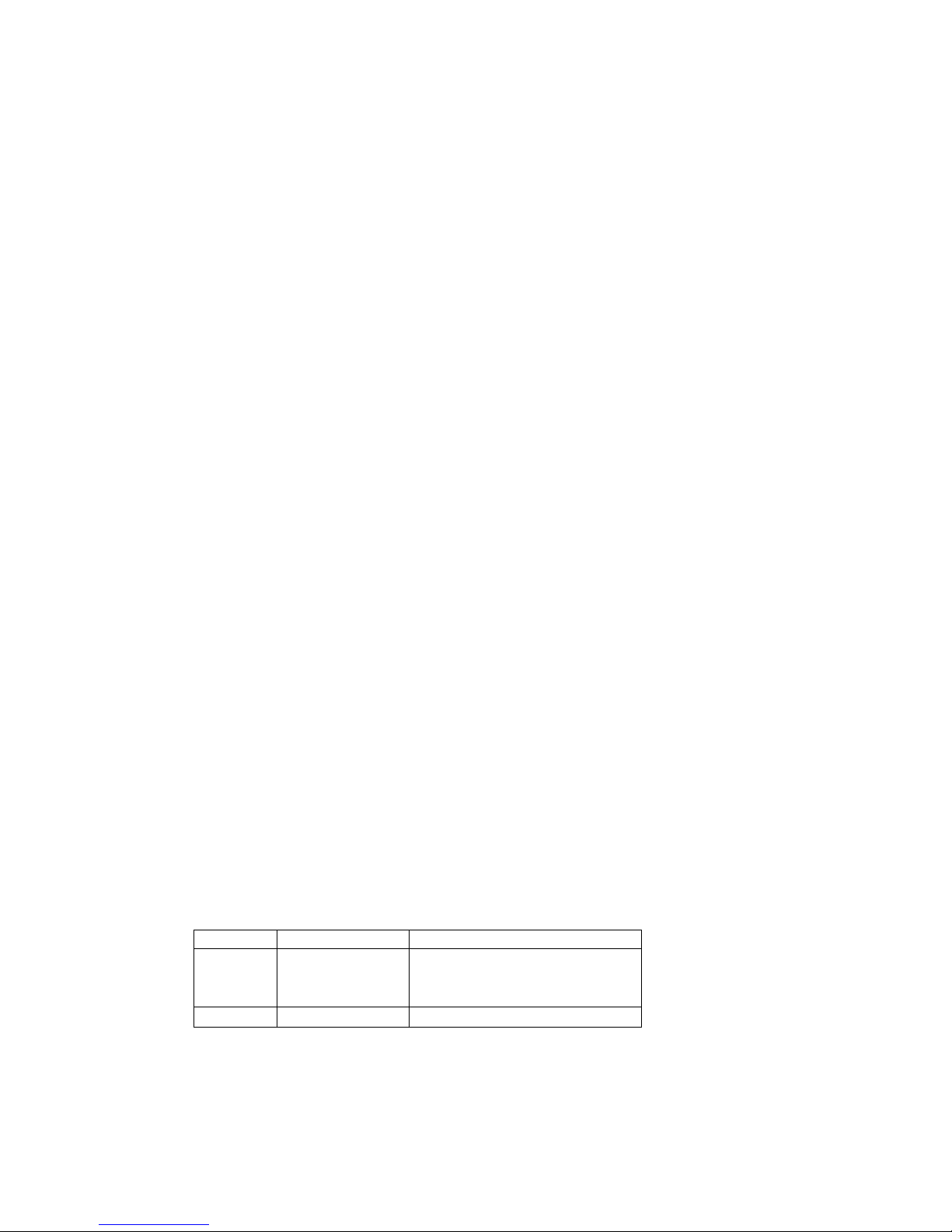
AC current (True RMS)
Range
Resolution
Accuracy
400mA
4A
40A
0.1mA
1mA
10mA
±1.0%rdg±8dgt
300A
100mA
±1.0%rdg±1% of full scale
- P2 -
Page 5

AC voltage (True RMS)
Range
Resolution
Accuracy
Input impedance
Max. input voltage
400mV
0.1mV
±1.0%rdg±8dgt
>10MΩ
AC 250V rms
400V
100mV
AC 450V rms
Resistance
Range
Resolution
Accuracy
Max. test current
Open circuit voltage
4000Ω
1Ω
±1.0%rdg±8dgt
70μA
1.5V
* Input Protection: 400V rms
3-2-2 Harmonics Mode
Measuring method: Synchronous filter
Measurable harmonics: Fundamental frequency to 25th harmonics
Minimum fundamental input: More than 5% of full scale in each range
Harmonics
Accuracy (In case of more than 4%, harmonics are included
against fundamental input)
1~9th
(
±1%rdg±5dgt)±(Basic accuracy of ACA or ACV)
- (Error by neighboring harmonics)
10~19th
(
±2%rdg±5dgt)±(Basic accuracy of ACA or ACV)
- (Error by neighboring harmonics)
20~25th
(
±5%rdg±5dgt)±(Basic accuracy of ACA or ACV)
- (Error by neighboring harmonics)
Typical error by neighboring harmonics
Harmonics Error
(Compensation %)
Harmonic component ratio
of the neighboring frequency
2~6th
1.5%
65%
7~8th
2.5%
41%
9~14th
4%
20%
15~20th
8%
10%
21~25th
15%
10%
* For example:
The neighboring frequency of 5th harmonic means 4th harmonic and 6th
harmonic. If the harmonic component ratio of 4th and 6th harmonic is
65%, the estimated error will be 1.5% typically.
- P3 -
Page 6

4. DIMENSIONS AND PANEL FUNCTION
①Current transducer(Jaw)
②Jaw opening lever
③Power switch: Push switch for power ON or OFF
④Range selector switch: Rotary switch for range selection
⑤Data hold switch: This push switch locks the display. To release, press the switch
again to cancel the hold condition.
⑥SELECT switch: Press this switch the harmonics mode. To return to the normal
mode (all pass mode), press the switch again.
⑦”UP” and “DOWN” switch: Press this switch to select a harmonic number.
⑧X 10 switch: In harmonics measurements, press this switch to read the measured
value at 10 times when the displayed value is less than 100 counts.
When this switch is pressed once, “X 10” is displayed on the LCD.
⑨V-RANGE switch: Press this switch to select 400mV or 400V range at 400V/400mV
measurements.
⑩LCD display
⑪400V terminal: This terminal is used for 400V range measurement.
⑫COM terminal: This is the common terminal for voltage and resistance measurements.
⑬400mV/Ω terminal: This terminal is used for 400mV and 4000Ω range measurements.
⑭Battery compartment
⑮Wrist strap
- P4 -
Page 7

5. METHOD OF MEASUREMENT
5-1 Preparation and Caution before Measurement
● Avoid using the tester in places subject to high temperature, humidity or
excessive vibration.
● Before measurements, be sure the data hold switch is set to “OFF” (It is
impossible to make measurements if the data hold switch is set to “ON”).
● Remove the batteries if the tester will not be used for a long period of time.
△! CAUTION
If the instrument is subjected to an electrical field of 3V/m within the frequency
range from 27MHz to 20MHz, the display error for voltage and resistance
measurements might increase.
△
!
WARNING
● To avoid electrical shock, use CAUTION when working with more than 60V DC
or 25V AC rms since the danger of electric shock exists. In addition, check
that the test leads are normal condition.
● POSSIBLE ELECTRICAL SHOCK: Do not make measurements if the case is
damaged or the rear case is removed.
Take off all electrical inputs before re removing the rear case.
● POSSIBLE ELECTRICAL SHOCK or FIRE HAZARD: Do not expose this tester
to rain or moisture. Do not operate the tester in the presence of flammable
gases or fumes.
● To avoid damage to the tester, disconnect test leads before changing functions.
Do not exceed the maximum input limits.
● Never make measurements for uninsulated conductors or bus bars.
● Do not make voltage measurements of power lines carrying more than 250V.
IN SOME CASES, POWER LINES MAY CARRY VOLTAGE SPIKES OF
SEVERAL TIMES OF THE NORMAL SUPPLY VOLTAGE. THIS TESTER
SHOULD NOT BE USED TO MEASURE POWER LINES.
* The terms of “Power Line” means the electrical circuit providing the power to
factories, buildings, etc.
- P5 -
Page 8

5-2 Line Current Measurement
① Set the POWER switch to "ON" position.
② Set the range selector switch to a range
appropriate to the current to be measured.
If the current of circuit is unknown, set the
switch to highest range and reduce setting
until satisfactory reading is obtained.
③ Clamp the conductor of the circuit under test.
Be sure the clamp jaws are securely closed.
④ Read the current value in the display.
⑤ If you make measurements in a dark place
or in a place where it is difficult to see the
readings, use the data hold switch. Fig.1
Note : Clamp around only one conductor of the circuit to be measured. (See Fig.1)
5-3 Leakage Current Measurement
5-3-1 Leakage Current Measurement for The Grounded Conductor
① Set the POWER switch to “ON”.
② Set the range selector switch to a range appropriate to the current to be
measured.
③ Clamp the conductor of the circuit under test with clamp jaws.
Be sure the clamp jaws are securely closed.
④ If you make measurements in a dark place or in a place where it is difficult
to see the readings, use the data hold switch.
⑤ Read the displayed value.
5-3-2 Leakage Current Measurement for The Single-phase or
Three-phase Electric Circuit
① Set the POWER switch to “ON”.
② Set the range selector switch to a range appropriate to the current to be
measured.
③ To measure a leakage current in a single-phase electric circuit, clamp the two
conductors together. Or clamp the three conductors together in the case of
three-phase electric circuit.
④ If you make measurements in a dark place or in a place where it is difficult to
see the readings, use the data hold switch.
⑤ Read the displayed value.
- P6 –
Page 9

5-4 Harmonics Current Measurement
① Set the POWER switch to “ON”.
② Set the range selector switch to a range appropriate to the current to be
measured.
If the current of the circuit is not known, set the switch to highest range and
reduce setting until satisfactory reading is obtained.
When the range is set incorrectly, “OL” mark will be displayed.
③ Clamp the conductor of the circuit under test.
Be sure the clamp jaws are securely closed.
④ Press the SELECT switch once, “HARMONIC NO. XX” is displayed and the tester
is activated to the harmonics mode.
“HARMONIC NO. 1” is the fundamental current.
⑤ Select a harmonic number by pressing UP and DOWN switch.
If you make measurements in a dark place or in a place where it is difficult to see
the readings, disconnect clamp and press UP and DOWN switches to select a
harmonic number.
⑥ Read the displayed value.
⑦ When the displayed value is less than 100 counts in harmonics mode, use “X10”
switch to read the measured value at 10 times.
Please note this value is 10 times of the actual value. In “X10” mode, even if the
least significant digit is fluctuated, this is not abnormal.
Note: In harmonics mode, it is impossible to change the range. If necessary, press to
release the harmonics mode with the SELECT switch once again and set the
range selector switch again to a range appropriate to the current to be
measured. To start the harmonics current measurement, press the SELECT
switch again. If the input current is relatively small, it will take the
reasonable time to get the sable reading.
5-5 Compensation for The Influence by The Harmonic Component of
The Neighboring Frequency
The accuracy of this tester is influenced by the harmonic component of the
neighboring frequency, as the synchronous filter method is used to measure the
harmonic current. For more accurate measurement, the following compensation
calculation is recommended.
Measured harmonic value Compensating
Measured value - of neighboring frequency X percentage (%)
= Compensated value
For example:
If the 5th harmonics = 2.00A (Measured harmonics value)
6th harmonics = 1.00A (Measured harmonics value)
The compensating calculation should be made as below.
5th harmonics = 2.00A - (1.00A x 0.15) = 1.985A
6th harmonics = 1.00A - (2.00A x 0.15) = 0.97A
Compensation percentage (1.5%)
Note: Refer to item 3-3-3 for the value of compensating percentage.
- P7 -
Page 10

5-6 Calculation Method of The Harmonic Distortion
① Harmonic distortion ratio for each harmonic number: In/I1 x 100 (%)
I1 = Fundamental current In = Harmonic current for each harmonic number
For example: Fundamental current 3A
5th harmonic current 0.5A
5th harmonic distortion ratio = 0.5/3x100 = 16.7%
② Total harmonics distortion ration (THD) = √₂ ₅
Σ In
2
x 100 (%)
n=2
I1
For example: Fundamental current 3A
3rd harmonic current 0.5A
5th harmonic current 0.3A
7th harmonic current 0.1A
√0.5
2
+
0.32 + 0.1
2
THD = 3 x 100 (%)=19.7%
Note: For harmonics voltage measurement, above calculation method is also
used.
5-7 Voltage Measurement
5-7-1 Voltage Measurement for AC 400V Range
△
!
WARNING
● Do not make voltage measurements of power lines carrying more than 250V.
IN SOME CASES, POWER LINES MAY CARRY VOLTAGE SPIKES OF
SEVERAL TIMES OF THE NORMAL SUPPLY VOLTAGE.
THIS TESTER SHOULD NOT BE USED TO MEASURE POWER LINES
* The term of “Power Line” means the electrical circuit providing the power to
factories, buildings, etc.
● To avoid damage to the tester, disconnect test leads before changing functions.
Do not exceed the maximum input limits.
① Set the power switch to "ON" position.
② Set the range selector switch to 400V/400mV
range. AC 400V range is automatically
selected and “V” mark is displayed on the LCD.
③ Connect the plug of black test lead into
the “COM” terminal and the plug of red
test lead into the “400V” terminal.
④ Contact the circuit under test with Test Leads
the test leads and read the displayed
value.
- P8 -
Page 11

5-7-2 Voltage Measurement for AC 400mV Range
① Set the range selector switch to 400V/400mV range.
② To select AC 400mV, press V-RANGE switch once.
The “mV” mark is displayed on the LCD.
③ Connect the plug of the black test lead into the
“COM” terminal and the plug of the red test lead
into the 400mV/Ω terminal.
④ Contact the circuit under test with the test leads
and read the displayed value.
5-8 Harmonics Voltage Measurement
① Set the POWER switch to “ON”.
② Set the selector switch to 400V/400mV range.
③ Select 400V or 400mV range appropriate to the voltage to be measured.
④ Connect the plug of the black test lead into the “COM” terminal.
For 400V range, connect the plug of the red test lead into “400V” terminal.
Or for 400mV range, connect the plug of the red test lead into the
“400mV/Ω” terminal.
⑤ Contact the circuit under test with the test leads and press the SELECT
switch once. “HARMONIC NO. XX” is displayed and the tester is
activated to the harmonics mode.
“HARMONIC NO. 1” is the fundamental voltage.
⑥ Select a harmonic number by pressing UP and DOWN switches.
⑦ Read the displayed value.
⑧ When the displayed value is less than 100 counts in harmonics mode,
use “X10” switch to read the measured value at 10 times.
Note: In harmonics mode, it is impossible to change the range.
If necessary, press to release the harmonics mode with the SELECT
switch once again to a range appropriate to the voltage to be measured.
To start the harmonics voltage measurement, press the SELECT switch
again.
5-9 Resistance Measurement
△
!
WARNING
Be sure all voltage is turned OFF in the circuit before making resistance
measurement.
① Set the Power switch to “ON”.
② Set the range selector switch to 400Ω range.
③ Connect the plug of the black test lead into
the “COM” terminal. Connect the plug of
red test lead into the “400mV/Ω” terminal.
④ Contact the circuit under test with test leads
and the displayed value.
- P9 -
Page 12

6. REPLACEMENT OF BATTERIES
△
!
WARNING
When the battery becomes exhausted or drops below the operating voltage,
the battery mark will appear on the display. Set the POWER switch to “OFF”
prior to installing batteries.
To install the batteries, remove the battery case
located on the unit back.
Loosen the screw on the battery case.
Replace the batteries (AAA size or R03) with
new ones, observing polarity.
Use high-quality batteries which are
guaranteed against leakage.
If the instrument is to be left unused
for long periods of, remove the batteries OPEN
to prevent damage from leakage.
7. REPAIR SERVICE
When making requests for repair service, please bring the instrument directly to
the dealer. If this is impossible, however, send the instrument directly to our
sales office.
When mailing this instrument, always pack it in its original or equivalent
packing material and pack together with name, address, telephone number and
the warranty documentation.
● To ensure speedy and reliable repair, always include information as the type of
failure and cause.
● If required, always return accessories with the instrument.
● When contacting us, provide the model number and serial number of your
instrument.
8. WARRANTY
This instrument is sent out from our factory after the sufficient internal
inspections but if you find any defect due to the fault in our workmanship or the
original parts, please contact the dealer where you bought the instrument.
The warranty period is 12 months from the date of purchase and the instrument
shall be repaired at free of charge, provided that we judge the cause of defect is
obviously resulted from our responsibility.
- P10 -
 Loading...