

Page 1
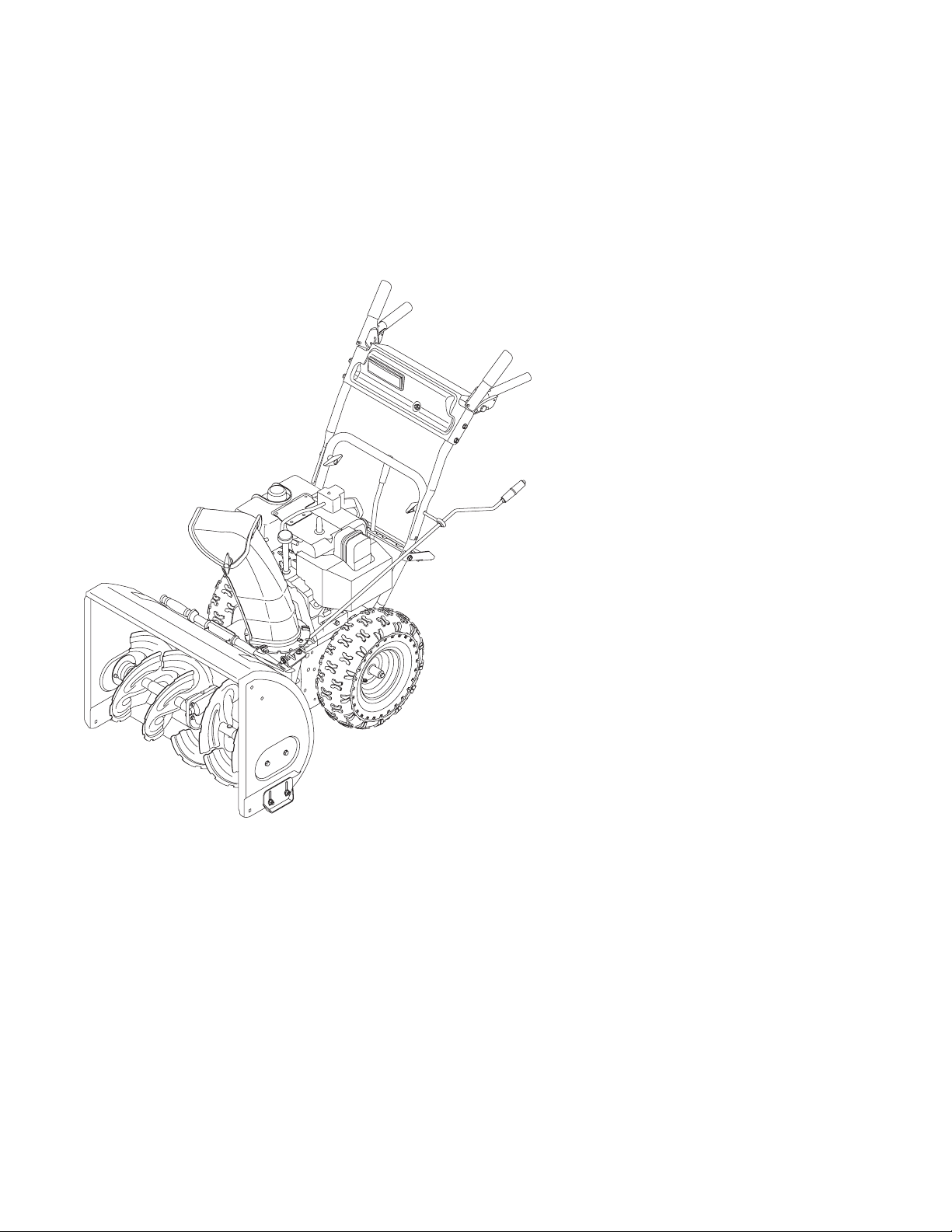
Operator’s Manual
Two-Stage Snow Thrower
Styles C & D
Model 6DE Shown
IMPORTANT: READ SAFETY RULES AND INSTRUCTIONS CAREFULLY
Warning: This unit is equipped with an internal combustion engine and should not be used on or near any unimproved forest-covered, brush-
covered or grass-covered land unless the engine’s exhaust system is equipped with a spark arrester meeting applicable local or state laws (if
any). If a spark arrester is used, it should be maintained in effective working order by the operator. In the State of California the above is required
by law (Section 4442 of the California Public Resources Code). Other states may have similar laws. Federal laws apply on federal lands. A spark
arrester for the muffler is available through your nearest engine authorized service dealer or contact the service department, P.O. Box 361131
Cleveland, Ohio 44136-0019.
MTD LLC, P.O. BOX 361131 CLEVELAND, OHIO 44136-0019
PRINTED IN U.S.A.
FORM NO.
769-01274.fm
(6/7/2004)
Page 2
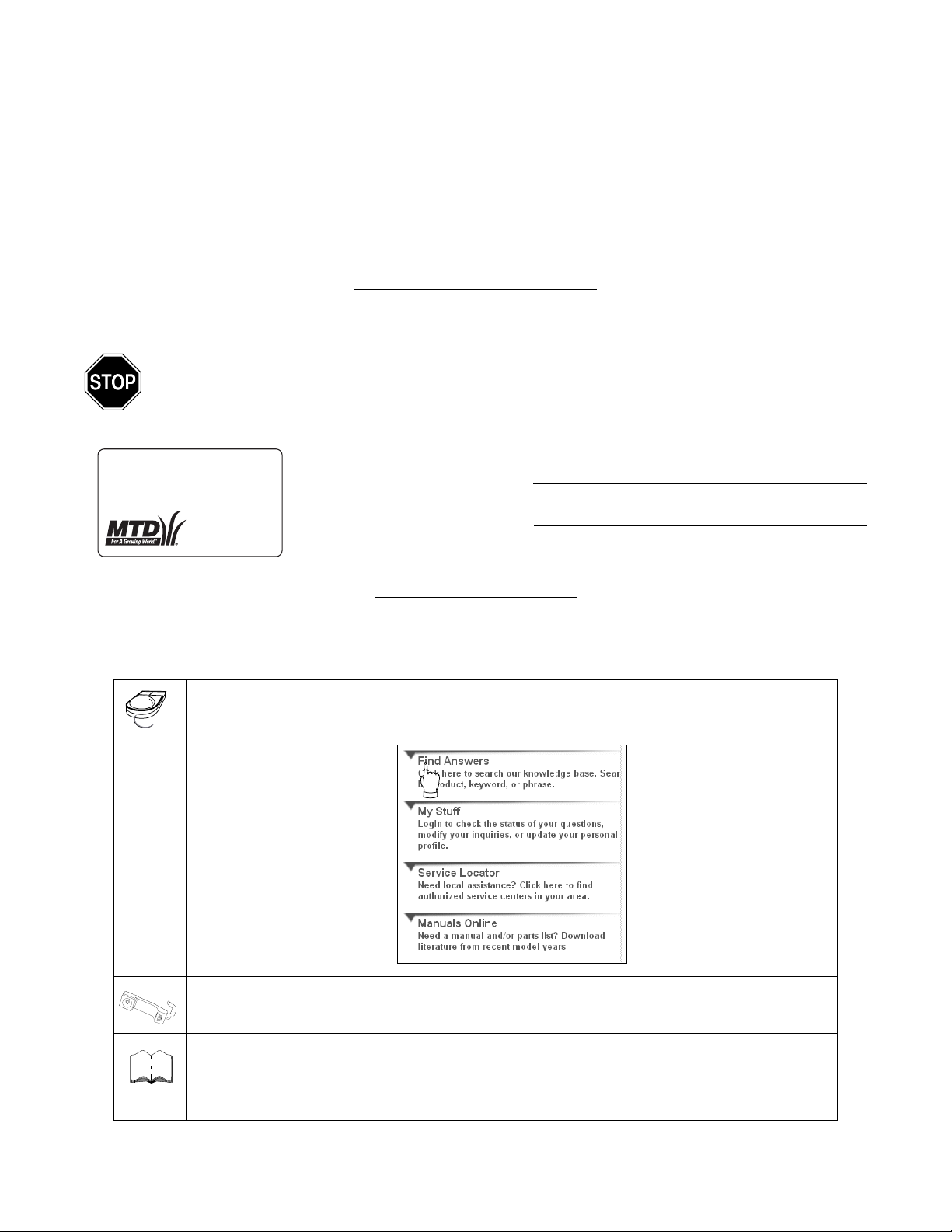
TABLE OF CONTENTS
Content Page
Important Safe Operation Practices 3
Assembling Your Snow Thrower 6
Know Your Snow Thrower 8
Operating Your Snow Thrower 10
Making Adjustments 13
Content Page
Maintaining Your Snow Thrower 15
Servicing Your Snow Thrower 15
Troubleshooting 20
Illustrated Parts List 22
Warranty Back Cover
FINDING MODEL NUMBER
This Operator’s Manual is an important part of your new snow thrower. It will help you assemble, prepare and
maintain the unit for best performance. Please read and understand what it says.
Before you start assembling your new equipment, please locate the model plate on the equipment
and copy the information from it in the space provided below. A sample model plate is also given below.
You can locate the model plate by standing at the operating position and looking down at the rear of the
deck. This information will be necessary to use the manufacturer’s web site and/or help from the
Customer Support Department or an authorized service dealer.
Copy the model number here:
www.mtdproducts.com
MTD LLC
P. O. BOX
CLEVELAND,OH
330-220-4683
800-800-7310
361131
44136
Copy the serial number here:
CUSTOMER SUPPORT
Please do NOT return the unit to the retailer from where it was purchased, without first contacting Customer Support.
If you have difficulty assembling this product or have any questions regarding the controls, operation or
maintenance of this unit, you can seek help from the experts. Choose from the options below:
Visit mtdproducts.com for many useful suggestions. Click on Customer Support button and
you will get the four options reproduced here. Click on the appropriate button and help is
immediately available.
The answer you are
looking for could be just
a mouse click away!
To reach a Customer Support Representative, please call 1(800) 800-7310.
The answer you are
looking for could be just
a mouse click away!
Engine
Manual
The engine manufacturer is responsible for all engine-related issues with regard to
performance, power-rating, specifications, warranty and service. Please refer to the engine
manufacturer’s Owner’s/Operator’s Manual, packed separately with your unit, for more
information.
2
Page 3

SECTION 1: IMPORTANT SAFE OPERATION PRACTICES
WARNING: Engine Exhaust, some of its constituents, and certain vehicle components
contain or emit chemicals known to the State of California to cause cancer, birth defects or
other reproductive harm
DANGER: This machine was built to be operated according to the rules for safe operation in this
manual. As with any type of power equipment, carelessness or error on the part of the operator can
result in serious injury. This machine is capable of amputating hands and feet and throwing objects.
Failure to observe the following safety instructions could result in serious injury or death.
DANGER: This machine was built to be operated according to the rules for safe operation in this manual. As with
any type of power equipment, carelessness or error on the part of the operator can result in serious injury. This
machine is capable of amputating hands and feet and throwing objects. Failure to observe the following safety
instructions could result in serious injury or death.
Training
1. Read, understand, and follow all instructions on the
machine and in the manual(s) before attempting to
assemble and operate. Keep this manual in a safe
place for future and regular reference and for
ordering replacement parts.
2. Be familiar with all controls and their proper
operation. Know how to stop the machine and
disengage them quickly.
3. Never allow children under 14 years old to operate
this machine. Children 14 years old and over
should read and understand the operation
instructions and safety rules in this manual and
should be trained and supervised by a parent.
4. Never allow adults to operate this machine without
proper instruction.
5. Thrown objects can cause serious personal injury.
Plan your snow-throwing pattern to avoid discharge
of material toward roads, bystanders and the like.
6. Keep bystanders, helpers, pets and children at
least 75 feet from the machine while it is in
operation. Stop machine if anyone enters the area.
7. Exercise caution to avoid slipping or falling,
especially when operating in reverse.
Preparation
1. Thoroughly inspect the area where the equipment
is to be used. Remove all doormats, newspapers,
sleds, boards, wires and other foreign objects,
which could be tripped over or thrown by the auger/
impeller.
2. Always wear safety glasses or eye shields during
operation and while performing an adjustment or
repair to protect your eyes. Thrown objects which
ricochet can cause serious injury to the eyes.
3. Do not operate without wearing adequate winter
outer garments. Do not wear jewelry, long scarves
or other loose clothing, which could become
entangled in moving parts. Wear footwear which
will improve footing on slippery surfaces.
.
4. Use a grounded three-wire extension cord and
receptacle for all units with electric start engines.
5. Adjust collector housing height to clear gravel or
crushed rock surfaces.
6. Disengage all control levers before starting the engine.
7. Never attempt to make any adjustments while
engine is running, except where specifically
recommended in the operator’s manual.
8. Let engine and machine adjust to outdoor
temperature before starting to clear snow.
9. To avoid personal injury or property damage use
extreme care in handling gasoline. Gasoline is
extremely flammable and the vapors are explosive.
Serious personal injury can occur when gasoline is
spilled on yourself or your clothes, which can ignite.
Wash your skin and change clothes immediately.
a. Use only an approved gasoline container.
b. Extinguish all cigarettes, cigars, pipes and
other sources of ignition.
c. Never fuel machine indoors.
d. Never remove gas cap or add fuel while the
engine is hot or running.
e. Allow engine to cool at least two minutes
before refueling.
f. Never over fill fuel tank. Fill tank to no more
than ½ inch below bottom of filler neck to
provide space for fuel expansion.
g. Replace gasoline cap and tighten securely.
h. If gasoline is spilled, wipe it off the engine
and equipment. Move machine to another
area. Wait 5 minutes before starting the
engine.
i. Never store the machine or fuel container
inside where there is an open flame, spark or
pilot light (e.g. furnace, water heater, space
heater, clothes dryer etc.).
j. Allow machine to cool at least 5 minutes
before storing.
3
Page 4

Operation
1. Do not put hands or feet near rotating parts, in the
auger/impeller housing or chute assembly. Contact
with the rotating parts can amputate hands and
feet.
2. The auger/impeller control lever is a safety device.
Never bypass its operation. Doing so makes the
machine unsafe and may cause personal injury.
3. The control levers must operate easily in both
directions and automatically return to the
disengaged position when released.
4. Never operate with a missing or damaged chute
assembly. Keep all safety devices in place and
working.
5. Never run an engine indoors or in a poorly
ventilated area. Engine exhaust contains carbon
monoxide, an odorless and deadly gas.
6. Do not operate machine while under the influence
of alcohol or drugs.
7. Muffler and engine become hot and can cause a
burn. Do not touch.
8. Exercise extreme caution when operating on or
crossing gravel surfaces. Stay alert for hidden
hazards or traffic.
9. Exercise caution when changing direction and
while operating on slopes.
10. Plan your snow-throwing pattern to avoid discharge
towards windows, walls, cars etc. Thus, avoiding
possible property damage or personal injury
caused by a ricochet.
11. Never direct discharge at children, bystanders and
pets or allow anyone in front of the machine.
12. Do not overload machine capacity by attempting to
clear snow at too fast of a rate.
13. Never operate this machine without good visibility
or light. Always be sure of your footing and keep a
firm hold on the handles. Walk, never run.
14. Disengage power to the auger/impeller when
transporting or not in use.
15. Never operate machine at high transport speeds on
slippery surfaces. Look down and behind and use
care when backing up.
16. If the machine should start to vibrate abnormally,
stop the engine, disconnect the spark plug wire and
ground it against the engine. Inspect thoroughly for
damage. Repair any damage before starting and
operating.
17. Disengage all control levers and stop engine before
you leave the operating position (behind the
handles). Wait until the auger/impeller comes to a
complete stop before unclogging the chute
assembly, making any adjustments, or inspections.
18. Never put your hand in the discharge or collector
openings. Always use the clean-out tool provided to
unclog the discharge opening. Do not unclog chute
assembly while engine is running. Shut off engine
and remain behind handles until all moving parts
have stopped before unclogging.
19. Use only attachments and accessories approved
by the manufacturer (e.g. wheel weights, tire
chains, cabs etc.).
20. If situations occur which are not covered in this
manual, use care and good judgment. Contact your
dealer or call 1-800-800-7310 for assistance and
the name of your nearest servicing dealer.
Maintenance & Storage
1. Never tamper with safety devices. Check their
proper operation regularly. Refer to the
maintenance and adjustment sections of this
manual.
2. Before cleaning, repairing, or inspecting machine
disengage all control levers and stop the engine.
Wait until the auger/impeller come to a complete
stop. Disconnect the spark plug wire and ground
against the engine to prevent unintended starting.
3. Check bolts and screws for proper tightness at
frequent intervals to keep the machine in safe
working condition. Also, visually inspect machine
for any damage.
4. Do not change the engine governor setting or overspeed the engine. The governor controls the
maximum safe operating speed of the engine.
5. Snow thrower shave plates and skid shoes are
subject to wear and damage. For your safety
protection, frequently check all components and
replace with original equipment manufacturer’s
(OEM) parts only. “Use of parts which do not meet
the original equipment specifications may lead to
improper performance and compromise safety!”
6. Check controls periodically to verify they engage
and disengage properly and adjust, if necessary.
Refer to the adjustment section in this operator’s
manual for instructions.
7. Maintain or replace safety and instruction labels, as
necessary.
8. Observe proper disposal laws and regulations for
gas, oil, etc. to protect the environment.
9. Prior to storing, run machine a few minutes to clear
snow from machine and prevent freeze up of auger/
impeller.
10. Never store the machine or fuel container inside
where there is an open flame, spark or pilot light
such as a water heater, furnace, clothes dryer etc.
11. Always refer to the operator’s manual for proper
instructions on off-season storage.
4
Page 5
YOUR RESPONSIBILITY
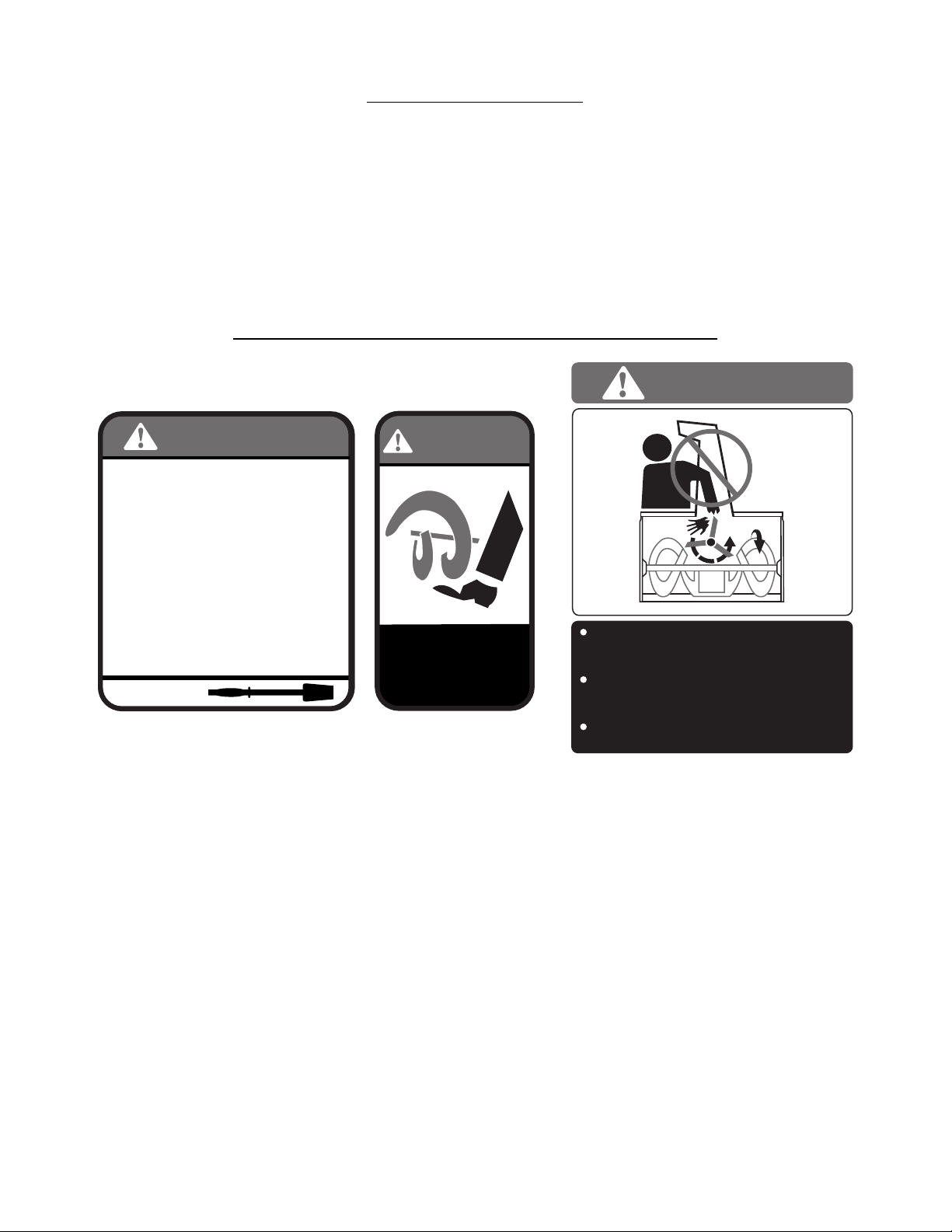
KEEP AWAY FROM ROTATING IMPELLER
AND AUGER. CONTACT WITH IMPELLER OR
AUGER CAN AMPUTATE HANDS AND FEET
.
USE CLEAN-OUT TOOL TO UNCLOG
DISCHARGE CHUTE.
DISENGAGE CLUTCH LEVERS, STOP ENGINE,
AND REMAIN BEHIND HANDLES UNTIL ALL
MOVING PARTS HAVE STOPPED BEFORE
UNCLOGGING OR SERVICING MACHINE.
TO AVOID THROWN OBJECTS INJURIES,
NEVER DIRECT DISCHARGE AT BYSTANDERS.
USE EXTRA CAUTION WHEN OPERATING ON
GRAVEL SURFACES.
READ OPERATOR'S MANUAL.
1.
2.
3.
4.
5.
DANGER
CLEAN-OUT TOOL
DANGER
AVOID INJURY FROM
ROTATING AUGER KEEP HANDS, FEET
AND CLOTHING AWAY.
Restrict the use of this power machine to persons who read, understand and follow the warnings and instructions in
this manual and on the machine.
Do not modify engine
To avoid serious injury or death, do not modify engine
in any way. Tampering with the governor setting can
lead to a runaway engine and cause it to operate at
unsafe speeds. Never tamper with factory setting of
engine governor.
Notice regarding Emissions
Engines which are certified to comply with California
and federal EPA emission regulations for SORE (Small
Off Road Equipment) are certified to operate on regular
unleaded gasoline, and may include the following
emission control systems: Engine Modification (EM)
and Three Way Catalyst (TWC) if so equipped.
SAFETY LABELS FOUND ON YOUR SNOW THROWER
DANGER
NEVER PUT HAND IN CHUTE. CONTACT WITH
ROTATING PARTS CAN AMPUTATE FINGERS
AND HANDS.
SHUT OFF ENGINE AND WAIT UNTIL ALL
MOVING PARTS HAVE STOPPED BEFORE
UNCLOGGING.
USE CLEAN-OUT TOOL OR WOODEN
UNCLOG DISCHARGE CHUTE.
5
STICK TO
Page 6
SECTION 2: ASSEMBLING YOUR SNOW THROWER
1
NOTE: References to right or left side of the snow
thrower are determined from behind the unit in the
operating position (standing directly behind the snow
thrower, facing the handle panel).
2
3
NOTE: This Operator’s Manual covers several
models. Snow thrower features vary by model. Not
all features referenced and pictured in this manual are
applicable to all snow thrower models.
IMPORTANT:
included with this manual. Refer to Augers on page 19
for more information regarding shear pin replacement.
Two replacement auger shear pins are
CAUTION: Prior to operating your snow
thrower, refer to Auger Control Test on page 11.
Read and follow all instructions carefully and
perform all adjustments to verify your snow
thrower is operating safely and properly.
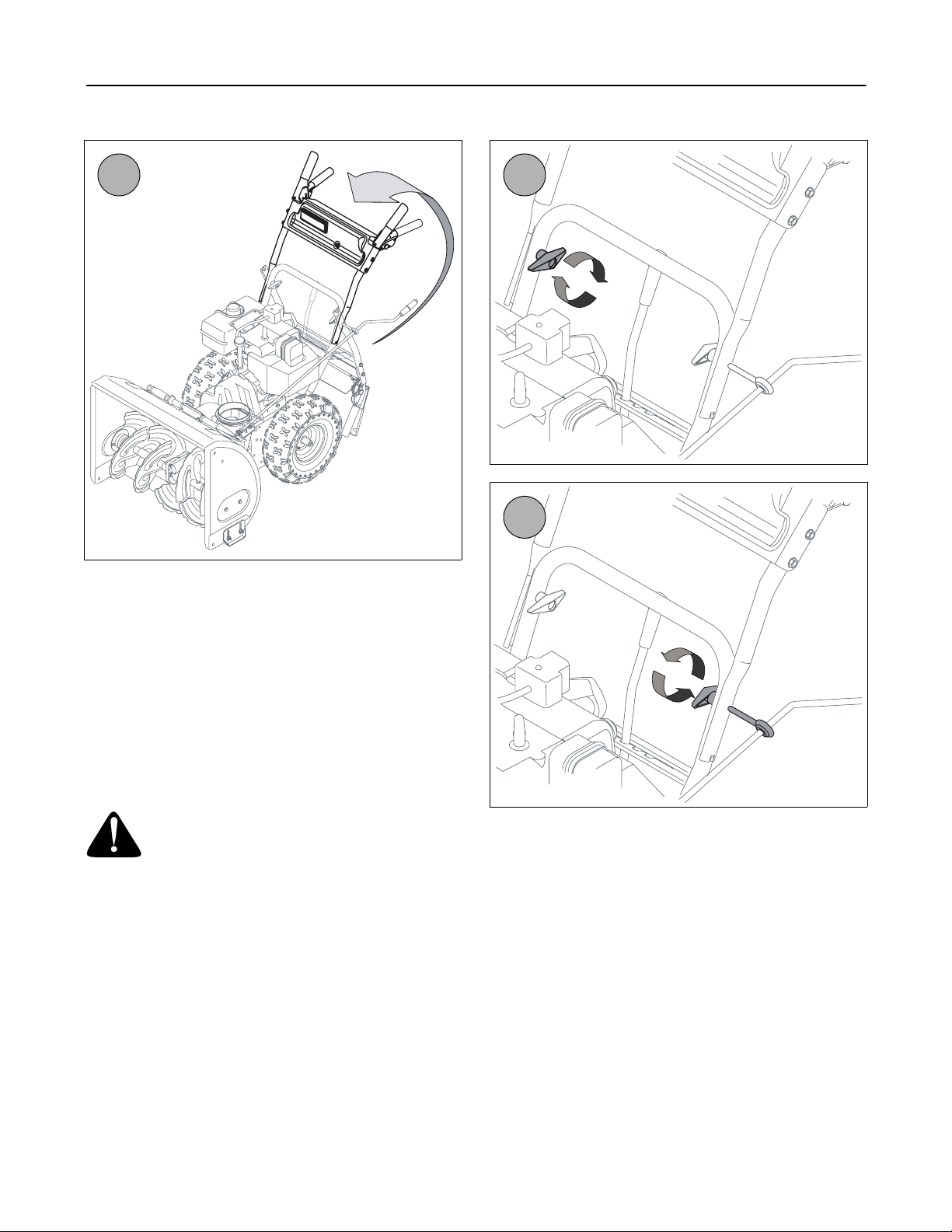
Securing the Handle
1. Observe the lower rear area of the snow thrower to
be sure both cables are aligned with roller guides
before pivoting the handle upward until it clicks into
the place.
2. Secure the right side of the handle by tightening the
plastic wing knob.
3. Secure the left side of the handle by tightening the
plastic wing knob into the eyebolt.
6
Page 7
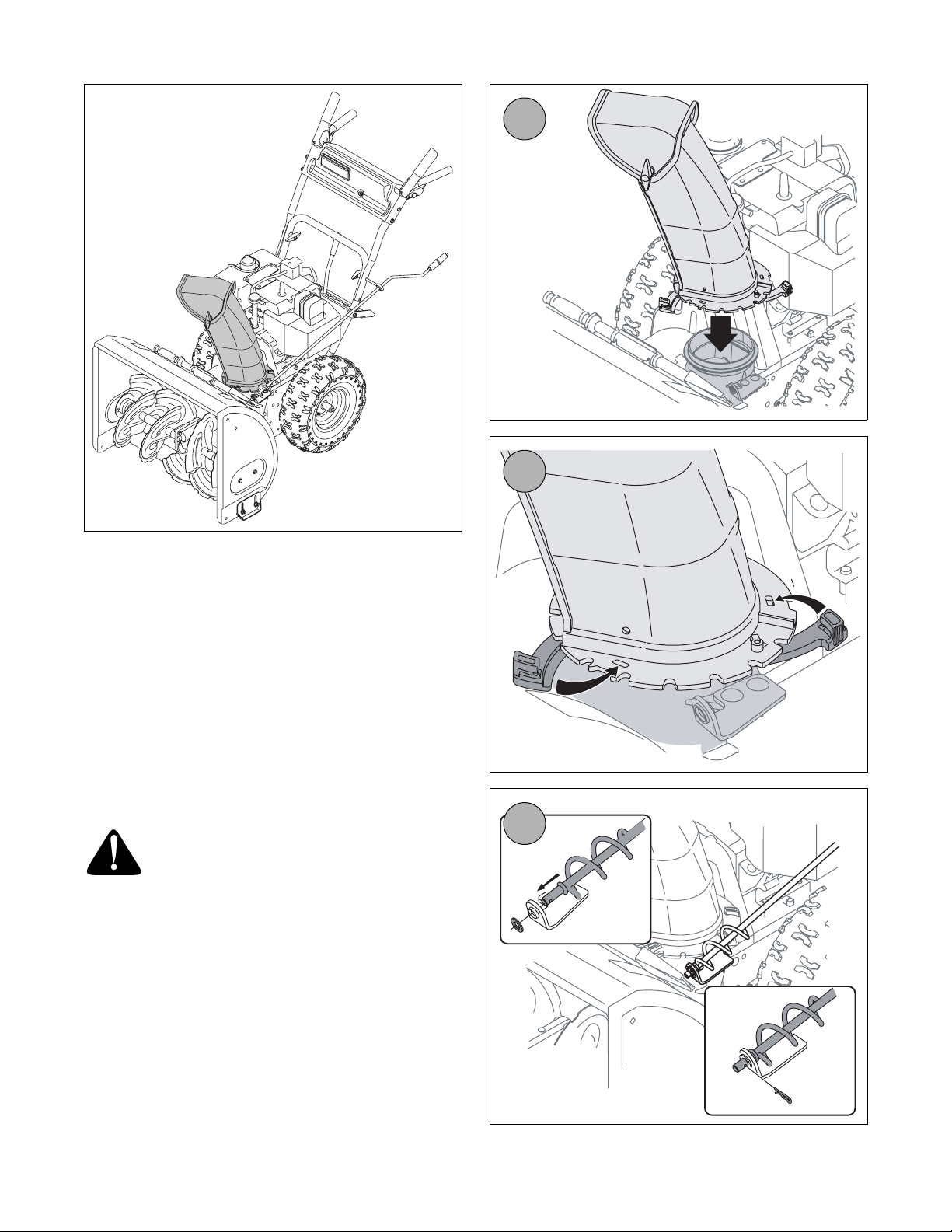
Attaching the Chute Assembly and Directional Control
1. Apply a light lubricant (i.e. 3-in-1 oil) to the rim of
the chute base and position the chute assembly
over the base.
2. Close the flange keepers to secure the chute
assembly to the chute base. The flange keepers
will click into place when properly secure.
3. Remove the flat washer and hairpin clip from the
end of the chute directional control. Insert the end
of the chute directional control into the lower
bracket and secure with the flat washer and hairpin
clip just removed.
1
2
NOTE: If necessary, the lower bracket can be
adjusted. Refer to Chute Bracket Adjustment. on Page 13.
CAUTION: Prior to operating your snow
thrower, refer to Auger Control Test on page 11.
Read and follow all instructions carefully and
perform all adjustments to verify your snow
thrower is operating safely and properly.
Tire Pressure
• Before operating, check tire pressure and reduce
pressure in both tires to between 15 psi and 20 psi.
NOTE: If the tire pressure is not equal in both tires,
the unit may not travel in a straight path and the shave
plate may wear unevenly.
3
7
Page 8
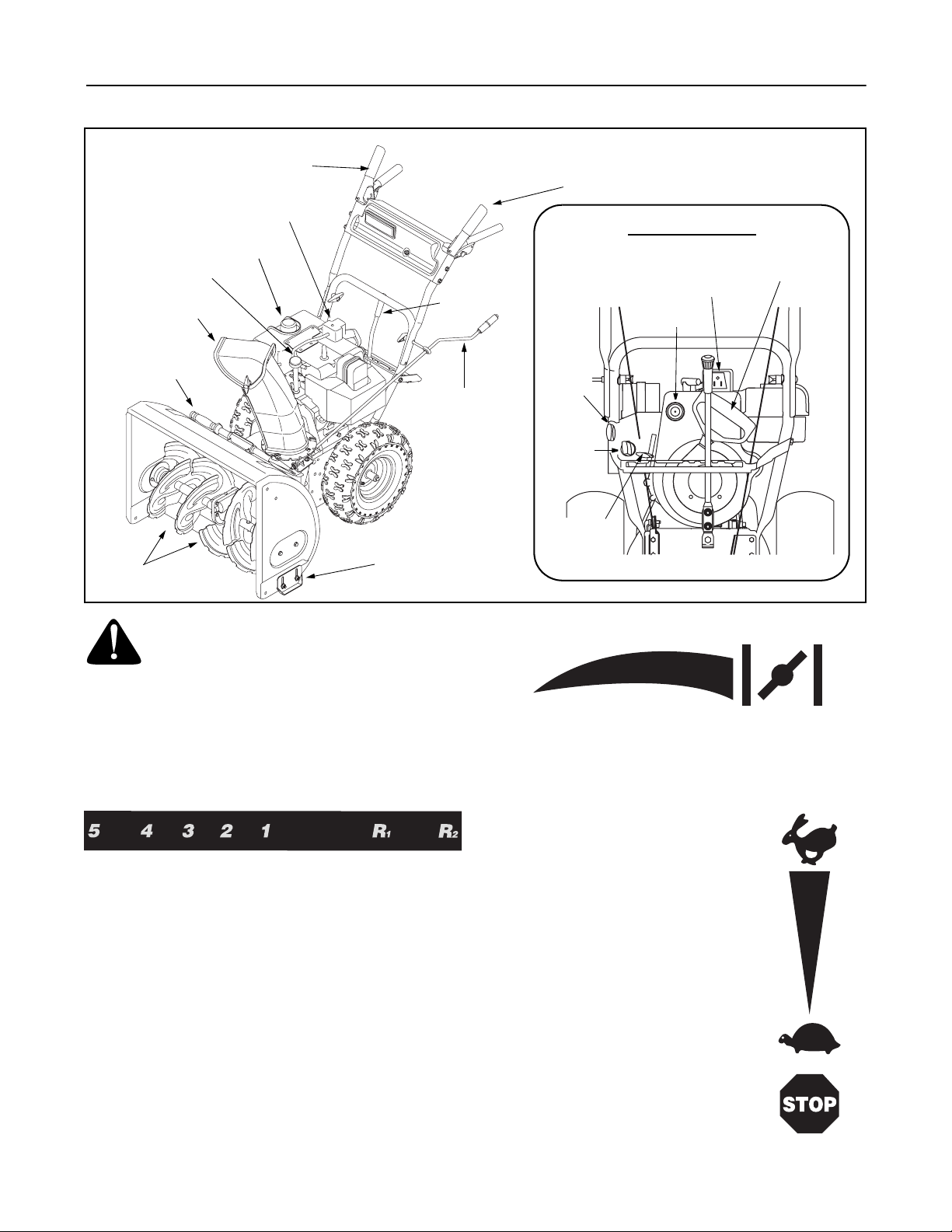
SECTION 3: KNOW YOUR SNOW THROWER
Drive Control
Electric Starter Button
Gas Cap
Oil Fill
Chute Assembly
Clean-out
Tool
Augers
Skid Shoe
Shift Lever
Chute Directional
Control
Auger Control
Engine Controls
Recoil Starter
Handle
Electric Starter Outlet
Primer
Ignition
Key
Choke
Control
Throttle Control
WARNING: Read, understand, and follow
all instructions and warnings on the machine
and in this manual before operating.
NOTE: For detailed starting instructions and more
information on all engine controls, refer to the
Tecumseh Engines manual packed separately and
Starting The Engine on page 10 of this manual.
Shift Lever
The shift lever is located between the lower handle,
behind the engine. Place the shift lever into any of
seven positions to control the direction of travel and
ground speed.
Forward
There are five forward (F) speeds. Position one (1) is
the slowest and position five (5) is the fastest.
Reverse
There are two reverse (R) speeds. One (1) is the slower
and two (2) is the faster.
Gas Cap
Unthread the gas cap to add gasoline to the fuel tank.
Choke Control
The choke control is found on the rear of the engine and
is activated by rotating the knob clockwise. Activating
the choke control closes the choke plate on the
carburetor and aids in starting the engine.
Throttle Control
The throttle control is located on the
engine. It regulates the speed of the
engine and will shut off the engine
when pushed down completely.
Primer
Depressing the primer forces fuel
directly into the engine’s carburetor to
aid in cold-weather starting.
Oil Fill
Engine oil level can be checked and
oil added through the oil fill.
8
Page 9
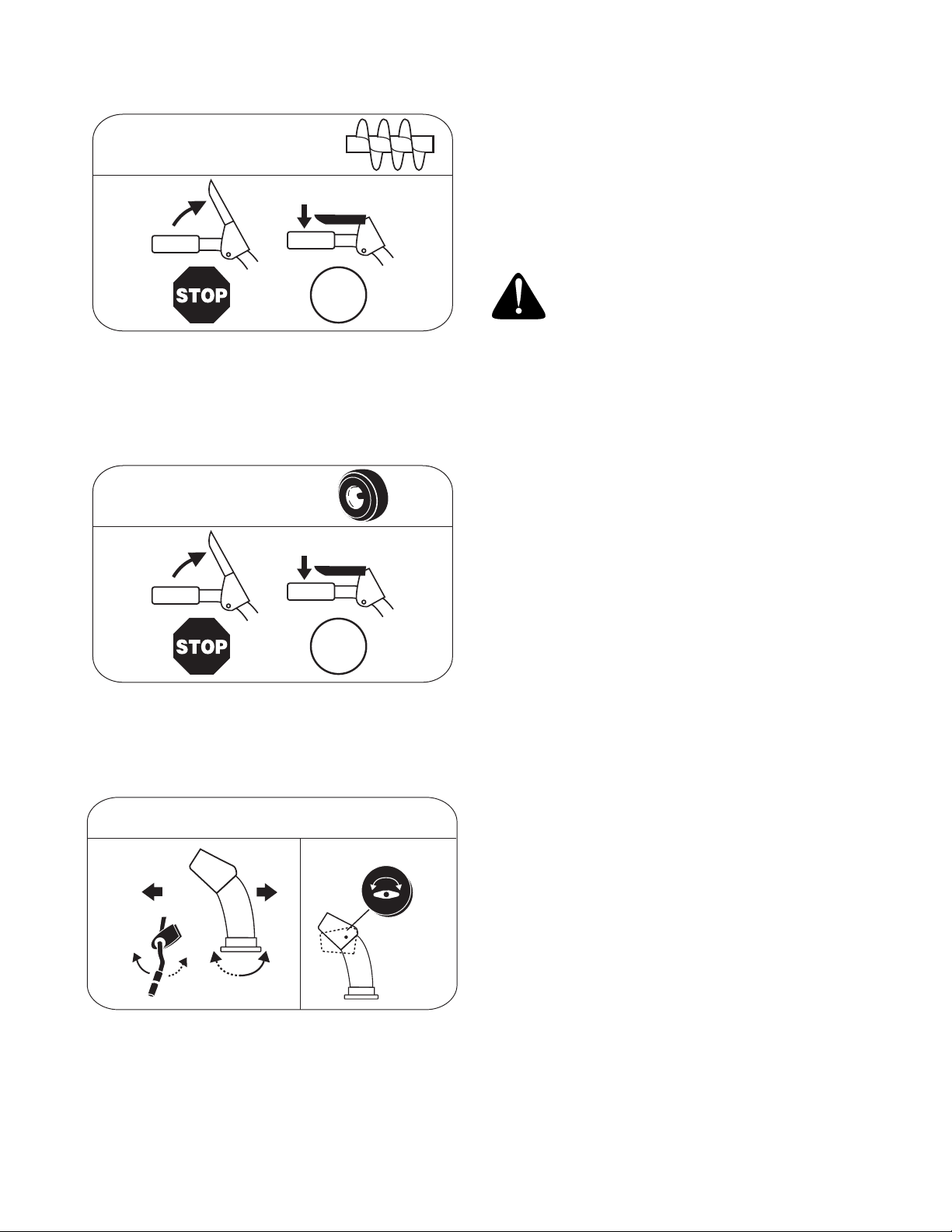
Auger Control
AUGER
CONTROL
GO
The auger control is located on the left handle.
Squeeze the control grip against the handle to engage
the augers and start snow throwing action. Release to
stop.
Drive Control
DRIVE
CONTROL
Ignition Key
The ignition key is a safety devise. It must be fully
inserted in order for the engine will start. Remove the
ignition key when the snow thrower is not in use.
IMPORTANT:
to start the engine. Doing so may cause it to break.
Do not turn the ignition key in an attempt
Clean-Out Tool
WARNING: Never use your hands to clear
a clogged chute assembly. Shut off engine
and remain behind handles until all moving
parts have stopped before unclogging.
The chute clean-out tool is fastened to the top of the
auger housing with a mounting clip. The tool is
designed to clear a clogged chute assembly. Refer to
Operating Your Snow Thrower section for more detailed
information regarding the chute clean-out tool.
NOTE: This item is fastened with a cable tie to the
rear of the auger housing at the factory. Cut the cable
tie before operating the snow thrower.
GO
The drive control is located on the right handle.
Squeeze the control grip against the handle to engage
the wheel drive. Release to stop.
Chute Directional Control
CHUTE DIRECTIONAL CONTROL
ADJUSTABLE
DISCHARGE
LEFT
DISCHARGE
RIGHT
CHUTE TILT
Skid Shoes
Position the skid shoes based on surface conditions.
Adjust upward for hard-packed snow. Adjust downward
when operating on gravel or crushed rock surfaces.
Recoil Starter Handle
The recoil starter handle is used to manually start the
engine.
Electric Starter Button (If so equipped)
Pressing the electric starter button engages the
engine’s electric starter when plugged into a 120V
power source.
Electric Starter Outlet (If so equipped)
Requires use of a three-prong outdoor extension cord
(packed with the snow thrower) and a 120V power
source/wall outlet.
Augers
When engaged, the augers rotate and draw snow into
the housing.
The chute directional control is located on left side of
the snow thrower.
To change the direction in which snow is thrown, turn
chute directional control as follows:
• Crank clockwise to discharge to the left.
• Crank counterclockwise to discharge to the right.
Chute Assembly
Snow drawn into the auger housing is discharged out
the chute assembly.
9
Page 10

SECTION 4: OPERATING YOUR SNOW THROWER
Before Starting
WARNING: Read, understand, and follow
all instructions and warnings on the machine
and in this manual before operating.
Gas & Oil Fill-Up
Service the engine with gasoline and oil as instructed in
the Tecumseh Engines manual packed separately with
your snow thrower. Read instructions carefully.
WARNING: Use extreme care when
handling gasoline. Gasoline is extremely
flammable and the vapors are explosive.
Never fuel the machine indoors or while the
engine is hot or running. Extinguish cigarettes,
cigars, pipes and other sources of ignition.
• A small plastic cup may be located inside the fuel fill
opening beneath the gas cap. Remove and discard
this cup before filling up the tank.
Starting The Engine
• Attach spark plug wire to spark plug. Make certain
the metal loop on the end of the spark plug wire
(inside the boot) is fastened securely over the metal
tip on the spark plug.
• Make certain both the auger control and drive
control are in the disengaged (released) position.
• Move throttle control up to FAST position. Insert
ignition key into slot. Make sure it snaps into place.
Do not attempt to turn the key
NOTE: The engine cannot start unless the key is
inserted into ignition switch.
Electric Starter (on models so quipped)
• Determine that your home’s wiring is a three-wire
grounded system. Ask a licensed electrician if you
are not certain.
CAUTION: If your home’s wiring system
is not a three-wire grounded system, do
not use this electric starter under any
conditions.
WARNING: The optional electric starter is
equipped with a grounded three-wire power
cord and plug, and is designed to operate on
120 volt AC household current. It must be
used with a properly grounded three-prong
receptacle at all times to avoid the possibility
of electric shock. Follow all instructions
carefully prior to operating the electric starter.
.
WARNING: If your home electrical
system is grounded, but a three-hole
receptacle is not available, do not use your
snow thrower’s electric starter.
If you have a grounded three-prong receptacle,
proceed as follows:
• Plug the extension cord into the outlet located on
the engine’s surface. Plug the other end of
extension cord into a three-prong 120-volt,
grounded, AC outlet in a well-ventilated area.
• Rotate choke control to FULL choke position (cold
engine start).
NOTE: If the engine is already warm, place choke
control in the OFF position instead of FULL.
• Push the primer two or three times for cold engine
start, making sure to cover vent hole in the center of
the primer when pushing.
NOTE: DO NOT use primer to restart a warm engine
after a short shutdown.
• Push starter button to start engine.
• Once the engine starts, immediately release starter
button.
• As the engine warms, slowly rotate the choke
control to the OFF position. If the engine falters,
quickly rotate the choke control back to FULL and
then slowly into the OFF position again.
• When disconnecting the extension cord, always
unplug the end at the three-prong wall outlet before
unplugging the opposite end from the snow
thrower.
Recoil Starter
• Rotate choke control to FULL choke position (cold
engine start).
NOTE: If the engine is already warm, place choke
control in the OFF position instead of FULL.
• Push the primer two or three times for cold engine
start, making sure to cover vent hole in the center of
the primer when pushing.
NOTE: DO NOT use primer to restart a warm engine
after a short shutdown.
NOTE: Additional priming may be necessary if the
temperature is below 15° Fahrenheit.
• Grasp the recoil starter handle and slowly pull the
rope out. At the point where it becomes slightly
harder to pull the rope, slowly allow the rope to
recoil.
10
Page 11

• Pull the starter handle with a firm, rapid stroke.
IMPORTANT:
snap back. Keep a firm hold on the starter handle and
allow it to slowly recoil.
• As the engine warms, slowly rotate the choke
control to the OFF position. If the engine falters,
quickly rotate the choke control back to the FULL
position and then slowly into the OFF position
again.
Do not release the handle and allow it to
Stopping The Engine
• Run engine for a few minutes before stopping to
help dry off any moisture on the engine.
• To help prevent possible starter freeze-up, proceed
as follows:
Electric Starter (on models so equipped)
1. Connect extension cord to the electric starter outlet
on the engine, then to 120 volt AC outlet.
2. With the engine running, push the starter button
and allow the starter for spin for several seconds.
The noise made by the starter is normal. The
engine’s starter is not being harmed.
3. When disconnecting the extension cord, always
unplug the end at the three-prong wall outlet before
unplugging the opposite end from the snow
thrower.
4. Move throttle control to STOP position.
5. Remove the ignition key.
6. Wipe all snow and moisture from the carburetor
cover in the area of the drive control and auger
control. Also, engage and release the controls
several times.
NOTE: Keep the key in a safe place. The engine
cannot start without the ignition key.
Recoil Starter
1. With engine running, pull starter rope with a rapid,
continuous full arm stroke three or four times.
Pulling the starter rope will produce a loud
clattering sound, which is not harmful to engine.
2. Move throttle control to STOP position.
3. Remove the ignition key.
NOTE: Keep the key in a safe place. The engine
cannot start without the ignition key.
4. Wipe all snow and moisture from the carburetor
cover in the area of the drive control and auger
control. Also, engage and release the controls
several times.
To Engage Drive
• With the throttle control in the Fast (rabbit) position,
move shift lever into one of the five forward (F)
positions or two reverse (R) positions. Select a
speed appropriate for the snow conditions and a
pace you’re comfortable with.
IMPORTANT:
comfortable and familiar with the operation of the snow
thrower.
• Squeeze the auger control against the handle and
the augers will turn. Release it and the augers will
stop.
• Squeeze the drive control against the handle the
snow thrower will move. Release it and drive
motion will stop.
IMPORTANT:
speeds or direction of travel) without first releasing the
drive control and bringing the snow thrower to a
complete stop. Doing so will result in premature wear to
the snow thrower’s drive system.
Use the slower speeds until you are
NEVER reposition the shift lever (change
To Engage Augers
• To engage the augers and start throwing snow,
squeeze the auger control against the left handle.
Release to stop the augers.
Auger Control Test
IMPORTANT:
operating your snow thrower for the first time and at the
start of each winter season.
Check the adjustment of the auger control as follows:
• When the auger control is released and in the
disengaged “up” position, the cable should have
very little slack. It should NOT be tight.
• In a well-ventilated area, start the snow thrower
engine as instructed earlier in this section under the
heading Starting the Engine. Make sure the throttle is
set in the FAST position.
• While standing in the operator’s position (behind
the snow thrower), engage the auger.
• Allow the auger to remain engaged for
approximately ten (10) seconds before releasing
the auger control. Repeat this several times.
• With the throttle control in the FAST (rabbit)
position and the auger control in the disengaged
“up” position, walk to the front of the machine.
• Confirm that the auger has completely stopped
rotating and shows NO signs of motion.
IMPORTANT:
immediately return to the operator’s position and shut
off the engine. Wait for ALL moving parts to stop before
re-adjusting the auger control.
Perform the following test before
If the auger shows ANY signs of rotating,
11
Page 12

• To readjust the control cable, loosen the hex jam
nut on the auger control cable “Z” fitting.
• Rotate the coupling end of the cable
counterclockwise to provide more slack.
• Retighten the hex jam nut. See Figure 1.
• Repeat Auger Control Test to verify proper
adjustment has been achieved.
Z Fitting
Hex Nut
Cable Should
Be Straight
Drift Cutters (on models so equipped)
Drift cutters should be used when operating the snow
thrower in heavy drift conditions.
On models so equipped, drift cutters are assembled to
the auger housing inverted. Remove the carriage bolts
by unthreading the hex nuts which secure them, and
reinstall the drift cutters in their proper position before
operating the snow thrower. See Figure 2.
Drift
Cutter
Carriage Screws /
Hex Nuts
Figure 1
Chute Clean-Out Tool
The chute clean-out tool is conveniently fastened to the
rear of the auger housing with a mounting clip. Should
snow and ice become lodged in the chute assembly
during operation, proceed as follows to safely clean the
chute assembly and chute opening:
• Release both the Auger Control and the
Control
• Stop the engine by removing the ignition key.
• Remove the clean-out tool from the clip which
secures it to the rear of the auger housing.
• Use the shovel-shaped end of the clean-out tool to
dislodge and scoop any snow and ice which has
formed in and near the chute assembly.
.
WARNING: Never use your hands to clean
snow and ice from the chute assembly or
auger housing
• Refasten the clean-out tool to the mounting clip on
the rear of the auger housing, reinsert the ignition
key and start the snow thrower’s engine.
• While standing in the operator’s position (behind
the snow thrower), engage the auger control for a
few seconds to clear any remaining snow and ice
from the chute assembly.
Drive
Figure 2
If your unit is not equipped with drift cutters, contact
Customer Support as instructed on page 2 for
information regarding price and availability.
Snow Thrower Model Drift Cutter Kit
All models OEM-390-679
Tire Chains (on models so equipped)
Tire chains should be used whenever extra traction is
needed. If your unit is not equipped with tire chains,
contact Customer Support as instructed on page 2 for
information regarding price and availability.
Operating Tips
NOTE: Allow the engine to warm up for a few minutes
after starting. The engine will not develop full power
until it reaches operating temperature.
WARNING: The muffler, engine and
surrounding areas become hot and can
cause a burn. Do not touch.
• Discharge snow downwind whenever possible.
• Slightly overlap each previous swath.
• Set the skid shoes 1/4” below the scraper bar for
normal usage. The skid shoes may be adjusted
upward for hard-packed snow. Adjust downward
when using on gravel or crushed rock.
• Avoid possible starter freeze-up. Clean the snow
thrower thoroughly after each use.
12
Page 13

SECTION 5: MAKING ADJUSTMENTS
Drive Control
When the drive control is released and in the
disengaged “up” position, the cable should have very
little slack. It should NOT be tight.
Check the adjustment of the drive control as follows:
1. With the drive control released, push the snow
thrower gently forward. The unit should roll freely.
2. Engage the drive control and gently attempt to push
the snow thrower forward. The wheels should not
turn. The unit should not roll freely.
3. With the drive control released, move the shift lever
back and forth between the R2 position and the F6
position several times. There should be no
resistance in the shift lever.
If any of the above tests failed, the drive cable is in need
of adjustment. refer to the figure at the right and
proceed as follows:
• Loosen the hex jam nut on the auger control cable
“Z” fitting and rotate the coupling end of the cable
downward to provide more slack or upward to take
up slack. See Figure 3.
• Retighten the hex jam nut and repeat all three tests
to verify proper adjustment has been achieved.
Figure 3
Skid Shoes
The space between the skid shoes and the ground can
be adjusted. See Figure 4.
• For close snow removal on a smooth surface, raise
skid shoes higher on the auger housing.
• Use a middle or lower position when the area to be
cleared is uneven, such as a gravel driveway.
CAUTION: Loose gravel can be picked up
and thrown by the auger, causing injury to the
operator and bystanders and/or damage to
the snow thrower and surrounding property.
• Adjust skid shoes by loosening the four hex nuts
(two on each side) and carriage bolts. Move skid
shoes to desired position.
• Make certain the entire bottom surface of skid shoe
is against the ground to avoid uneven wear on the
skid shoes. Retighten nuts and bolts securely.
Chute Bracket Adjustment
If the spiral at the bottom of the chute directional control
is not fully engaging with the chute assembly, the chute
bracket can be adjusted. To do so, loosen the two nuts
which secure the chute bracket and reposition it slightly
before retightening the nuts. See Figure 5.
Figure 4
13
Figure 5
Page 14

Tire Pressure
• Before operating, check tire pressure and reduce
pressure to between 15 psi and 20 psi.
NOTE: If the tire pressure is not equal in both tires, the
unit may pull to one side or the other.
Auger Control
Refer to Auger Control Test on Page 11 to adjust the auger
control.
Chute Assembly
The distance snow is thrown can be adjusted by
changing the angle of the chute assembly. To do so,
stop the engine by removing the ignition key and loosen
the plastic wing knob found on the left side of the chute
assembly. Pivot the chute upward or downward before
re-tightening the wing knob. See Figure 6.
Figure 6
14
Page 15

SECTION 6: MAINTAINING AND SERVICING YOUR SNOW THROWER
WARNING: Before lubricating, repairing, or
inspecting, disengage all controls and stop
engine. Wait until all moving parts have come
to a complete stop.
Engine
Refer to the separate Tecumseh Engines manual
packed with your unit for all engine maintenance.
Lubrication
Engine
Refer to the separate Tecumseh Engines manual
packed with your unit for all engine lubrication
instructions.
Gear Shaft
The gear (hex) shaft should be lubricated at least once
a season or after every 25 hours of operation.
• Remove the lower frame cover by removing the two
screws which secure it.
• Apply a light coating of an all-weather multipurpose grease to the hex shaft. See Figure 7.
Auger Shaft
• At least once a season, remove the shear pins on
auger shaft. Spray lubricant inside shaft, around
the spacers. Also lubricate the flange bearings
found at either end of the shaft. See Figure 8.
SpacersBearing Bearing
Shear Pins Shear Pins
NOTE: 30-inch Auger Shown
Figure 8
Gear Case
The auger gear case has been filled with grease at the
factory. If disassembled for any reason, lubricate with
two ounces of grease (Part Number 737-0168).
Figure 7
IMPORTANT:
drive plate.
Keep lubricant off the friction wheel and
Wheels
• At least once a season, remove both wheels. Clean
and coat the axles with a multipurpose automotive
grease before reinstalling wheels.
Chute Directional Control
• Once a season, the spiral end on the chute
directional control should be greased with
multipurpose automotive grease.
IMPORTANT:
the seals could result. Be sure the vent plug is free of
grease in order to relieve pressure.
Do not overfill the gear case. Damage to
WARNING: Before servicing, repairing, or
inspecting, disengage all controls and stop
engine. Wait until all moving parts have come
to a complete stop.
Shave Plate and Skid Shoes
• The shave plate and skid shoes on the bottom of
the snow thrower are subject to wear. They should
be checked periodically and replaced when
necessary.
• To remove skid shoes, remove the four carriage
bolts and hex flange nuts which secure them to the
snow thrower. Reassemble new skid shoes with the
four carriage bolts (two on each side) and hex
flange nuts. Refer to Figure 4.
• To remove shave plate, remove the carriage bolts
and hex nuts which attach it to the snow thrower
housing. Reassemble new shave plate, making
sure heads of carriage bolts are to the inside of
housing. Tighten securely.
15
Page 16

Auger Belt Replacement
1
To remove and replace your snow thrower’s auger belt,
proceed as follows:
1. Remove the plastic belt cover on the front of the
• Drain the gasoline from the snow thrower, or place
• Carefully pivot the snow thrower up and forward so
2. Remove the frame cover from the underside of the
3. Roll the auger belt off the engine pulley.
4. Unhook the support bracket spring from the frame.
• Loosen and remove the shoulder screw which acts
2
• Remove the belt from around the auger pulley, and
• Reassemble auger belt by following instructions in
IMPORTANT:
screw and reconnect the spring to the frame after
installing a replacement auger belt.
WARNING: Before servicing, disconnect
spark plug wire and ground it against the
engine to prevent unintended starting.
engine by removing the two self-tapping screws.
a piece of plastic under the gas cap.
that it rests on the auger housing.
snow thrower by removing four self-tapping screws
which secure it.
as a belt keeper.
slip the belt between the support bracket and the
auger pulley
reverse order.
Do NOT forget to reinstall the shoulder
3
16
4
Page 17

Drive Belt Replacement
1
To remove and replace your snow thrower’s auger belt,
proceed as follows:
1. Remove the plastic belt cover on the front of the
• Drain the gasoline from the snow thrower, or place
• Carefully pivot the snow thrower up and forward so
2. Remove the frame cover from the underside of the
3. a. Grasp the idler pulley and pivot it toward the
2
4. Slip the drive belt off the pulley and between friction
• Remove and replace belt in the reverse order.
WARNING: Before servicing, disconnect
spark plug wire and ground it against the
engine to prevent unintended starting.
engine by removing the two self-tapping screws.
a piece of plastic under the gas cap.
that it rests on the auger housing.
snow thrower by removing four self-tapping screws
which secure it.
right.
b. Insert a screw driver through aligning holes in
both the idler bracket and the engine.
c. Roll the auger belt off the engine pulley.
d. Lift the drive belt off engine pulley.
wheel and friction wheel disc.
3
d
a
c
b
17
4
Page 18

Friction Wheel Removal
If the snow thrower fails to drive with the drive control
engaged, and performing the drive control cable
adjustment on page 15 fails to correct the problem, the
friction wheel may need to be replaced. Follow the
instructions below. Examine the friction wheel for signs
of wear or cracking and replace if necessary
• Place the shift lever in third Forward (F3) position.
• Drain the gasoline from the snow thrower, or place
a piece of plastic under the gas cap.
• Carefully pivot the snow thrower up and forward so
that it rests on the auger housing.
1. a. Remove the frame cover from the underside
of the snow thrower by removing four selftapping screws which secure it.
b. Remove the right-hand wheel by removing
the screw and bell washer which secure it to
the axle.
c. Locate the hex shaft and E-ring on the right
side of the snow thrower frame, about two
inches from the wheel axle.
c. Using a suitable tool, carefully remove the
outer E-ring which secures the hex shaft to
the snow thrower frame and lightly tap the
shaft’s end to dislodge the ball bearing from
the right side of the frame.
2. a. Slide the hex shaft downward and to the left
while carefully un-meshing the lower gears
on the hex shaft from the upper gears on the
wheel axle.
b. Set the hex shaft’s gears aside.
c. Carefully remove the inner E-ring from the
hex shaft and slide the friction wheel
assembly off the hex shaft.
1
2
NOTE: If you’re replacing the friction wheel assembly
as a whole, discard the worn part and slide the new part
onto the hex shaft. Follow the steps above in reverse
order to reassemble components. If you’re
disassembling the friction wheel and replacing only the
rubber ring, proceed as follows:
3. Remove the four screws which secure the friction
wheel’s side plates together.
• Remove the rubber ring from between the plates.
• Reassemble the side plates with a replacement
rubber ring.
IMPORTANT:
before turning the wheel clockwise and proceeding with
the next screw. Repeat this process several times to
ensure the plates are secured with equal force.
• Slide the friction wheel assembly back onto the hex
shaft and follow the steps above in reverse order to
reassemble components.
Tighten each screw only one rotation
3
18
Page 19

Augers
• The augers are secured to the spiral shaft with two
shear pins and cotter pins. If the auger should strike
a foreign object or ice jam, the snow thrower is
designed so that the pins may shear.
Refer to Figure 8.
• If the augers will not turn, check to see if the pins
have sheared. One set of replacement shear pins
has been provided with the snow thrower. When
replacing pins, spray an oil lubricant into shaft
before inserting new pins.
SECTION 7: OFF-SEASON STORAGE
IMPORTANT:
anything other than OEM Part No.738-04124
replacement shear pins. Any damage to the auger
gearbox or other components as a result of failing to do
so will NOT be covered by your snow thrower’s
warranty.
NEVER replace the auger shear pins with
WARNING: Never store the machine or
fuel container indoors where there is an open
flame, spark or pilot light such as on a water
heater, furnace, clothes dryer or other gas
appliances.
WARNING: Drain fuel into an approved
container outdoors, away from open flame.
Allow engine to cool. Extinguish cigarettes,
cigars, pipes, and other sources of ignition
prior to draining fuel. Fuel left in engine for
extended period deteriorates and will cause
serious starting problems.
If unit is to be stored over 30 days, prepare for storage
as follows:
• Remove gasoline from carburetor and fuel tank to
prevent gum deposits from forming on these parts
and causing possible malfunction of engine.
• Run engine until fuel tank is empty and engine
stops due to lack of fuel.
• Drain carburetor by pressing upward on bowl drain,
located below the carburetor cover.
NOTE: Fuel stabilizers, such as STA-BIL®, are an
acceptable alternative in minimizing the formation of
fuel gum deposits during storage. Do not drain
carburetor if using a fuel stabilizer.
• Wipe equipment with an oiled rag to prevent rust.
• Remove spark plug and pour one ounce of engine
oil through spark plug hole into cylinder. Cover
spark plug hole with rag. Crank engine several
times to distribute oil. Replace spark plug.
• Follow the lubrication recommendations found in
the Maintenance Section.
• Always store the snow thrower in a clean, dry area.
When storing any type of power equipment in an
unventilated or metal storage shed, care should be
taken to rust proof the equipment. Using a light oil or
silicone, coat the equipment, especially any chains,
springs, bearings and cables.
19
Page 20

SECTION 8: TROUBLE SHOOTING GUIDE
Trouble Possible Cause(s) Corrective Action
Engine fails to start Fuel tank empty, or stale fuel.
Blocked fuel line.
Choke control not in ON position
Faulty spark plug.
Ignition key not present.
Spark plug wire disconnected.
Engine not primed.
Engine runs erratic Unit running on CHOKE.
Blocked fuel line or stale fuel.
Water or dirt in fuel system.
Carburetor out of adjustment.
Loss of power Spark plug wire loose.
Gas cap vent hole plugged.
Exhaust port plugged.
Engine overheats Carburetor not adjusted
properly.
Excessive vibration Loose parts or damaged auger. Stop engine immediately and disconnect spark plug wire. Tighten
Unit fails to propel itself Incorrect adjustment of drive
control cable.
Drive belt loose or damaged.
Unit fails to
discharge snow
Chute assembly clogged.
Foreign object lodged in auger.
Incorrect adjustment of auger
control cable.
Drive belt loose or damaged.
Fill tank with clean, fresh gasoline. Fuel will not last over thirty days
unless a fuel stabilizer is used.
Clean fuel line.
Move choke control to ON position
Clean, adjust gap or replace.
Insert key into ignition switch.
Connect spark plug wire.
Refer to the Tecumseh engine manual or Starting the Engine on page
10 of this manual for instructions on the engine primer.
Move choke control to OFF position.
Clean fuel line; fill tank with clean fresh gasoline. Fuel will not last
over thirty days unless a fuel stabilizer is used.
Drain fuel tank. Refill with fresh fuel.
Refer to the Tecumseh engine manual.
Connect and tighten spark plug wire.
Remove ice and snow from cap. Be certain vent hole is clear.
Clean following the engine manual.
Refer to the Tecumseh engine manual packed with your unit or
have carburetor adjusted by an authorized service dealer.
all bolts and nuts. Make all necessary repairs. If vibration
continues, have unit serviced by an authorized service dealer.
Adjust drive control cable.
Replace drive belt.
Stop engine immediately. Clean chute assembly and inside of
auger housing with chute clean-out tool
Stop engine immediately. Remove object from auger.
Adjust auger control cable.
Replace drive belt.
NOTE: For repairs beyond the minor adjustments above, contact your local authorized service dealer.
20
Page 21

NOTES
21
Page 22

SECTION 9: PARTS LIST
1
4
20
8**
17
3
6
37
28
36
3
23
9
11
12
30
16
5
7
18
19
22
35
3
21
18
12
24
11
16
29
26
8**
38
2
20
3
15
5
25
33
27
10
32
31
34
9
22
Page 23

Styles C & D
REF.
NO.
1 684-04106 Handle Ass’y, Engagement RH Black
2 684-04105 Handle Ass’y, Engagement, LH Black
3 710-0726 Screw, Self-tapping, 5/16-12, 0.750
4 710-1233 Screw, Machine, #10-24, 1.375
5 710-04164 Screw, #8-18 x .375
6 712-0161 Nut, Hex Lock, #10-24, Gr2, Nylon
7 712-04063 Nut, Flange Lock, 5/16-18, Grf, Nylon
8 712-04064** Nut, Flange Lock, 1/4-20, Grf, Nylon
9 714-0104 Pin, Cotter, .072 x 1.13
10 720-0274 Grip, 1.0 ID x 5.0
11 710-04354 Screw, 1/4-20, .375
12 711-04287 Rod, Pivot
13 731-04784 Handle, Clutch Lock, RH
14 731-04785 Handle, Clutch Lock, LH
15 732-04219 Spring, Control Lever Lock
16 731-04896 Cam, Lock
17 735-0199A Bumper, Rubber, .62 OD x .22
18 731-04894 Plate, Lock
19 747-1136 Retainer, Lens
20 738-04122 Screw, Shoulder, .437 x 1.345, 1/4-20
21 746-0778 Z Fitting, Cable
22 725-1658 Lamp, Halogen, 12V, 27W
23 725-1672 Lens Assembly, Lamp
24 725-04220 Harness, Headlight
25 747-04263 Eye Bolt, Chute Crank
26 790-00100 Panel, Handle, C-Style
790-00101 Panel, Handle, D-Style (w/ Cutout)
27 684-04104 Crank Assembly, Chute
28 710-0449 Screw, Carriage, 5/16-18, 2.25, Gr5
29 712-04081 Shoulder Nut, Hex, 1/4-20
30 720-0284 Knob Assembly, Wing Nut, 5/16-18
31 720-0201A Crank Knob, 1.0 Diameter x 3.2, Black
32 726-0100 Cap, Push, 3/8 Rod
33 735-0234 Grommet, .44 ID x .94 OD x .50
34 736-0185 Washer, Flat, .375 x .738 x .063
35 736-0451 Washer, Saddle, 320 x .93 x .060
36 749-04138 Handle, Lower, Snow
37 749-04141 Handle, Upper, RH
38 749-04142 Handle, Upper, LH
PART
NO. DESCRIPTION
** Found on models with a control lever lock only.
NOTE: Snow thrower features and components vary by model. NOT all parts listed above and pictured on the previous page
are standard equipment.
23
Page 24

Styles C & D
38
8
4
1
36
40
41
37
16
13
42
5
26
2
28
45
4
4
35
7
6
8
43
4
12
21
6
9
22
3
7
23
8
44
8
18
61
15
24
14
28
62
54
58
47
51
56
25
46
52
59
57
48
55
60
49
50
27
27
24
53
30*
29
32
33
31
34
33
Page 25

Styles C & D
REF.
NO.
1 731-2643 Clean Out Tool
2 684-04057 Impeller Assembly, 12” Diameter
3 710-0347 Hex Screw, 3/8-16, 1.75, Gr5, Std
4 710-0451 Bolt, Carriage, 5/16-18, .750 Gr1
5 710-0703 Screw, Carriage, 1/4-20, .75, Gr5
6 710-0726 Screw, Self-tapping, 5/16-12, 0.750
7 712-04063 Nut, Flange Lock, 5/16-18, Grf, Nylon
8 712-04064 Nut, Flange Lock, 1/4-20, Grf, Nylon
9 712-04065 Nut, Flange Lock, 3/8-16, Grf, Nylon
10 714-0149B Internal Cotter Pin
11 725-0157 Cable, Tie, 3/16 x .05 x 7.4
12 726-04012 Nut, Push-on, .25 Diameter
13 731-04705 Chute, Adapter 5” Diameter
14 732-0611 Spring, Extension, .38 OD x 3.6
15 736-0174 Washer, Wave, .625 x.885 x.015
16 731-2635 Mount, Clean Out Tool
17 738-0143 Screw, Shoulder, .498 x .340, 3/8-16
18 738-0281 Screw, Shoulder, .625 x .170, 3/8-16
19 738-04124 Pin, Shear, .25 x 1.50, Gr2
20 741-0245 Bearing, Hex Flange x .75 ID
21 741-0309 Bearing, Ball, .75 ID x 1.85 OD
22 756-0981A Idler Pulley, Flat 2.75 OD
23 790-00075 Housing, Bearing, 1.85 ID
24 790-00080 Bracket, Auger Idler w/ Brake
25 618-04170 Gearbox Assembly, Auger, 22”
26 684-04067 Housing Assembly, Auger 22”
27 684-04107 Spiral Assembly, LH
28 684-04108 Spiral Assembly, RH
29 714-0149B Internal Cotter Pin
30 731-04870* Spacer, 1.25 OD x .75 ID x 1.00
31 736-0188 Washer, Flat, .76 x 1.49 x .06
PART
NO. DESCRIPTION
618-04171 Gearbox Assembly, Auger, 24”
618-04172 Gearbox Assembly, Auger, 26”
618-04173 Gearbox Assembly, Auger, 28”
618-04165 Gearbox Assembly, Auger, 30”
684-04069 Housing Assembly, Auger 24”
684-04071 Housing Assembly, Auger 26”
684-04073 Housing Assembly, Auger 28”
684-04063 Housing Assembly, Auger 30”
REF.
NO.
32 738-04124 Shear Pin, .25 x 1.50, Gr2
33 741-0493A Bushing, Flange, .800 ID x .910 OD
34 790-00087 Housing, Bearing, 1” Hex
35 790-00117 Plate, Shave, 2.25 x 21.66
36 710-04071 Bolt, Carriage, 5/16-18, 1.0
37 720-04032 Knob Assembly
38 731-04426A Chute, Upper, w/ Domestic Label
39 731-04869 Chute, Keeper Flange
40 731-04912 Chute, Lower, 5.0 Diameter
41 736-0159 Washer.349 ID x .879 OD x .063
42 741-0475 Bushing, Plastic, .380
43 784-5647 Bracket, Chute Crank
44 784-5580 Shoe, Slide
45 719-0319 Housing, Auger, RH Reduced
46 719-0320 Housing, Auger, LH Reduced
47 721-0179 Seal, Oil, .750 ID
48 741-0662 Bearing, Flange, .75 ID x 1.00 OD x .59
49 710-0642 Screw, Self-tapping, 1/4-20, 0.750
50 711-04286 Axle, Auger, 22"
51 714-0161 Key, Hi-pro 3/16 x 5/8
52 715-04021 Pin, Dowel, .25 OD x 1.2
53 717-04126 Shaft, Worm .75 OD
54 717-0528A Gear, Worm 20T
55 718-04071 Collar, Thrust
56 721-0325 Plug, 1/4 x .437
57 721-0327 Seal, Oil, .75 x 1 x .131
58 736-0351 Washer, Flat, .760 ID x 1.5 OD
59 736-3084 Washer, Flat, .51 x 1.12
60 741-0663 Bearing, Flange, .75 ID x 1.00 OD x .925
61 746-0897 Auger Clutch Cable, 44.75”
62 741-0661A Bearing, Flange, .75 ID x 1.00 OD x .975
PART
NO. DESCRIPTION
790-00120 Plate, Shave, 2.25 x 23.66
790-00121 Plate, Shave, 2.25 x 25.66
790-00118 Plate, Shave, 2.25 x 27.66
790-00119 Plate, Shave, 2.25 x 29.66
711-04285 Axle, Auger, 24"
711-04284 Axle, Auger, 26"
711-04283 Axle, Auger, 28"
711-04282 Axle, Auger, 30"
* None found between spirals on models with 22-inch auger housing.
* One found between spirals on models with 24-inch auger housing.
* Two found between spirals on models with 26-inch auger housing.
* Three found between spirals on models with 28-inch auger housing.
NOTE: Snow thrower features and components vary by model. NOT all parts listed above and pictured on the previous page
are standard equipment.
25
Page 26

Styles C & D
39
5
57
54
40
59
49
4
57
52
56
46
53
43
45
48
58
4
51
44
50
18
29
10
27
16
35
1
32
17
22
19
8
3
42
47
55
38
21
14
15
18
11
2
9
13
31
11
28
5
26
18
62
12
34
61
41
6
33
25
5
20
4
37
5
30
25
63
64
65
26
5
36
21
24
68
60
66
5
67
23
Page 27

Styles C & D
REF.
NO.
1 656-04019 Disc Assembly, Wheel, .375 Friction
2 684-04066 Friction Wheel Ass’y, Bearing, 4.9 OD
3 684-04045 Support Bracket Ass’y, Friction Wheel
4 710-0627 Hex Screw, 5/16-24, .750, Gr5
5 710-0896 Screw, Self-tapping, 1/4-14, 0.625
6 710-0788 Screw, Self-tapping, 1/4-20, 1.000
7 711-04246 Shaft, Drive, .75 Hex
8 712-04065 Nut, Flange Lock, 3/8-16, Grf, Nylon
9 714-0161 Key, Hi-pro 3/16 x 5/8
10 716-0231 Ring, E-Type, .750Diameter
11 716-0136 Ring, E-Type, .875 Diameter
12 717-04138 Gear, Complete, 16/44T
13 717-04129 Pinion, 16T
14 717-04137 Gear, 44T
15 717-04139 Gear, Complete, 16/44T
16 726-0221 Nut, Speed, .500
17 732-0264 Extension Spring
18 736-0188 Washer, Flat, .76 x 1.49 x .06
19 736-04157 Washer, Wave, 1.56 x 1.875 x .018
20 736-0242 Washer, Bell, .340 x .872 x .060
21 736-04161 Washer, Flat, .75 x 1.00 x .06
22 736-3068 Washer, Flat, .531 x .875 x .060
23 790-00010 Plate, Friction, 12 Pt 4.60 Dia
24 790-00011 Plate, Friction, Extrs, 12 Pt 4.60 Dia
25 738-0924 Screw, Shoulder, 1/4-28, .375
26 738-04098A Rod, Shift, RH
27 741-0563 Bearing, Ball, 17 x 40 x12
28 741-04110 Bearing, Hex Flange, .75 x .75
29 741-04101 Bearing, Hex Flange, .75 x .9
30 746-0897 Auger Clutch Cable, 44.75”
31 746-04086 Drive Clutch Cable, 41.75”
32 748-0190 Spacer, .508 ID x .750 OD x .68
33 756-0625 Roller, Cable
34 784-5687A Guide Bracket, Auger Cable
35 790-00072 Frame
PART
NO. DESCRIPTION
REF.
NO.
36 790-00096 Guide Bracket, Front, Auger Cable
37 790-00054 Frame Cover
38 790-00055 Roller Bracket, Drive Cable
39 710-0191 Hex Screw, 3/8-24, 1.25, Gr8
40 710-0597 Hex Screw, 1/4-20, 1.00, Gr5
41 710-0654A Sems Screw, Self-tapping, 3/8-16, 1.000
42 710-1245B Hex Screw, 5/16-24, .875, Gr8, Lock
43 712-04064 Nut, Flange Lock, 1/4-20, Grf, Nylon
44 731-04792 Cover, Belt
45 732-0710 Spring, Extension, .38 OD x 2.68
46 736-0247 Washer, Flat, .406 x1.25 x.157
47 736-0505 Washer, Flat, .34 x 1.50 x .150
48 741-0919 Bearing, Ball, 20 x 47 x 14
49 748-0234 Shoulder Spacer
50 748-04053 Pulley Adapter, .75 Diameter
51 750-04230 Spacer, .777 OD x .260 ID x .550
52 750-04303 Spacer, .875 ID x 1.185 OD
53 754-04050 V-belt, 1/2
54 754-0456 V-belt, 3/8
55 756-04109 Pulley, Auger, 8.1 x .5 Belt
56 756-04113 Pulley, Half, 2.6 OD
57 756-04114 Pulley, Half, 2.2 OD
58 790-00062 Washer, Bearing, 2.12 OD x .255 ID
59 790-00082 Idler Bracket, Drive
60 See Chart Wheel, Assembly Complete
61 731-04873 Spacer, 1.25 OD x .75 ID x 3.00
62 738-04095 Axle, .75 x 22”
63 756-0648A Friction Disc, Wheel, .375 x 6.0
64 738-04121 Pin, Friction Disc Bearing
65 741-0600 Bearing, Ball
66 618-04169 Bearing Assembly, Friction Wheel
67 718-04070 Hub, Friction Wheel
68 735-0243B Friction Wheel Rubber, 4.875 OD
PART
NO. DESCRIPTION
731-04877* Spacer, 1.25 OD x .75 ID x 1.50
738-04109* Axle, .75 x 19”
* Found on models with a 22-inch auger housing only.
Wheel Assembly
Complete
634-04144 13 x 4 634-04151 734-1732 734-0255
634-04143 13 x 5 634-04151 734-1527 734-0255
634-04142 15 x 5 634-04151 734-1859 734-0255
634-04141 16 x 4.8 634-04140 734-1530 734-0255
Wheel Size Rim Only Tire Only Air Valve
NOTE: Snow thrower features and components vary by model. NOT all parts listed above and pictured on the previous page
are standard equipment.
27
Page 28

MANUFACTURER’S LIMITED WARRANTY FOR:
The limited warranty set forth below is given by MTD LLC with
respect to new merchandise purchased and used in the
United States, its possessions and territories.
“MTD”warrants this product against defects in material and
workmanship for a period of two (2) years commencing on the
date of original purchase and will, at its option, repair or
replace, free of charge, any part found to be defective in
materials or workmanship. This limited warranty shall only
apply if this product has been operated and maintained in
accordance with the Operator’s Manual furnished with the
product, and has not been subject to misuse, abuse,
commercial use, neglect, accident, improper maintenance,
alteration, vandalism, theft, fire, water, or damage because of
other peril or natural disaster. Damage resulting from the
installation or use of any part, accessory or attachment not
approved by MTD for use with the product(s) covered by this
manual will void your warranty as to any resulting damage.
Normal wear parts are warranted to be free from defects in
material and workmanship for a period of thirty (30) days from
the date of purchase. Normal wear parts include, but are not
limited to items such as: batteries, belts, blades, blade
adapters, grass bags, rider deck wheels, seats, snow thrower
skid shoes, shave plates, auger spiral rubber and tires.
HOW TO OBTAIN SERVICE: Warranty service is available,
WITH PROOF OF PURCHASE, through your local authorized
service dealer. To locate the dealer in your area, check your
Yellow Pages, or contact MTD LLC at P.O. Box 361131,
Cleveland, Ohio 44136-0019, or call 1-800-800-7310 or 1330-220-4683 or log on to our Web site at
www.mtdproducts.com.
This limited warranty does not provide coverage in the
following cases:
a. The engine or component parts thereof. These items
may carry a separate manufacturer’s warranty. Refer
to applicable manufacturer’s warranty for terms and
conditions.
b. Log splitter pumps, valves, and cylinders have a
separate one year warranty.
c. Routine maintenance items such as lubricants, filters,
blade sharpening, tune-ups, brake adjustments, clutch
adjustments, deck adjustments, and normal
deterioration of the exterior finish due to use or
exposure.
d. Service completed by someone other than an
authorized service dealer.
e. MTD does not extend any warranty for products sold or
exported outside of the United States, its possessions
and territories, except those sold through MTD’s
authorized channels of export distribution.
f. Replacement parts that are not genuine MTD parts.
g. Transportation charges and service calls.
No implied warranty, including any implied warranty of
merchantability of fitness for a particular purpose,
applies after the applicable period of express written
warranty above as to the parts as identified. No other
express warranty, whether written or oral, except as
mentioned above, given by any person or entity,
including a dealer or retailer, with respect to any product,
shall bind MTD. During the period of the warranty, the
exclusive remedy is repair or replacement of the product
as set forth above.
The provisions as set forth in this warranty provide the
sole and exclusive remedy arising from the sale. MTD
shall not be liable for incidental or consequential loss or
damage including, without limitation, expenses incurred
for substitute or replacement lawn care services or for
rental expenses to temporarily replace a warranted
product.
Some states do not allow the exclusion or limitation of
incidental or consequential damages, or limitations on how
long an implied warranty lasts, so the above exclusions or
limitations may not apply to you.
In no event shall recovery of any kind be greater than the
amount of the purchase price of the product sold. Alteration
of safety features of the product shall void this warranty.
You assume the risk and liability for loss, damage, or injury to
you and your property and/or to others and their property
arising out of the misuse or inability to use the product.
This limited warranty shall not extend to anyone other than the
original purchaser or to the person for whom it was purchased
as a gift.
HOW STATE LAW RELATES TO THIS WARRANTY: This
limited warranty gives you specific legal rights, and you may
also have other rights which vary from state to state.
IMPORTANT:
Owner must present Original Proof of
Purchase to obtain warranty coverage.
MTD LLC, P.O. BOX 361131 CLEVELAND, OHIO 44136-0019; Phone: 1-800-800-7310, 1-330-220-4683
 Loading...