

Page 1
OPERATOR’S MANUAL
Snow Throw er
Model 611
IMPORTANT: READ SAFETY RULES AND INSTRUCTIONS CAREFULLY
Warning:
covered, brush-covered or grass-covered land unless the engine’s exhaust system is equipped with a spark arrester meeting
applicable local or state laws (if any). If a spark arrester is used, it should be maintained in effective working order by the operator.
In the State of California the above is required by law (Section 4442 of the California Public Resources Code). Other states may have
similar laws. Federal laws apply on federal lands. A spark arrester for the muffler is available through your nearest engine authorized
service dealer or contact the service department, P.O. Box 368022 Cleveland, Ohio 44136-9722.
This unit is equipped with an internal combustion engine and should not be used on or near any unimproved forest-
MTD PRODUCTS INC. P.O. BOX 368022 CLEVELAND, OHIO 44136-9722
PRINTED IN U.S.A.
FORM NO.
770-8751A
Page 2

SECTION 1: IMPORTANT SAFE OPERATION PRACTICES
WARNING:
THIS SYMBOL POINTS OUT IMPORTANT SAFETY INSTRUCTIONS WHICH, IF
NOT FOLLOWED, COULD ENDANGER THE PERSONAL SAFETY AND/OR PROPERTY OF
YOURSELF AND OTHERS. READ AND FOLLOW ALL INSTRUCTIONS IN THIS MANUAL
BEFORE ATTEMPTING TO OPERATE YOUR SNOW THROWER. FAILURE TO COMPLY WITH
THESE INSTRUCTIONS MAY RESULT IN PERSONAL INJURY. WHEN YOU SEE THIS SYMBOLHEED ITS WARNING.
WARNING:
The Engine Exhaust from this product contains chemicals known to the State
of California to cause cancer, birth defects or other reproductive harm.
DANGER:
Your snow thrower was built to be operated according to the rules for safe
operation in this manual. As with any type of power equipment, carelessness or error on the
part of the operator can result in serious injury. If you violate any of these rules, you may
cause serious injury to yourself or others.
1. TRAINING
• Read this operator's manual carefully in its entirety
before attempting to assemble or operate this
machine. Be completely familiar with the controls
and the proper use of this machine before
operating it. Keep this manual in a safe place for
future and regular reference and for ordering
replacement parts.
• Never allow children under 14 years old to operate
a snow thrower. Children 14 years old and over
should only operate snow thrower under close
parental supervision. Only persons well acquainted
with these rules of safe operation should be
allowed to use your snow thrower.
• No one should operate this unit while intoxicated
or while taking medication that impairs the senses
or reactions.
• Keep the area of operation clear of all persons,
especially small children and pets.
• Exercise caution to avoid slipping or falling,
especially when operating in reverse.
1. PREPARATION
• Thoroughly inspect the area where the equipment
is to be used and remove all door mats, sleds,
boards, wires and other foreign objects.
• Disengage all clutches and shift into neutral before
starting engine.
• Do not operate equipment without wearing
adequate winter outer garments. Do not wear
jewelry, long scarfs or other loose clothing which
could become entangled in moving parts. Wear
footwear which will improve footing on slippery
surfaces.
• Before working with gasoline, extinguish all
cigarettes and other sources of ignition. Check the
fuel before starting the engine. Gasoline is an
extremely flammable fuel. Do not fill the gasoline
tank indoors, while the engine is running, or until
engine has been allowed to cool at least two
minutes. Replace gasoline cap securely and wipe
off any spilled gasoline before starting the engine
as it may cause a fire or explosion.
• Use a grounded three wire plug-in for all units with
electric drive motors or electric starting motors.
• Adjust collector housing height to clear gravel or
crushed rock surface.
• Never attempt to make any adjustments while
engine is running (except where specifically
recommended by manufacturer).
• Let engine and machine adjust to outdoor
temperature before starting to clear snow.
• Always wear safety glasses or eye shields during
operation or while performing an adjustment or
repair, to protect eyes from foreign objects that
may be thrown from the machine in any direction.
2. OPERATION
• Do not put hands or feet near or under rotating
parts. Keep clear of discharge opening and auger
at all times.
• Exercise extreme caution when operating on or
crossing gravel drives, walks, or roads. Stay alert
for hidden hazards or traffic. Do not carry
passengers.
• After striking a foreign object, stop the engine,
remove wire from spark plug, and thoroughly
inspect the snow thrower for any damage. Repair
the damage before restarting and operating the
snow thrower.
2
Page 3

• If the snow thrower should start to vibrate
abnormally, stop the engine and check
immediately for the cause. Vibration is generally a
warning of trouble.
• Stop engine whenever you leave the operating
position, before unclogging the collector/impeller
housing or discharge guide, and making any
repairs, adjustments, or inspections. Never place
your hand in the discharge or collector openings.
Use a stick or wooden broom handle to unclog the
discharge opening.
• Take all possible precautions when leaving the unit
unattended. Disengage the collector/impeller, shift
into neutral, stop the engine, and remove the key.
• When cleaning, repairing, or inspecting, make
certain collector/impeller and all moving parts have
stopped. Disconnect spark plug wire and keep
away from plug to prevent accidental starting.
• Do not run engine indoors, except when starting
engine and transporting snow thrower in or out of
building. Open doors. Exhaust fumes are
dangerous.
• Do not clear snow across the face of slopes.
Exercise extreme caution when changing direction
on slopes. Do not attempt to clear steep slopes.
• Never operate snow thrower without guards,
plates, or other safety protection devices in place.
• Never operate snow thrower near glass enclosure,
automobiles, window wells, drop off, etc., without
proper adjustments of snow thrower discharge
angle. Keep children and pets away.
• Do not overload machine capacity by attempting to
clear snow at too fast a rate.
• Never operate the machine at high transport
speeds on slippery surfaces. Look behind and use
care when backing.
• Never direct discharge at bystanders or allow
anyone in front of unit.
• Disengage power to collector/impeller when
transporting or not in use.
• Use only attachments and accessories approved
by the manufacturer of snow thrower (such as
wheel weights, counter weights, cabs, etc.).
• Never operate the snow thrower without good
visibility or light. Always be sure of your footing
and keep a firm hold on the handles. Walk, never
run.
• Muffler and engine become hot and can cause a
burn. Do not touch.
3. MAINTENANCE AND STORAGE
• Check shear bolts, engine mounting bolts, etc., at
frequent intervals for proper tightness to be sure
equipment is in safe working condition.
• Never store the machine with fuel in the fuel tank
inside a building where ignition sources are
present, such as hot water and space heaters,
clothes dryers, and the like. Allow engine to cool
before storing in any enclosure.
• Always refer to operator's manual instructions for
important details if snow thrower is to be stored for
an extended period.
• Run machine a few minutes after throwing snow to
prevent freeze up of collector/impeller.
• Check clutch controls periodically to verify they
engage and disengage properly and readjust if
necessary. Refer to operator's manual for
adjustment instructions.
WARNING - YOUR RESPONSIBILITY:
Restrict the use of this power machine to persons
who read, understand and follow the warnings and instructions in this manual and on the machine.
DANGER
AV OID INJUR Y FROM
ROTATING AUGER KEEP HANDS, FEET
AND CLOTHING A WA Y .
W ARNING
STOP ENGINE BEFORE REMOVING
1.
DEBRIS AND SERVICING UNIT
KEEP CLEAR OF IMPELLER WHILE
2.
ENGINE IS RUNNING
3.
NEVER DIRECT DISCHARGE AT
BYSTANDERS OR WINDOWS OR
ALLOW ANYONE IN FRONT OF
UNIT
THOROUGHLY INSPECT THE AREA
4.
WHERE THE EQUIPMENT IS TO BE
USED AND REMOVE ALL DOOR
MATS, SLEDS, BOARDS, WIRES AND
OTHER FOREIGN OBJECTS
REFER TO OWNERS MANUAL FOR
5.
FULL INSTRUCTIONS
3396MW
Figure 1
3
Page 4
SECTION 2: FINDING YOUR MODEL NUMBER
This Operators Manual is an important part of your new snow thrower. It will help you assemble, prepare and
maintain your snow thrower. Please read and understand what it says.
Before you start to prepare your snow thrower for its first use, please locate the model plate and copy the
information from it in this Operators Manual. The information on the model plate is very important if you need
help from your dealer or the MTD customer support department.
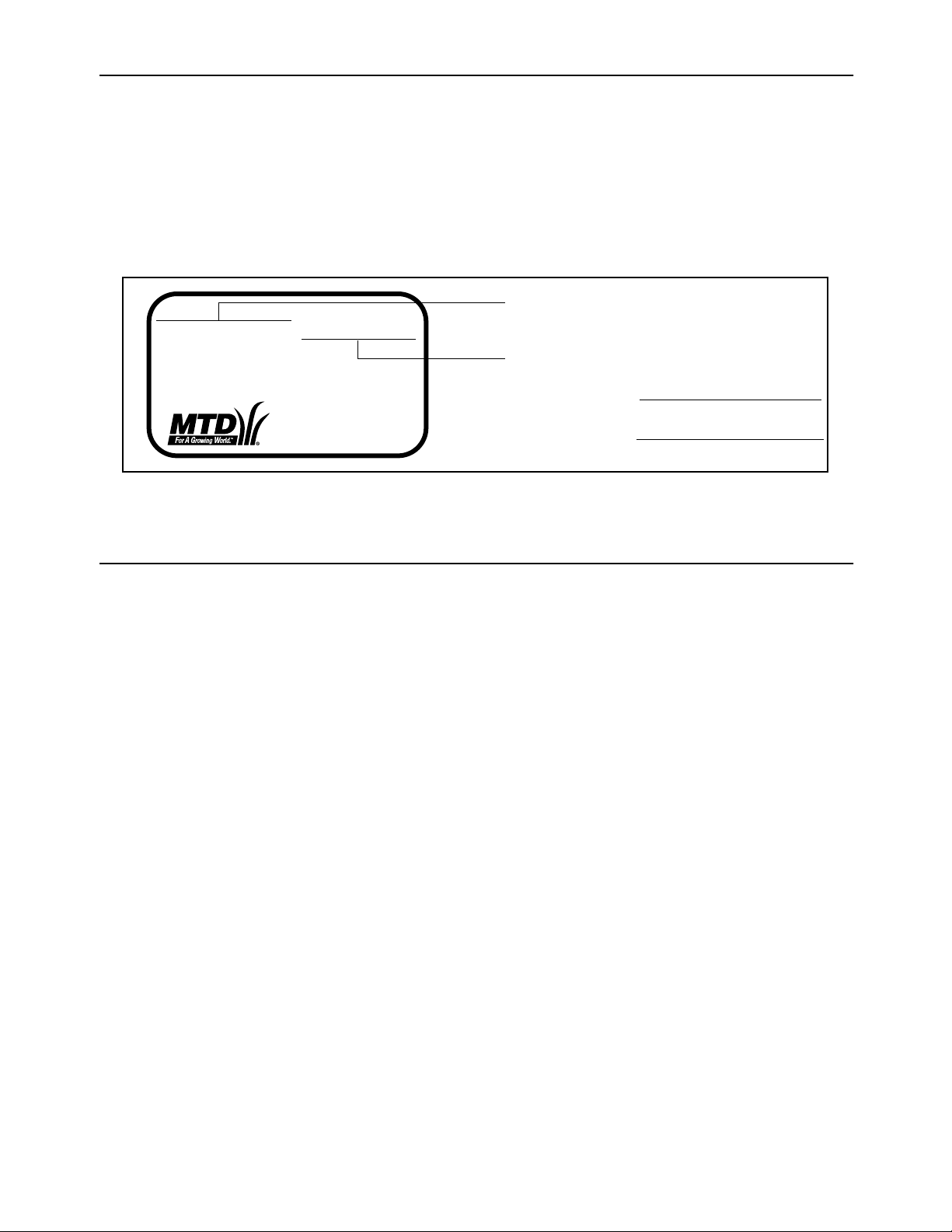
• Every snow thrower has a model plate. You can locate it by standing behind the unit in the operating
position and looking down at the frame below engine.
• The model plate will look like Figure 2.
This is where your model number will be.
XXX-X-XXX-X-XXX XXXXXXXXXXX
This is where your serial number will be.
Copy the model number here:
MTD PRODUCTS INC
CLEVELAND, OHIO 44136
Copy the serial number here:
Figure 2
SECTION 3: CALLING CUSTOMER SUPPORT
If you are having difficulty assembling this product or if you have any question regarding the controls,
operation or maintenance of this snow thrower, please call the Customer Support Department. You can
reach them by calling:
1-800-800-7310
Before you call, make sure that you have both your model and serial number ready. By having the model and
serial number ready, you help the Customer Support Representative give you faster service. To find your
units model and serial number, see SECTION 2: FINDING YOUR MODEL NUMBER.
4
Page 5

SECTION 4: CONTENTS OF HARDWARE PACK
Lay out the hardware according to the illustration for identification purposes. Part numbers are shown in parentheses.
(Hardware pack may contain extra items which are not used on your unit.)
ATTACHING THE HANDLES
A
D
(2)Hex Bolts (A)
(710-3180)
(2) Hex Bolts (B)
710-3008
ATTACHING THE SPEED SELECTOR PLATE
AND SHIFT LEVER
(4)Lock Washers (C)
(736-0119)
(2) Saddle (I)
(784-5599)
(4) Self-Tapping
Screws (F)
(710-0599)
ATTACHING THE CLUTCH GRIPS
B
ATTACHING THE HANDLE PANEL
C
(4) Carriage Bolts (E)
(710-0262)
(4) Hex Nuts (D)
(712-3010)
ATTACHING THE CLUTCH CABLES
E
(2) “Z” Fitting (R)
(746-0778)
(4) Hex Nuts (D)
(712-3010)
(4) Lock
Washers (C)
(736-0119)
(2) Hex Nuts (J)
(712-0121)
(2) Hex
Bolts (G)
(712-3015)
ATTACHING THE CHUTE CRANK ASSEMBLY
G
Cupped Washer (N)
(736-0242)
(2) Flat Washers
Hex lock nuts cannot be threaded onto a bolt by hand. A wrench
is required for assembly. This type of nut is used where vibration
occurs.
(2) Hex Lock Nuts (H)
(712-3027)
(2) Hex Nuts (D)
(712-3010)
Hair Pin Clip
(714-0104)
(736-0185)
ATTACHING THE CHUTE ASSEMBLY
F
(6) Hex Bolts (K)
(710-3015)
AUGER SHEAR BOLTS (SPARES)
H
(2) Hex Lock Nuts
(712-0429)
(2) Shear Bolts
(710-0890A)
(6) Hex Lock Nuts (M)
(712-3027)
(3) Chute Flange Keepers
(Not Shown) (731-0851)
5
Page 6
SECTION 5: ASSEMBLY INSTRUCTIONS
IMPORTANT:
with gasoline, and check oil level as instructed in
the separate engine manual packed with your unit.
NOTE:
thrower are determined from behind the unit in the
operating position.
References to right or left side of the snow
After assembly, service engine
UNPACKING
• Remove staples or break glue on the top
flaps of the carton. Remove any loose parts
included with unit (i.e., owner’s manual, etc.).
• Cut along dotted lines and lay end of carton
down flat. Remove packing material.
• Roll unit out of carton. Check carton
thoroughly for loose parts before discarding.
A
TOOLS REQUIRED FOR ASSEMBLY
• (1) 3/8" or adjustable wrench
• (2) 7/16" or adjustable wrench
• (2) 1/2" or adjustable wrench
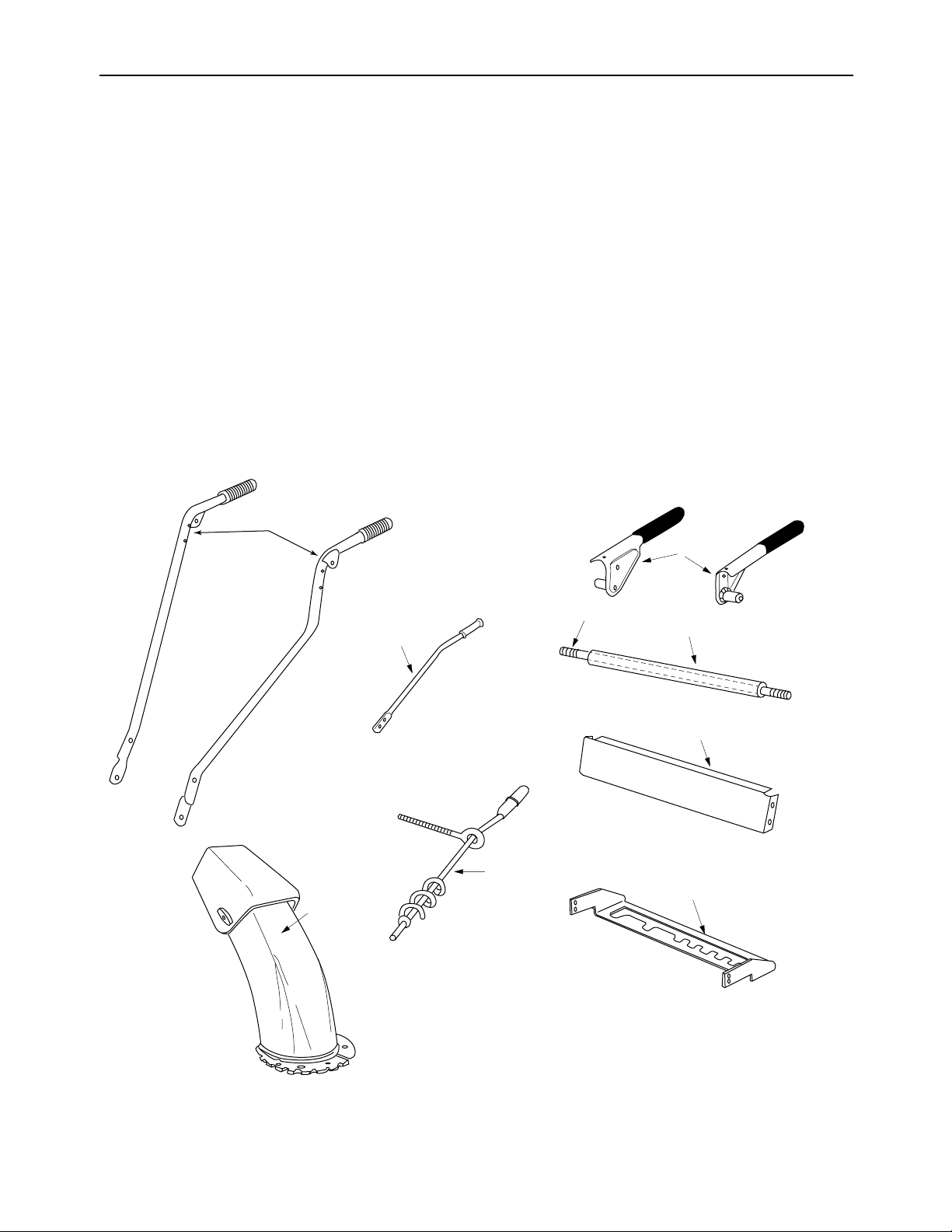
LOOSE PARTS IN CARTON (See Figure 3)
A (2) Handles (Right and Left)
B (1) Pivot Rod
C (1) Cov er Tube
D (2) Clutch Grips (Right and Left)
E (1) Handle Panel
F (1) Speed Selector Plate
G (1) Shift Lever
H (1) Chute Crank Assembly
J (1) Chute Assembly
I (1) Hardware Pack
D
B
G
H
J
C
E
F
Figure 3
6
Page 7
Saddle
(I)
Hex Bolt
(B)
Hex Bolt
Lock Washer
Figure 4
Lock Washer
(C)
(A)
(C)
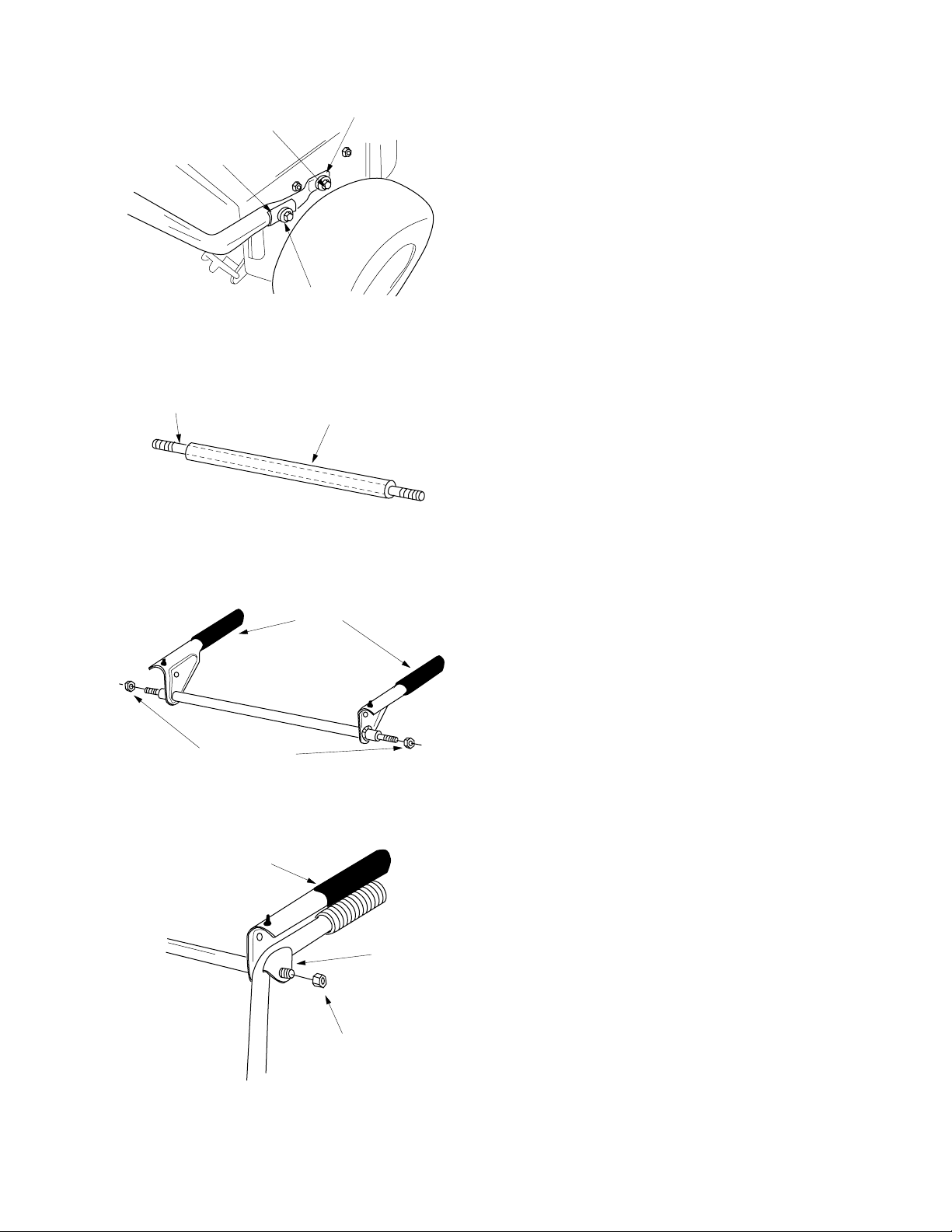
A TT ACHING THE HANDLES (Hardware A)
1. Place right handle in position against the snow
thrower so the flat side of the handle is against
the frame. Secure bottom hole in handle to
snow thrower using hex bolt (B) and lock
washer (C). There are weld nuts welded to the
inside of the frame for these bolts. See Figure
4. Do not tighten at this time.
2. Attach the left handle in the same manner. Do
not tighten at this time.
3. Place saddle (I) over upper holes on handles
(curve matching curve on handle). Secure to
the frame with lock washers (C) and hex bolts
(A). See Figure 4. Do not tighten at this time.
Pivot Rod
Hex Nuts (D)
Clutch Grip and
Rod Assembly
Figure 5
Clutch
Grips
Figure 6
Cover Tube
ATTACHING THE CLUTCH GRIPS
(Hardware B)
1. Slide the pivot rod into the cover tube as shown
in Figure 5. The pivot rod and cover tube may
already be assembled.
2. Place the clutch grips in position on the rod so
the flat side of the clutch grips are against the
pivot rod cover. Thread hex nuts (D) onto each
end of the rod. Tighten nuts allowing the clutch
grips to move freely on pivot rod. See Figure 6.
3. Insert clutch grip and rod assembly into handle
tabs. Clutch grips must sit on top of the
handles. Thread hex nuts (D) on each end to
hold into position. Do not tighten. See Figure 7.
Hex Nut (D)
Figure 7
Handle
Tab
7
Page 8

Hex Nuts (D)
ATTACHING THE HANDLE PANEL
(Hardware C)
Position the handle panel between handles. Insert
carriage bolts (E) and secure with lock washers (C)
and hex nuts (D). See Figure 8.
Lock Washers (C)
Speed
Selector
Plate
Figure 8
Shift Lever
Figure 9
“Z” Fitting
(R)
Carriage
Bolts (E)
Self-Tapping
Screw (F)
Hex
Bolts (G)
Shift Lever
Spring
Hex Lock
Nuts (H)
Hex
Nut
(J)
ATTACHING SPEED SELECTOR PLATE
AND SHIFT LEVER (Hardware D)
1. Assemble the speed selector plate to the
outside of the handles as shown in Figure 9.
The speed selector plate should not be
assembled between the handles and the
engine. Secure using four self-tapping screws
(F).
2. Insert the shift lever through slot in the speed
selector plate.
NOTE:
the operator. Secure shift lever to the shift lever
spring using two hex bolts (G) and hex lock nuts
(H). Tighten both bolts finger tight. At this point the
shift lever and shift lever spring are not against each
other. As you tighten the bolts and nuts with two
7/16" wrenches they will pull together. See Figure 9.
3. Tighten all hardware assembled to this point.
The bend in the lever should be towards
CLUTCH GRIPS MUST MOVE FREELY.
ATTACHING THE CLUTCH CABLES
(Hardware E)
1. Thread hex nuts (J) onto the “Z” fittings (R) (see
inset, Figure 10). Insert “Z” fitting into hole in
clutch grips.
2. Route the left cable between engine and speed
selector plate and then between handle panel
and clutch lever pivot rod before threading onto
the left “Z” fitting. Assemble the right cable
using the same route.
3. Correct adjustment on cables is minimal slack
but not tight. Tighten hex nuts when adjustment
is correct.
NOTE:
adjusted correctly, the wheels will tend to turn. If the
left hand lockout cable is not adjusted correctly, the
augers will not stop rotating.
If the right hand lockout cable is not
Figure 10
8
WARNING:
tension on either clutch cable with the
drive or auger clutch grip in the
disengaged (up) position. These
clutches are a safety feature, and their
function can be overridden if there is
tension on either cable with the
clutches disengaged.
There must not be any
Page 9
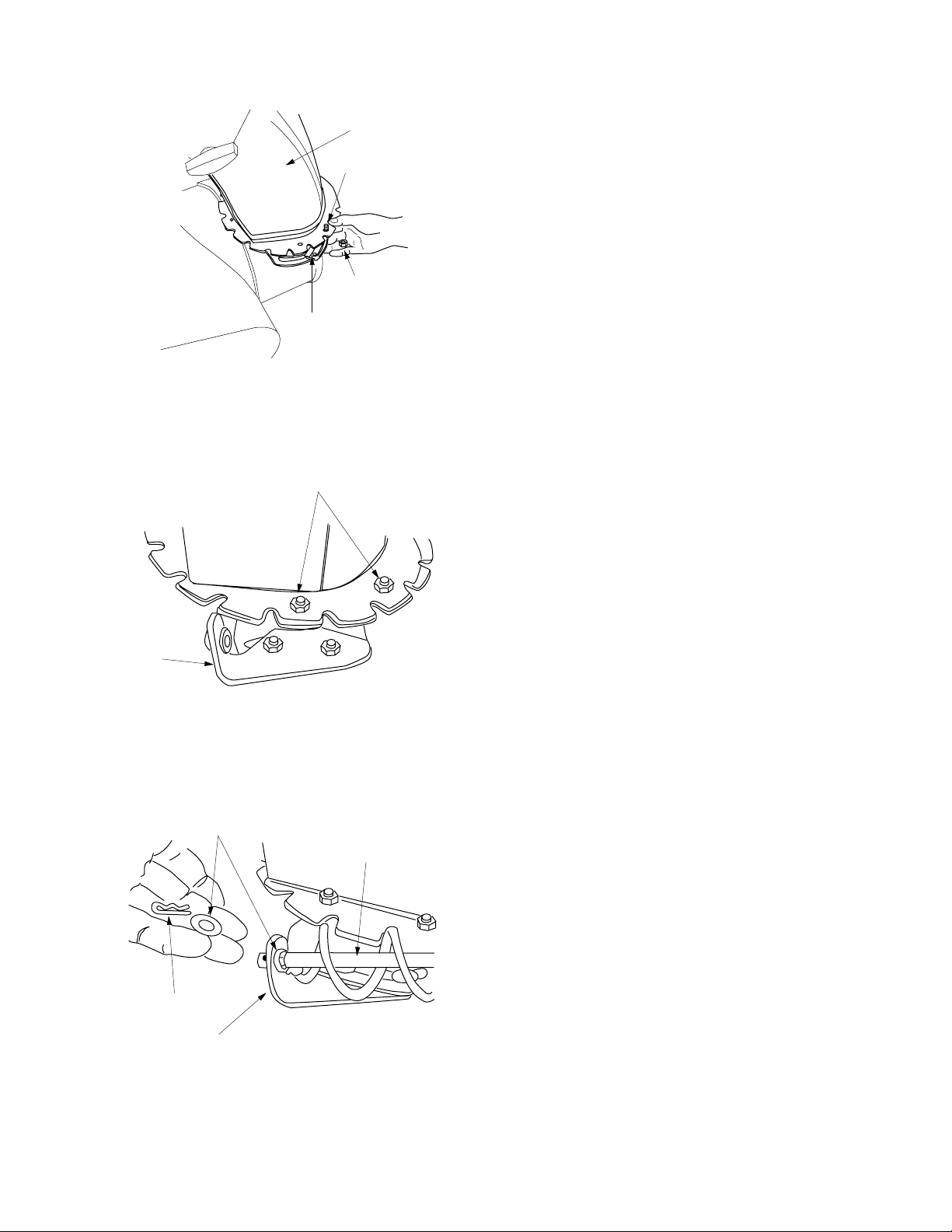
Lower
Chute
Crank
Bracket
Figure 11
Carriage Bolts
Hex Lock Nuts
Figure 12
Flat
Washer
Chute
Assembly
Hex Bolt
Hex Lock Nut
Chute Flange
Keeper
Chute
Crank
ATTACHING THE CHUTE ASSEMBLY
(Hardware F)
1. Place chute assembly over chute opening, with
the opening in the chute assembly facing the
front of the unit. Place chute flange keepers
beneath lip of chute assembly, with the flat side
of chute flange keeper facing downward.
2. Insert hex bolt (K) up through chute flange
keeper and chute assembly as shown in Figure
11. Secure with hex lock nut (M). After
assembling all three chute flange keepers,
tighten all nuts and bolts securely. Do not
overtighten.
Note : Locknuts cannot be threaded onto a bolt by
hand. Tighten with 2 7/16” wrenches. This type of
nut is used where vibration occurs.
ATTACHING THE CHUTE CRANK
(Hardware G)
1. Loosen the two hex nuts which secure the
chute crank support bracket (see Figure 12) to
the snow thrower housing.
2. Place one flat washer over the end of the chute
crank, then insert the end of the crank into the
hole in the plastic bushing in the chute bracket.
See Figure 13. Place second flat washer on
chute crank, and secure with hairpin clip.
3. Thread one hex nut (D) onto the eyebolt on the
chute crank assembly until there is at least two
inches of threads showing between the nut and
the head of the eyebolt. See Figure 14.
4. Place the eyebolt into the hole located half way
up the left handle. Secure with cupped washer
(N) (cupped side against the handle, see inset,
Figure 14) and hex nut (D).
5. Adjust the chute crank support bracket (see
Figure 13) so that the spiral on the chute crank
fully engages the teeth on the chute assembly.
Tighten the nuts on the chute crank bracket
securely. Tighten the hex nuts on the eyebolt.
6. Check to make sure all nuts and bolts on the
control panel and all four bolts which secure the
handles to the frame are tight.
Hairpin Clip
Chute Crank
Bracket
Figure 13
9
Page 10

FINAL ASSEMBLY AND ADJUSTMENTS
Left
Handle
Hex Nut
“Z” Fitting
Cable
(D)
2” of
Threads
Washer (N)
Figure 14
Hex Bolt
Figure 15
Cup
Side
Cupped
Crown
Side
Eyebolt
Hex Nut
(D)
Auger Drive Clutch
To check the adjustment of the auger drive clutch,
push forward on the left hand clutch grip (depress
the rubber bumper). There should be slack in the
cable. Release the clutch grip. The cable should be
straight. Make certain you can depress the auger
drive clutch grip against the left handle completely.
If necessary, loosen the hex lock nut and thread the
cable in (for less slack) or out (for more slack) as
necessary. Refer to Figure 15. Recheck the
adjustment.
Tighten the lock nut against the cable when correct
adjustment is reached.
Traction Drive Clutch and Shift Lever
Adjustment
To check the adjustment of the traction drive clutch
and shift lever, move the shift lever all the way
forward to sixth (6) position. With the traction drive
lever released, push the snow thrower forward. The
unit should move forward freely. Then engage the
traction drive clutch grip. The wheels should stop
turning.
Now release the traction drive clutch grip, and push
the unit again. Move the shift lever back to the fast
reverse position, then all the way forward again.
There should be no resistance in the shift lever, and
the and the wheels should keep turning
If you have resistance when moving the shift lever
or the wheels stop when they should not, loosen the
jam nut on the traction drive cable and unthread the
cable one turn. If the wheels do not stop when you
engage the traction drive clutch grip, loosen the jam
nut on the traction drive cable and thread the cable
in one turn. Recheck the adjustment and repeat as
necessary. Tighten the jam nut to secure the cable
when correct adjustment is reached.
Skid
Shoe
Hex
Carriage
Nuts
Bolts
Figure 16
Low Position
High Position
NOTE:
the correct adjustment, refer to the Adjustment
section.
If you are uncertain that you have reached
ADJUSTING THE SKID SHOES
The space between the shave plate and the ground
can be adjusted.
For close snow removal on a smooth surface, raise
the skid shoes into a high position on the auger
housing.
Use a middle or lower position when the area to be
cleared is uneven. See Figure 16.
Adjust skid shoes by loosening the four hex nuts
and carriage bolts and moving skid shoes to desired
position.
Make certain the entire bottom surface of skid shoe
is against the ground to avoid uneven wear on the
skid shoes. Retighten nuts and bolts securely.
10
Page 11

TIRE PRESSURE (Pneumatic Tires)
The tires are overinflated for shipping purposes.
Check tire pressure and reduce to 15 to 20 psi.
Refer to tire sidewalls for recommended tire
pressure.
NOTE:
tires, the unit may pull to one side or the other.
If the tire pressure is not equal in both
SECTION 6: CONTROLS
Auger Drive Clutch Traction Drive Clutch
Chute Crank
Shift Lever
Figure 17
CHUTE CRANK
(See Figure 17)
The chute crank is located on left hand side of the
snow thrower.
To change the direction in which snow is thrown,
turn chute crank as follows:
• Crank clockwise to discharge to the left.
• Crank counterclockwise to discharge to the
right.
THROTTLE CONTROL
(See Figure 18)
The throttle control is located on the engine. It
regulates the speed of the engine.
SAFETY IGNITION KEY
(See Figure 18)
The ignition key must be inserted in the switch
before the unit will start. Remove the ignition key
when snow thrower is not in use.
FUEL CUTOFF VALVE
The fuel cutoff valve, located under the fuel tank,
controls fuel flow from tank.
Closed
SHIFT LEVER
(See Figure 17)
The shift lever is located below the handle panel.
The shift lever may be moved into one of seven
positions. Run engine with throttle in the fast
position. Use the shift lever to determine ground
speed.
Forward—one of five speeds. Position number one
(1) is the slowest. Position number five (5) is the
fastest.
Reverse—two reverse speeds; R1 and R2. R2 is
the faster reverse speed.
AUGER DRIVE CLUTCH
(See Figure 17)
The auger drive clutch is located on the left handle.
Squeeze the clutch grip to engage the augers.
Release to stop the snow throwing action.
TRACTION DRIVE CLUTCH
(See Figure 17)
The traction drive clutch is located on the right
handle. Squeeze the traction drive clutch to engage
the wheel drive. Release to stop.
Choke
Ignition
Key
Throttle
Control
Figure 18
Open
Primer
Rope
Start
Handle
11
Page 12

SECTION 7: OPERATION
BEFORE STARTING
WARNING:
Labels on the snow thrower prior to
use. See Figure 1.
Your snow thrower is shipped with oil; however,
you must check the oil level before operating. Be
careful not to overfill.
The spark plug wire was disconnected for safety.
Attach spark plug wire to spark plug before starting.
Observe all Warning
GAS AND OIL FILL-UP
Check oil level and add oil if necessary. Service the
engine with gasoline as instructed in the separate
engine manual packed with your snow thrower.
Read instructions carefully.
WARNING: Never fill fuel tank
indoors. Never fill fuel tank with engine
running or while engine is hot. Do not
smoke when filling fuel tank.
TO START ENGINE
1. Attach spark plug wire to spark plug. Make
certain the metal loop on the end of the spark
plug wire (inside the boot) is fastened securely
over the metal tip on the spark plug. See Figure
19.
Metal Loop
on Spark
Plug Wire
Electric Starter
WARNING: The optional electric
starter is equipped with a three-wire
power cord and plug, and is designed
to operate on 120 volt AC household
current. It must be properly grounded
at all times to avoid the possibility of
electric shock which may be injurious
to the operator. Follow all instructions
carefully. Determine that your house
wiring is a three wire grounded system.
Ask a licensed electrician if you are not
certain. If your house wiring system is
not a three-wire grounded system, do
not use this electric starter under any
conditions. If your system is grounded
and a three-hole receptacle is not
available at the point your starter will
normally be used, one should be
installed by a licensed electrician.
When connecting the power cord, always connect
cord to starter on engine first, then plug the other
end into a three-hole grounded receptacle.
When disconnecting the power cord, always unplug
the end from the three-hole grounded receptacle
first.
Spark
Plug
Switch
Box
Starter Button
(Optional)
Rubber Boot
Figure 19
2. Make certain the fuel cutoff valve is in the
OPEN (vertical) position.
3. Make certain the auger and drive clutch levers
are in the disengaged (released) position.
4. Move throttle control up to FAST position. Insert
ignition key into slot. See Figure 20. Be certain
it snaps into place. Do not turn key
ENGINE WILL NOT START
UNLESS IGNITION KEY IS INSERTED INTO IGNITION
SLOT IN CARBURETOR
COVER. DO NOT TURN IGNITION KEY.
Choke
Ignition
Key
1. Rotate choke knob to OFF position.
2. Connect power cord to switch box on engine.
Plug the other end of power cord into a threehole, grounded 12-volt AC receptacle.
3. Push starter button to crank engine. See Figure
20. As you crank the engine, move choke knob
to FULL choke position.
12
Throttle
Control
Figure 20
Primer
Rope Starter
Handle
Page 13

4. When engine starts, release starter button, and
move choke gradually to OFF. If engine falters,
move choke immediately to FULL and then
gradually to OFF.
Recoil Starter:
1. Rotate choke knob to FULL choke position (cold
engine start).
2. If engine is warm, place choke in OFF position
instead of FULL.
3. Push primer button two or three times for cold
engine start. See Figure 20.
4. If engine is warm, push primer button once only.
NOTE: Always cover vent hole in primer button
when pushing. Additional priming may be necessary
for first start if temperature is below 15 degrees
Fahrenheit.
5. Grasp starter handle (see Figure 20) and pull
rope out slowly, until it pulls slightly harder. Let
rope rewind slowly.
6. Pull starter handle rapidly. Do not allow handle
to snap back. Allow it to rewind slowly while
keeping a firm hold on the starter handle.
7. Repeat step 8 until engine starts.
8. As engine warms up and begins to operate
evenly, rotate choke knob slowly to OFF
position. If engine falters, return to FULL choke,
then slowly move to OFF position.
TO STOP ENGINE
1. Run engine for a few minutes before stopping to
help dry off any moisture on the engine.
2. To help prevent possible freeze up of starter,
proceed as follows.
• Optional Electric Starter: Connect power
cord to switch box on engine, then to 120 volt
AC receptacle. With the engine running, push
starter button and spin the starter for several
seconds. The unusual sound made by
spinning the starter will not harm engine or
starter. Disconnect the power cord from
receptacle first, and then from switch box.
• Recoil Starter: With engine running, pull
starter rope with a rapid, continuous full arm
stroke three or four times. Pulling the starter
rope will produce a loud clattering sound,
which is not harmful to the engine or starter.
3. To stop engine, move throttle control to “stop” or
“off” position.
4. Remove the ignition key. Do not turn key.
Disconnect the spark plug wire from the spark
plug to prevent accidental starting while
equipment is unattended.
NOTE: Do not lose ignition key. Keep it in a safe
place. Engine will not start without the ignition key.
5. Wipe all snow and moisture from the carburetor
cover in the area of the control levers. Also,
move control levers back and forth several
times.
TO ENGAGE DRIVE
1. With the engine running near top speed, move
shift lever into one of the five FORWARD
positions or two REVERSE positions. Select a
speed appropriate for the snow conditions that
exist. Use the slower speeds until you are
familiar with the operation of the snow thrower.
2. Squeeze the auger clutch grip and the augers
will turn. Release it and the augers will stop.
3. Squeeze the drive clutch grip and the snow
thrower will move. Release it and drive motion
will stop.
4. NEVER move shift lever without releasing drive
clutch.
TO ENGAGE AUGERS
To engage the augers and start the snow throwing
action, squeeze the auger clutch grip against the left
handle. Release to stop the augers.
TIRE CHAINS (Optional Equipment)
Tire chains should be used whenever extra traction
is needed.
OPERA TING TIPS
NOTE: Allow the engine to warm up for a few
minutes as the engine will not develop full power
until it reaches operating temperature.
WARNING: Temperature of muffler
and surrounding areas may exceed 150
degrees Fahrenheit. Avoid these areas.
1. For most efficient snow removal, remove snow
immediately after it falls.
2. Discharge snow downwind whenever possible.
Slightly overlap each previous swath.
3. Set the skid shoes 1/4" below the scraper bar
for normal usage. The skid shoes may be
adjusted upward for hard-packed snow. Adjust
downward when using on gravel or crushed
rock.
4. Be certain to follow the precautions listed under
‘‘To Stop Engine’’ to prevent possible freeze-up.
5. Clean the snow thrower thoroughly after each
use.
13
Page 14

SECTION 8: ADJUSTMENTS
WARNING: NEVER attempt to clean
chute or make any adjustments while
engine is running.
CHUTE ASSEMBLY ADJUSTMENT
The distance snow is thrown can be controlled by
adjusting the angle of the top section of the chute
assembly.
SKID SHOE ADJUSTMENT
The space between the shave plate and the ground
can be adjusted. Refer to the Final Assembly and
Adjustments section.
TRACTION DRIVE CLUTCH
ADJUSTMENT
Refer to the Final Assembly and Adjustments
section to adjust the traction drive clutch. If you are
uncertain that you have reached the correct
adjustment, the adjustment can be physically
checked as follows.
1. With the snow thrower tipped forward (be
certain to drain the oil gasoline or drain the oil
and place plastic film under the gas cap if the
snow thrower has already been operated),
remove the frame cover underneath the snow
thrower by removing six self-tapping screws.
2. With the traction drive clutch released, there
must be clearance between the friction wheel
and the drive plate in all positions of the shift
lever. With the traction drive clutched engaged,
the friction wheel must contact the drive plate.
See Figure 21.
Friction
Wheel
3. If adjustment is necessary, loosen the lock nut
on the traction drive cable and thread the cable
in or out as necessary. Tighten the lock nut to
secure the cable when correct adjustment is
reached. Reassemble the frame cover.
NOTE: If you placed plastic under the gas cap, be
certain to remove it.
AUGER CLUTCH ADJUSTMENT
To adjust the auger clutch, refer to Final Assembly
and Adjustments section on page 10.
CARBURETOR ADJUSTMENT
WARNING: If any adjustments are
made to the engine while the engine is
running (e.g. carburetor), keep clear of
all moving parts. Be careful of heated
surfaces and muffler.
Minor carburetor adjustment may be required to
compensate for differences in fuel, temperature,
altitude and load.
Refer to the separate engine manual packed with
your unit for carburetor adjustment information.
DRIVE WHEELS
The wheels may be adjusted for two different
methods of operation. The adjustment is made by
placing the klick pins in one of two different holes on
the right side of the unit. See Figure 22.
1. One Wheel Driving—On the right side of the
unit, place klick pin in the outside axle hole only.
Do not place pin through wheel hub. This
position gives power drive to the left wheel only,
making the unit easier to maneuver.
2. Both Wheels Driving—Rotate wheel assembly
to align hole in hub with inner hole on axle shaft.
Insert klick pin in hole. Outer axle shaft hole
should be visible. See Figure 22.
Drive
Plate
Gear Shaft
Figure 21
14
Klick Pin in Hub
and Inner
Hole
Figure 22
Axle
Hole
Outside
Hole in Axle
Page 15

SECTION 9: LUBRICATION
WARNING: Disconnect the spark
plug wire and ground against the
engine before performing any repairs
or maintenance.
GEAR SHAFT
Lubricate the gear shaft with a good al-weather
multi-purpose light grease at least once a season or
after every 25 hours of operation.
IMPORTANT: Keep all grease and oil off of the
friction wheel and drive plate.
ENGINE
Refer to engine manual for engine lubrication
instructions.
WARNING: When following instruc-
tions in separate engine manual for
draining oil, be sure to protect frame to
avoid oil dripping onto transmission parts.
WHEELS
Oil or spray lubricant into bearings at wheels at
least once a season. Pull klick pin, remove wheels,
clean and coat axles with a multipurpose
automotive grease. See Figure 23.
Oil Bearings
Klick Pin
Axle
or Spray Lubricant
DRIVE AND SHIFTING MECHANISM
Remove rear cover. Oil any chains, sprockets,
gears, bearings, shafts, and shifting mechanism at
least once a season. Use engine oil or a spray
lubricant. Avoid getting oil on rubber friction wheel
and aluminum drive plate.
GEAR CASE
The worm gear case has been filled with grease at
the factory. If disassembled for any reason,
lubricate with 2 ounces of Shell Alvania grease
EPR00, part number 737-0168. Before
reassembling, remove old sealant and apply “Loctite
5699” or equivalent.
IMPORTANT: Do not overfill the gear case.
Damage to the seals could result. Be sure the vent
plug is free of grease in order to relieve pressure.
SECTION 10: MAINTENANCE
WARNING: Disconnect the spark
plug wire and ground against the
engine before performing any repairs
or maintenance.
Figure 23
CHUTE CRANK
The worm gear on the chute direction crank should
be greased with multipurpose automotive grease.
AUGER SHAFT
Remove shear bolts on auger shaft. Oil or spray
lubricant inside shaft. See Figure 24.
Shear Bolts
Bearings
Figure 24
ENGINE
Refer to separate engine manual for all engine
maintenance procedures.
AUGERS
The augers are secured to the spiral shaft with two
shear bolts and hex lock nuts. See Figure 24. If you
hit a foreign object or ice jam, the snow thrower is
designed so that the bolts will shear.
If the augers will not turn, check to see if the bolts
have sheared. A replacement shear bolt (P) and
hex lock nut (Q) have been provided with the snow
thrower. When replacing bolts, spray an oil lubricant
into shaft before inserting new bolts.
SHAVE PLATE AND SKID SHOES
The shave plate and skid shoes on the bottom of
the snow thrower are subject to wear. They should
be checked periodically and replaced when
necessary.
15
Page 16

• To remove skid shoes, remove the four
carriage bolts, cupped washers and hex nuts
which attach them to the snow thrower.
Reassemble new skid shoes with the four
carriage bolts, cupped washers (cupped side
goes against skid shoes) and hex nuts.
• To remove shave plate, remove the carriage
bolts, cupped washers and hex nuts which
attach it to the snow thrower housing.
Reassemble new shave plate, making sure
heads of the carriage bolts are to the inside of
the housing. Tighten securely.
Rear Auger
Belt
Idler
Pulley
Drive
Belt
Engine
Pulley
Front
Auger
Belt
BELT REMOVAL AND REPLACEMENT
WARNING: Remove the spark plug
wire from the spark plug and ground.
Drain gasoline from the fuel tank, or
place a piece of plastic film underneath
the gas cap to prevent gasoline from
leaking.
AUGER BELTS
1. Remove the plastic belt cover on the front of the
engine by removing the two self-tapping
screws. See Figure 25.
Self-Tapping
Belt
Cover
Screws
Engine
Pulley
Idler
Pulley
Figure 26
7. Unhook the support bracket spring from the
frame.
NOTE: It may be necessary to loosen the six nuts
that connect the frame to the auger housing to aid in
belt removal.
8. Lift the rear auger belt from the auger pulley,
and slip belt between the support bracket and
the auger pulley. See Figure 26. Repeat this
step for the front auger belt.
9. Replace both auger drive belts by following
instructions in reverse order.
Friction Wheel
Pin
Assembly
Figure 25
2. Drain the gasoline from the snow thrower, or
place a piece of plastic under the gas cap.
3. Tip the snow thrower up and forward so that it
rests on the housing.
4. Remove six self-tapping screws from the frame
cover underneath the snow thrower.
5. Roll the front and rear auger belts off the engine
pulley. See Figure 26.
NOTE: 5.0 HP model has only one auger belt.
6. Unhook the idler spring from the hex bolt on the
auger housing. See Figure 27.
16
Support
Bracket
Auger
Belt
Auger
Pulley
Idler
Spring
Auger
Housing
Figure 27
Frame
Gear
Shaft
Support
Bracket
Spring
Page 17

DRIVE BELT
1. Follow steps 1 through 4 of previous
instructions.
2. Pull idler pulley up, and lift belt off engine pulley
and friction wheel disc. See Figure 26.
3. Using a 7/16" wrench, loosen the nut on the
stop bolt until the support bracket rests on the
auger pulley. See Figure 28.
4. Slip belt between friction wheel and friction
wheel disc. See Figure 28. Remove and replace
belt. Reassemble following the instructions in
reverse order.
NOTE: The support bracket must rest on the stop
bolt after the new belt has been assembled. See
Figure 28.
Friction
Wheel
Disc
Friction Wheel
Drive Belt
Support Bracket
3. Remove six self-tapping screws from the frame
cover underneath the snow thrower.
4. Remove the klick pins which secure the wheels,
and remove the wheels from the axle.
5. Using a 7/8’’ wrench to hold the shaft, loosen,
but do not completely remove, the hex nut and
bell washer on the left end of gear shaft. See
Figure 29.
6. Lightly tap the hex nut to dislodge the ball
bearing from the right side of the frame.
Remove the hex nut and bell washer from the
left end of shaft.
7. Slide the gear shaft to the right, then slide the
friction wheel assembly from the shaft.
8. Remove the six screws from the friction wheel
assembly (three from each side). Remove
the friction wheel rubber from between the
friction wheel plate.
9. Reassemble new friction wheel rubber to the
friction wheel assembly, tightening the six
screws in rotation and with equal force.
10. Slide friction wheel assembly back onto the
gear shaft. Be sure to align the pin on the shift
rod with the hole in the friction wheel assembly.
See Figure 27. Reassemble in reverse order.
Stop
Bolt
Figure 28
CHANGING THE FRICTION WHEEL
RUBBER
The rubber on the friction wheel is subject to wear
and should be checked after 25 hours of operation,
and periodically thereafter. Replace the friction
wheel rubber if any signs of wear or cracking are
found.
1. Drain the gasoline from the snow thrower, or
place a piece of plastic under the gas cap.
2. Tip the snow thrower up and forward, so that it
rests on the housing.
Hex Nut
Bell Washer
Figure 29
17
Page 18

SECTION 11: OFF-SEASON STORAGE
WARNING: Never store engine with
fuel in tank indoors or in poorly
ventilated areas, where fuel fumes may
reach an open flame, spark or pilot
light as on a furnace, water heater,
clothes dryer or other gas appliance.
If unit is to be stored over 30 days, prepare for
storage as follows:
1. Remove all gasoline from carburetor and fuel tank to
prevent gum deposits from forming on these parts
and causing possible malfunction of engine.
• Run engine until fuel tank is empty and
engine stops due to lack of fuel.
• Drain carburetor by pressing upward on bowl
drain, located below the carburetor cover.
WARNING: Drain fuel into approved
container outdoors, away from open
flame. Be certain engine is cool. Do not
smoke. Fuel left in engine during warm
weather deteriorates and will cause
serious starting problems.
NOTE: Fuel stabilizer (such as STA-BIL) is an
acceptable alternative in minimizing the formation of
fuel gum deposits during storage. Add stabilizer to
gasoline in fuel tank or storage container. Always
follow mix ratio found on stabilizer container. Run
engine at least 10 minutes after adding stabilizer to
allow it to reach carburetor. Do not drain carburetor
if using fuel stabilizer.
• Remove all dirt from exterior of engine and
equipment.
• Remove spark plug and pour one (1) ounce
of engine oil through spark plug hole into
cylinder. Crank engine several times to
distribute oil. Replace spark plug.
• Follow lubrication recommendations on
page 15.
NOTE: When storing any type of power
equipment in an unventilated or metal storage shed,
care should be taken to rust proof the equipment.
Using a light oil or silicone, coat the equipment,
especially any chains, springs, bearings and cables.
18
Page 19

SECTION 12: Trouble Shooting Guide
Trouble Possible Cause(s) Corrective Action
Engine fails to start Fuel tank empty, or stale fuel.
Blocked fuel line.
Choke not in ON position
Faulty spark plug.
Key not in switch on engine.
Spark plug wire
disconnected.
Primer button not depressed.
Fuel shut-off valve closed
(if so equipped).
Engine runs
erratic**
Loss of power Spark plug wire loose.
Engine overheats Carburetor not adjusted
Excessive vibration Loose parts or damaged
Unit fails to propel
itself
Unit fails to
discharge snow
Unit running on CHOKE.
Blocked fuel line or stale fuel.
Water or dirt in fuel system.
Carburetor out of adjustment.
Gas cap vent hole plugged.
Exhaust port plugged.
properly.
Incorrect fuel mixture.
auger.
Incorrect adjustment of drive
cable.
Drive belt loose or damaged.
Discharge chute clogged.
Foreign object lodged in
auger.
Incorrect adjustment of drive
cable.
Drive belt loose or damaged.
Fill tank with clean, fresh gasoline. Fuel will not last over thirty
days unless a fuel stabilizer is used.
Clean fuel line.
Move switch to ON position
Clean, adjust gap or replace.
Insert key.
Connect spark plug wire.
Refer to the engine manual packed with your unit.
Open fuel shut-off valve.
Move choke lever to OFF position.
Clean fuel line; fill tank with clean fresh gasoline. Fuel will not last
over thirty days unless a fuel stabilizer is used.
Drain fuel tank. Refill with fresh fuel.
Refer to the engine manual packed with your unit or have
carburetor adjusted by an authorized service dealer.
Connect and tighten spark plug wire.
Remove ice and snow from cap. Be certain vent hole is clear.
Clean-see Maintenance section of engine manual.
Refer to the engine manual packed with your unit or have
carburetor adjusted by an authorized service dealer.
Drain fuel tank. Refill with proper fuel mixture.
Stop engine immediately and disconnect spark plug wire. Tighten
all bolts and nuts. Make all necessary repairs. If vibration
continues, have unit serviced by an authorized service dealer.
Adjust drive cable. Refer to Adjustment section of this manual.
Replace drive belt. Refer to Belt Replacement in Maintenance
section of this manual.
Stop engine immediately and disconnect spark plug wire. Clean
discharge chute and inside of auger housing.
Stop engine immediately and disconnect spark plug wire.
Remove object from auger.
Adjust drive cable. Refer to Adjustment section of this manual.
Replace drive belt. Refer to Belt Replacement in Maintenance
section of this manual.
Note: For repairs beyond the minor adjustments above, contact your local authorized service dealer.
19
Page 20

Model 611
20
Page 21

Model 611
REF.
NO.
2 05931 Housing, Bearing 1 27 736-0119 Lock Washer 9
3 618-0152 Gear Assembly (22") 1 28 736-0174 Washer, Flat 1
4 684-0052 22" Housing Assembly 1 29 736-0188 Washer, Flat, .76 I.D. x
5 684-0065 Impeller Assembly 1 1.49 O.D. x .06 6
6 605-5252 Spiral, 22" R.H. 1 30 736-0242 Washer, Bell 16
7 605-5253 Spiral, 22" L.H. 1 32 738-0281 Screw, Shoulder 1
8 705-5226 Reinforcement, Chute 1 33 741-0245 Bearing, Flange 2
9 710-0134 Bolt, Carriage 2 34 741-0309 Bearing, Ball 1
10 710-0604 Screw, Hex 6 35 741-0475 Bushing, Plastic 1
11 710-0134 Screw, Carriage 3 36 741-0493A Bushing, Flange 4
13 710-0451 Screw, Carriage 10 37 756-0178 Idler, Flat 1
16 710-0890A Bolt, Shear 2 38 784-5580 Shoe, Slide 2
18 712-0116 Hex Lock Nut 1 39 784-5576 22" Shave Plate 1
20 712-0429 Nut, Hex Lock 2 40 784-5632 Arm, Auger Idler 1
21 712-3010 Nut, Hex 19 41 784-5647 Bracket, Chute Crank 1
23 712-0324 Nut, Lock, Hex, Flanged 5 42 736-0169 Lock Washer 1
24 715-0114 Spring Pin 2 43 712-0798 Hex Nut 1
25 731-1379 Adapter, Chute 1 44 710-0459 Screw, Hex Cap 1
PART
NO. DESCRIPTION QTY.
REF.
NO.
45 736-0463 Washer, Flat 5
PART
NO. DESCRIPTION QTY.
REF.
NO.
1 618-0123 Housing—L.H. 1 10 721-0325 Plug 1
2 618-0124 Housing—R.H. 1 11 721-0327 Seal-Oil 1
3 710-0642 Screw 5 12 721-0328 Locktite 5699
4 711-1020 Spiral Axle 22" 1 13 736-0351 Washer-Flat 2
5 714-0161 Key 1 14 736-0369 Washer-Flat 4
6 715-0143 Pin-Spiral 1 15 736-0445 Washer-Flat 1
7 717-0526 Shaft-Worm 1 16 737-0168 Grease 1.5 oz.
8 717-0528 Gear-Worm 1 17 741-0662 Bearing-Flange 1
9 718-0186 Collar-Thrust 1 18 748-0663 Bearing-Flange 1
PART
NO. DESCRIPTION QTY.
REF.
NO.
PART
NO. DESCRIPTION QTY.
21
Page 22

Model 611
22
Page 23

Model 611
REF.
NO.
1 618-0063 Bearing Ass’y. 1 25 736-0242 Washer, Bell 1
2 656-0012A Ass’y., Friction Wheel Disc 1 26 712-0324 Nut 1
3 684-0013B Rod Shift, Wheel Drive 1 27 736-0351 Flat Washer 1
4 684-0021 Brkt. Ass’y. Friction Wheel 1 28 710-0809 Screw 1
5 684-0030 Frame Ass’y., 600 S/T 1 31 738-0869 Axle 1
6 684-0042B Wheel Friction 1 32 738-0924 Screw, Shoulder 3
7 710-0654A Hex Self-Tap Screw 4 33 741-0563 Bearing, Ball 2
8 710-0538 Hex Hd. Cap Screw 2 34 741-0598 Flange Bearing 2
9 710-0599 Scr., Hex Wash. Hd. 2 35 746-0897 Cable, Auger 1
10 710-0896 Hex Self-Tap Scr. 12 36 746-0898 Cable, Clutch 1
11 710-0788 Screw, Hex 1 37 748-0190 Spacer 1
13 712-0711 Nut, Hex 2 38 756-0625 Roller, Cable 3
14 714-0126 Key 1 39 784-5590 Frame, Shift Bracket 1
15 714-0143 Pin, Klick 2 40 784-5638 Cover, Frame 1
16 714-0474 Pin, Cotter 1 41 784-5688 Bracket, Drive Cable Roller 1
17 715-0249 Pin, Roll 2 42 784-5687 Brkt., Auger Clutch Cable Guide 1
19 717-1445 Gear 1 43 784-5689A Brkt., Front Support Guide 1
20 717-1444 Shaft, Hex 1 44 710-0599 Hex Wash Hd. TT-Tap Scr.
21 732-0264 Extension Spring 1 1/4-20 x .5" Lg. 6
22 736-0105 Washer, Bell 2 45 784-5617 Friction Plate 1
23 736-0160 Flat Washer 1 46 718-0301A F riction Wheel Hub 1
24 736-0188 Washer, Flat 3 47 735-0243 Friction Wheel Rubber 1
PART
NO. DESCRIPTION QTY.
REF.
NO.
PART
NO. DESCRIPTION QTY.
WHEEL ASSEMBLY
WHEEL ASSY .
SIZE
13 X 4 634-0114 734-1732 734-0255 734-1713 741-0401 714-0143
13 X 5 634-0166 734-1527 734-0255 684-0129 741-0401 714-0143
COMPLETE (1)
TIRE ONLY (2)
AIR VALVE (3) RIM ONLY (4)
23
SLEEVE
BEARING (5) KLICK PIN (6)
Page 24

Model 611
REF.
NO.
1 684-0022 Crank-Chute 1 22 736-0159 Washer 2
2 684-0047 Handle—L.H. 1 24 747-0904 Lever-Shift 1
3 684-0048 Handle—R.H. 1 25 747-0905 Rod-Pivot 1
4 746-0778 Fitting for Cable* 2 26 7103008 Screw 2
5 705-5231 Panel-5 Speed 1 27 710-3015 Screw 8
6 705-5232 Panel Handle 1 28 710-0262 Screw 4
7 705-5233 Lever-Clutch—L.H. 1 29 710-3180 Screw 2
8 705-5234 Lever-Clutch—R.H. 1 30 712-3010 Nut-Hex 10
9 710-0276 Screw-Carriage 1 31 712-3027 Nut-Hex Flange 8
10 710-0451 Screw-Carriage 1 32 714-0104 Pin-Cotter 1
11 712-0429 Nut-Lock 1 33 720-0223 Grip-Shift Lever 1
12 715-0138 Pin-Roll 1 34 731-0851A Keeper-Chute 3
13 720-0201A Knob-Chute Crank 1 35 735-0234 Grommet 1
14 720-0274 Grip - 5” Lg. 2 36 736-0119 Washer-Lock 8
15 720-0284 Knob 2 37 736-0185 Washer-Flat 2
16 726-0100 Cap-Push 1 38 736-0242 Washer-Bell 1
17 731-0921 Chute-Upper 1 39 747-0697 Eyebolt 1
18 731-1300A Chute-Lower 1 40 784-5599 Tab-Handle 2
19 731-1500 Tube-Pivot Rod Cover 1 41 712-0121 Nut** 2
20 732-0733 Spring-Shift Lever 1 42 710-0896 Screw 4
21 735-0199A Bumper 2 43 710-3015 Screw 1
* Not Shown - Fittings for Control Cable ** Not Shown
PART
NO.
720-0204 Grip - 4.7” Lg.
DESCRIPTION QTY.
REF.
NO.
PART
NO.
DESCRIPTION QTY.
24
Page 25

Model 611
REF.
NO
1 05896A Bracket-Idler 1 16 736-0329 Washer-Lock 1
2 629-0071 Cord-Extension 110V† 1 17 736-0331 Washer-Lock 1
3 710-0627 Screw-Hex 1 18 736-0505 Washer-Flat 1
4 710-1245 Screw-Hex 1 19 736-0507 Washer 1
5 710-0230 Screw-Hex 1 20 748-0234 Spacer 1
6 710-0342 Screw-Hex 1 21 748-0360 Adapter-Pulley 1
7 710-0696 Screw-Hex 1 22 754-0343 V-Belt 1
9 710-0896 Screw-Hex 2 23 754-0430 V-Belt 1
10 712-0181 Nut-Hex 1 24 756-0313 Idler-Flat 1
11 731-1324 Cover-Belt 1 25 756-0569 Pulley-Half 2
12 732-0339 Spring 1 26 756-0967 Pulley 1
13 736-0119 Washer-Lock 1 27 756-0984 Pulley-Half 1
14 736-0242 Washer-Bell 1 28 756-0985 Pulley-Half 1
15 736-0247 Washer-Flat 1 29 390-986 Electric Start Kit†† 1
†† Optional Kit
† For Electric Start Option
PART
NO. DESCRIPTION QTY.
REF.
NO
PART
NO. DESCRIPTION QTY.
25
Page 26

NOTES
26
Page 27

NOTES
27
Page 28

MANUFACTURER’S LIMITED WARRANTY FOR:
For TWO YEARS from the date of retail purchase
within the United States of America, its possessions
and territories, MTD PRODUCTS INC will, at its
option, repair or replace, for the original purchaser,
free of charge, any part or parts found to be
defective in material or workmanship. This warranty
covers units which have been operated and
maintained in accordance with the operating
instructions furnished with the unit, and which have
not been subject to misuse, abuse, commercial use,
neglect, accident, improper maintenance or
alteration.
Normal wear parts or components thereof are
subject to separate terms as noted below in the “No
Fault Ninety Day Consumer Warranty” clause.
All normal wear part failures will be covered on this
product for a period of 90 days regardless of cause.
After 90 days, but within the two year period, normal
wear parts failures will be covered ONLY IF caused
by defects in material or workmanship of OTHER
component parts. Normal wear parts are defined as
batteries*, belts, blades, blade adapters, grass
bags, rider deck wheels, seats, snow thrower skid
shoes, shave plates and tires.
How to obtain service: Warranty service is
available, with proof of purchase, through your local
authorized service dealer. To locate the dealer in
your area, please check the yellow pages or contact
the Customer Service Department of MTD
PRODUCTS INC, P. O. Box 368022, Cleveland,
Ohio 44136-9722. Phone 1 (800) 800-7310. The
return of a complete unit will not be accepted by the
factory unless prior written permission has been
extended by the Customer Service Department of
MTD PRODUCTS INC.
Transportation charges: Transportation charges
for the movement of any power equipment unit or
attachment are the responsibility of the purchaser.
Units exported out of the United States: MTD
PRODUCTS INC does not extend any warranty
for products sold or exported outside of the United
States of America, its possessions and territories,
except those sold through MTD PRODUCTS INC’s
authorized channels of export distribution.
Other Warranties:
1. The engine or component parts thereof carry
separate warranties from their manufacturers.
Please refer to the applicable manufacturer’s
warranty on these items.
2. *Batteries are covered by a 90-day replacement
warranty.
3. Log splitter pumps, valves and cylinders or
component parts thereof are covered by a one
year warranty.
4. All other warranties, express or implied,
including any implied warranty of
merchantability or fitness for a particular
purpose, are hereby expressly disclaimed in
their entirety.
5. The provisions as set forth in this warranty
provide the sole and exclusive remedy of MTD
PRODUCTS INC’s obligations arising from the
sales of its products. MTD PRODUCTS INC will
not be liable for incidental or consequential loss
or damage.
How state law relates to this warranty: This
limited warranty gives you specific legal rights, and
you may also have other rights which vary from
state to state. Certain disclaimers are not allowed in
some states and therefore they may not apply to
you under all circumstances.
NOTE: This warranty does not cover routine
maintenance items such as lubricants, filters, blade
sharpening and tune-ups, or adjustments such as
brake adjustments, clutch adjustments or deck
adjustments. Nor does this warranty cover normal
deterioration of the exterior finish due to use or
exposure.
28
 Loading...