

Page 1
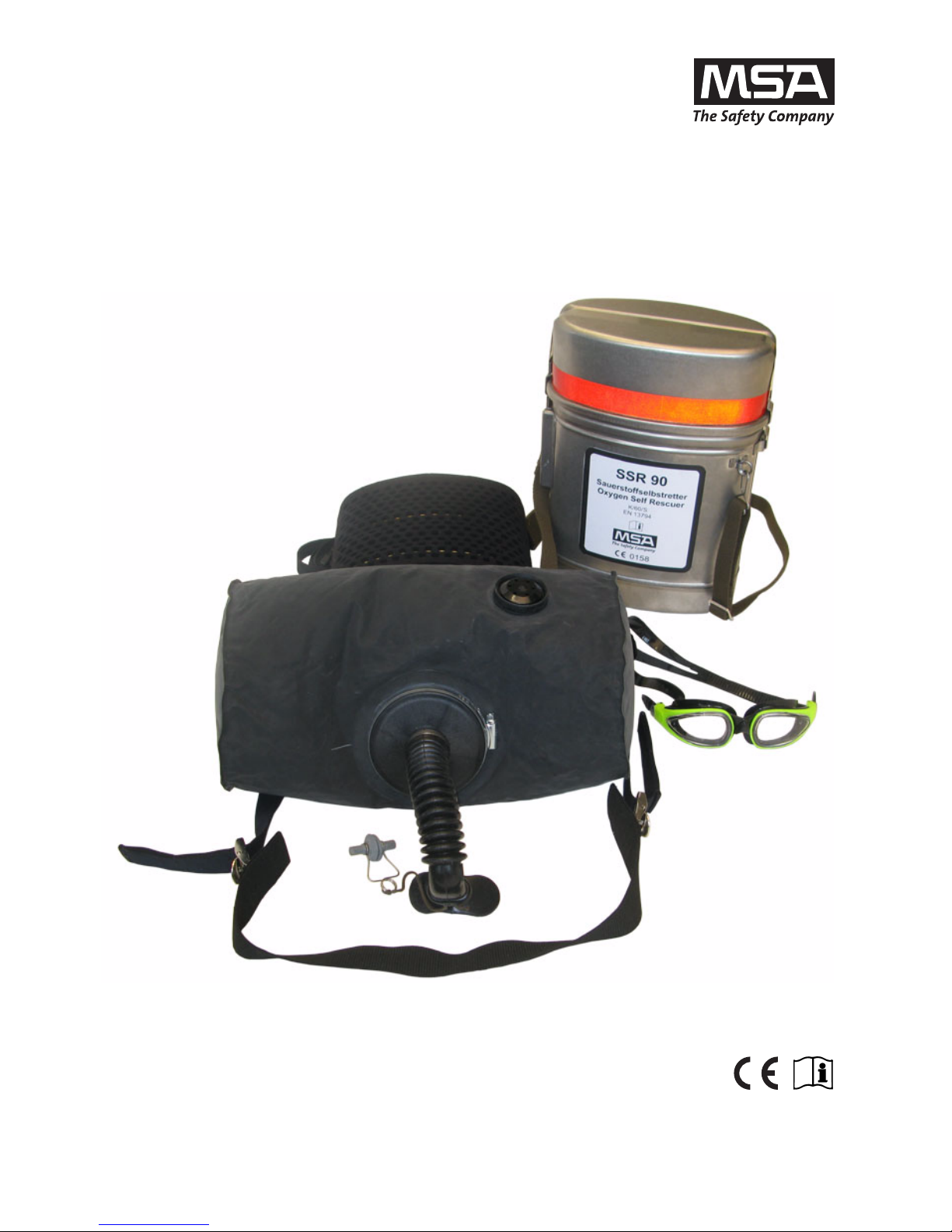
Operating Manual
MSA AUER SSR 90 [K60]
EN 13794 K/60/S
Order No. 10112006/00
Page 2

MSA AUER GmbH
Thiemannstrasse 1
D-12059 Berlin
Germany
© MSA AUER GmbH. All rights reserved
Page 3

ContentsMSA
Contents
1 Safety Regulations ................................................................................................. 4
1.1 Correct Use .................................................................................................. 4
1.2 Liability Information ....................................................................................... 5
1.3 Safety and Precautionary Measures ............................................................ 5
2 Description ............................................................................................................. 6
2.1 Overview ....................................................................................................... 6
2.2 Function ........................................................................................................ 7
2.3 Marking ......................................................................................................... 8
2.4 Demonstration and Training Device ............................................................. 8
3 Use .......................................................................................................................... 9
3.1 Important Escape Rules ............................................................................... 9
3.2 Donning the Device ...................................................................................... 9
4 Maintenance and Cleaning .................................................................................. 12
4.1 Maintenance Instructions ............................................................................ 12
4.2 Return of Used Device ............................................................................... 12
4.3 Tightness Test ............................................................................................ 13
4.4 Maintenance Intervals ................................................................................ 14
4.5 Documentation ........................................................................................... 14
5 Transport regulations .......................................................................................... 15
6 Disposal ................................................................................................................ 15
7 Technical Data ...................................................................................................... 15
8 Ordering Information ........................................................................................... 16
GB
SSR 90 [K60]
3
Page 4
1 Safety Regulations
1.1 Correct Use
The SSR 90 [K60] self-rescuer is a respiratory protection device [chemical oxygen
apparatus] for self-rescuing which is independent of the ambient atmosphere. It
protects the wearer of the devices during escape from a dangerous ambient atmosphere or whilst waiting for rescue from poisonous gases, toxic particles and oxygen
depletion. It is to be used exclusively for selfrescue under dangerous conditions and
is not intended for long-term use.
The device described in this operating manual comply with the European Directive
89/686/EEC [PPE Directive].
The device is developed for one mission, used devices must always be replaced,
reuse is not permitted.
Warning!
The device may only be used once and must never be reused. Used or
opened devices must be replaced by new devices.
MSASafety Regulations
It is imperative that this operating manual be read and observed when using the
product. In particular, the safety instructions, as well as the information for the use
and operation of the product, must be carefully read and observed. Furthermore,
the national regulations applicable in the user's country must be taken into account
for a safe use.
Danger!
This product is supporting life and health. Inappropriate use, maintenance or servicing may affect the function of the device and thereby seriously compromise the user's life.
Before use the product operability must be verified. The product must
not be used if the function test is unsuccessful, it is damaged, a competent servicing/maintenance has not been made, genuine MSA spare
parts have not been used.
Alternative use, or use outside this specification will be considered as non-compliance. This also applies especially to unauthorised alterations to the product and to
commissioning work that has not been carried out by MSA or authorised persons.
4
SSR 90 [K60]
GB
Page 5
1.2 Liability Information
MSA accepts no liability in cases where the product has been used inappropriately
or not as intended. The selection and use of the product are the exclusive responsibility of the individual operator.
Product liability claims, warranties also as guarantees made by MSA with respect
to the product are voided, if it is not used, serviced or maintained in accordance with
the instructions in this manual.
1.3 Safety and Precautionary Measures
Attention!
Chemical Oxygen Escape Devices used in mining may be subject to particular Mining-Regulations that are to be observed.
There is an ignition danger in case the device is destroyed and the oxygen generating chemical comes into contact with combustible substances,e.g. coal.
Safety RegulationsMSA
Also observe official regulations applicable in the country of use.
Attention!
Defective devices must not be used!
Removed defect devices from service and return them to MSA for
inspection.
For wearers of spectacles, the special eye protectors [goggles] which
are worn over the spectacles are recommended.
GB
SSR 90 [K60]
5
Page 6
2 Description
2.1 Overview
MSADescription
11
10
1
2
3
B
A
4
5
6
9
7
8
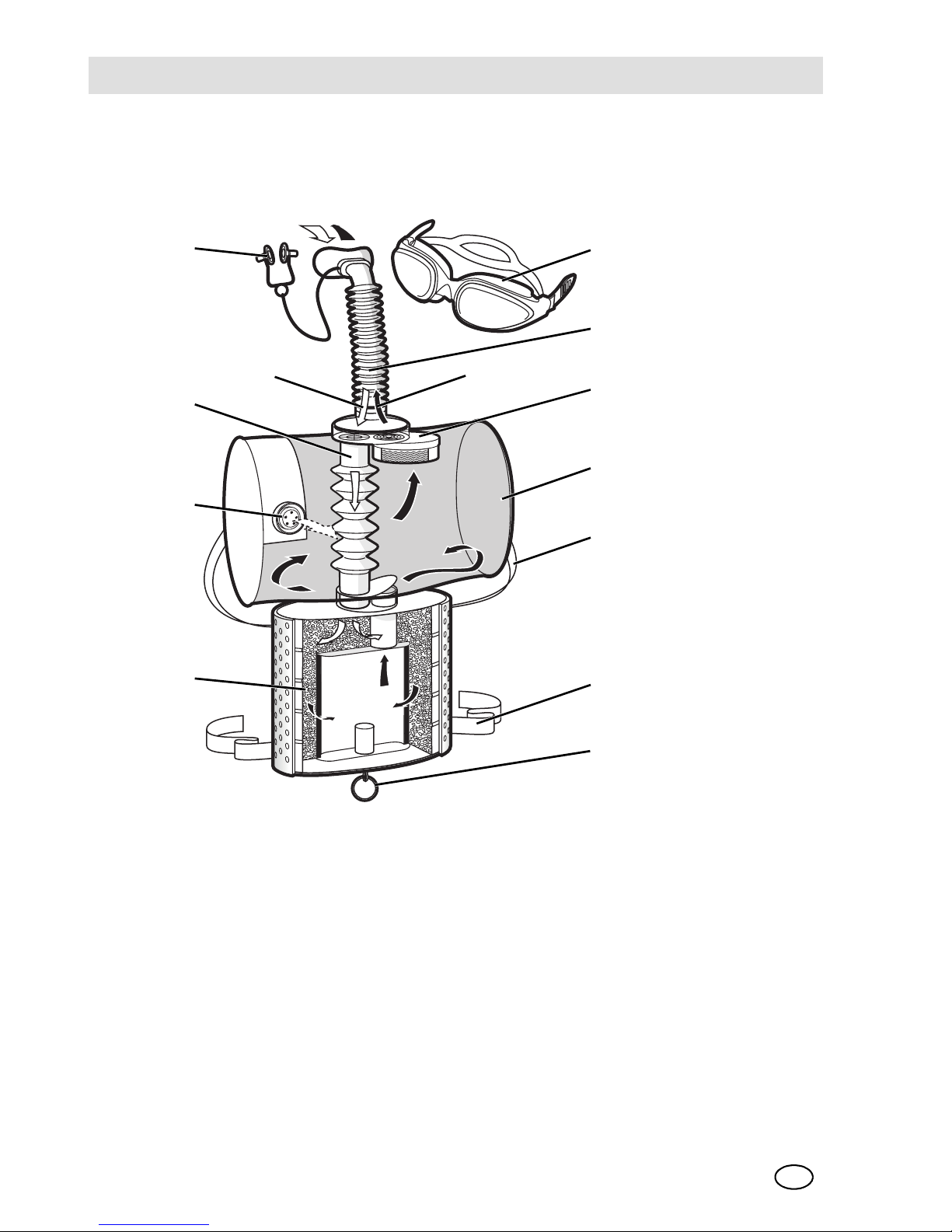
Fig. 1 Design of the device
A Inhalation 6 Neck strap
B Exhalation 7 Waist belt
1Nose clip 8Quick starter
2 Gas protective goggles 9 KO
3 Breathing tube with mouthpiece 10 Pressure relief valve
4 Particle filter 11 Corrugated tube
5 Breathing bag
The device is contained in an enclosed and sealed sturdy stainless steel container.
6
SSR 90 [K60]
-canister
2
GB
Page 7
The device includes a chemical canister with potassium hyperoxide [KO2], which is
required for the regeneration of the exhaled air.
After starting the device it is directly ready for use. During the escape, the device
supplies the wearer with breathable air which is prepared in the KO2 canister.
The device is carried by a carrying strap over the shoulder.
The device is equipped with a starter for the initiation of use which is actuated when
the device is put on. The breathing bag then fills with oxygen. During the escape,
the breathing air prepared in the KO
bag.
2.2 Function
The device supplies the wearer with oxygen which is created from the chemical potassium hyperoxide [KO2]. In an emergency, the container is opened and the respiratory protection device is taken out.
The device has a closed breathing circuit. When in operation, the exhaled air is
transferred into the chemical canister with the potassium hyperoxide. The potassium hyperoxide reacts with the humidity and the carbon dioxide of the exhaled air
and, at the same time, creates oxygen and heat. The air for inhalation prepared in
this way is fed into the breathing bag and is then inhaled again.
DescriptionMSA
canister is made available in the breathing
2
The amount of resulting oxygen depends on the intensity of respiration. Increased
respiration [more carbon dioxide, more humidity] increases the formation of oxygen
or vice versa.
When the device is used for breathing, the KO2 canister warms up, as does the inhalation air, gradually. This is normal and indicates the correct operation of the device.
The end of oxygen supply is indicated by increase of the inhalation resistance.
After actuating the starter, the breathing bag immediately fills with oxygen and
breathing can begin.
Warning!
The device must only be opened for use!
Otherwise humidity from the ambient air can penetrate the open device
and affect the performance.
Used or opened devices must be replaced by new devices.
GB
SSR 90 [K60]
7
Page 8
2.3 Marking
The devices are classified according to EN 13794 and marked with the type
[code letter] and nominal duration [minutes]. The type, nominal duration and referenced standard are marked on the device.
The device is marked as follows:
Device front side bottom side
MSADescription
Marking
MSA AUER
MSA
SSR 90
SSR 90 [K60]
EN 13794
2.4 Demonstration and Training Device
The demonstration and training device can be used for demonstration and practise
of wearing and breathing without using a chemical canister. The inhalation air is taken from the ambient air and the exhalation air is expelled outside.
The demonstration and training device is comparable in size, weight, external construction, handling and breathing resistance to the emergency use devices.
To distinguish it from the emergency use devices, the demonstration and training
device has marked blue.
For the demonstration and training device the breathing air is taken from
the ambient atmosphere, i.e. training must be made in environments
free from contamination.
Serial No.
Date of manufacture
Weight
8
SSR 90 [K60]
GB
Page 9
3Use
3.1 Important Escape Rules
The devices protects the wearer during escape from a dangerous ambient atmosphere. During the escape, the following rules must always be observed:
1. Stay calm!
2. Choose the shortest route to safe ambient air!
3. Breathe calmly! Extra air will be consumed if breathing is fast and irregular.
4. Do not damage or compress the breathing bag, otherwise lifesaving oxygen
may be lost!
5. The mouthpiece must be tight between teeth and lips and be tightly enclosed with the lips.
The device must always be available for emergencies. The device can
be put into operation with a few simple hand movements in about
20 seconds.
UseMSA
3.2 Donning the Device
Donning the SSR 90 [K60]
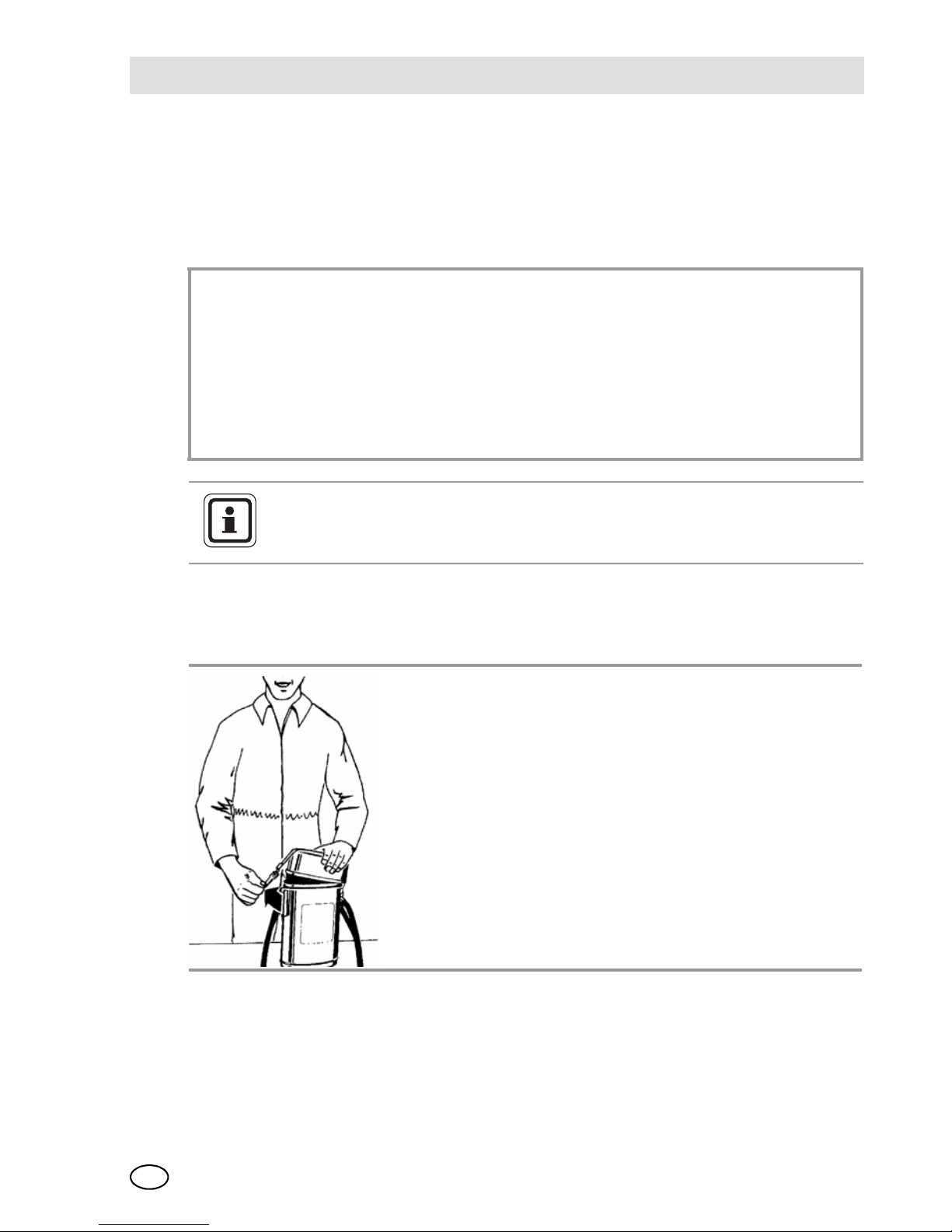
Opening the Container
(1) Place the container on a solid surface. The
label "Side facing body" points to the user,
the red locking lever points to the right.
(2) Pull the locking lever upwards in the direc-
tion of the arrow until the seal breaks.
(3) Remove cover.
Z After opening, the first thing seen and
available is the neck strap.
GB
SSR 90 [K60]
9
Page 10
MSAUse
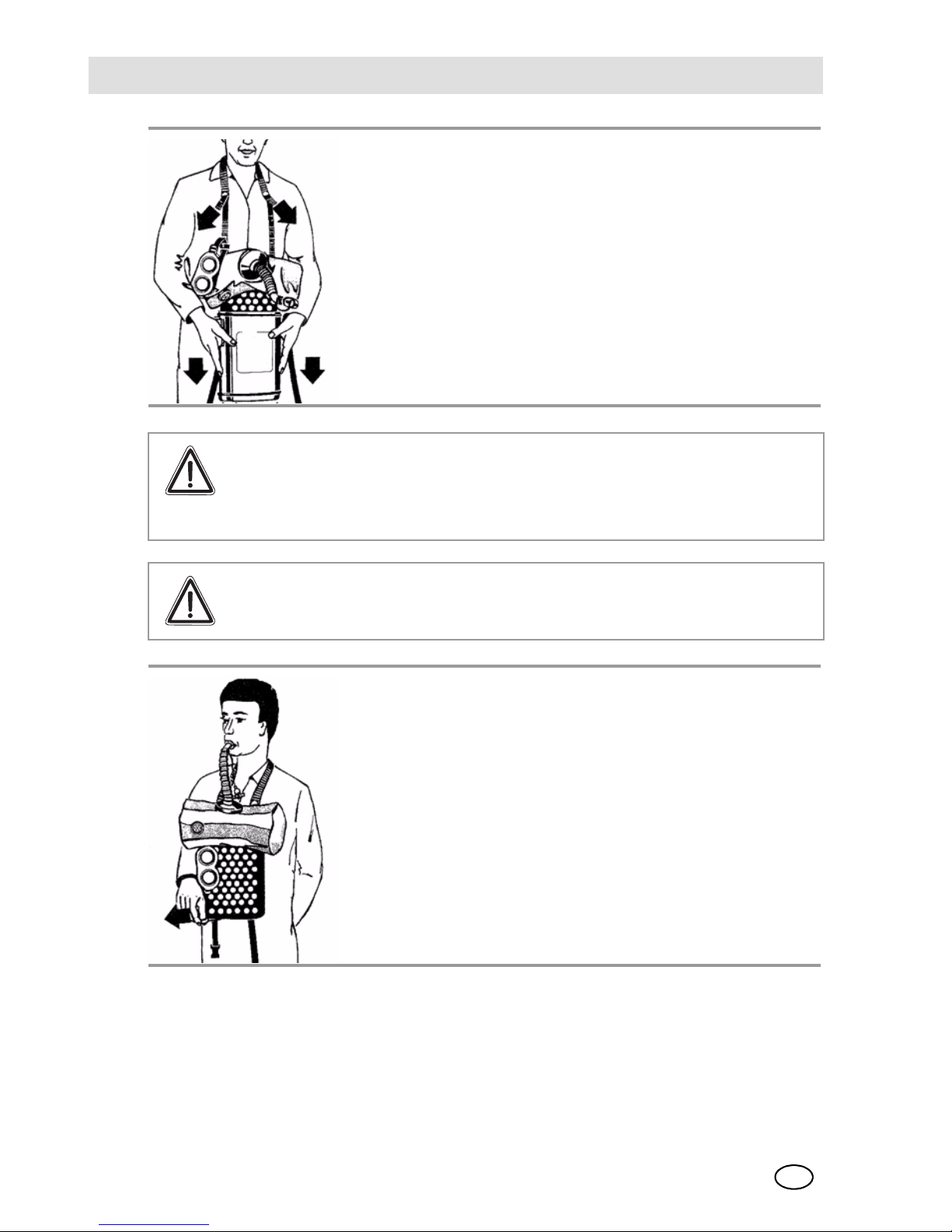
Fitting the Neck Strap
(4) Take off the protective helmet, if used.
(5) Place the neck strap around the neck,
straighten and tighten until the device is located across the chest.
(6) Pull the container downwards and remove
using both hands.
Attention!
The device must only be pulled out of the container using the neck strap.
Otherwise, the device could be damaged and thus would no longer provide secure protection.
Attention!
Activate the device before donning any equipment.
Inserting Mouthpiece and Activating the
Device
(7) Place mouthpiece into mouth with flange
of mouthpiece between teeth and lips.
(8) Bite down on the two lugs.
(9) Exhale into the device.
Z So the breathing bag is inflated.
(10) Now pull the start ring under the device
forwards.
Z The starter automatically fills the bag
with oxygen.
10
SSR 90 [K60]
GB
Page 11
UseMSA
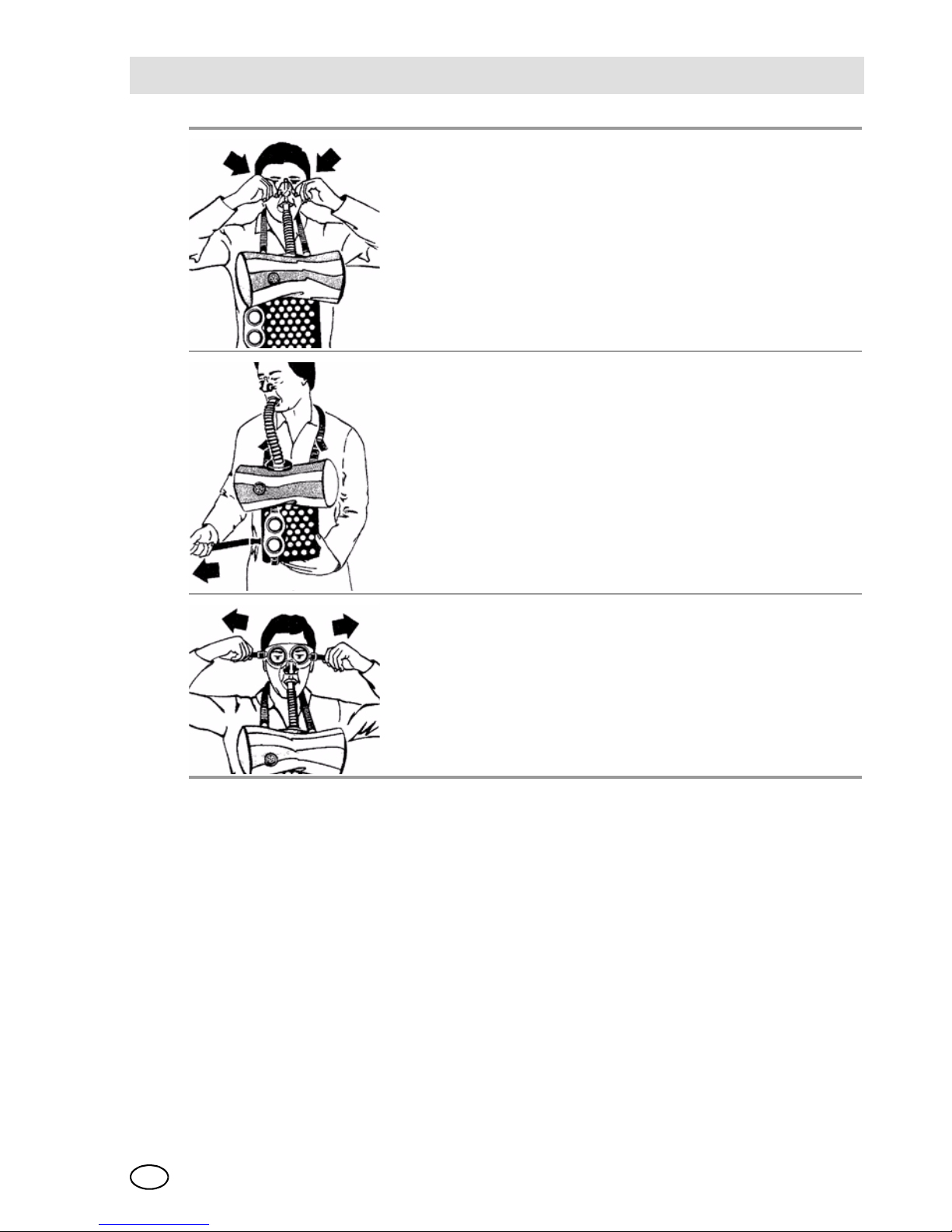
Fit Nose Clip
(11) Grasp nose clip by rubber nipples, pull
nose pads apart and fit them unto nose.
Fit Waist Belt
(12) Fit waist belt on the right side and tighten.
Fit Goggles
(13) Remove goggles from neck strap.
(14) Fit the goggles.
(15) Tighten goggles straps.
(16) Put the protective helmet on, if used.
GB
SSR 90 [K60]
11
Page 12

4 Maintenance and Cleaning
4.1 Maintenance Instructions
To maintain readiness for use, the device must be inspected regularly, checked for
integrity, tightness and, if necessary, cleaned [do not use metal brushes!].
As the device contains a chemical which is sensitive to moisture, it is packed in an
airtight container and is sealed at the factory.
The frequency of inspection depends on the device load [Æ chapter 4.4].
For used and/or opened devices, the chemical canister must always be replaced,
reuse is not permitted. Internal checks and any repairs to the devies are to be carried out by the MSA Customer Service or authorized service centers.
4.2 Return of Used Device
For return of used or opened devices, observe the following:
- Pack the device and components in the device containers only after they have
cooled down and are dry.
MSAMaintenance and Cleaning
- No organic substances must enter the chemical canisters [e.g. solvents, oils,
etc.].
- Observe transport regulations [Æ chapter 5].
If the complete device cannot be packed in the container, the following procedure
is required:
- Remove the chemical canister from the device:
(1) Therefor loosen the clamp and remove the breathing bag and breathing tube.
(2) Pack the chemical canister inside the container and seal with the original lock-
ing assembly of the container.
Z Do not use finely cutted filling material.
- Place the other components of the device with the closed container in a carefully
packed package.
- The components must be complete and undamaged.
12
SSR 90 [K60]
GB
Page 13

4.3 Tightness Test
The tightness test of the device is carried out using the MSA tightness tester for
chemical oxygen breathing protection apparatus. Detailed descriptions of the structure, function, use and maintenance of the tightness tester can be taken from the
relevant operating manual of the tightness tester [Æ chapter 8].
The tightness test of the device is carried out as follows:
(1) Push the device without any straps into the tightness tester in such a way that
the cover points towards the door.
(2) Close the door and lock.
(3) Set timer to 90 s.
(4) Create overpressure with the lever, i.e. push the lever downwards until it
engages and start the timer at the same time.
(5) After 30 seconds, cover the black pointer with the red pointer.
(6) After a further 60 seconds, the timer signals the end of the test period. Then
read the pressure difference between the red and the black pointers.
Maintenance and CleaningMSA
The device is tight if the black pointer remains in the prescribed pressure range and
if the pressure difference is no more than 5 mbar.
If the pressure drop is more than 5 mbar, the unit must be replaced.
GB
SSR 90 [K60]
13
Page 14
4.4 Maintenance Intervals
National regulation must be observed, e.g. control interval according
German Mining Regulation.
User specific conditions may require shorter intervals.
The service life depends on the type and kind of treatment to which the
device were subjected.
MSAMaintenance and Cleaning
Intervals
1
Inspection
Before and after carrying External visual check:
Check, that the seal is intact and that there are no
external damages on the device.
Annully Tightness check
After 3 years
3
Tightness check2 and complete check4 of 3% of the
2
representative population of devices which are carried
along or stored on vehicles.
After 5 years
3
Tightness check and complete check4 of 3% of the
population.
After 7 years
3
Tightness check2 and complete check4 of 3% of the
population.
After 9 years Tightness check2 and complete check4 of 3% of the
population.
After 10 years Replace device, use no longer permitted.
1. The intervals are based on the date of manufacture [month/year] on the con-
tainer. Devices manufactured in the same year are considered as "population"
and should be combined for inspection.
2. Tightness test with tightness tester D1118845 or by MSA Customer Service.
3. It is recommended that a service contract with MSA Customer Service is made.
4. Complete check = Internal inspection and check. The result will decide whether
the device can be used further.
4.5 Documentation
MSA recommends keeping a file for each device where the serial numbers, the
dates of manufacture and the dates and results of the inspections are recorded.
14
SSR 90 [K60]
GB
Page 15
5 Transport regulations
Chemical oxygen devices are classified as Dangerous Goods under Class 5.1 with
the designation and hazard label "5.1, 3356, oxygen generator, chemical". Regard
packing group II.
Undamaged and unopened devices can be transported in the packing material supplied with the device or in a different approved method of packing.
Damaged and/or opened devices should be welded into a plastic bag and packaged as described in chapter 4.1.
Notes concerning the various transport methods can be taken from the EU safety
data sheet.
6 Disposal
The chemical canister contains strong alkaline and oxidizing substances
[potassium hydroxide, potassium carbonate and potassium hyperoxide].
For disposal local regulations are to be observed.
Transport regulationsMSA
7 Technical Data
Weight [total] approx. 4.9 kg
Weight [ready for use] approx. 3.4 kg
Dimensions height: approx. 310 mm
Carrying mode with carrying strap
Carrying mode [during use] in front of chest
Storage conditions Normal climate, temperature: -10°C to 30°C
Temperature at start -10°C to 50°C
Ambient temperature in use -20°C to 50°C
Temperature class T1 and T2
Service life max. 10 years [without being used]
Breathing resistance Inhalation: 4 mbar
SSR 90 [K60]
width: approx. 220 mm
depth: approx. 120 mm
Exhalation: 6 mbar
Oxygen content more than 21% by volume
Carbon dioxide content 0.5 - 1.5% by volume
GB
SSR 90 [K60]
15
 Loading...