

Page 1
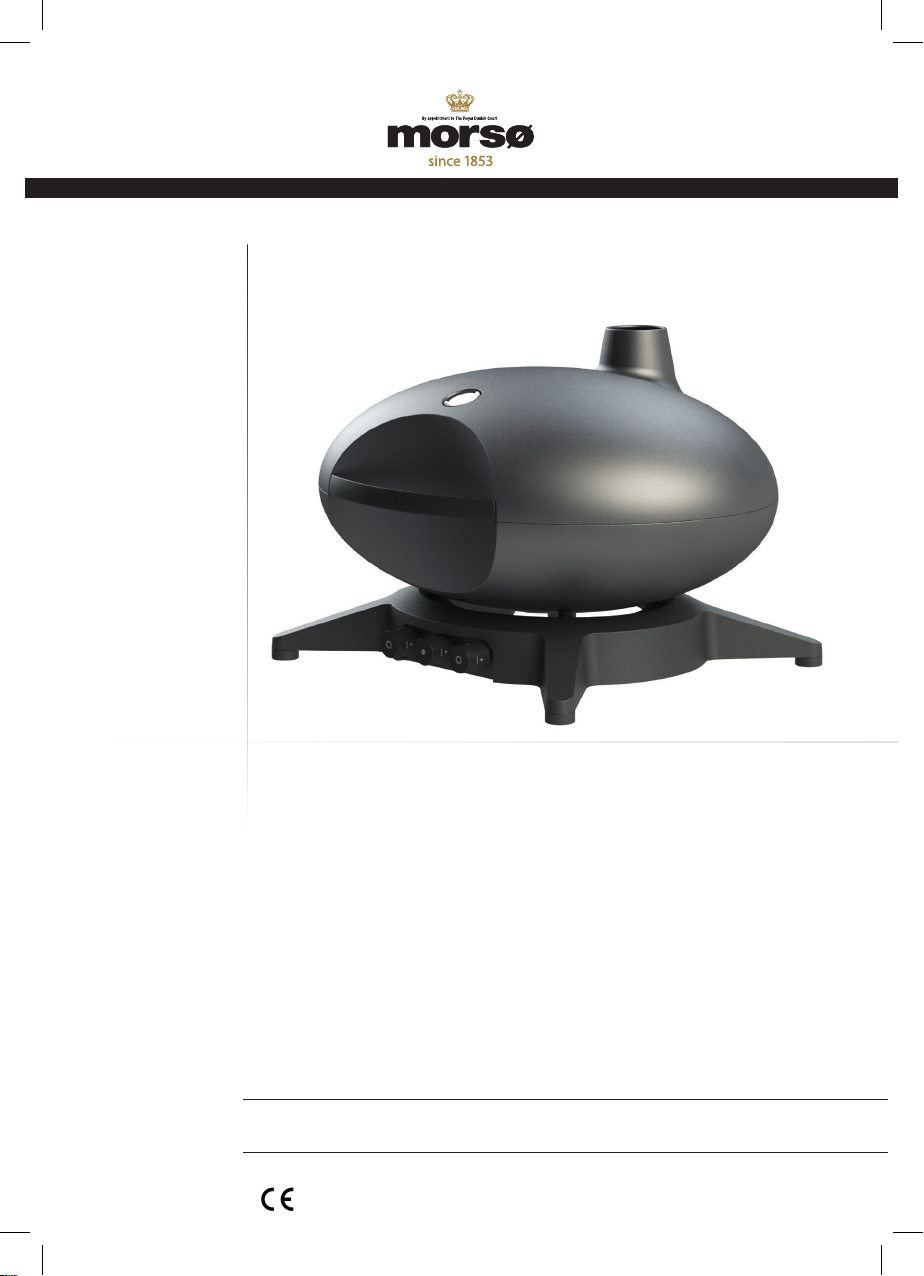
MORSØ FORNO GAS BBQ SERIES
MORSØ FORNO GAS Grande UK
R
• Powerful stainless steel burner with rotary
ignition for easy lighting
• Satin enamel cast iron cooking surface –
easy to cook on and wash up
• Durable die cast aluminium bowl and hood
• Integrated temperature gauge for maximum control when cooking
Important: Retain these instructions for future use.
CS
• High dome hood – 19 cm – allows you to
cook roasts easily
• Table available as an optional extra (sold
separately)
• Supplied with hose and regulator so it’s
ready to use with a POL gas cylinder
• Gas certied to CE standards
Page 2
READ ME FIRST
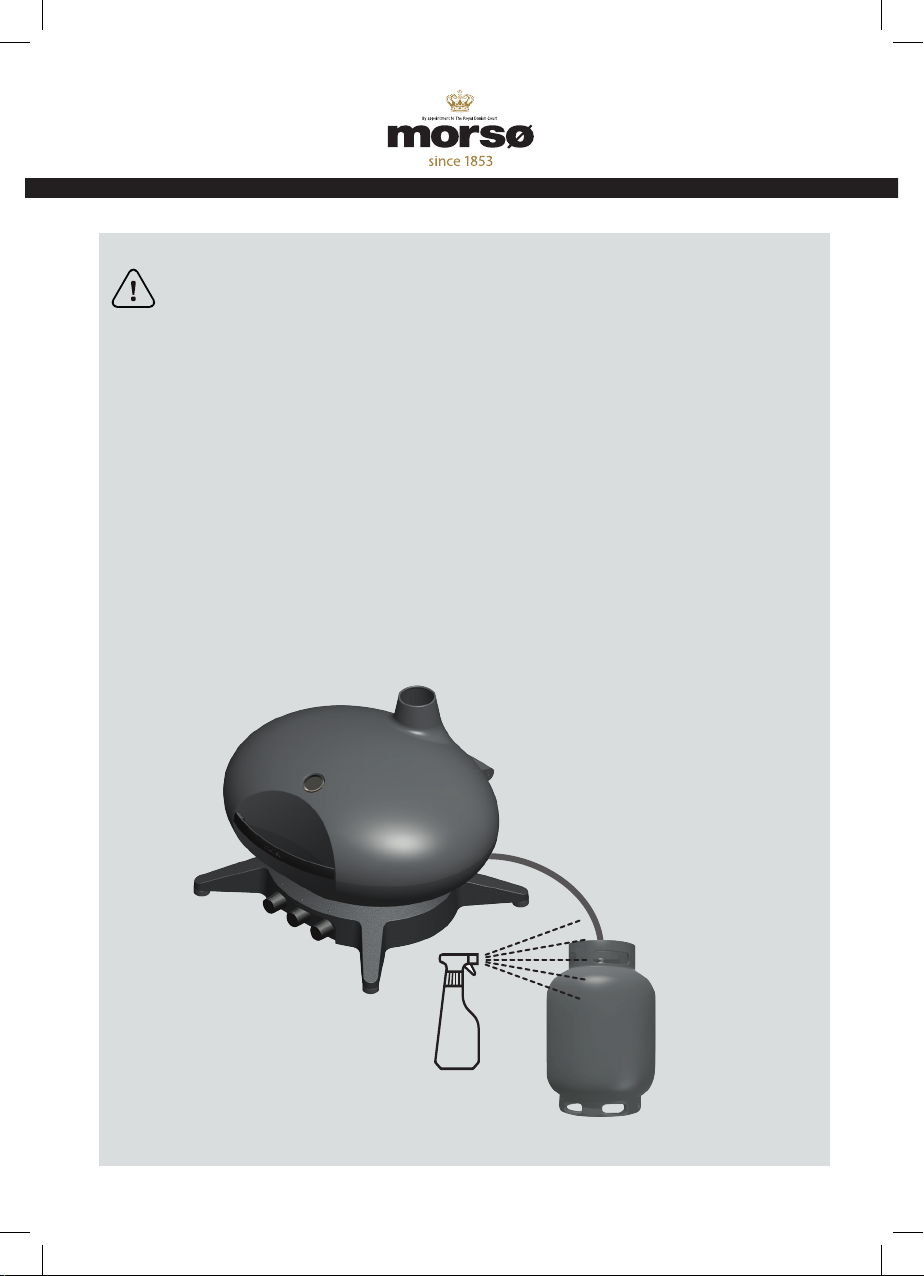
Gas leak testing
It is important that you leak test the BBQ before rst use and every time the gas cylinder is relled and
reconnected to the BBQ.
To Complete Leak Test
• Make sure all the control knobs are OFF.
• In a small container, mix up a solution of water and detergent/soap.
• Mix the solution well (about the same concentrate as washing up water).
• Turn the cylinder ON by rotating the knob to open position.
• Using a brush or spay bottle apply the soap solution to the gas line and each join in the gas line including:
- the gas connection at the inlet of the BBQ
- all gas hose connections
- the gas connection at the gas cylinder
• If bubbles appear, there is a gas leak.
• If the leak is at the connection, re-tighten and re-seal.
• If the leak is anywhere else or you cannot resolve the leak by tightening the connection DO NOT PROCEED.
• Replace gas hose and regulator.
• Replacement hose and regulators can be purchased from your local BBQ retail specialist.
2
Page 3
GENERAL INFORMATION
IMPORTANT
Read these instruction carefully prior to
use. Familiarise yourself with the appliance before connecting it to it’s gas
container. Keep these instructions for
future reference.
IF YOU SMELL GAS
1. Shut o gas to the barbecue at its
source, if possible.
2. Extinguish any open ame.
3. Open hood.
4. If odour continues immediately call
your gas supplier or re department.
Replacement of pressure
control and hose connector shall be carried out using
Morsø genuine products only.
Contact your local dealer.
Gas Installation Codes
• Barbecues must be used in accordance with the
installation requirements of your gas supply authority.
• Barbecues for use with bottled gas are labelled
‘propane gas’ or ‘Universal L.P.G’.
Clearances
Minimum Clearances from combustible materials
must be: Rear - 300mm Sides - 300mm Above 1000mm
Specications
Barbecue specications can be found on the data label
attached to the barbecue body.
Hose & Regulator Safety
The regulator and hose assembly supplied with the
barbecue are suitable for Propane Gas or Universal
L.P.G. only.
The pressure regulator and hose assembly
supplied with the barbecue must be used. Replacement of pressure control and hose connector shall
be carried out using Morsø genuine products only.
Contact your local dealer.
When connecting the hose and regulator assembly to
the gas cylinder, take care to avoid unnecessary twisting of the exible hose.
After the assembly has been secured, turn on the gas
and check for leaks by brushing a soap and water
solution over all connections.
If you are unable to correct the leak by tightening the
connections, turn o the gas and contact the supplier
immediately.
Always ensure the barbecue is kept away from ammable materials and the gas cylinder clear of any heat
source.
When changing over from an empty gas cylinder to a
full one make sure this procedure is carried out in a
well ventilated location, preferably outside, away from
people and away from any sources of ignition; such as
naked ames, pilot ames, electric heaters/equipment.
Gas Cylinder Use & Safety
This is a low pressure barbecue and must only be used
with the regulator supplied. Your barbecue is designed
for use with propane gas cylinders certied to the UK
market.
The gas cylinder should be lled by a reputable gas
supplier and visually inspected and re-qualied at each
lling.
Always keep cylinder in an upright position. Always
close the cylinder valve when the barbecue is not in use.
Do not subject gas cylinder to excessive heat.
NEVER STORE YOUR GAS CYLINDER INDOORS.
If you store your barbecue indoors, ALWAYS disconnect the gas cylinder rst and store the cylinder safely
outside.
Cylinders must be stored outdoors in a well ventilated
area out of reach of children, and must not be stored
in a building, garage or any other enclosed area.
3
Page 4

GENERAL INFORMATION
FOR YOUR SAFETY
Failure to comply with these instructions could
result in a re or explosion which could cause
serious bodily injury, death or property damage.
CAUTION: Accessible parts may be very hot.
Keep young children away.
DO NOT modify this appliance.
DO NOT move this barbecue during use.
Turn o gas supply at the gas cylinder after use.
Parts sealed by the manufacturer or their agent
must not be manipulated by the user. This barbecue
is only to be used and stored outdoors.
• Never operate this barbecue without a regulator.
• Do not test for gas leaks with an open ame.
• If this information is not followed exactly a re
causing death or serious injury may occur. Do not
store a spare gas cylinder under or near this
barbecue. This barbecue is only to be used and
stored outdoors.
• If there is a leak on your appliance (smell of
gas) immediately attempt to turn o the cylinder
valve. Remove the appliance to a well ventilated
location away from any ignition source. Only
check for leaks outdoors using soapy water. DO
NOT try to detect leaks using a ame.
• Check for leaks by brushing a soap and water
solution over all connections. If you are unable to
correct the leak by tightening the connections,
turn o the gas and contact customer service
immediately.
• Only use the hose assembly as supplied with
this appliance for connection to the cylinder DO NOT USE ADAPTERS.
• Maximum hose length - 1000mm.
• After use turn the gas cylinder valve o, wait
for the ame to go out, then turn the
appliance control valve o.
• Avoid twisting or kinking the exible hose.
• Do not store or use petrol or other ammable
liquids in the vicinity of this or any other
appliance.
• Do not store empty or full spare gas cylinders
under or near this or any other appliance.
• Never test for gas leaks with a lit match or open
ame. Never light barbecue with hood closed or
before checking to ensure the burner tubes are
fully seated over gas valve orices.
• Never lean over cooking surface when lighting.
• Never alter or modify the regulator or gas supply assembly.
• This barbecue must not be used indoors.
• Only use in well ventilated areas.
• Carbon monoxide hazard - Using this appliance in
an enclosed space may cause death. Do not use in
caravans, tents, marine craft, cars, mobile homes or
similar locations.
• This appliance shall only be used in an above ground
open-air situation with natural ventilation, without
stagnant areas, where gas leakage and products of
combustion are rapidly dispersed by wind and natural
convection.
• Ensure the barbecue is set up on a level and stable
surface.
• Do not move the barbecue while in use or when hot.
Remove the drip tray before moving.
• DO NOT use the BBQ as a hotplate. The warranty
will be voided and it violates the gas regulations, the
cooking grate provides the ventilation needed for the
BBQ to operate safely. It is not designed to be a solid
hotplate device.
IF THERE IS A LEAK
• Turn the cylinder o.
• Ventilate the area to disperse gas.
• Check all connections.
• If leak persists, keep the cylinder upright. Keep skin
away from any gas or liquid escaping from the cylinder.
• Keep the cylinder at least 20 metres away from any
sparks or ignition sources, including electrical equipment, camera ashes, engines and motors.
• Disperse gas by encouraging maximum ventilation and
spraying with a ne water spray.
IF THERE IS A FIRE
• If the re is at the barbecue, turn the gas o at the
cylinder. Smother the ames with a wet cloth, re
blanket or extinguish using a re extinguisher.
• If the re is at the cylinder, or you can not get to the
valve to turn the gas o, contact the re brigade immediately.
• Using a garden hose, direct the water to the middle of
the cylinder to keep it cool. Try not to extinguish the
ame. At least if the gas is burning, it won’t be able to
build up pressure and explode.
4
Page 5
Location of your Barbecue
DO NOT use your barbecue in garages, porches, sheds,
breezeways, or other enclosed areas. Your barbecue is
to be used OUTDOORS. The barbecue is not intended
to be installed in or on recreational vehicles and/or
boats and should not be placed under any surface that
will burn. Do not obstruct the ow of combustion and
ventilation air around the barbecue housing.
Protect Children
Keep children away from barbecue during use and until
barbecue has cooled after you have nished. Do not
allow children to operate barbecue.
Always ensure that no sporting or physical activities are
carried out in close proximity to the barbecue during
use and while still hot.
Tools You Will Need
Adjustable spanner, Philips head screwdriver.
Check Barbecue for any Damage
Inspect barbecue parts as you proceed. Contact your
supplier for assistance regarding replacement of any
damaged or missing parts. Do not assemble or operate
a barbecue that appears damaged. Barbecues for use
with gas cylinders are labelled ‘Propane Gas’. Check labelling at the gas connection on your barbecue.
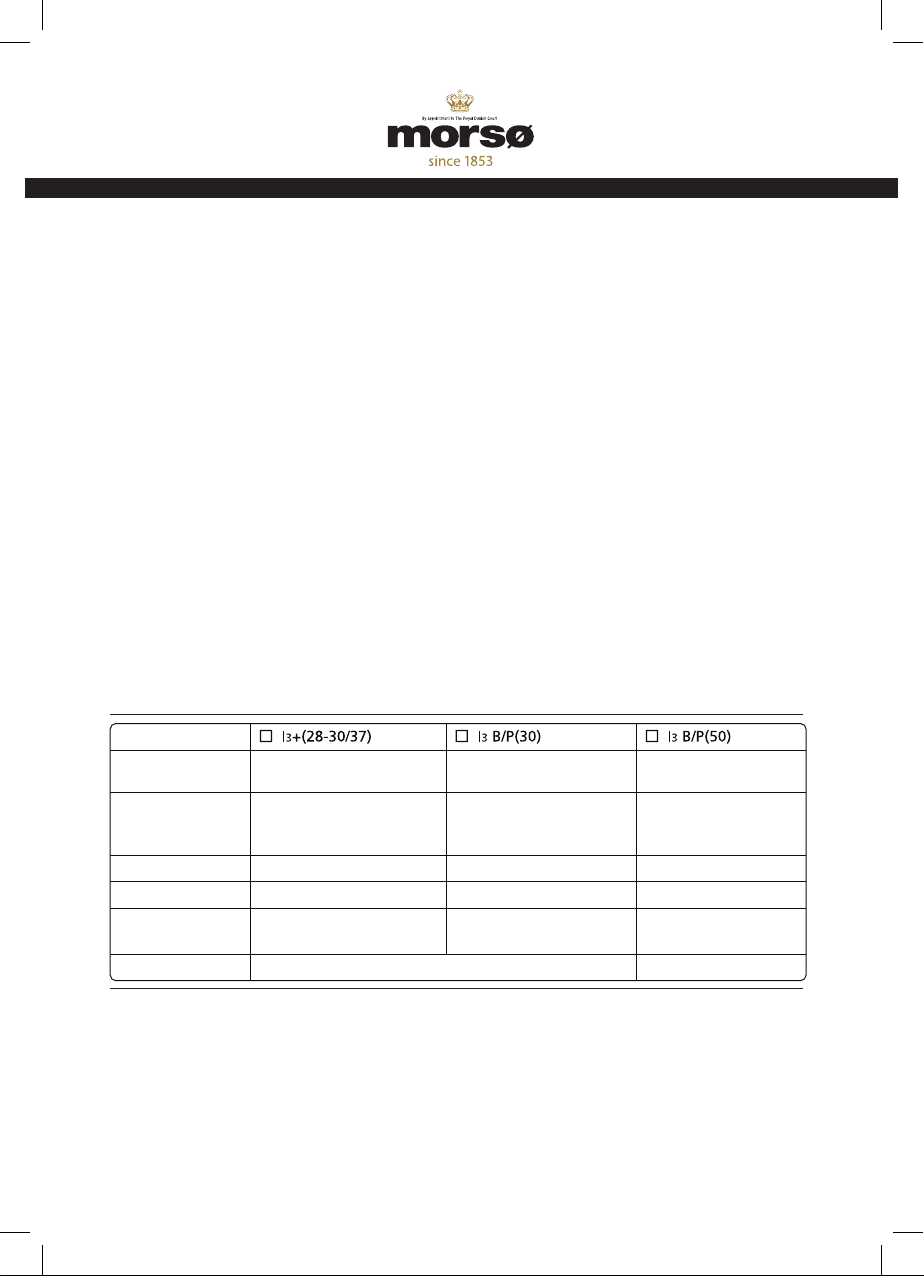
Gas Category
Gas and Supply
Pressure
Country Code
G30 Butane at 28-30 mbar
G31 Propane at 37 mbar
BE, CH, CY, CZ, ES, FR, GB,
GR, IE, IT, LT, LU, LV, PT, SK, SI
Burner
Nominal Heat Input
Burner Injector Size
Main Burner × 3
2.8 kW × 1 / 2.3 kW × 2 2.8 kW × 1 / 2.3 kW × 2 2.8 kW × 1 / 2.3 kW × 2
Middle: Ø0.8 mm
Left & Right: Ø0.74 mm
Total Heat Input
7.4 kW(G30:538g/h;G31:529g/h)
G30 Butane and
G31 Propane at 30 mbar
BE,CY, DK, EE, FR, GB, HU, IT,
G30 Butane and
G31 Propane at 50 mbar
AT, CH, DE, SK
LT, NL, NO, SE, SI, SK, RO, HR,
TR, BG, IS, LU, MT, FI
Main Burner × 3 Main Burner × 3
Middle: Ø0.8 mm
Left & Right: Ø0.74 mm
Middle: Ø0.72 mm
Left & Right: Ø0.63mm
Made in Taiwan
SUITABLE GAS TANKS
There are many dierent sizes of tank.
The gure shows the maximum tank size.
• Capacity of gas tank: Maximum 11 kg
• Height of gas tank: Maximum 595 mm
• Diameter of gas tank: Maximum 304 mm
Location of gas tank
Make sure there are no kinks in the gas hose.
The gas hose may be a maximum of 1 m in length.
5
Page 6
LISTE OVER DELE
1
2
3
4
5
6
7
9
11
15
17
16
19
18
14
13
12
10
8
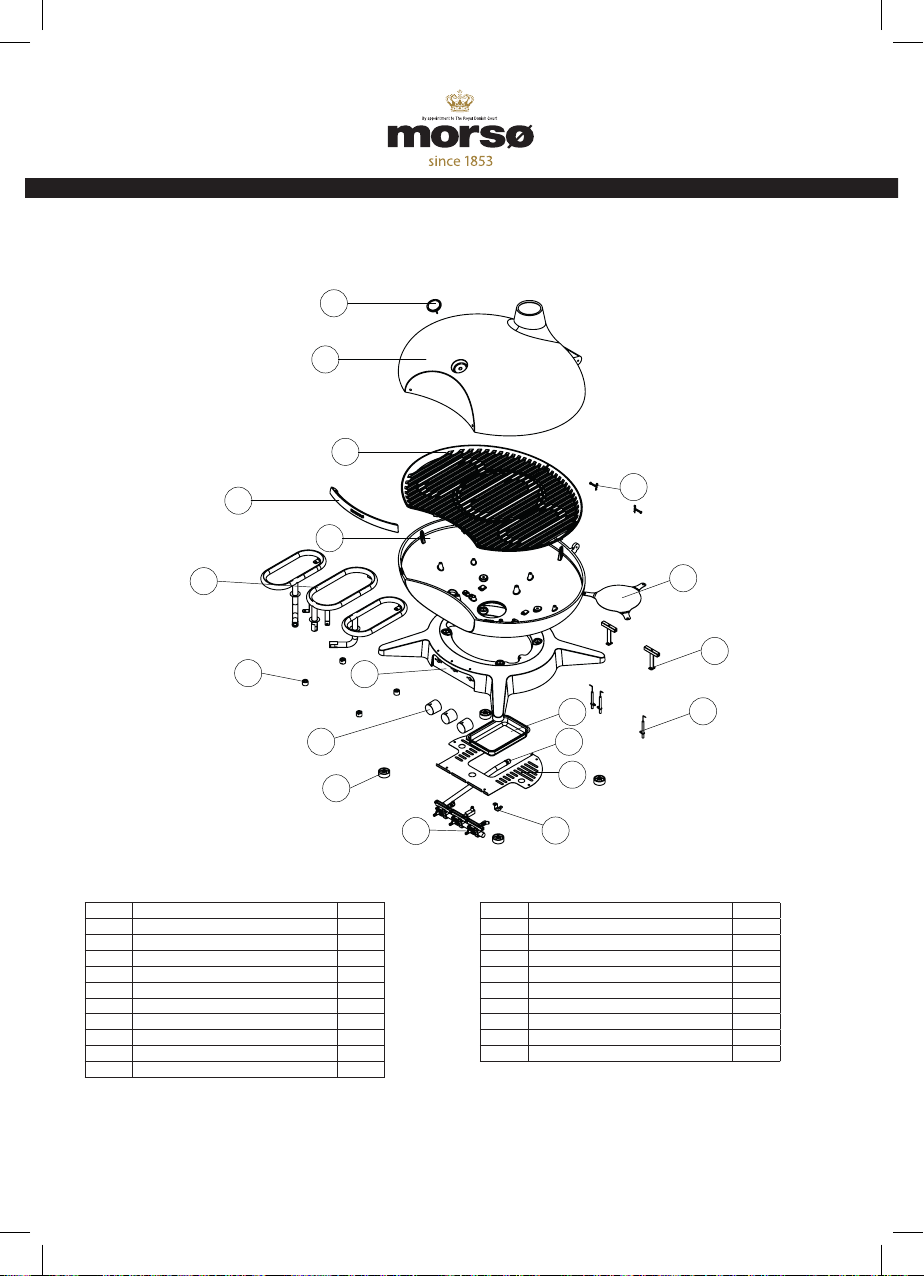
EXPLODED DIAGRAM
PARTS LIST
Part Description QTY
1 Temperature Gauge 1
2 Lid 1
3 Cooking Grate 3
4 Lid Handle 1
5 Bowl 1
6 Burner 3
7 Heat Insulator 4
8 Base 1
9 Knob 3
10 Plastic Feet 4
6
Part Description QTY
11 Valve 1
12 Grease Cup 1
13 Adapter 1
14 Grease Cup Support 1
15 Fixed Plate 1
16 Lid Hinge & R-Pin 2
17 Hole Cover 1
18 Frame Bridge 2
19 Ignition Electrode 3
Page 7
MONTAGEVEJLEDNING
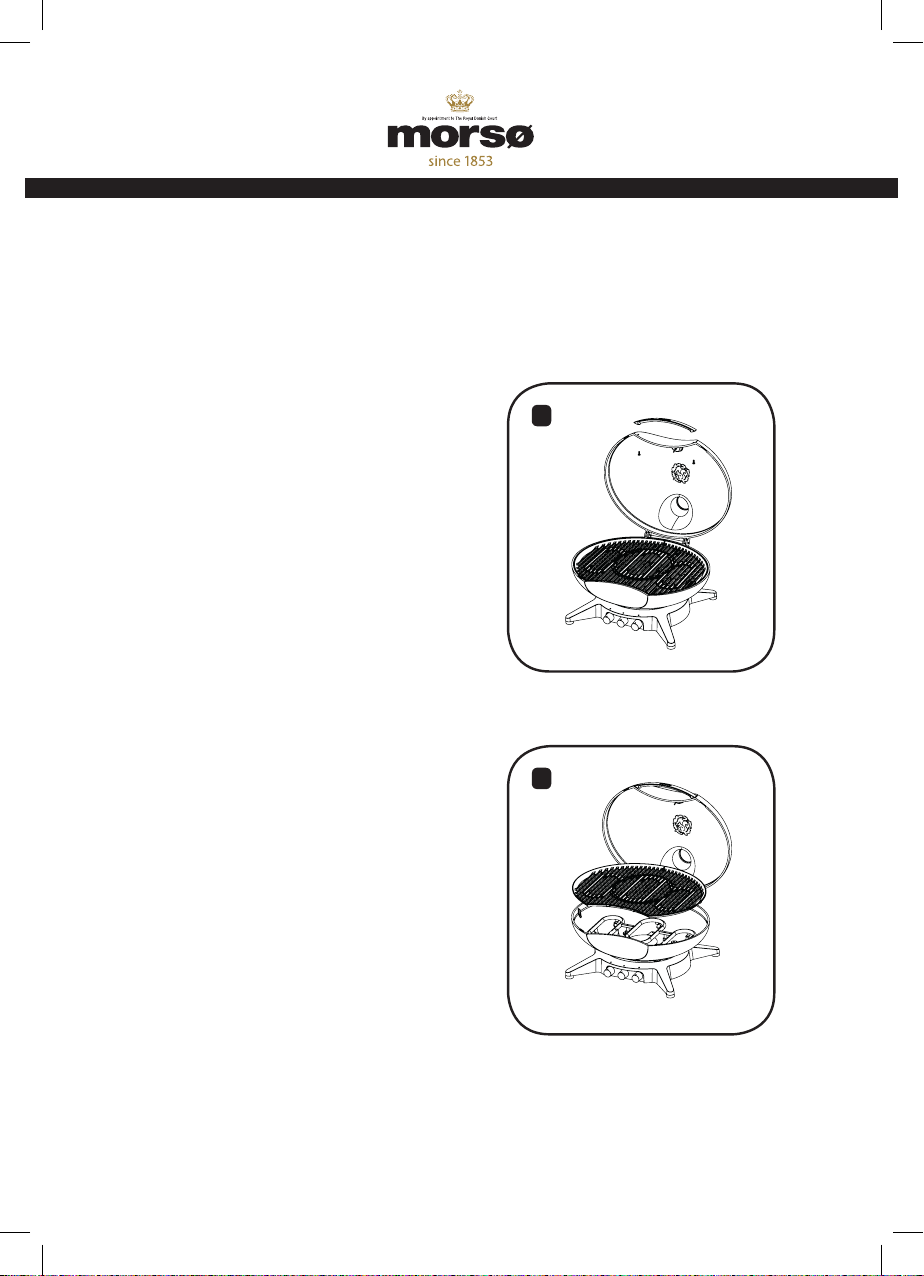
ASSEMBLY INSTRUCTIONS
Remove any transit protection material.
STEP 1
Attach the lid handle using the fasteners as
shown.
CONNECTING THE GAS CYLINDER
There are two dierent types of gas that can
be used on your gas bbq depending on where
you live, that being either butane or propane
gas.
Both are supplied in gas cylinders.
The gas cylinders must be positioned adjacent
to the bbq.
A
The connection between the gas cylinder and
the bbq is made with a regulator
It is important that you use the correct regulator
for the particular type of gas you purchase.
B
7
Page 8
GENERAL INFORMATION
GARANTI
CONNECTING & DISCONNECTING
TO GAS SOURCE
Familiarise yourself with the general information and
safety guidelines located at the front of this manual.
Check
1. Gas cylinder is lled. A sloshing sound will be heard
when shaken.
2. The burner control is in the ‘OFF’ position
Connecting
1. Ensure valve is in OFF position.
2. Check for any damage to the cylinder connection.
3. Attach the regulator to the cylinder valve.
4. Use a soapy water solution to check the joint. If bubbles appear the connection will need to be retightened.
Length Width Height
726 mm 627 mm 498 mm
IMPORTANT
• IMPORTANT: Before connecting and disconnecting
barbecue to gas source, make sure burner controls
are in ‘OFF’ position.
• CAUTION: When the barbecue is not in use, the gas
cylinder must be disconnected.
• Check that the seals between the appliance and the
gas cylinder are in place and in good condition before connecting the gas cylinder.
• Do not use this appliance if it has damaged or worn
seals.
• NOTE: If for some reason, ignitor fails to produce a
spark at the electrode, barbecue can be lit by a long
barbecue match with hood open insert the match
into a hole on the underside of the barbecue and
turn gas control to high.
• Check performance of burner prior to installing barbecue plates.
• Do not smoke when attempting to ignite barbecue.
• Never use volcanic rock, heat beads or other material.
• Always use protective gloves when handling hot
components.
8
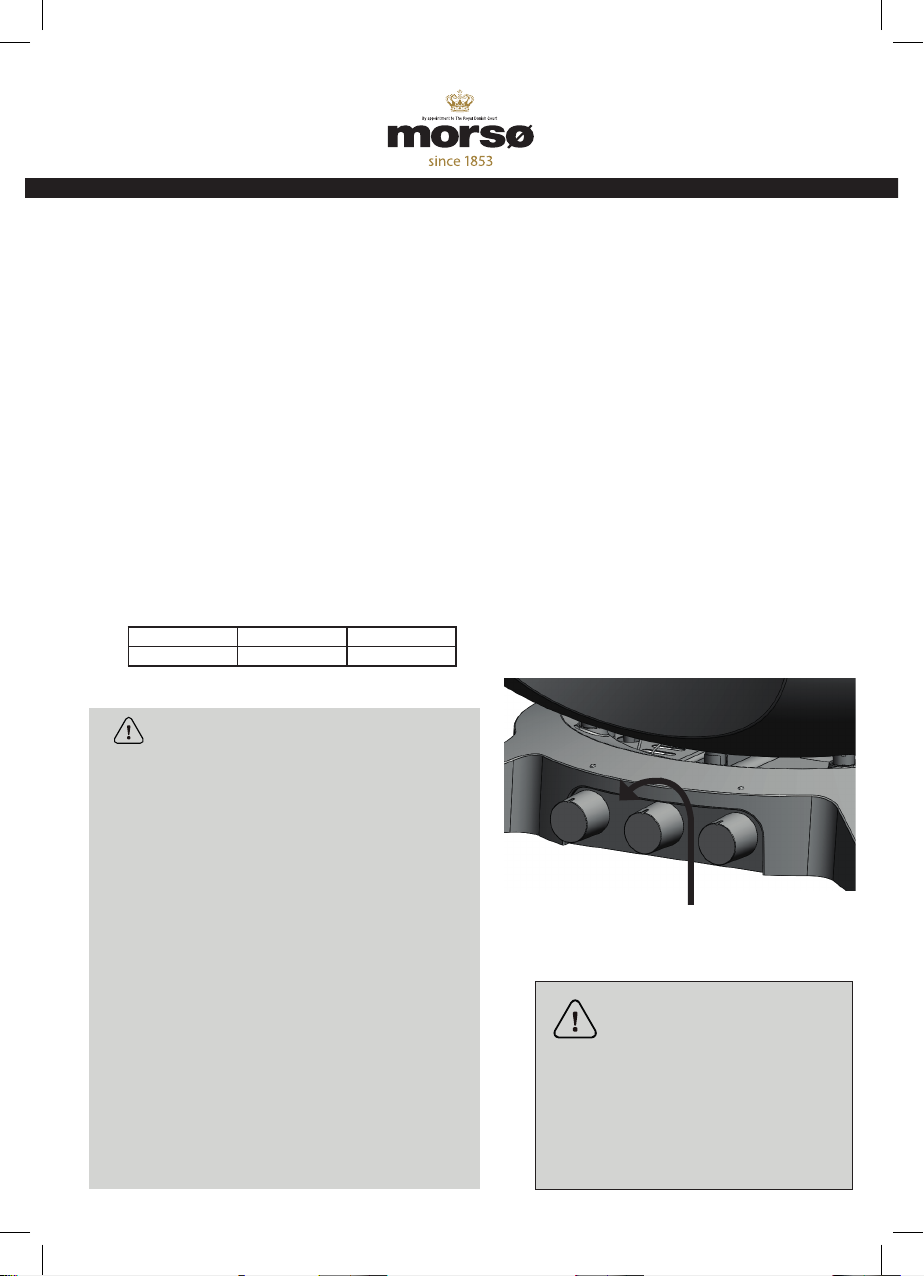
IGNITION PROCEDURE
1. Raise the lid of the gas grill – set the cylinder valve to
position ON.
2. Push in the gas control button and turn it anticlockwise until you hear a 'click/spark' and check whether
the spark has lit the burner.
3. When the burner is lit, let go of the gas control button. You can now turn the control button from ‘MAX’
to ‘MIN’ depending on the required heat.
4. If the burner does not light, repeat 'step 2' two to
three times, until the burner is lit.
5. If, after several attempts, the burner still does not
light, cut o the gas supply and check whether the
gas supply is blocked.
If re–ignition is necessary while the gas barbecue is still
hot, you must wait for a minimum of 5 minutes before
commencing to re–ignite (this allows accumulated gas
fumes to clear).
1. PUSH 2. TURN GENTLY
IMPORTANT
The hood must be in the open position
for lighting.
Do not smoke at any time when
attempting to ignite the barbecue
burners.
Do not leave the barbecue unattended
when alight.
Page 9
DATA PÅ MORSØ FORNO GAS
OPERATION
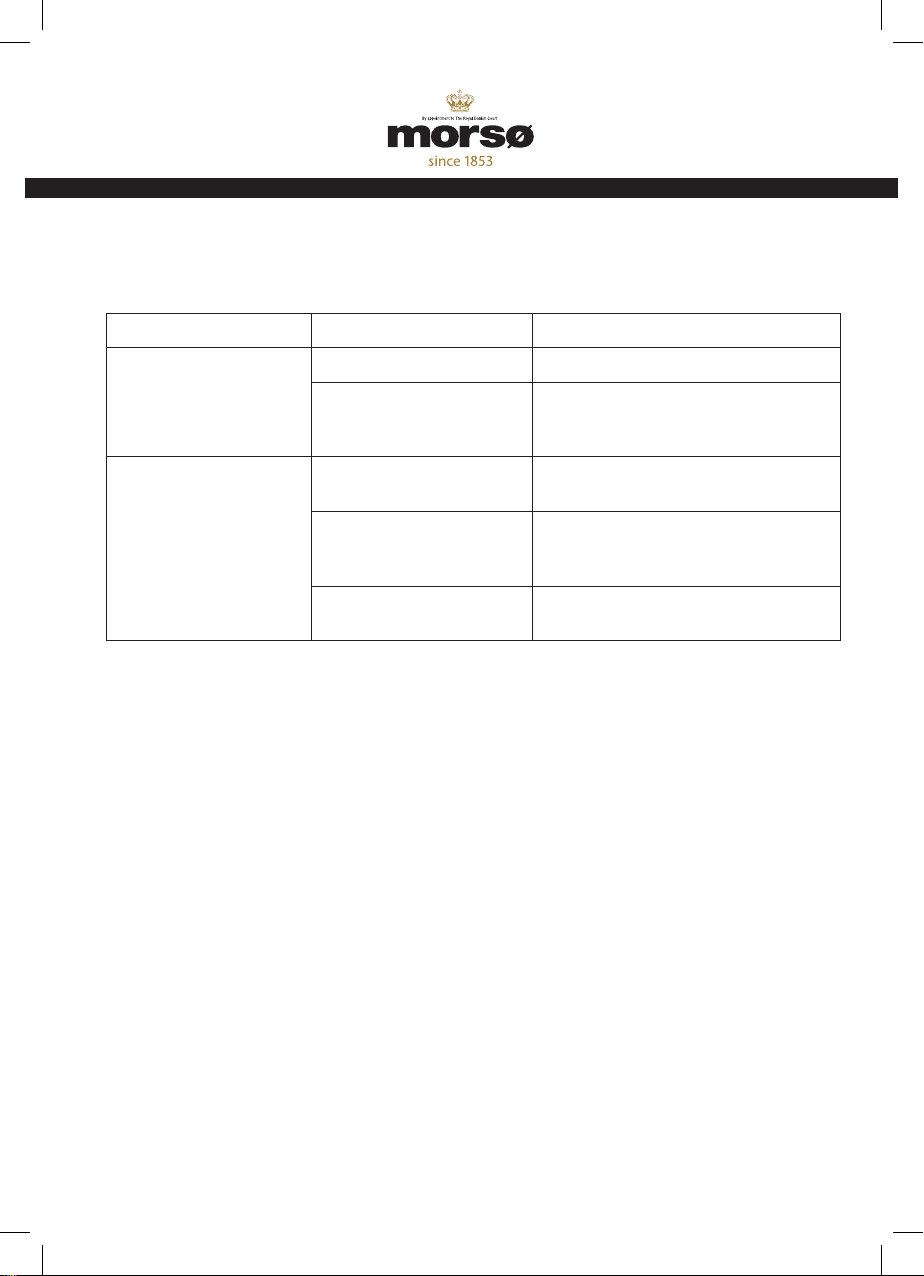
BURNER OPERATION & IGNITION SYSTEM CHECK
Problem Possible Reason Solution
Control knob is closed Turn knob to high when lighting
Burner will not ignite The ignition needle is faulty The grill is lit using a long grill match with the
lid open. Lead the match through the grilling
grid while turning the gas control to the left.
Burner has gone out Check that the gas bottle is not empty and
reignite the burner
Food is not cooking
or is taking too long
Cooking surface was not given
enough time to warm up before the food was applied
There is too much food on the
cooking surface
Remove the food and give the burner time to
warm the cooking surface (5-10 mins)
Cook smaller portions
OPERATING PROCEDURE
Cooking
The control knob can be turned from ‘MAX’ to ‘MIN’ depending on the heat required.
With the hood down the burner must only be used on ‘MIN’.
Servicing
Servicing should be conducted every year or sooner if required.
The appliance must only be serviced by an authorised person.
9
Page 10
TILSLUTNING AF FLASKE MED FLYDENDE PROPANGAS.
CARE & MAINTENANCE
As with all appliances, proper care and maintenance will
keep them in top operating condition and prolong their
life. Your new gas barbecue is no exception. By following these cleaning procedures on a timely basis, your
barbecue will be kept clean and working properly with
minimum eort.
Spiders and small insects occasionally spin webs or
make nests in the burner tubes during warehousing and
transit.
These webs can lead to a gas ow obstruction which
could result in a re in and around the burner tubes.
Cleaning with a soft brush before use and at least every
six months is recommended.
This type of problem is known as ‘FLASH-BACK’ and
can cause serious damage to your barbecue and create
an unsafe operating condition for the user. Although
an obstructed burner tube is not the only cause of
‘FLASHBACK’ it is the most common cause and frequent inspection and cleaning of the burner tubes is
necessary.
Flash-Back
If re occurs in and around the burner, immediately turn
o gas at its source and turn the burner control to
‘OFF’, wait until the barbecue has cooled, then clean
the burner tubes and burner ports.
Cleaning the Cooking Surface
After cooking, turn burner control to ‘OFF’ and let barbecue cool before attempting to clean the grill plate or
grate. Before rst use and periodically, it is suggested
that you wash the grill plate and grate in a mild soap and
warm water solution.
Care of Cooking Surface
Use and care of the cooking surface is important. Do
not use pans on the cooking surface. Do not overheat
the cooking surface with the hood down or no food on
the cooking surface.
Cleaning the Drip Tray
To avoid fat or grease dripping from the barbecue remove and empty the drip tray after each use. Wait until
the drip tray is cool to touch before disposing of contents.
The drip tray should be washed periodically in a mild
detergent and warm water solution.
IMPORTANT
10
• Beware of spiders and wasps. Burner tube
should be inspected and cleaned periodically.
• This appliance must only be serviced by an
authorised person.
• To avoid any are-ups, it is recommended
that the drip tray be checked and emptied
regularly. Contents of the drip tray may
be very hot during cooking. If emptied
during extended cooking extreme caution should be taken and direct contact by
hand should be avoided at all times. Allow
to cool completely before disposing of the
contents.
Page 11
KONTROL AF GAS LÆKAGE
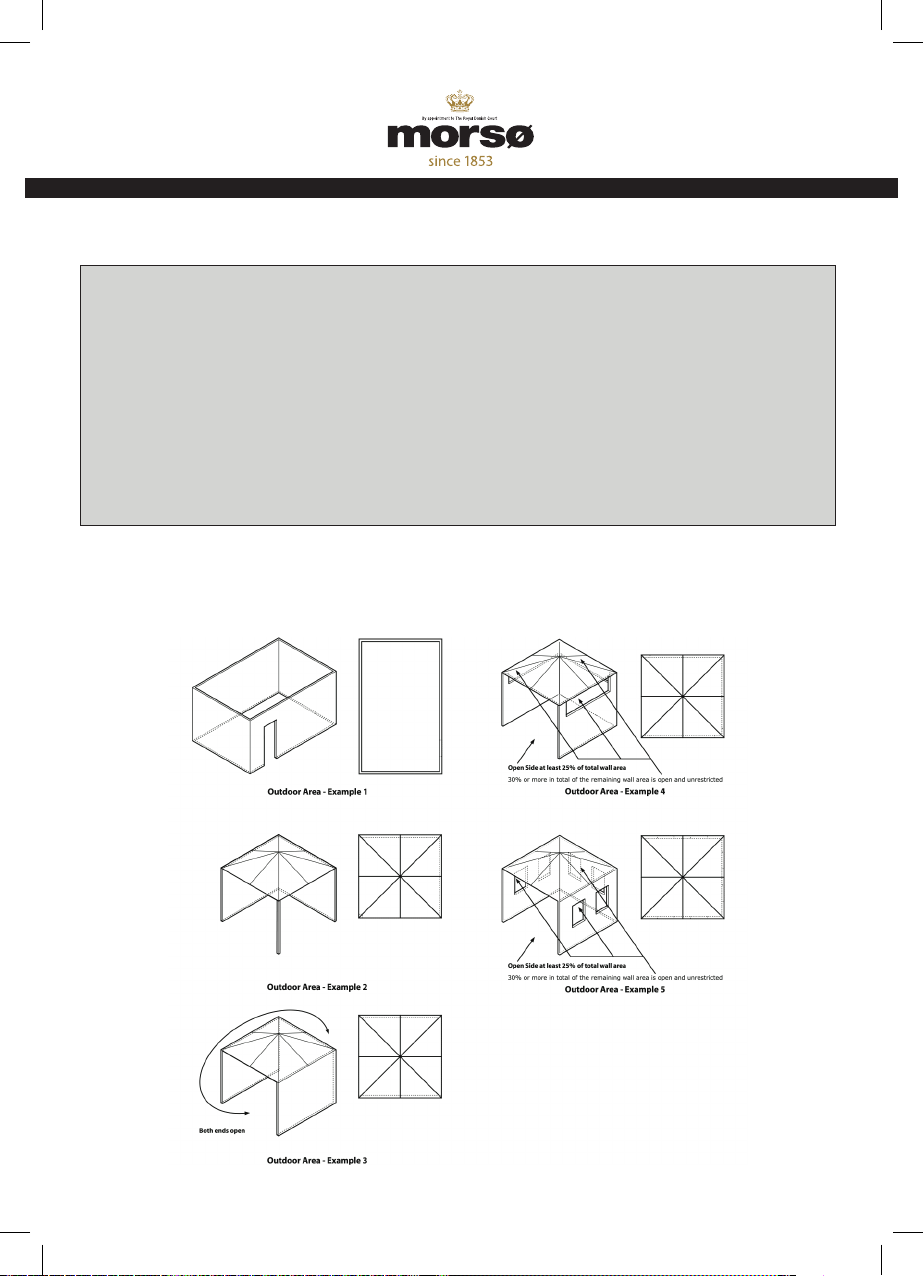
SAFE APPLIANCE LOCATIONS
This appliance shall only be used in an above ground open-air situation with natural ventilation, without stagnant
areas, where gas leakage and products of combustion are rapidly dispersed by wind and natural convection.
Any enclosure in which the appliance is used shall comply with the following:
An enclosure with walls on all sides, but at least one permanent opening at ground level and no overhead cover.
Within a partial enclosure that includes an overhead cover and no more than two walls.
Within a partial enclosure that includes an overhead cover and more than two walls, the following will apply:
• at least 25% of the total wall area is completely open, and
• at least 30% of the remaining wall area is open and unrestricted.
In the case of balconies, at least 20% of the total wall area shall be and remain open and
unrestricted.
DIAGRAMMATIC REPRESENTATI ONS OF OUTDOOR AREAS
The following gures are diagrammatic representations of outdoor areas. Rectangular areas have been used
in these gures – the same principles apply to any other shaped area.
11
Page 12

For any queries or assistance call:
Customer Service
Denmark
+45 96 69 19 00
Open:
Monday to Friday 9:00-15:00 (GMT+1)
Keep your purchase receipt, this will be required to
make any claims under the 12 month warranty.
www.morsoe.com
07.03.2019
 Loading...