

Page 1
HIGH-EFFICIENCY - MULTI SOLID FUEL
CENTRAL-HEATING STOVE WITH AUTOMATIC CONTROL
ISSUED - 10/09/2013 (456)
PLEASE LEAVE THIS DOCUMENT WITH THE HOUSEHOLDER
DB15
INSTALLATION AND OPERATING INSTRUCTIONS
Page 2
3
DB15 INSTALLATION AND OPERATING INSTRUCTIONS
The Morso DB15 may be used in smoke control areas strictly in accordance with these instructions,
when burning:
THIS APPLIANCE BECOMES
EXTREMELY HOT IN USE.
A fire-guard should be used if children or the infirm are present.
The installer is required to EXACTLY follow these instructions and to completely
comply with all local, national and international standards.
Building rules and regulations are available at www.soliftec.com
UK: Untreated wood logs,
lignite briquettes or authorised
smokeless fuels
(Exempted from s20 of the Clean
Air Act 1993)
RoI: Wood logs, smokeless fuels
or peat briquettes,
but not petroleum coke
(Control of Atmospheric
Pollution Regulations, 1970)
INSTALLING a stove is
a ‘controlled service’, the
law expects that it is either
supervised by a qualified
installer or that the building
inspector is informed. Check
with your local authority.
A certificate of installation
must be issued by building
control or a competent person
scheme.
ASBESTOS Your stove does
not contain asbestos, but take
care to avoid disturbing
asbestos in an old installation.
WEIGHT Your stove is heavy
(187kg) take great care
when moving it and ensure
that the intended fireplace
can support the weightconsider fitting a load
distributing plate.
YOUR FIREPLACE Stoves
become VERY hot, the setting
must be made entirely of
durable non-combustable
materials. take care to
observe the safe distances to
combustibles shown on the
back page.
YOUR CHIMNEY
Specific rules apply where
the flue passes through
timber, thatch or other
vulnerable materials - take
specialist advice. It is not
possible to access the
chimney for cleaning through
the stove, inspection and
sweeping access must be
provided. The chimney must:
• Generate a draught in use
of at least 12Pa (0.05ins wg)
• Be capable of withstanding
the temperatures generated.
• Be absolutely incapable
of leaking fumes into
the dwelling
Several different forms of
chimney may be suitable,
but they will commonly need
to be:
• At least 5m high.
• Terminating at least 1m
above any roof ridge.
• Have an internal crosssection equivalent to not
less than 150mm dia and
not more than 0.14m²
(eg 375 x 375mm)
• Be free from even the slightest
crack or source of leakage.
• Have no bends sharper
than 45º or comply with
BS 15 287.
• Be swept and entirely free
of obstructions
• Be connected only to this
one appliance.
• Be of thick masonry or
otherwise adequately
insulated.
• Conform to local and
national building
regulations.
AIR SUPPLY: The stove
needs a fresh air supply
complying with the
requirements of building
regulations to operate
correctly. Where needed,
it is wise to fit an outside
vent as close to the fire as
possible. Correctly sited
and sized, air will only
move between the vent
and the stove, preventing
unpleasant draughts.
An extractor fan, or another
flue-using appliance, or an
open fireplace or chimney,
in the same building,
may remove this air.
ON THE PURCHASE
OF YOUR MORSØ DB15
PLEASE READ THESE
INSTRUCTIONS CAREFULLY
C
O
N
G
R
A
T
U
L
A
T
I
O
N
S
TO FIND A QUALIFIED INSTALLER, FUEL SUPPLIER or CHIMNEY SWEEP, CONTACT:
UK:
HETAS Ltd
Orchard Business Centre
Stoke Orchard, Cheltenham
Gloucestershire GL52 7RZ
www.hetas.co.uk
RoI:
Irish Nationwide Fireplace Organisation,
162 Capel Street,
Dublin 1
Tel:01-801-5959
www.fireplace.ie
Page 3
DB15 INSTALLATION AND OPERATING INSTRUCTIONS
4 5
DB15 INSTALLATION AND OPERATING INSTRUCTIONS
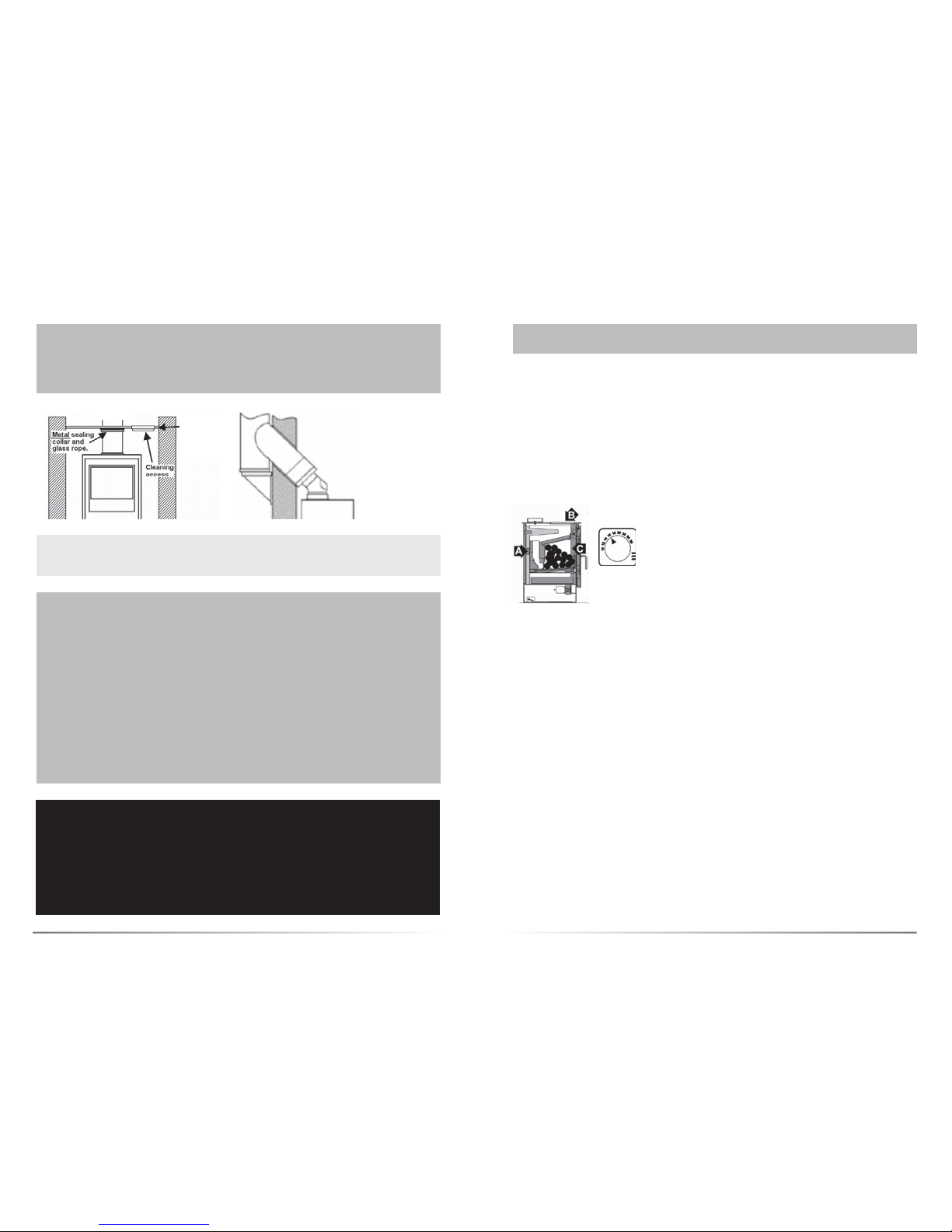
HOW THE DB15 WORKS
The Morsø DB15 is a ‘downburn’
stove where the waste gases
pass down through the fire bed
and into the ’afterburn’ chamber
(A) reaching temperatures
of 1000ºC at the back where
the smoke is burned away.
This system gives very clean
combustion and extremely
high efficiency on a wide range
of fuels.
LIGHTING If lighting after a
period of non-use, do check
that the flueways and chimney
are completely clear. Place
two or three firelighters close
together, or screwed-up paper
covered with dry kindling, at the
back of the grate and light them.
When they are burning well
gently fill the fire with dry fuel.
Downburn stoves ignite very
quickly, but they begin to burn
at the back, so the full flame
may not be apparent for a
few minutes.
STOKING Don’t fill to the
point where fuel touches roof
of the stove.
CONTROL Correctly installed
(see page 10) this stove will
control itself for minimum
fuel consumption. The manual
control on the top of the
door overrides the automatic
control. It can be helpfully
used when first lighting or
refuelling, but keep it shut,
or nearly so, in normal use.
The Thermostat Dial on
the lower right of the stove
controls a device which senses
the temperature of water in
the boiler and automatically
allows air in to make the fire
burn more or less fiercely,
so that water always leaves
the boiler at about 50ºC on the
lowest setting to about 90ºC
at the highest. Once you have
found the most appropriate
setting for your house usually about midway -
it shouldn’t be necessary to
adjust it again. To adjust
the house temperature, adjust
the radiator thermostats
(if fitted) or your central room
thermostat. These controls
will then automatically limit
or allow the flow of water
through the boiler, which will
adjust itself accordingly. Your
fire will die down or flare up
and the central heating pump
go on or off as needed in
response to the temperature
of rooms and water. When you
adjust the central controls,
wait an hour or two for the
adjustment to ‘stabilise’ controls are deliberately made
to react slowly to prevent rapid
on-off-on-off cycling.
EMPTYING ASHES If you’re
using mineral fuels like anthracite
or manufactured smokeless
fuels - then empty the ash
regularly, if it builds up it will
severely damage the grates.
If you mainly use wood, then
do the opposite, let the ash and
charcoal build up. To empty
the ash agitate the firebed
by using the tool to operate
the riddling mechanism on
the right-hand side. Use the
ashpan tool to remove the
ashpan. Remember to let ash
cool before disposing in plastic
sacks or dustbins. There is
no need to empty every last
speck, but ash from mineral
fuels (coal etc) should never
be allowed to build up so that
it comes into contact with the
underside of the grate
EXTENDED BURNING Allow
the fire to burn down to a low,
hot firebed. Empty the ash,
fully fill with hard fuel such
as anthracite and your stove
can burn for up to twelve
hours without attention.
KEEPING THE WINDOW CLEAN
Reduce the risk of staining by
using only very dry fuel. Severe
stains can be removed when
cold with Morsø glass cleaner.
DO NOT use proprietary solventbased stove window cleaners.
The window is not glass but a
transparent ceramic, when
using some solid fuels it may
develop tiny hairline surface
cracks, these are harmless,
and a known characteristic of
some mineral fuels.
OPENING THE DOOR
This stove is designed to be
operated only with the door
closed. Open the door very slowly
to minimise fume emission and
prevent hot fuel falling out.
SUMMER SHUT DOWN
Before a long period of non-use,
empty fuel and ash and leave
all the air controls open and the
door slightly ajar to allow ventilation
to reduce condensation.
GUARD AGAINST CONDENSATION!
Solid fuels contain water which can condense on cool boiler faces to cause
rapid corrosion and failure. Always fit a device such as a low-level thermostat to
minimise cool water circulating through the boiler. ALLOW FOR OVERHEATING!
This boiler has automatic control, but there must be some way of dissipating
surplus heat - fit a high-level thermostat to override controls and run the central
heating if there is risk of boiling. Follow the rules given in this instruction booklet.
An old-fashioned ‘heat leak’ radiator will not suffice.
LIVING WITH YOUR STOVE Every fuel, chimney and condition of use is different.
Only experience will show which are the best settings for you.
FITTING Fit the flue collar to the top of the stove and seal to the chimney using a short length
of uninsulated pipe. Two possible ways of doing this are shown below.
Whichever method is used it is imperative that the route for gases from the stove to
the chimney terminal is completely air-tight; even the tiniest gap or crack can spoil the
updraught. Seal all joins with fireproof cement and/or heatproof rope.
HEATING SYSTEM DESIGN This appliance is for use with an open-vented water heating circuit
at a maximum pressure of 2 Bar, equivalent to a static head of 18 metres. Suggested circuit
designs are given on page 10 & 11.
IMPORTANT! CHECK THE INSTALLATION!
Once installed check that:
1) The route for gases from the stove to the chimney terminal is completely airtight,
unobstructed and able to be swept. (access hatches may be required.)
2) The entire fireplace construction is of durable non-combustable materials
3) The flue presents a draught in use of at least 12Pa
5) A CO alarm is fitted
6) Flue data plate is completed and fixed in the fireplace recess or utility cupboard
7) The water system can never exceed 2 Bar pressure, has provision to dissipate or store
surplus heat, can accommodate boiling, and has means to minimise the circulation of cool
water through the boiler
8) Light stove and ensure it burns controllably and does not emit fumes to the room
9) Demonstrate the operation of the stove to the householder
LIVING WITH YOUR STOVE
Every fuel, chimney and condition of use is different. Only
experience will show which are the best settings for you.
HOW THE DB15 WORKS: The Morso DB15 is a 'downburn' stove
where the waste gases pass down through the hot fire and into an
'afterburn' chamber (A) at the back where even smoke is burned
away. This system gives very clean combustion and extremely
high efficiency on a wide range of fuels.
LIGHTING If lighting after a period of non-use, do check that the
flueways and chimney are completely clear. Empty the ashes if
need be. Place two or three firelighters close together, or screwed-
up paper covered with dry sticks, at the back of the grate and light
them. When they are burning well
gently fill the fire with dry fuel.
Downburn stoves ignite very
quickly, but they begin to burn at
the back, so the full flame may not
be apparent for a few minutes.
FILLING: (C) Don't fill to the point
where fuel touches roof of the
stove.
CONTROL. Correctly installed
(see separate sheet) this stove
will control itself f or minimum fuel
consumption.
The manual control on the top of
the door overrides the automatic
control. It can be helpfully used
fuel and ash and leave all the air controls open to allow ventilation
to reduce condensation.
FUELS
The Morso DB15 is one of very few stoves which can burn almost
any solid fuel. But there is no 'perfect' fuel, so we strongly
recommend that you try a selection of fuels (or mixtures) to find
which suits you best. Do avoid dusty materials like sawdust, they
can burn far to violently.
SMOKE CONTROL: In certain
areas special rules apply to
reduce smoke nuisance. Check
with your local authority.
WOOD only emits as much
carbon to the atmosphere as the
tree took in when growing, so wood is considered the 'carbon
neutral' fuel. When wood is cut down its cells are full of water.
Burning such wet or 'green' wood wastes heat in making steam
and produces flammable, acidic tars which will cling to, and rapidly
damage, your stove and chimney. Split logs will typically take two
years to become reasonably dry, round logs very much longer.
Cracks in the ends, a hollow sound when tapped and bark falling
away are all signs that a log may be ready for use. The fine, white
residue produced when wood burns is not ash, but the remains of
cell walls which can burn if kept hot enough, so don't de-ash the
fire until absolutely necessary when using wood.
For best performance, and always for low smoke emission:
●Split logs lengthways for drying
●Use logs no bigger than about 100mm x 250mm
fuel and ash and leave all the air controls open to allow ventilation
to reduce condensation.
FUELS
The Morso DB15 is one of very few stoves which can burn almost
any solid fuel. But there is no 'perfect' fuel, so we strongly
recommend that you try a selection of fuels (or mixtures) to find
which suits you best. Do avoid dusty materials like sawdust, they
can burn far to violently.
SMOKE CONTROL: In certain
areas special rules apply to
reduce smoke nuisance. Check
with your local authority.
WOOD only emits as much
carbon to the atmosphere as the
tree took in when growing, so wood is considered the 'carbon
neutral' fuel. When wood is cut down its cells are full of water.
Burning such wet or 'green' wood wastes heat in making steam
and produces flammable, acidic tars which will cling to, and rapidly
damage, your stove and chimney. Split logs will typically take two
years to become reasonably dry, round logs very much longer.
Cracks in the ends, a hollow sound when tapped and bark falling
away are all signs that a log may be ready for use. The fine, white
residue produced when wood burns is not ash, but the remains of
cell walls which can burn if kept hot enough, so don't de-ash the
fire until absolutely necessary when using wood.
For best performance, and always for low smoke emission:
●Split logs lengthways for drying
●Use logs no bigger than about 100mm x 250mm
●Ensure logs are absolutely dry (less than 20% moisture)
●Fill the stove loosely, so air can circulate between logs.
●Fill 'little and often'
●When first lighting, or reviving a fire from embers, use only very
small, thin, dry, sticks.
●Keep a constant, deep, bed of charcoal and wood ash beneath
the burning logs. This may need several firings to build up.
JOINERY WASTE Dry wood offcuts will burn well, but don't expect
softwood waste to burn as cleanly or for as long as hardwood logs.
PEAT: Sod turf must be thoroughly dry.
LIGNITE or BROWN COAL is a natural mineral, between peat
and coal. It lights easily and burns well, but produces much ash.
BITUMINOUS COAL (Sold as 'Housecoal' or 'Polish') (does
NOT burn smokelessly, and is not permitted in smoke control
areas of the UK and RoI) is raw, natural coal containing a high
proportion of bitumen. The DB15 is one of very few stoves which
Use radiator or
room thermostats to
control the system,
not the controls on
the stove
150mm dia and not more than 0.14m² (eg 375 x 375mm)
●Be free from even the slightest crack or source of leakage.
●Have no bends sharper than 45º.
●Be swept and entirely free of obstructions
●Be connected only to this one appliance.
●Be of thick masonry or otherwise adequately insulated.
●Conform to local building regulations.
Special rules apply where the flue passes through timber, thatch or
other vulnerable materials- take specialist advice.
It is not possible to access the chimney for cleaning through the
fire, fit hatches to provide access.
YOUR FIREPLACE: Stoves become VERY hot, the setting must
be made entirely of durable fireproof materials. take care to
observe the safe distances to combustibles shown on the front
page.
AIR SUPPLY: Your stove needs fresh air from outside to breathe -
the air inlets should equ al about 550mm² for each kW of nominal
output.
This degree of air can often be provided by leakage around door
frames etc, especially in older buildings. It must be a matter for the
judgement of the installer as to whether an extra permanent air
vent is required. Where is needed, it is wise to fit an outside vent
as close to the fire as possible. Correctly sited and sized, air will
only move between the vent and the stove, preventing unpleasant
draughts.
An extractor fan, or another fuel-using appliance, or an open
fireplace or chimney, in the same building, can remove this air.
Whichever method is used it is imperative that the route for
gases from the stove to the chimney terminal is completely
air-tight; even the tiniest gap or crack can spoil the updraught.
Seal all joins with fireproof cement and/or heatproof rope.
Adjusting the thermostat: Check the thermostat on the
side of the stove before fitting! With the fire cold, the
Building rules and regulations are available at www.soliftec.com
INSTALLING a stove is a 'controlled service', the law expects that
it is either supervised by a qualified installer or that the building
inspector is informed. Check with your local authority.
ASBESTOS: Your stove does not contain asbestos, but take care
to avoid disturbing asbestos in an old installation.
WEIGHT: Your stove is heavy (182kg) take great care when
moving it and ensure that the intended fireplace can support the
weight- consider fitting a load distributing plate.
YOUR CHIMNEY, by becoming warm, makes the gas inside it
rise, pulling fresh air into the stove to make it work. It must:
●Generate a draught in use of at least 12Pa (0.05ins wg)
●Be capable of withstanding the temperatures generated.
●Be absolutely incapable of leaking fumes into the dwelling
Several different forms of chimney may be suitable, but they will
commonly need to be:
●At least 5m high.
●Terminating at least 1m above any roof ridge.
●Have an internal cross-section equivalent to not less than
150mm dia and not more than 0.14m² (eg 375 x 375mm)
●Be free from even the slightest crack or source of leakage.
●Have no bends sharper than 45º.
●Be swept and entirely free of obstructions
●Be connected only to this one appliance.
●Be of thick masonry or otherwise adequately insulated.
●Conform to local building regulations.
Special rules apply where the flue passes through timber, thatch or
other vulnerable materials- take specialist advice.
It is not possible to access the chimney for cleaning through the
fire, fit hatches to provide access.
YOUR FIREPLACE: Stoves become VERY hot, the setting must
be made entirely of durable fireproof materials. take care to
observe the safe distances to combustibles shown on the front
page.
AIR SUPPLY: Your stove needs fresh air from outside to breathe -
the air inlets should equ al about 550mm² for each kW of nominal
output.
This degree of air can often be provided by leakage around door
frames etc, especially in older buildings. It must be a matter for the
judgement of the installer as to whether an extra permanent air
vent is required. Where is needed, it is wise to fit an outside vent
as close to the fire as possible. Correctly sited and sized, air will
only move between the vent and the stove, preventing unpleasant
draughts.
An extractor fan, or another fuel-using appliance, or an open
fireplace or chimney, in the same building, can remove this air.
FITTING
Fasten the flue outlet to the top of the stove and seal to the chimney using a short (up to about 0.5m) length of uninsulated pipe. Two
possible ways of doing this are shown.
Whichever method is used it is imperative that the route for
gases from the stove to the chimney terminal is completely
air-tight; even the tiniest gap or crack can spoil the updraught.
Seal all joins with fireproof cement and/or heatproof rope.
Adjusting the thermostat: Check the thermostat on the
side of the stove before fitting! With the fire cold, the
THIS APPLIANCE BECOMES EXTREMELY HOT
AND CAN PRODUCE POISONOUS GASES.
A fire-guard should be used if children or the infirm are
present. The installer is required to EXACTLY follow
these instructions and to completely comply with all
local, national and international standards.
A register plate
of at least 1.5mm
thick rust protective
steel
Page 4
DB15 INSTALLATION AND OPERATING INSTRUCTIONS
6 7
DB15 INSTALLATION AND OPERATING INSTRUCTIONS
SMOKE CONTROL In certain
areas rules apply to reduce
smoke nuisance. Check with
your local authority.
WOOD only emits as much
carbon to the atmosphere as
the tree took in when growing,
so wood is considered the
‘carbon neutral’ fuel. When
wood is cut down its cells are
full of water. Burning such
wet or ‘green’ wood wastes
heat in making steam and
produces flammable, acidic
tars which will cling to, and
rapidly damage, your stove
and chimney. Split logs will
typically take two years to
become reasonably dry,
round logs very much longer.
Cracks in the ends, a hollow
sound when tapped and bark
falling away are all signs that
a log may be ready for use.
Alternatively use a Morsø
moisture meter. The fine,
white residue produced when
wood burns is not ash, but
the remains of cell walls
which can burn if kept hot
enough, so don’t de-ash the
fire until absolutely necessary
when using wood. For best
performance, and always for
low smoke emission:
- Split logs length ways
for drying
- Use logs no bigger than
100mm x 250mm
- Ensure logs are absolutely
dry (less than 20%
moisture)
- Fill the stove loosely, so air
can circulate between logs.
- Fill ‘little and often’
- When first lighting, or
reviving a fire from embers,
use only small pieces
of wood.
- Keep a constant, deep,
bed of charcoal and wood
ash beneath the burning
logs. This may need several
firings to build up.
JOINERY WASTE Dry wood
offcuts will burn well, but
don’t expects soft wood waste
to burn as cleanly or for as
long as hardwood logs.
PEAT Sod turf must be
thoroughly dry.
LIGNITE or BROWN COAL
is a natural mineral,
between peat and coal.
It lights easily and burns
well, but produces
much ash.
BITUMINOUS COAL
(Sold as ‘Housecoal’ or
‘Polish’) (does NOT burn
smokelessly, and is not
permitted in smoke control
areas of the UK and RoI) is
raw, natural coal containing
a high proportion of bitumen.
The DB15 is one of very few
stoves which can burn this
fuel with high efficiency. But
be aware that it makes lots
of tarry smoke and large
volumes of flammable gas
which can sometimes make
it difficult to control.
ANTHRACITE is a natural
hard, shiny form of coal.
Slow to light, it can burn for
very long periods with great
heat. Despite its high priceper-bag it generally works
out to be one of the cheapest
of all fuels. Use the ‘small
nuts’ size.
COKE is coal from which the
smoke has been removed.
Sometimes difficult to light,
it burns very cleanly.
BRIQUETTES Are compressed
blocks of fuel, generally
able to burn for long periods
and remarkable for their
consistency.’Homefire’ and
‘Phurnacite’ are smokeless
types while other brands are
made from lignite, peat
or housecoal.
PETROLEUM COKE sold
as ‘Petcoke’, ‘Longbeach’
and other names, is an
industrial reagent made from
oil sometimes simply sold
as ‘smokeless fuel’ without
any brand designation and
identifiable by a structure of
tiny cohered beads. Although
the DB15 can burn this
fuel safely, it WILL rapidly
degrade interior parts and
may damage the flue.
HOUSEHOLD WASTES
Some plastics give off toxic
fumes when burned and
remember that batteries
and aerosols explode!
The stove is not an incinerator,
so only ever use the
recommended fuels and
NEVER use liquid fuels in
any form.
SMOKE FROM THE CHIMNEY
It is quite normal for a little
smoke to be emitted from the
chimney, especially when the
fire is cold.Use only VERY dry
wood or smokeless fuels. Is
the chimney high enough and
hot enough to generate the
necessary 12Pa draught?
POOR HEAT OUTPUT
This appliance is very easily
capable of producing the quoted
heat outputs given suitable
fuels and a chimney capable of
developing sufficient draught.
Is the chimney too short or
becoming cool or damp?
Is the fuel completely dry?
Have the central controls been
set correctly? Is the building
sufficiently well insulated?
CONDENSATION onto cool
surfaces inside the stove can
be severe if fuel is in any way
damp. Use only very dry fuel.
It is vital that the heating circuit
is fitted with a device, such
as a low-limit thermostat, to
minimise cold water circulating
through the boiler.
SMOKE COMING INTO ROOM
A little smoke leaking into
the room during refuelling
is normal, but fumes are
poisonous and recurrent smoke
emission must NEVER be
tolerated, causes might be:
NEW STOVE There is often a
smell and sometimes visible
fumes as the paint cures.
This normally stops after
an hour or so.
INADEQUATE SEALS
Are all flue pipes and connectors
absolutely gas-tight? Even the
tiniest crack or gap can spoil
the draught.
BLOCKED FLUEWAYS
Has soot and ash collected above
the inner back part of the firebox?
UNSUITABLE, BLOCKED
OR UN-SWEPT CHIMNEY
The first requirement for correct
operation is a sound chimney.
Check the requirements earlie r
in this document and in any case
of doubt engage a professional
sweep or chimney engineer.
POOR AIR SUPPLY Lack of air
to the fire is a common cause of
smoking and poor performance.
Air supply problems may be
worse in certain wind conditions
(often incorrectly ascribed
to’downdraught’, which is in fact
very rare), where air can
be sucked out of the room.
The answer is to fit an air vent,
as near to the fire as possible,
facing into the usual wind
direction.
DOWN DRAUGHT Wind can
blow down a chimney if there is
something higher nearby such
as a tree, hill or high building.
POOR CHIMNEY DRAUGHT-
Chimney draught in use MUST
be at at least 12Pa.
CHIMNEY FIRE In the rare event
of deposits inside the chimney
igniting (roaring sound, plus
dense smoke and sparks from
the chimney) immediately close
the door, shut all air controls
and call the fire brigade.
FUELS The Morso DB15 is one of very few stoves which can burn almost any solid fuel. But there
is no ‘perfect’ fuel, so we strongly recommend that you try a selection of fuels (or mixtures) to
find which suits you best. Do avoid dusty materials like sawdust, they can burn far too violently.
PROBLEMS Problems like those listed here are usually due to some difficulty with the
installation, chimney or fuels, so please check back through this leaflet carefully. If necessary
seek specialist advice.
MAINTENANCE
MONTHLY Open the fire door
and inspect the top flue passages.
Gain access for cleaning by
using the tool to lift off the lid
(B) on the diagram on page 5.
ANNUALLY- SWEEP THE
CHIMNEY
The entire length of the
chimney from stove to outlet
should be swept annually, more
often if smoky fuels are used.
NEW PARTS Your stove has
been extensively tested for
safety - please don’t try to
modify it and always obtain
genuine spare parts.
SURFACE FINISH Wipe the
stove body with a slightly damp
cloth when cool. NEVER use
aerosol spray or wax near
the hot fire –they can ignite.
Painted steel parts can be
refurbished using Morsø spray
paint. Your stove generates
VERY high temperatures.
Eventually the internal parts
will require replacement.
Help parts to last by:
- Using only recommend,
very dry, fuels.
- Emptying the ash very
regularly when using mineral
fuel -never allow it to touch
the underside of the grate.
- Cleaning the flueways
regularly.
- Avoiding ‘over-firing’
Page 5
DB15 INSTALLATION AND OPERATING INSTRUCTIONS
8 9
DB15 INSTALLATION AND OPERATING INSTRUCTIONS
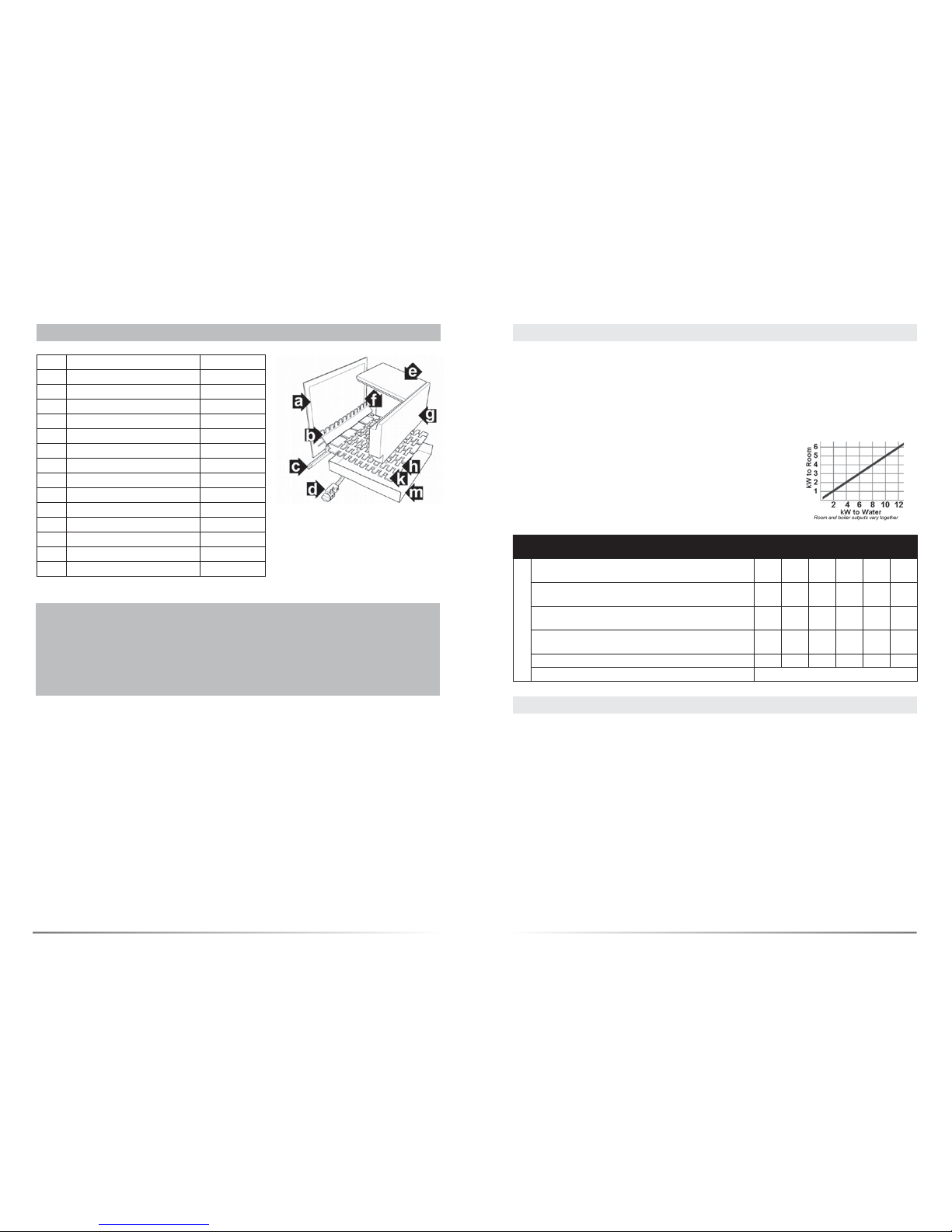
PARTS AND ACCESSORIES Standard Spare Parts for Morso DB15 Central Heating Stove
DOWNDRAUGHT: Wind can blow down a chimney if there is
something higher nearby such as a tree, hill or high building.
Fitting an anti-downdraught cowl to the chimney top can cure this.
Types which cannot be swept through are not recommended.
POOR CHIMNEY DRAUGHT- Chimney draught in use MUST be
at least 12Pa.
CHIMNEY FIRE: In the rare event of deposits inside the chimney
igniting (roaring sound + dense smoke and sparks from the
chimney) immediately close the door, shut all air controls and call
the fire brigade. Prevent fires by using very dry fuel and having
your chimney swept regularly.
MAINTENANCE
MONTHLY- Open the fire door and inspect the top flue passages.
Gain access for cleaning by using the tool to lift off the lid (B on the
diagram).
ANNUALLY- SWEEP THE CHIMNEY The entire length of the
chimney from stove to outlet should be swept annually, more often
if smoky fuels are used.
NEW PARTS Your stove has been extensively tested for safety -
please don't try to modify it and always obtain genuine spare parts.
SURFACE FINISH Wipe the stove body with a slightly damp cloth
when cool. NEVER use aerosol spray or wax near the hot fire –
they can ignite. Painted steel parts can be refurbished using
special spray paint.
Your stove generates VERY high temperatures. Eventually the
internal parts will require replacement . Help parts to last by:
●Using only recommend, very dry, fuels.
●Emptying the ash very regularly when using mineral fuel -never
allow it to touch the underside of the grate.
●Cleaning the flueways regularly.
●Avoiding 'over-firing'
KEY SPARE PART PART NUMBER
A WINDOW MOR0029
B FRONT FIREBAR MOR0032
C RIDDLING BAR MOR0031
D THERMOSTAT ASSEMBLY MOR0032
E ROOF BRICK, PAIR, WITH SEALS MOR0033
F SIDE BRICK, PAIR, WITH SEALS MOR0034
G MID BRICK, WITH SEALS MOR0035
H FIREBAR, UPPER MOR0036
K FIREBAR, LOWER MOR0037
M ASHPAN MOR0038
TOUCH-UP PAINT MOR0039
OPERATING TOOL MOR0040
ROPE SEAL KIT MOR0041
MINERAL FIBRE SEALS BETWEEN BRICKS MOR0042
1. CONTROL THE
HEATING SYSTEM
Stove boilers control their
own water temperature
by an internal thermostat,
so controls such as time
clocks and thermostats
regulate flow through the
heating circuit, not
the boiler.
2. GUARD AGAINST
CONDENSATION!
Solid fuels contain water
which can condense on
cool boiler faces to cause
VERY rapid corrosion and
failure. Use very dry fuel
and always fit a device such
BOILER STOVE CENTRAL HEATING SYSTEMS
This is a rough guide to specifying and fitting central heating using a solid fuel boiler stove with
thermostatic control. It doesn’t cover every detail, which will need to be determined on-site by
a skilled heating engineer.
‘Wet’ solid fuel central heating systems use the same types of pipework (including microbore,
plastic) and heat emitters (radiators, underfloor, etc), as other fuels and they can likewise
come on in the morning, go off at night and regulate themselves. Systems must...
HEAT REQUIREMENT
CONTROLS
GET THE RIGHT SIZE HEATERS
Guesswork won’t do.
A preliminary estimate of heat
requirement for each room
can be got from the table here.
Example: A room 6m x 5m x
2.8m has volume of 84m³.
If it was a ground floor room
in the corner of a two-storey
house, in which the adjacent
rooms and the one above were
also heated, then 2 unheated
outsidewalls + 1 outside floor =
3 unheated faces.
If moderately insulated then
Your stove has a built-in
mechanical thermostat
to regulate its water
temperature. A tiny vial of
oil is fitted in the boiler.
As the boiler water gets
hotter, the oil expands
along a fine tube, moves
a bellow outward,moving
an arm, which closes off
air to the fuel and so slows
combustion. So, if the time
clock or room thermostat
determines that no heat
is needed, it stops the
circulating pump; without
Room and boiler outputs vary together
the factor in the table is 40 Watts
per m³, so 84m³ x 40 = 3360 Watts,
or 3.36kW. A radiator, or
radiators, emitting at least
3.36kW should be specified.
Don’t forget that, with boiler
stoves, the room output and
water output go up and down
together - turn the central
heating down, and the whole
stove goes cooler.
It is usually wise to fit a
radiator (with thermostatic
valve) in the fireplace room.
The actual value varies
as a low-level thermostat
to minimise cool water
circulating through the boiler.
3. ALLOW FOR
EXCESS HEAT
The fire can close down
automatically, but it can’t
completely stop combustion
and output will vary considerably
during a fuelling cycle.
There must be some infallible
means of dissipating, and
preferably storing, surplus
heat, for instance a hot
water cylinder or a thermal
store and always a system
to run the central-heating
pump if there is risk of
boiling. Should thermostat
and pump fail together,
there must be infallible
provision to cool the system,
or allow it to boil, for
instance through an open
vent.
(The old-fashioned idea of
deliberately wasting heat
through a permanent “heat
leak” radiator not only
throws heat away, it just
will not suffice with powerful
modern stoves.)
APPROXIMATE HEAT REQUIREMENT OF ROOMS
Watts per Cubic Metre
NUMBER OF UNHEATED FACES
1 2 3 4 5 6
INSULATION
No effective insulation eg: all-glass rooms with single
glazing, barns, workshops, tents
120 132 145 158 170 183
Poor insulation eg; single glazing, little loft insulation,
uninsulated cavity walls, draughts
62 70 78 86 94 102
Moderate insulation eg: thick solid walls, some loft insulation,
some draught-proofing
31 35 40 44 48 53
Good Insulation eg: some wall insulation, thick loft insulation,
double glazing, draught-proofing
21 24 27 31 34 37
Best insulation eg: properties built to 2008 UK standards 16 18 20 22 24 26
WATTS (W) PER CUBIC METRE
water circulation the boiler
begins to get too hot, the oil
expands, shuts off air and
the fire dies down. If there
is demand for heat, for instance
in the morning, the pump
comes on, colder water
enters the boiler, the air-flap
opens and the fire blazes up.
The control dial on the stove
does not directly turn the
stove up and down, it sets
the water temperature at
which the thermostat will
begin to shut the fire down.
We recommend a control
system regulating the
central-heating pump
through (1) a single-channel
time clock, (2) a centrallylocated room thermostat
(not in the stove room) and
(3) thermostatic radiator
valves on all but one
radiator. A low-level (about
50°C) pipe thermostat to
prevent pumped circulation
of cool water (which can
cause condensation, rust,
and deplete stored hot
water) and a high level one
with the shape, exposure,
draughtiness and temperatures.
For larger installations or
whole-house heating, use
the more accurate ‘U-Value
method - an online heat-need
calculator is available at
www.soliftec.com.
Page 6
DB15 INSTALLATION AND OPERATING INSTRUCTIONS
10 11
DB15 INSTALLATION AND OPERATING INSTRUCTIONS
WATER SYSTEM CONNECTIONS
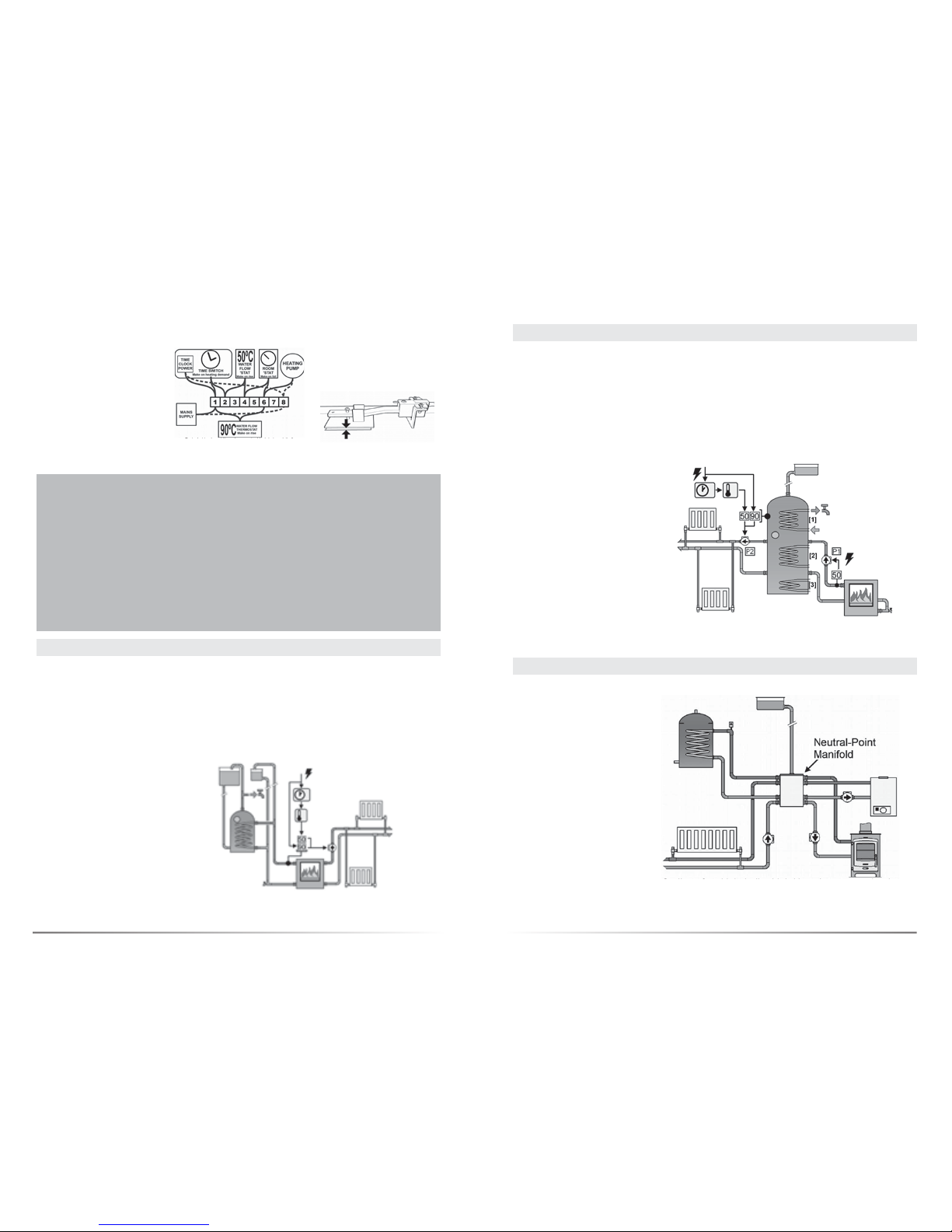
Outlines of some possible installation
schemes are shown here.
In both of them:
- Possible boiling is safely accommodated
by a vent pipe leading directly to an open
feed and expansion tank.
- A c50°C low-level thermostat brings the
pumped system ‘on’ only when the fire
is hot. It prevents stored hot water from
being depleted and cold water chilling
the boiler. Vital to prevent corrosion.
- A c90°C thermostat can close to override
allother controls and operate the central
heating pump to dissipate heat if there is
a risk of boiling.
- There are time and room-temperature
controls controlling the central-heating pump.
- Hot water for taps is not separately
controlled, it may become scalding hot consider fitting a thermostatic mixing valve.
- An electric immersion heater is provided
for summer hot water. Temperatures are
approximate and will vary.
SCHEME 1: TRADITIONAL 2-SIDE
LINK-UP TO ANOTHER BOILER
Compact and quick to heat.
Stores hot water for taps, but
radiators will go cold if the fire
goes out. Recommended for
occasional use or where longburning mineral fuels are
used. One side of the boiler
feeds, by gravity circulation
alone, an indirect coil to heat a
hot-water storage cylinder and
has feed and vent connections
to a small open expansion
tank. (Gravity piping requires
careful calculation but will
generally be at least 28mm
diameter, rise continually and
have a horizontal distance from
the boiler of no more than its
vertical distance above it.)
The other side of the boiler
Your stove can be linked
into an oil or gas central
heating system and operate
completely automatically.
One method is to use a
thermal store system,
like Scheme 2 above,
with a separate coil (for
pressurised boilers) or
extra direct connections
(for open-vent boilers).
Another method uses a
‘neutral point manifold’ where
both boilers are connected
to the manifold, which is in
turn connected to the hot
water and radiator circuits.
Suitable devices come from
www.esse.com and
www.systemlink.ie.
connects to the pumped
central heating circuit, which
activates only when a timeclock, room thermostat and
c50°C pipe thermostat (on the
domestic hot-waterside flow
pipe near to the boiler), are all
‘closed’. A second electrical
supply feeds a pipe thermostat
on the flow pipe to domestic
water very near to the boiler
and set to close above c90°C,
such that if there is risk of
boiling the central-heating
pump will always operate to
dissipate heat.
Scheme 1: Traditional 2-side system with gravity hot water.
Recommended where mineral fuels are mai nly to be used
SCHEME 2: THERMAL STORE
A large body of water is
stored at a high temperature,
to supply both taps and
central heating when needed.
High and low output phases
are evened-out; heating
can operate even if the fire
is out, eg, next morning.
Recommended for all uses,
and always where wood is
the main fuel. In one system,
a ‘combined’ thermal store
or ‘heat bank’ of about 300
litre capacity is directly
heated by the boiler and
has an indirect coil [1] in
its highest (hottest) part
to supply tap water, below
which the central-heating
flow is taken-off as needed.
Pump (P1) circulates hot
water from the boiler to
the store only when a pipe
thermostat on the boiler
flow pipe is above c50°C.
The separate, central
heating pump (P2) operates
only when the time-clock,
room thermostat and a
second c50°C thermostat
responsive to temperature in
the store, areall ‘closed’.
A second thermostat towards
the top of the store closes
at c90°C to dissipate heat
if there is risk of boiling.
Extra indirect coils may
be provided at [2] to
accommodate a supply from
a second central-heating
boiler, and at [3] to receive
relatively low-grade heat
from solar panels.
(about 90°C) to override
controls and run the
heating circuit to dissipate
heat if there is a risk of
boiling. Stored hot water
for taps is not controlled,
but accumulates during
normal operation, especially
during periods while central
heating is not required.
BOILER STOVE CENTRAL HEATING SYSTEMS
This is a rough guide to specifying and fitting central heating using a solid fuel boiler stove with thermostatic control. It doesn't cover
every detail, which will need to be determined on-site by a skilled heating engineer.
'Wet' solid fuel central heating systems use the same types of pipework (including microbore, plastic) and heat emitters (radiators,
underfloor, etc), as other fuels and they can likewise come on in the morning, go off at night and regulate themselves. Systems must...
1: CONTROL THE HEATING SYSTEM. Stove boilers control their own water temperature by an internal thermostat, so controls
such as time clocks and thermostats regulate flow through the heating circuit, not the boiler.
2: GUARD AGAINST CONDENSATION! Solid fuels contain water which can condense on cool boiler f aces to cause VERY rapid corrosion
and failure. Use very dry fuel and always fit a device such as a low-level thermostat to minimise cool water circulat ing through the boiler.
2: ALLOW FOR EXCESS HEAT. The fire can close down automatically, but it can't completely stop combustion and output will vary
considerably during a fuelling cycle. There must be some infallible means of dissi pating, and preferably storing, surplus heat, for instance a
hot water cylinder or a thermal store and always a system to run the central-heating pump if there is risk of boiling. Should thermostat and
pump fail together, there must be infallible provision to cool the system, or allow it to boil, for instance through an open vent. (The old-
fashioned idea of deliberately wasting heat through a permanent "heat leak" radiator not only throws heat away, it just will not suffice with
powerful modern stoves.)
HEAT REQUIREMENT
GET THE RIGHT SIZE HEATERS. Guesswork won't do. A preliminar y estimate of heat
requirement for each room can be got from the table here. Example: A room 6m x 5m x 2.8m
has volume of 84m³. If it was a ground floor room in the corner of a two-storey house, in
which the adjacent rooms and the one above were also heated, then 2 unheated outside
walls + 1 outside floor = 3 unheated faces. If moderately insulated then the factor in the table
is 40 Watts per m³, so 84m³ x 40 = 3360 Watts, or 3.36kW . A radiator, or radiators, emitting
at least 3.36kW should be specified.
Don't forget that, with boiler stoves, the room output and water output go up and down
together - turn the central heating down, and the whole stove goes cooler. It is
usually wise to
fit a radiator (with thermostatic valve) in the fireplace room.
The actual value varies with the shape, exposure, draughtiness and temperatures. For larger
installations or whole-house heating, use the more accurate 'U-Value method - an online
heat-need calculator is available at www.soliftec.com
.
APPROXIMATE HEAT REQUIREMENT OF ROOMS
Watts per Cubic Metre
Number of unheated faces
1 2 3 4 5 6
No effective insulation eg: all-glass rooms with single glazing, barns, workshops, tents 120 132 145 158 170 183
Poor insulation eg; single glazing, little loft insulation, uninsulated cavity walls, draughts 62 70 78 86 94 102
Moderate insulation eg: thick solid walls, some loft insulation, some draught-proofing 31 35 40 44 48 53
Good Insulation eg: some wall insulation, thick loft insulation, double glazing, draught-proofing 21 24 27 31 34 37
Best insulation eg: properties built to 2008 UK standards 16 18 20 22 24 26
Watts (W) per cubic metre
CONTROLS
Your stove has a built-in
mechanical thermostat to
regulate its water
temperature. A tiny vial of oil
is fitted in the boiler. As the
boiler water gets hotter, the
oil expands along a fine tube,
moves a bellow outward,
moving an arm, which closes
off air to the fuel and so
slows combustion. So, if the timeclock or room thermostat determines
that no heat is needed, it stops the circulating pump; without water
circulation the boiler begins to get too hot, the oil expands, shuts off
air and the fire dies down. If there is demand for heat, for instance in
the morning, the pump comes on, colder water enters the boiler, the
air-flap opens and the fire blazes up.
The control dial on the stove does not directly turn the stove up and
'Teddington' thermostat
(Normal cold '0' setting - about 7mm open)
Room and boiler outputs vary together
Number of unheated faces
1 2 3 4 5 6
Watts (W) per cubic metre
Room and boiler outputs vary together
Typical wiring layout through
connector block (return dotted)
‘Teddington’ thermostat (Normal
cold ‘0’ setting - about 7mm open)
Scheme 1: Traditional 2-side system with gravity hot water.
Recommended where mineral fuels are mainly to be used
Scheme 2: Thermal store system. Recommended for
all uses, and always where wood is the main fuel.
Outline of multiple boiler Link-Up using
a neutral-point manifold
Page 7
MORSø UK UNIT 7 THE IO CENTRE, VALLEY DRIVE
RUGBY, WARWICKSHIRE CV21 1TW
WWW.MORSO.CO.UK
MORSO.CO.Uk/PRODUCT/MORSO-Db15
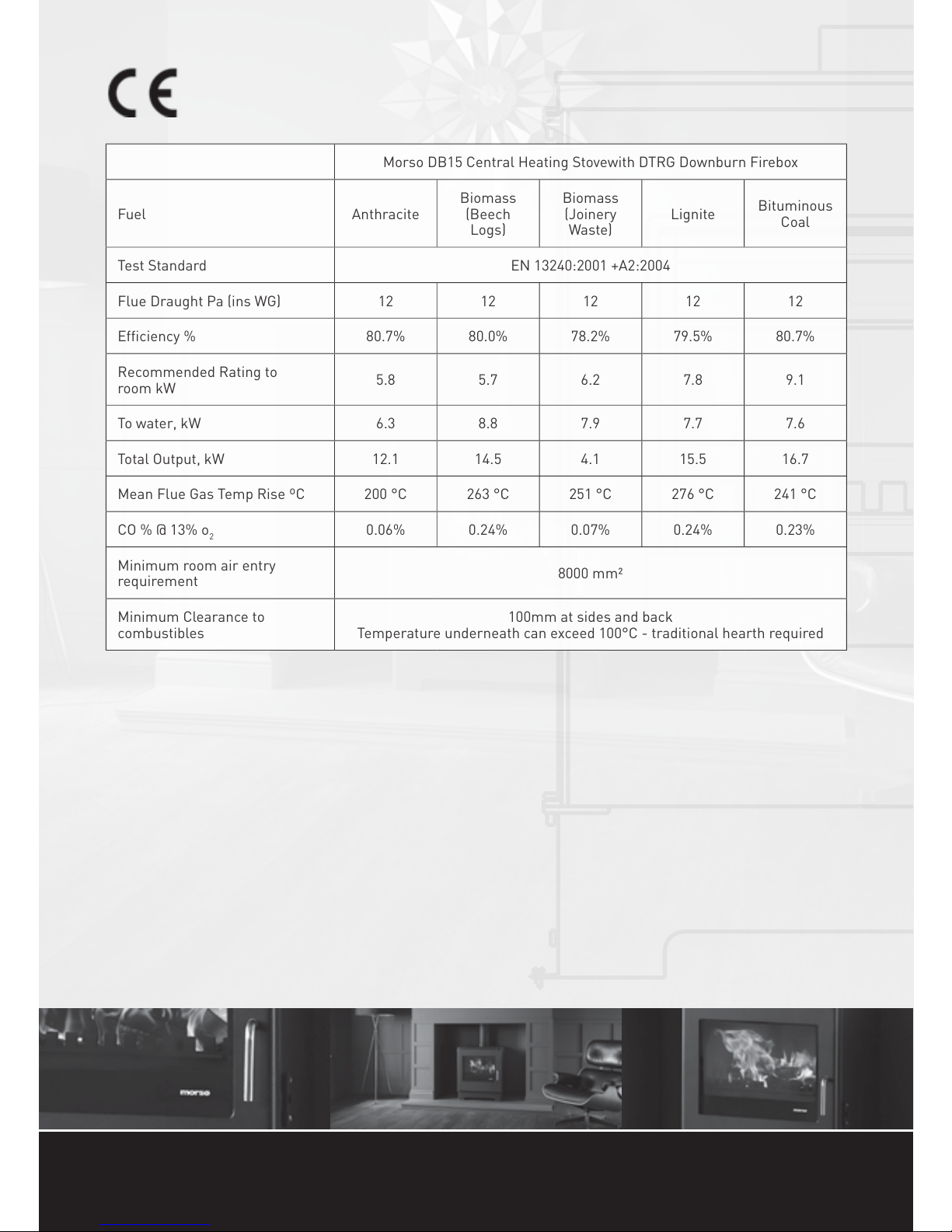
Morso DB15 Central Heating Stovewith DTRG Downburn Firebox
Fuel Anthracite
Biomass
(Beech
Logs)
Biomass
(Joinery
Waste)
Lignite
Bituminous
Coal
Test Standard EN 13240:2001 +A2:2004
Flue Draught Pa (ins WG) 12 12 12 12 12
Efficiency % 80.7% 80.0% 78.2% 79.5% 80.7%
Recommended Rating to
room kW
5.8 5.7 6.2 7.8 9.1
To water, kW 6.3 8.8 7.9 7.7 7.6
Total Output, kW 12.1 14.5 4.1 15.5 16.7
Mean Flue Gas Temp Rise ºC 200 °C 263 °C 251 °C 276 °C 241 °C
CO % @ 13% o
2
0.06% 0.24% 0.07% 0.24% 0.23%
Minimum room air entry
requirement
8000 mm²
Minimum Clearance to
combustibles
100mm at sides and back
Temperature underneath can exceed 100°C - traditional hearth required
These stoves exceed the safety and performance requirements of European Standards
Intermittent burning solid fuel roomheaters for installation with a single dedicated chimney.
Independently tested by SGS Nederland BV. Notified Body 0608 - May 2011
CD7454
 Loading...