

Page 1
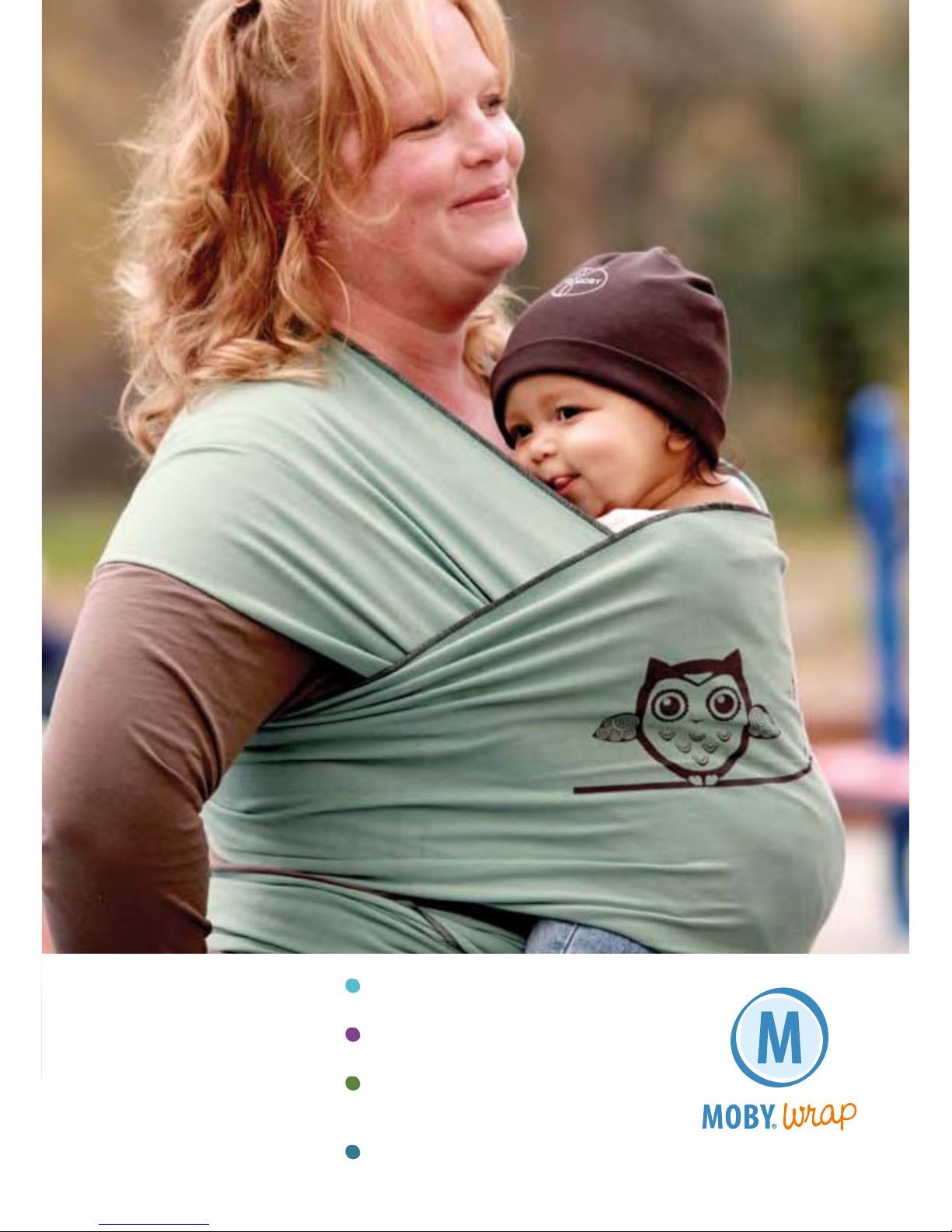
Instructional Booklet
Award-Winning • Ergonomic • Versatile • Irresistibly Comfortable
Page 2

First Steps
Moby Safety - important tips to keep baby secure . . . . . . . . . . . 1
Wrapping Folded - basic pocket wrap technique . . . . . . . . . . . 5
Wrapping Gathered - simple and quick wrap technique . . . . . . . . . 7
Holds & Checks
Triple-Wrapped Security - simple as 1, 2, 3 . . . . . . . . . . . . 10
Newborn Hug Hold - upright position with legs tucked . . . . . . . . 11
Hug Hold - upright position with legs out . . . . . . . . . . . . . 13
Hip Hold - variation of the Hug Hold . . . . . . . . . . . . . . . 15
Kangaroo Wrap & Hold - wrap around baby . . . . . . . . . . . 17
Am I Wrapped Correctly? - how to test your Moby t. . . . . . . . . 19
Moby Checklist - making sure Moby is correctly worn . . . . . . . . . 21
Taking Baby Out - how to get baby out without unwrapping . . . . . . 22
Discover MOBY
Moby Massage - with baby in your Moby . . . . . . . . . . . . . 23
Moby Exercises - 3 toning moves to do with baby . . . . . . . . . . 27
Nutrition - provided by LUNA® . . . . . . . . . . . . . . . . . 30
Moby Yoga - get centered while carrying your little one . . . . . . . . . 31
Top 5 Breastfeeding Tips - by Best for Babes™ . . . . . . . . . . . 23
8 Principles of Parenting - by API . . . . . . . . . . . . . . . 35
Importance of Touch - skin-to-skin care . . . . . . . . . . . . . 37
Moby Information - about your Moby and how to contact us . . . . . . 40
This instructional booklet is a guide for exploring the
various ways to use your Moby Wrap. Babywearing
is a time-tested tradition practiced around the world
for centuries. The Moby Wrap brings COMFORT
to TRADITION. Baby and wearer can enjoy all the
benets
of
being close for extended periods of time.
After a hold has been introduced, continue to
use it as long as baby is comfortable and secure.
Remember each child is an individual and will
develop at his or her own rate and have his or her
own preferences.
Contents
Getting Started
After the birth of my son Nathan, I wanted a
baby carrier that would allow him to be with me
while I continued my work as a parent educator.
I created the Moby Wrap and named it for
the feeling of closeness and connection between
mother and baby (MOther + baBY).
My wish is that your Moby will help you and
your baby experience the joys of babywearing.
Sincerely,
Gillian
Co-Founder & President
Moby Wrap Inc.
G
i
l
l
i
a
n
&
b
a
b
y
N
a
t
h
a
n
,
2
0
0
3
Carry baby in the Moby Wrap the same way that
you would in your arms - supported, snug and
aligned. By mimicking the way you naturally carry
baby you will find:
• Baby's preferred carrying position
• A hold that is soothing and calming
for baby and wearer
• Decreased back strain on the wearer
• Baby in a correctly aligned position
Thank you for choosing a Moby® Wrap!
Page 3
MOBY® Wrap Safety
1
Moby® Wrap
2
Award-Winning Baby Carrier
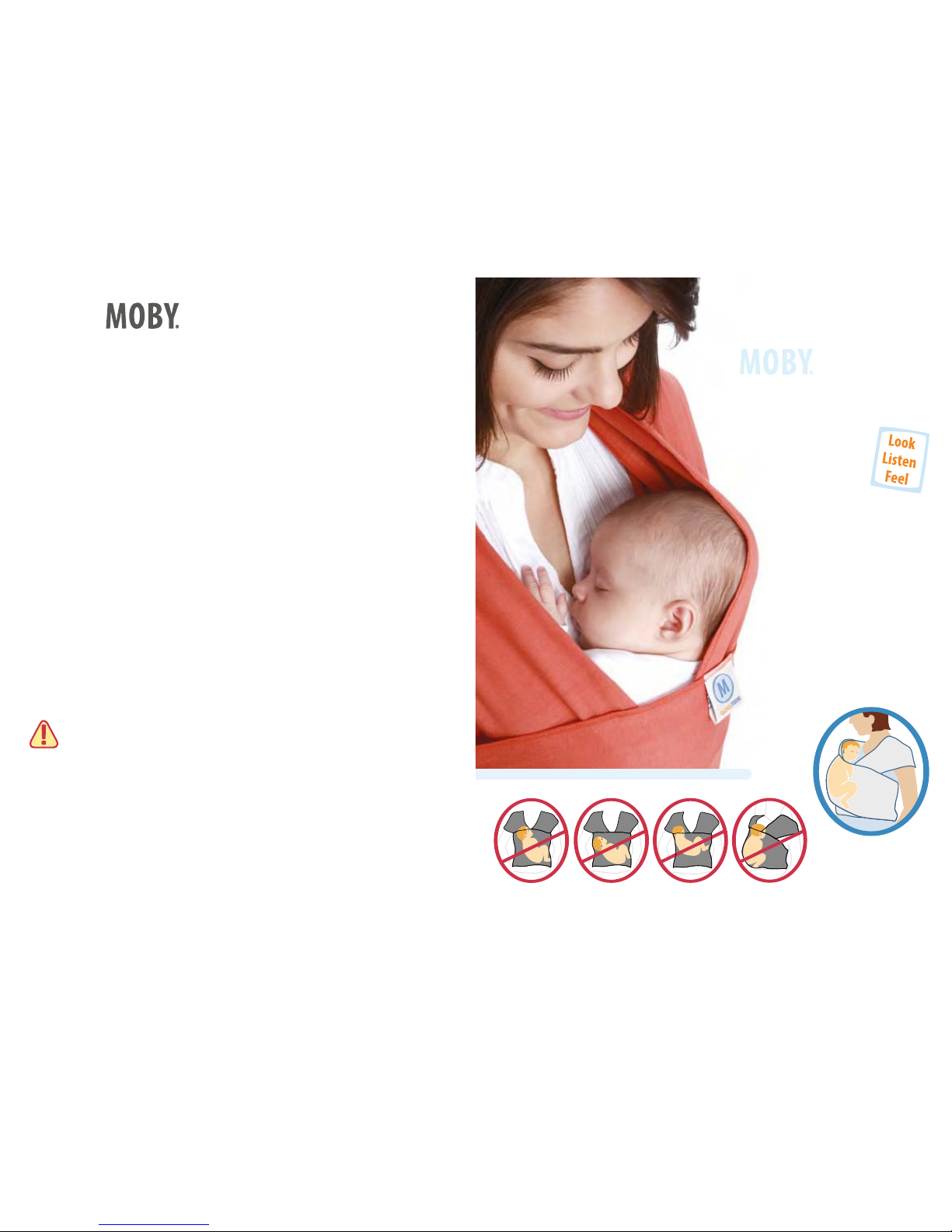
SUFFOCATION HAZARD
Ensure that the infant’s face is above the fabric, visible and free from obstructions at all
times. Babies at the greatest risk of suocation include those born prematurely, those
with respiratory problems and those under four months of age. Ensure that the baby
does not curl into a “C” position with the chin resting on or near the chest. This position
can interfere with breathing, even if nothing is covering the nose or mouth.
FALL HAZARD
Leaning, bending over, or tripping can cause baby to fall. Keep one hand on baby while moving.
ONLY USE THIS CARRIER FOR BABIES BETWEEN 8 LBS AND 35 LBS
Never use this carrier for a preterm infant without seeking the advice of a healthcare professional.
WARNING
FAILURE TO FOLLOW THE MANUFACTURER’S INSTRUCTIONS
CAN RESULT IN DEATH OR SERIOUS INJURY.
YES
Chin up!
Face visible!
Nose & mouth
NOT covered!
NO
Baby’s face is covered
NO
Baby’s face is pressed
tight against wearer
NO
Baby is hunched,
chin touching chest
NO
Baby is too low
• Read and follow all printed instructions
and view instructional videos online
before use.
• Examine your Moby before each use for
wear and tear, including ripped seams
or torn fabric.
• Check to be sure the baby is safely
positioned in the Moby according to
instructions for use.
• Check on the baby often. Ensure that the
baby is periodically repositioned. Failure
to pay attention can lead to falls or failure
to notice distress.
• If using a Moby while breastfeeding,
always move the baby’s face away from
the breast after feeding and then
reposition baby upright.
• Never leave a baby in a baby carrier that
is not being worn.
• Never use when balance or mobility is
impaired because of exercise, drowsiness
or medical conditions. Your balance may
be adversely aected by your movement
and that of your child.
• Never use a Moby while engaging in
activities such as cooking and cleaning
which involve a heat source or exposure
to chemicals.
• Never wear a Moby while driving or
being a passenger in a motor vehicle.
• Never place more than one child in a
baby carrier. Never use more than one
baby carrier at the same time.
• Never use a Moby Wrap in any body
of water.
• Keep the baby facing towards the
caregiver. Never face a baby outwards
before they have head control.
Look
Make sure
baby's nose and mouth
are visible. Ensure that the baby does
not curl into a "C" position with the chin
resting on or near the chest.
Listen
to baby's breathing.
Reposition baby if breathing is raspy,
loud or abnormal.
Feel
Make sure you can t at least two
ngers between baby's chin and chest.
Safety Checks
You will nd this icon at the end of
each hold. It is a reminder to do your
Moby Safety Checks.
Page 4
MOBY® Wrap Seguridad
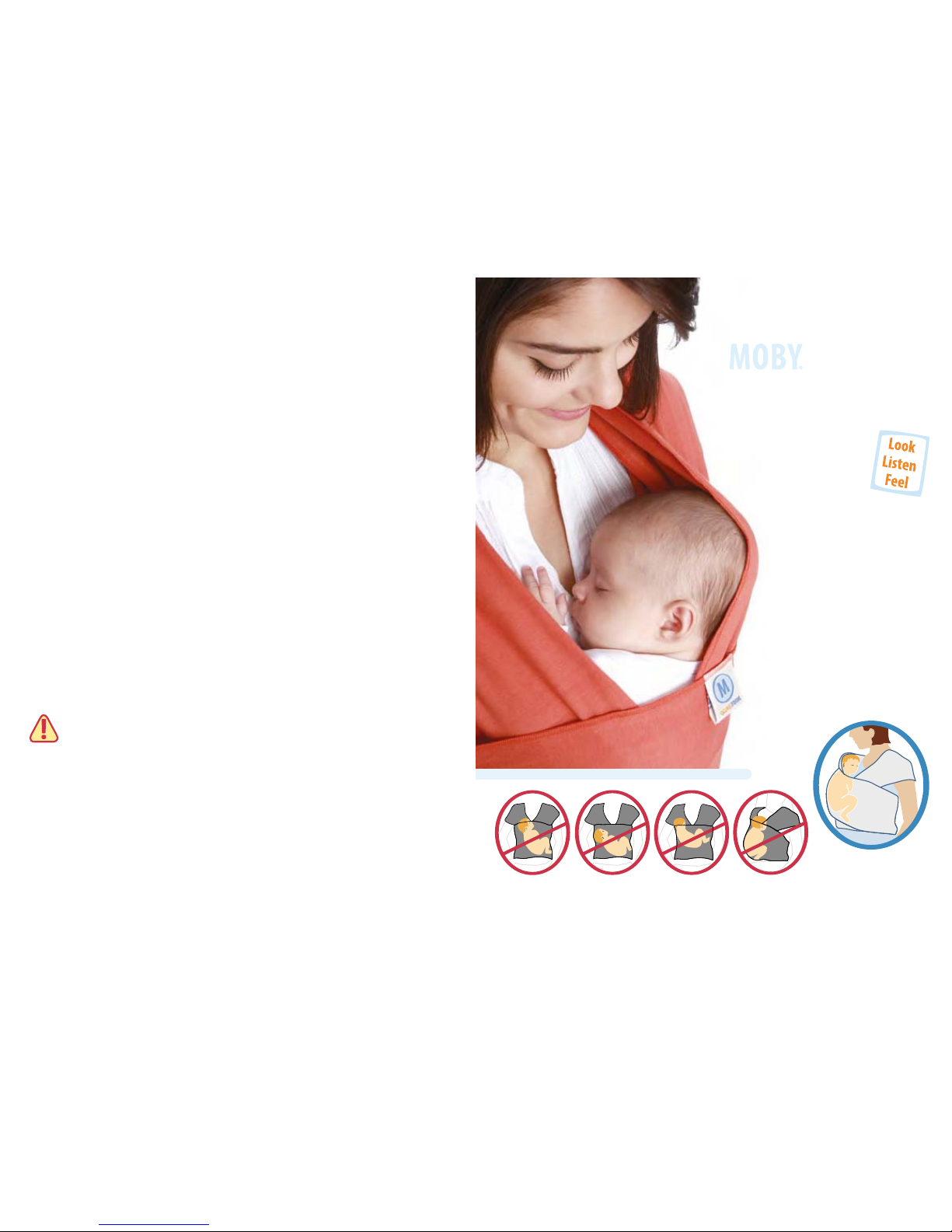
RIESGO DE SOFOCACIÓN
Asegúrese de que el rostro del niño siempre sobresalga por encima de la tela, visible y libre
de cualquier obstrucción en todo momento. Los bebés con más riesgo de sofocarse son los
nacidos prematuramente, o los que tengan problemas respiratorios o sean menores de cuatro
meses. Asegúrese de que el bebé no se doble en una posición en forma de "C”, con la barbilla
reposando sobre el pecho o cerca del pecho. Esta posición puede interferir con la respiración,
incluso si no hay nada que pueda cubrir la nariz o la boca.
RIESGO DE CAÍDAS
Inclinarse, agacharse o tropezarse puede provocar que el bebé se caiga. Cuando esté en movimiento,
siempre coloque una mano sobre el bebé.
USE ESTE PORTABEBÉS SÓLO PARA INFANTES QUE PESEN ENTRE 3,6 Y 15,8 KILOS (DE 8 A 35 LIBRAS).
Nunca use este portabebés con un bebé prematuro sin antes consultar a un profesional de la salud.
ADVERTENCIA
NO CUMPLIR CON LAS INSTRUCCIONES DEL FABRICANTE PUEDE
CAUSAR LA MUERTE O LESIONES SEVERAS.
• Antes de usar el producto, lea y siga todas
las instrucciones impresas y vea todos los
vídeos instructivos (en línea).
• Examine su portabebés Moby antes de
cada uso, para descartar desgaste o daños,
incluyendo costuras rasgadas o tela rota.
• Asegúrese de que el bebé esté en una
posición segura en el portabebés Moby, de
acuerdo con las instrucciones de uso.
• Vigile al bebé continuamente. Asegúrese
de cambiar periódicamente la posición del
bebé. No prestar atención puede provocar
caídas o impedir notar si el bebé siente
dolor o tiene dicultades para respirar.
• Si usa el portabebés Moby para
amamantar, siempre aleje la cabeza del
bebé de su seno después de alimentarlo
y procure que permanezca en posición
erguida.
• Nunca coloque a más de un bebé en
un portabebés. Nunca use más de un
portabebés al mismo tiempo.
• Nunca use el portabebés cuando su
equilibrio o movilidad se vean afectados a
causa de ejercicio, somnolencia o alguna
condición médica. Su equilibrio puede
verse afectado por su movimiento y por el
de su bebé.
• Nunca use el portabebés Moby cuando
esté realizando actividades como cocinar
o limpiar, ya que involucran una fuente de
calor o exposición a químicos.
• Nunca use un portabebés Moby cuando
esté conduciendo un vehículo o viaje en el
asiento de pasajero.
• Nunca deje a un bebé en un portabebés
que no esté siendo usado.
• Nunca use un portabebés Moby Wrap en
un cuerpo de agua.
• Siempre mantenga al bebé de frente
al portador. Nunca coloque a un bebé
mirando hacia fuera si aún no puede
controlar su propia cabeza.
Observe
Asegúrese de que
la nariz y boca del bebé sean
visibles. Asegúrese de que el bebé no se
doble en una posición en forma de "C”,
con la barbilla reposando sobre el pecho
o cerca del pecho.
Escuche
la respiración del bebé.
Reposicione al bebé si la respiración es
áspera, ruidosa o anormal.
Sienta
Asegúrese de que puede
colocar al menos dos dedos entre la
barbilla y pecho del bebé.
Comprobaciones
de Seguridad
Sí
¡BARBILLA ARRIBA
Y ROSTRO VISIBLE!
NO
El rostro del bebé
está cubierto.
NO
El
rostro del bebé está
apretado contra el
pecho del portador.
NO
El bebé está encorvado.
La barbilla está
tocando el pecho.
NO
El bebé está
colocado muy abajo.
Usted encontrará este icono al nal de
cada bodega. Es un recordatorio para
hacer sus controles de seguridad Moby.
3
Moby® Wrap
4
Award-Winning Baby Carrier
Page 5
Baby will
sit on "X"
Wrapping Folded
Newborn Hug Hold pg. 11
Hug Hold pg. 13 • Hip Hold pg. 15
Tie where knot
comfortably lands
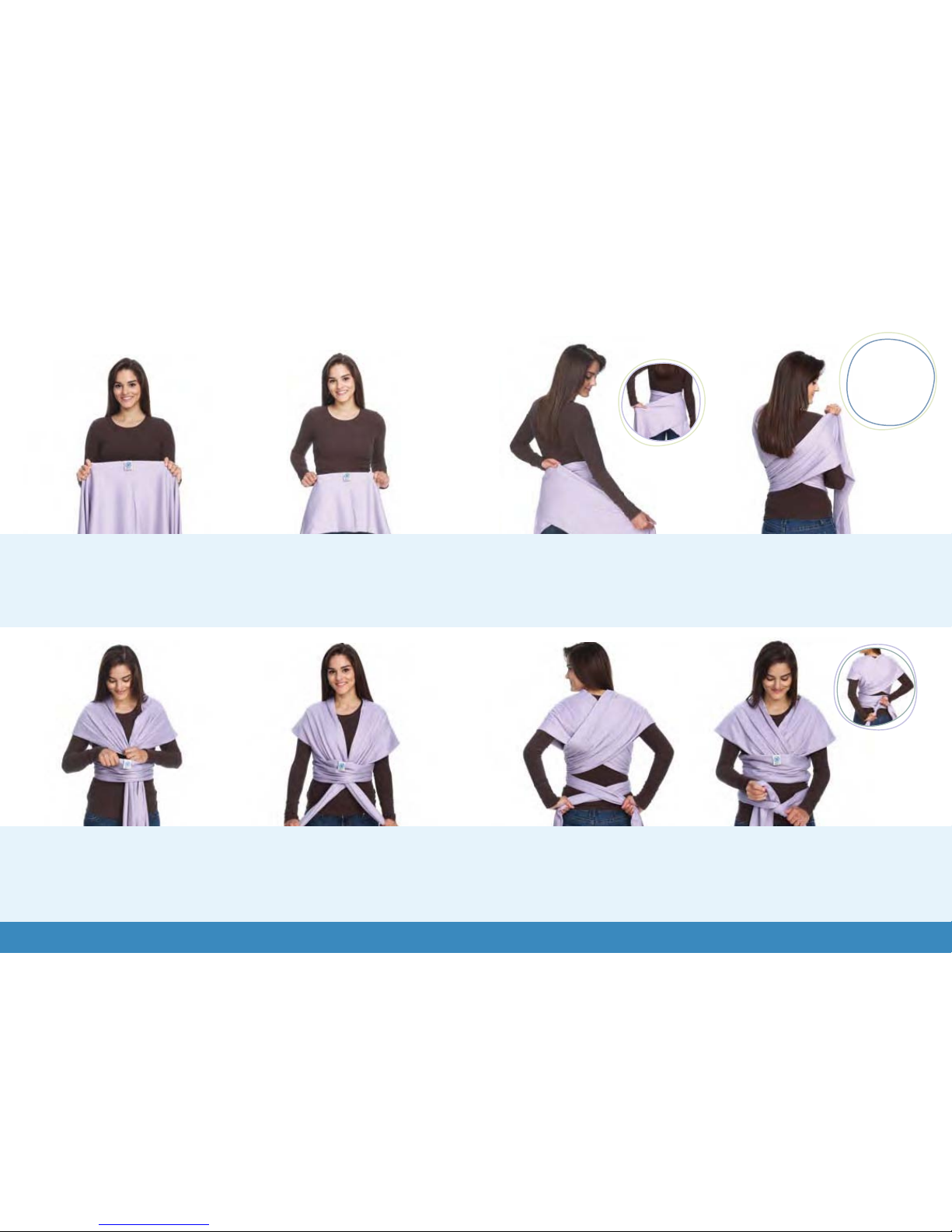
Fold the Moby Wrap in half lengthwise and
place across your
waist with the stitched edges
on top
.
Doble el Moby Wrap por la mitad a lo largo y
colóquelo delante de su cintura con los bordes con
costuras en la parte de arriba.
Cross the two ends behind your back and
bring one end up and over your shoulder.
Cruce los dos extremos por detrás de su espalda
y lleve hasta arriba uno de ellos, pasándolo por
encima del hombro. Meta un lado por abajo para
que se mantenga en su lugar.
Bring the other end over your opposite
shoulder creating an “X” on your back.
Haga pasar el otro extremo por encima del hombro
contrario formando una "X" en su espalda. Consejo
para una Mayor Comodidad: Mantenga los bordes con
costuras cerca de su cuello. Cuanto más plana ponga la
tela, más comodidad habrá.
Tuck one side under
to hold in place
Tuck the ends of the wrap under the logo
section from top to bottom.
Meta los extremos del fular por debajo de la sección
del logotipo, desde la parte superior
hasta la inferior.
Bring the fabric ends behind your back and
tie a knot here, or continue to wrap around to
the front of your body.
Lleve los extremos de la tela hasta detrás de
su espalda y átelos en ese lugar, o continúe
envolviendo hasta la parte delantera de su cuerpo.
Cross the end pieces in the front making an
“X” on your chest.
Cruce los extremos de la parte delantera
formando una "X" sobre su pecho.
Tie a double knot on your back, hip or front.
Haga un doble nudo sobre su espalda, cadera
o parte delantera. Haga el nudo donde más
cómodo resulte.
Begin with your Moby logo tag centered at
your navel.
Comience con la etiqueta del logotipo de su Moby
centrada al nivel de su ombligo.
5
1 3
76
4
8
2
First Steps
5
Moby® Wrap
6
The Comfortable Baby Carrier
Comfort Tip
Keep stitched edges
near your neck
.
T
he
atter the fabric, the
more comfortable
you will feel.
Getting ready for baby
Page 6
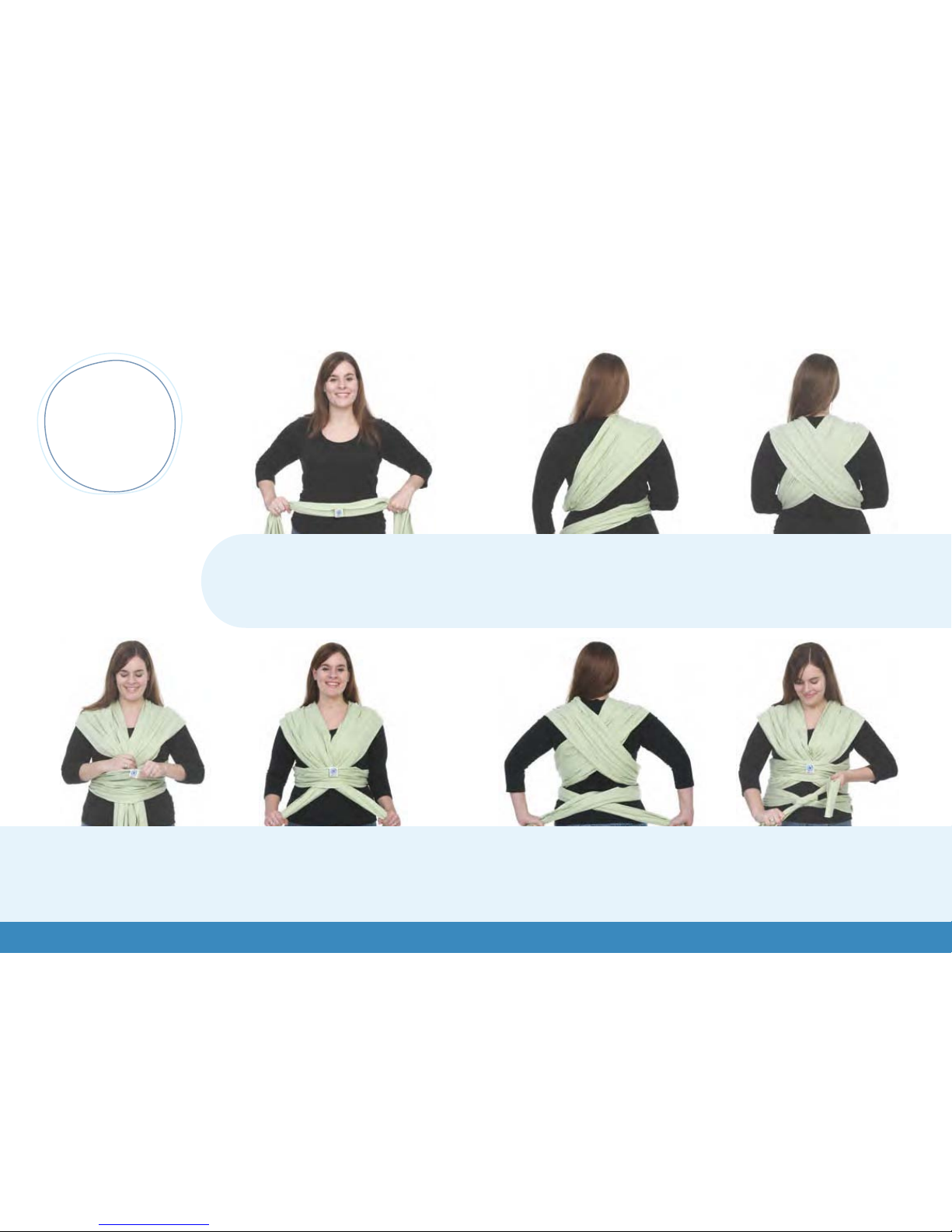
Getting ready for baby
Newborn Hug Hold pg. 11
Hug Hold pg. 13 • Hip Hold pg. 15
Gather the Moby Wrap and place across your
waist with the logo tag centered at your
navel.
Sujete el Moby Wrap y colóquelo enfrente de su
cintura con la etiqueta del logotipo centrada en
su ombligo.
Cross the two ends behind your back and
bring one end up and over your shoulder.
Cruce los dos extremos por detrás de su espalda
y lleve hasta arriba uno de ellos, pasándolo por
encima del hombro.
Bring the other end over your opposite
shoulder creating an “X” on your back.
Haga pasar el otro extremo por encima del hombro
contrario formando una "X" en su espalda.
Tie where
knot comfortably
lands, making
sure wrap is snug
A higher "X"
positons baby
higher; a lower
"X" will positon
baby lower
Tuck the ends of the Moby under
the logo
section, from top to bottom.
Meta los extremos del fular por debajo de la
sección del logotipo, desde la parte superior hasta
la inferior.
Bring the fabric ends behind your back and
tie a knot here, or continue to wrap around
to the front of your body.
Lleve los extremos de la tela hasta detrás de
su espalda y átelos en ese lugar, o continúe
envolviendo hasta la parte delantera de su cuerpo.
Cross the end pieces in the front making an
“X” on your chest.
Cruce los extremos de la parte delantera formando
una "X" sobre su pecho. Una "X" más alta colocará al
bebé más arriba; una "X" más baja colocará al bebé
más abajo.
Tie a double knot on your back, hip or front.
Haga un doble nudo sobre su espalda, cadera o
parte delantera. Haga el nudo donde quede cómodo,
asegurándose de que el fular quede ajustado.
1
2
3
76
4 5
First Steps
7
Moby® Wrap
8
The Comfortable Baby Carrier
Wrapping Gathered
Try both Moby
wrapping methods
gathered & folded
to nd what works
best for you!
Page 7
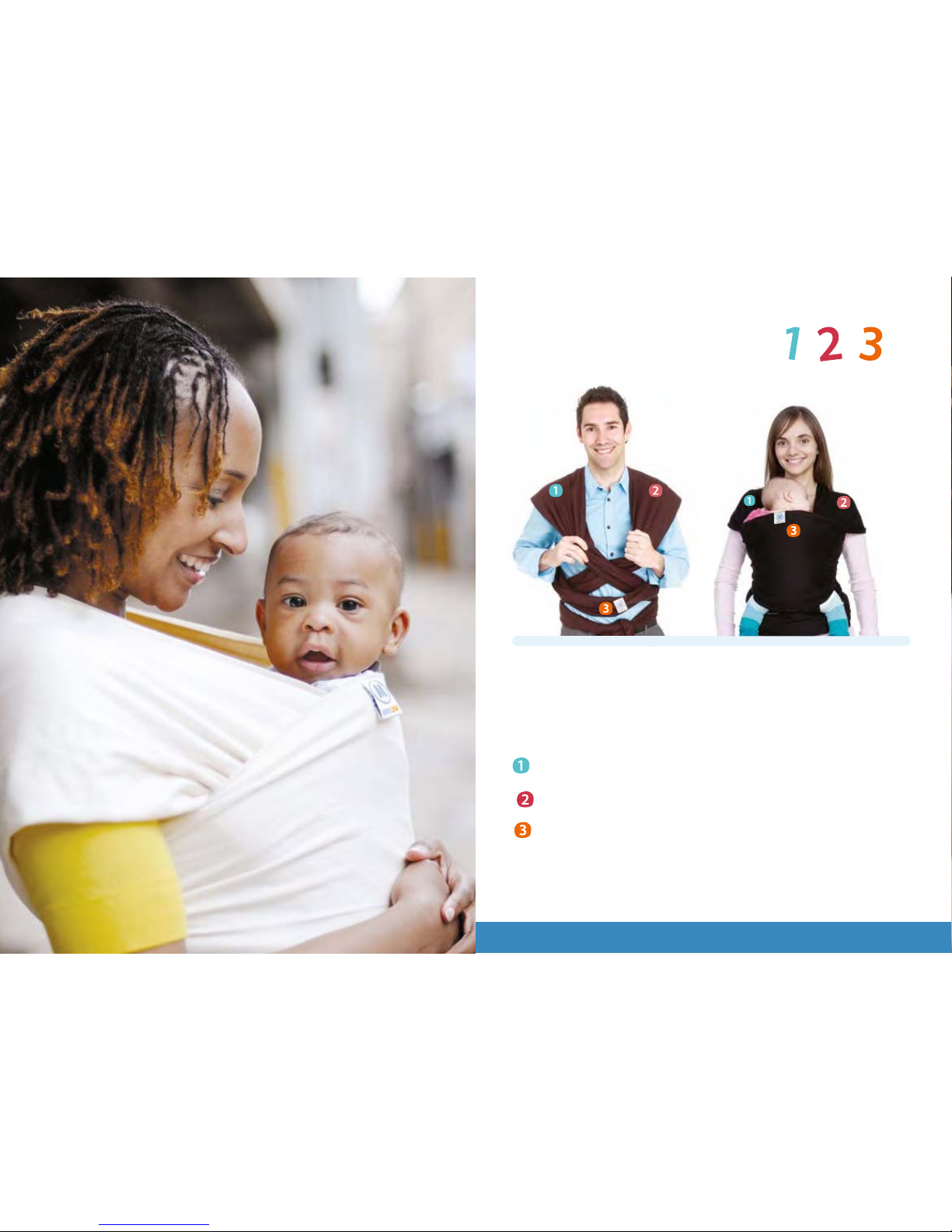
The "X" Factor
Sections 1 and 2 cross from your shoulders around baby's
back and between baby's legs.
Buckle Up
Think of section 3 as your Moby seat belt. Always secure
your baby's back and shoulders with this section of fabric
by pulling it up and over baby.
Putting baby in your Moby
...it's as simple as
1 2 3
Now that you are wrapped it's time to put baby in.
Baby will sit on the "X" and be secured by three
sections of fabric. Together, these sections create the
MOBY® Triple-Wrapped Security.
Shoulder piece section
Otra pieza de la parte del hombro
Shoulder piece closest to your body
La pieza del hombro más cercana a su cuerpo
Logo tag section
Sección de la etiqueta del logotipo
Triple-Wrapped Security
Introducir al bebé en su Moby es tan fácil como 1,2,3.
Seguridad de triple envoltura Ahora que ya ha realizado
la envoltura, llega el momento de introducir al bebé, al
cual se le situará sobre la "X" y se le asegurará mediante 3
secciones de tela.
El factor "X" Las secciones 1 y 2 se cruzan desde sus
hombros, alrededor de la espalda del bebé y entre las
piernas de este.
Abróchese el cinturón Piense en la sección 3 como si
fuera su cinturón de seguridad Moby. Asegure siempre la
espalda y los hombros de su bebé con esta sección de tela
tirando de ella hacia arriba y por encima del bebé.
Holds & Checks
9
Moby® Wrap
10
The Comfortable Baby Carrier
Page 8
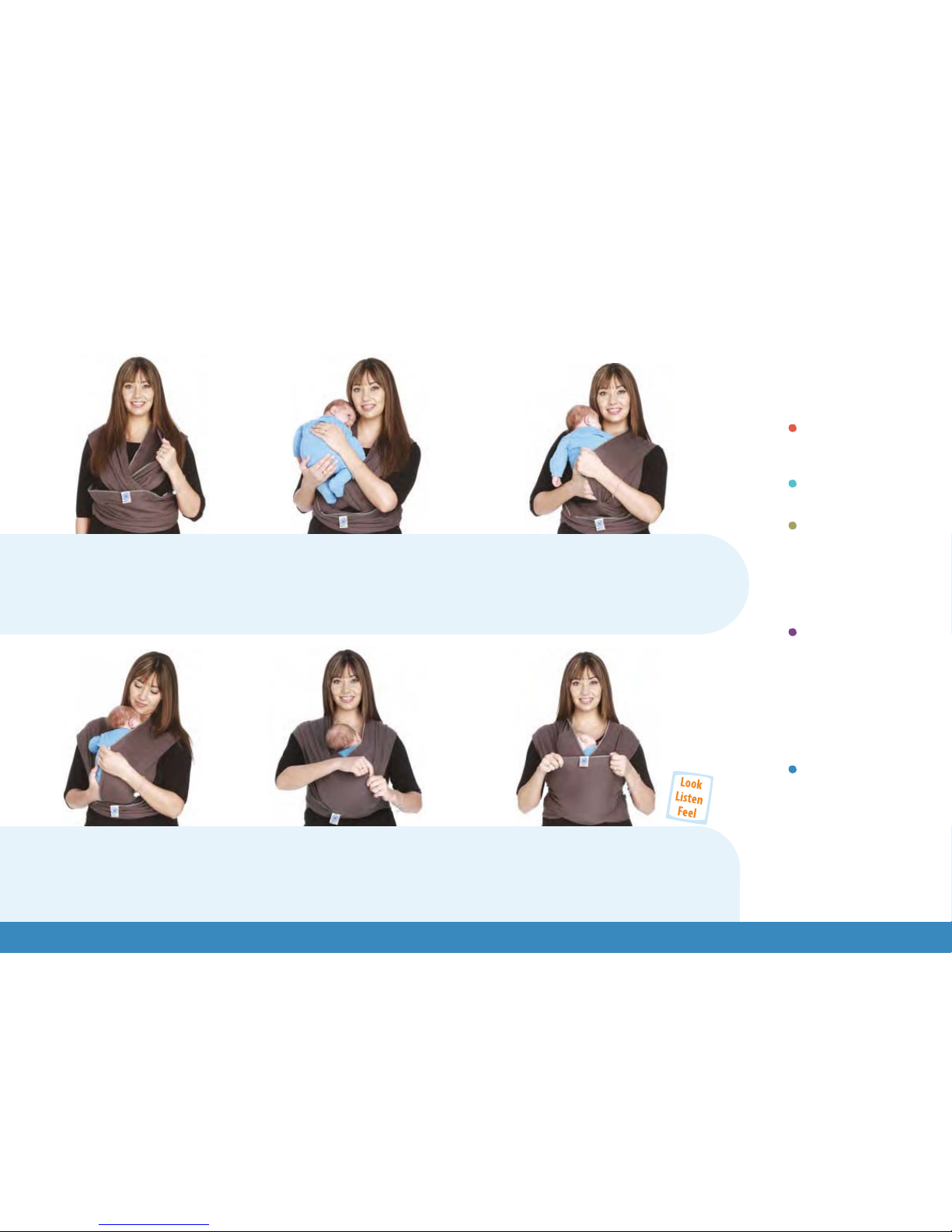
with Andrea & Austin
2
Newborn Hug Hold with Andrea & Austin
Upright position with legs tucked
Locate the shoulder piece that is nearest your
body. Open seams to create a pocket for baby.
Utilizar a partir de 3,63 kg. Para bebés de menos de
3,63 kg, consulte a su médico.
Localice la pieza del hombro más cercana a su
cuerpo. Abra las junturas para crear un bolsillo
para el bebé.
Spread the fabric over the baby’s body
including the shoulders, back and bottom.
Extienda la tela por encima del cuerpo del bebé,
incluyendo los hombros, espalda y trasero.
Place baby on the shoulder opposite from the
piece of fabric closest to you.
Coloque al bebé en el hombro contrario a la pieza
de tela más cercana a usted.
Locate the opposite section of fabric and
spread over baby's body.
Localice la sección de tela contraria y extiéndala
sobre el cuerpo del bebé.
Slide baby down your chest and into this
pocket. The baby's legs will remain in the
fetal position.
Deslice al bebé hacia abajo e introdúzcalo en este
bolsillo. Las piernas del bebé permanecerán en
posición fetal.
Find the logo tag and pull this
section of
fabric up and over baby.
Busque la etiqueta del logotipo y tire hacia arriba
de esta sección de tela y por encima del bebé.
Puede meter la cabeza del bebé por debajo de una de
la piezas del hombro para obtener apoyo adicional.
4
1 3
6
5
Helpful Hints
Newborn babies with colic,
gas or acid reux often
prefer being carried in an
upright position.
If baby doesn’t like being
in the wrap, gently take
baby out and try again later.
A baby can sense a wearer's
hesitance when using the
wrap. Babies who "don't like
being wrapped" actually
enjoy it (and fall fast asleep)
when c arried by a n
experienced babywearer.
Keep practicing!
Babies will cue you when
they are ready to be out
of this position by starting
to stretch their legs. At this
point, you may put baby’s
legs through the fabric as
instructed in the Hug Hold.
Dad Tip
The vibration of a man’s
Adam’s apple can be soothing
to an upset baby. Try having Dad
or Grandpa hold the baby in
this position and walk around
humming or singing to soothe
a crying infant.
For more helpful tips
please visit our website:
mobywrap.com
You may tuck baby's
head under one of the
shoulder pieces for
additional support
Introduce at 8 lbs. For babies under 8 lbs, consult your healthcare professional
Holds & Checks
11
Moby® Wrap
12
The Comfortable Baby Carrier
Page 9
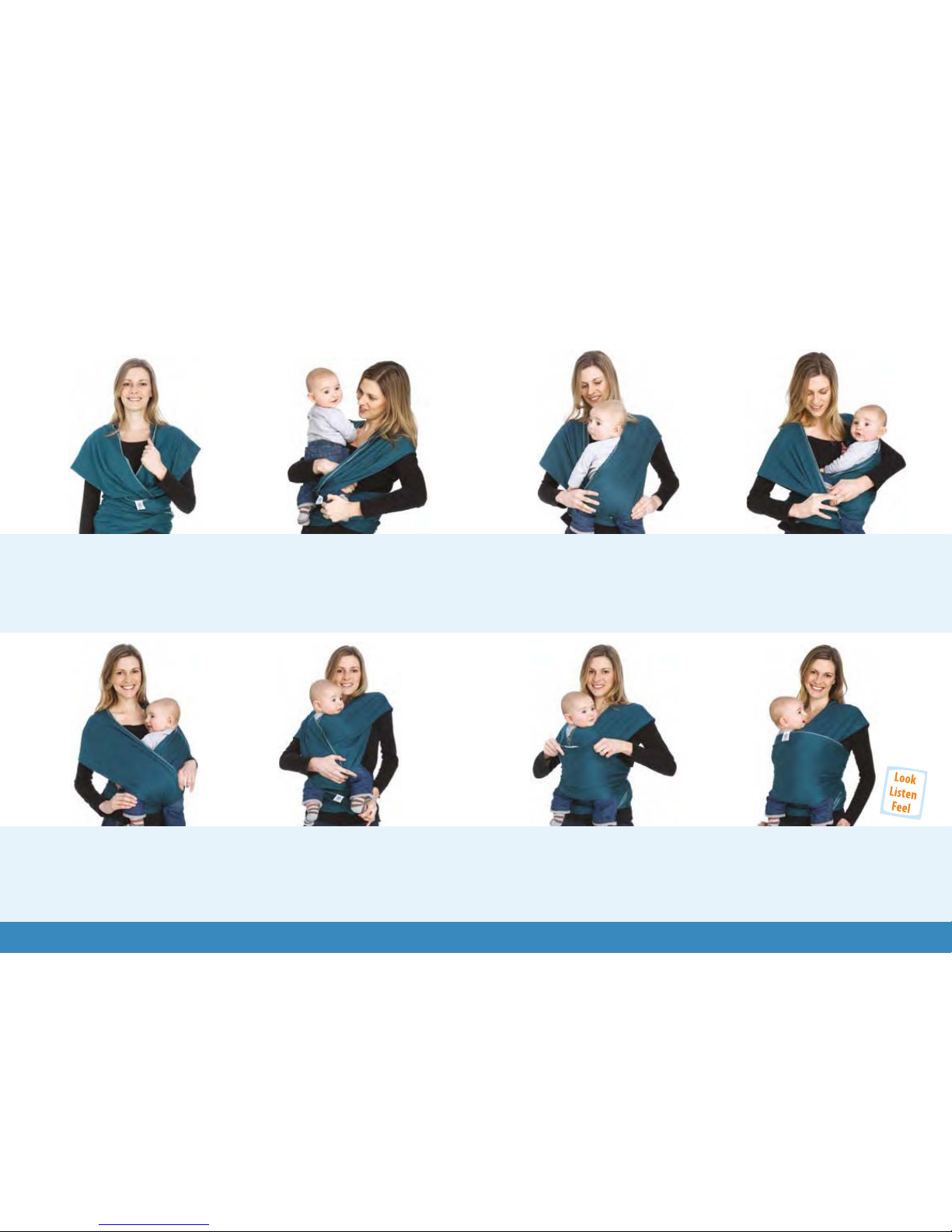
11
Hug Hold with Jessica & Lucas
Upright position with legs out
Baby should be
in a seated
position with
knees up
Secure baby's
shoulder with two
sections of fabric
Carr y baby
above your hips
Baby may need
to be slightly
lifted up to
locate logo tag
Locate the shoulder piece that is closest
to your body.
Introducir cuando el bebé está completamente
estirar las piernas (2-3 meses).
Localice la pieza del hombro más cercana a
su cuerpo.
Spread the fabric, covering baby's bottom and
shoulder.
Extienda la tela, cubriendo el trasero y el hombro
del bebé.
While holding baby on your opposite
shoulder, carefully put baby’s rst
leg through
the shoulder
piece.
Mientras sujeta al bebé sobre el hombro contrario,
pase con cuidado la primera pierna del bebé por la
pieza del hombro.
Spread the fabric over baby’s bottom and
shoulder. Keep spreading until the fabric is to
the hollows of baby’s knees.
Extienda la tela por encima del trasero y el hombro
del bebé. Siga extendiendo hasta que la tela llegue
a la concavidad de detrás de las rodillas del bebé.
Continue pulling this section of fabric up
and over baby's back and shoulders.
Continúe tirando de esta sección de la tela hacia
arriba, así como por encima de la espalda y los
hombros del bebé. Asegure el hombro del bebé
con dos secciones de tela. Lleve al bebé por encima
de la cadera.
Place baby’s second leg through the
other shoulder piece while supporting the
upper body.
Haga pasar la otra pierna del bebé por la pieza del
otro hombro mientras sostiene la parte superior
del cuerpo.
You may tuck baby's head under one of the
shoulder pieces for additional support.
Puede meter la cabeza del bebé por debajo de
una de la piezas del hombro para obtener apoyo
adicional. El bebé debería estar sentado con las
rodillas hacia arriba.
Locate the logo ta g and
gently put baby's
legs through this section.
Localice la etiqueta del hombro y haga pasar con
cuidado las piernas del bebé por esta sección.
5
1 2 3
76
4
8
Introduce when baby is fully stretching legs (2-3 months)
Holds & Checks
13
Moby® Wrap
14
The Comfortable Baby Carrier
Page 10
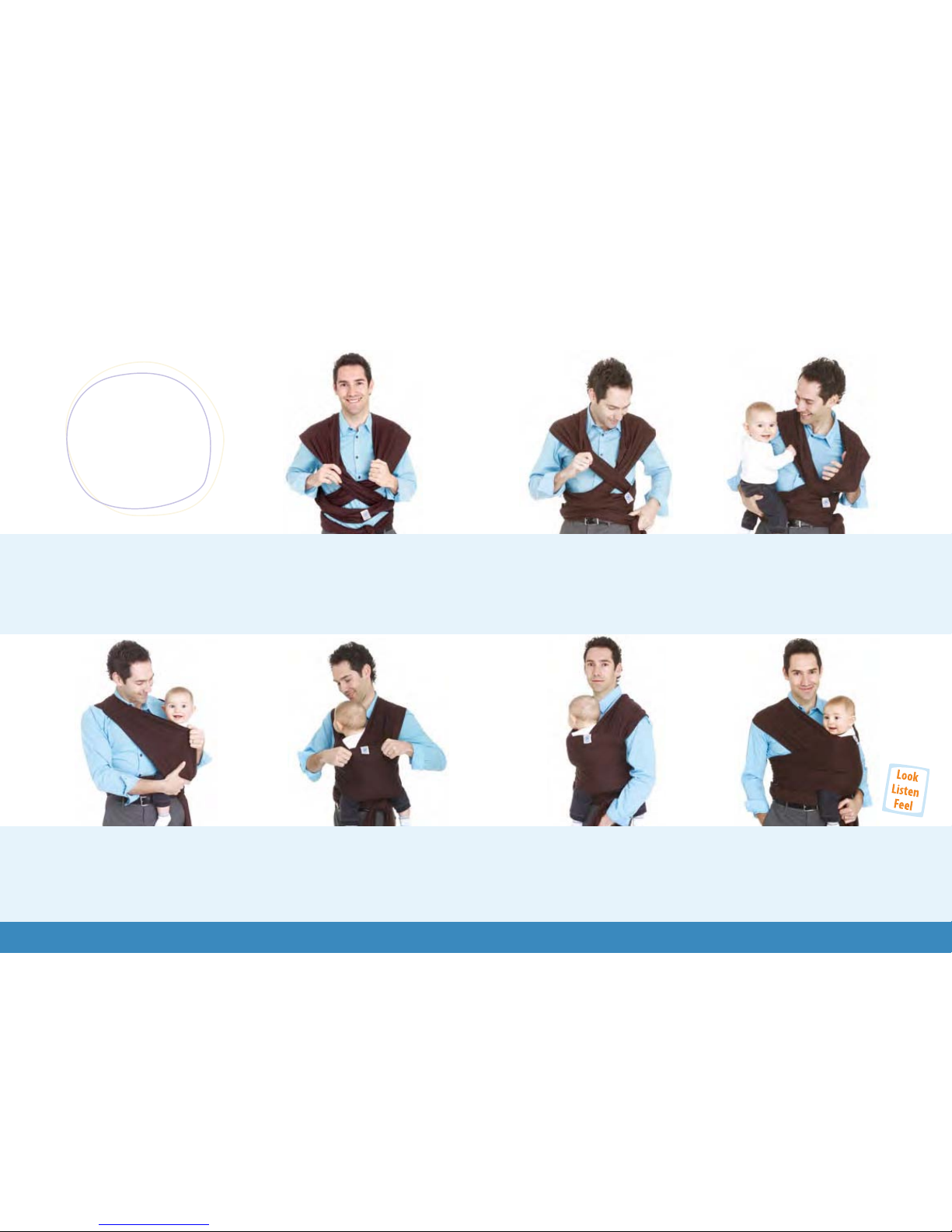
Bring baby’s other leg through the opposite shoulder
piece. Fully spread the fabric, ensuring it is to the
hollows of baby’s knees and over baby’s entire back.
Haga pasar la otra pierna del bebé por la pieza del
hombro contrario. Extienda completamente la tela,
asegurándose de que está en la concavidad de detrás
de las rodillas y por toda la espalda del bebé.
Shift the Moby so that the fabric “X” is
moved from your front to your side.
Mueva el Moby de modo que la "X" de la tela pase
de la parte de delante hasta su costado.
Baby is now in a seated position straddling
your hip with one leg in front and one
behind you.
Los hombros del bebé deberían asegurarse
con dos capas de tela y debería sentarse
cómodamente en su cadera.
Place one of baby’s legs through the shoulder
piece closest to your body, so that baby straddles
your hip. Spread the fabric over baby’s bottom
and shoulder.
Haga pasar una de las piernas del bebé por la pieza
del hombro más cercana a su cuerpo, de modo que el
bebé se siente a horcajadas sobre su cadera. Extienda
la tela sobre el trasero y el hombro del bebé.
Locate the logo tag and gently put both of
baby’s legs through this section. Pull fabric
up over baby’s back and shoulders.
Localice la etiqueta del logotipo y pase
cuidadosamente las dos piernas del bebé por esta
sección. Tire de la tela hacia arriba por encima de la
espalda y los hombros del bebé.
5
2
3
7
6
4
Wrap so that the shoulder piece closest to your
body is the side on which you will carry baby
(Antonio will carry on his left).
Envuelva de modo que la pieza del hombro más
cercana a su cuerpo sea el costado sobre el que
llevará al bebé (Antonio lo llevará a su izquierda).
Envuelva utilizando el Método Doblado o el Recogido.
Baby should be seated comfortably at your hip
with baby's shoulders secured by two layers of
fabric.
Los hombros del bebé deberían asegurarse con dos
capas de tela y debería sentarse cómodamente en su
cadera. El bebé debería estar sentado con las rodillas
hacia arriba.
8
Baby should
be in a seated
position with
knees up
13
14
1
Before you wrap, choose the hip on which
you’d like to carry baby.
Empiece a utilizarlo cuando el bebé tenga un excelente control
de la cabeza y la parte superior del cuerpo (más de 5 meses).
Antes de envolver, elija la cadera sobre la que le gustaría llevar
al bebé. Una variante de la Sujeción de Abrazo consiste en que se
traslada la "X" a su costado. Es una alternativa estupenda para
bebés a los que les gusta que les lleven sobre la cadera.
Wrap using
either the
Folded or
Gathered
method
Hip Hold with Antonio & Lucas
Variation of the Hug Hold
Introduce when baby has excellent head & upper body control (5+ months)
A variation on the
Hug Hold, this hold
moves the “X” to
your side. It is a great
alternative for babies
who like to be carried
on the hip.
Holds & Checks
15
Moby® Wrap
16
The Comfortable Baby Carrier
Page 11
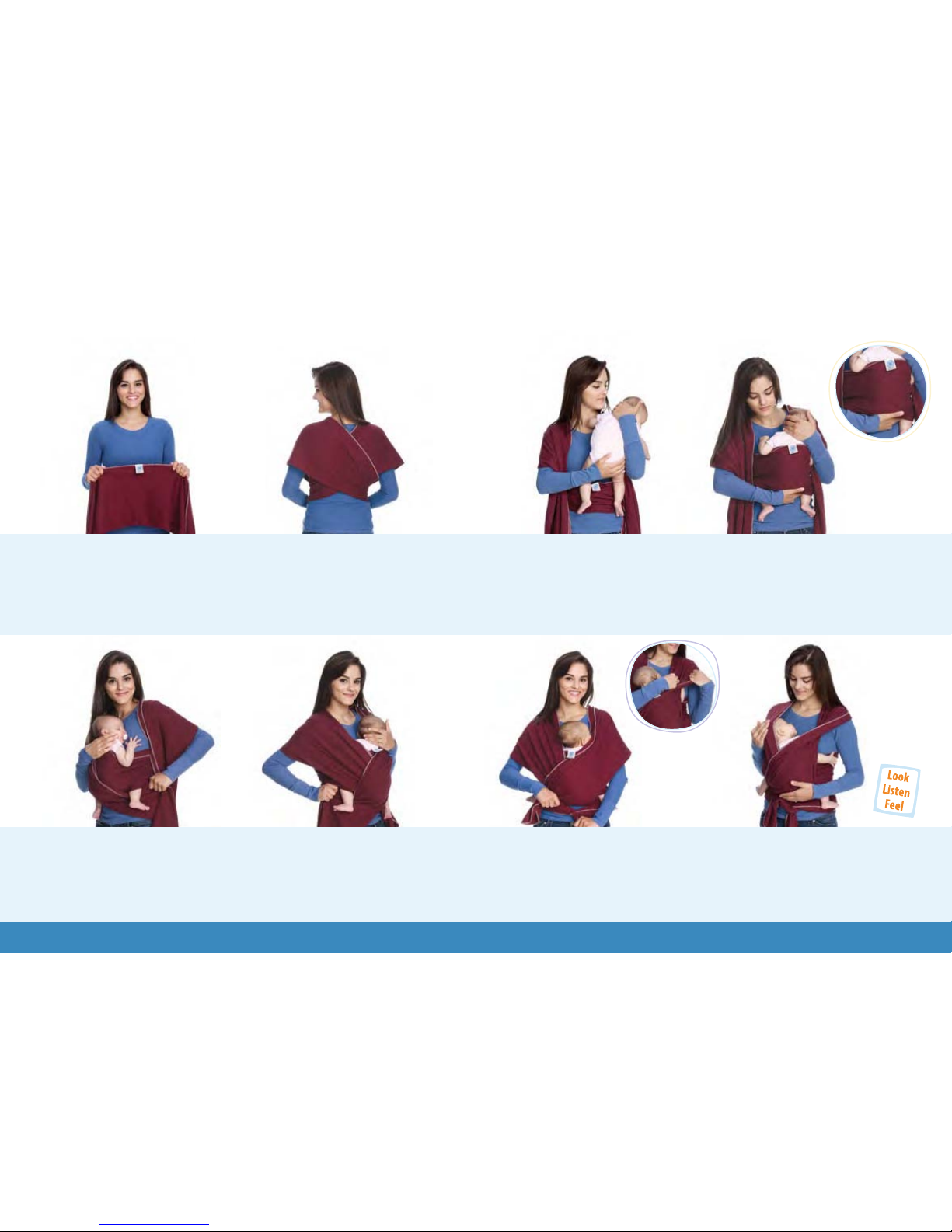
Wrap around baby
Make sure
baby's mouth
and nose are
visible
Feel to make
sure chin is
lifted o chest
Try ipping
fabric at
shoulder for
comfort
Place the Moby Wrap across your waist with
the logo tag centered at your navel.
Utilizar a partir de 3,63 kg. Para bebés de menos
de 3,63 kg, consulte a su médico.
Coloque el Moby Wrap delante de su cintura con la
etiqueta del logotipo centrada en su ombligo.
Repeat with the other fabric end, making sure
you keep both fabric ends pulled snugly as
you wrap.
Repita la operación con el otro extremo de la tela,
asegurándose de tirar de ambos extremos de la misma
de forma que se ajusten bien mientras envuelve.
Wrap the ends of the Moby behind your back.
Make an "X" on your back by crossing the two
ends up over your shoulders.
Envuelva los extremos del Moby por detrás de su
espalda. Forme una "X" en la espalda cruzando los
dos extremos por encima de los hombros.
Wrap fabric ends around your body. Double
knot at your back, hip or front.
Envuelva su cuerpo con los extremos de la tela.
Anúdelos en la espalda, la cadera o por delante.
Pruebe a darle la vuelta a la tela en el hombro para
una mayor comodidad.
Now it's time for baby. Hold baby up on
your shoulder.
Llega el momento del bebé. Sujete al bebé y
apóyelo sobre su hombro.
Tuck back of baby’s head into a shoulder
section for additional support.
Introduzca la nuca del bebé en una sección del
hombro para conseguir apoyo adicional. Asegúrese
de que la boca y la nariz del bebé se pueden ver.
Asegúrese de comprobar que la barbilla está
despegada del pecho.
Gently lower baby into the fabric section with
the logo tag, putting both legs through and
tucking fabric under baby's bottom.
Introduzca cuidadosamente al bebé en la sección
de la tela con la etiqueta del logotipo, haciendo
pasar las dos piernas y metiendo la tela por debajo
del trasero del bebé. Tire hacia arriba de un poco de
tela entre las piernas del bebé para crear un asiento.
Holding baby securely, bring one fabric end
over baby’s
back towards
your opposite hip
and guide under baby's leg.
Mientras sujeta al bebé con seguridad, pase un
extremo de la tela sobre la espalda del bebé,
llévelo hasta la cadera contraria y guíelo por
debajo de la pierna del bebé.
Tuck fabric up
between baby’s
legs to create
a seat
5
1
2
3
76
4
8
15
16
Kangaroo Wrap & Hold with Brittany & Elsie
Introduce at 8 lbs. For babies under 8 lbs, consult your healthcare professional
Holds & Checks
17
Moby® Wrap
18
The Comfortable Baby Carrier
Page 12
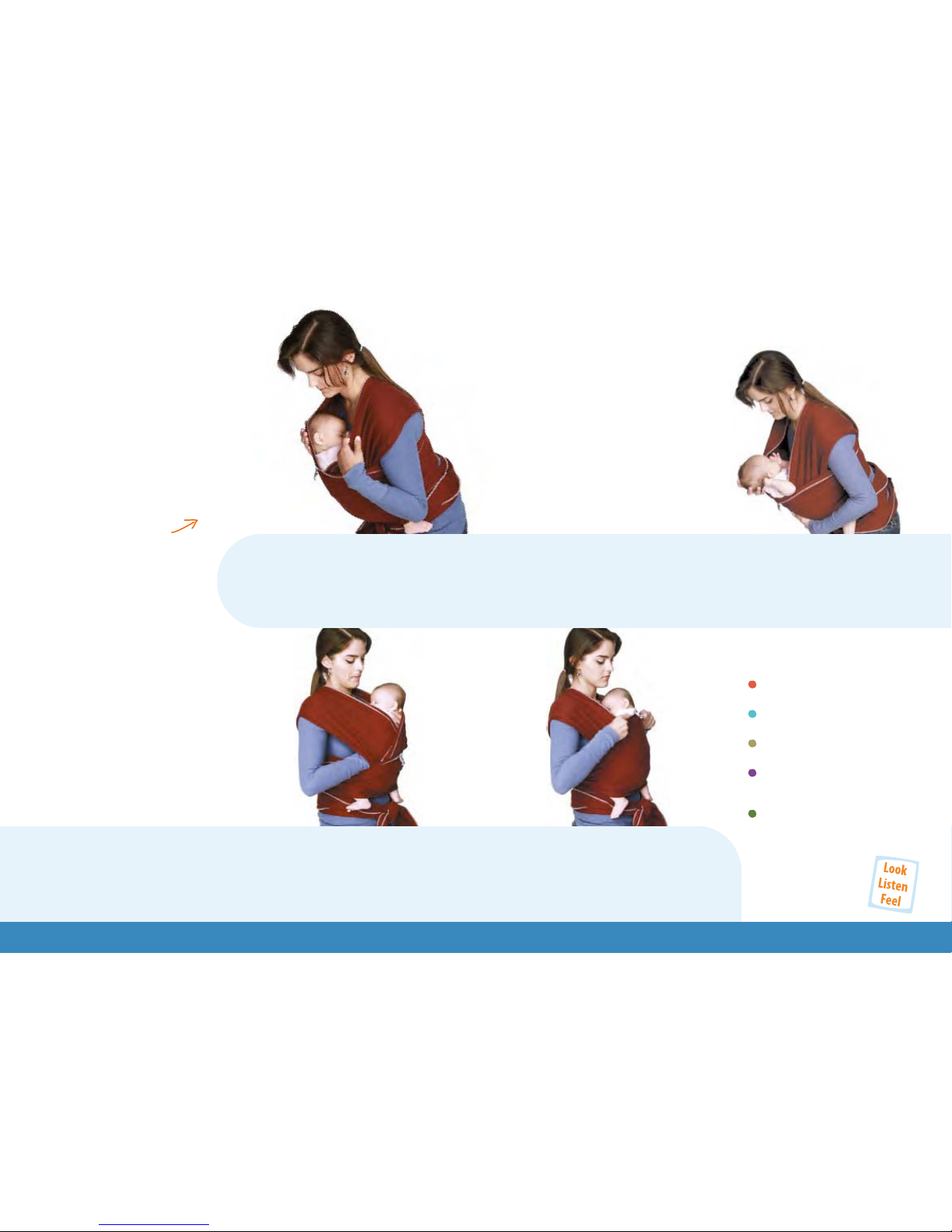
Baby should stay close to your body.
Baby should t snugly in
your Moby as shown here.
El bebé debe estar cerca de su cuerpo.
El bebé debería ajustarse bien en su Moby.
18
Am I
Wrapped
Correctly?
Bring logo section down to baby’s mid-back. Insert hands
through sides of the Moby Wrap and adjust baby as
needed. You are wrapped too tight if you can’t adjust baby.
Mueva hacia abajo la sección del logotipo hasta el centro de
la espalda del bebé. Introduzca las manos por los lados del
Moby Wrap y ajuste al bebé según sea necesario. El Moby está
demasiado apretado si no puede ajustar al bebé.
2
1
Is your Moby
wrapped too tight?
To test: Follow the directions on
the right. You are wrapped too
tight
if you can’t adjust baby.
Readjust your wrap if it is too tight by
removing baby from wrap, untying and
loosening fabric. Then re-tie. Check again
after baby is back in.
¿Está la envoltura de su Moby
demasiado apretada?
Comprobación: Sujete al bebé con al menos
una mano e inclínese hacia delante. Reajuste la
envoltura si está demasiado ceñida y saque al
bebé de esta, desatándola y soltando tela. Luego,
átela de nuevo. Vuelva a comprobar después de
reintroducir al bebé.
Is your Moby
wrapped too loose?
To test: Support baby
with at
least one hand
and lean forward.
Readjust your wrap if it is too loose by
removing baby from wrap, untying and
pulling fabric tighter. Then re-tie. Check
again after baby is back in.
¿Está su Moby demasiado suelto?
Comprobación: Sujete al bebé con al menos una
mano e inclínese hacia delante. Reajuste la
envoltura si está demasiado ceñida y saque
al bebé de esta, desatándola y soltando tela.
Luego, átela de nuevo. Vuelva a comprobar
después de reintroducir al bebé.
Your Moby is too loose if baby
pulls away from your body
when you lean forward.
Su Moby está demasiado suelto si el bebé se
separa de su cuerpo al inclinarse hacia delante.
Adjusting Baby
To adjust baby, follow steps
1 & 2 on the left.
Check on baby's positioning to ensure
safety and comfort.
Be sure to perform your safety checks
(pages 8 & 17) while adjusting baby.
If baby seems fussy in the Moby, first
try adjusting baby's position before
taking baby out.
It may take a few tries to feel condent
with the wrapping process. Read
Practice Makes Perfect on page 40
for more helpful hints.
After checking that baby is wrapped correctly,
pull logo section back up to secure shoulders.
Tras comprobar que el bebé está envuelto
correctamente, vuelva a tirar hacia arriba de la
sección del logotipo para asegurar los hombros.
How to test your Moby t
¿Me he Envuelto Correctamente?
Perfect!
Holds & Checks
19
Moby® Wrap
20
The Comfortable Baby Carrier
Time for
your Moby
Safety Checks
Page 13
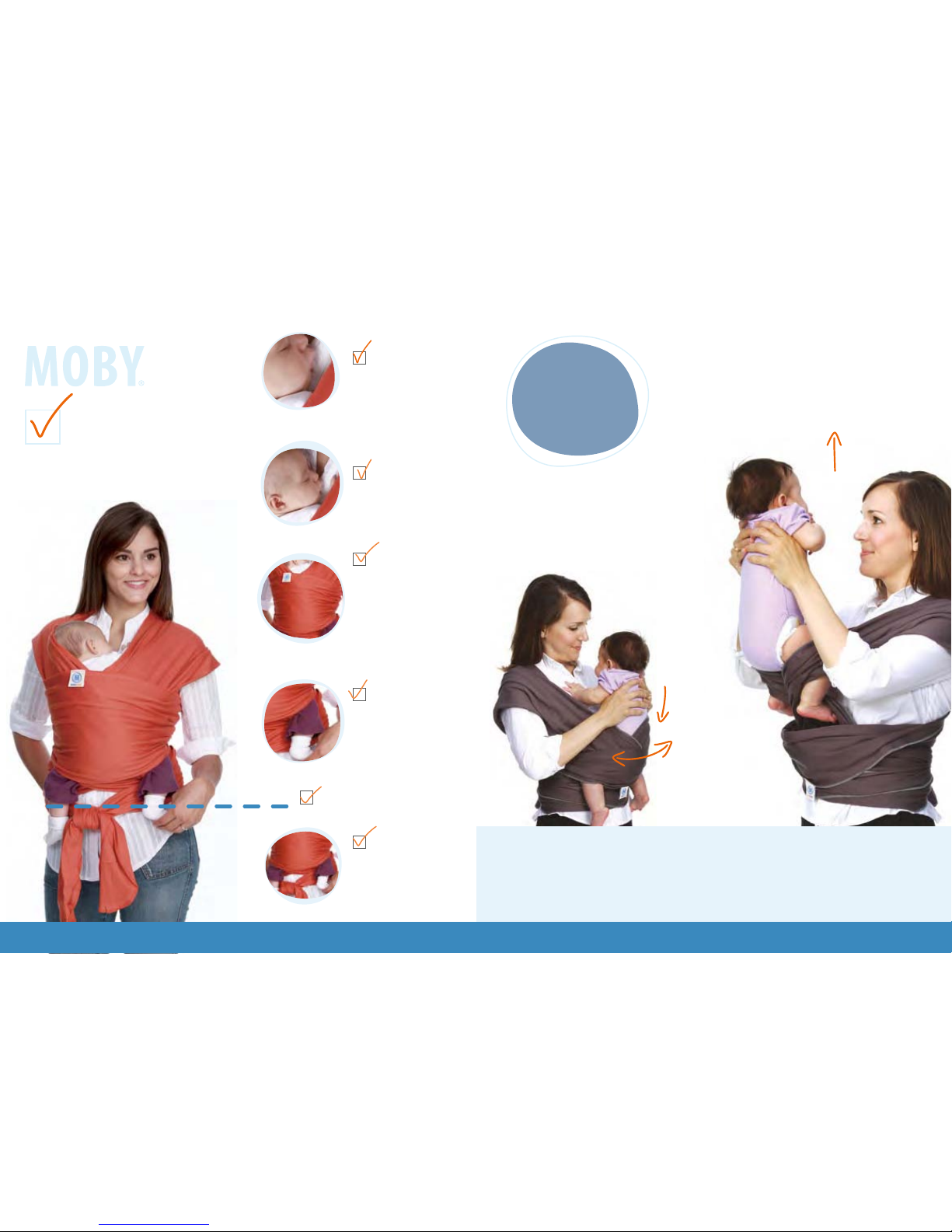
Baby is in a seated
position with knees
up above bottom
El bebé está sentado con
las rodillas hacia arriba por
encima del trasero
Baby's face is visible
Puede verse la cara del bebé
The logo tag
section "seat belt"
is securing baby's
entire
back and shoulders
La sección de la etiqueta
del logotipo ("cinturón de
seguridad") está asegurando
toda la espalda y los hombros
del bebé
Chin is o chest
La barbilla está despegada
del pecho
Checklist
Baby is carried above hips
El bebé se lleva por encima de las caderas
Taking
Baby Out
Fabric is spread
to the hollows
of baby's knees
La tela se extiende hasta
las concavidades de las
rodillas del bebé
Lower the Moby logo tag below baby’s bottom.
Open fabric, carefully supporting baby as you do
this. Newborns will need additional head support.
Baje la etiqueta del Moby por debajo del trasero del
bebé. Abra la tela, sujetando al bebé con cuidado
mientras lo hace. Los recién nacidos necesitarán
apoyo adicional para la cabeza.
1
Lift baby straight up and out of the Moby.
Keep baby close to your body as you lift up.
Levante al bebé hacia arriba y sáquelo del Moby.
Mantenga al bebé cerca de su cuerpo mientras
lo levanta.
2
Keep your
Moby on, then
baby can go
back in when
ready!
Consejo: ¡no deshaga la
envoltura de su Moby,
ya que el bebé puede
volverse a meter cuando
todo esté listo!
Comprobaciones de Seguridad
Cómo Sacar al Bebé
Holds & Checks
21
Moby® Wrap
22
The Comfortable Baby Carrier
Page 14
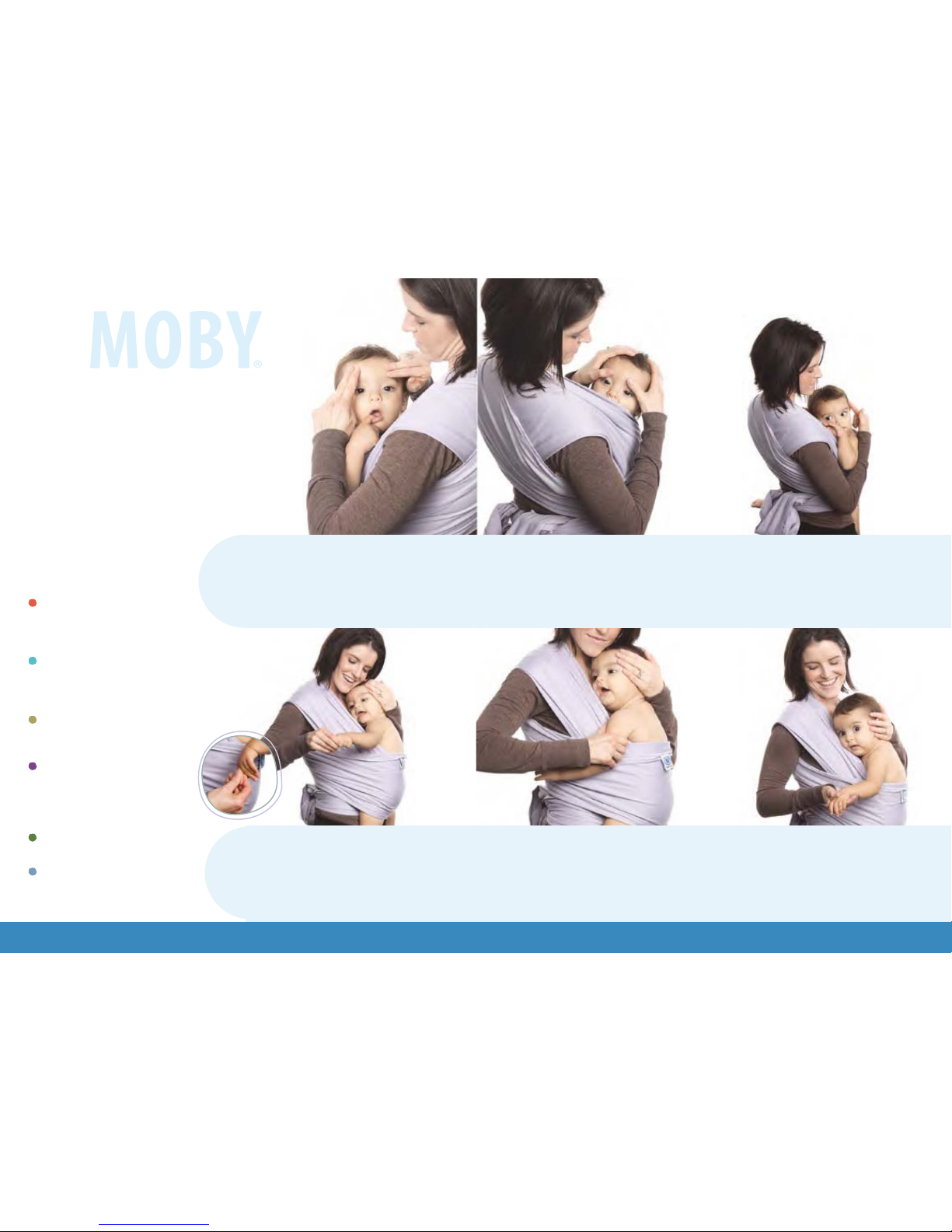
Eyebrows and Eyes
Place thumbs on baby’s eyebrows above the nose.
Gently stroke toward the temples.
Around the Ears
Place the ats of ngers in front of the ears.
Stroke over and around the ear, then under the
jaw to the chin.
Benets for Baby
Relief - massage can relieve
discomfort from teething,
congestion, constipation, gas
and colic.
Bonding - more intimate
interaction with parent and
infant, helping to foster the
parent/infant bond.
Skin stimulation - all the
physiological systems are
stimulated by massage.
Helps to deepen respiration,
improves muscle tone and
circulation, improves sensory
awareness, and helps baby
sleep deeper and longer.
Improves digestion and baby’s
immune system.
Better able to handle stimulation
and self-soothe.
The practice of infant massage
combines caregiving, communication,
play and intimacy between a parent
and baby. Research, clinical studies
and observation attest the benecial
attributes of massage.
Stroke the Arm
Mold your hand around baby’s arm near the
shoulder with ngers on top, thumb underneath.
Stroke from the shoulder to the wrist.
Finger Massage
Use your thumb and index nger to roll each
of baby’s ngers from the palm to the tip.
Hand Massage
Hold baby’s hand in yours. Stroke the top of the
hand with your thumb from the wrist to the ngers.
Draw circles around the wrist with your thumb.
MOBY® Massage head & arms
Forehead Massage
Begin with your ngers meeting in the middle
of baby’s forehead, stroke toward the temples
using the at part of your ngers.
Massage
Infant Massage USA
23
Moby® Wrap
24
The Comfortable Baby Carrier
Discover Moby
Page 15
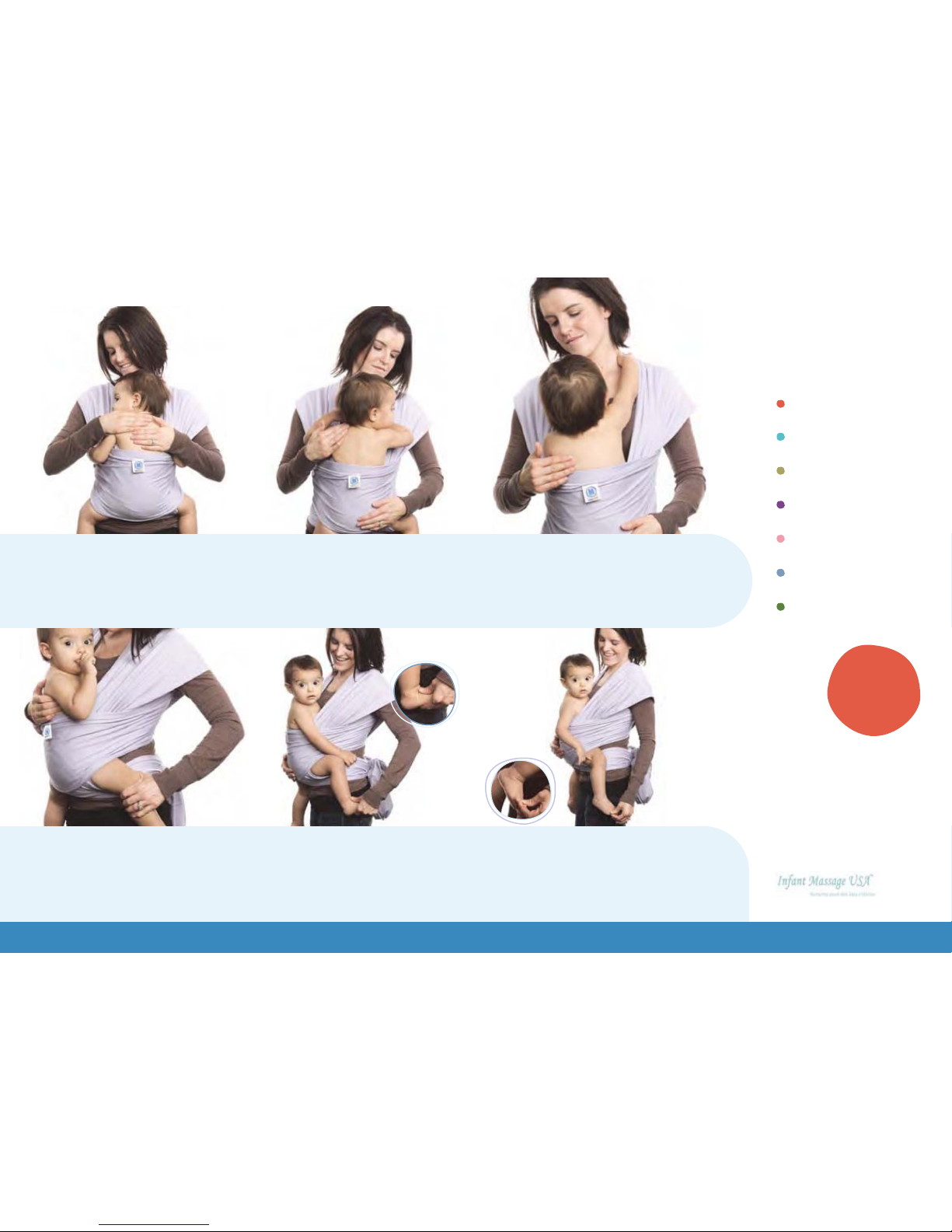
Back and Forth
Mold your hands to baby’s back starting at the
shoulders. Glide back and forth across the back
from shoulders to bottom then back up.
Stroke the Leg
Mold your hand around baby’s leg near the hip
with your ngers on top, thumb underneath.
Stroke from the hip to the ankle.
Gliding
Glide your hand down baby’s back from shoulders
to bottom.
Foot and Ankle Massage
Hold baby’s foot in your hand. Stroke the top of the
foot with your thumb from the toes to the ankle.
Draw circles around the ankle with your thumb.
Recommended
Reading:
Infant Massage:
A Handbook for Loving Parents
by Vimala McClure
Loving Hands - The Traditional
Art of Baby Massage
by Dr. Frederick LeBoyer
A special thanks to Infant Massage USA®,
a pioneering non-prot family education
and service organization, for their guidance
in bringing the awareness of infant massage
to Moby wearers and babies everywhere!
infantmassageusa.org
MOBY® Massage back & legs
Toe Massage
Use your thumb and index nger to gently
roll each toe.
Benets
for Parents
Helps establish a strong bond
between parent and child.
Enhances parent-infant
nonverbal communication.
Feel more condent and
competent with parenting skills.
Better able to understand
the needs of infants.
Provides fathers quality time
with their babies.
Helps overcome feelings of
depression or post-baby blues.
Provides time to relax
and unwind from the busy
pace of life.
These
strokes have
been designed
for Moby Wrap
Circles
Use the ats of your ngers to draw circles down
one side of baby’s back then back up the other side.
Infant Massage USA
25
Moby® Wrap
26
The Comfortable Baby Carrier
Discover Moby
Page 16
Posture, posture!
Before we begin your workout, let’s talk posture. The
main downside we nd with most carriers is that
they can wreak havoc on your posture. New moms
already suer from posture problems aggravated by
feeding, picking up baby, car seats and more. The best
way to use a baby carrier is to focus on stretching the
chest area and strengthening the upper back. When
wearing the carrier, regularly contract your shoulder
blades, bringing them together as if you were
squeezing a pencil. Keep shoulders down and back,
and neck long and relaxed.
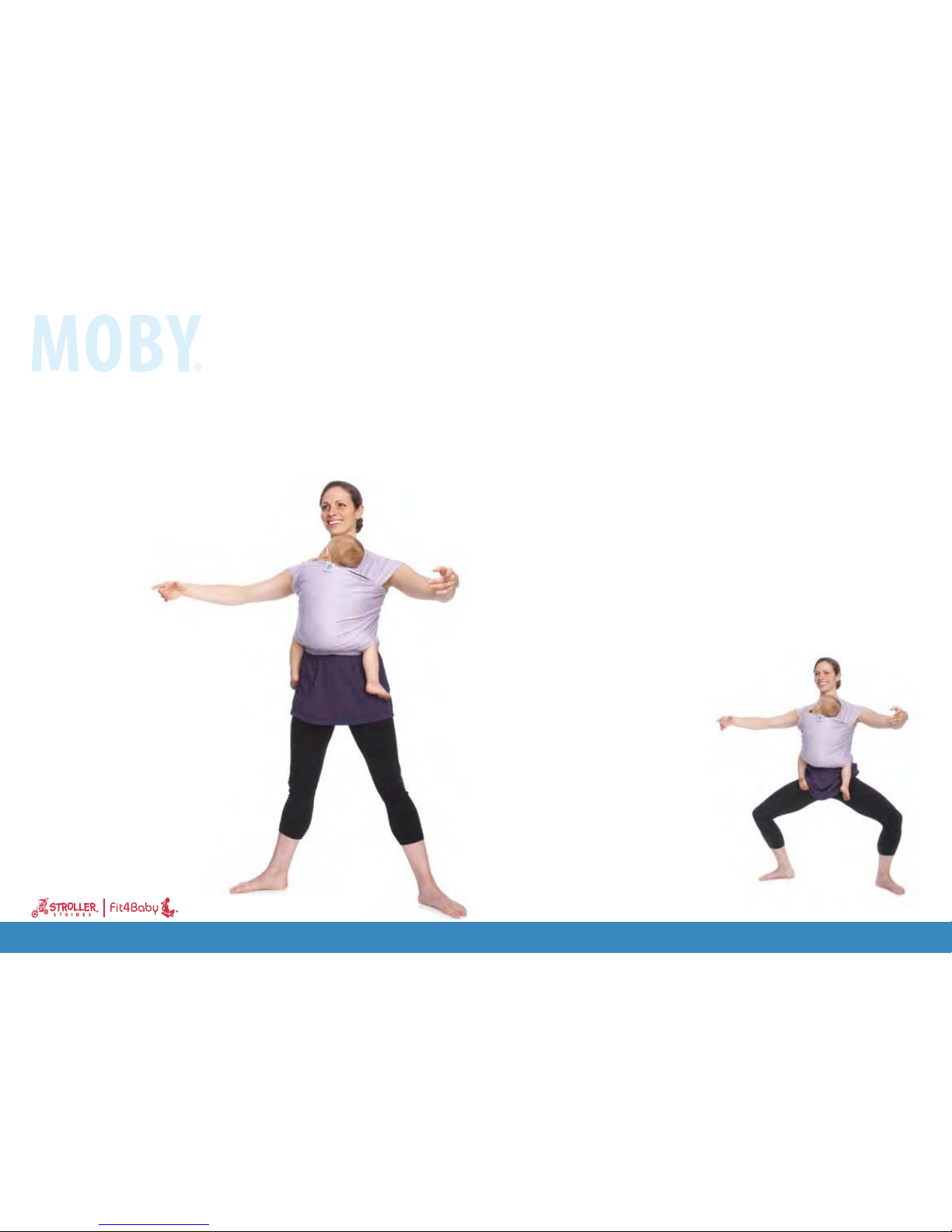
Plie Squat
A plie squat is a gym favorite for shaping thighs
and lifting derrieres. This exercise works the quads,
hamstrings, inner thighs and glutes. Baby will love the
light bounce and your bottom will love the workout.
1. Stand with feet wide, toes turned out.
2. Pull abdominal muscles in at.
3. Slowly lower down until your thighs are
near parallel to the oor, keeping knees
and toes aligned.
4. Slowly squeeze thighs and glutes until you’re
back to star t position.
5. Repeat for 1 to 3 sets of 12-16 repetitions, with
a 20-30 second rest between sets.
6. To add intensity, hold your squat in the lowered
position and do some controlled pulses.
3 toning moves to do with baby
exercises
Babies love the motion
and closeness; parents
love the comfort and
convenience! Even
better, the Moby Wrap
can also be a part
of great workout.
Baby's weight is
evenly distributed
while adding a
functional 'weight'
to your exercises!
What else can you do
with a Moby Wrap carrier?
Although not appropriate for running or even power
walking (because baby needs to be kept stable), a
slow walk can become a workout with baby in tow.
You can also add exercise tubing to your workout
and do bicep curls, lateral raises and other exercises
where you are standing and upright. As long as
baby’s head is supported and you can maintain good
posture, you’re set to get t!
Moby Wrap baby carriers can be
used for babies up to 35 lbs
Since newborns lack sucient head and neck
control, be sure to provide proper support until they
have developed adequate control. A Moby Wrap is
easier on your body (than holding baby), because it
distributes your baby's weight evenly.
By Lisa Druxman, founder of Stroller Strides®
Stroller Strides
27
Moby® Wrap
28
The Comfortable Baby Carrier
Discover Moby
Page 17
strollerstrides.com
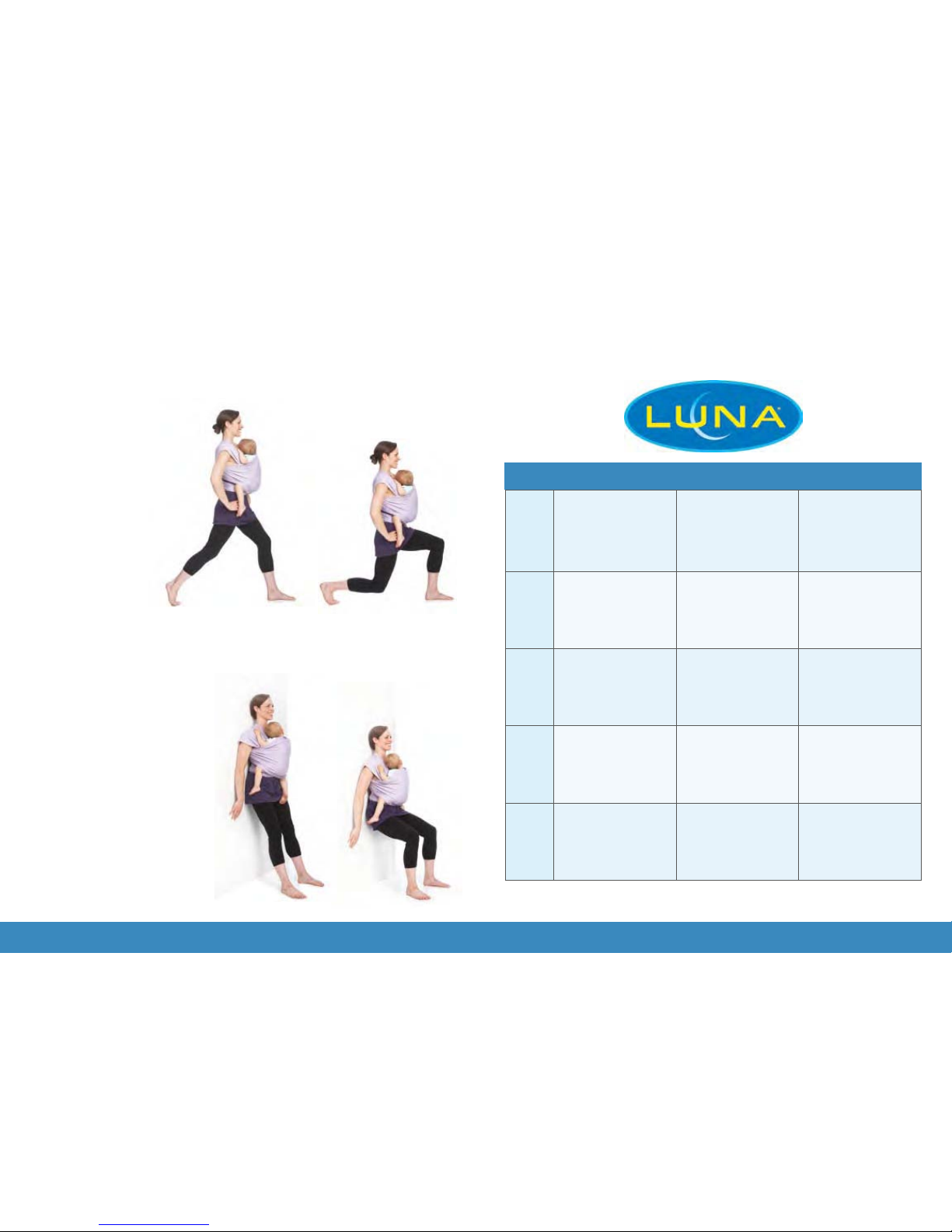
Lunge
A lunge is also one of the most popular gym exercises
because it does so much at once. In just this one
exercise, you work the glutes, hamstrings, quads and
inner thighs. It's more important to have a long
stride than to lunge deeply while performing
this exercise. If you feel o balance, make your
stance wider or use a chair for support.
1. Stand in a long staggered lunge stance.
2. Bend knees and descend to form a
90-degree angle with upper and lower
position of each leg.
3. The kneecap of front leg should be
approximately over the last shoelace.
4. Keep front heel down and weight
distributed evenly through front foot.
5. Heel of back leg is up o oor
and ball of foot is in contact
with oor.
6. Keep head over hips and eyes
focused directly forward.
7. Keep chest expanded and shoulder blades
squeezed together.
8. Return to start position and repeat for 1 to 3 sets
on each leg, about 12-16 repetitions.
Wall Squat
A wall squat is a great exercise to work your upper
legs. We recommend singing to your baby while
your minute-long wall squat counts down!
1. Standing with your back to a bare wall,
slide down the wall until your legs are
at a 90-degree angle.
2. Feet should be shoulder-width apart,
toes forward and abdominals tucked.
3. Hold this position and squeeze
your glutes.
4. Hold for one minute or until your
thighs beg for mercy.
Nutrient
While Pregnant
& Breastfeeding
What It Does Where To Get It
Protein
65-75 grams per day
vs. 50-55 grams pre-pregnancy
- that is an additional 2 oz of
meat OR 2 tbsp of almond butter
Baby’s red blood cells,
metabolism and development
are dependent on protein.
• lean red meat
• poultry
• sh
• dairy
• beans/soy
• eggs
• LUNA Bar
Folic Acid
800 micrograms per day
vs. 400 mcg pre-pregnancy that is an additional 1 cup
cooked spinach OR ¾ cup 50%
RDA folate fortied cereal
Promotes baby's brain and
spinal column development.
• dark green leafy vegetables
• beans
• fortied orange juice
• whole grains
• LUNA Bar
Calcium
1,000 milligrams per day
(the amount hasn't changed
since pre-pregnancy but it's even
more important now that you are
eating for two)
Necessary for formation of baby's
bones and keeping mom's bones
strong.
• dairy
• tofu
• beans
• almonds
• broccoli/kale
• LUNA Bar
Iron
27 milligrams per day
(vs. 18 mg pre-pregnancy that is an additional 2 oz lean
beef AND ¾ cup kidney beans)
Helps promote weight gain in
baby and support healthy blood
cells in mom.
• lean red meat
• eggs
• enriched whole grains
• beans/lentils
• spinach
• LUNA Bar
Omega - 3
Fatty Acids
1.3-1.4 grams per day
(vs. 1.1 grams pre-pregnancy
- not a big change, but very
important at this stage)
Important in baby's brain
and central nervous system
development. Helps maintain
mom's positive outlook postpartum.
• low mercury sh like
salmon (12 oz per week)
• axseed (oil or ground)
• walnuts
• LUNA Bar
©2012 Clif Bar & Company. CLIF and LUNA are trademarks of Clif Bar & Company.
Taking care of yourself
Nutrition by
LUNA®
29
Moby® Wrap
30
The Comfortable Baby Carrier
Discover Moby
Page 18
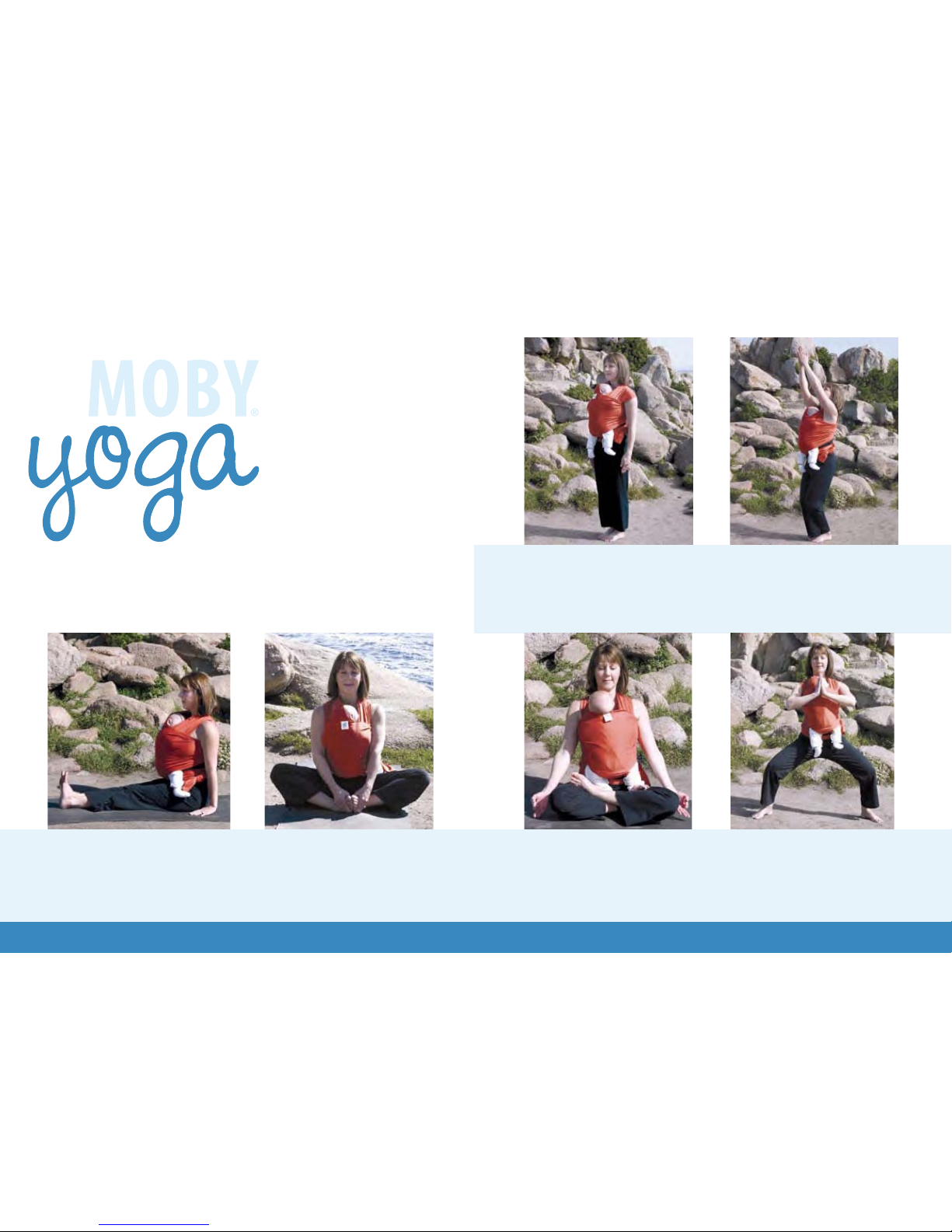
Mountain Pose
Stand up straight, big toes together. Inhale arms
out to sides and overhead. Exhale arms down to
Mountain Pose. Repeat 3-5 times.
On these pages are yoga poses
that are easily done while
wearing baby. Please make
sure to consult your doctor or
midwife before resuming any
exercise regimen and listen
to your body, stopping if you
feel any discomfort. Before you
start, make sure baby is fed and
happy. That way, you’re set up
for success on this adventure.
Lotus Pose
Sit in Sta Pose. Bring legs into cross-legged
position. Place the backs of your hands on tops of
knees, with the thumbs and rst ngers touching.
Take 5-10 full breaths.
Sta Pose
Sit on your mat with your legs straight. Ground sitting
bones into the mat, engage quadriceps and push
through the heels of the feet. Ground palms next to
hips and lift chest. Hold for 3-5 breaths.
Bound Angle Pose
Sit in Sta Pose. On the exhale - bend knees, pull heels
toward pelvis, then drop knees out to the sides and
press the soles of the feet together. Hold toes or ankles.
Inhale, lifting chest and stay in position for 3-5 breaths.
Squats
Legs should be wider than your shoulders, with
feet turned out slightly. On exhale, bend the knees.
Hold 3-5 breaths and come back up on the inhale.
Repeat 3-5 times.
Modied Sun Salutations
Stand in Mountain Pose. Inhale arms overhead and
bend knees for Chair Pose. Hold for 3-5 breaths.
Exhale arms down, straighten legs, coming back
into Mountain Pose. Repeat 3-5 times.
Once you master the basic yoga poses, you can
modify others in your skill & comfort level
.
Hav
e fun!
Get centered while carrying your little one
31
Moby® Wrap
32
The Comfortable Baby Carrier
Discover Moby
Page 19
Get inspired
Talk to a friend or relative who enjoyed
breastfeeding, or read up on celebrity
moms and everyday role models. Watch a
mom nurse and ask questions. Know what
motivates you - that special bond, fewer bottles
to wash, or fewer trips to the doctor for both of you!
Scope out spots to nurse so you can get out of the
house. Psych yourself up. You can do it!
Hit the ground running
Aim for a good latch within an hour of birth
and get a pro to help you; pain is not okay!
Your baby is programmed to go straight
from birth to the breast, both for comfort
and colostrum - so weighing, tests, and
relatives can wait. Snuggle up: skin-to-skin
contact boosts your supply and cues baby to latch
well. Demand pasteurized, screened donor milk if a
supplement is medically required.
Prepare in advance
Treat breastfeeding like planing a wedding,
or intervi ewing for a job. Take a class, join
or create a su pport group and inter view
lactation co nsultants
(just in case). Enroll your
spouse - their support is key. Make sure
your
employer understands that breastfeeding
equals fewer sick days, less turnover and higher
employee morale. You and your baby are worth it.
The benets of breastfeeding
last a lifetime!
{Top 5}
Breastfeeding Tips
Reaching your personal breastfeeding goals
Beat the "booby traps"
Have a game plan for any bumps along
the way. Make sure your ob-gyn, hospital and
pediatrician are truly breastfeeding friendly. Ask
about their breastfeeding success rates! Find local
resources - think expert coach and cheering squad
to reach your personal best. Remind nosey bodies
and naysayers that we know more now, as with seat
belts and sunscreen. Remember, almost all women
can breastfeed successfully, and 95% of problems are
easily solved with the right help.
Get in the groove
Remember, the rst few days and weeks
are a learning curve, but like riding a bike,
you'll get the hang of it soon. Keep
phone numbers of your support
group and top lactation
consultants handy, and get
help immediately if you
have any pain. Ask friends
and family to bring a meal
or watch the baby while
you nap, set small,
manageable goals
and acknowledge
yourself.
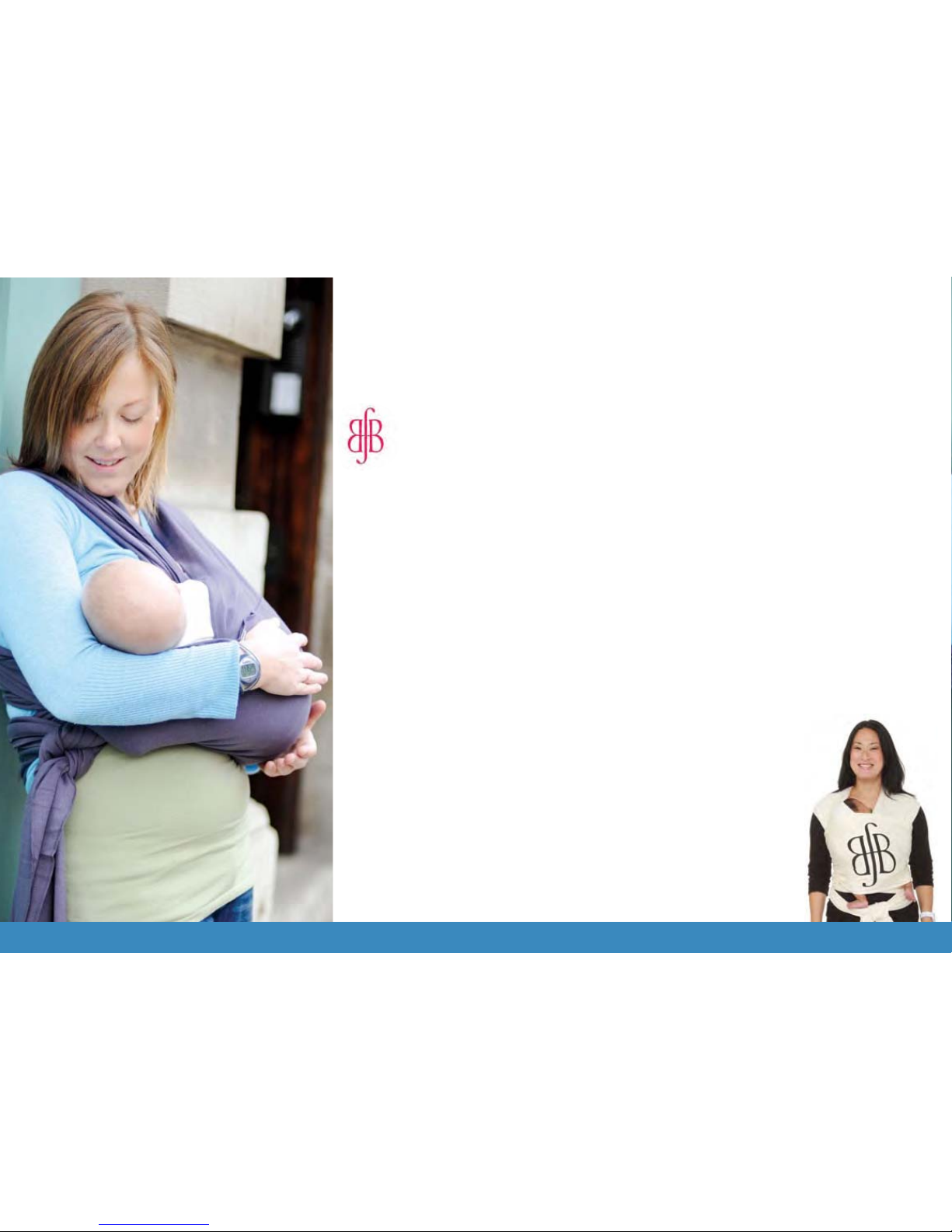
Best for Babes™ is
the rst consumerdriven, celebrity and
corporate-backed
501(c)(3) nonprot
dedicated to beating
the cultural and
institutional barriers
-- the Breastfeeding
Booby Traps® -- that
prevent parents from
making informed
feeding decisions
and prevent moms
from achieving
their personal
breastfeeding goals,
whether that's 2
days, 2 months, or 2
years! Moby Wrap has
partnered with Best
for Babes to create
a stunning wrap
featuring the Best for
Babes logo.
A portion of the
proceeds from
the sale of this
Moby will be
donated to
Best for Babes™
Best for Babes™
Discover Moby
33
Moby® Wrap
34
The Comfortable Baby Carrier
1
2
3
4
5
When using a Moby
while breastfeeding,
use your arms to
support baby. After
feeding, always move
baby's face away from
the breast and reposition
baby upright.
Page 20

Used with permission. Copyright © API 2012
Attachment Parenting International
35
Moby® Wrap
36
The Comfortable Baby Carrier
Ensure Safe Sleep,
Physically & Emotionally
Babies and children have needs at night
just as they do during the day, from hunger,
loneliness, and fear, to feeling too hot or too cold.
They rely on parents to soothe them and help them
regulate their intense emotions. Sleep training
techniques can have detrimental physiological and
psychological eects. Safe cosleeping benets both
babies (or children) and parents.
Provide Consistent, Loving Care
Babies and young children have an intense
need for the physical presence of a consistent,
loving, responsive caregiver, ideally a parent. If it
becomes necessary, choose an alternate caregiver
who has formed a bond with the child and who
cares for her or him in a way that strengthens the
attachment relationship. Keep schedules exible, and
minimize stress and fear during short separations.
Practice Positive Discipline
Positive discipline helps a child develop a
conscience guided by his or her own internal
discipline and compassion for others. Discipline that
is empathetic, loving, and respectful strengthens the
connection between parent and child. Rather than
reacting to behavior, discover the needs leading
to the behavior. Communicate and craft solutions
together while keeping everyone’s dignity intact.
Strive for Balance
in Personal & Family Life
It is easier to be emotionally responsive when
you feel in balance. Create a support network,
set realistic goals, put people before things, and
don’t be afraid to say “no.” Recognize individual needs
within the family and meet them to the greatest
extent possible without compromising your physical
and emotional health. Be creative, have fun with
parenting, and take time to care for yourself.
Prepare for Pregnancy,
Birth & Parenting
Become emotionally and physically prepared
for pregnancy and birth. Research available
options for healthcare providers and birthing
environments, and become informed about routine
newborn care.
Feed with Love and Respect
Breastfeeding is the optimal way to satisfy
an infant’s nutritional and emotional
needs. “Bottle nursing” adapts breastfeeding
behaviors to bottle-feeding to help initiate a secure
attachment. Follow the feeding cues for both infants
and children, encouraging them to eat when they
are hungry and stop when they are full. Oer healthy
food choices and model healthy eating behavior.
Principles of
Parenting
Attachment Parenting International
promotes the conditions that are
vital for the optimal development of
children. These are at the core of API’s educational
mission and are encompassed in API’s
Eight Principles of Parenting:
API’s Eight Principles of Parenting
Respond with Sensitivity
Build the foundation of trust and empathy
beginning in infancy. Tune in to what your
child is communicating to you, then respond
consistently and appropriately. Babies cannot be
expected to self-soothe; they need calm, loving,
empathetic parents to help them learn to regulate
their emotions. Respond sensitively to a child who is
hurting or expressing strong emotion, and share in
his or her joy.
Use Nurturing Touch
Touch meets a baby’s needs for physical
contact, aection, security, stimulation, and
movement. Skin-to-skin contact is especially
eective, such as during breastfeeding, bathing, or
infant massage. Carrying or babywearing also meets
this need while on the go. Hugs, snuggling, back
rubs, massage, and physical play help meet this
need in older children.
1
2
3
4
5
6
7
8
API's Mission
Educate and support all parents
in raising secure, joyful, and
empathic children in order to
strengthen
families and create a
more
compassionate world.
API Membership
API has provided almost 20 years of
grassroots, global, compassionate,
support to families everywhere! Help
spread the word and impact the
community through an API membership.
API oers free membership that includes
great e-newsletters and The Attached
Family electronic magazine. Join today!
attachm entparentin g.org
Discover Moby
Page 21
The Research
Dr. Nils Bergman's comprehensive
research
promotes the concept of bringing the mother and
baby together as almost a single entity. His studies
revealed that babies have a biological need for skinto-skin contact, and that a mother’s body responds
to this need.
Dr. Bergman’s research concludes:
A mother’s chest temperature changes to meet her
baby’s needs, rising if baby is cold and decreasing
if baby becomes too warm. The mother’s chest
responds through biofeedback, doing a superior job
when compared to a traditional incubator.
A baby’s stress hormones, blood pressure,
oxygenation, temperature and heart rate stabilize
with skin-to-skin contact. These ndings are
changing hospital practices for the better. Babies are
more likely to be left on their mothers for at least an
hour after birth in order to stabilize vital signs. This
is also true before and after any invasive procedure
such as drawing blood.
A baby that exper iences skin-to-ski n
contact is
more likely to breastfeed without problems.
The closeness elicits maternal caregiving and
protective behaviors.
Skin-to-Skin:
The Overall Results
According to Dr. Sears and many other
pediatric experts, skin-to-skin care and babywearing
are proven to:
• Reduce Crying
• Increase Baby’s Weight
• Help Prevent Colic
• Increase Baby’s Overall Health
• Boost Milk Production
• Improve Baby’s Sleep Time
and Quality
• Lower Baby’s (& Mother’s)
Stress Hormones
1
Importance
Touch
1 Lawrence, Ruth and Robert Lawrence, Breastfeeding:
A Guide for the Medical Profession, 1999
2 Sears, William, M.D., The Attachment Parenting Book, 2001
Skin-to-skin contact is used to
promote parent/infant bonding,
especially for premature babies.
It is the practice of holding an
infant dressed only in a diaper
between a mother’s bare breasts
or on father’s chest. Through
contact with parents' skin, babies
remain warm and experience
more interaction.
Skin-to-Skin & Breastfeeding
Mothers who practice skin-to-skin care with their
infants breastfeed longer and more frequently.
Babies have better weight gain and are discharged
from the hospital earlier. Mothers also report greater
condence in caring for their infants.2
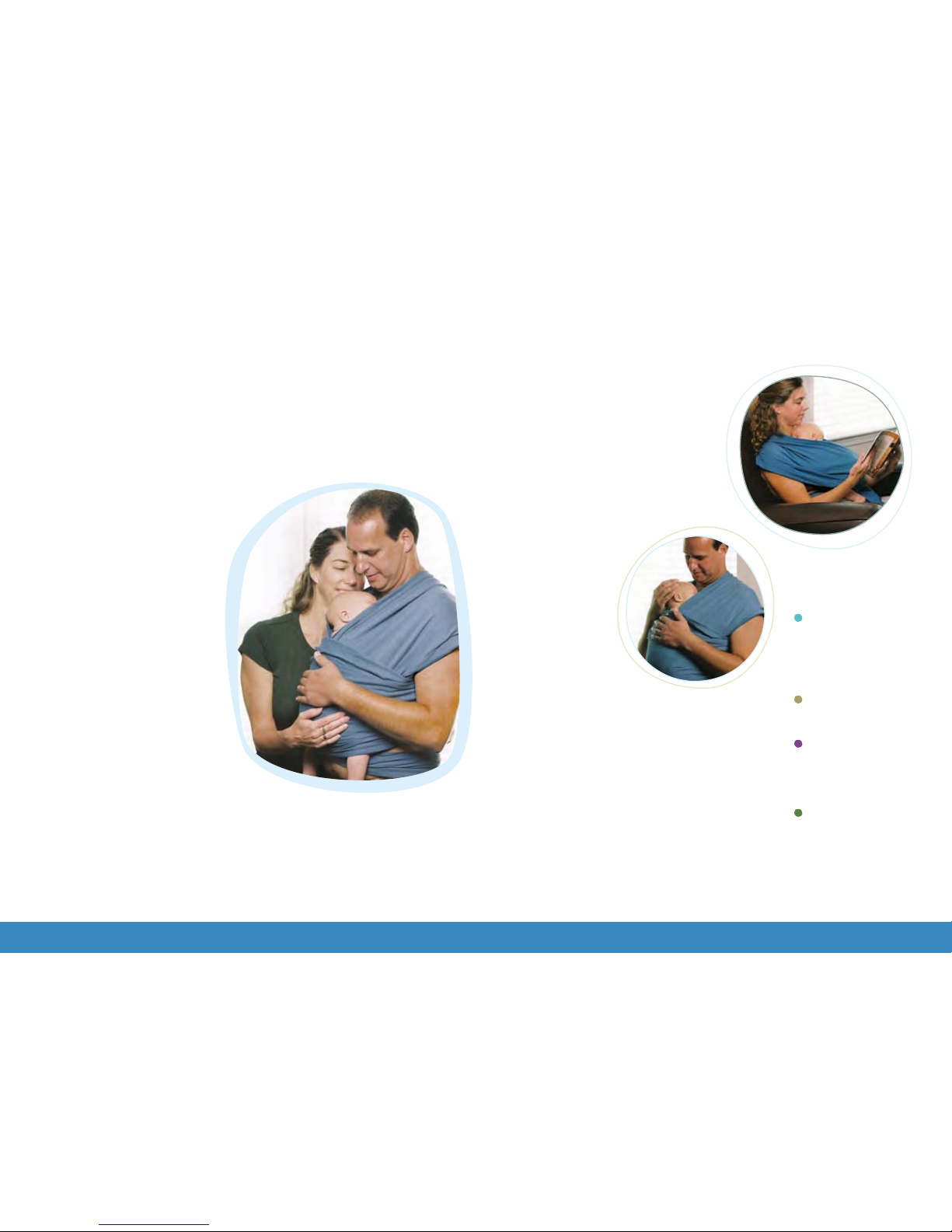
Dads Too!
Fathers who practice
skin-to-skin care with their
babies feel an incredible
bond. This is highly
preferable to having dad
involved by bottle feeding,
which can have the adverse
eect of decreasing the
mother’s milk supply,
leading to early weaning.
Skin-to-Skin Care in the Moby Wrap
of
There is no fabric
separating the parent
from the baby, so
parents can practice
skin-to-skin for several
hours a day with ease.
The Moby Wrap is wide
enough to keep the parent
covered and warm.
This is a wonderfully
rewarding way for
parents and caregivers
to bond with their
babies!
It may take a few tries to
feel condent with the
wrapping process.
Read Practice Makes
Perfect on page 40 for
more helpful hints.
Discover Moby
37
Moby® Wrap
38
The Comfortable Baby Carrier
Page 22
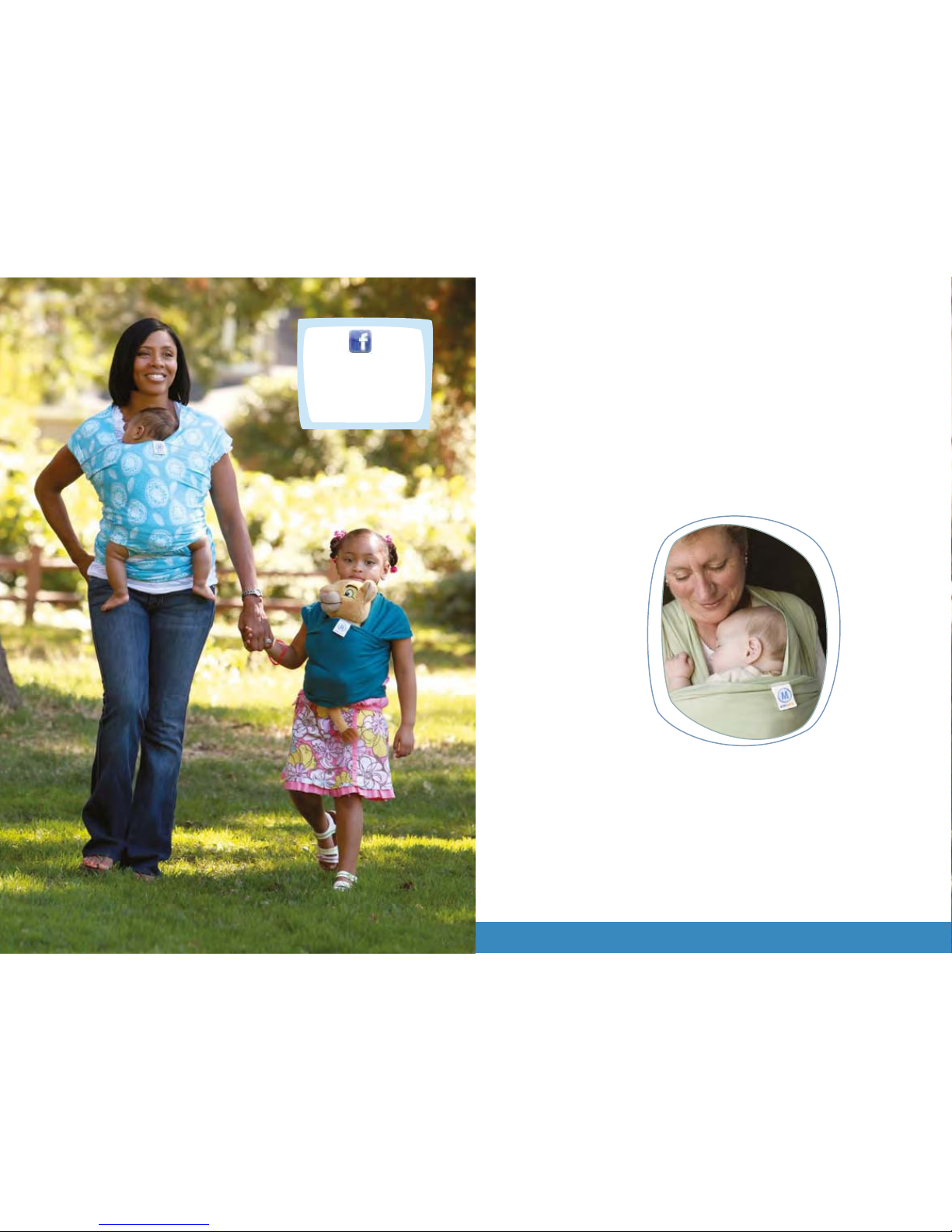
Soothes Fussy Babies
It is amazing how quickly a baby will settle down once
wrapped in the Moby Wrap. Experts, like Dr. Sears,
stress the importance of holding baby often and
close. The Moby Wrap allows you to
do this with ease.
Practice Makes Perfect
It may take 3-5 attempts at wrapping
to feel condent with the process.
Try watching yourself
in the mirror
while you put on your
Moby Wrap.
Practice with a doll or large stued
animal. When introducing baby to
the Moby Wrap, make sure baby is
fed and happy.
Machine Washable
The Moby Wrap is easy to clean.
Prewashing before rst use is
recommended. You can machine
wash your wrap in cold water and
air-dry or tumble dry on low. Your
Moby Wrap may shrink slightly in
the dryer, but will stretch out again
after being worn.
Be Comfortable
The Moby Wrap design uses your entire back, as well
as your shoulders, to carry the weight of baby. Unlike
other carriers, which have narrow straps or go across
one shoulder, the Moby Wrap is a wide piece of fabric
that is wrapped over both shoulders. The absence of
buckles, snaps or other fasteners makes it amazingly
comfortable and easy to wear. It is simple to adjust
the t of your Moby Wrap by varying how tightly you
wrap yourself.
Moby Wrap Inc.
PO Box 1066
Chico, CA 95927
mobywrap.com
toll free: 888-629-9727
530-898-8200
Photos by Marty Crosley Photography
Copyright © 2012 Moby Wrap Inc.
Be Secure
With the one-way
stretch cotton and
wide width of
the Moby Wrap,
baby is wrapped
close and tight,
ensuring a secure
hold. Baby’s
head can also be
tucked under the
stretchy cotton
fabric for added
safety. You can
go about your day
in triple-wrapped
security. Please refer
to the safety section
(pages 1-4, 10 & 19-21)
for tips on keeping your
child secure, as well as
safety tips for each specic hold
throughout the booklet.
Be Uniquely Close
There is not a lot of extra material or bulky padding
between you and baby. Within the cuddly connes of
the Moby Wrap, baby nds comfort in the warmth of
your body and the sound of your heartbeat.
39
Moby® Wrap
40
The Comfortable Baby Carrier
Discover Moby
Moby Information
Visit mobywrap.com
to view Moby Accessories
including: Moby Minis,
Blankets, Hats & more
Join us on Facebook
Meet our amazing Moby Fans!
Fun, conversation & helpful tips:
facebook.com/mobywrap
Page 23
Helps provides an ideal environment
for healthy child development.
Close contact with parents encourages
babies to feel secure and condent.
Helps parents accomplish day-to-day
activities while still being close
with
their baby.
Helps fussy, tired infants fall asleep.
Carry
your child
because...
More information on babywearing available on mobywrap.com
 Loading...