

Page 1
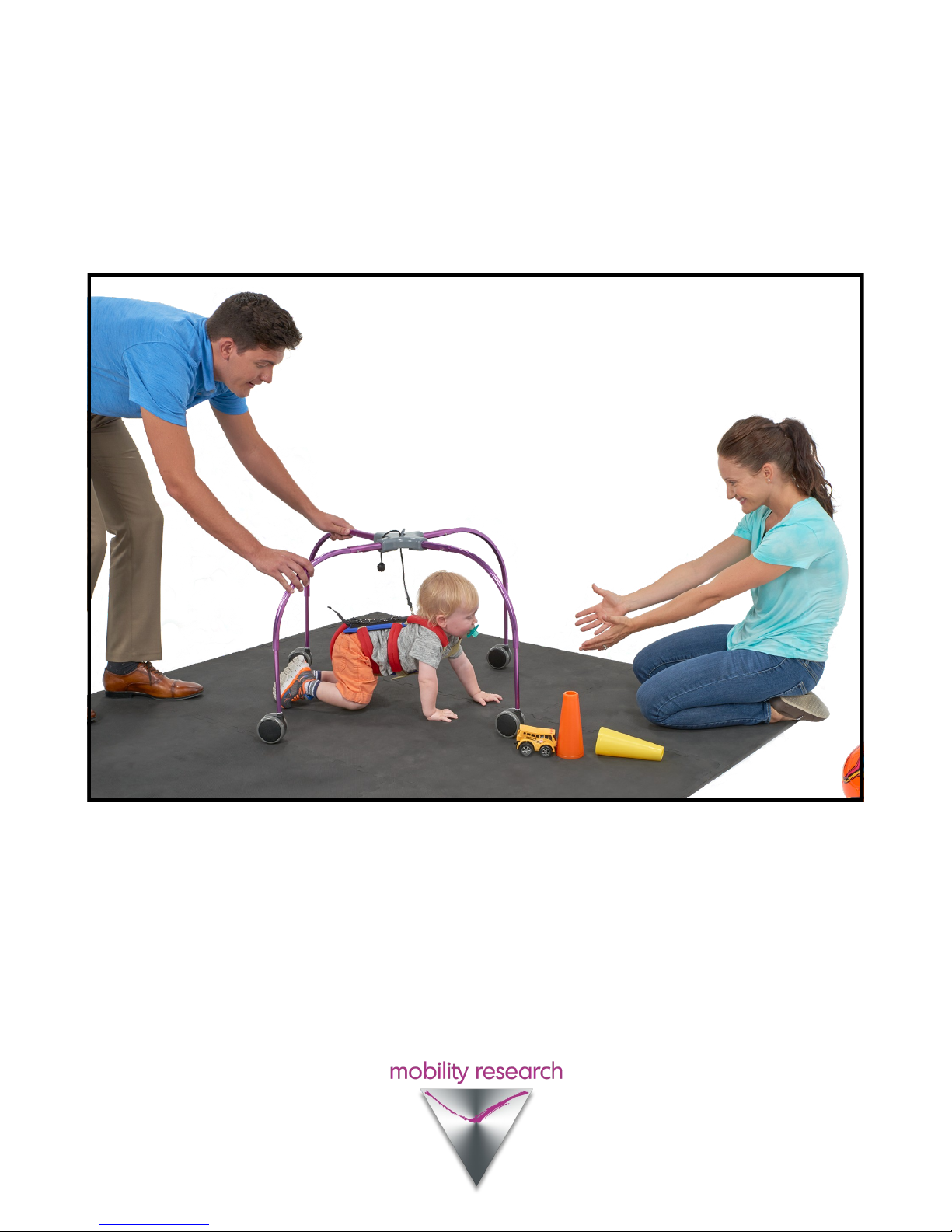
USER’S GUIDE
CRAWLAHEAD
Assistive Crawler Device
Page 2

!
By reading this document beyond this section, and/or using the therapeutic medical device (“CrawlAhead”) herein (hereafter “Device”), to the
fullest extent permitted by law, the parent, guardian, clinician, and/or Therapist responsible for any child or patient under their care who is
allowed to be in proximity of the said Device (hereafter “Patient”) shall indemnify, defend and hold harmless Mobility Research Inc., their legal
representatives, clients, associates, assigns, sub-contractors, corporate bodies, agents, and employees (hereafter collectively “Mobility
Research”), from and against all claims arising out of or resulting from the use of said device, with and on the named Patient. The term “Claim” as
used in this agreement is defined as any financial loss, claim, suit, action, damage, or expense, including but not limited to attorney’s fees,
attributable for bodily injury, sickness, disease or death, or injury to or destruction of tangible property including loss of use resulting there from.
Therapist’s adult user’s obligation to indemnify, defend, and hold harmless includes any claim by Therapist’s and adult’s legal representatives,
clients, associates, assigns, agents, employees, or representatives.
Therapist, parent, or any other adult user of the “device”, agrees that they are fully aware of risks and hazards connected with the use of said
”device”, and elect voluntarily to have the Patient participate in such use, knowing that it may be hazardous to Patient. Therapist and adult user
understands that the potential risks and hazards include failure of the Device being used due to inadequate/unsafe design, improper use, and/or
any number of possible sources including those known, unknown or anticipated by Mobility Research, regardless whether or not explicitly
disclosed to any user by Mobility Research. Therapist/adult user agree to voluntarily assume full and complete responsibility for any risks of loss,
property damage or injury, including death, that may be sustained by Patient, or any loss or damage to property owned by said adult users, as a
result of being engaged in using the device, whether caused by the negligence of Mobility Research or otherwise. Such adult users understand
and agree that they will not be compensated in any manner whatsoever for Patient’s participation in said Testing.
The statements in this document have not been approved by the Food & Drug Administration (FDA). This product has not been approved by the
Food & Drug Administration to prevent, cure, treat, or diagnose any disease.
Absolutely none of the statements in this document should be construed as medical advice. The information provided in this document is for
informational purposes only and is not intended as a substitute for advice from a physician or other health care professional.
The information in this document and/or the Device is describes should not be used for diagnosis or treatment of any health problem or for
prescription of any sort of medical treatment. You should consult with a licensed healthcare professional before considering beginning any type
of therapy, or if you have, or suspect the patient with whom you intend to use it may have a health problem. Those seeking treatment for a
specific disease should consult a qualified physician.
Mobility Research reserves the right to make changes without notice in design, specifications, and models. Mobility Research provides no
warranties or guarantees for this Device.
The information in this manual is confidential and may not be disclosed to third parties without the prior written consent of Mobility Research.
This user’s guide and therapeutic device as described within are provided as-is, without warranty as to their performance, merchantability, or
fitness for any particular purpose. The entire risk as to the safety, results, and performance of this product is assumed by the parent, guardian, or
clinician specifically by way of example but not limitation, in the event that the Therapist or the Patient have history of medical conditions,
muscular disorders, infirmities or are not in good health, Therapist should consult with the Patient’s physician, clinician, and/or Therapist before
using this Device.
Mobility Research shall not be liable for indirect, social, or consequential damages resulting of the use of this Device.
This user’s manual is provided as a clinical aid to assist properly licensed medical professionals in the usage of this device. As part of this
professional usage, the medical professional must use their professional judgment in making any final determinations in product usage and
technique. In doing so, the medical professional should rely on their own training and experience and should conduct a thorough review of
pertinent medical literature and the product’s Directions For Use or User’s Manual.
Therapist/adult user agrees that this release is irrevocable, worldwide and perpetual, and will be governed by the laws (excluding the law of
conflicts) of Arizona. Therapist and any adult user hereby warrants that he/she is a legal competent adult and a parent, legally appointed guardian
of the Patient, and/or the Patient’s clinician/Therapist, and that they have every right to contract for the Patient in the above regard. Therapist/
adult user states further that he/she has read the above authorization, release, and agreement, prior to use, and that they are fully familiar with
its contents. This release shall be binding upon the Patient and Therapist, adult user and their respective heirs, legal representatives, associates,
and assigns.
LEGAL DISCLAIMER
US Patent# 9,445,968 B1
2
Page 3
TABLE OF CONTENTS
A - WARNINGS
B - INTRODUCTION
C - ASSEMBLY & HARNESS APPLICATION
D - USE OF CRAWLAHEAD
E - MAINTENANCE
F - RESOURCE DIRECTORY
4
5
7
8
10
11
3
Page 4
A
WARNINGS
Read and understand this entire manual before using. Obey all safety messages that follow this symbol to avoid
possible injury or death resulting from misuse.
Use only on a FLAT level ground under the supervision of a parent/caregiver, DO NOT use the device around stairs, steep
slopes or water or injury can occur.
This device is NOT a toy and should NOT be used if it appears damaged or inoperable. Do NOT leave this device within the
reach of children while unattended.
4
Page 5
INTRODUCTION
B
Introduction
Crawling is an important step in child development. When a child is on his/her hands and knees, the arm and leg joints, muscles
and connective tissues receive feedback (proprioceptive feedback) to let the brain know where the body is in space which helps
stabilize the joints. Crawling is also believed by many to be one of the most essential developmental phases for optimal future
learning. Not only does it strengthen the neck, extremities, and trunk muscles of a young child, but the mechanics of crawling are
believed to stimulate different areas of the brain which influence the child’s ability to learn. It’s also the precursor to walking since
the arms and legs are moved in a similar pattern while walking. As opposed to a caregiver (or two) attempting to support the
patient’s arms, legs, head and trunk, the CrawlAhead allows the patient to move and support themselves independently. This frees
the caregiver to encourage the child to crawl, reach for objects, develop weight‐shifting and improve head control. Other similar
devices currently exist on the market, but all have severe shortcomings compared to benefits of the CrawlAhead.
Indications/uses:
The CrawlAhead was designed to be used for a variety of different diagnoses or motor conditions that hinder the child from getting into or maintaining a quadruped position.
Examples of Indications:
● Neurological Conditions e.g.: Cerebral Palsy, Spina Bifida,
Pediatric Neurotransmitter Disease, etc…..
● Genetic syndrome conditions e.g.: Angelman Syndrome,
Down Syndrome, etc….
● Orthopedic conditions e.g.: Cranial deformities and limb
deformities, etc…..
Precautions:
● G-tube, J-tube and similar ostomy ports. (Wrap gauze or
wash towel to create a barrier)
● Recent wounds around the torso that come in contact with
the harness (surgical or trauma)
● Anything that would prevent a child to be in a quadruped
position
● Tracheostomy- ventilator or non-ventilator dependent
● Anything that prevents a harness to be applied to the torso
(please consult with your physician or clinician).
5
Page 6
B
INTRODUCTION (CONT’D)
System Familiarization
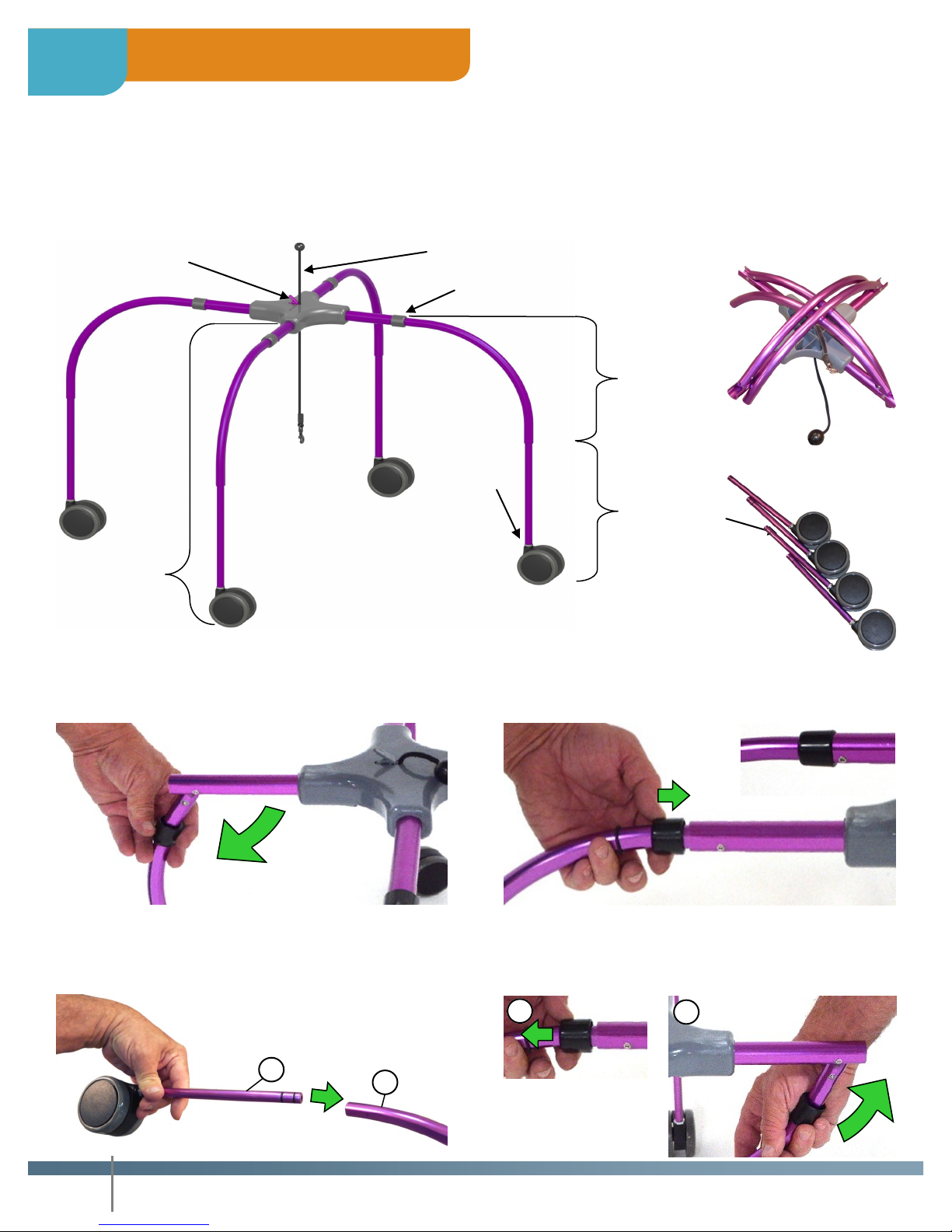
The CrawlAhead consists of two major components; the Frame and the Harness. The Frame and Harness have both been designed
to safely support up to 40 lbs (18 kg). Once the baby has been attached to the device, there’s two major adjustments that can be
made. The Vertical Lift Cord is used to vary the overall load carrying assistance provided by the device (See Diagram 1 “Lift Patient”,
page 8). The Load Biasing Adjuster allows the ratio of load carrying assistance to vary between the upper and lower body (See
Diagram 1 “Lift Patient”, page 8).
A) Vertical Lift Cord
Release Button
E) Frame Leg
(Fully Attached)
B) Vertical Lift Cord
F) Wheel
Assembly
1. Carefully unfold each of the lower halves of the four
frame legs.
Folded Hub
C) Locking Collar
D) Upper
Frame Leg
See Below
G) Lower
Frame Leg
2. Slide locking collar over upper frame leg to lock each
extension.
3. Grasp the end of the upper frame leg (2). Insert the lower
frame leg (1) into the upper frame leg (2). Press firmly in
until you hear a snap. Test fit security by trying to pull legs
connection apart.
1
6
Locked
4. To collapse device, slide locking collar away from upper
frame leg to unlock (3). Fold legs under frame for compact
storage or transport (4).
3
2
4
Page 7
ASSEMBLY & HARNESS APPLICATION
Harness Familiarization
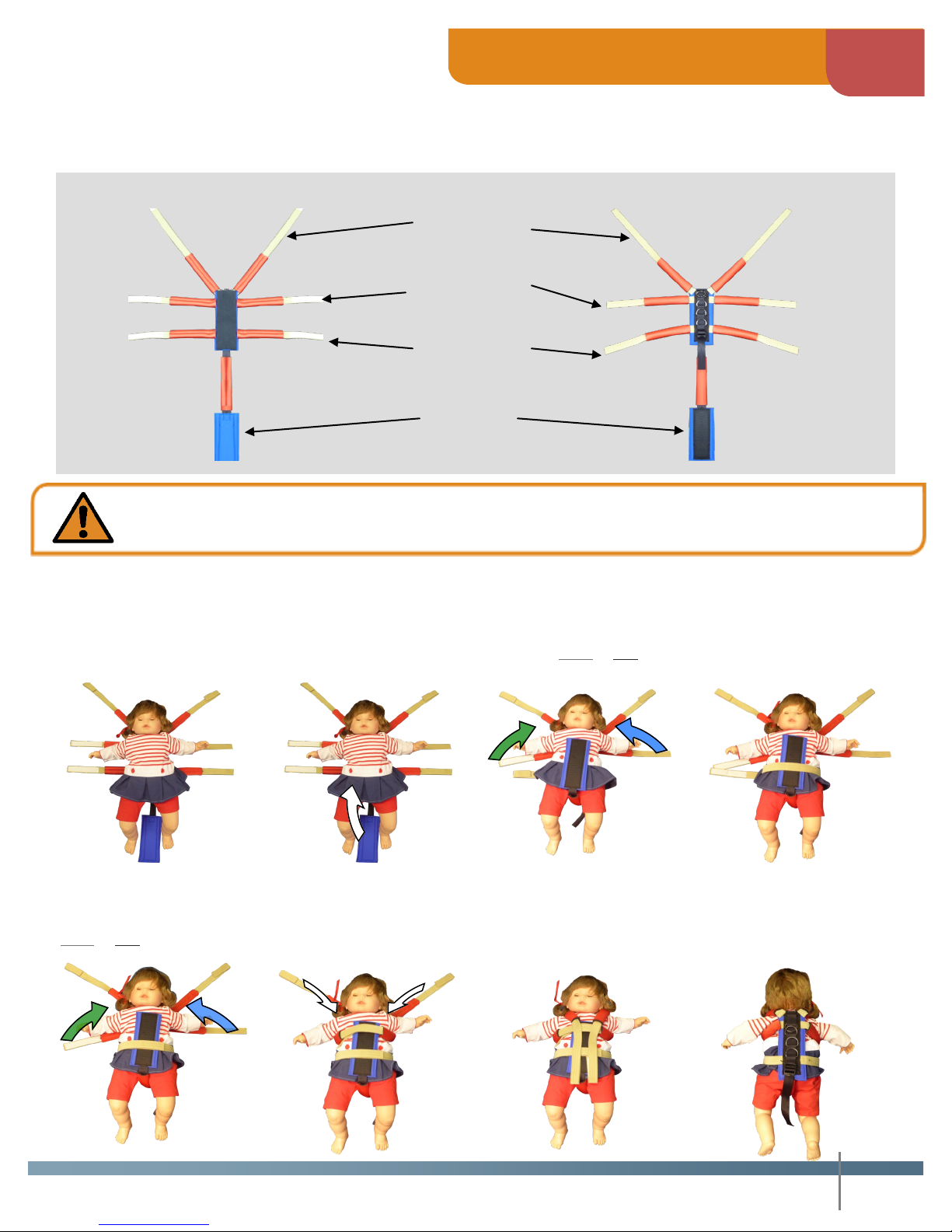
See “Harness Application” for detailed information on properly fitting the child into the harness.
C
Bottom View
Follow proper harness application to ensure correct support of the child. Girth size fits children from 16” to 27”.
Harness Application:
1. Lay harness onto a flat
surface and place baby on
Harness.
Shoulder Straps
Chest Straps
Waist Straps
Torso Strap
2. Pull torso strap between
the legs
3. Wrap waist straps around
the lower torso, from the
caregivers Right to Left side.
Top View
4. Connect the waist straps
using the strap Velcro on the
torso strap..
5. Wrap chest straps around
the chest from the caregivers
Right to Left side.
6. Pull shoulder straps down
in front of torso.
7. Connect shoulder straps to
front of abdomen using strap
Velcro.
6. Adjust straps until
comfortably snug. Do not
over tighten straps.
7
Page 8
D
Consult with the users physician or licensed clinician before using and supervision by a parent/caregiver is required at all
times.
The maximum patient weight is 40 lbs (18 kg), height 35 in (89cm). Never apply downward force to the device exceeding
40lbs (18 kg).
Ensure the child’s fingers and toes will not be pinched by the wheels and long hair should be tied back or otherwise covered
to prevent injury. If patient appears uncomfortable, faint, dizzy, short of breath, or ill while use, stop the session and seek
proper attention.
USE OF CRAWLAHEAD
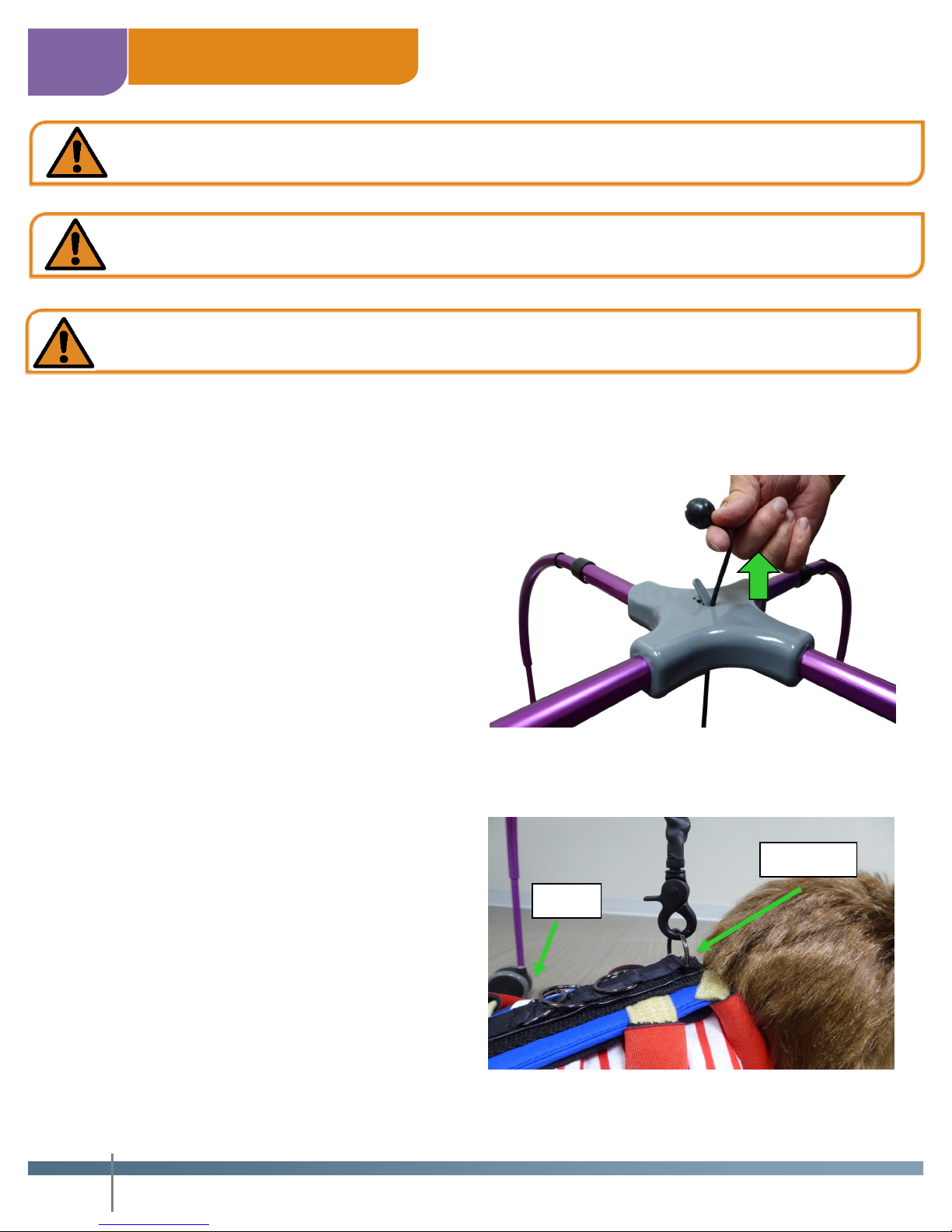
1. Lift Patient
Place one hand under the torso to raise the baby into the hands
and knees position while pulling up on the vertical lift cord.
The amount of lifting assistance required by each patient will
vary based on their specific clinical needs and degree of
therapeutic progress. Assuming the patient is showing
improvement, the amount of load carrying assistance the device
is providing should typically be decreased over time, allowing
the patient to carry more of their weight until the device is no
longer necessary for proper crawling.
2. Load Biasing Adjustment
Depending on the needs of each patient, the ratio of assistance
provided to the patient’s upper body (arms) or lower body (legs)
may be easily varied by adjusting the Vertical Lift Clip superiorly
towards (towards the neck) or inferiorly (towards the end of
spine). By adjusting the Vertical Lift Cord Clip position inferiorly,
more assistance is provided to the patient’s lower body.
Similarly, Vertical Lift Cord Clip position superiorly, more
assistance is provided to the patient’s upper body. This
adjustment position may also need to be changed over time as
the patient progresses.
8
Superior
Inferior
Page 9
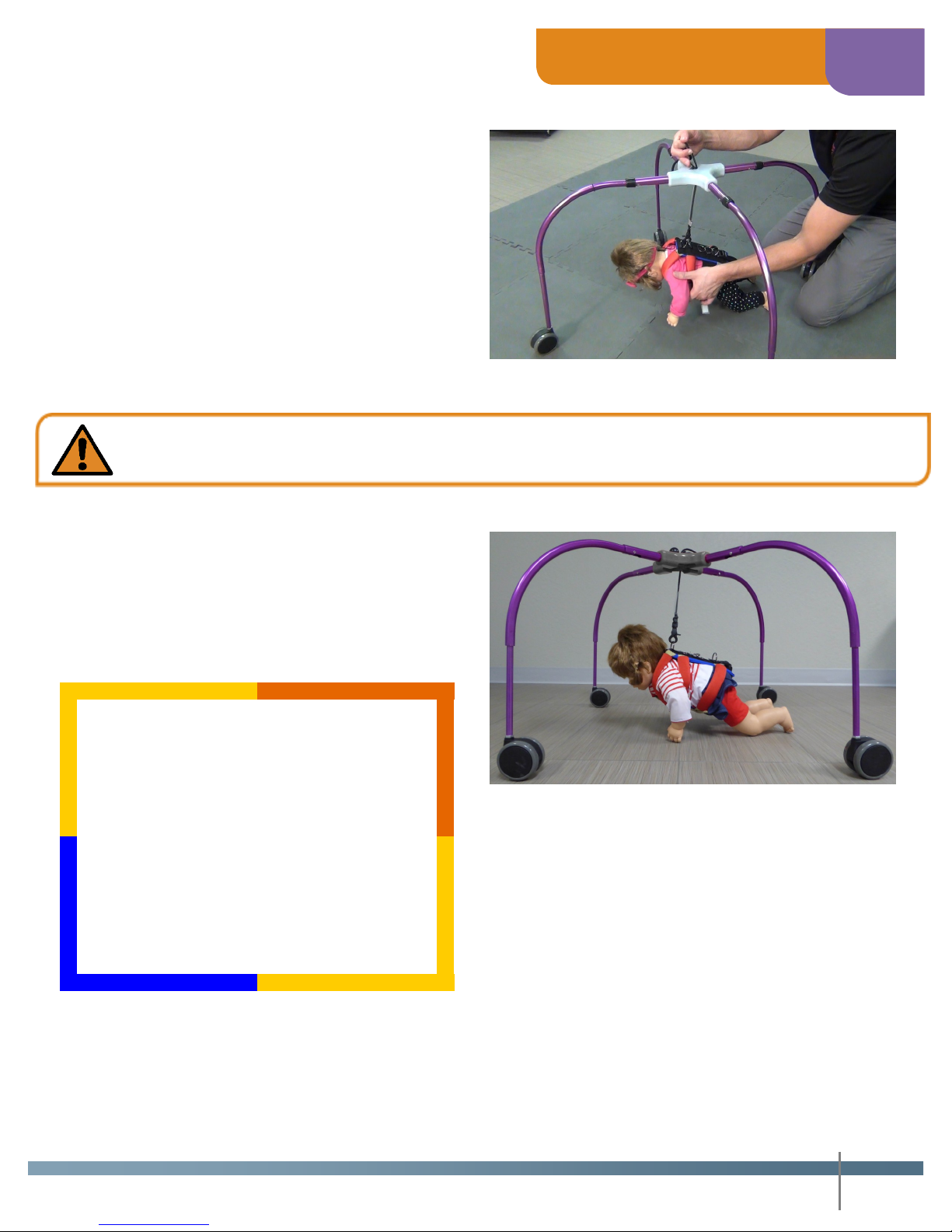
3. Lowering Patient
Place one hand under the torso before lowering the baby. Pull
up on the Vertical Lift Cord to slightly lift the patient’s weight
being supported by the device. With the baby’s weight removed
from the Frame, push the Vertical Cord Release Button to allow
the patient to be lowered.
Ensure patient’s weight is completely supported independently of the device’s Frame prior to depressing Vertical Cord
Release Button while lowering baby or serious injury to patient could occur.
USE OF CRAWLAHEAD
D
4. Application
This user’s guide is intended to provide general application
instructions to be used for a variety of diagnosis’s that delay
motor development. The device provides adjustable support of
the child so the user can move and support themselves more
independently.
Various Examples:
Support head control during crawling
Great for supportive sitting positon
Weight shifting in a quadruped position
Turn while in a quadruped position
Target upper or lower extremities to work on
strengthening the muscles
Work on prone-lying activities: reaching for objects,
lifting the head, pushing off the ground
Provide a more interactive and engaging environment
to increase the child’s self-confidence
9
Page 10

E
MAINTENANCE
Maintenance:
The CrawlAhead has been specially designed to be durable and relatively maintenance free. The frame is constructed from aluminum
and has been painted to resist scratches.
The Frame and Harness should be inspected before every use.
Cleaning:
Frame cleaning instructions: Can be wiped down with a diluted Windex type cleaning solution or hospital approved cleaning solution.
Harness cleaning instructions: The harness wrap is made with a blue cloth material that is impermeable and wipeable. Use of bleach is
discouraged and may effect the permeability of the harness material.
Laundering Harness instructions: The harness can be washed in hot water up to 80°C according to facility infection control guidelines.
Harnesses should be dried with low or no heat tumble dry.
Frequency
Cleaning Agent
Water Temperature
Follow facility infection control guidelines
Follow facility infection control guidelines
Wash up to 176°F (80°C) *
Frequency
Cleaning Agent
Water Temperature
Drying Method
Special Cleaning
Harnesses should be dried with LOW or NO HEAT TUMBLE DRY.
Wipe with disinfecting solution, per facility infection control procedures
Follow facility infection control guidelines
Follow facility infection control guidelines
Wash up to 176°F (80°C) *
B
Page 11
RESOURCE DIRECTORY
Resource Directory
Phone/Fax Website: Email Directory
F
Phone :
800.332.WALK (9255)
Toll free in U.S. and Canada
Fax:
480-829-0737
CrawlAhead.com
LiteGait.com
LiteGait.org
Service & Parts [email protected]
Clinical Support [email protected]
Education [email protected]
Sales [email protected]
LiteGait® is a Registered Trademark of mobility research, Inc. (2018 US)
P.O. Box 3141, Tempe, AZ 85280, Tel: 800-332-9255, Fax:480-829-0737, Email: [email protected], www.LiteGait.com
 Loading...