

Page 1

MODEL SV-2000
SOLVENT VAPOR GENERATOR
OPERATING MANUAL
WARRANTY
Miller-Nelson Instruments, a unit of Assay Technology, Inc., products are warranted
against defects in materials and workmanship for a period of one year from the date of
shipment. Damage from physical abuse, exposure to corrosive atmospheres, or
misapplication in not covered by this warranty.
Page 2

SV-2000 OPERATING MANUAL
Introduction
The Solvent Vapor Generator is used to facilitate the evaporation of solvents in order to
produce an airborne vapor stream. It can be used to produce vapors from aqueous
solutions of polar species (e.g. formaldehyde). Caution must be exercised when
performing these functions.
Vaporization of Pure Solvents
Check to make sure that you are operating below the explosive temperature and
concentration of the solvent being vaporized. Also make sure that the solvent does not
react chemically with either brass or copper. Once these two determinations are made,
set up the vaporizer as follows:
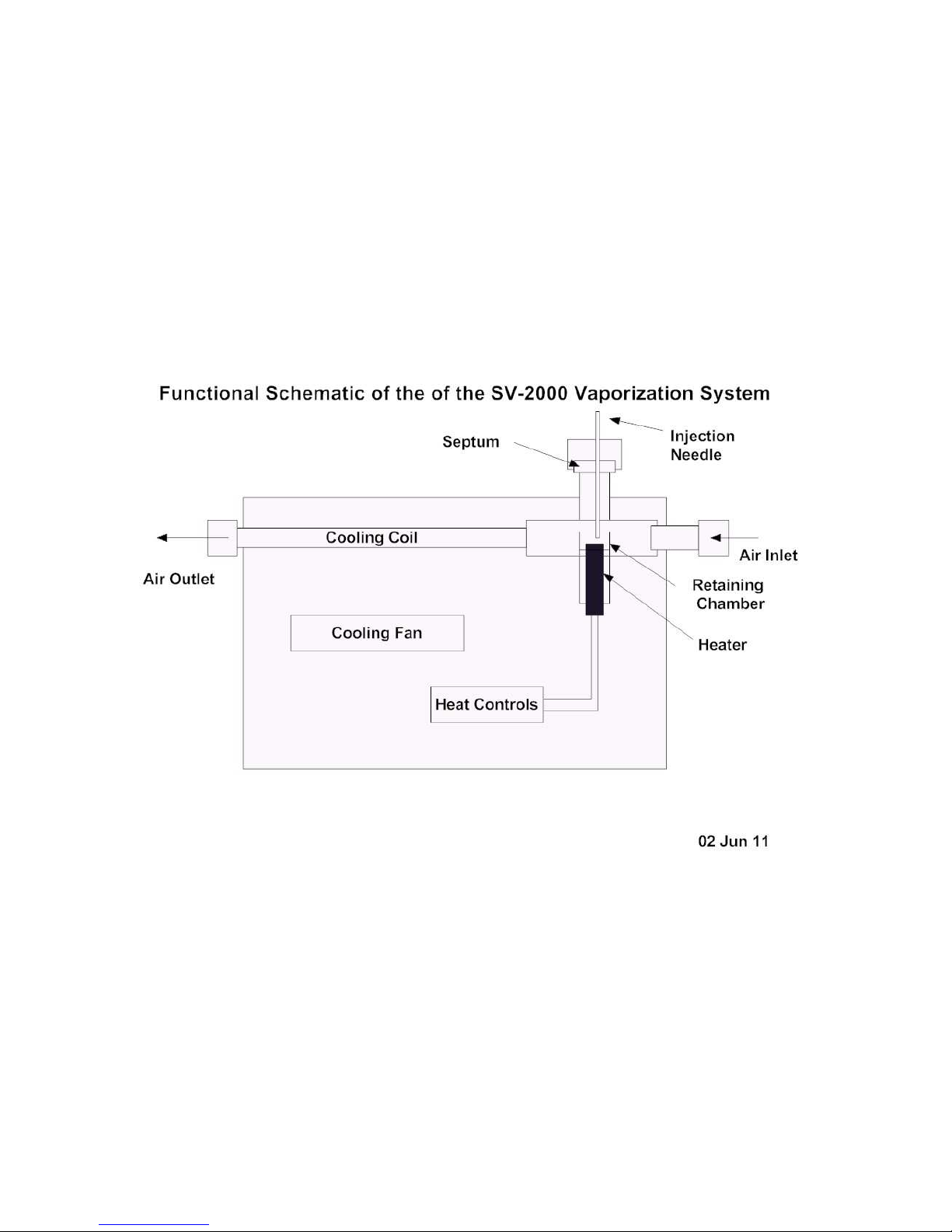
1. Set vaporizer on the bench and connect a flowing air supply (e.g. MNR HCS-401)
to the air INLET connection.
2. Establish the desired flow rate and relative humidity from the flowing air supply.
3. Turn on the vaporizer and set the heater setting to the desired level. DO NOT
TURN ON THE VAPORIZER UNLESS AIR IS FLOWING THROUGH THE
SYSTEM. The heater setting should be just enough to completely evaporate the
liquid. Too much heat could decompose the liquid.
4. Fill an appropriate sized syringe with the solvent of interest. Connect the syringe
to a length of PTFE tubing that terminates in a needle.
5. Pierce the septum on the INJECTION PORT with the needle and push until the
needle stops (about 2 ¼ inches).
6. Place the solvent-filled syringe into a syringe pump and adjust the heater setting
until a smooth outflow of vapor is established. If the output from the vaporizer is
irregular, the flow from the vaporizer may be passed through a mixing chamber
prior to use to obtain a more uniform mixture.
Rev June 2011
Page 3

Vaporization of Formaldehyde Solutions
Formaldehyde in air can be produced by injecting known concentrations of either
formalin or paraformaldehyde into an air stream and vaporizing.
1. Prepare the formaldehyde solution in the following way. If the presence of
methanol is not important, the easiest way is to dilute formalin (37% by weight
formaldehyde, 10-15% methanol) to the concentration of interest (see table 1).
TABLE 1
Formaldehyde Vapor Generation
Desired Air
Concentration
Liquid HCHO
Concentration Used
5 1
10 2
100 10-15
2. If the presence of methanol is a problem, make the formaldehyde from
paraformaldehyde. Weigh out 25 grams of solid paraformaldehyde and add to
220 ml of water in a volumetric flask. Place an inverted 100 ml beaker over the
top of the flask and heat to 80OC while stirring with a magnetic stirrer. Heat until
the solution clarifies (usually about 2-6 hours). Remove the magnetic stirrer and
dilute to mark with distilled water. The resulting solution should be about 10%
(100 mg/ml) formaldehyde. If in doubt, the concentration may be checked using
the Chromotropic acid technique or titrating with 0.1 M HCL (Anal.Chem.53,
2118 (1981)).
3. Set up the formaldehyde generator in the following way. Attach the air supply
(clean dry air or air from a Miller-Nelson Research HCS-401 series humidity
control system) to the INLET of the vaporizer. Set the air flow to the desired
level. If the air flow is greater than 20 lpm, set the vaporizer to 100%.
4. Attach the needle to the syringe using the Teflon tubing provided. Fill the syringe
with the formaldehyde solution. The concentration can be calculated from C =
24.5 qdX/QM.
5. Place the needle into the INJECTION PORT and push in until needle stops. The
needle tip must be in direct contact with the heater.
6. Attach the OUTLET of the vaporizer to an infrared analyzer to monitor the
formaldehyde concentration produced (3.58 microns). If the concentration is
irregular, reposition the injection needle. A mixing chamber may be used to
smooth irregularities.
Page 4
Page 5
 Loading...